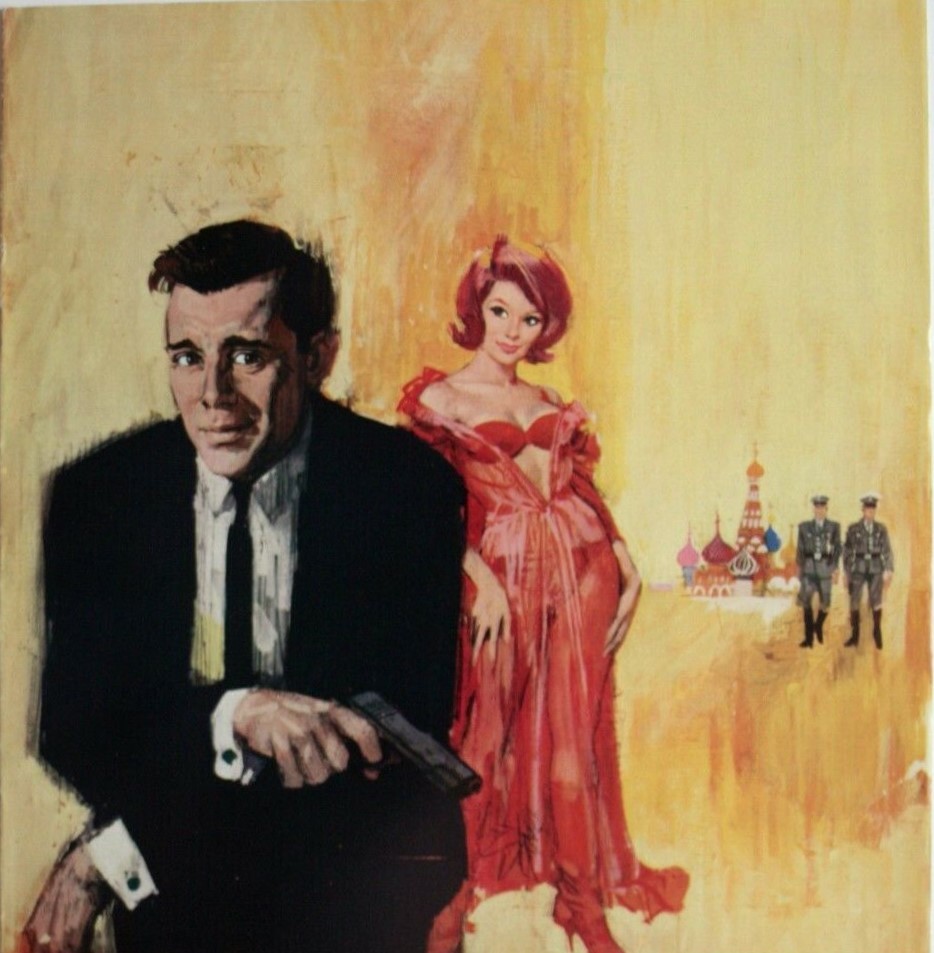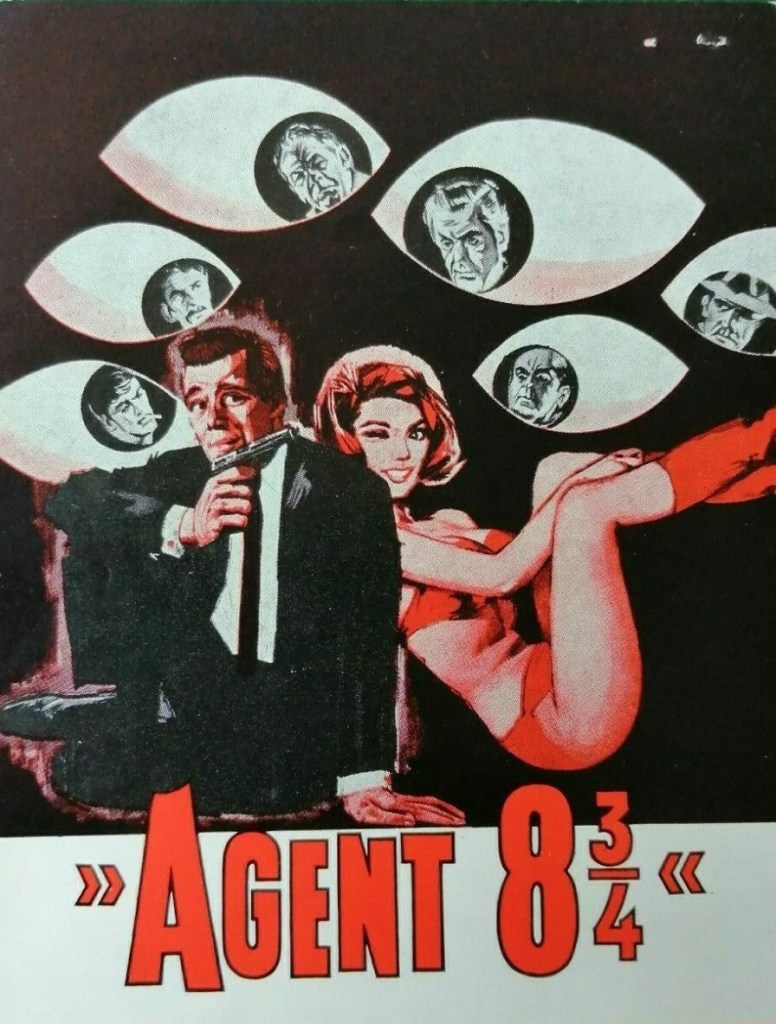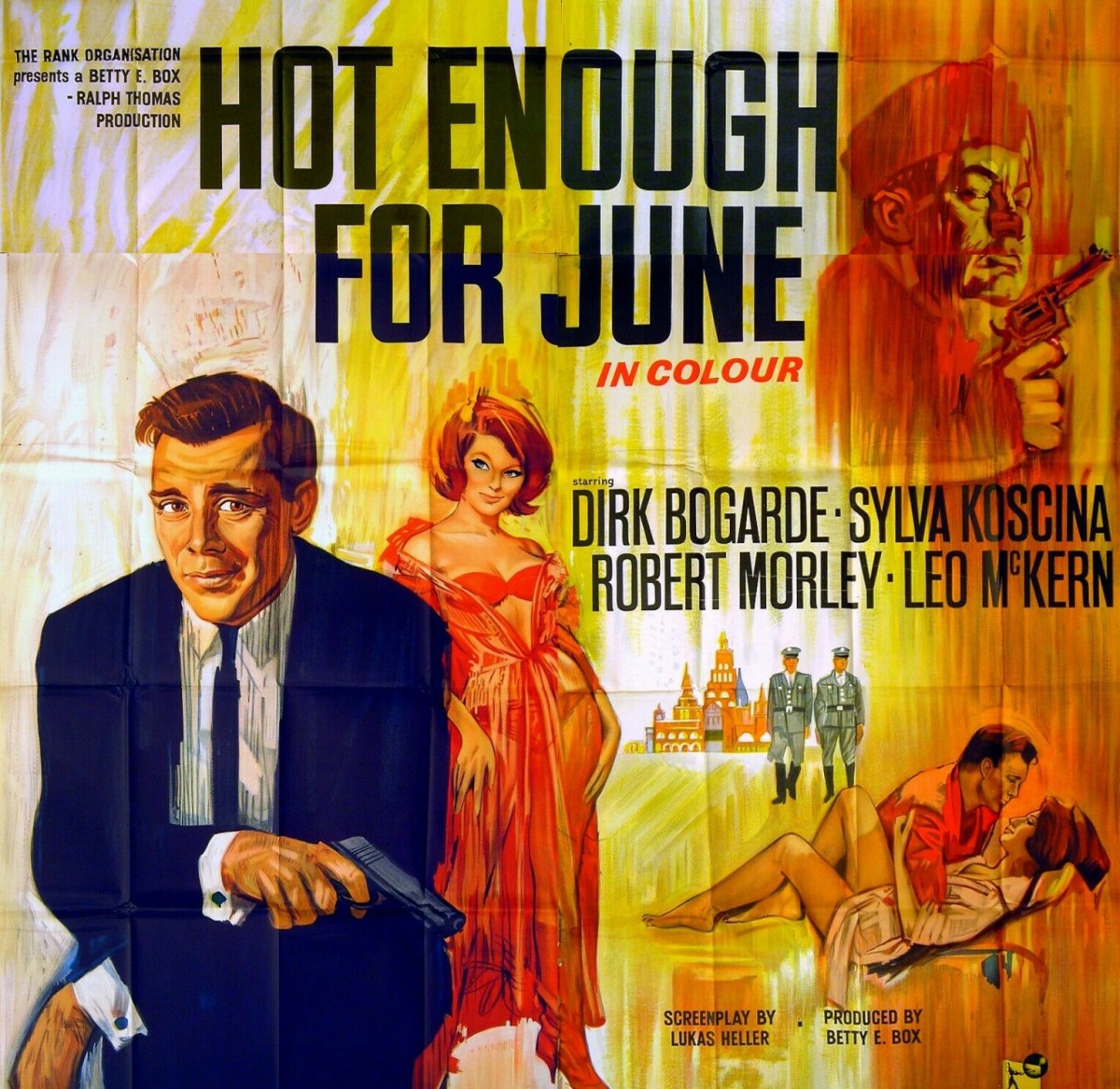
Hot Enough for June / Agent 8 3/4 (1964) ***

Thanks to his language skills unemployed wannabe writer Nicholas (Dirk Bogarde) is recruited as a trainee executive on a too-good-to-be-true job visiting a Czech glass factory  only to discover that while engaged on what appears a harmless piece of industrial espionage is in fact considerably more serious.  Complications arise when he falls in love with his chauffeur Vlasta (Sylva Koscina) whose father, Simenova (Leo McKern), is head of the Czech secret police.

Eventually, it dawns on Nicholas that he is in the employ of the British secret service headed by Colonel Cunliffe (Robert Morley). Soon he is on the run. Adopting a variety of disguises including waiter, Bavarian villager and milkman, he evades capture and makes a pact with Vlasta that neither of them will participate in espionage activities.
A chunk of the comedy arises from misunderstandings, Iron Curtain paranoia, the destruction of indestructible glass, password complications, Nicholas’s contact turning out to be a washroom attendant, and from the essentially indolent Nicholas being forced into uncharacteristic action. Soon he is adopting the kind of ruses a secret agent would invent to outwit the opposition, including burning the hand of a man with his cigarette and stealing a milk cart.

The romance is believable enough and Vlasta has the cunning to shake off the secret agent shadowing her, although the ending is unbelievable and might have been stolen from a completely different soppy picture. Although Nicholas is clearly in harm’s way several times that is somewhat undercut by the espionage at a higher level being presented as a gentleman’s game.

There are unnecessary nods to 007 and the kind of gadgets essential to Bond films, although none come Nicholas’s way. But these attempts to modernise what is otherwise an old-fashioned comedy largely fail. Taking a middle ground in comedy rarely works. You have to go for laughs rather than plod around hoping they will miraculously appear. And in fact the comedy is redundant in a plot – innocent caught up in nefarious world – that has sufficient story and interesting enough characters to work.
That the movie is in any way a success owes everything to the casting. Dirk Bogarde, though well into his 40s, still can carry off a character more than a decade younger. He can turn on the diffidence with the flicker of an eyelash. And yet can call on inner strength if required. He is the ideal foil for light comedy, having made his bones in Doctor in the House (1954), reprising the character for Doctor in Distress (1963) and dipped in and out of serious drama such as Victim (1961) and the acclaimed The Servant (1964), released just before this.

In some respects it seems as if two different pictures are passing each other in the night. The Bogarde section, excepting some comedy of misfortune, is played for real while in the background is a bit of a spoof on the espionage drama.

Sylva Koscina (The Secret War of Harry Frigg, 1968) is excellent as the beauty who betrays her country for love. Robert Morley (Topkapi, 1964) and Leo McKern (Assignment K, 1968), although in on the joke, are nonetheless convincing as the secret service bosses.  Look out for a host of lesser names in bit parts including Roger Delgado (The Running Man, 1963), Noel Harrison (The Girl from U.N.C.L.E. 1966-1967), Richard Pasco (The Gorgon, 1964) and stars of long-running British television comedies John Le Mesurier, Derek Fowlds and Derek Nimmo.  

This was the eighth partnership between director Ralph Thomas and Dirk Bogarde, four in the Doctor series but also three serious dramas in Campbell’s Kingdom (1957), A Tale of Two Cities (1958) and The Wind Cannot Read (1958). In themselves the comedies and the dramas were successful, but mixing the two, as here, less so. Written by Lukas Heller (Flight of the Phoenix, 1965) from the bestseller by Lionel Davidson.

American distributors were less keen on this picture and it was heavily cut for U.S. release and retitled Agent 8¾ presumably in an effort to cash in on the James Bond phenomenon. I’ve no idea what was lost – or perhaps what was gained – by the editing.

The end result of the original version is a pleasant enough diversion but not enough of the one and not enough of the other to really stick in the mind. 

Should you be interested in how the book was translated into the film, there’s another article here covering that. Link below.

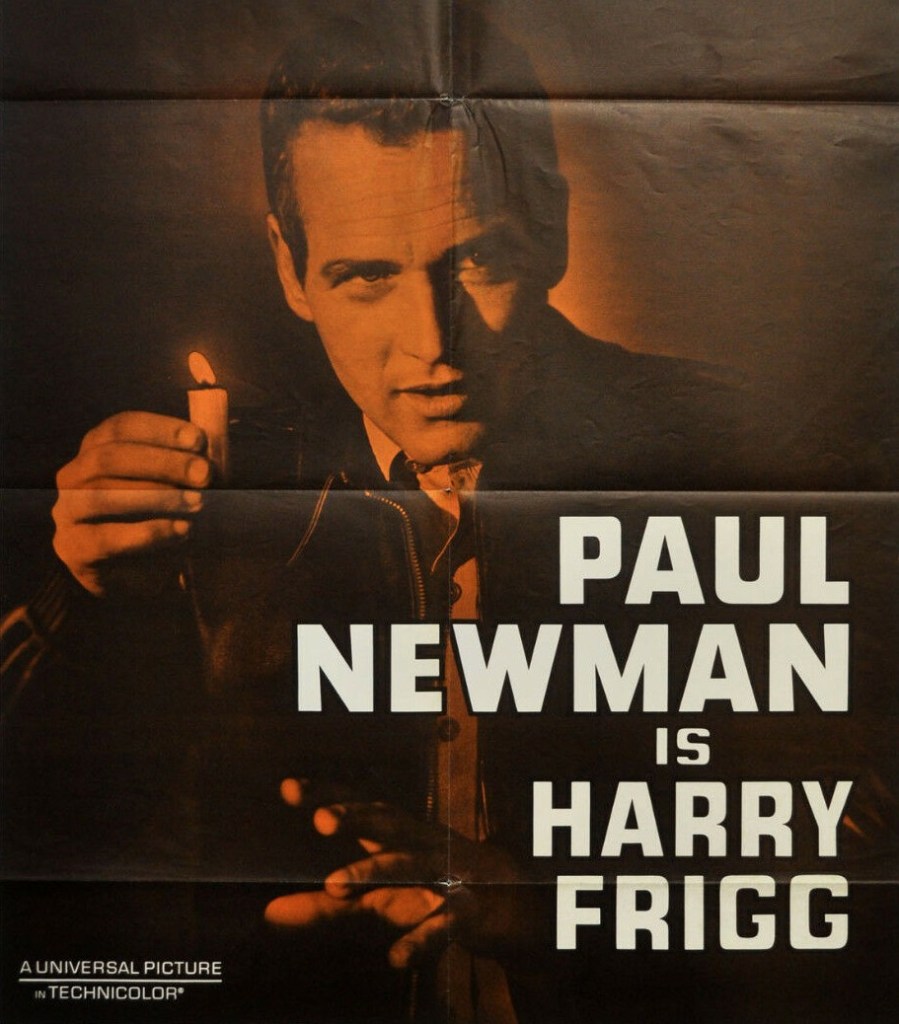
The Secret War of Harry Frigg (1968) ***

Except for an ingenious escape attempt and Paul Newman spoofing his Cool Hand Luke (1967) persona, this World War Two POW number falls into the “sounded like a good idea at the time” category. Harry Frigg (Newman), the American army’s most notorious escapee (though from British military prisons), is promoted from buck private to two-star general and parachuted into northern Italy to organize a breakout of five one-star generals.

The premise that the war effort is hampered by embarrassment at the generals being captured seems far-fetched as is the notion that the quintet are hopelessly incompetent when it comes to doing anything that sounds like proper army stuff. Adding another offbeat element is that they are being held in effectively a deluxe POW camp, an ancient castle run by Colonel Ferrucci (Vito Scotti), a former Ritz hotel manager with a lapdog attitude to the rich and powerful.

Almost immediately Frigg discovers an escape route through a secret door but is disinclined to go any further since it leads into the boudoir of the Countess Francesca (Sylva Koscina). New Jersey inhabitant Frigg feels out of the place with the high-falutin’ generals and proceeds to get himself a cultural education. Meanwhile, the countess, obtaining her position through marriage rather than birth, trying to bolster his confidence naturally triggers his romantic impulses.

The humor is of the gentlest kind – Frigg taking advantage of his superiority, Italians speaking tortured English – and not much in the way of bellylaffs either. Director Jack Smight, who collaborated so well with Newman in Harper (1966) and manages to achieve a tricky balance in No Way to Treat a Lady (1968), loses his way here, not least structurally, as the movie pingpongs between the generals, the commandant and Frigg and, thematically, issues of power. Crucially, he fails to rein in Newman.

The generals, squabbling among themselves for power, would be caricatures except that their characters are rounded out by the players, Charles Gray (The Devil Rides Out, 1968) as Cox-Roberts and Tom Bosley (Divorce American Style, 1967) as Pennypacker. The other generals are played by Andrew Duggan (Seven Days in May, 1964), John Williams (Harlow, 1965) and Jacques Roux (The List of Adrian Messenger, 1963). Representing the American top brass in England are James Gregory (a repeat role in the Matt Helm series) and Norman Fell (The Graduate, 1967)

After her excellent turn as a mischievous and vengeful villain in Deadlier than the Male (1967), Yugoslavian Sylva Koscina comes down to earth with a less rewarding role as charming leading lady with a sly sense of humor rather than the femme fatale of A Lovely Way to Die (1968). Werner Peters (The Corrupt Ones / The Peking Medallion, 1968) makes a late appearance as a Nazi and you might spot screenwriter Buck Henry (The Graduate) in a bit part.

The screenplay by Peter Stone (Arabesque, 1966) and Oscar-winner Frank Tarloff (Father Goose, 1968) is an odd mixture of occasional sharp dialog and labored story. The set-up takes too long and you keep on wondering when it is going to get to the pay-off.

No doubt looking for some light relief after a quartet of heavier dramatic roles – Harper (1966), Torn Curtain (1966), Hombre (1967) and Harper (1967) – Newman acts like he has escaped the straitjacket of a considered performance and instead indulges in mugging and hamming it up, his body freeing a barrage of mannerisms previously held in check.

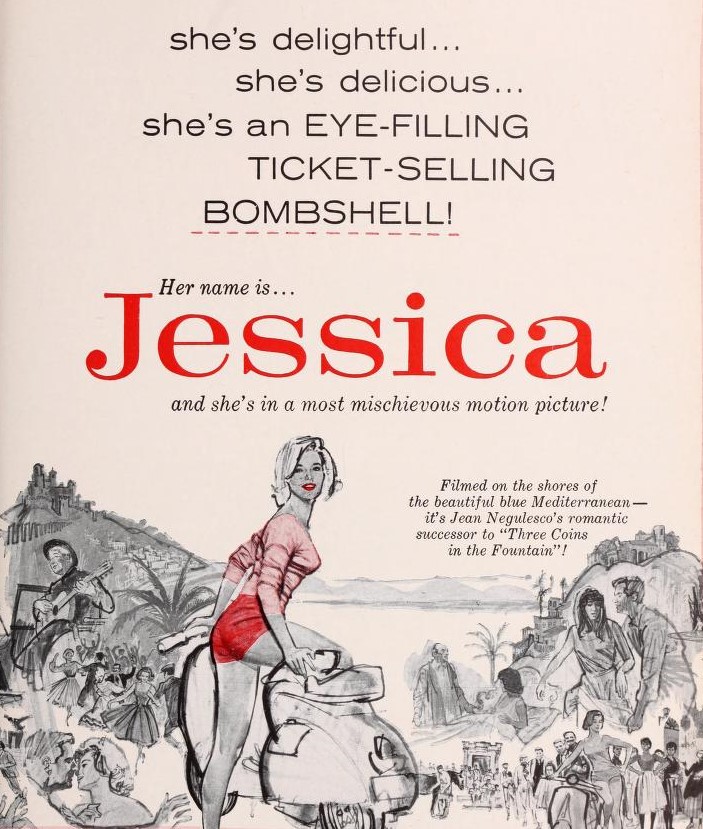
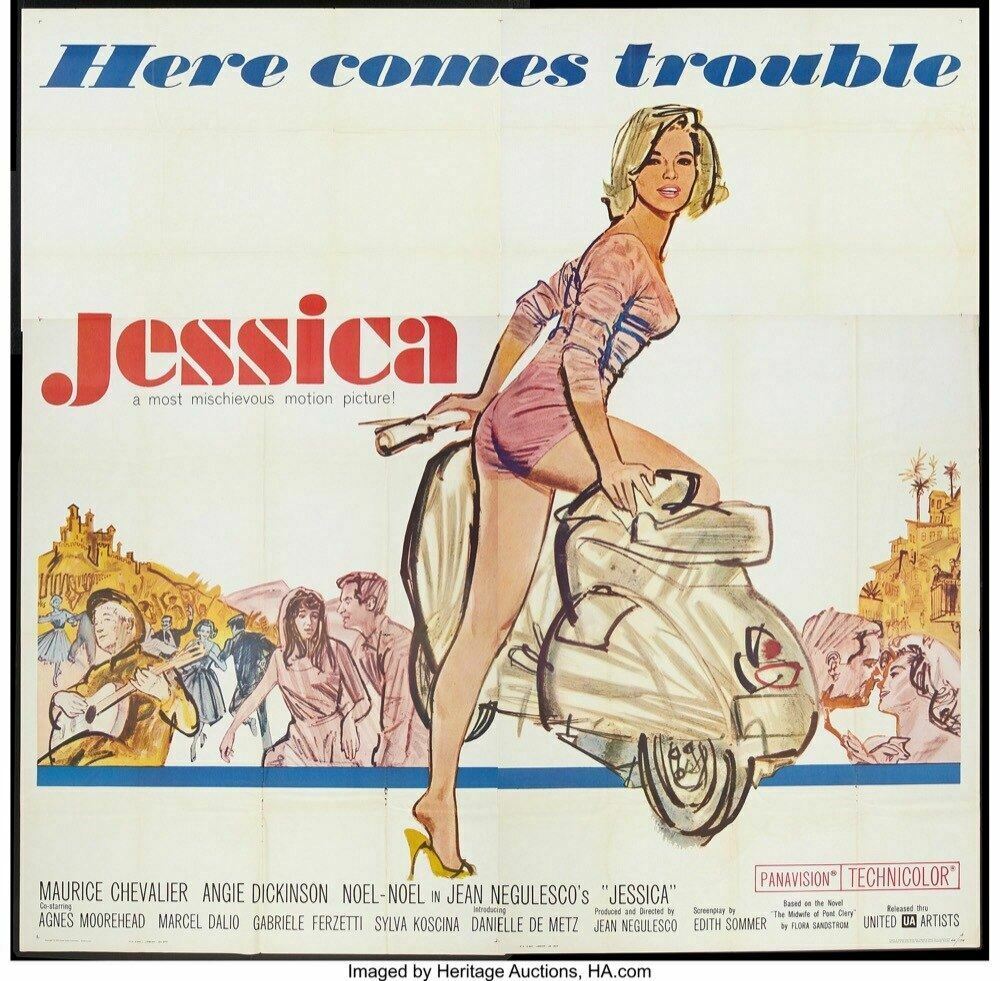
Jessica (1962) ***

Roman Holiday (1953), Three Coins in a Fountain (1956) and Boy on a Dolphin (1956) had set a high bar for Hollywood romances set in Italy. Since Jean Negulesco had directed the last two, he was expected to sprinkle box office magic on this slight tale of young American midwife Jessica Brown Visconti (Angie Dickinson) adrift in a rustic village in Sicily.

She’s the kind of beauty who’s going to raise male temperatures except Jessica, having been widowed on her wedding day, is not romantically inclined. Unfortunately, that doesn’t stop the entire male population becoming so entranced that their wives become so enraged that led by Maria (Agnes Moorehead) they embark on a sex strike, assuming that without any pregnancies (contraception being frowned upon in a Catholic domain) to deal with Jessica will become redundant and go away. And that so annoys Jessica, who is doing a good job as a midwife, that she turns on the flirting to get back at her female tormentors. Luckily, there’s a reclusive landowner (Gabriele Ferzetti) who happens to be a widower, although romance takes a while to stir. There’s also a priest (Maurice Chevalier), in part acting as narrator, who turns to song every now and then.

So it’s a surprise that this unlikely concoction works at all. It’s charming in the obvious ways, the lush scenery, a traditional wedding, gentle comedy. But it’s a decade too late in taking an innocent view of sex. There’s no crudeness, of course; it doesn’t fall victim to the 1960s  need to sexualize in an obvious manner. And not every husband is continuously ogling Jessica so Nunzia (Sylva Koscina) and young bride Nicolina (Danielle De Metz) are in the awkward situation of potentially betraying the sisterhood.

But in resolving the central issue the story develops too many subplots and introduces too many characters, often leaving Jessica rather redundant in terms of the plot, with not much to do, especially when her prospective suitor is absent for a long period going fishing.

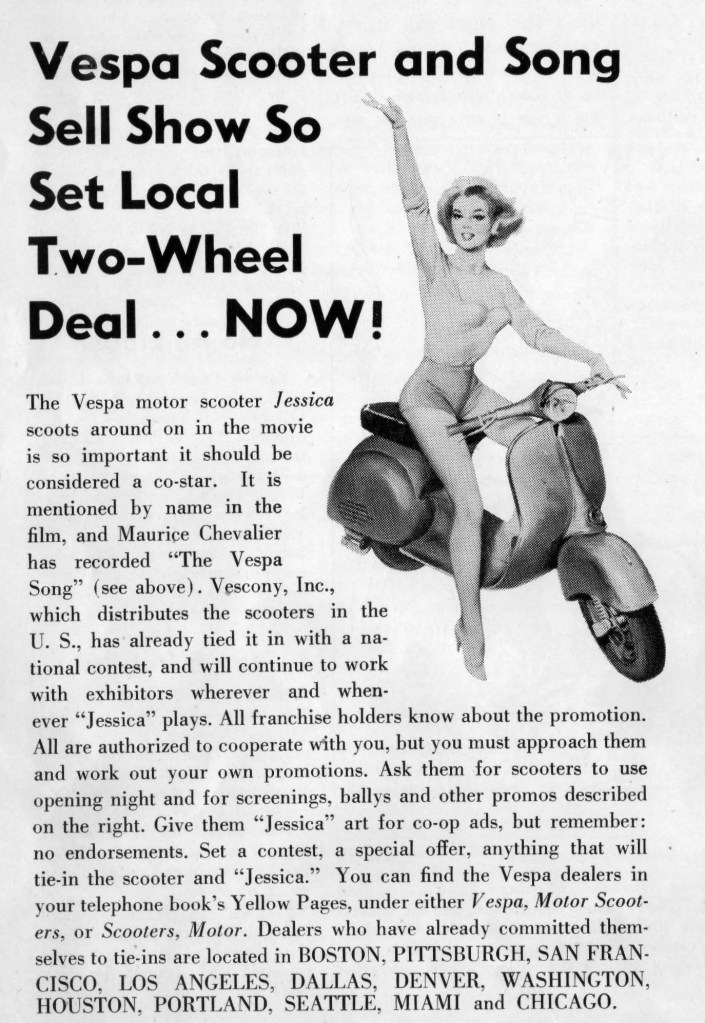
Angie Dickinson is delightful as the Vespa-riding innocent turned mischievous. However, in some way though this seemed a backward step for Dickinson, a rising star in the Lana Turner/Elizabeth Taylor mold after being John Wayne’s squeeze in Rio Bravo (1959) and Frank Sinatra’s estranged wife in Ocean’s Eleven (1960) and after a meaty supporting role in A Fever in the Blood (1961)  elevated to top billing in The Sins of Rachel Cade (1961). It seemed like Hollywood could not make up its mind whether it wanted her to be like Gidget or be given free rein to express her sexuality.

A charmer like Maurice Chevalier (A Breath of Scandal, 1960) was ideal for what was in effect a whimsical part. The singing probably met audience expectation. Perhaps like Sean Connery’s perennial Scottish accent, nobody ever asked Chevalier to drop his pronounced French accent even to play an Italian. But the picture is whimsical enough without him.

There’s a surprisingly strong supporting cast in four-time Oscar nominee Agnes Moorehead (Pollyanna, 1960), Gabriele Ferzetti (Once Upon a Time in the West, 1969) and French actor (and sometime writer-director) Noel-Noel. Yugoslavian Sylva Koscina (Deadlier Than the Male, 1967), Frenchwoman Kerima (Outcast of the Islands, 1951) and Danielle De Metz (The Scorpio Letters, 1967) all make a splash. Screenplay by Edith Sommer (This Property Is Condemned, 1966) from the bestseller by Flora Sandstrom.

Terrific turn from Angie Dickinson.

Deadlier than the Male (1967) ****

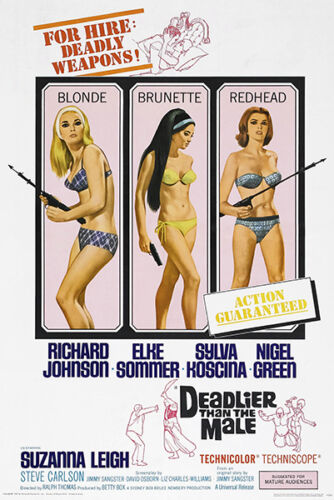
For a movie intended to set up a series character in the vein of James Bond, it was ironic that it was the women who stole the show, not just from their tendency to turn up in bikinis but for their outrageous villainy. Irma (Elke Sommer) and Penelope (Sylva Koscina) are the seductive assassins in the hire of Carl Petersen (Nigel Green) who has designs on an Arab oil empire. On her own Irma dispatches mogul Henry Keller (Dervis Ward) then the pair – emerging from the sea like a pair of latter-day Ursula Andresses – harpoon his colleague Wyngarde (John Stone).  

Soon Hugh Drummond (Richard Johnson), investigating the death of Stone, becomes a target  and that sets him off, with nephew Robert (Steve Carlson) in tow,  to the Mediterranean and the yacht of oil-rich King Fedra (Zia Mohyeddin) where, of course, the girls lie in wait.

Dispensing with the gadgets – except for one item employed by the villainesses – and gimmicks of Bond, but retaining the quips, this is a fun ride with a more down-to-earth leading man – like the early Bonds – smarter girls, a more old-fashioned mystery, hefty thug Chang (Milton Reid)  in the Oddjob mold, a castle doubling as the villain’s lair, a suave master criminal, some detective work, and a super scene involving giant robotic chess men.

The bickering between Irma and Penelope, not just a tad sadistic but a kleptomaniac especially as far as her partner is concerned, coupled with their overweening confidence, makes them much more human than any Bond Girl and the character traits explored have a pay-off at the climax. Equally interesting are the mind games, Drummond vs. Peterson but also Drummond vs. Irma. And that the female baddies see it as points on their scoreboard to seduce Drummond rather than the other way round.

Drummond is every bit as capable a seducer as Bond and equally ruthless, stripping one suspect naked. Petersen is also a clever character, faking his own death and running a very smooth operation, and certainly his recruitment techniques are second to none.

Some ideas were certainly ahead of their time, the chess men are the equivalent of a modern computer game while the human bomb has, unfortunately, entered the modern lexicon and there are enough female serial killers around to prevent anyone believing they are always (to use a sexist phrase) the gentle sex. However, in the middle 1960s, the concept that women would be partial to murder and torture not to mention repeatedly seducing males went so much against the grain of the male authority figures that the British censor slapped an X-certificate on the movie.

Shakespearian actor Richard Johnson was at one time an MGM contract player, but his only previous top-billed outing was the Italian-made The Witch (1966) but he certainly made a splash with this character, investing it with a great deal more gravitas than Derek Flint or Matt Helm. The Teutonic Elke Sommer (The Venetian Affair, 1966) is brilliant as one half of the assassin tag-team with a batch of one-liners for every occasion. Sylva Koscina (A Lovely Way To Die, 1968), nose always put out of joint, almost steals the show.  Nigel Green (Tobruk, 1967), while his usual sardonic self, has the playfulness of the rich and powerful.

Steve Carlsen, in his movie debut, doesn’t make much of an impact in a largely lame role. Zia Mohyeddin has a more interesting role as the oil kingpin wanting to help his people. As you can expect in a spy picture there are a host of beautiful women – Suzanna Leigh (The Lost Continent, 1968) a defector, Virginia North, also making her debut, Justine Lord (Night after Night after Night, 1969), and Didi Sydow in her only screen appearance.

The light comedy experience of director Ralph Thomas (Doctor in Distress, 1963) comes in very handy, as his sense of comic timing is excellent, but, perhaps learning from his previous brush with espionage in Hot Enough for June / Agent 8¾ (1964) brings a bigger punch to the action scenes. And it’s a bold ploy to start with an action sequence revolving around Irma and Penelope rather than our star man.

The screenplay was a team effort – Jimmy Sangster (The Devil-Ship Pirates, 1964), taking a break from Hammer duties, David D. Osborn (Maroc 7, 1967) and Liz Charles-Williams, making her screen debut  – all involved.  This was familiar territory for composer Malcolm Lockyer (Five Golden Men, 1967). British pop act The Walker Brothers had a hit with the theme tune.

This is more fun than camp, not a send-up of the genre like Derek Flint and Matt Helm, but a spy picture with a believable leading men and excellent villains. But the plot is more centered on filthy lucre rather than global control and there is a genuine understanding of how businesses work – takeovers, mergers, dirty dealings – though small wonder Petersen would like to be shot of pedantic boardroom nuisances like Bridgenorth (Leonard Rossiter) – wouldn’t we all?

Bulldog Drummond was an international crime-buster invented by “Sapper,” the pen-name of H.C. McNeile. Bulldog Drummond had been a Hollywood mainstay for over four decades, the twenty-plus pictures attracting stars like Ronald Colman (Bulldog Drummond, 1929, and Bulldog Drummond Strikes Back, 1934), Ray Milland (Bulldog Drummond Escapes, 1937), Walter Pidgeon (Calling Bulldog Drummond, 1951) and a young Ralph Richardson (The Return of Bulldog Drummond, 1934). But the notion, in the Swinging Sixties, of tagging any leading man by the moniker of ‘Bulldog’ did not seem like a good idea, so the character underwent wholesale reinvention, and his nickname is never mentioned. 

The title comes from a line in a poem by Rudyard Kipling, The Female of the Species. That was the original title of the film and also of a Sapper book.

Hornets Nest (1970) ****

Given exceedingly short shrift in its day. Viewed as in exceptionally poor taste. Marketed in some respects as Lord of the Flies Meets The Dirty Dozen. Audiences accepting of kids putting on a show or, the modern equivalent, making a movie, not so keen on youngsters going to war. In any case there’s an inbuilt repugnance as you get the distinct impression some of these kids would have been ideal recruits for Hitler Youth or the Mussolini version.  And Italy, one-time ally of Hitler, becoming suddenly heroic seemed to jibe. Not to mention Rock Hudson’s marquee value fading fast after a gigantic turkey called Darling Lili (1969). Despite some distinctly unsavory aspects, bordering on exploitation, this seems enormously underrated, not just as an actioner, but for a raw depiction of war, far more realistic than many in the genre that toplined on violence.

Sure, it’s an odd concept, Italian kids, in the absence of adults, turned into a fighting force by dint of letting loose their innate venality and savagery. But they’ve not been washed up, adult-free, on a desert island. This small bunch have been orphaned and bloodily. Germans on the hunt for local partisans execute an entire village and then, finding a quisling, proceed to massacre the local resistance and for good measure destroy a team of American parachutists dropped into the area to facilitate the Allied advance.

The kids come across the one survivor, Turner (Rock Hudson), hide him from the enemy and dupe German doctor Bianca (Sylva Koscina), sympathetic to the plight of the innocent, into caring for the wounded soldier. Rather than hang around and accept the ministrations of such a beauty and see out the war with a view to possible romance, Turner is intent on single-handedly completing his mission of blowing up a dam.

Given the kids have amassed a secret armory and are trigger-happy, desperate to avenge their parents, and getting down to the gung-ho aspects of war, Turner, with appalling disregard for their safety, decides to commandeer them for his own unit. Bianca objects and watches with horror and for most of the rest of the picture confines herself to the pair too young to be considered combatants and who reek of desolation or to find ways of killing Turner or betraying him to the Germans.

Meanwhile, the kids have their own ruthless leader, Aldo (Mark Colleano), one part John Wayne, one part the creepy Maggott (Telly Savalas in case you’ve forgotten) from The Dirty Dozen, who objects to taking orders. Training consists of little more than a bit of marching in file and learning how to quickly reload a machine gun. Turner’s clever plan is to use their perceived innocence to distract the Germans guarding the dam. The distraught Bianca, stepping out of line once too often, is raped for her trouble.

Oddly enough, Koscina does take a machine gun to the Germans, which you would have thought would be catnip to the marketeers, but that image is excluded from the poster.

Setting aside all audience misgivings about the premise and the sexual undertones, the mission is very well done, plenty tension, a workable plan, and the eventual dam-burst impressive on the budget.

But the misgivings are not glossed over. There’s a dicey moment when it looks as if the kids, crawling all over the nurse, tearing off her clothes, are about to embark on mass juvenile rape. And the bloodlust will only be slaked when, by dint of secreting the detonators essential to the plan, they force Turner to lead them on a raid on the Germans, tossing hand grenades into houses and opening fire from the back of a truck on the unsuspecting enemy.

Aldo, in particular, gets a taste for killing and in a later battle doesn’t hold back when one of his comrades inadvertently gets in his way.

Sold as a junior edition of a mission picture, the trailer would have probably been enough to put off large sections of the audience, uncomfortable with kids being employed in such mercenary fashion. Kids grow up in war but not that fast seemed to be the general reaction. Okay if they’re portrayed as victims, less acceptable as gun-happy butchers.

So, the best elements of the movie is in not avoiding such misgivings. It was soon clear from the American experience – though this is not specifically alluded to – that hordes of kids in Vietnam were going down this route. The point at which kids cross over into bloody adulthood and lose the essence of childhood is dealt with too. That scene on the face of it and in isolation appears maudlin but in the context of the picture works very well. But the violence or its aftermath are not the most striking images. Again and again, the camera returns to the dirty, clothes-tattered, Bianca clutching the two infants, the detritus of conflict.

Setting aside his moustachioed muscle, Rock Hudson (Seconds, 1966) gives a well-judged performance and Sylva Koscina (A Lovely Way To Die, 1968), shorn of glamor, holds the emotional center. Mark Colleano (The Boys of Paul St, 1968) gives a vicious impression of a young hood on the rise. Directed by sometime cult director Phil Karlson (A Time for Killing, 1967) from a script by S.S. Schweitzer (Change of Habit, 1969) and producer Stanley Colbert. Great score from Ennio Morricone.

It’s worth pointing out that the idea of kids taking up arms received positive critical approval when it was applied to such an arthouse darling as If… (1969) but of course they were public schoolboys forced into action by bad teachers and in reaction to “the establishment” and not after seeing their families slaughtered. Double standards, methinks.

Worth reassessment.

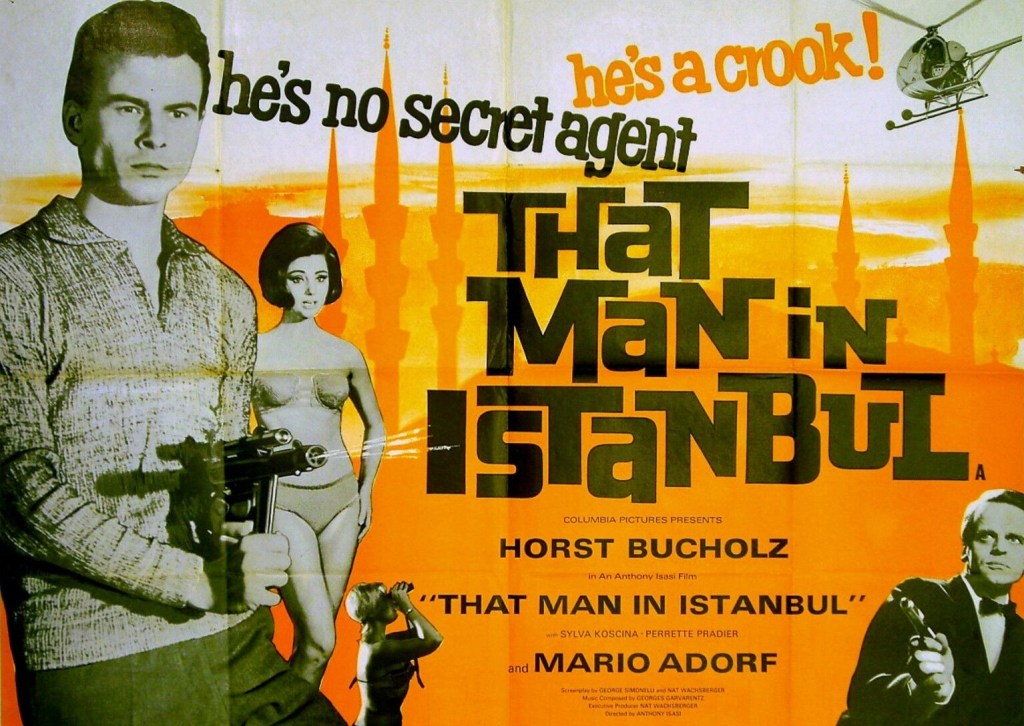
That Man in Istanbul / Istanbul 65 (1965) ****

Action-packed superior James Bond rip-off belonging to the Eurospy subgenre and elevated by memorable lines, wit and visual imagination. So if you recall any movie where ricochets play havoc in a room, this is where it originated. Flying through a window on a rope and then crashing through a series of rooms and not stopping, ditto. That famous line uttered by Johnny Depp in Pirates of the Carribean (2003) about “the marchandise,” yep, you’ve guessed it. Although it did steal a nice touch from Robin and the 7 Hoods (1964), the one where an illegal drinking den (illegal casino here) is remarkably transformed.

And all the promise star Horst Buchholz showed in The Magnificent Seven (1960) and kept stowed away all these years, that’s back in spades. Chases, fistfights, shootouts, saloon (well, casino, actually) brawl, competing ruffians, safe-cracking, hitmen, infiltration of secret hideout, a pair of femme fatales and the inevitable atomic scientist.

Some clever thugs including Schenk (Klaus Kinski) dupe the U.S. government out of a million bucks by only pretending to hand over a missing scientist, instead pocketing the cash and blowing up a plane with him on board. With for the time suprising use of forensics, the CIA determines the man killed in the plane wasn’t the missing scientist and work out that he might well be getting sold on to China.

Camera footage taken of the plane crash scene points to mysterious underworld figure Tony (Horst Buccholz). Against her superior’s wishes, agent Kelly (Sylva Koscina) heads off to the titular city in pursuit, tracks down Tony with no great difficulty to his illegal gambling den just in time to witness the electronic miracle of the roulette wheels disappearing into the floor when the cops turn up. The electronic scam would have worked except for a drunken customer who demands his chips be cashed and the only way to silence him being for Tony to slug him and trigger a brawl.

Under the cover of which, Kelly sneaks into Tony’s office whereupon finding no evidence of either a million bucks or a missing scientist, she asks for a job. “Strip!” he demands. But that’s not for licentious reasons it transpires, but to examine the labels on her clothing, from which he and his henchmen deduce (I won’t bore you with the details but they do match up) she’s a plant.

However, she is the one, accidentally, to trip over the Chinese conspiracy, in, of all places, a cemetery. Eventually, she persuades Tony to help her out, although that’s for financial rather than patriotic reasons. She’s got a few tricks of her own up her sleeve, and under the guise of kissing him, steals his keys.

Kelly kind of fades in and out of the picture – which is a shame because she’s good value in a feisty seductive clever way – while all the chasing of opposing sets of criminals is down to Tony. First target being the man with the steel hand (though not the steel claw that in the old British comic The Valiant allowed him to become invisible).

The non-Chinese criminals are as likely to kill their own men to stop them coughing up. But mostly, Tony and his gang are stalking the two sets of criminals, Kelly mostly waiting in a car or popping up to ask questions, with Tony being driven off a mountainside, thrown off a tower, duelling underwater and avoiding a scalding in a sauna. But we’re talking the Houdini of spies and none better than when escape involves commandeering a bulldozer and ramping up over a bunch of vehicles (that idea’s got to have appeared in a later film, too).

Kelly’s the good kind of femme fatale, the spy who has to use her wiles to snare the bad (or badd-ish) guy. But she’s a rookie compared to Elizabeth  (Perette Pradier) who leads Tony a merry dance by first of all pretending to be a victim.

But there’s style by the bucket load, clever reversals by the ton. There’s a marvellous scene where Tony knocks out a guy and then with nowhere to hide him props him up at a piano only to be undone when the fella slides over and hits the piano keys. Ever seen someone use the rolling coin distracting device. Or when the rope between two stanchions snaps mid-air casually sliding down the broken end. Or sex indicated by one person hanging their bathrobe over a door after the other person has done the same. Or the hero doing up a bikini top instead of undoing it. And a leading man who spends more time in a state of undress than any of the females. And, for good measure, a couple of times, and this very much  in the contemproary idiom, breaking the fourth wall.

Once we get going it’s the kind of non-stop action we later equated with Taken (2008) or John Wick (2014). Horst Buchholz was never better, a brilliant light touch with the lines and good deal tougher with the fists. Sylva Koscina (A Lovely Way To Die, 1968) has less to do than you’d like once the rival femme fatale appears but she shows just how capable an actress she is in displaying in non-verbal fashion and in a three-shot of all things her jealousy.

If you’re familiar with Spanish director Antonio  Isasi-Isasmendi from They Came to Rob Las Vegas (1968) stick that to one side because this is way better. Screenplay by Giovanni Simonelli (Django Shoots First, 1966), Nat Wachsberger (Starcrash, 1978) and Luis Josep Comeron (They Came to Rob Las Vegas).

Great treat.

A Lovely Way To Go / A Lovely Way To Die (1968) ****

Woefully neglected detective thriller with a sparkling script and sexy leading stars exuding screen charisma. Like the celebrated William Goldman-scripted opening to Paul Newman private eye picture Harper (1966), the credit sequence here is at least as innovative in that it appears to be little short of a trailer, a highlights reel showing the audience what lies in store.

Schuyler (Kirk Douglas) is a womanizing cop too handy with his fists, half his arrests making an unexpected detour to hospital. Rena (Sylva Koscina) is the bored young wife of an older millionaire whose idea of fun is to chuck an expensive scarf out of a speeding car forcing her husband to pull up and go back and fetch. When her husband is shot, suspicion falls on Rena, inclined  to dress in revealing outfits for the media, and her playboy boyfriend.

At the behest of attorney Fredericks (Eli Wallach) sporting a rich Southern accent and a with knack for speaking in parables, Schuyler, having resigned from the force one step ahead of being fired, is sent in to provide security and find out whether her alibi stacks up. He soon finds out it doesn’t but by this time he has fallen under her spell. Witnesses disappear, intruders are dealt with, attempts are made on the detective’s life, and the twists come thick and fast. Rena is the arch femme fatale who is a past master in the twisting department – twisting every male within a 50-mile radius round her little finger.

Harper was a throwback to The Maltese Falcon/The Big Sleep but A Lovely Way To Die knocks that shamus tradition on the head. For a start, Schuyler is a high-living high-rolling  character who doesn’t take prisoners. The second time we meet him he has dumped the girl he took to the races for someone he has met when picking up his winnings.  Seducing gorgeous women and dumping them is second nature. This is Douglas as a glorious charmer, a part of his screen persona lost after a glut of more serious pictures like Seven Days in May (1964) and Cast a Giant Shadow (1966). Yugoslavian actress Koscina, often little more than eye candy for most of the decade, had vaulted into the higher echelons after a turn as Paul Newman’s squeeze in The Secret War of Harry Frigg (1968).

An inherent part of the attraction of this picture is how deftly Rena keeps Schuyler at bay. Scriptwriter A. J. Russell (Stiletto, 1969) and director David Lowell Rich (Madame X, 1966) deliver the goods in maintaining the tension in their relationship. There is a wonderful scene where the expectant Schuyler follows her up the stairs of her fabulous mansion and three times he ignores the import of her unmistakable “Goodnight,” his uber-confidence taking him to her door – which she shuts in his face.  

Sure, in some ways it is slick, but it is also taut and realistic, Schuyler does not win all his fights and he eats with the rest of the help at the mansion. And he does some terrific detection so it doesn’t fall short in that department. He is definitely helped by some choice lines – “police methods are sometimes difficult for an amateur to understand” he tells Rena after he brutally deals with an intruder.

Koscina is in her element as the sexy, wealthy suspect, and especially in her banter with Douglas – her main aim to disarm his cockiness. Eli Wallach (The Moon-Spinners, 1964) is also superb, given just enough ham to hang himself, but matching Douglas in arrogance and outgunning the D.A. with his courtroom gymnastics. A couple of the subsidiary characters are well-drawn, a housekeeper who plays the markets.      

For some reason this sank like a stone on its initial outing, audiences perhaps being more attuned to the Bogart-style sleuth, but I found it highly enjoyable and this could be seen as a  taster for anyone familiar with the antics of the star’s son Michael Douglas who found himself in similar territory in Basic Instinct (1992).

Complex tale high on intrigue and sex, well worth a watch.

REVIEWED PREVIOUSLY IN THE BLOG: Kirk Douglas in Strangers When We Meet (1960), Lonely Are the Brave (1962), Two Weeks in Another Town (1962), For Love or Money (1963), Seven Days in May (1964), In Harm’s Way (1965), The Heroes of Telemark (1965), Cast a Giant Shadow (1966), Is Paris Burning? (1966), The Way West (1967), The Brotherhood (1968), The Arrangement (1969); Sylva Koscina in Jessica (1962), Hot Enough for June (1963), Deadlier than the Male (1967), The Secret War of Harry Frigg (1968); Eli Wallach in Seven Thieves (1960), The Misfits (1961), Act One (1963), The Moon-spinners (1964), Kisses for My President (1965), Lord Jim (1965), Genghis Khan (1965), How to Steal a Million (1966).

Book into Film – “Hot Enough for June”/ “Agent 8 3/4” (1964)

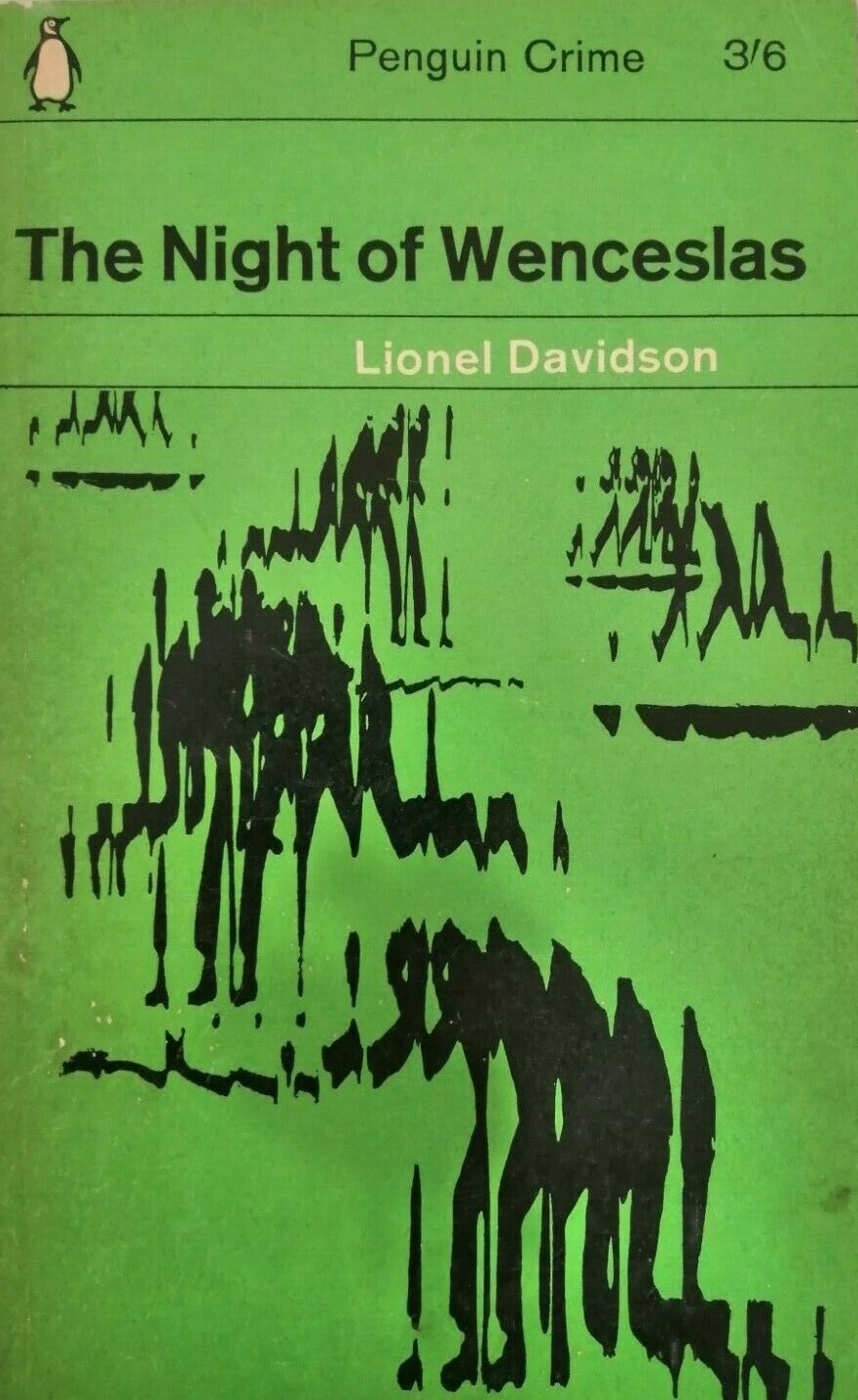
Timing is everything in the movie business. Had British film studio Rank shifted into top gear to adapt the best-selling thriller The Night of Wenceslas by Lionel Davidson soon after its publication in 1960 it would probably have been a completely different film to Hot Enough for June which took four years to reach the screen. Davidson had produced a ground-breaking espionage thriller that had critics reaching for the superlatives and putting him in the same bracket as Graham Greene and Eric Ambler. A film appearing, for example, in 1961 would not have been lost in the box office tsunami, in Britain at least, that greeted Dr No on its movie debut in 1962.

But by the time Hot Enough for June was released a second Bond – From Russia with Love (1963)- had changed public attitudes to spy films and in addition readers were reeling from two blockbuster spy novels, Len Deighton’s The Ipcress File (published in 1962) and John Le Carre’s monumental bestseller The Spy Who Came in from the Cold (published 1963). In preproduction in May 1963, minus any cast, the projected film was still being known as The Night of Wenceslas. Star Dirk Bogarde dithered so much about his involvement that at one point he was replaced by the considerably younger Tom Courtenay (Billy Liar, 1963).

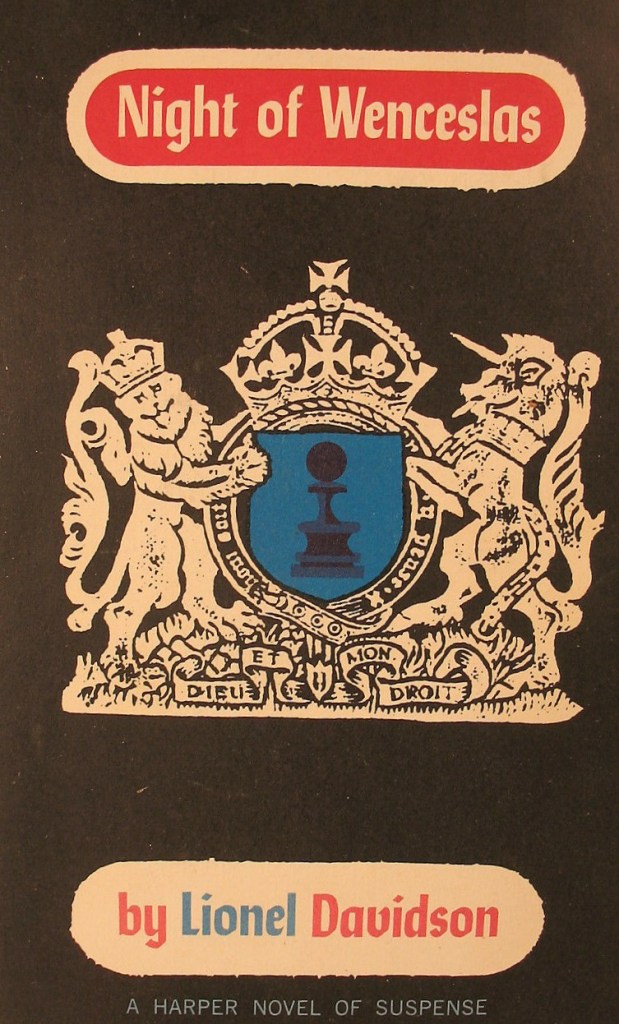
U.S. cover of the Davidson novel.

As was often the case in adaptations of best sellers, the screenwriter, in this instance Lukas Heller (Whatever Happened to Baby Jane, 1962) both added to and subtracted from the original material. For example, the Nicholas of the Lionel Davidson novel was not a particularly attractive character, truculent, snippy, with a bad case of self-entitlement, a bit of a ne’er-do-well, scrounging to pay bills, with expensive tastes and far from charming in his relationship with his girlfriend. He is also employed, rather than unemployed and with hankerings to be a writer as in the film, and comes into the orbit of Cunliffe (Robert Morley in the film) who dupes him into thinking an uncle has left him an inheritance.

Sensibly, Lukas Heller dispenses with Nicholas’s back story which posits him as a Czechoslovakian exile, albeit leaving his native land at the age of six, and various other complications concerning that country. He is sent to collect a formula for unbreakable glass. The “hot enough for June” password is a Heller construct and feels as if belongs to an earlier era of spy pictures. In the book all Nicholas has to do is leave his guide book lying around in the factory for the contact to write there the formula. However, rather than discovering he is working for the British Secret Service, the novelist employs a different twist, that the young man is, unknowingly, in the pay of foreigners plotting against Britain.

Davidson envisaged a different kind of Czech girl, more of a Valkyrie, statuesque (“her breasts stood out like bombs”) rather than the slimmer Sylva Koscina. It is Heller who adds the complication of her father heading up the secret police. In the book, her father is merely a musician and conveniently absent for most of the time, freeing up his house for romantic interludes. And the book has none of the James Bondesque features since the first of the series had not been written when The Night of Wenceslas was published.

However, the film having established the alternative world of rival secret agencies, of the girl being under suspicion and of her father being a senior official in the espionage business, the screenwriter then follows the bulk of the novel’s romance and the thrilling episodes involving Nicholas on the run. The swimming pool, cigarette burn, the parade and the milkman can all be found in the book.

There is one element that had to be changed. In the book, Nicholas makes two trips to Prague. But it is a golden rule of screenwriting that a character visits a location only once. Davidson ends his book with a touch of irony: Nicholas is swapped for Cunliffe.

At whose behest, it was decided to insert the comedy is anybody’s guess. Possibly the feeling that the book as written would be too unsophisticated for audiences accustomed to the rattling action and glamour of a James Bond. The Bond-style connections at the beginning of the film are clunky and the later references to espionage at the highest level also seemed to have been slotted in with no regard to retaining the essence of the book.

Hot Enough for June / Agent 8 3/4 (1964) ***

Thanks to his language skills unemployed wannabe writer Nicholas (Dirk Bogarde) is recruited as a trainee executive on a too-good-to-be-true job visiting a Czech glass factory  only to discover that while engaged on what appears a harmless piece of industrial espionage is in fact considerably more serious.  Complications arise when he falls in love with his chauffeur Vlasta (Sylva Koscina) whose father, Simenova (Leo McKern), is head of the Czech secret police.

Eventually, it dawns on Nicholas that he is in the employ of the British secret service headed by Colonel Cunliffe (Robert Morley). Soon he is on the run. Adopting a variety of disguises including waiter, Bavarian villager and milkman he evades capture and makes a pact with Vlasta that neither of them will participate in espionage activities.

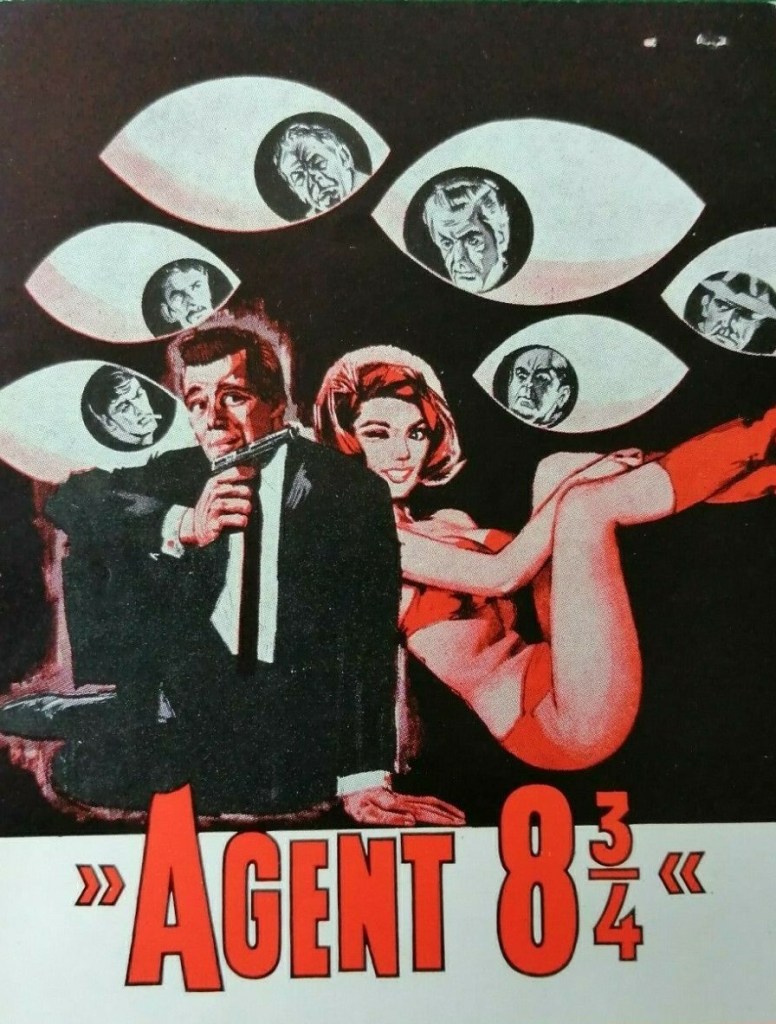
The slinky clothing and the image of Bogarde with a gun played up to the James Bond persona,
which is of course completely lacking in the film. While Sylva Koscina is seductive
at the correct moment she is not overtly so.

A chunk of the comedy arises from misunderstandings, Iron curtain paranoia, the destruction of indestructible glass, password complications, Nicholas’s contact turning out to be a washroom attendant, and from the essentially indolent Nicholas being forced into uncharacteristic action. Soon he is adopting the kind of ruses a secret agent would invent to outwit the opposition, including burning the hand of a man with his cigarette and stealing a milk cart.

The romance is believable enough and Vlasta has the cunning to shake off the secret agent shadowing her, although the ending is unbelievable and might have been stolen from a completely different soppy picture. Although Nicholas is clearly in harm’s way several times that is somewhat undercut by the espionage at a higher level being presented as a gentleman’s game.

There are unnecessary nods to 007 and the kind of gadgets essential to Bond films, although none come Nicholas’s way. But these attempts to modernise what is otherwise an old-fashioned romantic comedy largely fail. Taking a middle ground in comedy rarely works. You have to go for laughs rather than plod around hoping they will miraculously appear. And in fact the comedy is redundant in a plot – innocent caught up in nefarious world – that has sufficient story and interesting enough characters to work.

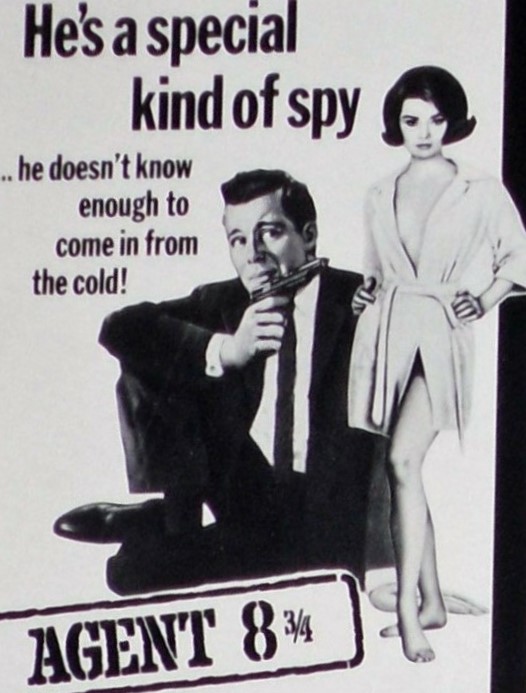
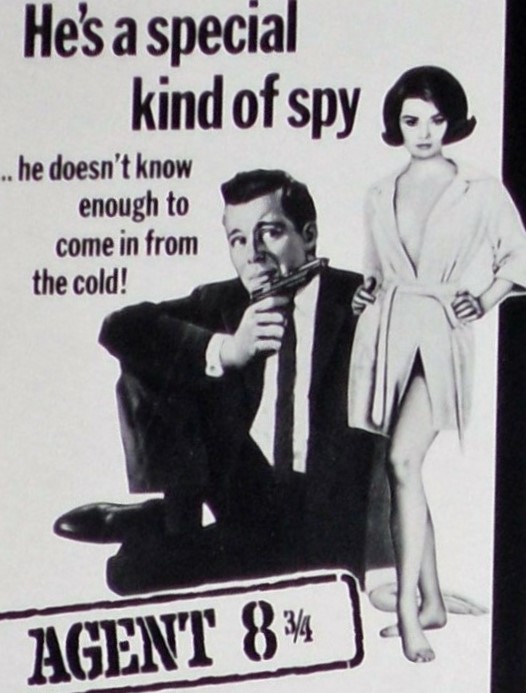
As well as James Bond, the movie tagline referenced “The Spy Who Came in
from the Cold” (1965). The American version of “Hot Enough for June”
appeared with a new title a year after the British release and was
able to take advantage of the film adaptation of the John Le Carre novel.

That the movie is in any way a success owes everything to the casting. Dirk Bogarde, though well into his 40s, still can carry off a character more than a decade younger. He can turn on the diffidence with the flicker of an eyelash. And yet can call on inner strength if required. He is the ideal foil for light comedy, having made his bones in Doctor in the House (1954), reprising the character for Doctor in Distress (1963), while dipping in and out of serious drama such as Victim (1961) and the acclaimed The Servant (1964), released just before this.

In some respects it seems as if two different pictures are passing each other in the night. The Bogarde section, excepting some comedy of misfortune, is played for real while in the background is a bit of a spoof on the espionage drama.

Sylva Koscina (The Secret War of Harry Frigg, 1968) is excellent as the beauty who betrays her country for love. Robert Morley (Topkapi, 1964) and Leo McKern (Assignment K, 1968), although in on the joke, are nonetheless convincing as the secret service bosses.  Look out for a host of lesser names in bit parts including Roger Delgado (The Running Man, 1963), Noel Harrison (The Girl from U.N.C.L.E. 1966-1967), Richard Pasco (The Gorgon, 1964) and stars of long-running British television comedies John Le Mesurier, Derek Fowlds and Derek Nimmo.  

This was the eighth partnership between director Ralph Thomas and Dirk Bogarde, four in the Doctor series but also three serious dramas in Campbell’s Kingdom (1957), A Tale of Two Cities (1958) and The Wind Cannot Read (1958). In themselves the comedies and the dramas were successful, but mixing the two, as here, less so. Lukas Heller (The Dirty Dozen, 1967) wrote the screenplay based on the Lionel Davidson bestseller.

American distributors were less keen on this picture and it was heavily cut for U.S. release and retitled Agent 8¾ presumably in an effort to cash in on the James Bond phenomenon. I’ve no idea what was lost – or perhaps what was gained – by the editing.

The end result of the original version is a pleasant enough diversion but not enough of the one and not enough of the other to really stick in the mind.

Spy Girls

If you’ve not already come across Cinema Retro magazine – now celebrating 18 years of publication –  or its various Special Issues you are in for a treat. Spy Girls fell under its “Foto Files Special Edition” portfolio and includes over 200 illustrations of the actresses who dominated the wave of espionage pictures in the 1960s and to a lesser extent the 1970s.

As well as focusing on the leading female stars in every series film – James Bond, Derek Flint, Matt Helm, Bulldog Drummond, The Man from Uncle and Harry Palmer – the magazine also pay tribute to the wide variety of starlets who appeared in bit parts such as Zena Marshall (Dr No, 1962), Aliza Gur (From Russia with Love, 1963), Shirley Eaton and Margaret Nolan (Goldfinger, 1964) Molly Peters (Thunderball, 1965) and Gila Golan (Our Man Flint, 1966).

However, in the main the concentration is on the flood of European actresses who set Hollywood agog following multiple appearances in spy pictures. Beginning with original Swiss-born Bond girl Ursula Andress (Dr No and Casino Royale, 1967, the magazine features every actress who had a starring role in the mainstream spy films. Some, of course, seemed very comfortable in the genre with roles in several pictures.

Leading that particular parade were Italian Daniela Bianchi who, after her spy debut in From Russia with Love, was seen in Slalom (1965), Operation Gold (1966), Special Mission Lady Chaplin (1966), Requiem for a Secret Agent (1966) and Operation Kid Brother (1967). Matching her was Austrian Senta Berger, caught in The Secret Ways (1961), The Spy with My Face (1965), Our Man in Marrakesh (1966), The Quiller Memorandum (1966), The Ambushers (1967) and Istanbul Express (1968).

Not far behind came Israeli Daliah Lavi who lit up the screen in The Silencers (1966), The Spy with a Cold Nose (1966), Casino Royale (1967), Nobody Runs Forever (1968) and Some Girls Do (1969). German Elke Sommer was another regular, headlining The Venetian Affair (1967), The Corrupt Ones (1967), Deadlier than the Male (1967) and The Wrecking Crew (1968.) Also a regular in the genre was Yugoslavian Sylva Koscina with Hot Enough for June/Agent 8¾ (1964), That Man in Istanbul (1965), Agent X-77 Orders to Kill (1966) and Deadlier than the Male (1967)

Canadian Beverly Adams featured three times in the Matt Helm series, in The Silencers, Murderers Row (1966) and The Ambushers (1967). Czechoslovakian Barbara Bouchet turned up in Agent for H.A.R.M (1966), Casino Royale and Danger Route (1967) and Austrian Marisa Mell had top roles in Masquerade (1965), Secret Agent Super Dragon (1966) and Danger:Diabolik (1968). Another three-peater was Rome-born Luciana Paluzzi – To Trap a Spy (1964), Thunderball (1965) and The Venetian Affair (1967) – not forgetting Swede Camilla Sparv in Murderers Row (1966), Assignment K (1968) and Nobody Runs Forever (1968).

No study on the girls involved in espionage over these two decades would be complete without mention of Raquel Welch for Fathom (1967), Monica Vitti in Modesty Blaise (1966), Honor Blackman in Goldfinger and Britt Ekland in The Man with the Golden Gun (1974). The occasional American leavened the pot – Jill St John appearing in The Liquidator (1966) and Diamonds Are Forever (1971) and Lana Wood also in the latter. 

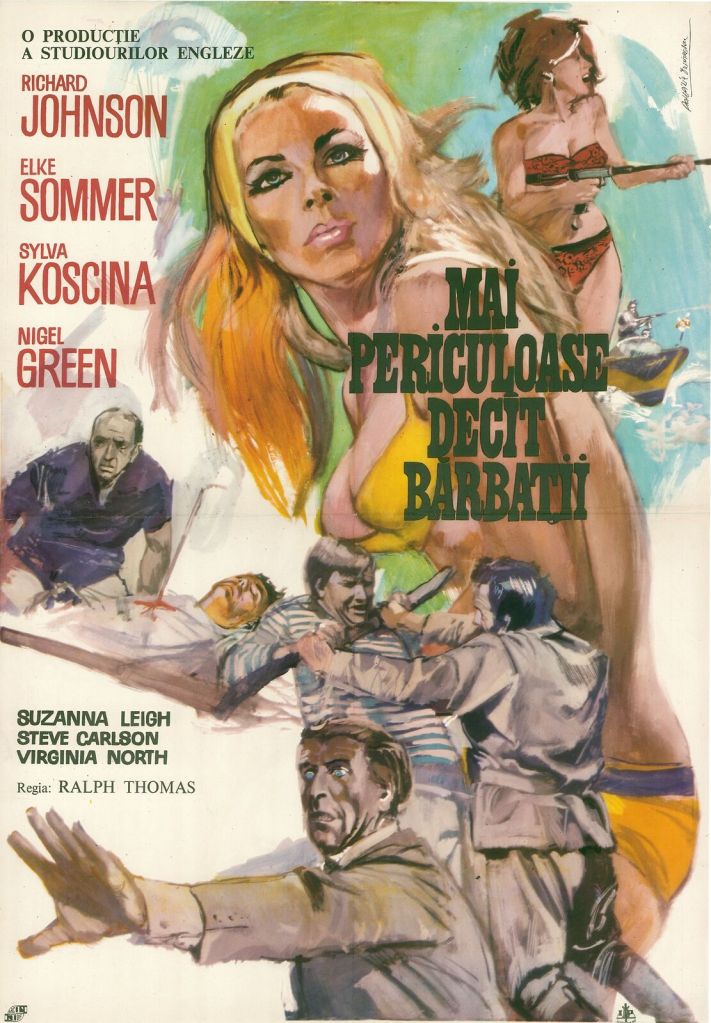
The extensive illustrations include stills, and photographs of the stars relaxing on set or setting up a shot, as well as a veritable archive of posters from virtually every country in the world, often with substantially different artwork to the originals. In addition, articles on the main actresses are included as well as snippets of information on the lesser stars.

Priced at just £6.95 / $11.99 this might make a nice Xmas filler.

http://www.cinemaretro.com/index.php?/archives/8048-COMING-FROM-CINEMA-RETRO-SPY-GIRLS-FOTO-FILES-ISSUE-1.html

Discover WordPress

A daily selection of the best content published on WordPress, collected for you by humans who love to read.

The Atavist Magazine

by Brian Hannan

WordPress.com News

The latest news on WordPress.com and the WordPress community.