Jungle Street / Jungle Street Girls (1961) ***

More social document than thriller. Two elements make it stand out. Critics pointed to the likes of kitchen sink drama Saturday Night and Sunday Morning (1960) as exemplifying the British working class. Equally, when looking for a picture that identified the British criminal, critics and academics were more likely to point to Robbery (1967) and Get Carter (1971) where the villains demonstrated considerable intelligence, leadership and acumen.

Let’s get the social aspects out the way first. Petty thief Terry Collins (David McCallum) still lives with his parents. He argues with his father, is mollycoddled by his mother. There’s a fry-up for breakfast. The kitchen doubles as the dining area. Excitement is limited to winning the Pools (a football-based version of the current Lottery) and going to the cinema. His father (Thomas Collins) has worked all his life shifting sacks of potatoes (presumably in a market). But he’s not disillusioned with life. He’s brought up his family and can still spend time down in the pub.
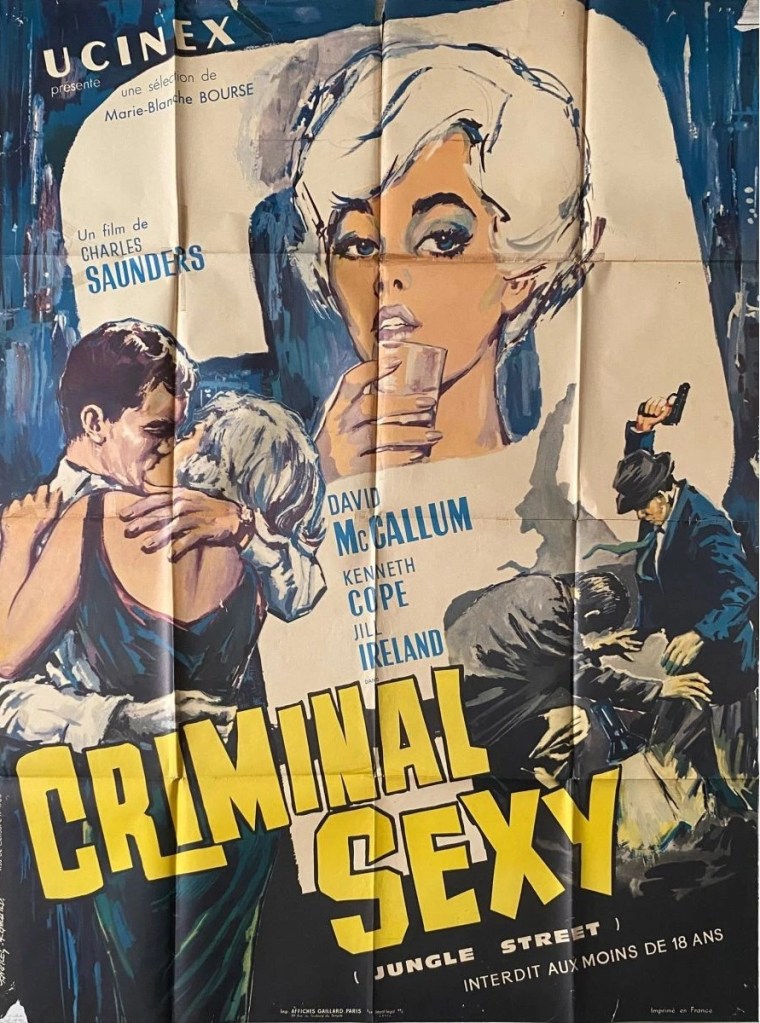
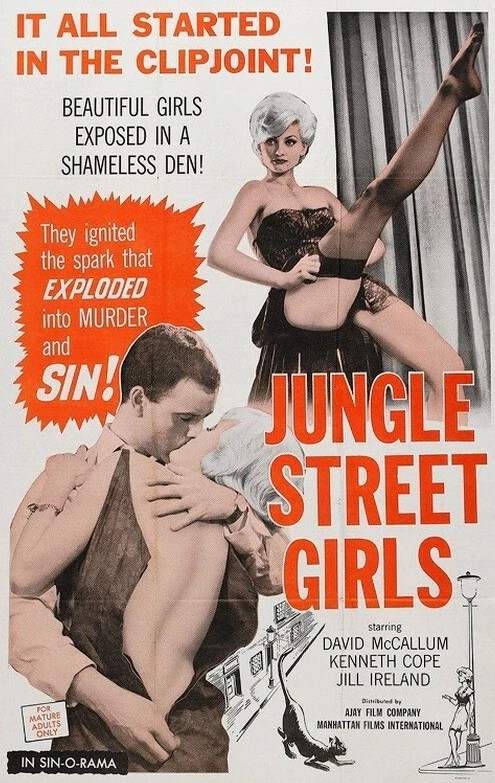
Terry is a delusional gangster. But only a part-time one, making his living working in a garage, having chucked in his factory job. He thinks he can make a big score and run off to Europe to live the high life. He’s in love with stripper Sue (Jill Ireland) who doesn’t respond to his romancing. She’s taken to stripping because her lover Johnny (Kenneth Cope) is serving a one-year stretch for a jewel robbery. 

People always seem to be laughing at Terry and he reacts violently. But he’s not the rough-tough dominant male he aspires to be. Three times he gets whacked about the face, twice by criminal colleagues, once by Sue.

Inadvertently, he’s killed an old man while robbing him. So the police are on his tail. Johnny’s been released from prison, reclaiming Sue, and wants to know what happened to his share of the loot from the jewel heist in which Terry was his partner. To compensate, Terry offers to set up a robbery of the safe at the strip club whose routines he has studied.

Once the safe has been opened, he clatters Johnny over the head, and scarpers with the cash, makes for Sue, and is astonished when she refuses to accompany him. Eventually, the police catch up and another deluded petty criminal bites the dust.

Initially, of course, the audience sides with our young lad, understands his need to escape the boredom of ordinary life that awaits. But, gradually, he provides little to root for.
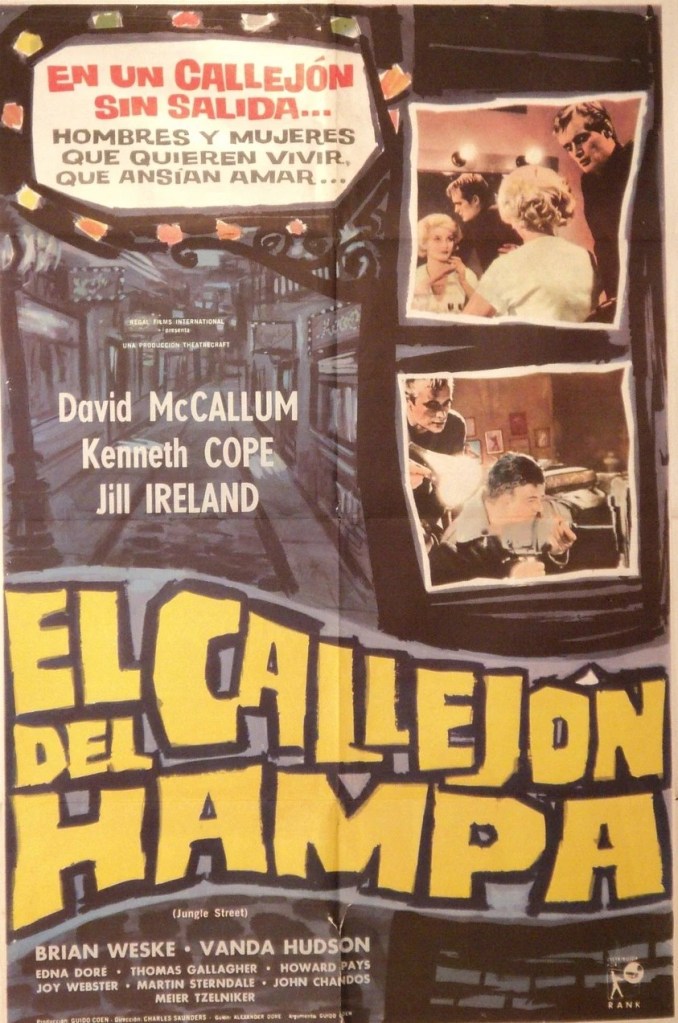
Given the regular sequences of girls stripping, the running time is even leaner than usual. The heist has some considerable moments of tension especially when the watchman, bound hand and foot, inches along the floor to the alarm button, and then when Terry appears trapped before jumping out a window.

There’s nothing glamorous about the strip club either, Sue having to constantly ward off the unwelcome advances of owner Jacko (John Chandos) and every other customer who thinks a stripper is morally lax. Even though she’s kept herself for Johnny, he doesn’t believe her. Some girls know how to play the system, a new stripper not giving in to Jacko until he’s spelled out the financial benefits.

The seediness of the lower depths is depicted well and it’s not hard to see how young men and young women are easily snookered into this kind of existence when the alternative is so mind-numbingly boring.

David McCallum (Sol Madrid/The Heroin Gang, 1968) and real-life wife Jill Ireland (Cold Sweat, 1970) are both convincing, exuding surprising emotional depth. Kenneth Cope (Randall and Hopkirk Deceased/My Partner the Ghost, TV series 1969-1970) is on hand to show the young ingenue what it means to be a proper tough guy.

Charles Saunders (Danger on My Side, 1962) directs from a script by Alexander Dore (The Wind of Change, 1961) and Guido Coen (Baby Love, 1969).

More interesting as a character study than as a thriller.
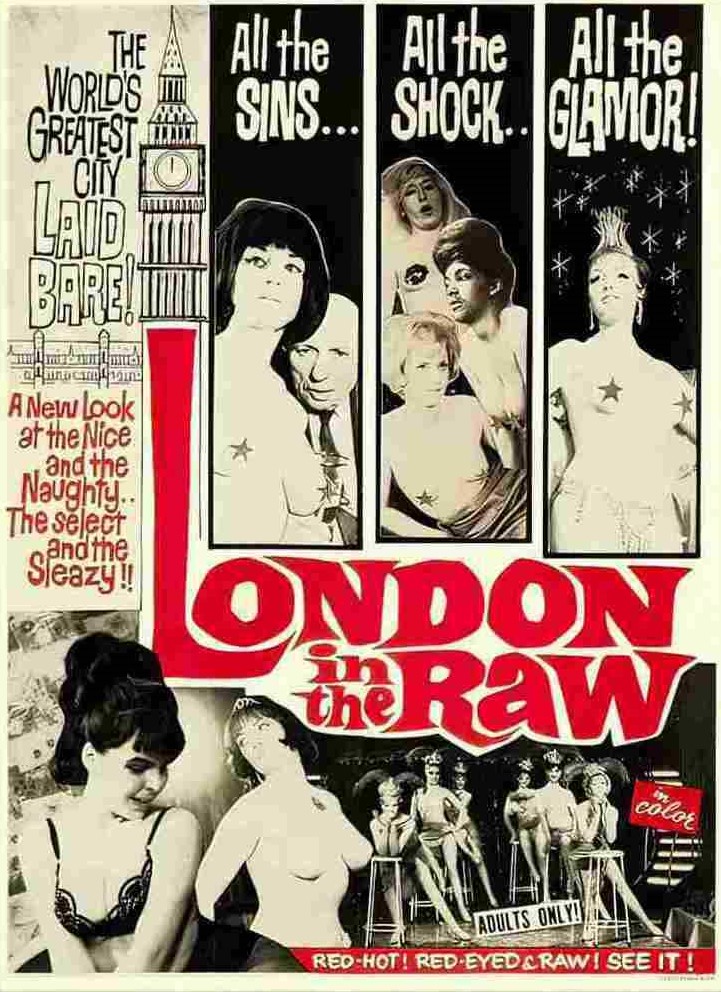
London in the Raw (1964) ***

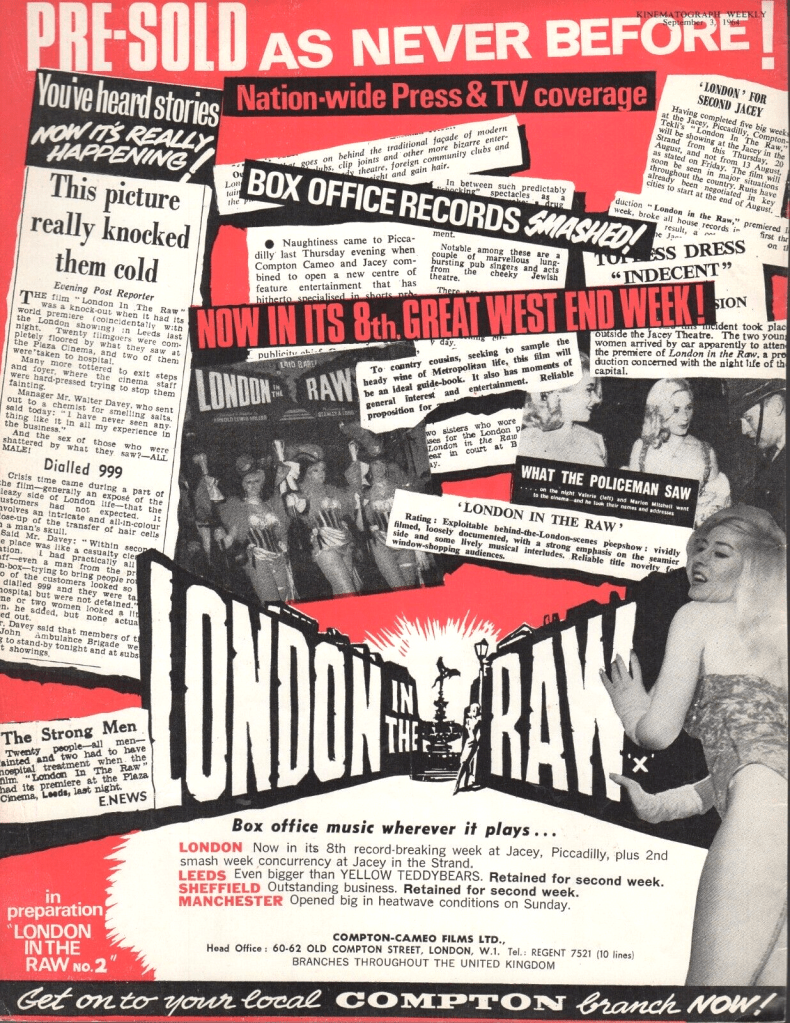
The headmaster of top English public school Harrow and the owners of upmarket emporium Grieves probably didn’t realize what they were letting themselves in for when they agreed to participate in this British version of Mondo Cane (1962), the movie that turned documentary into box office gold by the simple device of concentrating on the sleaze.

In truth it’s a bit of bait-and-switch, although anyone seeking titillation in those more repressed times when nudity was forbidden by the censor would be rewarded by the sight of three women topless, an anomaly explained by such nudity appearing in a non-sexual situation and my guess that the movie’s producers pointed to the stage loophole which permitted it as long as the women did not move. (That reasoning was explained, should you be interested, in Mrs Henderson Presents, 2005.)

The nudity occurs in the context of life classes, one organized by a bunch of beatniks as a means of funding their lifestyle, which includes eating baked beans cold and snacking on cat food, rebels that they are; when business is poor, they resort to taking snaps of the girls for Soho magazines. The other is the post-dinner entertainment in an upmarket restaurant where the customers sketch drawings of the undressed immobile models.

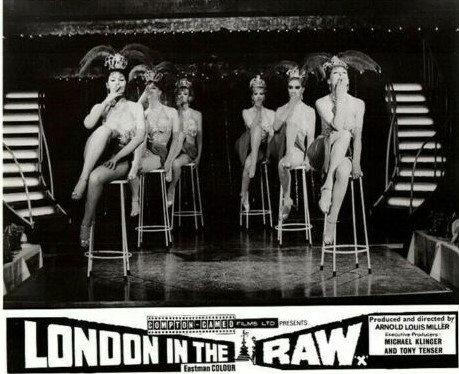
There’s an expose of clip joints, where elderly men are duped out of money by unfulfilled promise, paying extortionate amounts for non-alcoholic beverages, and a behind-the-scenes look at a strip club (nudity concealed behind nipple pasties) and a sex worker, the narrator making the point that while it’s not illegal for that woman to ply her trade indoors, a beggar playing a penny whistle in the street could be arrested. The strip club has the dingiest of entrances.

But in the main it’s a rather snippy examination of contemporary mores as staid London, at this stage not quite Swinging London, undergoes dramatic change. A health club enters the frame and there’s a gory piece on male hair transplants, a bloodier experience than audiences might expect, and a trawl round various unusual, but harmless, place of entertainment: an Irish pub with a horde of singers, an amateur Jewish theater, disco dancing at the renowned Whiskey-A-Go-Go, German students congregating for a slice of home at the Rheingold Club, the casino at Churchills, and cabaret.

“Bold! Brazen! Bizarre!” boasts the trailer and while that might be typical hype, audiences in those tamer times may well have been shocked especially when the camera focuses on two elements rarely discussed at that point in polite society: homelessness and drug addiction. Even so, it does find, as with the rest of the movie, unusual aspects of both. For example, the homeless lace their methylated spirits with milk. A director with an eye for dynamic composition could not have hit upon a better idea than contrasting the white contents of one bottle with the blue contents of another, the mixture being consumed in tea cups.

And I, for one, did not know that drug addicts were treated far more sympathetically in Britain than in the United States. That may well have been because the numbers were low, only 600 registered addicts compared to 47,000 across the Atlantic, though the degradation was no less pitiful, female abusers taking to the streets to pay for their addiction.

As a slice-of-life it’s less exploitational than the posters – or title – suggest and so falls into the historic category of The London Nobody Knows (1967), although less compelling, and it’s perhaps more interesting for the personalities involved, several of whom became significant figures, one way or the other, in the movie business.

Making the biggest later impact was Michael Klinger who went on to produce Roman Polanski’s Cul-de-Sac (1966), drama Baby Love (1969), gangster classic Get Carter (1971), Gold (1974) and Shout at the Devil (1976). Co-producer Tony Tenser went on to found Tigon, the horror outfit that challenged Hammer. Stanley Long turbocharged the British sexploitation industry with numbers such as Groupie (1970), The Wife Swappers (1970) and Eskimo Nell (1975).

But it didn’t open many doors for director Arnold L. Miller who managed only a handful of features such as Frustrated Wives/Sex Farm (1974) which was banned by the British censor. Uncredited co-director Norman Cohen later made The London Nobody Knows.

Interesting for the most part and buy it if you want to play your part in upholding the British Film Institute which has rescued this from the vaults in the hope of making a quick buck.

Discover WordPress

A daily selection of the best content published on WordPress, collected for you by humans who love to read.

The Atavist Magazine

by Brian Hannan

WordPress.com News

The latest news on WordPress.com and the WordPress community.