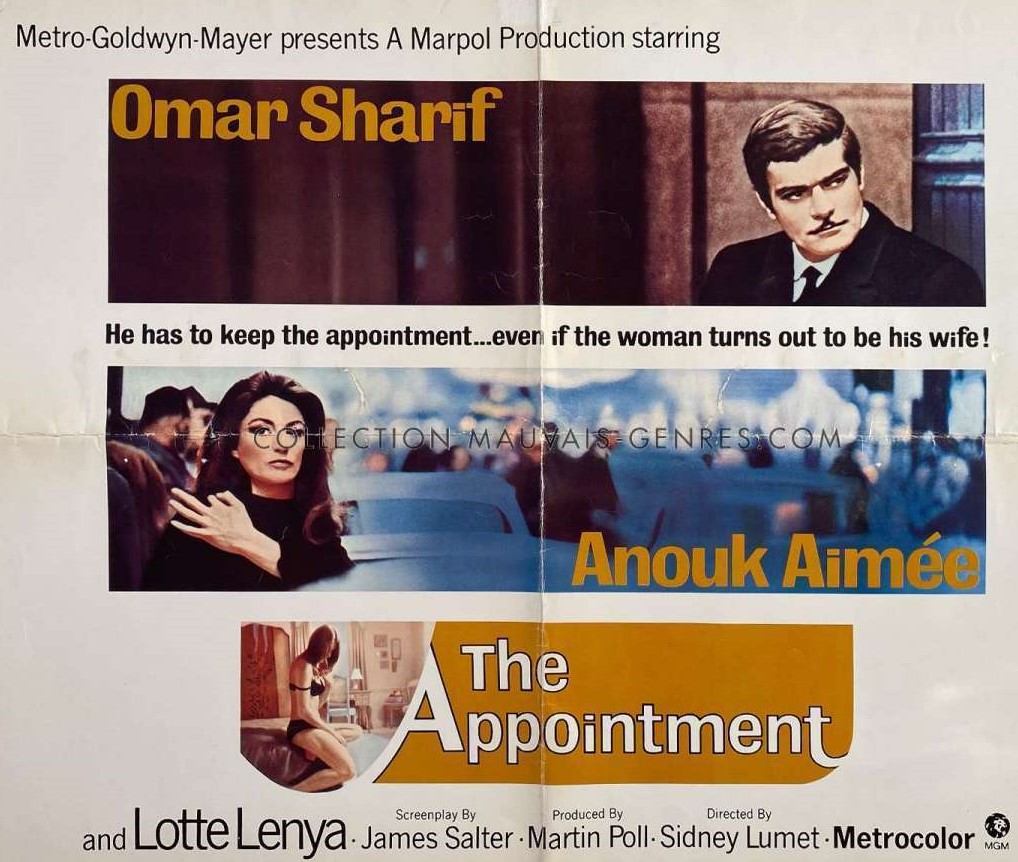
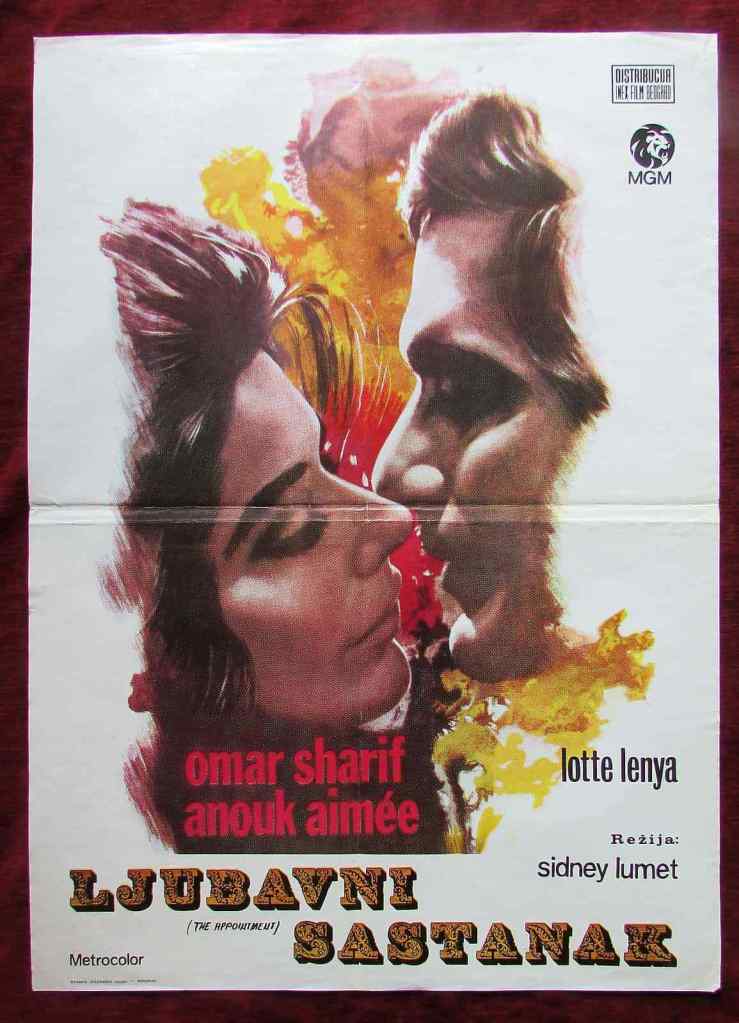
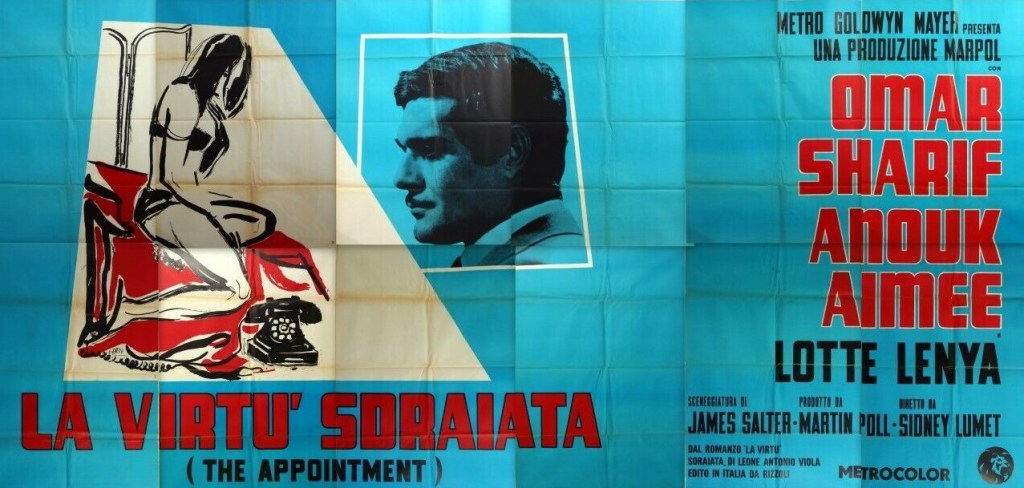
The Appointment (1969) ****

You can see why MGM dumped this. Just as easily as you can see its attraction for star Omar Sharif, his boldest-ever role, completely against type, burying the romantic hero in one fell swoop. It wasn’t just the arthouse pretensions – the absurdly long, by Hollywood standards, long shots held for an insanely long time and the greatest aerial shot, almost to the moon and back, ever devised – that made the studio cut and run faced with the impossibility of selling Omar Sharif as a creepy, repressed guy who drives his wife to suicide.

Luxuriant moustache trimmed to look like a ramrod British colonel, often bespectacled, unmarried middle-aged lawyer Federico (Omar Sharif) takes a fancy to the withdrawn Carla (Anouk Aimee), fiancée of legal buddy Renzo (Fausto Tozzi). She works as a model in a high-class fashion house.

So Federico is shocked to discover that Renzo has dumped her after discovering evidence, somewhat circumstantial it has to be said, that she moonlights as an equally high-class sex worker who takes occasional assignments from antiques dealer Emma (Lotte Lenya). Now that Carla is unencumbered in the marital stakes, Federico undertakes to discover whether the accusation is indeed correct. If not, then he reckons, she might well fall for him, if only on the rebound, after all he is very successful and, despite the geeky haircut and moustache, a handsome dude.

It’s left to your imagination whether Federico actually has sex with the young woman – who “could pass for 17” and arrives clutching schoolbooks – for whom he pays 100,000 lire (around $1,000) but my guess is he does, getting her to pretend he’s her Latin schoolmaster. So that’s the Omar Sharif romantic persona killed off right there and from then on it’s hard to muster any sympathy for the character, every bit as obsessive, say, as James Stewart in Vertigo (1958).

This has a Hitchcockian aura, an atmosphere of stealth and secrecy and chill. He ends up marrying her, turns into a control freak, refuses to let her go out to work, complains about her make-up, asks where she’s been. He gets it into his head that she’s back to her old tricks and rekindles the investigation. She becomes more withdrawn and eventually commits suicide. The ideal ending, the arthouse ending, would have left Federico forever puzzled, not knowing whether he had married a hooker or not, whether, for all his caution, he had been duped. But that’s not the way with what you would otherwise describe as a psychological thriller – calling it a big-budget arthouse picture from a major studio by a relatively unacclaimed (outside of The Pawnbroker, 1964) mainstream director would not be an option – so we get a twist at the end.

This isn’t your usual Italy either, it’s not set in a sun-drenched land with impeccable beaches and ladies wandering around with cleavage abounding. This is the Italy of traffic jams and rain and wind and huge brown waves battering the shore and buttoned-up women.

And audiences have rarely been presented with such a depressing insecure female character. You get the impression she wears fabulous clothes to hide, not glorify, her body. She might come across as playing with Federico, pretending to be asleep when he comes to bed during a romantic weekend on a remote island, the woman way out of his league who wants to keep him at a distance while she makes up her mind. But that interpretation would only be from Federico’s perspective. Otherwise, an attendant viewer would note that she doesn’t seem at all comfortable with life, and that abandoned by one lover without finding out why she can’t risk losing her heart to another.

Had this been made by Visconti or Antonioni (Blow-Up, 1966, went down a similar suspicious route) it might have been acceptable as a distribution vehicle for MGM (after all, they did pump millions into Zabriskie Point, 1970). The odd thing was, the arthouse mob didn’t like it either, showing disdain in the most publicly humiliating manner possible, audiences at Cannes booing it off the screen.

But once you accept the odd premise and equally fall in with the seedy character depicted by Omar Sharif, you begin to feel its power. The daring camerawork is exceptional, some of the scenes in extreme long shot contain as their essence elements of intimacy, and the world’s greatest aerial shot pulls away from the picture’s most romantic scene, as if giving indication of what is not well, rather than enveloping the characters with the usual background of nature at its most rapturous. And it’s pretty much silent, a John Barry theme dips in and out, but scarcely swells when it does, on a rare occasion, appear, so this plays out without much in the way of musical nods to the audience.

Outside of Lawrence of Arabia (1962), this is easily Omar Sharif’s greatest performance. His gamble in parlaying his box office marquee and universal romantic appeal (he appeared in Mayerling, the ultimate romantic tale, the same year) to take on this unappealing role showed a commitment to expanding his screen persona that went unrewarded. Anouk Aimee, anointed one of the screen’s biggest female romantic leads after the unexpected success of A Man and a Woman (1966), is also playing against type.

Sidney Lumet went through a distinctly lean period between The Pawnbroker and his 1970s output – The Anderson Tapes (1971), Serpico (1973), Dog Day Afternoon (1975) – and while The Pawnbroker presented an equally disaffected character he was crying out for your sympathy. You could almost view The Appointment as an exercise in style and the director trying to see, in terms of narrative and character, what he could get away with, and to become the director stars would trust when they wanted to shake up their screen persona – witness Sean Connery as a criminal and Al Pacino as a gay bank-robber.

Critics have avoided this like the plague – three reviews on imdb, only one on Rotten Tomatoes – so if that’s not a sign of being under-rated I don’t know what is.

It’s different for sure but that doesn’t make it any less worth seeing. And it would certainly fit in with the expectations of a contemporary audience.

The Group (1966) ***

The ensemble picture provided a showcase for new talent. But consider the gender imbalance at work. Only Candice Bergen proved a breakout star of any longevity compared to a flop  like The Magnificent Seven (1960) from which six relative newcomers – Steve McQueen, James Coburn, Charles Bronson, Robert Vaughn, Eli Wallach (only his fourth movie) and Horst Buchholz – became top-billed material.

Part of the problem was Hollywood itself, not enough good roles for actresses who weren’t destined for spy movies or to become a decorative supporting player, and who could not headline a western, war picture or (with the exception of Bonnie and Clyde) a hardnosed crime movie. But part of the problem was the structure of The Group. Yes, there’s a 150-minute running time, but there are eight main characters to contend with.

And the story doesn’t have a central focus like The Magnificent Seven where characters are built in asides to the main action but has to meander in eight different directions. Luckily, it still remains a powerful confection, tackling, as if setting out to shock audiences,  contentious issues like mental illness, leftwing politics, birth control and lesbianism. What could easily have descended into a chick flick or a glorified soap opera instead pushes in the direction of feminism.

A bunch of wealthy privileged university female graduate friends sets out in the 1930s to change the world only discover, to their amazement, that the male-dominated dominion  chews them up and spits them out.

Only Lakey (Candice Bergen), who prefers the company of women, appears to find fulfilment but that’s mostly from running off to the more liberated Paris at the earliest opportunity to study art history though the Second World War puts an end to that.

Kay (Joanna Pettet) seems to have made the best marriage, with a wannabe alcoholic writer (Larry Hagman), but she ends up in a mental asylum. Dottie (Joan Hackett) also views life in the art world, marrying a painter, as the best option only to later prefer a more mundane husband.  Priss (Elizabeth Hartmann), the strongest-minded of the octet, lands a man of a stronger, controlling, character.  

Polly (Shirley Knight) is the most sexually adventurous. Ostensibly, Helena (Kathleen Widdoes), a renowned traveller, and Libby (Jessica Walter), a successful novelist, appear to achieve the greatest independence and success but come up short in that most important of endeavors, romance. The men, you should be warned, are all one-dimensional scumbags.

The movie focuses mainly on Kay, Polly and Libby. Lakey shows up at the beginning and the end.

At its best, it’s an insight into the world of women, on a grander scale than any of the tear-jerkers of previous decades. But it suffers from too many characters and too little time. It might have been better as a mini-series, though that, obviously, was not an option at the time. The Sidney Buchman (Cleopatra, 1963) screenplay fails to match the intensity of the critically-acclaimed source novel by Mary McCarthy, a huge bestseller.

It’s a surprising choice for Sidney Lumet (The Pawnbroker, 1964), more mainstream than his general output, but while he clearly presents the characters in sympathetic fashion, his hallmark tension is missing.

Mostly, it works as a time-capsule of a time-capsule, a movie about the 1960s optimism of 1930s optimism, and the obstacles faced by both.

Only Candice Bergen (Soldier Blue, 1970) approached the level of success achieved by The Magnificent Seven motley crew, achieving top-billed status in a number of films and her screen persona, possibly as a result of this movie, was often independence. Leading lady in Will Penny (1968) and Support Your Local Sheriff (1969) was the height of success for Joan Hackett.

Already twice Oscar-nominated as a Supporting Actress, Shirley Knight was the best-known of The Group, but was only thereafter top-billed once, in the low-budget Dutchman (1966) although she won critical plaudits for The Rain People (1969).

An Oscar nominee for her debut A Patch of Blue (1965), Elizabeth Hartmann was top-billed in You’re A Big Boy Now (1967) and then fell into the supporting player bracket. Never top-billed, Joanna Pettet was a strong co-star for the rest of the decade but that was marked by flops like Blue (1968) and The Best House in London (1968) and she drifted into television.

Best known for Number One (1969) and Play Misty for Me (1971) Jessica Walter failed to achieve top-billing. Though, as a result of this review, it has been pointed out to me (thanks Mr Film-Authority) that I glossed over her brilliant performance in television show Arrested Development (2003-2019); in fact, if your search for her on imdb that TV series is the one that pops up first.

Most of the actresses did have long careers, sustained by leading roles in television or bit parts in movies but when you consider the success visited upon the group known as The Magnificent Seven  you can’t help thinking this was a whole generation of talent going to waste because they could not be accommodated by the Hollywood machine and did not fit the industry prototype.

For another example of gender disparity you could compare the consequent comparative success of the stars of Valley of the Dolls and The Dirty Dozen, both out the following year.

The Hill (1965) ****

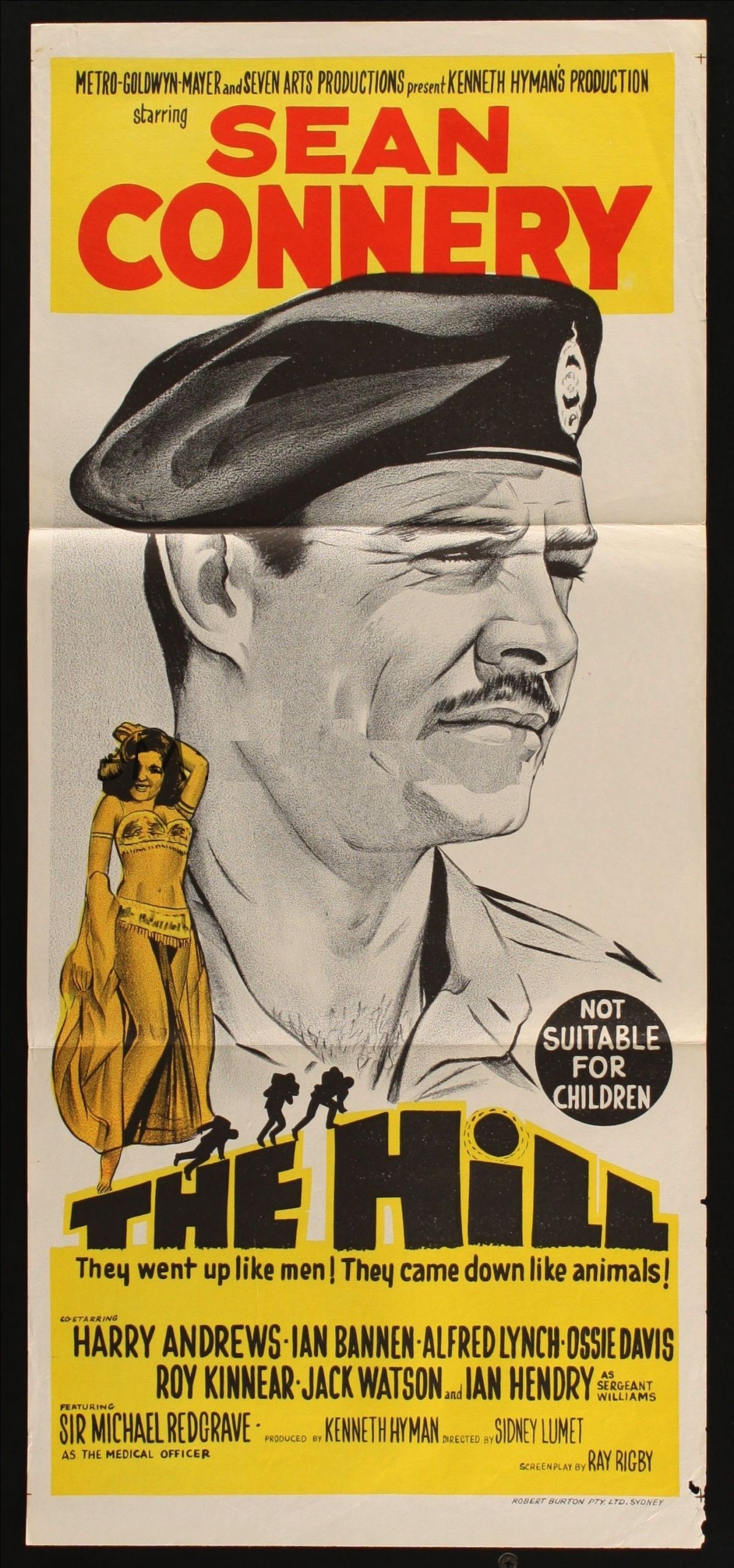
Set in a British Army prison camp in North Africa during World War Two ruled by sadistic Sergeant Wilson (Harry Andrews) who believes himself above the regulations he forces others to follow, The Hill is a parable about the hypocrisy of totalitarian rule. And much of what is shown would be offensive to modern sensibilities. Although the commandant (Norman Bird) and medical officer (Michael Redgrave) are his superior officers, Wilson runs the unit by force of personality. He believes his ruthless treatment of the prisoners turns them into proper soldiers. Into his fiefdom come five new prisoners including coward Joe Roberts (Sean Connery), spiv Monty Bartlett (Roy Kinnear), African American Jacko King (Ossie Davis), another Scot Jock McGrath (Jack Watson) and weakest link George Stevens (Alfred Lynch).

Most films about prisons emphasize imprisonment, most scenes taking place in cells or other places of confinement. Sidney Lumet (The Pawnbroker, 1964) directs this film as though it is a paeon to freedom with incredible shots of the vista within which the men are contained. He uses some of the most bravura camerawork you will ever see outside of David Lean. The film opens with a two-minute crane shot credit sequence that begins with a prisoner collapsing on the titular hill and pulls back to reveal the entire encampment and follows with a one-minute reverse tracking shot of Andrews striding through his domain. And while the camera controls what we see, our ears are constantly assailed by the constant drumbeat of other marching prisoners.  

Climbing the hill in full pack would break any man and those who collapse are roused by pails of water. The first to crack is Stevens who is constantly tormented by homophobic jibes. Continuous racist abuse is heaped on Jacko King until driven to the point of madness he begins to behave like a gorilla which frightens the life out of his superiors. Obeying orders, says Joe Roberts, is “like a dog picking up a bone.”  RSM Wilson is out of control, the commandant spending his nights with a prostitute, the medical officer clearly sent here as punishment for some previous misdemeanor. Of the senior staff only Harris (Ian Bannen) comes away with any dignity, constantly trying to thwart the worst bullying.

When Stevens dies suddenly, the film changes tack and becomes a battle for survival among those who could be blamed for causing his death and those who dare to point the finger.  Wilson has no problem stitching up his colleagues and blackmailing the medical officer while Roberts is beaten up for his effrontery in standing up to authority. But the astonishing presence and self-confidence and, it has to be said, courage of Wilson lords it over everyone, and there is an extraordinary scene where he forces the entire battalion of prisoners to back down when they are on the brink of open rebellion.

Connery as Roberts is superb in what is his first dramatic role in a bread-and-butter dramatic production rather than the glossier Marnie (1964) and Woman of Straw (1964) and while he has his moment of defiance he gives enough glimpses of vulnerability and fear to ensure we do not mistake him for his alter ego James Bond. Ian Bannen delivers a touching assured performance far removed from the nasty sarcastic personalities he portrayed in his other desert pictures, Station Six Sahara (1963) and the Flight of the Phoenix (1965).  Ossie Davies, as defiant as Connery, is brilliant as the man who works out a way to beat the enemy by confusing them; the scene in the commandant’s office where he treats the officer as his inferior is a tour de force.   

Although the Army is meant to run according to established regulation, where obedience to a superior is paramount, it is equally apparent that it can also become a jungle if those who are the fittest assume control. Sgt Wilson demands unquestioned discipline even as he is breaking all the rules in the book. But he retains his authority not just by bullying, but by intelligence, exploiting weakness, coolness under pressure and by welcoming confrontation, his personality as dangerous as any serial killer.   

The Pawnbroker (1964) *****

Director Sidney Lumet (Fail Safe, 1964) could have made an excellent film just about the customers of a pawn shop, the haunted individuals haggling for more bucks than they will ever be paid, the sad sacks, junkies, lost souls and general losers whose stories are told in the items they pawn or redeem – candlesticks, lamps, radios, musical instruments, occasionally themselves. You don’t need to be a pawnbroker to know that three hoodlums turning up with a pricey lawnmower are dealing in stolen property. And it comes as something of a surprise to learn that the pawnbroker is involved in some kind of money-laundering scam for a local gangster. Clearly shot on location on a bustling low-rent area, north of 116th St in East Harlem, New York, there’s enough going on in the streets – the markets, the tenements, poolrooms, the bustle, the eternal noise – to keep you hooked.

But you might think twice about positing as your hero an “absolute bastard” as Lumet himself described shop owner Sol Nazerman (Rod Steiger). He is more haunted than any of his clientele, a Holocaust survivor, plagued by flashbacks to the concentration camp where he witnessed his son die and his wife raped. He is devoid of life, completely shutdown to any emotion, rejecting overtures of friendship, and his life is played out in tiny elliptical shreds. He does not even derive any enjoyment out of his affair with a widow and although he claims to worship money – according to him the only “absolute” outside of the speed of light – that brings no fulfillment either. It is surprising he has lasted so long without imploding. After his war experience, you would have to wonder at a man who spends his life behind the bars of the grille in his shop and just in case he considers escaping from his predicament designer Richard Sylbert (Chinatown, 1973) incorporates other visual aspects of imprisonment into the production.

This startling image taken from the Pressbook encapsulates one of the striking moment of the film. As seen on the advert at the top of the blog, although not technically a roadshow in the normal sense (i.e. in the grandeur of 70mm) it played separate performances. This was a technique to drive up demand by limiting access. Originally, to take advantage of a British tax break known as the Eady Levy, the film was due to be made in London. Lumet pulled out when MGM insisted on a London shoot and only returned after that idea was abandoned and second-choice director Arthur Hiller bowed out.

Steiger gives a very restrained performance, especially for an actor known for his volubility and over-acting. He seems to sink into the role. He is accused of being among “the walking dead.” Around him are a set of very lively characters, his ambitious assistant (Jaime Sanchez, The Wild Bunch, 1969) trying to go straight and his girlfriend (Thelma Oliver), a very smooth and wealthy and gay gangster (Brock Peters), and a trio of small-time hoods with whom the assistant is friendly. But also the deranged and the lonely. A widowed social worker (Geraldine Fitzgerald) who suffers from the “malady of loneliness” offers him friendship but is rejected.

There is little plot to speak but it is just enough to teeter him on the brink of self-destruction. So it is primarily a character study. Unusually, Lumet observes without any sentimentality those around Steiger. “Sol has buried himself in this area,” Lumet wrote (“Keep them on the hook,” Films and Filming, October 1964, p17-20) “because he needs to be with people that he can despise….This is a man who is in such agony that he must feel nothing or he will go to pieces.” There is no redemption and he lacks the courage to commit suicide. It’s a stunning, bold picture, as raw as you can get without turning into a bloodsucker.

Fans of “The Godfather” might recognise this image – of a puppet on the strings -used to symbolise the power of the Mafia don. Eight years before Coppola’s gangster saga, this rarely seen but similar image in the Pressbook for “The Pawnbroker” evoked the opposite – a broken man.

The film had a few firsts. It was the only mainstream American picture to deal with the Holocaust from the perspective of a survivor (although films like Judgement at Nuremberg, 1961, has shown camp victims). It broke mainstream conventions on nudity, bare breasts being seen for the first time. Lumet experimented with incredibly short cuts – just one-frame and two-frames in places (a technique he had first used in television)- when the standard assumption was that audiences required three frames to register an image. Brock Peters played not just the first openly gay person in a mainstream picture, but the first gay African-American (although The Long Ships the same year had a bit of comedy about a eunuch chasing Vikings).

Quincy Jones made his debut as a movie composer. If you listen closely you might detect a piece of music later made famous by the Austin Powers pictures and if you look closely you might spot a debut sighting of Morgan Freeman. And if want another anomaly, try and work out why Rod Steiger lost out to that year in the Best Actor Oscar stakes to Lee Marvin in Cat Ballou (1965).

Many of the films from the 1960s are to be found free of charge on TCM and Sony Movies and the British Talking Pictures as well as mainstream television channels. But if this film is not available through these routes, then here is the link to the DVD and/or streaming service.

Discover WordPress

A daily selection of the best content published on WordPress, collected for you by humans who love to read.

The Atavist Magazine

by Brian Hannan

WordPress.com News

The latest news on WordPress.com and the WordPress community.