Daddy’s Gone A-Hunting (1969) ***

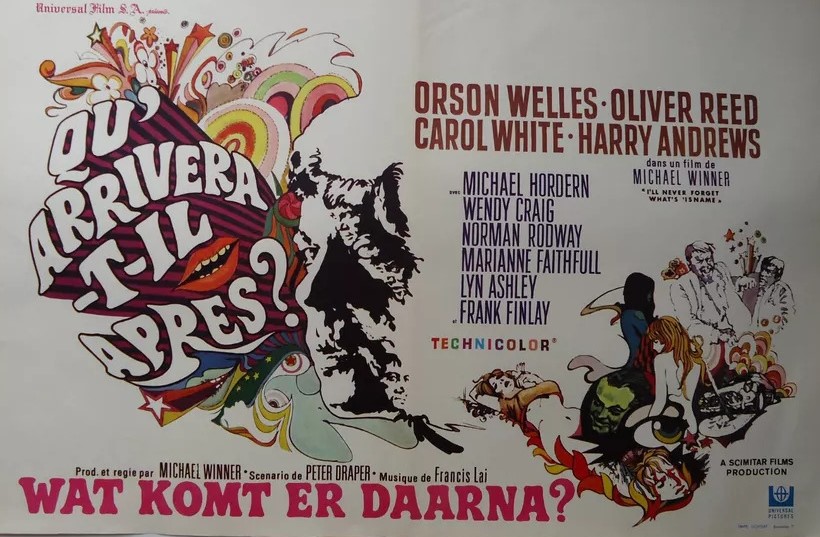
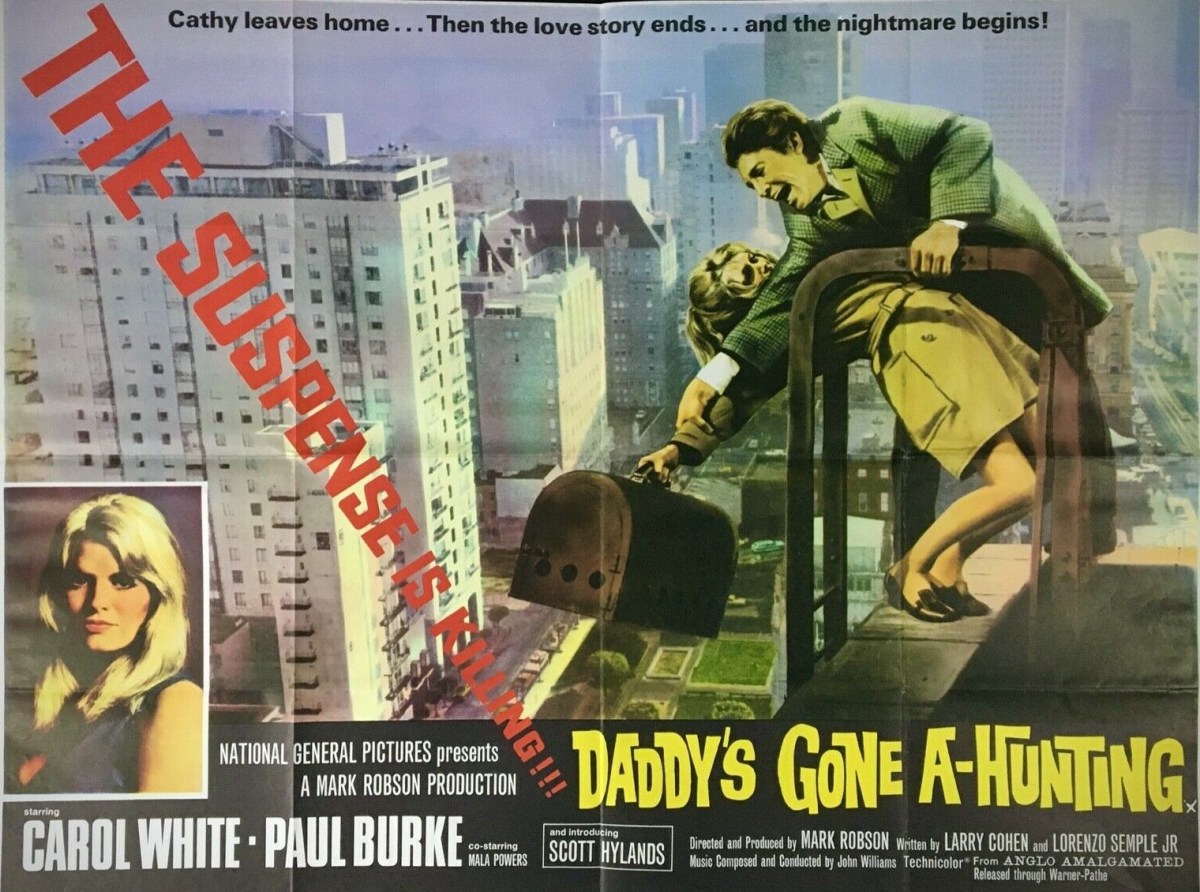
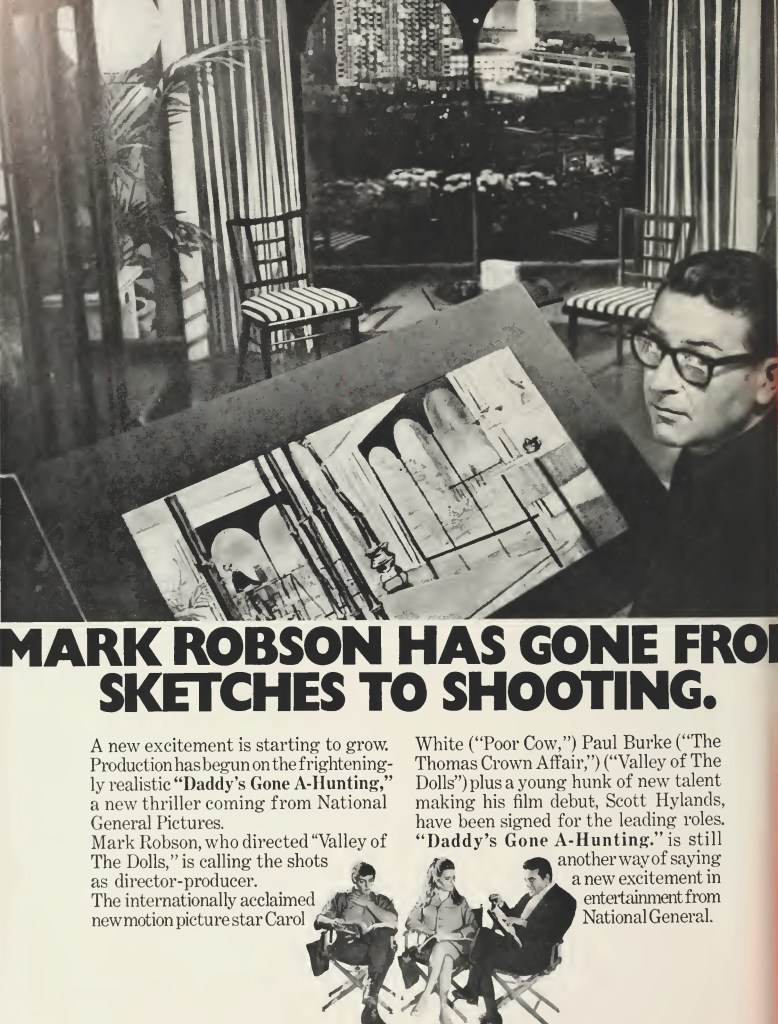
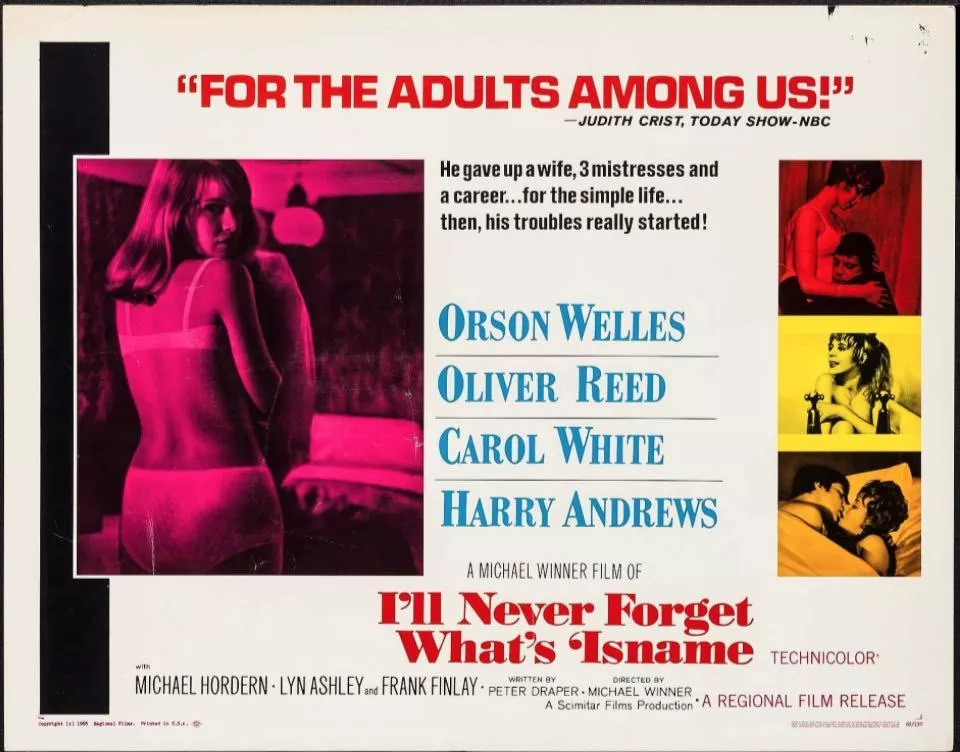
Everyone wants to be a star-maker. Director Mark Robson thought he had some form in this area after Valley of the Dolls (1968) showcased Barbara Parkins and Sharon Tate. There’s no doubt British actress Carol White reveling in critical kudos for Poor Cow (1967) had promise. But not necessarily good professional advice otherwise how to account for a supporting role in Prehistoric Women/Slave Girls (1967) her first picture after success in three BBC television productions. The female lead in Michael Winner’s I’ll Never Forget Whatisname (1967) was followed by a small role in the more prestigious John Frankenheimer drama The Fixer (1968). But none of these films did anything at the box office. Enter Mark Robson.

This thriller might have made her a star had it not been so darned complicated. It veers from paranoia to stalkersville to Vertigo via Gaslight without stopping for breath and some elements are so obviously signposted at the start you are just waiting for them to turn up. Plus, if ever a film has dated, it’s this one, going back to the days when abortion carried automatic stigma and fathers could get away with lines like “you murdered my baby.”

So, one of the few times in history San Francisco got snow (it averages zero inches annually according to Google) the meet-cute is sketch artist Cathy (Carol White) being hit by a snowball thrown by wannabe Kenneth (Scott Hylands, making his debut). But when she realizes how much he enjoys watching cats stalking canaries decides she doesn’t want his baby and aborts it. 

A few years later she marries congressional candidate Jack (Paul Burke from Valley of the Dolls) and when pregnant crosses paths with Kenneth who manages to insinuate himself into her family via her husband. Twist follows twist until we are on the Top of the Mark (a famous city landmark) for a gripping climax.

White does well as she shifts through the emotional gears but she is barely given respite from being overwrought so at times her acting appears one-dimensional rather than varied. In fairness to her, the movie’s plot gives her no chance to deliver a settled performance. Hyland looks as if he’s auditioning for a role as a serial killer, but the depth of his cunning and his twisted perceptions kept this viewer on edge – what it would take for Cathy to make amends will chill you to the bone.

Robson has some nice directorial touches, a scene reflected in the eye of a cat, a clever jump-cut from marriage proposal to marriage ceremony and some flies in milk.  Mala Powers makes a welcome big screen appearance after nearly a decade in television. That this whole concoction emanated from the fertile imaginations of screenwriters Larry Cohen (It’s Alive, 1974) and Lorenzo Semple Jr. (Fathom, 1967) might give you an idea of what to expect.

Candy (1968) **

Ode to the male gaze. Once a cult vehicle, this will struggle to find favor these days what with its backward attitudes. Virtually impossible to excuse the rampant self-undulgence. The sexually exploited naïve Ewa Aulin in the title role didn’t even have the benefit of being turned into a star. The satire is executed with all the finesse of a blunderbuss. And while, theoretically, picking off a wild range of targets, if this movie has anything to say it’s to point out how easy it is for men to deify themselves at the slightest opportunity.

Not much of a narrative more a series of sketches slung together with the slightest connecting thread. Most its appeal lies in watching huge marquee names make fools of themselves. Or, if you’re that way inclined, seeing how much nudity will be imposed on the star, intimacy  rarely consensual, clothes usually whipped off her.  

Teenager Candy (Ewa Aulin) has father issues, daddy (Jack Austin) being a dumb angst-ridden teacher. Randy poet McPhisto (Richard Burton) drives a class of schoolgirls into a frenzy with his lusty reading, inveigles Candy into his chauffeur-driven car, ends up in her basement drunkenly humping a mannequin while Mexican gardener (Ringo Starr) with an accent as coruscating as that of Manuel from Fawlty Towers assaults her on pool table.  Scandalized father packs her off to his twin brother in New York, that notoriously safe haven for nymphettes, while on the way to the airport they are almost driven off the road by the gardener’s vengeful biker sisters (Florinda Balkan et al).

For no apparent reason she is hitching a lift on a military plane commanded by randy Brigadier Smight (Walter Matthau) who, on the grounds that he hasn’t had sex for six years, commands her to remove her clothes for the good of the nation. In the Big Apple, rock star surgeon Dr Krankheir (James Coburn), entering the operating theater to the same kind of waves of acclaim as McPhisto, finds an excuse to have her undress and submit to him, this just after she’s managed to avoid the attentions of her randy uncle. It should come as no surprise that Krankheit treats women as his personal property to the extent of branding them like cattle.

In due course, she encounters a gang of mobsters, an underground movie director and a hunchback (Charles Aznavour) who, in return for her showing pity for his condition, proceeds to rape her. She is arrested. Guess who wants to frisk her. Naturally, when she escapes she runs into a bunch of drag queens.   

Then she finds sanctuary in a semi-trailer truck, home to guru Grindl (Marlon Brando). He’d be convincing enough as a mystic except he, too, finds an excuse to rip her clothes off. There are more cops to contend with and another guru, facial features obscured by white clay. If they’re going to have sex then naturally it must be in a Hindu temple. Turns out the latest person to take advantage of her is her father but he’s been handed a get-out-of-jail-free card because by now he’s brain damaged.

This might all be a dream/nightmare. Candy might even be an alien. It’s dressed up in enough psychedelia to sink a battleship and its highly likely that any lass as gullible as Candy will find herself at the mercy of any man, so in that context it carries a powerful message. I’m sure many beautiful young girls will attest to the truth that men feel they have the right to paw anyone who comes their way without asking permission. And the other message is just as powerful – how many young actresses have been seduced by thoughts of fame to disport themselves in this fashion only to find that all the industry wants is their nudity not their acting talent.

You might say that the target is so obvious it hardly needs pointing out but the MeToo campaign will beg to differ and you would hope that Hollywood has wised up. It’s just a shame that the satire is so heavy-handed. The military and the medical profession are sorely in need to answering tough questions. Unfortunately, this picture doesn’t ask any. It’s like an endless casting couch.

Directed by Christian Marquand (Of Flesh and Blood, 1963) in, thankfully, his final picture, from a screenplay by Buck Henry (The Graduate, 1967) and Terry Southern (Dr Strangelove, 1962) based on the novel by Southern and Mason Hoffenberg. Nobody comes out of this well and it’s rammed full of cameos from the likes of Elsa Martinelli (The Belle Starr Story, 1968), John Huston (Myra Breckenridge, 1970), Anita Pallenberg (Performance, 1970), Marilu Tolo (Bluebeard, 1972) and boxer Sugar Ray Robinson.

Ewa Aulin (Start the Revolution Without Me, 1971) isn’t given much of chance, her character whimsical, pallid and submissive and she didn’t become a major marquee name.

A mess.

Les Biches (1968) *****

Innocence and experience alike are corrupted by the destructive power of love in this elegant and compelling early masterpiece from French director Claude Chabrol. Although he owed much of his later fame to slow-burning thrillers, this is more of a three-hander drama with a twist and it says much for his skill that we sympathize in turn with each of these amoral characters.

Wealthy stylish Frederique (Stephane Audran), in an iconic hat, picks up younger pavement artist Why (Jacqueline Sassard) in Paris. They decamp to St Tropez where Frederique keeps a rather discordant house, indulging in the antics of two avant-garde house-guests. Why loses her virginity to architect Paul Thomas (Jean-Louis Trintignant) who soon abandons her in favor of the older woman. Each is guilty of betrayal and although a menage a trois might have been one solution instead the lovers dance from one to another with Frederique  apparently in control, in one scene stroking Why’s hair with her hand and caressing Paul’s  face with her foot. In an attempt to win the man back, Why dresses like her rival down to hairstyle, make-up and even the older woman’s beauty spot.   

At no point is there angry confrontation, nor does Frederique simply dismiss Why from the household, but the story works out in more subtle insinuation, Frederique clearly expecting either that Why make herself scarce or, alternatively, make herself available for whenever Frederique tires of male companionship. The movie’s focus is the baffled Why. When the older pair disappear to Paris, the camera follows Why through off-season St Tropez, chilly weather replacing glorious sunshine. Frederique and Paul are the sophisticates who expect Why  to know how to play the game. The younger woman has wiles enough to see off the avant-garde irritants.

It looks for a while as if it might be a coming-of-age tale or of young love thwarted but every time Frederique enters the picture her dominance is such that proceedings, no matter how deftly controlled, have an edge and so it becomes a study of something else entirely. At one point, each has power over the other. If Why has learned anything it is restraint, so the movie never descends to tempestuous passion. She also learns, in a sense, to submit, since the impoverished can never compete with the rich. In the end her revolt takes the only other option available, against which the wealthy have no defence.     

Excellent performances from Stephane Audran (The Champagne Murders, 1967), Jean Louis Trintignant (A Man and a Woman, 1966) and Jacqueline Sassard (Accident, 1966) but Chabrol keeps all under control, twisting them round his little finger.

Superb.       

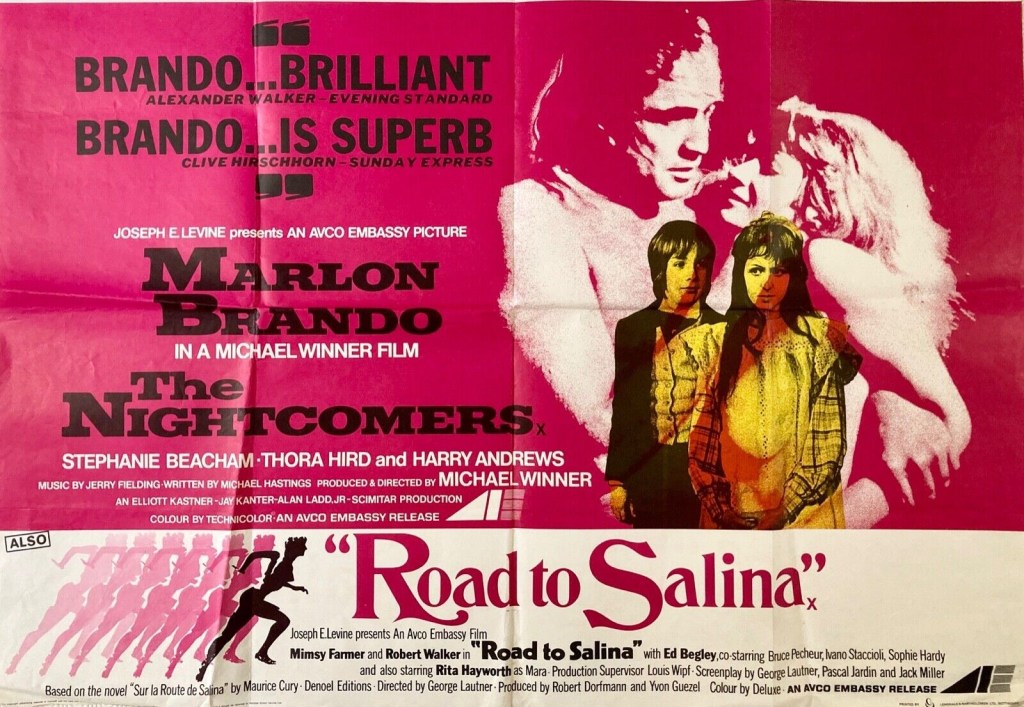
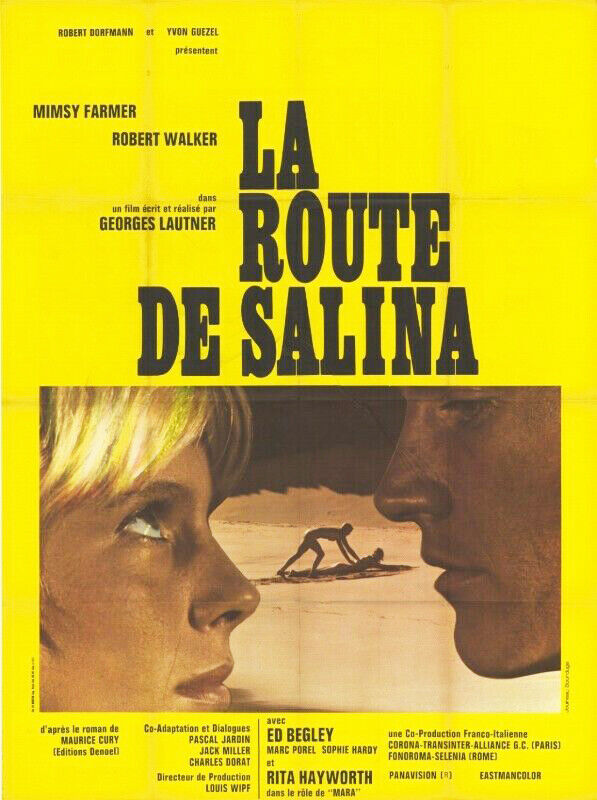
The Road to Salina (1970) ***

I thought I’d taken a stab at finding out what happened to Mimsy Farmer after More (1969) and by chance stumbled upon Rita Hayworth (The Happy Thieves, 1961), also persona non grata in mainstream Hollywood.

Pivots on the tricky trope of mistaken identity. Or, rather, someone who insists on believing that a stranger turning up is actually a long-lost son / lover / whatever. Jodie Foster was the too trusting wife in Sommersby (1993), for example, but it’s hard to pull this off once suspicions are aroused. Unless, of course, the potential dupe is determined to believe because it fills an emotional hole, thus providing sufficient narrative undercurrent.

Double bill of creepiness.

That’s the case here, when drifter Jona (Robert Walker Jr) turns up at the roadside service station run by Mara (Rita Hayworth) his resemblance to her dead son Rocky (Marc Porel) is so uncanny she believes it is the child returned. Just to be clear, Rocky died in mysterious circumstances, corpse never found, so there’s some foundation to her belief beyond maternal madness. Seizing the opportunity for a warm bed and some decent grub and the chance to be spoiled, Jona plays along – especially after Rita’s neighbour Warren (Ed Begley) supports her delusion – and soon he’s invited into another bed, that of Rocky’s sister Billie (Mimsy Farmer). The savvy daughter has her own reasons for going along with it. Then we’re into flashbacks within the flashback as the mystery unfolds and we dip in and out of incidents around the gas station and the somewhat unusual relationship between brother and sister.

As with most slow-burn dramas, you wouldn’t really call it a thriller, it depends on atmosphere, but in the same way as, for example, Don’t Look Now (1973), there’s definitely something insidious here and noir-ish if you don’t mind a story played out away from that genre’s physical darkness. It digs deep into the worst emotion of all, loneliness, and how the hankering after relationship, and an inability to steer clear of the psychosexual, anything to stop you from being alone, can bring torment and tragedy. Dangling fantasy in front of a woman incapable of dealing with reality is a dangerous temptation.

While some of the elements verge on the bizarre, and the narrative threatens to tip into confusion, the viewer is nonetheless kept on pretty much an even keel by the direction, which doesn’t play hard and loose with the facts, but just takes its own slow way heading towards resolution.

The main younger characters aren’t anything we’ve not seen before and the impetuous immoral Billie could easily be a cousin to Estelle in More (1969) while Jona is just every dopehead drifter with an eye on the main chance, except he turns patsy under the femme fatale wiles of Estelle. Rita Hayworth (The Money Trap, 1965), by now a Hollywood back number, brings a healthy dose of reality, and it’s worth the admission just to watch the former sex symbol fry eggs and dance around with the equally middle-aged and frumpy Ed Begley (Hang ‘Em High, 1968) while tacitly acknowledging the bolder elements of the counter culture.

Robert Walker Jr (The Happening, 1967) doesn’t bring much to the party but Mimsy Farmer sizzles. The movie trips easily through the decades, contemporary 1970s buzz undercut by old-fashioned  1940s sensibilities.

French director George Lautner’s stylish concoction – this begins with a downpour, character trapped in torrential rain, an unusual image for the times, and unwinds in flashback – forces you to suspend disbelief long enough to guide the endeavour to a satisfactory conclusion.

Under-rated, this should appeal beyond the Farmer and Hayworth fan clubs.

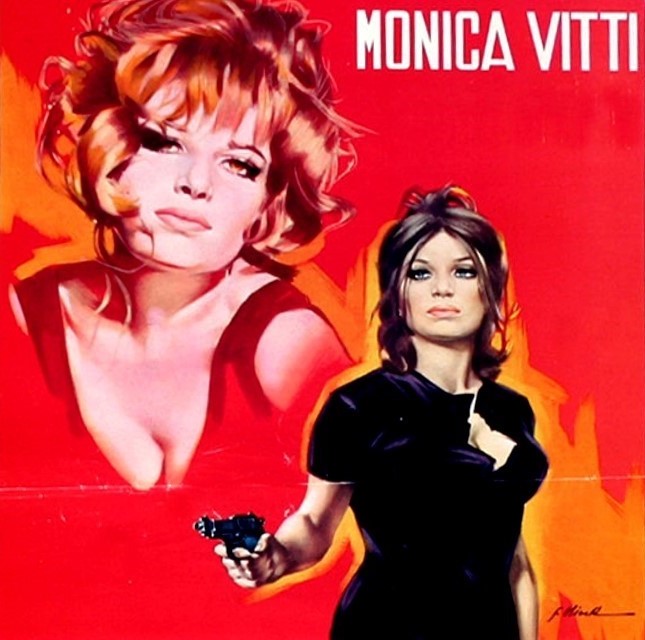
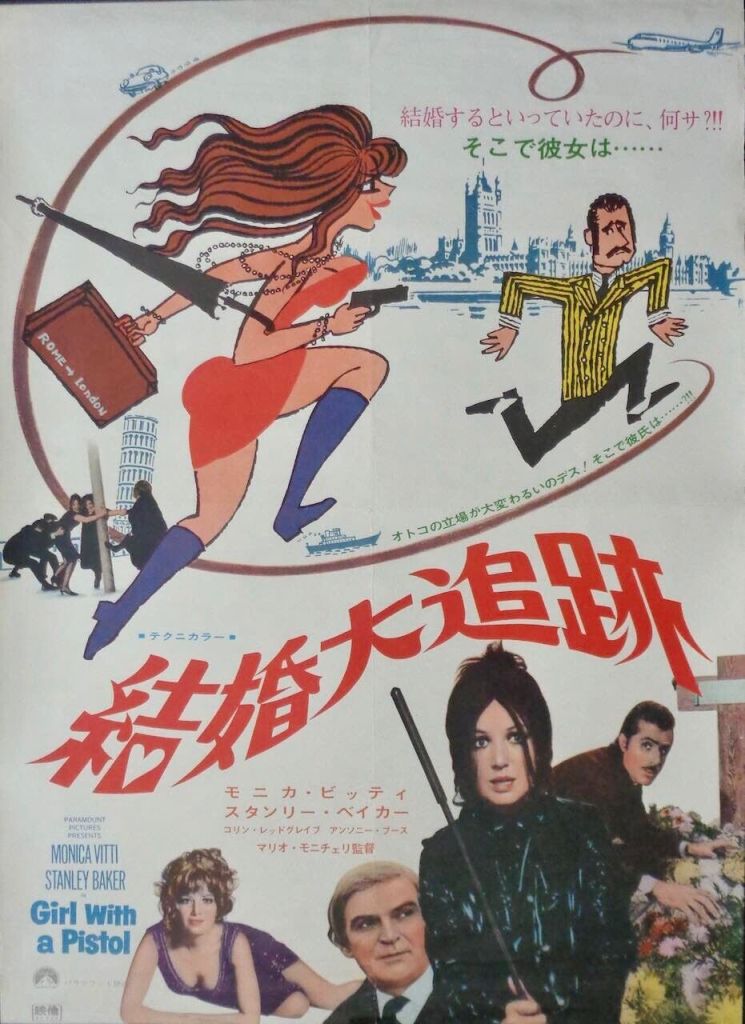
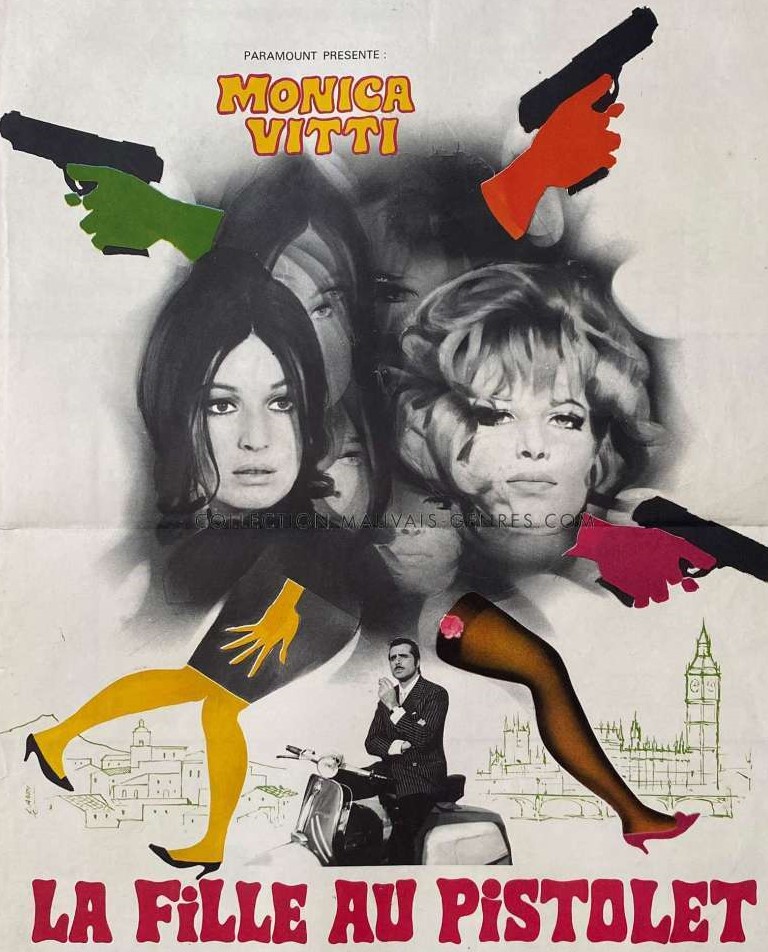
Girl with a Pistol (1968) ****

Off-beat Oscar-nominated comedy-drama that is both a marvelous piece of whimsy and a slice of social realism set in the kind of Britain the tourist boards forget, all drizzle and grime. It zips from Edinburgh to Sheffield to Bath to London to Brighton to Jersey as if the characters had been dumped from an If It’s Tuesday It Must Be Belgium sketch. If your idea of Italy was Fellini’s glorious decadence or Hollywood romance amid historic ruins and fabulous beaches, then the upbringing of Assunta (Monica Vitti) is the repressive opposite.

All women in her small town wear black. Men are not allowed to dance with women and must make do with each other. A man like Vincenzo (Carlo Giuffre) desiring sex must kidnap a woman, in this case Assunta, to which she will consent as long as he marries her. When instead he runs off to Scotland, she is dishonored and must kill him, armed with the titular pistol.

Pursuit first takes her to Edinburgh and a job as a maid, has a hilarious encounter with a Scottish drunk, and various other cross-cultural misinterpretations – in a bar she cools herself down with an ice-cube then puts it back in the bucket. Then it’s off   to Sheffield where she falls in with car mechanic Anthony Booth (television’s Till Death Do Us Part) because he is wearing Italian shoes.

She can’t imagine he can watch sport for two hours. “You’re a man, I’m a woman, nobody in the house and you look at the television.” Although tormented by images of being attacked back home by a screaming mob of black-robed women, she begins to shed her inhibitions, wearing trendier clothes, although an umbrella is essential in rain-drenched Britain and given the Italian preference for shooting exteriors.  

In between sightings of Vincenzo there are episodes with a suicidal gay man (Corin Redgrave) and a doctor (Stanley Baker). She becomes a nurse, then a part-time model, sings Italian songs in an Italian restaurant, drives a white mini, wears a red curly wig and more extravagant fashions. It turns out she can’t shoot straight. Gradually, the mad chorus of home gives way to feminist self-assertion as she becomes less dependent on men and a world run by chauvinists. It’s a startling mixture of laugh-out-loud humor and social observation. And while the narrative that at times verges on the bizarre, Assunta’s actions all appear logical given her frame of mind.

Vitti was Italian director Michelangelo Antonioni’s muse (and companion) through  L’Avventura (1960), La Notte (1961) and L’Eclisse (1962) to Red Desert (1964). She had a brief fling with the more commercial, though still somewhat arty, movie world in Joseph Losey’s Modesty Blaise (1966) and the nothing-artistic-about-it comedy On the Way to the Crusades (aka The Chastity Belt, 1968) with Tony Curtis. Director Mario Monicello had two Oscar nominations for writing but was best-known for Big Deal on Madonna Street (1958) and Casanova ’70 (1965). Girl with a Pistol was nominated in the Best Foreign Language film category at the Oscars.

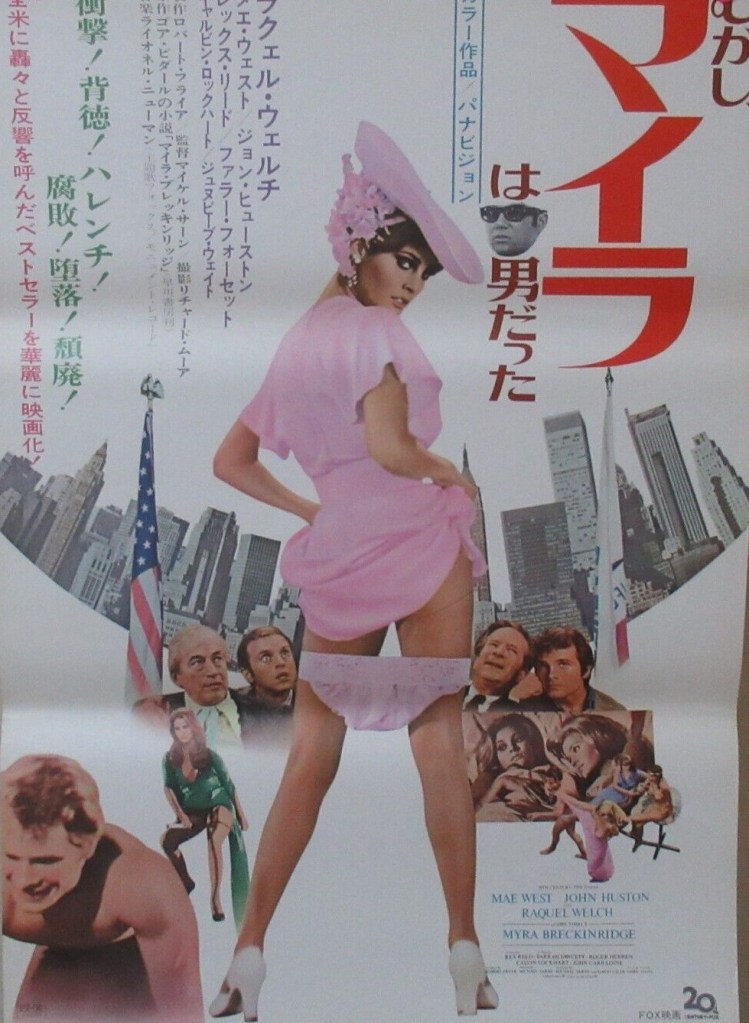
Myra Breckenridge (1970) ***

Proof that time can be kind to even the unholiest of unholy messes. Previously only appreciated/mocked for its camp values, the thin story this has to tell suddenly carries contemporary weight. Not so much the transgender elements but now revealed as the first picture to bring the MeToo agenda to light.

While it’s still terrible, with a tendency towards the really really obvious and, when that doesn’t work, bombard the audience with a That’s Entertainment smorgasbord of sexual innuendo. In fairness, even in those more feminist-awakening times, you probably still had to batter the viewer over the head to get them to accept any of the points being made.

Candy-striped oufit pure invention of the poster designer.

The first, while theoretically in a theoretical twist tranposed to the female, was the sexual predator, closely followed by the notion that every woman wanted “it”, regardless of them expressing otherwise. Even the dumbest cinemagoer could not have failed to see that putting an exclusively male casting couch at the disposal of Hollywood agent Leticia (Mae West) was actually a clever way of showing just how the movie business at its worst worked, though in reverse, the females queuing up (apparently) for the kind of sexual transaction that could give them a shot at stardom.

That it’s Myra (Raquel Welch) herself who spends most of the movie degrading men (anal rape anyone?), and women indiscriminately (I’m surprised the posters didn’t scream “Raquel Goes Lesbian”), it’s again just a play on what went on in the virtually exclusive male enclave of Hollywood. Just as pointedly it points the finger at the way Hollywood has destroyed the American Dream, snaring thousands of hopefuls who spend fortunes, whittle away their lives and prostitute themselves (and still do) in the vain hope that taking acting lessons for an eternity will somehow provide them with a talent they weren’t born with.

The narrative – what narrative? – concerns Myron (Rex Reed) having a sex-change operation to become the aforesaid Myra and then claiming an inheritance, on exceptionally spurious grounds, from her kinky uncle Buck (John Huston). And trying to part hunk wannabe Rusty (Roger Herren) from his wannabe girlfriend (Farrah Fawcett, the Major came later). You might argue that the continuous loitering presence of Myron is a distraction but occasionally it’s welcome as the movie runs out of punchbags.

And in case you didn’t get the message in what passes for dialog, Myra takes to just delivering straightforward lectures on the male-dominant Hollywood that posited the notion that women were there for the taking if you were just male enough to take them and that any women who showed the slightest ounce of onscreen intelligence and the ability to swat away predatory males was just a predatory male in disguise.

Nobody comes out of this with any dignity and though it destroyed the career of director Michael Sarne (Joanna, 1969) and Roger Herren, John Huston (The Cardinal, 1963) was inclined to self-indulgence on-screen if not restrained by a strong director, while Farrah Fawcett and, in a bit part, Tom Selleck survived to become television legends. The less said about wooden Rex Reed the better.

Quite where this left Raquel Welch is anyone’s guess. While she held the narrative together in convincing fashion, as an actress she wasn’t provided with enough material beyond the sensational to convince as a dramatic actress of anything more than middling caliber. Yet, it was an incredibly brave career decision. The contemporary likes of Joanne Woodward, Jane Fonda, Maggie Smith et al would have balked at the thinness of the material, and would have run a mile from expressing themselves in such sexual terms, despite probably recognizing what the movie was attempting to achieve.

It needed someone larger than life to play the part and, possibly with higher expectations than seemed plausible, the bold Raquel stepped up to plate. Perhaps the element that appeared most to her was that she took revenge on Rusty because (shock, horror) he didn’t fancy her at a time when she was presented as the most fanciable woman on the planet.

So discretion left at the door, blunderbuss in full operational mode, but even now it’s that approach that is wakening the industry up to the sexual misbehavior of many of its to male personnel. What was once top of the so-bad-it’s-good tree is now revealed as not too bad after all, if you swap the phantasmagoria for the stinking reality underneath.

Behind the Scenes: “More” (1969)

In reality, very much a what-if autobiographical tale. Barbet Schroeder had fallen in love “at first sight” with a “very quiet reasonable girl” but a junkie whose mission was to make him try heroin. She failed but the resulting movie imagines what would have happened had she succeeded. Drawing very much on his own early life on Ibiza, the film also set out the capture the island’s splendor, the sense of a world and way of living untouched for centuries.

Schroeder grew up in the house where the movie was filmed. He lost his virginity there. It had been built by an artist in 1935 and they enjoyed a peasant lifestyle. Rainwater supplied the cisterns, the building was painted once a year with lime manufactured from rudimentary ovens in the local woods, candles provided the lighting. They cooked locally-caught fish on grills fuelled by locally-made charcoal, as the characters do in the film. A great deal that was close to home was incorporated in the movie.

Around the age of 14, Schroeder developed an interest in cinema, and determined he was going to pursue a movie career. But, equally, he decided that “it was not a good idea to start too young” – his idols Fellini and Nicholas Ray had, in his opinion, made their best films in middle age – and would hold back from becoming a director until he was 40. In the meantime, he had become a producer, behind the films of Eric Rohmer such as La Collectionneuse (1967) and Ma Nuit Chez Maude (1969). He spent two years writing a screenplay, along with Paul Gegauf, for More and raised the finance after filming a trailer on location.

His mother was German hence the nationality of Stefan. The aspects of the Nazi character in the film was also autobiographical since his immediate neighbour in Ibiza had displayed similar tendencies, creating such tension between the two households that they kept to separate beaches, although the Germans as well as sun-worshipping proved to be pill-poppers leaving amyl nitrate capsules on the sand.

“I did not want to deal with drug problems,” insisted Shroeder, who viewed the movie in more “esoteric terms.” He saw it as the “story of someone who sets out on a quest for the sun and who is not sufficiently armed to carry it through…so instead finds…a black sun.” The drugs element was only employed “in relation to character…as an element in destruction, only as a motor in the sado-masochistic relationship between a boy and a girl.” Stefan is “passionately in love but unable to really love.”

When in doubt, resort to the old sex sells marketing.

In fact, Schroeder refused to treat the drugs element in didactic fashion, determined to not only show the differences between individual drugs but make plain that this was “one particular case.” He cautioned, “Naturally, there will be spectators, impressed by the dramatic violence at the end, who will forget the nuances shown before and will believe they have seen a film moralizing the use of drugs.” The Ibiza setting was not, in itself, crucial to the tale, and it could as easily have been set on another isle.

He knew the film would be banned in France, due to the extensive and full-frontal nudity as much as the non-judgemental depiction of drug use. Despite acclaim at Cannes, it was on the forbidden list in France for almost a year though the version later released was censored. Regardless of the American funding, Schroeder wanted to make a movie that was European in its sensibilities. “It was less a story of our time and more a timeless story of a femme fatale,” he said. However, the island was at the forefront of an avant-garde movement more interested in the spiritual and an intense communion with nature. Even so, the perspective was “the very opposite of the hippie” ethos. As Stefan explains, there is “no pleasure without tragedy.”

Mimsy Farmer followed a long line of actresses turning to Europe when careers were stymied in Hollywood. Although talent-spotted at the start of the decade and selected as one of the “Deb-Stars,” her role in Spencer’s Mountain (1963) had not led to the kind of parts she might have expected and she had drifted into B-movie fare like Hot Rods to Hell (1966), Riot on Sunset Strip (1967) and Wild Racers (1969). Her Ibiza sojourn led to The Road to Salina (1970) and iconic giallo Four Flies on Grey Velvet (1971).

Pink Floyd became involved because the director was captivated by their first two albums “The Piper at the Gates of Dawn” (1967) and “A Saucerful of Secrets” (1968) and they were susceptible to following his instructions of not writing standard film music but pieces that were “anchored in the scenes.” He showed the band a work print of the movie and they composed and produced the score in less than two weeks. Coming out in the wake of Easy Rider, it plugged into an audience more appreciative of the counter-culture music infiltrating the Hollywood mainstream.

The movie was not as unfavorably received by the critics as supposed (witness the poster shown above) and three out of the four main New York critics gave it the thumbs up. It opened in three cinemas in Paris and ran for over 10 weeks in a New York arthouse, the Plaza, picked up business in London and the response in Germany stimulated a tourist boom in Ibiza.

SOURCES: Interview by Noel Simsolo, published in the Pressbook, 1969, copyright Image et Son/Les Films de Losange; “Making More,” (2011), produced by Emilie Bicherton, BFI.

YouTube has the documentary.

More (1969) ***

Hedonism gets a reality check but not before it’s done a pretty good job of marketing Ibiza as an idyllic setting and just the place to accommodate anyone wanting to get high on drugs. Despite being the directorial debut of French producer Barbet Schroeder (Reversal of Fortune, 1990), the movie’s better known for the soundtrack created by Pink Floyd.

Which is a shame because despite the focus on the beautiful people living in an exotic world, and plugging, it has to be said, the delights of marijuana as the drug du jour, and not wandering down any cinematic cul de sac like visually exploring in subjective fashion the effects of an LSD trip, it fairly captures the free love counter culture paradise of the time where you could chill out in the sun and you didn’t need to be a biker to do it.  

Estelle (Mimsy Farmer) is the lissom siren who hooks the far from innocent Stefan (Klaus Grunberg) – an ex-student, he has indulged in a bit of burglary – and introduces him to pot, Ibiza and heroin in that order. He finds his own way to other indulgences like a menage a trois. There’s an older drug dealer (Heinz Engelmann) in the background and some pals, Charlie (Michael Chanderli) and Cathy (Louise Wink), fleetingly hover into vision, but mostly it’s a two-hander, and there’s none of the despair and nihilism of drug addiction nor the moralistic overtones of a Hollywood picture too frightened of even the more enlightened censor to dare suggest you can have your cake and eat it.

There’s not much story, just the pair falling in love and hanging out, and Stefan wanting to experience the “more” that has made Estelle so impervious to life’s downturns. When he discovers her secret is heroin he wants to turn on in similar fashion and loving lover that she is she obliges. He can’t handle it the way she can and he’s the one that goes over the edge and dies of an overdose. But the director doesn’t resort to any moralizing at the end, this is no wake up call for Estelle, and there’s no sense of guilt, he’s just another handsome ship passing in the night.

The film’s best at exhibiting the easy living, the relaxed lifestyle, of the drug community where ownership is forbidden and life is cheap. It’s filmed as a romance, glorious settings made more glorious by the cinematography of Nestor Almendros (Days of Heaven, 1978).

Mimsy Farmer (Spencer’s Mountain, 1963) is the standout, making the jump into adult roles with ease, presenting an amoral character whose main aim in life to find the deepest sensory experiences. Klaus Grunberg, on his debut, is really just swept along like some flotsam in her attractive wake. Even when Farmer is stoned and really out of it she captures the camera, and while her character is essentially unattractive, it takes some pretty good acting to keep the audience from coming to that conclusion.

The act of shooting up was innovative for the time – and censored in some countries – but it’s not presented as anything but an extension of freedom, liberation of self a la LSD, and even Stefan’s death, the grittiest scene, comes over as mere collateral damage.

That it works is mostly due to Farmer’s performance and Schroeder’s lack of prurience. While there’s abundant nudity, and Estelle makes out with a gal and then enjoys a threesome, there’s no sense of sexploitation, which creates quite a different atmosphere to the more sensational movies of the time. Best of all, in deliberately moving away from heightened drama and turgid instincts that might focus instead on such elements like jealousy or guilt, the director allows the audience to make up its collective mind.

And if you get bored, there’s always the soundtrack and scenery.

Interesting depiction of elusive nirvana.

Red Sun (1971) ****

Reminder of just how good an actor Charles Bronson was before he went all monosyllabic in The Valachi Papers (1972) and Death Wish (1974) and growled and grimaced his way to superstardom. Realistic western filled with anti-heroes except for the least likely hero in the shape of a Japanese swordsman.

In the early days of the multi-national co-production, the idea was to headline the picture with stars who could sell the picture in their domestic country, although Bronson did double duty, a Yank who was a far bigger star in France than in his home land. Frenchman Alain Delon (Texas Across the River, 1966) also doubled up, a reliable performer in U.S. markets as well as in his home patch. Toshiro Mifune (Hell in the Pacific, 1968), huge commercially in Japan, also appeal to the global arthouse mob. Ursula Andress (She, 1965), though technically Swiss, held sway over male hormones in wide swathes of Europe. And if that wasn’t enough, for good measure, there was another French beauty in Capucine (The 7th Dawn, 1964).

Interspersed with bouts of action of one kind or another, the story is mostly of the immoral kind, double-crossing to the fore, seduction merely a tool, but arriving at a surprisingly moral conclusion. Usually, pictures that focus on adversarial characters forced to work together pivot on a gender clash, romance going to find a way. But here, the outlaw and the swordsman are mostly at odds and, to top it all, outlaws, swordsman and seducer have to band together to save the day at the end.

Story is slightly complicated in that Link (Charles Bronson) begins as a bad guy, in league with Gauche (Alain Delon), to rob a train and doesn’t really stop being a bad guy, and is very self-aware about the consequences of his chosen profession, even when, double-crossed and left for dead, he seeks revenge on his partner. The opening section has a heist-like quality, you know the kind, where clever machination is required. Here, it’s how to empty the train of the soldiers helping escort a Japanese ambassador. But once that’s accomplished and the small matter of $400,000 swiped, only greed cues the complication, in that Gauche also nabs a Japanese ceremonial sword, and Kuroda (Toshiro Mifune) is honor-bound to recover it.

Gauche is also the kind of outlaw who doesn’t appreciate his team’s efforts, not only attempting to murder Link but finding occasion to bump off other members of the gang. Link becomes Kuroda’s prisoner and spends a good chunk of time trying to escape and even when they supposedly come to an agreement can’t resist the odd double-cross. The quarrel is mainly over who gets to kill Gauche.

Anyway, eventually, they end up in a small western town big enough to contain a whorehouse run by Pepita (Capucine), sometime lover of Link, where lies potential bait in the shape of Christina (Ursula Andress), Gauche’s girlfriend. When Gauche doesn’t take the lure,  they have to saddle up and seek him out, hoping to trade the girl for at least some of the loot and the sword. Christina is as untrustworthy a prisoner as Link and gets them into trouble with the local Commanche, thus setting up a finale in a blazing cornfield.

The tasty exchanges between the Yank and the Japanese, more than the culture clash, drive the picture, though the eastern obsession with cleanliness is a new one for the western. You wouldn’t say the pair end up buddies but they certainly hold each other in healthy respect.

Charles Bronson isn’t easy-going but he’s much more natural, with a welcome grin, plenty dialog, and ready for most eventualities (except the first one, obviously). Mifune brings in  the wider audience that gave Hell in the Pacific the thumbs-down. This could have been a swashbuckler had he been more cavalier in character, and perhaps the most telling difference between east and west is his venerating approach to a sex worker. Mifune is a fine match for Bronson.

Delon and Bronson go way back to  Farewell, Friend / Adieu L’Ami (1968), the movie that turned Bronson into a giant star in France and in which they were the adversarial buddies. Delon here plays both sides of his screen person, the charming gallant and the ruthless gangster, and it’s a rare sight indeed to have three actors at the top of their game appearing in scenes together. Ursula Andress also plays against type, as a conniving seductress, with a complete lack of the self-awareness that typifies Bronson. Mostly, she’s just nasty.

On the face of it, the eastern western should be nothing more than a marketing gimmick but in the capable hands of Terence Young (Mayerling, 1968) it works a treat. More talky than audiences might have expected but that adds meat to the raw bones of a revenge picture. Took three screenwriters to pull it off – William Roberts (The Magnificent Seven, 1960), Denne Bart Petitclerc (Islands in the Stream, 1977) and Laird Koenig (Bloodline, 1979). Great score by Maurice Jarre (El Condor, 1970).

A surprise.

Sam Whiskey (1969) ***

You don’t realize the importance of treatment until you see an interesting story mangled. Taking the comedic approach to a heist picture is tricky. You can’t just make it happen because that’s what the script says, you’ve got to prove to an audience that whatever takes place is believeable. And frankly, asking three inexperienced dudes to smelt down a ton of gold and sneak it into a government building in the shape of a bust (the statue kind, not the other) and then smelt it back down again while inside and turn it into gold bars is a stretch too far.

This is amiable enough as far as it goes, and Burt Reynolds gives his good-ol’-boy routine a try-out, Angie Dickinson strays from her usual screen persona, and it does present some interesting screen equality – a Yaqui Indian shown as someone you would pay a debt to, Ossie Davis making a pitch for the African American acting crown.

I saw this double bill at the time of original release.

But it’s bogged down in a cumbersome plot that I guess many in the audience, like me, would have been begging for a switcheroo at the end that made more sense for the genre.

So, bear with me, Laura (Angie Dickinson) hires ex-gambler Sam Whiskey (Burt Reynolds) to retrieve $250,000 worth of gold ingots lying inside a sunken riverboat at the bottom of a river. Fair enough, you think, it’s the nineteenth century, nobody would be able to hold their breath that long to attempt to retrieve it even one gold bar at a time.

But she only wants the gold back to satisfy family honor. You see, her dead husband was in charge of transporting the gold to the local mint and to cover up his calmaity he replaced the gold with ingots made of lead. And hold on, there’s more, a Government inspector is due at the mint.

So, Sam and his buddies, blacksmith Jed (Ossie Davis) and strongman turned inventor O.W. Bandy (Clint Walker) have not just to recover the gold, and resist the temptation to simply spirit it away over the border, but find a method of getting it back inside the mint without anyone knowing and at the same time smuggle out the false ingots.

Of course, Laura has a blueprint of the plans of the mint so that’s okay then. And there’s a bust of her dead husband in the hallway of the mint and if Sam can just find the right excuse to take it away – and bearing in mind he has no obvious mold to use to re-cast it – he can re-make it in gold, return it, sneak it down into the smelting room and turn it back into gold bars.

Yes, the story is that complicated. Sam is only prevented from stealing the haul for himself by the seductive presence of Laura, who also has to act femme fatale enough to waylay the real inspector, whose identity Sam steals. I was praying that Laura, who seemed to be too good to be true what with all that family honor, was actually playing Sam for a patsy and that what was being removed from the mint was the real gold and what was being substituted was the fake.

No such luck. And this might well have worked if it had been treated seriously, if Sam was a famous robber, and if the director hadn’t interrupted proceedings every few minutes with some woeful comedy music and littered it with non-sequiturs or even provided a decent villain apart from Fat Henry (Rick Davis) and his motley crew who suspect something is up and attempt to hijack the gold before it reaches the mint.

And it’s a shame because the leading players are all an interesting watch. Burt Reynolds (Fade In, 1968), still a few years short of stardom, takes a risk in playing his character in light comedy fashion, coming off second best in his opening encounter with Jed. Angie Dickinson (Jessica, 1962) is far too genteel to play the femme fatale and it’s clear she only goes down the seduction route when Sam balks at the barminess of the idea, but it’s equally clear she’s the brains of the operation, and that’s pretty much a first in the western robbing business, and her character is so deftly acted that it’s only later, when you add everything up, you realize the depths of the character and that’s she only allowed audiences a glimpse of the surface.

Ossie Davis (The Scalphunters, 1968) doesn’t attempt the obvious either. He’s not after the Jim Brown action crown. He can look after himself with his fists, but he’s got the intelligence to avoid getting trapped by violence. And Clint Walker (The Great Bank Robbery, 1969), also primarily playing against type, is a muscular version of the crackpot inventor you usually found in a British comedy, but who is capable of coming up with an early version of  diving equipment. And he has a great line that despite endless rehearsal he muffs up, “Aha!” he proclaims, battering in a bedroom door, in best Victorian melodrama fashion, “I caught you trifling with my wife.”

So it’s worth it for the performances and if you ever hankered after the seminal shot of a squirrel overhearing a conversation or wondered how many shots in one movie a director could contrive to make through a small space then this is for you. Screenwiter William Norton (The Scalphunters) had better luck with other directors but here Arnold Laven (Rough Night in Jericho, 1967) takes a wrong turning. Amiable is not enough, certainly not for a complicated heist picture.

Angie Dickinson and Burt Reynolds completists, though, will not want to miss this.

Discover WordPress

A daily selection of the best content published on WordPress, collected for you by humans who love to read.

The Atavist Magazine

by Brian Hannan

WordPress.com News

The latest news on WordPress.com and the WordPress community.