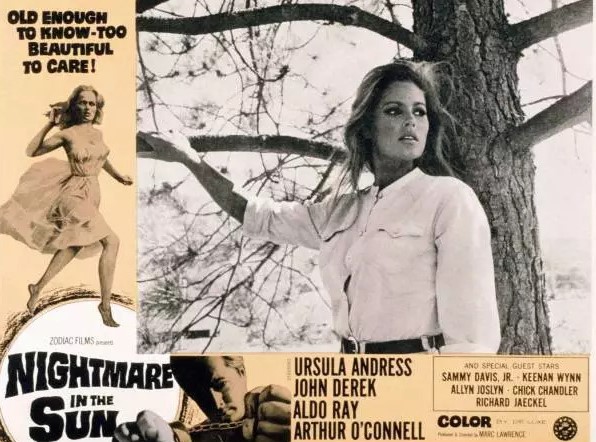
Nightmare in the Sun (1965) ***

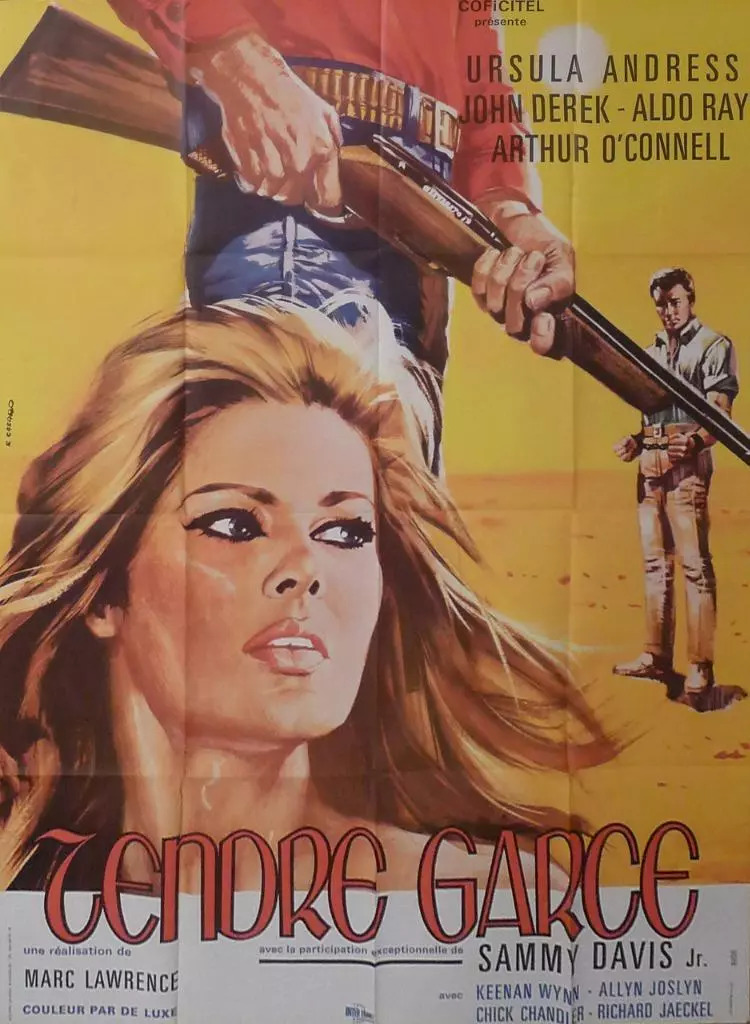
Your first question is how did rookie director Marc Lawrence have the standing and the foresight to  assemble such an amazing cast? Not just wife-and- husband team Ursula Andress  and John Derek (Once Before I Die, 1966) upfront, but Rat Pack member Sammy Davis Jr (Sergeants 3, 1962), The Godfather (1972) alumni Robert Duvall and John Marley, Aldo Ray (The Power, 1968), Richard Jaeckel (The Devil’s Brigade, 1968), Keenan Wynn (Warning Shot, 1966) and Arthur O’Connell (Fantastic Voyage, 1966).

And it’s bold work, throwing the Psycho dice, playing the hell out of the noir tune, most of the time heading down a nihilistic road, and with a terrific twist for a climax. Some great scenes that with a more experienced director would be instantly memorable and managing to fit into what should be a straightforward thriller some intriguing oddball characters.

Anonymous drifter (John Derek) ends up in a small town in Nowheresville where Marsha (Ursula Andress) has a slew of lovers including the sheriff (Aldo Ray). Wealthy rancher husband Sam (Arthur O’Connell) is the jealous type who checks out her speedometer to see if her tales of out-of-town visits tally up. Naturally, a handsome stranger is easy prey to her seductive charms but when hubbie spots said stranger leaving his house he loses his rag and kills her.

Holy moly, talk about Psycho, getting rid of the sexy star one-third of the way through is a heck of a note. Who does this director think the audience is coming to see? But if he’s no  Hitchcock, he’s got another trick up his sleeve. Sheriff won’t let the husband plead guilty, not when he can play that card for all it’s worth, rooking the rancher for thousands of bucks, so he decides to pin the blame on the man seen leaving the house. Not only that, he plants evidence, stolen jewellery etc, on the suspect and handcuffs him.

Suspect escapes, taking with him a cop car, but those handcuffs are tougher to remove than most cinemagoers have been led to believe from previous yarns. A hacksaw won’t do it nor will trying to burn them apart with an oxy-acetylene cutter. So he’s stuck with carrying about proof of guilt or at least suspicion and spends most of the time picking up cats or items to hide the evidence.

A couple of bikers (Robert Duvall and Richard Jaeckel) decide to chase the reward money, able to scoot through the desert in a way denied the cops’ four-wheelers. It’s a shame this pair are anonymous, as most characters here are, defined by occupation rather than slowing down the pace with introductions. So it’s the Robert Duvall character who we discover is more fragile than his appearance would suggest and lashes his bike with a chain when his character is questioned.

So here’s the oddball line-up: a couple (George Tobias and Lurene Tuttle) running a small-time animal-bird sanctuary, nursing back to health creatures peppered with gunshot or the wounded version of roadkill; a junkyard dealer (Keenan Wynn), one-time hoofer who can’t wait to demonstrate his moves; and a type of boy scout leader (Allyn Roslyn) whose troop gets lost in a sandstorm, one of whom our drifter rescues. The latter sequence has a touching aspect, rescued child, probably the only person in the whole movie with an understanding of law, accepting a suspect as innocent rather than guilty, is betrayed by the leader who instead of helping our escapee to safety, hands him over to the cops.

And to a final, quite unexpected, climax.

So it’s corruption all the way, even our innocent, supposedly heading home to a beloved wife, taking time out for a touch of adultery.

There’s something about these early low-budget films that brings out the best in Ursula Andress. She’s not just spouting lines to fill in some essential part in a story, but takes her time over delivery, essentially establishing character with what she does between talking and for a practised seducer there’s an innocence in her pleading, “Please take me somewhere nice.”

Aldo Ray is as odious as they come, sneaky too, and you sense he has practice on pinning the blame on the wrong person. And no wonder the wife plays around when her self-pitying husband gets so stoned he passes out.

I saw this on a very poor print on YouTube but even so its narrative qualities, if less so the direction, were obvious.

Worth a look.

Dark of the Sun / The Mercenaries (1968) ****

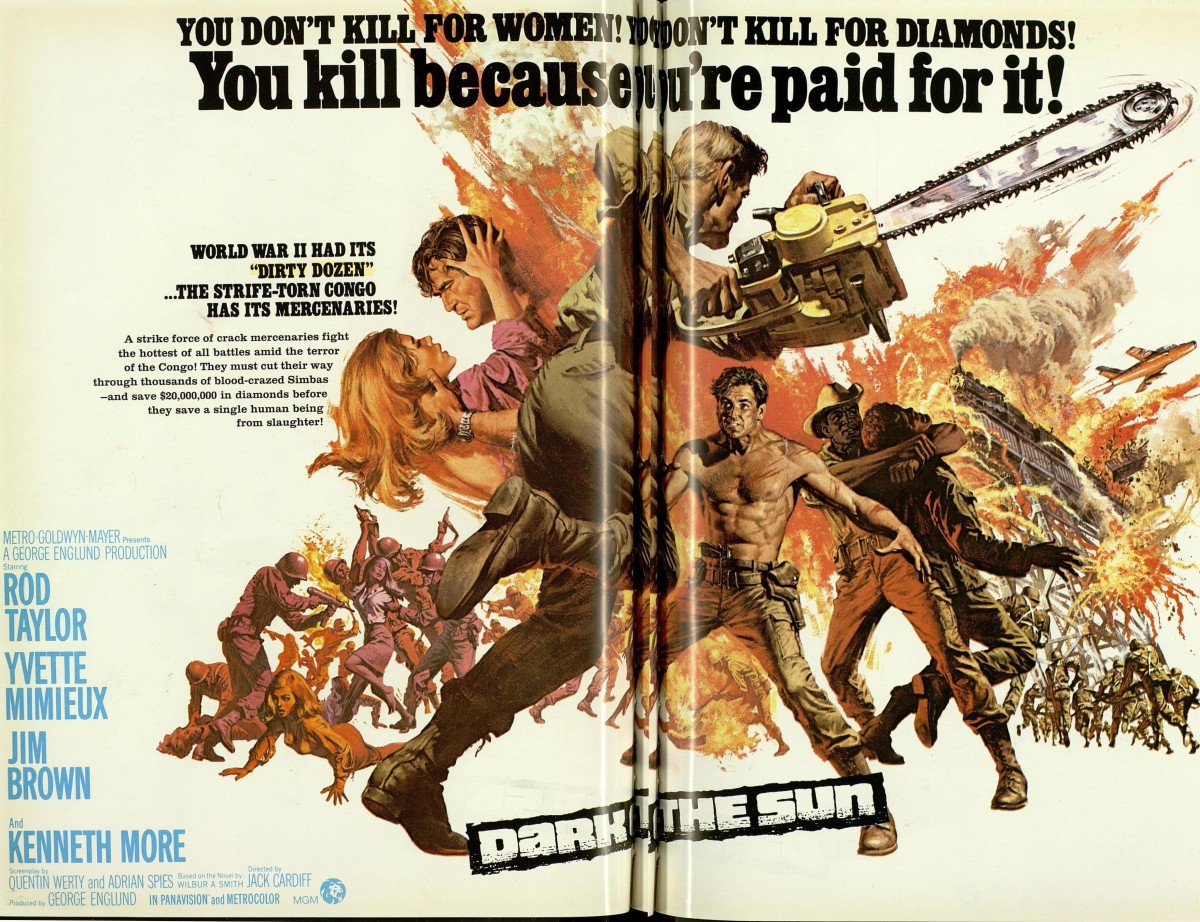
Rod Taylor made a brisk transition to two-fisted action hero from his previous forte of drama (Hotel, 1967) and comedy foil to Doris Day (The Glass Bottom Boat, 1966) in this violent adventure set in the Congo in the early 1960s. As Captain Curry, assisted by sidekick Sgt Ruffo (Jim Brown) and 40-man local outfit Striker Blue Force, he leads an ostensibly humanitarian mission to rescue settlers cut off by the Simba rebels as a cover for collecting $50 million in diamonds. The loot is essential to save the toppling regime of President Ubi (Calvin Lockhart).  The only feasible transport is train. There is a three-day deadline.

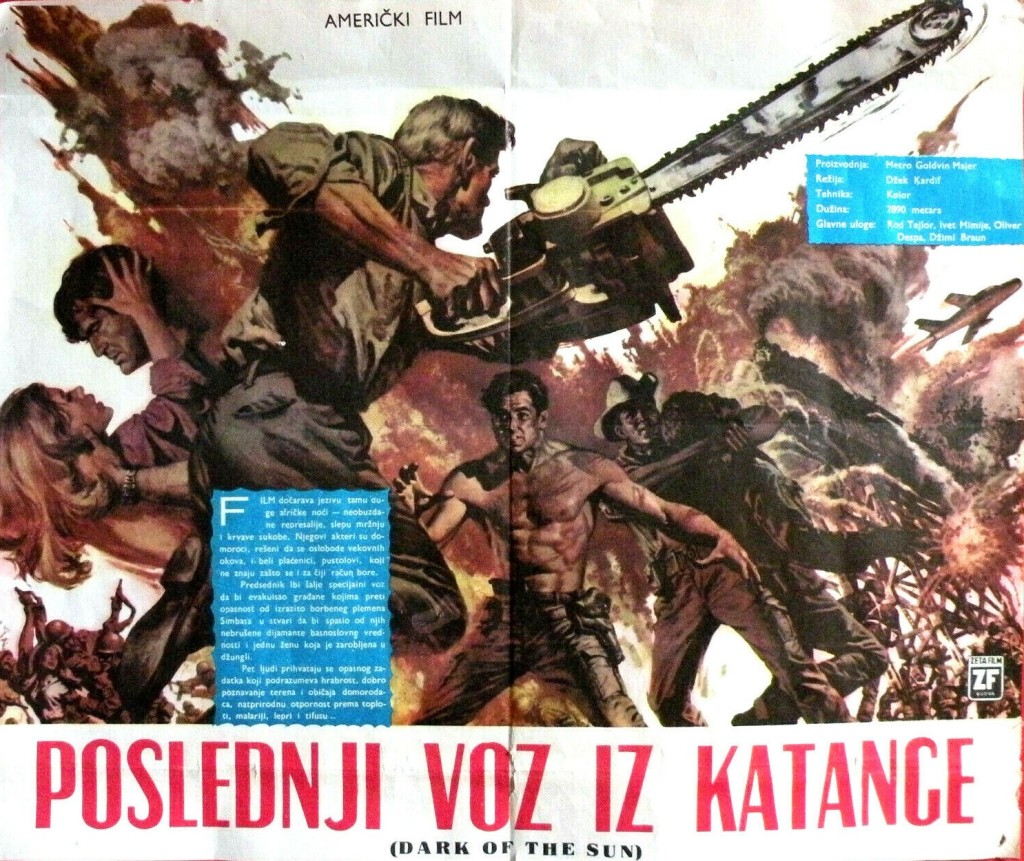
Problems immediately ensue, not least a clash with Capt. Heinlein (Peter Carsten), former Nazi leader of Blue Force, who is even more ruthless than Curry, mowing down two native children who stray too close to the train, and apt to go into a fistfight with a chainsaw. The train is attacked by a United Nations plane and on reaching its destination Curry is forced to wait three hours until the time-controlled giant diamond vault can be opened, giving the rebels time to catch up. Then it’s an ongoing battle of one kind or another.

Although the worst of the violence is carried out by the rebels – rape, torture and massacre – a core element of the drama is how a lifetime of killing has affected Curry. Ruffo, a man of principle who grew up in a primitive tribe, acts as his conscience – and that of the audience – spelling out how violence is more than a money-making scheme and essential to upholding order in terrorist times. Curry has some redemptive features, saving widow Claire (Yvette Mimieux) from Heinlein, sending the alcoholic Doctor Wreid (Kenneth More) to help a woman give birth, and eventually acknowledging his strong bond with Ruffo. Although Curry would like to think he is the opposite of Heinlein, they are carved from the same stock and when the savage beast is loose blood lust takes over. 

Claie is more or less there as bait, tempting Heinlein and any rebels in the vicinity, but coming into her own in convincing Wreid, paralytic by this stage, to carry out a section on the pregnant woman, and as a reminder of civilization for Curry.

The action scenes are terrific, particularly the plane strafing the train, and there is a particularly good ruse, instigated by Ruffo, to outwit the enemy. Hollywood never managed to portray the terror of the native Vietnamese on being overrun by Viet Cong, and this film could easily be that substitute, especially when some of the rescued white settlers realize they will not escape.

This is not one of those films like Born Free (1966) or Out of Africa (1985) which are scenic odes to the continent, in part because the picture was shot in Jamaica, but in the main because director Jack Cardiff (Our Mother’s House, 1967) chooses to focus on the mechanics of the mission. And in so doing, he writes a love letter to a train. There had a mini-vogue for war movies set on trains – Von Ryan’s Express (1965) and The Train (1965) come to mind – but none reveal an adoration for the power and perhaps the beauty of the locomotive. Every move it makes (to steal an idea from pop group The Police) is noted on screen and on the soundtrack, the hissing, the belching smoke, the wheels, cabooses, engine, the coupling and uncoupling of links, the screech of brakes, and various tracking and crane shots as the train snakes its way through enemy terrain.

Rod Taylor is excellent in the kind of role he is made for. Jim Brown in a major step up the billing after The Dirty Dozen (1967) is surprisingly good in a part that calls as much for reflection as action. Peter Carsten is the all-time Nazi scum. Yvette Mimieux, who had partnered Taylor in The Time Machine (1960), is also in transition mode, her role a meatier dramatic departure from the likes of the innocuous Monkeys, Go Home! (1967). In what was essentially his last major role – even though it doesn’t amount to much in screen time – Kenneth More (Sink the Bismarck!, 1960) wavers considerably from his stiff-upper-lip default.

The score by Jacques Loussier is particularly good, as Quentin Tarantino attested when he incorporated elements of it for Inglorious Bastards, which was a boon for the composer since up till then he was best remembered for the music accompanying the advert for Hamlet cigars. You might get a laugh out of the screenplay credits. Quentin Werty (i.e. Qwerty, the first six letters on a typewriter) the pseudonym of Ranald McDougall, Oscar-nominated for Mildred Pierce (1945), co-wrote the screenplay, adapted from the novel by Wilbur Smith, with television writer Adrian Spies.

An outstanding example of the all-out action mission picture, its occasional outdated attitudes do not get in the way of the picture and half a century later from what we now know of how wars are fought the levels of violence will appear realistic rather than exploitative.    

In Search of Gregory (1969) ***

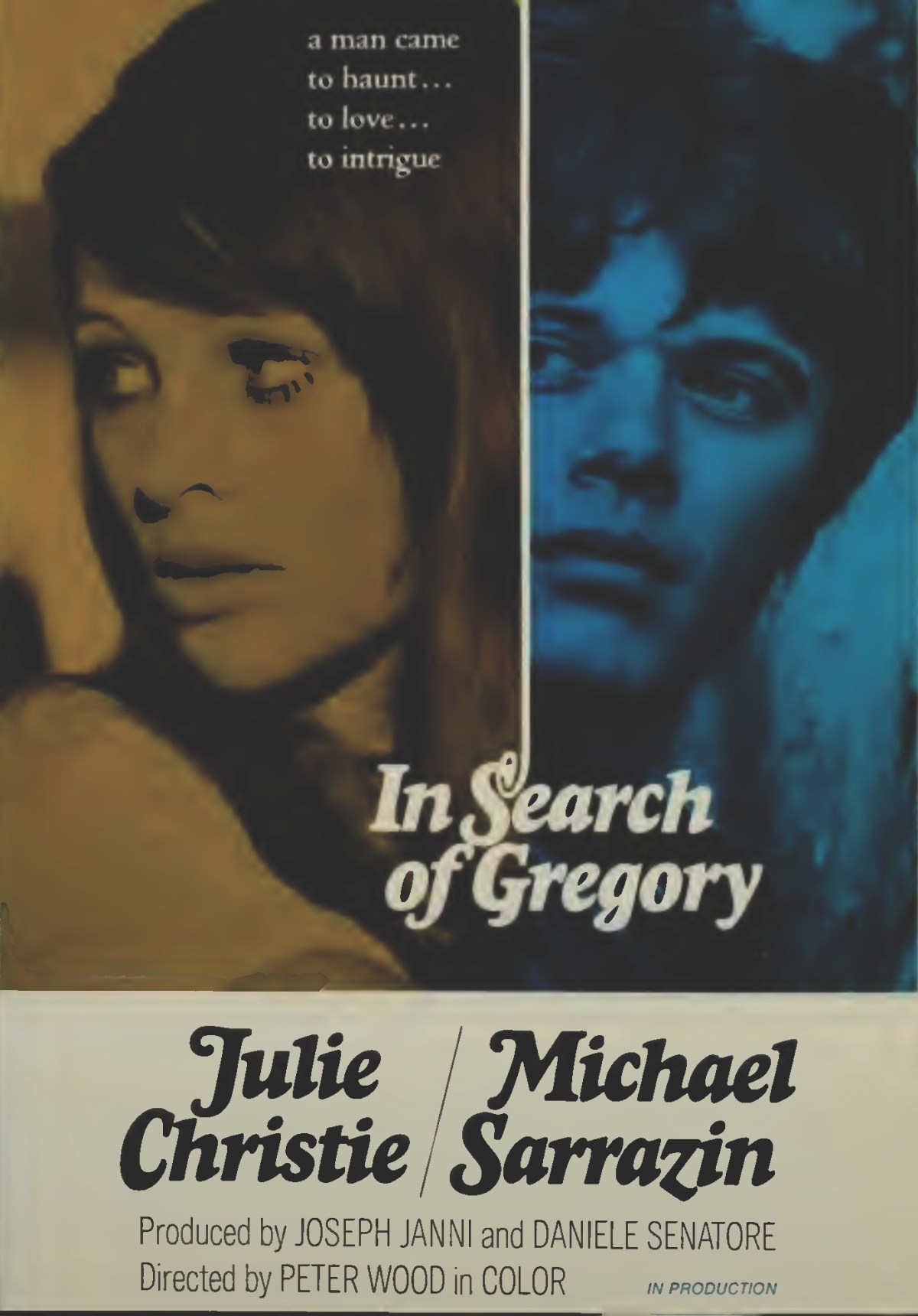
Off-beat examination of the fantasy vs. reality conundrum with an ever-watchable Julie Christie as the woman on the titular hunt. The only film of acclaimed British theater director Peter Wood is a more whimsical cousin to the more deliberately obscure works of Alain Resnais (Last Year at Marienbad, 1961) and Michelangelo Antonioni (Blow-Up, 1966) which pivoted upon the question of whether events presented actually occur or exist only in the head of the leading character.    

Catherine (Julie Christie) is enticed to Geneva by her father (Adolfo Celi) for his latest wedding on the basis that she will meet the impossibly handsome Gregory (Michael Sarrazin). On arrival she discovers the agoraphobia of younger brother Daniel (John Hurt) has been temporarily lifted by Gregory. Catherine appears set to meet Gregory on a number of occasions, but either he does not turn up (the wedding) or somehow, they miss each other, even at one point occupying adjoining phone booths. And it would have been a pretty dull picture if that was all that was going on. But whether the result of reality or Catherine’s imagination, the Gregory we see is a vivid screen presence. The world the characters inhabit is unusual to say the least, so unique that it is either obviously real or fake, but virtually impossible to determine which.

The best Gregory sequence, of which Steve McQueen would be proud, involves the character moving by means of the windscreen from one side to the other of a car driven at high speed. In another scene Gregory plays the equally perilous game of Autoball, a kind of polo with stock cars. As convincing is Gregory’s avant-garde orchestra consisting of two guitars, bottles, a bicycle wheel, a waste bin and coins in a glass. 

The detail is so extraordinary that it must be real. The brother seems real enough, too real if anything, close to enjoying (or pining for) an incestuous relationship with his sister. But for every moment that appears questionable – did she really witness Gregory making love to her future mother-in-law – there are others where doubts are immediately quelled (an address which appears non-existent is not). And long before anybody came up with the idea of selling bottled water, Gregory is apparently in the business of selling tinned Alpine air. Other moments she does not witness – Daniel riding a Lambretta/Vespa with feet on the handlebars – add to the prospect of genuine reality.

Catherine might even have met Gregory except that in going to bed with the man who looks very much like what we believe Gregory to look like she determines that he shall remain anonymous. So it’s anybody’s guess whether Gregory is a figment or phantom of her imagination. And why, of course, should such invention be necessary? Does it mean that her father and brother do not exist either?

It’s an entertaining mystery. There’s no great angst. Antonioni had the sense or cunning to ensure that consequence mattered in Blow-Up – a murderer escaping justice. But there’s no such tension here. While Catherine is tabbed a nympho by her brother (who never questions her father’s predilection for multiple marriages), the suggestion that she’d fly from Rome (where she lives with her boyfriend) to Geneva is the hope of a hook-up seems too far-fetched.

Despite the presence of Julie Christie – who can certainly carry even as slight a picture as this – and a quixotic turn from John Hurt (Sinful Davy, 1969) it’s neither obscure enough to be arthouse nor sufficiently plot-driven to be mainstream and remains an oddity. If you are going to be irritated beyond belief that will occur in the first fifteen minutes or so, but if you stay the course, you may find it a worthwhile watch rather than a cinematic car crash. Written by Bonnie Golightly (her only screenplay), Oscar-nominated Tonino Guerra (Blow-Up, 1966), and  Lucile Laks (The Black Belly of the Tarantula, 1971).

Stiletto (1969) ***

The bursting of the B-movie bubble dealt a death blow to the careers of the two stars here. In the past, rising talent who failed to make the marquee grade could find almost a lifetime of contentment in low-budget westerns, neo-noir thrillers and down’n’dirty exploitationers with the hope of an occasional supporting role in a bigger picture to ease their path. By the end of the decade, just about the only option were Roger Corman biker flicks or spaghetti westerns. Especially if they had gone down the tough guy route, B-pictures might have provided an exemplary move for both Alex Cord and Patrick O’Neal. As it was, this was their last shot at the big time. And it was lean pickings.  

Retirement can be a tough call any time for a high-flying businessman. But when you’re at the top of your profession in the Mafia, loosening such ties can prove problematic. Count Cesare (Alex Cord) is a part-time assassin, spending the rest of his time as a fun-loving playboy with a string of women, fast cars and racehorses. Only problem is, he wants to retire from the Family – and not in normal fashion, weighted down by a block of cement. Unfortunately, his dilemma doesn’t solicit sympathy from boss Matteo (Joseph Wiseman).

Adding to his problems is tough cop Baker (Patrick O’Neal) on his tail who fastens onto illegal immigrant Illeana (Britt Ekland), Cesare’s girlfriend when he’s not pursuing Ann (Barbara McNair). A strictly by-the-numbers thriller it’s enlivened by two underrated tough screen hombres. Alex Cord (The Brotherhood, 1968) isn’t given enough of a character here to  tug at audience heartstrings although elsewhere he had proved better-than-expected value. If anything, he’s an existential kind of hero.

Cord made a brief splash as an action hero in the monosyllabic Clint Eastwood/Charles Bronson mold after debuting in the John Wayne role of the Ringo Kid in the remake of Stagecoach (1966) and didn’t have more than half a dozen stabs at making his name on the big screen before disappearing into the television hinterlands. So he’s something of an acquired taste, maybe the small output enough to qualify him for cult status. Here, he’s a decent fit for the violence but saddled with a role that makes little sense.

Patrick O’Neal (El Condor, 1970) followed a similar career trajectory, swapping television with the occasional movie and even managing a screen persona as a snarky type of villain/supporting character. A few more tough-guy roles and he might well have built a stronger footing in the business.

This is another thankless role for Britt Ekland (Machine Gun McCain, 1969), there to add glamor, but, surprisingly, she manages to bring pathos to the part. Barbara McNair (If He Hollers Let Him Go, 1968), always worth watching and who had made an auspicious debut the year before, hardly gets any screen time. 

Director Bernard L. Kowalski (Krakatoa, East of Java, 1968) proves better at the action than the characterization, though, luckily nobody needs to be anything other than tough. Three scenes, in particular, are well handled – the opening murder in a casino, a shoot-out a penthouse and the climax on a deserted island which has more than a hint of a spaghetti western. Joseph Wiseman (Dr No, 1962) rustles up another interesting performance and collectors of trivia might note Roy Scheider (Jaws, 1975) putting in an appearance.

This old-style tough-guy thriller would have been better off had the Cord vs. O’Neal set-up taken center stage, with the assassin on murderous overkill hunted down by the zealous cop. As it is, it’s a missed opportunity for Cord to develop an Eastwood/Bronson persona and enter the action star hall of fame.

Based on a thin Harold Robbins bestseller, the screenplay by W.R. Burnett (The Great Escape, 1963) and A.J. Russell (A Lovely Way to Die, 1968) doesn’t take any prisoners.

Doesn’t quite deliver what it says on the tin, but interesting to see Cord and O’Neal battle it out.

The Sicilian Clan / Le Clan des Siciliens (1969) *****

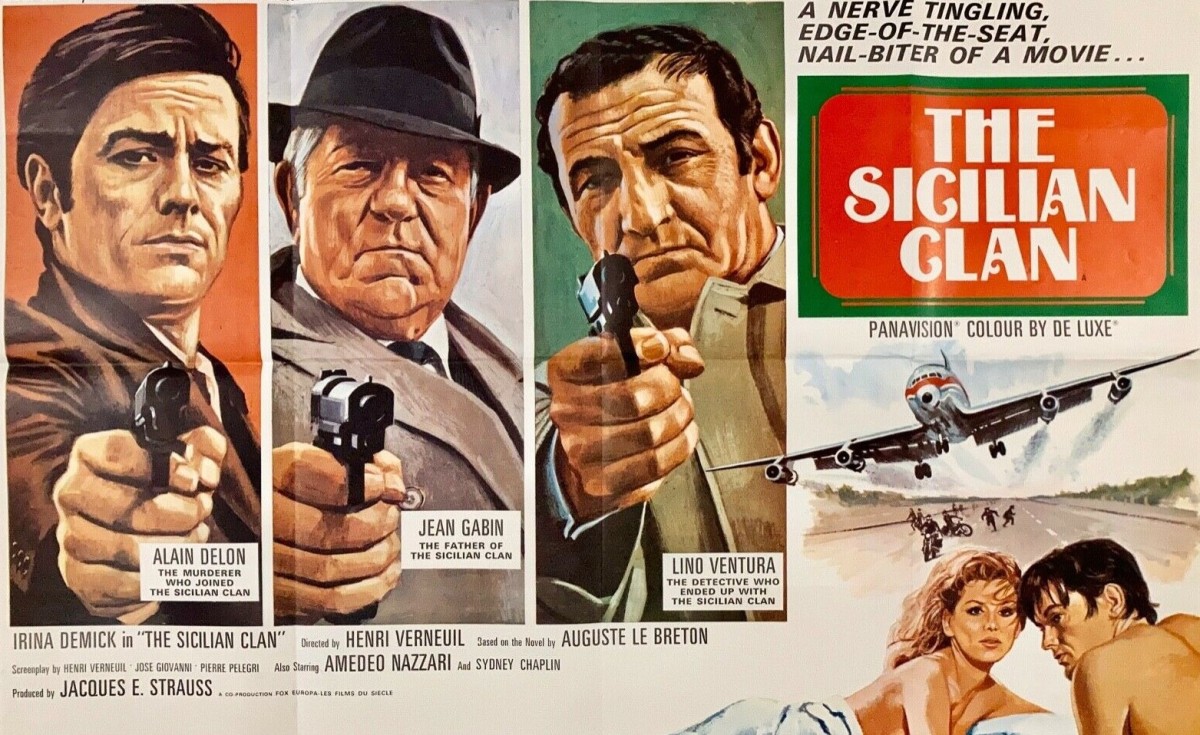
Absolutely cracking, brilliantly structured, gangster thriller featuring two fabulous heists and three legendary French stars in Jean Gabin, Alain Delon and Lino Ventura. Roger Sartet (Delon) is a trigger-happy robber whose terrific prison escape is organized for a hefty fee by French-based Mafia chieftain Vittorio Manalese (Gabin). Le Goff (Ventura) is the rugged cop hunting down the escapee which brings him into the orbit of Manalese, about whose existence he is completely unaware, the gangster having kept an extremely low profile, never engaging in violence, hiding behind the legitimate front of a pinball machine business.  Veteran French director Henri Verneuil (Guns for San Sebastian, 1968) dukes between the twin storylines with ease.

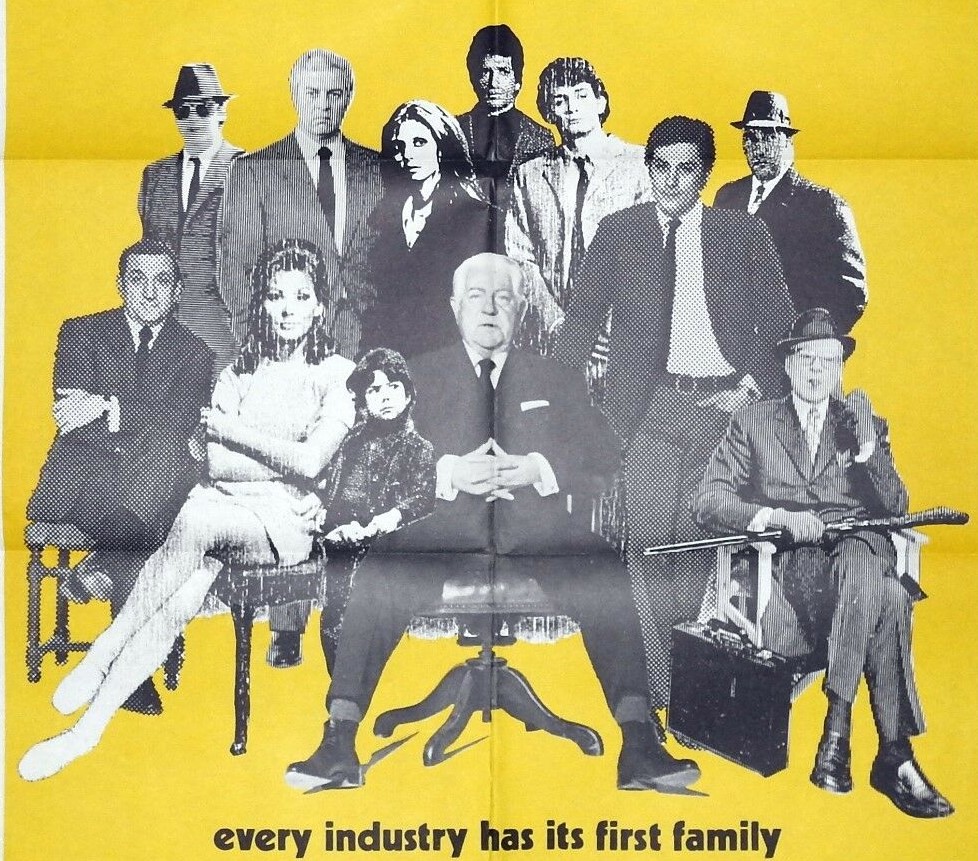
Sartet brings Manalese the opportunity to pull off the most audacious jewel robbery in history, even though the older man despises Sartet’s penchant for violence and sex. We often see Manalese at family gatherings, head of the dinner table, the family watching television together, frowning on one son’s liking for alcohol, playing with his grandson. He is not just a calm and clever businessman, but very quick-thinking, his sharp mind in a couple of instances preventing disaster. Sartet, on the other hand, will happily endanger his life and freedom by consorting with prostitutes and breaking an unspoken code of honor in an affair with Manalese’s son’s wife (Irina Demick).

The result combines dogged detective work by Le Goff and the inspired planning and execution of the jewel robbery until the two worlds collide. The investigation alone would have made this an outstanding picture. Le Goff, always seen with an unlit cigarette in his mouth although he is trying to give up smoking, concentrating initially on Sartet, sets up surveillance on the thief’s innocent sister and begins an involved – and engrossing – process of tracking down every potential lead and when at last he has Sartet in his sights it brings him up close to Manalese.

Le Goff’s professionalism is matched by that of Manalese and the picture develops into an absorbing battle of wits and the latter’s family values and moral compass puts him at odds with loner Sartet. There is some brilliant invention, the sacrificial watch, for example, and the unexpected appearance of a faithful British wife, although you do guess just how long Le Goff will go before lighting his ever-tempting cigarette. 

The ultra-cool Alain Delon (Once a Thief, 1965) excels in this kind of amoral part, but Jean Gabin (Any Number Can Win, 1963) and Lino Ventura (Army of Shadows, 1969) as old-style gangster and cop, respectively, steal the show. Irina Demick (Prudence and the Pill, 1968) thrives as the bored wife of a dull gangster who is attracted by the violent Delon, at one point deliberately putting herself in the line of his potential fire for the thrill. Actually, it’s the jewel heist that steals the show. Unlike other heist pictures where you have fair idea in advance of the details of the theft, here the audience is kept completely in the dark. Just as important in any heist is that the thieves get away with their plunder and the plan in this instance is breath-taking.

As proved by The Burglars (1971) director Henri Verneuil has the nose for a heist, but this tops that for sheer audacity and elan. Verneuil, Delon and Gabin had worked together on Any Number Can Play. Written by Verneuil and Jose Giovanni (Rififi in Tokyo, 1963) from the novel by Auguste Le Breton (Rififi, 1965).

Preceding The Godfather (1972) in its exploration of family and Mafia code of conduct, it offers plenty in the humanity department while dazzling with ingenuity in the criminality stakes.

Unmissable.

Frankenstein Created Woman (1967) ***

Custom-made for a contemporary audience. How can you fail with a tale about a male brain taking over a female body. Male soul if you want to be strictly correct and metaphysical about it or if you are Martin Scorsese for whom discussion about whether the soul leaves the body after death and exists on some other plane was of the greatest interest. But, yes, so although our hero/villain Baron Frankenstein (Peter Cushing) does create a female instead of a male, and not just with the misogynistic purpose of supplying a monster with a mate, unfortunately in the act of creation the poor woman is saddled with the soul/brain of a man, and, even worse, one with  bloody revenge on his mind.

These days for sure audiences would not have any trouble with female stars carving a swathe through any populace and nobody would require transplanting of  male hormones-soul-brain-whatever to take off on a rampage. But, back in the day, before Hammer went full-tilt-boogie down the lesbian vampire route, it was rare, outside of film noir and exploitationer pictures, for a woman to be so savage. So her actions are viewed with regret rather than roars of approval. But, for once, nobody is taking a torch or axe to the good old Baron.

That’s not all that takes the audience by surprise. The use of a guillotine, ideal for a post-task  dripping of blood, turns out to be widely used in central Europe in the 19th century, hardly surprising since it was a German invention. The movie opens with a young boy, Hans, witnessing his father’s execution on such a device, a point that seems arbitrary but proves pivotal.

The grown-up Hans (Robert Morris) assists Dr Hertz (Thorley Walters) assisting the Baron in some kind of resurrection experiment, the guinea pig being Frankenstein himself. Naturally, for purely metaphysical purposes you understand, the Baron would like to experiment on as barely-dead a cadaver as possible to prove his theories. That this takes a good while to materialize is largely because the narrative has to go all around the houses.

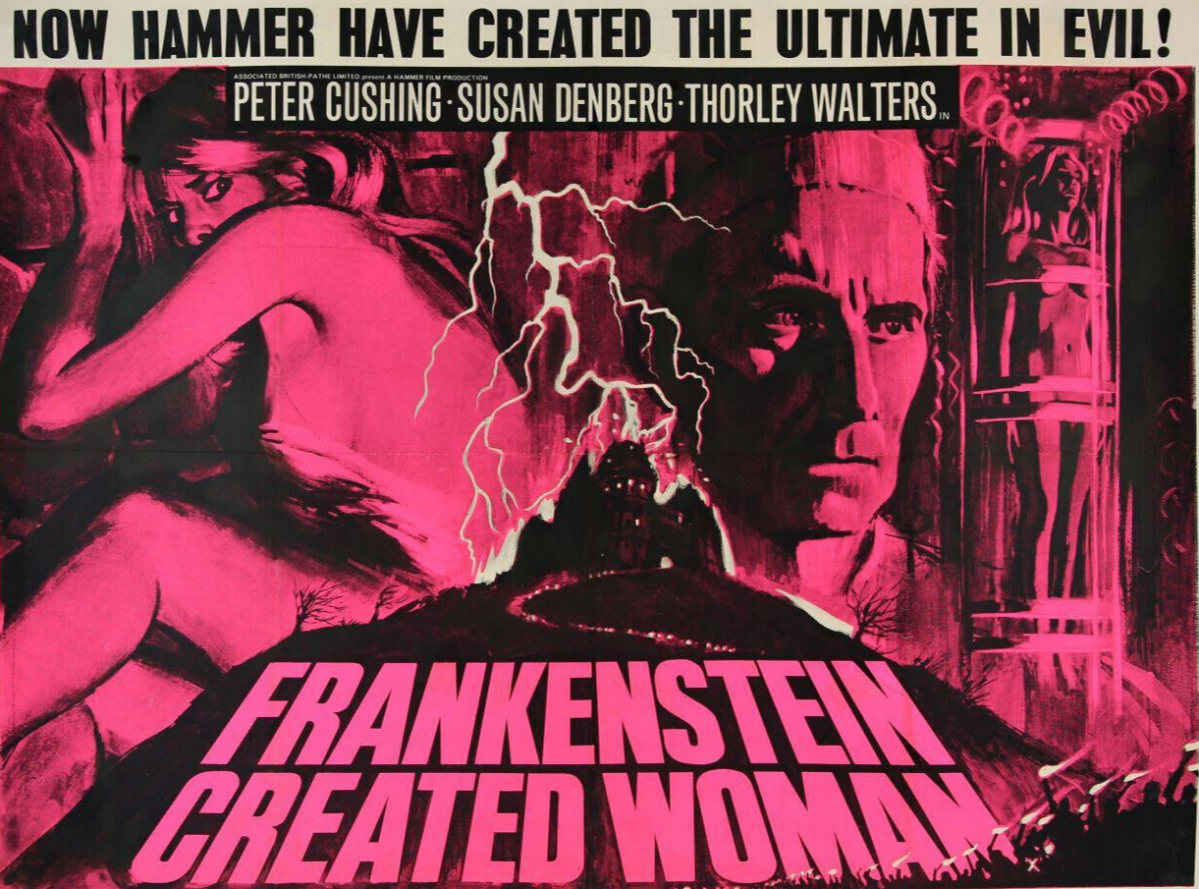
Hans’s lover, disfigured and lame innkeeper’s daughter Christina (Susan Denberg), is taunted by a trio of young swells that results in Hans attacking them. Later, for no particular good reason, the toffs kill the innkeeper, but Hans gets the blame and is sentenced to death. After he is  guillotined, Christina commits suicide by drowning. Both bodies turn up in Frankenstein’s lab at roughly the same time. Complication of course being that a guillotine doesn’t deliver a body intact. Quite how Frankenstein achieves his soul-body transplant is left up to your imagination – the scene promised in the poster is a marketing fiction.

And there’s a touch of Poor Things about the result as Christina wakes up minus scars and disfigurement but with no recollection of her past and needs to be taught who she is. Not that she requires much education in the feminine wiles department and is soon stalking the three young toffs, seducing them with hints of sexual promise before taking savage revenge.

There also a Curse of the Undead element when villagers discover her grave is empty. In fairness to the Baron, he soon realizes what fate had befallen her and tries to ensure that, once her revenge is complete, she can live a different life, although in the way of horror films a happy ending is rarely an option. And in fairness to the Baron the villagers aren’t queueing up to set him alight.

With various subplots to get through, this leaves the Baron out of the picture for considerable periods of time. From a contemporary perspective, there’s a freshness here that will appeal, especially the creation’s desire to discover her purpose in life, her not being bred to fulfil a romantic purpose, and the battle of the male-female will.

Peter Cushing (The Skull, 1965) is as usual splendid, Thorley Walters (Sherlock Holmes and the Deadly Necklace, 1962) presents as an inebriated and impecunious assistant while Austrian Susan Denberg (An American Dream, 1966) does well in the dual role.

Fourth outing in the Hammer series, directed with occasional verve by the reliable Terence Fisher (The Devil Rides Out, 1968) from a screenplay by Anthony Hinds (The Mummy’s Shroud, 1967).

Contemporary appeal and can never go wrong given that it is purportedly one of Martin Scorsese’s favorite films.

I’ll Never Forget Whatsisname (1967) ****

Director Michael Winner’s proudest moment – from a critical perspective. Rave reviews all round and hailed as a rising star of British cinema. Such adulation didn’t last long, of course, Hannibal Brooks (1968) and The Games (1970) elicited little critical reposnse and whatever kudos he achieved from a couple of westerns was soon blown away once he went down the Death Wish (1974) brutal revenge route. So this fits into the anomaly department in his canon and, although pretentious in spots, it does show a fine intelligence at work and a singular prophetic quality that should have contemporary reverberation.

For a start, he highlights the creativity of the advertising world that became the training ground for such British directorial talents as Ridley Scott (Alien, 1979), his brother Tony (Top Gun, 1986), Alan Parker (Midnight Express, 1978) and Adrian Lyne (Fatal Attraction, 1987) as well as producers in the vein of David Puttnam (Chariots of Fire, 1981). Perhaps more interesting are the ecological aspects, predicting the importance of waste both as an issue and a financial opportunity.

And although If… (1969) was viewed as the pre-eminent depiction of public school immorality, this provided a much shorter introduction to the prevalence of public school attitudes in society. You might also suggest, should you be so bold, that Winner envisioned the boom in reality televison, when the camera is not used to create illusion but to pick at the scabs of society. And we might also fast forward to Jaws (1975) whose meanest character shares the same surname as our hero here, whose personality defects are what drives the picture.

Within all this there’s a fair chunk of satire. And it’s rare for this director to so obviously poke fun at his heroes.

The narrative follows disillusioned advertising ace Quint (Oliver Reed) as he tries to extricate himself from various romantic entanglements in order to concentrate on first playing a more meaningful role via literary creativity and then, when that option is pulled out from under him, exposing the hypocrisy from which he has made his fortune.

The movie opens with a stunning image. Quint wielding an axe. Despite this being in the  middle of London, he scarcely receives a second glance – as if this might be construed as typical English eccentricity – as he marches towards his posh headquarters, proceeds to smash his office and hand in his notice to boss Lute (Orson Welles). He finds work in a literary magazine with old school chum Nicholas (Norman Rodway) where, unfortunately given he already has a wife and several mistresses, he falls for virgin secretary Georgina (Carol White).

But despite his success he is tormented by his schooldays, which instead of toughening him up made him more vulnerable to abuse from a teacher and to bullying from fellow pupils led by entitled thug Maccabee (Harvey Hall). The nightmarish glimpses of school are sharply brought into focus when he encounters Maccabee again and witnesses the savage hounding of another innocent man.

Meanwhile, Lute keeps popping up, either to try and seduce Quint back to his job or to sabotage his existing one. When a fight breaks out at one of Lute’s parties he wants it stopped before another of his precious artworks is broken rather than before a participant ends up in hospital. Lute takes English eccentricity to the extreme, enjoying a massage while playing Scalextrix, the epitome of avuncular decency except that he’s twisting the rules.

Even with his diabolical childhood, it’s hard to sympathize with Quint. He’s little more than a charming lout, but I suspect his is a more universal condition, those who have so much easy wealth inclined to poke at the foundations of success, and seek a more worthwhile profession. The ending is contrived, but, then, the fun has to stop somewhere.

That said, Oliver Reed (The Assassination Bureau, 1969) presents a more rounded character than in many of his later films. From the confidence of his delivery you get the impression that Orson Welles (House of Cards, 1968)  – top-billed ahead of Reed – improvised many of his lines. He’s certainly having some fun with his role, but then that is the seductive part of his character. Carol White (Daddy’s Gone A-Hunting, 1969) is the big surprise, bringing a genuine freshness to her role, before she conformed to the Hollywood dictat. And you won’t forget the malicious Harvey Hall (The Games, 1970).

The quite amazing cast includes Edward Fox (Day of the Jackal, 1973),  Michael Hordern (Where Eagles Dare, 1968) as a demented headmaster, Marianne Faithfull  (The Girl on a Motorcycle, 1968), Harry Andrews (The Long Duel, 1967) as a writer with a creepy hobby, Wendy Craig (TV series Not in Front of the Children, 1967-1973), Ann Lynn (Baby Love, 1969) and Frank Finlay (The Shoes of the Fisherman, 1968).

It’s entirely possible that it was pure coincidence that Winner covered so many topics relevant to today but I’m giving him the beenfit of the doubt. Written by Peter Draper (The System / The Girl-Getters, 1964).

Great – and meaningful – fun.

Three into Two Won’t Go (1969) ***

Unhappily married and childless salesman Steve (Rod Steiger) begins an affair with kooky promiscuous hitchhiker Ella (Judy Geeson). A free spirit in control of her life – no VD and on the Pill – and happy to drift from mundane job to mundane job, Ella ranks her many lovers on their sexual performance. Steve has just moved into a new house on a dreary new estate, perhaps in the hope of revitalizing his staid marriage to Frances (Claire Bloom).

While Steve is away on business, Ella turns up at his home where, revealing, without implicating Steve, that she is pregnant, she convinces Frances to let her stay the night. Naturally, it is Steve’s baby, but Ella plans an abortion. Steve wants the baby and so, too, still unaware of the father, does Frances, seeing adoption as the solution to their marital woes. And so a love triangle, or more correctly a baby triangle, plays out, with a few unexpected twists.

Like most of the marital dramas of the 1960s, especially in the wake of the no-holds-barred Who’s Afraid of Virginia Woolf (1966), this is riddled with outspoken protagonists who have no idea how to find real happiness. Based on the book by Andrea Newman and adapted by Edna O’Brien, who both have previously marked out this kind of territory, the picture shifts sympathy from one character to the next. While no one is entirely culpable, none are blameless either. Yet there is an innocence about Steve and Frances in the way they fling themselves in the direction of unlikely salvation. They are not the first couple to find themselves in a marital cul de sac, nor the first to do nothing about it, hoping that somehow through a new house or job promotion things will right themselves.

Audiences, accustomed to seeing Steiger (In the Heat of the Night, 1967) in morose roles, might have been shocked to see him happy and he manages to present a more rounded character than in some previous screen incarnations. In burying herself in domesticity, Claire Bloom (Charly, 1968) essays a far from fragile character, whose resilience and pragmatic character will always find a way forward. Geeson is the surprise package, at once knowing and in charge, and at other times completely out of her depth, and to some extent enjoying the chaos she sparks. The exuberant screen personality she presents here is almost a grown-up more calculating version of the character she portrays in Hammerhead (1968).

Director Peter Hall (Work is a Four-Letter Word, 1968) generates more universal appeal by ensuring the movie is not so obviously grounded in the 1960s that it would quickly become outdated and the snatching at last-minute fantasy to avert marital disharmony will still strike a note. The performances are all excellent, including a turn by Peggy Ashcroft (Secret Ceremony, 1968) and bit parts from British character actors Paul Rogers (Stolen Hours, 1963) and Elizabeth Spriggs in her second movie.

Complex but not hard work.

Two Weeks in September (1967) ***

Soubriquets were not common currency in Hollywood. Names might be shortened to a Christian name or a surname, as in Marilyn or Garbo, and occasionally a reporter might suggest an unlikely familiarity by referring to a star as “Coop” and for sure Bogie must have been desperate for people to call him anything other than Humphrey, hardly a name that spun off the tongue for a supposedly hardbitten hero eschewing his middle-class origins. But the world swung on its axis when simple use of the star’s initials were enough to guarantee universal acceptance.

BB was born on a wave of controversy. After And God Created Woman (1956) broke box office records all over the world, a star was born. But one who seemed to live as much on the pages of newspapers as on the screen. She could forever be guaranteed to provide a revealing photograph to spice up the more puritan newspapers.

But BB’s global fame didn’t translate into worldwide box office in part because her movies were mostly X-certificate in the U.K. and, being made generally by foreign companies, slipping past the Production Code in the U.S. and therefore into arthouses or shady emporiums in both countries rather than mainstream houses.

This isn’t the best introduction to her canon, but in many senses it’s pretty typical. The camera adores BB and shuns anyone else in her presence. There’s not much story here – bored wife dashes off to a model assignment in London and has an affair and can’t decide whether he’s ready for divorce.

To fill in the time we get plenty Carnaby St fashion shoots, certainly put into the shade by the likes of Blow-Up (1966), but of the kind that used to be so common, beautiful women in outlandish clothes against backdrops like zoo animals or suits of armor and all the while flirting with photographers and being chatted up in night clubs by all and sundry. As you might expec, red buses and mini cars are common, though the chances of a cop on horseback at night seems to stretch it a bit.

Cecile (Brigitte Bardot) seems too lively for staid husband Philippe (Jean Rochefort) and burdens him with ensuring her happiness. But he seems, I guess unusually for the time for such a wealthy character, to be happy for her to continue in her profession. She’s never been unfaithful unlike model buddy Patricia (Georgina Ward). But all this cavorting brings out the lech in photographer Dickinson (Mike Sarne) and while she flirts with him she fancies for no apparent reason the doe-eyed Vincent (Laurent Terzieff) although his doe-eyed dog is livelier.

Anyway, off they go to Scotland for a romantic idyll since every filmmaker in the world has been duped by Scottish Tourist Board fantasies of sunshine, tartan, heather and miles of unspoiled beaches (unaware they are empty because the natives have more sense than to go diving into icy water in freezing temperatures). Mostly, what they get is damp streets and grey skies, though if you have BB romping  in the water then nobody’s really going to notice the awful weather. And, naturally, the highways and byways are filled with tartan-clad gents so Brigadoon rides again.

Not quite sure how “To Their Heart’s Content” – clumsy in translation as it is –
is turned into the dull “Two Weeks in September.” Though she hardly seems happy in the poster.

In any case, by the time September comes round, the sun has already packed up for the winter in Scotland, so there’s your get-out-of-jail-card in the title. Not much happens in Scotland either, mostly soulful camera work, soulful BB and dull-as-ditchwater Vincent. There’s a contrived ending.

What impresses most is how little BB you need to make a picture work, even one as patchy as this. It is almost the same template as an Elvis picture minus the songs. Just like BB, Elvis scarcely required a working script, just any excuse to get him on screen. Some stars possess screen charisman that it’s impossible to shift. Shame it was left to Serge Bourguignon (The Picasso Summer, 1969) to get more out of the faint storyline because he  was never that bothered with narrative and inclined just to get by on close-ups and scenery. With BB she was as much scenery as audiences ever seemed to require.

Hardly falls into the recommended bracket but nonetheless an interesting example of how Bardot could get away with the mildest of trifles.

Love Lies Bleeding (2024) *** – Seen at the Cinema

This year’s Saltburn. An ethereal mix of noir, exploitation, wife beating, body building, carpetbagging, blackmail, steroids, bug snacking, daddy issues, such a long string of coincidence it could run a marathon, topped off with a healthy dose of surrealism. I guess going with the flow brings reward. Not sure it made much of being set in 1989, no signs of movie theater marquees promoting Batman or Indiana Jones and the Last Crusade though the principals might have got a buzz out of Lethal Weapon.

You do have to wonder though at choice. Was this all that Kirsten Stewart was offered or has she aligned herself as the kind of arthouse darling whose attachment makes such an unwieldy project feasible? But an actress who can switch from Seberg (2019) to Charlie’s Angels (2019) and back again to Crimes of the Future (2022) demonstrates the kind of versatility that can sit easily on both sides of the Hollywood fence. But it’s a step too far for martial artist Katy O’Brian (Ant Man and the Wasp: Quantumania, 2023).

Coincidence can only get you so far though generally you can rely on a screenwriter to attempt to magnify relationships by ensuring that nobody gets through a movie without having some difficult relationship. That guy on the corner, let’s make him an uncle. The kid who appears once, let’s make him a drug addict who’s addicted to heroin because he blames himself for his mum dying in childbirth. Coincidence overload has found a true champion here.

So hitchhiker Jackie (Katy O’Brian) has sex in the car of JJ (Dave Franco) on the understanding that he’ll find her a job on a shooting range owned by Lou (Ed Harris) who happens to be the father and shares the same name as Lou (Kirsten Stewart) a gym manager who falls for Jackie’s swelling pecs and who happens also to be JJ’s brother-in-law. Lady Lou happens to have a sometime girlfriend Daisy (Anna Baryshnikov) who happens upon Jackie driving Lady Lou’s car after Jackie’s s murdered JJ. And Lady Lou’s only happened upon the murder because – you can see where this going.

Luckily Lady Lou is experienced in getting rid of a corpse – and luckily there are plenty of good-sized rugs to spare because she has to lug out a total of three dead bodies. Her dad’s a gun-runner and corrupter of cops so he’s immune to pretty much everything unless his daughter decides to rat him out, which might be a complication for her, given that earlier she was running in his slipstream.

There’s plenty lowlife mixed in with high end angst, Lady Lou falling out with Jackie once she cottons on to the fact that she quite enjoys bisexuality and has no objection to swapping sex for a job, not even with an odious wife-beating brother-in-law. And then Lou has to come to terms with the fact that after committing murder Jackie’s only concern is in high-tailing it down to Vegas for a body building competition.

So really way too much narrative and subplot for this thin gruel. But in passing there are some memorable moments. For a start, this is the first time I can remember seeing anyone at a shooting range who isn’t a cop of the Dirty Harry persuasion or a spy. To see ordinary folks happily popping off at targets and enjoying a beer afterwards goes a long way to explain the country’s obsession with ownership of weaponry.

And the face of the victim of the wife-beating was truly shocking as was what was left of JJ’s jaw once Jackie had smashed it into a table. Then we have the surreality – a full-grown Lady Lou pops out of JJ’s mouth covered in birth residue, Jackie’s muscles audibly crack almost every time she takes a breath and when she goes into full-blown Incredible Hulk mode her tee-shirt splits in half, plus she turns into a giant to pin down Daddy Lou.

By the time you get to the end, there’s been so many changes of tempo and mood that you’re grateful that after all this is really a romantic comedy complete with making up on a tennis court and a corpse coming to life in the back of a car. It’s a good few tunes short of a decent picnic, but once you realize this is more of a cartoon than a genuine noir thriller and go with the flow it has rewarding moments. There’s a decent amount of nihilism and almost anytime anyone makes a declaration of love you can be sure they’re going to blow the loved one’s brains out or do something to totally contradict their statement.

As directed by Rose Glass (Saint Maud, 2019), it might have been better if the surrealism had infused the entire movie rather than being reseved, as if the icing on the cake, for the final segments.

As I said, this year’s Saltburn.

Discover WordPress

A daily selection of the best content published on WordPress, collected for you by humans who love to read.

The Atavist Magazine

by Brian Hannan

WordPress.com News

The latest news on WordPress.com and the WordPress community.