The Doomsday Flight (1966) ***

Early entry to the hijack subgenre – this one pivoting on the bomb-on-a-plane. Could almost deem it a template for what to do and not do in this particular field. Airport (1970) was the most obvious beneficiary although Speed (1994) could be reckoned to be something of a homage. And though “what if” was largely the preserve of sci fi, this posed very scary questions for audiences only beginning to enjoy the benefits of cheaper international travel. A quartet of excellent twists and three examples of men under pressure heat up the concept.

Unusually, the writer was the main selling point, Rod Serling (Seven Days in May, 1964) being more famous than most screenwriters thanks to The Twilight Zone (1959-1964) scaring the pants off viewers in ways that nobody thought television would dare to do.

Propped up by an interesting cast – Jack Lord (The Name of the Game Is Kill!, 1968), former major league movie star Van Johnson (Wives and Lovers, 1963), Edmond O’Brien (Rio Conchos, 1964), John Saxon (The Appaloosa, 1966), Ed Asner (The Satan Bug, 1965) and Michael Sarrazin (They Shoot Horses, Don’t They, 1969).

Unusual in that the two main characters lose it and the movie is probably the first to touch upon PTSD in Vietnam. While Special Agent Frank Thompson (Jack Lord), leading the task force on the ground, appears to be in complete control, in fact he’s hidden the fact that his wife is on the hijacked plane. That’s only revealed in the final climactic twist, so you have to cast your mind back over the movie and reassess Jack Lord’s apparently unflappable performance.

The anonymous hijacker (Edmond O’Brien) is a pretty cunning individual. He’s set a bomb to explode on the plane’s descent and removed the easy option of making a speedy landing by forcing the jet to remain above a certain height otherwise an altitude-sensitive trigger will blow the passengers to kingdom come. He demands a $100,000 ransom which the airline is only too willing to pay.
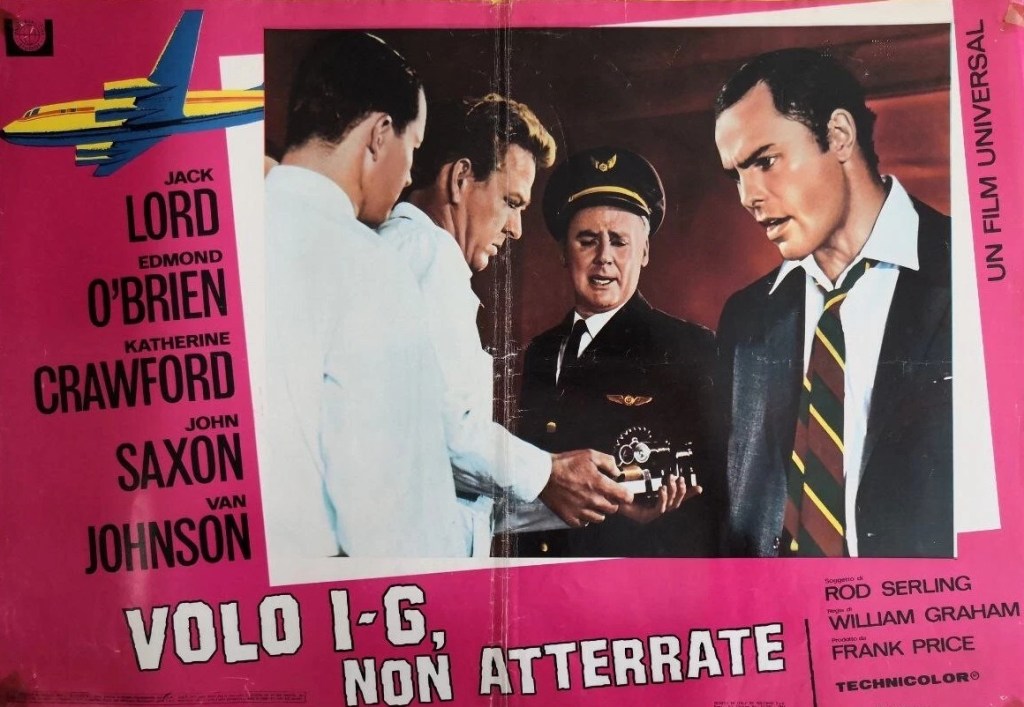
Meanwhile, Capt Anderson (Van Johnson), who had appeared the insouciant handsome epitome of the airline pilot of the kind you saw in advertisements, is sweating profusely under the pressure as the cabin crew begin to search for the bomb. The passengers are not quite as terrified as you’d expect, most sitting in their seats, and i’ts left to celebrity George Ducette (John Saxon) to kick up a ruckus until put in his place by an anonymous army corporal (Michael Sarrazin) who has a distinct aversion to bombs and so far has sat rigid in his seat.

The hijacker keeps everyone on their toes by constantly moving from phone to phone. There’s a hiccup when the delivery van carrying the ransom has an accident and the cash is obliterated. By this point the hijacker, in a bar, is getting drunk and his iron control is tested by the news. The plane, meanwhile, is running out of fuel and Capt Anderson has long run out of patience.

Turns out the bomber isn’t the evil genius you expect. He’s been cast aside by the American dream, his considerable talents overlooked, and he wants everyone to know that he’s worth more. Unfortunately, he doesn’t get his moment in the sun, either literally having made off with the money, or by having his face splashed over the front pages of newspapers.

When he dies of a heart attack, the plane still circling and fuel levels dangerously low and now unable to locate the bomb, that’s a heck of a fabulous twist. But what Rod Serling takes away with one hand, he gives with the other, and the pilot soon works out that if he lands at a high altitude airfield he’ll prevent the bomb exploding.

Safely on the ground, we come to the third twist. The hijacker had deposited the bomb in Capt Anderson’s flight bag, carelessly left lying around at the airport. The final twist is the revelation that Thompson’s wife was on board.

What had every opportunity of becoming a run-of-the-mill thriller, especially since we are light on passenger drama (no pregnant women about to give birth, no kids or nuns to claw at our sentiments), segues into something more interesting as it delves into the cracking up of the hijacker and intimation that soldiers returning from Vietnam do not feel like heroes.

Edmond O’Brien is the pick, but Van Johnson possibly the most courageous in filleting his screen persona. You wouldn’t have predicted Michael Sarrazin’s later success from this performance, nor that Jack Lord would hit a home run in television’s Hawaii Five-O (1968-1980).

Ably directed by William Graham (Waterhole #3, 1967) and although, technically, all he has to do is point the picture in the direction of the twists, he brings more by allowing Edmond O’Brien to humanize his character.   

I saw this as the supporting feature to Carry On Doctor and as a youngster never came out of a cinema more scared. Originally it was a made-for-television number though yanked after only one screening after airlines, not surprisingly, objected, so, as with many hard-to-find pictures it entered the cult zone in the USA.

As YouTube is often the curator of cult you can find it there.

Behind the Scenes: “One-Eyed Jacks” (1961)

A three-hour western epic directed by Stanley Kubrick (2001: A Space Odyssey, 1968), written by Sam Peckinpah (The Wild Bunch, 1969) and The Twilight Zone’s Rod Serling and starring Spencer Tracy (Judgement at Nuremberg, 1961) and Marlon Brando. What’s not to like? That all of these major players, with the exception of Brando, had nothing to do with the final product was par for the course for a movie that didn’t reach cinema screens until two years after shooting was completed.

Marlon Brando was riding high when the project was first mooted in 1956. The box office and critical sensation of the 1950s, four Oscar nominations in successive years, winner for On the Waterfront (1954), his price was rising by the minute. And he had ambitions to take control of his career, set up his own production shingle, a trend that was beginning to gather pace.

He established Pennebaker (named after his mother) Productions in 1957 with ex-marketeer Walter Seltzer, producer of 711 Ocean Drive (1950), and George Glass, a former partner in Stanley Kramer’s independent production company. Paramount agreed to back the company. A western, A Burst of Vermilion, was intended as the company’s first offering. Soon there were five movies on the schedule including The Authentic Death of Hendry Jones by Charles Neider.

Brando had paid $150,000 for the rights to the book and a script by Sam Peckinpah. The original title was changed to Guns Up. It was going to mark the debut of the new Pennebaker outfit ahead of other projected movies like Shake Hands with the Devil to star James Cagney and Anthony Perkins (he didn’t make it to the final cast), The Raging Man and Ride, Comancheros (no relation to The Comancheros, 1961) and C’Est La Vie to be filmed in Paris.

Paramount paid through the nose, committing to an unprecedented deal. The studio would fund the entire cost of Guns Up and as well as $150,000 upfront Brando would receive 100 per cent of the profits, Paramount relying on its 27% of the gross as a distribution fee to turn a profit. Stanley Kubrick, riding high after Paths of Glory (1957), was hired to direct. While the studio preferred Spencer Tracy as co-star, Brando wanted old buddy Karl Malden who had co-starred with Brando in A Streetcar Named Desire (1951) and On the Waterfront, winning an Oscar for the former and a nomination for the latter.

And in part to reflect the Asian community in Monterey, location of the main section of the film, he also wanted current squeeze France Nuyen (A Girl Named Tamiko, 1962) to play his lover in the film, but Kubrick was aghast and instead cast Mexican debutante Pina Pellicer (Rogelia, 1962). There were roles for Katy Jurado (Barabbas, 1962) and recognizable western types like Ben Johnson (The Undefeated, 1969), Slim Pickens (Firecreek, 1968) and Elisha Cook Jr (The Great Bank Robbery, 1969).

Shooting was set for June 1958, then it shifted to September and then November. To Brando’s shock, Kubrick pulled out two weeks before production was due to begin, citing pre-production on Lolita (which, ironically, didn’t go ahead for a couple of years). To salvage the situation, Brando decided to direct. He wasn’t the first actor to go down this route, especially if you count Charlie Chaplin, Buster Keaton and Orson Welles as actors first and foremost. Laurence Olivier helmed Henry V (1944) and three others, Jose Ferrer The Cockleshell Heroes (1955), hoofer Gene Kelly Singin’ in the Rain (1951) and Charles Laughton Night of the Hunter, 1955. So he was in good company.

Cameras turned on December 2, 1958. It was an auspicious era for westerns, a total of 41 had appeared that year. Although budgeted for three months, it took six months to shoot in locations like Sonora in Mexico and Monterey in California (where the film was set) as well as Pfeiffer Beach on the Big Sur and the Warner Ranch.

Although prior to shooting commencing the title had changed to One-Eyed Jacks, scoring and editing were well in hand and Paramount announced it as one of its 17 pictures set for 1959 release. In the end Shake Hands with the Devil beat it to the punch as Pennebaker’s initial release, in 1959. But it didn’t favor so well, skipping the more lucrative but riskier Broadway first run in favour of hitting the circuits.

Meanwhile, Brando was angling for a three-hour running time. The budget kept increasing. The original $2m budget had doubled. Eventually, Paramount acknowledged it had cost $5 million though other estimates put it closer to $6 million.

Part of the problem in readying it for release was Brando’s other commitments. He was still a working actor and could hardly resist the offer of a record-setting one million bucks to star in The Fugitive Kind (1960). Even so, the bigger problem was not time, but experience and a first-time director being unable to make up his mind, having shot a colossal amount of footage and having tremendous difficulty trimming it down to workable length. Paramount still had it on the release agenda in 1960. It was going to be a “special release,” which most people took, especially given the running time, to be roadshow.

But by December 1960, the studio had waited long enough and just before Xmas the studio took over the editing and after editing out around 40 minutes from Brando’s three hour cut, Paramount scheduled it for a world premiere in New York in March 20, 1961, in a kind of semi-roadshow – moviegoers could buy in advance but the tickets did not come with reserved seats, which was the whole point of roadshow. Nor were prices hiked, which was gave roadshow its prestige.

Already deemed “Brando’s Folly” and coming in the wake of The Alamo (1960), the John Wayne-directed epic which had flopped in roadshow, commercial hopes were not high. In part, because production had been so long ago it had skipped under the journalistic radar which was concentrating on skewering The Alamo and the equally troubled The Misfits (1961). So it didn’t come trailing disaster. Still, it seemed more likely, audiences would not take to the odd tale which didn’t fit so easily into the western genre. Plus Brando’s previous effort The Fugitive Kind had been his first outright flop.

Turned out, though, Brando still was a major attraction. It snaffled a “huge” $81,000 in its opener at the 4,820-seat Capitol in New York. There was a “smasheroo” $21,000 in Detroit, a “big” $14,000 in Buffalo, a “hotsy” $15,000 in Cincinnati. “Giant” was the preferred adjective, covering $60,000 in Chicago, $32,000 in Philadelphia and $15,000 in Boston.

Rentals (what studios make after cinemas have taken their share of the gross) amounted to a very decent $4.3 million, enough to rank seventeenth for the year. And whereas those figures were considered decent enough, it did “substantially better abroad.”

So, more than likely, against all the self-destructive odds, it earned a profit.

SOURCES:  Stefan Kanfer, Somebody, The Reckless Life and Remarkable Career of Marlon Brando (Faber & Faber, 2008); “Glass, Seltzer in Brando Co Berths,” Variety, April 17, 1957, p22; “Chatter, Hollywood,” Variety, May 22, 1957, p62; “Marlon Brando Guns Up for Paramount,” Variety, April 30, 1958, p22; “Chatter, Paris,” Variety, July 30, 1958, p126; “Brando Gets 100% of Film Profit!”, Variety, August 6, 1958, p1; “Briefs from Lots,” Variety, September 24, 1958, p15; “Marlon Brando’s Own,” Variety, November 26, 1958, p5; “Shake Hands First with Circuits,” Variety, May 6, 1959, p4; “Brando’s Ugly American,” Variety, July 1, 1959, p3; “Par 17 Pix Set for Release,” Variety, July 15, 1959, p5; “Par Division Eyes Upcoming Product,” Variety, November 25, 1959, p22; “Doubt or Delay re Brando’s Jacks,Variety, August 10, 1960, p3; “Brando Jacks Editing,” Variety, December 21, 1960, p7; Advert, Variety, January 6, 1960, p32; Box Office Figures, Variety, April 5-Jul 24, 1961; “Hoss Operas in O’Seas Gallop,” Variety, August 23, 1961, p16; “1961 Rentals and Potential,” Variety, January 10, 1962, p13.

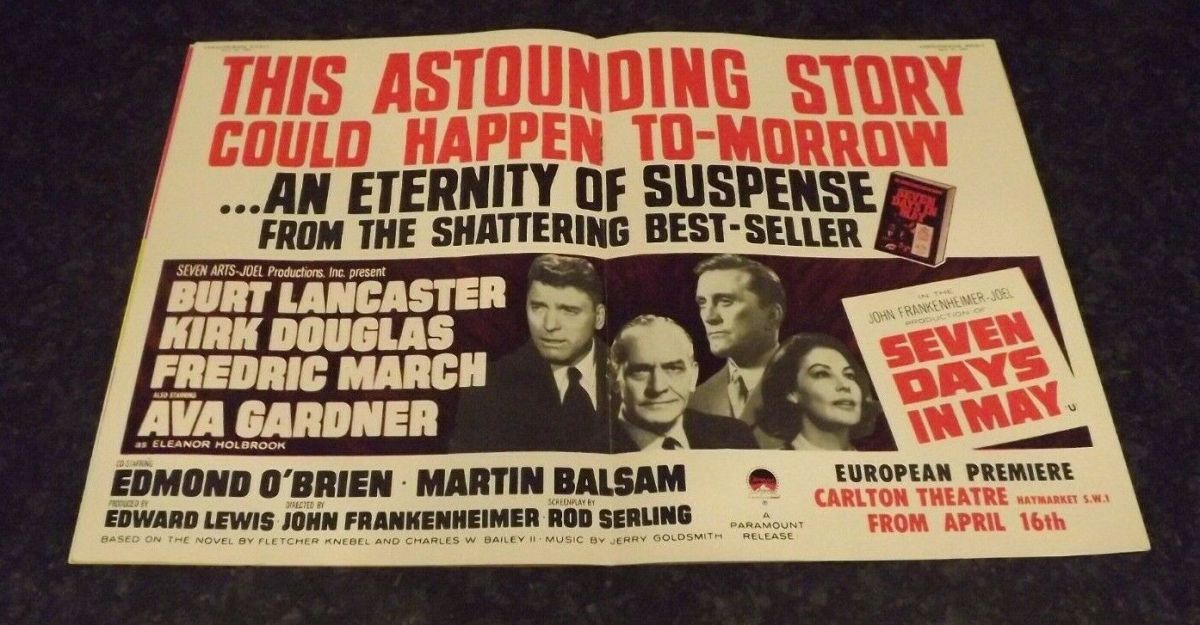
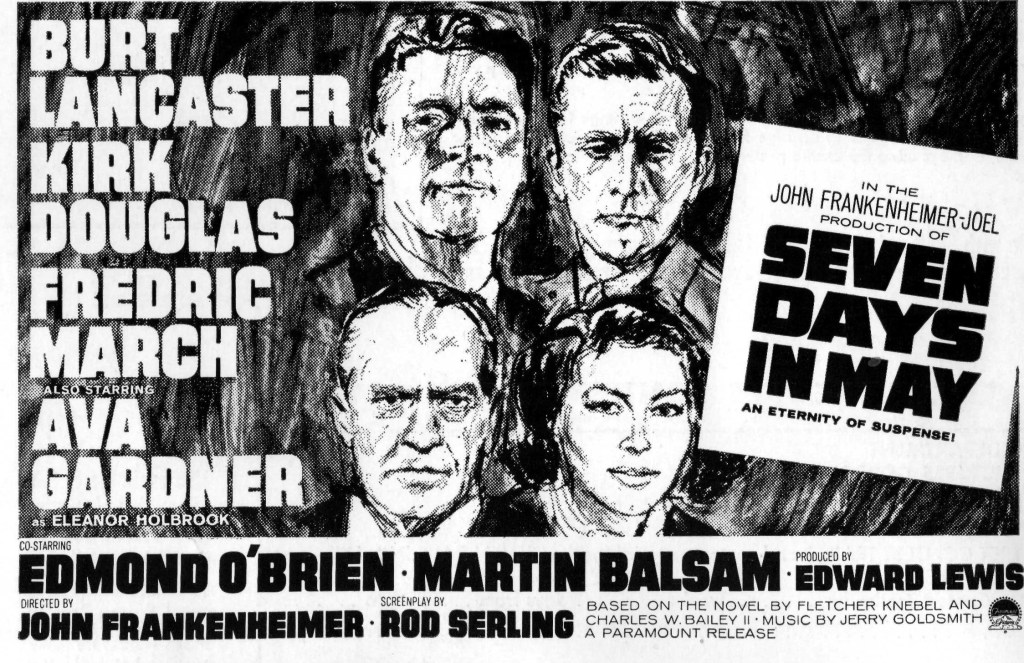
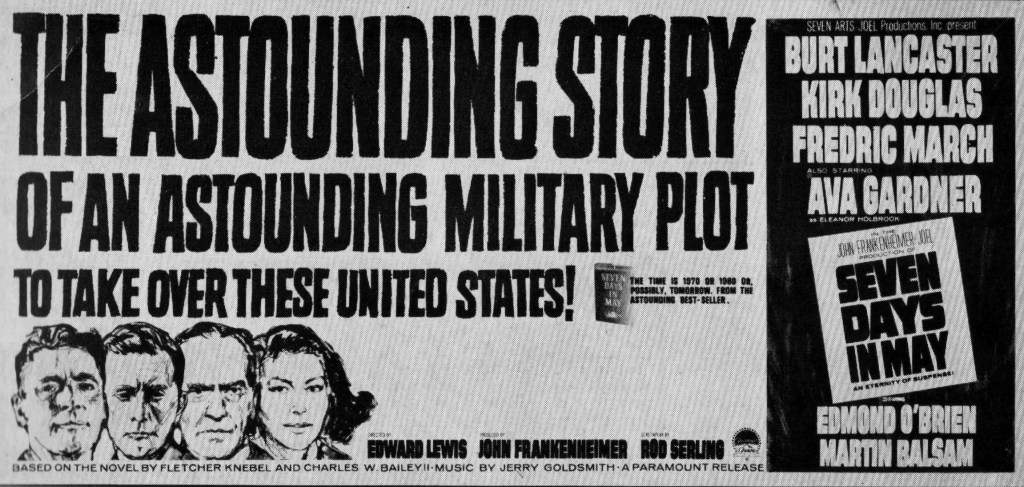
Seven Days in May (1964) ****

Democracy is a dangerous weapon in the hands of the people. Can they be trusted to make the correct decision? That’s in part the thematic thrust of this high-octane political thriller that pits two of the greatest actors of their generation in a battle to decide the fate of the world. This was the era of the nuke picture – Dr Strangelove (1962), Fail Safe (1964), The Bedford Incident (1965) – all primed by the real-life Cuban Missile Crisis and the growing threat of the Cold War.

Just as the President (Fredric March) is about to sign a nuclear treaty with the USSR, much to the fury of the majority of Americans judging by opinion polls, Colonel Jiggs Casey (Kirk Douglas) uncovers signs of a military coup headed by hawk General James Mattoon Scott (Burt Lancaster). The movie divides into the classic three acts. In the first, Casey investigates the existence of a secret army unit in El Paso comprising 3,600 men trained to overthrow the government and needs to persuade the President the country is in danger. The second act sees the president hunting for find proof of the imminent coup and identifying the conspirators. The third act witnesses showdowns between the President and Scott and Scott and Casey.

At the heart of the story is betrayal – Scott of his country’s constitution, Casey of his friend when he takes on the “thankless job of informer.” Casey proves rather too ruthless, willing to seduce and then betray Eleanor Holbrook (Ava Gardner), Scott’s one-time mistress. Both Holbrook and the President prove to have higher principles than Casey.

For both Kirk Douglas and Burt Lancaster who operate at a high threshold of intensity and could easily have turned in high-octane performances the tension is even better maintained by their apparently initial low-key confrontations. Douglas has a trick here of standing ramrod straight and then turning his head but not his body towards the camera.  

As a pure thriller, it works a treat, investigation to prove there is a conspiracy followed by the deaths and disappearances of vital people and finally the need to resolve the crisis without creating public outcry. The only flaw in the movie’s structure is that Casey cannot carry out all the investigations and when presidential sidekicks Paul Girard (Martin Balsam) and Senator Clark (Edmond O’Brien) are dispatched, respectively, to Gibraltar and El Paso the movie loses some of its intensity. But the third act is a stunner as the President refuses to take the easy way out by blackmailing Scott over his previous relationship with Holbrook.  

Of course, there is a ton of political infighting and philosophizing in equal measure and speeches about democracy (“ask for a mandate at the ballot box, don’t steal it”) and the constitution and the impact of nuclear weapons on humanity. But these verbal volleys are far from long-winded and pack a surefire punch. The coup has been set up with military precision and must be dismantled by political precision.

The film was awash with Oscar talent – Burt Lancaster, Best Actor for Elmer Gantry (1960) and, at that point, twice nominated; thrice-nominated Kirk Douglas; Fredric March, twice Best Actor for Dr Jekyll and Mr Hyde (1931) and The Best Years of Our Lives (1946) plus  three other nominations besides; Ava Gardner nominated for Best Actress (Mogambo, 1953); and Edmond O’Brien named Best Supporting Actor for The Barefoot Contessa (1954).

None disappoint. March is especially impressive as a weak president tumbling in the polls who has to reach deep to fight a heavyweight adversary. Lancaster and Douglas both bristle with authority. Although Lancaster’s delusional self-belief appears to give him the edge in the acting stakes, Douglas’s ruthless manipulation of a vulnerable Ava Gardner provides him with the better material. Edmond O’Brien as an old soak whose alcoholism marks him out as an easy target is also memorable and Ava Gardner in recognizing her frailties delivers a sympathetic performance.

Rod Serling (The Twilight Zone) does a terrific job of distilling a door-stopper of a book by Fletcher Knebel and Charles W. Bailey II.  But the greatest kudos must go to director John Frankenheimer – acquainted with political opportunism through The Manchurian Candidate (1962) and with Burt Lancaster (The Birdman of Alcatraz, 1962) – for keeping tension to the forefront and resisting the temptation to slide into political ideology.

Behind the Scenes: “Planet of the Apes” (1968)

J. Lee Thompson (The Guns of Navarone, 1961) saw a much-needed boost to a drifting career vanish when he ducked out of this project – he had spent considerable time developing the project – in favor of Mackenna’s Gold (1969). Blake Edwards, first director attached, probably also lamented losing out. This was to have been Edwards last outside film before committing exclusively to Mirisch.

Producer Arthur P. Jacobs, who had bought the rights to Pierre Boulle’s Monkey Planet in 1963, could hardly believe his luck after the calamitous Doctor Dolittle (1967). Unusually, the two films were not cross-collaterized, a standard studio device whereby the losses on one film were played against the profits in the other, which would have almost certainly resulted in no profit payments to Jacobs.

And you could probably say the same for eventual director Franklin J. Schaffner, relegated to television and movie stiffs like The Double Man (1967) after the failure of big-budget historical drama The War Lord (1965) and his abortive attempt to film the Travis McGee novels of John D. MacDonald, whose total sales exceeded 14 million. He wasn’t involved in Darker than Amber (1970), the first McGee title to be filmed. Heston, who Schaffner had directed in The War Lord, pushed for his involvement.

Charlton Heston was also in dire need of career resuscitation, his past five movies – Sam Peckinpah’s Major Dundee (1965), The Agony and the Ecstasy (1965), The War Lord (1965), Khartoum (1966) and realistic western Will Penny (1967) – had all tanked. “In my view,” he opined, “I haven’t made a commercial film since Ben-Hur,” clearly ignoring the success of El id (1961).

And once it became a success Warner Brothers regretted letting it go. The studio had been involved in the project when Blake Edwards was to direct.  The movie was cancelled due to cost – it was budgeted then at $3-$3.5 million – and script and production problems. The studio might also have shied away after learning of the booming budget and lengthening schedule for MGM’s 2001: A Space Odyssey. Twentieth Century Fox ended up forking out $5.8 million to turn the project into reality.

As was often the norm in Twentieth Century Fox pictures, studio head honcho Darryl F. Zanuck found a part for his mistress, in this case Linda Harrison as Nova, the mute love interest. She  was a graduate of the studio’s program of investment in young talent. Others included Jacqueline Bissett (The Detective, 1968) and Edy Williams (The Secret Life of An American Wife, 1968).  Had Raquel Welch (One Million Years B.C, 1966) considered the opportunity to don a fur bikini again, it is doubtful Harrison would have won the role. But she turned it down as did Ursula Andress (The Southern Star, 1969). Angelique Pettyjohn (Heaven with a Gun, 1969) was auditioned

Former child star Roddy McDowall (Lassie Come Home, 1943), Kim Hunter (A Streetcar Names Desire, 1951) and Maurice Evans (The War Lord) fleshed out the ape contingent. Ingrid Bergman (The Visit, 1964), also in much need of a career uplift, turned down the role of Zira. Other stars in the frame for roles included Yul Brynner, Alec Guinness and Laurence Olivier. Edward G. Robinson should have played Zaius, but couldn’t manage with the make-up.

Source material was Monkey Planet by Pierre Boulle, author of Bridge on the River Kwai. Twilight Zone creator Rod Serling took a year and a reported 30 drafts to turn in a viable screenplay and the former blacklisted Michael Wilson, whose name had been removed from the credits of Bridge on the River Kwai (1957) and Lawrence of Arabia (1962), added the polish.  Wilson had won an Oscar for A Place in the Sun (1951) and another one for Friendly Persuasion (1956) although that was actually awarded to Jessamyn West since Wilson’s involvement was kept secret. If he had not been blacklisted, he would have been in the unusual position of having won four screenplay Oscars, although in the end the others were retrospectively awarded.

If you were looking for a sci-fi picture with dramatic heft, decent action, mysterious outcome and an examination of the human condition this was a more straightforward bet than 2001: A Space Odyssey (1968). While Fox reckoned its previous sci-fi venture Fantastic Voyage (1966) had worked out well, it had reservations about the cost of Planet of the Apes and the possibility of making an ape setting believable. In this case the special effects’ conundrum was make-up for the apes. If they just looked like humans wearing monkey suits the movie would not fly. Fox spent $5,000 on a test with Heston in a scene with two apes before it greenlit the movie.

Faces that could not express emotion and were as stiff as a botox overdose would invite audience ridicule. In the end the studio spent a reported million dollars on pioneering ape renditions by John Chambers, who  previously been a surgical technician repairing the faces of wounded soldiers. He had a team of 78 make-up artists There were almost as many scripts as crew and the changes wrought as the picture moved closer to being greenlit were to switch from a futuristic setting to a primeval one (which, incidentally, saved on costs), covering up the breasts of the female prisoners and inventing the stunning ending.

There were three possible endings, the one shot being that favored by the star.. Heston’s hoarse voice was not in the script, but an incidental by-product of him catching the flu. Apart from studio sets, the movie was filmed in blistering heat in Arizona. The rocket ship crashed into Lake Powell in Utah, ape city – modeled on the work of celebrated Spanish architect Gaudi – was constructed in Malibu Creek State Park, and the final scene was filmed on Zuma Beach in Malibu.

Unlike Fantastic Voyage which told audiences what the mission was, but in keeping with 2001: A Space Odyssey, Planet of the Apes opens with mystery. Like Rosemary’s Baby, the movie is viewed through the eyes of an innocent, one who cannot quite cotton on to his fall down the evolutionary food chain. Albeit more hirsute and muscular than Mia Farrow, nonetheless the casting of Heston dupes the audience into thinking he is somehow going to win, rather than just escape. He is an experiment who has wandered into the wrong planet. But there are few films that can top that shock ending.  And the movie more than fulfills the “social comment,” on which Heston was very keen, contained in the Boulle novel.

SOURCES: Russo, Joe, Landsman, Larry, and Gross, Edward, Planet of the Apes Revisited, The Behind the Scenes Story of the Classic Science Fiction Saga (New York: Thomas Dunne Books/St Martin Griffin, 2001); Hannan, The Making of The Guns of Navarone, 187. “Warners Ape World,” Variety, March 18, 1964, 4; “High Costs Impress Capital,” Variety, March 23, 1964, 3; “Planet of Apes Off for Present,” Variety, March 10, 1965. “Michael Wilson Under His Own Name For A.P. Jacobs,” Variety, December 14, 1966, 7. “MacDonald Novels Cue Major Pictures Corp.,” Variety, May 17, 1967, 5; Austen, David, “It’s All A Matter Of Size,” Films and Filming, April 1968, 5; “Fox’s Talent School,” Variety, June 26, 1968, 13; Film Locations for Planet of the Apes,” www.film-locations.com.

I have to confess this Behind the Scenes article would have been better if I had not loaned out – and never got it back – my copy of The Making of Planet of the Apes by JW Rinzler which was published five years ago.

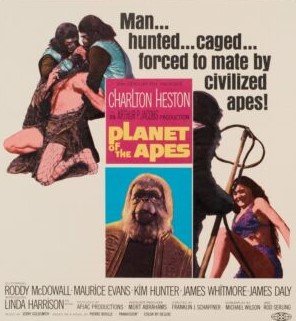
Planet of the Apes (1968) *****

Still astonishing that the two movies that rocked sci-fi to its core came out the same year. Initially beloved mostly by dopeheads 2001: A Space Odyssey quickly achieved ultra-academic status. But it’s difficult to ignore the fact that that Planet of the Apes had the greater long-term effect, given it spawned umpteen sequels and two sets of remakes.

You could also argue that the concept is even bolder than the Kubrick, not just man’s treatment of animals, but the idea of man being subject to a superior species, and inside an action-packed picture there’s plenty of time to digest the unimaginable and engage in debate about the nature of man. The elevator pitch might have been: “Take Hollywood’s strongest hero and torture him one way or another.”

Part of the movie’s genius is the unsettling opening, swirling, almost deranged, camerawork, a discordant score, the confident occupants of a spacecraft heading into the unknown finding the kind of unknown that fills them with dread rather than awe. Two thousand years into the future a spaceship doesn’t gently touch-down on a strange planet, but crashes into it, luckily landing in a lake, the three survivors escaping the sinking craft.

The audience knows a great deal more than they do, that the arid desert in which they find themselves stretches everywhere. But then they realize, with supplies that will last only three days, the soil here will not support life. But they are quickly upbeat when they find a small plant followed by substantial greenery. The sight of crucified figures on a hill is put to one side when they hear running water and rush to dive naked into a pool, confidence restored that they won’t die of thirst and should at least be able to eat vegetable matter.

The pool is a clever reversal. Usually open water is there for a female to disport herself. Now we’re seeing Charlton Heston’s bare backside. And another reversal: when clothes disappear it’s usually so a female has to come out of the water exposed.

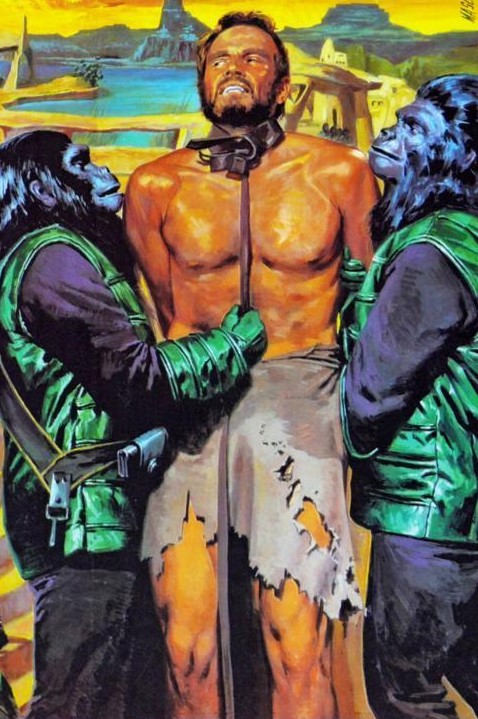
But from the sight of the crucified apes, for the next seven minutes, their world is completely turned upside down. Chasing after their clothes they find inhabitants, automatically assumed to be inferior because they are mute and dressed like cavemen. But then the tribe hears a noise and panics. We see horses hooves, the tops of the flailing sticks used to beat prey out from the undergrowth, rifles, the natives, like dumb beasts, being driven into nets.

Then the first sight of an ape astride a horse wielding a gun. There can’t have been a more astonishing image, not even from the mind of Stanley Kubrick, in the whole of Hollywood sci-fi. Man is not just an alien in a world ruled by apes, but treated like an animal and only kept alive for scientific experiment. That man is rendered mute is hardly surprising because the apes don’t expect their captives capable of uttering an intelligent word.

From then on we’re in familiar and unfamiliar territory. There’s little more cliched than a captive trying to escape, success and failure the next beats. There’s little more cliched than a captive striking up a relationship with an imprisoned female, the pair contriving to achieve freedom.

Where this breaks new ground is that, in addition to making a connection with Nova (Linda Harrison), Taylor (Charlton Heston) woos a female ape scientist Zira (Kim Hunter) who tries to help him become accepted by her people. In the opening section, Taylor had opined, “somewhere in the universe there must be something better than man” but in the arrogance of humanity had assumed he be treated as an equal rather than an inferior.

So it becomes a duel of words. Taylor forced into being told how terrible humans are, and it’s hard to argue with the ape conclusion, while at the same time making the case for mankind, and especially himself, as a special type of species. There’s more than enough meat in the script, riddled with brilliant lines, to make audiences think deeply about the impact of man on the world. You could cast your mind back to the slaves of Spartacus (1961), trying to be accepted as equals, forced into revolt when that is denied. And to some extent that’s the imagined set-up here: Taylor will escape and establish some kind of resistance movement.

But that’s not what director Franklin J. Schaffner (The War Lord, 1965) has in mind at all. He’s been leading us by the nose to the most stunning ending in all of sci fi, and one of the most astonishing climaxes in the entire history of the movies, a shock wrung through with irony.

The movie is a supreme achievement, in springing its multitude of audience traps, turning  the world upside down. Jarring soundtrack and discomfited camerawork add to the stunning images. The ape world is revealed as complex, filled with engaging characters.

Outside of Number One (1969), this is Charlton Heston’s best performance as he moves through a range of emotions, cocky, puzzled, confident, baffled, captive, pleading, arguing the case for humanity, before spilling out into straightforward heroic mode of escapee. For the first time ever Hollywood now had a genuine box office star to headline sci-fi pictures and Heston would carry the torch for The Omega Man (1971) and Soylent Green (1973)

At every level a masterpiece.

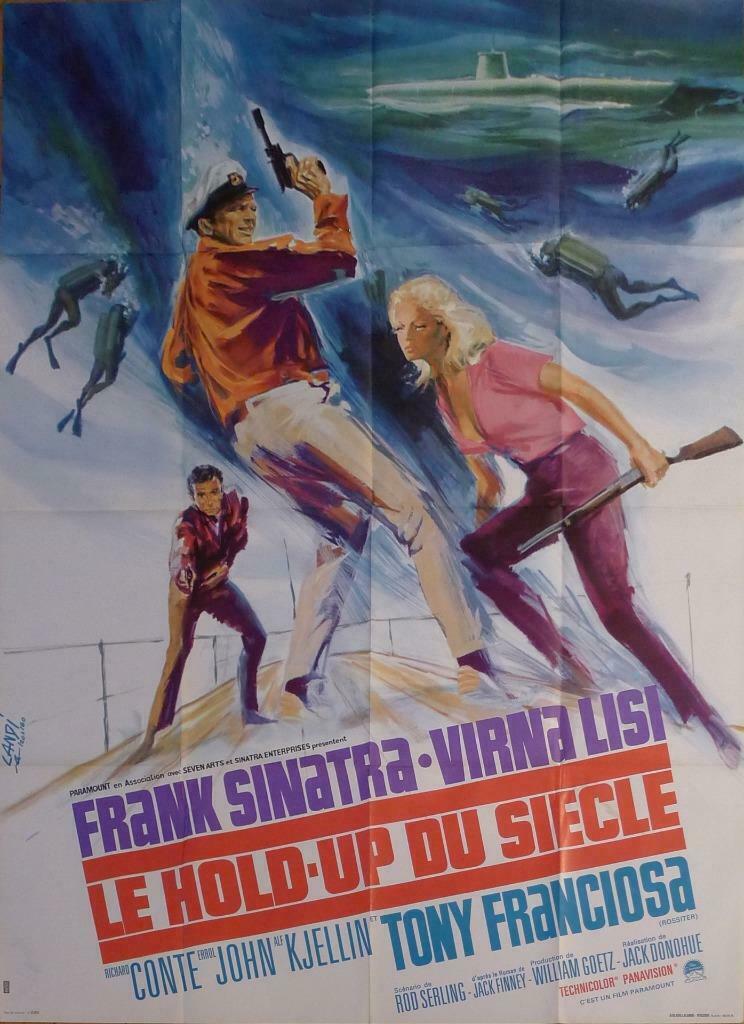
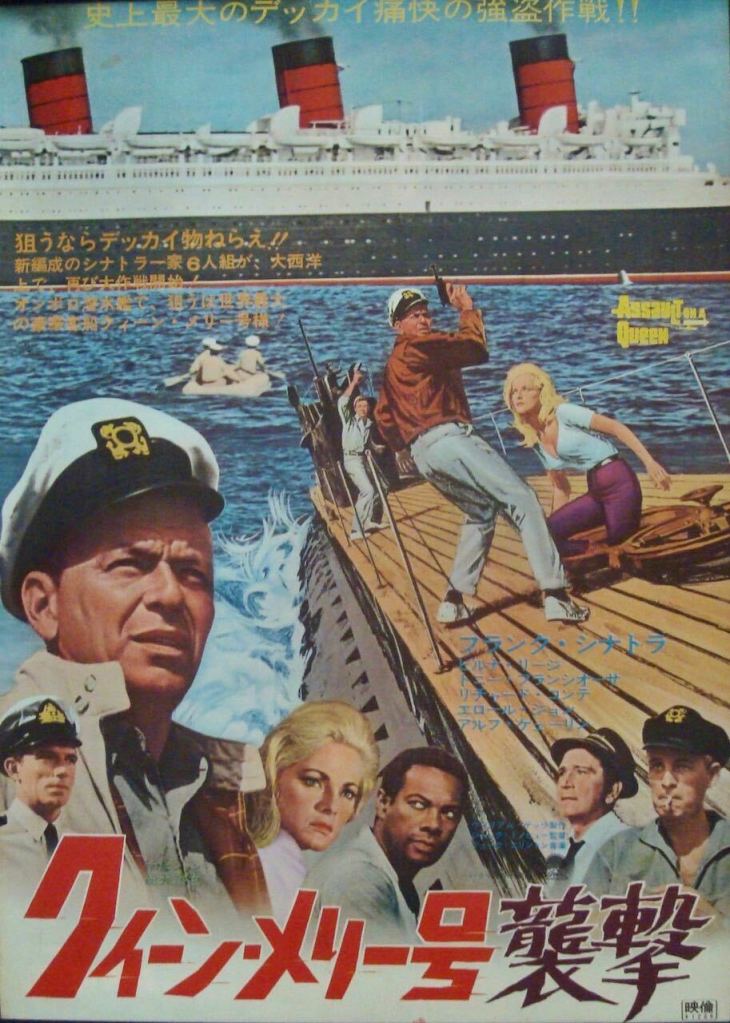
Assault on a Queen (1966) ***

I always wondered why this was a flop. I’m still baffled. Not only is it a perfectly serviceable caper picture, but it’s also high-concept before the term was invented, a World War Two submarine involved in holding up high-end ocean liner Queen Mary (yep, the real thing, thanks to cooperation from owners Cunard). 

The dialogue’s crisp, the robbery well-planned, a good number of twists, plenty underwater thrills, hostility between crew members, and sexual tension kept high by the presence on board of the Italian Miss Big. Diver Mark Brittain (Frank Sinatra) is sucked into a treasure hunt in part because he needs the money and in part through the sexual magnetism of Rosa (Virna Lisi), the expedition backer, who already has suave Vic (Anthony Franciosca) on a string.

The plan evolves into piracy when Brittain discovers a World War Two German submarine on the seabed. As it happens, skippering the salvage vessel is former German U-boat captain Eric (Alf Kjellin). After Mark successfully raises  the sub, it’s game on, Vic’s qualms wilting under Rosa’s seductive gaze. The other team members are engineer Tony (Richard Conte) and wireless operator Linc (Errol John). The prize is a cool million in cash and gold bullion.

Catch No 1: the sub can’t stay submerged for more than an hour. Catch No 2: it’s not that seaworthy and could spring a leak at any time (“don’t just look for water, listen for it,” advises Eric). Catch No 3: in order to successfully board the Queen Mary looking for vital equipment, one of these very American Yanks has to pass himself off as a British sub captain on a secret mission.

Potential Catch No 4 has already been dealt with – if the Queen Mary officers rumble the ruse and call the thieves’ bluff the hijackers plan to put a dummy torpedo up the spout and fire it into the ship’s hull. Catch No 5: there’s so much pent-up hostility among the team the whole endeavor could be sunk. Mark and Vic are vying for Rosa’s favors and clever bombshell that she is she intends to keep it that way, stringing both along.

Racist Vic takes against Eric and also resents splitting the loot with late arrival Tony. Alf not only resents Mark, also a former sub officer, for ending up on the war’s winning side, but exhibits psychopathic tendencies and might just for the hell of it blow a passing tanker out of the water. Like any gang, each member brings something specific to the party. And without giving too much away, the  endgame turns into a battle of wits, especially when the unexpected occurs.

I’m a big fan of Sinatra’s acting style. He is so natural, his gestures don’t look like they’ve been rehearsed for hours in a mirror, you’ll never accuse him of Method acting, or picking parts with Oscars in mind, but somehow he still manages to inhabit his characters.

This is a fascinating role for Virna Lisi (How to Murder Your Wife, 1965), reminiscent of film noir in the way she handles men, but also years ahead of her time not just in combining  sexual and financial independence but of being the boss funding the heist and recruiting the team, and soon has the reluctant Mark playing ball with no sense that’s ultimately she’s going to fall at his feet.

Anthony Franciosca (Rio Conchos, 1964) is mostly a distraction, engaged in a private feud with James Coburn as to who has the brightest and biggest screen teeth. Richard Conte (Lady in Cement, 1969) and Alf Kjellin (Midas Run, 1969) are the physical and mental muscle, respectively, and Trinidadian Errol John (Man in the Middle, 1965) essays an interesting role. Jack Donohue (Marriage on the Rocks, 1965) keeps it all ticking along.

Rod Serling (Planet of the Apes, 1968) devised the screenplay from the novel by Jack Finney (Good Neighbor Sam, 1964). So why did critics and the public have such a downer on the picture? Critical attitudes to the star were easier to understand. Sinatra’s films were generally disliked, and knowledge of his one-take preference allowed critics to thumb their collective noses at his acting, assuming he put no effort into it.

Rumors of his underworld connections were beginning to emerge, he had just married Mia Farrow, less than half his age, and the Beatles and the British invasion had usurped his position in the pop rankings. The general feeling was he was on the way out so why not boot him while he was down. This was despite him receiving some of the best notices of his career for Von Ryan’s Express (1965).

Audiences might have been expecting another Rat Pack lark in the vein of Ocean’s 11 (1960) or felt the supporting cast lacked lustre, Lisi a little known commodity, this only her second Hollywood picture, Franciosca still the second banana, and Hardy Kruger would certainly have invested the German with more malevolence. Otherwise, it’s hard to see what there is to complain about. As I mentioned the dialogue was good, characters simmering, and the story satisfying enough.

Sure, a better director might have extracted more tension from the set pieces, lifted the pace, and added a booming score as with Ice Station Zebra (1968).

It might not be the best heist picture ever made, but it’s too good to be dismissed.

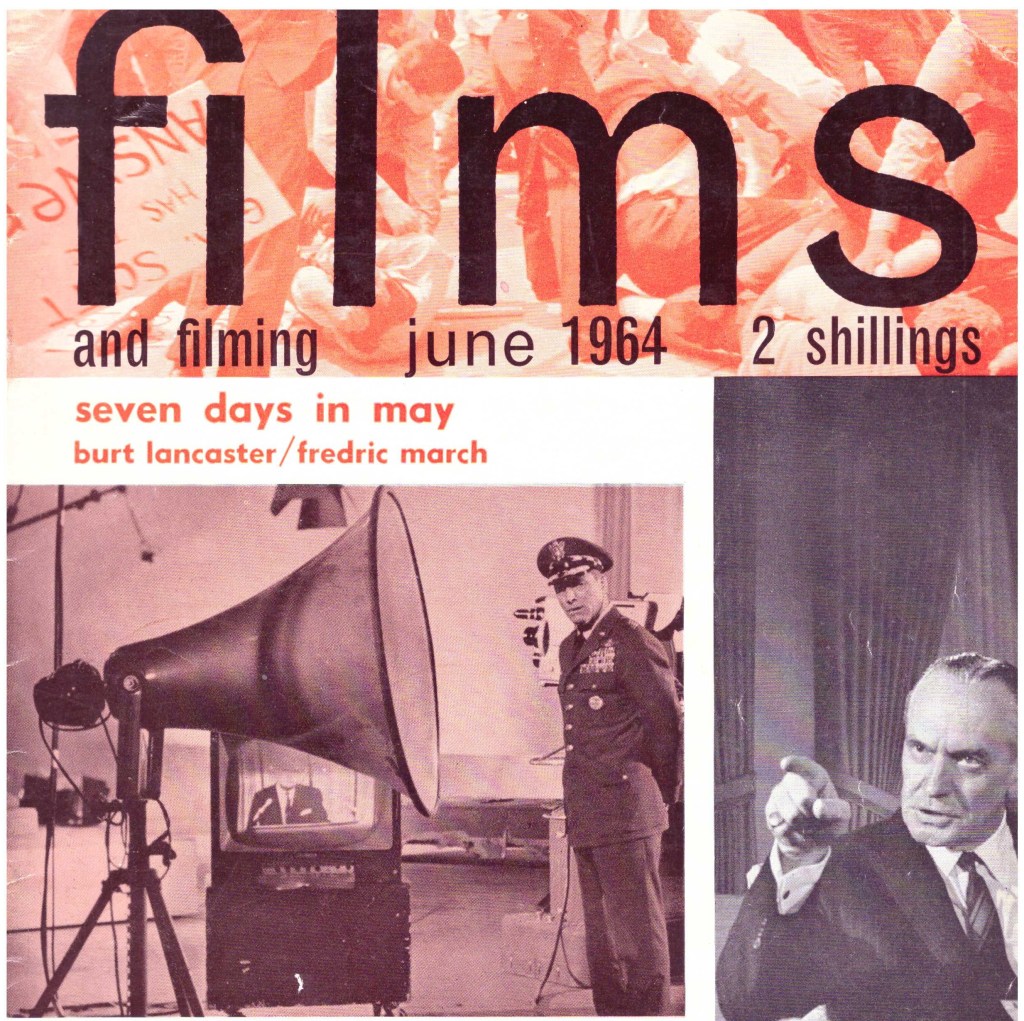
Seven Days in May (1964) ****

Donald Trump and the recent insurrection bring this picture bang up to date. Democracy is a dangerous weapon in the hands of the people. Can they be trusted to make the correct decision? That’s in part the thematic thrust of this high-octane political thriller that pits two of the greatest actors of their generation in a battle to decide the fate of the world. This was the era of the nuke picture – Dr Strangelove (1962), Fail Safe (1964), The Bedford Incident (1965) – all primed by the real-life Cuban Missile Crisis and the growing threat of the Cold War. But since that threat has never gone away – if anything it has worsened – the movie is as relevant today.

Promoting a male-oriented film about politics was always going to be a hard sell despite the distinguished cast. One route Paramount marketeers went down was a massive tie-in with publisher Bantam’s bestseller paperback . Over 1.5 million copies of the book had been rolled out and Bantam had arranged cross-over publicity in supermarkets, five-and-dime stores, booksellers and wholesalers stocking the book. “Look” magazine ran a six-page article by one of the book’s authors Fletcher Knebel.

Just as the President (Fredric March) is about to sign a nuclear treaty with the USSR, much to the fury of the majority of Americans judging by opinion polls, Colonel Jiggs Casey (Kirk Douglas) uncovers signs of a military coup headed by hawk General James Mattoon Scott (Burt Lancaster).

The movie divides into the classic three acts. In the first, Douglas investigates the existence of a secret army unit in El Paso comprising 3,600 men trained to overthrow the government and needs to persuade the President the country is in danger. The second act sees the President hunting for proof of the imminent coup and identifying the conspirators. The third act witnesses showdowns between March and Lancaster and Lancaster and Douglas.

About $65 million out of the U.S. national budget of $90 million was allocated to the military, according to director John Frankenheimer writing in the above magazine. Frankenheimer combined with Kirk Douglas’s company to purchase the book and hire writer Rod Serling. The original script was too long so, without losing a scene, the director went through it cutting phrases and sentences here and there till it was down to the required two-hour length. Paramount put up extra money to get Ava Gardner join the cast.

At the heart of the story is betrayal – Lancaster of his country’s constitution, Douglas of his friend when he takes on the “thankless job of informer.” Douglas proves rather too ruthless, willing to seduce and then betray Ava Gardner, Lancaster’s one-time mistress. Both Gardner and March prove to have higher principles than Douglas. For both Douglas and Lancaster who operate at a high threshold of intensity and could easily have turned in high-octane performances the tension is even better maintained by their apparently initial low-key confrontations. Douglas has a trick here of standing ramrod straight and then turning his head but not his body towards the camera.   

As a pure thriller, it works a treat, investigation to prove there is a conspiracy followed by the the vital element to conspiracy theory – the deaths and disappearances of vital people – and finally the need to resolve the crisis without creating public outcry. The only flaw in the movie’s structure is that Douglas cannot carry out all the investigations and when presidential sidekicks Martin Balsam and Edmond O’Brien are dispatched, respectively, to Gibralter and El Paso the movie loses some of its intensity. But the third act is a stunner as March refuses to take the easy way out by blackmailing Lancaster over his previous relationship with Gardner.   

Of course, there is a ton of political infighting and philosophizing in equal measure and speeches about democracy (“ask for a mandate at the ballot box, don’t steal it”), the American Constitution and the impact of nuclear weapons on humanity. But these verbal volleys are far from long-winded and pack a surefire punch. The coup has been set up with military precision and must be dismantled by political precision.

A hint of the future: one unusual aspect of the picture was the use of closed-circuit television which was seen as being used as method of general communication between politicians and the Pentagon.

The film is awash with Oscar talent – Burt Lancaster, Best Actor for Elmer Gantry (1960) and, at that point, twice nominated; thrice-nominated Kirk Douglas; Fredric March, twice Best Actor for Dr Jekyll and Mr Hyde (1931) and The Best Years of Our Lives (1946) plus  three other nominations besides; Ava Gardner nominated for Best Actress (Mogambo, 1953); and Edmond O’Brien named Best Supporting Actor for The Barefoot Contessa (1954).

None disappoint. March is especially impressive as a weak President tumbling in the polls who has to reach deep to fight a heavyweight adversary. Lancaster and Douglas both bristle with authority. Although Lancaster’s delusional self-belief appears to give him the edge in the acting stakes, Douglas’s ruthless manipulation of a vulnerable Ava Gardner provides him with the better material. Edmond O’Brien as an old soak whose alcoholism marks him out as an easy target is also memorable and Ava Gardner in recognizing her frailties delivers a sympathetic performance.

Fashion might have seemed to offer limited marketing opportunities for such a picture but that did not stop Paramount’s publicists. On the back of one of the subsidiary characters being seen combing her hair with an Ajax comb the manufacturer was inveigled into a nationwide campaign. Director John Frankenheimer was pictured wearing a custom-made Cardinal suit in an advert in “Gentlemen’s Quarterly” and designer Mollie Parnis created a suit for women which could be simply altered every day to provide enough outfits for seven days.

Rod Serling (The Twilight Zone) does a terrific job of distilling a door-stopper of a book by Fletcher Knebel and Charles W. Bailey II.  But the greatest kudos must go to director John Frankenheimer – acquainted with political opportunism through The Manchurian Candidate (1962) and with Burt Lancaster through The Birdman of Alcatraz (1962) – for keeping tension to the forefront and resisting the temptation to slide into political ideology.

Many of the films from the 1960s are to be found free of charge on TCM and Sony Movies and the British Talking Pictures as well as mainstream television channels. But if this film is not available through these routes, then here is the link to the DVD and/or streaming service.

Discover WordPress

A daily selection of the best content published on WordPress, collected for you by humans who love to read.

The Atavist Magazine

by Brian Hannan

WordPress.com News

The latest news on WordPress.com and the WordPress community.