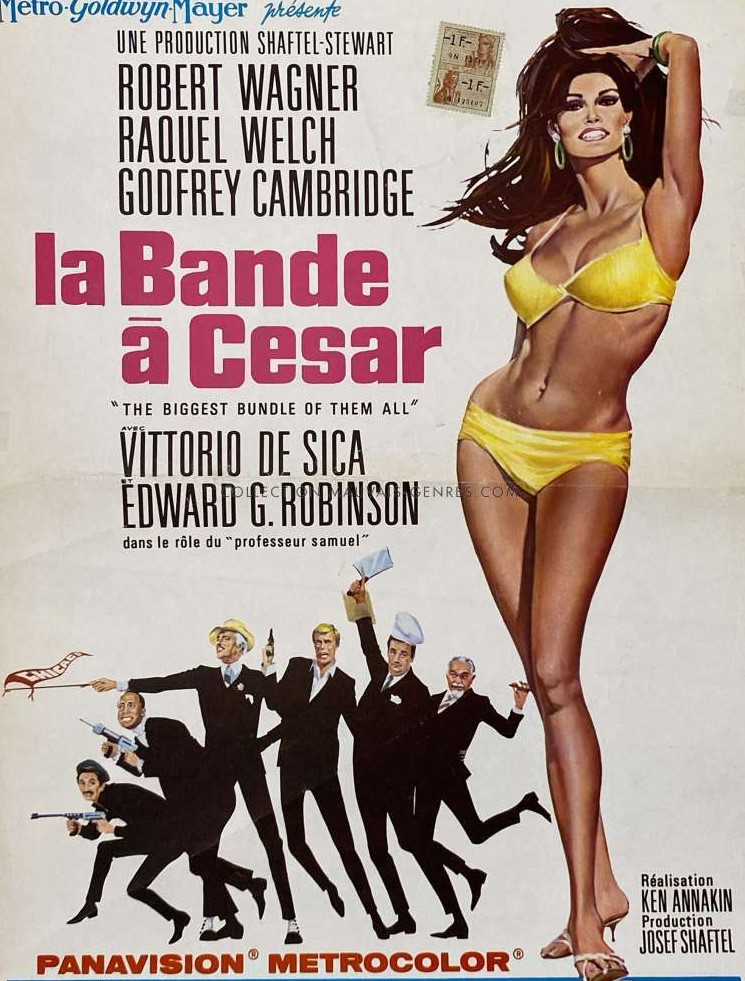
Bunch of incompetent crooks kidnap an impoverished Mafia boss who pays his ransom by setting up a major heist. By a stroke of casting alchemy this brings together Cesare (Vittorio De Sica), the epitome of old world Italian charm, knock-out gangster’s moll and scene-stealer-in-chief Juliana (Raquel Welch) replete with scanty knock-out outfits and criminal mastermind Professor Samuels (Edward G. Robinson). In order to acquire the funds necessary to steal $5 million of platinum ingots from a train – the plan involving a tank and an WW2 bomber – the crew, initially headed by American Harry (Robert Wagner), need to carry out smaller jobs.
Problem is, none of them are any good, not even Cesare, who has lost his flair and botches an attempt to rob an old flame of her jewels. They can’t even carry out a simple theft from a restaurant. The heist itself is pretty spectacular and innovative. And the movie is quirky, with a darker edge. While there are few belly laughs, the light tone is enough to carry the gentle humor, mostly inspired by the misplaced team, amateurs for various reasons, not necessarily outright lawbreaking, on the run. These include London Cockney mechanic Davey (Davy Kaye), chef Antonio (Francesco Mule) distracted by hunger at every turn, cowardly violinist Benny (Godfrey Cambridge) and Joe (Mickey Knox) with a helluva brood to feed.
The story does a good bit of meandering, as does the camera, much of its focus on the voluptuous charms of Juliana, but the hurt pride of Cesare and the grandiose machinations of the professor keep it on course. The Italian settings, incorporating grand villas and ruins, do no harm either. The heist is terrific and there is a final twist you may or may not see coming. The interplay of characters works best when it involves Juliana, who attempts to twist Cesare around her little finger, that tactic mutual it has to be said, who keeps the professor on his toes by dancing with him in a disco, and it soon becomes apparent that she has the upper hand over loverboy Harry.
You could be forgiven for thinking the title refers to Raquel Welch – a cinematic infant at this stage with only One Million Years B.C (1966) in her locker – especially when her cleavage and looks receive such prominence, but the caper is classy and different. As well as being obvious she is both sinuous and seductive and clearly has a mind of her own, possibly the most criminally intent of the entire outfit, with weapons the others lack. By this point, she had invented the pop-out bikini, pictures of which had flooded Europe, making her the pin-up par excellence, but those who came to simply gawp quickly realised there was talent behind the body.
De Sica (The Shoes of the Fisherman, 1968) constantly plays around with the idea of being a defunct godfather and Robinson (Grand Slam, 1967) is the antithesis of the gangster roles on which his fame relied. Robert Wagner (Banning, 1967) is less effective, miscast and out of place in such august acting company and losing out to welch in every scene.
This was a considerable change of pace for British director Ken Annakin after Those Magnificent Men in Their Flying Machines (1965) and Battle of the Bulge (1965) and he brings to this the comedy of the former coupled with the narrative complications of the latter, wrapping everything up in an easy inviting style that makes the most of his stars and the locations. Screenwriter Sy Salkowitz was a television veteran (Perry Mason, The Untouchables et al) , this marking his first venture into the big screen.
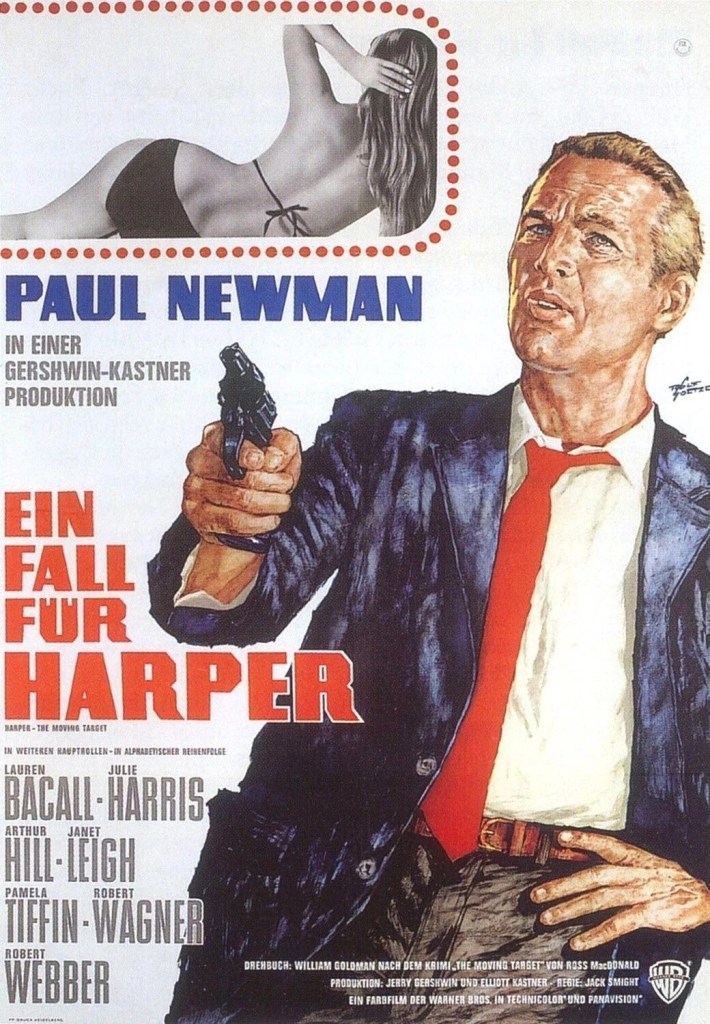
Inventive screenplay by William Goldman (Masquerade, 1965), the ideal combination of witty lines and others that strike to the heart, and Paul Newman’s most naturalistic performance, and a family at each other’s throats, create a genuine addition to the private eye genre. Punch-ups are limited, generally the sleuth comes out worse, his skull an easy target apparently for any villain wanting to give him a good biff.
Most people remember the celebrated credit sequence. But, in fact, most people do not. They remember that this is a guy who will reuse old coffee grinds, which is as good a character definition as you’re going to get. But the opening sequence says much more – he sleeps in a pull-out couch, he falls asleep with the television on, dunking his face in ice suggests a hangover, and – the killer – he sleeps in his office. You won’t forget the ending either, the freeze frame, as fed-up Harper (Paul Newman) just gives up on the stupidity of mankind. And just before that there’s a delicious moment when crippled mother Elaine Sampson (Lauren Bacall) trills to the daughter she loathes Miranda (Pamela Tiffin) in a voice that would denote happiness but is anything but, “I’ve got some news for you,” as she looks forward to informing the child that the father she adores and that Elaine equally loathes is dead.
Not surprisingly, Harper’s on the verge of divorce from wife Susan (Janet Leigh), but he still hankers after being a knight in shining armor, those few days every year when he puts the world to rights rather than chasing down errant husbands in seedy hotel rooms.
The tale is a tad convoluted, involving initially tracking down Elaine’s estranged missing millionaire husband that turns into kidnapping and then murder with a side order of a fake cult headed by Claude (Strother Martin) that’s a front for an illegal immigrant operation, and going through the gears, character-wise, with malicious wife, an extremely flirtatious Miranda who gets her come-uppance when she tangles with Harper, faded alcoholic star Fay Estabrook (Shelley Winters) and junkie Betty (Julie Harris) sometime lover of lothario pilot Allan Taggert (Robert Wagner).
Two distinctive thugs Dwight Troy (Robert Webber) – Fay’s husband – and Puddler (Roy Jenson) offset the dumbest of dumb cops led by Sheriff Spanner (Harold Gould) and lovesick attorney Albert Graves (Arthur Hill), Harper’s longtime buddy, who pines for Miranda.
Torture comes in two guises – the junkie gets the treatment from Dwight and Harper is put through the wringer listening to the endless whining of Fay as he tries to pump her for information. Harper avoids beatings and takes beatings and various characters bounce through doors with a gun – both Taggert and Graves save Harper from being shot.
Harper’s got a slick way about him, but mostly his charm is used to weasel information. He hasn’t got enough of it left to work on his wife.
When Harper’s not racing his sports car along twisting mountain roads, the action shifts to a cult temple, the docks and an abandoned oil tanker. Even when Harper works out who’s in on the kidnapping, it turns out he’s now got a murder to solve since someone’s bumped off the kidnappee.
Despite the endless complications, this whizzes along, helped enormously by Paul Newman’s (Cool Hand Luke, 1967) winning characterization. He’s brought a new trick to his acting arsenal, mastering a method of not listening to a conversation by tilting his head away from the speaker, and there’s a number of novel gestures. The scene where he rejects Miranda is a cracker. Tough guy running short of a soft center, he makes a very believable human being. And he’s got his work cut out because Lauren Bacall (Shock Treatment, 1964) is on scene-stealing duties. As is Pamela Tiffin (The Pleasure Seekers, 1964) though she can hardly match the older woman for arch delivery.
It’s a top-notch cast all the way down. Fans of Strother Martin (Cool Hand Luke) will enjoy his fake healer, Arthur Hill (Moment to Moment, 1966) is engaging, Robert Wagner (Banning, 1967) adds another notch to his rising star bow while Robert Webber (Don’t Make Waves, 1967) emanates menace with his “old stick” routine. Shelley Winters (The Scalphunters, 1968) is a great lush, Julie Harris (The Split, 1968) a junkie trying to pretend she’s not and Janet Leigh (Psycho, 1960), having kicked her husband out, still hoping he might come back in more acceptable form.
Jack Smight (The Third Day, 1965) directs with some zap. This should have had everyone singing the praises of crime writer Ross MacDonald, who in inventing the character (Lew Archer in the original) had inherited the Raymond Chandler mantle, but instead they came away whistling Dixie for screenwriter William Goldman.
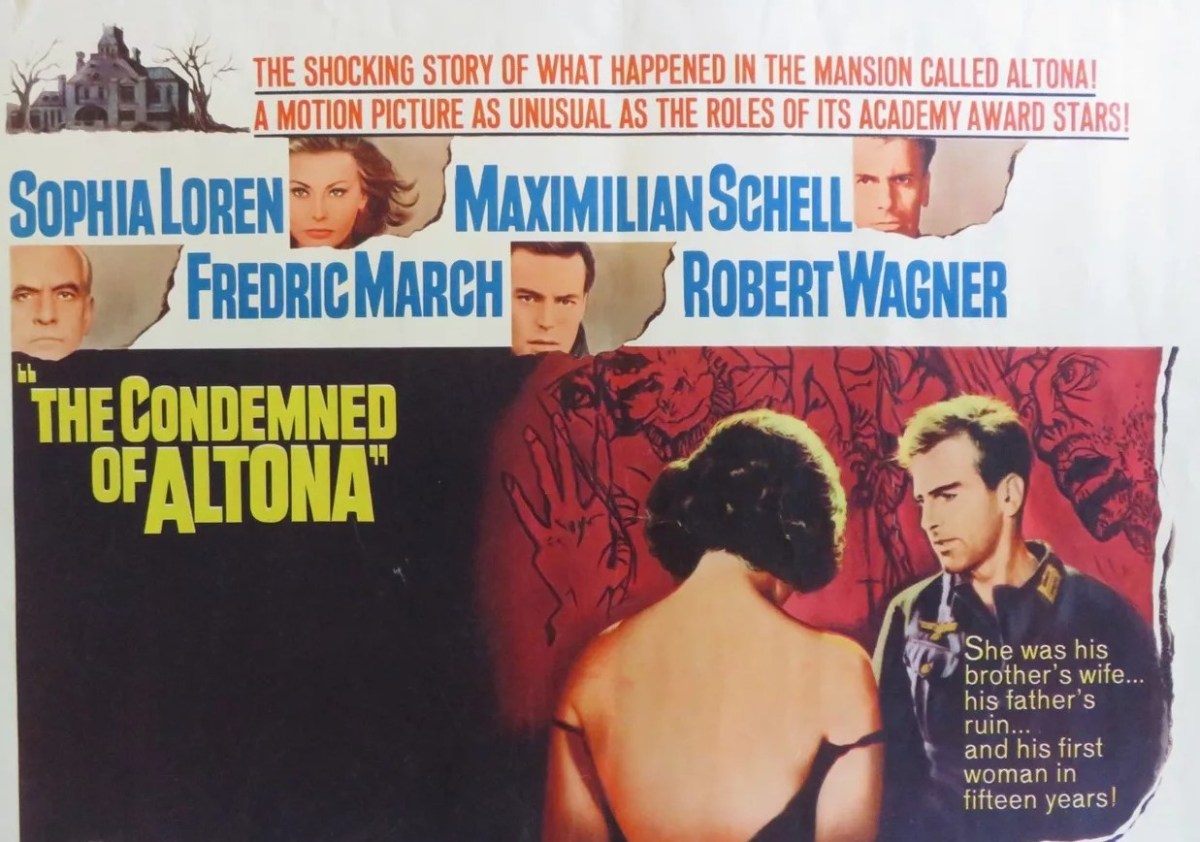
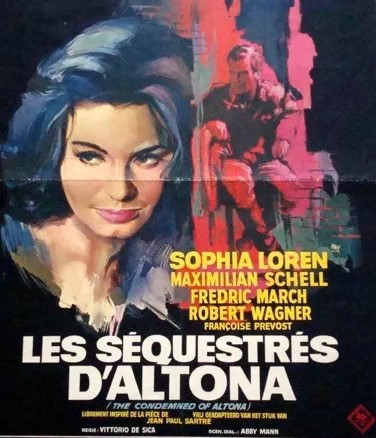
Shades of last year’s Oscar-winning Zone of Interest but with more guilt, some characters dodging it, others driven mad by remembrance of what they did or didn’t do during the Holocaust of World War Two. But mostly, an object lesson in how to expland a play (written by French philosopher Jean-Paul Sartre). Despite top class performances from Sophia Loren (Arabesque, 1966), Maximilian Schell (Counterpoint, 1967), Fredric March (Seven Days in May, 1964) and even, astonishingly, from Robert Wagner (Banning, 1967) it’s director Vitttorio De Sica (A Place for Lovers, 1968), with stunning images and clever camerawork, who steals the show.
You won’t forget in a hurry the outstretched hand of a prisoner in a blizzard condemned to die, nor the skeletal jaw seen through an x-ray machine. The backward crab crawl will remind you of a later movie. De Sica moves the camera every whichway. Aerial and overhead shots are mixed in with the camera swivelling from character to character or suddenly pulling back from a scene and then suddenly he stops you his restraint. But that doesn’t prevent him getting to the heart of the narrative matter and adding in some frisson of accuser attracted to accused.
Set at the end of the 1950s, we begin on a Succession note, but without the contemporary angst and back-stapping. German shipping entrepreneur Albrecht (Fredrich March), a war profiteer turned post-war profiteer having taken advantage of demand in the Germany industrial boom, and now with only months to live, wants to pass on his business to son Werner (Robert Wagner). But Werner shies away, disgusted by his father’s unspoken collaboration with the Nazis during the war, ignoring the argument that the businessman was simply dealing with whatever party was in power. And this would be the narrative, father explaining actions, hoping for expiation, planning for the business to pass down the family line rather than be sold off.
Except that Werner’s left-winger actress wife Johanna (Sophia Loren) discovers there is another contender, the supposedly dead older son Franz (Maximilian Schell) who, instead of being sentenced to death for war crimes and fleeing to Argentina, where he purportedly died, as was the story given out, is actually hiding in the family mansion. He’s pretty much been driven mad, the walls of his substantial hidey-hole daubed with disconcerting images. Windows blocked-up and no knowledge of the outside, wearing his Nazi uniform he envisages a Germany languishing in decay, poverty and hunger. He lives on champagne, oysters and chocolate (so not quite the tough prison regime), and, as discreetly portrayed as was possible at the time, has an incestuous relationship with doting sister Leni (Francoise Prevost), the only human being with whom he is in contact. The inmate, knocking back handfuls of Benzedrine, occupies his time by recording messages to be delivered, he hopes, to Germans many centuries ahead.
Johanna wonders how this mentally-ill man came to be obsessed with guilt and we discover that when he was growing up his father rented out spare land around the mansion to the Nazis for a concentration camp where 30,000 people died. But Franz hid a Jew in the house, was reported to the S.S. by his father, and witnessed the man’s execution, then was punished by being forced to join the Army where he was known as a torturer. Finally, he emerges from isolation and sees a different Germany and confronts his father in a shock ending.
Both Loren and Schell had just won Oscars, for Two Women (1960) – incidentally directed by De Sica – and Judgement at Nuremberg (1961), respectively, so their confrontation, where his initial male dominance (the poster image reflects this scene) settles into a more equal power dynamic. Frederic March is good as the father convinced he has done no wrong and I had to check that this was the same Robert Wagner who had often been indifferent in pictures. De Sica draws great performances from all and layers the whole movie in a doom-laden atmosphere. Written by Abby Mann (Judgement at Nuremberg) and Cesare Zavattini (Woman Times Seven, 1967)
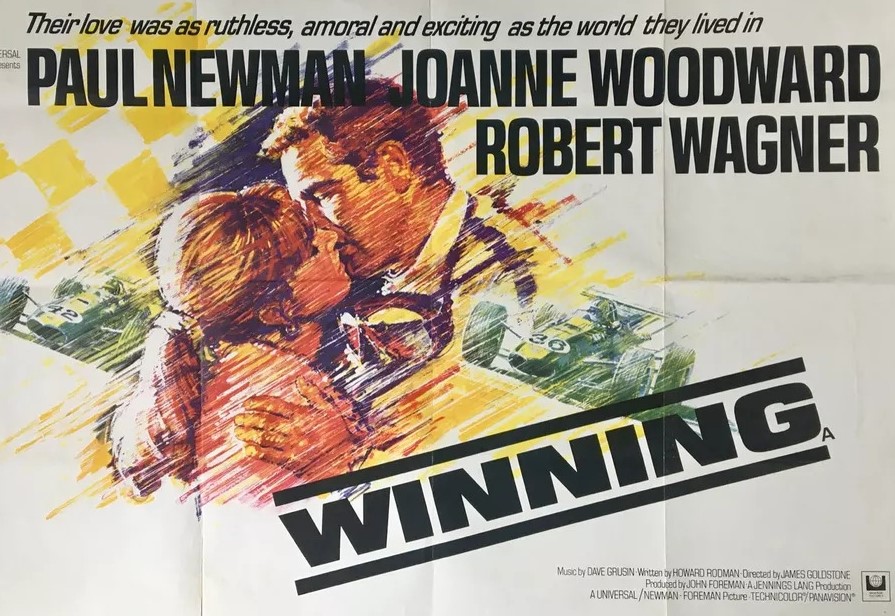
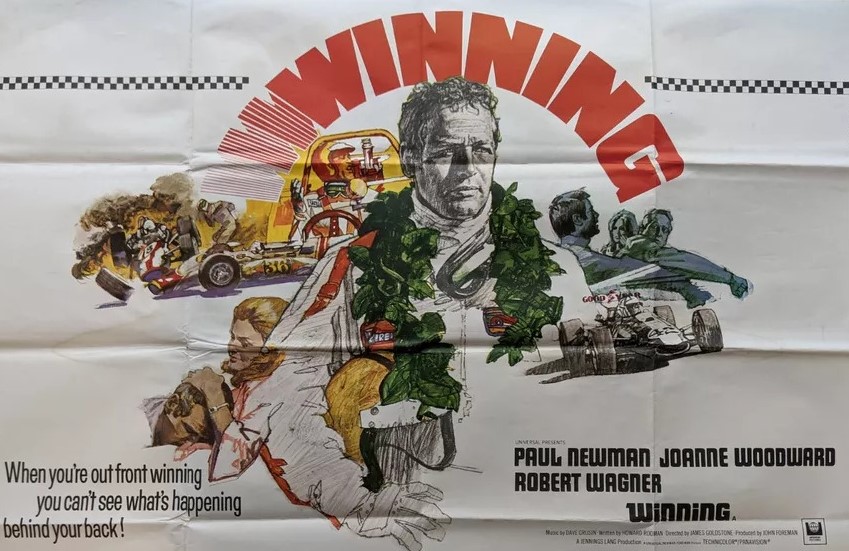
Boasting more marquee firepower than Grand Prix (1966) but less throttle on the track, faces the same problem as all racing pictures, namely, what to do with the cast when the camera’s not watching cars hurtle round and round. The John Frankenheimer Cinerama epic brought audiences much closer to the actuality of the circuit, though it fell down at the box office because U.S. moviegoers were less interested in Formula One than their home-grown variety, and filled up the off-track narrative with a clever concoction of politics, romance and revenge.
Le Mans ‘66/Ford vs Ferrari (2019) is the acknowledged ace of racing pictures, with terrific speed action, detailed engineering background, and the true-life tale of the manufacturing kingpin of America trying to wrest a crown from the European monarch, and with romance kept strictly off screen; I’ve no idea if Carroll Shelby had a wife or kids, that’s how disinterested this picture was in moving away from the central situation.
So what you inevitably have here is, to use the football idiom, a picture of two halves. And from today’s perspective, oddly enough it’s the off-screen maneuvers that take center stage. For the time, the racing sequences would have been interesting, not in the Grand Prix league, but then that didn’t make as much money as MGM would have liked, so it made sense to try and back up the spinning around with a more interesting story.
And this one’s a zinger, and the only reason the picture doesn’t work as well as it should is because the racing keeps on getting in the way of two hard-nosed individuals. There’s nothing particularly unusual about race ace Capua. He’s not of the win-at-all-costs league of Charlton Heston in Number One (1969), there’s no dodgy dealings for example, but he’s got the standard winner’s mindset, everything, including wife, takes second place to achieving his goal which in this instance is winning the Indy 500 (a 500-mile race round the same circular track about 200 times, not the twisting-and-turning racetracks of Grand Prix).
Even when he does win he lacks the champagne’n’sex personality of rival Erding (Robert Wagner) who’s usually got a girl on both arms and both knees and knows how to party. You’re more likely to find Capua wandering alone and drunk through the streets late at night with an empty hotel bed awaiting.
That’s where he meets single mum Elora (Joanne Woodward) shutting up shop (the hours they work!) in a car rental outlet (Avis, if you must know, since presumably they paid for the plug), the type of gal who looks a lot more straight-up than she turns out. She’s happy to dump her son on her mother and hightail off with new lover and he’s so smitten it’s not long before they’re married and she has to come to terms with the fact that he’s a lot more monosyllabic as a husband than a skirt-chasing Romeo.
What should have upset the applecart is her son, Charley (Richard Thomas), but Capua’s taken a shine to the teenager and spends a whole weekend – mum packed off elsewhere – getting to know him. Movies of this era didn’t waste any time on father-son bonding, kids mostly getting in the way of either romance or family life, and played for comedic effect (The Impossible Years, 1968, etc) or already having flown the nest and getting stoned. So this is pretty unusual territory and it’s well done.
But the real twist is Elora. Setting aside that she’s the kind of woman that dumps her son when a handsome hunk hoves into view, she looks like your typical mom, happy to sit on the sidelines and wait for hubby to come home and console him should he be on a losing streak. But Elora’s not that kind of woman at all. She needs attention. And if she doesn’t get it from a husband too wrapped up in his work she’s going to look elsewhere.
There’s an absolutely stunning scene that has little place in a sports picture when said handsome hunk, sporting god, top dog, finds her in bed with Erding. This has got to be Paul Newman’s best ever acting. And cleverly directed. The movie’s been toddling along with a nifty romantic score and that music’s playing as Capua heads home. But it shuts off suddenly when he opens the motel door. Tears brim in Capua’s eyes. The wife reacts from shame. No words are spoken. It’s all in looks.
Consequently, Charley takes against the erring mom and in a fast-forward to contemporary complicated maternal relationships she wants him to be her “friend.”
Of course, with her out of the way, Capua can get down to the serious business of winning, but that still leaves an emptiness inside. You’ll probably remember the famous freeze-frame ending of Butch Cassidy and the Sundance Kid (1969), perhaps it’s no coincidence that Newman and producing partner John Foreman were in charge of that as well, because here they resort to the same technique. While, theoretically, this leaves audiences on an edge, it doesn’t at all, it just, as in the western, stops short of spelling things out. Elora’s much more self-aware than Capua, she’s making no moves to welcome a second chance, and you’re pretty darned sure this marriage ain’t going to get over her betrayal.
All the noise and razzamatazz of seeing the Indy 500 on the screen obscured the fine acting. Coming at it now with the racing sequences not appearing half as exciting as they must have been back in the day, and the twisty character of Elora to the fore, plus the exploration of the father-teenage son relationship, this has got a lot more to offer.
My guess is it gets marked down because the racing isn’t up to modern day expectations but ignore that and watch the acting. Joanne Woodward (A Big Hand for the Little Lady, 1966) steals the show, and, except in that one scene, beats Paul Newman (The Prize, 1963) hands down but that’s taking little away from the actor. In his debut Richard Thomas (Last Summer, 1970) shows definite promise, Robert Wagner (The Biggest Bundle of Them All, 1968) better than I’ve seen him. James Goldstone (When Time Ran Out, 1980) directed from a script by Howard Rodman (Coogan’s Bluff, 1968).
The making of this could have been a movie in itself. The novel, published in 1952, suffered from a long gestation involving four directors with seven actors at various points either signed up or mooted for the two top main roles.
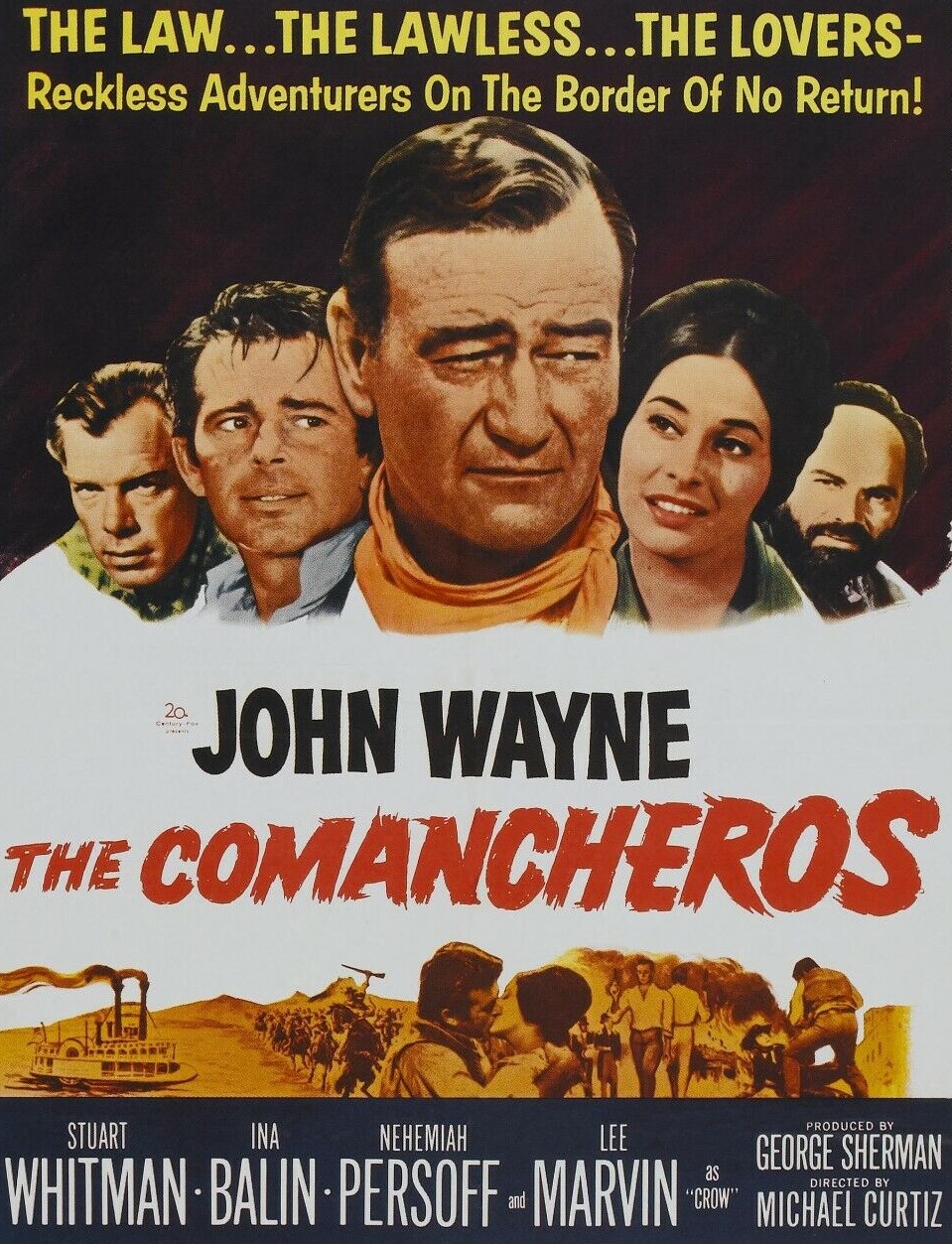
Journalist-turned-author Paul Wellman specialized in westerns and historical non-fiction with a western bent. The Comancheros was the last of the half-dozen of his near-30 novels to reach the screen, following Cheyenne (1947) with Jane Wyman, The Walls of Jericho (1948) with Cornel Wilde and Linda Darnell, Alan Ladd as Jim Bowie in The Iron Mistress (1952), Burt Lancaster as Apache (1954) and Glenn Ford as Jubal (1956).
Originally earmarked by George Stevens as a follow-up to his Oscar-nominated Shane (1953), it was scheduled to roll before the cameras on completion of Giant (1956) in a Warner Bros production that contemplated re-teaming Vera Cruz (1954) pair Gary Cooker and Burt Lancaster. When that failed to gel, next up were Gary Cooper and James Garner. That was kind of a tricky proposition given that Garner had taken on the might of Warner Brothers in a lawsuit in a bid to extricate himself from his contract.
But the producer didn’t seem to care as the day the actor won the lawsuit he received the script. “I didn’t like it, I didn’t want to do it,” recalled Garner, “but a couple of days later I heard Gary Cooper was going to do it,” resulting in a speedy change of heart. However, despite his verbal acceptance, no contract appeared and never hearing from Fox again assumed foul play from Warner studio head Jack Warner.
Meanwhile, Stevens’ interest had cooled and after settling on The Diary of Anne Frank (1959) he sold the film rights off to Twentieth Century Fox for $300,000, more than he had originally paid the author. Fox hired Clair Huffaker (Hellfighters, 1968) to write the script with Cooper’s sidekick role assigned to the up-and-coming Robert Wagner (Banning, 1967). But Cooper’s ill-health prevented that version going ahead.
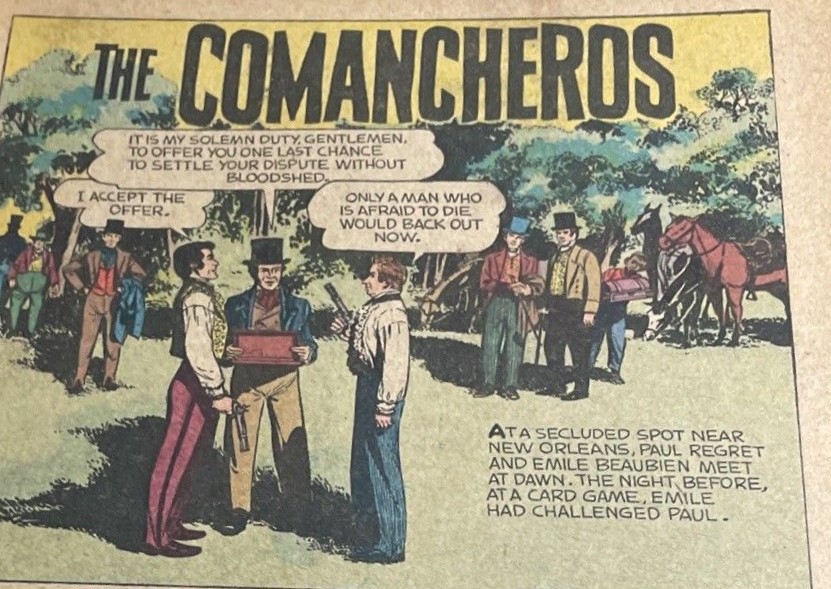
Comic specialist Dell was a bit slow on the uptake, it’s tie-in copy (Issue 1300) not appearing until three months after the movie opened.
Television director Douglas Heyes (Beau Geste, 1966) was set to make his feature film debut with the plum cast of John Wayne and Charlton Heston, fresh off global monster hit Ben-Hur (1959). Ironically, Wayne could have made this movie years before, in 1953 having been sent the novel by then-agent Charles Feldman (who had clearly also contacted Stevens).
Wayne had come back into the equation after signing a three-picture deal with Fox. But Heston, on reflection, decided it would not be in the interests of his career at this point to take second billing and dropped out.
Wayne’s involvement meant re-shaping the script. In the novel the main character was Paul Regret, the Louisiana gambler wanted for murder for killing a man in a duel. Wayne was too old to play him so to puff up his part the Huffaker script was rewritten by James Edward Grant, better known originally as a short story writer, who had begun working for Wayne on The Angel and the Badman (1947) and would continue to do so for another 11 projects ending with Circus World (1964).
Another newcomer, Tom Tryon (The Cardinal, 1963), was lined up to play Regret. Then Heyes dropped out leaving the way clear for the final teaming of Hungarian director Michael Curtiz (Casablanca, 1942), now a freelance after decades with Warners, and John Wayne.
Stuart Whitman (Murder Inc, 1960) arrived from left field. While starring as Francis of Assisi (1961) he was shown the script by that film’s director, Curtiz. Tryon was eased out after Whitman managed to secure an interview with Wayne and the pair hit it off.
That Curtiz was already suffering from cancer was obvious to Whitman. Whatever sympathy his illness might have attracted was scuppered by the director’s rudeness. He had a predilection for sunbathing in the nude and blowing his nose on tablecloths, the actions of a powerful figure letting everyone know he could get away with it. His illness meant he restricted working to the mornings. After lunch he fell asleep in his chair, the crew placing umbrellas over his head to protect him from the sun.
While the director dozed, Wayne took over the directorial reins. When Curtiz was hospitalized, the actor finished the picture. It is estimated that he filmed over half of it, including the climactic battle.
Ina Balin, a Method actor, found her acting style cut little ice with Wayne. When she demanded rehearsals and long discussions about her character, he simply shot the rehearsal. “Cut. Print. See how easy this is,” explained the actor after wrapping her first scene with him using the rehearsal take.
“Duke was a terrific director,” observed Stuart Whitman, “as long as you did what he wanted you to do. Shooting with him was very easy although Ina Balin…pissed him off. Before each shot, she’d dig down and get emotional and he was a little impatient: get the goddam words out, he’d mutter to himself.”
Jack Elam, playing one of the heavies, had won in a poker game with their handler a pair of camera-trained vultures. The daily fee for the birds to sit on a branch was $100. Elam thought he’d get cute and ramp up the price to $250. That notion didn’t sit well with Wayne and he soon reverted to the original price.
While on the set, Curtiz fired third assistant Tom Mankiewicz, later a screenwriter, but currently just a lowly nepo, owing his job to the fact he was son of director Joseph L. Mankiewicz. Tom’s downfall was arguing with Curtiz over his plans for the stampede scene for which he had rented dozens of Wayne’s prized longhorns. Asking the cattle to go over a 5ft drop and scramble up the other side was a good way of breaking their legs. Having informed Wayne of the director’s proposal, he was told by the star to turn up for work the next day, by the time the actor had finished chewing out the director that would be the least of his problems.
Despite friction with Curtiz, Wayne was surrounded by old friends and colleagues, including producer George Sherman, cinematographer William Clothier and screenwriter James Edward Grant. “Duke and George Sherman grew up together working at Republic for $75 a week and all the horses you could ride,” explained Clothier. “They were old friends. Duke didn’t understand old Mike Curtiz very well and I must say he didn’t try very hard. Mike was just plain out-numbered and I felt sorry for him.”
Although set in Texas in 1843, parts of the film were shot in Utah and the cast used weapons such as the Winchester lever-action rifles and the Colt Peacemaker which were not in production for another three decades.
Michael Curtiz, after nearly half a century directing movies, died shortly after the film’s release. The Comancheros, a box office smash, helped balance Wayne’s finances after the financial hit of The Alamo and solidified the notion that as far as is career went he was better concentrating on westerns than anything else.
For some reason, U.S. box office figures are sketchy but it was a huge hit around the world, finishing seventh for the year at the British box office for example, and re-emphasizing the Duke’s resounding global popularity.
SOURCES: Scott Eyman, John Wayne, His Life and Legend, (Simon and Schuster paperback, 2014) p352-357; Howard Thompson, “Wagner Steps Up Work In Movies,” New York Times, January 21, 1961, p18; Lawrence Grobel, “James Garner, You Ought To Be in Pictures,” Movieline, May 1, 1994
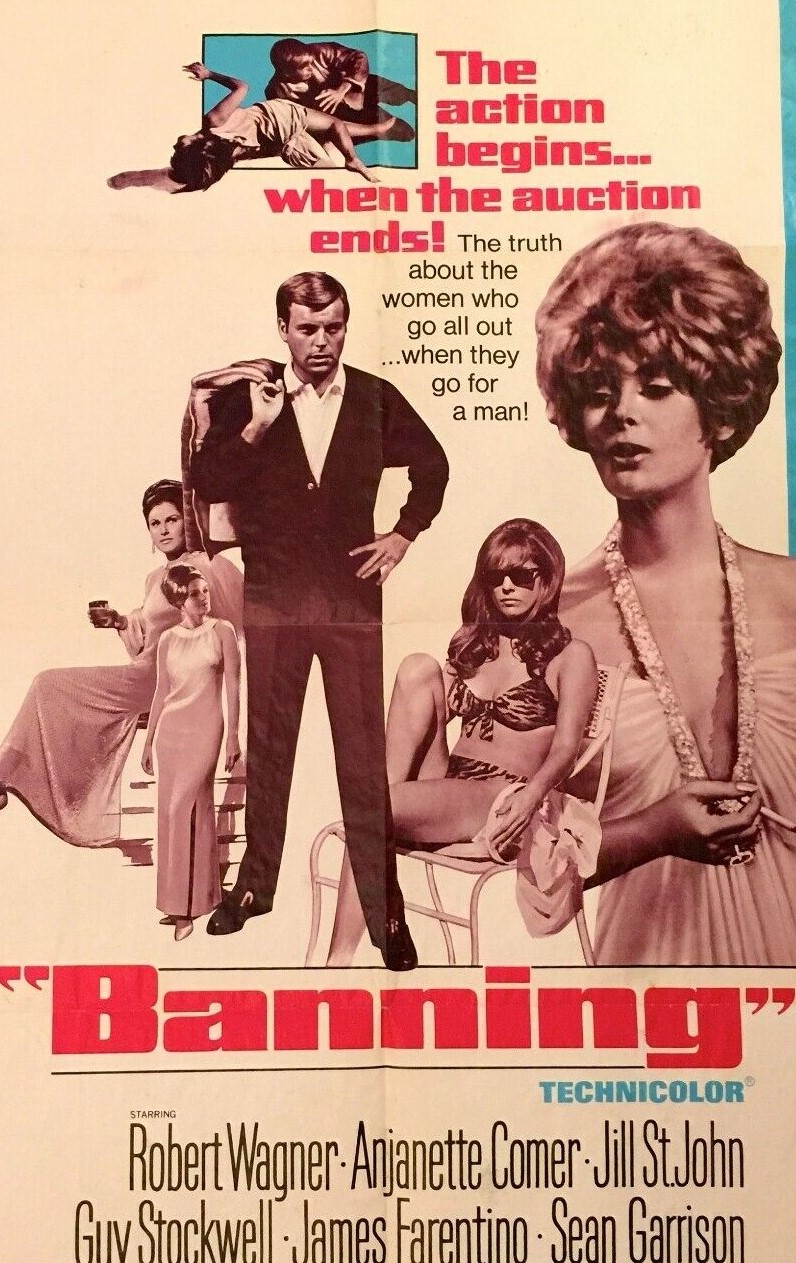
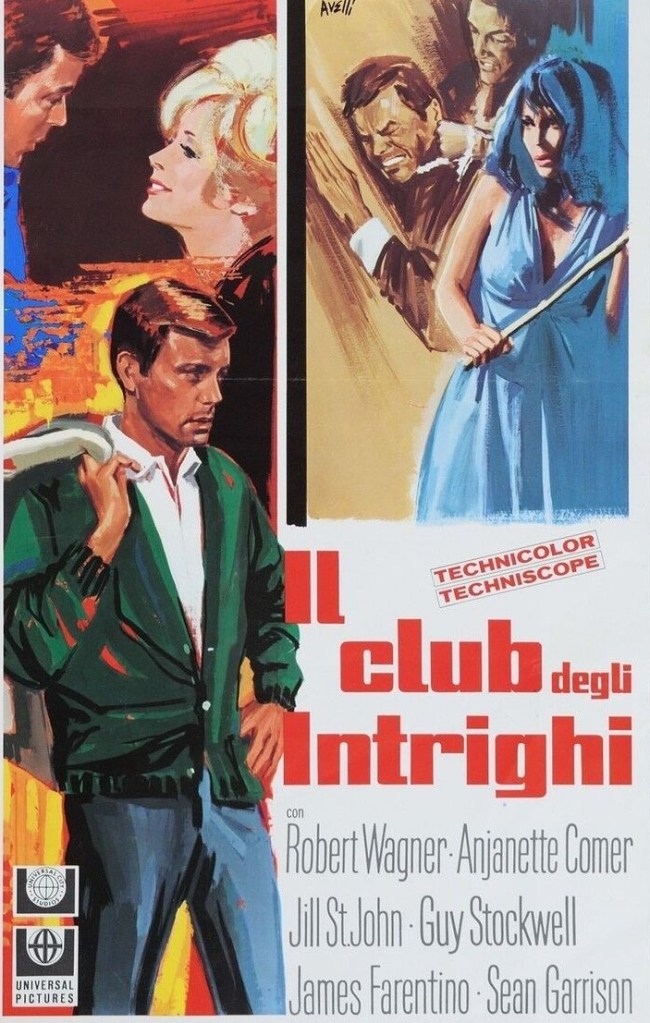
Robert Wagner’s bid for stardom is scuppered by a limp plot set in the overheated world of the country club set where a posse of sexually predatory women operate. It doesn’t help that the main narrative thrust finds trouble just hanging in there.
Ex-professional golfer Banning (Robert Wagner), a “moral diabetic” on the run from a loan shark, pitches up at an upmarket country club where he finds work as the assistant golf pro to Jonathan (Guy Stockwell). His most arduous task appears to be picking his way between the toned bikini-ed bodies lounging around the pool and avoiding the advances of Angela (Jill St John) and Jonathan’s wife Cynthia (Susan Clark) while coming on strong to overpaid secretary Carol (Anjanette Comer).
There’s an element of Life at the Top (1965) here, with Jonathan married to the boss’s daughter, resenting their close relationship while not making the executive advances he would like. Every now and then bits of what sound like a complicated past implicating Jonathan and the alcoholic Tommy Del Gaddo (Gene Hackman) pop up and around the halfway mark a subplot kicks in, involving something called a “Calcutta,” a golf tourney which looks like it’s being rigged.
Given that it’s organised by a club boss (Howard St John) who claims every gimme going and feigns drunkenness to skin members at poker, it’s almost a given that Banning is going to come out worst. I have to tell you you probably couldn’t care less, since most of the action, and all of the fun, is off course, and not so much in the bedroom stakes as the war between women for available men.
“I bought you,” purrs Angela in her most seductive attire after she has made it possible for Banning to find a way to pay off his debts. “I want you,” snaps single mother Carol, making a forthright play after spending most of the picture fending off his advances. Standing on the side-lines, watching Angela making her moves, Cynthia observes, “I’d say Angela’s had at least a dozen husbands,” pause for the punchline, “including mine for all I know.”
Predatory moves are not all one way. Turns out the price Carol pays for a salary five times the going rate and a nice house and private schooling for her daughter is setting aside Thursday afternoons for Jonathan. But in the pragmatic manner that appears inbred in the country club, she states, “No apologies, no excuses.”
And before Carol works out just how attractive Banning actually is she had to cut him dead a couple of times and, in a scene guaranteed to put off the modern audience, prevent him drunkenly raping her. It was almost a throwback to the 1940s and 1950s when, it appeared, a woman just needed a good smack on the chops before she could submit and start billing and cooing.
Robert Wagner (The Biggest Bundle of Them All, 1968), tanned within an inch of his life, doesn’t so much miss the target as not being given a target worth hitting. There’s very little sense danger, of a man on the run from the mob or whichever gangster has picked up the tab for his debt, and he’s not a lounge lizard. Acting-wise, he relies on a raised eyebrow, an eye swivel and that scene-stealing trick, copyright Robert Vaughn, of raising his lowered head to open his closed eyes, a neat device for a supporting star but hardly required when you are top-billed.
Anjanette Comer (Guns for San Sebastian, 1968) doesn’t snatch the brass ring either, relying on a tremulous lower lip to evoke emotion. In fact, it’s a toss-up between the classier Jill St John (The King’s Pirate, 1967) and Susan Clark (Tell Them Willie Boy Is Here, 1969) as to who steals the most scenes, both winging it with striking dialog, emanating power, regarding men as weak and playthings.
Gene Hackman (Lilith, 1964), generally a prime contender for scene stealing, especially with trademark chuckle now in full swing, unfortunately does himself no favors by over-acting. You might also spot James Farentino (Rosie, 1967) and Sean Garrison (Moment to Moment, 1966).
Ron Winston (Ambush Bay, 1966) directed from a screenplay by James Lee (Counterpoint, 1967). It would have worked better to concentrate more on the bitchy women than the sub-plots.
I’m sorry to say you’ll have a hard job finding this since I purchased my DVD on the second-hand market. Worth the hunt if you’re a fan of St John and Clark or to discover why Wagner’s promising screen career never took off.
You would have to be a fan of farce and slapstick to appreciate much of the debut of the celebrated Pink Panther franchise. I enjoy slapstick, though this is limited here to mishaps with items of furniture, but farce tends to pass me by (although I laughed myself silly at One Man, Two Guv’nors on stage). And you should be aware that this is really a dry run for the Clouseau character later hilariously perfected by Peter Sellers.
The premise is clever. Bumbling detective Clouseau (Peters Sellers, minus the pronounced French accent that appeared later) is on the trail of ace cat burglar The Phantom (David Niven), unaware that his wife Simone (Capucine) is not only in cahoots with the jewel thief but his lover. The trail leads to Switzerland where the robber plans to steal the titular diamond owned by The Princess (Claudia Cardinale). The Phantom, aka Sir Charles Lytton, attempts to get to know her better by stealing and then rescuing her dog.
Danny Kaye or Peter Sellers?
Meanwhile, to add to the confusion, Lytton’s conman nephew George (Robert Wagner) has arrived in town, and soon attempts to purloin his uncle’s mistress and on realising Lytton’s true identity stals his equipment with the intention of turning thief himself.
Lytton has the tendency to take a suite adjoining the Clouseau bedroom complete with linking doors to make it easier to make hay with Simone while the complaisant detective is lured elsewhere.
Cue a series of bedroom farces of the kind where Lytton attempting to make love to a drunken Princess in the lounge of his suite does not realise his nephew is in the bedroom and Simone expecting the uncle and finding the junior. And the classic of Simone, pursued by both men in her own room, having to hide them, on her husband’s return, in bed, cupboard, shower and bath.
There’s a fancy dress party where competing gorillas target the famed jewel and Clouseau, clunking around in armour, knocks into or knocks down anything in sight. And finding one of his men, dressed as a zebra, drinking on duty, harangues him with the threat of having his stripes (best joke by far).
But the bulk of the laugh out loud comedy originates from the inspector’s tussles with inanimate objects, doors, even approached cautiously, appearing to be capable of springing surprises.
The original cast – Ava Gardner in the Capucine role and Peter Ustinov as Clouseau.
Unfortunately, the first Pink Panther outing was not designed with Sellers expressly in mind and so the plot, necessitating accommodating the other stars via romantic interlude, does not play to his strengths. You get the impression of Sellers improvising his way into stealing every scene he is in with his brilliant physical comedy as there’s only limited value in his role as the duped husband.
After the sequel A Shot in the Dark (1964) where Sellers took center stage Blake Edwards would go all-out slapstick in his next venture The Great Race (1965) but here there’s neither sufficient Keatonesque or Chaplinesque buffoonery or Laurel and Hardy antics to maintain the comedic momentum.
David Niven (Bedtime Story, 1964) is perfectly serviceable as the master criminal especially as it calls mostly for his legendary charm, though he brings his double take quickly up to speed. Claudia Cardinale (Once Upon a Time in the West, 1968) is surprisingly good in a light-hearted role while Robert Wagner (The Biggest Bundle of Them All, 1968), a rising star at this point, comes over as slippery ingenue. Capucine (The 7th Dawn, 1964) has the most difficult part since she is in effect playing two roles, faithful wife and wanton lover.
Despite priceless roles in Ealing comedies and various attempts to embrace the Hollywood dynamic, this was the picture that turned Peter Sellers (Heavens Above!, 1963) into a bona fide star. It says a lot for the director that, having found a comedy genius on his hands, he did his best to accommodate him without allowing him to over-dominate what was in effect a carefully-orchestrated piece.
In small roles you will find John Le Mesurier (The Liquidator, 1965) and Brenda de Banzie (A Matter of Innocence, 1967) and the chanteuse in the ski chalet you might be interested to know was Fran Jeffries (Sex and the Single Girl, 1964). And of course the memorable theme tune, as celebrated as the movie itself, was composed by Henry Mancini (Hatari!, 1962). The film also spawned the famous cartoon series. Edwards wrote the screenplay with Maurice Richlin (Pillow Talk, 1959).
You could do worse than splurge on a five-disc box set.
Films that reach the screen two years after filming was completed are generally stinkers. Ken Annakin caper movie The Biggest Bundle of Them All wrapped production in summer 1966 and was not released until January 1968. But the reason was not the usual.
The cause of the unseemly delay was a temper tantrum by Oscar-winning uber-producer Sam Spiegel (Lawrence of Arabia, 1962) who had been working on a similar project about incompetent amateurs kidnapping a gangster kingpin – The Happening (1967) starring Anthony Quinn (previously reviewed in the Blog). After bringing a charge of blatant plagiarism, Spiegel was mollified by being permitted to bring his movie out first, with an inbuilt eight-month gap between both releases, the deal sweetened by a 15% cut of The Biggest Bundle’s profits and the right to vet the script.
Despite success with Those Magnificent Men in Their Flying Machines (1965) and Battle of the Bulge (1965) British director Annakin was at a career impasse. The Fifth Coin written by Francis Ford Coppola and starring George Segal failed to get off the ground. He turned down western Texas Across the River (1966) at a time when Catherine Deneuve and Shirley Maclaine were slotted in for the female roles and was fired from The Perils of Pauline (1967). The Italian Caper as it was then known, recalled Annakin, “did not seem a world-shattering movie but I found the caper fascinating and the cast irresistible.”
Let them eat cheesecake.
It marked the movie debut for producer Josef Shaftel of The Untouchables television fame and for screenwriter Rod Amateau (The Wilby Conspiracy, 1975), also then a television regular although the final script was attributed to another neophyte Sy Salkowitz. The film made the most of Italian locations, Naples and Rome, as well as the South of France and Provence. Annakin caught pneumonia just as shooting was to commence. Shaftel took over for five days only for his material to prove unusable.
Both veteran actors proved easy to direct. “Robinson was like putty in my hands, completely trusting.” And while Vittorio De Sica was every bit as amenable he was inclined to fall asleep on the set as the result of entertaining his mistress the night before. Di Sica was also a compulsive gambler and at one point lost half his salary in a casino.
Raquel Welch, in only her second picture after One Million Years B.C. (1966) – which contained minimal dialogue – was initially a handful. Primarily, this was due to inexperience and her desire to present herself in as alluring a fashion as possible, with impeccable hairstyles and make-up. After she had kept the crew waiting once too often Annakin threatened to eliminate her close-ups unless she respected the shooting schedule.
“On the whole I was quite pleased with the results because she really applied herself and so long as one broke up the scenes into a couple of lines at a time she became able to handle them quite adequately…I was getting along excellently with Raquel – even to the extent of trying to find another picture with her,” Annakin noted in his autobiography. Since this was written three decades after the movie was made, it would have given him ample time to get rid of any latent hostility to the actress. This reaction, it has to be said, is contrary to much of what has been written about Welch’s behavior on the picture. At the time of filming he reported that “she has a marvelous flair for comedy.”
But it appeared that Annakin was the only one who spotted her star potential. “The rest of the cast, especially Bob (Robert Wagner), regarded her as a pin-up girl on the make…none of them thought she was particularly sexy at this time.”
Otherwise, the only other trouble came from Godfrey Cambridge who “had a chip on his shoulder” and from Robert Wagner’s insistence on wearing false eyelashes. Problems arose over the cinematographer’s determination to employ powerful lights even at the height of a Mediterranean summer and a massive dust storm interrupted filming of the final scenes. Annakin also benefitted from the locations and using his experience was able to shift 35 pages of script from interiors to outdoors, completely altering the look of the picture. This made the $2 million movie “look like it cost three or four million,” according to Annakin.
At this point Welch, best known for having been sued by her publicist, was in the process of turning herself into a star in demand. In 1966 Welch was something of a Hollywood secret. She had three pictures in the bank, was working on a fourth and had signed up for a fifth before any of her movies had been released. On the other hand, she was fast becoming one of the most famous faces (and bodies) in the world, on the cover of of hundreds of magazines in Europe, many for the fourth or fifth time.
Having set up a company, Curtwel, managed by husband Patrick Curtis, she would earn $15,570 a week on loan to MGM for a second film Italian movie Shoot, Loud…Louder, I Don’t Understand (1966), considerably more than through her contract with Twentieth Century Fox. A year later she collected £100,000 for two weeks on portmanteau picture The Oldest Profession (1967).
Curtwel was also moving into the production arena, in 1965 attempting to set up No Place for the Dead and the following year optioning the musical comedy The Opposite Sides of the Fence and taking a quarter share in the mooted The Devil’s Discord to star Peter Cushing and Edd Byrnes under the direction of Michael Reeves (Witchfinder General, 1968). None of these ventures materialzed.
As well as having to contend with audience disinterest in the clumsy crook scenario as witnessed by the flop of The Happening, the enforced time gap allowed a second picture featuring bungling criminals called Too Many Crooks (1967) to reach cinemas prior to The Biggest Bundle. However, by January 1968, Welch was a much bigger name on movie marquees, having appeared on 400 international magazine covers and selected by U.S. exhibitors for the International Star of the Year Award while The Biggest Bundle had been preceded by another seven pictures including hits One Million Years B.C. and Fantastic Voyage (1966).
SOURCES: Ken Annakin, So You Wanna Be a Director, (Tomahawk Press, Sheffield 2001), pages 187-194; “Raquel Welch and Manager Form Curtwel Co,” Box Office, May 3, 1965, pW3; “Raquel Welch, Pat Curtis Form Curtwel Prods,” Box Office, October 5, 1965, pSE6; “Toutmasters Sue for 5% of Raquel Welch,” Variety, October 6, 1965, p14; “Raquel Welch in Rome,” Box Office, April 25, 1966, page SE1; “MGM’s Bundle Wrapping at Nice, Orders On Set in 3 Languages,” Variety, July 6, 1966, p7; “8 Pix for 2 Unseen Actresses,” Variety, August 17, 1966, p5; “Businesswoman Side of Raquel Welch,” Variety, November 2, 1966, p20; “Oldest Profession Gets New Locale in West Berlin, Raquel Welch’s 100G Job,” Variety, January 18, 1967, p24; “Columbia-Spiegel Holds 25% Share of MGM’s Bundle,” Variety, December 6, 1967, p3.
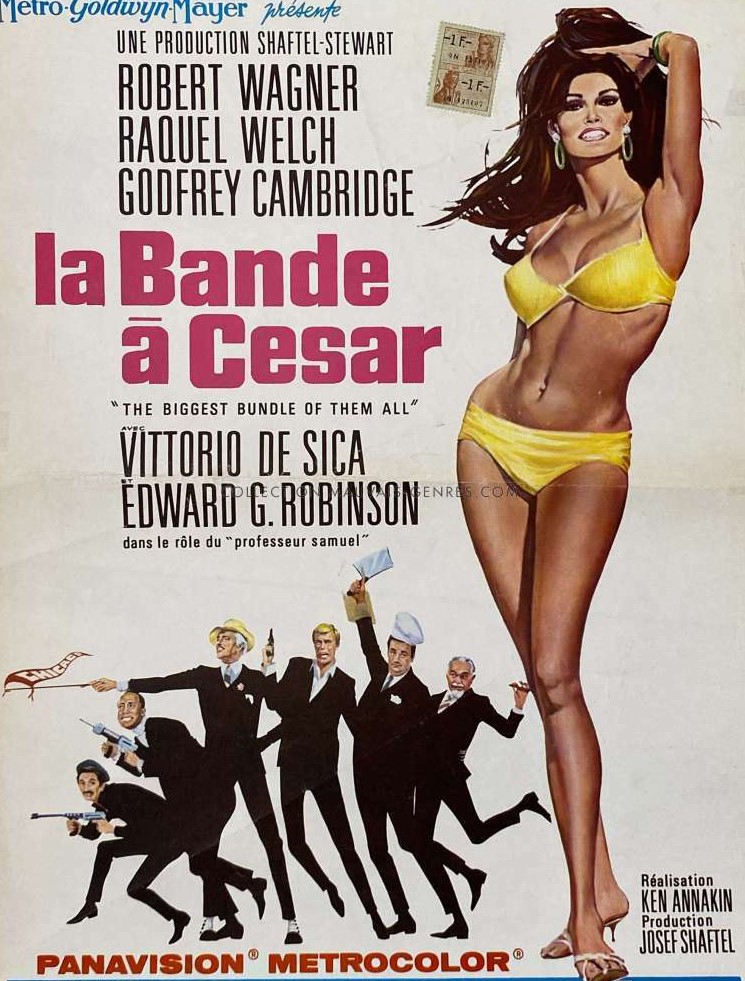
Bunch of incompetent crooks kidnap an impoverished Mafia boss who pays his ransom by setting up a major heist. By a stroke of casting alchemy this brings together Cesare (Vittorio De Sica), the epitome of old world Italian charm, knock-out gangster’s moll and scene-stealer-in-chief Juliana (Raquel Welch) replete with scanty knock-out outfits, and criminal mastermind Professor Samuels (Edward G. Robinson). In order to acquire the funds necessary to steal $5 million of platinum ingots from a train – that plan involving a tank and an WW2 bomber – the crew, initially headed by American Harry (Robert Wagner), need to carry out smaller jobs.
Problem is, none of them are any good, not even Cesare, who has lost his flair and botches an attempt to rob an old flame of her jewels. This is a twist on Topkapi (1964) which employed effective amateurs. This bunch can’t even carry out a simple theft from a restaurant. The heist itself is pretty spectacular and innovative. And the movie is quirky, with a darker edge. While there are few belly laughs, the light tone is enough to carry the gentle humor, mostly inspired by the misplaced team, amateurs for various reasons, not necessarily outright lawbreaking, on the run. These include London Cockney mechanic Davey (Davy Kaye), chef Antonio (Francesco Mule) distracted by hunger at every turn, cowardly violinist Benny (Godfrey Cambridge) and Joe (Mickey Knox) with a helluva brood to feed.
The story does a good bit of meandering, as does the camera, much of its focus on the voluptuous charms of Juliana, but the hurt pride of Cesare and the grandiose machinations of the professor keep it on course. The Italian settings, incorporating grand villas and ruins, do no harm either. The heist is terrific and there is a final twist you may or may not see coming. The interplay of characters works best when it involves Juliana, who attempts to twist Cesare around her little finger, that tactic mutual it has to be said, and who keeps the professor on his toes by dancing with him in a disco, and it soon becomes apparent that she has the upper hand over lover-boy Harry.
You could be forgiven for thinking the title refers to Raquel Welch – a cinematic infant at this stage with only One Million Years B.C (1966) in her portfolio – especially when her cleavage and looks receive such prominence, but the caper is classy and different. As well as being obvious she is both sinuous and seductive and clearly has a mind of her own, possibly the most criminally intent of the entire outfit, with weapons the others lack. By this point, she had invented the pop-out bikini, pictures of which had flooded Europe, making her the pin-up par excellence, but those who came to simply gawp quickly realized there was talent behind the body. Although of course there would be those who didn’t care.
De Sica constantly plays around with the idea of being a defunct godfather and Robinson is the antithesis of the gangster roles on which his fame relied. Robert Wagner is less effective, miscast and out of place in such august acting company and losing out to Welch in every scene.
This was a considerable change of pace for British director Ken Annakin after Those Magnificent Men in Their Flying Machines (1965) and Battle of the Bulge (1965) and he brings to this the comedy of the former coupled with the narrative complications of the latter, wrapping everything up in an easy inviting style that makes the most of his stars and the locations. Screenwriter Sy Salkowitz was a television veteran (Perry Mason, The Untouchables et al) , this marking his first venture into the big screen.
Not in the Topkapi class – very little is – but a pleasant diversion nonetheless and for avid Raquel Welch fans, setting aside her outfits, a chance to see her develop more of a screen persona than was permitted in her debut One Million Years B.C.









 The Magnificent 60s