Cinema is my oasis of calm. I go once a week on the same day (Monday), on my own, usually sit two rows from the front so I’m not interrupted by heads or popcorn or whispering, and sit in darkness for three or four hours, occasionally longer. It’s usually a seamless procession from car park to cinema. For a number of reasons, I hadn’t managed my weekly visit for a couple of weeks so I had a lot of catching–up to do so much so that a quadruple bill was on the cards. What could possibly go wrong to disturb my tranquillity.
For a start, my regular car park was shut for maintenance. So instead of a 10-minute walk from car park to cinema I had a 25-minute trudge. Access to the cinema proved more difficult than usual. The escalator was out of action and for some reason the people who make escalators make them with bigger steps so it’s always an awkward climb. Things didn’t look any better when I settled down for my first screening. There was no sound. We were shunted out and into another movie. I can’t even be bothered to tell you how bad it.
So my day required immediate redemption. I wasn’t so sure about Backrooms given I didn’t have the same ecstatic reaction to Obsession as others.
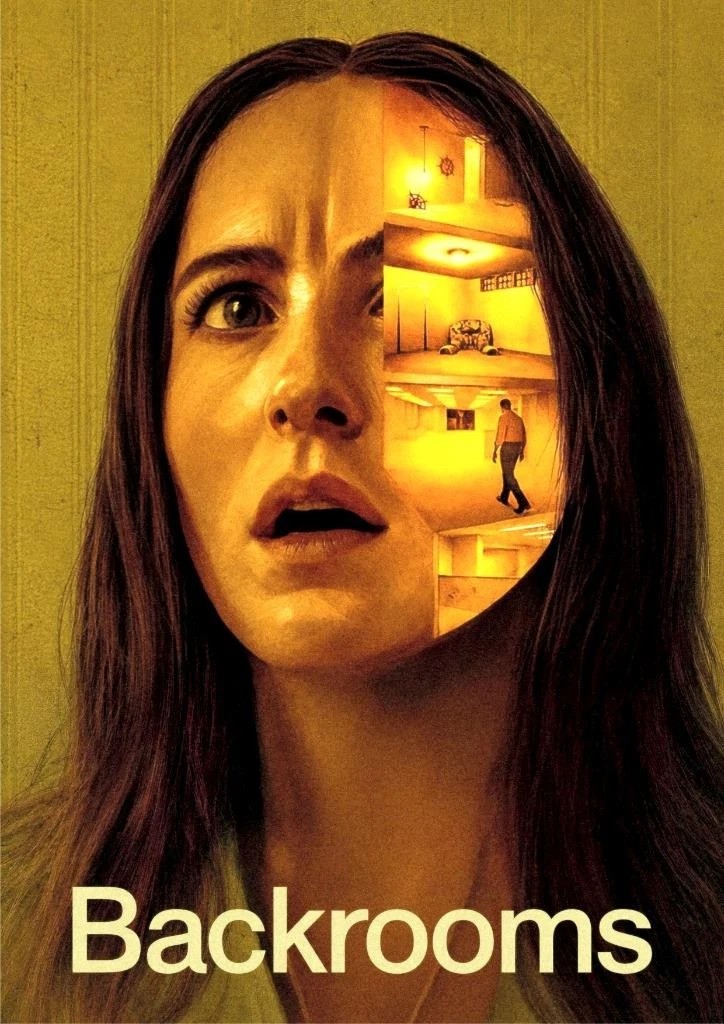
What is so astonishing about Backrooms is the tone. It’s not like other horror films built on a soundtrack of screams and visually propelled by jump starts and gore. The two main characters are, in the main, solid and observant. Failed architect and full-time misogynist Clark (Chiwetel Ejiofor) runs a struggling furniture store. He’s separated and apt to blame others for his situation, inclined to brush aside his heavy drinking and anti-feminism.
Mary (Renate Reinsve) is his therapist with a cruel past, her mother demented and paranoid. She often appears distant even in company, separated from the real world.
Trying to find out why his electricity bills are so high, Clark passes through a wall in his basement and finds another, peculiar, world, occupied primarily by pieces of furniture, in places stacked to the ceiling, or sinking at an angle into the floor as if the floor was sand, or disappearing into the ceiling. There are a host of corridors and doorways, some horizontal, some vertical, some sloping.
Using his architectural skills, Clark scopes out the labyrinthine space. He takes his findings to Mary who thinks he’s gone off his rocker. Clark enrols his two assistants to help him investigate the space further. But they come to a bad end. Shadows lurk, someone strong pulls on the end of a rope.
Eventually, Mary investigates her missing client and discovers this parallel world where people appear as only part of what they are, as if the maze remembers them in a different way.
There are some nods to horror but mostly this is psychological sci fi. It’s the unexplainable. Even scientists can’t explain it, relying on the experiences of those who returned to build up their knowledge of the other world.
But because director Kane Parsons in his debut is so restrained this has more of the hypnotic air of Last Year at Marienbad (1960) than anything in contemporary horror or sci fi. In the Alain Resnais film repeated dialog and repeated visuals did most of the work, but here it’s the endlessness, the implacability of the otherworld. Even the otherworldliness is understated, inanimate objects creating the disjointed mood. It’s like Planet of the Apes (1968) where escapee Charlton Heston discovers at the climax that he hasn’t escaped at all. Or Seconds (1966) where Rock Hudson can’t even escape.
One of the problems facing any sci fi or horror picture is the necessity to maintain the logic of the situation. Too often, a director or screenwriter, chasing another thrill, just slips out of the world they have created. That doesn’t happen here. This remains implacably, ruthlessly, logical so, although we have travelled through this strange world, we are no clearer at the end as to how it came into being or its purpose or how to avoid its trap.
There are no heroes and no heroics. Depending on your personality, the back rooms might provide succor. Or they might not.
It’s rare that you’d find two Oscar-nominated actors turning up in a low-budget horror picture. The impassive Renate Reinsve (Sentimental Value, 2025) comes off better than the more emotional Chiwetel Ejiofor (12 Years a Slave, 2014) but there’s not much between them. I’m sure the film’s unexpected box office success will stir demand for a sequel, but I hope not, for as it stands it’s every bit as outstanding a venture as the best of sci fi. Written by the director and Will Soodik, also making his movie debut.
If only Steven Spielberg had shown an ounce of this originality in Disclosure Day.
All hail Kane Parsons.
 The Magnificent 60s