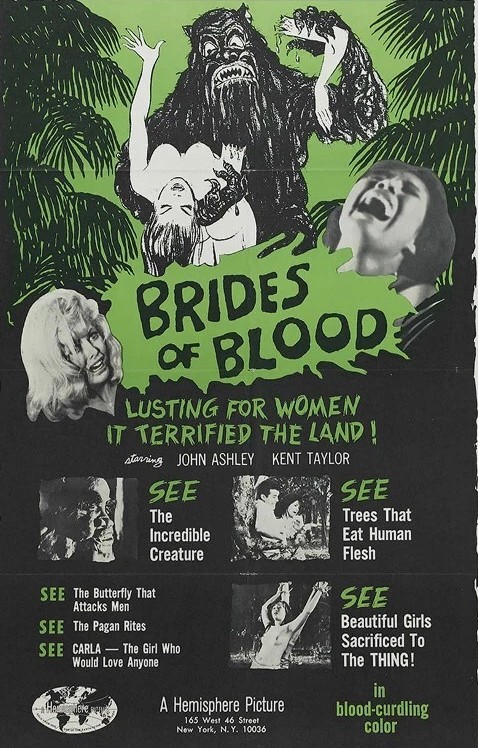
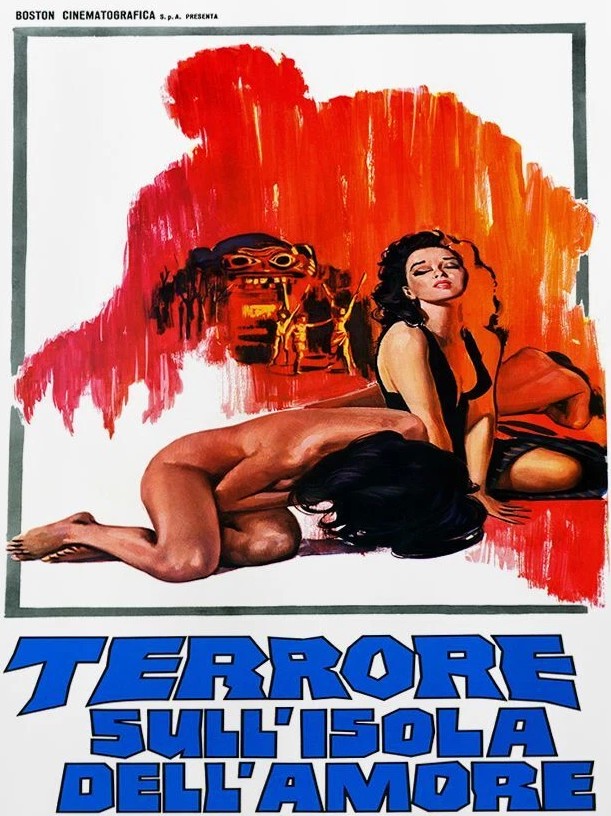
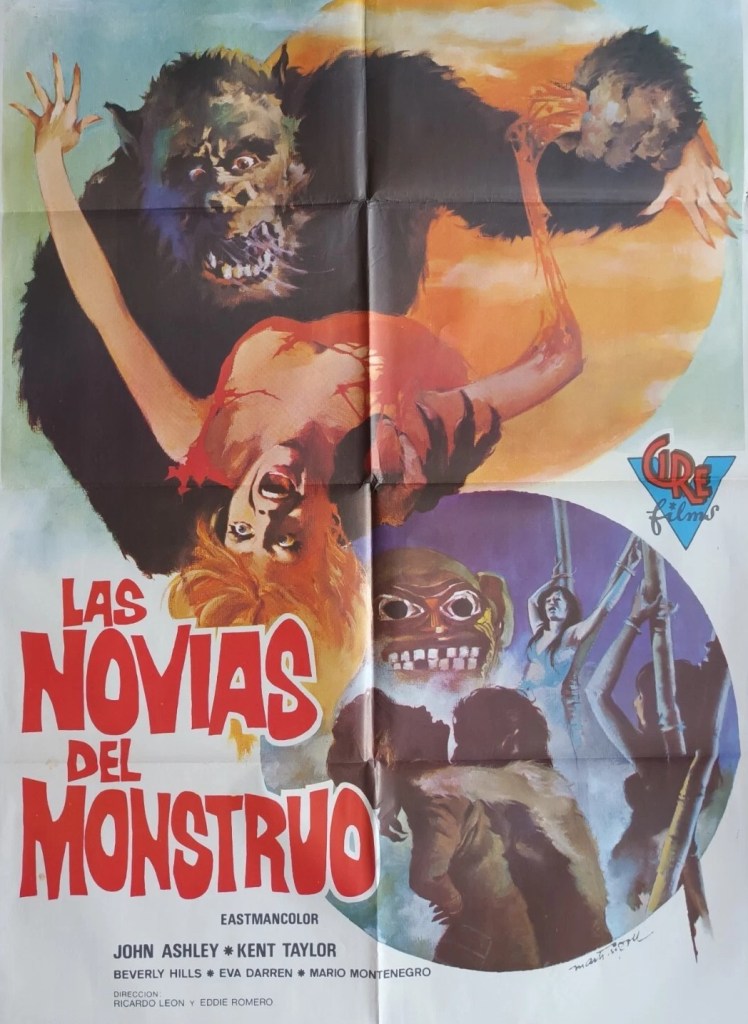
More than passable low-budget horror effort taking in atomic bomb mutation, human sacrifice, killer trees, giant moths and cockroaches and a fairly decent monster. Given the budget, the special effects are fine. The fact that it was shot in the Philippines gives the jungle scenes more validity. And while the main characters are submerged in exposition that still leaves room for a sassy flirtatious wife to snare all the best lines and for the guy whom we expect to be the villain of the piece to turn out to be the tragic one.
Scientist Dr Paul Henderson (Kent Taylor), wife Carla (Beverley Hills) and do-gooder Jim (John Ashley) arrive at the “wrong time” on a remote Pacific island which has reverted to primitivism. This is kind of place where sunset arrives too early and land crabs assume bizarre shape. Dr Henderson is here to assess the potential effect of radiation from A-bomb tests nearby. Jim is here to help build health centers, schoolhouses and to explain the benefits of irrigation. Carla is here to make fun of her older husband, flirt with any fit male and give in to advances.
They encounter a piano-playing rich American Powers (Mario Montenegro) who employs an overseer given to savagery. But despite his name, Powers isn’t the power in these parts. The local witch doctor is, and the island is already knee-deep in human sacrifice. Local girls have to do the equivalent of pick their names out of a hat to see who will be sacrificed next.
The new arrivals try to intervene but fail and their nerve is tested when trees with serpentine branches try to strangle them to death. Jim has enough time to fall for an islander, Alma (Eva Darren), which is just as well because, eventually, she needs an outsider to rescue her from the sacrificial cross. Carla has enough time to slip into Powers’ bedroom not realizing he’s in the process of mutation – his wife died in horrible circumstances after their yacht strayed too close to the atomic test grounds – and when she ventures outside runs into the monster making up for lack of sacrifice being laid out on a plate (I mean, a cross).
While Henderson and Farrel verge on cliché, and 1950s cliché at that, Henderson with his pencil-thin action-man Clark Gable moustache, and Farrell with ingenue written all over him, Carla is a different kettle of fish, blonde hair mounted in a beehive, bosom heaving at every opportunity, and she’s sassy enough to put her husband in his place and introduce inuendo at every opportunity, and inclined to indicate passion by stroking the bedpost, and looking as if she’s auditioning for a femme fatale role in film noir.
For exploitation purposes, it’s lucky that the monster prefers his victims naked.
All in all entertaining hokum. And it must have done well at the box office because it spawned another three. John Ashley (Young Dillinger, 1965) went on to have a bigger career as a producer. Kent Taylor (Law of the Lawless, 1964) was at the tail end rather than the beginning of his career. Miss Beverley Hills (she won a beauty competition of that name) changed her name to Powers without any more significant effect on her career.
Philippine ambassador’s son Eddie Romero (Black Mama White Mama, 1973) directed along with compatriot Gerardo de Leon (Women in Cages, 1971) from a script by Cesar Amigo (The Hunted, 1970).
Better than I expected. Quite fun, really. YouTube has a decent print.
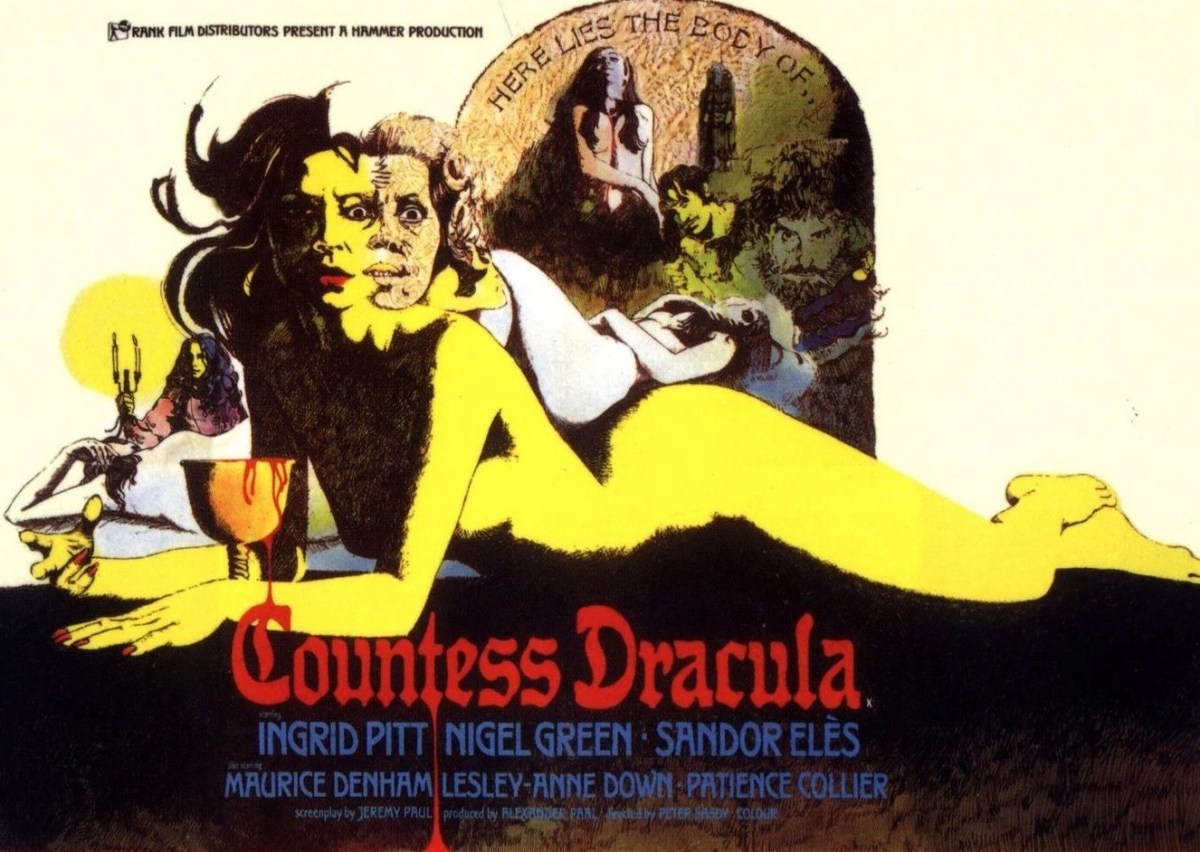
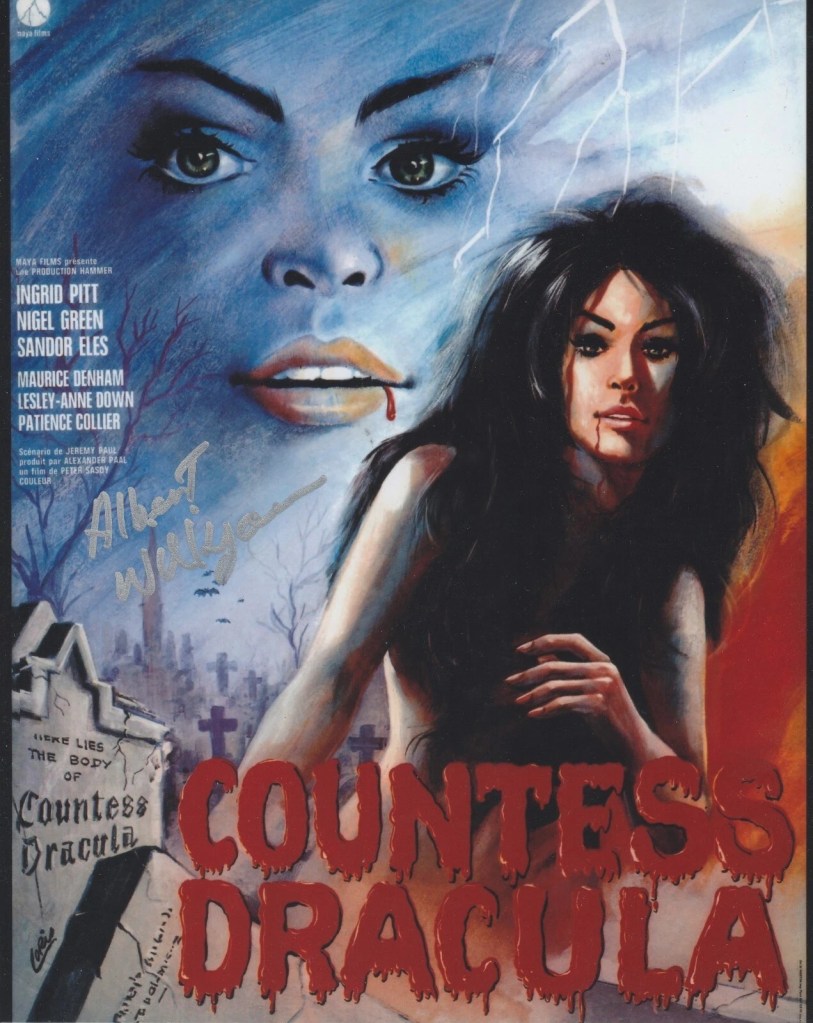
You wouldn’t go looking to British studio Hammer for a subtle treatise on the perils of ageing. Nor might you expect a predator to be so cruelly, and consistently, punished. Nor, for that matter, for a mirror to provide revelation given that in the traditional vampire movie one of the signs you have a bloodsucker in your midst is that a mirror does not show their reflection.
The title is something of a misnomer: while there’s bloodletting aplenty there’s zero actual bloodsucking. Hammer had taken a sideways shift into female empowerment and more obvious sexuality and gender twist with the introduction of the female vampire – beginning with The Vampire Lovers (1970), sequel Lust for a Vampire (1971) and, completing the trilogy, Twins of Evil (1972). For that matter it also pre-empted, in perverse fashion, the body swap genre of Freaky Friday (1976 etc.).
These days this would be termed the expansion of a “horrorverse” or a “Hammerverse” as the studio developed its IP since it had not abandoned the traditional Christopher Lee version, doubling down in 1970 with Taste the Blood of Dracula and The Scars of Dracula and following up with Dracula A.D. 1972 (1972).
While Countess Dracula doesn’t fall into the vampiric category, neither does it so obviously exploit the sexuality and rampant nudity of the female vampire trinity. But there are other shocks in store. Be prepared for emotional punch, not something normally associated with Hammer.
The ageing beauty had been a 1960s trope as Hollywood had come to terms with finding starring roles for 1940s/1950s stars past their box office best but names – Lana Turner and Vivien Leigh among others- with still some marquee lure. And this follows a similar trajectory, older woman falling in love with younger man.
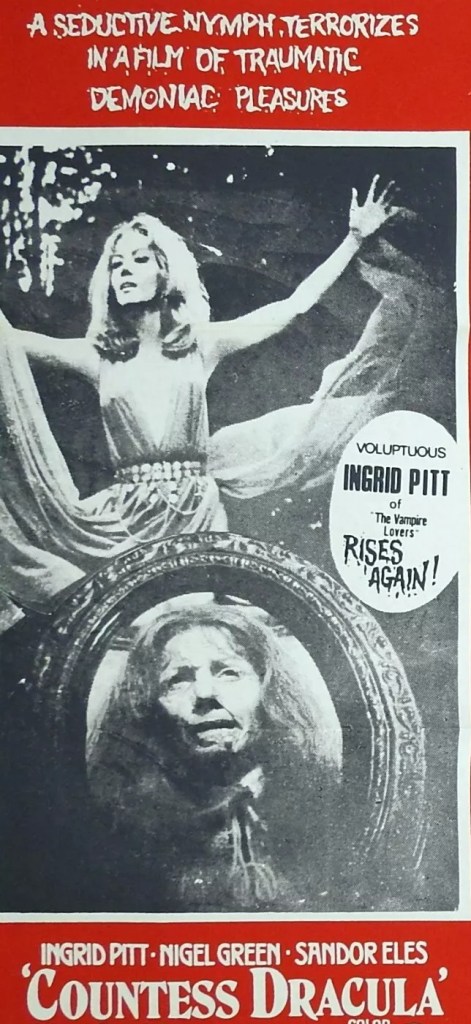
Set in Hungary in the seventeenth century, widowed Countess Elisabeth Bathory (Ingrid Pitt) discovers by accident that a touch of virgin blood rejuvenates her skin and tempts her into stealing the suitor Toth (Sandor Eles) of her 19-year-old daughter Ilona (Lesley-Anne Down). But that means kidnapping Ilona and keeping her imprisoned so Bathory can impersonate her, finding a ready supply of virgins to murder and exsanguinate, enlisting in her scheme lover Capt Dobi (Nigel Green) and maid Julie (Patience Collier).
The ruse appears to work well – at first. Believing Bathory is actually her daughter, Toth is easily seduced. But there’s a downside which is quickly apparent. What spell blood casts, it doesn’t last long. And there’s a sting in the tail. Having acted as a rejuvenating agent, when the virgin blood has run its course transformation goes the other way and turns her into an old crone.
So now, Bathory and her team enter serial killer territory, the disappearances and deaths arousing suspicion among the locals and historian Fabio (Maurice Denham), and her daughter threatening at any minute to escape her captor and turn up at the castle. And Bathory cannot give up the fantasy, not least because when the blood runs out, she’ll be unrecognizable as an old crone.
You can see where this is headed, so that’s not much of a surprise. What is astonishing is how well director Peter Sasdy (Taste the Blood of Dracula) handles the emotion. You might think the special effects do all the work that’s required, but that’s not the case. It’s Bathory’s eyes not her crumpled skin that make these scenes so powerful and in between, apart from the initial transformation, Bathory shifts uneasily between exultation that she is living the fantasy and terror that it will come to a sudden end.
Ingrid Pitt (The Vampire Lovers, 1970) has the role of her career, superbly playing a woman bewitched by her fantasy and the prospect of literally turning back the years. None of the ageing actresses that I previously mentioned manage to so well to portray that specific female agony of a beauty losing her looks. Sandor Eles (The Kremlin Letter, 1970) looks the part and Nigel Green (Fraulein Doktor, 1968), while shiftier than usual, also has to scale more emotional heights than normal, in not just having to countenance his lover going off with another man but helping her to do so. Lesley-Anne Down (The First Great Train Robbery, 1978) makes a splash.
More than ably directed by Sasdy, from a screenplay by Jeremy Paul in his debut based on the book by Valentine Penrose.
I’m not sure how well this went down with vampire aficionados and suspect there was audience disappointment, but there is more than enough depth to make up.
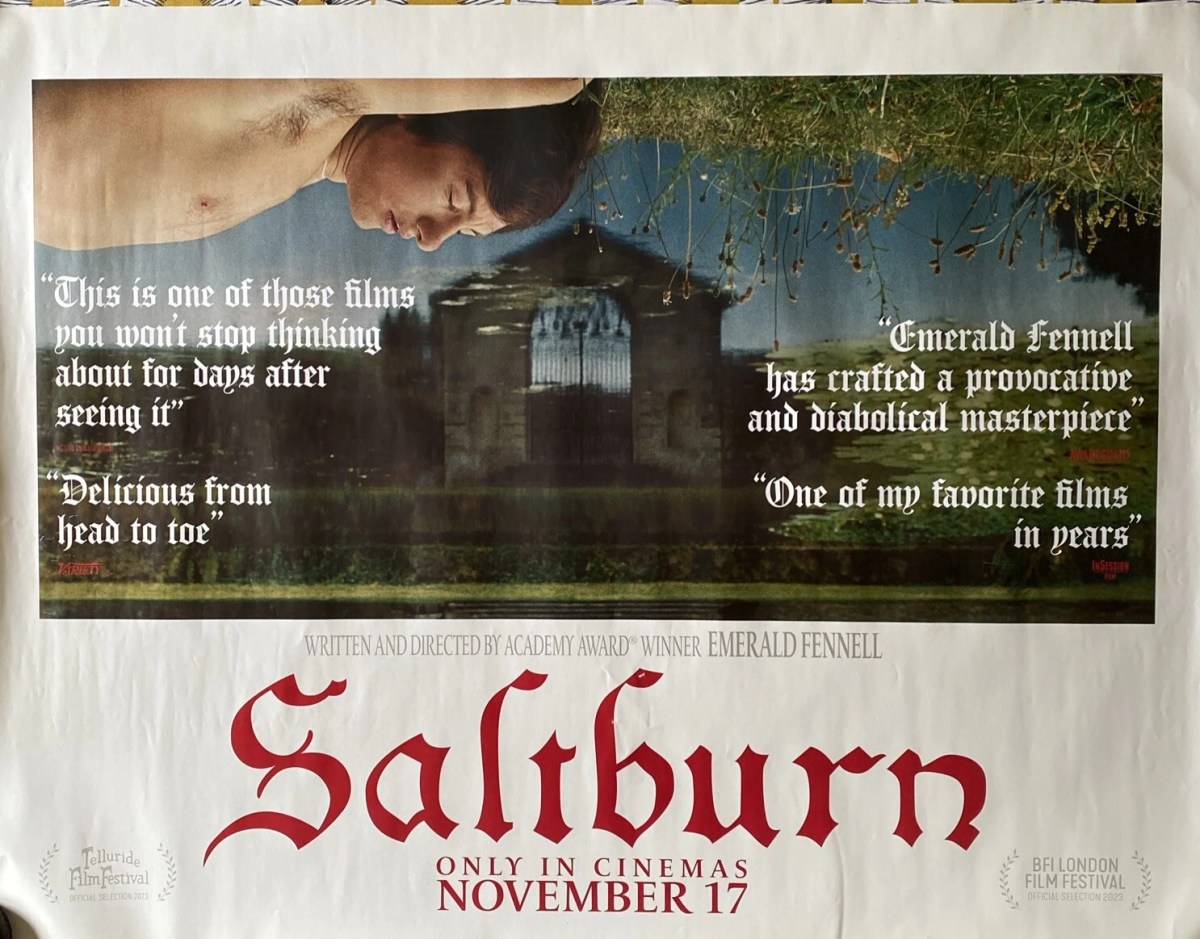
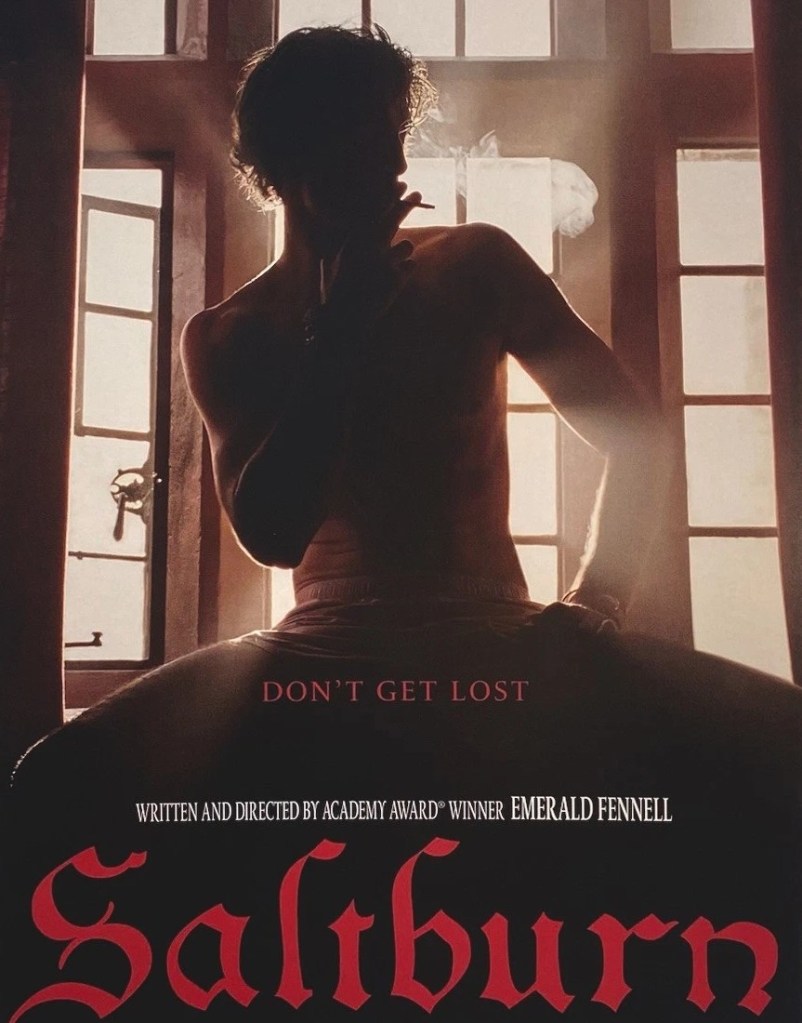
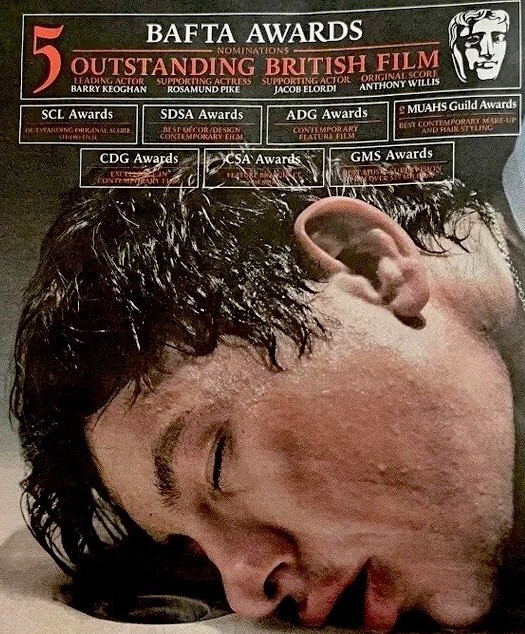
With the arrival of Emerald Fennell’s latest epic Wuthering Heights (or to give it it’s full title “Wuthering Heights” – yes, don’t ask me!) imminent I thought I’d go back to Saltburn and see if my second impression was any better than my first.
Alas, I was right first time. Another “visionary” director disappearing up their own backside, despite having a superb cast at their disposal including Oscar-nominated Jacob Elordi (Frankenstein, 2025, and now Wuthering Heights), Oscar-nominated Barry Keoghan (The Banshees of Inisherin, 2022) and Oscar-nominated Rosamund Pike (Now You See Me: Now You Don’t, 2025).
There wasn’t enough in a second viewing to convince me to spend a whole lot of my time revising my original review, so what follows is an expanded version of my first attempt.
Brideshead Revisited Meets Carry On Downton Abbey. Wouldn’t surprise me if that’s the way it was actually pitched, it’s just so uneven, veering through several different styles without ever finding a target. The shock elements are, unfortunately, just risible. Via the trailer this appeared to be a moody, atmospheric picture about entitlement, the downside, if you like, of Downton Abbey.
Instead, it’s just plain barmy, which might well have worked if its take on the bizarre had been consistent, but, really it’s a contender for the coveted So-Bad-It’s-Good Award with Rosamund Pike odds-on to nab the award for the best Maggie Smith impression. .
Oliver (Barry Keoghan) is supposedly a scholarship student at Oxford, coming from a sinkhole estate in Liverpool, parents drug dealers etc etc. Out of his depth, by chance he latches on to sex god Felix (Jacob Elordi) and is invited to spend the summer at the latter’s stately home complete with sneering butlers and demonic family, all graduates of the Over-Acting Academy.
Turns out we’ve not been watching Downton Abbey at all, but The Usual Suspects, Oliver not an innocent little bookworm after all but an extremely malevolent character who manages – in the absence (luckily) of post-mortem or any forensic examination– to bump off the entire family in order to inherit (don’t ask!) Saltburn in order to, in a bizarre nod to Risky Business, dance naked through it.
The only reason it gets any points at all is Jacob Elordi, who exhibits tremendous screen charisma, and because the barmy extremely self-centred and out-of-it Rosamund Pike does elicit a few laughs and maybe, courtesy of Richard E. Grant, has a haircut to enter some kind of Hall of Fame.
The shock elements are hilarious as though someone of school age has decided they are really going to shock mummy and daddy. So we’ve got Oliver licking up Felix’s leftover sperm in the bath, the various deaths and the stark naked (are you shocked now?) Risky Business homage.
Jacob Elordi has since come good. He was a believable Elvis in Priscilla (2023), excellent in On Swift Horses (2024) and superb as Frankenstein and possibly still in with a shout of becoming our next James Bond. Barry Keoghan hasn’t come good, at least in the commercial sense, second-billed in Bird (2024) and Bring Them Down (2024) and third-billed in Hurry Up, Tomorrow (2025). For all I know he may be content to plough the arthouse furrow but given his presence – and third-billed again – in the forthcoming big-budget Crime 101 that doesn’t seem to be the case, though it is true it sometimes takes a while for new faces to find a way to fit in.
It’s a shame really because spoofing Downton Abbey or Brideshead Revisited for that matter can be done with considerable ease as the recent Fackham Hall has proved.
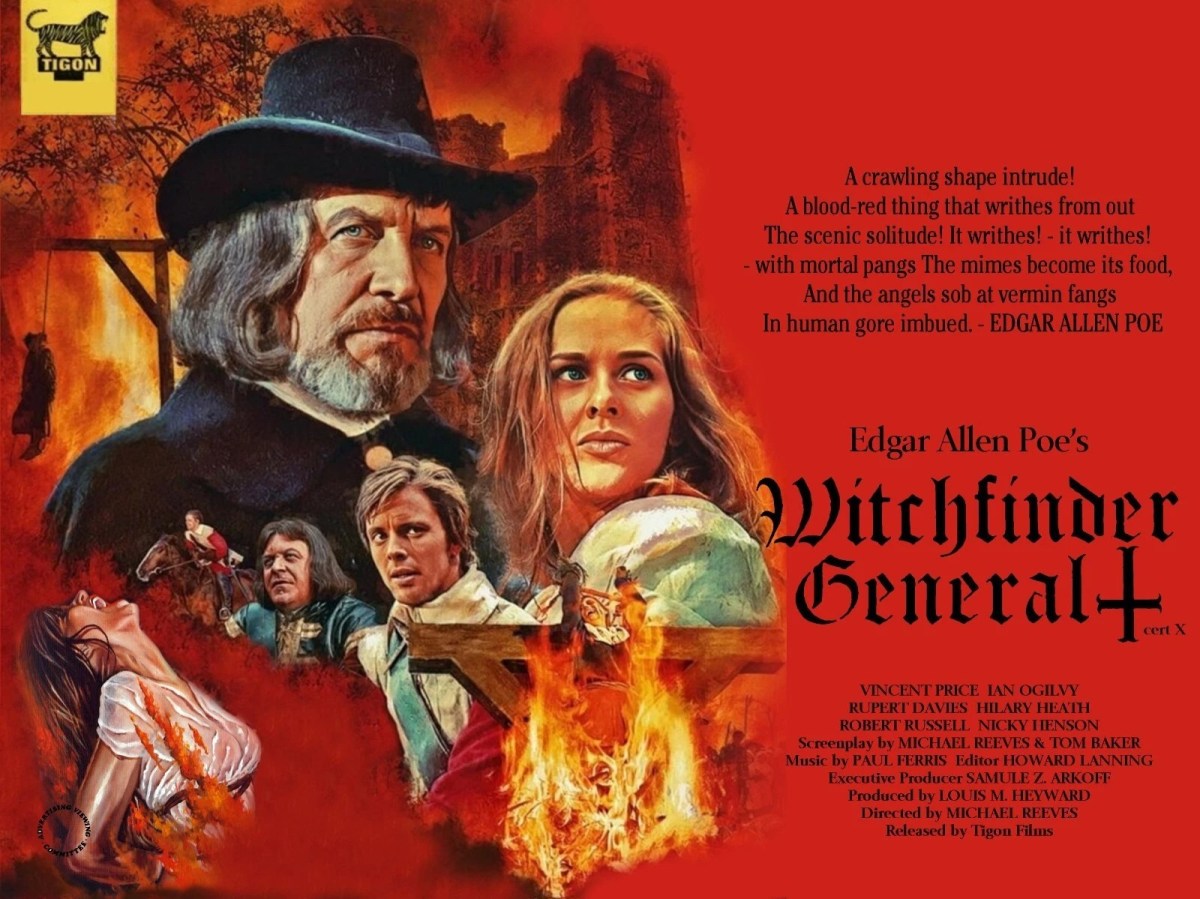
Truth was the first casualty. Matthew Hopkins, the character played in the film by Vincent Price, was 27 when he died in 1647. He had been hunting witches for three years. Price was 57 when the movie appeared. Co-star Ian Ogilvy, aged 25, would have been a better fit, though he lacked the menace. Oliver Reed, who had the swagger and the scowl, would have been the ideal candidate, age-wise, since he was just turning 30. And the movie might well have benefitted from presenting Hopkins as a young grifter who through force of personality and cunning held a country to ransom.
Price wasn’t director Michael Reeves’ (The Sorcerers, 1967) first choice. In fact, he originally wanted buddy Ogilvy, who had played opposite Boris Karloff in The Sorcerers. When that idea failed to float with Tony Tenser – previously head of Compton Films – now boss of British horror outfit Tigon, a challenger to the Hammer crown, Reeves pivoted to Donald Pleasance who, although better known as a supporting actor in the likes of The Great Escape (1963), had headlined Roman Polanski’s chiller Cul de Sac (1966). But when Tenser did a deal with American International Pictures, the U.S. mini-studio insisted on contract player Vincent Price, the mainstay of their Edgar Allan Poe output, with 16 previous films (out of 74) for the company.
Twenty-one-year-old Hilary Dwyer (The Oblong Box, 1969), under contract to Tigon, made her movie debut. Rupert Davies (The Oblong Box) was a seasoned veteran while Nicky Henson (Here We Go Round the Mulberry Bush, 1967) was a potential breakout star.
Tigon was a relatively new entrant to the horror scene, founded in 1966 by Tenser. Its second picture was The Sorcerers; this would be its fourth. Tenser has bought, pre-publication, the rights to Ronald Bassett’s novel Witchfinder General, published in 1966. Director Reeves faced something of a deadline once Tenser finalized the £83,000 budget. AIP chipped in £32,000 which included a £12,000 fee for Price. While it was Tigon’s biggest film to date, it was pin money for AIP.
The film needed to begin shooting by September 1967 at the latest to avoid the worst of the British cold weather. But the screenplay proved too unpleasant for the taste of the British censor. Reeves had already begun the screenplay with Tom Baker (The Sorcerers) with Donald Pleasance in mind portraying “a ridiculous authority figure” and had to quickly revamp it for Price. The laws of the period required a green light for the script from the British Board of Film Censors, who were repulsed by a “study in sadism” which dwelt too lovingly on “every detail of cruelty and suffering.”
That draft was submitted on August 4, 1967. The second draft, submitted on August 15, proved no more appealing. A third, substantially toned-down version, was approved. This resulted in the elimination of gruesome details of the Battle of Naseby and a change to the ending.
Production began on September 18, 1967. Star and director clashed. Reeves refused to go and meet Price on arrival at Heathrow Airport and told him, “I didn’t want you, and I still don’t want you, but I’m stuck with you.” The star was riled by the director’s inexperience. When told to fire a blank pistol while on horseback, Price was thrown from his horse after the animal reared up in shock at the sound. Price, in real-life a very cultured person, was surprised at Reeves’ attitude because in general he got on with directors.
Price turned up drunk on the last day of shooting, the filming of his character’s death scene. Reeves was planning revenge and told Ogilvy to really lay into the star. But the producer, anticipating trouble, ensured Price was well padded.
Reeves was better known for his technical rather than personal skills. Ogilvy commented: “Mike never directed the actors. He said he knew nothing about acting and preferred to leave it up to us.” That wouldn’t square with him falling out with Price over his interpretation of the character. And Hilary Dwyer saw another side of Reeves. “He was really inspiring to work with,” she said, “And because it was my first film, I didn’t know how lucky I was.” She would work with Price again on The Oblong Box and Cry of the Banshee (1970).
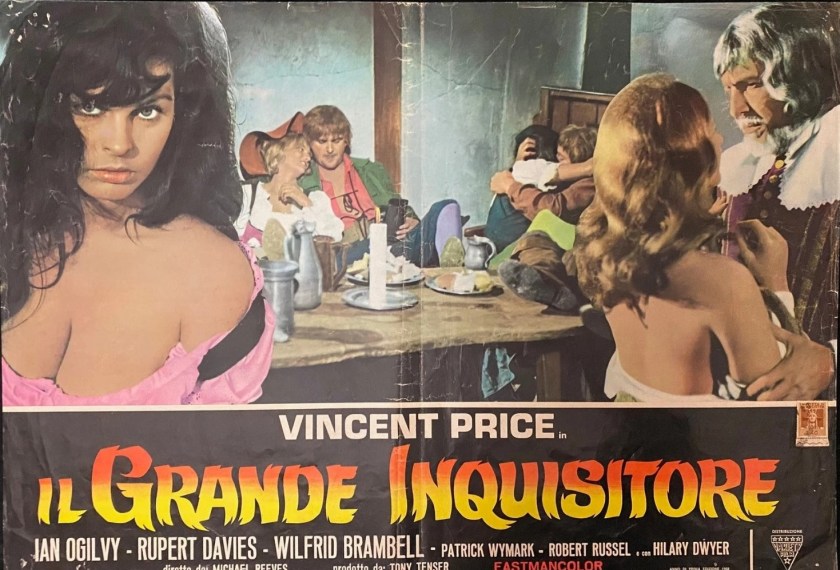
Tony Tenser, egged on by AIP’s head of European Productions, shot additional nude scenes in the pub sequence for the German version, A continuity error was responsible for the freeze-frame ending. There was a short strike when the production fell foul of union rules. Producer Philip Waddilove and his wife Susi were occasionally called upon to act.
Two aircraft hangars near Bury St Edmunds in Suffolk were converted for the interiors while a wide variety of locations were utilized for exteriors including Lavenham Square in Suffolk, the coast at Dunwich, also in Suffolk, Black Park in Buckinghamshire, Orford Castle in East Anglia, St John The Evangelist Church in Rushford, Norfolk, and Kentwell Hall in Long Melford on the Essex-Suffolk border. When the operation could not afford a camera crane, the crew improvised with a cherry picker.
Despite the tension on set, Price was pleased with his performance and the overall film. He praised the film in a 10-page letter. Price remarked, “I realized what he wanted was a low-key, very laid-back, menacing performance. He did get it but I was fighting him every inch of the way. Had I known what he wanted I would have cooperated.”
AIP retitled it The Conqueror Worm for U.S. release, hoping to snooker fans into thinking this fell into the Edgar Allan Poe canon, since the title referred to one of the author’s poems, part of which was recited over the credits.
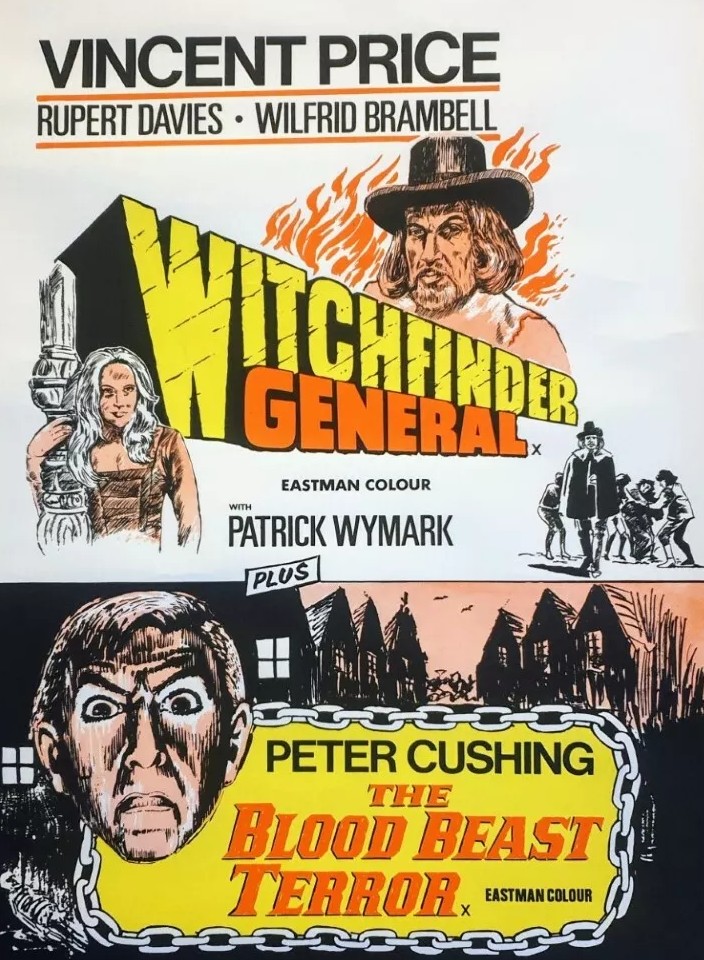
The movie was generally lambasted by critics for its perceived sadistic approach, but is now considered cult. It was a big box office hit, especially considering the paltry budget, gaining a circuit release in the UK – “very good run beating par by a wide margin” – and despite being saddled with the tag of “unlikely box office prospects” by Variety did better than expected business in New York ($159,000 from 28 houses), Los Angeles (a “lusty” $97,000 from 16) and Detroit ($35,000 from one). The final U.S. rental tally was $1.5 million placing it ahead in the annual box office charts of such bigger-budgeted efforts as Villa Rides starring Yul Brynner and Robert Mitchum, Anzio with Mitchum again, James Stewart and Henry Fonda in Firecreek and Sean Connery and Brigitte Bardot in Shalako.
SOURCES: Benjamin Halligan, Michael Reeves (Manchester University Press) 2003; Lucy Chase Williams, The Complete Films of Vincent Price (Citadel Press, 1995); “Big Rental Films of 1968,” Variety, January 8, 1969, p15; Steve Biodrowski and David Del Valle, “Vincent Price, Horror’s Crown Prince,” Cinefantastique, Vol 19; Bill Kelley, “Filming Reeves Masterpiece Witchfinder General,” Cinefantastique, Vol 22; “Box Office Business,” Kine Weekly, June 1, 1968, p8; “Review,” Variety, May 15, 1968, p6. Box office figures – Variety, May-August 1968.
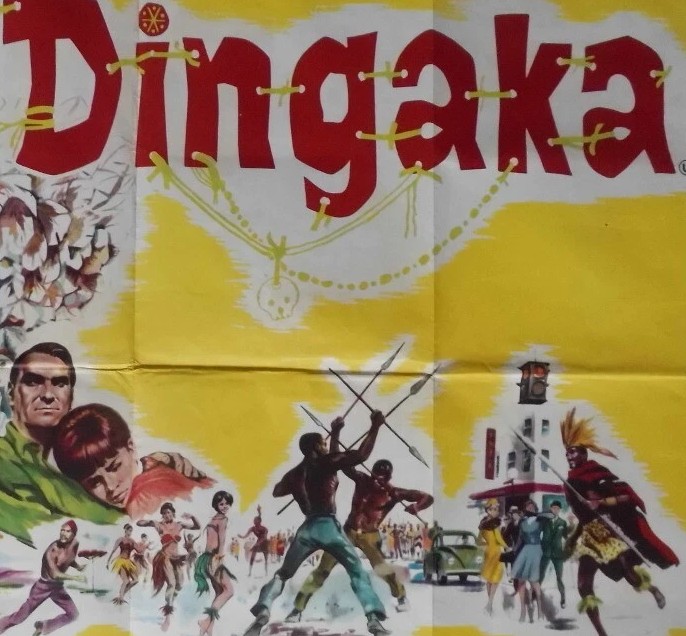
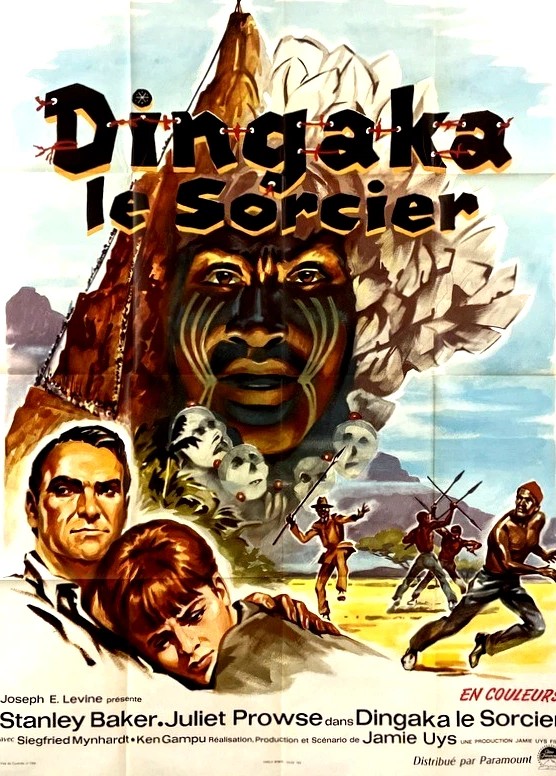
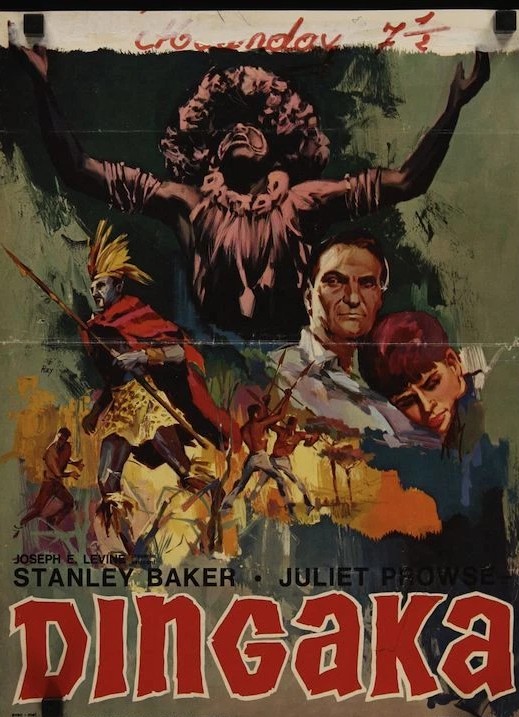
Whether you appreciate this will depend on whether you were attracted by the prospect of an early offering by South African writer-director Jamie Uys (The Gods Must Be Crazy, 1980) or by the star wattage of Stanley Baker (Sands of the Kalahari, 1965) or perhaps by the promise of the salacious. Hopefully, it was the first, because you would be disappointed on the other two counts, Baker not making an entrance until halfway through the picture and not much of an impact thereafter.
Surprisingly relevant due to its depiction of people in the thrall of a higher power – whether you take that in a religious or political context makes little difference – and in the cultural conflict between an indigenous tribe and the “civilized” white man. But there’s also a noir tone here, the fatalism that often prevents the “good criminal” in a noir picture from escaping the judicial consequence of an action that could be seen as moral.
And if you think you know your African music through interpretations by the likes of Neil Diamond and Paul Simon, then here’s a far better introduction. Song is a constant whether for ceremonial purpose, worship, entertainment and work or for making more bearable time spent in jail or hard labor.
And though it’s not spelled out there’s a Biblical element, the old “eye for an eye,” done away with in modern civilization through courtrooms, juries and due process whereby the act of killing is carried out remotely by the state rather than the victim’ relatives.
An African tribesman Masaba (Paul Makgopa), furious at being dethroned after a six-year reign as the local fighting champion, seeks a cure for the loss of prowess from a witch doctor (John Sithebe). He is told to eat the heart of a small child. Soon after the daughter of Nkutu (Ken Gampu) is found dead. The distraught father beats the witch doctor until he points to Masaba. In revenge for Nkutu assaulting the witch doctor, revered as a local god, Nkutu is cursed, resulting in the almost immediate death of his wife.
Nkutu pursues Masaba to the city and strangles him to death. He is taken aback to be arrested since, according to tribal law, he is well within his rights. Of course, that’s at odds with civilized law. When the judge learns of the murder of Nkutu’s daughter and advises that the state would take care of any killing in the way of punishment that had to be done, Nkutu is puzzled. “You must not hang him. He did not kill your child. I must kill him. It is the law.”
It turns out Masaba has survived, giving Nkutu, on meeting him in court, a second chance to kill him, which fails.
“Big hard cynical lawyer” Tom (Stanley Baker), grudgingly doing pro bono work, has his work cut out since Nkutu refuses to give him instruction, is defiantly unremorseful, and can’t provide any proof that Masaba murdered his daughter beyond that “his eyes told me that he killed her.”
But since Nkutu only attempted murder then he gets off with a relatively light sentence, though it still involves back-breaking work. But at least it’s outside, providing the opportunity to escape and go home and kill Masaba properly. Meanwhile, Tom has chanted his tune and tries to help Nkutu by confronting the witch doctor.
Eventually, Nkutu learns the witch doctor was the murderer and despite fear of being eternally cursed challenges the witch doctor’s authority and kills him. And given this takes place away from civilization it’s unlikely that anyone’s going to come asking questions.
Outside of the drama and the culture clash, the director keeps this perpetually interesting by adding in authentic aspects of local life. There’s a milk tree, a man cures hides by spinning them on a rock that dangles from a tree on a rope, access to the otherwise inaccessible witch doctor’s lair on a mountaintop is via a series of vertigo-inducing ladders, prison guards have spears not guns. The use of music adds atmosphere.
And the acting is good, and as a consequence of this Ken Gampu enjoyed a Hollywood career in such films as The Wild Geese (1974) and ended up with over 80 film credits. Stanley Baker’s character is well drawn, exchanging barbs with his wife (Juliet Prowse) his cynicism in part due to the couple’s fertility problems.
Now warned about the limitation of Baker’s involvement, if you are happy to examine the tale as presented – one of struggle against both malicious and just authority – you will be rewarded.
YouTube has a decent print and not one marred with advertisements.
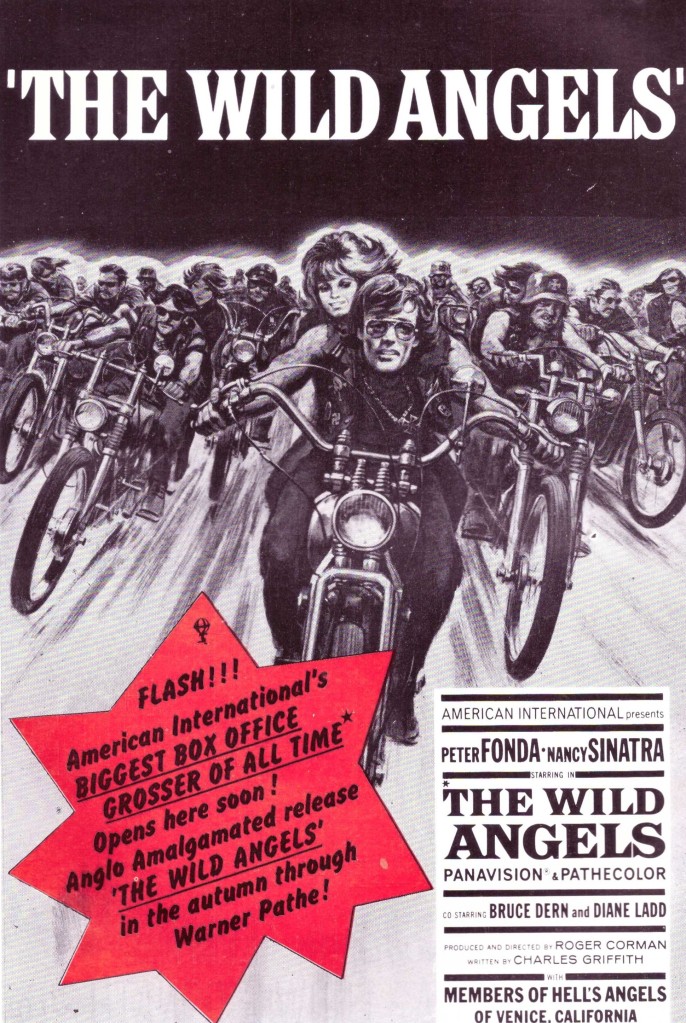
Riders stretched out across a sun-baked valley – you could be harking back to the heyday of the John Ford cavalry western instead of the biker picture, the first in the American International series, that sent shockwaves through society and laid the groundwork for the more philosophical Easy Rider (1969) a few years later. Long tracking shots are in abundance. You might wonder had director Roger Corman spent a bit more on the soundtrack, the bikers just worn beads instead of swastikas, and been the victims rather than the perpetrators of violence how this picture would have played out critics- and box office-wise.
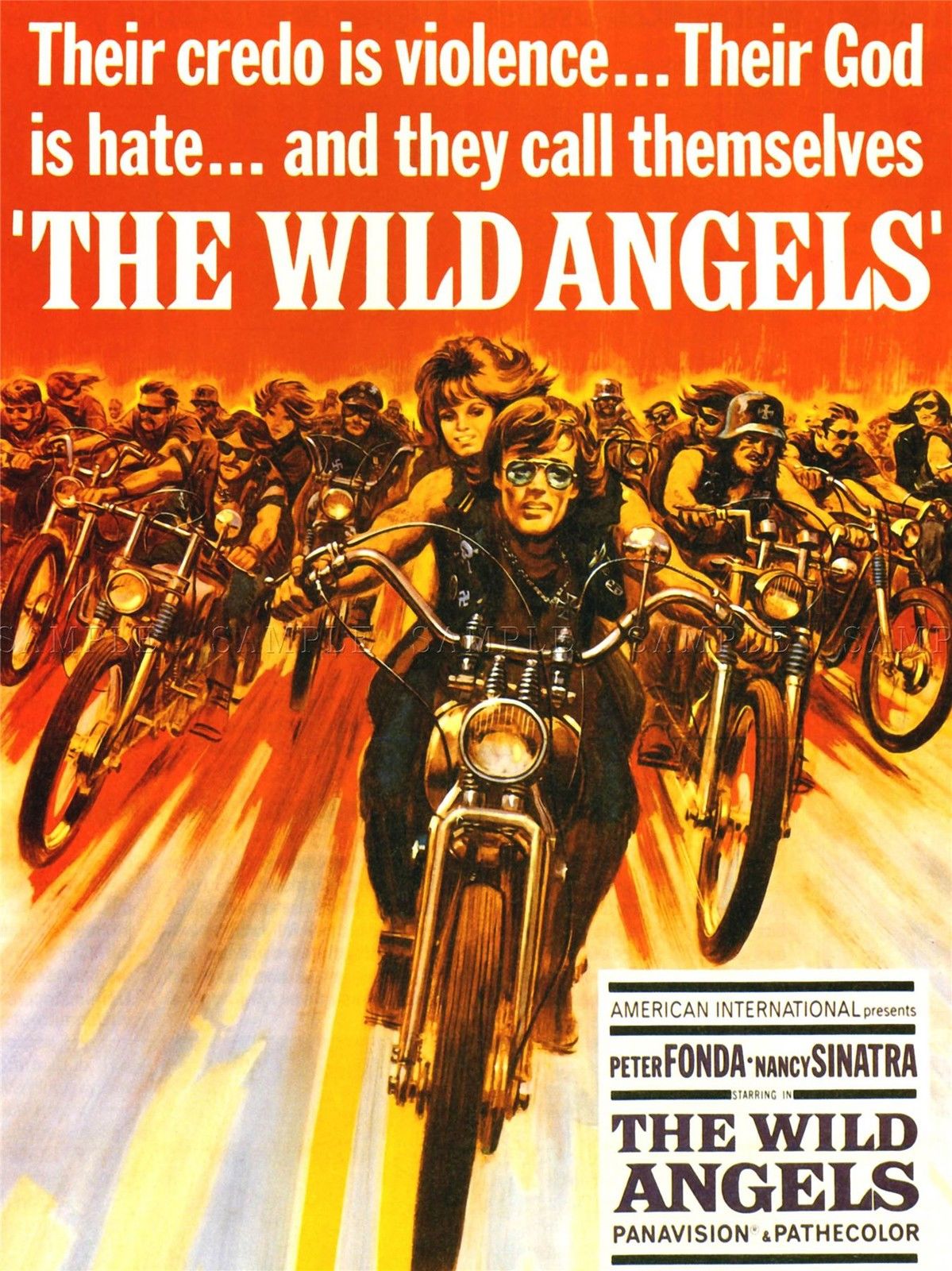
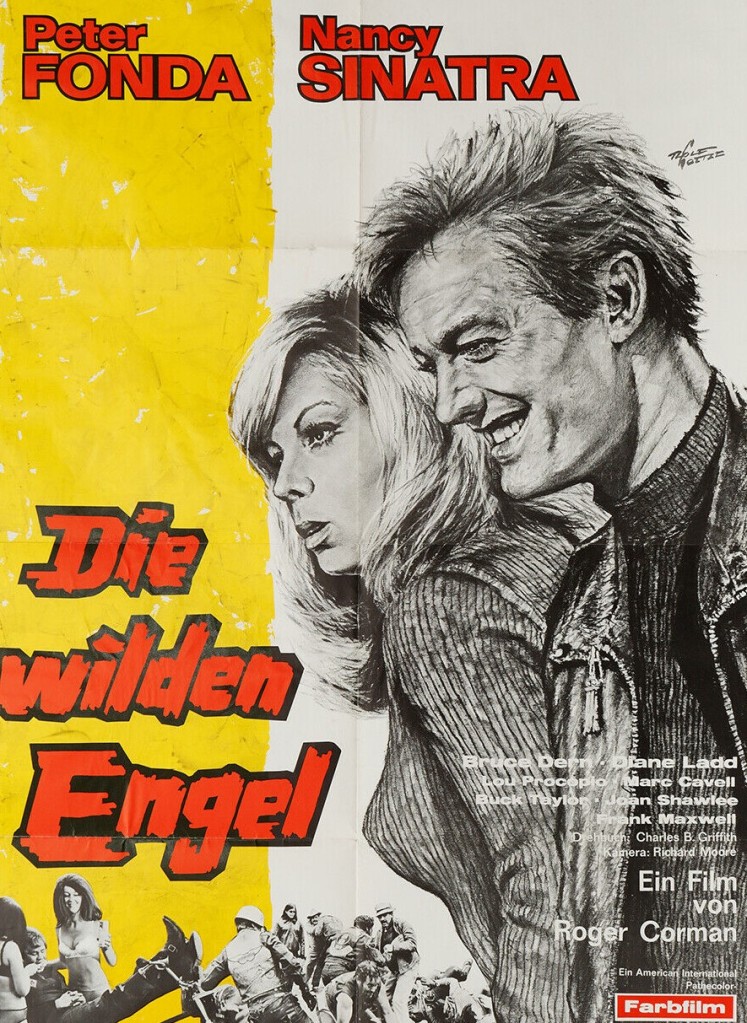
The Wild Angels set up a template for biker pictures, one almost slavishly followed by Easy Rider, a good 15 per cent of the screen time allocated to shots of the Harley-Davidson riders and scenery, and a slim plot. Here Heavenly Blues (Peter Fonda), trying to recover a stolen bike, leads his gang into a small town where they beat up a bunch of Mexican mechanics, are pursued by the cops, hang out and indulge in booze, drugs and sex, and then decide to rescue the badly-injured Joe (Bruce Dern) from a police station. This insane act doesn’t go well and after Joe dies they hijack a preacher for a funeral service that ends in a running battle with outraged locals and the police.
One of the weirdest posters of all time – at first sight it looks like Nancy Sinatra is holding the decapitated head of Peter Fonda in front of her.
There’s an odd subplot, given the lifestyle of freedom and independence, of Monkey (Nancy Sinatra) trying to get a romantic commitment out of Heavenly. Conversely, Heavenly, rejecting the traditional shackles of love, finds himself trapped by grief, eventually and quite rightly blaming himself for Joe’s death, and apparently turning his back on the Angels to mourn his buddy. The decline – or growing-up – of Heavenly provides a humane core to a movie that otherwise takes great pride in parading (and never questioning) excess, not just the alcohol and drugs, but rape of a nurse, gang-bang of Joe’s widow (Diane Ladd), violence, corpse abuse, and wanton destruction.
A ground-breaking film of the wrong, dangerous, kind according to censors worldwide and anyone representing traditional decency, but which appealed to a young audience desperate to find new heroes who stood against anything their parents stood for. In a decade that celebrated freedom, the bikers strangely enough represented repression, a world where women were commodities, passed from man to man, often taken without consent, and racism was prevalent.
Roger Corman (The Secret Invasion, 1964) was already moving away from the horror of his early oeuvre and directs here with some style, the story, though slim, kept moving along thanks to the obvious and latent tensions within the group. If he had set out to assault society’s sacred cows – the police, the church, funeral rites – as well as a loathing of everything Nazi, he certainly achieved those aims but still within the context of a group that epitomized some elements of the burgeoning counterculture.
In retrospect this appears an ideal fit for Peter Fonda, but that’s only if viewed through the prism of Easy Rider for, prior to this (see the “Hot Prospects” Blog) he was being groomed as a romantic leading man along the lines of The Young Lovers (1964). Bruce Dern (They Shoot Horses, Don’t They, 1969) was better suited, his screen persona possessing more of the essential edginess while Michael J. Pollard (Bonnie and Clyde, 1967) was the eternal outsider.
Rather surprising additions to the cast, either in full-out rebel mode as with Nancy Sinatra (The Ghost in the Invisible Bikini, 1966) or hoping appearance here would provide career stimulus as with movie virgins Diane Ladd (Chinatown, 1974) and Gayle Hunnicutt (P.J. / A New Face in Hell, 1968). Sinatra certainly received the bulk of the media attention, if only for the perceived outrage of papa Frank, but Hunnicutt easily stole the picture. Minus an attention-grabbing role, Hunnicutt, long hair in constant swirl, her vivid presence and especially her red top ensured she caught the camera’s attention.
Charles B. Griffiths (Creature from the Haunted Sea, 1961) is credited with a screenplay that was largely rewritten by an uncredited Peter Bogdanovich (The Last Picture Show, 1971).
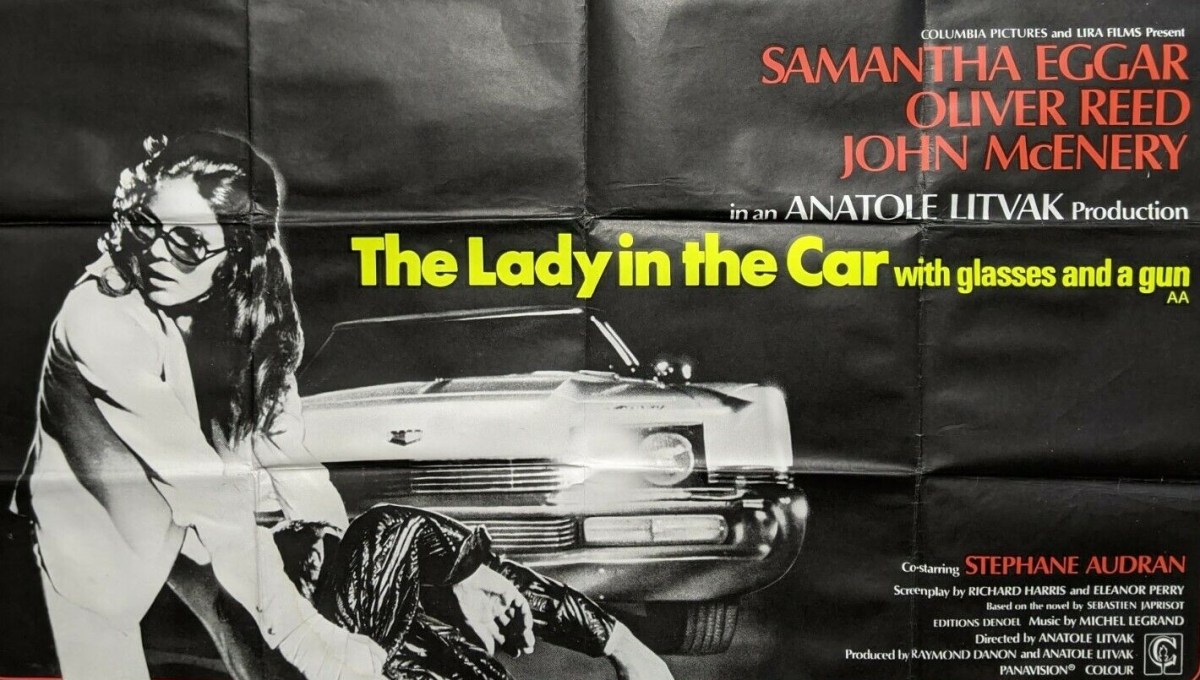
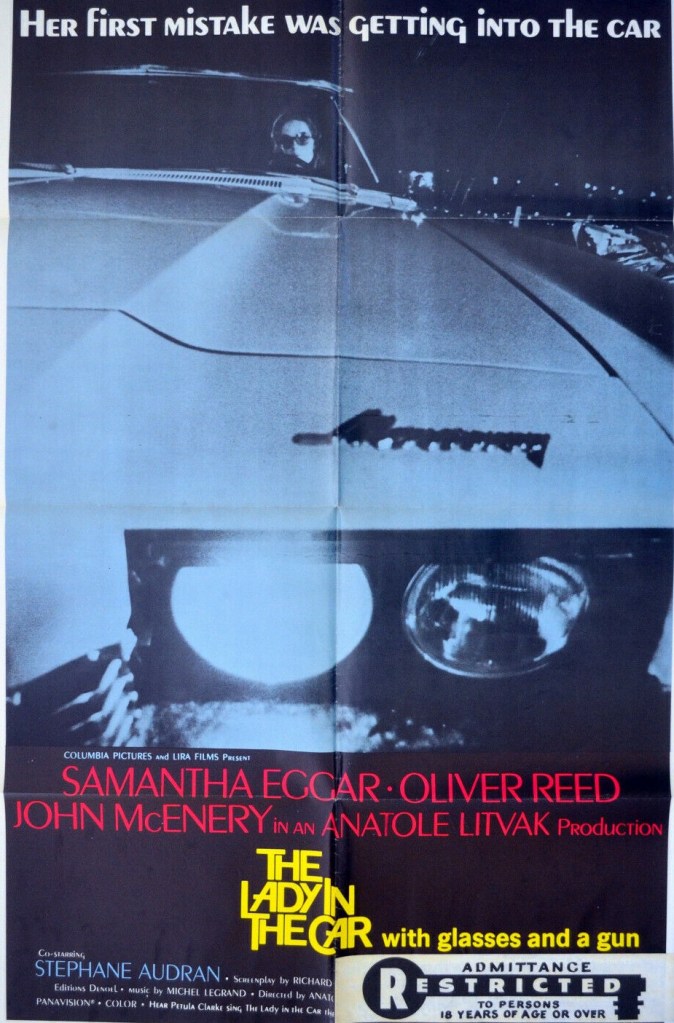
Samantha Eggar (The Collector, 1965) in her first top-billed role and an adapatation of a novel by French cult item Sebastian Japrisot (Adieu L’Ami/Farewell Friend, 1968). You couldn’t get a better mix.
Fashion photographer Danielle (Samantha Eggar) sets off on road trip from Paris to the south of France only to discover everywhere she goes a doppelganger has been there first. She’s on edge anyway because she’s “borrowed” the car of employer Michael (Oliver Reed) and once police start recognizing her she gets jumpier still. The discovery of a body in the boot and the titular gun (a Winchester rifle) don’t help her frame of mind. But instead of reporting the corpse to the police – she’s a car thief after all – she tries to work it out herself. Amnesia maybe, madness because she keeps having flashes of memory – a spooky surgical procedure – or something worse?
She’s got a battered hand she doesn’t know how. Michael’s wife Anita (Stephane Audran) says she’s not seen Danielle in a month though she is convinced she stayed with the couple the previous night. A drifter Philippe (John McEnery) starts helping her out. Eventually she ends up in Marseilles none the wiser.
It’s a tricksy film and like Mirage (1965), recently reviewed, being limited to her point of view means the audience can only work out everything from her perspective. The string of clues sometimes lead back to the original mystery, other times appear to provide a possible solution. The explanation comes in something of a rush at the end.
Despite being the first top-billed role for Samantha Eggar (Walk Don’t Run. 1966), she would not scale that particular credit mountain again until The Demonoid (1981) but she is good in the role of a mixed-up woman struggling with identity. But since it’s based on a novel by Sebastian Japrisot (The Sleeping Car Murder, 1965) there’s a sneaky feeling a French actress might have been a better fit. Oliver Reed (Women in Love, 1969) is not quite what he seems, a difficult part sometimes to pull off, but he succeeds admirably.
Stephane Audran (Les Biches, 1969), jealous of Danielle, a friend whom she views as a rival for her husband’s affections, has the most intense part, using Danielle as an unwitting cover for betraying Michael. John McEnery (Romeo and Juliet, 1968) could almost be a London spiv, blonde hair, impecunious, clearly using women wherever he goes. Watch out for French stalwarts Marcel Bozzuffi (The French Connection, 1971) and Bernard Fresson (The French Connection II, 1975).
There’s certainly a film noir groove to the whole piece, the innocent caught up in a shifting world, and that’s hardly surprising since director Anatole Litvak began his career with dark pictures like Sorry, Wrong Number (1948) while previous effort Night of the Generals (1967) also involved murder. Litvak and Japrisot collaborated on the screenplay.
I expected a project laced with more atmosphere and a host of original characters. In truth, this is less atmospheric than the other two Japrisot adapatations , the interplay between the characters not so tightly woven, nor the climax so well-spun but it was enjoyable enough.
There was a remake in 2025 starring Freya Mayor (The Emperor of Paris, 2018).
British outfit Talking Pictures has embarked on an educational program. Back in the day this would have been termed a “retrospective”, a coveted description indicating that a director or actor’s portfolio was worth reassessment. However, Talking Pictures has taken something of an outlier approach on this one. What it seems intent on educating us about is the U.S. “skinflick”.
You might not be aware of the difference between movies made in the U.S. and anywhere else that appealed to the lowest common denominator in the 1960s. Movies that featured nudist camps were generally acceptable to the British censor. And although major filmakers continually challenged the censor everywhere during the decade, that generally came under the auspices of artistic merit.
When permissiveness got the upper hand, the British seemed somewhat suspicious of abundant nudity and tended to overload it with comedy – Confessions of a Window Cleaner (1974) and Adventures of a Taxi Driver (1976) – and titles majoring on the double entendre like Keep It Up Downstairs (1976). There was a censor to keep everything in check.
In the U.S. it was different. You could avoid censorship simply by refusing to submit your film to the Production Code. And there were plenty cinemas only to0 keen to show the worst anyone could come up with in terms of sex and nudity.
The pair I’m reviewing here are not just the worst films I have ever seen but the worst films to be shown on a highly reputable channel, British outfit Talking Pictures TV. As you may be aware this channel has often been a first port of call in finding rare British pictures, often of the crime variety, especially the output from Renown. So pretty much I’m a sucker for anything they turn up dating from the 1960s even if it’s a new movie to me since I admit my knowledge of that era still has gaps. I’m the kind of sucker that never does any research on unknown titles, just trusts that TPTV is taking me down an interesting route
So if I’m unfamiliar with the picture, I generally give it the benefit of the doubt as I assume the people who run Talking Pictures will have done the hard yards. But now I’m not so sure.
Admittedly, there’s a fine line between cult and trash. A great deal of what passes for cult these days was dismissed as trash back in the day, so often it depends on your point of view. But it’s hard to make any justification for screening either of these movies.
At the time of their release neither would have been shown without extensive cuts in the UK and would have been shown in US cinemas minus a Production Code seal of approval.
Admittedly, too, I am making this damning judgement – deeming them worse than the awful Orgy for the Dead (1965) which was redeemed if only just by its campness – without having watched much of either picture. A 20-minute sample of each was as much as I could take.
It’s not just that they are devoid of any cinematic or even technical merit – there’s no dialog for a start, just a monotonous voice-over – but basically that they are an excuse for an endless parade of nudes. Skin flicks in the American vernacular, movies for the dirty raincoat brigade the British equivalent.
Take Me Naked purports to be the more artistic of the pair given it’s set in a derelict area of New York filled with alcoholics and bums. But really, it’s an excuse for a rancid low life to spy on a naked woman (Roberta Findlay) and imagine what’s he’s going to do to her. That’s pretty much it, apart from an unsavory violent aspect.
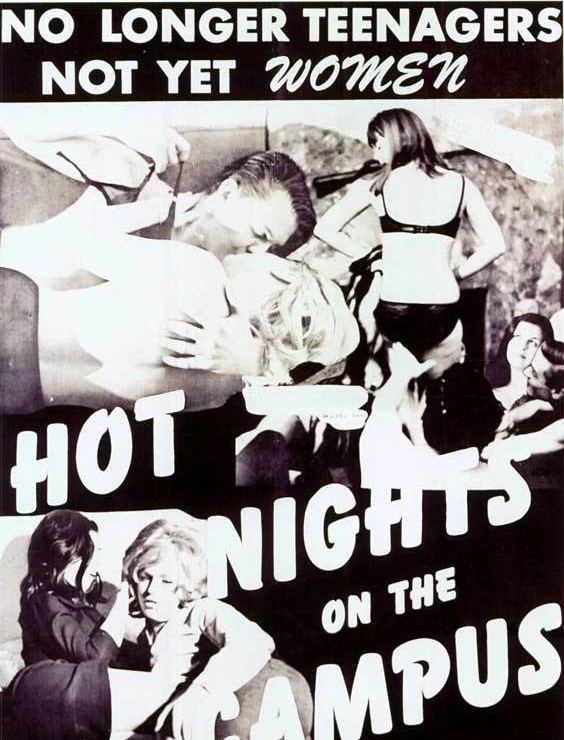
Hot Nights on the Campus has less nudity. But that’s it’s only saving grace. Again, there’s no dialog, just voice-over. Sally (Gigi Darlene) is a farm girl who is led astray at college and her education mostly comprises orgies, lesbianism and seduction. There’s at least an attempt at narrative since Sally’s adventures incur pregnancy and abortion, but like the rest of the picture their purpose is purely exploitational.
Take Me Naked was directed by Michael and Roberta Findlay, the latter making a name for herself helming exploitation, sexploitation and hardcore porn. Hot Nights on the Campus was written and directed by Tony Orlando who made three others in the same vein.
I’ve marked this up since my previous viewing of it. And that’s an exceptionlly rare occurrence. What may not have suited the 1960s audience accustomed to standard boy-meets-girl boy-loses-girl even with whatever complications were available at the time, this should chime more with a contemporary audience seeking more reality and less glorification in a love story.
Not quite the Hollywood romance, too much bellyaching from the male for a start, and a couple of years before Love Story (1971) gave terminal illness a box office shot in the arm, but nonetheless very much an adult love affair and far from deserving a place in the top 50 worst films of all time.
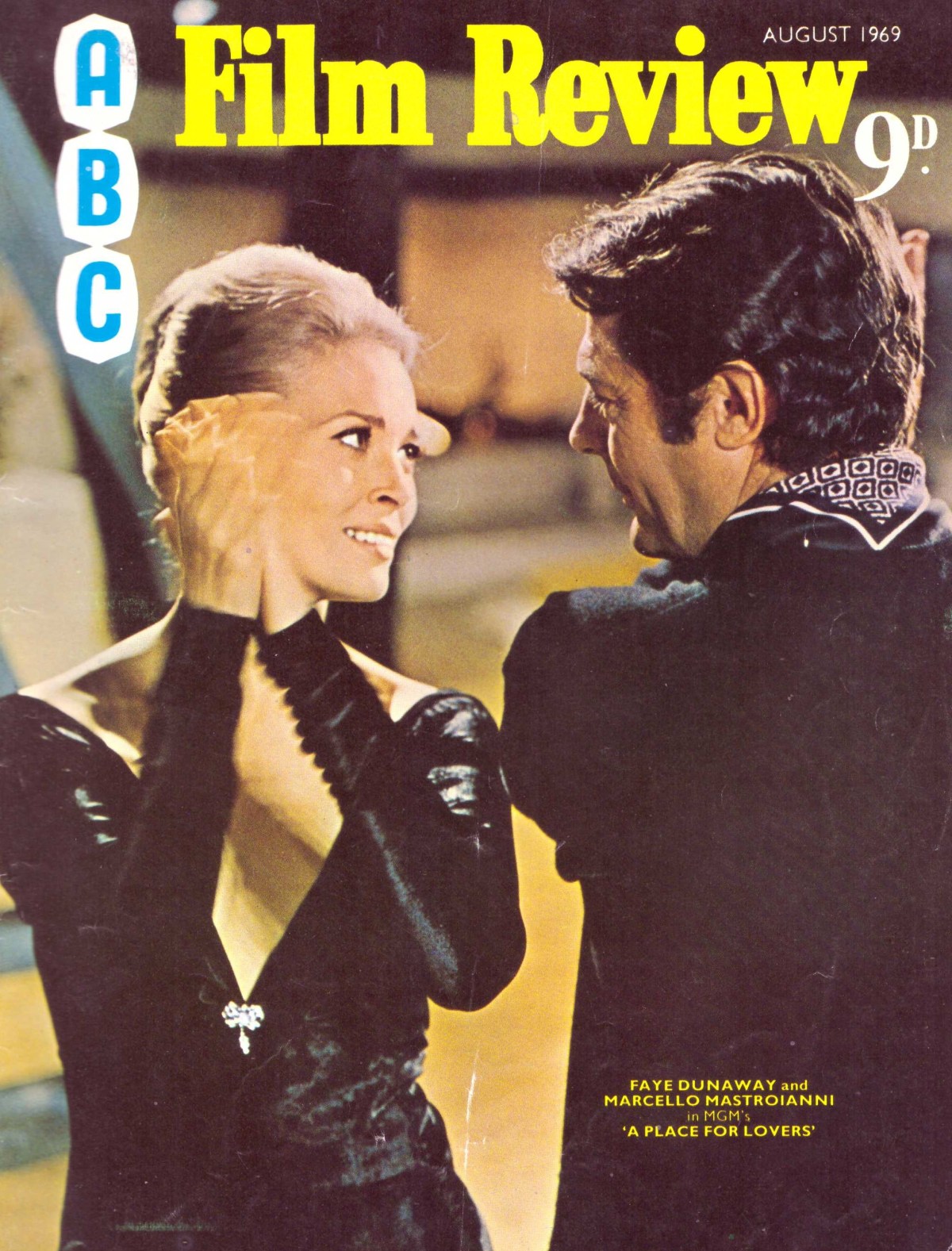
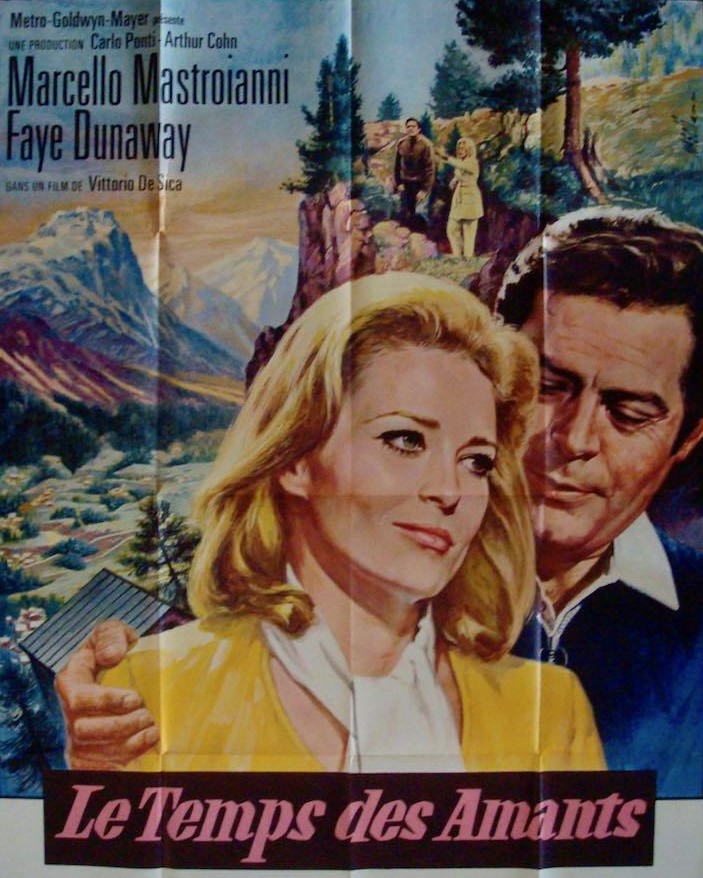
For a start director Vittorio De Sica plays around with audience expectations. This always has the feel of a romance that could end at any time, of characters not quite sure of the other person’s feelings, real love or just sex, the sense of not knowing where this could go, and of where, emotionally, they find themselves. And it begins with confusion, a blaring horn in the background, a close-up of Julia (Faye Dunaway), and then she jiggles around with some bricks in a wall before retrieving a key and finding her way inside a grand though modern Italian pallazo. You’ve no idea why she is here and I guess neither does she.
There’s been no meet-cute and there’s no real intimation of how the attraction began except, judging from a brief flashback, they must have bumped into each other at an airport. That’s my conclusion anyway because the details of the actual meeting are never clarified, like a lot of what subsequently goes on. She hides information from him, he does the same, so for a time feelings are not spelled out. It’s clandestine in all the wrong ways. There’s a separation, a distance, characters often seen in very long shot. Sometimes there are physical barriers between them, a high fence in one instance, as if true intimacy is impossible.
Still no sign of the man she has come to visit. She rescues a stray dog from the town dog collector. It’s an exceptionally grand house, classically designed, marble floors, paintings and artistic artefacts all over the place, but no clutter. When Valerio (Marcello Mastroianni) arrives – it’s his house – he checks the labels on her luggage, presumably finding out her full name, possibly her address, possibly accustomed to lovers providing false information on both counts. We learn he’s a safety-conscious racing driver, a man who requires barriers.
They are on a deadline already. She is only in Italy for a further two days. This is a lie. She has 10 days at her disposal but wants to set the pace, heat up the sexual atmosphere. They make love beside a lake. He takes her to dinner with friends where the entertainment is a lecture on sexual positions shown in art. But after someone suggests a game of what we would these days term speed-dating, he calls an end to the affair, jealous that she would consider spending any time in close proximity to another man.
So that’s it. Grand love affair dead and buried after just one day. Except she turns up next day at a practice at a racing circuit. After they reconcile, she watches in a car mirror as he makes a call in a phone box – speaking to his wife or another lover, we never find out, except her reaction explains it must be either.
There’s little of the sparkling dialog found in Hollywood romances, especially for audiences who grew up on the Tracy-Hepburn pictures, but she tells him that “if you put all the houses I have lived in you would make a good little town” and not just that she had lived a peripatetic lifestyle but that she also had six grandfathers so a rather fluid upbringing. She confesses now she has more time to spare, she just wanted him to ask for it, being stricken by her potential absence an indication in her eyes of true love.
So this is a fragile individual, her smile is always hesitant, external confidence hiding vulnerability. Her face is never flush with passion. When he asks why she never revealed her terminal illness, she replies, “I can’t take any more sad eyes.” There’s an ironic ending.
It is of course set against glorious backdrops but instead of letting the audience wallow in the love affair, as would be the Hollywood temptation, De Sica finds some way of undercutting it. Valerio is never quite sure of her and she is never quite sure of him. Their pasts remain hidden. Their lovemaking beside the lake is interrupted by a hunter bagging game. She coos over a baby only to discover it has an ugly father. She drives too fast even with a racing driver in the passenger seat and she clearly has suicidal tendencies, the love affair almost a salve for her despair.
We could have been presented with the suave charming Marcello Mastroianni (La Dolce Vita, 1960) cliché from a dozen Italian films, but instead he is often jealous, annoyed, real. Faye Dunaway (Bonnie and Clyde, 1967) plays a character who never knows where she stands with her emotions, accepting her fate one moment, determined to end her life the next, and yet still time to dally in a love affair that of course can have no future.
Vittorio De Sica (Two Women, 1960) has fashioned a picture that is neither uplifting nor downhearted, a love affair that lives just for the moment, but with implied complications that could at any moment wreck it, a romance always teetering on the edge.
I’ve no idea what compelled Harry Medved to include this in The Fifty Worst Films of All Time, published in 1978, but you might easily question his judgement on discovering that his list includes Sergei Eisenstein epic Ivan the Terrible, Alain Resnais’s hypnotic Last Year at Marienbad, Otto Preminger’s Hurry Sundown, Alfred Hitchcock’s Jamaica Inn and even such passable entertainments as The Omen.
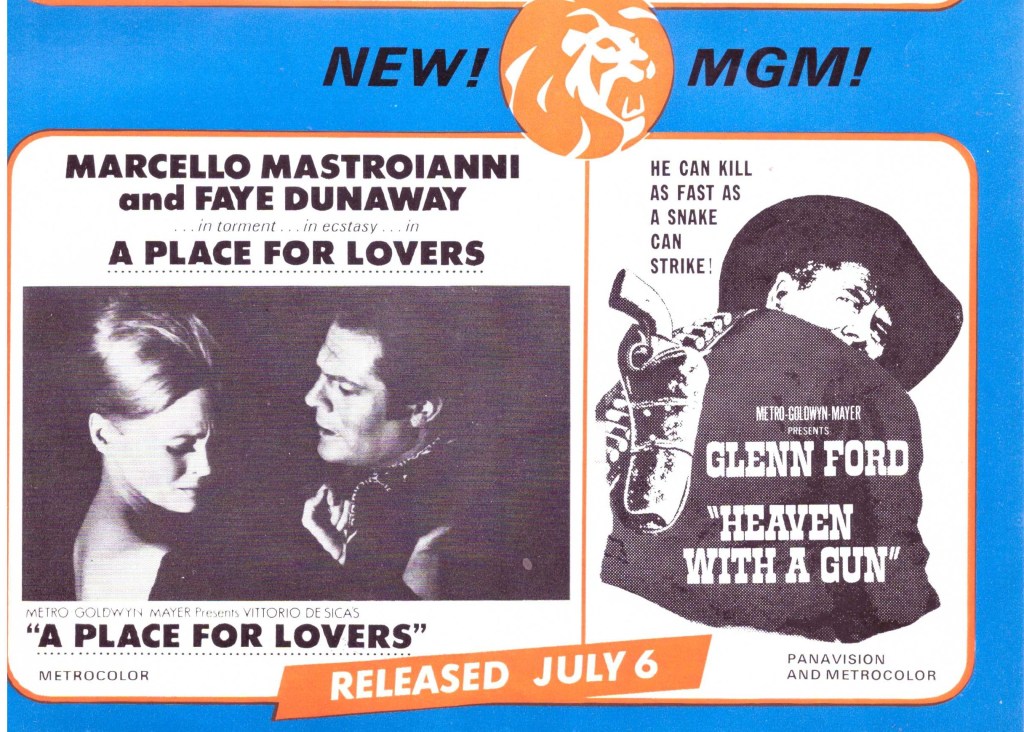
Maybe you’ve been put off giving this a whirl thanks to the Medved seal of disapproval. A Place for Lovers is not the greatest film ever made, but it’s certainly far from the worst, two striking actors and a director who could never make a terrible picture make sure of that. And, as I mentioned, exerts greater appeal for the contemporary viewer.
No DVD available so you will need to check out Ebay or streaming.
A dislocated, fractured film about disjointed, fractured people. Takes a heck of a long time to work what’s going on because director Richard Lester in the elliptical style of the times tells us bits of the story a bit at a time and no guarantee anything is in logical order or that the characters tell the truth about themselves or their actions. And, unusually, outside of a western, all the men appear prone to violence.
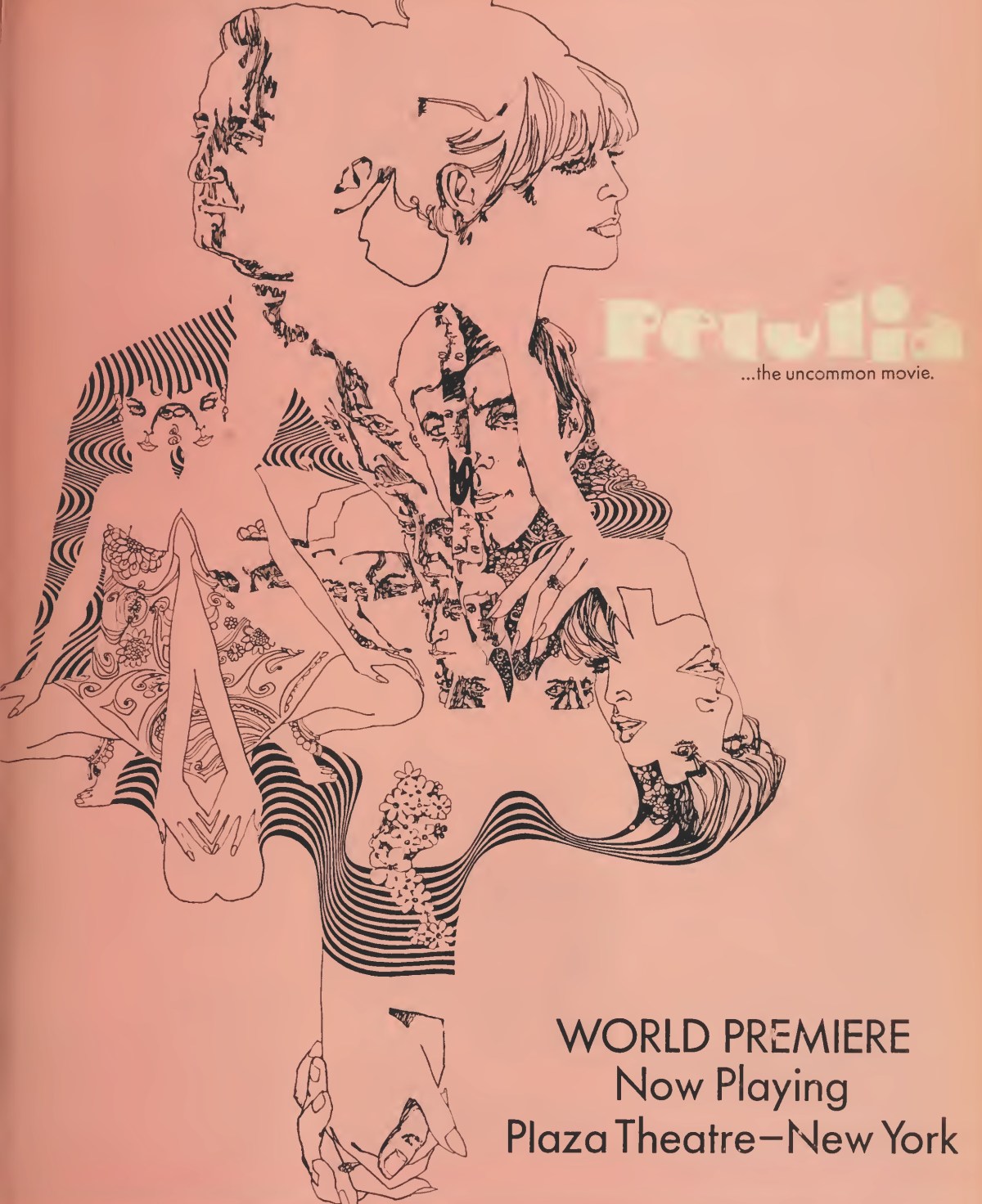
Petulia (Julie Christie), a self-appointed “kookie” (in the vernacular of the times) and married for just six months to wealthy naval architect David (Richard Chamberlain), for no reason at all begins an affair with surgeon Archie (George C. Scott) that she encounters at a posh function. Archie, getting divorced for no reason at all except boredom from Polo (Shirley Knight), already has a girlfriend, all-round-sensible boutique-owner May (Pippa Scott). Petulia and Archie may or may not have consummated the affair, she certainly puts him off often enough. Petulia may or may not be the daughter and sister of prostitutes. You see where this is going? Unreliable narrator, par excellence.
A broken rib may be the result of stealing a tuba from a shop. She could have cracked her head open after a dizzy spell. A Mexican boy keeps turning up and, it has to be said, nuns. It’s all very avant-garde: an automated hotel where the key comes out of slot and the fob sets off flashing lights at the bedroom door, the televisions in hospital rooms are dummies, Janis Joplin is the singer in a band, characters viewed in longshot down corridors, up car park ramps, emerging from tunnels.
Eventually the demented jigsaw puzzle comes together but not after a tsunami of overlapping dialog, flash scenes and snippets that have nothing to do with the film. It’s San Francisco so there’s a scene in Alcatraz. But little is constant, every marriage seems on the verge of break-up, even the contented Wilma (Kathleen Weddoes), wife of another surgeon, wishes she had Archie’s courage in ending his marriage.
But Petulia is anything but free-spirited. She is trapped and doesn’t know how to get what she wants. She may be a tad unconventional and big-hearted and occasionally small-minded but once you get to the end of the film and find what she really wants the rest of her behavior makes sense. And although Archie is able to verbalize what he doesn’t want from marriage, the only option open to Petulia is one apparently mad action after another.
Although set in the Swinging Sixties, the male hierarchical system remains dominant. Archie’s ex-wife relies on him for money, David and his father (Joseph Cotten) hold sway over Petulia regardless of her bids for freedom. David is unsavory, his father is willing to provide a false alibi, another surgeon Barney (Arthur Hill) lets loose with a vicious rant and even the harmless soft spoken Archie lets loose on Polo.
Julie Christie (Doctor Zhivago, 1965) makes Petulia as irritating as she is endearing, the freedom she expects to embrace in the counterculture impossible to grasp, leaving her only with the vulnerability of the vanquished. George C. Scott (The Hustler, 1961) has forsaken his growling persona, the volcanic screen presence set to one side, to portray a more interesting character, bemused by Petulia but ultimately standing up for her.
There’s an excellent supporting cast in Richard Chamberlain, still in the process of shucking off Dr Kildare (1961-1966), Arthur Hill (Moment to Moment, 1966), Shirley Knight (Flight from Ashiya, 1964) and Joseph Cotten (The Third Man, 1949).
Britisher Richard Lester (A Hard Day’s Night) was a director du jour who, while fulfilling the expectation of delivering cutting-edge techniques and casting a wry eye on contemporary mores, offered some surprisingly more homely family scenes and for a movie which is so much about the distance between characters many scenes of just touching, Petulia stroking Archie’s hands, Archie stroking is wife’s neck, even when the intimacy they seek is a forlorn hope. The incident with the tuba which would be a meet-cute to end all meet-cutes in other pictures turns into a cumbersome irrelevance. You get the impression that the chopping up of the time frames and the points of view reflects the characters’ feelings that they can impose their own reality on a situation. Lawrence B. Marcus (Justine, 1969) wrote the screenplay from the novel Me and the Arch Kook Petulia by John Hasse.
Check out a Behind the Scenes on this film’s Pressbook.


 The Magnificent 60s