The Two Faces of Dr Jekyll / Jekyll’s Inferno / House of Fright (1960) ****

One of the most shocking films of its day with its unusual focus on sex and violence, this takes the famed Robert Louis Stevenson tale down a different direction in that Dr Jekyll enjoys the base animal instincts he has unleashed with his experiments rather than expressing remorse or guilt. Evil has never been more demonstrably enjoyed.

Dr Jekyll (Paul Massie) is a shy cuckolded scientist when he takes the magic elixir that diverts his dull personality towards a more dynamic, if ultimately perverted, destination. From being fearful of life, he begins to sample its more exotic pleasures under the guidance of louche best friend Paul (Christopher Lee) who is carrying on an affair with the good doctor’s wife Kitty (Dawn Addams).

Not only does the reincarnation of Jekyll as the lusty Hyde consort with prostitutes and manage to snare exotic dancer Maria (Norma Marla), a beautiful woman who would normally be way out of his league,  he develops a fetish for violence, almost beating to death a hooligan (Oliver Reed) in a dodgy club, only prevented from committing his first murder by the intervention of his friend.

Sure, there’s some philosophising about the nature of good and evil and whether violence is inborn or nurtured and there are moments when guilt rears its ugly head, but these are pretty fleeting to be honest, and most of the time he can hardly wait for another draught of his poison in order to shake off his insipid persona and revel in the new creation.

But magic will only take you so far. Believing he is now irresistible to women he fancies his chances with Paul’s amour, who is of course none other than his wife, but she will have none of it, finding him a poor alternative to the charming Paul. In one of the most controversial scenes of the day, and perhaps only ironically acceptable at the time, Hyde proceeds to rape the resisting Kitty. This skirts so close to the edge of taste, not just the worst type of domestic abuse (though husband assaulting wife would be no less unusual in Victorian times than it is now), but almost the neanderthal man taking what he wants, that it makes for uncomfortable viewing, especially as it is presented as a come-uppance for the adulterous hoity-toity Kitty.

Perhaps more interesting is that having won over the cold Maria, a trophy lover on a par with the higher-born Kitty, that’s not enough for Hyde.

Also, for the time, is an extremely risqué scene involving Maria and her snake, especially when having completed the usual survey of her curves, the reptile ends up down her throat. That the Victorians were masters of the art of hypocrisy comes as little surprise, but the extent of it takes the viewer aback.  

There’s another twist. When it becomes apparent that his crimes are about to catch up with him the cunning Jekyll attempts to blame Hyde.   

Sumptuously mounted by Terence Fisher (Dracula, Prince of Darkness, 1966) and with nary an attractive character in sight – none of the innocent victims of the vampire sagas, for example – to leaven the sight of such unmitigated wickedness, the director offers an unique vision of how easy human beings will degenerate given the chance. At the outset Paul appears the most obvious villain, leeching on his friend to pay his gambling debts, while at the same time making hay with his wife. But initial audience sympathy for a wife, presented as a beautiful woman who for the sake of security has made a bad marriage and who needs an outlet for passion, soon dissipates as her true character is revealed.

The refusal to temper the ongoing degeneracy with one good character is a bold choice. Budgetary restrictions eliminated the usual transformation scene but that was probably for the best, since Hyde merges as though from a chrysalis into a stronger personality rather than undergoing some body-wracking physical change. It’s almost as if the director is determined to show how easy, given opportunity, a good but essentially weak man will embrace the dark side.

Accusations that Fisher has failed to bring sufficient suspense to the film I find unfair. Certainly, there’s not the tension of the will-he-be-found-out vein, but since the story is so well-known that appears a redundant course sensibly avoided. The director replaces that with ongoing friction between Jekyll and his friend on the one hand and his wife on the other, both of whom are unaware that the man they know as Jekyll is aware of just what a fool has been made of his alter-ego.

The emphasis instead falls on how and when the cuckold will take his revenge. And although the rape scene is unwelcome, there’s a certain ironic sadness for Jekyll to discover that his new persona is no more attractive to his wife than his old one.

Paul Massie (Call Me Genius, 1961) is of course far removed from an actor like Spencer Tracy (Dr Jekyll and Mr Hyde, 1941) and he relies overmuch on rolling the eyes but even so this is a decent performance. Christopher Lee (Dracula, Prince of Darkness) is the revelation, creating a very believable insidiously charming man who never quite approaches outright villainy. Dawn Addams is excellent as the spoiled entitled wife.

One of the unusual aspects of the picture is that where Hammer had been and would remain a breeding ground for new stars – Christopher Lee a most obvious example – everyone else featured here came to, in cinematic terms only I assure you, an untimely end.

This turned out to be Paul Massie’s only starring role – he only made another three films during the entire decade – and was soon relegated to television. Dawn Addams only managed another nine and, apart from House of Sin/The Liars (1961), spy flick Where the Bullets Fly (1966) might be counted the peak.

David Kossof only made another four, and none beyond 1964. And this was the final film in an extremely brief two-picture career for Norma Marla. Only the uncredited Oliver Reed (Women in Love, 1969) and of course Christopher Lee (Dracula, Prince of Darkness, 1966) went on to bigger and better things.

As did Terence Fisher who helmed most of the best Hammer pictures of the decade. Wolf Mankowitz (The Day the Earth Caught Fire, 1961) wrote the script.

Generally dismissed at the time, this has for good reasons acquired a substantial following and is well worth a look.

Homicidal (1961) ****

William Castle (The Tingler, 1959) was always a cult director but 60 years later this hits a contemporary bullseye with uncanny accuracy. It couldn’t be more Hitchcockian, down to the director making an appearance at the start and adopting the same lugubrious tones as Alfred Hitchcock did for his television series.

Bookended by two brilliant scenes, one of mystery, the other revelation, it’s only when you go back and unravel the way this has been put together you realise how fiendishly clever – and heartrendingly awful – it had been. Gender identity, in case you hadn’t guessed, is a central theme.

Castle wasn’t known for concentrating on any emotion beyond fear but this goes back to the most basic of all emotions. Who am I? How do I figure myself out? And even the acting – almost as black-and-white as the picture with one over-the-top character and one so weak he almost drains the picture of any life – makes more sense in retrospect.

Stunning blonde Miriam Webster (Jean Arless) checks into a hotel and offers bellhop Jim (Richard Rust) $2,000 to marry her that night on the understanding the marriage will immediately be annulled. Puzzled, and of course fancying his chances of sex as a tip, he drives her to local Justice of the Peace Alfred S. Adrims (James Westerfield) who demands an increased fee for getting dragged out of bed. In short order, Miriam murders him and his wife and escapes.

Turns out she’s not Miriam Webster. That’s the name of a florist in the town where Emily, her real name, looks after mute invalid Helga (Eugenie Leontovich). The real Miriam (Patricia Breslin) is half-sister to businessman Warren (George Marshall), returning home after a lengthy absence to claim his inheritance. At the age of 21, in a couple of days’ time, he falls heir to a $10 million fortune. Helga was his Danish nanny whom he resolved to provide care for after a heart attack.

But it’s soon clear that Emily hates her charge who can only communicate, and only to draw attention, by using a clacker to batter against her wheelchair. When Miriam visits Helga, Emily skips out, promising to return shortly, only to tell Miriam’s boyfriend Karl (Glenn Corbett) that she’s been detained and won’t be free to join him for a picnic.

Then she proceeds to smash up Miriam’s flower shop, in particular destroying anything that points to a wedding, and tearing up a photograph of Miriam’s half-brother. When Carl pops in, she knocks him out.

So what’s with all the wedding malarkey? You won’t be surprised to learn it’s something of a red herring, especially as Emily is already married to Warren, news that comes as a shock to Miriam.

Warren has the constitution of a weakling and looks the kind of boy who would have been trampled over as a child. Except, it turns out, he was bullied by his father, a driven businessman, and whipped by Helga to turn him into someone a lot sturdier, able to stand on his own two feet, and not get knocked around. If anything, he was inclined to be the bully.

Emily should have murdered the bellboy when she had the chance because of course he goes and rats on her and now there’s an illustration of her in the newspaper and the cops are on her trail having tracked down a Miriam Webster living in her town.

Naturally, Warren rejects the notion, but Miriam isn’t so sure. There was an incident in her bedroom and she had lied to Miriam about nipping out for a few minutes and something had been dropped among the debris in the florist shop that linked its destruction to Emily.

So if Emily’s married to a man who’s about to become a multi-millionaire and by far the richest guy in town and with who knows what influence that could buy…You see where this is going? Or if the deeply-in-love Warren could tolerate a wife with homicidal tendencies? Or if she would inherit should Warren have a nasty accident? You see where else this could be heading?

Well, it goes to none of those places. And I’m not going to spoil the climax by telling you exactly where it goes, but it’s a shocker for sure and just superbly done.

And once that revelation’s out in the open everything else makes sense – and doesn’t. For what is at its heart is something so jarring real and troubling, an emotion with consequence, that it neatly fits into one of the most compelling controversies of today.

Otherwise, it’s a perfectly good straight-up thriller, owing much to Psycho (1960), especially the knife-wielding killer, but with some thrilling moments and, in another contemporary salute, busting open the fourth wall with the “Fright Break” gimmick where at the height of proceedings the director literally stops the clock and gives the audience 45 seconds to get out of the theater if they can’t take any more.

If you think William Castle has managed some sleight-of-hand I’m going to have to fess up and say I’ve done the same but you’ll only understand what if you watch the film. Anyone who guesses it can let me know.

There’s a prize. A copy of my latest book, shipped to anywhere in the world, 1960s Movies Redux, Volume 1 – printed copy available now, e-book shortly.

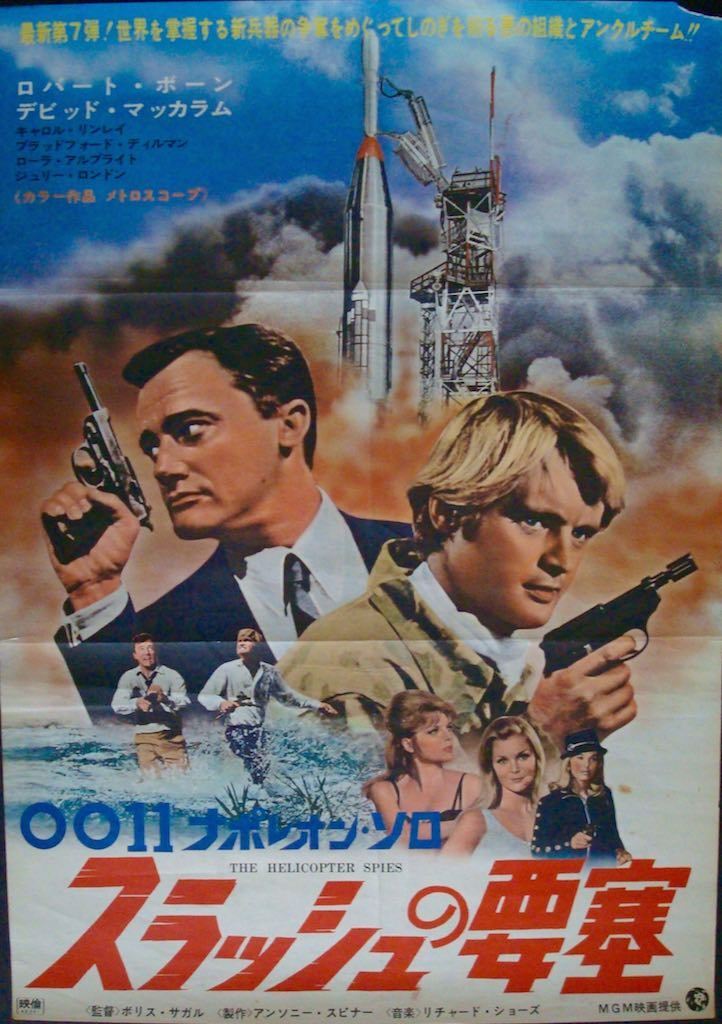
The Karate Killers (1967) ****

What a hoot! A sheer blast! The most brilliant yet of the madman dominating the world schemes, autogyros to out-Bond Bond, a fabulous cast and of course the most incompetent spies this side of Get Smart.

You can’t get better than a scientist inventing a way of turning water into gold. Takes chutzpah to even think of that as a plot. No having to batter your way into Fort Knox as poor Bond did in Goldfinger (1964), you just turn on the tap. But, wait, the formula is lost and our intrepid heroes have to – heaven forbid! – track down five gorgeous women to find it. Was there ever a more onerous proposal?

I never saw any of these films when they came out. At the time I guess they would have been viewed as small screen rivals to James Bond. But although 007 in every picture would eventually be trapped in the madman’s lair, he spent most of the film beating the sh*t out of the bad guys. In sharp contrast, The Men from U.N.C.L.E. seem always to be on the wrong side of a beating, number one hero Napoleon Solo (Robert Vaughn) more hapless than number two Ilya Kuryakin (David McCallum).

With hindsight, it looks like this was never meant to be taken seriously and without going into over-spoof plays exceptionally well as a light-hearted romp. Solo seems to be constantly outwitted with Kuryakin invariably coming to the rescue, the former too often duped by beauty, the latter a bit more discerning. There’s a lovely moment here in their reactions to the instruction by boss Mr Waverley (Leo G. Carroll) to hunt down a dead scientist’s quintet of daughters/step-daughters; Solo gives a knowing smirk, Kuryakin shows disdain.

Must be the best cast yet assembled: legendary Joan Crawford, suddenly hot again after Whatever Happened to Baby Jane (1962) and Strait-Jacket (1965), Curd Jurgens (Psyche ’59, 1964), Herbert Lom (Villa Rides, 1968), Telly Savalas (The Dirty Dozen, 1967), Kim Darby (True Grit, 1969), Terry-Thomas (How To Murder Your Wife, 1965)  and Jill Ireland (Mrs Charles Bronson) as you’ve never seen her before.    

The U.N.C.L.E. duo are in a race against T.H.R.U.S.H. operative Randolph (Herbert Lom) to track down the missing formula. Randolph has a head start. He has been having an affair with the scientist’s wife Amanda (Joan Crawford) who is shocked to discover his charming exterior conceals a ruthless interior.

Solo and Kuryakin track down the scientist’s daughter Sandy (Kim Darby), a good bit brighter than your average eye-candy spy girl, who points the way to the step-daughters and to the possibility that each has one part of the missing formula. Was there ever an easier justification for introducing such a random set of characters?

First up is stark naked Countess (Diane McBain) locked away by jealous impoverished husband (Telly Savalas) in a castle in Rome. Then we’re onto Imogen (Jill Ireland), a flamboyant lass shaking her booty at any opportunity, arrested by a constable (Terry-Thomas) for indecent exposure, and involved in a punch-up in a London night-club where Solo is nearly drowned (yup!) and Randolph instructs the band to keep playing since the ruckus is nothing to do with them.

Then we’re off to Switzerland and Yvonne (Danielle De Metz) and a machine-gun ski chase down a mountainside (beat that, Mr Bond). And so on until all the clues, contained in photographs of the dead father, have been found and, wait for it, the puzzle remains incomplete. Eventually it’s unravelled and the final showdown is on.

But what a way to go. Never mind the ski chase, the picture opens with the duo being attacked by a fleet of autogyros (one-man mini helicopters, the “Little Nellie” of the later You Only Live Twice, 1967 ), and as usual someone, this time Kuryakin, is trapped on a low-tech machine, this time on a ice-block travelator where blocks of ice are smashed to bits by nasty spikes.

Randolph is the most droll villain alive. “Don’t be so melodramatic, my dear,” he informs Amanda when she uncovers his villainy and is about to be murdered. The whole jigsaw is exceptionally appealing, the global whizzing about, Japan also included not to mention one of the poles where T.H.R.U.S.H. has established its HQ.  

The action is a good bit more thrilling, the aerial and ski sequences very well done on a budget a fraction of the Bonds, and there’s more than enough going on to keep interest levels high, not just where to go next, and who to encounter, but the gathering of the clues,  and working out of the final mystery, which offers a nice emotional touch.

Kim Darby is more of a typical ingenue here, sparkier than you might expect but not offering the originality of character expressed in True Grit, while Jill Ireland is a good bit more sassy than she ever appeared thereafter. Barry Shear (Wild in the Streets, 1968) directed.

This is the best so far that I have seen on the series. My interest had begun to flag but, thus fortified, I will continue with my endeavors to watch them all. on your behalf, of course.

How the West Was Won (1962) ***** – Seen at the Cinerama

I’ve got Alfred Newman’s toe-tapping theme music in my head. In fact, every time I think of this music I get an earworm full of it. Not that I’m complaining. The score – almost a greatest hits of spiritual and traditional songs – is one of the best things about it. But then you’re struggling to find anything that isn’t good about it. But, for some reason, this western never seems to be given its due among the very best westerns.

Not only is it a rip-roaring picture featuring the all-star cast to end all-star casts it’s a very satisfying drama to boot and it follows an arc that goes from enterprise to consequence, pretty much the definition of all exploration.

Given it covers virtually a half-century – from 1839 to 1889 – and could easily have been a sprawling mess dotted by cameos, it is astonishingly clever in knowing when to drop characters and when to take them up again, and there’s very little of the maudlin. For every pioneer there’s a predator or hustler whether river pirates, gamblers or outlaws and even a country as big as the United States can’t get any peace with itself, the Civil War coming plumb in the middle of the narrative.

Some enterprising character has built the Erie Canal, making it much easier for families to head west by river. Mountain man fur trader Linus Rawlings (James Stewart) on meeting prospective pioneers the Prescotts has a hankering after the young Eve (Carroll Baker) but as a self-confessed sinner and valuing his freedom has no intention of settling down. But he is bushwhacked by river pirates headed by Jeb Hawkins (Walter Brennan) and left for dead, but after saving the Prescotts from the gang changes his mind about settling down and sets up a homesteading with Eve.

We have already been introduced to Eve’s sister Lilith (Debbie Reynolds) who has attracted the attention of huckster Cleve Van Valen (Gregory Peck) and they meet again in St Louis where she is a music hall turn and widow. Her physical attraction pales in comparison with the fact she has inherited a gold mine. He follows her, unwelcome, in a wagon train which survives attack by Cheyenne, but still she resists him, not falling for him until a third meeting on a riverboat.

Zeb Rawlings (George Peppard) wants to follow his father to fight in the Civil War. Linus dies there, but there’s no great drama about it, he’s just another casualty, and the death is in the passing. In probably the only section that feels squeezed in, following the Battle of Shiloh a disillusioned Zeb saves General Sherman (John Wayne) and Ulysses S. Grant (Harry Morgan) from an assassin.

Returning home to find Eve dead, Zeb hands over his share of the farm to his brother and heads west to join the U.S. Cavalry at a time when the Army is required to keep the peace with Native Americans enraged by railroad expansion. Zeb links up with buffalo hunter Jethro Stuart (Henry Fonda), who appeared at the beginning as a friend of his father.

Eve, a widow again, meets up in Arizona with family man and lawman Zeb who uncovers a plot by outlaw Charlie Gant (Eli Wallach) to hijack a train. Zeb turns rancher once again, looking after her farm.

But the drama is peppered throughout by the kind of vivid action required of the Cinerama format, all such sections filmed from the audience point-of-view. So the Prescotts are caught in thundering rapids, there’s a wagon train attack and buffalo stampede, and a speeding train heading to spectacular wreck. There’s plenty other conflict and not so many winsome moments.

Interestingly, in the first half it’s the women who drive the narrative, Eve taming Linus, Lilith constantly fending off Cleve. And there’s no shortage of exposing the weaknesses and greed of the explorers, the railroad barons and buffalo hunters and outlaws, and few of the characters are aloof from some version of that greed, whether it be to own land or a gold mine or even in an incipient version of the rampaging buffalo hunters to pick off enough to make a healthy living.

And here’s the kicker. Virtually all the all-star cast play against type. John Wayne (Circus World, 1964) reveals tremendous insecurity, Gregory Peck (Mirage, 1965) is an unscrupulous though charming renegade, the otherwise sassy Debbie Reynolds (My Six Loves, 1963) is as dumb as they come to fall for him, and for all the glimpses of the aw-shucks persona James Stewart (Shenandoah, 1965) plays a much meaner hard-drinking hard-whoring version of his mean cowboy. Carroll Baker (Station Six Sahara, 1963) is an innocent not her usual temptress while George Peppard (The Blue Max, 1966) who usually depends on charm gets no opportunity to use it. .

Also worth mentioning: Henry Fonda (Madigan, 1968), Lee J. Cobb (Coogan’s Bluff, 1968), Carolyn Jones (Morticia in The Addams Family, 1964-1966), Eli Wallach (The Moon-Spinners, 1964), Richard Widmark (Madigan), Karl Malden (Nevada Smith, 1966) and Robert Preston (The Music Man, 1962).  

Though John Ford (The Man Who Shot Liberty Valance, 1962) had a hand in directing the picture, it was a small one (the short Civil War episode), and virtually all the credit belongs to Henry Hathaway (Circus World) who helmed three of the five sections with George Marshall (The Sheepman, 1958) taking up the slack for the railroad section.

And though you might balk at the idea of trying to cover such a lengthy period, there’s no doubting the skill of screenwriter James R. Webb (Alfred the Great, 1969) to mesh together so many strands, bring so many characters alive and write such good dialog. Bear in mind this was based on a series of non-fiction articles in Life magazine, not a novel, so events not characters had been to the forefront. Webb populated this with interesting people and built an excellent structure.

I’m still tapping my toe as I write this and I was tapping my toe big-style to be able to see this courtesy of the Bradford Widescreen Weekend on the giant Cinerama screen with an old print where the vertical lines occasionally showed up. Superlatives are superfluous.

Deus (2022) ** / Watcher (2022) ** – Seen at the Cinema

Luckily I had been fortified in my weekly cinema outing by the wonderful Living (2022) before entering dudsville for this double bill. Both Deus and Watcher have all the hallmarks of direct-to-DVD productions which have, to use the old parlance, “escaped” into cinema distribution.

I’m probably a bit rusty about the cost of making the kind of giant spacecraft shown in Deus, billions of dollars surely, so am assuming that big projects like this will encounter budget overruns which would account for the rationing of electricity on board, resulting in the  murky lighting. And there’s not an alien in sight unless you count the robotic crew who speak in strangely monotonous tones.

Like most sci-fi films this involves a crew on a mysterious mission awaking from hibernation to investigate a distant object, in this case a sphere. The title assumes this might be about someone playing God and so it transpires, taking a leaf out of The Avengers: Infinity War (21018) playbook with a plot to wipe out three-quarters of the Earth’s population in some kind of eco good deed.

Not only has an evil genius Vance (Phil Davis), who appears only as a hologram (natch), gone to all this bother and created a heavenly apparition but in order to achieve his ends he has had to go to all the clever bother of killing off the family of Karla (Claudia Black) in a car crash so that he can have the opportunity to insert a chip in her brain to infiltrate her imagination.

Former hitman Ulph (David O’Hara) forms part of the crew and the only measure of excitement comes when, mercifully, parts of the mother ship explode. Any action or suspense is purely theoretical with writer-director Steve Stone (In Extremis, 2017) responsible for this monstrosity.

It’s a terrible thing to say I know but I was praying for the serial killer to get a move on and wipe out dull lifeless heroine Julia (Maika Monroe) in Watcher. A former actress, now unemployed,  who has moved to Bucharest with advertising executive partner Francis (Karl Glusman) she spends all her time moping around crying wolf. Naturally, everyone ignores her if only for the fact that when she claims to be watched by a man from across the street she has facilitated such voyeurism by leaving her curtains wide open.

The serial killer is known as The Spider for obvious reasons – I guess he has either a hairy back, six arms, climbs up the outside of buildings, or is the type of arachnid who bites the head off his victims or all of the above or because newspaper headline writers had run out of murderer nicknames or were simply devoid of imagination.

As with Matt Damon in Stillwater (2021) her sense of isolation, what with hubby working all hours, is increased because only a tiny minority of the population have the courtesy to speak English.   Location-wise you know where this is going to end up because next door neighbor Irina (Madalina Anea) keeps a gun in a drawer in case her ex gets antsy, making him of course the first red herring.

For a time it looked as if this was going to turn into something a lot more interesting, a twist on a twist, for in fact she is as much a watcher as the man (Burn Gorman) – a cleaner in a strip club who stares out of the window in a break from the relentless task of caring for his aged father – accused of this crime. In a very foolish gesture she appears to be encouraging him.  

You begin to hope that, to redeem this picture, the upshot is going to be that a paranoid woman shoots an innocent man. Instead, the climax is straight of Hancock’s Half Hour, a legendary British television comedy series, where the heroine survives after losing more than a good armful of blood, probably enough to fill all arms, legs and the bulk of her body.

Maika Monroe (It Follows, 2014) has gone with the erroneous assumption that the less acting she does the more she will appear withdrawn. I felt sorry for Karl Glusman (Greyhound, 2020) in his first leading man role, given nothing to do. Oddly enough, Burn Gorman (Pacific Rim, 2013) has the best scene, demanding an apology from his accuser.

I’m not quite sure what debut director Chloe Okuna did to the original screenplay of the more experienced Zack Ford (Girls’ Night Out, 2019) to grab the main writing credit but it was far from enough.

Like The Banshees of Inisherin, too much appears to be expected of both writer-directors who might have benefitted from a stronger producer challenging their concepts and helping shape the finished material.

The London Nobody Knows (1967) ****

Poverty is hardly an attractive movie subject. But in the light of Where the Crawdads Sing being accused of Hollywoodizing poverty, this is far grittier reminder of the grim reality.

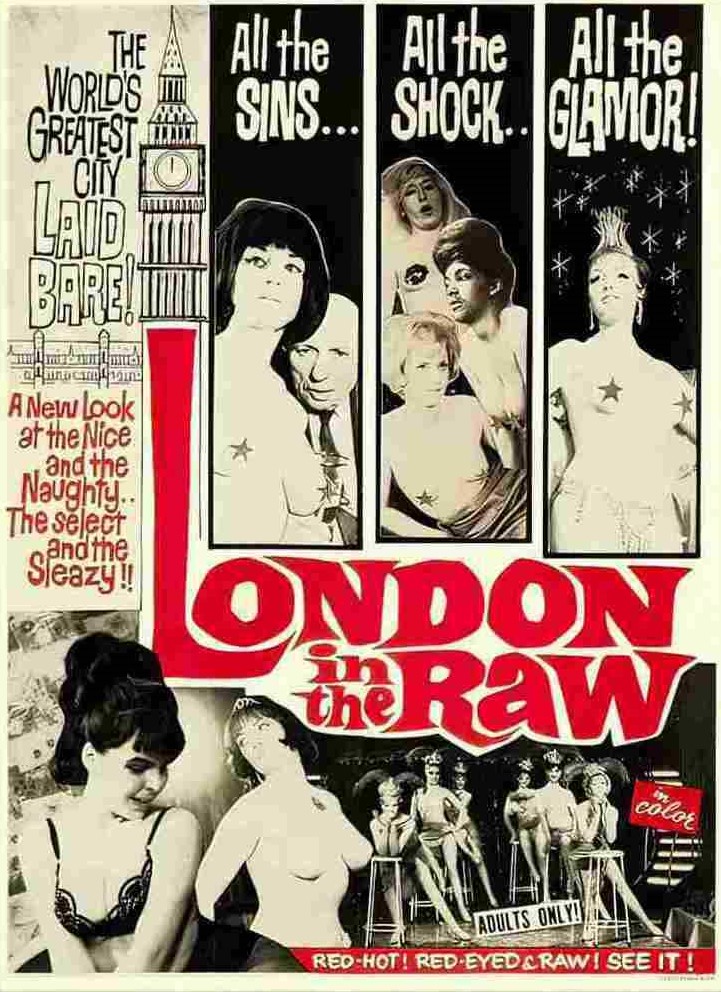
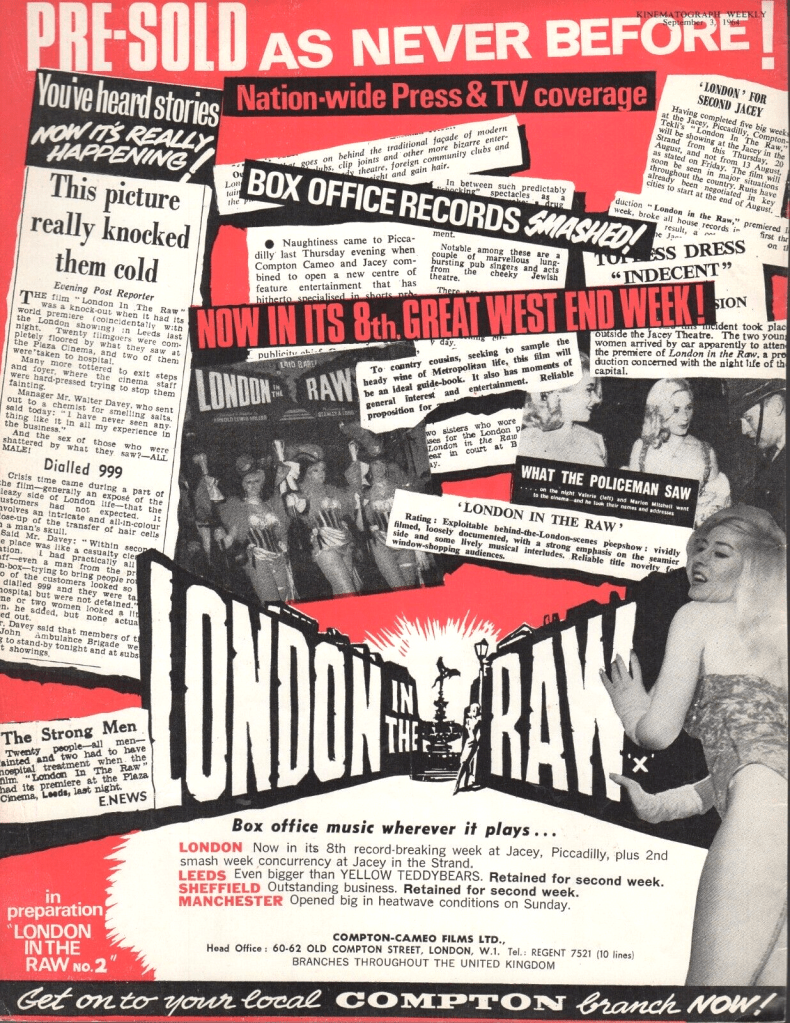
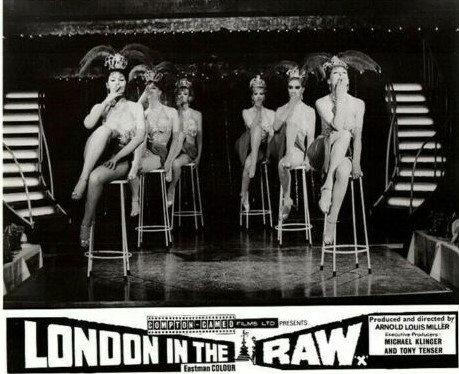
Unexpectedly, documentaries hit a rich box office seam in the 1960s. But these were not the earnest features of the Man of Aran (1934) variety that elated the arthouse crowd or even Disney’s humor-leavened True-Life animal tales. No, documentaries in this decade mainlined the exploitative vein. West End Jungle (1961), Mondo Cane (1962) and London in the Raw (1964) had a very high cost-to-profit ratio.

The London Nobody Knows does not appeal to the prurient. It is a gritty riposte to the Swinging Sixties tourist-bedazzled London of Carnaby St fashion, pop music, red buses, Buckingham Palace and Big Ben. But to lure in an audience the camera intially focuses on the kind of travelogue that purports to show the different side to a well-known locale, before it delves into the terrible poverty which sections of the population could not escape.

Fronted by an actor – unusual then but standard now – in James Mason (Age of Consent, 1969) it begins with a diatribe against the way modern soulless architecture has destroyed significant parts of traditional London, ignoring for the most part that it swept away slums. The actor, bedecked in tweed jacket, polished brown shoes, flat cap and rolled-up umbrella, is in sharp contrast to the often decayed parts of the capital he strolls round.

Initially, what he turns up is almost quiz-question material. A victim of Dr Crippen who had a connection to the abandoned Bedford music hall theatre, home to giants like Marie Lloyd and where artist Walter Sickert was an avid attendee, the backyard in Spitalfield where Jack the Ripper disposed of one of his victims. We visit Clink St, site of a famed prison, which gave its name to “the clink,” and the Roundhouse Theater, originally a  turntable for railway engines. Near the Savoy a man goes through the act of lighting a street gas lamp.

There’s a now-defunct egg-breaking plant, a business that carried out that chore on an enormous scale for chefs, and various bustling markets a-brim with the range of fresh food – eels squirming in their tanks, piles of fruit and vegetables – we only see these days in European or Asian markets. And there’s a look in passing at the type of fashions on parade when people don’t have a personal dresser, strange mixtures of outfits that were all the rage.

And then we come to the grim heart of forgotten London, a land of forgotten people, the homeless or near enough. Homelessness was not the issue it is now. The BBC play Cathy Come Home (1966) made a star out of Carol White, triggering a debate on the issue, highlighted by the formation the same year of homeless charity Shelter. But Cathy Come Home hardly touched the surface and after all it was fronted by a glamorous star.

There’s nothing glamorous about the awful, defeated often toothless faces here. Loss never looked so raw. Some don’t even find a park bench to spend the night but sprawl on the grass or fall asleep standing up leaning against a wall. Nothing so temporary as even a cardboard box available.  

Others eke out a living as buskers – again, not the acceptable occupation it is now – a man dressed in a pirate outfit doing a demented tap dance. Some are not quite homeless, living in a shared dormitory on bunk beds in a Salvation Army hostel for six shillings and sixpence a night (a third of one pound sterling) or if they are flush a private room for 63 shillings a week.

Mention when seeking employment that your abode is the Salvation Army Hostel and you’ll never be offered a job. It’s a stigma. The sole perk here – what with spitting and drinking and gambling outlawed – is breakfast, but comprising porridge or fried egg, tea and two slices of toast, a meager repast by Full English standards.  

The alcoholics drink something blue – methylated spirits probably – but the last vestiges of hope disappeared long ago except for one forlorn aged tramp who aims “to see if I could better myself…in a better way.”

The camera lingers on lived-in faces as though this was not a motion picture but the work of a photographer recording for posterity lives long worn away.

Oddly enough, there’s none of the self-pity that would predominate today. And there’s no blaming either. Circumstances are not investigated, though it’s obvious most took a wrong possibly alcoholic turn in their lives, were once gainfully employed but through unemployment were at the mercy of a system that didn’t yet exist to sustain them through this kind of tribulation.

Irish director Norman Cox had previously worked uncredited on London in the Raw, but the success of his mainstream breakthrough, the movie adaptation of television comedy series Till Death Us Do Part (1968), probably gave him carte blanche to undertake this though nothing else in his later portfolio – Confessions of a Pop Performer (1975), Stand Up Virgin Soldiers (1977) – approached this depth. Geoffrey Fletcher wrote the screenplay based on his own book published in 1965.

Burn, Witch, Burn / Night of the Eagle (1962) ****

That rare event, a piece of cinematic alchemy. None of the principals had any particular form yet it all comes together quite splendidly.

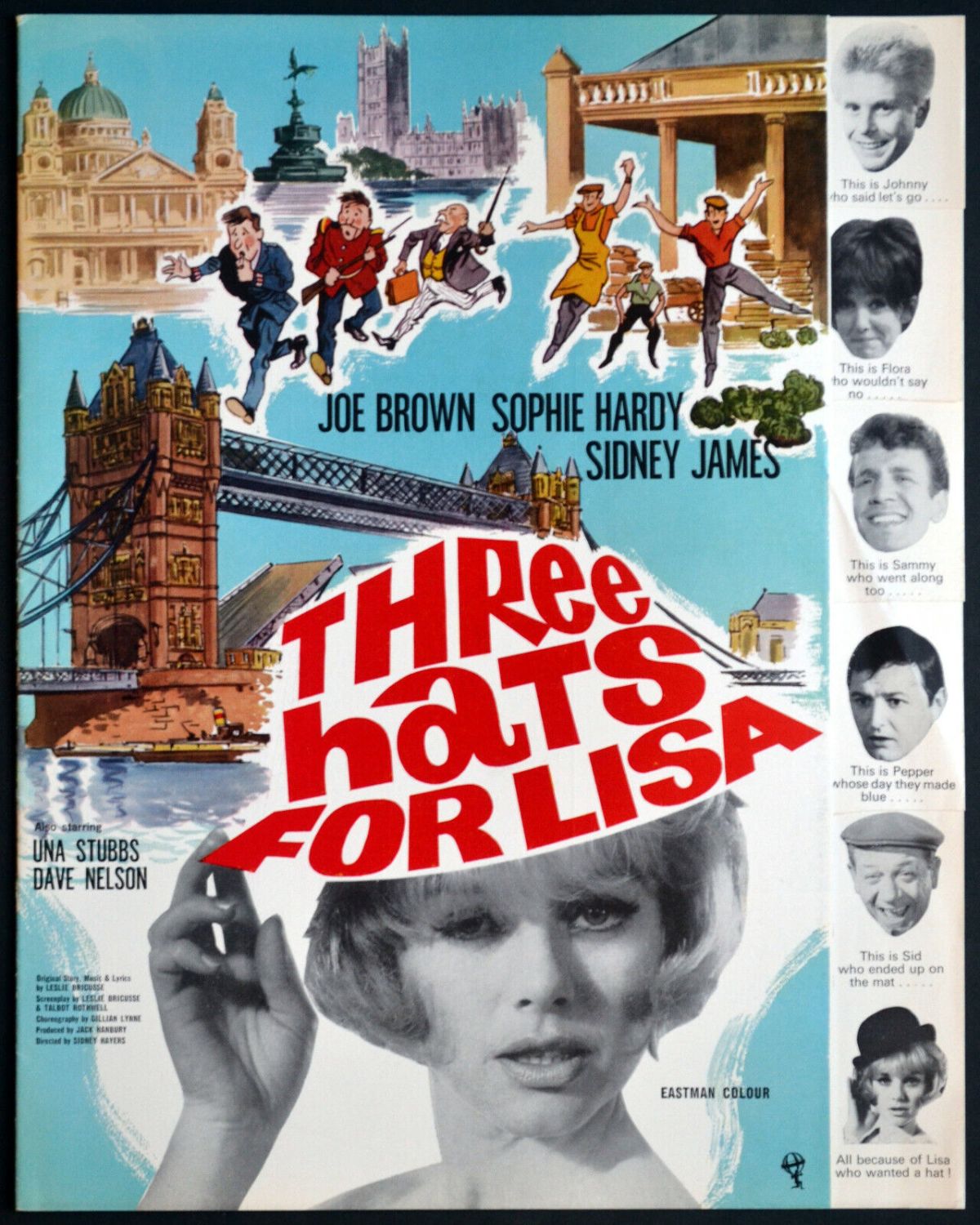
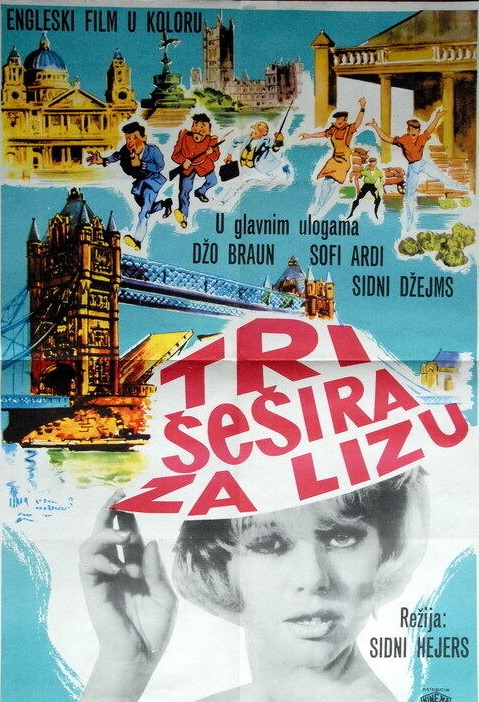
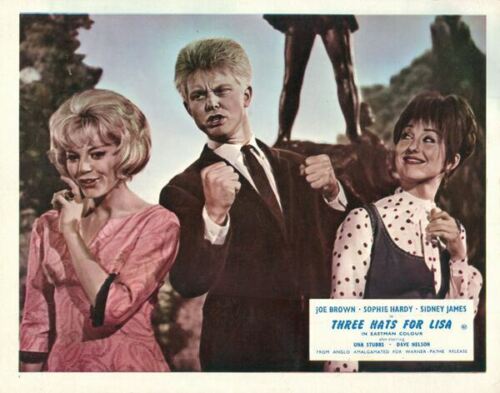
Director Sidney Hayers was a journeyman, for every Circus of Horrors (1960) or Southern Star (1969) there was Cliff Richard vehicle  Finders Keepers (1966) or Three Hats for Lisa (1965) starring pop star Joe Brown. Apart from The Innocents (1961), Peter Wyngarde did not make another movie for nearly two decades and fame eluded him until he grew one of television’s most iconic moustaches for Department S (1969).

Janet Blair was attempting to revive a moribund career that had stopped dead with The Fuller Brush Man (1948). Ditto Margaret Johnston, nothing since Touch and Go (1955).

More prominent names were attached to the script: Richard Matheson had made B-movie waves with The Fall of the House of Usher (1960) and The Pit and the Pendulum (1961) and Charles Beaumont for The Premature Burial (1962). But the script itself, an adaptation of Fritz Lieber Jr.’s novel Conjure, Wife, was not in itself extraordinary.

Instead, it’s a prime example of what a director can bring to material. It begins with credits on one side of the screen and a wide-open eye on the other. Scenes brim with suspense yet often we have no idea what’s going on and with only music to guide us are sucked into a devilish plot. Most of the time Hayers concentrates on eyes, reaction, rather than lengthy scenes of dialog.

The fact that Hollywood ignored the depth of Wyngarde’s performance seems beyond belief. And you might be interested to know it was one of the earliest feminist pictures, the wife in control, acting as protector for the husband.

Norman Taylor (Peter Wyngarde) is a handsome successful college professor in the running for promotion. While he locks horns with lazy pupil Fred (Bill Mitchell), he charms others to the point of infatuation, witness Margaret (Judith Stott). But after a bridge party at their home his wife Tansy (Janet Blair) becomes obsessed with finding something. Upstairs, by accident Norman comes across a dead spider that she claims is a good luck charm from a holiday in Jamaica.

Eventually, while he’s asleep, she finds what she’s looking for, hidden in a lampshade and burns it. Later, a suspicious Norman uncovers all sorts of strange objects. All three scenes of the characters looking are filled with suspense and masterpieces if you like of how to use a camera and hook an audience, no explanation given, just a background of increasingly ominous music.

Confronted, Tansy admits she is a witch, that decision triggered by an incident in which her husband nearly died. Her spells, she claims, have brought him not just good luck, but protected him from bad sorcery, his success not just down to his charm. He insists on burning all her material, including, to her horror, a locket with his picture. And no time is spent, a la The Devil Rides Out (1968), in explaining the intricacies of the occult.

From then on his life turns sour. He is nearly run over by a van. Fred makes a complaint against him and then comes after him with a gun, Margaret claims he raped her. Gradually, Norman, an atheist where the Devil is concerned, believing that neurosis causes the wrong kind of faith, comes to realise he is a victim.

They are both up against someone more powerful. Some of the events have a supernatural tinge – doors that swing open in a storm, Tansy praying to “let me die in his place” – but others appear severe accentuations of the normal, a loudspeaker blaring out his voice from a tape recording over the college grounds, an eagle that hunts him down, big enough (in one astonishing scene) to break through a door, and with a 9ft wing span appearing enormous in a corridor.

The curse plays out to a fabulous end, a tremendous finale, full of human drama, emotions ripped apart, confrontation, Norman’s failed schemes to save his wife.

To say I was mesmerised was an under-statement. Just a brilliantly-done little picture with cracking direction and excellent acting all round.

Not only is the picture ripe for reassessment you would have thought it was well worth a remake.

The Wonderful World of the Brothers Grimm (1963) *** – Seen at the Cinerama

With Hollywood already snagging the best characters of the Grimm inventory – Snow White, Cinderella, The Sleeping Beauty and Tom Thumb – and others like Rumpelstiltskin not deemed cute enough, George Pal (The Time Machine, 1960) had a battle on his hands to come up with a decent enough second string. Spurning for no obvious reason contenders like Hansel and Gretel and The Frog Prince, he plumped for a strange hybrid.

He incorporated three fairy stories – The Dancing Princess, The Elves and the Shoemaker and The Singing Bone – in a drama about the authors. Both sides of this tale had a common background, 19th century Germany with its rich vein of fairy castles and cobbled streets where kings ruled. The Grimms are posited as wannabe writers but with warring personalities.

Unmarried Jacob (Karl Boehm) wants to stick to the knitting and complete the work, a biography of the Duke (Oscar Homolka), they are being paid for while married Wilhelm (Laurence Harvey) prefers to use that time instead to write down the stories he has collected from a variety of sources.

The stories Pal chooses to bring to life pop into the narrative by the simple devices of telling kids a bedtime story or overhearing the tale. Jacob is actually more interested in academic writing; books on law and grammar are what capture his imagination. The narrative switches between the brothers falling out, enduring poverty and Jacob falling in love with Greta (Barbara Eden) but lacking the romantic touch mostly making heavy weather of it.

The first tale in the triptych – The Dancing Princess – is simple enough. A King (Jim Backus) promises the hand of his daughter (Yvette Mimieux) in marriage to whoever can find out what she does at night which a humble woodsman (Russ Tamblyn) manages with the help of a cloak that makes him disappear. In the second story elves come to life to save the skin of a shoemaker more interested in helping orphans than his rich clients.  

The third, demanding the biggest special effects, less successfully translates to the screen since it involves the creation of a dragon to be slaughtered. However, it is saved by humor, since the knight (Terry-Thomas) is too cowardly to do the job and relies on servant Hans (Buddy Hackett) for the actual slaying, and by the most gruesome of endings.

Plus, since it is in Cinerama, something speeding is required seen from the audience point-of-view or a hero who could fall into a canyon. And in the best fairy tale tradition the heroes are unsung and under pressure.

Laurence Harvey (A Dandy in Aspic, 1968), Karl Boehm (The Venetian Affair, 1966) , Claire Bloom (Two Into Three Won’t Go, 1969) and Barbara Eden (I Dream of Jeannie television series, 1965-1970) are just about buoyant enough to keep the main story ticking along and carve out a piece of Disney territory without so much as a decent song to help proceedings. Three unexpected twists – four if you count a miraculous recovery from serious illness – nudge this in unexpected directions.

The first is the solidity of brotherly love, with one having to choose wife over his close bond with his sibling – the kind of emotional hit that would be more common in an adult picture, though kids obviously couldn’t care less. The second is the appearance of virtually all the famous Grimm characters in what amounts to a cameo. Last is a proper fairy tale ending where it’s the kids who elevate the brothers to literary success.

Laurence Harvey hides his snide side and does his best Dirk Bogarde impression as the errant brother whose imagination brings his family to near-ruin. Despite being offered love on a plate, Karl Boehm remains steadfastly dour, while Claire Bloom as Wilhelm’s wife has little to do. Scene stealing honors go to Oscar Homolka (The Happening, 1967) while Terry-Thomas (How to Murder Your Wife, 1965) just about shades it in the comedic duel with Buddy Hackett (The Love Bug, 1968).

George Pal concentrated on the fantasy elements with Henry Levin (Genghis Khan, 1965) directing the drama so it’s a mixture of very grounded and very flighty. It’s not really long enough for a true Cinerama roadshow movie but with an overture and intermission it stretches enough.

It was filmed with the traditional three Cinerama lenses and would have been projected with three projectors but at the Bradford Widescreen Weekend  I saw a new restoration that does away with the vertical lines. For contemporary audiences who only view fairy stories through the microcosm of animation and for whom live-action means Ray Harryhausen, the special effects here will come as something of a disappointment. But on the other hand it is still George Pal, so enjoy.

William Roberts (The Magnificent Seven, 1960), Charles Beaumont (Mister Moses, 1965) and David P. Harmon (Dark Purpose, 1964) cobbled up the screenplay.

As I said I saw this in the magnificence of the big screen and in widescreen Cinerama to boot so I am bound to be a shade benevolent but this still holds up, the drama dramatic enough, as a biopic interesting, and kids who might be taken with the fairy stories are way too young to complain about the effects.

Circus World / The Magnificent Showman (1963) **** – Seen at the Cinema

Bookended by disaster – a ship turning turtle, fire raging in the big tent – and kept aloft by giddy circus turns this long-ignored movie in the John Wayne canon is ripe for reassessment. In more down-to-earth mold, with no villains to rein in, no gun-toting required, this calls upon something more basic from the actor, the dramatic skill required to make the audience fix on a strong character within a spectacular screen event.

Presented in stunning Super Technirama, the swansong of maverick producer Samuel Bronston (El Cid, 1961), and mistakenly viewed as little more than a travelog or a compendium of circus acts, this dwells instead on transition and loss as Matt Masters (John Wayne) struggles to allow adopted daughter Toni (Claudia Cardinale) to grow up and to come to terms with the part he played in the romantic calamity – father a high-wire suicide, acrobatic mother Lili (Rita Hayworth) fleeing to Europe – that left her parentless.  

It’s no coincidence that sending his three-ring circus cum Wild West Show on a lucrative tour of Europe in the early part of the 20th century provides an opportunity to hunt for Lili, the love of his life. But the circus ship capsizes in Barcelona, leaving Masters penniless, forced to  work for a rival European promoter until he can scrape together enough dough to start again. Masters uses the opportunity of traveling through European capitals to scout new acts, including clown Aldo (Richard Conte), a lion-tamer turned tiger-tamer Emile (Hans Dante), and ballerina Katharyna (Giovana) who performs on the high wire while Toni wants to chance her arm against Matt’s objections as an acrobat and flex her romantic muscles in romantic dalliance with Matt’s new partner Steve (John Smith).

The subplots add dramatic heft, the lion-tamer is frightened of tigers, Aldo has vengeance in mind, so in between the scintillating circus acts the storyline is compressed around the drink- and guilt-sodden Lili and conflict on several fronts with Toni while old retainer Cap (Lloyd Nolan) is on hand to pep up or challenge Matt.

You wouldn’t be allowed to make this kind of film these days so it’s worth glorying in the glory days of the circus – dancing horses, lions, tigers, elephants, acrobats and genuinely hilarious clown sequences. It being a three-ring circus there’s always something going on, plus the Wild West element which comprises a stagecoach being attacked.

John Wayne is as befuddled as ever in romance, restricting his trademark double take to astonishment at Tony’s transition to womanhood. There’s an occasional reversal but mostly  it’s a battle against the odds, potential triumph leavened by gritty loss.

A modern producer would have switched the disasters – it didn’t really matter how Matt got into a fix. But the capsizing, appearing so early the effect is stunning, is brilliantly handled, not just the rescue of people and animals but Matt in lion-taming mode and ending with a clever coda. In every photograph Lili’s face has been scratched out but in among the saturated notes of Matt’s vital cash box is a picture of her.

Some critics have suggested John Wayne (In Harm’s Way, 1965), recovering from his own financial debacle caused by over-investment in The Alamo (1960), took the role for financial expediency. But I can see the attraction, as I’m sure the actor did. This is a far more rounded character than anything since The Searchers (1956) and he can’t even find redemption from a six-shooter. He’s more protective than aggressive, paternal instinct triggering character reaction, and it’s more of a James Stewart type of role, coming back from adversity, and nothing straightforward about a man whose love affair caused marital disaster.

Critics have also taken pot-shots at Claudia Cardinale (The Pink Panther, 1963) as if she was not already an accomplished actress (a favorite of Visconti, for example) in a compelling role and competing on even terms with a star of John Wayne’s charisma without being able to fall back on the old saw of the romantic interest. Although playing a character nearly a decade younger, Cardinale  brings an earthy feistiness to a character with a bucket of decisions to make, turning on its head her relationship with Matt and going through the dramatic hoops with Lili.

Rita Hayworth (The Happy Thieves, 1961) has shucked off the glamor, a worn-down relic of her former self, turning to drink and religion in equal measure in vain hope of finding peace. Veteran Lloyd Nolan (The Double Man, 1967) and Richard Conte (Assault on a Queen, 1966) hold their own, but John Smith (Waco, 1966) does not. Look out for former British star Kay Walsh (A Study in Terror, 1965).  

Henry Hathaway (5 Card Stud, 1968) does a terrific job marshalling all the elements, containing the core family drama within the wider action-oriented structure. While there’s never a dull moment, in among all the spectacular scenes are some exhibiting a particularly sensitive directorial touch such as when Matt discovers Lili’s hotel room and reflects on his own misdemeanors.

There were almost as many writers as circus performers – James Edward Grant (The Commancheros, 1961), Ben Hecht (Spellbound, 1945), Julian Zimet (A Place for Lovers, 1968), Bernard Gordon (55 Days at Peking, 1963), Nicholas Ray (The Savage Innocents, 1960) and Philip Yordan (El Cid).

Come at it from the fun perspective and you won’t go wrong. John Wayne completists will adore it.

I was lucky enough to see this is full glorious widescreen at the cinema where it was the Closing Film at this year’s  Widescreen Weekend in Bradford. What a way to end a show!

Madigan (1968) ****

Reignited the careers of director Don Siegel (no Hollywood traction since Hell Is For Heroes in 1962), Richard Widmark (reduced to supporting roles) and Henry Fonda (no longer first name on the team sheet for the biggest pictures) and reinvented the cop thriller as a gritty urban affair. The plot – chasing down a suspect – is a MacGuffin to explore tough police methods, corruption, and the harm the job does to the domestic lives of the police.

Detective Dan Madigan (Richard Widmark) and partner Rocco Bonero (Harry Guardino) come woefully and embarrassingly unstuck when hood Benesch (Steve Ihnat) evades capture and steals their guns. They have 72 hours to bring him back or be suspended. So, basically, they spend most of the time following a bunch of leads, intimidating anyone who gets in their way, including a helpless secretary. And while Bonero is happily domesticated, Madigan’s lonely wife Julia (Inger Stevens) is fed up with late nights and broken promises to the extent of considering a one-night stand when hubby stands her up once too often.  

Commissioner Russell (Henry Fonda) has his hands full dealing with the errant detectives  without the ramifications of corruption involving his best friend, long-time cop Chief Inspector Kane (James Whitmore). The widowed Russell would be a poster-boy for the principled cop except he’s having an affair with married woman Tricia (Susan Clark).

While Madigan is kicking and snarling his way through the underworld, Russell is trying to work out how to save his friendship and his affair. And while they might appear opposites, the classy top officer and the street cop, the uptight Russell envies Madigan’s way with people. Madigan is comped drinks and even a suite at the Sherry-Netherland hotel not merely because he’s a cop but because his charm goes a long way.

And while Russell dithers over helping out a friend, Madigan has no qualms about being taking for a ride by an old pal down on his luck and in need of an excuse to be bought a drink. When it comes down to it, Madigan is the better advert for humanity.

The soap opera elements don’t intrude too much on the thriller. Madigan and Bonero go in with fists blazing and work their way through a menagerie of skunks including Castiglione (Michael Dunn) and stool pigeon Hughie (Don Stroud). Benesch is a piece of work, not just clever enough to use his lover’s nudity to distract the attention of cops, but sufficiently hard-boiled to shoot a cop dead in the street and have little hesitation in opening fire on anyone who comes too close.

There’s some fascinating internal cop politics as Kane locks horns with Chief of Detectives Lynch (Bert Freed) over the latter’s insistence on suspending Madigan. And Russell has to finagle his way through the problems a well-heeled son is causing a rich doctor (Raymond Jacques).

Every time the pace slackens, the movie falls back on the old Chandler routine, have someone come through the door with a gun (a fist would suffice). Madigan is a driven cop, struggling to hold onto his marriage, Julia too often the sacrificial lamb. And for all his outward bravado, there’s a superb scene when unexpectedly encountering Russell he turns into a stammering ball of nerves, like a schoolkid anticipating a roasting from a headmaster.

Richard Widmark (The Bedford Incident, 1964) has a hell of a part, tough guy, check, but with a side helping of kindness, and pretty assured on the loving front, investing what could have been a fairly cliched character with a good deal of complexity. Henry Fonda (Firecreek, 1968) does a lot of pacing as his self-esteem implodes; how can he be a good guy if he’s running around with another man’s wife and how can he stick to his principles if he’s going to let a pal away with corruption?

Inger Stevens (Firecreek, 1968) is impressive as the disappointed wife trying to keep disappointment at bay. Harry Guardino (Hell Is For Heroes) always makes a good sidekick, but James Whitmore (The Split, 1968) digs into a sack of guilt as he attempts to avoid the oncoming storm. Don Stroud was almost auditioning for Don Siegel – he would turn up again in Coogan’s Bluff (1968) and Joe Kidd (1973); Susan Clark, too, Eastwood’s squeeze in Coogan’s Bluff. In smaller parts are Sheree North (Lawman, 1971) and Raymond St Jacques (Uptight, 1968).

But the show belongs to Don Seigel. There can be few directors so out-of-favor that they are able on their return to kick start a new cop cycle that culminated in Dirty Harry (1971). While this pulls no punches on the action front, it’s the quieter behind-the-scenes domesticity that almost as much catches the eye, the way he gives the characters time to breathe, opens them up to reveal more intricate inner workings.

It also spelled rebirth for blacklisted screenwriter Abraham Polonsky (Tell Them Willie Boy Is Here, 1969) in his first credit under his own name for 17 years. He didn’t do it all himself, though, Howard Rodman (Coogan’s Bluff) sharing the chores, the pair working from the novel The Commissioner by Richard Dougherty.

Discover WordPress

A daily selection of the best content published on WordPress, collected for you by humans who love to read.

The Atavist Magazine

by Brian Hannan

WordPress.com News

The latest news on WordPress.com and the WordPress community.