Anyone breaking into the private eye market in the late 1960s had to content not only with the ghost of Humphrey Bogart but a heavyweight slugger name of Harper (1966) whom Paul Newman had fashioned into the most likely contender for the Bogart crown. Ironically, it was growing interest in Bogart that spurred on an imitator. His movies, screened two hundred times a year on television, created an initial cult following, his persona maximized to the full by the reissue on the tenth anniversary of his death of 45 of his pictures plus the half-dozen biographies that appeared in a three-month stretch.
As it happened a couple of Raymond Chandler novels, The Little Sister and The Long Goodbye never before filmed and theoretically at least avoiding comparison with the past, were up for grabs. The Little Sister was the chosen vehicle. But, anyone chancing their arm in the role of Philip Marlowe was likely to be met with jibes of “he’s no Humphrey Bogart.”
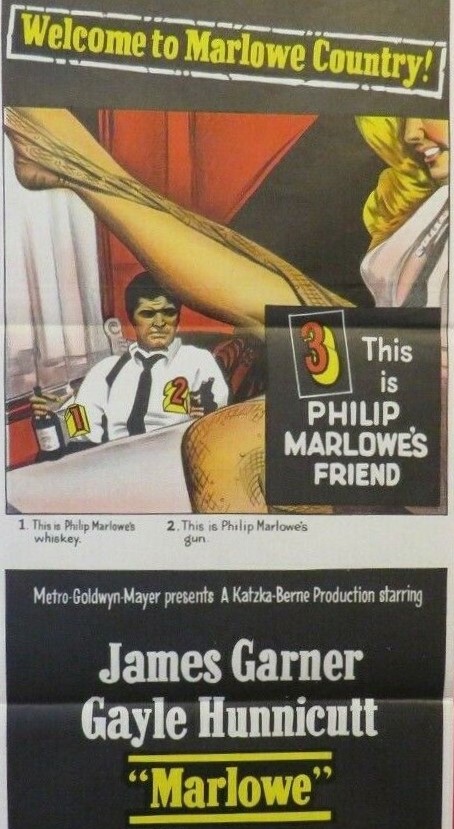
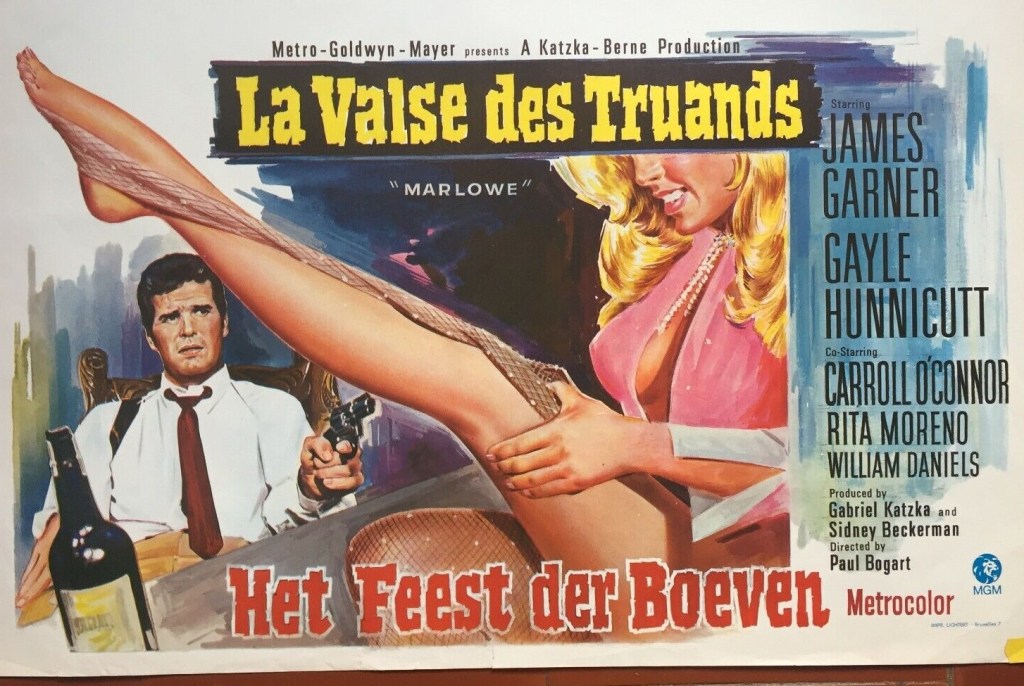
That’s not the only problem here. The story is awfully convoluted, it’s been updated to a modern Los Angeles complete with hippies and gym work-outs and screenwriter Stirling Silliphant has chucked away the bulk of the original dialog. So, little remains of what made the character compulsive viewing in the first place.
Marlowe (James Garner) is investigating the disappearance of the brother of Orfamay Quest (Sharon Farrell), a young woman from Kansas, when he stumbles upon a couple of ice-pick murders and a pack of incriminating photos that depict television sit-com star Mavis Weld (Gayle Hunnicutt) – no slouch herself at knocking people out – in a compromising situation with top-line gangster Sonny Steelgrave (H.M. Wynant) whose speciality had been killing people with an ice-pick. So it’s a murder/blackmail double whammy.
The plot thickens when Winslow Wong (Bruce Lee) tries to pay him off and when that fails wrecks his office by demonstrating the kung fu skills that would later make that actor a star. Detective Lt French (Carroll O’Connor) is the typical dumb cop that Marlowe runs rings round. Also entering the fray is exotic dancer Dolores (Rita Moreno), a friend of Mavis, and to liven things up for the gumshoe a girlfriend Julie (Corinne Camacho) who has some nifty one-liners when Ofamay attempts to seduce her boyfriend. And there’s any number of Steelgrave’s thugs who make any number of attempts to scare Marlow off.
Eventually, after being drugged by Dr Vincent Lagardie, Marlowe finds the missing brother, Orrin, who, while dying, attempts to kill the detective with an ice-pick. Assuming that clears up both cases, Marlowe then discovers that Orrin, Mavis and Orfamay are siblings.
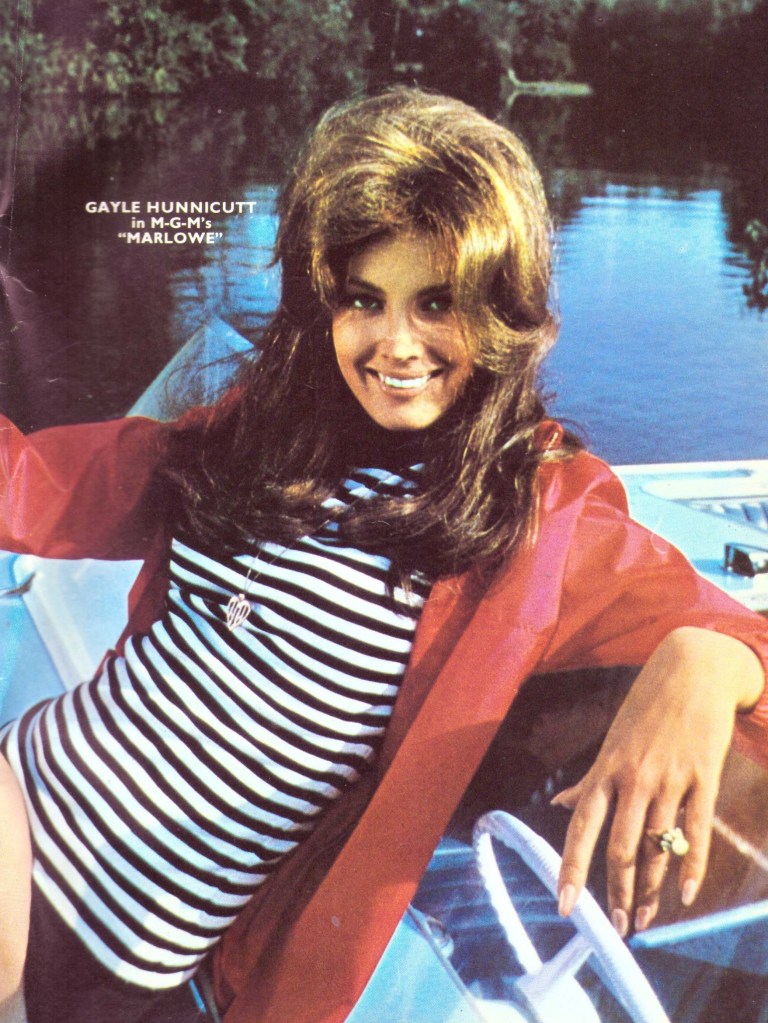
Hunnicutt is given the pin-up treatment in ABC Film Review.
But the tale still has some way to go, uncovering a hornet’s nest of spite and revenge among the warring siblings. There’s way too cute an ending though whether that was Silliphant’s invention or the tack taken by Chandler I have little interest in finding out, exhausted as I am by a seemingly endless series of twists and turns.
I’m not exactly sure what’s missing from this except a femme fatale – Mavis makes no moves on Marlowe, though her sister, who hardly qualifies as a femme fatale, does. It’s unfair in a sense to complain that it’s not following the Chandler template when so much effort has gone in to trying to initiate something new. If it had been called anything else, or the name Marlowe substituted by Smith, then we wouldn’t be thinking so much of the source material or the imitable Bogart.
Confusingly, there is a Bogart involved, director Paul Bogart (The Three Sisters, 1966 – from the Checkov play and no relation to The Little Sister) and although he keeps the plot ticking along – who wouldn’t with so much plot to tick – that’s pretty much all he does, in the cold light of Los Angeles hardly able to emulate the film noir setting.
So, effectively, it’s up to James Garner (Mister Buddwing, 1966) to pull the whole movie together, or put another way, keep it from falling apart. Audiences, much taken with the actor’s reinvention of his screen persona in his previous picture, comedy western Support Your Local Sherrif (1969), didn’t bring sufficient box office support. Garner is okay but sorry to say he’s no Bogart.
Rita Moreno (Night of the Following Day, 1969) is the pick of the supporting cast. Gayle Hunnicutt (Eye of the Cat, 1969), given the type of billing that elevated Lauren Bacall to super-stardom, doesn’t do enough to achieve the same. Interestingly, both Garner and Hunnicutt went down the shamus route in television in the future, the former in The Rockford Files (1974-1980), the latter in an episode of Philip Marlowe, Private Eye (1983).
If you’re a fan of Garner a reasonable watch. If you’re a fan of Chandler or Bogart you’d be inclined to give it a miss.
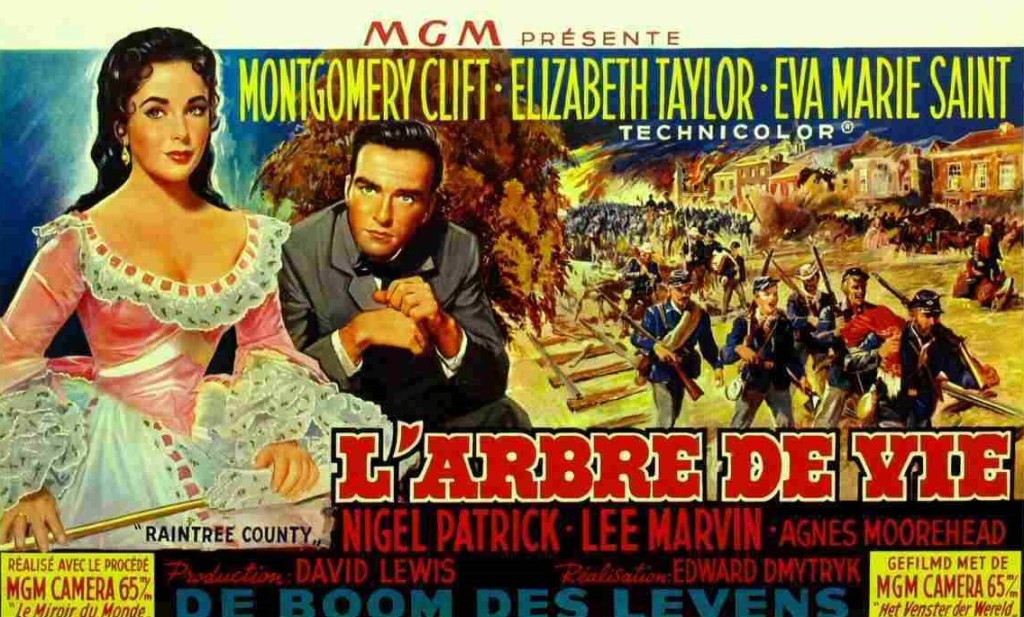
Much-maligned melodrama. No more episodic over a three-hour running time than Ben-Hur (1959) or Doctor Zhivago (1965) and though bookended by the American Civil War has less grandiose views on history. Part of the problem is that, faced with such length, critics expected something with greater depth rather than just ordinary people caught up in circumstance. As if a stunning treatment of madness was not enough, inside the warring mind of a beautiful woman, whose realisation of her condition sets her on the road to tragedy. But it is riddled throughout by an element of fantasy, the fabled “rain tree” with golden leaves triggers a moment of madness in all who seek to find it in the swamps.
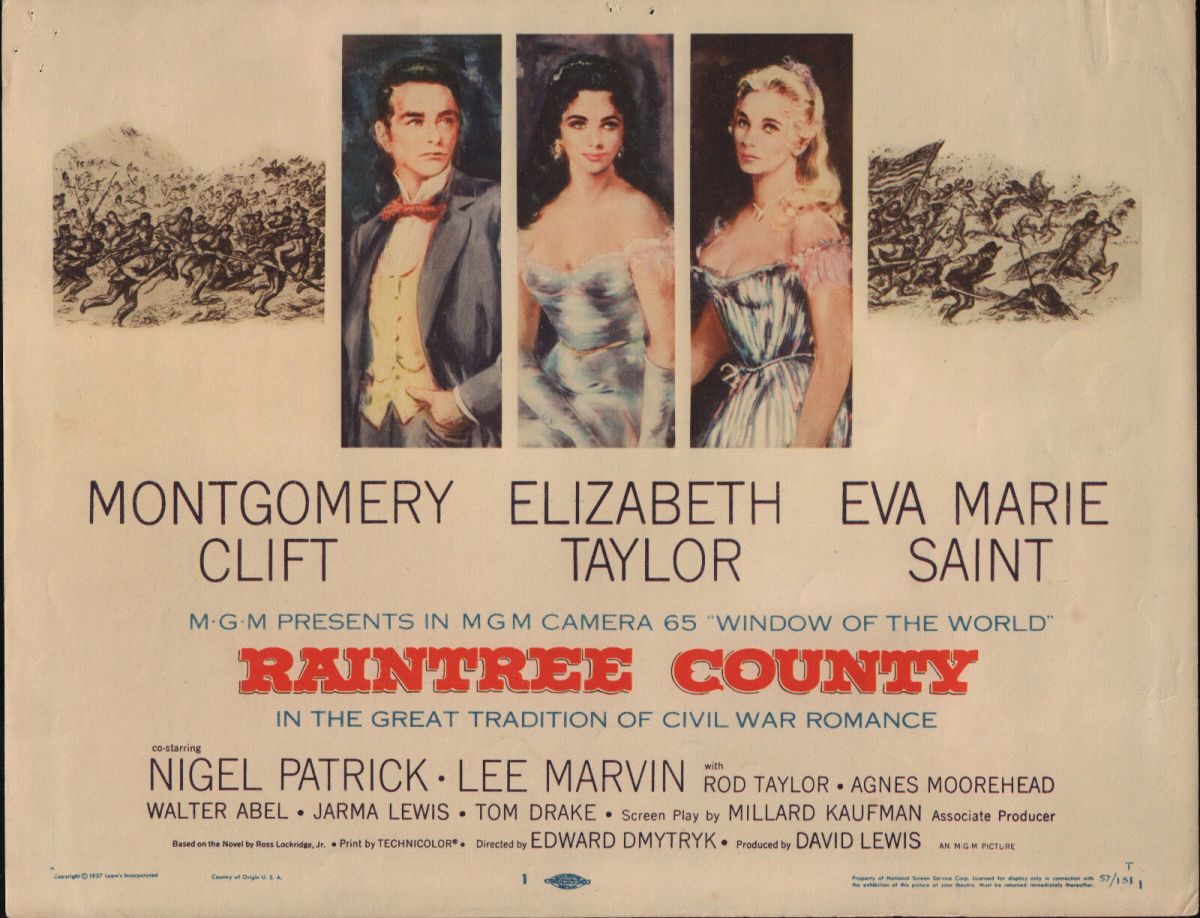
Like Zhivago, the narrative arc is a love triangle between principled teacher John Shawnessy (Montgomery Clift), southern belle Susana (Elizabeth Taylor) and reporter Nell (Eva Marie Saint). Sub-plots involved drunken gregarious Flash (Lee Marvin), bumptious Garwood (Rod Taylor) and the charming adulterous Professor (Nigel Patrick). The characters intertwine at various points and John, Flash and the Professor come together during the war while Garwood tries to make political capital out of it afterwards.
John and Nell have known each other since childhood, but there’s no real sense that they are childhood sweethearts. If they have passion for each other, it’s well hidden, and when Susana turns up, she steals him away, in part by the ruse of pregnancy. Despite her incipient madness, perhaps because of it, John sticking by her no matter what, there’s grand passion in full view. But the best scenes are Susana talking not about her condition, but what she believes to be true and her fears that her truth may be false. She lies, for example, about her age when a fire killed her father and his lover. She leaves her husband a note that she discovers she has never written. Her confusion at the depth of her illness, fear that she might have inherit the genes of her mother (also insane), is very touching.
She also does one thing that smacks of “Hollywood madness,” the crazy action that is shorthand for insanity, but within the twisted confines of her mind that is out of love for John. She has a dark secret about her role in the events surrounding the fire. But she overcomes her innate racism out of love for him, prior to the war freeing her slaves. She clings to John because she knows he is the one route out of her madness.
Audiences wouldn’t buy a three-hour picture about madness. You might perceive the other episodes as mere filler, and in some senses that’s true, but the episodes in themselves are quite entertaining and revealing. Though told the “rain tree” is a local myth, a kind of “holy grail”, John is the only character who tries to find it, out of idealism or insanity who knows, and nearly drowns as a result. Flash has come by his nickname for his running exploits and is challenged to a race by John and the otherwise outwardly idealistic Professor, a gambler, tries to influence the outcome.
Though a stranger in town Susana (“I’ll arrange it”) positions herself to place the garland of victory upon his head. When the Professor tries to make off with another man’s wife, John’s skills with a bullwhip prevent him getting shot. Although John’s mother and Nell push him towards politics, Susana leaves him be, recognizing the joy and fulfilment he gets from teaching.
The war is primarily viewed through the perspective of the Professor, a non-combatant who has found himself a job as a war correspondent, making wry comment as he illustrates various battles. By the end of it, soldiers on both sides are weary of the slaughter.
This was intended as one of the first roadshows, MGM’s initial attempt at incorporating its innovative widescreen process Camera 65 (meaning 65mm – the other 5mm in the more common 70mm taken up with the sound strip) that was later used to tremendous effect on Ben-Hur. And while this lacks the scope or action sequences of the Biblical epic, it looks just sumptuous on the wide screen.
Director Edward Dmytryk (Mirage, 1965) has a keen compositional eye and he also favors actors over showing off his directorial skills. But there are exceptional scenes from the directorial perspective. In one the camera remains fixed on Montgomery Clift at the side of the screen while in the background Lee Marvin is creating havoc. In another we follow a female warden as she unlocks door after door in an asylum before Montgomery Clift is led to Elizabeth Taylor.
The acting is superb, Elizabeth Taylor was nominated for an Oscar and might well have won except Joanne Woodward was playing a character with a split personality in The Three Faces of Eve. But it was a bold role for a young star like Taylor, and a tremendous piece of casting. As much as she uses words to try to explain or understand herself, when the camera cuts to her face you can see the terror in her eyes.
Clift had disfigured his face during an accident during shooting and that clearly physically affected his performance. Eva Marie Saint (36 Hours, 1964) is very effective as the rejected lover. Lee Marvin (Point Blank, 1967) takes the showboating approach to his role while Rod Taylor (Chuka, 1967) is not above some scene-stealing himself. But then both are competing with the over-the-top Nigel Patrick (The Battle of Britain, 1969). Millard Kaufman (The War Lord, 1965) wrote the screenplay from the Ross Lockridge Jr. bestseller.
The kind of film to immerse yourself in the performances and let the running time take care of itself.
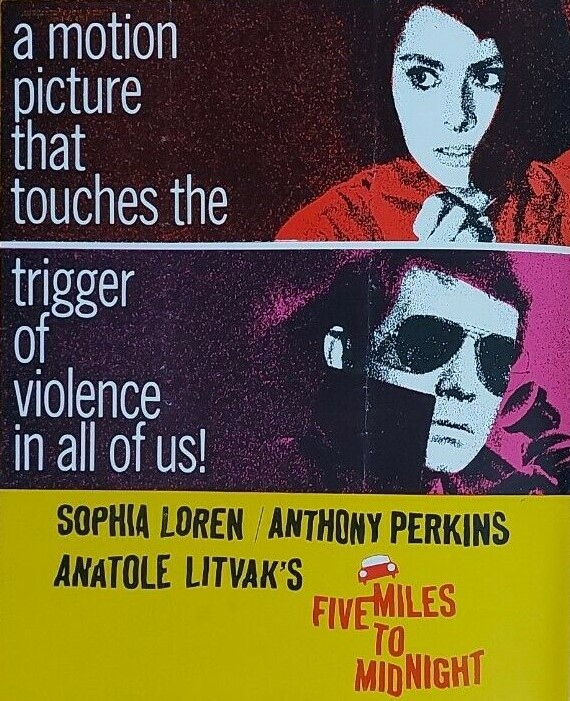
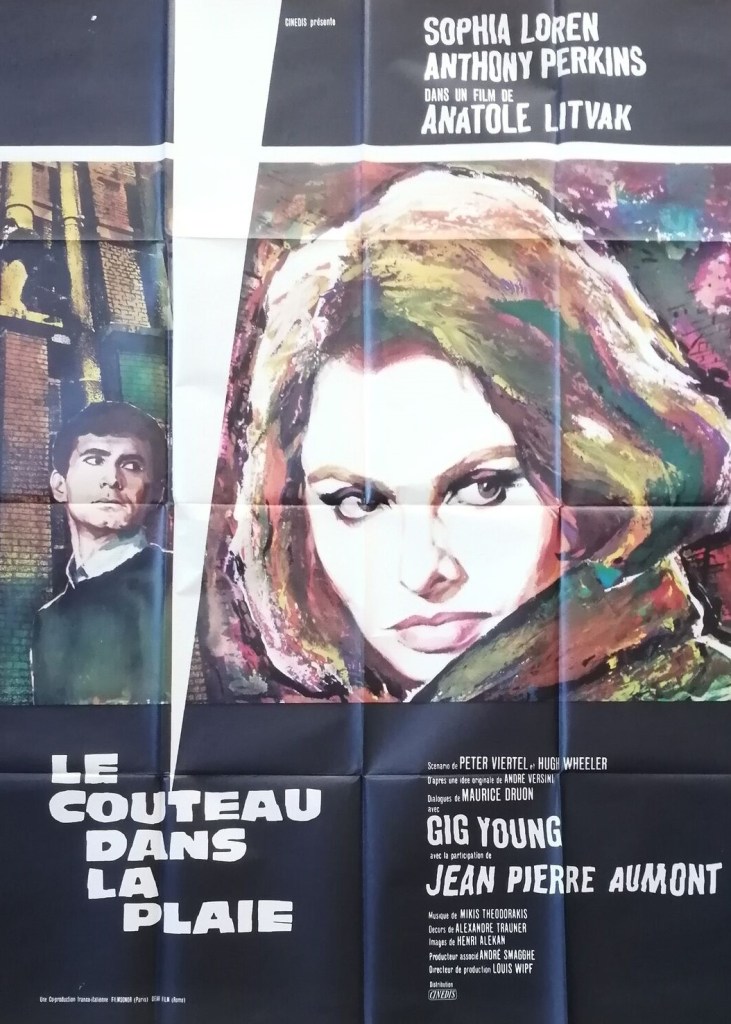
Superb performance by Sophia Loren (Arabesque, 1966) lifts taut Parisian-set thriller into outstanding class. Forced, of narrative necessity, to keep a lid on her emotions, Loren’s eyes betray her feelings. Director Anatole Litvak’s (Lady in the Car with Glasses and a Gun, 1970) camera is relentless, trapping her with almost claustrophobic compulsion, allowing little release, preventing her escaping the eye of truth.
Husband Robert (Anthony Perkins) and wife Lisa (Sophia Loren) embark on major insurance fraud. He’s the instigator, she reluctantly goes along with the plan as she imagines that, with their unlikely marriage already teetering, it will buy her freedom. Robert, sole survivor of a plane crash, rather than announcing he is alive, uses his death to scam the insurance company out of $120,000 (equivalent to $1.2 million today).
Given he is deceased, she has to carry out the formalities of making the claim, dealing with the various authorities, including police and the American consulate. Meanwhile, hiding out, every knock on the door or ring of the telephone creates panic. At various points Robert has to hide in every room in the apartment – remembering to remove any sign of his existence – and on the stairwell and when that proves too dangerous on the roof.
Little things that could give him away. The extra plate or glass could trigger suspicion from the cleaner. Lisa, a non-smoker, has to purchase cigarettes for Robert, the remains of an ashtray a possible reveal. She returns to work much faster than you would expect of a grieving widow.
She attracts an initially unwelcome suitor, David (Gig Young), a doctor, a friend of a friend. Workmates turn up at inopportune moments. A boy in an apartment opposite spots the recluse, at one point, shining a mirror into Robert’s eyes, dazzling him as he hides, precariously, on the roof. A cat, too, threatens to reveal the voluntarily imprisoned man.
You might wonder how why she married the financially dissolute Robert in the first place, more baby than man, a “charming octopus” whose needs would strangle the life out of a wife. He was her meal ticket from post-war Naples. She was so desperate to escape poverty that she would, as Robert acidly (and truthfully) puts it, that she would have gone off with any fellow with “a couple of bucks in his pocket.”
In Britain it was released on the lower part of a double bill to “Taras Bulba.”
He suspects she has a lover. And from random clues in the apartment, David also suspects she has a lover. But mostly it’s nail-biting waiting. And when her nerves are so shredded she is inclined to confess all to the police, and be rid of her husband, she realises she would be jailed as his accomplice. And though going along with the notion that the money will buy both their (separate) freedom, the devious Robert has no intention of letting her go, intending to blackmail her into remaining with him.
As the stakes rise we enter a frankly magnificent endgame, with one twist after another, Lisa barely coherent from overwhelming pressure even as freedom beckons.
It’s splendidly done, chock full of surprises, from the opening credits to the last intense close-up of Lisa. The credit sequence, a long tracking shot following a pair of legs from a bus to a nigh club, jaunty jazz in the background, Lisa exuberantly dancing the Twist, ends in an explosive slap. Where are obstructive insurance agents, the kind that automatically challenge every claim, hoping to whittle down the amount, when you need them? This one couldn’t be more helpful, even easing the path, when she had counted on the opposite in order to scupper the outrageous plan, to getting a death certificate out of the American consulate. It turns out you can easily dupe the police by simply denying that a coat found near the location of the crash does not belong to Robert.
The focus is kept almost evenly on the culprits. Awful husband that he is, Robert’s little-boy-lost persona still extracts audience sympathy – she is a deceiver after all, conning him into marriage, lover on the side – especially as you know that, even though this never occurs to Lisa, that capturing Robert will result in her imprisonment. But Robert already lives on the emotional edge and there’s one terrifying scene where he is clearly tempted to throw the small boy off the roof.
Even when Lisa believes she has found sanctuary in David, his suspicions threaten that. I won’t spoil the endgame for you because it is exceptional, very well worked in terms of action and emotion.
This didn’t get much attention when it appeared despite Loren’s stunning performance, perhaps because insurance fraud suggests little of the inherent tension of a heist. Anthony Perkins, desperately trying to avoid the typecasting triggered by Psycho (1960), successfully develops a more attractive screen persona that would climax in Pretty Poison (1968). Given the set-up, you imagine that the eternally charming Gig Young (They Shoot Horses, Don’t They, 1969) will turn out to be an undercover insurance agent. Even when that is obviously not the case, he is too inquisitive for Lisa’s good.
In contrast to the claustrophobic tension, the movie plays out against the backdrop of fun-filled parties, dancing, nightclubs, cocktails, the high life.
At this point Anatole Litvak was rarely mentioned in dispatches, critics considering his best films (The Snake Pit, 1948, for example) way behind him and that he was more likely to helm lumbering well-meaning vehicles like The Journey (1959). But, opening credits and a couple of scenes making using of perilous shadow apart, he is primarily an actor’s director. And when he gives a star of the skill of Sophia Loren such leeway, the script not permitting her self-justification, he is truly rewarded.
Superb performance by Sophia Loren (Arabesque, 1966) lifts taut Parisian-set thriller into outstanding class. Forced, of narrative necessity, to keep a lid on her emotions, Loren’s eyes betray her feelings. Director Anatole Litvak’s (Lady in the Car with Glasses and a Gun, 1970) camera is relentless, trapping her with almost claustrophobic compulsion, allowing little release, preventing her escaping the eye of truth.
Husband Robert (Anthony Perkins) and wife Lisa (Sophia Loren) embark on major insurance fraud. He’s the instigator, she reluctantly goes along with the plan as she imagines that, with their unlikely marriage already teetering, it will buy her freedom. Robert, sole survivor of a plane crash, rather than announcing he is alive, uses his death to scam the insurance company out of $120,000 (equivalent to $1.2 million today).
Given he is deceased, she has to carry out the formalities of making the claim, dealing with the various authorities, including police and the American consulate. Meanwhile, hiding out, every knock on the door or ring of the telephone creates panic. At various points Robert has to hide in every room in the apartment – remembering to remove any sign of his existence – and on the stairwell and when that proves too dangerous on the roof.
Little things that could give him away. The extra plate or glass could trigger suspicion from the cleaner. Lisa, a non-smoker, has to purchase cigarettes for Robert, the remains of an ashtray a possible reveal. She returns to work much faster than you would expect of a grieving widow.
She attracts an initially unwelcome suitor, David (Gig Young), a doctor, a friend of a friend. Workmates turn up at inopportune moments. A boy in an apartment opposite spots the recluse, at one point, shining a mirror into Robert’s eyes, dazzling him as he hides, precariously, on the roof. A cat, too, threatens to reveal the voluntarily imprisoned man.
You might wonder how why she married the financially dissolute Robert in the first place, more baby than man, a “charming octopus” whose needs would strangle the life out of a wife. He was her meal ticket from post-war Naples. She was so desperate to escape poverty that she would, as Robert acidly (and truthfully) puts it, that she would have gone off with any fellow with “a couple of bucks in his pocket.”
He suspects she has a lover. And from random clues in the apartment, David also suspects she has a lover. But mostly it’s nail-biting waiting. And when her nerves are so shredded she is inclined to confess all to the police, and be rid of her husband, she realises she would be jailed as his accomplice. And though going along with the notion that the money will buy both their (separate) freedom, the devious Robert has no intention of letting her go, intending to blackmail her into remaining with him.
As the stakes rise we enter a frankly magnificent endgame, with one twist after another, Lisa barely coherent from overwhelming pressure even as freedom beckons.
It’s splendidly done, chock full of surprises, from the opening credits to the last intense close-up of Lisa. The credit sequence, a long tracking shot following a pair of legs from a bus to a nigh club, jaunty jazz in the background, Lisa exuberantly dancing the Twist, ends in an explosive slap. Where are obstructive insurance agents, the kind that automatically challenge every claim, hoping to whittle down the amount, when you need them? This one couldn’t be more helpful, even easing the path, when she had counted on the opposite in order to scupper the outrageous plan, to getting a death certificate out of the American consulate. It turns out you can easily dupe the police by simply denying that a coat found near the location of the crash does not belong to Robert.
The focus is kept almost evenly on the culprits. Awful husband that he is, Robert’s little-boy-lost persona still extracts audience sympathy – she is a deceiver after all, conning him into marriage, lover on the side – especially as you know that, even though this never occurs to Lisa, that capturing Robert will result in her imprisonment. But Robert already lives on the emotional edge and there’s one terrifying scene where he is clearly tempted to throw the small boy off the roof.
Even when Lisa believes she has found sanctuary in David, his suspicions threaten that. I won’t spoil the endgame for you because it is exceptional, very well worked in terms of action and emotion.
This didn’t get much attention when it appeared despite Loren’s stunning performance, perhaps because insurance fraud suggests little of the inherent tension of a heist. Anthony Perkins, desperately trying to avoid the typecasting triggered by Psycho (1960), successfully develops a more attractive screen persona that would climax in Pretty Poison (1968). Given the set-up, you imagine that the eternally charming Gig Young (They Shoot Horses, Don’t They, 1969) will turn out to be an undercover insurance agent. Even when that is obviously not the case, he is too inquisitive for Lisa’s good.
In contrast to the claustrophobic tension, the movie plays out against the backdrop of fun-filled parties, dancing, nightclubs, cocktails, the high life.
At this point Anatole Litvak was rarely mentioned in dispatches, critics considering his best films (The Snake Pit, 1948, for example) way behind him and that he was more likely to helm lumbering well-meaning vehicles like The Journey (1959). But, opening credits and a couple of scenes making using of perilous shadow apart, he is primarily an actor’s director. And when he gives a star of the skill of Sophia Loren such leeway, the script not permitting her self-justification, he is truly rewarded.
The screenplay, for once not drawn an another source like a novel or Broadway play, is an original drawn out of the combined minds of Peter Viertel (The Old Man and the Sea, 1958), Hugh Wheeler (Kaleidoscope, 1967) and Andre Versini (Mission to Venice, 1964).
Loren is the true star. In a peach of a performance, her eyes constantly reveal inner turmoil.
There’s an odd tone to this comedy about that British obsession: class. The narrative arc is basically about come-uppance. But you would expect in any movie dealing with the upper-class that it is the poor man who comes out on top. But that’s not the case here and it’s not the case because, basically, the movie makers have decided that the confident charming guy buoyed up by a wealthy background should hold sway over the insecure chap undermined by his lack of breeding.
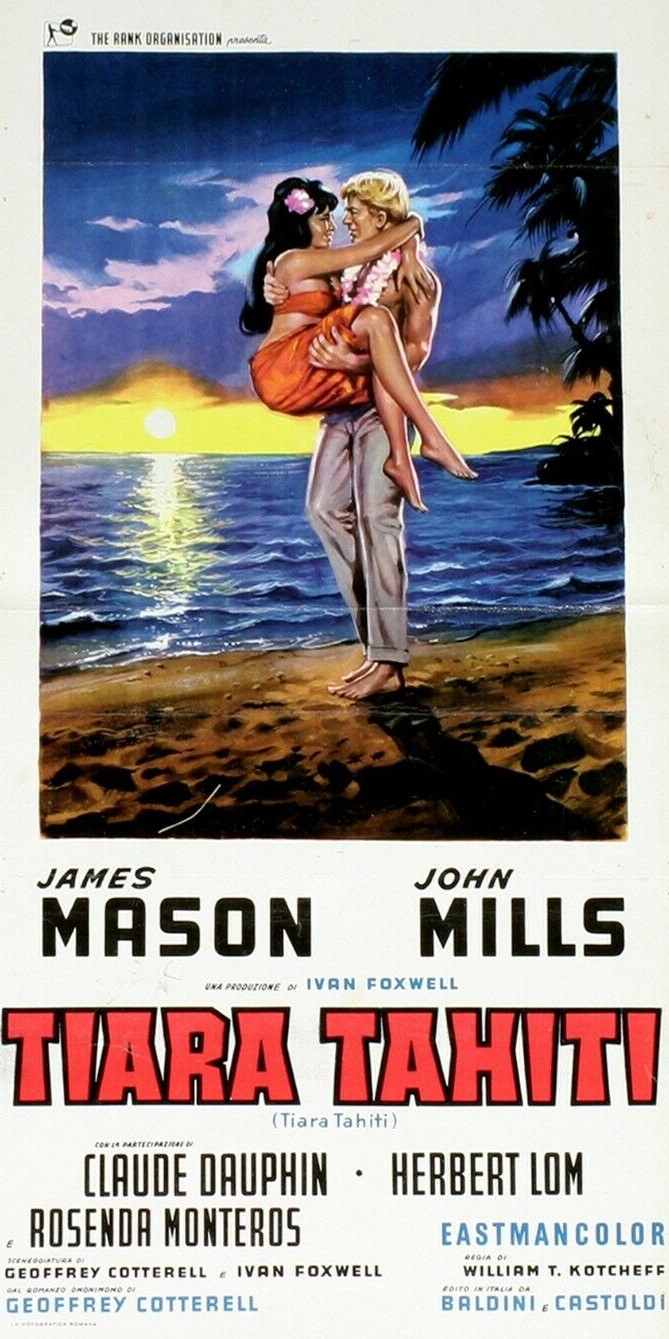
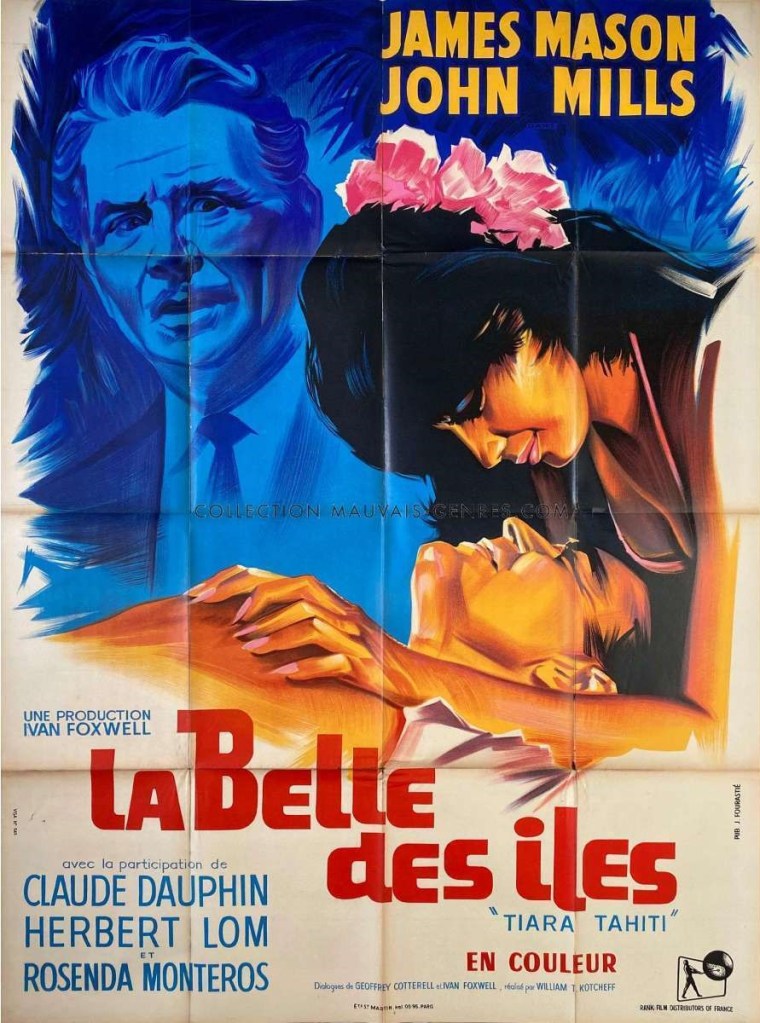
I doubt if they expected audiences to feel sorry for the jumped-up martinet Lt.Col Southey (John Mills) whose cushy number in post-war Germany is disrupted by the arrival of suave Capt Ainslie (James Mason). The former is reminded by the latter that he was once a lowly clerk in the stockbroking firm of which the captain, by dint of birth, held a managerial position. Soon Ainslie wins over the officers and humiliates Southey at every turn. To gain revenge, Southey informs on the junior officer who is arrested with illicit goods at the customs.
Several years later, Ainslie lives the life of Riley in Tahiti, beautiful girl Belle Annie (Rosenda Monteros) in tow catering to his every whim and under the false impression that he will soon take her back with him to London. He makes a living playing poker, and when luck runs against him can rely on the easily corrupted local police officer to keep his creditors at bay. Into this ostensible paradise arrives Southey, now chairman of an international hotel company, so important he can swan around the world answering to no one.
I had expected that having made it to the top of his profession by dint of hard work rather than accident of birth or having made the right connections, that Southey would have rid himself of his inferiority complex and that, somehow, he would get revenge on Ainslie for the humiliation in Germany. But that proves not to be the case and, in fact, any mention that Southey was once Ainslie’s mere clerk brings the high-flying businessman down to earth and he reverts to his previous jumped-up bumptious persona.
Only momentarily does Southey gain the upper hand, when the broke Ainslie seeks employment, but that lasts only until Southey reveals the part he played in Ainslie being cashiered from the Army. All along there’s been a sub-plot of a jealous Chinese storekeeper Chong (Herbert Lom, would you believe) trying to ease Ainslie out of the way so that Belle Annie will return to him. Chong arranges for a thug to bump off Ainslie. But when Ainslie survives the assault he blames Southey so that he can have the pleasure of ruining Southey’s career when he is kicked off the island.
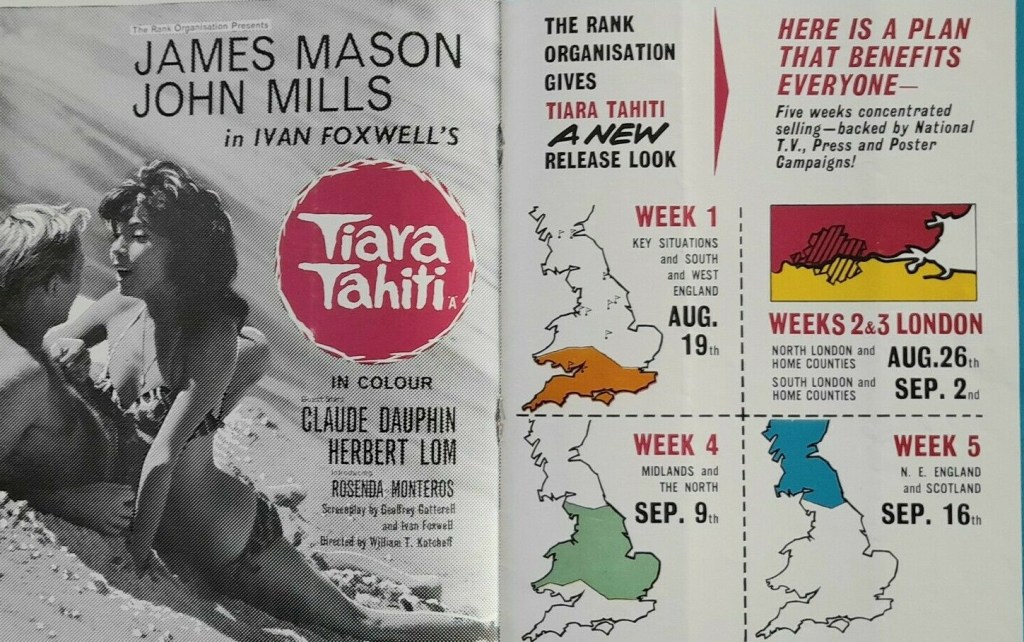
A significant change to the way films were distirbuted in Britain. Normally, it was London which got first bite of the cherry. Opening a film outside London was a bold move
I can’t have been the only viewer to sympathise with Southey, the man who got to high-ranking positions in the Army and business through his own hard graft while charmers like Ainslie used their class to ease their passage. I had imagined that it would be Southey who got his revenge, employing Ainslie in a lowly position rather than the other way round. And it may just be me but I didn’t believe the suggestion in the final scene that any enmity Ainslie felt towards Southey was all in Southey’s head.
Be that as it may, the acting carries this one. John Mills adds a comic element to his stiff-upper-lip officer last seen in the more dramatic Tunes of Glory (1960) while James Mason (Age of Consent, 1969) is the essential cad who can get away with anything thanks to bucketloads of charm.
Several scenes stand out. You wonder if the famed Robert De Niro “you talkin’ to me” in Taxi Driver (1976) had its origins in the scene where Mills talks to himself in a mirror to build up his confidence before confronting Mason. The scenes where Mason dupes the police officer into believing the cop’s novel is a work of genius are very funny. Mason also takes the mickey out of a middle-aged Englishwomen by pretending to be a native Hawaiian.
And that’s not forgetting the exuberance of Rosenda Monteros – mistakenly given the “and introducing” credit when she had previously appeared as the love interest in The Magnificent Seven (1960) – not quite as dumb as she sometimes appears, able to con Chong out of new dresses and ready at a moment’s notice to run away with an athletic young sailor. Not to mention, too, that her bare derriere makes an appearance in a bathing scene rather risqué for the period.
Debut of Canadian director Ted Kotcheff (Life at the Top, 1965, also dealing primarily with class) who has the sense to leave the actors to it. Written by Ivan Foxwell (A Touch of Larceny, 1960), it sticks too closely to the source novel by Geoffrey Cotterell, lumbering the movie with one sub-plot and a couple of characters too many, but excellent when concentrating on the warring protagonists.
Setting the class elements apart, this is all good fun, and the jousting between two of the greatest British actors of all time makes it more than well worth a viewing. It was a big hit in Britain at the time, not quite in the category of Dr No – oddly termed “a bizarre comedy drama” by trade magazine Kine Weekly and – second to Cliff Richard musical The Young Ones in the annual box office chart – but easily in the Top 25.
Setting aside my reservations about the tone and the perspective, I found this far more enjoyable than I expected as result of witnessing two class acts at the top of their game.
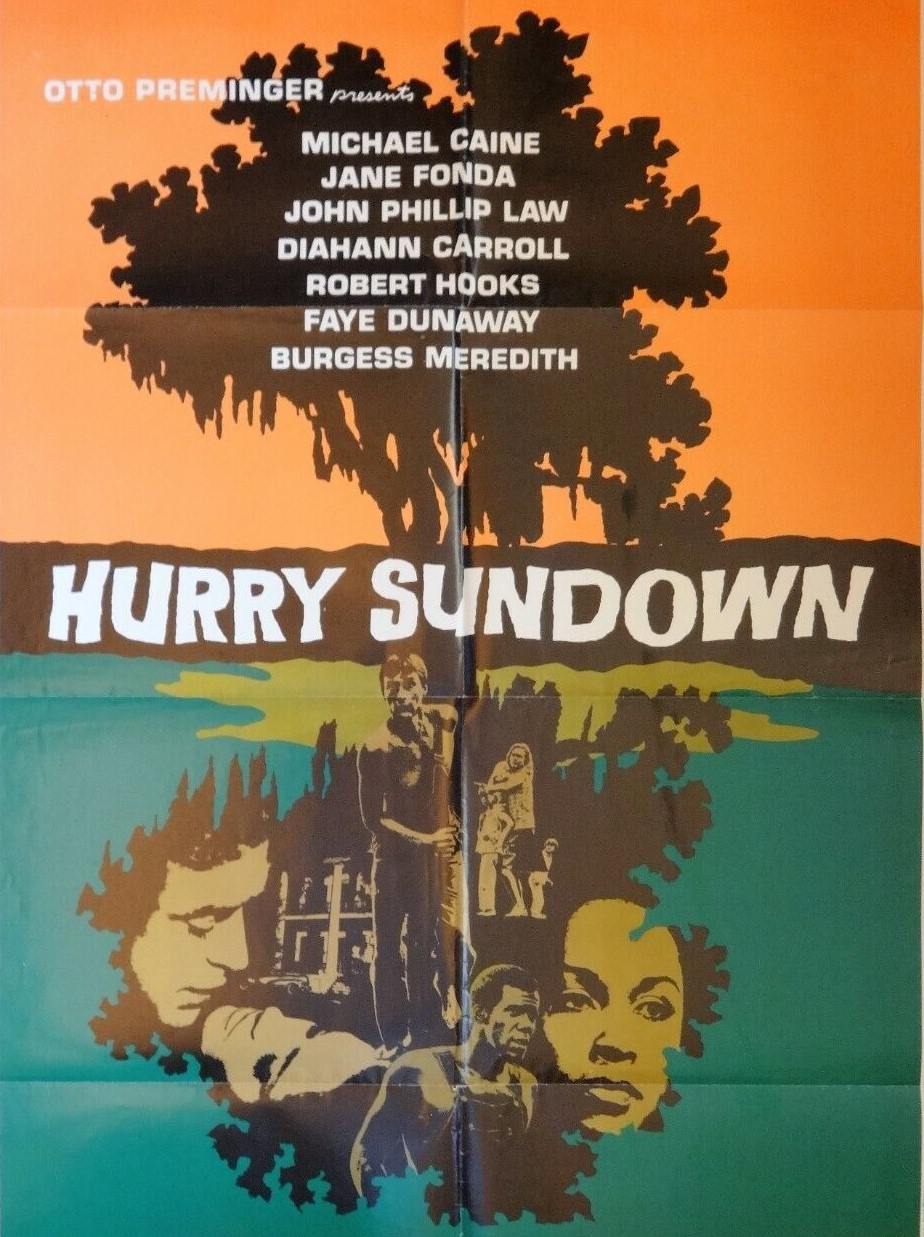
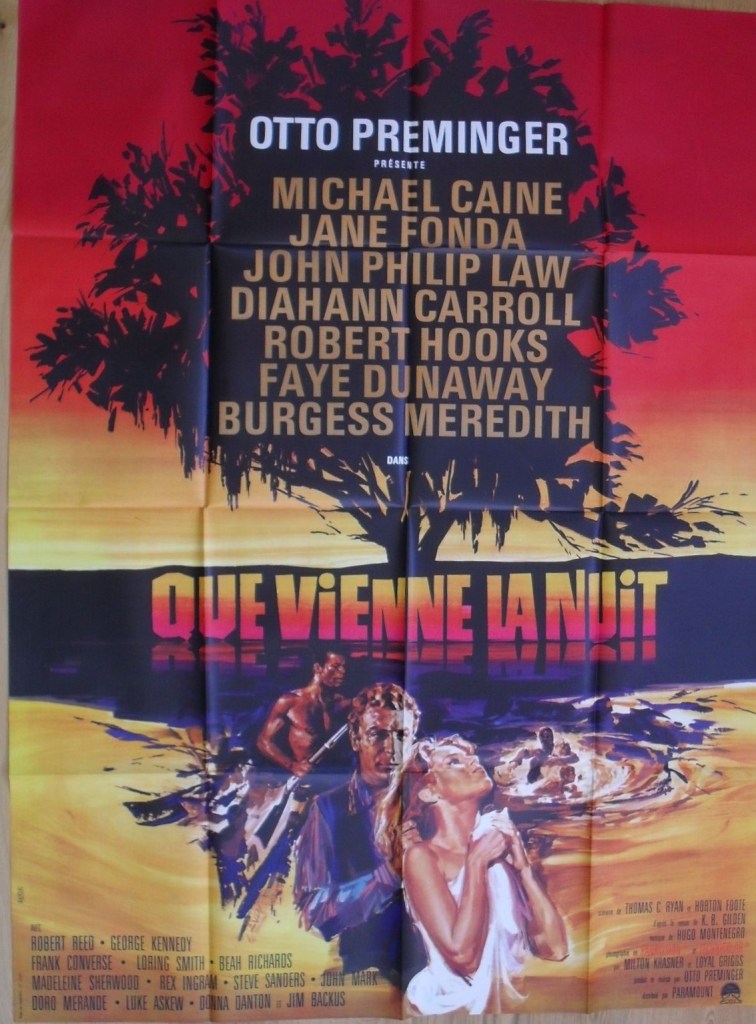
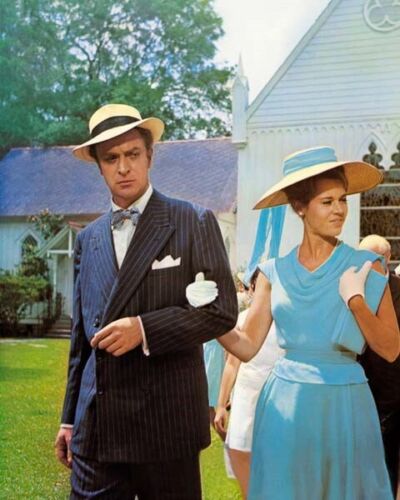
Otto Preminger’s drama was the first of a trio of heavyweight films in 1967 – the others being In the Heat of the Night and Guess Who’s Coming to Dinner – that took African American issues seriously. In post-war Georgia land-grabbing by ambitious Henry Warren (Michael Caine) pits him against World War Two vet Rod (John Philip Law) and African American farmer Reeve (Robert Hooks) who team up. Throw in a quintet of feisty women – Henry’s wife Julie Ann (Jane Fonda), Rod’s wife Lou (Faye Dunaway), schoolteacher Vivian (Diahann Carroll) – Reeve’s love interest – Henry’s lover Sukie (Donnie Banton) and Rod’s mother (Beah Richards) – and emotional confrontation comes thick and fast.
Preminger had spent most of the decade making films about big subjects – Exodus (1960), the politics behind the formation of Israel; Advise and Consent (1962), just politics; The Cardinal (1963), politics within the Roman Catholic Church; and In Harm’s Way (1965), Army politics and bluster around Pearl Harbor
Preminger is both economic and elegant. From opening dialogue to climactic court scene, the picture races along, and continuous use of tracking shots ensures the movie never gets bogged down. While there is no lynching, racist abuse, whether direct or indirect (through patronizing attitude) is never far from the surface. Corrupt Judge Purcell (Burgess Meredith) is by far the most vicious, his unrestrained language making you wince. But even those with more measured approaches have to play the game, Reeve gives a lift to Rod but has to let him off before they reach town in case anyone spots this, Rod forbidden, for example, to buy dynamite.
But the racists do not get it all their own way. Julie Ann stands up to the judge and her position in the community is so strong that others boycott the judge’s daughter’s wedding leading to the judge receiving a tongue-lashing from his wife. Weak Sheriff Coombs (George Kennedy) coming to arrest Rod is bamboozled by his female relatives while Vivian charms her way past the judge.
The women are uniformly strong. Julia Ann goes from seductive wife to distraught mother, but in between capable of defrauding Rod’s mother, her childhood nanny, out of her inheritance. Lou resents her husband’s return after in his absence taking on a full-time job while running the farm and now resisting the idea of selling up to Henry. Rod’s mother, beholden to white men all her life, now turns against them. The judge’s daughter (Donnie Banton) makes no bones about the fact that she is marrying her “dull” fiancé for his money. This is no spoiler because you will have guessed some similar outcome but at the end it is Vivian who takes the initiative in her relationship with Rod and marches into his house with her baggage, declaring she has come to stay.
Caine and Fonda.
And although the ruthless Henry is the bad guy, he, too, is afforded insight, soothing himself by playing a musical instrument, a man with talent who had “distracted” himself by pursuit of money. And there is another touching moment when he takes in a runaway child. Acting-wise, Michael Caine (Gambit, 1966) is a revelation. Gone is the trademark drawl and the laid- back physical characteristics. Here he talks snappily – and no quibbles with his Southern accent either – and strides quickly. That we can believe he is brutal, gentle, remorseful and ruthless is testament to his performance.
Similarly, this is a massive step forward in Jane Fonda’s (Cat Ballou, 1965) career, away from Hollywood comedies and sexed-up French dramas, and her internal conflict springs from being forced to choose between husband and son, between her innate sexiness that oozes out in every intimate scene and maternal longing to comfort her disturbed child. Her usual shrill delivery is tempered somewhat by the deeper emotions she is forced to bear. While her attempt to defraud Rod’s mother comes from a desire to keep her husband, her eyes tell you she knows that is no excuse.
What’s perhaps most surprising of all is the tenderness. There are wonderful, gentle love scenes between Caine and Fonda and Law and Dunaway.
Children, too, also unusually, play a central role. Henry’s callousness is no better demonstrated than in his earlier treatment of his son. Reeve’s eldest son also resents his father’s return and, viewing Henry as a more suitable adult, betrays his father. The Judge is obliged to drop one of the worst aspects of his racism in order to appease his daughter.
The acting throughout is uniformly good. Dunaway’s debut won her a six-picture contract with Preminger. Singer Diahann Carroll’s role as a confident young woman led to a television series. Robert Hooks would also enjoy small-screen fame. The surprisingly effective John Philip Law would partner Fonda in sci-fi Barbarella (1968) and link up with Preminger again in the ill-fated Skidoo (1969). Horton Foote (To Kill a Mockingbird, 1962) and Thomas C. Ryan (The Heart Is A Lonely Hunter, 1968) wrote the screenplay based on the bestseller by K.B. Gilden.
Unfairly overlooked by Oscar votes, who preferred the other Poitier films, Hurry Sundown, despite the rawness of the language and the innate brutality meted out to African-Americans, has been vastly under-rated. It is worth another look because at its core is not just racism but big business which scarcely cares about the color of those it exploits. It is as much about the power shift in relationships and ambition.
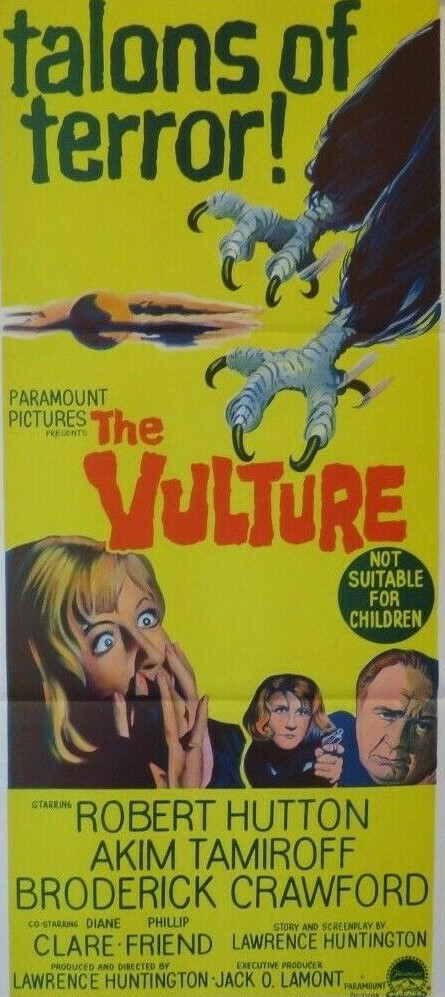
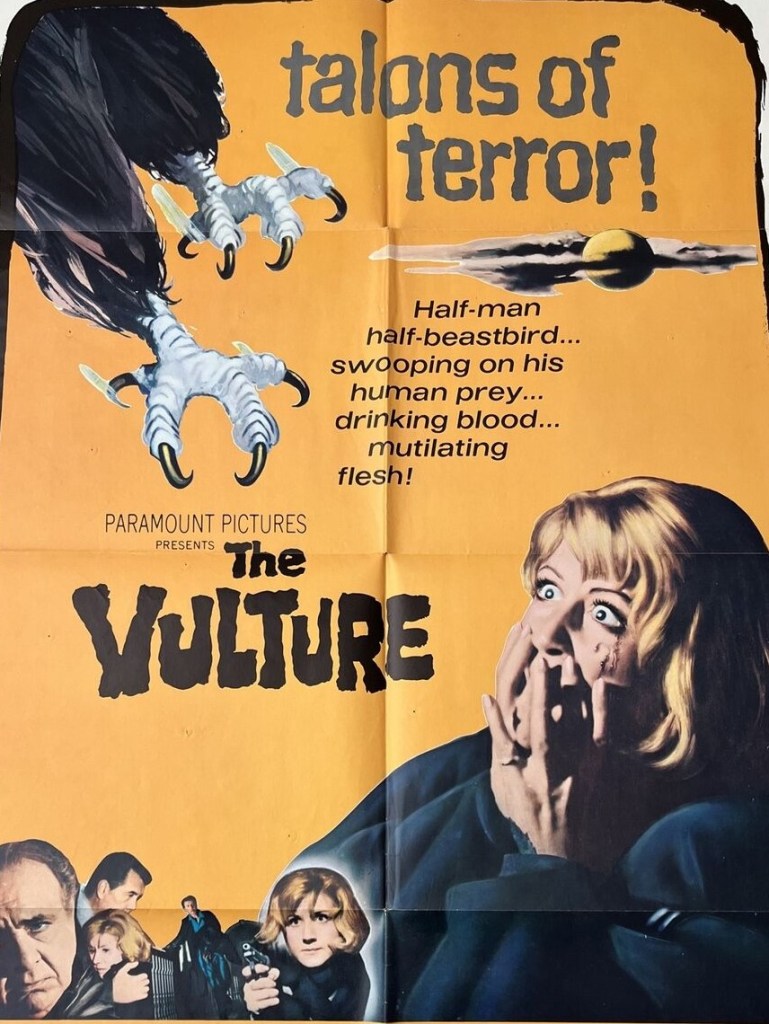
The notion that the presence of Oscar-winning Broderick Crawford or that a bunch of expository scenes will divert audiences away from the lack of decent special effects, or story for that matter, comes sadly unstuck. There’s so much exposition that at times it feels like an audio book rather than a piece of cinema. The one great image – a skeleton in laboratory – is treated with disdain. Not only has it “cult” written all over it but it must be a contender for the all-time “So Bad It Hasn’t A Hope Of Being Good” Award,
Which is a shame because on paper at least this might have sounded passable what with atomic transmutation, hidden treasure, grave-robbing, remote location, strange noises in the night, an incident in the 15th century, man buried alive, eerie tapping on windows, a creepy Church sexton, and a mythological beast originating from the Incas or Aztecs or even Easter Island.
But it pivots on the kind of family curse, mysterious past, strange occurrences, that Sherlock Holmes might have been called in to resolve, especially as there seemed an awful lot of explaining to do and it’s easier to hang on to every word of the world’s most famous detective rather than a scientist banging on about the inexplicable. The first two-thirds is taken up with solving the mystery, it’s only in the last section when horror takes over that a genuine sense of tension emerges.
A woman taking a shortcut through a graveyard (as one does) spies a gravestone wobbling, earth erupting in front of her and has visions (enough to make her hair go white) of a huge bird with a man’s head. Visiting nuclear scientist Eric (Robert Hutton) takes an interest. His wife Trudy’s (Diane Clare) uncle Brian (Broderick Crawford) explains the legend of a Spaniard buried alive because he turned himself into a vulture and kidnapped a small child. His buddy, German professor Koniglich (Akim Tamiroff), expands on the story.
Gold coins are found scattered close to the grave. Boys find the bloody leg of a sheep on a beach and there’s a likely unreachable hiding place of a cave in the cliffs. Uncle Brian is of the obstinate variety and refuses to the toe the line and keep his windows firmly closed so he’s next to disappear. But there’s a hungry beast to feed so Brian’s brother Edward (Gordon Sterne) is the next victim. Trudy is despatched out of harm’s way to London but lured back by a mysterious telegram.
Meanwhile, hot on the trail, Eric finds Koniglich’s lair, a laboratory inhabited only by a skeleton, but with his own understanding of the possibilities of atomic science Eric works out the German must have employed nuclear power to fuse man and vulture and set out to wreak revenge.
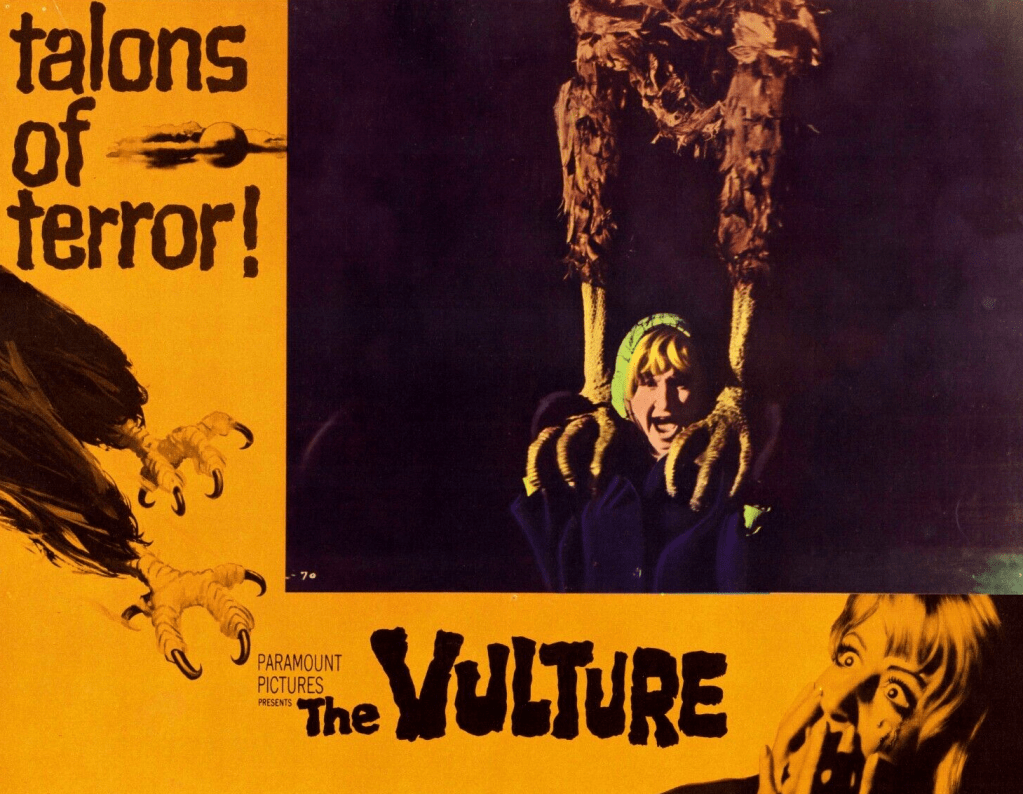
It was obviously a toss-up between spending the tiny budget on a fading Hollywood star and supporting bad guy actor of some repute rather than on special effects. Quite how, at that time, anyone would have managed a convincing half-man-half-vulture is anybody’s guess and the prospect of making such a creature credibly fly would have been beyond comprehension so sensibly director Lawrence Huntingdon settles for the prospect, showing talons from time to time and letting audience imagination do the rest, and I am sure if you saw this as a child you would be bolting doors and windows.
Robert Hutton (They Came from Beyond Space, 1967) doesn’t have a chance of imposing himself on the picture since he is lumbered by buckets of exposition and supposition. Though he could take a lesson from Broderick Crawford (A House Is Not a Home, 1964) in how to milk a small role. Crawford is something of a clever red herring. Given his screen persona I had expected him to be the bad guy, at the point of his appearance in the picture notions of scientific dexterity not being a prerequisite. Akim Tamiroff (The Liquidator, 1965) plays down his villainous qualities so until we are introduced to his lab, he’s not the obvious bad guy either.
It might have worked better if the audience was filled in on more of the mystery than the investigator, perhaps witnessing Koniglich at least toying with his equipment, maybe making the screen glow the way dodgy scientists were inclined to do.
This was the final film in the 30-year career of director Lawrence Huntingdon (Drums Along the River, 1963) and if he couldn’t manage a swansong of the kind Clark Gable delivered with The Misfits (1960) then I guess the next best thing was a movie for cultists to savor.
Bold examination of racism years ahead of its time. Narrative not sweetened for audiences by a detective story (In the Heat of the Night, 1967) or grumpy father-of-the-bride comedy (Guess Who’s Coming to Dinner, 1967) or by protagonists unrepresentative of society by being criminal (The Defiant Ones, 1958) and criminally insane (Pressure Point, 1962), the issue of racism – miscegenation and interbreeding – smack bang in the middle. Though it takes place in Hawaii, theoretically at one remove from the violence emanating in the U.S. Deep South, the points made strike home.
If a shade melodramatic, that is undercut by a set of very fine performances by all the principals. Charlton Heston, later lacerated in democratic circles for his defence of the right to bear arms, here employs his marquee value to deal with the ticking time bomb.
Yep, that is an advert shaped as a diamond. Subtle, huh?
The tale is simple enough. Headstrong Sloane (Yvette Mimieux) decides to marry native-born Paul Kahana (James Darren) against the wishes of her older brother, widowed millionaire landowner “King” Howland (Charlton Heston). Despite using equality as an election platform in a bid to become a Senator, King fiercely objects to the marriage on the grounds that it will dilute his bloodline and, in effect, hand over control of his empire to an outsider. His spinster sister-in-law Laura (Elizabeth Allen) backs him on this score as does, oddly enough, Paul’s mother Kapiolani (Aline McMahon) who complains that interbreeding has reduced the number of native Hawaiians to a mere 12,000.
Complicating matters is King’s hypocrisy. His mistress, Mai Chen (France Nuyen), already is of mixed parentage. But when she announces she is pregnant, he demands she have an abortion. Spicing up that particular complication is her brother Bobbie (Marc Marno) who sponges off the perks King provides and now decides to hit the gold seam by blackmailing King. And just in case that’s not enough in the way of complications Sloane has always had a yen for Paul’s older and more successful brother Dean (George Chakiris), now a hospital doctor. In fact, as outlined in a flashback, Paul was decidedly second-best in Sloane’s eyes and there is a hint she romanced him to spite the more sensible brother.
Bobbie doesn’t get the chance to put his scheme into practice as he is implicated in the death of Paul, who had been trying to stop the blackmailer from drunkenly attacking King at a traditional engagement ceremony. Paul is killed accidentally by King.
That should have simplified matters, but it doesn’t. King is abandoned by Sloane and Laura leave and Mai Chen throws him out. The scandal of Paul’s death should have ended his political ambitions, but despite his backers dropping out, arrogantly he decides to go it alone until receiving the slow-handclap treatment from the public. He is fully aware of the consequences of his action, pointing out that $3 million spent on philanthropy wouldn’t “buy me a tear.”
It could have ended there, proud man brought down by ambition, institutional racism and stubbornness, but it follows a different, and reconciliatory, tack at the end.
And it could have been a heaving brew of melodrama with dilated nostrils and screaming matches but it’s redeemed from that by most of the actors downplaying their roles. There is some impressive playing by Charlton Heston (55 Days at Peking, 1964) who carries off his hypocrisy in some style, but doesn’t descend to the obvious ploy of disinheriting the defiant one or at the very least chucking her out and generally manages to keep the lid on his temper. George Chakiris (Flight from Ashiya, 1964) uncannily captures all the elements of his character. An educated man so can’t be downtrodden but has to watch his step in confronting such a powerful man, so he makes his point with quiet determination.
In an early starring role Yvette Mimieux (Joy in the Morning, 1965) is given a lot more to do than in some later offerings. She exhibits defiance not just in regard to racism but sexism as well, determining that her marriage would be an equal relationship not one where she would be subservient to her husband. Had she been able to rein in her pig-headedness and present herself as more interested in the business than its perks she might have allayed her brother’s fears that in endorsing the marriage he was risking handing over his empire to her idiot husband, so lacking in the brain department he needed extra years to graduate at college.
France Nuyen (Man in the Middle, 1964) has a peach of a part, plenty good lines, and the beneficiary of the few scenes not driven by narrative requirements, in particular her observations at watching her lover dress. James Darren (The Guns of Navarone, 1961), given less to do, is not surprisingly more of a cliché. Oscar-nominated Alice McMahon (Cimarron, 1960) is quietly impressive as the equally torn parent who could, at one point, take legal revenge on King.
Director Guy Green (The Magus, 1968), aware the content is inflammatory enough without the principals going overboard, does pretty well to stick to the issues. Screenwriter Marguerite Roberts (5 Card Stud, 1968), in adapting the bestseller by Peter Gilman, makes several changes to keep the focus on the key element.
In his diary, Charlton Heston noted that that movie was overly melodramatic but with the proper treatment it could work. He was right. The plot has more cogs than any wheel could comfortably accommodate, but by keeping the central issue central the movie would be viewed today as the highpoint of Hollywood’s opposition to racism rather than being superseded five years later by the pair starring Sidney Poitier.
The predatory female was a late 1960s trope but this takes it stage further by suggesting that a woman can have it all, husband, lover and career fulfilment. Usually, it’s the powerful male that sets his mistress up in an apartment. It being British, Mrs Blossom (Shirley MacLaine), wife of bra manufacturer Robert (Richard Attenborough), stashes lover Ambrose (James Booth) in the attic.
There’s an element of Carry On in the focus on Robert’s profession, sniggering at the audacity of it all when it’s little more than an excuse to show a succession of half-naked girls modelling the product. The central conceit is ahead of its time, not so much one-size-fits-all, the Holy Grail of all manufacturers, but that women can have the bosom-shape they desire (rather than these days opting for the under-wired bra or going the whole hog with cosmetic surgery) through inflating the brassiere to suit.
Except toward the end, the bra business takes second place to the sex business as Mrs Blossom demonstrates exactly how to have your cake and eat it. Her shenanigans with Ambrose cause her to make greater effort with Robert. Although the male perspective occasionally intrudes: Mrs Blossom “ecstatic” at the prospect of making two men happy.
There’s not much going on plot-wise beyond Robert hearing strange noises in the attic and discovering a number of items, purloined by Ambrose, going missing, resulting in him seeking the help of a psychiatrist (Bob Monkhouse).
The whole enterprise is doused in modernity, probably post-ironic for all I know, Mrs Blossom’s painting tending towards Pop Art, some in-jokes (one dot on a canvas turns out to be a “sold” sticker). Since there’s not much else going on, Robert, kept sexually satisfied, hardly imagining his wife is engaged upon an affair, scarcely raising a scintilla of suspicion, the lovers carry on as if they are, in the best Hieronymus Merkin fashion, embarking on a welter of fantasies, primarily of the cinematic variety, so nods to Hitchcock, David Lean and even Raymond Chandler etc.
The climax at some kind of ticker-tape convention featuring Robert speaking atop a giant bra-clothed statue looks as though it consumed most of the budget. At bit more of the money could have been spent on jokes, because, without the danger of the illicit couple being found out, it lacks any real tension, unless you count a pair of bumbling and/or camp detectives (Freddie Jones and Willie Rushton) whose sole purpose appears to be to over-act. There’s a clever twist at the end.
Director Joseph McGrath (The Magic Christian, 1968) is something of an acquired taste. His main claim to fame at this point having helmed music videos for The Beatles and his scattergun approach rarely hits the target. One of the few examples where opening up a play (by Alec Coppel – of Vertigo fame!!) results in in racing in too many directions.
Shirley MacLaine (Sweet Charity, 1969), by now the decade’s most celebrated kookie, brings immense charm to the role and it has to be said it’s the acting in the main that keeps this on an even keel when the director is so clearly on a different planet. Richard Attenborough (The Flight of the Phoenix, 1965) is believable as a workaholic who lets off steam conducting an imaginary orchestra. James Booth (Fraulein Doktor, 1969), meanwhile, in a role that could have gone seven ways to Sunday, makes a convincing lothario.
Comedian Bob Monkhouse is surprising good as the madcap psychiatrist and you might have some fun spotting John Cleese, Barry Humphries and a young Patricia Routledge. Producer Joseph Shaftel (The Biggest Bundle of Them All, 1968) wrote the script with Denis Norden (The Best House in London, 1969).
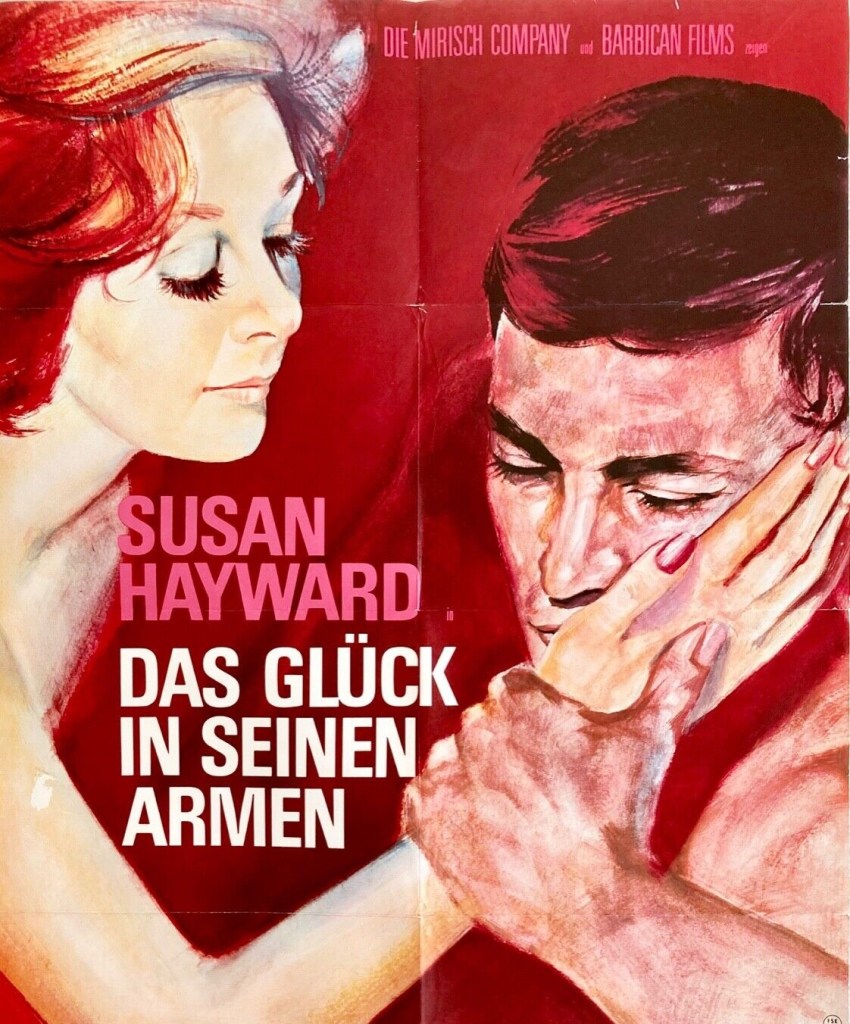
New York Times critic Bosley Crowther famously took Susan Hayward to task for over-acting in the first half of this picture before turning subtle in the second without realizing that was the whole point. Hayward was always full-on, either because he played tougher-than-tough characters (weakness their Achilles heel) or was squaring up against macho males like Clark Gable (Soldier of Fortune, 1954) or John Wayne (The Conqueror, 1956).
Here, she duped audiences. Anyone expecting to view her normal feisty screen persona would come away happy with the first half, bewildered by the second. But, as I said, that was the whole point, a superb effort turning expectations on their head. In any case it was a pretty bold undertaking. In the 1960s, Hollywood went on a cycle of regurgitating old classics but mostly with newcomers like Alex Cord standing in for John Wayne in Stagecoach (1966) or Doug McClure for Gary Cooper in Beau Geste (1966).
There were not many actresses who would think of trying to match the legendary Bette Davis in one of her legendary roles. But Susan Hayward was not just larger than life but a queen of melodrama, able to ratchet up emotions with a look. No actress in the early 1960s could match Davis’s record of two Oscars and a further eight nominations (she would win another one later). By that point Katharine Hepburn equalled her on number of wins but had two fewer nominations (her other wins also came later). But Hayward ran both pretty close, one win (for I Want To Live, 1959) and four nominations.
So if you were going to select an actress to take on the Davis role in a remake of Dark Victory (1939) you could do worse than choose Hayward. The plot’s been transitioned to England but it follows the same formula as before – in other words stand by for a full-scale weepie. Jet-setting divorced socialite Laura (Susan Hayward) lives life to the full – and then some. When diagnosed with a brain tumor, her reaction is to let all her wildness hang out, reviving romance with old racing driver boyfriend Mike (Edward Judd) before taking stock and abandoning the high life and settling down in the back of beyond (remote Cornwall) with Dr Carmody (Michael Craig).
It’s basically a film of two halves. The almost otherworldly life of the rich and famous who chase after every expensive delight without any notable increase in their happiness quotient contrasts with life in a Cornish village where problems, although apparently smaller, are every bit as vital to those affected. The gaudy section is filled with fine costumes, grand houses and glorious scenery. The serious part is a good bit more down-to-earth as the grande dame discovers her neighborly and maternal qualities. The characters inhabiting the rich life appear flimsy, the poorer people much more realistic. It is almost as if she has swapped fantasy for reality and uncovered a different kind of richness.
There’s not much more to the story than that so it requires acting of the highest caliber to keep us hooked all the way through. Well, for that, you’ve certainly come to the right place. What appears over-acting in the first section is just that, and deliberately so, since the personality switch is the ideal hook. The film’s emotional impact will hit you hard especially the ending. What initially appears to be heading for the sensational soon pulls back to reveal an ordinary person trying to overcome adversity, not with a grand gesture, but simply by living an ordinary life to the full.
While Michael Craig (Life at the Top, 1965) is pretty much a bystander, his calming approach sorely needed in the first half is redundant in the second as Laura comes into her own, developing an inner life she never knew was possible. Hitchcock protege Diane Baker (Mirage, 1965) continues to show early-career promise.
Perhaps more attention should be focused on director Daniel Petrie (The Main Attraction, 1962) who slides out from under his journeyman tab to over-egg the first section and under-egg (if there is such a word) the second. You could almost get the impression of a conductor fine-tuning an orchestra of one.
Superb showing from Hayward certainly gives Bette Davis a run for her money though you could argue she was too old for the role, Davis half her age in Dark Victory, but it’s to Hayward’s credit that you feel the loss of such a vibrant middle-aged personality as you do with Davis’s younger protagonist.
They don’t do melodrama like this anymore, mostly because there isn’t the likes of a Susan Hayward to make them work.
Passable British crime B-picture, mainlining on sleaze, plot as flimsy as the costumes of the dancers, rescued by, flipping her screen persona on its head, a heartfelt performance by Jayne Mansfield. Career tumbling spectacularly after her Frank Tashlin heyday (The Girl Can’t Help It and Will Success Spoil Rock Hunter, both 1957) she was loaned out to any outfit that would have her. Director Terence Young’s (Dr No, 1962) career was also at a low ebb after Safari and Zarak (both 1956) while Carl Boehm (Peeping Tom, 1960) and future Carry On stalwart Barbara Windsor, minus trademark Cockney accent, were on the way up.
Ostensibly an expose of the Soho strip club business, invests too much time in cabaret, though Midnight Franklin’s (Jayne Mansfield) number is surprisingly well done. Parallel plots see journalist Robert (Carl Boehm) investigating the industry while rival night club owners Johnny Solo (Leo Genn) and Diamonds Dielli (Sheldon Lawrence) duke it out over the spoils.
As you might expect, such clubs are populated by seedy customers, some harmless like a Leipzig salesman falling for disinterested showgirl Lilliane (Danik Patisson), others on the creepier side like Mr Arpels (Martin Boddey) who tempts unwary girls with talk of setting them up in the movie business. Naturally, so many girls together, jealousies simmer and tensions flare, resulting, as you might expect, in a catfight. But that’s nothing compared to the beating handed out to Johnny by Diamonds’ thugs. Matters aren’t helped by Johnny’s manager Novak (Christopher Lee) being in the pay of the opposition.
Apart from wearing outfits that would give the censor of the time a heart attack, Midnight is really a sensible girl, hating violence, warning boyfriend Johnny to get out of the business before he ends up dead. She’s got few illusions left, hardly expecting Johnny to pop the question, but like Richard Widmark in yesterday’s Two Rode Together (1961) gradually becoming repelled by his actions.
For the most part she accepts that Johnny effectively pimps out his acts to wealthy customers like Arpels but recoils when he attempts to do so with Ponytail (Barbara Windsor) whom most people believe to be under-age. However, when Ponytail’s attempted rape turns into murder and the police turn up at the nightclub, Midnight, initially obeying the laws of omerta, turns on Johnny after she discovers his gun. But in a wonderful closing scene, she picks up the discarded flower he wore in his lapel and kisses it.
There’s some surprisingly potent dialogue and sharp one-liners – “that’s a very nice dress you nearly got on” / “I had a friend once but it didn’t take”/ “there’s not enough milk of human kindness around here to fill a baby’s bottle” / after a date with Arpels “some girls came back with promises…one came back with a baby.” A good bit more of such zingers and the movie would barrel along regardless of limp plot.
Energy is lost by focusing too long on the cabaret acts and on the growing romance between Robert and Lilliane. As glamorous fading nightclub star, Midnight provides the necessary oomph in more ways that one, but the movie would have benefitted by concentrating more on her ruefulness and self-awareness. Though besotted by Johnny, she knows he’s no lifetime ticket, tries to keep from herself as long as possible acknowledgement of his more sinister side, not so much knowing her place but aware which barriers not to cross. There’s a terrific scene in the middle of the night when she guesses he might be in trouble but hesitates over telephoning him in case this would be deemed over-familiar intrusion. Even she doesn’t know why she still hangs around a joint like this except “fish gotta swim, bird gotta fly.”
Bombastic on stage, she’s subtle off. You will come away believing Jayne Mansfield can actually act. But there’s nothing much to get excited about from the other performers, mostly in the stolid category, though it’s interesting to see what Barbara Windsor can do without reverting to a Cockney accent. Oscar-nominated Leo Genn (55 Days at Peking, 1963) proves that even crooks can possess a stiff upper lip. At this point with only a couple of horror pictures to his name Christopher Lee (The Devil Rides Out, 1968) could still be found in dramatic fare, but this is no break-put role.
Herbert Kretzmer, credited with the screenplay along with Harry Lee (All That Heaven Allows, 1955), would go onto worldwide fame and enormous wealth for Anglicizing French hit musical Les Miserables. While posters boast of Eastman color, which would have added to enjoyment of the dance routines, you can pretty much only find this in black-and-white and with ten minutes lopped off.
Wanna feel sorry for Jayne Mansfield, this is for you.






 The Magnificent 60s