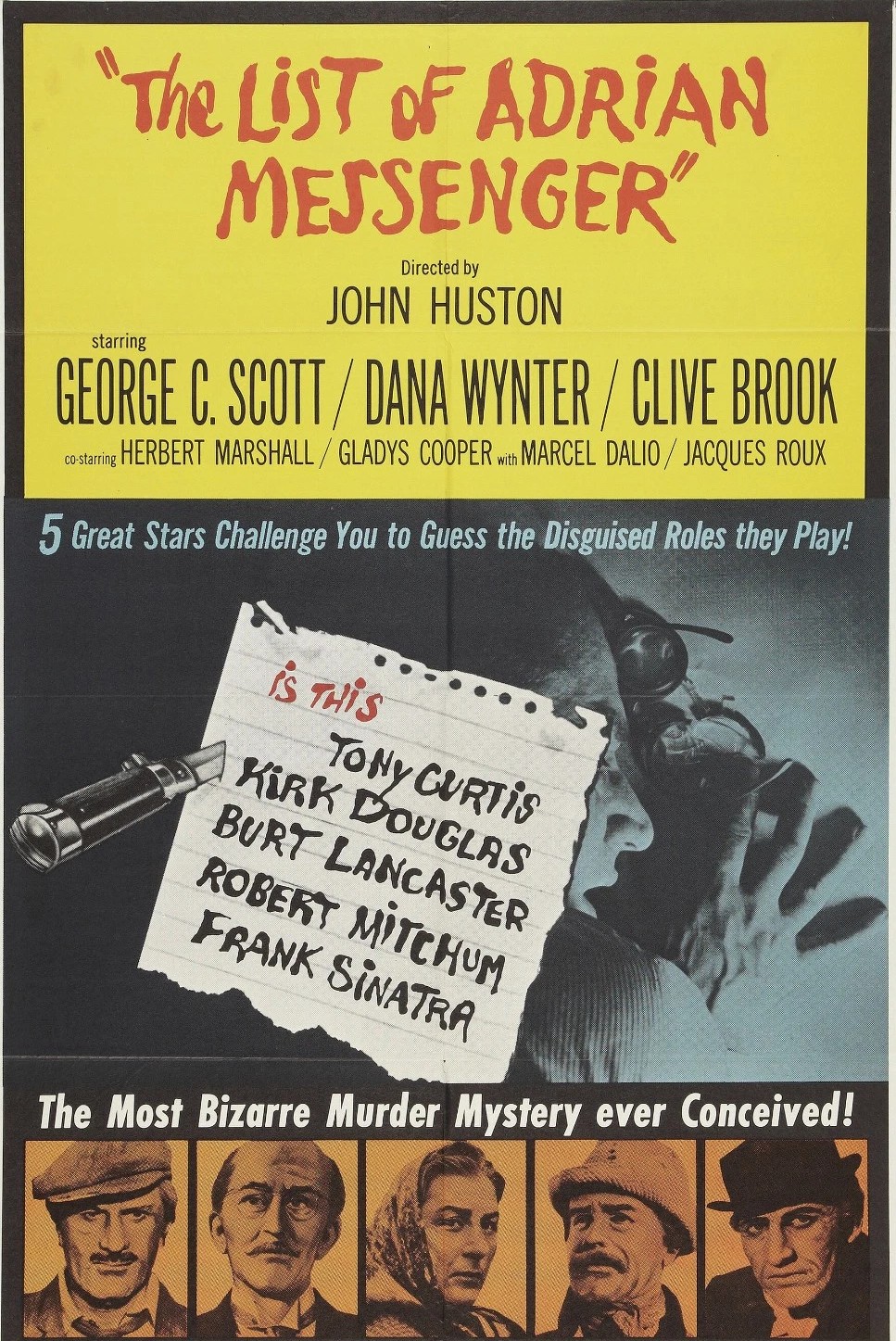
The List of Adrian Messenger (1963) ***

The gimmick of stars in disguise isn’t enough to spark this routine whodunit and the extended sequences of fox-hunting might deter the contemporary viewer but oddly enough something else of considerable interest is going on and enough to keep you hooked.

Given it’s an actor’s screen persona that tempts you to their movies, how are you going to respond when that’s gone AWOL? Actually, you get a more intriguing performance. Covered in slabs of make-up Kirk Douglas makes out like a latter-day Alec Guinness or Peter Sellers, essaying a number of quite different characters. So the jutting chin, the fierce eyes and the aggressive tone are all gone and in its place he shows he can act. His vicar is especially appealing.
But the same holds true of George C. Scott even though he’s not in disguise. Director John Huston, much as he did with his trio of star names in The Misfits (1961), gets Scott to tone down his screen idiosyncrasies. So the growl is tempered, the flaring eyebrows in cold storage for much of the time, and his jutting chin and aggression set to one side as he depicts a different character to his usual.

The Academy usually hands out Oscars to people who over-act or have some affliction to overcome, and they seem to wilfully ignore it when actors show how well they can act outside their comfort zone.

The story is the usual combination of clever deduction, red herrings and set pieces. Former spy Anthony Gethryn (George C. Scott) is hired by the titular character (John Merivale) to find out if a bunch of people on his list are still alive. Messenger himself is soon bumped off in a plane explosion but not before he leaves a garbled clue with sole survivor of the sabotage Raoul Le Borg (Jacques Roux). Gethryn soon discovers everyone on the list is dead. This may have something to do with the Second World War or it may be that the killer wants to cover up something now before potential scandal can ruin a promising future.

Meanwhile, the killer keeps bumping people off. And just to keep Gethryn from getting distracted by possible romance by Lady Bruttenholm (Dana Wynter) Le Borg pounces on her.
By this point the director was pursuing his dreams of becoming landed gentry with a stately home in Ireland and very keen on all the trimmings including fox-hunting which probably accounts for the length of time accorded the sport.

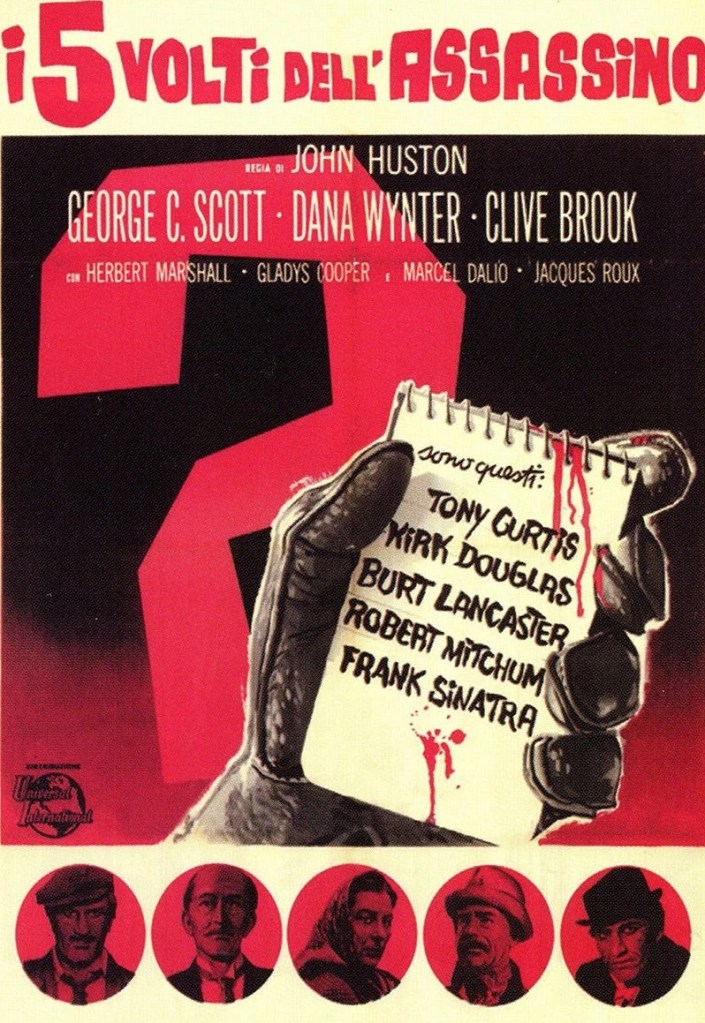
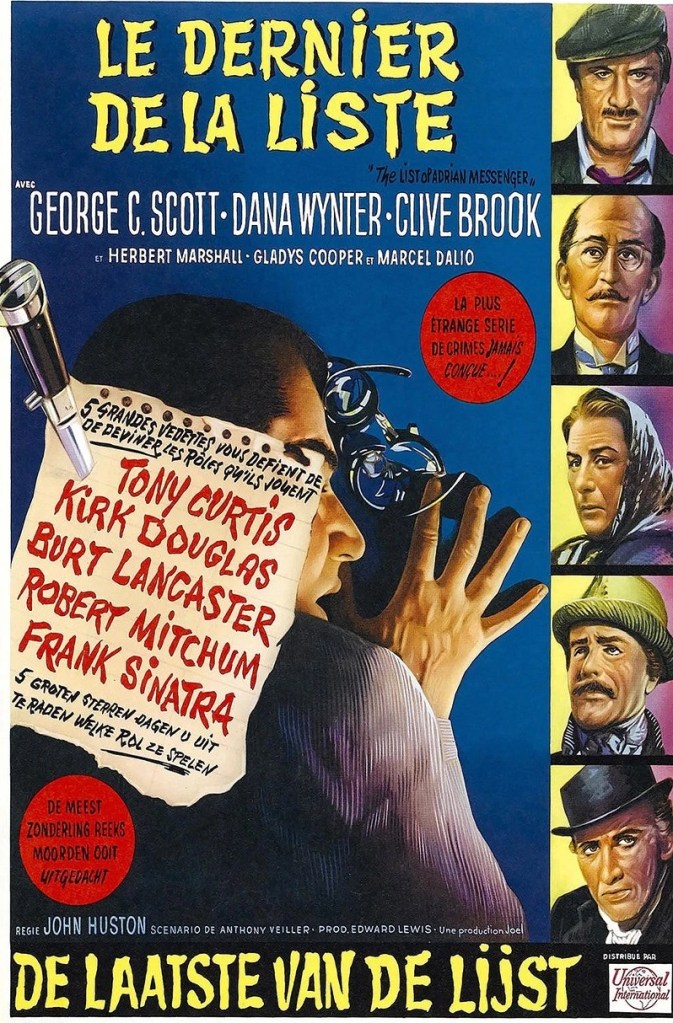
Kirk Douglas, who’s company produced the picture, thought – either to fire up public interest or to help along a fairly straightforward tale – he would ask a few of his movie star buddies to bury themselves in make-up and play bit parts. Whether audiences spent all their time when they should have been concentrating on Gethryn’s detection on carrying out their own sleuthing trying to detect which of the supporting characters might actually be Tony Curtis, Frank Sinatra, Robert Mitchum or Burt Lancaster is anybody’s guess. It does have to be pointed out that some of the make-up is unconvincing, some faces looking as though they’ve come out of a box.

Despite all this, I enjoyed seeing George C. Scott (Patton, 1970) and Kirk Douglas (Cast a Giant Shadow, 1966) playing decidedly against type and showing how easy it is to act if you’re not always having to adopt a screen persona.

John Huston looks as if he’s having a ball. Written by Anthony Veiller (Night of the Iguana, 1964) and Alec Coppel (Vertigo, 1958) from the book by Philip MacDonald.

A watchable curiosity.

The Bliss of Mrs Blossom (1968) ***

The predatory female was a late 1960s trope but this takes it stage further by suggesting that a woman can have it all, husband, lover and career fulfilment. Usually, it’s the powerful male that sets his mistress up in an apartment. It being British, Mrs Blossom (Shirley MacLaine), wife of bra manufacturer Robert (Richard Attenborough), stashes lover Ambrose (James Booth) in the attic.

There’s an element of Carry On in the focus on Robert’s profession, sniggering at the audacity of it all when it’s little more than an excuse to show a succession of half-naked girls modelling the product. The central conceit is ahead of its time, not so much one-size-fits-all, the Holy Grail of all manufacturers, but that women can have the bosom-shape they desire (rather than these days opting for the under-wired bra or going the whole hog with cosmetic surgery) through inflating the brassiere to suit.

Except toward the end, the bra business takes second place to the sex business as Mrs Blossom demonstrates exactly how to have your cake and eat it. Her shenanigans with Ambrose cause her to make greater effort with Robert. Although the male perspective occasionally intrudes: Mrs Blossom “ecstatic” at the prospect of making two men happy.

There’s not much going on plot-wise beyond Robert hearing strange noises in the attic and discovering a number of items, purloined by Ambrose, going missing, resulting in him seeking the help of a psychiatrist (Bob Monkhouse).

The whole enterprise is doused in modernity, probably post-ironic for all I know, Mrs Blossom’s painting tending towards Pop Art, some in-jokes (one dot on a canvas turns out to be a “sold” sticker). Since there’s not much else going on, Robert, kept sexually satisfied, hardly imagining his wife is engaged upon an affair, scarcely raising a scintilla of suspicion, the lovers carry on as if they are, in the best Hieronymus Merkin fashion, embarking on a welter of fantasies, primarily of the cinematic variety, so nods to Hitchcock, David Lean and even Raymond Chandler etc.

The climax at some kind of ticker-tape convention featuring Robert speaking atop a giant bra-clothed statue looks as though it consumed most of the budget. At bit more of the money could have been spent on jokes, because, without the danger of the illicit couple being found out, it lacks any real tension, unless you count a pair of bumbling and/or camp detectives (Freddie Jones and Willie Rushton) whose sole purpose appears to be to over-act. There’s a clever twist at the end.

Director Joseph McGrath (The Magic Christian, 1968) is something of an acquired taste. His main claim to fame at this point having helmed music videos for The Beatles and his scattergun approach rarely hits the target. One of the few examples where opening up a play (by Alec Coppel – of Vertigo fame!!) results in in racing in too many directions.

Shirley MacLaine (Sweet Charity, 1969), by now the decade’s most celebrated kookie, brings immense charm to the role and it has to be said it’s the acting in the main that keeps this on an even keel when the director is so clearly on a different planet. Richard Attenborough (The Flight of the Phoenix, 1965) is believable as a workaholic who lets off steam conducting an imaginary orchestra. James Booth (Fraulein Doktor, 1969), meanwhile, in a role that could have gone seven ways to Sunday, makes a convincing lothario.

Comedian Bob Monkhouse is surprising good as the madcap psychiatrist and you might have some fun spotting John Cleese, Barry Humphries and a young Patricia Routledge. Producer Joseph Shaftel (The Biggest Bundle of Them All, 1968) wrote the script with Denis Norden (The Best House in London, 1969).

Kind of has to be seen to be believed.

Discover WordPress

A daily selection of the best content published on WordPress, collected for you by humans who love to read.

The Atavist Magazine

by Brian Hannan

WordPress.com News

The latest news on WordPress.com and the WordPress community.