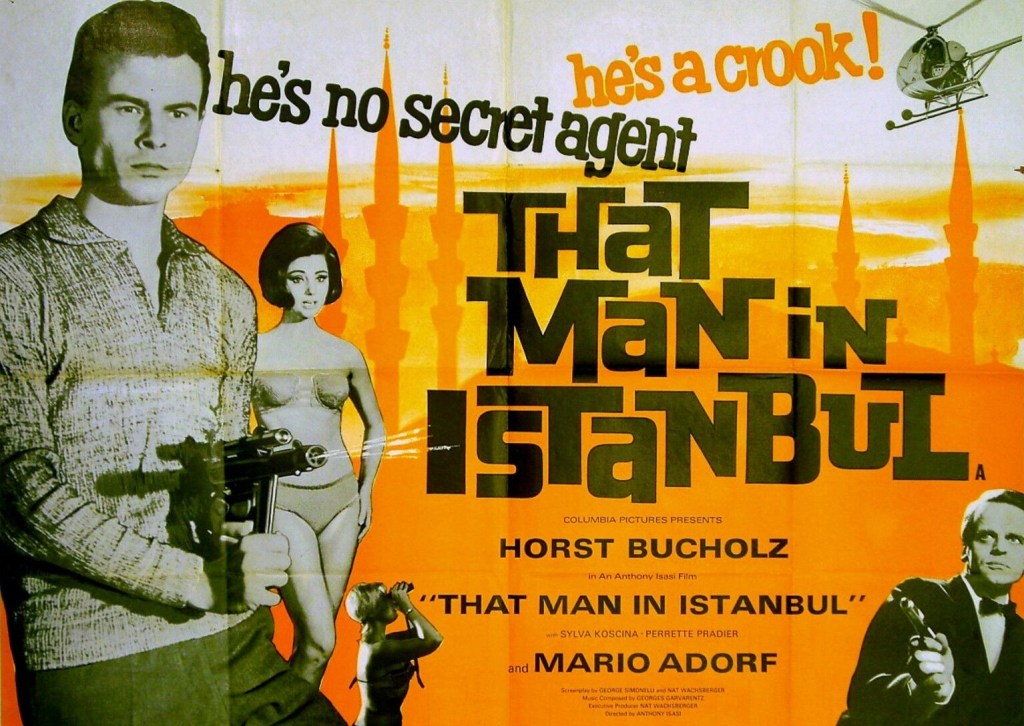
Sitting Target (1972) ****

Forms a neat trilogy with British Noir New Wave gangster pictures Get Carter (1971) and Villain (1971) both with topline stars attached in the form of Michael Caine and Richard Burton. Laden with atmosphere and intrigue, this carries hefty emotional power as a very tough guy struggles to show his gentler side. The moral of the story is that brains always trump brawn. And it’s one of these movies where the truth only unravels when you hit the twist at the end and every character is shown in quite a different light.

Like Get Carter, this is a revenge picture. Discovering girlfriend Pat (Jill St John) is pregnant by another guy, imprisoned bankrobber Harry (Oliver Reed), serving a 15-year stretch for murder, is turned into a “lethal weapon” by the very thought and determines to break out and kill her. And at the same time collect the loot from his last bank robbery.
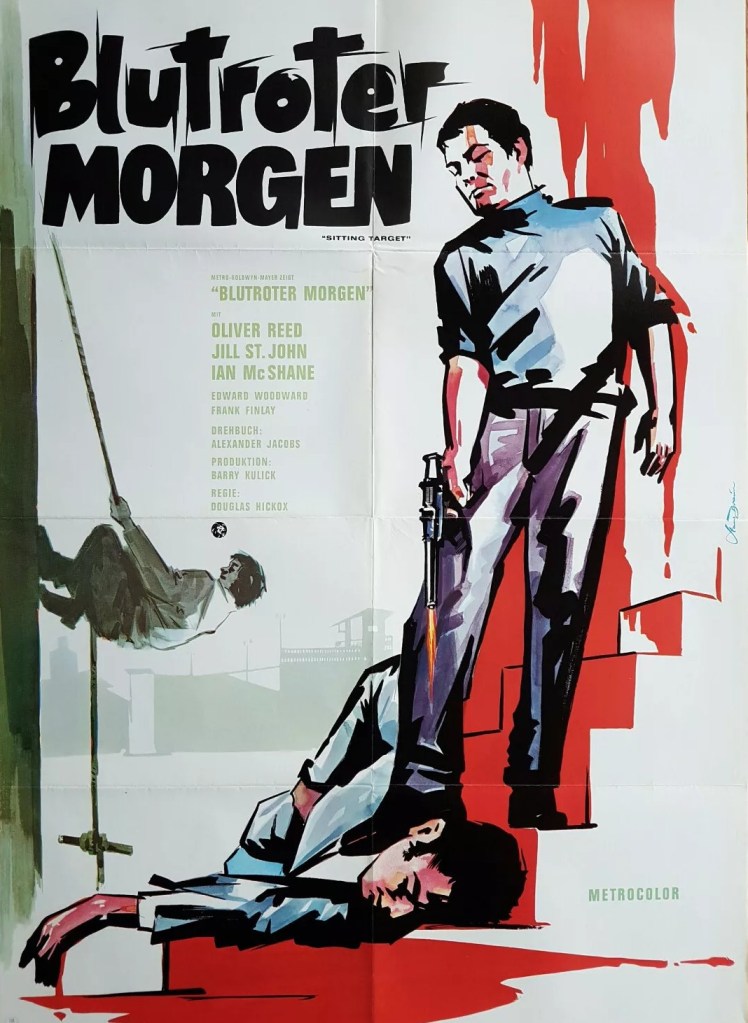
His escape, masterminded by the gentlemanly MacNeil (Freddie Jones) and accompanied by long-time buddy Birdy (Ian MacShane), is a tense, exciting sequence. First stop outside is to strongarm another gangster into supplying a Mauser that can be turned, a la Day of the Jackal, into a long-range rifle.

And while the movie brings into play the standard trope of villains seeking their share of the loot, it also hangs on another standard wheeze of the 1960s B-picture of the woman as bait. Anticipating that Harry will make a beeline for his loved one, but unaware of his nefarious intent, Inspector Milton (Edward Woodward) has her under police guard. But the likes of Harry always finds a way to sneak in, which triggers police pursuit, in the course of which Harry commits the unpardonable crime of shooting a cop – the villain world only too aware of the severe repercussions.

There’s a stop-off at the apartment of the moll (Jill Townsend) of Mr Big, Marty (Frank Finlay). That doesn’t go as planned, but still they manage to uncover a hidden sack of cash leaving Harry to knock off, sharpshooter style, the unfaithful girlfriend.

And then the pair make a getaway….Not quite. Birdy turns out to be greedy and wants all the robbery cash for himself and attempts to shoot Harry. That would be enough of a twist to be getting on with but there are a few stingers to come. Pat’s not dead – Harry (too far away to identify  her face) just shot a policewoman on protection duty standing in her window. Pat’s not  pregnant either, just stuffed a cushion down her jumper to complete the pretense. And she and Birdy are an item. And it’s clear that Birdy simply purloined Harry’s rage to get him to do the dirty work involved in the escape and dealing with the other gangsters.

Except in the case of being willing to knock off his longtime business partner, Birdy, you see has always been averse to violence, cowardly not to put too fine a point on it, though quite capable of pouring a bowl of urine down a captured guard’s throat, or rape.

Villains are as conflicted as anyone else, otherwise how to explain that Harry climbs into the burning car containing his dead girlfriend, gives Pat a gentle kiss and waits for the car to explode and take him to a fiery grave. We’ve seen the softer side of Harry in flashes. He turns down the chance to bed a sex worker in the getaway lorry, doesn’t take advantage of the moll, and buries his face in the moll’s fur coat. The furthest he gets to expressing his feelings is to explain to Birdy that he was very happy with Pat. He’s almost – perish the thought – got a feminist side. And presumably it takes a lot for a tough gangster like him to open up to a woman, which explains why he takes her betrayal so badly.
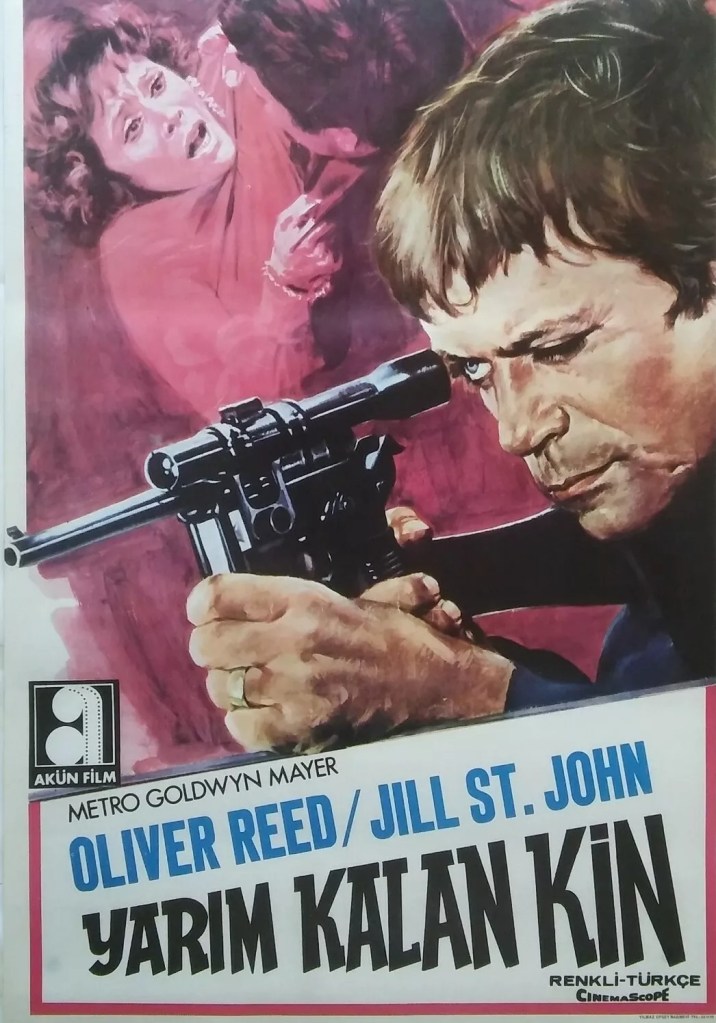
The fact that he still kills her is somehow beside the point. As I said, gangsters are complex, witness the gay Richard Burton in Villain.

This is Ian MacShane (The Wild and the Willing, 1962) still in matinee idol mode, minus the gravitas and husky tones of John Wick (2014). Once the twists kick in, you look back and realize he’s stolen the film, a weaselly charmer, able to bend Harry (not that hard, mind you) to his will, which was to help him escape, lead him to the money and send him off to live happily ever after with Pat. Where Harry clearly believes in true love, Birdy has no moral scruples. Even with a beauty like Pat waiting for him, he’s happy to indulge in sex with the sex worker and help himself to the helpless moll. (MacShane was equally dubious in Villain).

Oliver Reed’s Thug we’ve seen countless times before, Oliver Reed’s Softie less so. Jill St John (Tony Rome, 1967) manages a British accent and proves herself capable of a better  role than usual. Actors often say they build up a character from their walk. Watch Edward Woodward (The Wicker Man, 1973) for a classic example of it.

Douglas Hickox had essayed delicate romance via his debut Les Bicyclettes des Belsize (1968) and it’s to his credit that he touches on Harry’s sensitivity in such subtle fashion. Otherwise, some terrific standout sequences – Harry’s fist battering through the glass into the prisoner’s visiting room, the escape, the duel with motorcycle cops through a fog of washing strung out on lines, the final car chase.

Written by Alexander Jacobs (Point Blank, 1967) from the bestseller by Lawrence Henderson. Superb score by Stanley Myers.

Not quite in the league of Get Carter or Villain but not far short.
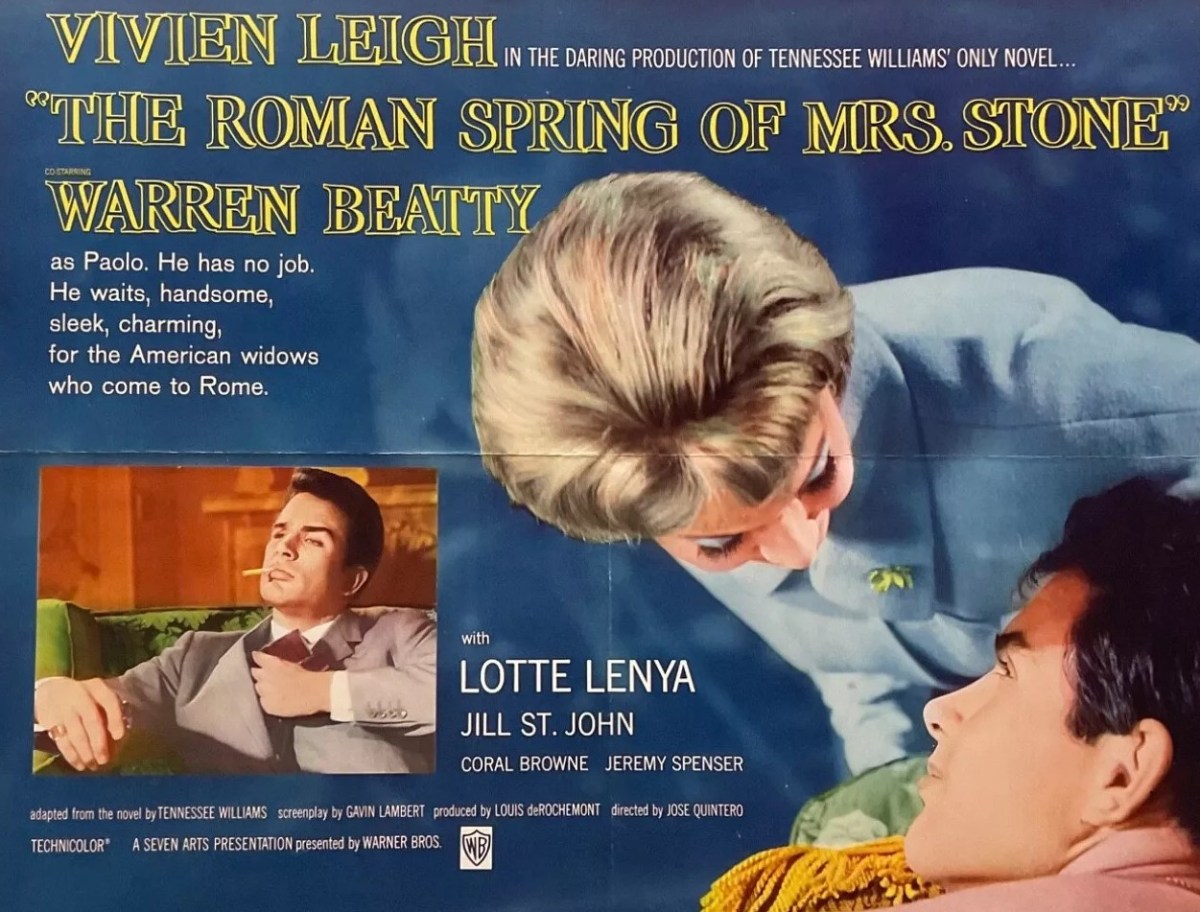
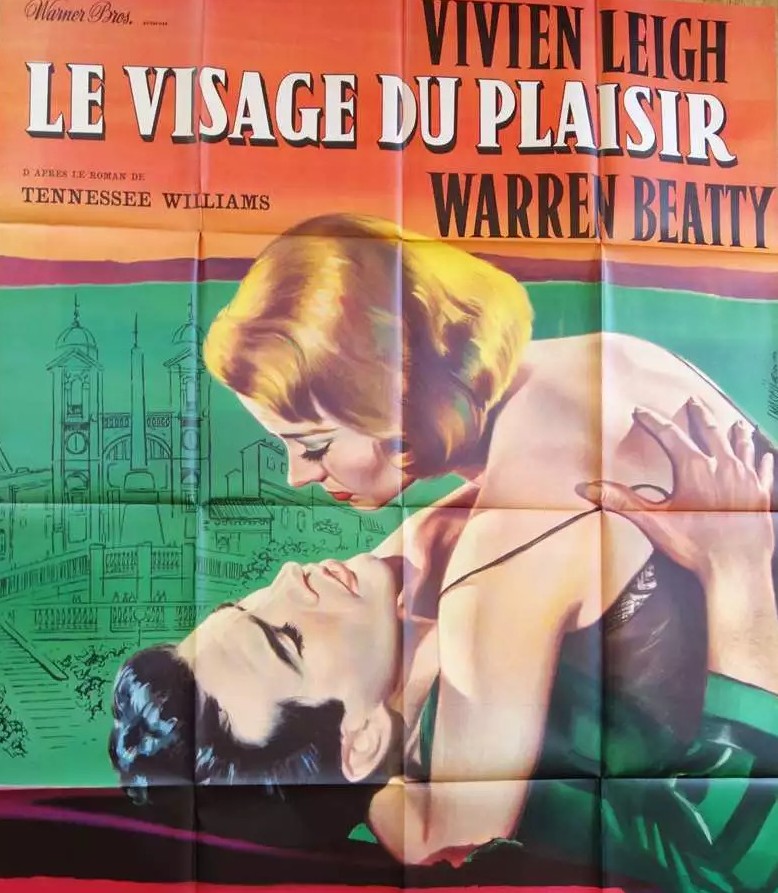
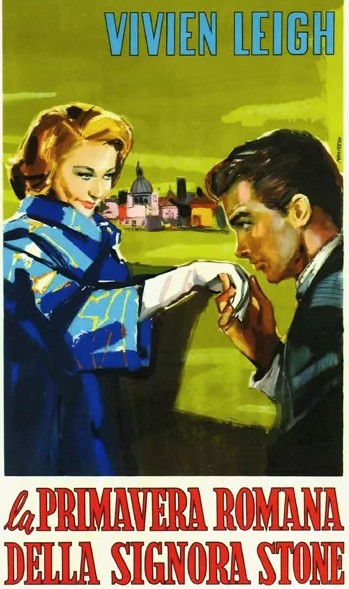
The Roman Spring of Mrs Stone (1961) **

Dreary miscalculation. Ever since Tennessee Williams hit a home run with Cat on a Hot Tin Roof (1958), studios, directors and stars had clamored for his works, so much so that Hollywood had greenlit seven adaptations in five years. While box office was one consideration, the playwright was catnip to the Oscar, racking up 17 nominations with a hefty number in the Best Actress category.

However you dressed it up, his work contained a substantial number of portraits of sadness and malevolence and often teetered on the murky, so making them work at all depended not just on the acting and direction, but the initial story. Rather than being based on a play, this was sourced from his first novel, a bestseller.

But the tale never shifts out of first gear and it’s difficult to summon up sympathy never mind interest in any of the characters. The middle-aged romance had proved a cumbersome fix for studios, and since May-December numbers featuring ageing male and younger female had proved popular, Cary Grant set up with an endless supply of woman nearly half his age, it seemed only fair to give middle-aged actresses the opportunity to romance younger men.

Usually, however, this followed a more straightforward path, involving genuine feelings on both sides. But Hollywood was also digging into another cesspit, the female sex worker, somewhat dressed up in Butterfield 8 (1960) and Go Naked in the World (1961), treated more straightforwardly in Never on Sunday (1960) and Girl of the Night. So it only seemed fair to introduce the gigolo.

Stage actress Karen Stone (Vivien Leigh) heads for Rome with her wealthy husband to recover from the failure of her latest play, a Shakespearian outing. When her husband dies on the plane, Karen decides to hang on in the Italian capital, which, after a year, brings her into the orbit of gigolo Paulo (Warren Beatty) and his unscrupulous mentor/manager Contessa Magda (Lotte Lenya). While Karen isn’t entirely a dupe and quickly sees through Paulo, nonetheless a year of loneliness has taken its toll.

Plus she understands the attraction of the older lover, her husband being a good two decades older and willing to subsidize her theatrical and cinematic ambitions. Despite not falling for Paulo’s more obvious con tricks, Karen finds herself enmeshed in a one-sided romance, ignoring the warnings of friend Meg (Coral Brown) on the dangers of becoming the talk of the town with her lover clearly more attracted to rising movie star Barbara (Jill St John). Paulo quickly dumps the Contessa, leaving her free to pour bile into Karen’s ear.

Inevitably, the younger lover tires of the older, but generally such pairings work well enough because initially at least there is attraction on both sides. But when it’s as lop-sided as this no amount of long drawn-out close-ups of the disenchanted provide sufficient compensation for a story that overstays its welcome.

While there are hints of the decadence of La Dolce Vita (1960) that Fellini explored, here it’s more of a surface examination until the surprising ending, where you would think Karen is doing little more than willingly opening the door to a potential serial killer.

The only redeeming element, which might reverberate more easily today, is of the woman demonstrating her independence by being the one to choose, and to some extent discard, the man. While not for most of the movie a sexual predator, she may well have turned into one at the end.

Oscar-winner Vivien Leigh, in her first movie in six years, essays her role well but is compromised by portraying a character that fails to elicit sympathy. Warren Beatty (Promise Her Anything, 1966) avoids the trap of thickening his Italian accent and going wild with the gestures which lends his character more of a thoughtful personality but there’s not much here to write home about. Lotte Lenya (From Russia with Love, 1963) steals the show and was rewarded with an Oscar nomination. Jill St John (Tender Is the Night, 1962) plays the ingénue like an ingénue.

Unless you’re a student of theater I doubt if you’ll have come across Panamian director Jose Quintero. This was his only movie and he was more famous for staging some of Williams’ plays and for resurrecting Eugene O’Neill on Broadway. His inexperience shows in lingering on faces at the expense of creating drama. Gavin Lambert (Inside Daisy Clover, 1965) adapted the novel.

Disappointment.

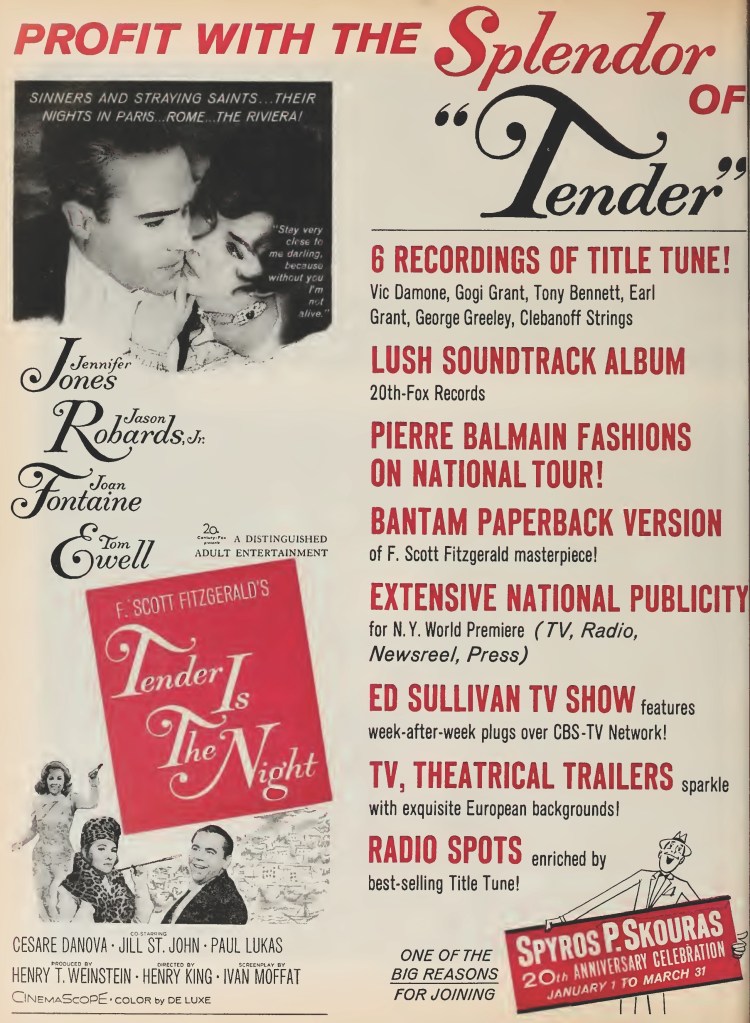
Tender Is the Night (1962) ***

Hollywood hadn’t had much luck with F. Scott Fitzgerald, now considered one of the three American literary geniuses of the 20th century along with Nobel prize-winners Ernest Hemingway and William Faulkner. His novel The Great Gatsby has easily proven the century’s best-read literary novel. He was an alcoholic wastrel when in the employ of studios, in the latter stages of his life. Although The Great Gatsby had been filmed twice, in 1926 with Warner Baxter and 1949 with Alan Ladd, both versions had flopped.

His biggest seller, debut novel The Beautiful and the Damned (1922) didn’t hit the box office mark either. The Last Time I Saw Paris (1954), based on one of his short stories and starring Elizabeth Taylor, and a modest success, didn’t inspire Hollywood and it took Beloved Infidel, the memoir of his lover, gossip columnist Sheilah Graham, to kickstart further interest. But the film of that book, even with top marquee name Gregory peck, died at the box office in 1959.

So, whatever way you cut it, Twentieth Century Fox was taking a serious gamble – the budget was $3.9 million – trying to mount Tender Is the Night especially with such questionable stars. It was a comeback for Jennifer Jones, at one time a solid performer at the box office and an Oscar-winner besides. But she had been out of the business for five years, a lifetime in Hollywood terms. Male lead Jason Robards was virtually a movie unknown. This was his sophomore outing and his debut By Love Possessed (1961) had flopped. How much his Broadway prowess would attract audiences outside the Big Apple was anyone’s guess.

But Oscar-nominated director Henry King (Beloved Infidel) who had helmed Jones’s breakthrough picture Song of Bernadette (1944) clearly thought he was on to a winner because this had the slow and stately feel – running time close on two-and-a-half-hours – of a movie that’s never going to run out of breath never mind pick up a head of steam.

Truth is, it’s slow to the point of being ponderous. Takes an age to set up the story. Psychiatrist Dr Dick Diver (Jason Robards) living with ex-patient wife Nicole (Jennifer Jones) – an arrangement that would be professionally frowned upon these days – in the French Riviera in the 1920s host a party where the husband takes a shine to Rosemary (Jill St John) and the wife shows she has not shaken off her mental malady. Despite there not being a great deal of actual period detail, we spend a long time at the party as various permutations take shape.

Then we dip into a long flashback to find out how we got here, mostly consisting of Dick falling in love with his patient, abandoning his career  to enjoy a hedonistic lifestyle funded by Nicole’s wealthy sister Baby Warren (Joan Fontaine). There’s a stack of gloss. We swap the South of France for Paris and Switzerland and we’re hopping in and out of posh restaurants and hotels and the kind of railway trains that for the rich never meant a draughty carriage and hard seats.

Basically, it’s the tale of a disintegrating marriage – one that would have been better avoided in the first place as most of the audience would have pointed out – and falls into one of those cases of repetitive emotional injury. Clearly, living on his wife’s sister’s money renders Dick impotent, compounded by the loss of peer regard.

Jennifer Jones (The Idol, 1966) is pretty good, essaying a wide variety of moods, flighty, whimsical, and stubborn, exhibiting the kind of nervous energy that was implicit in her illness and which he managed to tamp down but not fully control. Jason Robards is basically on the receiving end of a character he knows only too well, and he is simply worn down by the force of her personality. So, he can’t come across as anything but pathetic, especially when he wishes to succumb to the temptations of the likes of Rosemary.

For all the strength of his usual screen persona, Robards is miscast. He doesn’t command as he needs to in order for the film to work and for the audience to sympathize with his downfall. At this stage of her career, Jennifer Jones was so far more accomplished it doesn’t take much, even when she’s not letting fly, for her to hog the screen at the expense of a balanced drama. There’s a twist in the tale but by the time that comes we couldn’t care less.

In a less showy role than was her norm, Jill St John (Banning, 1967) is effective.

Ivan Moffat (The Heroes of Telemark, 1965) wrote the screenplay. A box office disaster, it only hauled in $1.25 million in U.S. rentals. Henry King didn’t direct another picture.

Trimmed by 30 minutes, this would have been more effective.

Tony Rome (1967) ***

Effervescent mystery punching a hole in the traditional private eye caper. Look elsewhere for film noir as Frank Sinatra (The Manchurian Candidate, 1962) reinvents his screen persona. On the one hand he’s such a cool cat, living on a boat in Miami, you half expect him to burst into song just with joy. On the other hand, you wouldn’t cross him. Corpses tend to pile up in his vicinity.

There’s a surprising self-awareness that’s dealt with through considerable subtlety, not with the usual angst of film noir where flaws not only tend to be magnified but spill over and drench the plot. Addicted to gambling, Rome steers clear of marriage and any long-term relationship, knowing such a move would be disastrous for the other party. A former cop, he is touchy though about his father, also a cop, who blew his brains out when some murky deal went wrong.

High on the glamorous side, houses the sizes of small cities, women parading in either next to nothing or with the current year’s hot fashion items. You’d be surprised there wasn’t a horse-riding scene, or one set at a hi-hat ball. But this is pretty much a procedural as the canny detective probes the low life as much as the high, bars where go-go dancing is the least of the illicit activities, jewellers who act as fences, and plumbs the life of millionaire Rudolph (Simon Oakland), tough on the business side, dumb as donuts when it comes to romance with former cocktail waitress (a profession often bracketed with quote marks) wife Rita (Gena Rowlands).

And oddly enough, romance here turns out to be touching, sex coming with responsibility rather than a free-for-all as you are initially led to believe. A lesbian scene for once is not exploitative.

Begins with one of the humdrum cases that must consume the bulk of a gumshoe’s time – the hunt for a valuable diamond brooch, lost from the dress of married drunken heiress Diana (Sue Lyon). Turns out he’s not the only one, inexplicably, looking. He takes a beating from a couple of hoods.

When his ex-partner meets his maker in a bathtub, it’s a cinch Tony Rome is next, which means he has a lot of explaining to do to his endlessly frustrated ex-colleague Lt Santini (Richard Conte). If it was a question of whiling away the time, Rome could spend it in the arms of Diana or multiple divorcee Anne (Jill St John).

As you might expect, everyone has secrets they prefer to keep hidden, and happy to do so with violence. Otherwise, they’re going to be knocked sideways by the past. There’s no shortage of suspects including the elusive Nimmo.

I’m assuming the censor enjoyed a chuckle when Mrs Schuyler (Templeton Fox) appeared rather than pursing their lips in disapproval at the way Sinatra wrapped his lips around the word “pussy.” There’s a certain amount of light-hearted sexual jousting but if you were looking for predatory behavior it’s women you’d point the finger at, though given a free pass since in Miami, apparently, men were vastly outnumbered by men and lasses who had not developed a come-hither would be left on the sidelines.

To properly appreciate the picture, you’d have to cast your mind back to a time before there was a surfeit of television detectives and when the general mystery picture (also encompassing spy movies) had gone AWOL or awry with balderdash plot and outsize villains whose only satisfaction in life was holding the world to ransom. In fact, in retrospect, it’s refreshing to find a picture where the director doesn’t pull the wool over your eyes and your hero isn’t an arrogant preening bantam.

So what you’ve got is a properly-plotted plot, clues aplenty that only our clever private eye can unravel, and, inevitably, in the Raymond Chandler tradition some heavy bursting through a door with a gun, and, in this case, also a shovel. This private dick doesn’t fall into the hard-working category of legend, often favors a Bud over the harder stuff, and though he can knock out the cynical one-liners they often come with a tinge of truth or melancholy.

And for once the MacGuffin (Maltese falcon might be a more apt reference) bears significance to the plot.

One of the interminable pot-shots critics took at Sinatra was his preference for working in a single take, the impression given that he was a lazy sod and a bit more effort would have resulted in a better performance. On the other hand, you could just be in awe of an actor who can hit the button stone dead in a single take.

Co-star Gena Rowlands, with something of a hard-boiled reputation herself, found him to be a “wonderful actor; he could do a whole complicated scene in one take…there was nothing pretentious about him, he was just awfully nice.”

Sinatra is no Bogart but for a time afterwards audience were saying of other pretenders to the shamus crown “he’s no Sinatra.” Jill St John (The King’s Pirate, 1967) makes the most of a more interesting part, including delivering the stinger in the tale. Gena Rowlands (Machine Gun McCain, 1969) reveals the little girl under the glam,  Richard Conte (The Lady in Cement, 1969) tones down his typical belligerence, Sue Lyon (Night of the Iguana, 1964) good as a young woman confused by sudden wealth.

The under-rated Gordon Douglas (Stagecoach, 1966) directed from a script by Richard L. Breen (A Man Could Get Killed, 1966) and Marvin H. Albert (Duel at Diablo, 1966), also author of the source novel.

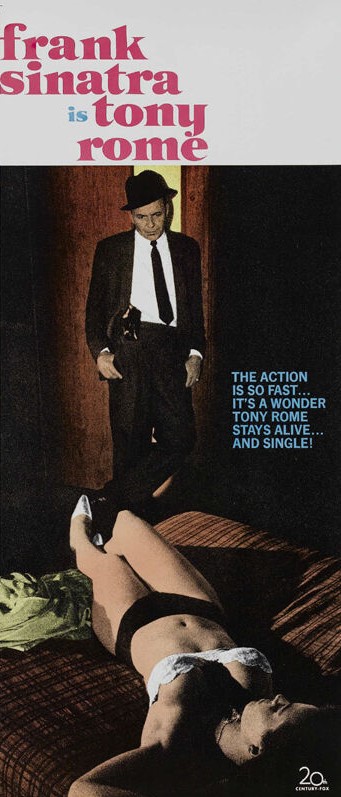
The poster designer pulled a fat one. In typical titillating fashion, you think Sinatra is staring down at a half-naked corpse. But, in fact, no female was harmed in this picture.

Takes a little while to get going but once it hots up it’s perfect entertainment.

The Oscar (1966) ****

Don’t you just love a really good bad movie? Where redemptive character is outlawed. When over-acting is the key. In which everyone gets the chance to spout off about someone else, generally to their face, and then is permitted, in the cause of balance, a quiet moment of bitter self-reflection. And even the most minor character gets a zinger of a line. Welcome to Hollywood.

Tale of an actor’s rise and not exactly fall because we leave Frank Fane (Stephen Boyd) at a pinnacle of his career, though, don’t you know, he’s empty inside and deserted by all his faithful companions. Lucky Frank has some kind of charisma or that he just fastens onto losers who see in him what they need because from the outset he is one mean hombre, living off stripper girlfriend Laurel (Jill St John), so dumb she switched to him from his so dependable best pal Hymie (Tony Bennett – yes, that Tony Bennett, the singer).

He hooks up with Kay (Elke Sommer), a designer who happens as a sideline to make costumes for off-Broadway productions. When King of Lowlife Punks Frank shows a pusillanimous stage actor what you do in a knife fight he strikes a chord with theater producer Sophie (Eleanor Parker), who happens to have a sideline as a talent scout for the movies.

She fixes him up with an agent Kappy (Milton Berle – yes that Milton Berle, the loudmouth comedian) and together they sell him to studio boss Regan (Joseph Cotten). The only good deed Frank does in the entire movie is to stand witness – not for marriage, but for divorce – for an ordinary couple, private detective Barney (Ernest Borgnine) and Trina (Edie Adams), he meets at a bullfight, huge fans, and thank goodness that action comes back to bite him.

The picture goes haywire in the third act. Fane’s career is crumbling in the face of audience indifference, exhibitor displeasure and, don’t you know it, a chance for revenge for Regan, who was stiffed in a previous contract. But instead of taking the traditional tumble into the forgotten category, his career is revived by an Oscar nomination.

From top to bottom – a fully-clothed Stephen Boyd, then in various states of undress, Elke Sommer, Jill St John and Eleanor Parker. That’s how to sell a picture apparently.

But that’s not enough for the ruthless Fane. Earlier in his life a corrupt sheriff had stuck him with charges of pimping. Using Barney, who seems to have the ear of the media, he plants a story about himself, hoping that Hollywood being the cesspool it is, everyone will assume one of his rivals did the dirty. “I can’t rig the votes,” rationalizes our poor hero,”  but I can rig the emotions of the voters.”

What a scam. I was chortling all the way through this section and almost laughing out loud when it transpires Frank had misjudged how deep the cesspool is, because Barney then blackmails him. This gives everyone he has treated heinously over the years the chance to stick it to him. Nobody will lend him the dough to get this grinning monkey off his back. Salvation comes in the oldest of Hollywood maneuvers. Trina, who has always wanted to get into pictures, and is the kind of person who embodies A Grievance Too Far, supplies the information that will sink her ex-husband, in exchange for Frank using his influence to get her a small role.

There’s a brilliant climax. I should have said spoilers abound but I can’t resist telling you the ending it’s such a cracker. So there is Frank at the Oscars with Bob Hope (yes, that Bob Hope) as master of ceremonies and the audience studded with real stars like Frank Sinatra (yes, that…). Like an evil chorus – you can almost hear them hissing under their breath and they all fix him with baleful looks – are all those he treated badly.

The winner is announced. “Frank…” Assuming victory, Fane gets to his feet. “Sinatra.” The only way he can rescue his embarrassment is to make it look as he is giving the winner a standing ovation. But when the rest of the audience follows suit, he slumps to his chair, and in the only true cinematic moment in all the sturm and drang the camera pulls back from him sitting bitter, twisted and defeated in his seat.

Stephen Boyd (Shalako, 1969) is terrific because even when he was top-billed he tended to over-act and when he became a co-star or supporting player he was an inveterate scene-stealer, of the sharp intake of breath / vicious tongued variety. Here he shows both his charming and venomous side. If he was playing a gangster he couldn’t be more menacing – or charismatic. It’s a peach of a role – he can dish it out, dump women at will, and still embrace victimhood as “170lb of meat.”

Luckily, most of the rest of the cast take the subtle route. Although all disporting in various negligible outfits at one time or another, Jill St John (The Liquidator, 1965), Elke Sommer (The Prize, 1963) and Eleanor Parker (Eye of the Cat, 1969) and giving Frank his comeuppance wherever possible – St John slings him out – the performances are generally nuanced, Parker in particular evoking sympathy.

Tony Bennett is miscast, especially as he has to do double duty as an unwelcome voice-over, filling in bits of the narrative that, thankfully, has been skipped. But Milton Berle is pretty good as  a quiet-spoken agent.

In the over-the-top stakes, Boyd has his work cut out to hold his own in scenes with Ernest Borgnine (The Wild Bunch, 1969) who revels in his scam, and Edie Adams (The Honey Pot, 1967) who is anything but a dumb blonde and delivers the most stinging of zingers.

Doesn’t tell us anything we didn’t know about Hollywood except in one delicious scene where, early in his career, Frank has to squire around a female star who relishes putting him in his place.

It’s not badly made just pell-mell and over-the-top. Russell Rouse (The Caper of the Golden Bulls, 1967) directs from a screenplay by himself and Harlan Ellison (yes that Harlan Ellison, the sci fi author) from the bestseller by Robert Sale.

An absolute hoot.   

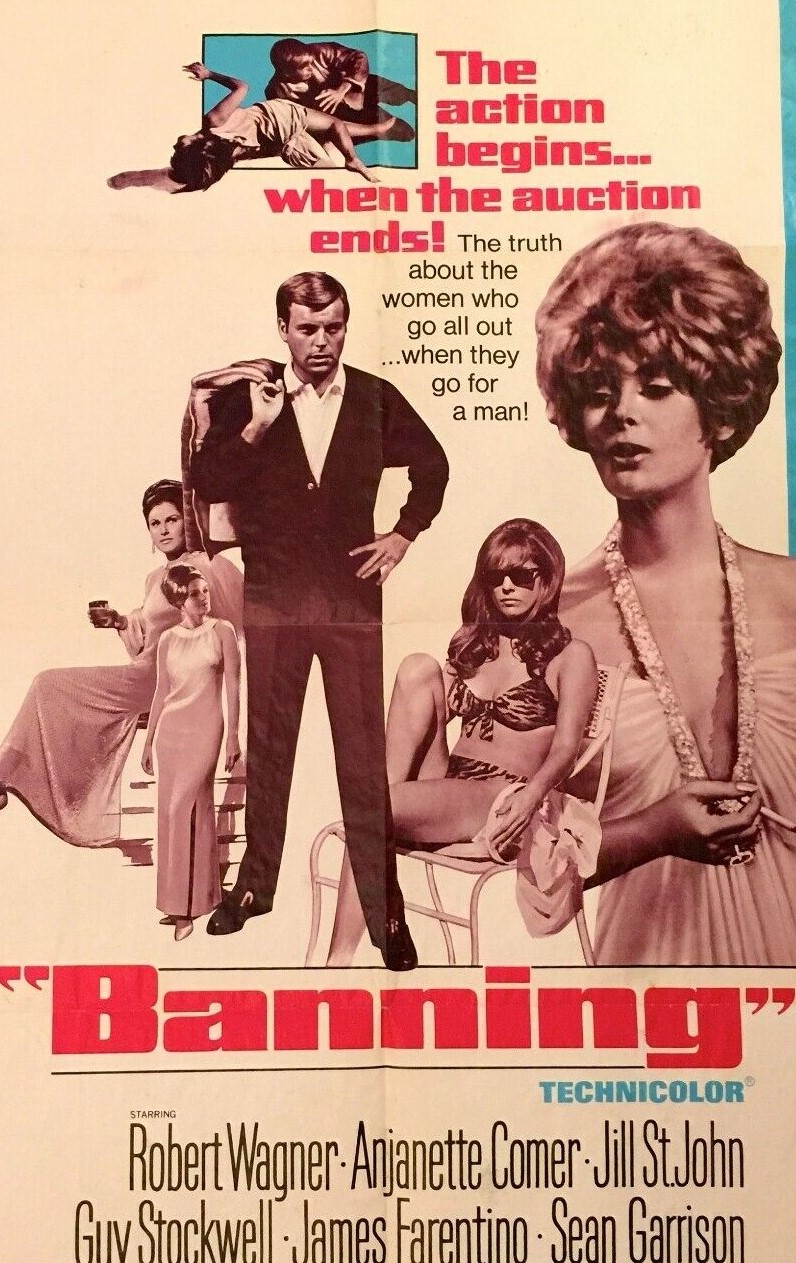
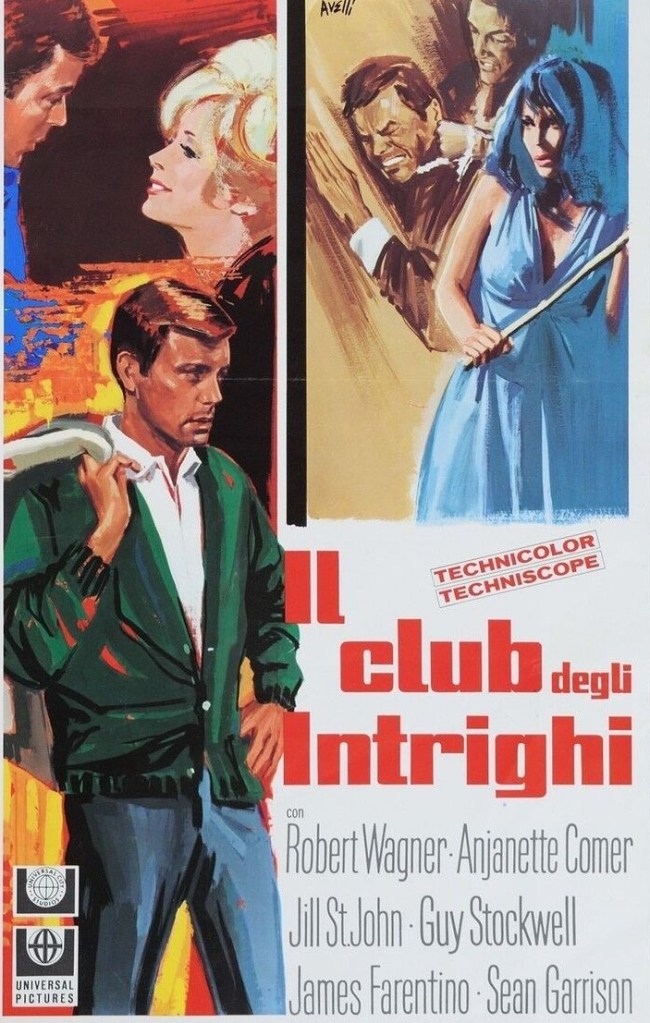
Banning (1967) ***

Robert Wagner’s bid for stardom is scuppered by a limp plot set in the overheated world of the country club set where a posse of sexually predatory women operate. It doesn’t help that the main narrative thrust finds trouble just hanging in there.

Ex-professional golfer Banning (Robert Wagner), a “moral diabetic” on the run from a loan shark, pitches up at an upmarket country club where he finds work as the assistant golf pro to Jonathan (Guy Stockwell). His most arduous task appears to be picking his way between the toned bikini-ed bodies lounging around the pool and avoiding the advances of Angela (Jill St John) and Jonathan’s wife Cynthia (Susan Clark) while coming on strong to overpaid secretary Carol (Anjanette Comer).

There’s an element of Life at the Top (1965) here, with Jonathan married to the boss’s daughter, resenting their close relationship while not making the executive advances he would like. Every now and then bits of what sound like a complicated past implicating Jonathan and the alcoholic Tommy Del Gaddo (Gene Hackman) pop up and around the halfway mark a subplot kicks in, involving something called a “Calcutta,” a golf tourney which looks like it’s being rigged.

Given that it’s organised by a club boss (Howard St John) who claims every gimme going and feigns drunkenness to skin members at poker, it’s almost a given that Banning is going to come out worst. I have to tell you you probably couldn’t care less, since most of the action, and all of the fun, is off course, and not so much in the bedroom stakes as the war between women for available men.

“I bought you,” purrs Angela in her  most seductive attire after she has made it possible for Banning to find a way to pay off his debts. “I want you,” snaps single mother Carol, making a forthright play after spending most of the picture fending off his advances. Standing on the side-lines, watching Angela making her moves, Cynthia observes, “I’d say Angela’s had at least a dozen husbands,” pause for the punchline, “including mine for all I know.”

Predatory moves are not all one way. Turns out the price Carol pays for a salary five times the going rate and a nice house and private schooling for her daughter is setting aside Thursday afternoons for Jonathan. But in the pragmatic manner that appears inbred in the country club, she states, “No apologies, no excuses.”

And before Carol works out just how attractive Banning actually is she had to cut him dead a couple of times and, in a scene guaranteed to put off the modern audience, prevent him drunkenly raping her. It was almost a throwback to the 1940s and 1950s when, it appeared, a woman just needed a good smack on the chops before she could submit and start billing and cooing.

Robert Wagner (The Biggest Bundle of Them All, 1968), tanned within an inch of his life, doesn’t so much miss the target as not being given a target worth hitting. There’s very little sense danger, of a man on the run from the mob or whichever gangster has picked up the tab for his debt, and he’s not a lounge lizard. Acting-wise, he relies on a raised eyebrow, an eye swivel and that scene-stealing trick, copyright Robert Vaughn, of raising his lowered head to open his closed eyes, a neat device for a supporting star but hardly required when you are top-billed.

Anjanette Comer (Guns for San Sebastian, 1968) doesn’t snatch the brass ring either, relying on a tremulous lower lip to evoke emotion. In fact, it’s a toss-up between the classier Jill St John (The King’s Pirate, 1967) and Susan Clark (Tell Them Willie Boy Is Here, 1969) as to who steals the most scenes, both winging it with striking dialog, emanating power, regarding men as weak and playthings.

Gene Hackman (Lilith, 1964), generally a prime contender for scene stealing, especially with trademark chuckle now in full swing, unfortunately does himself no favors by over-acting.  You might also spot James Farentino (Rosie, 1967) and Sean Garrison (Moment to Moment, 1966).

Ron Winston (Ambush Bay, 1966) directed from a screenplay by James Lee (Counterpoint, 1967). It would have worked better to concentrate more on the bitchy women than the sub-plots.

I’m sorry to say you’ll have a hard job finding this since I purchased my DVD on the second-hand market. Worth the hunt if you’re a fan of St John and Clark or to discover why Wagner’s promising screen career never took off.

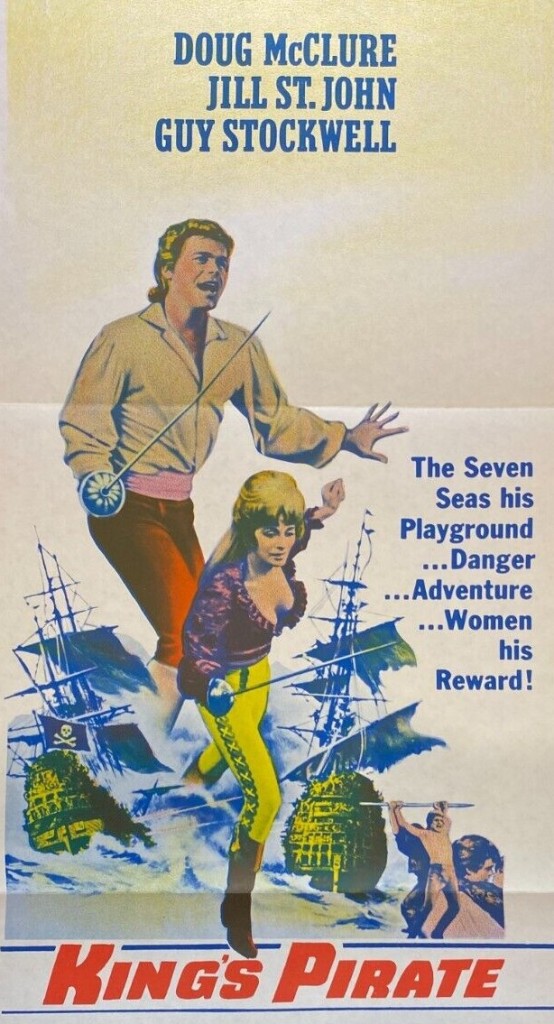
King’s Pirate (1967) ****

Swell show. Virtually every movie Doug McClure (Beau Geste, 1966) made was under-rated, mostly due to his presence, but here he is at his impish cavalier best in a swashbuckler that rather than offering a re-tread goes in for clever reversals, running jokes and a healthy dose of the flashing blade. While McClure is no Errol Flynn (Against All Flags, 1952) he would be a safe match for Tyrone Power and Jill St John (Come Blow Your Horn, 1963) as his nemesis/lover could give the pirate picture’s most reliable spitfire, Maureen O’Hara (Against All Flags), a run for her money.

Well, actually, it is a bit of a re-tread, a spirited good-humored remake of Against All Flags, and  follows the same story as Pirates of Tortuga (1961) of good guy infiltrating a pirate stronghold by pretending to be a buccaneer. But the locale has shifted a good three thousand miles to Madagascar, ideally placed to plunder cargo ships en route to India, and it would be hard to argue that Lt Brian Fleming’s (Doug McClure) motivation is pure, given he is expecting major financial reward for risking his life. 

Still, to complete his disguise, he submits to a flogging. His task is to incapacitate the cannons that protect the island from Royal Navy invasion. But his team is somewhat unusual, a bunch of acrobats headed by Zucco (Kurt Kasznar) which ensures he can avoid the wall/cliff-climbing normally associated with such endeavors. Having just about convinced pirate king John Avery (Guy Stockwell), Fleming’s mission runs into trouble when Mogul’s daughter Princess Patna (Mary Ann Mobley) falls in love with him after he saves her from a burning ship, though admittedly one he had helped set on fire. He falls foul, too, of “Mistress” Jessica (Jill St John), the island’s de facto ruler and accomplished femme fatale, expert swordswoman, but a la Pirates of Tortuga with a yen to be a “lady.”

So, basically, he has to dodge the suspicious Avery, and put off the princess while trying to woo Jessica in order to find a secret map of the cannon locations.

The island’s preferred style of execution is staking men at the water’s edge and letting the rising tide do the rest. When Fleming, on initial arrival on the island, gulps at this demonstration of barbarity, you probably don’t guess this will happen to him. It’s just one a litany of reversals that make this a delight.

Talking of reversals and delights, how about the Indian princess speaking in a Scottish accent, courtesy of her governess, the fearsome Miss MacGregor (Diana Chesney)?

Not to mention Jessica’s habit of making her romantic inclinations known at gunpoint. Unusually lacking in the female ability of expressing her emotions, Jessica’s actions tend to be the opposite of her stated intention, resulting in, having given Fleming the brush-off, bidding against him in the slave market for Princess Patna to avoid the Indian lass getting her romantic claws into him. But not only is Jessica expert with the sword she is a crack shot and can shoot the end off a rapier.

Of course, when his sword can’t do the talking. Fleming has to weasel his way out of many a dicey situation with an inventiveness that would do Scheherazade proud.

All in all the best pirate film of the decade – though there wasn’t much competition. Competently made with McClure and St John striking cinematic sparks with former Miss America Mary Ann Mobley (Istanbul Express, 1968) happily cooperating in turning her character into a comedic gem.

While there’s certainly a touch of the Tony Curtis in McClure’s portrayal it is also his stab at carving out a position as a jaunty leading man. Jill St John, given a lot more to do than in most of her pictures, takes the opportunity to shine. Guy Stockwell (Beau Geste) delivers another villain.

Don Weiss (Billie, 1965) directed and does exceptionally well steering audiences away from unfulfillable expectation, given the low budget, by focusing on the qualities of the stars and a ripping tale knocked out by television comedy writer Paul Wayne, who rewrote or incorporated material from Aeneas MacKenzie and Joseph Hoffman responsible for the original.

Catch it on YouTube.

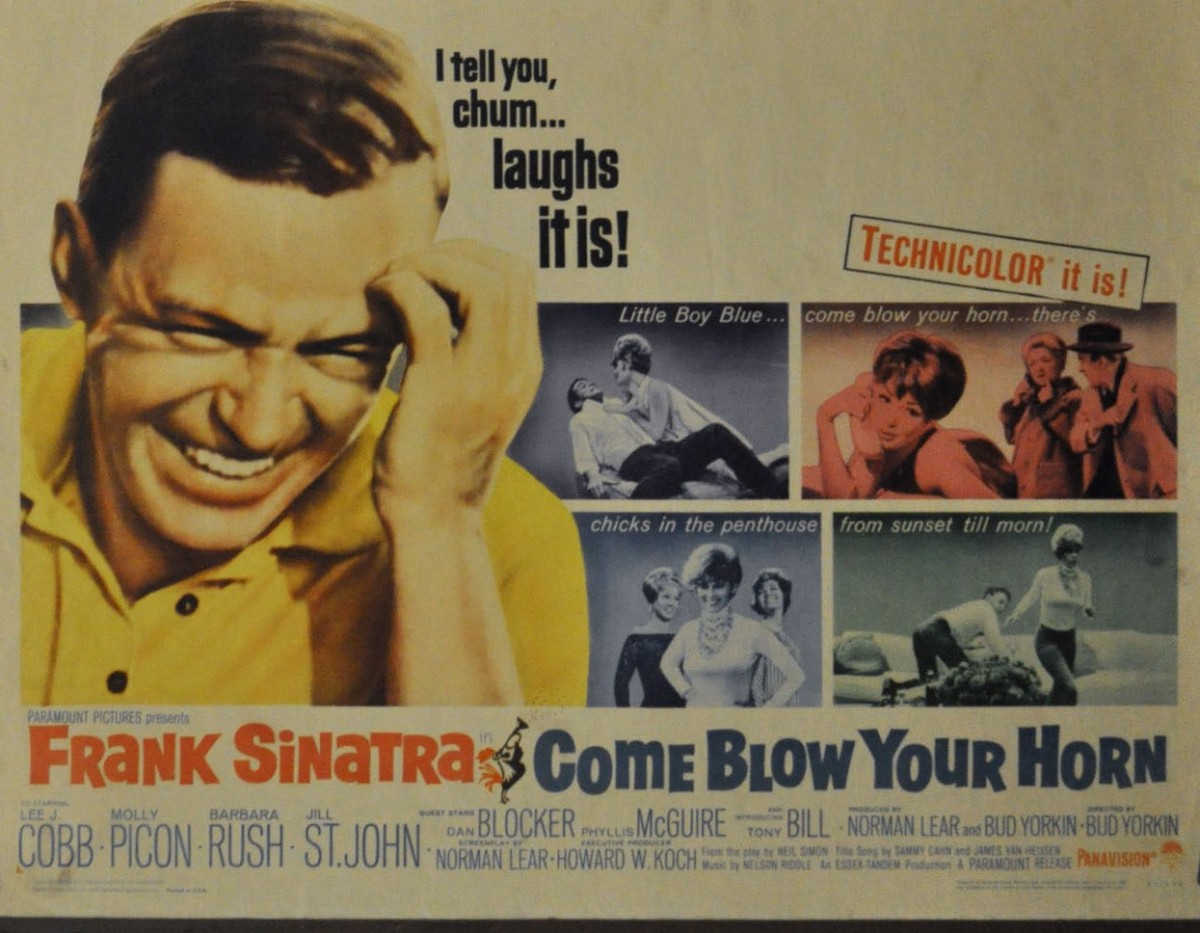
Come Blow Your Horn (1963) ***

Wonderful upbeat performance from Frank Sinatra lifts this out of a misogynistic pit where  women were either dumb, desperate to get married or passive-aggressive harridans. Bachelor playboy Alan (Frank Sinatra) has more women on a string than there is string. When younger brother Buddy (Tony Bill) moves in, Alan introduces him to the fun ways of the world, not expecting Buddy to be such an apt pupil.

Alan keeps main squeeze Connie (Barbara Rush) dangling while, pretending to have Hollywood connections, making hay with actress wannabe Peggy (Jill St John). He also keeps customer Mrs Eckman (Phyllis McGuire) sweet in transactional sex fashion and there’s no shortage of other women liable to appear out of the woodwork.

Meanwhile, his boss, apoplectic father Harry (Lee J. Cobb), goes around screaming at everyone, berating Alan for his lifestyle and moaning at harassed wife Sophie (Molly Picon). Most of the time it looks like it’s going to swerve into a more typical English farce with various women being hidden out of sight from various other woman or Harry or an equally apoplectic cuckolded husband (Dan Blocker).

But, with considerably more sophistication than that, the story takes the more interesting tack of character development. Alan, who might appear to be sitting pretty, woman at his beck and call, a glorious modern apartment, cocktails on tap, is brought up sharply by his brother’s delight at such a shallow life. Alan gets to play Hollywood honcho with Peggy while Connie delivers an ultimatum that threatens to bring Frank to his senses though, naturally, he believes it’s all hooey.

The fraternal business is well done, instead of the normal rivalry genuine affection and the older sibling offering guidance, though primarily in how to get drunk and get off with women rather than anything that might otherwise stand him in good stead. Though you might argue that being shown how to dress, and how converse with women, and organise a fun party might be as much education as a young gentleman in the Big Apple required.

The only thing better than one Frank Sinatra picture is two Frank Sinatras so to scoop up some extra cash these were paired for a speedy reissue.

Playwright Neil Simon, the toast of Broadway at this stage, exhibited such a keen sense of structure that the story never sagged. Any time that appeared a remote possibility, instead of a stranger coming in a la Raymond Chandler with a gun, it’s Harry stomping all over the place. There are some good catchphrases, genuinely funny moments, and some great lines, the best, I have to confess, from Peggy who bemoans the fact that she was stranded in a hotel room with Alan at a ski resort by all the snow outside. Redeeming factor: her homely kind of dumb serves narrative purpose, making the otherwise unbearably charming Alan come across as a heel.

This is quite a different Sinatra, like he’s channeling his record persona, none of the anguish, dramatic intensity or Rat Pack bonhomie he brought to other pictures. Often you hear of actors just playing the same character or a variation thereof, but this ain’t a Sinatra persona I’m familiar with and brings verve to the whole shebang.

Lee J. Cobb (Coogan’s Bluff, 1968) gives in to overacting. You can see how that loud style might work on the stage, but it’s less effective here. Jill St John (Tony Rome, 1967) is very good as the uncertain beauty, who could be incredibly seductive if only she could work out how, and not quite a victim either, and still managing vulnerability. Barbara Rush (Robin and the 7 Hoods, 1964) is wasted, though. Set up as a modern woman, she collapses at the first sniff of marriage, though framing her eyes in a mask of light in a taxi cab is about the only compositional mark of any note.

Quite what possessed director Bud Yorkin (Divorce American Style, 1967) to stick in the title song in the middle of the picture is anybody’s guess. Norman Lear (Divorce American Style) wrote the script but you can hardly go wrong with a Neil Simon template. 

End up: it’s mostly about family and people coming to terms with themselves and each other.

The Lost World (1960) ***

A pair of pink knee-length boots, courtesy of adventuress Jennifer (Jill St John), are among the wondrous sights awaiting our band of intrepid explorers. She’s not the only curiosity, Professor Challenger (Claude Rains) is certainly the most obstreperous of archaeologists, aristocrat Hoxton (Michael Rennie) must have a screw loose to keep on resisting the charms of Jennifer, while Gomez (Fernando Lamas) brings along his guitar to (literally) strike a chord at appropriate moments. But it’s a fun ride – cannibals, volcano, giant phosphorescent spiders, carnivorous plants, and dinosaurs.

There are secrets, too. Hoxton has been here – a lost plateau in the middle of the Amazon – before and abandoned an earlier exploration in favour of hunting for the mythical diamonds of El Dorado, Gomez wants to kill Hoxton, Jennifer plans to hook a duke, and Professor Summerlee (Richard Haydn) wants more than anything else to prove Challenger wrong.

A bit of poetic licence here by the illustrator, Jill St John’s pants staying intact throughout.

And of course, in the way of dinosaur pictures, having battled to find the damned creatures, intrepidity goes out the window and the explorers spend all their time running away from the dinosaurs, seeking a hidden way down from the plateau, while being hunted by cannibals. Any time you see a ledge you know there’s something terrible above – battling monsters with long tails capable of swishing you downwards – or below, not just a sea of lava but a giant sea beast. The only element that’s missing is the booby-traps. Unfortunately, all the spunk goes out of the otherwise spunky Jennifer when faced with monsters and she turns into the quivering screaming cliché.

But the script is on point, feelings indicated by action rather than dialogue. Having learned of Hoxton’s past, Jennifer spurns him by refusing a cigarette and a moment later taking one of her own, Gomez sneaks glances at a mysterious locket. With so much action there’s little time for romance so mainly by looks and the occasional rescue sparks fly between Jennifer and newspaperman Ed (David Hedison) and between Jennifer’s brother David (Ray Stricklyn) and the native girl (Vitina Marcus). And to alleviate the drab scenery there’s always Jennifer in a new bright outfit and, for comic effect, her poodle.

Given that writer-producer-director Irwin Allen (Voyage to the Bottom of the Sea, 1961) was unable to hire the likes of Ray Harryhausen (Jason and the Argonauts, 1963) for the special effects or even find the budget to utilize the drawings of Willis O’Brien (King Kong, 1933) who had been responsible for the stop-motion techniques in the original silent version of The Lost World (1925), the monsters come across on the small screen as acceptable enough. The infusion of sub-plots keeps the project ticking along.

Allen made significant changes to the original – introducing the diamonds, making Challenger rather than following in the footsteps of a previous explorer having previously visited the plateau but lost his proof, swapping the heroine’s pet monkey for a pet poodle, turning the heroine into a gold-digger, substituting as plateau inhabitants natives for ape men, and adding the heroine’s wardrobe. The spicing up of the story helps divert the tale in certain places from the dinosaurs, so the tension is not just waiting for the next attack.

Oddly enough, the film strikes a very contemporary note with regards to the current contentious issue of invasion of privacy. Challenger hits out at pestering journalists for what he views as the invasion of his privacy. Later on he says, “invasion of privacy gives man the right to kill,” but that bold statement relates to the explorers breaching the lost sanctuary, “we are the invaders.”  

It’s still pretty enjoyable stuff especially allowing for the budget limitations. None of the actors is called upon to do much, which is what you would expect, although Claude Rains is a surprise and Jill St John a delight. Michael Rennie  (Hotel, 1967), primarily there for his stiff-upper-lip, is provided with a neat reversal, the supposed hero with feet of clay. Claude Rains (Casablanca, 1942) is the standout as the feisty bombastic professor not above battering annoying newspapermen with his umbrella.

In an early role, Jill St John (The Liquidator, 1965) provides not just sultry evidence of her physical charms, but carries a terrific almost playful screen presence, though she’s better as the tough gal in a man’s world of the earlier section of the movie than the damsel in distress of the last part. Former Latin movie heartthrob Fernando Lamas (100 Rifles, 1969) is the only other one with a decent part, participating in the expedition to find his lost brother. Vitina Marcus (Taras Bulba, 1963) has a small but pivotal role. David Hedison (Live and Let Die, 1973) and Ray Stricklyn (Track of Thunder, 1967) are outshone by their respective amours. Jay Costa (Escape from Zahrain, 1962) is a pantomime villain.

Charles Bennett (City in the Sea, 1965) helped Irwin Allen flesh out the screenplay.

Spy Girls

If you’ve not already come across Cinema Retro magazine – now celebrating 18 years of publication –  or its various Special Issues you are in for a treat. Spy Girls fell under its “Foto Files Special Edition” portfolio and includes over 200 illustrations of the actresses who dominated the wave of espionage pictures in the 1960s and to a lesser extent the 1970s.

As well as focusing on the leading female stars in every series film – James Bond, Derek Flint, Matt Helm, Bulldog Drummond, The Man from Uncle and Harry Palmer – the magazine also pay tribute to the wide variety of starlets who appeared in bit parts such as Zena Marshall (Dr No, 1962), Aliza Gur (From Russia with Love, 1963), Shirley Eaton and Margaret Nolan (Goldfinger, 1964) Molly Peters (Thunderball, 1965) and Gila Golan (Our Man Flint, 1966).

However, in the main the concentration is on the flood of European actresses who set Hollywood agog following multiple appearances in spy pictures. Beginning with original Swiss-born Bond girl Ursula Andress (Dr No and Casino Royale, 1967, the magazine features every actress who had a starring role in the mainstream spy films. Some, of course, seemed very comfortable in the genre with roles in several pictures.

Leading that particular parade were Italian Daniela Bianchi who, after her spy debut in From Russia with Love, was seen in Slalom (1965), Operation Gold (1966), Special Mission Lady Chaplin (1966), Requiem for a Secret Agent (1966) and Operation Kid Brother (1967). Matching her was Austrian Senta Berger, caught in The Secret Ways (1961), The Spy with My Face (1965), Our Man in Marrakesh (1966), The Quiller Memorandum (1966), The Ambushers (1967) and Istanbul Express (1968).

Not far behind came Israeli Daliah Lavi who lit up the screen in The Silencers (1966), The Spy with a Cold Nose (1966), Casino Royale (1967), Nobody Runs Forever (1968) and Some Girls Do (1969). German Elke Sommer was another regular, headlining The Venetian Affair (1967), The Corrupt Ones (1967), Deadlier than the Male (1967) and The Wrecking Crew (1968.) Also a regular in the genre was Yugoslavian Sylva Koscina with Hot Enough for June/Agent 8¾ (1964), That Man in Istanbul (1965), Agent X-77 Orders to Kill (1966) and Deadlier than the Male (1967)

Canadian Beverly Adams featured three times in the Matt Helm series, in The Silencers, Murderers Row (1966) and The Ambushers (1967). Czechoslovakian Barbara Bouchet turned up in Agent for H.A.R.M (1966), Casino Royale and Danger Route (1967) and Austrian Marisa Mell had top roles in Masquerade (1965), Secret Agent Super Dragon (1966) and Danger:Diabolik (1968). Another three-peater was Rome-born Luciana Paluzzi – To Trap a Spy (1964), Thunderball (1965) and The Venetian Affair (1967) – not forgetting Swede Camilla Sparv in Murderers Row (1966), Assignment K (1968) and Nobody Runs Forever (1968).

No study on the girls involved in espionage over these two decades would be complete without mention of Raquel Welch for Fathom (1967), Monica Vitti in Modesty Blaise (1966), Honor Blackman in Goldfinger and Britt Ekland in The Man with the Golden Gun (1974). The occasional American leavened the pot – Jill St John appearing in The Liquidator (1966) and Diamonds Are Forever (1971) and Lana Wood also in the latter. 

The extensive illustrations include stills, and photographs of the stars relaxing on set or setting up a shot, as well as a veritable archive of posters from virtually every country in the world, often with substantially different artwork to the originals. In addition, articles on the main actresses are included as well as snippets of information on the lesser stars.

Priced at just £6.95 / $11.99 this might make a nice Xmas filler.

http://www.cinemaretro.com/index.php?/archives/8048-COMING-FROM-CINEMA-RETRO-SPY-GIRLS-FOTO-FILES-ISSUE-1.html

Discover WordPress

A daily selection of the best content published on WordPress, collected for you by humans who love to read.

The Atavist Magazine

by Brian Hannan

WordPress.com News

The latest news on WordPress.com and the WordPress community.