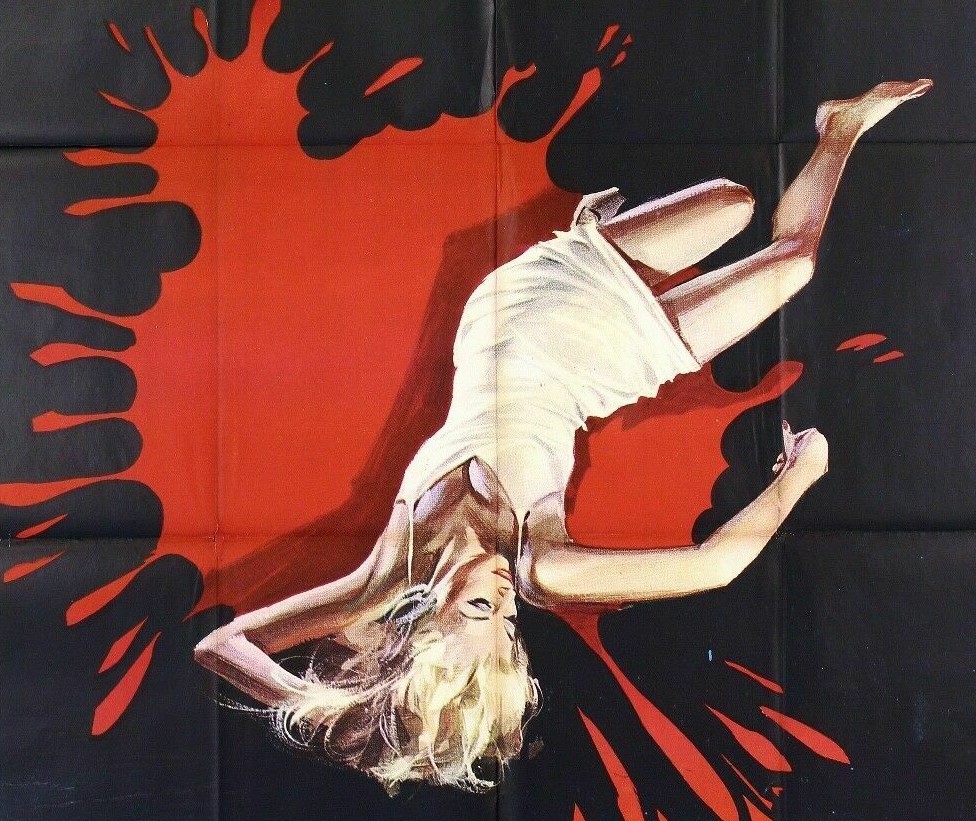
A Fine Madness (1966) **

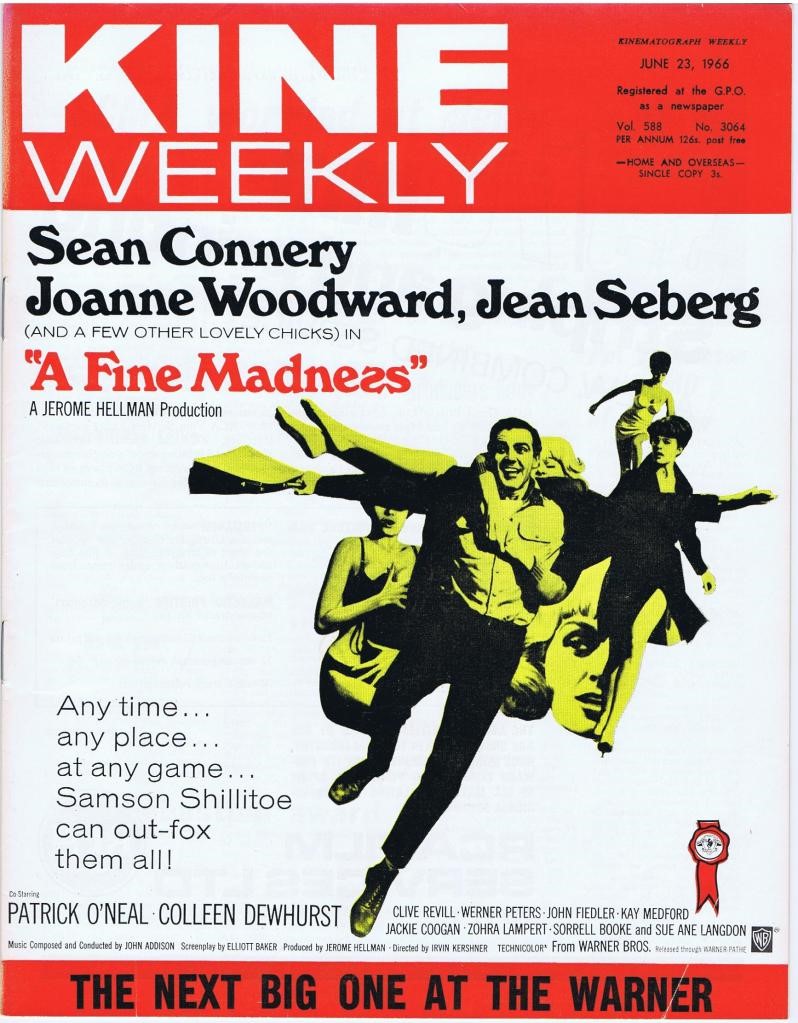
Let’s start with the Hollywood happy ending. Poet Samson (Sean Connery) slugs pregnant second wife (Joanne Woodward). He’d have punched her lights out before if only she hadn’t been so good at diving out of the way. As it is he manages to throw her down the stairs. The film kicks off with him ill-temperedly whacking her over the head with a pillow.

This is the kind of film where violence against women is treated as a running gag.

Let’s try to sell it as a wacky comedy.

Lydia (Jean Seberg), wife of psychiatrist Dr West (Patrick O’Neal) treating Samson for writer’s block, doesn’t have the courage to make it plain to his creepy colleague Dr Vorbeck (Werner Peters) that she doesn’t fancy him when he endlessly paws her and slaps her rear so he takes this as the green light to attempt to rape her. That’s another running gag.

Surly loud-mouthed bully Samson gets a free pass because he’s an artist, a poet with one poor-selling volume of poetry, and unable to find the time or space to complete his masterpiece. He would have more time if he didn’t spend so much of it chasing women.

At my count, he gets through at least four – Lydia, office secretary Miss Walnicki (Sue Ann Lngdon), a client (he cleans carpets for a living) Evelyn (Zohra Lampert), and Dr Kropotkin (Collen Dewhurst), another colleague of Dr West, not to mention the current wife he drives demented and the previous wife for whom he is being aggressively pursued for alimony.

You can see how director Irvin Kershner was a shoo-in for The Flim-Flam Man/One Born Every Minute (1967) because at every opportunity he tries to turn simple dramatic confrontation that enhance the story into needless chases that divert it and extract slapstick from material that in no way suggests it’s ripe for such an approach.

Trivia lovers note: The John “Redcap” Thaw in the supporting feature “Dead Man’s Chest” is the same John Thaw from “The Sweeney” and “Morse“.

There’s a story in here somewhere and a pretty barmy one at that if you set aside the poor poet’s endless battle against a world that fails to understand his genius and his dodging of the alimony. Rightfully diagnosed as some kind of sociopath by yet another of Dr West’s colleagues, the needle-happy Dr Menken (Clive Revill), he is admitted to a psychiatric hospital initially as a way of dodging his creditors and providing him with space and time to write.

Again, his most creative use of his time is to make out with Lydia and Krokoptin. But since he is spotted in a hydro-bath/ripple bath with  naked Lydia, the vengeful husband gives the go-ahead to perform some kind of lobotomy on the poet, on the assumption it will dull his violent tendencies. (It doesn’t work.) The opportunity to satirise the psychiatric profession takes second place to another opportunity for a chase.

Anomalies abound. Samson’s character is clearly drawn on Welsh poet Dylan Thomas who exploited his fame and made his money on recital tours. Performing is against the broke Samson’s principles and he turns viciously on his audience of appreciative women. Despite demanding center stage, when offered it he turns it down. He lambasts middle-aged women but has little against those younger members of the species more susceptible to his charms. He only has to tell Miss Walnicki she has “pouty lips” and she falls into his arms.

All this has going for it are the performances. Sean Connery (Marnie, 1964), it has to be said, certainly exhibits screen charisma though this is not as far removed as he would like from the macho James Bond. Joanne Woodward (From the Terrace, 1960) – switching from her normal brunette to blonde – is excellent as the downtrodden waitress wife, but on the occasions when she is spiky enough to put him in his place soon regrets her temerity.

Jean Seberg (Pendulum, 1969) – switching from blonde to brunette and paid more ($125,000 to Woodward’s $100,000) – is good as the sexually frustrated rich housewife. And Patrick O’Neal (Stiletto, 1969) looks as if he is desperate to throw a punch. Elliott Baker (Luv, 1967) wrote the screenplay based on his own novel.

You do sometimes wonder at the knuckle-headedness of stars. Was this all that was offered to Connery at his James Bond peak? Or was it a pet project? I doubt if it would have been made with another big star – you couldn’t see even the macho Steve McQueen entering this territory and the likes of Paul Newman wouldn’t go near it.

Theoretically, studio head honcho Jack Warner gets the blame for this. He didn’t like Kershner’s cut and ordered it re-edited but I’d be hard put to see how his hand could be any less heavy than that of the director.

That’s two stinkers in a week. If you want proof of just how rampant sexism was in Hollywood check out a double bill of this and A Guide to a Married Man (1967).

An insult.

All-Time Top 40

It’s Angie Dickinson vs Ann-Margret at the top of the All-Time Top 40. The two female stars take four of the top seven spots with Ann-Margret’s The Swinger replacing at the top long-time favorite The Secret Ways. These two have been duking it out over the past year, in which time the top spot has changed hands four times, with Jessica and Once Upon a Time in the West also taking a turn in the premier position. It’s also noticeable that women are top-billed in seven of the pictures in the Top Ten.

I started this Blog three years ago in June. Last year it was being read in 120 countries but that’s now gone up to 182 (out of the 193 recognized by the United Nations plus the Vatican state and the State of Palestine). Reviews have also increased and I’m now approaching 7,000 views a month, so thanks to you all.

I’ve been doing an Annual Top 40 since I started so this is the third iteration of that idea based on those reviews – out of the 900-plus posted so far – which have attracted the most attention over the three-year period. This isn’t my choice of the top films in the Blog, but yours, my loyal readers. The chart covers the films viewed the most times since the Blog began, from June 1, 2020 to July 31, 2023. (Yeah, it should have been May 31, but I’ve been remiss.)

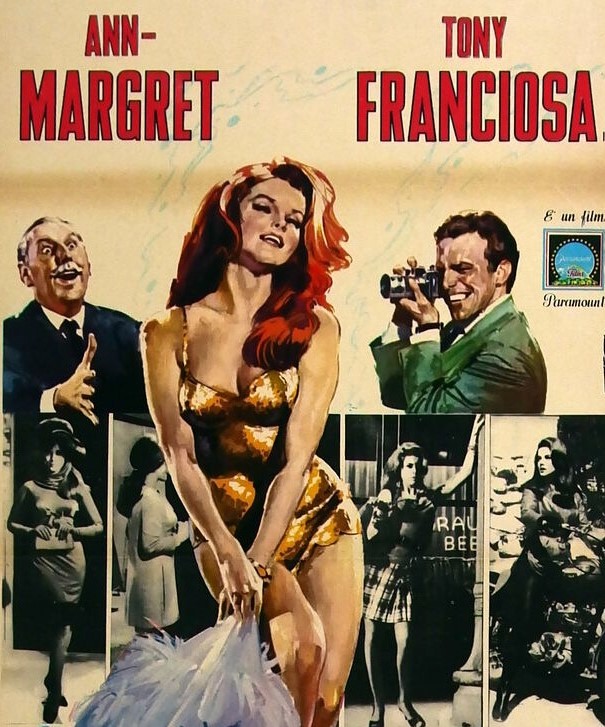
  1. (7) The Swinger (1966). Ann-Margret struts her stuff as a magazine journalist trying to persuade Tony Franciosa she is as sexy as the characters she has written about.
  2. (-) Once Upon A Time in the West (1968). Rated the top western of all time, Sergio Leone’s operatic epic with Claudia Cardinale, Henry Fonda and Charles Bronson and the astonishing Ennio Morricone score.
  3. (2) Jessica (1962). Innocently gorgeous widow Angie Dickinson finds her looks turn so many male heads in a small Italian town that the female population seek revenge.
  4. (5) Fraulein Doktor (1969). Suzy Kendall in the best role of her career as a sexy German spy in World War One.
  5. (-) Stagecoach (1966). Ann-Margret, Alex Cord and Bing Crosby in decent remake of classic John Ford western.
  6. (1) The Secret Ways (1961).  Richard Widmark exudes menace in this adaptation of an early Alistair MacLean spy thriller set in Hungary during the Cold War. Senta Berger  has a small role.
  7. (-) The Sins of Rachel Cade (1961). Angie Dickinson as a missionary who falls in love with Peter Finch in war-torn Africa.
  8. (-) Gerry Anderson’s Fireball XL5. Colorized version of the famed sci fi television show.
  9. (11) Moment to Moment (1966). Hitchcockian-style thriller with Jean Seberg caught up in  murder plot in the French Riviera. Also features Honor Blackman.
  10. (3) Ocean’s 11 (1960). In the Rat Pack debut Frank Sinatra, Dean Martin, Sammy Davis Jr. et al plan an audacious Las Vegas robbery. 
  11. (17) Can Heironymous Merkin Ever Forget Mercy Humpe and Find True Happiness? (1969). Off-the-wall musical awash with nudity and Fellini-esque cavorting, directed by star Anthony Newley. Has to be seen to be believed. Joan Collins pops up. 
  12. (4) Pharoah(1966). Priests battle kings in Polish epic set in ancient Egypt. Fabulous to look at and thoughtful.
  13. (-) Sisters (1969). French drama bordering on the incestuous starring Nathalie Delon and Susan Strasberg.
  14. (-) Vendetta for the Saint (1969). Feature length version of the television show sees Roger Moore and Rosemary Dexter battling the Mafia in Sicily.
  15. (6) The Golden Claws of the Cat Girl (1968). Cult French movie starring Daniele Gaubert as a sexy cat burglar.
  16. (-) Baby Love (1969). Orphan Linda Hayden finds herself in a predatory middle-class London household.
  17. (-) Pendulum (1969). The under-rated George Peppard as a cop accused of murdering cheating wife Jean Seberg.
  18. (-) Lady in Cement (1969). Frank Sinatra reprises private eye Tony Rome as he tangles with Raquel Welch.
  19. (15) Subterfuge (1968). C.I.A. operative Gene Barry hunts an M.I.5 mole in London. Intrigue all round with Joan Collins supplying the romance and a scene-stealing Suzanna Leigh as a villain.
  20. (-) Plane (2023). Gerard Butler goes Die Hard as stranded pilot outwitting terrorists on a remote Pacific island.
  21. (18) Pressure Point (1962). Prison psychiatrist Sidney Poitier must help racist Nazi Bobby Darin.
  22. (31) Fade In (1968). Long-lost modern western with Burt Reynolds serenading low-level movie executive Barbara Loden whose company is actually filming Terence Stamp picture Blue.
  23. (16) A House Is Not a Home (1965). Biopic of notorious madam Polly Adler (played by Shelley Winters) who rubbed shoulders with the cream of Prohibition gangsters.
  24. (19) Deadlier than the Male (1967).  Richard Johnson as Bulldog Drummond is led a merry dance by spear-gun-toting Elke Sommer and Sylva Koscina in outlandish thriller.
  25. (-) The Girl on a Motorcycle (1968). Marianne Faithful dons – and slips out of – leathers in erotic drama with Alain Delon.
  26. (-) Some Girls Do (1969). Daliah Lavi and Beba Loncar get tough with Bulldog Drummond in sequel to Deadlier than the Male.
  27. (-) Beat Girl / Wild for Kicks (1960). London teenager heads for shady Soho. Starts out in milk bars, ends up in strip clubs.
  28. (-) Sodom and Gomorrah (1962). Robert Aldrich biblical epic sees Stewart Granger giving way to temptation in the infamous locale.
  29. (-) A Dandy in Aspic (1968). Director Anthony Mann died during shooting of spy picture so star Laurence Harvey took over. Mia Farrow co-stars.
  30. (-) The Brotherhood (1968). Martin Ritt’s Pre-Godfather take on the Mafia starring Kirk Douglas and Alex Cord as duelling brothers.
  31. (23) Once a Thief (1965). Ann-Margret (again)  is a revelation in crime drama with ex-con Alain Delon coerced into a robbery despite trying to go straight. Supporting cast boasts Jack Palance, Van Heflin and Jeff Corey. . 
  32. (-) Uptight (1968). Jules Dassin remake of John Ford classic The Informer set among black revolutionaries.
  33. (9)  A Place for Lovers (1969). Faye Dunaway andMarcello Mastroianni in doomed love affair directed by Vittorio De Sica.
  34. (-) The Misfits (1961). Stunning last hurrah for Marilyn Monroe and Clark Gable in John Huston tale of ageing cowboys.
  35. (-) Father Stu (2022). Biopic of boxer-turned-priest with Mark Wahlberg and Mel Gibson.
  36. (-) Blonde (2022). Andrew Dominik’s controversial take on the life of Marilyn Monroe with Ana de Armas.
  37. (12) 4 for Texas (1963). Frank Sinatra and Dean Martin face off in a Robert Aldrich western featuring Ursula Andress and Anita Ekberg with Charles Bronson in a smaller part.
  38. (-) Istanbul Express (1968). Gene Barry, John Saxon and Senta Berger involved in nefarious dealings on the other famous trans-European express.
  39. (33) P.J./New Face in Hell (1968). Private eye George Peppard is duped by shady millionaire Raymond Burr and mistress Gayle Hunnicutt in murder mystery.
  40. (10) The Venetian Affair (1966). Robert Vaughn hits his acting stride as a former C.I.A. operative turned journalist investigating suicide bombings in Venice. Great supporting cast includes Elke Sommer and Boris Karloff.

Dropping out of the Top 40

The surge of new entrants and other films attracting a vast new audience has meant some previous favorites tumble out of the Annual Top 40. (Previous year’s position shown in brackets).

(8) It’s Not All Rock’n’Roll (2020).  Ageing rocker Dave Doughman aims to mix a career with being a father in this fascinating documentary

(13) Age of Consent (1969). Helen Mirren stars as the nubile muse of jaded painter James Mason returning to his Australian roots.

(14) The Double Man (1967). Yul Brynner chases his doppelganger in the Swiss Alps with Britt Ekland adding a touch of glamour.

(20) Valley of Gwangi (1969). Special effects genius Ray Harryhausen the star here as James Franciscus and Gila Golen encounter prehistoric monsters in a forbidden valley.

(21) The Naked Runner (1967). With his son held hostage, Frank Sinatra is forced to carry out an assassination in east Germany.

(22) Orgy of the Dead (1965). Bearing the Ed Wood imprint, mad monster mash-up with the naked dead.

(24) The Sicilian Clan (1969). Stunning caper with thief Alain Delon and Mafia chief Jean Gabin teaming up for audacious jewel heist with cop Lino Ventura on their trail. French thriller directed by Henri Verneuil. Great score by Ennio Morricone.

(25) Dark of the Sun / The Mercenaries (1968). More diamonds at stake as Rod Taylor leads a gang of mercenaries into war-torn Congo.  Jim Brown, Yvette Mimieux and Kenneth More co-star. Based on the Wilbur Smith bestseller

(26) Stiletto (1969). Mafia hitman Alex Cord pursued by tough cop Patrick O’Neal. Britt Ekland as the treacherous girlfriend heads a supporting cast including Roy Scheider, Barbara McNair and Joseph Wiseman.

(27) Maroc 7 (1967). Yet more jewel skullduggery with Gene Barry infiltrating a gang of thieves in Morocco who use the cover of a fashion shoot. Top female cast comprises Elsa Martinelli, Cyd Charisse, Tracy Reed and Alexandra Stewart.

(28) The Rock (1996). Former inmate Sean Connery breaks into Alcatraz with Nicolas Cage to prevent mad general Ed Harris blowing up San Francisco. Michael Bay over-the-top thriller with blistering pace.

(29) The Swimmer (1968). Burt Lancaster’s life falls apart as he swims pool-by-pool across the county. Superlative performance. 

(30) Hour of the Gun (1967). James Garner as a ruthless Wyatt Earp and Jason Robards as Doc Holliday in John Sturges’ realistic re-telling of events after the Gunfight at the O.K. Corral.

(32) Dr Syn Alias the Scarecrow (1963). The British movie version of Disney American television mini-series sees Patrick McGoohan as a Robin Hood-type character assisting local smugglers.

(34) Sol Madrid/The Heroin Gang (1968). In his second top-billed role David MacCallum drags hooker Stella Stevens to Mexico to capture drugs kingpin Telly Savalas.

(35) A Twist of Sand (1968). Diamonds again. Smugglers Richard Johnson and Jeremy Kemp hunt long-lost jewels in Africa. Honor Blackman is along for the voyage.

(36) Genghis Khan (1965). Omar Sharif plays the legendary warlord who unites warring Mongol tribes. Stellar cast includes Stephen Boyd, James Mason, Francoise Dorleac, Eli Wallach, Telly Savalas and Robert Morley.

(37) Interlude (1968).Bittersweet romance between famed conductor Oskar Wener and young reporter Barbara Ferris.

(38) Woman of Straw (1964). Sean Connery tangles with Gina Lollobrigida in tangled tale of the killing of wealthy uncle Ralph Richardson.

(39) Bedtime Story (1964). Marlon Brando and David Niven are rival seducers on the Riviera targeting wealthy women.

Lilith (1964) *****

You couldn’t make this now. What top-ranked actor would be willing to play a character who takes sexual advantage of a vulnerable young woman? You’d find it even harder to get a marquee name to play a female with paedophiliac tendencies, predatory sexual instincts and thinks it fine to drive a lovelorn young man to suicide.

That it was feasible back in the day was largely due to the restraints imposed by the much-maligned Production Code. Most of the issues are delicately probed, the problematic themes only touched upon, so that the result is quite amazing, the director turning to the lyrical,  rendered by its intensity a metaphor for internal conflict.

War veteran Vincent (Warren Beatty) takes a job as an occupational therapist at an upmarket mental institution, the kind that looks more like a country club or grand hotel with extensive manicured grounds. Few of the inmates are of the type found in the normal hospitals for the insane, the worst cases a woman with a maniacal laugh and another who treats a doll like a baby, but he is warned insane women are more “sinister” than crazy men.

One of his charges is the withdrawn Lilith (Jean Seberg) whom he gradually coaxes out of her shell, soon believing that it is his innate skill that brings about the possibility that such a high-risk individual could possibly achieve something akin to cure, or at least a greater degree of normality. You can hardly blame him for missing the obvious – that Lilith is using him – for the young woman is every inch the winsome innocent seeking guidance from the more mature responsible male.

It’s mostly shorn of obvious metaphor but there is one scene, compelling in itself, where Vincent plays the knight on horseback, complete with lance, winning a contest of skills for his lady, that completes his idealisation in her eyes. But he is already halfway there, with unexpected dexterity he frees her hair caught in loom, the kind of scene that in an otherwise more romantically-inclined movie would be the meet-cute.

And this isn’t one of those films about a madwoman in an attic or an apparently sane person turning demented. Instead, considerable time is spent analysing the condition of the schizophrenic, either through clinical lead Dr Lavrier (James Patterson) expounding his theories or through Vincent discussing individual patients with his boss Dr Brice (Kim Hunter). The idea of opening up a new realm to an audience is crystallised in one scene where Lavrier explains that even spiders go mad, resulting in asymmetrical webs rather than the typical formations to which we are more accustomed.

And by using one of the oldest tricks in the book, an inexperienced young man negotiating a new world, disbelief is suspended. But just when we think we are seeing everything from Vincent’s perspective, we are thrown into a heightened intensity linked to the lyrical – a river, a waterfall – the madness of ecstasy, what used to be called rapture, as Lilith stares and stares at nature.

But there are warnings about the personality of both characters. Lilith bears a startling resemblance to Vincent’s dead mother. He has difficulty committing, lack of communication while away at war resulting in girlfriend Yvonne (Anne Meacham) marrying someone else.

And there is plenty that is disconcerting about Lilith that only the besotted would overlook. She leads on lovelorn Stephen (Peter Fonda) to potential disasters he cannot foresee. Angry at Vincent, “I show my love for all of you and you despise me,”  she seduces vulnerable older patient Laura (Jessica Walter). But the worst aspect of her character is that she perceives no boundaries to behavior. She exhibits inappropriate attitudes to young boys, inviting one to rub his finger along her lower lip.

However, for most of the film the skilful direction of Robert Rossen (The Hustler, 1961) has you rooting for the young lovers. Even while never falling back on the cliché of the doctor-type saving the ill person, there is enough in Vincent’s earnestness and Lilith’s innocence to make that a distinct possibility, were it not for the other discordant elements of her character.  The picture is wrapped in natural sound – the river, waterfall, a flute playing mournful tune, ping-pong ball hitting bat, reeds or branches parting, rain, footsteps, a ticking clock, and the bulk of the music emanates from Stephen’s radio. And then he will twist it slightly, reflections are seen upside-down in the river, or a shot of the waterfall is held for too long, the sound of water increasing, or Lilith standing in the river bends down to kiss the surface, or at a picnic she eats a leaf irrespective of whether it might be poisonous.

Usually, when you get so much detail it’s a surfeit, and ends up drowning the viewer. But that’s not the case here. Either it builds or expands. And there is even a throwaway that mocks the notion of containing madness in an institution. The best, most revealing, line in the  picture is not spoken by either of the two principals, but secondary character Yvonne, seen only at the beginning and end. When for unspecified reasons Vincent turns up at her house and her husband (Gene Hackman) leaves them on their own, she says, “I told you I’d never really let you make love to me until I was married,” (pause), “well, I’m married now.”

Jean Seberg (Moment to Moment, 1966) is just superb, coming across as a young woman entering adulthood full of fears and insecurities, only suggesting the darker side of her character, and never giving in to the temptation of overplaying. Warren Beatty (Kaleidoscope, 1966) can’t quite match her for subtlety or kick those acting mannerisms – lowered head, looking away – but his stupefied expression towards the end as he realizes just what he has taken on is priceless.

There’s an outstanding cast of rising stars. Peter Fonda (Easy Rider) as the preppy insecure victim is excellent while Jessica Walter suggests the qualities that would make her the prime candidate for the femme fatale in Play Misty for Me (1971). Gene Hackman, in his movie debut and still working on his trademark chuckle, provides early evidence of his immense talent.  

Robert Rossen, who wrote the screenplay (from the novel by J.R. Salamanca) and also produced, couldn’t have wished for a better epitaph. This was his final film in a relatively short career – he only directed 10 films.

Despite contemporary reservations about the content this is a beautifully observed piece and well worth a look.

Year-End Round-Up: Top 30 Films Chosen by You

Top 30

This isn’t my choice of the top films of the year, but yours, my loyal readers. This is a chart of the films viewed the most times over the full calendar year of January 2021 – December 2021.

  1. The Secret Ways (1961). Richard Widmark in spy thriller set in Hungary during the Cold War and adapted from the Alistair MacLean novel. Senta Berger has a small role.
  2. Ocean’s 11 (1960). Frank Sinatra, Dean Martin and the Rat Pack embark on an audacious Las Vegas robbery.  
  3. Pharoah (1966). Epic Polish picture about political shenanigans in ancient Egypt.
  4. Age of Consent (1969). Helen Mirren stars as the nubile muse of jaded painter James Mason returning to his Australian roots.
  5. The Venetian Affair (1966). Robert Vaughn hits his acting stride as a former CIA operative turned journalist investigating suicide bombings in Venice. Great supporting cast includes Elke Sommer and Boris Karloff.
  6. The Golden Claws of the Cat Girl (1968). Cult French movie  starring Daniele Gaubert as a sexy cat burglar.
  7. Moment to Moment (1966). Jean Seberg is caught up in a Hitchcockian murder plot in the French Riviera. Also features Honor Blackman.
  8. It’s Not All Rock’n’Roll (2020).  Ageing rocker Dave Doughman aims to mix a career with being a father in this fascinating documentary.
  9. 4 for Texas (1963). Frank Sinatra and Dean Martin face off in a Robert Aldrich western featuring Ursula Andress and Anita Ekberg with Charles Bronson in a smaller part.
  10. Once a Thief (1965). Trying to go straight ex-con Alain Delon is coerced into a robbery. Ann-Margret is a revelation as his wife. Jack Palance, Van Heflin and Jeff Corey add up to a great supporting cast.  
  11. Stiletto (1969). Alex Cord as a Mafia hitman wanting to retire is pursued by tough cop Patrick O’Neal. Britt Ekland heads a supporting cast which includes Roy Scheider, Barbara McNair and Joseph Wiseman.
  12. Subterfuge (1968). C.I.A. operative Gene Barry is called to London to uncover a mole in M.I.5. Joan Collins provides the romance. Richard Todd, Tom Adams, Suzanna Leigh and Michael Rennie lend a touch of class.
  13. The Swimmer (1968). Burt Lancaster delivers a superlative performance as a man whose life is falling apart.
  14. The Rock (1996). Blistering thriller starring Sean Connery as an ex-inmate of Alcatraz helping Nicolas Cage infiltrate the island to prevent mad general Ed Harris destroying San Francisco. Michael Bay directs.
  15. The Sicilian Clan (1969). Alain Delon joins forces with Jean Gabin to pull off an daring jewel heist with tenacious cop Lino Ventura on their trail. French thriller directed by Henri Verneuil.
  16. The Naked Runner (1967). With his son held hostage, Frank Sinatra is forced to carry out an assassination in East Germany.
  17. A House Is Not a Home (1965). Biopic of notorious madam Polly Adler (played by Shelley Winters) who rubbed shoulders with the cream of Prohibition gangsters.
  18. Pressure Point (1962). Prison psychiatrist Sidney Poitier must help racist Nazi Bobby Darin.
  19. Genghis Khan (1965). Omar Sharif plays the legendary warlord who unites warring Mongol tribes. Stellar cast includes Stephen Boyd, James Mason, Francoise Dorleac, Eli Wallach, Telly Savalas and Robert Morley.
  20. A Twist of Sand (1968). Beleaguered smuggler Richard Johnson spars with Jeremy Kemp in thriller about hidden diamonds in Africa. Honor Blackman is along for the voyage.
  21. Jason and the Argonauts (1963). Ray Harryhausen special effects dominate this legendary tale of the hunt for the Golden Fleece.  
  22. Dr Syn Alias the Scarecrow (1963). Disney movie that was turned into a mini-series in the U.S. starring Patrick McGoohan as the eponymous Robin Hood-type character who assists smugglers.
  23. The Hitman’s Wife’s Bodyguard (2021). Ryan Reynolds and Samuel L. Jackson reunite for wild sequel also featuring Salma Hayek and Antonio Banderas.
  24. Dark of the Sun / The Mercenaries (1968). Rod Taylor leads a private army into the war-torn Congo to rescue a cache of uncut diamonds. Jim Brown, Yvette Mimieux and Kenneth More co-star. Based on the Wilbur Smith bestseller.
  25. The Guns of Navarone (1961). Classic war mission picture with an all-star cast of Gregory Peck, David Niven, Anthony Quinn, Stanley Baker, Irene Papas and Gia Scala. Adapted from the Alistair McLean bestseller.
  26. Maroc 7 (1967). Gene Barry infiltrates a gang of jewel thieves in Morocco operating under the cover of a fashion shoot. Dazzling female cast includes Elsa Martinelli, Cyd Charisse, Tracy Reed and Alexandra Stewart.
  27. The Satan Bug (1965). John Sturges adaptation of Alistair MacLean pandemic thriller stars George Maharis, Richard Basehart and Dana Andrews.
  28. Five Golden Dragons (1967). Cult thriller with Robert Cummings as the playboy caught up in an international crime syndicate. Klaus Kinski and Christopher Lee head an exceptional supporting cast that also includes Margaret Lee, Brian Donlevy, George Raft, Dan Duryea and Maria Rohm.
  29. Claudelle Inglish (1961). Diane McBain as the poor farmer’s daughter who wants to get rich quick.
  30. Jessica (1962). Angie Dickinson plays a young widow who turns so many heads in a small Italian town that their wives seek revenge.

The Road to Corinth (1967) ***

Top-class cast and occasional stylish direction get in the way of a thriller that can’t make up its mind whether it is in reality just a spoof. On the one hand we have a killer in a white suit complete with straw boater and a secret service boss who sells Turkish Delight, on the other hand a story not so much from James Bond but from Bond imitators.

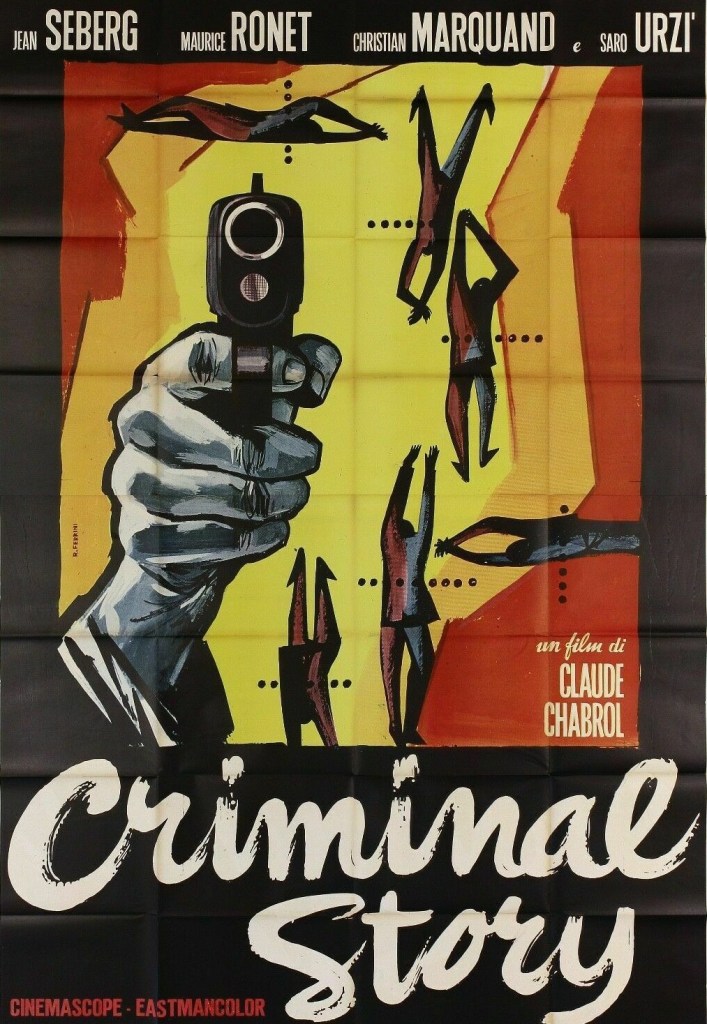
Agent Robert Ford (Christian Marquand) is on the trail of black boxes that prevent missiles launching. When wife Shanny (Jean Seberg) is framed for his murder she determines to uncover the real killer, aided by Dex (Maurice Ronet), and find the maker of the boxes.

But that’s an over-simplification of an over-complicated plot so it’s best to concentrate on the highlights. For example, when customs officials stop a magician they find white rabbits and doves in his vehicle and, despite severe interrogation, he can, magically, release himself from his bonds enough to swallow a concealed cyanide pill. Instead of the usual cute children that proliferate in these kind of films, there’s a really annoying one. Shanny, imprisoned, has to make dolls. Greek Orthodox priests play a significant role.

Throw in kinky secret service boss Sharps (Michel Bouquet) who relishes being slapped for his inappropriate overtures to Shanny, a porn film starring Madame Phiphi, the heroine dangled from a crane and later lashed down to a dumper, and a villain willing to give up his villainy for the love of a good woman.

But mostly it’s a picture in a rush. There are chases galore and nods to Hitchcock and lush Greek scenery.

It would be easy to assume that in eye-catching outfits Jean Seberg (Moment to Moment, 1966) is mostly there to provide eye candy but she does manage to outwit her pursuers from time to time although she seems equally to have a knack for being caught. Maurice Ronet (Lost Command, 1966), Christian Marquand (The Corrupt Ones, 1967) and especially Michel Bouquet (La Femme Infidele, 1969) bring an air of quality to the proceedings.  

Apart from the occasional stunning image, this is not the Claude Chabrol (Les Biches, 1968) that lovers of his thrillers would expect.

There’s a print of this on Youtube. Amazon Prime has this for certain regions. Otherwise it will be Ebay.

Pendulum (1969) ****

It’s better to come at this as a drama rather than the thriller it was marketed as. That the name of George Schaefer, the last to make a movie of the directors who shot to fame in television in the 1950s, is attached should be indication that this is character- and issue- rather than action-driven. It’s more about people being sucked into the system, about the vulnerable members of society, who, whether cop or criminal, have no recourse to some kind of higher power to sort their lives out. As such, it’s a satisfying drama.

A-list male stars playing emotionally vulnerable characters was a growing trend in the late 60s. Think of Burt Lancaster in The Swimmer (1968) and Kirk Douglas in The Arrangement (1969) – all reviewed in the Blog, incidentally. Here top Washington detective Frank Matthews (George Peppard) goes through the personal and professional wringer, suspecting wife Adele (Jean Seberg) of an affair then becoming a suspect himself in a murder case. Underlying these plot-driven aspects is an exploration of the political issue of civil liberties, in particular the constitutional rights of criminals, setting this up as one of the earliest law’n’order movies, a trope that would take center stage in films like Dirty Harry (1971).  

At a peak of professional success, having been awarded a medal and promoted to consultant on a subcommittee on Law and Order headed by Senator Augustus Cole (Paul McGrath), Matthews’ ethics come under scrutiny when alleged murder/rapist Paul Sanderson (Robert F. Lyons), whom Matthews had arrested, is freed on a technicality thanks to the efforts of civil liberties attorney Woodrow Wilson King (Richard Kiley).

Matthews appears distracted much of the time trying to keep track of his wife’s whereabouts.  After delivering a speech in Baltimore, he walks the streets in a fug of depression. Meanwhile, King is disturbed by the fact that a man he clearly believes guilty refuses to seek psychiatric help. The question in the audience’s mind is where he will strike next. There’s an excellent scene in King’s office where his secretary Liz (Marj Dusay), delighted at the lawyer’s success in overturning Sanderson’s case, instinctively pulls away from the freed man.

When Adele and lover are murdered in Matthews’ bed, he finds himself on the opposite side of the law, undergoing the kind of treatment he has meted out to so many criminals, quickly aware that circumstantial evidence could find him guilty. Front-page news himself now, suspended from his job by a quick-to-judge senator, emotionally isolated and a laughing stock, he retreats further inside himself. Naturally, he evades subsequent arrest, setting out to track down the killer himself, that leads him into the murkier depths of society from which emotionally-abused villains easily spring. 

Other issues are explored in passing, the independent woman for a start, whether it is wanting to have her own career and not play the stay-at-home wife or considering it fair game – as with Gwen (Faye Dunaway) in The Arrangement – to upturn accepted morality and take a lover.

But the focus remains squarely on Matthews struggling to cope with life running away from  him, falling deeper into despair and into the maw of the criminal justice system which has the knack of bending its own rules. He has never been the saintly cop and there are moments where violence seems the best option, although not the vicious kind later espoused by Inspector Harry Callaghan. It’s ironic that the only solid detection the cop does in the first part of the film is tracking down his wife’s whereabouts.

George Peppard (Tobruk, 1967), generally a much-maligned actor, excels in a part where he can neither charm his way into an audience’s heart, nor confide in someone else about his marital problems, nor resort to action to define his character. That his pain is all internalised shows the acting skills he brings to bear. Oddly enough Jean Seberg (Moment to Moment, 1966), a specialist in emotional pain, takes a different path, coming across as a devious minx, keeping Matthews on the hook while enjoying relations with an ex-lover, whose career, as it happens, has panned out a lot better than her husband.

I only knew Richard Kiley, an American theatrical giant and primarily in the 1960s a television performer, through that mention in Jurassic Park (1993), but he is solid as the attorney who has qualms about releasing a prisoner he knows is guilty. Robert F. Lyons, making his movie debut, brings jittery danger to the unbalanced criminal. Look out also for Charles McGraw (The Narrow Margin, 1952) as the cop determined to take Matthews down and Frank Marth (Madigan, 1968) as the subordinate who gives the suspect too much leeway – to his cost. Madeleine Sherwood (Hurry Sundown, 1967) is excellent as the disturbed, needy mother.

George Schaefer, at this point a four-time Emmy award-winner, specialized in thought-provoking drama such as Inherit the Wind (TV, 1965) and Elizabeth the Queen (TV, 1968).  This fits easily into that pattern. The title is a giveaway, too, referring to the pendulum swinging, “perhaps too far,” from all-powerful police to the rights of the accused taking prominence.

This was the only screenplay from Stanley Niss, who died shortly after the film’s release. He was also the producer. And better known as the writer-producer of television series like Jericho (1966-1967) and Hawaiian Eye (1959-1961).

Catch-Up: George Peppard pictures reviewed in the Blog are Breakfast at Tiffany’s (1961), Operation Crossbow (1965), The Blue Max (1966), Tobruk (1967), and P.J. / New Face in Hell (1968).

Pendulum is best sourced on Ebay.

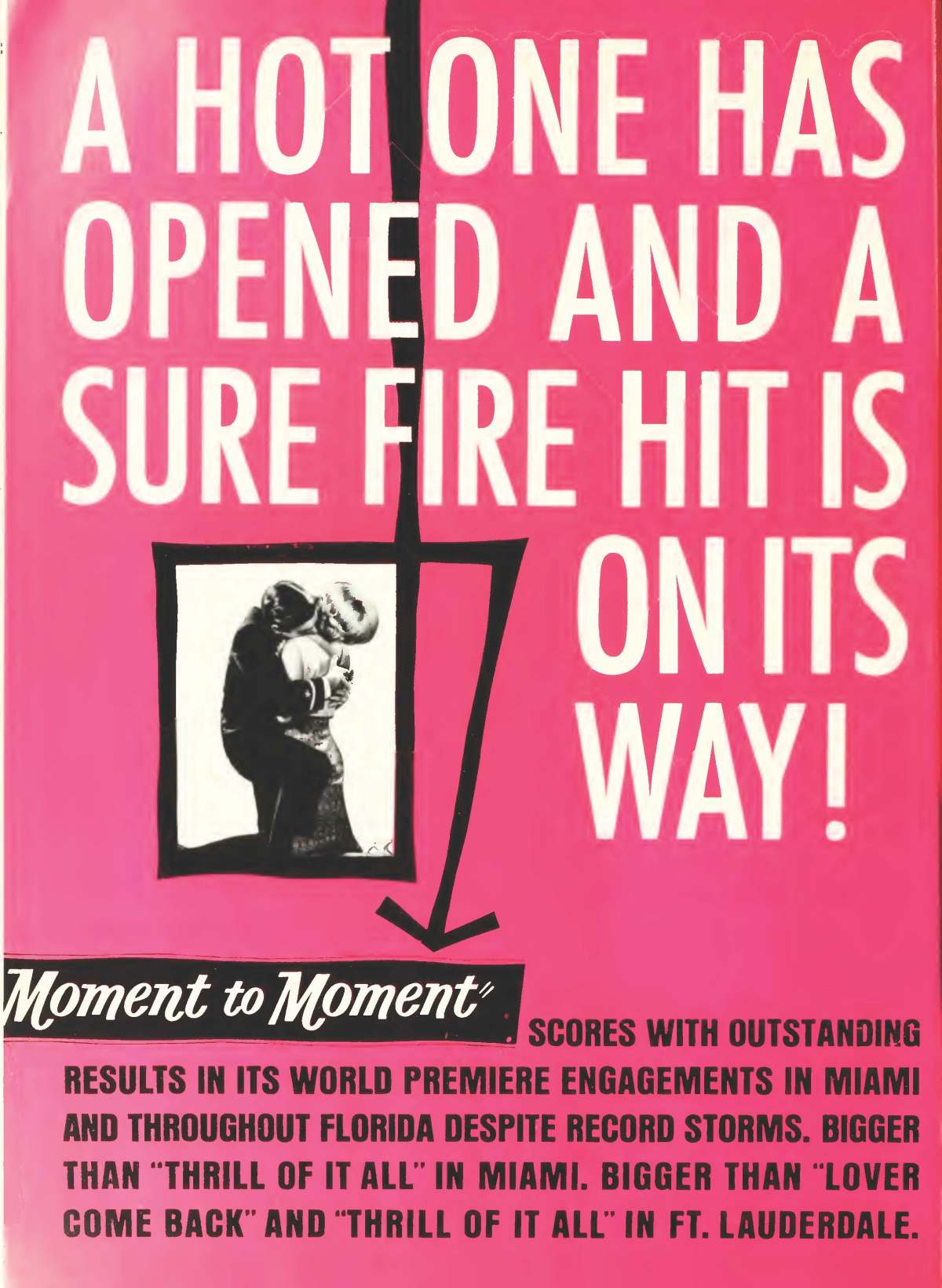
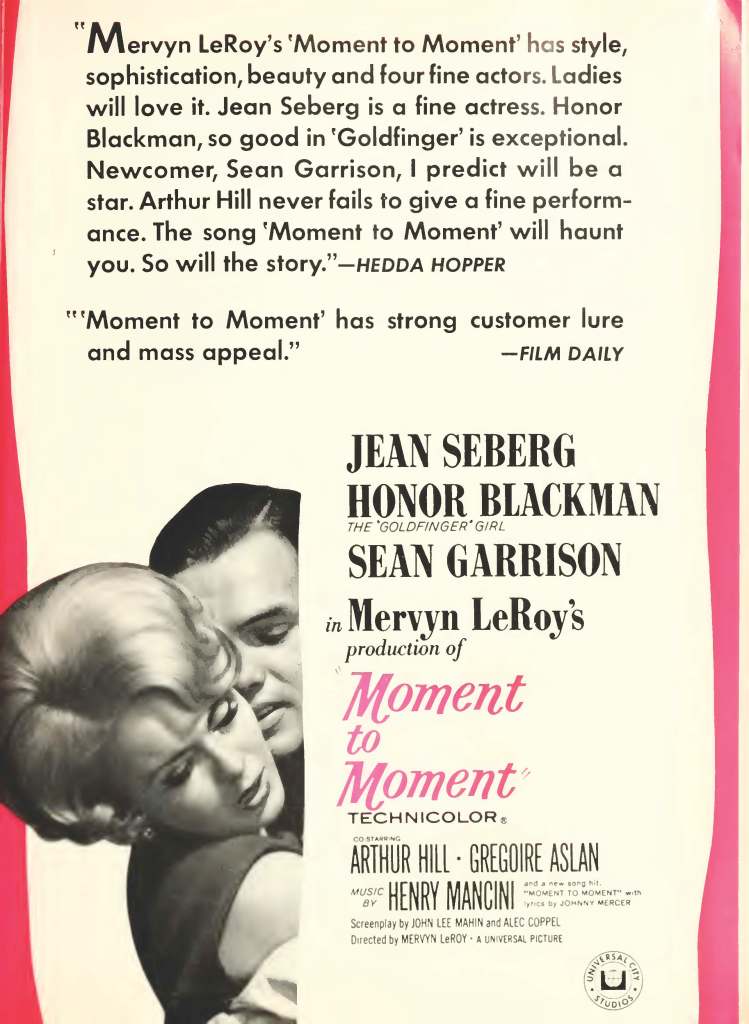
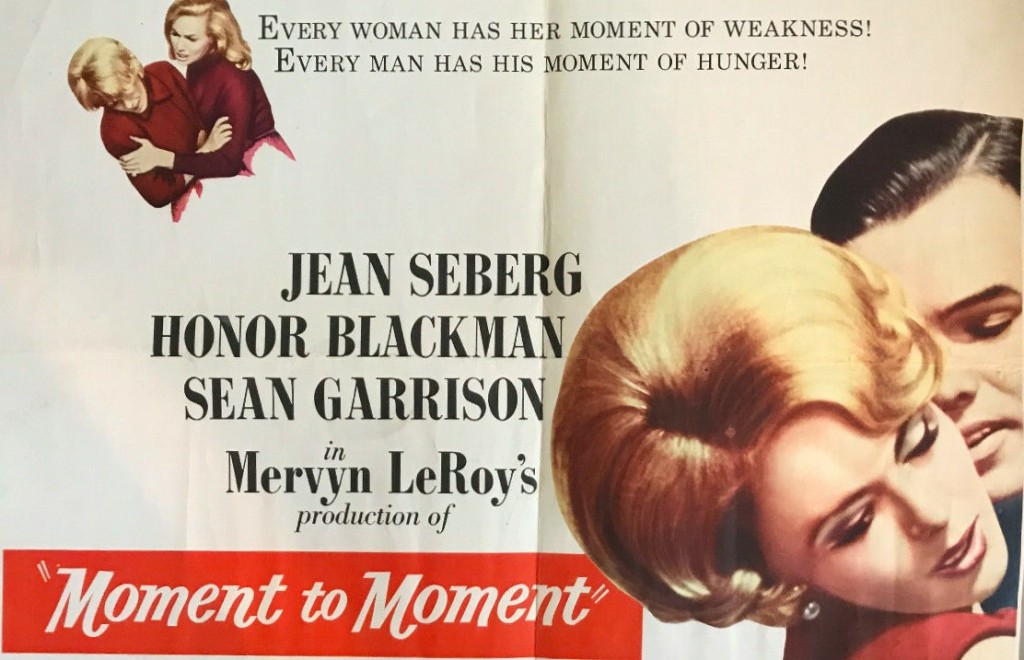
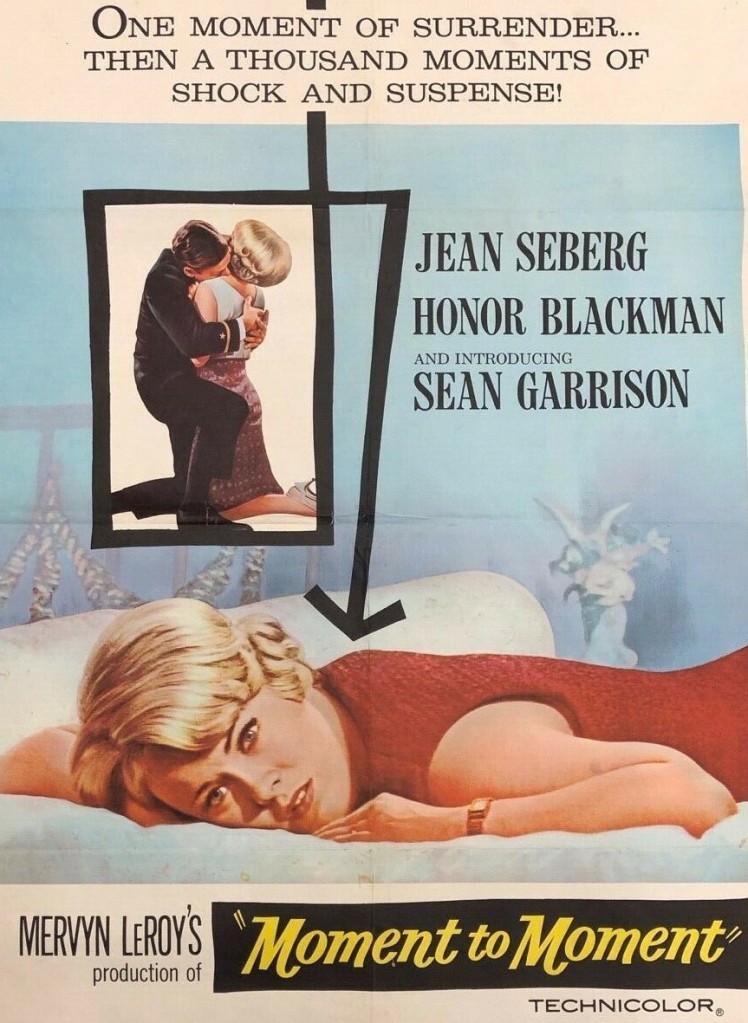
Moment to Moment (1966) ***

Screenwriter Alec Coppel, responsible for Alfred Hitchcock’s Vertigo (1958) – now considered the best film ever made, supplanting Citizen Kane in the Sight & Sound poll – follows pretty much the same structural idea as in the James Stewart-Kim Novak thriller. The second half here is in many respects a repeat of the first, with a man trying to recapture previous experience in a bid to reawaken memory.

But in this case the man is French police inspector DeFargo (Gregoire Aslan) trying to trap glamorous Kay Stanton (Jean Seberg) suspected of killing young sailor and architect-wannabe Mark (Sean Garrison) with whom she has engaged in a brief affair. DeFargo is cunning in the extreme, almost stalking Stanton, turning up unexpectedly, employing all sorts of ruses, including recruiting Stanton’s unsuspecting husband Neil (Arthur Hill), an internationally renowned psychiatrist.

The picture is set on the French Riviera so it’s the height of fashion. Kay wears a series of stunning top-of-the-range clothes (designed in fact by Yves St Laurent), as does high-living  neighbor and suspected accomplice Daphne (Honor Blackman). Kay drives a red sports car and frequents swanky restaurants and chic bars.

A number of cleverly-wrought images in the first half – white doves that turn golden at sunset, dancing to a tune called “Moment to Moment,” the wind causing shutters to bang, a statue in a village square, some sketches, the clacking together of the hard balls used to play the French traditional game of boules, a boardgame called “Blockhead” – prove pivotal in the second half. They form clues from which the inspector has to determine meaning.  

But if ever there was a film of two halves, this is it, and they are not a great fit. The first section involves Kay, lonely due to her husband’s continual absence, embarking on an affair. That she initially resists, in order to prove she is at heart really a good woman, gets in the way of the picture, since that makes the romance more drawn-out than necessary and leaves the viewer wishing the director would get a move on. Even though the time is spent in planting all the clues necessary for the second half to work, had Kay been more keen on a piece of action, driven for example (as is the case) by her husband staying away far longer than promised, it would have speeded things up to get to the more interesting part of the story.

Part of the problem is that the affair is totally unconvincing. Mark is handsome enough and dashing in the way most sailors are in uniform with an artistic streak, first viewed  making sketches, but Sean Garrison is so wooden the romance never sparks. That leaves Seberg to do the heavy lifting and, in fairness, once she is targeted by the wily inspector she comes up to the mark.

I’m not the first to think, after watching this picture, what would Hitchcock have done? That was exactly the same conclusion reached by the New York Times critic on original release. For this picture has a great deal going for it, but not a sufficient quota of suspense, and, as I mentioned, takes too long to get to the core of the story.

However, the second half works exceptionally well, as Seberg is put under pressure by the wily inspector and her husband unexpectedly enters the equation. An abundance of  twists culminate with a number in the final few minutes that serve to confound audience expectation.

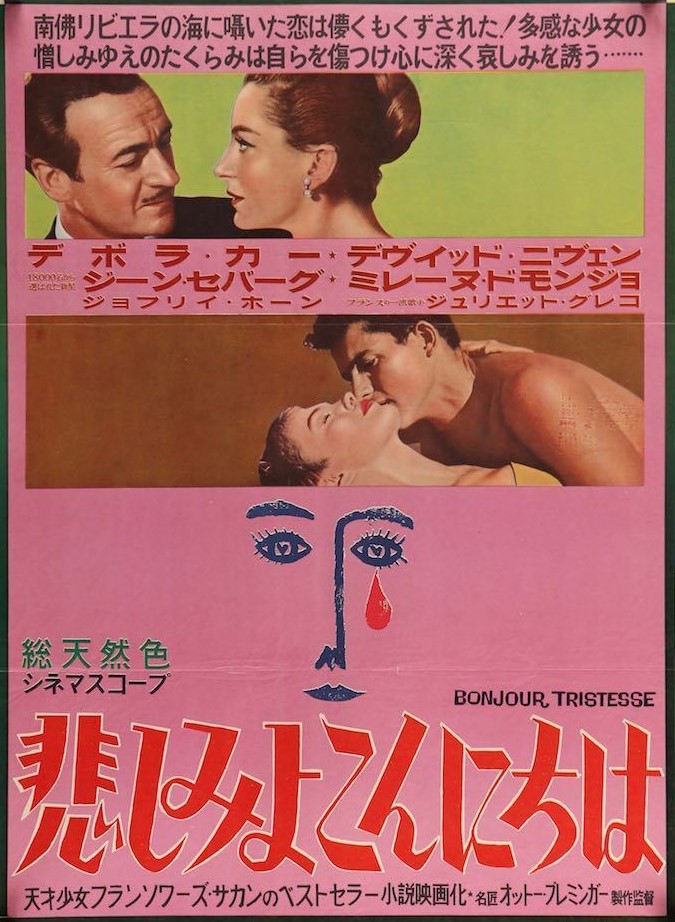
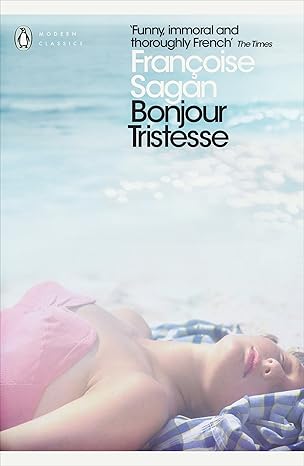
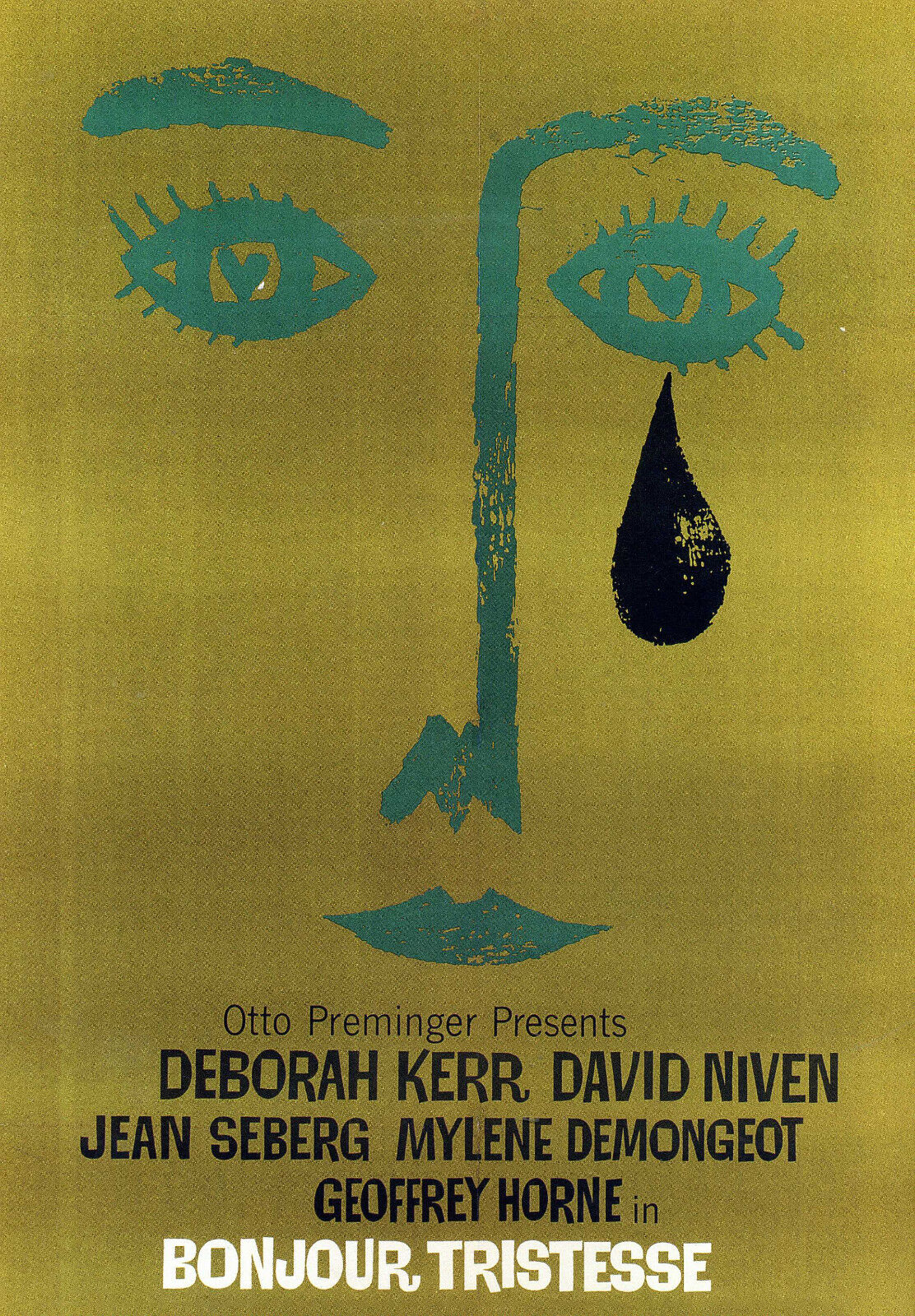
Seberg’s career up to now had been somewhat disjointed, a sense of unfulfilled potential. An Otto Preminger protégé via Saint Joan (1957) and Bonjour Tristesse (1958), she was widely believed, despite the artistic coup of Jean-Luc Godard’s Breathless (1960), to have thrown her career away by decamping to France where she made no further films of particular note. Her previous Hollywood offering Lilith (1964) had not commercially delivered. So this high-budget Universal number was considered something of a comeback. But the perfectly-coiffed fashion-model look seems a poor imitation of Grace Kelly (To Catch a Thief, 1955) and Tippi Hedren (The Birds, 1963). At times, with the romance scarcely touching the lower rungs of passion, the movie falls back on haute couture.

Second half Seberg is better than the first as she is given far more material to work with and a decent opponent in Gregoire Aslan. Honor Blackman, as a flirtatious divorcee, reinvents her  screen persona, far removed from her memorable incarnations as Catherine Gale in British television series The Avengers (1962-1964) and Pussy Galore in Goldfinger  (1964). Sean Harrison made only one more movie, and his career mainly consisted of television. Arthur Hill (Harper, 1966) is excellent as the over-enthusiastic husband, unwittingly hammering nails in his wife’s coffin and Gregoire Aslan (Lost Command, 1966) almost steals the show as Seberg’s accomplished adversary.

Veteran Mervyn LeRoy (The Devil at 4 O’Clock, 1964) had a distinguished and versatile career including an Oscar nomination for Random Harvest (1942) and recipient of an Oscar in the form of the Irving G. Thalberg Award for lifetime contribution to the business. But this isn’t quite up to the mark of innovative gangster picture Little Caesar (1931), drama Little Women (1949), Biblical epic Quo Vadis (1951) or cultish The Bad Seed (1958).  

My Movie Books of the Year

Rather than write about the best films I have seen this year, I thought I would look at the four best books about films that I have read over the last twelve months. However, I’m beginning with an older book. I was so taken with Kirsten Stewart’s portrayal of actress Jean Seberg in the biopic Seberg (2019) that I sought out Garry McGee’s Jean Seberg – Breathless, Her True Story first published in 2007 and reprinted in 2018 in time for the movie.

The film concentrates on Seberg’s mental disintegration as she discovers she is on J. Edgar Hoover’s hit list. But the biography has a far wider remit.

This is a startling and ultimately a very sad book of the star as an American tragedy who shot to the heights in her first film and spent the rest of her life with a couple of exceptions falling earthwards. She took her own life, aged 40, in 1979. She was seen as both calculating and a victim, a woman of great strength and immense vulnerability, who used her popularity to espouse unpopular causes.

Her career followed no pattern anyone could understand, least of all Hollywood. Thrust into the limelight as a teenager when hand-picked as Saint Joan (1957) by director Otto Preminger – an experience that scarred her physically and mentally – she quickly shifted to France where she was enshrined in Jean-Luc Godard’s New Wave masterpiece Breathless (1960), but remained in France too long appearing in less prestigious productions. She was a vivid Lilith (1964) in Robert Rossen’s dissection of mental illness, but disappeared off the Hollywood map again until reappearing at the end of the decade in roadshow musical Paint Your Wagon (1969) – in which she stole the show from Lee Marvin and Clint Eastwood. After blockbuster Airport (1970) and western Macho Callahan (1970) she departed Hollywood for good, her final films being made in Europe.

Why her career was so apparently topsy-turvy is explored in this excellent biography, the final departure from America propelled by the discovery that she was under investigation by the FBI.

Chinatown (1973) is one of the greatest noir thrillers ever made but with its director Roman Polanski now persona non grata in Hollywood, it remains to be seen whether the film will retain its high status. Sam Wasson’s The Big Goodbye, Chinatown and the Last Years of Hollywood leaves any discussion of the director’s sexual mores until the last chapters when the shock of the allegations against him threaten to overwhelm the entire book. That said, up till then, it is a riveting book, not just the convoluted process of making this particular movie, but especially fascinating when discussing the screenplay, the working methods of writer Robert Towne, and the tangled dealings with agents.

After The Godfather (1972), Paramount was on a high and studio boss and wunderkind Robert Evans was apparently untouchable – the studio had given him his own production company – but his wife Ali McGraw had run off with Steve McQueen and he was at war with studio president Frank Yablans. Jack Nicholson, however, was approaching a box office peak. Polanski was hot and if his touch was anywhere as good as Rosemary’s Baby (1968) it would be a slam dunk. But as the movie approached its premiere, it was looking more like a stinker. Preview audiences hated it. The original score was dumped, Jerry Goldsmith brought in to make the music more evocative of the period.

The author takes a wider view than the normal “making of” book and his portrayal of Hollywood at a time of massive change and the corrosive and often self-destructive nature of many of the personalities involved gives the subject material greater bite. A film of this book is being greenlit with Ben Affleck’s involvement.

According to Stephen Rebello, Valley of the Dolls (1968) is in a class of its own. It was top of the class in Bad Movies We Love, the book he co-wrote with Edward Margulies. Rebello has now accorded to his “making of” one of the longest book titles in history – Dolls! Dolls! Dolls!, Deep Inside Valley of the Dolls, The Most Beloved Bad Book and Movie of All Time. Rebello, of course, is famous for his opus on Psycho. Valley of the Dolls was based on the bitchy bestseller by Jacqueline Susann and the movie itself fell into a similar category. Director Mark Robson had been twice Oscar-nominated, once for his adaptation of Peyton Place, a novel occupying the same trashy ground as Valley of the Dolls. Although Natalie Wood, Lee Remick, Bette Davis and Kim Novak were at various times in the running, the book was such a huge bestseller that Twentieth Century Fox thought it would get away with a less-than-stellar cast. The best known of the stars Judy Garland was fired over her alcoholism. Rebello has an irreverent style, but a forensic eye for detail and has produced a highly-readable book of a film now termed a camp classic.

If Valley of the Dolls was in a class of its own, then so too was Ryan’s Daughter (1970), filmed on location in Ireland. In the David Lean canon, none of his pictures have been so maligned. While not approaching the sensational box office of Doctor Zhivago (1965) it was still a massive audience favorite. In Glasgow, where I lived, it ran as a 70mm roadshow presentation at the first-run ABC2 for an entire year. But it was mauled by the critics who felt it was clearly within their rights to dole out to Lean a public humiliation after inviting him to a meeting of the National Society of Film Critics where Pauline Kael and Richard Schickel in particular tore his film to shreds.

Quite why the book has taken so long to be published is another mystery given the author says he did the bulk of the research in 1999-2003. Maybe the publishers were counting on a 50th anniversary revival. Certainly, he has no shortage of material from the drunken and pot-smoking shenanigans of star Robert Mitchum to the miscasting of Christopher Jones and the director’s own haphazard personal life. MGM, which was going through a financial tsunami, backed the director to the hilt even as the budget continued to soar -it ran 135 days over schedule. Because of the overages Jones took home more than this £200,000 contracted salary and John Mills nearly double his original $200,000. Lean’s legendary perfection endangered the lives of the crew and actors during the storm sequence while the sex scene between Jones and Sarah Miles caused particular problems. The author alleges that Jones’ food was spiked. For some reason the author has dubbed this “one of the great movie follies” and while I would not agree with that estimation it remains an interesting read.

Discover WordPress

A daily selection of the best content published on WordPress, collected for you by humans who love to read.

The Atavist Magazine

by Brian Hannan

WordPress.com News

The latest news on WordPress.com and the WordPress community.