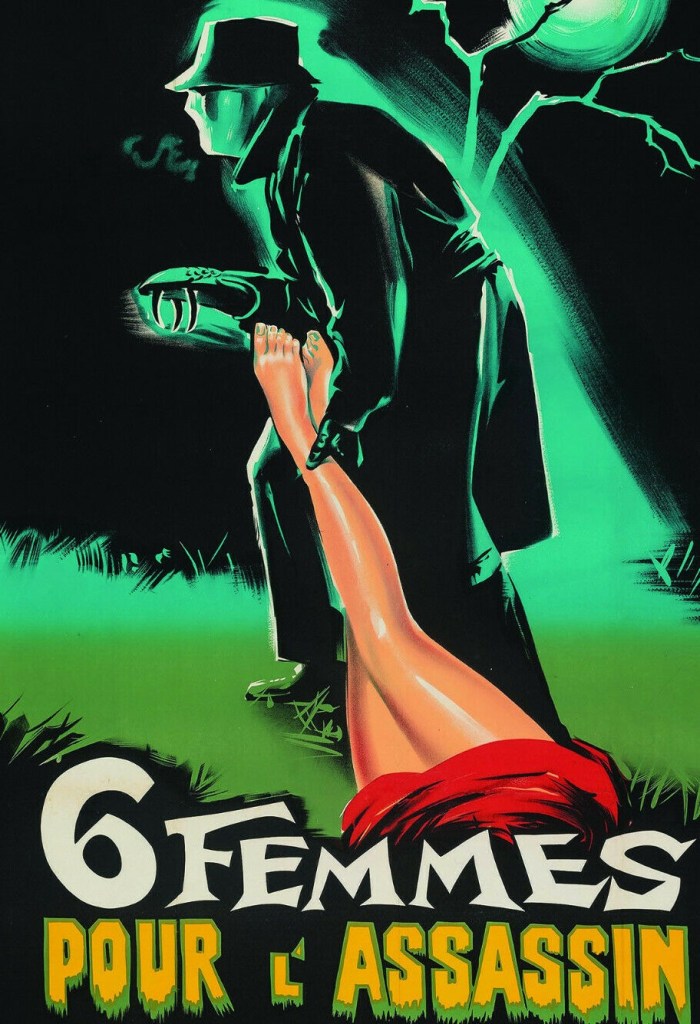
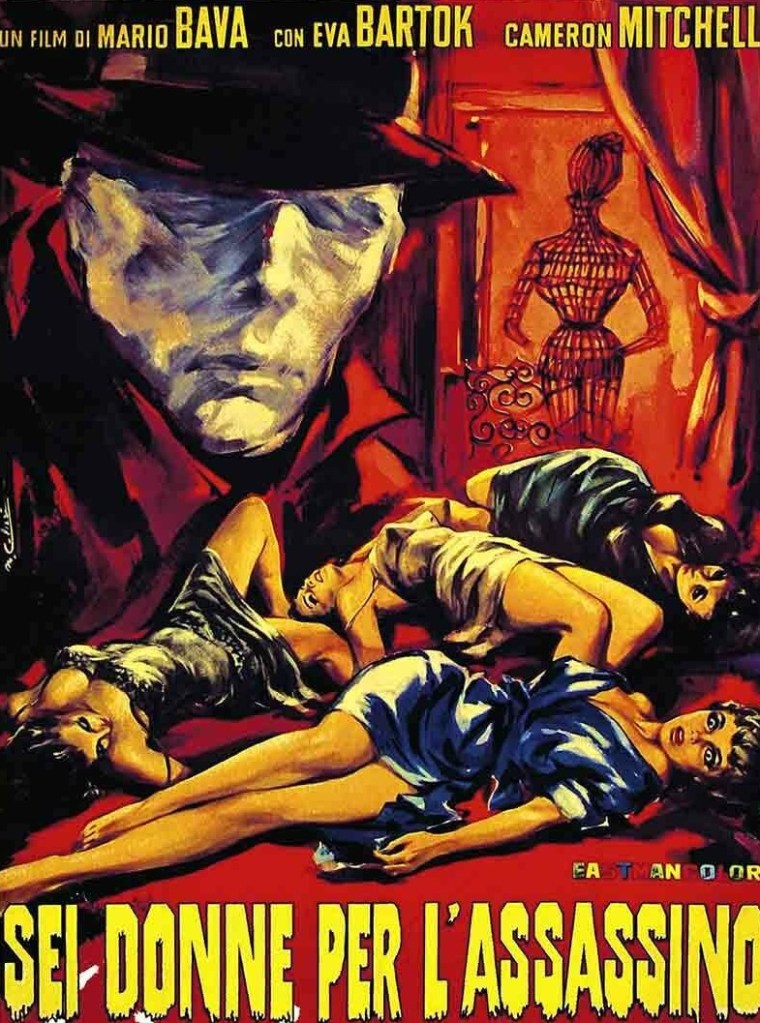
Director Mario Bava channels his inner Douglas Sirk in a rich color palette for this early version of giallo. About as surprisingly rich is the camerawork, which, for a low-budget picture is exceptionally accomplished, tracking, drifting, bobbing between characters. This early in the 1960s, nudity was not so prevalent but setting a movie in a fashion house – ensuring the beauty quotient is remarkably high – provided sufficient opportunity for ladies to be seen (within a work context naturally) in a certain amount of undress and you can be sure the killer leaves them half-naked. And it’s not the usual giallo sex maniac at work either but, despite the volume of murders, a killer driven by a desire to conceal shame.
Blackmail, theft, abortion, cocaine addiction, pregnancy, impotence and illicit affairs are among the secrets the protagonists wish to keep hidden, all risking exposure by a diary kept by the first victim Isabella (Francesco Ungaro). So rather than a whodunit, it’s a whydunit. The killer is particularly creepy, face concealed behind white gauze like an Egyptian mummy. As the Italian title explains, six women are intended for the chop, so that kind of rules out a great deal of tension as you spend your time counting. Are we nearly there yet? And as we run out of obvious potential victims, who the heck is there left to kill? Of course, by that time, we are into twist territory and that element is certainly neatly done.
The main candidates for the murderer are: Franco (Dante DiPaolo), Riccardo (Franco Ressel), Cesare (Luciano Piggozi). Massimo (Cameron Mitchell) and Marco (Massimo Righi). These are the official ones, rounded up by Inspector Silvestri (Thomas Reiner). But that still leaves housekeeper Clarice (Harriet Medin) in her black leather coat. And a fashion house being a festering wound of jealousy, sex, status and privilege you wouldn’t discount any of the models either nor an owner Cristiana (Eva Bartok) who is such a slave-driver she denies her seamstresses time to mourn.
Emotions would be running high in this establishment never mind with a killer on the loose. Relationships are so fraught that even when this is the worst possible time to be alone in a house, certain of the models refuse to offer sanctuary to others and one, Tao-Li (Claude Dantes), just plans to head for the hills (Paris, in other words) and abandon the others. Add to that a high degree of stupidity. When Greta (Lea Lander) discovers the disfigured corpse of Nicole (Arianna Gorini) in the trunk of her car, rather than calling the police, she drags the body into the house and hides it under the stairs while her butler is about to serve tea. Except it’s not out of folly, it’s because Greta, like all the women here, wishes to protect a male, passion reigning supreme to the extent that the thought of losing a lover even if he is a murderer is too much to bear.
The inspector’s task would be made easy if the killer had a distinctive modus operandi. Death occurs through strangulation, suffocation, drowning (though with cut wrists to make it look like suicide), falling from a great height and Nicole’s face thrust into a stove. If victims take a long time to die, it’s not from the killer’s sadism but his/her incompetence. Virtually none are speedily dispatched, murder not as easy as you might imagine, an idea that Hitchcock purloined in Torn Curtain (1966)
For most of the time the way the camera moves you would wouldn’t think you were watching a film about a serial killer (in those days as rare in reality as in fiction) but a dense emotional tale as spun by the likes of Luchino Visconti (The Leopard, 1963) amidst a backdrop of wealth and beauty. Setting aside the murders, there is a feast of intrigue, and a rich seam of characters, though the central theme seems to be (not surprising for the era) that money and beauty are not as fulfilling as love, something that women will commit various crimes (though stopping short of murder) to achieve.
I would imagine it was just such intricate camerawork that put audiences off the picture on initial release, a big flop in Italy and, if screened anywhere else (as in Britain) the lower part of a double bill. Not quite as intense as Bava’s previous The Whip and the Body (1963) nor so stylistically driven as Danger : Diabolik (1968) and some way short of horror masterpieces like Black Sabbath (1963), this is still an interesting watch, something of a template for future giallo and from a pure directorial perspective glorious to watch.
The number of characters featured and the time spent on the various deaths limit the opportunities for any one star to dominate but Hungarian Eva Bartok (Operation Amsterdam, 1960) leads the line on the female side while American transplant Cameron Mitchell (Minnesota Clay, 1964) and Dante DiPaulo (Sweet Charity, 1969) vie for male acting honors. The screenplay was a joint effort by Marcello Fondato, Giuseppe Barilla and Bava.
YouTube has this for free though be warned it comes with ads and for the sumptuous photography alone you may want in any case to splash out.
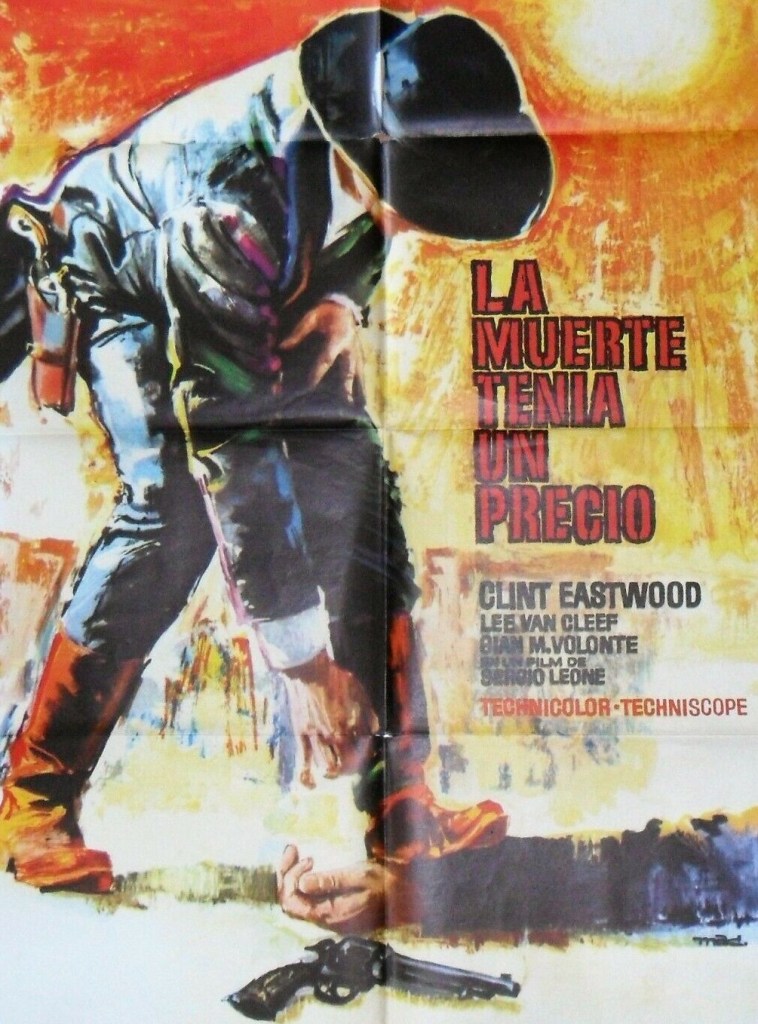
The prospective casting was tantalizing. How about Clint Eastwood and Lee Marvin, a pairing for the ages, two of the toughest guys in screen history? Failing that, Eastwood and Charles Bronson, The Man With No Name vs The Monosyllabic Man? The role of Colonel Mortimer could also have gone to Henry Fonda or Robert Ryan before in one of the movie business’s oddest tales it ended up with Lee Van Cleef.
In due course Bronson and Fonda would work with Sergio Leone in the director’s best film, Once Upon a Time in the West (1969). Fonda’s agent had already dodged Leone’s entreaties once, having rejected A Fistful of Dollars (1964). Marvin was, in fact, all set, an oral agreement in place until a few days before shooting began on For a Few Dollars More he suddenly opted instead for Cat Ballou (1965), a decision that won him an Oscar and turned him into an unlikely star.
When none of his first choices proved available or interested, Leone turned to Van Cleef. Or, more correctly, a photo of the actor pulled from an old casting catalog. Although a western buff like Leone remembered Van Cleef from his debut in High Noon (1952) plus Gunfight at the O.K. Corral (1957), The Tin Star (1957) and a dozen other bit parts and supporting roles in westerns, Van Cleef had not been credited in a movie since The Man Who Shot Liberty Valance (1962).
He proved virtually impossible to track down. No small surprise there because he earned a living mostly as a painter now, a car accident having left him with a limp. He couldn’t run, much less ride anything but a docile horse. He required a stepladder to get mounted. Leone flew to Los Angeles and his first sight of Van Cleef, older than his photograph, proved his instincts correct, Van Cleef’s face “so strong, so powerful.” The salary on offer, for a down-on-his-luck actor scarcely able to pay a phone bill, was a fat purse of $10,000. (Eastwood’s salary was $50,000 plus a profit share compared to just $15,000 for the first film).
Leone put him to work right away, the day he arrived in Italy filming reaction shots. It was just as well his input that day was so simple because, as Clint Eastwood had discovered, the language barrier was a problem. Equally disconcerting was that Van Cleef had no idea why he had been chosen, and since A Fistful of Dollars had not been released in the U.S., no inkling of the kind of western the director had in mind. At Eastwood’s urging, he nipped out to a local cinema and returned with the understanding that the script was “definitely second to style.” Van Cleef was easy to work with, and although he could put away a fair amount of liquid refreshment it never interfered with his work. He came ready for direction.
Leone had not wanted to make a sequel. His original plan was a caper picture called Grand Slam or a remake of Fritz Lang’s classic M to star Klaus Kinski or an autobiographical drama – Viale Glorioso – set in the 1930s. Jolly, the producers of A Fistful of Dollars, offered him a 30 per cent profit share on that film if he made a sequel, as they felt he was legally obliged to do. Instead, furious with his treatment at their hands, the director hit upon the title of a sequel For a Few Dollars More, the actual storyline only coming to fruition when he came across a treatment called The Bounty Killer by Enzo dell’Aquilla and Fernando Di Leo, who in exchange for a large sum, surrendered their screen credits. Luciano Vincenzoni completed the screenplay in nine days, leavening it with humor, after the director and his brother-in-law Fulvio Morsella had produced a revised treatment, Leone also involved in the final screenplay.
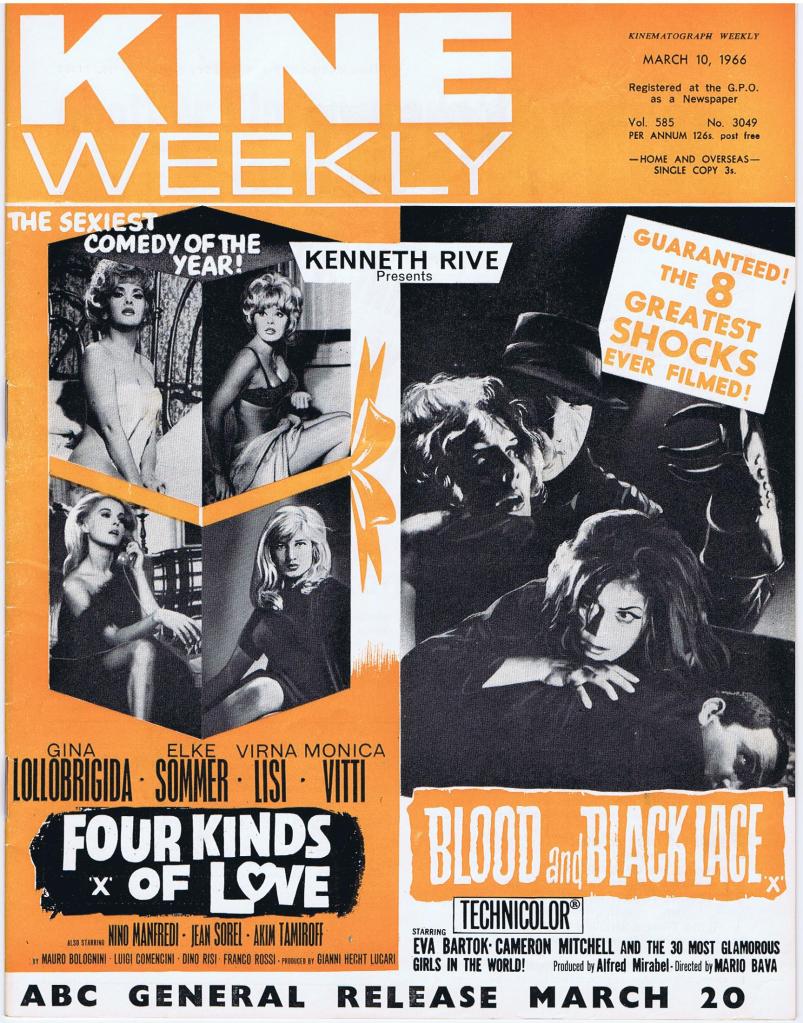
Jolly Films, the makers of “A Fistful of Dollars” already had experience of selling its films abroad. But as with Mario Bava’s “Blood and Black Lace” they were usually sold outright with no share of the box office and in turn sold as a supporting feature for a fixed price to an exhibitor.
Leone found a new backer in Alberto Grimaldi, an Italian entertainment lawyer who worked for Columbia and Twentieth Century Fox and had produced seven Spanish westerns. He promised to triple the first film’s budget to $600,000, with the director on a salary and 50 per cent profit share.
Success bred artistic confidence. A Fistful of Dollars had broken all box office records in Italy, grossing $4.6 million, and so Leone sought to improve on his initial offering and develop an “authorial voice.”
Thematically, with two principals, initially rivals who end up as “argumentative children,” it took inspiration from westerns like The Bravados (1958) – the photo and the chiming watch – and Robert Aldrich’s Vera Cruz which pitched Burt Lancaster against Gary Cooper. While bounty hunters had cropped up in Hollywood, they were not ruthless killers, actions always justified, rather than merely professionals doing their job. So in some sense Leone was drawing upon, and upending, films like Anthony Mann’s The Naked Spur (1953) and The Tin Star, Andre De Toth’s The Bounty Hunter (1954) and Budd Boetticher’s Ride Lonesome (1959). Just as Clint Eastwood’s bounty hunter underwent change, gradually the character played by Gian Maria Volonte evolved from a straightforward outlaw called Tombstone to a stoned, sadistic bandit named El Indio.
With artistic pretension came attention to detail. Leone required historical exactitude not just relating to weapons used, but their ballistics and range. Lee Van Cleef’s arsenal included a Buntline Special with removable shoulder stock, Colt Lightning pump action shotgun, Winchester ’94 rifle, and a double-barreled Lefaucheux. Carlo Simi’s town, constructed near Almeria, contained a two-storey saloon, undertaker’s parlor, barbershop, telegraph office, jail, hotel and an adobe First City Bank. And there was nothing pretty about it. The saloon was dirty and overcrowded, machines belching so much smoke it “looked as if a man could choke in there.” Filming took place between mid-April and the end of June 1965.
Perhaps the biggest area for improvement was the music. Ennio Morricone had scored another nine films since A Fistful of Dollars. Both director and composer had ambitious ideas about how to use the music. The score was not recorded in advance, nor was Morricone given a screenplay, instead listening while Leone told him the story and asked for individual themes for characters. Morricone would play short pieces for Leone and if met with his approval compose longer themes. Each character had their own leitmotif, sometimes the same instrument at different registers, the flute brief and high-pitched for Monco (Eastwood) but in a low register for Mortimer, church bells and a guitar representing El Indio. In a very real sense, they were experimenting with form. Bernardo Bertolucci regarded Morricone’s music as “almost a visible element in the film.” Musical ideas regarding El Indio’s watch, however, were developed at the rough cut stage, its repetitive melody becoming “sound effect, musical introduction and concrete element in the story.”
As well as creating music for audiences, Leone’s films are punctured with music that holds particular meaning for characters, here the watch and in Once Upon a Time in the West the harmonica, in both films flashback used to assist understanding.
The myth of why it took so long for either film to reach the United States was based on two misconceptions, firstly that Japanese director Akira Kurosawa, whose Yojimbo (1961) A Fistful of Dollars closely resembled, had blocked its progress, secondly that it relied on screenwriter Vincenzoni to make the breakthrough via a contact working for United Artists.
In fact, there were more obvious reasons for resistance from American distributors. In the first place, you could not discount snobbery. The notion that the country that had invented the western should now be reliant on importing them from Italy seemed a shade abhorrent. Although For a Few Dollars More was sold to 26 countries in a day at the annual Sorrento trade fair in 1965 – at the same fair a year earlier there had not been a single taker for A Fistful of Dollars – the United States was not among the buyers, distributors perhaps even more daunted by the prospect of introducing so much violence to American audiences reared on the traditional western.
Foreign movies that made the successful transition to the United States arrived weighted down with critical approval and/or awards or garlanded with a sexy actress – Brigitte Bardot, Anna Magnani, Sophia Loren among the favored – and risqué scenes that Hollywood dare not include for fear of offending the all-mighty Production Code.
But sex was a far easier sell in the U.S. than violence. And an actor with no movie marquee such as Clint Eastwood did not fill exhibitors with delight and even the notion that A Fistful of Dollars was a remake of Akira Kurosawa’s Yojimbo (1961) failed to stir the critics (as with The Magnificent Seven being a remake of Seven Samurai, most viewing the notion as repellent). So both the first and second pictures in the “Dollars” trilogy were stuck in distribution limbo for three and two years, respectively, before being screened in America.
And, initially, it had appeared that Italian audiences shared the same distaste for a cultural intruder such as A Fistful of Dollars. One cinema chain owner refused to book the film on the grounds that there were not enough female characters. A Fistful of Dollars was released in Italy in August, a dead period, since the month is so hot and everyone has abandoned the city for the beach. It opened – only in Florence and with neither publicity nor advertising – on August 27th 1964, a Friday, and did poor business that day and the next. But by Monday, it was a different story, takings had doubled and over the following two days customers were being turned away. New films typically played first-run for 7-10 days in Florence, A Fistful of Dollars ran for three months, triggering a box office story of Cinderella proportions.
But my research indicated there had been ample opportunity for an American distributor to snap up the rights to A Fistful of Dollars in 1965, two years before it was finally released there. In the first place, the music rights had already been purchased by New York firm South Mountain Music in March 1965 in expectation the film would acquire release that year. In December 1965 Arrigo Colombo, partner in Jolly, flew to the United States for the specific purpose of lining up a major distributor for A Fistful of Dollars. The company had previously secured U.S. distribution for horror product like Castle of Blood (1964) and Blood and Black Lace (1964) but those were outright sales.
With the movie already sold to Spain, West Germany, France and Japan, Colombo aimed to conclude a deal for the English-speaking market, “purposely holding back” from releasing the picture in those countries as he sought an all-encompassing contract. At that point, Kurosawa no longer stood in the way, that issue “now cleared up” settled in the normal fashion by financial inducement, in an “amicable settlement” Toho snagging the Japanese and Korean rights, the deal sweetened with a minimum $100,000 against a share of global profits. But Colombo went home empty-handed, unable to secure any deal and his temerity ridiculed by trade magazine Variety
Although Sergio Leone had one other legal obstacle to surmount that would not have got in the way of a U.S. distribution deal, the worst that could happen being that a contract might be struck with a different company. Italian companies Jolly Films/Unidis, which had backed the original, took umbrage at Leone going ahead with the sequel without their financial involvement, cutting them off from the profit pipeline. So in April 1966 they took Leone to court in Rome arguing that For A Few Dollars More “represented a steal as well as unlawful competition for its own Fistful.” Four months later the judge denied the claim on the grounds that “the character played by Clint Eastwood in each film is not characterized to such a degree that a likeness exists” (even though to all intents and purposes it was the same character, cigar, poncho, gun, bounty hunting!). Ironically, Italian laxity in such matters counted against Eastwood when he failed to prevent the distribution of a film based on two segments of Rawhide stitched together.
It would also be highly unusual if United Artists was not aware of both A Fistful of Dollars and For A Few DollarsMore since, in keeping tabs on the foreign performance of both Goldfinger (1964) and Thunderball (1965) the studio could scarcely fail to notice the Italian westerns close on their box office tail, the second western outpointing Thunderball in daily averages in Rome.
But the story still, erroneously, goes that it was the intervention of writer Vincenzoni which proved decisive. He had contacts in U.S, namely Ilya Lopert of United Artists. Grimaldi was, meanwhile, trying to sell U.S. and Canada rights relating to the second picture. Vincenzoni arranged for UA’s representatives to view A Fistful of Dollars in Rome and cut himself in for a slice of the profits when the distributor surprisingly purchased the entire series.
Since A Fistful of Dollars had already been sold to most major territories, UA could only acquire the North American rights – for a reported $900,000 – but for the other two films gained a considerably larger share of global distribution
United Artists was an unusual company among the Hollywood hierarchy, and not primarily due to recurrent Oscar success, but because it had, completely unexpectedly, hit box office gold with James Bond. There was nothing particularly odd about a series, as Tarzan, Sherlock Holmes etc (still flourishing in the 1960s) testified. What was distinctive about the Bonds was that each picture – the four so far had earned close to $150 million worldwide, not counting merchandising – had done better than the last, which went against the standard rule of sequels of diminishing returns and higher costs. Given the opportunity to buy into a ready-made series (two films in the can, the third in production) UA made an “attempt to calculatedly duplicate the (Bond) phenomenon” and in so doing “create a trend.” Assuming the movies would follow the Bond formula of increased grosses with each successive picture, the studio was prepared to spend “many hundreds of thousands” of dollars to establish the first picture.
United Artists embarked on an unusual sales campaign to the trade. Instead of marketing the pictures one at a time, they started to promote the series with the tagline “A Fistful of Dollars is the first motion picture of its kind, it won’t be the last.” The advertising campaign was unusual in that it was based entirely around introducing the character rather than the story (much in the same way as James Bond had been), three separate slivers of the poster devoted to visual aspects, the cigar, gun and poncho, each carrying mention of “The Man With No Name,” such anonymity one of the talking points of the movies.
Cinema managers were briefed on release dates, A Fistful of Dollars in January 1967, the sequel for April and The Good, the Bad and the Ugly for Xmas that year. Like the Bonds, it was expected that box office would progressively, if not explosively, increase. The studio unveiled a “hard-hitting campaign” designed to “intrigue the western or action fan.”
However, the North American premiere was held not in the United States but Canada, at the Odeon-Carlton in Toronto. Having committed to a four-week engagement, a risky prospect for an unknown quantity, the cinema started advertising a teaser campaign three weeks in advance. During the first week, posters were not just focused on the “man with no name” but also “the film with no name” and the “cinema with no name,” all those elements removed from the artwork until the second week of the campaign. UA allocated $20,000 in marketing, up to four times the usual amount spent on a launch there, and was rewarded with strong results – “bullish but not Bondish” Variety’s verdict.
However, the UA gamble did not pay off, especially when taking into account the high cost of buying the rights allied to huge marketing costs. Initial commercial projections proved unrealistic. Despite apparently hitting the box office mark in first-run dates in key cities, the film was pulled up short by its New York experience. Shunted straight into a showcase (wide) release rather than a first-run launch, it brought in a pitiful $153,000 from 75 theaters – even The Quiller Memorandum (1966) in its second week did better ($150,000 from 25). As a consequence when For a Few Dollars More was released in April/May, UA held off boking it into New York until “a suitable arrangement” could be made, which translated into hand-picking a dozen houses famed for appealing to action fans plus 600-seat arthouse the Trans-Lux West.
United Artists predicted $3.5 million in rentals (the amount returned to studios after cinemas take their cut of the gross) for A Fistful of Dollars and $4.5 million with For a Few Dollars More. Neither came close, the latter the marginally better performer with $2.2 million in rentals (enough for a lowly 41st on the annual chart) with the first film earning $2.1 million in rentals (46th) way behind more traditional performers like Hombre ($6.5 million for tenth spot), El Dorado ($5.9 million in 13th) and The War Wagon ($5.5 million in 15th).
The vaunted Bond-style box office explosion never materialized and it might have helped if UA had kept closer watch on the actual revenues posted in Italy for the series. While For a Few Dollars More increased by $2 million the takings of A Fistful of Dollars, the final film in the trilogy, The Good, the Bad and the Ugly produced lower grosses than even the first.
However, it did look as if The Good, the Bad and the Ugly would come good. UA opened it in two first-run cinemas in New York where each house retained it for six weeks. But although the final tally of $4.5 million (24th spot in the annual rankings) was the best of the series, it did not herald returns that made it anywhere near comparable to the Bonds.
It’s possible the movies did better in terms of admissions than the box office figures show. Distributors pushing foreign product into arthouses were generally able to achieve a high share of the rental – 50 per cent the going rate – because they were able to set rival arthouses against each other and movies with a sexy theme/star had inbuilt box office appeal, La Dolce Vita (1960) and And God Created Women (1956) the classic examples. But that would not be possible when trying to interest ordinary cinemas with a film lacking in sex.
When I researched the early Bonds for a previous Blog, I found that United Artists had only managed to achieve bookings for Dr No (1962) by lowering its rental demand. Exhibitors paid the studio just 30 per cent of the gross. And I wondered if perhaps the same occurred with A Fistful of Dollars given the star, like Sean Connery, was completely unknown. Of course, it would not explain why the series did not grow as expected.
Of course, there was a surprising winner and an unexpected loser in the whole ‘Dollars’ saga. Clint Eastwood emerged as the natural successor to John Wayne with a solid box office – and later critical – reputation for American westerns starting off with Hang ‘Em High (1968) which beat The Good, the Bad and the Ugly at the box office, while Sergio Leone’s Once Upon a Time in the West (1969) proved a huge flop in the U.S.
Christopher Frayling, Sergio Leone, Something To Do With Death (Faber & Faber, 2000), p160-162, p165-200; “Italo’s Own Oater Leads Box Office,” Variety, December 2, 1964, p16; “South Mountain Buys Dollar Score,” Variety, March 10, 1965, p58; “Jolly’s Colombo Discovers N.Y.C. Busy at Xmas,” Variety, December 22, 1965, p3; “Tight Race for Box Office Honours in Italy Looms as Thunder Leads Dollars,” Variety, January 65, 1966, p15; “Dollars World Distribution for UA,” Variety, March 22, 1966, p22; “Clint Eastwood Italo Features Face Litigation,” Variety, April 13, 1966, p29; “UA Cautious on Links to Italo Fistful; Faces Slap from Kurosawa,” Variety, July 13, 1966, p7; “Rome Court Rejects Plea for Seizure of Few Dollars Made By Fistful Film,” Variety, August 3, 1966, p28; “Clint Eastwood vs Jolly on 2 Segs of Rawhide ‘Billed’ New Italo Pic,” Variety, September 7, 1966, p15; “Italy Making More Westerns, Spy Films Than Star Vehicles,” Box Office, October 31, 1966, p13; “Hemstitched Feature,” Variety, November 23, 1966, p22; “UA Division Holds Screenings of Westerns,” Box Office, December 12, 1966, pE2; Advertisement, Variety, December 21, 1966, p12-13; “UA Gambles Dollars As Good As Bonds,” Variety, December 28, 1966, p7; “Fred Goldberg Shows Ads on UA ‘Dollar’ Films,” Box Office, January 2, 1967, pE4; “Review,” Box Office, January 9, 1967, pA11; “Fistful of Dollars: Male (and Italo) B.O.,” Variety, January 18, 1967, p7; “Fistful of Dollars: The Glad Reaper,” Variety, February 1, 1967, p5; “This Week’s N.Y. Showcases,” Variety, February 8, 1967, p9; “Fistful’s Weaker N.Y. B.O. Clench,” Variety, February 8, 1967, p7; “Methodical Campaign Kicks Off Ideal Fistful Ballyhoo in Toronto,” Box Office, May 1, 1967, pA1; “Few DollarsMore Runs 30% Ahead of First Dubbed Italo-Made Western, So Bond Analogy Makes Out,” Variety, May 31, 1967, p4; “N.Y. Slow to Fall Into Line,” Variety, May 31, 1967, p4; “B’way Still Boffo,” Variety, July 12, 1967, p9; “Carefully Picked,” Variety, July 12, 1967, p4; “B’way Biz Still Big,” Variety, July 19, 1967, p9; “Big Rental Films of 1967,” Variety, January 3, 1968, p25; “B’way B.O. Up,” Variety, January 31, 1968, p9; “Big Rental Films of 1968,” Variety, January 8, 1969, p15.
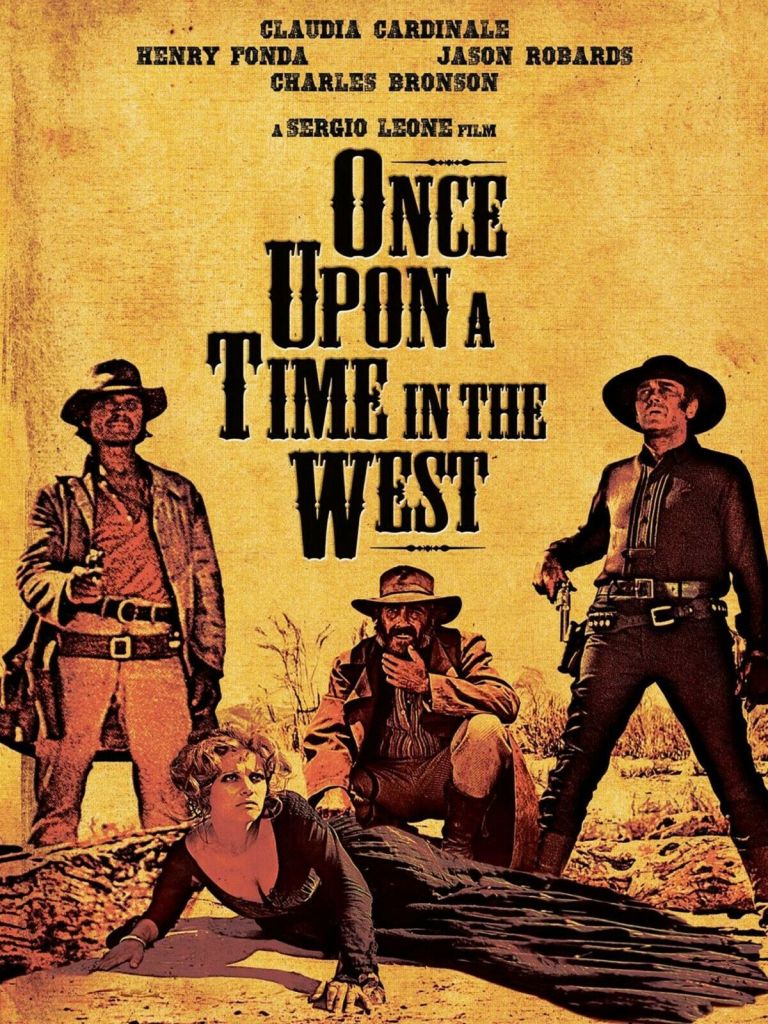
A masterpiece to savor. The greatest western ever made. Sergio Leone’s movie out-Fords John Ford in thematic energy, imagery and believable characters and although it takes in the iconic Monument Valley it dispenses with marauding Native Americans and the wrecking of saloons. That the backdrop is the New West of civilisation and enterprise is somewhat surprising for a movie that appears to concentrate on the violence implicit in the Old West. But that is only the surface. Dreams, fresh starts are the driving force. It made a star out of Charles Bronson (Farewell, Friend, 1968), turned the Henry Fonda (Advise and Consent, 1961) persona on its head and provided Claudia Cardinale (Blindfold, 1965) with the role of a lifetime. And there was another star – composer Ennio Morricone (The Sicilian Clan, 1969)
New Orleans courtesan Jill (Claudia Cardinale) heads west to fulfil a dream of living in the country and bringing up a family. Gunslinger Frank (Henry Fonda), like Michael in The Godfather, has visions of going straight, turning legitimate through railroad ownership. Harmonica (Charles Bronson) has been dreaming of the freedom that will come through achieving revenge, the crippled crooked railroad baron Morton (Gabriele Ferzetti) dreams of seeing the ocean and even Cheyenne (Jason Robards) would prefer a spell out of captivity.
The beginnings of the railroad triggers a sea-change in the West, displacing the sometimes lawless pioneers, creating a mythic tale about the ending of a myth, a formidable fable about the twilight and resurgence of the American West. In essence, Leone exploits five stereotypes – the lone avenger (Harmonica), the outlaw Frank who wants to go straight, the idealistic outlaw in Cheyenne, Jill the whore and outwardly respectable businessman Morton whose only aim is monopoly. All these characters converge on new town Flagstone where their narratives intersect.
That Leone takes such stereotypes and fashions them into a movie of the highest order is down to style. This is slow in the way opera is slow. Enormous thought has gone into each sequence to extract the maximum in each sequence. In so doing creating the most stylish western ever made. The build-up to violence is gradual, the violence itself over in the blink of an eye.
Unusually for a western – except oddities like Five Card Stud (1968) – the driving force is mystery. Generally, the western is the most direct of genres, characters establishing from the outset who they are and what they want by action and dialogue. But Jill, Harmonica and Cheyenne are, on initial appearances, mysterious. Leone takes the conventions of the western and turns them upside down, not just in the reversals and plot twists but in the slow unfolding tale where motivation and action constantly change, alliances formed among the most unlikely allies, Harmonica and Cheyenne, Harmonica and Frank, and where a mooted alliance, in the romantic sense, between Jill and Harmonica fails to take root.
There’s no doubt another director would have made shorter work of the opening sequence in Cattle Corner, all creaky scratchy noise, in a decrepit railroad station that represents the Old West, but that would be like asking David Lean to cut back Omar Sharif emerging from the horizon in Lawrence of Arabia (1962) or Alfred Hitchcock to trim the hypnotic scenes of James Stewart following Kim Novak in Vertigo (1958). Instead, Leone sets out his stall. This movie is going to be made his way, a nod to the operatic an imperative. But the movie turns full circle. If we begin with the kind of lawless ambush prevalent in the older days, we end with a shootout at the Sweetwater ranch that is almost a sideshow to progress as the railroad sweeps ever onward.
No character performs more against audience expectation than Jill. Women in westerns rarely take center stage, unless they exhibit a masculine skill with the gun. There has rarely been a more fully-rounded character in the movies never mind this genre. When we are introduced to her, she is the innocent, first time out west, eyes full of wonder, heart full of romance. Then we realize she is a tad more mercenary and that her previous occupation belies her presentation. Then she succumbs to Frank. Then she wants to give up. Then she doesn’t. Not just to stay but to become the earth mother for all the men working on the railroad.
Another director would have given her a ton of dialogue to express her feelings. Instead, Leone does it with the eyes. The look of awe as she arrives in Flagstone, the despair as she approaches the corpses, the surrender to the voracious Frank, the understanding of the role she must now play. And when it comes to close-ups don’t forget our first glimpse of Frank, those baby blue eyes, and the shock registering on his face in the final shoot-out, one of the most incredible pieces of acting I have ever seen.
And you can’t ignore the contribution of the music. Ennio Morricone’s score for Once Upon a Time in the West has made a greater cultural impact than even the venerated John Williams’ themes for Star Wars (1977) and Jaws (1975) with rock gods like Bruce Springsteen and Metallica among those spreading the word to successive generations and I wonder in fact how people were drawn to this big-screen showing by the opportunity to hear the score in six-track Dolby sound. There’s an argument to be made that the original soundtrack sold more copies than the film sold tickets.
The other element with the music which was driven home to me is how loud it was here compared to, for example, Thunderball (1965), which as it happens I also saw on the big screen on the same day. Although I’ve listened to certain tracks from the Bond film on a CD where the context is only the listener and not the rest of the picture, I was surprised how muted the music was for Thunderball especially in the action sequences. Today’s soundtracks are often loud to the point of being obstreperous, but rarely add anything to character or image.
One final point, Once Upon a Time in the West was reissued not as some kind of retrospective for the director but in memory of the composer.
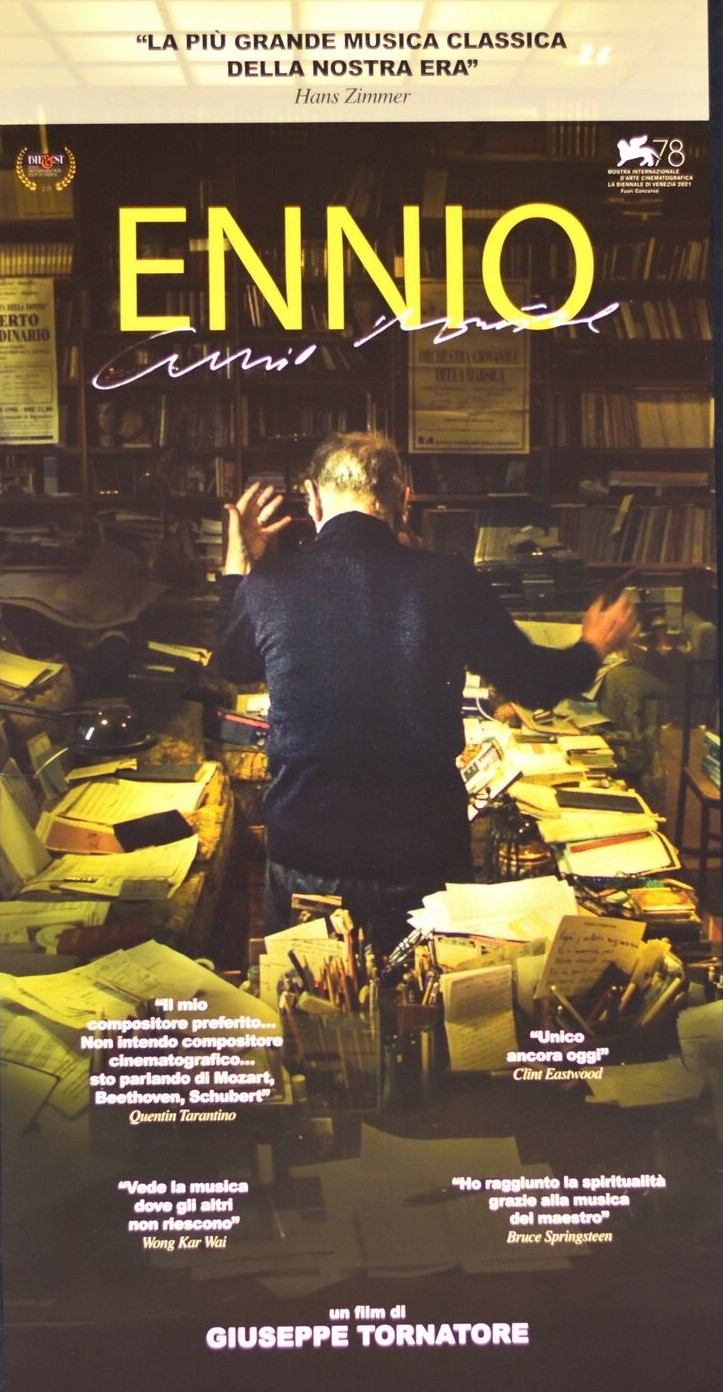
I became an instant fan of Ennio Morricone after watching dance troupe Pan’s People performing on BBC TV’s weekly Top of the Pops to Hugo Montenegro’s version of The Good, the Bad and the Ugly when it topped the singles charts in Britain in 1968. Sure, there had been successful theme songs in the charts before like Shirley Bassey’s rendering of Goldfinger, but never a pure instrumental and not a wailing guitar. This is quite simply an extraordinary documentary, and although it comes with an indulgence of anecdotes, what is considerably more compelling is the concentration, in accessible fashion, on the artist’s compositional skills. I could have watched four hours of this, never mind that clocking in at 156 minutes it’s already on the lengthy side for a documentary.
Morricone should never have been a film composer or a composer of any kind. He was too poor. His father was a trumpet-player and Morricone only took up music, designated instrument the trumpet, because his father believed a good trumpet player would always make a living and provide for his family. He was not a good trumpet player. At least, not at the start. Given that once orchestras and dance bands went out of favor, trumpet playing would have been a precarious existence, it was lucky his father’s insisted he also study harmony and composition. He won a place at a conservatoire, where the pupils, all except him, were the sons and daughters of the wealthy elite. And a conservatoire in those days was academically inclined, intending to produce classical composers and players, not people who would work as arrangers and composers of pop songs or commit the unpardonable sin of writing for the movies.
Morricone, always prolific, started working as an arranger of pop tunes for the RCA label in Italy and then for RAI, the Italian state television. But he was also an innovator and many of his songs began with a distinctive sound rather than the music being merely a backdrop to the song. He founded an experimental music group, making music out of anything but a musical instrument. You can see the benefits of that inquiring mind from the first 20 minutes of Once Upon a Time in the West (1968), for me his compositional masterpiece and my favorite western.
When he started working for Sergio Leone, he realized they had once been classmates. Leone came to him because Morricone had already written music for Italian westerns. Of course, the collaboration became legendary. As you will be aware, Leone liked the music recorded before filming began and played it during filming. While an interesting approach, I always thought it odd, until I witnessed, here, Robert De Niro making an entrance in one scene of Once Upon a Time in America (1984).
While his themes were often complex, he had a genius for catching the ear of the listener. Many scenes showed Morricone with voice and fingers tapping out a theme you will instantly recognize because all his best work was instantly recognizable. Although an extremely shy person, he was not above walking out – or threatening to do so – if a film was not going according to plan, if a director insisted on making a change or incorporating other material. Nor, for such a genius, was he full of self-confidence. Eventually, he relied on his wife as a listening board to decide if his work was any good. For what he called the “triumphant” scene from The Untouchables (1987), where cops brandishing shotguns prompted by Sean Connery burst in on bootleggers, he supplied nine ideas for director Brian De Palma, who proceeded to use the one Morricone considered the weakest. Other times, he was the one suddenly requiring an extra piece of work, calling upon Joan Baez to supply lyrics at the last minute to his theme for Sacco and Vanzetti (1971) that became the memorable “Here’s To You.”
One of the most enjoyable elements of the movie is seeing concert renditions of his themes, “Here’s To You” with a massive choral ensemble making the hairs on the back of your head stand on end. You could probably make a case for Morricone reinventing the chorus, paving the way for such practitioners as Hans Zimmer. Until then, there was many a heavenly chorus, but Morricone found better use for a chorus. And you could also argue that he influenced the likes of Ridley Scott (Gladiator, 1999) in using female opera singers to introduce a completely new sound to movies.
One of Morricone’s stated aims was to use music to bring something else out of a scene, not to merely provide a relevant sound. So for the death of Sean Connery in The Untouchables or the baby carriage scene his music goes completely against what you are watching but nonetheless adds a deeper understanding. We also see how he folds different themes into the one piece of music.
There are a number of very moving sequences, when Morricone, for example recalls his father – he would not use a trumpet in his compositions until his father died – or when he explains his hurt at being made to feel an outcast by his classical peers, and there is one extraordinary moment when one of those who has disdained him writes a letter asking forgiveness for having so under-rated his work. And certainly there is clear petulance at being passed over for the Oscar for The Mission (1986), a piece of work that director Roland Joffe said made the movie a completely different experience. Morricone complained that half the music that won Herbie Hancock the Oscar for Round Midnight (1986) was actually old, rather than new, music.
My favorite anecdote is how Gillo Pontecorvo, hearing heard a piece of music Morricone had composed for The Year of the Cannibals (1970) promptly stole it for his own Queimade/Burn (1969) before settling, after an argumemt, for a similar piece. Actors, composers and directors in the anecdote queue include Quentin Tarantino (The Hateful Eight, 2015) , Clint Eastwood, Terence Malick (Days of Heaven, 1978), Dario Argento (Four Flies on Grey Velvet, 1971), John Williams, Hans Zimmer, Oliver Stone (U Turn, 1997) Marco Bellochio (Fists in the Pocket, 1965) and Bernardo Bertolucci (1900, 1976).
Morricone’s film music changed over the decades. Following the westerns were giallos, marked by dissonance rather than melody, then Hollywood came calling. I hadn’t quite realized what an audience Morricone commanded – over 70 million albums sold. He had hit singles In Italy – A Fistful of Dollars ranked fourth in the charts, For a Few Dollars one place below, “Here’s To You” also fourth. In Britain, “Chi Mai” reached the second spot; in France “Man with Harmonica” from Once Upon a Time in the West went to number one, as did “Chi Mai” while “Here’s To You” was at number two. And, of course, his music has been adopted by a host of rock bands, most notably Bruce Springsteen and Metallica.
Director Giuseppe Tornatore, who has a special place in the Morricone catalog thanks to Cinema Paradiso (1988), has produced a magnificent tribute to the genius. In my half century of regular cinema going, there are four composers I rank above all the rest, John Barry, John Williams, Hans Zimmer and Ennio Morricone, but of them all, the latter is the number one for not just his enormous output – 500 scores including 29 in one year – and his wide range of melodies, but because they are so many memorable pieces. Once Upon a Time in the West is never off my CD player and especially gets worn out in the car. For sheer enjoyment this is an undeniable five-star treat.
I am sure this will end being streamed somewhere but I urge you to try and catch it at the cinema, the effect will be lost on the small screen of the massed choruses or Morricone conducting in vast amphitheaters.
British espionage team embarking on a scheme to fool Adolf Hitler during the Second World War find they are susceptible to deceit and deception in their own lives. What could have been a plodding step-by-step documentary-style picture is given a huge fillip by examination of the lives of those involved. The twists and turns of this extraordinary tale, both in the professional and personal sense, make for a very enjoyable picture. It is no less thrilling for, like The Day of the Jackal (1973), being aware of the outcome.
Planning to invade Sicily in 1943, the Allies are determined to convince Hitler that they are instead more likely to attack Greece. The British come up with “Operation Mincemeat,” a variation on the Trojan horse with the “gift” this time being secret papers referring to the Greek assault that are contained in a briefcase attached to a corpse which washes up on the shores of Cadiz in Spain. The assumption is that the German high command is predisposed to being hoodwinked after having ignored the papers on a genuine corpse that came their way prior to the invasion of north Africa.
Tasked with devising the operation are the accomplished Ewen Montagu (Colin Firth) and the gawky Charles Cholmondeley (Matthew Macfadyen) into whose orbit comes Jean Leslie (Kelly Macdonald) whose persona is used to provide a romantic background for the corpse. Although the project has been given the green light from the highest authority i.e Winston Churchill (Simon Russell Beale) not everyone is in favour and the team face obstacles, since technically the plan comes under the remit of the Royal Navy, from Admiral John Godfrey (Jason Isaacs).
The romantic intrigue that ensues creates sufficient resentment for one member of the team to spy on the other at the behest of the admiral, thus ensuring that those charged with deceiving Hitler through moral means are entering into immoral personal activity.
But what drives this picture is the detail. Finding the correct type of corpse, ensuring it is preserved and has sufficient water in the lungs to make a convincing drowned man at the same time as creating a suitable legend for the character. Films dependent on the inner workings of espionage science, for want of a better word, do not always work. Enigma (2001), a riveting book, did not translate well onto the screen while The Imitation Game (2014), covering similar territory, did. Here, the minutiae of minutiae are presented in such detail it is an education, down to the importance of an eyelash, how to extract a letter without breaking the seal on an envelope, and, critically how to judge whether the Germans have examined the material closely enough to ensure they have taken the bait.
The story has already been told though not in such detail as “The Man Who Never Was” (1956) but with Hollywood stars Clifton Webb and Gloria Grahame playing the leads.
And that’s before other twists and turns. The corpse was a down-and-out, abandoned, so it appeared, by all and sundry, until out of the blue his sister arrives to claim the body. The coroner on duty in Cadiz turns out, against all expectations, to be an expert in drowning. The British Attache in Spain must seduce both genders to ensure smooth passage of the secret documents. On the more human side, widows abound, husbands lost in combat. A spy on the British side must be unmasked or rendered harmless. A host of other smaller stories unfold within the larger narrative. Above all lies the tension of the necessity for the operation’s success, failure would mean the deaths of thousands of men on the Sicily beachheads and possibly a thwarted invasion.
Matthew Macfadyen (Succession, 2018-2021) steals the show as the over-sensitive individual with the sense of entitlement that comes from having too big a brain, Oscar-winner Colin Firth (Kingsman: The Secret Service, 2014) the imperturbable figure who finds emotion wreaks havoc, Kelly Macdonald (Goodbye Christopher Robin, 2017) the secretary drawn deeper into a world where genuine emotion has little place.
The cream of British character actors providing sturdy support include Johnny Flynn (Emma, 2020) as spy writer Ian Fleming, Penelope Wilton (Downton Abbey: A New Era, 2022), Mark Gatiss (The Father, 2020), Alex Jennings (Munich: The Edge of War, 2021), Jason Isaacs (The Death of Stalin, 2017) and Mark Bonnar (Guilt, 2019-2021). ,
Oscar-nominated John Madden (Shakespeare in Love, 19980 directs with something approaching verve, never letting the pace drop, zipping from scene to scene, from the war effort into more intimate moments, without any sign of the tension flagging. In her movie debut Michelle Ashford (The Masters of Sex, 2014-2016) does an excellent job of distilling Ben McIntyre’s bestselling book.
Sure, this is one of those British pictures in a long line of movies that show the country at its best, generally in the thick of war, but the story is so involving that it merits viewing. It is still showing at the time of writing in British cinemas but in the United States and Latin America it will air on Netflix on May 11.
If anybody in Britain told you they saw Wild Angels (1966) when it came out that year you could safely accuse them of being liberal with the truth for that was one of the many films banned by the censors there. Global censorship remained a major issue for studios during the 1960s, every country imposing its own system, and very rarely did they conform with each other. At the beginning of the decade, the biggest issue was sex, by the end it was joined by violence and drugs.
Films were rarely banned in the United States since scripts for movies liable to violate the agreed guidelines tended to be submitted in advance and a compromise reached prior to production. However, local U.S. censorship bodies acting independently prevented some films being shown, This Rebel Breed (1960) in Memphis, Room at the Top (1959) in Atlanta. Movies banned in different countries included: Operation Eichmann (1961) in Israel and Germany, Queen Bee (1963) in Italy, The Collector (1965) in New Zealand, Wild Angels (1966) in Denmark, Lady in a Cage (1964) in Sweden and Geneva, Ulysses (1967) in Glasgow and Edinburgh, and Easy Rider (1969), despite winning a prize at Cannes, in France. Doctor Zhivago (1965) was banned in Thailand for being pro-communistic and in India for the opposite reason. Ireland banned 56 movies in 1960, Finland 12 in 1962, Sweden 10 in 1963 and West Germany 19 that same year. In South Korea in 1962 you still could not see any Japanese movies.
Being banned of course became a promotional tool. It was a regular joke in America that a low-budget picture had no chance of box office success unless it was banned in Boston. In France, Les Teenagers (1968), Young Wolves (1968), The Nun (1966) and Paris Secret (1965) all benefitted from being released after tussles with the censor and the controversy over Ulysses saw it break box office records in Dundee in Scotland.
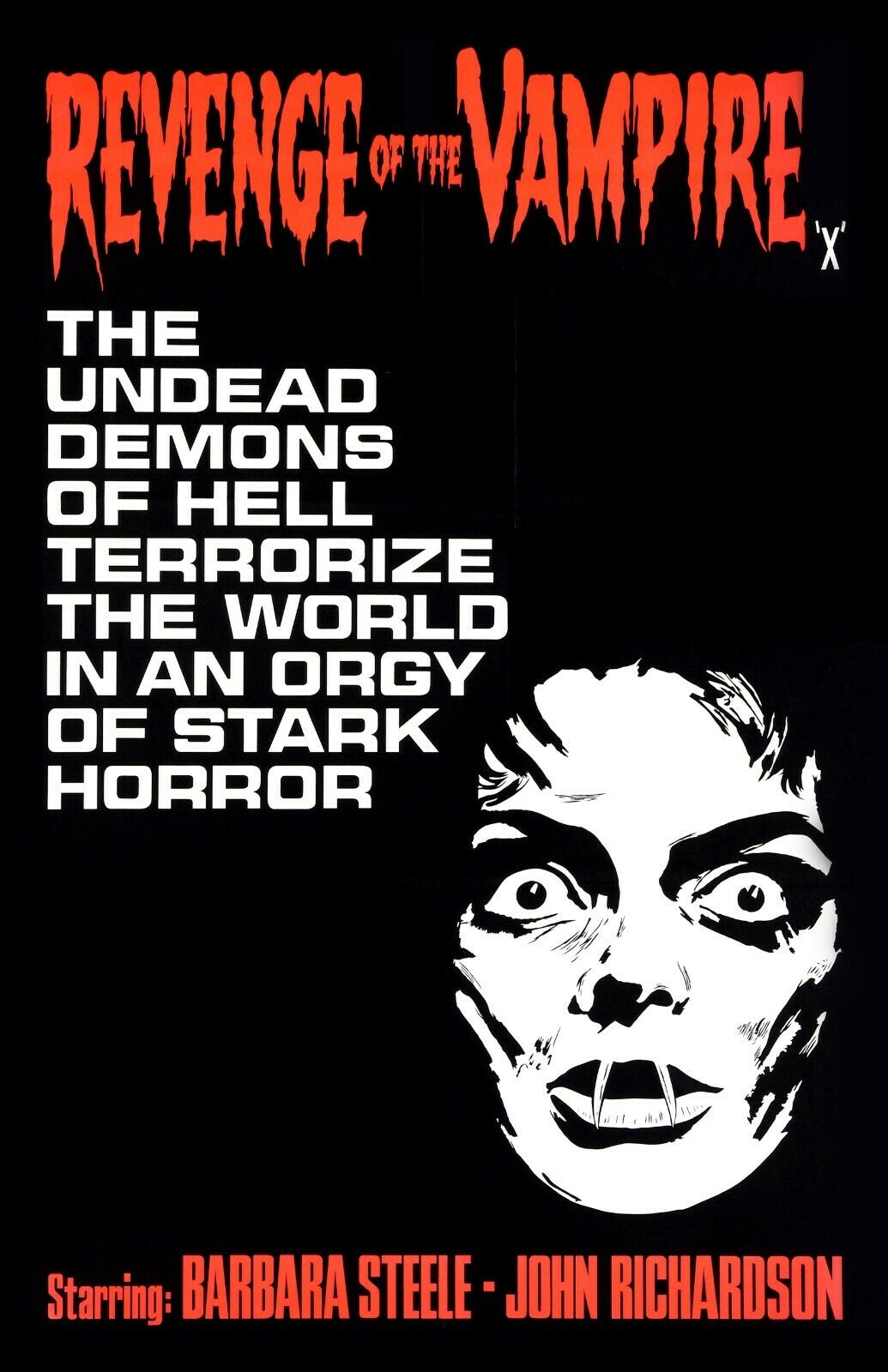
The British censor prevented screening of films deemed too violent including The Couch (1962) about a serial killer, Samuel Fuller’s Shock Corridor (1963), Violent Midnight (1963), The Thrill Killers (1963), Shock Treatment (1963) – despite a cast that included Lauren Bacall and Stuart Whitman – Fuller’s The Naked Kiss and Weekend of Fear (1966). Among horror films denied a showing were Blood Feast (1963), Two Thousand Maniacs (1964) and, initially, Mario Bava’s Black Sunday (1960) which was later reprieved and shown as Revenge of the Vampire.
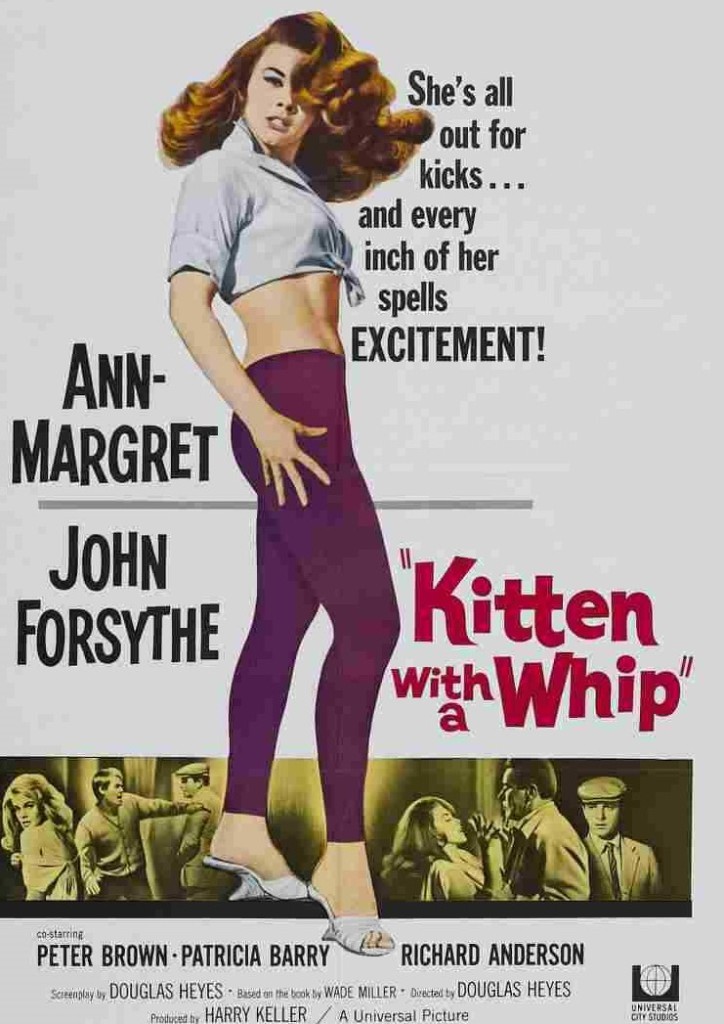
Juvenile delinquency, often straddling the biker world, was another subject to fall foul of the British Board of Film Censors. Among them The Choppers (1961), Jacktown (1962), The Cool World (1964), Kitten with a Whip (1964) starring Hollywood sensation Ann-Margret, the aforementioned Wild Angels (1966), Rat Fink (1966), Hot Rods to Hell (1966) with Dana Andrews and Mickey Rooney, Riot on the Sunset Strip (1967), Born Losers (1967), Devil’s Angels (1967) and virtually anything that mentioned Hell’s Angels.
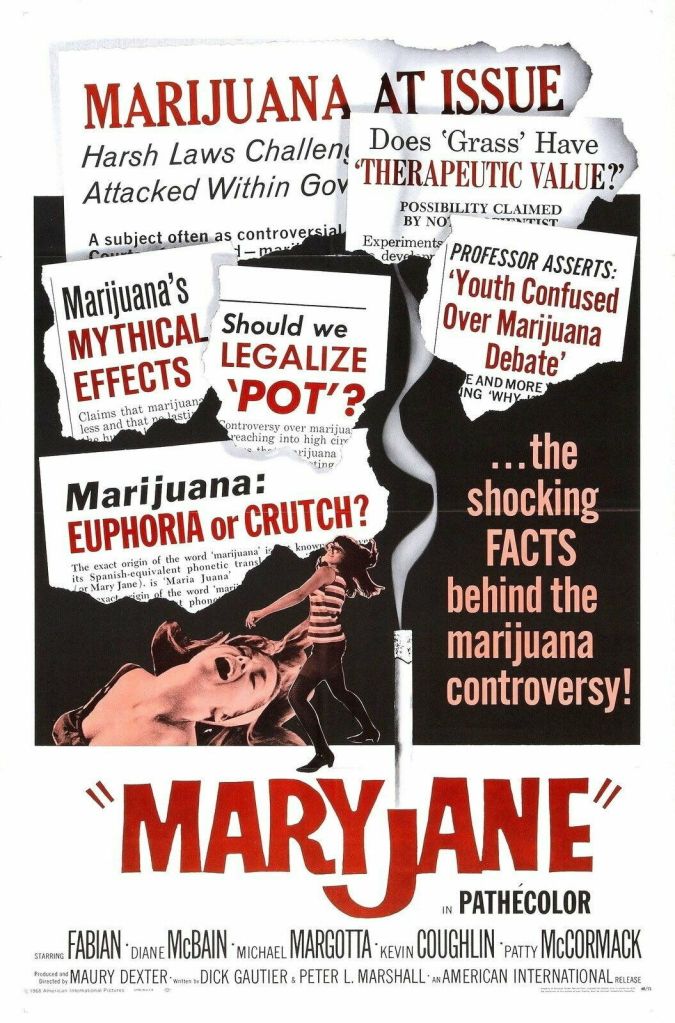
Drug taking was also forbidden to be seen, thus accounting for the absence on British screens of The Trip (1967), Hallucination Generation (1967), Mary Jane (1967), LSD Flesh of the Devil (1967) with Guy Madison and Revelation – The Flowering of the Hippies (1967). Easy Rider (1969) was passed for “being actively concerned with human beings and the effect of drug taking.” Films considered too morally dubious or too sexually open to let loose on British audiences included Sinderella and the Golden Bra (1964), 3 Nuts In Search of a Bolt (1964) starring Mamie Van Doren, 90 Degrees in the Shade (1965) with Anne Heywood, Russ Meyer’s Motorpsycho (1965), Good Morning…And Goodbye (1967) and Lee Frost’s The Animal (1968). Explicit language was the objection to Warrendale (1967) and Ulysses (1967), homosexuality the problem for Deathwatch (1965) starring Leonard Nimoy and Shirley Clarke’s documentary Portrait of Jason (1967).
In Britain, to get round the censor’s strictures, the “cinema club” was invented in 1960 by Gala Film Theatres, an offshoot of a distributor specializing in racy fare, and within a month had 7,500 members, the operation launching with a showing of The Wild One (1953). Local authorities could also take exception to the national censor’s findings and grant a reprieve for various films, Wild Angels and The Trip eventually achieving exposure in this fashion. Most cinema clubs would eventually segue into becoming outlets for soft porn but some stuck with the original concept of showing arty movies considered too risqué by the censor. The New Cinema Club in London, for example, in August 1969 programmed Wild Angels and Kenneth Anger’s Scorpio Rising (1963)
But the censor was not the only reason why films were not shown and ended up either ignored by the distributors or stuck on the shelf and we’ll come to those in another article.
David McGillivray, “The Crowded Shelf,” Films & Filming, September 1969, 14-15; “High Cost of Censor Fights vs. Principles,” Variety, March 2, 1960, 1;“If Banned in Britain, All Is Not Lost,” Variety, April 20, 1960, p48; “Theatre, Not Censors, Banned Breed,” Variety, June 1, 1960, p24; “Room at the Top Ban,” Variety, July 27, 1960, 4; “Operation Eichmann Banned in Germany, ” Variety, May 3, 1961, 1; “211 Pix Scissored, 56 Banned in Ireland,” Variety, May 3, 1961, p15; “Operation Eichmann Banned by Israeli,” Variety, November 1, 1961, p2; “12 Pix Banned by Finland Censors,” Variety, March 28, 1962, 17; “Singapore Censor Gets Tough with U.S. Pix; Satan, Suzie Banned,” Variety, August 8, 1962, 21; “Japanese Pix Still Banned by S. Korea,” Variety, December 12, 1962, p16; “Bee Banned by Italian Censor,” Variety, January 23, 1963, p18; “W. Germany Claims Only 19 Pix Banned, “ Variety, December 4, 1963, p11; “Swedish Censors Banned 10 in ’63,” Variety, February 5, 1964, p2; “The Group Banned,” Variety, April 8, 1964, p84; “Lady in Cage Banned by Sweden Censors,” Variety, July 15, 1964, 2; “New Zealand Censors Turn Down Collector,” Variety, November 3, 1965, 11; “Cage Banned By Geneva Censors,” Variety, January 19, 1966, 16; “Can’t Second Guess Global Censors,” Variety, November 30, 1966, 20; “Banned in Australia,” Variety, May 24, 1967, 26; “Scot Exhib, Whose Town Disapproves Censorship, Cleans Up with Ulysses,” Variety, May 1, 1968, 27; “Film Censors in France Spark B.O.,” Variety, May 8, 1968, 131; “Dracula Sole Film Banned in Israel Last Year,” Variety, May 28, 1969, 39; “Britain gives ‘X’ Tag to Fonda’s Rider Pic,” Variety, June 18, 1969, 30; “Eire Banned 35 Films in ’68,” Variety, August 20, 1969, 32.
A new episode in the James Bond legend began on February 23, 1966, when a plasterer from Scotland made an audacious bid for movie stardom. His name was Neil Connery, currently earning $10 a week, shooting for a $5,000 payday as he took part in a screen test in Rome for producer Dario Sabatello (Seven Guns for the MacGregors, 1966) for a film entitled Operation Casbah that would later be tagged Operation Kid Brother (O.K. Connery in Italy).
Sabatello was an experienced producer beginning with The Thief of Venice (1950) starring Hollywood legend Maria Montez. Connery was a skilled laborer living in the four-year shadow of elder brother Sean and with little intention of moving out of that shadow. However, as a result of a work-related incident, he became the subject of a newspaper article and then a radio interview. Nobody was much interested in the reason for the interview – stolen tools – but everyone was impressed by the sound of Neil’s voice. “Sean’s brother spoke exactly like him.”
Archers Assemble! Connery on the bowstring.
The newspaper interview caught the eye of Sabatello, who noted the actor’s likeness to his brother and who flew over to Edinburgh to interview Neil and in so doing becoming aware of his athletic attributes, height and good looks. A month later came an invite for the screen test. Neil’s agent, who had no right to make such a claim, promised that if Neil got the part big brother Sean would play a cameo. For the test, Connery had to “embrace a girl, sing, dance and finally end up in a hand-to-hand fight with a guy with a knife.” However, the test was so successful that the presence of Sean was not required. Sabatello signed the neophyte actor to a six-picture deal that would generate a six-figure salary if the film turned the Scot into a star.
Italian production giant Titanus sold the world rights (except for Italy) to United Artists, ironically the distributor of the James Bond pictures, thus securing the funding for the $1.2 million three-month shoot that kicked off in Cinecitta in Rome on December 14, 1966. Locations were scheduled to include Monte Carlo, San Remo, Turin, Barcelona, Malaga and Tetuan.
The supporting cast was dominated by actors with a Bond connection including Adolfo Celi, Daniela Bianchi, Anthony Dawson, who had all worked with director Alberto De Martino on Dirty Heroes (1967) and Lois Maxwell and Bernard Lee. Ennio Morricone, another De Martino aficionado, was brought in to do the score.
Affiliates Assemble! Connery with Bond regulars Bernard Lee and Lois Maxwell.
Connery’s boxing training in the British Army came in handy when he had to become an archer. Pulling a bow takes considerable physical exertion. Target practice was held at Adolfo Celi’s house outside Rome. “I had remembered everything about putting the bow down, bringing it up, pull and push, as there was quite a pull on it,” he said. Celi’s arrow managed just a few yards but Connery hit the target. His luck did not hold when filming the real thing in Monte Carlo. Celi’s shot did not go far again but this time Connery’s arrow missed the target.
Although Connery had read the script he was only given his lines in the morning as he went into make-up. He acquitted himself well in the fight scenes, except for one scene which ended with him being taken to hospital.
The film opened in Britain at the Pavilion in London’s West End on April 25, 1667, with a general release slated for May 5. But it didn’t get a circuit release. That is, it didn’t go out on either of the two main cinema chains, ABC or Odeon, or the lesser Gaumont circuit, so its bookings would have been restricted. It didn’t appear in the United States until November, 1967, having been reviewed without much enthusiasm in Variety which posited “at best the film deserves bottom half bookings”, i.e. the bottom half of a double bill, which means it would play for a fixed rental rather than a percentage.
It did open in first run in a number of city center picture houses in November and December, to occasionally decent but hardly lush box office. Its $20,000 week in Chicago was deemed “good”, as was the $4,000 in Providence, while $13,000 in Philadelphia was considered “brisk” but $5,000 in St Louis considered only “fair.” There was a first run showing in New York but only at a 600-seater arthouse.
But when it went wider in “Showcase” releases the box office collapsed. In New York it managed only $67,000 from 25 theatres compared to, in the same week, British film The Family Way on $223,000 from 26, and the second week of Point Blank with $145,000 from 25. Business was worse in Los Angeles, just $49,000 from 26 compared to $125,000 from 29 for Barefoot in the Park, and it was dire in Kansas City, only $9,000 from eight houses.
Given the relatively low budget, the film globally may well have broken even but it certainly did not send Neil Connery’s box office status into the stratosphere. He had small parts in two more low-budget movies, The Body Stealers (1969) and Mad Mission 3: Our Man from Bond St (1984) plus some television.
SOURCES: Brian Smith, “Bond of Brothers,” Cinema Retro, Vol 4 Issue 12 2008, p13-19; Allen Eyles, Odeon Cinemas 2, (CTA 2005), p212; Allen Eyles, ABC (CTA, 1993), 123-124; Allen Eyles, The Granada Theatres (CTA 1998)’ p247; Allen Eyles, Gaumont British Cinemas, (CTA 2005), p197; William Hall, “Big Brother Is Watching Him,” Photoplay, June 1967; “International Soundtrack,” Variety, February 23, 1966, p33; “Titanus Sets Pre-Prod Deals for Two UA Pix,” Variety, December 14, 1966, p24; “International Soundtrack,” Variety, December 21, 1966, p24; “Hollywood and British Production Pulse,” Variety, December 28, 1966, p17; Advertisement, Variety, January 4, 1967, p65; “Connery Pix a Family Affair with UA,” Variety, March 8, 1967, p24; Review, Variety, October 11, 1967, p22; “Picture Grosses,” Variety November 1, November 8, November 15, November 29, December 13, 1967.
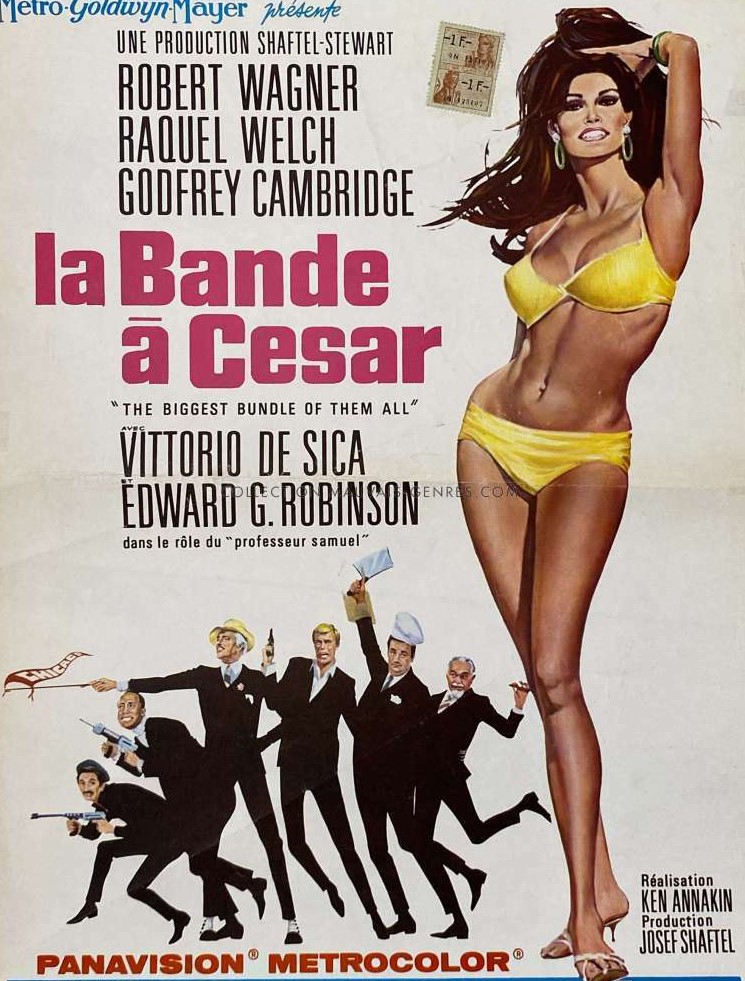
Films that reach the screen two years after filming was completed are generally stinkers. Ken Annakin caper movie The Biggest Bundle of Them All wrapped production in summer 1966 and was not released until January 1968. But the reason was not the usual.
The cause of the unseemly delay was a temper tantrum by Oscar-winning uber-producer Sam Spiegel (Lawrence of Arabia, 1962) who had been working on a similar project about incompetent amateurs kidnapping a gangster kingpin – The Happening (1967) starring Anthony Quinn (previously reviewed in the Blog). After bringing a charge of blatant plagiarism, Spiegel was mollified by being permitted to bring his movie out first, with an inbuilt eight-month gap between both releases, the deal sweetened by a 15% cut of The Biggest Bundle’s profits and the right to vet the script.
Despite success with Those Magnificent Men in Their Flying Machines (1965) and Battle of the Bulge (1965) British director Annakin was at a career impasse. The Fifth Coin written by Francis Ford Coppola and starring George Segal failed to get off the ground. He turned down western Texas Across the River (1966) at a time when Catherine Deneuve and Shirley Maclaine were slotted in for the female roles and was fired from The Perils of Pauline (1967). The Italian Caper as it was then known, recalled Annakin, “did not seem a world-shattering movie but I found the caper fascinating and the cast irresistible.”
Let them eat cheesecake.
It marked the movie debut for producer Josef Shaftel of The Untouchables television fame and for screenwriter Rod Amateau (The Wilby Conspiracy, 1975), also then a television regular although the final script was attributed to another neophyte Sy Salkowitz. The film made the most of Italian locations, Naples and Rome, as well as the South of France and Provence. Annakin caught pneumonia just as shooting was to commence. Shaftel took over for five days only for his material to prove unusable.
Both veteran actors proved easy to direct. “Robinson was like putty in my hands, completely trusting.” And while Vittorio De Sica was every bit as amenable he was inclined to fall asleep on the set as the result of entertaining his mistress the night before. Di Sica was also a compulsive gambler and at one point lost half his salary in a casino.
Raquel Welch, in only her second picture after One Million Years B.C. (1966) – which contained minimal dialogue – was initially a handful. Primarily, this was due to inexperience and her desire to present herself in as alluring a fashion as possible, with impeccable hairstyles and make-up. After she had kept the crew waiting once too often Annakin threatened to eliminate her close-ups unless she respected the shooting schedule.
“On the whole I was quite pleased with the results because she really applied herself and so long as one broke up the scenes into a couple of lines at a time she became able to handle them quite adequately…I was getting along excellently with Raquel – even to the extent of trying to find another picture with her,” Annakin noted in his autobiography. Since this was written three decades after the movie was made, it would have given him ample time to get rid of any latent hostility to the actress. This reaction, it has to be said, is contrary to much of what has been written about Welch’s behavior on the picture. At the time of filming he reported that “she has a marvelous flair for comedy.”
But it appeared that Annakin was the only one who spotted her star potential. “The rest of the cast, especially Bob (Robert Wagner), regarded her as a pin-up girl on the make…none of them thought she was particularly sexy at this time.”
Otherwise, the only other trouble came from Godfrey Cambridge who “had a chip on his shoulder” and from Robert Wagner’s insistence on wearing false eyelashes. Problems arose over the cinematographer’s determination to employ powerful lights even at the height of a Mediterranean summer and a massive dust storm interrupted filming of the final scenes. Annakin also benefitted from the locations and using his experience was able to shift 35 pages of script from interiors to outdoors, completely altering the look of the picture. This made the $2 million movie “look like it cost three or four million,” according to Annakin.
At this point Welch, best known for having been sued by her publicist, was in the process of turning herself into a star in demand. In 1966 Welch was something of a Hollywood secret. She had three pictures in the bank, was working on a fourth and had signed up for a fifth before any of her movies had been released. On the other hand, she was fast becoming one of the most famous faces (and bodies) in the world, on the cover of of hundreds of magazines in Europe, many for the fourth or fifth time.
Having set up a company, Curtwel, managed by husband Patrick Curtis, she would earn $15,570 a week on loan to MGM for a second film Italian movie Shoot, Loud…Louder, I Don’t Understand (1966), considerably more than through her contract with Twentieth Century Fox. A year later she collected £100,000 for two weeks on portmanteau picture The Oldest Profession (1967).
Curtwel was also moving into the production arena, in 1965 attempting to set up No Place for the Dead and the following year optioning the musical comedy The Opposite Sides of the Fence and taking a quarter share in the mooted The Devil’s Discord to star Peter Cushing and Edd Byrnes under the direction of Michael Reeves (Witchfinder General, 1968). None of these ventures materialzed.
As well as having to contend with audience disinterest in the clumsy crook scenario as witnessed by the flop of The Happening, the enforced time gap allowed a second picture featuring bungling criminals called Too Many Crooks (1967) to reach cinemas prior to The Biggest Bundle. However, by January 1968, Welch was a much bigger name on movie marquees, having appeared on 400 international magazine covers and selected by U.S. exhibitors for the International Star of the Year Award while The Biggest Bundle had been preceded by another seven pictures including hits One Million Years B.C. and Fantastic Voyage (1966).
SOURCES: Ken Annakin, So You Wanna Be a Director, (Tomahawk Press, Sheffield 2001), pages 187-194; “Raquel Welch and Manager Form Curtwel Co,” Box Office, May 3, 1965, pW3; “Raquel Welch, Pat Curtis Form Curtwel Prods,” Box Office, October 5, 1965, pSE6; “Toutmasters Sue for 5% of Raquel Welch,” Variety, October 6, 1965, p14; “Raquel Welch in Rome,” Box Office, April 25, 1966, page SE1; “MGM’s Bundle Wrapping at Nice, Orders On Set in 3 Languages,” Variety, July 6, 1966, p7; “8 Pix for 2 Unseen Actresses,” Variety, August 17, 1966, p5; “Businesswoman Side of Raquel Welch,” Variety, November 2, 1966, p20; “Oldest Profession Gets New Locale in West Berlin, Raquel Welch’s 100G Job,” Variety, January 18, 1967, p24; “Columbia-Spiegel Holds 25% Share of MGM’s Bundle,” Variety, December 6, 1967, p3.
Bunch of incompetent crooks kidnap an impoverished Mafia boss who pays his ransom by setting up a major heist. By a stroke of casting alchemy this brings together Cesare (Vittorio De Sica), the epitome of old world Italian charm, knock-out gangster’s moll and scene-stealer-in-chief Juliana (Raquel Welch) replete with scanty knock-out outfits, and criminal mastermind Professor Samuels (Edward G. Robinson). In order to acquire the funds necessary to steal $5 million of platinum ingots from a train – that plan involving a tank and an WW2 bomber – the crew, initially headed by American Harry (Robert Wagner), need to carry out smaller jobs.
Problem is, none of them are any good, not even Cesare, who has lost his flair and botches an attempt to rob an old flame of her jewels. This is a twist on Topkapi (1964) which employed effective amateurs. This bunch can’t even carry out a simple theft from a restaurant. The heist itself is pretty spectacular and innovative. And the movie is quirky, with a darker edge. While there are few belly laughs, the light tone is enough to carry the gentle humor, mostly inspired by the misplaced team, amateurs for various reasons, not necessarily outright lawbreaking, on the run. These include London Cockney mechanic Davey (Davy Kaye), chef Antonio (Francesco Mule) distracted by hunger at every turn, cowardly violinist Benny (Godfrey Cambridge) and Joe (Mickey Knox) with a helluva brood to feed.
The story does a good bit of meandering, as does the camera, much of its focus on the voluptuous charms of Juliana, but the hurt pride of Cesare and the grandiose machinations of the professor keep it on course. The Italian settings, incorporating grand villas and ruins, do no harm either. The heist is terrific and there is a final twist you may or may not see coming. The interplay of characters works best when it involves Juliana, who attempts to twist Cesare around her little finger, that tactic mutual it has to be said, and who keeps the professor on his toes by dancing with him in a disco, and it soon becomes apparent that she has the upper hand over lover-boy Harry.
You could be forgiven for thinking the title refers to Raquel Welch – a cinematic infant at this stage with only One Million Years B.C (1966) in her portfolio – especially when her cleavage and looks receive such prominence, but the caper is classy and different. As well as being obvious she is both sinuous and seductive and clearly has a mind of her own, possibly the most criminally intent of the entire outfit, with weapons the others lack. By this point, she had invented the pop-out bikini, pictures of which had flooded Europe, making her the pin-up par excellence, but those who came to simply gawp quickly realized there was talent behind the body. Although of course there would be those who didn’t care.
De Sica constantly plays around with the idea of being a defunct godfather and Robinson is the antithesis of the gangster roles on which his fame relied. Robert Wagner is less effective, miscast and out of place in such august acting company and losing out to Welch in every scene.
This was a considerable change of pace for British director Ken Annakin after Those Magnificent Men in Their Flying Machines (1965) and Battle of the Bulge (1965) and he brings to this the comedy of the former coupled with the narrative complications of the latter, wrapping everything up in an easy inviting style that makes the most of his stars and the locations. Screenwriter Sy Salkowitz was a television veteran (Perry Mason, The Untouchables et al) , this marking his first venture into the big screen.
Not in the Topkapi class – very little is – but a pleasant diversion nonetheless and for avid Raquel Welch fans, setting aside her outfits, a chance to see her develop more of a screen persona than was permitted in her debut One Million Years B.C.
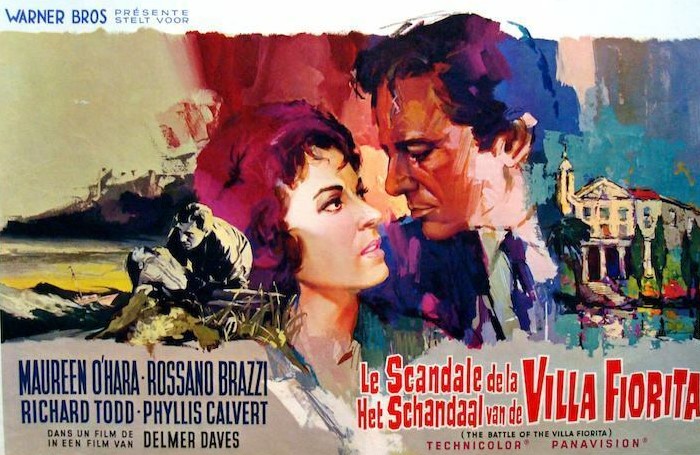
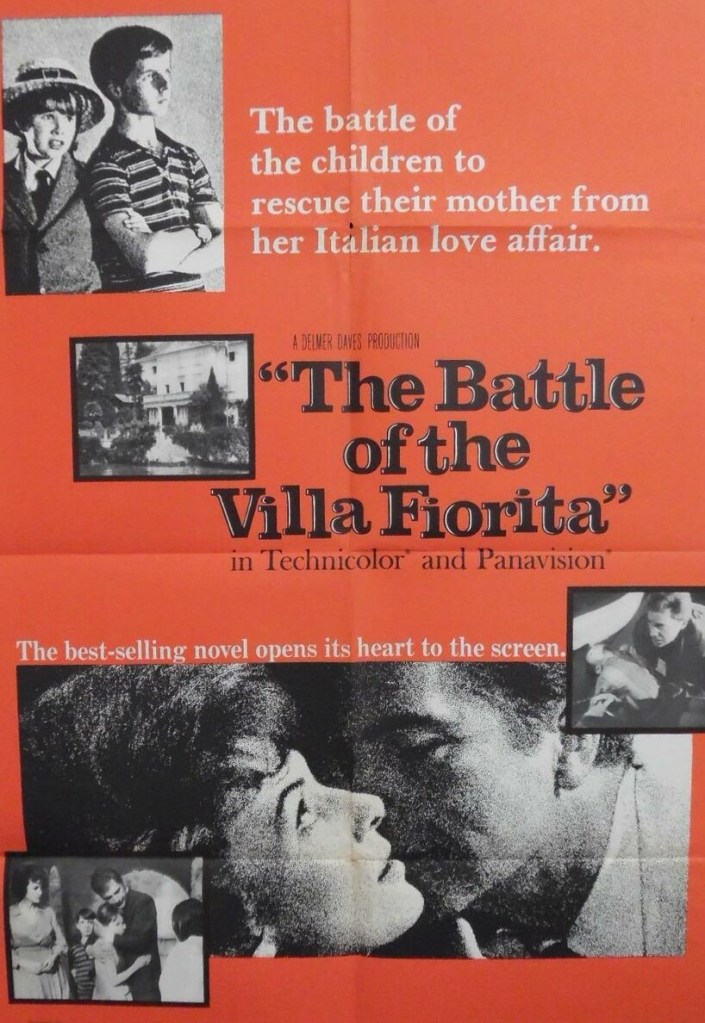
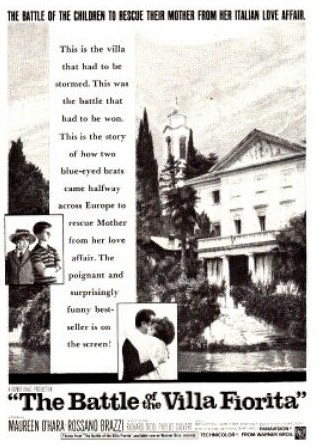
One of the few romantic dramas of the 1960s to resonate today. Neglected wife Moira (Maureen O’Hara) abandons her two children to fly to the eponymous villa on Lake Garda in Italy to take up with composer Lorenzo (Rossano Brazzi). While husband Darrell (Richard Todd) accepts the fait accompli, kids Michael (Martin Stephens) and Debby (Elizabeth Dear) set out to bring her back. Although Disney had created a hit on a similar theme with The Parent Trap (1961) – also starring O’Hara – The Battle of the Villa Fiorita failed to find an audience at the time primarily because it sailed too close to comfort regarding the reality of the effect of separation and impending divorce on children.
Nor are these kids Disney cute. While Debby occasionally calls upon her internal winsome to tug at heartstrings, both she and Michael are made of sterner stuff. Unwilling to use comedy as a means of bringing the errant adults to heel, the movie gets deeper and deeper into darker territory, as the kids embark on a war of attrition, disrupting the cushy love-nest and forcing their mother to accept her maternal responsibilities. And the ending is far from what you would term happy.
Moira injects some nascent feminism into her role, determining that she is entitled to happiness rather than merely fulfilling the part of a good mother, running a household, looking after her offspring and enjoying the life of a well-to-do matron married by a husband too often away on business and the too-familiar company of boring respectable friends. A Disney picture would have seen the kids relying on the kindness of strangers or harmless subterfuge to make the trip from Britain by boat and train to Italy. Here, they fund the journey by selling Debby’s horse. The trek is not only dull but on their miserable budget they spend most of the time famished, unable to afford food on the train, resigned to watching adults in their compartment stuff their faces (Disney would have had the grown-ups share out the tasty fare).
Arriving at the palatial villa, where Moira is waited on hand and foot, spoiled by presents and ardently wooed, the children are under no illusion about the uphill battle they face especially when Moira is not immediately stricken enough by conscience to give in to their entreaties. Lorenzo’s initial solution is to fly the children home. Adult fortitude begins to waver when the English pair join forces with Lorenzo’s estranged daughter Donna (Olivia Hussey) on a hunger strike. Lorenzo shows a sharper side to his temperament, Moira a weaker. The children’s solidarity is also, however, sorely tested by their own differences.
That there is no easy solution – the kids perhaps joining their mother full-time in Italy or some kind of child-sharing scheme – is what gives this movie its power. The classical idea of a repressed woman finding redemption in the arms of an Italian lover (as with Summertime, 1955, also starring Brazzi) is turned on its head as reality intervenes. It’s as well the kids don’t kill us with cuteness, but instead present a realistic example of what it’s like for adoring children to be abandoned. As the film progresses, and the children turn the screw, they soon face adult realization that, even if they win, the mother they will bring back will not be the mother they knew.
After turns with James Stewart (Mr Hobbs Takes a Vacation, 1962) and John Wayne (McLintock!, 1963), Maureen O’Hara had regained her marquee appeal, and although feisty enough in those outings, this was a different, and more courageous, performance than her fans might have expected. Her conflict is mostly internalized and especially when her children fail to see her point of view, that feistiness vanishes from sight replaced by a more somber, thoughtful individual. Brazzi is excellent as the lover whose paternal responsibilities he takes lightly compromised by a woman forced to come to terms with motherhood. Martin Stephens (The Innocents, 1961), Elizabeth Dear (The Pumpkin Eater, 1964) and, making her debut, Olivia Hussey (Romeo and Juliet, 1968) make convincing, conniving, children still dealing with their own hormonal and emotional growth.
Adapting the bestseller by Rumer Godden (Black Narcissus, 1947), this proved to be the final movie for veteran director Delmer Daves (3:10 to Yuma, 1957).









 The Magnificent 60s