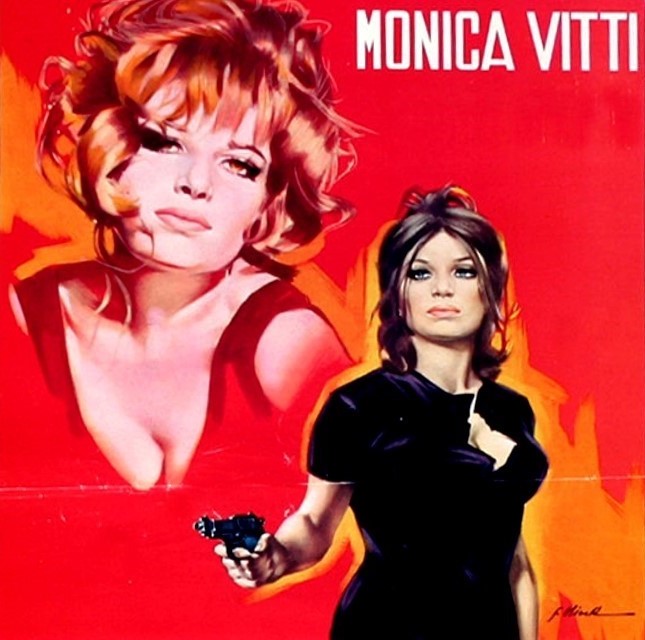
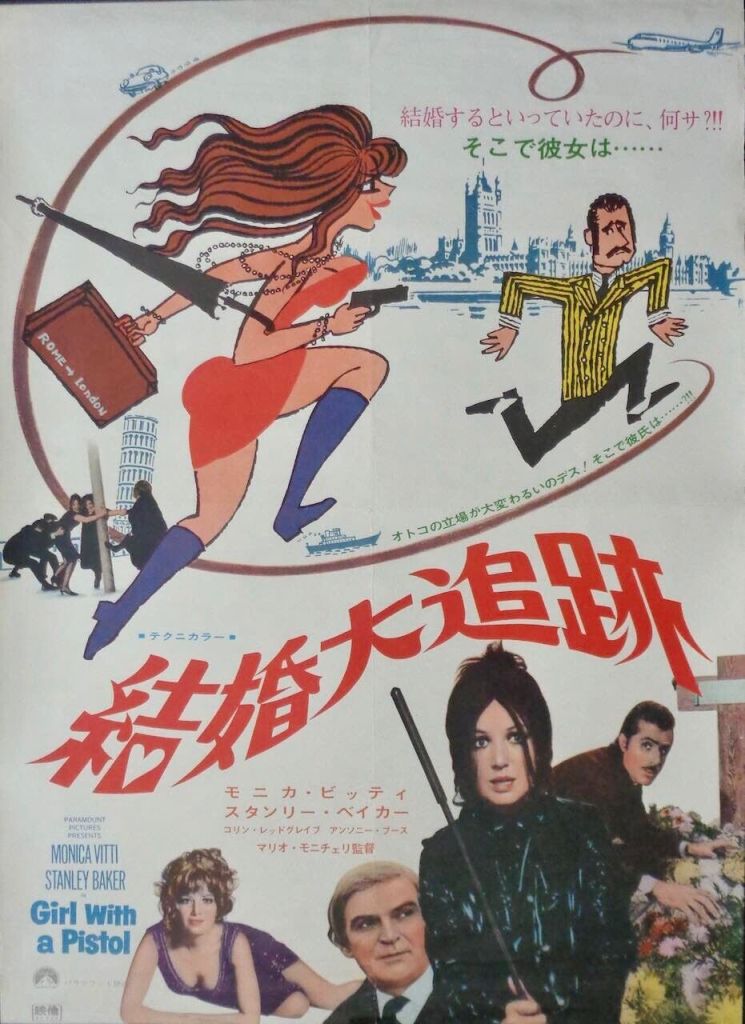
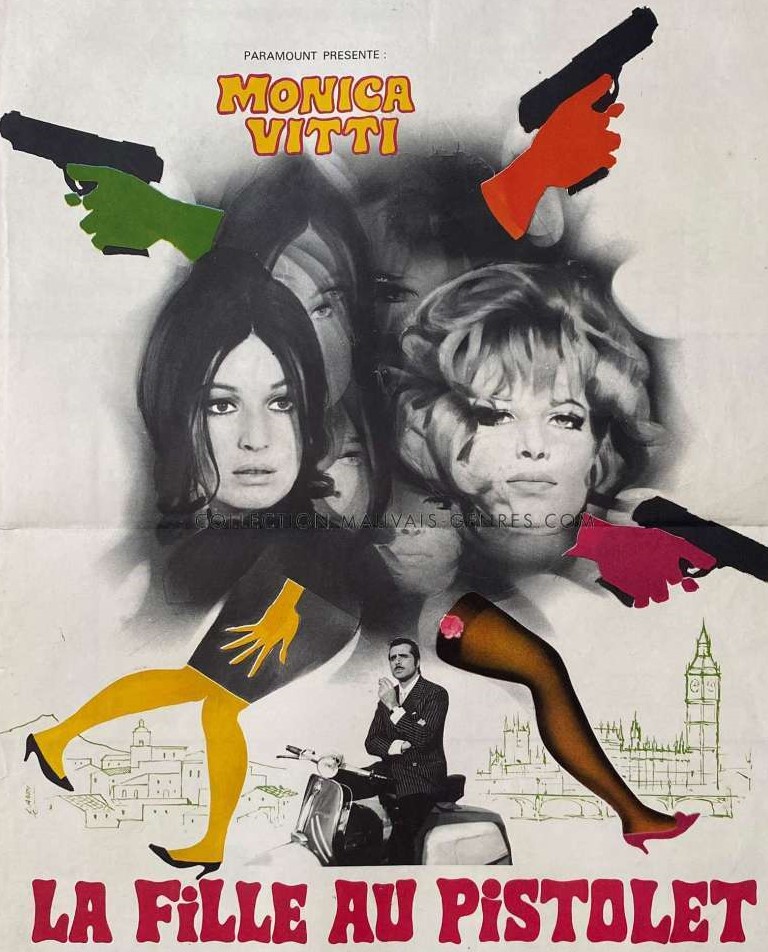
Girl with a Pistol (1968) ****

Off-beat Oscar-nominated comedy-drama that is both a marvelous piece of whimsy and a slice of social realism set in the kind of Britain the tourist boards forget, all drizzle and grime. It zips from Edinburgh to Sheffield to Bath to London to Brighton to Jersey as if the characters had been dumped from an If It’s Tuesday It Must Be Belgium sketch. If your idea of Italy was Fellini’s glorious decadence or Hollywood romance amid historic ruins and fabulous beaches, then the upbringing of Assunta (Monica Vitti) is the repressive opposite.

All women in her small town wear black. Men are not allowed to dance with women and must make do with each other. A man like Vincenzo (Carlo Giuffre) desiring sex must kidnap a woman, in this case Assunta, to which she will consent as long as he marries her. When instead he runs off to Scotland, she is dishonored and must kill him, armed with the titular pistol.

Pursuit first takes her to Edinburgh and a job as a maid, has a hilarious encounter with a Scottish drunk, and various other cross-cultural misinterpretations – in a bar she cools herself down with an ice-cube then puts it back in the bucket. Then it’s off   to Sheffield where she falls in with car mechanic Anthony Booth (television’s Till Death Do Us Part) because he is wearing Italian shoes.

She can’t imagine he can watch sport for two hours. “You’re a man, I’m a woman, nobody in the house and you look at the television.” Although tormented by images of being attacked back home by a screaming mob of black-robed women, she begins to shed her inhibitions, wearing trendier clothes, although an umbrella is essential in rain-drenched Britain and given the Italian preference for shooting exteriors.  

In between sightings of Vincenzo there are episodes with a suicidal gay man (Corin Redgrave) and a doctor (Stanley Baker). She becomes a nurse, then a part-time model, sings Italian songs in an Italian restaurant, drives a white mini, wears a red curly wig and more extravagant fashions. It turns out she can’t shoot straight. Gradually, the mad chorus of home gives way to feminist self-assertion as she becomes less dependent on men and a world run by chauvinists. It’s a startling mixture of laugh-out-loud humor and social observation. And while the narrative that at times verges on the bizarre, Assunta’s actions all appear logical given her frame of mind.

Vitti was Italian director Michelangelo Antonioni’s muse (and companion) through  L’Avventura (1960), La Notte (1961) and L’Eclisse (1962) to Red Desert (1964). She had a brief fling with the more commercial, though still somewhat arty, movie world in Joseph Losey’s Modesty Blaise (1966) and the nothing-artistic-about-it comedy On the Way to the Crusades (aka The Chastity Belt, 1968) with Tony Curtis. Director Mario Monicello had two Oscar nominations for writing but was best-known for Big Deal on Madonna Street (1958) and Casanova ’70 (1965). Girl with a Pistol was nominated in the Best Foreign Language film category at the Oscars.

Violent City /Family (1970) ****

Of all the lazy, incompetent streamers this has to take the biscuit. Not content with branding as new films made over half a century ago, now we have films being screened which clearly nobody has bothered to watch even once. Otherwise, how to explain a picture where the language lapses into Italian at critical moments without the benefit of sub-titles.

Which is a big shame because, confusing through the movie is, it takes an unique approach to the femme fatale angle and serves up a noted screen tough guy as one whose heart is genuinely broken – suck that up, pale imitators going by the name of Stallone, Schwarzenner, Willis et al.

Post-Bullitt (1968) but pre-The French Connection (1971) we open with a dazzling car chase where the pursued race up stairs rather than down as is the current trope and batter their way through closely-packed streets in the Virgin Islands. That’s before wannabe retired assassin Jeff (Charles Bronson) is gunned down, although he’s still capable of diving under a burning car to escape immediate detection.

Jeff is on the lam with lover Vanessa (Jill Ireland). Dumped in jail with time to repent (no, strike that), mull over his circumstances, in the meantime dodging a tarantula (a real one!) crawling over his body, and coming to the conclusion that the moll has set him up and has returned to her previous lover, ace racing driver Coogan (no idea who plays him, imdb doesn’t know either). Despite having abandoned his profession, Jeff, not getting the hang of the broken-hearted moping malarkey, decides he’ll come out of retirement for the usual one last job, this time laying waste to Coogan.

But someone spots him and he’s blackmailed by Mafia chief Weber (Telly Savalas) into continuing his murderous ways. But here’s a sting in the tail – a wonderful twist to end all twists: Weber is Vanessa’s husband. She’s not a femme fatale at all just a sexual butterfly who dances from one lover to the next with Weber’s tacit approval.

But, in fact, in another twist, she is, after all, the femme fatale to end all femme fatales, setting up Jeff to bump off Weber so that she and attorney lover (what, another one) Steve (Umberto Orsini), Jeff’s best buddy, can take over her husband’s organization now that it has gone legit. And in the final twist to end all twists this ends with Jeff’s broken heart turning him suicidal (beat that Schwarzenneger, Stallone, Willis et al).

This is a very down’n’dirty Italian thriller, dashing from deadbeat locale to Southern Belle balls, from rusting riverboats to swampland, from factories to fashion shoots, the confusion factor infused further by the sudden incursions into Italian, often in mid-scene, as if this was some kind of artistic coup, determined to leave the viewer baffled.

Despite going the whole nine yards in the broken-heareted department, Jeff isn’t quite the full-blown romantic, an attempted rape of Vanessa in New Orleans only interrupted by (wait for it) three thugs beating another character to death. Naturally, Jeff isn’t the kind of good bad guy who intervenes, and these characters, even more naturally, have nothing to do with the plot (except as Jeff points out it’s a violent city after all). But what the hell, it’s that kind of film.

I’ve cutting Amazon Prime a big break here with my rating, because despite the language problems, it’s a cut above your normal thriller, and Charles Bronson (Red Sun, 1971) before being typecast by Death Wish (1974) gives a very good account of himself, certainly a lot more to do than just grimace, and, heck, you even feel sorry for him twisted inside out by emotion. Telly Savalas (A Town Called Hell, 1971) is a bit more polished and emotionally aware than his usual villain.

You might be tempted to call Jill Ireland (Rider on the Rain, 1970) the stand-out. She still can’t act for toffee, but she is well suited to playing this kind of jinxed minx, whose beauty snags dupes well below her league. And (spoiler alert) she does let it all hang out, indulging in copious nudity.

Directed with some flair by Sergio Sollima (The Big Gundown, 1967) and extra marks for coaxing unusual performances from the three principals. Six screenwriters (can’t you tell) put this together including Lina Wertmuller (The Belle Starr Story, 1968). Great score by Ennio Morricone.

Given I couldn’t understand half of what was going on thanks to streamer disinterest in sub-titles, I was still very impressed. Worth a watch.

NOTE: Amazon Prime has this under the title Family but once the credits roll it switches to original title Violent City.

Youtube has the trailer.

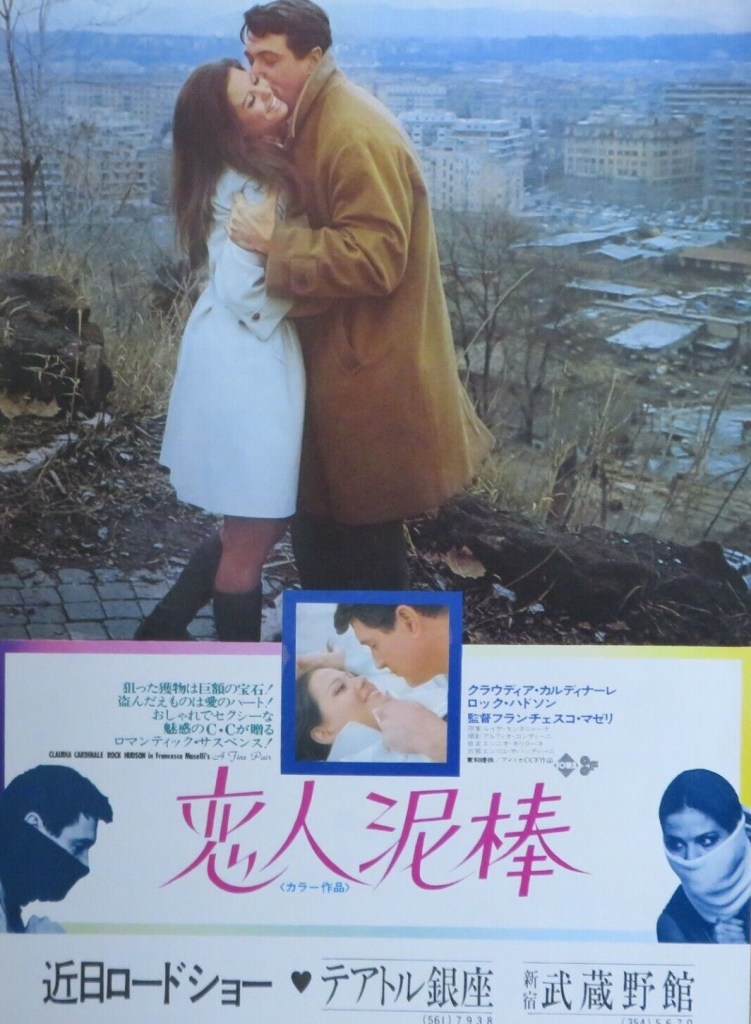
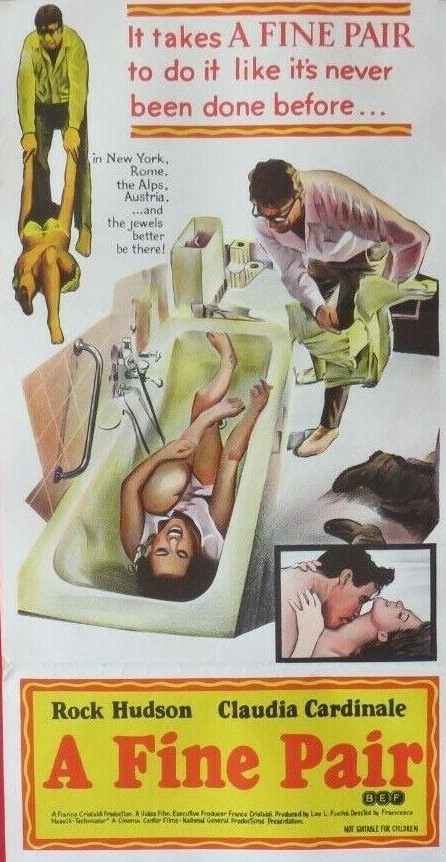
A Fine Pair (1968) ***

Essentially an Italian take on the slick glossy American thriller in the vein of Charade (1963), Arabesque (1966) and of course Blindfold (1966) which previously brought together Rock Hudson and Claudia Cardinale. Produced by Cardinale’s husband Franco Cristaldi, directed and co-written by Francesco Maselli (Time of Indifference, 1966), it is a cute variation on the heist picture. Fans accustomed to seeing the more sultry side of the Italian actress (as in The Professionals, 1966) might be surprised to see how effective she is in more playful mood apart from one scene where she strips down to bra and pants. The other major difference is that in her American-made films, Cardinale is usually the female lead, that is, not the one driving the story, but here she provides the narrative thrust virtually right up until the end.

The twist here (as in Pirates of the Caribbean nearly four decades later) is that the bad guy (in this case bad girl) wants to return treasure rather than steal it.  Esmeralda (Claudia Cardinale) arrives in New York to seek the help of Capt. Mike Harmon (Rock Hudson), an old family friend, a stuffy married American cop who even has a timer to tell him when to take his next cigarette. She has come into jewels stolen by an internationally famous thief and wishes to return them to a villa in the Alps before the owners discover the theft. The bait for Harmon is to try and apprehend the guilty party.

The audience will have guessed the twist, that she is not breaking in to return jewels, but once Harmon, through his police connections, has been shown the alarm systems, to deposit fakes and steal the real thing. So Harmon has to work out an ingenious method of beating three alarm systems, one of which is heat-sensitive, the whole place “one big safe.”

Most of the fun comes from the banter between the principals and the is-she-telling-truth element essential to these pictures. “I lied – and that’s the truth,” spouts Esmeralda at one point. I disagree with a common complaint of a lack of chemistry between Hudson and Cardinale. What the film lacks is not enough going wrong such as occurred in Man’s Favorite Sport (1962), which makes the audience warm to the otherwise rigid Hudson, or as seen in Gambit (1966) where Michael Caine played a similar stand-offish character. Cardinale is terrific in a Shirley MacLaine-type role, as the playful foil to the uptight cop, and who, like MacLaine in Gambit, knows far more than she is letting on.

What does let the film down is that it is at cross-cultural cross-purposes. As mentioned, this is an Italian film with Italian production values. The color is murky, way too many important scenes take place outside, but, more importantly, the actual heist lacks sufficient detail, and post-heist, although there a few more twists, the film takes too long to reach a conclusion. But for the first two-thirds it is a perfectly acceptable addition to the heist canon, the script has some very funny lines, Cardinale is light, charming and sexy.

The American title of this film was Steal from Your Neighbor, which is weak. A Fine Pair while colloquial enough in America has, however, an unfortunate meaning of the double-entendre kind in Britain.

Lack of films being released – these days due to the pandemic – is not new. A Fine Pair was made during a time of low production. But there was a sickening irony in the story of this film’s production. It was financed by the short-lived Cinema Center owned by the American television network CBS. When television was in its infancy, American studios had been barred by the Government from becoming involved in the new media. CBS got into movie production after studios had suffered from another governmental policy reversal.

In 1948 the Paramount Decree prohibited studios from owning cinemas, a move which led to the end of the studio system and decimated production. The most sacrosanct rule of American film regulations was that studios could not own movie houses. Everyone assumed that applied the other way until in the early 1960s cinema chain National General challenged the ruling.

By this point, production was so low that exhibitors were crying out for new product so the government relented, much to the fury of the studios. That opened the door for television networks like CBS and later ABC (Charly, 1968) to enter movie production. And now, of course, studios have re-entered the exhibition market as have, once again, television companies.

Entertaining enough and the pair have enough charisma to see it through.

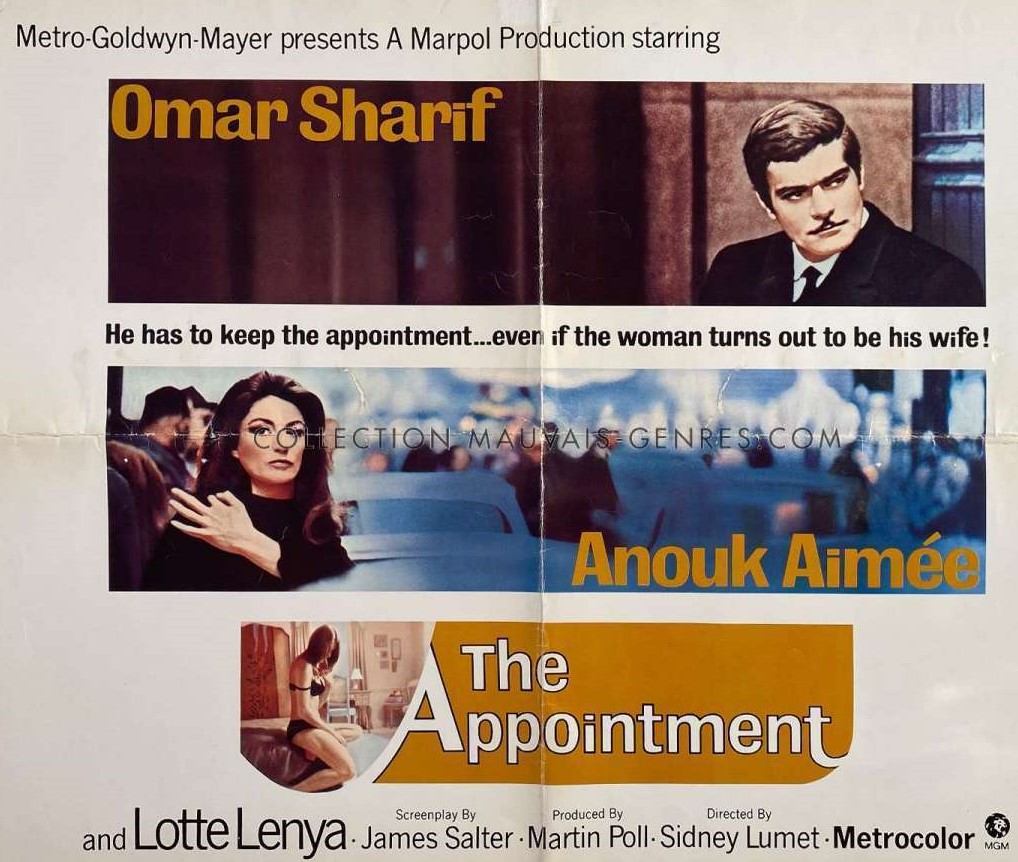
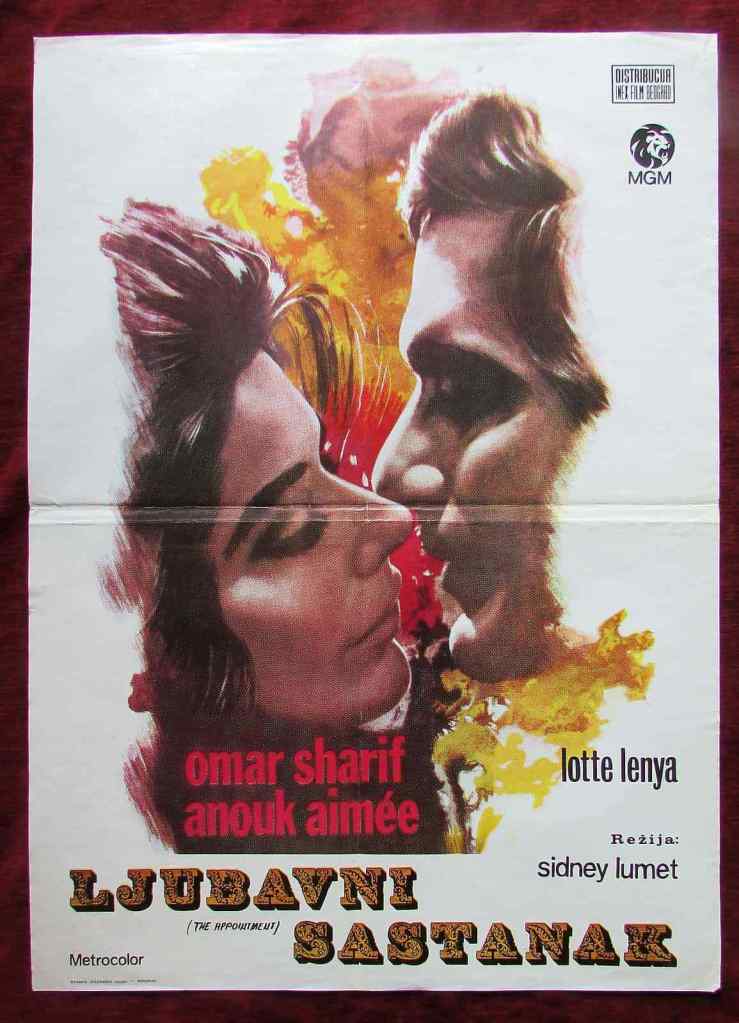
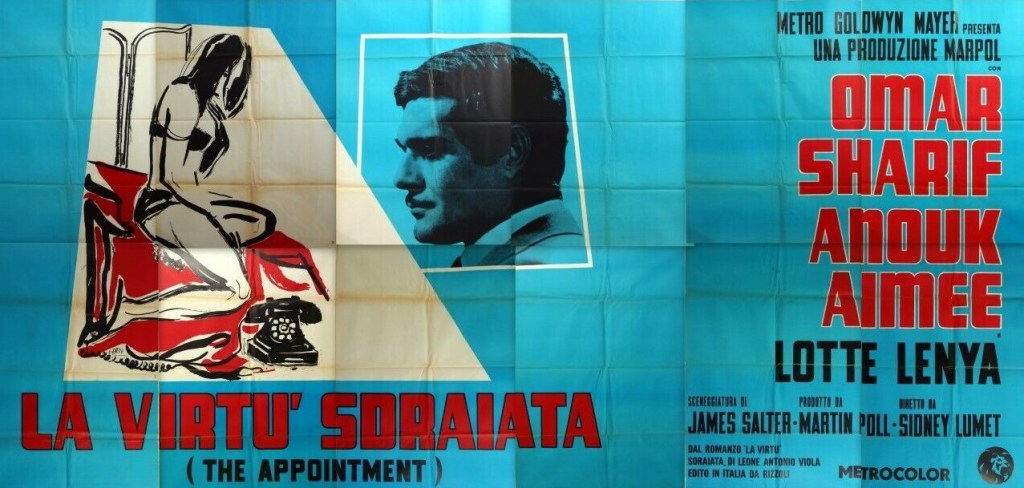
The Appointment (1969) ****

You can see why MGM dumped this. Just as easily as you can see its attraction for star Omar Sharif, his boldest-ever role, completely against type, burying the romantic hero in one fell swoop. It wasn’t just the arthouse pretensions – the absurdly long, by Hollywood standards, long shots held for an insanely long time and the greatest aerial shot, almost to the moon and back, ever devised – that made the studio cut and run faced with the impossibility of selling Omar Sharif as a creepy, repressed guy who drives his wife to suicide.

Luxuriant moustache trimmed to look like a ramrod British colonel, often bespectacled, unmarried middle-aged lawyer Federico (Omar Sharif) takes a fancy to the withdrawn Carla (Anouk Aimee), fiancée of legal buddy Renzo (Fausto Tozzi). She works as a model in a high-class fashion house.

So Federico is shocked to discover that Renzo has dumped her after discovering evidence, somewhat circumstantial it has to be said, that she moonlights as an equally high-class sex worker who takes occasional assignments from antiques dealer Emma (Lotte Lenya). Now that Carla is unencumbered in the marital stakes, Federico undertakes to discover whether the accusation is indeed correct. If not, then he reckons, she might well fall for him, if only on the rebound, after all he is very successful and, despite the geeky haircut and moustache, a handsome dude.

It’s left to your imagination whether Federico actually has sex with the young woman – who “could pass for 17” and arrives clutching schoolbooks – for whom he pays 100,000 lire (around $1,000) but my guess is he does, getting her to pretend he’s her Latin schoolmaster. So that’s the Omar Sharif romantic persona killed off right there and from then on it’s hard to muster any sympathy for the character, every bit as obsessive, say, as James Stewart in Vertigo (1958).

This has a Hitchcockian aura, an atmosphere of stealth and secrecy and chill. He ends up marrying her, turns into a control freak, refuses to let her go out to work, complains about her make-up, asks where she’s been. He gets it into his head that she’s back to her old tricks and rekindles the investigation. She becomes more withdrawn and eventually commits suicide. The ideal ending, the arthouse ending, would have left Federico forever puzzled, not knowing whether he had married a hooker or not, whether, for all his caution, he had been duped. But that’s not the way with what you would otherwise describe as a psychological thriller – calling it a big-budget arthouse picture from a major studio by a relatively unacclaimed (outside of The Pawnbroker, 1964) mainstream director would not be an option – so we get a twist at the end.

This isn’t your usual Italy either, it’s not set in a sun-drenched land with impeccable beaches and ladies wandering around with cleavage abounding. This is the Italy of traffic jams and rain and wind and huge brown waves battering the shore and buttoned-up women.

And audiences have rarely been presented with such a depressing insecure female character. You get the impression she wears fabulous clothes to hide, not glorify, her body. She might come across as playing with Federico, pretending to be asleep when he comes to bed during a romantic weekend on a remote island, the woman way out of his league who wants to keep him at a distance while she makes up her mind. But that interpretation would only be from Federico’s perspective. Otherwise, an attendant viewer would note that she doesn’t seem at all comfortable with life, and that abandoned by one lover without finding out why she can’t risk losing her heart to another.

Had this been made by Visconti or Antonioni (Blow-Up, 1966, went down a similar suspicious route) it might have been acceptable as a distribution vehicle for MGM (after all, they did pump millions into Zabriskie Point, 1970). The odd thing was, the arthouse mob didn’t like it either, showing disdain in the most publicly humiliating manner possible, audiences at Cannes booing it off the screen.

But once you accept the odd premise and equally fall in with the seedy character depicted by Omar Sharif, you begin to feel its power. The daring camerawork is exceptional, some of the scenes in extreme long shot contain as their essence elements of intimacy, and the world’s greatest aerial shot pulls away from the picture’s most romantic scene, as if giving indication of what is not well, rather than enveloping the characters with the usual background of nature at its most rapturous. And it’s pretty much silent, a John Barry theme dips in and out, but scarcely swells when it does, on a rare occasion, appear, so this plays out without much in the way of musical nods to the audience.

Outside of Lawrence of Arabia (1962), this is easily Omar Sharif’s greatest performance. His gamble in parlaying his box office marquee and universal romantic appeal (he appeared in Mayerling, the ultimate romantic tale, the same year) to take on this unappealing role showed a commitment to expanding his screen persona that went unrewarded. Anouk Aimee, anointed one of the screen’s biggest female romantic leads after the unexpected success of A Man and a Woman (1966), is also playing against type.

Sidney Lumet went through a distinctly lean period between The Pawnbroker and his 1970s output – The Anderson Tapes (1971), Serpico (1973), Dog Day Afternoon (1975) – and while The Pawnbroker presented an equally disaffected character he was crying out for your sympathy. You could almost view The Appointment as an exercise in style and the director trying to see, in terms of narrative and character, what he could get away with, and to become the director stars would trust when they wanted to shake up their screen persona – witness Sean Connery as a criminal and Al Pacino as a gay bank-robber.

Critics have avoided this like the plague – three reviews on imdb, only one on Rotten Tomatoes – so if that’s not a sign of being under-rated I don’t know what is.

It’s different for sure but that doesn’t make it any less worth seeing. And it would certainly fit in with the expectations of a contemporary audience.

Behind the Scenes: Dear Mr Scorsese…or Mr Nolan

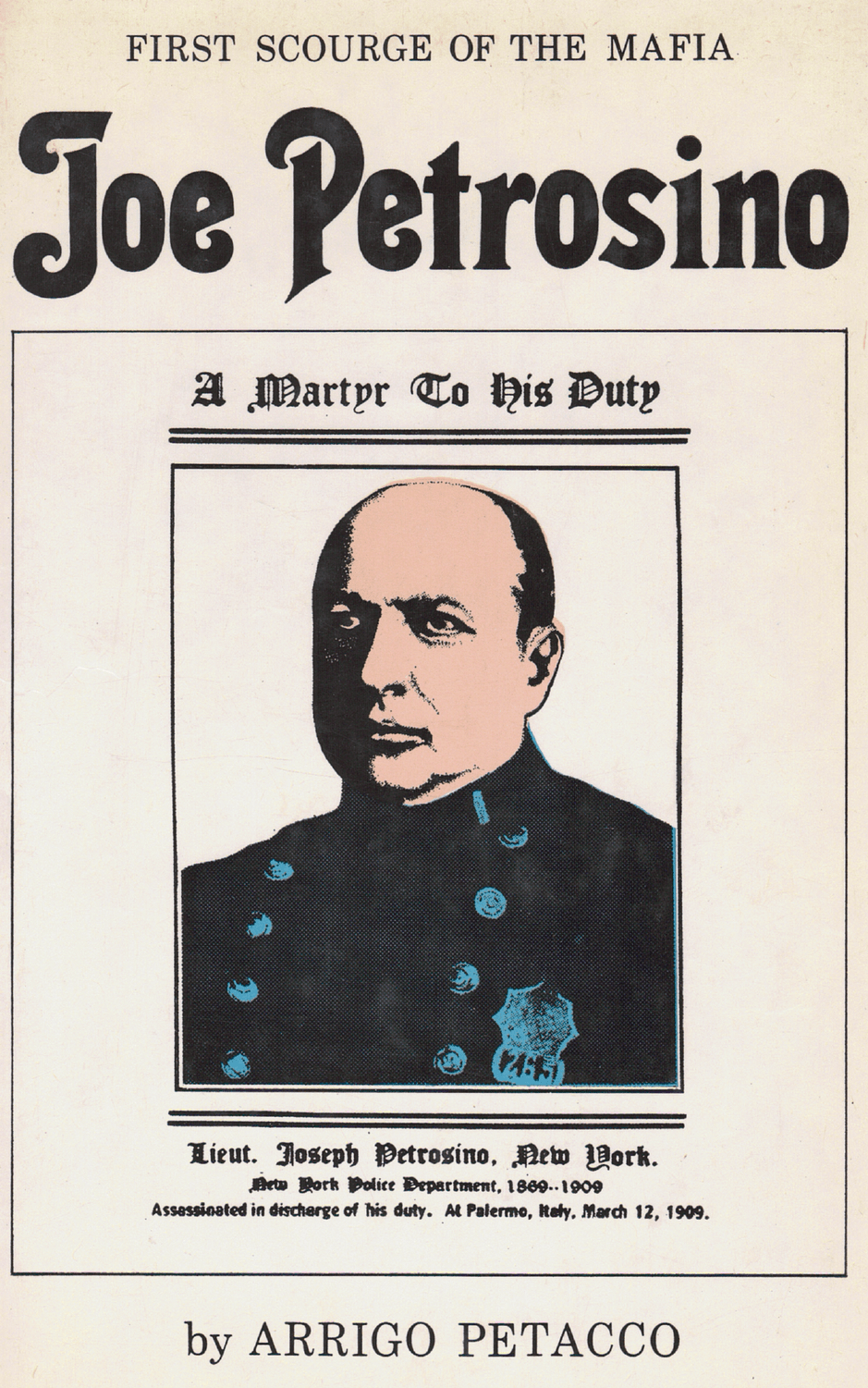
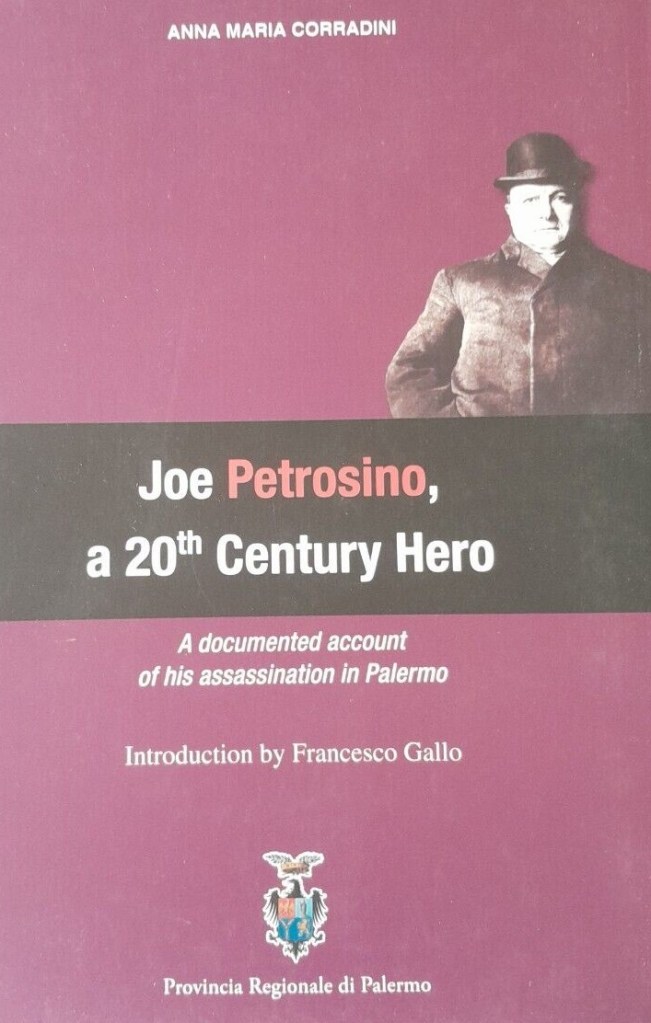
Should you be in the mood for atonement after a lifetime of deifying gangsters, Mr Scorses, you might wish to consider a biopic of the greatest cop, outside of Elliott Ness and Serpico, in American history. I’m sure Leonardo DiCaprio, who was at one time attached to a filmization of the bestseller The Black Hand (2017) by Stephen Talty, has brought the subject matter to your attention. Although Pay or Die (1960) covered similar territory, its budget and restrictions of length denied it the opportunity to properly explore the historical depth and social comment, for which in Killers of the Flower Moon (2023) you now seem more at home.

After the success of Oppenheimer (2023) audiences might be receptive to a true story about a cop who took on the Mafia a.k.a. the Syndicate a.k.a. the Cosa Nostra before it was known by any of those names and there is, to boot, a heart-rending romance that the Ernest Borgnine picture barely touched upon.

I’ve even dreamed up an opening.

A horse pulls a wagon laden with oranges and apples through a congested New York street circa 1883. As the driver pauses to make a delivery, a child, Claudia, watches from the window of her father’s shop – F. Fellini Jeweller. The horse collapses. The fruit scatters. Malnourished kids race to scoop up the merchandise. Claudia races out and strokes the horse’s mane.

We cut to a man in brown overalls striding towards the camera armed with a cleaver. The crowd parts. The child clings to her father in terror. The man raises the cleaver high over his head and slams it into the horse’s haunch. The child screams. The jeweller remonstrates with the man. The man removes his cleaver and says, “Not dead enough.”

As the credits roll, we see Claudia chasing away the flies that gather over the corpse, being pushed away by a man chiselling out the horse’s hoof, another sawing off its tail. Some days later as she is trying to pick off wriggling maggots, the man returns, this time driving a wagon. She hides behind her father.

His cleaver flashes in the sun as he hacks away at the horse. By now decomposition is so bad that the legs easily part from the body and the man is able to drag the horse bit-by-bit onto the back of his cart. Claudia watches as he leaves with the steaming carcass. We follow the wagon through the streets down to the river. A boat is waiting. The man heaves the meat onto the boat. The boat sets sail. Far out in the channels, the man begins chucking the meat overboard.

Back on dry land, the man cleans his cleaver and removes his brown overalls. Underneath he is wearing the uniform of a cop.

This is Joe Petrosino.

In those days cops also ran the Sanitary Dept in New York. Removing dead horses – they were too heavy to lift manually so you had to wait till the meat rotted sufficiently to fall from the bones – was a job for new recruits.

When Petrosino reaches the police precinct you’ll notice two things about him. He is short, well below the standard police requirement, and all the accents except his are Irish. In fact, he’s the only Italian cop on the force and only recruited because he can speak Italian and get information from all those immigrants who still can’t speak a word of English.

But he’s also very unusual especially to a contemporary audience because we’ve all been acclimatized to thinking that all Italians of this and successive generations accepted the Mafia rather than as Petrosino hating them and all they stood for. So this is effectively the tale of a silent majority who came from the same locale as the Mafia, understood their position in society in the home country, but loathed the fact that they had been allowed to infiltrate American society in part at least because they spoke a secret language (Italian) that few Americans understood or made an effort to understand with all the underlying racism that suggested.

But Petrosino’s not like a contemporary cop, forced to work within the tight constraints of the law and he’s not even like the cops of the 1930s-1960s who might have lawyers breathing down their necks and in the later decades accused by the media of breaching civil liberties. Petrosino was a good old-fashioned two-fisted cop, think James Cagney or Lee Marvin or Clint Eastwood but on the side of law and order. He thought nothing of beating up hoods, humiliating them in public as a way of showing that society was not going to stand by and let them terrorize the public.

Eventually, Petrosino was able to set up a specialist Italian-speaking squad to tackle The Black Hand/Mafia.

But he was also a superb detective. The Black Hand’s main line of business was kidnapping – little Claudia would come back into the story as a victim. Don’t pay the ransom and your business or your house would be blown up, the kidnappee killed. You may remember from old kidnapping movies that the kidnappers always cut out words from newspapers to write their demands.

Well, the only reason they ended up doing that was because of Petrosino. Prior to that, they just wrote out their demands in pen and ink. But he started to round up suspects by the hundreds and find an excuse to get samples of their handwriting. And then using the samples on file, whenever a new demand appeared he would scout the files to match the samples and go an arrest an astonished hood. So the gangsters wised up and started using newspapers.

He was also the guy who worked out that immigrants didn’t suddenly take up crime on arriving in America but they may well have criminal records back home and therefore could be extradited.

On top of that was the heart-rending love story. Petrosino had fallen for the daughter, Adelina, of a restaurant owner. Every night he dined in the restaurant. But she had been married before. She was a widow. Her husband had died young and she couldn’t contemplate marrying again to someone who was in such constant peril. So it took years of wooing, nightly meals, before she agreed to marry. The marriage lasted a year, ended by his death. He was assassinated while going into the lion’s den, the Mafia strongholds of Italy.

And all this is before you deal with the social issues of immigrant integration, of racism, of finding the new world as guilty of betrayal of trust as the old, of those complicit in murderous actions of the Mafia by turning a blind eye.

I’m suggesting Martin Scorsese because he’s covered this ground before but on second thoughts this might appeal more to the likes of Christopher Nolan who is comfortable with complexity and constantly seeks a wider perspective and who, whether through the Batman chronicles or Oppenheimer, is happy for his principal character to be in the main an upholder of justice.

Quadruple Bill: Ferrari (2023) **** / Anyone But You (2023) *** / One Life (2024) *** / Next Goal Wins (2023) **

The stars aligned and with only a couple of minutes between features I was able to squeeze in a record-equalling four movies in a single day (excepting all-nighters of course) at the cinema and with one exception they were all well worth the ticket price.

Ferrari

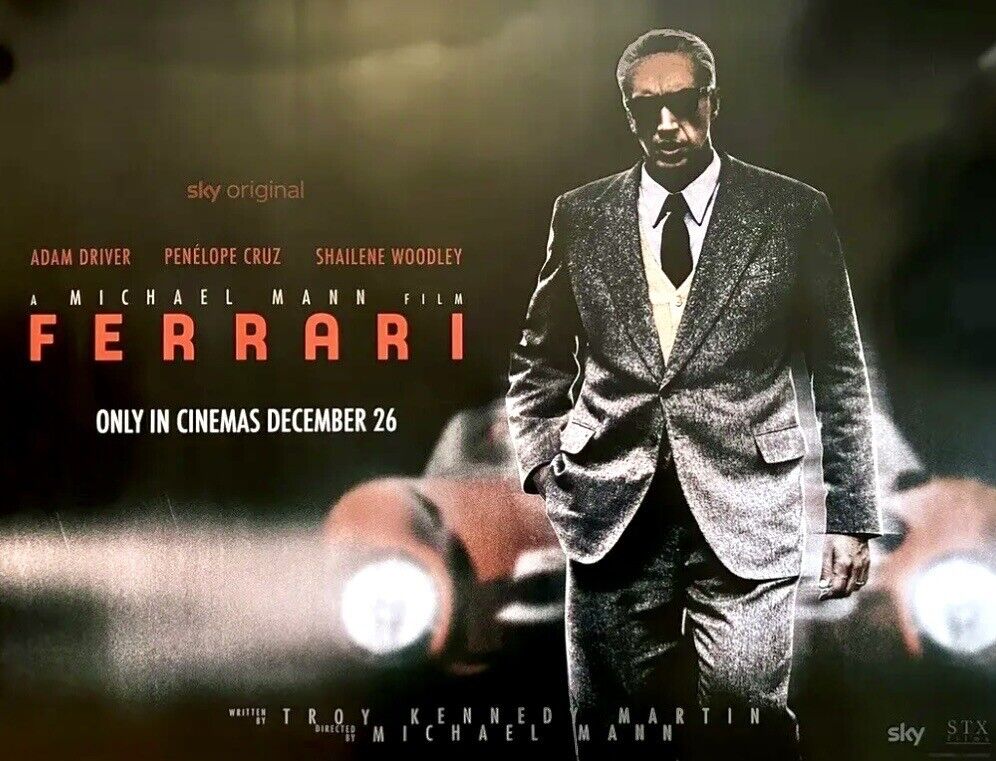
Not really a motor racing picture in the mold of Ford v Ferrari / Le Mans ’66 (2019) or Rush (2013) but more of a domestic drama centering around a dramatic race. The acting is plum, Penelope Cruz (The 355, 2022) taking the honors ahead of Adam Driver (House of Gucci, 2021) though Shailene Woodley (The Last Letter from Your Lover, 2021)  seems miscast. The climactic race doesn’t carry the punch of Le Mans, however, the focus more on the backseat players than the drivers. And it’s not quite prime Michael Mann (Heat, 1995)

Set about decade before Ford v Ferrari, it finds Enzo Ferrari (Adam Driver) coping with the death the year before of his only son, the potential collapse of his business, and trying to conceal long-standing mistress Lina Lardi (Shailene Woodley) from long-suffering wife Laura (Penelope Cruz).

The depth of the couple’s despair at the loss of their son can be measured in the fact that every morning they take flowers, separately, to his graveside. He has at hand an immediate substitute, having fathered a boy, now approaching ten years old, with his mistress, but rejects the chance to officially gave the boy his name.

The manufacturing side of the business was always viewed as merely a way of financing the racing, Ferrari having been a driver earlier in his life. But overspending or lack of income, such details are not specified, has pushed the business towards bankruptcy and he toys with inviting a merger with a bigger company such as Fiat or Henry Ford (which formed a central plank of Ford v Ferrari). But the easiest way out is to win Italy’s most prestigious race, the Mille Miglia, a four-day 992-mile event that ran clockwise across public roads from Brescia to Rome and back.

But I had to look that up. Unlike Le Mans, unless you are a racing aficionado, this doesn’t immediately click in the public consciousness. And there were a host of other details that seemed to skimp on information. Unlike Ford v Ferrari where you learned exactly how fast cars got faster and what it took to drive them or be driven in one (witness Henry Ford’s terrifying hurl), here you are only given some vague technical data which makes little sense. There is little background fill, Maserati pops up as Ferrari’s chief rival but its inclusion is almost incidental. In fairness, you do get more about the jiggery-pokery of running a business.

Running parallel to the racing venture is the family soap opera, will Laura find out about the mistress and child, will she jeopardize the business out of spite. Once the race starts, it’s hard to keep up. Here the distinct lack of detail hurts the most, although there is one shocking scene.

Engrossing enough but it’ll struggle to fill cinemas.

Anyone But You

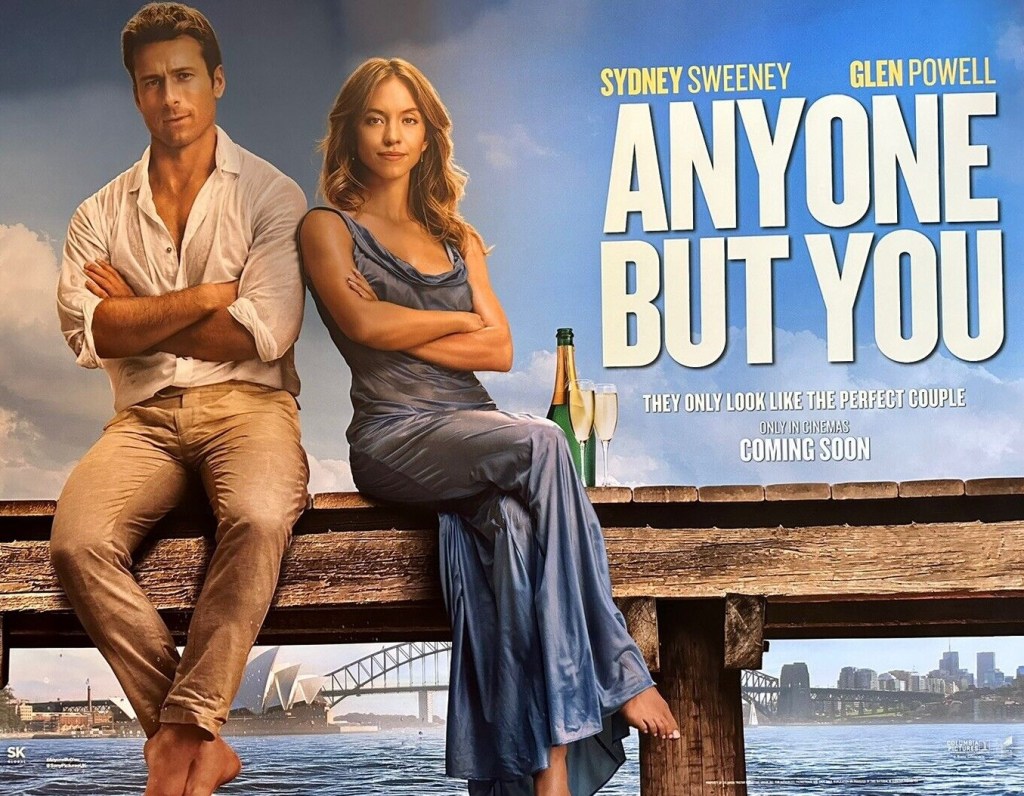
A contemporary take on the rom-com with the disgruntled participants of a one-night stand forced to pair up at a wedding where they encounter an abundance of exes and various interfering family members. Glen Powell, star in the making in Top Gun: Maverick (2022), comes good as does Sydney Sweeney (The Voyeurs, 2021). Skipping the raw rudeness of its immediate predecessors, this pivots on charm, but with a few helpings of humiliation (he strips naked to avoid a predatory spider) and slapstick thrown in, plus some old-style determinedly un-woke action from one parent in particular. He is the more vulnerable, a poor swimmer, requiring a soothing song to fly. The plot is over-plotted and occasionally it seems some incidents have come straight from Room 101, but generally it works. Probably it helps, if I’m permitted of offer such a comment, that they are  A-grade beefcake and cheesecake, respectively. Setting that aside, they appear to have mastered the lost art of the rom-com and certain drew appreciative laughter from the audience I was part of. the kind of film that in the olden days would have picked up a sizeable audience on DVD and turned into the kind of cult that guaranteed a return joust.

One Life

A film of two halves when it should have been divided into three-quarters and one-quarter or an even stiffer division. Concerning the efforts of the “British Schindler” Nicholas Winton (Johnny Flynn playing the younger version, Anthony Hopkins the older) to smuggle out of Prague over 600 Jewish children at the outbreak of World War Two. The earlier section is far more gripping and the later section that revolves apparently around an attempt to publicize the previous rescue in order to highlight the plight of later refugees falls mostly flat on its face as it seems more intent on glamorizing the actions of a man who wanted anything but public recognition. Too much time is spent pillorying a society that sanctified such inanities as the long-running That’s Life television program when I felt it would have been more sensible, and fair, to devote more attention to the work of Winton’s collaborators. While the climactic scene where Winton meets, as grown-ups, the children he saved is moving, it feels redundant compared to the actual children-saving.

Next Goal Wins

Eventually, it turns into a feel-good picture but for most of the time seems intent on making fun of Samoans carrying the tag of the world’s worst team. Nobody seems to ask why FIFA is so determined to bring football to countries where there is no interest in the game. Oddly, Michael Fassbender turns in his most accessible performance as the coach drafted in to improve the team, a big ask since he has clearly been a flop at his chosen profession. You could have pinned the movie more easily on the transgender player more accepted in Samoa than virtually any other country in the world who, by default, becomes the first transgender to play in the World Cup.

The Brotherhood (1968) ****

Minimal violence and no sex was the wrong recipe for this Mafia picture – as proven at the box office – but this is an absorbing, underrated drama nonetheless.

It bears a surprising number of parallels to The Godfather (1972). Pure coincidence, extraordinary though that may appear, because The Brotherhood premiered in December 1968 while the Mario Puzo novel was printed in March 1969 (and delivered to the printers long before), so no opportunity at all for plagiarism.

The two films could be opposite sides of the same coin. For a start, both begin with a wedding. Vince Ginetta (Alex Cord), brother of Mafia kingpin Frank (Kirk Douglas), is marrying Emma (Susan Strasberg), daughter of another Mafia chief Dominick (Luther Adler). Like Michael (Al Pacino) in The Godfather, Vince is just out of the army, well-educated and primed for a life outside the business. And like Michael is called upon to commit an act of supreme violence. There’s even a hint of Tom Hagen (Robert Duvall) in the relationship between the brothers, Frank having brought up the much younger Vince after his father’s premature death.

And just as Don Corleone (Marlon Brando) refuses to join the other Mafia families in a new business venture (in that case, drugs) so Frank bows out of an incredibly high risk (but amazingly prescient) scheme to invest in electronic firms involved in military work for the government, a deal that not only promises huge profits but a potential hold over the powers-that-be.

Frank’s wife Ida (Irene Papas) is like Don Corleone’s wife, not wanting to know anything about the business, but both Emma and Frank’s daughter Carmela (Connie Scott) are thematic cousins to Kay Adams (Diane Keaton) as initial implicit trust is wiped away. When Frank dances with Carmela at the wedding, that is reflected in Don Corleone dancing with his daughter at her wedding. Like The Godfather our first sight of the other Mafia chieftains – including Jim Hagen (Murray Hamilton) and Don Peppino (Eduardo Cianelli) – is at the feast where they are viewed with suspicion by Frank’s clan. And the scene where Frank uses a banana to tease his nephew will remind you of Don Corleone spooking his grandson with an orange.

However, the twist, if you like, is that, unlike Michael, Vince is desperate to join the Family and is instrumental in developing legitimate enterprises, which is echoed by Michael Corleone’s strategic shift to Las Vegas. In some respects, Frank is more like Sonny (James Caan), happy to take personal command of murders which the other Mafia chiefs now scrupulously delegate to “mechanics” in Los Angeles. He is more old-school whereas the others have assumed the personas of respectable businessmen.

And then it becomes a question of loyalty. Which side the ambitious Vinnie will take is crucial to the story. Frank is under pressure on all sides, from the other Mafia leaders, a government investigation, Vinnie, and the need to exact revenge on the man who caused his father’s death.

There is authentic detail here as well – religious procession in Sicily, Frank playing boccia (the Italian version of the French boules) with his old pals, family dinner, canary stuffed in the mouth of a stool pigeon, but it is less spaghetti-drenched than The Godfather. Screenwriter Lewis John Carlino (The Fox, 1967), also listed as technical adviser, claimed to be drawing on his intimate knowledge of organized crime.

There are only three moments of violence – four if you count a shocking moment of someone spitting on a corpse at a wake – a pair of straightforward murders that bookend the film, plus a scene of Godfather-style brutality in which a man slowly strangles himself to death after being hogtied. Everyone is happily married, Ida very old-school to the extent of removing her husband’s clothes (and shoes) when he returns home drunk, Vince in a good relationship.

Kirk Douglas (Cast a Giant Shadow, 1966) is excellent in a difficult role that presents a fully rounded character, playful with his daughter, loyal to his wife, holding his own against the other mob bosses, enjoying the company of the old-timers who resemble his father, and the changing nature of his relationship with brother Vince. Alex Cord, whose work I initially dismissed (Stiletto, 1969), I have come to more fully appreciate, especially here, where he makes the transition from adoring brother to threat. It is a masterpiece of restraint.

The supporting cast is terrific, a rare Hollywood sojourn for Irene Papas (The Guns of Navarone, 1961), Luther Adler  (Cast a Giant Shadow, 1966) as one of the hoodlums exasperated by Frank’s recalcitrance,  Murray Hamilton (The Graduate, 1967) but, except at the start, Susan Strasberg (The Trip, 1967) is underused.

While director Martin Ritt (Hombre, 1967) is at times guilty of melodrama, his rendering of family life is much more nuanced than Coppola’s. There are very tender moments between Frank and his wife and Frank and his daughter, as well as moments where Ida plays a more maternal role.

For nearly half a century, The Brotherhood has lain in the shadow of The Godfather simply because they both deal with the Mafia. But this is an excellent movie in its own right.

The Equalizer 3 (2023) **** – Seen at the Cinema (three times)

Stylish, triumphant, conclusion to a vigilante series that stands comparison with John Wick as the best of the new century. Oddly enough, the pair share some motifs, not least a mountainous stairway to a medieval church. And there are nods to The Godfather, killings against the backdrop of a religious procession and fruit spilling onto a corpse, a dagger pinning a hand to a table. And you might find shades of Apocalypse Now in the brooding remorseful figure of Robert McCall (Denzel Washington) convalescing in a remote fishing village in southern Italy. And it’s fully contemporary with a nod to the power of the mobile phone in depicting live events.

For an actioner it’s chockful of mystery. To begin with, you think we’re at the end, the aftermath of some gun battle, but, in fact, it’s just the start. Quite why McCall has ended up in a Mafia fiefdom in Sicily is held back till the end as is explanation regarding helping young C.I.A. agent Emma (Dakota Fanning) track down Mafia drug dealers, both narrative hooks adding to the subtlety and nuance that filters through this reflective actioner. Sure, there’s brutality, when is there not with McCall around, but there’s also reality, marvellously evocative scenes of village life, the vigilante sipping his trademark tea in a café, buying fresh-caught fish, joining exuberant locals celebrating a famous win at soccer.

Assisted by local physician Enzo (Remo Arisio) and local cop Gio (Eugenio Mastandrea) in recovering from a life-threatening bullet-wound, it’s all McCall can do to hobble down the steps with the aid of a walking stick. No Rocky-style reinvention dynamics here, no weight-training or running regime, no taking to the target range. When McCall struggles up a flight of steps your heart is in your mouth.

Meanwhile, a story unfolds of a power grab, legitimate and illegitimate, by Mafia chief Vincent (Andrea Scarduzio). But when the gangster’s younger brother Marco (Andrea Dodero) pushes his weight around once too often in McCall’s presence the rumbling volcano starts to erupt. But in temperate fashion to begin with, McCall relying on being able to locate a particular nerve (a physical one) enough to send the young thug scarpering.

Worth noting that the movie avoids two obvious traps. Agent Emma isn’t fighting a gender war, she’s no feminist battling for approval from male counterparts; in fact, if anything, she’s accorded full praise for her work and makes sure that she never acknowledges McCall’s input to her superiors, which seems even more realistic.

You might expect by now that widower McCall would be ripe for romance but though waitress Aminah (Gaia Scodellaro) takes a shine to him that goes little further than a pleasant walk along the beach sampling local delicacies. So you might also expect that, sticking to the core, this would be just a lean rip-off sequel. Instead, it’s rich in composition and detail. Many scenes play out in what appears to be atmospheric black-and-white. While not in the operatic league of John Wick 4, it’s a joy to watch.

Plenty bang for your buck but an interesting storyline that meshes drugs, terrorism and the Mafia. Deceptively subtle performance from Denzel Washington (The Magnificent Seven, 2016). He could have coasted home with his brooding persona. Instead, he walks like a man half-dead, reacts as if bewildered to still be alive, and finds he is no longer an outsider. Dakota Fanning (Once Upon a Time in Hollywood, 2019) plays down her role, there are no dramatic fireworks, she’s a confident individual, not giving an inch in her quiet duel with McCall, but no histrionics either.

Long-lasting director-actor teamings generally bring richer rewards as the partnership grows. This is the fifth film for Washington and Antoine Fuqua, beginning with Training Day  (2001) and incorporating The Magnificent Seven and the two previous Equalizer outings. It has the feel of a famous partnership along the lines of John Wayne-John Ford, James Stewart-Anthony Mann and Gregory Peck-Henry King.

Nod to Richard Wenk, third time in the writer’s chair, for the screenplay and espcially to Marcelo Zarvos (Emancipation, 2022) for a score that combines haunting theme tune and screeching guitar for the action.

I was so taken with this I’ve already seen it three times. Might well head back a fourth time next week for more nuance – and more bang.

The Belle Starr Story (1968) ***

Only spaghetti western directed by a woman. Brings a distinctly feminist feel to that most sexist of the subgenres. You tend to forget that the sexy female Europeans imported to Hollywood as co-stars or to add spice further down the credits were actually top-billed stars in their natïve countries and demonstrated a greater range than the American industry allowed.

Not only do we have Elsa Martinelli (Maroc 7, 1967) as the leather-clad cigar-smoking titular gunslinger, whose watchword is female independence, but it was helmed by arthouse icon Lina Wertmuller (Swept Away, 1974).  There’s a thematic consistency lacking in most Italian-made westerns, for example predating Once Upon a Time in the West (1969) in its water imagery. But any potential for lyricism is undercut by the risk attached to being a lone woman. And there’s a Tracy-Hepburn tone to the endless bickering and battle for superiority in her niggling romance with outlaw Blackie (George Eastman).

And, unusually in that decade, a woman who throws caution to the wind and will even bet her body when the money runs out at the poker table, as twisty a meet-cute as a screenwriter could devise. But thereafter it’s a struggle for dominance between the pair. She won’t take orders from a man. He won’t accept female equality even when she shoots the wooden fence  he’s sitting on from under him, making him fall to the ground, and for good measure putting a bullet in his heels.

The first act builds up Belle Starr, cool at the poker table, even cooler in the bedroom, and demonstrating the gunplay that attracted her notoriety. The second act take an odd route, a lengthy flashback that digs deep into feminism, the orphaned Belle Starr running away after being sold into marriage by her uncle to an ugly old rich powerful man, traded, effectively, for political favor.

She returns to save a servant condemned to death for the crime of attacking the uncle when he tried to rape her. Sexual humiliation is a theme. Another outlaw Harvey (Robert Woods), who she regards as a platonic friend, steals her clothes as she swims in a lake, and then, having saved her from a posse, forcibly tries to take his reward.

The third act, like the duel between The Man With No Name and The Man in Black, is a case of double- and triple-cross. She refuses to join Blackie’s gang when he plans a million-dollar jewel heist, but hijacks the concept, recruiting her own gang to beat him to the robbery, and teach him a lesson.

But it backfires. Blackie is waiting. She has inadvertently hired his men. In the subsequence shoot-out he is captured. She rides to his rescue. But with their opposing ideas of a woman’s place in the world part on good terms.

The flashback was more subtly observed in Once Upon a Time in the West, and while she shared with Charles Bronson gunslinging skills he was not at any time viewed as a commodity or a piece of property or a candidate for rape. The flashback here fleshes out for the audience the powerlessness of women. But also the kind of camaraderie that is generally also usually only conferred on male characters.

We are pretty conversant with the notion that the gun rules the West. But less conscious of what happens when you are gun-less. Depriving someone of their fundamental weaponry makes them instantly impotent, as humiliating as denying someone water in a desert.

There are some nice directorial touches, blood dripping from a ceiling onto a dinner table, a saloon door opening to cast sudden light onto a corpse, waterfalls suggest sanctuary whereas open water attracts predatory males, and the finale, as they part, of Blackie, desperate to demonstrate his superiority, shooting off her hat from some distance.

Elsa Martinelli is a revelation as a star working to her own beat rather than playing second fiddle to some Hollywood marquee name. This wasn’t Lina Wertmuller’s first film and she had already made an impact with the Rita the Mosquito series, featuring another rebellious woman. Don’t be fooled by the co-directing credit, she replaced debut director Piero Cristofani after a few days.

It’s somewhat ironic that in a contemporary Hollywood attempt to create a female outlaw leader in Cat Ballou (1965), Jane Fonda was upstaged by Lee Marvin, and that in Bonnie and Clyde (1967), despite taking precedence in the title, Faye Dunaway was not the dominant one in the relationship.

By no means a great western but worth a look to see what Elsa Martinelli can achieve when not slotted in to the Hollywood co-star cliche and to get a preview of what Lina Wertmuller could offer.  

Decent print on YouTube.

The Cardinal (1963) ****

Would appear resolutely old-fashioned except for Forrest Gump (1994) adopting same premise of the main character present at major events. Here it’s issues affecting the Catholic Church between last century’s two world wars and the protagonist is an American priest, Father Stephen Fermoyle (Tom Tryon) of Irish stock,  who rises to the position of Cardinal.

So we move at a relatively stately pace through abortion, inter-denominational marriage, racism, a miracle, challenging church philosophy, and Hitler’s annexation of Austria on the eve of the Second World War, in which the church played an inglorious part. Along the way Fr Fermoyle is afflicted so badly by doubt that he takes a sabbatical only for his flesh to be sorely tempted.

Astonishingly, I saw this on YouTube (it’s still there) in a beautiful 70mm print preserved by the National Film and Television Archive. The roadshow print, to be exact, which begins with a marvellous five-minute overture. Oddly enough there’s something very settling about sitting in the darkness with the curtains drawn watching a blank (black) screen and listening to the majestic score by Jerome Moross (The Big Country, 1958).

And then it’s another few minutes of a stunning credit sequence, all sunlight and shadow, before the movie begins. The movie itself is over three hours long, so if you are put off by this kind of epic now’s the time to check out. But if you do, you will miss something genuinely to be savored.

For Otto Preminger (Hurry Sundown, 1967) certainly knows how to tell a story, even one as sweeping as this. For all its pomp, he manages to retain intimacy.

Immediately after his ordination just as America enters the First World War, Fr Fermoyle faces a crisis. His sister Mona (Carol Lynley) wants to marry a Jewish dentist (John Saxon) who refuses to convert to Catholicism. Fermoyle’s advice, in keeping with the church’s stringent rules: give him up.

A noted intellectual, Fermoyle is astonished to be sent by the worldly piano-playing cigar-chomping Archbishop Glennon (John Huston) to an impoverished parish to learn humility. There, he encounters the blind faith of parishioners and a pastor, Fr Halley (Burgess Meredith), so inclined to put others first that he will not seek help for a debilitating disease.

Meanwhile Mona, now a dancer and drinker, has become pregnant, and not by the dentist. But complications arise and she is forced to choose between herself and the unborn child. According to Church doctrine, as Fermoyle, advises, abortion being illegal, the mother must die to save the baby. Mona, not the sacrificial kind, does the opposite. Fermoyle, racked with guilt, wants to quit the church. Instead, he is promoted to Monsignor, and given a two-year timeout which he spends lecturing in Vienna.

There he falls in love with Annemarie (Romy Scheider). In the nick of time, he is recalled to the States and sent to the Deep South to help the black Fr Gillis (Ossie Davis) who is being harassed by the Ku Klux Klan. In standing by his colleague, Fermoyle undergoes a brutal whipping. Promoted to bishop, he is despatched to Austria “to instruct the princes of the church in the realities of the modern world.” Unfortunately, the clergy, siding with the Nazis, presides over the marriage of Germany and Austria.

Meanwhile, he is reacquainted with Annemarie, who has married a Jewish banker, and witnesses at first-hand Nazi treatment of the Jews, her husband so fearful of his future he jumps out a window.   When a mob ransacks a church, Fermoyle isn’t so intent on facing up to them and instead, with Annemarie, manages to escape.

At its best and its worst by the narrative being forced through the prism of an individual. His reactions to issues are regulated by his employers, the Church, which exerts as much control over personal thought as the Communist Party, so, in effect, it becomes a tale of a person initially bristling against authority until, it turns out, the Church shares the same antipathy to the worst of the century’s scandals, the Ku Klux Klan and the Nazis.

Father Fermoyle hardly seems suited to high office, given he is so often inclined to temptation, either in a sexual sense, or in taking the opposite view of the Church. And it’s almost as though the splendid backdrop as represented by the immense wealth of the Church has only been achieving by subjugation of the individual. That the worldly Glennon appears as the poster boy for the Church hierarchy is almost Preminger playing with the audience.

It might be sumptuously mounted, but once again Preminger takes no prisoners, showing up an institution that while purportedly set up for the benefit of mankind so often sabotages noble endeavor.

Tom Tryon (In Harm’s Way, 1965) is excellent in the leading role, personal conviction getting in the way of the easy path to the top. But the pick of the performers are the supporting stars, especially John Huston, more famous as a director (The Night of the Iguana, 1964) and here making his acting debut, and Romy Scheider (Triple Cross, 1966). Look out for Carol Lynley (Bunny Lake Is Missing, 1965), silent film star Dorothy Gish in her final movie appearance, Maggie McNamara (The Moon Is Blue, 1953) in her first picture in eight years, and John Saxon (The Appaloosa, 1966) before he was typecast as a heavy.

Otto Preminger (In Harm’s Way) directs in stately fashion from a screenplay by Robert Dozier (The Big Bounce, 1969) and Ring Lardner Jr. (The Cincinnati Kid, 1965).

Thoughtful and striking.

Discover WordPress

A daily selection of the best content published on WordPress, collected for you by humans who love to read.

The Atavist Magazine

by Brian Hannan

WordPress.com News

The latest news on WordPress.com and the WordPress community.