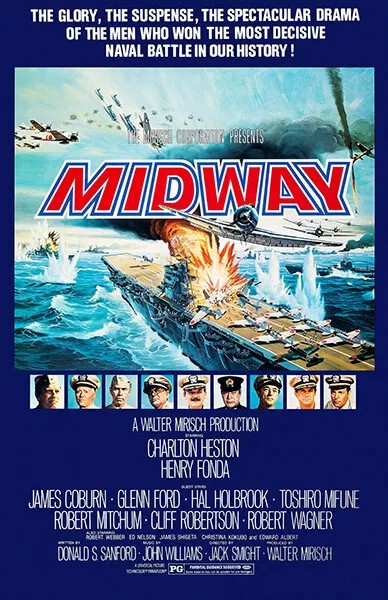
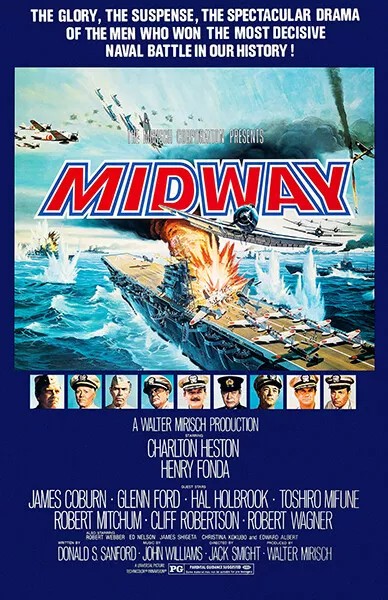
Behind the Scenes: “Battle of Midway” (1976)

Mirisch could easily lay claim to be the top independent production outfit of the 1960s generating hits like The Magnificent Seven (1960),  West Side Story (1961), The Great Escape (1963), The Pink Panther (1964) and its sequel A Shot in the Dark (1964), The Russians Are Coming, Russians Are Coming (1966), In the Heat of the Night (1967) and The Thomas Crown Affair (1968) plus a shelf load of Oscars and Oscar nominations. But dependence on a partnership with Billy Wilder in the 1970s and a more lackluster performance at the box office – with the noted exception of Fiddler on the Roof (1971) – spelled the end of its 17-year relationship with United Artists, which was reeling from financial losses and under new management.

The company found a new partner in Universal which had a series of deals with other major producers like Alfred Hitchcock, Zanuck and Brown (Jaws, 1975) and George Seaton (Airport, 1970). Mirisch was not in any financial trouble, having severed ties with UA after Mr Majestyk (1974), a major success abroad, and recovered its development costs for Wheels, based on the Arthur Hailey novel but the script rejected by UA, from Universal which turned it into a mini-series.
The Universal deal was initially not as good as that enjoyed at UA. Universal charged a twenty-five per cent overhead whereas UA had charged nothing and Universal was now doing direct deals with directors rather than relying on the likes of Mirisch to tie up the talent.

Many years before, Mirisch had commissioned a script on the Battle of Midway from Donald S. Sanford who specialized in war pictures but of the distinctly low-budget variety – Submarine X-1 (1968), The Thousand Plane Raid (1969) and Mosquito Squadron (1969), none of which had enjoyed any success. 

Though all of the Mirisch war pictures had concentrated on Europe, Walter Mirisch, generally the creative driving force for the production company, in his previous incarnation with Allied Artists had some experience of the Pacific War, having produced Flat Top / Eagles of the Fleet (1952), set around an aircraft carrier during the Battle of Leyte Gulf, and was an avid reader of books about the Second World War.

John Ford and Louis de Rochmont had made documentaries about the Pacific naval battles. UA rejected the script twice, a shrewd move in the end because Tora! Tora! Tora! (1970) lost a packet for Twentieth Century Fox. The Sanford screenplay had initially taken more of a documentary approach but after gaining the interest of Charlton Heston, who had starred in Mirisch’s The Hawaiians (1970), the script was tweaked.

Programming a war picture was a risk for the studio. There hadn’t been a big-budget war picture in five years. And while Patton (1970) and Kelly’s Heroes (1970) ended up on the right sight of the ledger book, Tora!, Tora! Tora! and Too Late the Hero (1970) were stiffs.

Mirisch signed a two-picture deal with Universal, for Midway and Wild Card with a screenplay by Elmore Leonard (Mr Majestyk). Mirisch proposed to reduce costs by using footage from naval archives, converting the original 16mm film to 35mm. The producer also  took footage from Japanese film Storm over the Pacific / I Bombed Pearl Harbor (1960) – the rights cost him $96,000. Footage of the Pearl Harbor attack in Tora! Tora! Tora! doubled for shots of the attack on Midway Island.   A clip of the Dolittle raid on Tokyo from Thirty Seconds over Tokyo (1944) was used in the credit sequence after “subjecting it to a sepia bath.”

After the success of Earthquake (1975), Heston was back in the top ranks of box office stars and his involvement guaranteed the green light. The U.S. Navy offered its support, not surprising since Midway was considered its greatest success.

John Guillermin (The Towering Inferno, 1974) was hired to direct and Stirling Silliphant (In the Heat of the Night) signed up for a screenplay rewrite. Mirisch had determined to employ the all-star-cast device that had been an essential ingredient of many of the 1960s roadshow pictures, kicking off with Henry Fonda (The Boston Strangler, 1968), by now pretty much a spent force at the box office – he hadn’t made a picture in three years – but still a well-known name. 

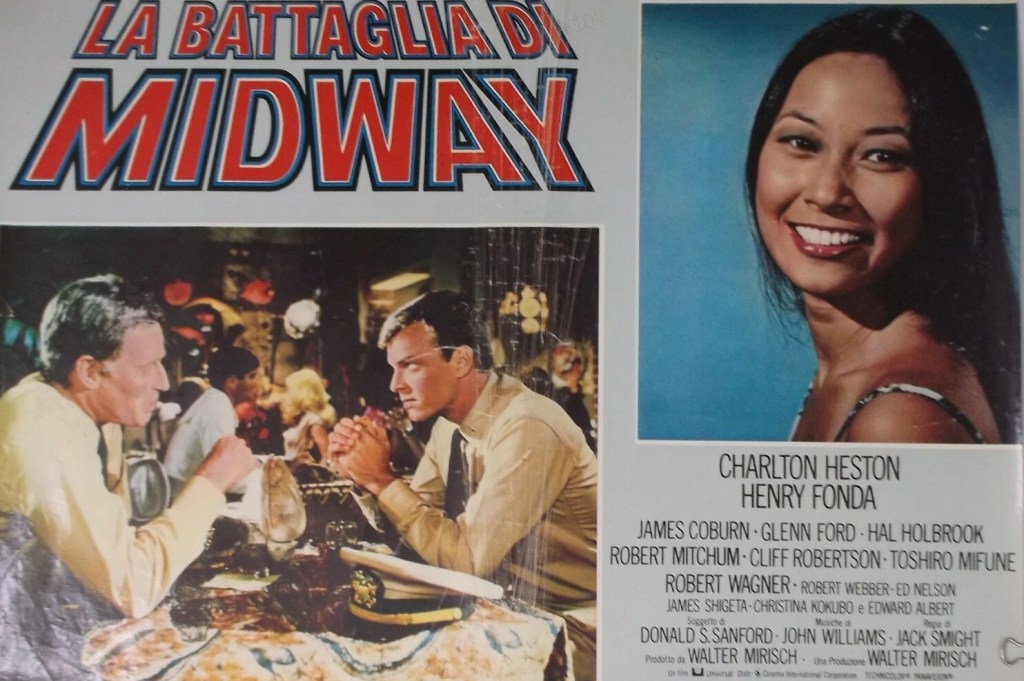
The amount of work involved for the other stars was minimal – mostly just one day – and, astutely, Mirisch called on stars who had worked for him in the past and who, like James Coburn (The Great Escape), Cliff Robertson (633 Squadron, 1964) and Christopher George (The Thousand Plane Raid) owed him something in terms of a career leg-up. Others included Robert Mitchum (The Sundowners, 1960), Robert Wagner (The Biggest Bundle of Them All, 1968) and Tom Selleck in an early role. Mitchum was the first of these stars to sign up, in March 1975, six weeks before the scheduled start date of April 27, followed two days later by Coburn.

Toshiro Mifune (Red Sun, 1971) headed up the Japanese cast and proved so meticulous in his preparations that he had his uniform made by Japanese tailors. The white gloves he wore had a finger shortened on the left hand because his character Admiral Yamamoto was missing a pinky. However, despite coaching in English by actress Miko Taka (Walk, Don’t Run, 1966), his dialog was revoiced by Paul Frees. 

Guillermin demanded a bigger budget to accommodate more airplanes and equipment and a longer shooting period. Two months before filming was due to start, Mirisch put his foot down and told the director he couldn’t accommodate his requests as Universal had only provided funding on the basis of Mirisch’s original idea. Guillermin walked. As far as the public was concerned, the parting of the ways was due to a “conflict of schedules.” Jack Smight, who had directed Airport ’75 (1974), a box office success and also starring Heston, was his replacement.

The Navy lent aircraft carrier U.S.S. Lexington – the last remaining World War Two carrier – while it was at sea training pilots as long as the shoot didn’t interfere with those exercises. A limited number of World War Two vintage planes – in great condition having been cared for by their owners – were permitted on board. The Navy charged the crew for accommodation – Mirisch was housed in Admiral Strean’s quarters – and meals. “We had a detailed contract with the Navy,” recalled Mirisch, “in which we agreed to stay out of their way when asked.”

On board, the crew filmed scenes, some silent and others with dialog, and “made plates for rearview projection and aerial shots of our vintage planes so positioned that we could print them into flights of six or nine.” Charlton Heston, Glenn Ford (Rage, 1966) and Hal Holbrook (The Group, 1966) were aboard and the shoot went well.  A scene involving Henry Fonda was shot at Pensacola. The Florida coast stood in for the Pacific. Additional exteriors were filmed in Los Angeles at Long Beach and Point Dune with interiors at Universal.

The construction of the interiors for the Japanese aircraft carriers was so authentic Mirisch was later asked to reassemble the set for the Smithsonian Institute for a presentation there. The interpolation of the old footage was crucial and it was planned in advance where such shots would appear. The old footage was precut and scenes were shot with actors with “scene missing” in those sequences into which the old footage could be dropped. Other devices were used to ensure the background in the old footage was more lively.

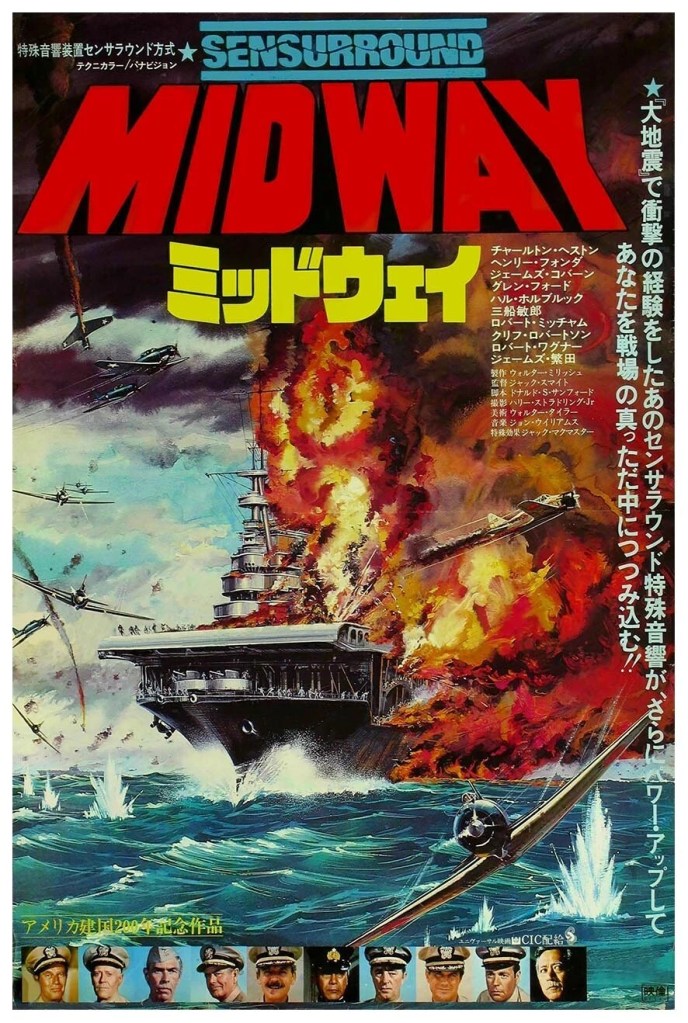
The final element was in cinematic presentation. Sensurround, a precursor of Imax, had been introduced with great success by Universal to Earthquake and this added greater realism to the battle scenes. While limited to those theaters which had installed the expensive equipment, and although the roadshow was long gone, it created an “event” aspect to those viewing it in that system. In his autobiography Mirisch suggested the addition of Sensurround was last minute and sparked  by the success of Earthquake. But, in fact, Universal had announced a year in advance of opening that Battle of Midway would utilize Sensurround.

Some cinema owners were outraged at the stock footage, whose proposed inclusion had been kept from them when they went into the blind-bidding process at the start of the year. Mirisch countered that there was no alternative. “A great many aircraft,” he argued, “used in the battle no longer exist.” Universal’s terms were stiff – a minimum nine-week run starting at a 70/30 split for the first three weeks in the studio’s favor, a $75,000 advance guarantee from cinemas and 5% of the gross for use of Sensurround.

With the budget kept as low as a reported $4 million it was a massive hit, picking up $20.3 million in rentals (what the studio retains of the box office gross) – sixth in the annual box office league beaten only by Oscar-winner One Flew over the Cuckoo’s Nest, All the President’s Men with Robert Redford and Dustin Hoffman, demonic The Omen, Walter Matthau baseball comedy The Bad News Bears and Mel Brooks’ Silent Movie and just ahead of such offerings as Sidney Lumet’s Dog Day Afternoon with Al Pacino, and comedy Murder by Death but nearly doubling the take of the more critically-acclaimed Taxi Driver, Clint Eastwood western The Outlaw Josey Wales and thriller Marathon Man also starring Hoffman. The final domestic figure amounted to $21.8 million.

Foreign figures were astonishing, especially in Japan, where its gross exceeded $4 million. The benefits of the promotional tour undertaken by Heston in the Far East were soon obvious – in Manila it beat both Jaws and Earthquake. In the annual box office league there and Hong Kong, it ranked third. In Italy it proved a “big surprise”, coming in fourth behind King Kong, Taxi Driver and a local offering.

While a successful movie could expect to benefit from television viewings – this was before the video revolution – the movie had an unusual afterlife. NBC, which had bought the rights, wanted the film to be longer, so it could be shown over two nights, thus increasing advertising and setting it up as a more prestigious event. Largely by adding plotlines to the Heston character, the running time increased by nearly an hour, which proved a bonus for the future home screening revolution. 

“Of all the films that I have made,” noted Mirisch, “it produced the greatest amount of profit.”

SOURCES: Walter Mirisch, I Thought We Were Making Movies Not History (University of Wisconsin Press, 2008) pp324-339; “Readying Midway,” Variety, February 5, 1975, p6;  “Universal in New Shake,” Variety, July 23, 1975, p3; “Admiral Mitchum,” Variety, March 12, 1975, p18; ”Jap Feature Footage Inserted into Midway,” Variety, June 6, 1976, p7;  “Midway Big in Manila,” Variety, August 11, 1976, p24; “Big Rental Films of 1976,” Variety, January 5, 1977, p14; “Jaws Led Bangkok,” Variety, February 9, 1977, p39;  “International,” Variety, June 29, 1977, p35.
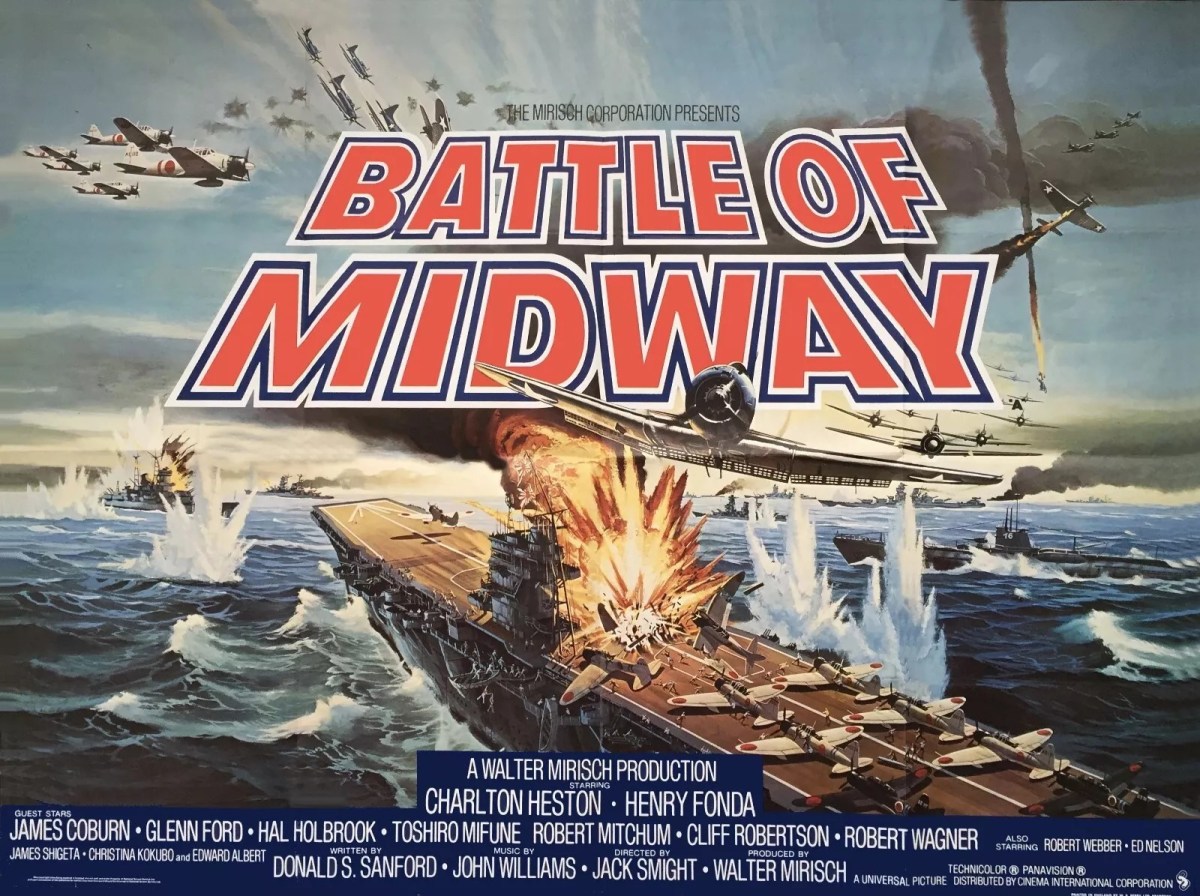
Battle of Midway (1976) ****

Even-handed documentary-style tale recounting of the most famous U.S. naval battle of all time, a turning point in the struggle for control of the Pacific in 1942. Both sides make mistakes, luck and judgement play an equal part.

I’d always assumed Midway was some abstract geographical position without any idea of its strategic importance – did the name mean it was halfway between the U.S. (or Hawaii) and Japan? But here I learned it was an actual island that the Japs planned to invade and the Americans intended to stop them. In some senses, it was bait, a way to draw the U.S. Navy out of Pearl Harbor. But the bait ran both ways. If the Yanks could coax the enemy out into the Pacific, they had a chance of gaining an advantage, even though the Americans were inferior in shipping tonnage.

The Japs have been stung into action by the audacious American bombing of Tokyo. Admiral Yamamoto (Toshiro Mifune) uses the perceived threat of further attacks to gain official approval for his plan to invade Midway.

This is strictly a male show. However, in a bid to lower the testosterone levels a romantic subplot is inserted. The aviator son, Lt Thomas Garth (Eddie Albert), of top aide and former pilot Captain Matthew Garth (Charlton Heston) has an American-born lover Haruko (Christina Kobuko) of Japanese descent who’s being investigated for espionage and subsequently interned. On intervening, the father digs up a hodgepodge of racism – from both sides, Haruko’s parents against her forming a relationship with a non-Japanese. But the plan backfires causing a breakdown between father and son.

But that’s very much on the fringes and although it raises interesting cultural aspects, the movie concentrates mostly on the nuts-and-bolts of heading into a major engagement.

American intelligence, headed by Commander Joe Rochefort (Hal Holbrook), gets wind of the planned attack. But the clues are scant – the old trope of increased radio traffic not enough to convince – and while the audience knows the Japs are on the move with a mighty naval force including four top-class airplane carriers, the Americans remain ignorant almost until it’s too late.

Luckily, Admiral Nimitz (Henry Fonda), heading up the American naval contingent, is keen to inflict a blow on the enemy, even though he’s limited to two carriers and another just out of the repair yard. Each side relies on spotter planes to detect the enemy. But the Japanese, by imposing radio silence, shoot themselves in the foot, unable to switch tactics until too late. The hunch plays an important part.

There’s rarely much opportunity for individual heroics on a ship under fire, beyond rescuing someone. The fighter pilots are a better bet, especially since some of their forays are nearly suicidal given the firepower they attract. Matt Garth, who for most of the picture is an upscale backroom boy, is called into action with unexpected results.  

Most battle films tend to concentrate on the heroics often at the expense of understanding in any detail what’s going on. Thankfully, this is different. We are kept informed of every change in the conflict. And whereas you might think that dull, in fact I wouldargue that it adds substantially to the tension, and the fact that the only one of the commanders who looks as if he could throw a punch (Robert Mitchum) in the manner of John Wayne is confined to his bed thus forcing the movie to concentrate as much on brain as brawn.

Audiences at the time welcomed all the talking and this was a substantial hit. Snippets of old war footage were carefully sewn into the lining of the action, bringing the kind of authenticity that moviemakers reckoned moviegoers craved. For me, there was more than enough going on already.

Nimitz’s decision to go for broke rather than dive for cover results in victory but he’s no gung-ho commander, rather presented as a thoughtful but determined individual. The lack of backstage effort especially in the communications department was partly to blame for the humiliation of Pearl Harbor but here these guys share the glory.

Boasting the kind of all-star cast that used to be the hallmark of the 1960s roadshow, this has a bunch of top-notch actors, albeit most just flit in and out of the picture. Charlton Heston (Planet of the Apes, 1968) effortlessly shoulders the main burden with Henry Fonda (Once Upon a Time in the West, 1969) the fulcrum of all decision-making. Robert Mitchum (The Way West, 1967) , James Coburn (Our Man Flint, 1966), Glenn Ford (Rage, 1966), Cliff Robertson (The Devil’s Brigade, 1968) and Toshiro Mifune (Red Sun, 1971) all feature.

Jack Smight (Harper / The Moving Target, 1966) directs from a script by Donald S Sanford (Mosquito Squadron, 1969).

Thoroughly engrossing.

  • I’m doing a Behind the Scenes tomorrow.

Behind the Scenes: “Deliverance” (1972)

You couldn’t make it like that now, so the ill-informed tale goes. Actors doing their own paddling in canoes, climbing a cliff. But anyone who has watched Leonard DiCaprio and Kate Winslet half-drowning in Titanic (1997) is well aware that it’s just not always possible to use a stand-in for key sequences. Or, for that matter, William Holden breaking in a horse in Wild Rovers (1971).

For a start, there actually were four stunt men on Deliverance, one who was star Jon Voigt’s stunt double. None were credited in the picture, not so unusual in those days, and anyone who knows anything about filming climbing scenes, not least the one where actors are actually crawling across a floor, or where there are, out of sight of cameras, safety facilities underneath, will know that the actors here, though it might get a tad tough, were not risking life and limb. Greater injuries were endured by the stars during the storm scenes of The Guns of Navarone (1961). That said, the movie does benefit from sufficient shots of the actors braving the waters and Ned Beatty nearly drowned and Burt Reynolds cracked his tailbone.

But, of course, danger in moviemaking is relative. There’s scarcely any equivalent to the numbers of deaths that occur in other professions, mining, for example, or industry, and I’m always suprised how easily the Hollywood PR machine is so easily accepted by the public when the peril mentioned is rarely actually perilous at all.

For the scene where the canoe broke, director John Boorman had found a more serene location on a river which was dammed, so he was able to close the sluice gates and lay a rail on the river bed. However, in the event, the sluice gates were opened too soon and the actors engulfed in an avalanche of water.

Should any of the actors show temerity, Boorman would leap into a canoe himself, and paddle downriver over and around various obstacles to show how easy it was.

Deliverance was an unexpected bestseller in 1970, the author an unlikely candidate to hit the commercial jackpot or even to pen such a tale. Ex-adman James Dickey was known for his poetry. Warner Bros bought the book pre-publication about “four decent fellows killing to survive” for $200,000 and more for Dickey to pen the screenplay without working out how it could be filmed. The studio was going through a major transition. In 1970 only three releases had cleared $1 million in rentals; in 1971 the number tripled and the studio was high on a release slate that included Death in Venice, A Clockwork Orange, Summer of ’42, Klute, The Devils, Dirty Harry and Billy Jack.

The studio alighted on John Boorman because he had made Hell in the Pacific (1968) starring Lee Marvin and Toshiro Mifune, that, while a certified flop, was made under arduous physical conditions in the western Pacific.

After the surprise success of Point Blank, British director Boorman had helmed two flops, Leo the Last (1970) being the other, so he was in the market for the kind of hard-nosed project with which he had made his name. Warner “felt I was the man to take it on,” explained Boorman.

At one point, Warner Brothers planned to team up Jack Nicholson (hot after Easy Rider, 1969, and Carnal Knowledge, 1971) and Marlon Brando, still largely in the pre-The Godfather wilderness. The studio tried to tempt Charlton Heston, who turned it down (“I probably won’t have time to do it”) but consoled himself that WB considered him “employable.” Donald Sutherland also gave it a pass. Dickey agitated for Sam Peckinpah to direct and Gene Hackman to star while Boorman was keen to work a third time with Lee Marvin. Theoretically, Robert Redford, Henry Fonda, George C. Scott and Warren Beatty were considered, but such big names would hardly be compatible with the lean budget.

The final budget was a mere $2 million, not sufficient to attract big name – or even to pay for a score. WB had reservations about a picture without any women in lead roles. Jon Voigt was not a proven marquee name, despite the success of Midnight Cowboy (1969). He only had a bit part in Catch 22 (1970) and his other films, Out of It (1969) and The Revolutionary (1970) had performed dismally while The All-American Boy was sitting on the WB shelf, only winning a release to cash in on Deliverance.

Despite a less than buoyant career, Voigt was reluctant to commit. He resisted making the movie till the last minute. Even after trying to convince himself about the film’s worth by reading out the entire screenplay to his girlfriend Marcheline Bertrand (Angelina Jolie’s mother), it took a telephone call from the director and Boorman demanding a decision before he counted to ten before Voigt signed up. Voigt viewed the film as about how men “lose part of their manhood by hiding, coddling themselves into thinking we’re safe.”

Burt Reynolds was treading water in action B-films like Skullduggery (1970), as the second male lead in bigger films like 100 Rifles (1969) and in television (Dan August, 1970-1971). In his favor, he had the lead in offbeat cop picture Fuzz (1972). But it looks like Voigt and Reynolds took casting to the wire. Both were announced for the film a few weeks before it began shooting on May 17, 1971.

Whether it boosted his career is open to question, but Burt Reynolds’ name achieve notoriety in April 1972, a few months before Deliverance opened, by becoming the first male centerspread in Cosmopolitan.  Billy Redden, as the banjo player, was hired for his physical appearance, clever use of the camera disguising the fact that there was a genuine banjo player concealed behind him doing all the playing. Boorman used snatches of the banjo music instead of coughing up for a proper score. While the credits claimed the “Dueling Banjos” number had been devised by Eric Weissberg and Steve Mandel, Arthur Smith, writer of “Feudin’ Banjos” in 1955, took the studio to court and won a landmark copyright ruling. The tune had received a gold record for sales.

Setting aside any inherent danger in the water, the shore could just be as perilous. A script altercation between Dickey and Boorman ended with the director losing four teeth. Cinematographer Vilmos Zsigmond got into a spat with his union and was slapped on the wrists for operating the camera too often. Filming of the rape scene was uncomfortable for all concerned, even observers. When Reynolds complained the director let the sequence last too long, Boorman countered that he let it run till he reckoned Reynolds, in his character, would intervene.

Despite WB including it in a promotion to its international partners in May 1971 Deliverance, filmed between May 17 – a week later than originally envisaged – and August 1971, sat on the shelf for nearly a year before being premiered at the Atlanta Film Festival in July 1972 with Playboy picking up the tab for flying Reynolds to the event.

These days it would be called a platform release. Deliverance opened in one small house in New York – the 558-seat Loews Tower East – at the end of July and except for Los Angeles didn’t go any wider until early October. Reviews were good, four faves out of five in New York. But it was the box office that caught the eye. An opening day record and an eye-popping $45,000 for the first week took the industry by surprise. It remained at Loews until December. Chicago led the applause in October with a “brawny” $49,000. Everywhere it was hot – “lusty” $26,000 in Washington DC, “socko” $21,000 in Philadelphia were typical examples of the public response.

In what these days would be called counter-programming it went into the New York showcases at Xmas – making off with a huge $589,000 from 46 the first week and $500,000 the second. WB had predicted it might hit $15 million in rentals. The studio was wrong. It scrambled up $21 million. The 1973 tally made it the second best at the box office that year.

SOURCES: Phil Hoad, “How We Made Deliverance,” The Guardian, May 29, 2017; Oliver Lyttleton, “5 Things You Might Not Know about Deliverance, Released 40 Years Ago,” IndieWire, July 30, 2012; Charlton Heston, The Actor’s Life (Penguin, 1980); “Bow and Arrow Party,” Variety, May 20, 1970, p30; “Dickey Ga-Bound,” Variety, January 21, 1971, p4; “Reps of 45 Flags,” Variety, April 14, 1971, p5; “Voigt in Deliverance,” Variety, May 12, 1971, p14; “Runaway Robert Altman,” Variety, December 15, 1971, p4; Advert, Variety, August 9, 1972, p23; “Big Rental Films of 1972,” Variety, Janaury 3, 1973, p7; “Big Rental Films of 1973,” Variety, January 9, 1974, p19. Box office figures from Variety October 11, 1972.

Advise and Consent (1962) ****

Excoriating engrossing political drama in which the unscrupulous take the moral high ground and the principled are destroyed. In other words, the reality of power – gaining it and keeping it and all the skullduggery that involves. And it has resonance in today’s cancel culture for it is minor indiscretions from the past that bring down the most upstanding of the species.  

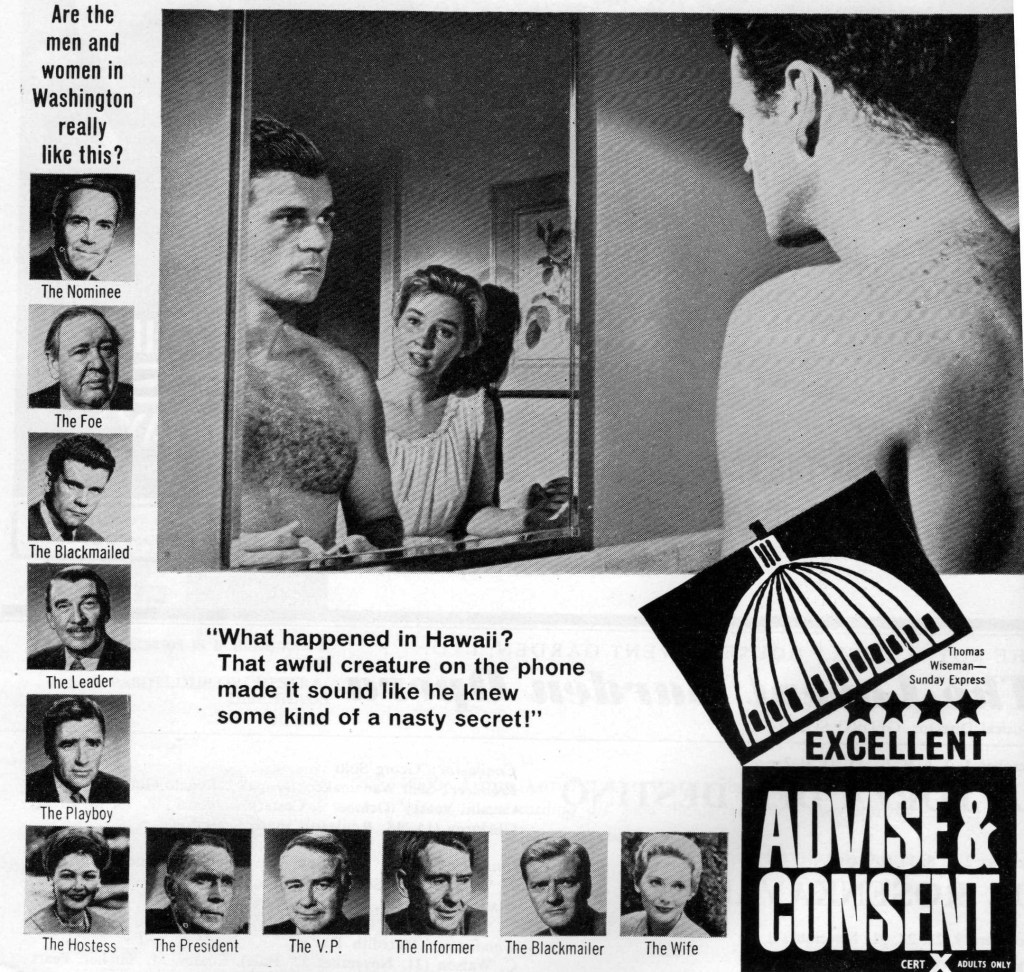
Theoretically, director Otto Preminger (Hurry Sundown, 1967) broke one major taboo in touching on the subject of same-sex relationships. But in reality he took an even bolder step from the Hollywood perspective of giving center stage in the main to older players. Many  had first come to the fore in the 1930s or earlier – Walter Pidgeon (Turn Back the Hours, 1928), Lew Ayres (All Quiet on the Western Front, 1930),  Charles Laughton (Oscar winner for The Private Life of Henry VIII, 1933) Franchot Tone (Oscar nominated for Mutiny on the Bounty, 1935), Henry Fonda (You Only Live Once, 1937).

This was the kind of all-star cast you used to get in 1960s big-budget pictures filling out supporting roles. But in this ensemble drama, they all, at various times, hold the floor. And this approach lent the movie greater authenticity. Even if few viewers today recognize any, that, too, works in the movie’s favor, giving it an almost documentary feel.

Movies about politics are never heavy on plot, so if you’re looking for a thriller in way of All the President’s Men (1973) go elsewhere. It has more in common with The Trial of the Chicago Seven (2020) with multiple viewpoints and opposing perspectives. What the best movies about politics have in abundance is repartee. Virtually every exchange is a verbal duel, the cut and thrust, the slashing attack, the parry, sometimes the knockout blow delivered through humor.

Given politicians spend most of their lives making speeches, even the shortest of sentences, even the bon mots, have a polished ring. And that, frankly, is the joy of this picture, brilliantly written by Wendell Mayes (Anatomy of a Murder, 1959) from the Allen Drury bestseller. In some respects the plot is almost a MacGuffin, a way into this labyrinthine world, where characters duck and dive like a more elevated breed of gangster

A lesser director would have given in to the temptation of filming these duels in close-up.  Instead, Preminger’s direction is almost stately, keeping characters at bay.

A seriously ill President (Franchot Tone), distrusting his feeble Vice-President Harley Hudson (Lew Ayres), decides to fill the vacancy for Secretary of State with highly-principled Senator Robert Leffingwell (Henry Fonda). This not being the beginning of the President’s term, he can’t just do what he wants, his nomination must go before a committee and then face a vote in the Senate.

The Senate Majority Leader Bob Munson (Walter Pidgeon) isn’t too happy with the idea, seeing Leffingwell as a dove, likely to appease the growing Soviet threat. Others on the committee, namely Senator Brigham Anderson (Don Murray) feel the same and the committee hearing has the tone of an interrogation. The fine upstanding Leffingwell parries well until Senator Seabright Cooley (Charles Laughton) introduces a witness Herbert Gelman (Burgess Meredith) who says Leffingwell belonged to a Communist cell, an accusation Leffingwell denies.

Twist number one: Leffingwell has lied on oath. He confesses this to a friend Hardiman Fletcher (Paul McGrath) who then stitches up the witness. The committee apologies to Leffingwell, which means he is a sure thing for the post, but Cooley smells a rat and starts his own investigation. Leffingwell tries to get out of the job but the President won’t allow this. The Majority Leader and Anderson are let in on the secret, the former willing to accommodate the President but the latter outraged and planning to thwart the nomination when it reaches the voting stage at the Senate. Anderson comes under pressure, phone calls to his wife about something that went on in Hawaii.

And so the stage is set. The pressure builds on Anderson. The President becomes more unwell, making the appointment of Leffingwell more crucial. Aware of Anderson’s intentions, the Majority Leader starts whipping up votes, with Cooley doing the same for the opposition. Machinations take over.  And for a movie that was initially light on plot, and it ends with three stunning twists, and proving once and for all there is nothing quite so standard as the self-serving politician.

This was the first movie for several years for Henry Fonda (Broadway and television his refuge) and for society hostess Gene Tierney (Laura, 1945) who suffered from mental health problems and the last screen appearance of Charles Laughton. The acting is uniformly excellent and the direction confident and accomplished. 

A slow-burner for sure, but a fascinating insight into the less savory aspects of politics and the human collateral damage.  

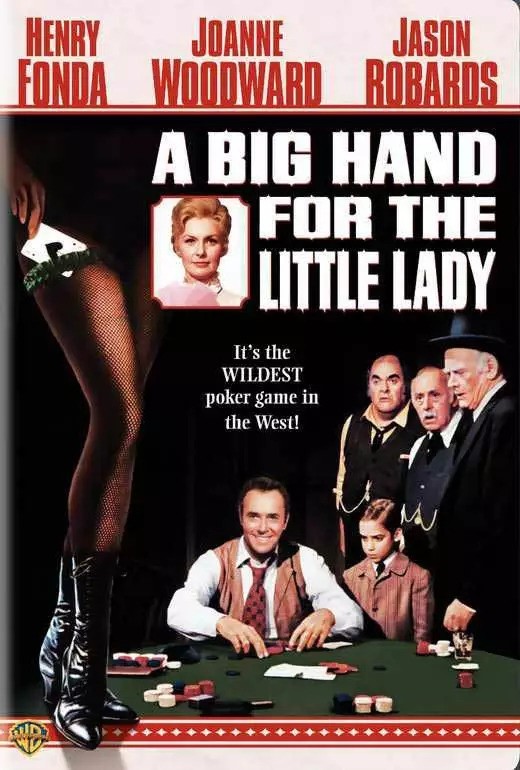
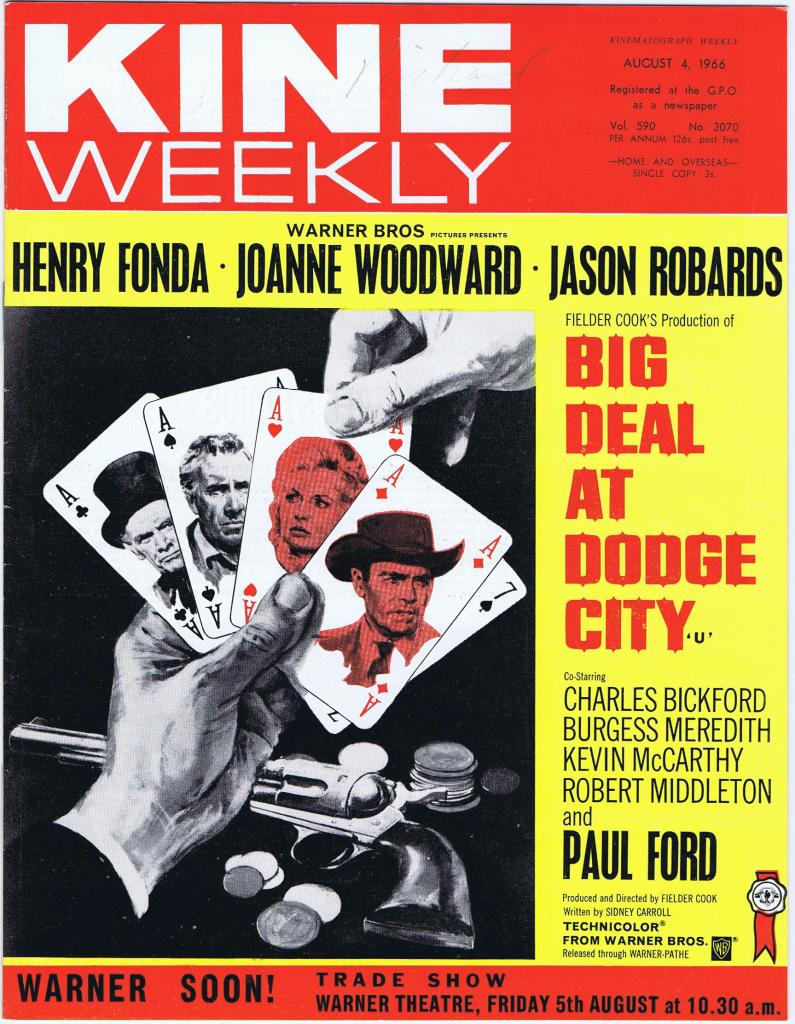
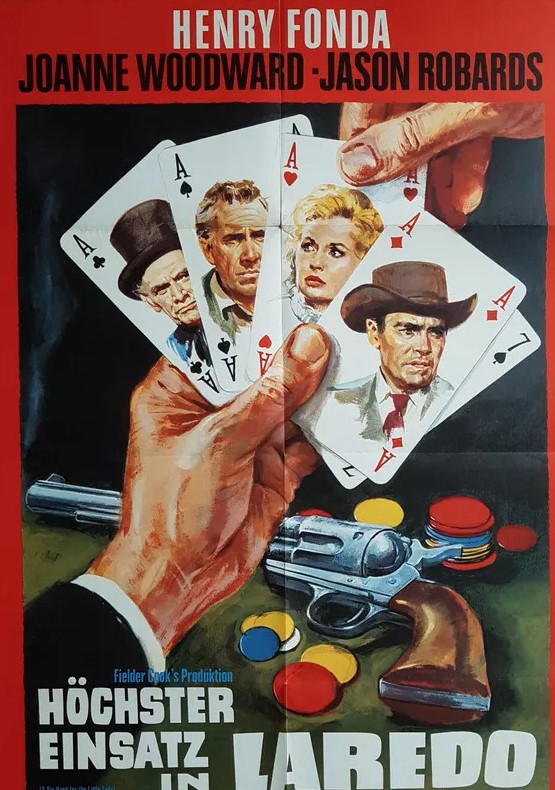
A Big Hand for the Little Lady / Big Deal at Dodge City (1966) ****

An absolute delight. Thrilling too. Knocked sideways in the box office battle of the poker pictures by the purportedly classier The Cincinnati Kid (1965) with Steve McQueen in one of his most iconic roles facing off against Edward G. Robinson and underrated ever since. But this more than holds its own against the Norman Jewison number. In part because of terrific untypical performances from Once Upon a Time in the West alumni Henry Fonda and Jason Robards.

I get my daily movie fix late at night when the rest of the house is abed and disinclined to share my interest in old movies but when at a critical point my DVD gave out instead of, as would be more sensible, giving up and going to bed, I spent ten minutes frantically scouring YouTube for a copy, even glancing hopefully at one in a foreign language, and expended the same time again tearing apart my DVD collection, which at one point had been sensibly arranged alphabetically until too many additions made nonsense of that arrangement, until I found another copy. Finally, I settled down, even later at night, to watch an enthralling finale.

A more blatant example of artistic license you couldn’t find. The movie is set in Laredo, not Dodge.

Fielder Cook (Prudence and the Pill, 1968), with only a handful of movies to his name and generally considered no great shakes as a director, plays this hand brilliantly. It reeks of mystery, as a poker table should. We begin with an undertaker’s coach racing from town to town and  house to house collecting with urgency a disparate collection of people delivered to the backroom of a hotel in Laredo, Texas, where, nonetheless, the townspeople are excited beyond belief. It’s the long-awaited poker game between the five richest men in the territory.

As he stuffs more cash in the safe and pulls out bigger and bigger batches of poker chips, the hotel owner (James Berwick) is constantly badgered by his exuberant customers as to who is winning. He remains mute on that score until Doc Scully (Burgess Meredith), heading out to deliver a baby and a foal, asks the same question. Such is the medic’s local standing, the owner gives a reply. This means something to the onlookers but not to us because we have very little concept of the players.

And that remains largely the case beyond some good-humored and occasionally tense banter when we learn that Drummond (Jason Robards) abandoned his daughter’s wedding to get here and that lawyer Habershaw did likewise in court leaving his client to defend himself. And the game itself is boisterous, devoid of the cathedral-like atmosphere of The Cincinnati Kid.

But when a relatively impoverished newcomer Meredith (Henry Fonda) enters the fray the situation turns ugly as he is besieged by insult and verbal abuse as his paltry stake gets smaller and smaller. When he takes his last $3,000 – the whole sum intended to provide a new future for his wife and son on a farm near San Antonio (“San Antone” he quickly learns is the correct pronunciation) – he discovers that he is undone as his fellow gamblers raise the bidding beyond his amount.

At which point he collapses, potential heart attack. Doc Scully hauls him off on a makeshift stretcher. The money will be defaulted unless upstanding wife Mary (Joanne Woodward) of the anti-gambling fraternity can be called upon to play out his hand in a game of which she is completely ignorant and, more to the point, raise the cash to be allowed to continue.

The players sneer at what she has to offer. The richest men in the territory have no need, even at a cut-price offer, of a gold watch and a new team of horses and wagon. For a moment you think Mary, seeing her family fortunes going downriver, is going to offer herself as collateral, but instead, she decides to try and get a loan, based on the hand she holds, from the bank. You might as well try to get blood out of a stone from bank owner Ballinger (Paul Ford). Maybe she has something worth more to him as collateral than watch and wagon.

I won’t spoil it for you by revealing the ending but it’s well worth the wait and the mystery.

I was knocked out by Henry Fonda’s acting. Usually, he is gritty, upstanding, sometimes the last man standing, and his smile is often more of a grimace. Here, he is nervous, jumpy, anxious, and desperate, the reformed gambler unable to resist temptation, persuading himself that this one last game would be worth all the broken promises given his wife. His smile is so ingratiating you wouldn’t want anything to do with it. As regards the temptation facing addicts it’s on a par with the heroin victim of The Man with the Golden Arm (1955) and the alcoholics of Days of Wine and Roses (1962).

With him removed from the equation, the acting lot falls to Joanne Woodward (A Fine Madness, 1966). She’s the prim opposite and doesn’t overplay her hand, restraining as best possible her confusion and fear. And this is a very fine turn from Jason Robards, most commonly accused of over-acting or under-acting, and here he gets the balance just right, volubility matched by arrogance, and a determination not just to win but to demolish an opponent.

A raw truth is expored here. Winners don’t just like winning – the medal, the lap of honor, the pile of cash, all that jazz – but they enjoy more seeing the defeat of their opponent, savoring that disgrace. This ain’t the kind of game that ends in a handshake or embraces sportsmanship. This is real in a way that The Cincinnati Kid is not.

There are a couple of familiar faces, John Qualen (The Sons of Katie Elder, 1965), and Charles Bickford (Days of Wine and Roses) in his final movie. The rest of the cast is largely anonymous, there to add febrile excitement, with hollering and racing around, desperate to keep up with the action.

Screenwriter Sidney Carroll had been here before, the big stakes, no-hoper taking on the world in The Hustler (1961) but he and Cook had managed a small-screen rehearsal of this picture a few years before on U.S. television in the DuPont Show of the Week series.

Every now and then, as I’ve maybe mentioned before, one of the joys of this little odyssey into the world of the 1960s movie is that you come across a little gem.

This one sparkles.

Spencer’s Mountain (1963) ****

Lot feistier than the heart-warming genre might suggest with the usually restrained Henry Fonda (Advise and Consent, 1961) coming over like he’s had a gagging order lifted, letting rip not just with a plague of cuss words but damning to Hell every hypocrite under the sun. A perfect example of the haves and have-nots where to become elevated to the former you need to know your Latin.

Despite loathing religion, quarry miner Clay (Henry Fonda) has got quite the Biblical spirit, no intention of girding his loins when he can sire nine kids, a heck of a crew to support from meager wages. He enjoys the kind of pleasures – add alcohol and gambling to his lust – that his God-fearing neighbors find objectionable, though they put those aside when he’s neighbourly enough to carry out repairs on their property for no charge.

When wife Olivia wants him to break open the piggy bank to fund a graduation ring for their oldest, Clayboy – what was wrong with just calling your kid Junior, I wonder – (James MacArthur), her dream clashes with his. He’s already spent the money on the power saw he needs to cut down to size the logs with which he is building his dream house, a bigger building, and brand-new, so his offspring don’t need to sleep five or six to a room or on the floor.

Clayboy is astonished to discover he’s the top dog at school but winning the class medal opens doors poverty prevents him getting through. Even when the local pastor Clyde (Wally Goodman) finds a last-minute loophole, Clay’s excellent grades don’t meet qualification criteria for college, he’s lacking in Latin.

But if there’s one thing Clay has learned to overcome, it’s adversity and soon a scheme is hatched. But even that has a drawback. A scholarship won’t cover all the costs. While Olivia accepts the principle that God intended them to be poor, Clay rejects that notion, the kind that keeps the downtrodden in their place, denying them the opportunity for betterment that comes with education.

This ain’t no sermon but it’s not The Grapes of Wrath either. Poverty hasn’t kicked the living daylights out of everyone but nobody seems able to catch a break even when one is floating tantalisingly close. Ain’t a family saga either, covering too short a period of time, and little but a series of loosely-connected episodes that eventually come together.

Clay gets the preacher in the mire for filling him full of booze, telling him it’s a cure for mosquito bites, while the pair are fishing. Public revulsion at the drunk pastor loses the preacher his congregation. Clay sorts it out by berating the churchgoers as hypocrites and threatening to withdraw his free labor when it comes to repairs. Come the Latin crisis, turns out the preacher was an ace scholar in the subject and can do the teaching, on the condition that the anti-religious Clay attends church.

In the meantime, there’s another kind of education required of Clayboy. Claris (Mimsy Farmer), whose training extends to reproduction and pores over the unexpurgated dictionary, gleefully hovering over the dirty words, has to teach the young man that a young woman wants more than whispers in the ear and bunches of flowers. Unfortunately, Clayboy has another suitor Cora (Kathy Bennett) who doesn’t take kindly to him rejecting her advances and when the opportunity arises to sabotage his plans does so with pleasure.

This is a film about working people. Not labor as such, and not about labor unrest or agitation either. In the way of Witness (1985), there’s a great scene (minus the soaring music of course) of constructing a wooden building, there’s men drilling and hammering at the quarry, and a pivotal scene in chopping down a tree. People seeing the benefit of hard work are less convinced by the ephemeral attraction of education, especially when that seems either beyond their reach, out of their league or as likely to find as the end of a rainbow.

So without overly saying anything much about the class divide in the U.S. (which is unspoken anyway and assumed, what with equality and all, not to exist) this says a great deal.

Henry Fonda fills his boots. It’s a plum role and he goes for it. Certainly, it’s the opposite of all those buttoned-up parts he seemed to land. Maureen O’Hara (The Battle of the Villa Florita, 1965) has a smaller part and it’s a mercy after nine kids she managed to keep her figure. James MacArthur (Battle of the Bulge, 1965) has every scene stolen from him by the charming minx Mimsy Farmer (Bus Riley’s Back in Town, 1965). You might spot Donald Crisp (Pollyanna, 1960) in his final role.

If you equate director Delmer Daves with hard-hitting westerns like Broken Arrow (1950) and 3:10 to Yuma (1957), it’s worth remembering he had a strong romantic streak as exhibited in Rome Adventure/Lovers Must Learn (1962). But he deliberately avoids the comedy pratfall of the later Yours, Mine, Ours (1968), also starring Fonda. He wrote the screenplay based on the book by Earl Hamner Jr.

Because this reputedly led to The Waltons TV series, you could be mistaken for thinking it’s as schmaltzy. It’s anything but. Take away the lush background and the idyllic scenery and while it finally gets to a heart-warming climax it’s tougher going and with a sexuality way ahead of its time.

Great watch.  

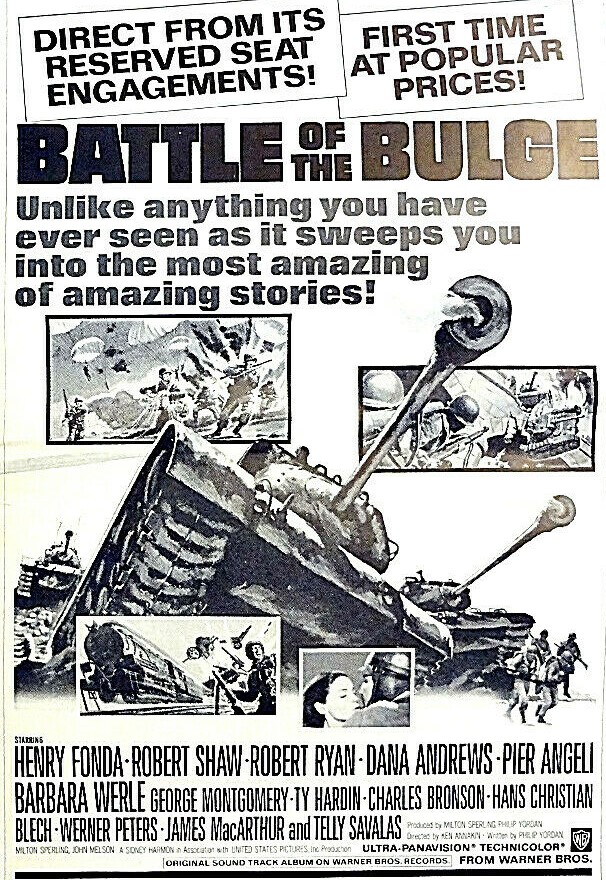
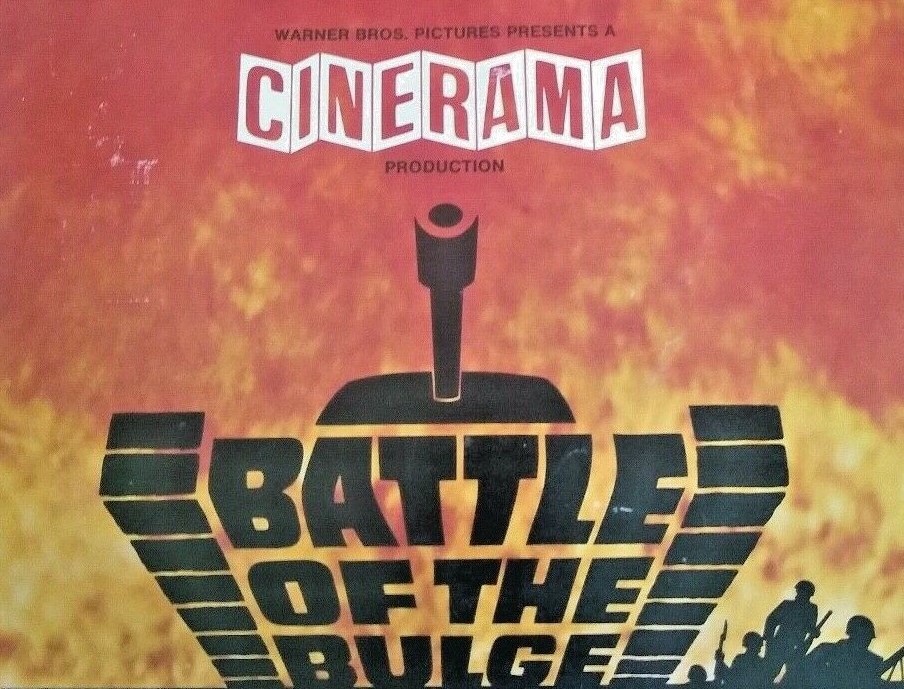
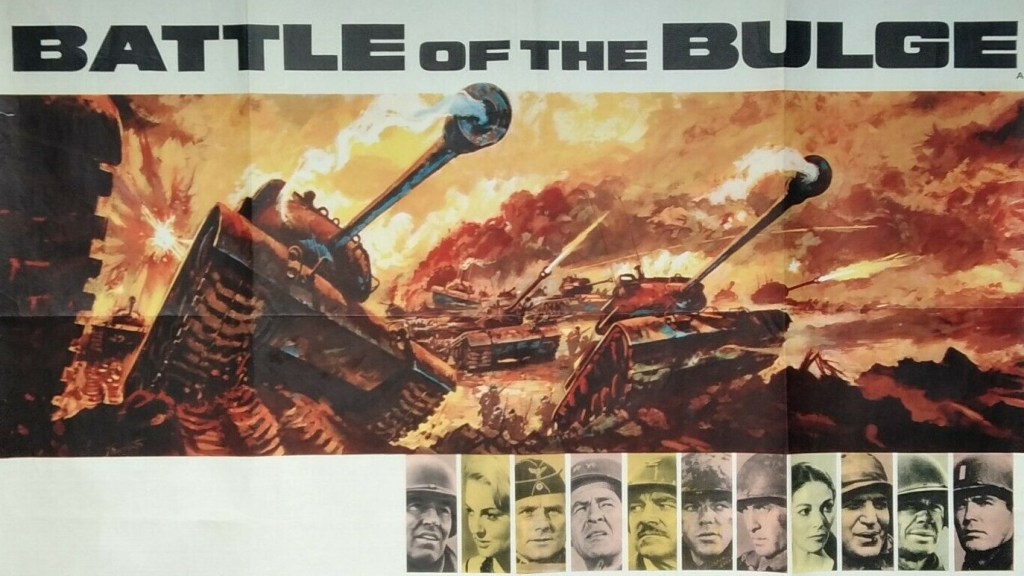
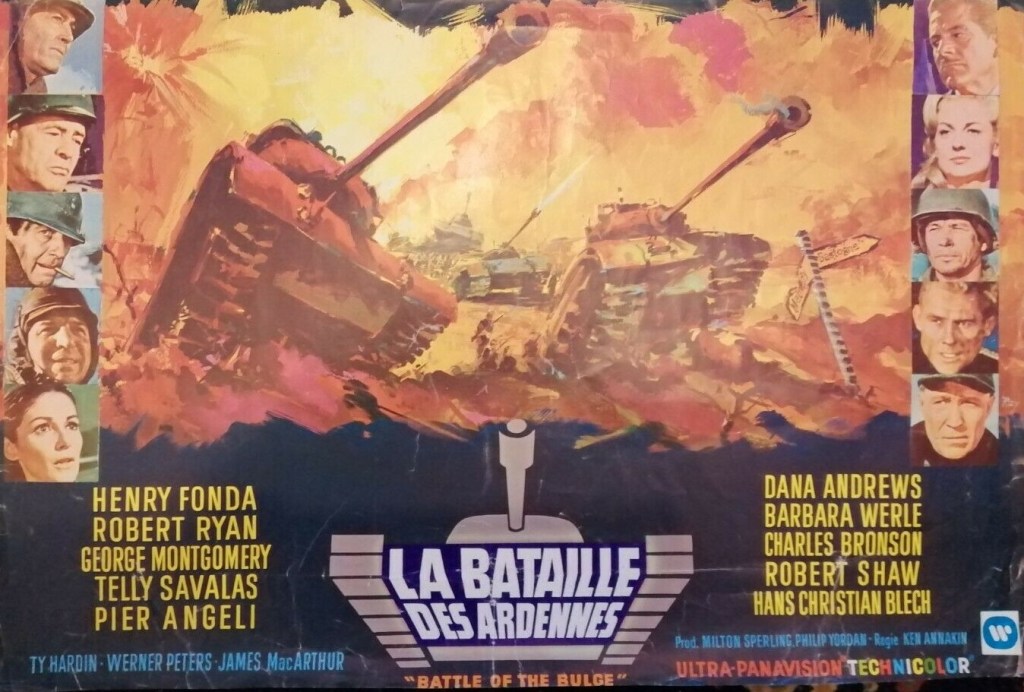
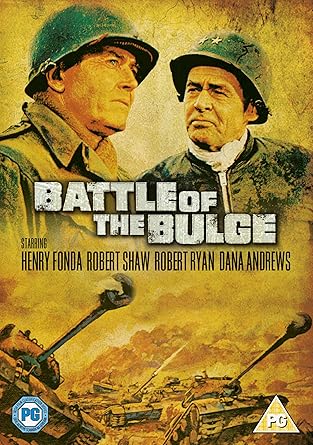
Behind the Scenes: “The Battle of the Bulge” (1965)

It was Hollywood’s worst nightmare. Two major studios – Columbia and Warner Brothers –  were competing to make films about the Battle of the Bulge, one of the most famous episodes of the Second World War. Rival movies on similar or the same subject  – classic examples You Only Live Twice (1967) vs Casino Royale (1967) or Deep Impact (1998) vs.  Armageddon (1998) – risk cannibalising each other, each entry eating into the prospective audience of the opposition.

At first it seemed like the Columbia entry had the upper hand. Writer-producer Anthony Lazzarino had spent four years preparing The 16th of December: The Story of the Battle of the Bulge (the date referring to the start of the battle). Lazzarino’s project was endorsed by the U.S. Department of Defense which offered exclusive cooperation. Advisors were of the top rank – General Omar Bradley,  General Hasso E. von Manteufel who had commanded the Panzers during the battle, British generals Sir Francis de Guingard and Robert Hasbrouck and Colonel John Eisenhower plus the cooperation of Eisenhower himself and Field Marshal Montgomery.

With a budget in the $6 million – $8.4 million range, and shooting was set to start in winter 1965, William Holden was lined up to play General Eisenhower and Kirk Douglas for  General Hasso. Although initially intending to film in the Ardennes and Canada, ultimately the producers settled for the cheaper option of  Camp Drum, one of the largest military installations in the U.S, a remote area in upper New York where the buildings could stand in for Bastogne, around which much of the real battle revolved, production there feasible because the Camp closed for winter. .

But that meant it would already be behind the eight-ball since Battle of the Bulge intended opening at Xmas 1965. Richard Fleischer (The Boston Strangler, 1968) was originally signed to direct. But he had become embroiled in a lawsuit with producer Samuel Bronston (El Cid, 1961, The Fall of the Roman Empire, 1964) whose production outfit had gone bust, killing off a deal for Fleischer to make The Night Runners of Bengal. The director was seeking  g $910,000 in compensation.

Warner Brothers had enlisted Cinerama as co-producer, the studio’s first involvement in the stunning widescreen process and the first time war was considered a subject. The process had been utilised in other Hollywood pictures most notably MGM How the West Was Won (1962), but that has been as a supplier of the equipment, and taking a small share of the profits. But now Cinerama planned to enter the production business and had contracted with WB to shoot the film in the single-lens process instead of the more complicated three-camera approach which had led to vertical lies on screens.

Neither company was in great shape. Cinerama had posted a $17.9 million loss in 1964, WB $3.8 million. But whereas WB had My Fair Lady on the horizon, Cinerama was less reaons for optimism. Its income stream relied on sales of its equipment, either for filming or projection, and a levy from every cinema using the process. Expansion was seen as key to renewal. With only 67 cinemas equipped to show Cinerama in the U.S. and only 59 overseas, a major program was underway to reach 230 by 1967. Setting up a production division would ensure there were enough films to feed into Cinerama houses, and since such films were intended as roadshows, they would keep the cinemas product-secure for months on end.

Cinerama planned to spend $30 million on five films – John Sturges  western The Hallelujah Trail (1965) budgeted at $5 million, Battle of the Bulge ($.75 million) while $6.5 million had been allocated to an adaptation of James Michener bestseller Caravans, $6 million for Beyond the Stars which became 2001: A Space Odyssey (1968) and $7 million for Grand Prix (1966). Added to the list was epic William the Conqueror, due to film in England in early 1966 with Robert Shaw taking top billing.

The WB-Cinerama project, which had taken a year to negotiate, was to be filmed in Spain under the aegis of producer Philip Yordan, one time associate of Bronston who had built a mini-Hollywood there. Yordan, Bronston’s chief scriptwriter, had written the screenplay along with his co-producer Milton Sperling. Instead of seeking official support or reproduce the battle in documentary detail, Yordan and Sperling aimed for a fictional account that took in the main incidents. The cast would include “ten important stars.”

Just what constituted an “all-star cast,” one of the key ingredients of the roadshow phenomenon of the 1960s, was open to question. While The Longest Day (1962) boasted stars of the pedigree of John Wayne, Robert Mitchum, Richard Burton and Sean Connery, it was also liberally sprinkled with actors of no marquee value. David Lean in Lawrence of Arabia (1962) had loaded his film with the likes of Oscar winners Alec Guinness, Anthony Quinn and Jose Ferrer to offset unknowns Peter O’Toole and Omar Sharif as the leads. While The Great Race (1965) could boast Jack Lemmon, Tony Curtis and Natalie Wood, It’s A Mad, Mad, Mad, Mad World (1963) only had Spencer Tracy amid a host of television comedians.

But none of the stars of Those Magnificent Men in Their Flying Machines (1964) had successfully opened a major picture. Of the Battle of the Bulge contingent only Henry Fonda could truly be called a current star, although his box office star had considerable dimmed since the days of The Grapes of Wrath (1939) and Fort Apache (1948). Former stars Robert Ryan and Dana Andrews were now supporting actors, Ty Hardin was best known for television, Charles Bronson (The Great Escape, 1963) had not achieved top billing and while James MacArthur had done so that was in youth-oriented movies. Initially, Italian prospect Pier Angeli (Sodom and Gomorrah, 1962) was announced as “the only principal female role” – playing a Frenchwoman – for a touching scene showing the effect of war on innocent women caught up in the conflict.

Just before filming was about to start, Fleischer pulled out, citing differences of opinion with the producers. Yordan turned to British director Ken Annakin, who had helmed the British sequences in The Longest Day and Those Magnificent Men in Their Flying Machines. There was soon a double whammy. Realizing he was losing ground, and hoping to sabotage its progress, Larrazino sued WB for $1 million, claiming that “another film, less accurate, would be confused with his picture.” Just as filming of the Battle of the Bulge got underway in January 1965, it was hit by a temporary restraining order. While failing to shut down the production, it imposed a marketing blockade. WB was prevented from publicising its picture, a potentially major blow given how dependent big budget roadshows were on advance bookings which could only be generated by advance publicity.

Annakin’s immediate response to the opportunity was delight. He commented that he had a “lot of toys to play with.” He found inspiration for his approach from an unusual source, the Daleks (“an apparently irrevocable onslaught of metal monsters”) from the BBC television series Dr Who. He decided he would use Cinerama as “a kind of 3D, shooting in such a way that the tanks would loom up as monsters against humans whom I would make small and puny.”

Although he had no influence in the casting, Annakin was already familiar with some of the actors, James MacArthur from Swiss Family Robinson (1960) and Werner Peters and Hans Christian Blech from The Longest Day. He did not receive such a warm welcome from Robert Shaw whom he had rejected for a role in The Informer.

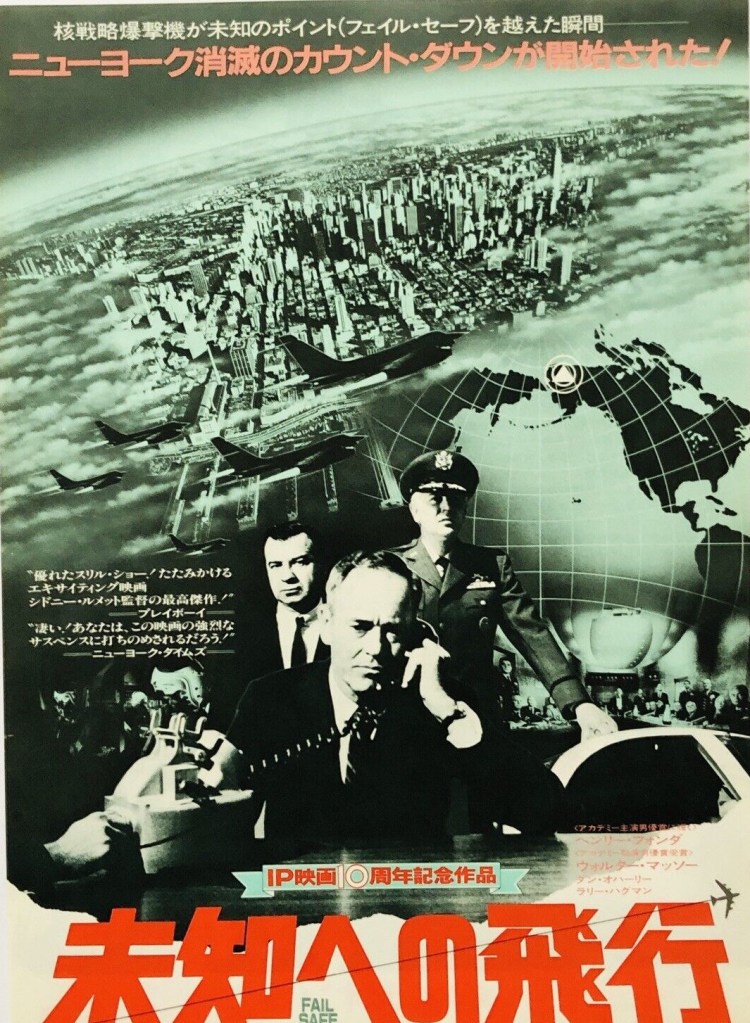
He found Fonda “a remarkable professional…always on time, patient, eager to get to work, and always knew his lines.” He confessed to being a reluctant movie actor, preferring the stage, and had not been a big office draw since his work with John Ford in the 1930s and 1940s. Even critical successes like Twelve Angry Men (1957) had lost money, some of it the actor’s own, and prestige movies like The Best Man (1964) and Fail Safe (1964) failed to attract sufficient audiences. “In the theatre,” he said, “the actor achieves fulfilment from beginning to end. But on a picture you create a minute here and a minute there over a twelve-week period. When it’s finished there’s no recollection of what you did…Films are a director’s medium.” Battle of the Bulge was his 59th picture, after completing a supporting role in Otto Preminger’s In Harm’s Way (1965) and taking second billing to Glenn Ford in modern western The Rounders (1965).  

There was a stand-off with Bronson on his first day after the actor kept the crew waiting while fiddling too long with his costume. Ty Hardin (television’s Bronco, 1958-1962) was accident-prone, tumbling into a frozen river in full kit, and whacking the director’s wife in the face with his helmet. Dana Andrews had a drink problem so that in some scenes Fonda and Ryan would be surreptitiously holding him up. But such veteran actors could improvise their way round scenes and “give me hints and lead me into changes.”

Andrews was enjoying career resurgence. His movie career was at a standstill, a ong way from a peak like Laura (1944). But his last significant top-billed parts were over a decade gone. “I was starting to get nothing for a while but offers came swarming in when I told my agent to go ahead and try from Walter Huston parts.” After only televisions roles in the four years since Madison Avenue (1961), Battle of the Bulge would mark his eighth role in 1965, including The Satan Bug and In Harm’s Way.

Winter in Spain was cold which meant it provided the ideal backdrop for the WB version. The chosen location, 4,500ft high in the mountains of Segovia provided identical conditions to the actual battle. Spain had provided 80 tanks including Tigers mounted with 90mm guns and Shermans. Half of the 20-week shoot would be spent in Segovia with interiors filmed at studios in Seville and the Roma facility in Madrid. The WB adviser was General Meinrad von Lauchert, a divisional tank commander during the battle. He hoped the picture would show the German solider “as he was, brave and good” rather than clichéd presentation and not give the “impression that the American Army had nothing to do but walk into Germany.”

He wanted the film to reflect the truth that the “Americans had to pay a high price for every yard.

Extras were drawn from the Spanish village of El Molar, with a population of just 2,400, which specialised in that supply. Locals could earn 200 pesetas a day. A pair of tavern owners had established this lucrative side-line, demand so high at this point that “they can play Russian World War One Deserters for Doctor Zhivago (1965) one day and shipped to World War Two the next for Battle of the Bulge.” Whenever Annakin found himself in trouble with the script he turned to the senior actors, Fonda, Ryan and Andrews who could improvise their way round scenes and “give me hints and lead me into changes.”

For the first scene, a week’s worth of white marble dust, representing snow, had been spread over the ground before 40 tanks emerged from a pine forest. But just as the cameras begun to turn, unexpectedly, against all weather forecasts, it began to snow. While initially a boon, when it continued to fall for five weeks the snow turned into a liability. Nobody was prepared for snow, not to the extent of snowploughs or even salt and it was a three-mile hike uphill to reach the tank location until army vehicles could be used to transport the crew. The tanks churned up so much mud that three or four cameras were required to catch the action.

“It was a director’s feast,” recalled Annakin, salivating about the prospect of a “vast panoramic” employing the entire array of tanks. To speed production, he had two units one hundred yards apart and jumped from one to the other, thus achieving 30-40 set-ups a day while the effects team exploded tubes and burned rubber tyres to create a fog of black battle smoke. A small town, already wrecked and shelled from the Spanish Civil War, added an air of realism when standing in for Bastogne.

Midway through shooting the producers realised the movie lacked a theme and from then on Annakin was faced with daily rewrites as new scenes were added to bring out the humanity implicit in war. Then Cinerama boss William Foreman arrived and demanded the insertion of the type of shot he believed his audiences were expecting, the equivalent of the runaway train and the ride through the rapids in How the West Was Won. He angled for a jeep racing downhill or a plane spinning and diving and happy to stump up any extra costs.

Such a request was more easily accommodated than his insistence that a role be found for his girlfriend Barbara Werle. a bit part actress Tickle Me (1965). While Yordan, wearing his producer’s hat, was willing to keep one of his main funders happy, the director and Robert Shaw were not. Shaw refused to do the scene until Foreman pleaded with both, explaining that in a vulnerable period of his personal life – when, in fact, he had been imprisoned – Werle had helped him out and he owed her a favour.

In Annakin’s opinion Werle was “willing but completely dumb…as though you had picked a girl straight from the cash desk of a supermarket.” Her one scene, as a courtesan offered to Robert Shaw by a grateful superior, was used to mark out the German commander as a man of honour when he rejection such temptation out of hand.

To overcome problems of matching earlier Panzer footage with the climactic battle to be shot on the rolling hills of Campo – in the earlier shots the ground was covered in snow, but now it was summer and the ground was scorched by the sun – Annakin relied on aerial shots, shooting downwards, “keeping as close as possible so as not to reveal what the terrain actually looked like” while on the ground two units shot close-ups of the action. The action was augmented by 30 model shots with miniature explosions.

When shooting was completed, there was a race to get the movie ready for its schedule launch, on December 16, 1965, the 21st anniversary of the start of the battle. There were ten weeks left to do post-production. Four editors had already been working on the material but Yordan asked Annakin, who had not been near a moviola for two decades, to personally edit the climactic battle scene. The director found the experience exhilarating: “matching my location footage with miniature shots; a four-foot helicopter (i.e. aerial) shot cut with a couple of feet of a U.S tank rounding rocks to face a Panzer; a shot of Telly Savalas at his gun site yelling ‘Fire’ intercut with a miniature tank blowing up.” But all his intricate work never made it into the final cut. Another editor fiddled around with the material and since no one had thought to make a dupe of Annakin’s original it was lost.

Although the challenge from Lazzarino had died away, the Pentagon was unhappy with the amount of time allocated to the German perspective. Yordan had the perfect riposte, pointing  the finger at Annakin and saying “see what happens when you get a limey director.” 

Werle had the last laugh. She was billed sixth in the credits (Angeli came fifth) but in the same typeface as Fonda, Shaw, Ryan and Andrews, and above the likes of Bronson, MacArthur and Hardin who not only all had substantially greater screen experience but had a bigger impact in the movie.

With the smallest part of all the listed stars, nonetheless she managed to turn the experience to her advantage, introduced to the press part of the marketing campaign and attending the world premiere at the Pacific Cinerama on December 16, 1965 in Los Angeles and the New York premiere the following day, brought forward four days, at the Warner Cinerama. In Los Angeles she arrived in true style at the head of a marching brigade of 100 service men.

SOURCES: Ken Annakin, So You Wanna Be A Director (Tomahawk, 2001) p167-181; “Du Pont, Bronston, Co-Defendants,” Variety, July 22, 1964, p4; “Schenck-Rhodes Roll Battle of Bulge at Camp Drum in U.S.” Variety, July 22, 1964, p42; “German Military Sensitivity,” Variety, September 23, 1964, p32;  “Columbia Will Distribute Battle of Bulge Film,” Box Office, September 28, 1964, p18; “Plan Battle of Bulge As Cinerama Film,” Box Office, November 23, 1964, p4; “Tony Lazzarino To Produce The 16th of December,” Box Office, December 16, 1964, p4; “Rival Battles of Bulge; Bill Holden Up for Ike in Lazzarino Version,” Variety, December 16, 1964, p5; “Warner Reports Loss of £3,861,00,” Variety, December 23, 1964, p5; “L.A. Court Has Its Battle of Bulge Hearing, 27th,” Box Office, January 25, 1965, pW-2; “Dana Andrews Strategy: Regain Momentum,” Variety, March 10, 1965, p3; “Battle of Bulge Now Being Lensed in Spain,” Box Office, March 15, 1965, pNE2; “Winter in Spain Cold But Correct for Bulge Pic,” Variety, March 17, 1965, p10; “Cinerama Plans Five Films to Cost $30 Mil,” Box Office, April 19, 1965, p13; “For Actor Satisfying Legit Still Beats Pix, Reports Henry Fonda,” Variety, May 3, 1965, p2; “London Report,” Box Office, May 3, 1965, p8; “One Girl in WB Bulge,” Variety, May 5, 1965, p20; “Battle of Bulge Pic May Roll Next Winter,” Variety, May 5, 1965, p29; “El Molar, Spain’s Village of Extras,” Variety, May 12, 1965, p126; “Cinerama Report Loss,” Variety, May 13, 1965, p15; Advert, Box Office, July 12, 1965, p22; “WB To Film Cinerama Epic in England,” Box Office, October 11, 1965, p11; “Introduce Barbara Werle,” Box Office, October 18, 1965, pE3; “Battle of Bulge Opens N.Y. Now Dec 21,” Box Office, October 18, 1965, p10; “Actress To Attend Bows of Bulge in L.A., N.Y.,” Box Office, December 6, 1965, pW4.

Battle of the Bulge (1965) ***** – Seen at the Cinema in Cinerama and 70mm

Cinerama was the IMAX of the day and far superior in my view in many aspects not least the width of the screen. IMAX goes for height but I’m not convinced that compensates for lack of the widest screen you could imagine. So the chance of seeing this in the original Cinerama print, 70mm and six-track stereo, at the annual Bradford Widescreen Festival yesterday was too good to miss. And so it proved. A thundering experience. Much as I enjoyed it on DVD, this was elevated way beyond expectation.

Superb even-handed depiction of war, far better than I remembered. Most war films of this era and even beyond showed the action primarily from the view of the Americans/British – even the acclaimed The Deer Hunter (1978) and Apocalypse Now (1979) show nothing of the skills of the Vietnam forces that would prove victorious. And while The Longest Day (1962) shows reaction to the invasion, the Germans are revealed as caught on the hop. Given the basis for this picture is the unexpected German offensive in the Ardennes, France, in December-January 1944-1945, you might expect the Germans to be accorded some attention. But hardly, given as much of the picture as this, so that in the early stages the Germans are portrayed as powerful, clever and patriotic while the Americans are slovenly and complacent, their greatest efforts expended on preparing for Xmas.

With tanks the main military focus, Cinerama is deployed brilliantly, the ultra-wide screen especially useful as the unstoppable vehicles rampage through forests and land and allowing true audience involvement when opposing armies meet head-to-head. Of course, it being Cinerama, there are a couple of scenes that play to the strength of this particular screen, a car careening round bends and a train racing along twisting tracks, the kind of scenes that previously would have had the audiences out of their seats with excitement, but here mainly used to raise the tension in the battle.

It’s to the film’s benefit that the all-star cast doesn’t feature a single actor who is truly a star in the John Wayne/Gregory Peck/Steve McQueen mould so that prevents the audience rubbernecking to spot-a-star that afflicted The Longest Day. The biggest name, technically, is Henry Fonda, and although he received top billing in many pictures, you would have to go back to The Wrong Man (1956) to find an actual box office hit. The only previous top billing for Robert Shaw (From Russia with Love, 1963) had been in The Luck of Ginger Coffey (1964), a flop few had seen. And the top-billing days of Robert Ryan (Horizons West, 1952) and Dana Andrews (Laura, 1944). In fact, the actor with the biggest string of hits was Disney protégé James MacArthur (Swiss Family Robinson, 1960). Anybody who had seen The Magnificent Seven (1960) and The Great Escape (1963) would recognise Charles Bronson in a supporting role. So fair is the movie that it’s the blond-haired Shaw who steals the show with a dynamic performance.

So it helped the almost documentary-style of the film that it was filled with familiar faces rather than dominant stars and the director was not bound to give a star more screen time or provide them with one brilliant scene after another, or establish a redundant love story in order to provide them with more emotional heft. In fact, the only romance goes to a sly black marketeer who views his relationship more as a business asset.

Initially, the role of Lt. Col. Kiley (Henry Fonda), a former cop, seems only to be to rile his superiors General Grey (Robert Ryan) and Colonel Pritchard (Dana Andrews), his pessimistic view contrasting with the accepted notion that the Germans are well and truly defeated and the war would be over soon. On airplane reconnaissance he takes a photograph of an officer later identified as Panzer tank genius Colonel Hessler (Robert Shaw). While Grey and Pritchard over-ride his conclusions, the movie concentrates on the German build-up, their discipline, efficiency, leadership and determination juxtaposed to the American inefficiency and sloppiness.

Where the Americans just want to get home, Hessler – more charismatic than any of the dull Yanks – is in his element, wanting the war to never end, convinced at least that a tank-driven assault would drive a wedge between the Allied forces, and reaching the target Antwerp in Belgium in the north would extend the war by another year by which time Germany’s V2 rockets would give them greater firepower. The Germans also have a clever idea, the type that the British were always coming up with and would make a film of its own, of parachuting American-born Germans behind enemy lines, dressed in American uniforms to carry out vital sabotage and hold crucial bridges across the River Meuse.

In one of the best scenes in the film, his tank commanders spurt spontaneously into a patriotic song with much stamping of boots. And while Hessler’s immediate superior (Werner Peters) , ensconced in a superior bunker, can enjoy a comfortable lifestyle, no more illustrated by the fact that he has courtesans to hand, one of whom, offered to Hessler, is furiously dismissed. And the clock is ticking, the Germans have limited supplies of fuel and must reach the enemy’s supply dumps before they run out of gas.

The maverick Kiley manages to be everywhere – the River Meuse bridge, in the air in the fog determinedly hunting for the panzers he believes are hidden, is the one who realises how critical the fuel situation is for the enemy, and at the fuel depot for the movie climax. Otherwise, the picture uses its cast of supporting characters to cover other incidents, the massacre of prisoners of war at Malmedy, the chaos  as the Germans over-run American-held towns.

Best of all is the human element. It would be easy on a picture of this scope to lose emotional connection, as you would say was the prime flaw of The Longest Day. Not only is Kiley the outsider trying to beat the system, but we have the cowardly Lt Weaver (James MacArthur) who would rather give up without a fight than lose his life, the weaselly Sgt. Guffy (Telly Savalas) representing the worst instincts of the grunts, the confused General Grey can’t make up his mind how to respond to the sudden attack, and Hessler’s driver   Conrad (Hans Christian Blech) who is fed up with paying the price of war.

The action scenes are outstanding. If you’ve never been up against a tank in full flight, you will soon get the idea how fearsome these metal battering rams are, as the rear up, crash over trees, race across open fields, and either with machine gun or shells wreak havoc. As with the best war films, you are given very precise insights into the battles, the tactics involved, the ultimate cost. Wolenski (Charles Bronson) is in the thick of the fighting.  

While Robert Shaw is easily the biggest screen personality, Henry Fonda is solid, and holds the various strands of the picture together, while Charles Bronson enjoys a further scene-stealing role. But the pick of the acting, mostly thanks to bits of improvisation, is Telly Savalas (The Slender Thread, 1965) as the thieving Guffy. In one memorable scene he kicks out in resentment at his collection of hens and in another shakes his body at the tanks. No one else, beyond Shaw, comes close to his infusing his character with elements of individual personality.

Pier Angeli (Sodom and Gomorrah, 1962) as Guffy’s mistress and Barbara Werle (Krakatoa, East of Java, 1968) as the courtesan are inexplicably billed above Charles Bronson, Telly Savalas and James MacArthur perhaps in a ploy to deceive audiences into thinking there was more female involvement.

Full marks to British director Ken Annakin (The Biggest Bundle of Them All, 1968) for visual acumen and for simplifying a complicated story and peppering it with human detail. His battles scenes are among the best ever filmed. Credit for whittling down the story into a manageable chunk goes to Philip Yordan (The Fall of the Roman Empire, 1964), Milton Sperling (The Bramble Bush, 1960) and John Melson (Four Nights of the Full Moon, 1963).

A genuine classic, with greater depth than I ever remembered.

Fail-Safe (1964) *****

Given unexpected heft by current concerns over AI. Human error, it appears, is more simple to correct than computer malfunction. Once a course of action commences, machines have no way of checking it. And paranoia is the first casualty of truth. Bear in mind this was shockingly contemporary at the time it was made, the world in constant fear of nuclear war, the Cold War, that seemingly endless stalemate doing little to pacify terror.

Those whose job it ease the best outcome in the event of nuclear war were always inclined to rationalize staggering death tolls. So we begin with a late night discussion in which political analyst Dr Groeteschele (Walter Matthau) makes the argument that in the event of war, the country with the fewest casualties is the winner and in a nod to the ironic suggests the most likely survivors would be the worst type of convict, imprisoned underground, and office workers protected from the blast by being surrounded by filing cabinets crammed full of paper.

Just before the real drama begins there’s a neat scene where a women, turned on by a powerful man, makes a move on the doctor only to be slapped into place, sternly told by the prim analyst that he’s not of “her kind.” That’s not the only human element in the tale. the highest levels of secrecy may force top-level Army and Government executives to sacrifice families.

For no accountable reason, jets with nuclear warheads shift into an attacking position on the Russian border, the target if not stopped Moscow. The planes are unstoppable once they commence attack, unable to turn away from a strict sequence of pre-determined action. Not even the personal intervention by the President (Henry Fonda) of the United States can affect the outcome, the pilots already trained to ignore such an action on the grounds that the  enemy could be imitating the President’s voice.

When the planes fail to turn back, the only option is for the Americans to blow their own planes out of the sky, an action that appears not just inconceivable to the Army personnel but treasonable. High-rankings officers ruthless trained for battle and to observe the protocol of obeying orders find this unconscionable.

Three dramas take place at once. On the ground the Army chiefs try to explore every option to avoid the unthinkable while battling with their own consciences at what appears to be the only way out. The President on the hotline to the Russian premier has to circumvent natural suspicion that this is a cunning ploy by the Yanks and then come to some agreement with the Russians on the assumption that Moscow may yet come under attack. We, the audience, are playing out the third element in our minds, a series of terrifying what if scenarios with indescribable consequence.

I’m not going to reveal the shock ending because it came as a hell of a shock to me, given I’d not seen the picture in decades.

It’s brilliantly-made with almost futuristic sets and noir lighting and the President effectively physically imprisoned, and not just by his conscience, stuck in a featureless cell presumably in the pits of the White House arguing the toss with the Russian chief, his only companion the translator (Larry Hagman) whose face seems to get greyer and greyer as he transmits worse and worse news.

Dr Groeteschele makes matters worse, at least to a pacifist left-wing viewer (though an opposite view would be taken by the hawks), by urging the President to take advantage of computer error and “first strike” and blow Russia to pieces, assuming that indulging in the attack option will result in fewer casualties in America, and thus, following his earlier projections, not just win the war but rid the word of the fear of nuclear war.

While the style is documentary, it’s a riveting watch. The tension is unbearable. Some like Col Cascio (Fritz Weaver) succumb to the pressure while the commanding General Black (Dan O’Herlihy) retains a stolid soldierly presence.  

Sidney Lumet (The Pawnbroker, 1964) doesn’t put a foot wrong. Taking the line – rather than in The Bedford Incident (1965) of the wrong man with his finger on the button – of the right man trying to make the best of a botched job, he delivers a just superb picture. Walter Bernstein (The Magnificent Seven, 1960) does a terrific job in delivering a taut screenplay from a more meandering novel by Eugene Burdick and Harvey Wheeler.        

There probably couldn’t be a more prescient movie for today.

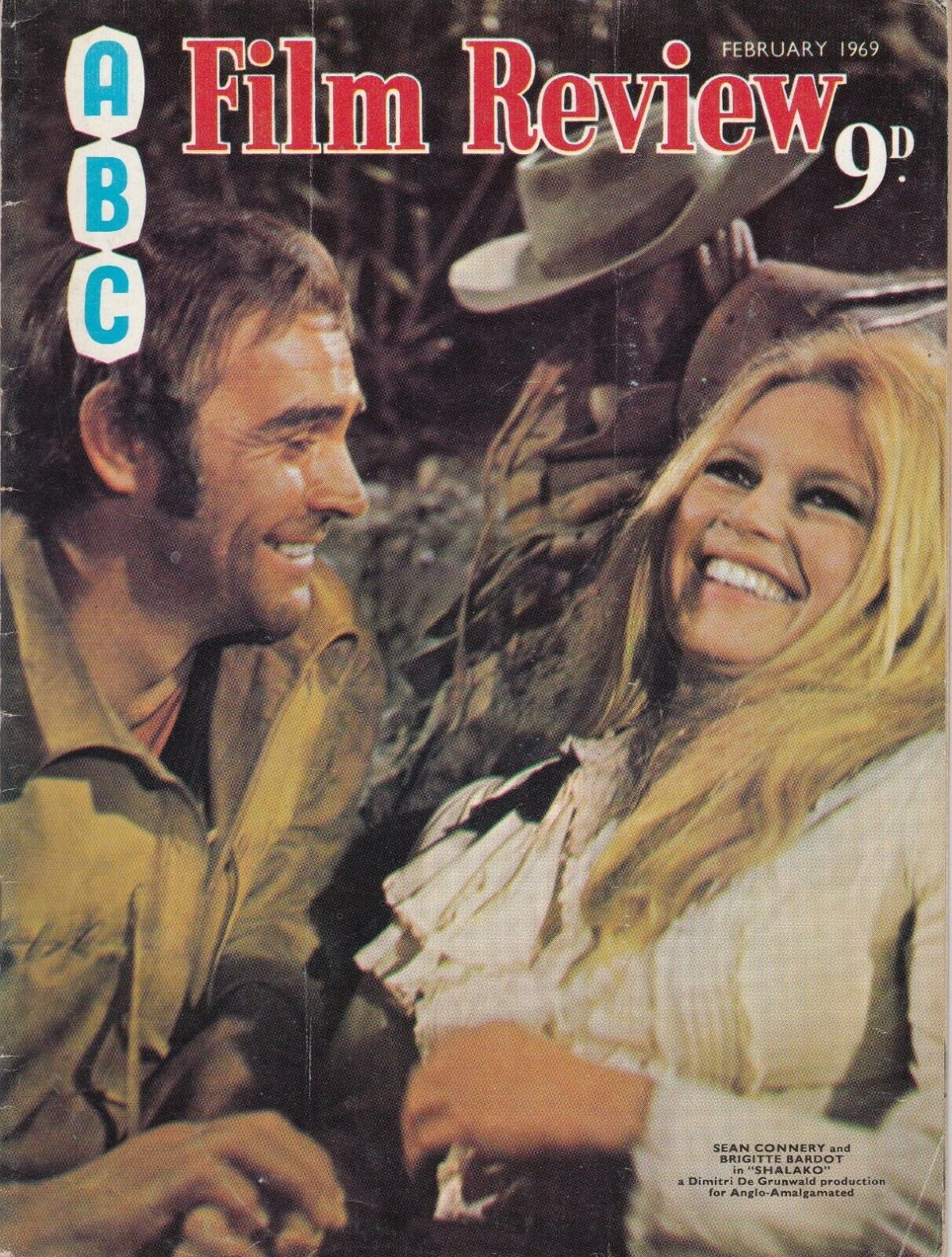
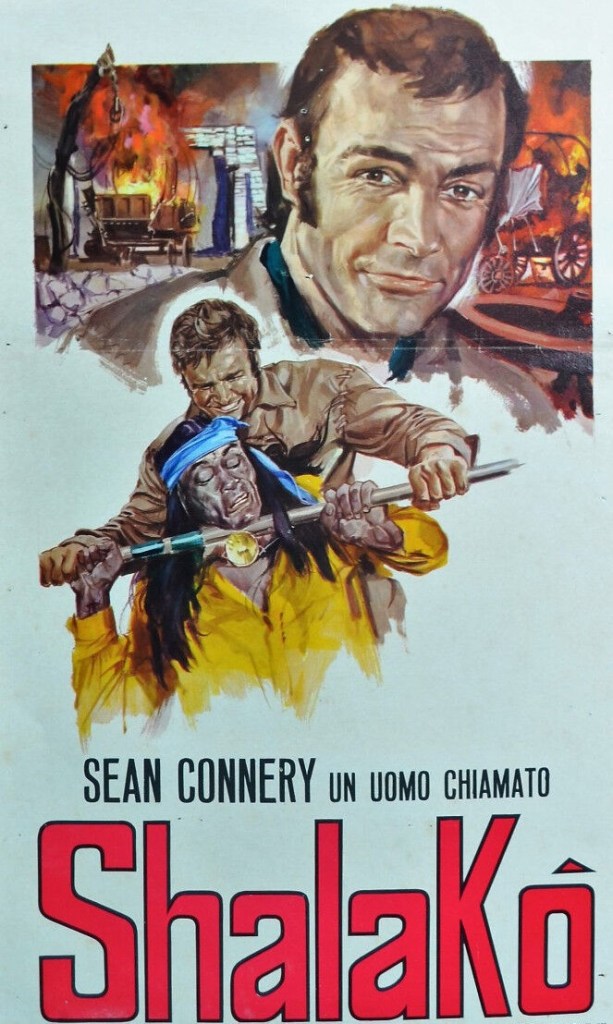
Behind the Scenes: “Shalako” (1968)

If you ever wondered just how a producer earns his crust, the convoluted process to make Shalako would provide a test case. British publicist turned producer Euan Lloyd had little on his calling card to gain entry to Hollywood, not even with the stars in tow for the project. Having worked for several years as a production assistant with Warwick Films, the British-based outfit headed by Cubby Broccoli and Irving Allen, he transitioned to associate producer on The Secret Ways (1961) but didn’t earn the moniker of producer until he pulled together an all-star cast for The Poppy Is Also A Flower (1966). Although released theatrically in Europe it was in reality a made-for-television number and screened as such in the United States.

So, actually, he was very much a neophyte producer. But early in his career he had become fast friends with Alan Ladd (Shane, 1953) and since they shared a love of westerns the actor had put him in touch with bestselling western author Louis L’Amour who was so taken with the Englishman’s enthusiasm he granted him a free option on any one of his un-filmed novels. Lloyd chose Shalako. “I could identify with that subject as it’s about a bunch of Europeans on safari in the West,” said Lloyd. (In fact, though as yet unfilmed, it was not as though nobody had tried. A report in Box Office magazine dated August 19, 1963, stated that Richard Carr was working on a screenplay for producer George Golitsin set for Universal).

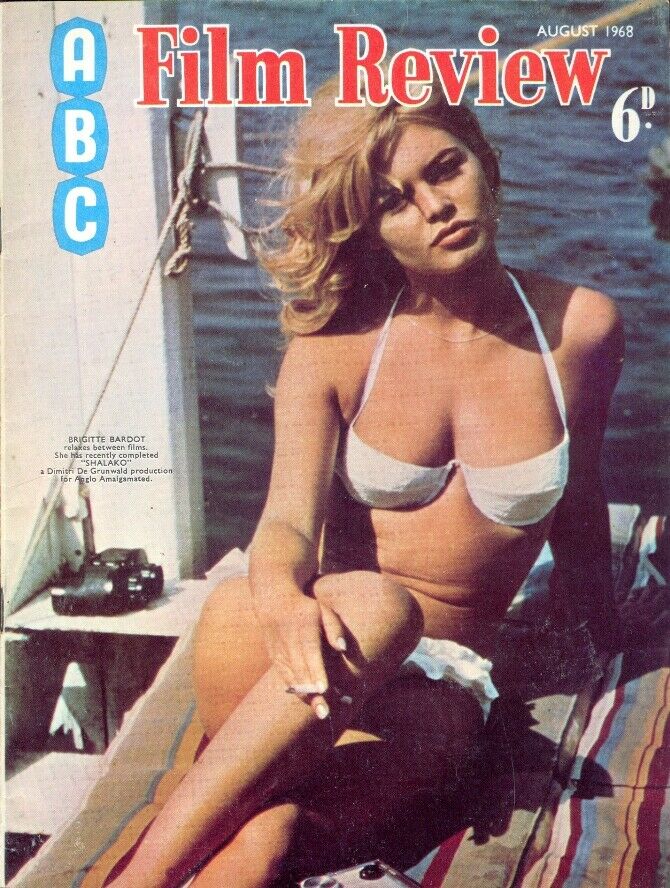
No connection to Shalako but little excuse necessary to showcase BB’s figure apparently.

On the production side, it would give him the excuse he required to put together a cast of non-Americans, stars from different nationalities who could open the distribution doors to significant European countries like France and Germany. His original starring pair were Henry Fonda (Firecreek, 1968) and Senta Berger, whom he knew from The Secret Ways and The Poppy Is Also A Flower. “Privately, she was the antithesis of the character she played in The Secret Ways…she came to mind as a very likely countess.”

He recruited Edward Dymytrk (Mirage, 1965), having got to know the director, a fugitive from the Communist witch hunt in the U.S., on the set of the British-made So Well Remembered (1947). Dmytryk had worked with Fonda on Warlock (1959). While appreciating Lloyd’s interest and keen to work again with Dmytryk, Fonda warned that he was not a strong enough marquee name to get the project off the ground.

To cover his back and using the names of his two stars and director, Lloyd set about pulling together finance from European sources. Although such co-productions were becoming  more common, Lloyd must have set some kind of record by pre-selling the movie, in the end, to 36 different bodies. But still it wasn’t enough. Without an American partner, the movie was no-go. Fonda proved the sticking point and in 1967 Lloyd decided to go for broke with a bigger cast (Fonda was pretty gracious about being dumped, “I did warn you,” he said).

Sean Connery was not even initially on the list of proposed stars until Louis L’Amour alerted Lloyd to the length of the queues to see the latest Bond blockbuster (quite how a producer didn’t know that might be considered a mystery). Connery was incommunicado, filming a documentary in Scotland, but Lloyd managed to get in touch and seven weeks later he had what he believed, based on the Bond box office, was the biggest star in the world.

Part of the attraction for Connery of course was that for the first time he was receiving a salary ($1.2 million in total) commensurate with his box office. But it turned out as far as Hollywood was concerned, Connery had been taken in by his own publicity, studios pointing out that his non-Bond movies, Marnie (1964),  The Hill (1965) and A Fine Madness (1966) had not approached his Bond box office.

Nor was Brigitte Bardot a golden name on the U.S. cinema scene. Until the mid-decade reissue of La Dolce Vita (1960), her first starring role And God Created Woman (1956) held the record for the biggest imported movie. But since them, except for Viva Maria (1966), her movies had been relegated to arthouses, hardly worth risking for a $400,000 salary – she was in Variety’s list of Top Ten Overpriced Stars.

Three major studios rejected the movie. Assuming all the majors would take the same view that “Connery will never make it away from Bond,” Lloyd targeted a mini-major, the kind of neophyte outfit that might pony up to get a big name on its forthcoming schedule, a way of proving it could play with the big boys. ABC, an offshoot of the television network, was hooked, paying $1.4 million for the privilege.

Trevor Howard, Karl Malden, Claire Bloom and Ingrid Pitt was all considered for roles. Even without them, as well as Bardot, the movie, in terms of credits, had the look of one of those all-star epics so beloved in the 1960s: Jack Hawkins (Lawrence of Arabia, 1962), Stephen Boyd whom Lloyd knew from being associate producer on Genghis Khan (1965) and German star Peter van Eyck (Station Six Sahara, 1963). And if Bardot wasn’t enough to get journalist tongues wagging, Connery would also be reunited with Honor Blackman from Goldfinger (1964). The cast also included Woody Strode (The Professionals, 1966), famed 1940s western star Don ‘Red’ Barry (The Adventures of Red Ryder, 1940) and English comedian Eric Sykes (The Plank, 1967).

Mexico was first choice of location until the devalued peso rendered it too expensive. Almeria in Spain, location of choice of many a spaghetti western, was the alternative. The biggest problem pre-shooting was that, to get into character, Connery had decided to grow a Mexican moustache, presumably not aware that moustaches were verboten for stars after The Gunfighter (1950) sank at the box office reputedly because Gregory Peck wore one.  In the end, without the subject becoming a thorny issue, Connery shaved it off. He spent two weeks learning to ride under the tuition of Bob Simmons, a stunt arranger on the Bond pictures, so he could, indeed, sit as tall in the saddle as the great western stars. “He was a very proficient horseman by the time we started,” commented co-star Eric Sykes, “He looked as if he had been riding all his life.”

Meanwhile, Jack Hawkins (Masquerade, 1965) had undergone an operation for throat cancer and though he could speak his words were accompanied by a kind of belch and the voice for which he was so famous had disappeared. By coincidence Lloyd heard what he thought was Hawkins voicing a beer commercial. The distinctive tones belonged to Charles Gray (The Devil Rides Out, 1968) and he re-voiced Hawkins’ lines.

Despite Connery’s assertions to the contrary – his famous quote “she’s all girl but…all on the outside” was viewed as a detractory statement – Lloyd insisted it was a happy set. “I had absolutely no trouble from the cast during shooting and Sean and Brigitte performed perfectly and in harmony. Eddie Dmytryk was a man who knew exactly what he wanted and how to get it. The co-stars liked him enormously.”

Other sources paint a different picture, pointing to tension between Connery and Bardot over who was the bigger star, between Bardot and former lover Boyd, and between Connery and Dmytryk over the script. According to Eric Sykes, sitting beside Connery in between takes, the actor “would tear half a page or even a whole page of dialog out of his script…He was editing his part as he went along, apparently without reference to the director…One scene in particular with him and Brigitte Bardot, a long scene where they were sitting around a pool….it went on and on for about eight minutes…Sean’s editing turned it not a slick two- or three-minute scene…Eddie (Dmytryk) did not challenge it because when he saw what Sean had done he knew it was right.”

A big success in UK and Europe, it was a flop in the U.S. where ABC recorded a $1.2 million loss, but since every area was sold separately it is doubtful this shortfall would need to be repaid by the producer so counting the income from other sources it would have gone into profit. Incidentally, Connery was pictured wearing a moustache when the movie had its premiere and he was actually one of the few major stars who regularly wore a moustache in pictures and there are those who attribute his career longevity to cultivating a beard while still in his prime.

SOURCES: John Parker, Sean Connery, 1930-2020, The Definitive Biography (Bonnier Books, 2020) p171-176; Mac Mcsharry and Terry Hine, “The Way West,” Cinema Retro, Issue #2 May 2005, p38-42.

Discover WordPress

A daily selection of the best content published on WordPress, collected for you by humans who love to read.

The Atavist Magazine

by Brian Hannan

WordPress.com News

The latest news on WordPress.com and the WordPress community.