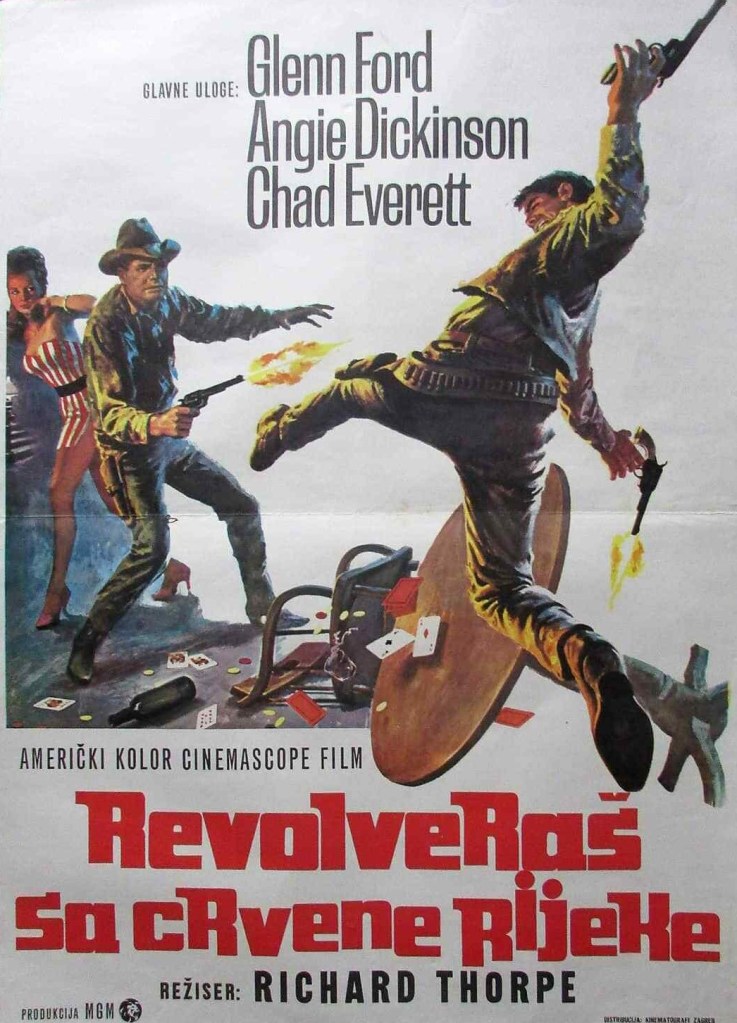
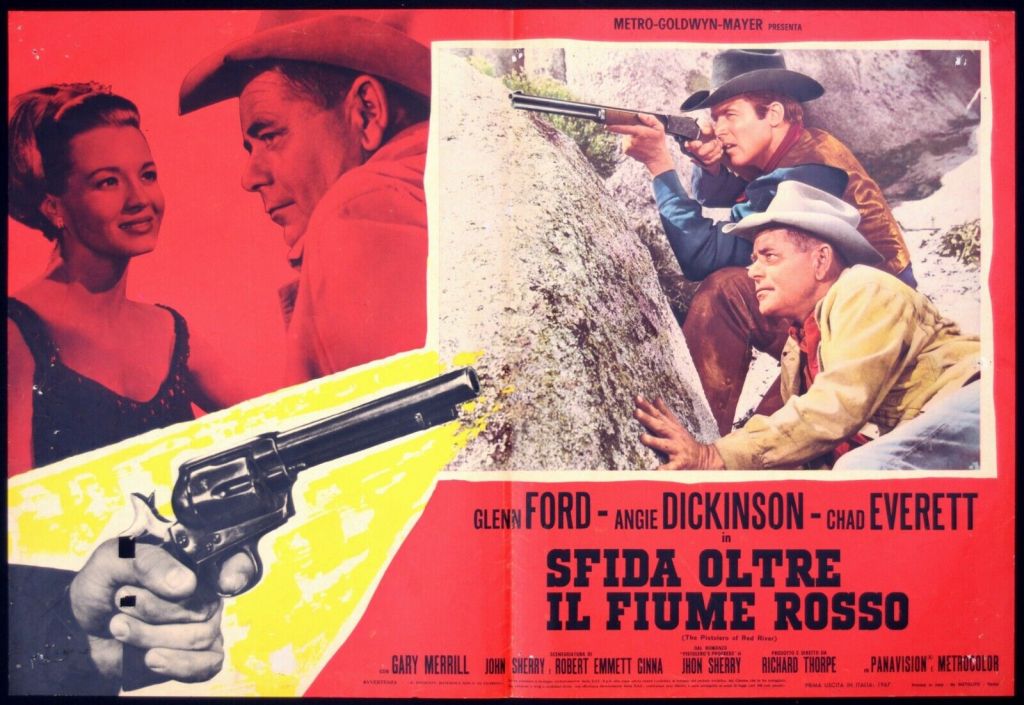
A little gem. Mature, thoughtful, cleverly structured. Plays with expectations. Another assured performance from Glenn Ford (Rage, 1966) with Angie Dickinson (Jessica, 1962) permitted a character of considerably more complexity than normal.
Quite an unusual set-up. Marshal Blaine (Glenn Ford) is an ex-convict, his paramour Lisa (Angie Dickinson) is the local madam. Both are pretty much accepted in this small western town. Some hypocrisy comes Lisa’s way – her money acceptable to a storekeeper who out of earshot refers to her as white trash – but generally the townspeople are happy with an ex-gunslinger as lawman.
But he’s not your standard lawman. He’s very easy-going, not spending all is time upholding the law or out hunting varmints, and she’s not your typical madam either, mothers her employees, keeps unwanted men at a distance, and has made enough money for a fine rig and fancy clothes.
Blaine is sensible but ruthless, taking tough action to prevent a young kid getting into trouble with a dangerous gunman, but having no compunction about shooting the gunslinger. He’s not out for an easy life, but my he does enjoy it, though on a slack day finds fishing more fun than rolling in the hay with Lisa. She knows she has made a good catch, her friend still getting knocked about by her husband, and although Blaine doesn’t seem the marrying kind she has notions of having a baby.
But out fishing Blaine frees a villain Ernest (Jack Elam) who has upset the local Indians. Since they shared a cell way back, Ernest sees Blaine as an easy touch and when told where to go on that score fingers to blackmail Lisa. Meanwhile, this turns out to be an eventful fishing trip. Blaine buddies up with a stranger, Lot (Chad Everett), they fish, cook and drink whisky together until the newcomer reveals he’s on a mission to kill the lawman and take his title of fastest gunman in the southwest.
So you can see where this is headed. Except it doesn’t take that route. Because Lisa, worried that the youngster might well be faster on the draw, hires Ernest to kill him. And when that backfires, it’s only a matter of time before Blaine finds out and you wonder what that’s going to do to their relationship.
There’s some standard stuff, a poker cheat for example, but there’s a lot more going on. Blaine’s young deputy, mostly left to do the chores, tries to throw his weight around with the gunman only to end up with egg on his face. There’s an Native American in jail who we never see and a subplot involving his colleagues that looks like it’s headed in the direction of standard western confrontation until that notion is cleverly nipped away from under the audience’s feet.
Given credence by the worried Lisa is the idea that Blaine is coming to the end of the trail and it’s a testament to the direction that the tension lasts as long as it does. The promotional material gives out that the youngster is a tearaway threatening to shoot up the town, but that’s far from the truth, Blaine trying to talk him out of such rashness while at the same time seeing the boy as a reflection of his younger self.
There’s some brilliant dialog. “Of all the people ain’t worth saving,” Blaine tells Ernest, “you’re the first that comes to mind.” At their first meeting, Lot asks Blaine, “Where’s your tin star?” Retorts Blaine, “You better never see it on me.” As they part, Lot says, “We’ll be meeting again.” Replies Blaine, without aggression, “If that’s the way you want it.”
But there’s quite a lot that’s missed out. There’s no scene of Lisa hiring Ernest, just that he ambushes Lot. The jailed Native American is, as I mentioned, off-camera. There’s none of the usual massive build-up towards a showdown. And even as the shootout approaches, Lisa still doesn’t trust in Blaine’s skill and plans to shoot Lot herself.
That betrayal comes as a helluva shock. When has any lawman’s moll lacked such faith? As for Lot, gunslinging is all that he lives for, the measure of himself, and there’s a purity about him as he rejects countless offers of whisky and women even as he knows he’s making a terrible bed to lie in.
This was very much ahead of its time, especially in thwarting audience expectation not just in the representation of character but in the narrative. It proved a fine last hurrah for veteran Hollywood director Richard Thorpe (The Truth about Spring, 1965). Robert Emmett Gina (Before Winter Comes, 1968) wrote the screenplay based on the John Sherry novel.
As it happened, I watched this back-to-back with Rage so ended with an even better appreciation of Glenn Ford’s talent but was also very taken with Angie Dickinson for the way her character twisted and turned as she attempted to create the outcome she desired. Definitely worth a watch.
You can count on Glenn Ford to bring his A-game to a B-picture. While never reaching the top tier of stardom he had been a box office stalwart in the 1950s until gradually losing his marquee touch in the early 1960s.
This is an odd one, with some nods at Wages of Fear (1953) and any picture that involved a trek or featured a hooker with a heart of gold. The story was certainly unusual – rabies. And the idea of a resulting pandemic will resonate more now than it did then. But it takes quite a long time for the key storyline to emerge, which is just as well because it allows Glenn Ford (Experiment in Terror, 1962) time to turn in one of his best characterisations.
Generally, Ford was Mr Dependable, very capable of holding his own and meting out punishment to anyone who crossed the line. So, this is as far from typecasting as you can get.
Dr Reuben (Glenn Ford) is a washed-up alcoholic working in a flyblown mining pitstop in Mexico, riddled with guilt at the death of wife and child. So when a posse of prostitutes turns up, he’s last in the queue, possibly his disinterest the attraction for Perla (Stella Stevens). By the time he realises he’s contracted rabies, he’s up against the clock, 48 hours to reach a town with an antidote, but still a baby to deliver, a jeep that has to cross a rickety bridge and then runs out of gas, so that, once linked up again with Perla and helped by Pancho, he has to cross mountain and desert to reach safety.
Logic isn’t in much evidence here. Despite knowing he has contracted the disease, he still delivers a baby and then spends most of the final 36 hours in the company of Perla and Pancho (David Reynoso), not to mention that the Mexican has abandoned his wife, who has just given birth in a shack, in order to accompany the doctor, or that the doc finds his way onto a bus loaded up with kids (presumably they are immune).
Not to mention that with a jeep running out of gas surely the last thing you’d want is to weight it down with passengers. And with a budget that’s not going to cater for a proper runaway bus that sequence falls back on the old speeded-up film. And if you’re going down the line of a rickety bridge, do it once, don’t repeat it.
But then you wouldn’t have anyone on hand to deliver philosophic lines, or to start to fall in love (wih Perla, you understand, not Pancho).
Take away the illogicality and there is still quite enough that works. The driver of the hooker truck unceremoniously jacks up his load to dump them in the town. A woman is tied to a table in preparation for giving birth. A suspected rabies victim is dragged through the streets by rope. The hunt for gas leads them to drain oil lamps. There’s a very self-aware Perla, more than enough common sense for both of them. She knows exactly what she has become and that’s something for which there ain’t no cure. But there are a couple of beautifully-wrought scenes that would allow Reuben and Perla to express their true feelings if either was capable of letting go, and you won’t see more expressive fingers.
They struggled to sell this one. The old “woman scorned” line is out of place as is a town eaten up with rage and Glenn Ford does little pistol-packing. But Stella Stevens does look pretty in pink.
And the clock running down also means that the symptoms are building up. Reuben’s senses are heightened. Light is too bright, sounds deafening, and if the doctor is already too ill he won’t be able to drink from a waterfall.
Every now and then director Gilberto Gazcon – who hadn’t made a picture in four years since La Risa de la Ciudad (1962) and wouldn’t make another for three years – chucks in a cinematic morsel, the camera whizzing around or racing back, to show Reuben’s state of mind. But, honestly, he needn’t have bothered.
You hire Glenn Ford and you get everything through his eyes, maybe a sly tensing of his features or a gesture from time to time, but this is one actor – mostly under-rated – who is just rock solid when it comes to displaying character. So when he’s not trying to save himself, dashing from one scheme to the next, he’s flat out trying to stop himself going mad, and only pausing for a bit of reflection as Perla tries to inject some meaning into his life.
Stella Stevens (Sol Madrid, 1968) ain’t that gold-hearted she’s going to let men treat her like dirt, she hands out a couple of good thumpings, but in her world you’re not going to come across any men who aren’t pure predatory, and it’s a shock for her to meet someone who thinks a woman can’t be bought. This is a rounded character – tough but vulnerable, and surprisingly tender should the opportunity arise.
Definitely a mixed-bag and a bit more work on the screenplay would not have gone amiss but top-drawer performance from Glenn Ford.
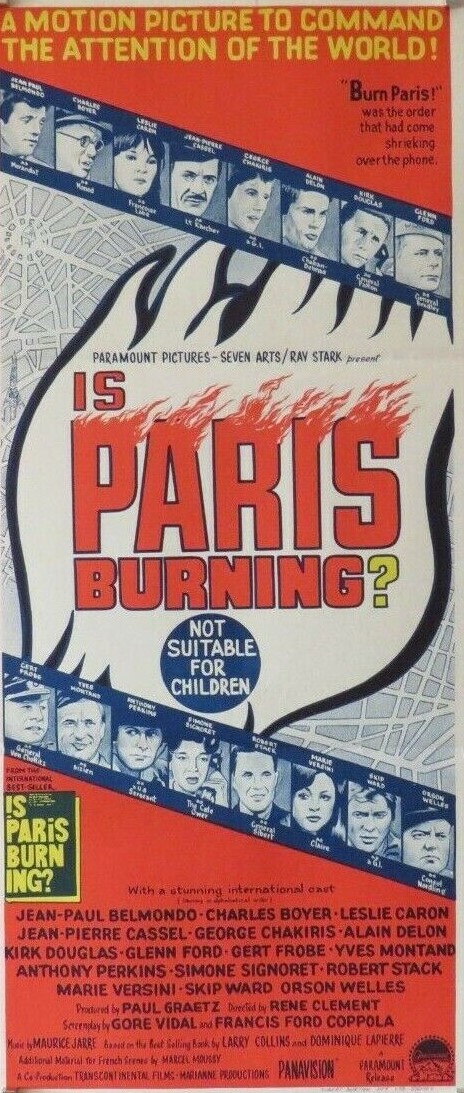
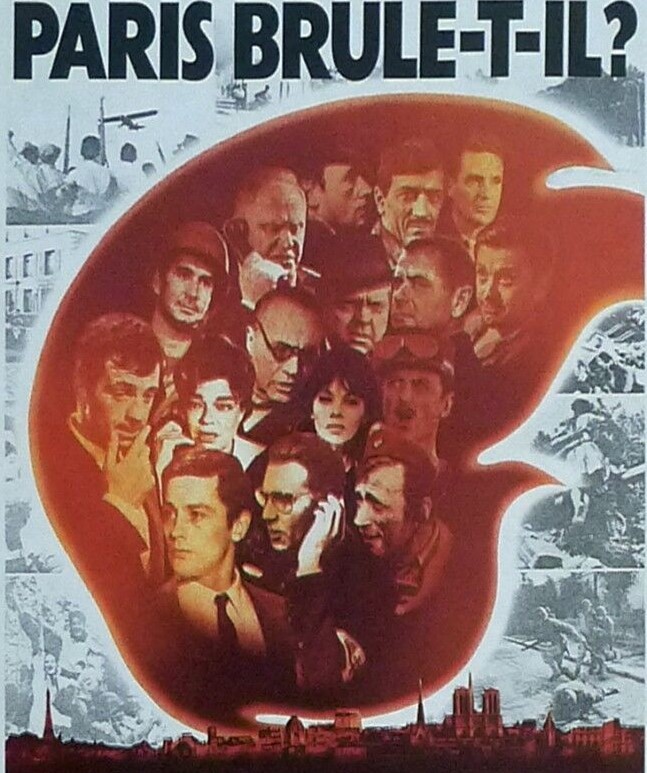
Politics don’t usually play a part in war films of the 1960s but’s it’s an essential ingredient to Rene Clement’s underrated documentary-style picture. Paris has no strategic importance and after the Normandy landings in 1944 the Allies intend to bypass the German-occupied French capital and head straight for Berlin.
Meanwhile, Hitler, in particular vengeful mood after an attempt on his life, orders the city destroyed. Resistance groups are splintered, outnumbered and lacking the weaponry to achieve an uprising. Followers of General De Gaulle, the French leader in exile, want to wait until the Allies send in the troops while the Communists plan to seize control before British and American soldiers can arrive.
When the Communists begin the fight by seizing public buildings, the Germans retaliate by planting explosives on the Eiffel Tower, the Louvre, and other famous buildings and all the bridges across the River Seine. German commandant Von Choltitz (Gert Frobe), no stranger to slaughter having overseen the destruction of Rotterdam, holds off obeying his orders because he believes Hitler is insane and the war already lost.
The Gaullists dispatch a messenger to persuade General Omar Bradley to change his mind and send troops to relieve the city. Director Clement, aware how little tension he can extract from the question of whether von Clowitz will press the destruct button (history tells us he did not) so he takes another route and documents in meticulous detail the political in-fighting and the actual street battles that ensued, German tanks and artillery against Molotov cocktails and mostly old-fashioned weaponry.
The wide Parisian boulevards provide a fabulous backdrop for the fighting. Shooting much of the action from above allows Clement to capture the action in vivid cinematic strokes. Like The Longest Day (1962) the film does not follow one individual but is in essence a vast tapestry. Scenes of the utmost brutality – resistance fighters thrown out of a lorry to be machine-gunned, the public strafed when they venture out to welcome the Americans – contrast with moments of such gentleness they could almost be parody: a shepherd taking his flock through the fighting, an old lady covered in falling plaster watching as soldiers drop home-made bombs on tanks.
This is not a film about heroism but the sheer raw energy required to carry out dangerous duty and many times a character we just saw winning one sally against the enemy is shot the next. The French have to fight street-by-street, corner-by-corner, bridge-by-bridge, enemy-emplacement-by-enemy-emplacement, tank-by-tank.
And Clement allows as much time for humanity. Francophile Sgt Warren (Anthony Perkins), an American grunt, spends all his time in the middle of the battle trying to determine the location of the sights he longs to see. Bar owner Simone Signoret helps soldiers phone their loved ones.
Like The Longest Day and In Harm’s Way (1965), the film was shot in black-and-white, but not, as with those movies for the simple reason of incorporating newsreel footage, but because De Gaulle, now the French president, objected to the sight of a red swastika.
Even so, it permitted the inclusion of newsreel footage, which on the small screen (where most people these days will watch it) appears seamless. By Hollywood standards this was not an all-star cast, only fleeting glimpses of Glenn Ford (Fate Is the Hunter, 1964), Kirk Douglas (A Lovely Way To Die, 1968), Robert Stack (The Corrupt Ones / The Peking Medallion, 1967), Orson Welles (House of Cards, 1968) and George Chakiris (West Side Story, 1961).
But by French standards it was the all-star cast to beat all-star casts – Jean-Paul Belmondo (Breathless, 1960), Alain Delon (Lost Command, 1966), Yves Montand (Grand Prix, 1966), Charles Boyer (Gaslight, 1944), Leslie Caron (Gigi, 1958), Michel Piccoli (Masquerade, 1965), Simone Signoret (Room at the Top, 1959) and Jean-Louis Trintignant (A Man and a Woman, 1966). Director Rene Clement was best known for Purple Noon (1960), an adaptation of Patricia Highsmith’s The Talented Mr Ripley starring Alain Delon
At $6 million, it was the most expensive French film ever made, a six-month shooting schedule, shot on the streets of the city including famous locations like Etoile, Madeleine and the Louvre. Big hit in France, it flopped in the United States, its box office so poor that Paramount refused to disclose it.
These days fact-based magazine articles commonly spark movies – The Fast and the Furious (2001) was inspired by a piece in Vibe, A Beautiful Day in the Neighborhood (2019) started life in Esquire – but it was rare in the 1960s (see Note below).
However, a series of seven lengthy historical articles in the multi-million-selling Life magazine in 1959 about the Wild West, extensively illustrated with material from the time, captured the attention of the nation. Bing Crosby acquired the rights, not as a potential movie, but for a double album recorded in July 1959 on a new label Project Records set up specifically for the purpose – two months after the series ended – and a proposed television special.
When the latter proved too expensive, the rights were sold to MGM which then linked up in a four-film pact with Cinerama to create the first dramatic picture in that format, the three-screen concept that had taken the public by storm in 1952 with This Is Cinerama. Since then, Cinerama had focused exclusively on travelogs and coined $115 million in grosses from just 47 theaters, including $9 million in seven years at the Hollywood theater in Los Angeles. Eight years in its sole London location had yielded $9.4 million gross from a quartet of pictures, Cinerama Holiday (1955) leading the way with (including reissue) a 120-week run, followed by 101 weeks of Seven Wonders of the World (1956), 86 for This Is Cinerama and 80 weeks for South Seas Adventure (1958).
Box office was supplemented with rentals of the projection equipment. But the novelty had worn off, lack of product denting consumer and industry interest, many of the theaters set up for the project returning the equipment, so that by the time of this venture there were only 15 U.S. theaters still showing Cinerama. The company went from surviving primarily on equipment royalties to becoming a producer-distributor-exhibitor. Ambitiously, the company believed it could generate $5,000 a week profit for each theater, and, assuming growth to 60 houses, that could bring in $15 million a year.
Crosby initially remained involved – crooning songs to connect various episodes – but that idea was soon abandoned. Director Henry Hathaway (North to Alaska, 1960), claimed he came up with the movie’s structure. “The original concept was mine,” he said, “The first step in the winning of the West was the opening of the canal, then came the covered wagon, next the Civil War which opened up Missouri and the mid-West then the railroads, and finally the West was won when the Law conquered it instead of the outlaw gangs; which was the theme I worked out for the picture.
“So I conceived the whole idea and then got writers to work on the five episodes. Each episode was about a song originally. Then I travelled all over the country to find locations.”
For once this was a genuine all-star cast headed up by actors with more than a passing acquaintance with the western: John Wayne (The Man Who Shot Liberty Valance, 1962), Oscar-winner Gregory Peck (The Big Country, 1958), James Stewart (Winchester ’73, 1950), Richard Widmark (The Alamo, 1960) and Henry Fonda (Fort Apache, 1948) with Spencer Tracy (Broken Lance, 1954) as narrator plus George Peppard (Breakfast at Tiffany’s, 1961) in his first western.
The two strongest female roles were given to actresses playing against type, Carroll Baker (Baby Doll, 1956), who normally essayed sexpots, as a homely pioneer and Debbie Reynolds (The Tender Trap, 1955), more at home in musicals and comedies, as her tough sister. The impressive supporting cast included Lee J. Cobb, Eli Wallach, Walter Brennan, Robert Preston, Carolyn Jones and Karl Malden.
Glenn Ford and Burt Lancaster were unavailable. Frank Sinatra entered initial negotiations but ultimately turned it down. Gary Cooper, also initially considered, died before the film got underway.
Initially under the title of The Winning of the West screenwriter James R. Webb (The Big Country, 1958) was entrusted with knocking the unwieldy non-fiction story into a coherent fictional narrative. In effect, it was an original screenplay at a time when Hollywood was turning its back on bestsellers, “the pre-sold theory less compelling.” His first draft accommodated various montages covering the journey from the Pilgrim Fathers to the building of the Erie Canal and the Civil War and it was only in subsequent drafts that the tale of Linus Rawlings (James Stewart) emerged with surprising focus on female pioneers.
Webb’s initial ending had involved a father-son conflict, presumably a fall-out between the Rawlings played by James Stewart and George Peppard, but that was rejected in order not to finish on a “note of bitterness” out of keeping with the spirit of the movie. Although he did not receive a credit, John Gay (The Happy Thieves, 1961) also contributed to the screenplay.
Given the film’s episodic structure it is amazing how well the various sequences fit together and the narrative thrust maintained. The story covers a 50-year stretch beginning in 1839 with the river sequence bringing together James Stewart and Carroll Baker. After Stewart is bushwhacked by river pirates, he marries Baker and they set up a homestead. The next section pairs singer Debbie Reynolds with gambler Gregory Peck whose wagon train is attacked by Indians on the way to San Francisco. Later, Stewart and son George Peppard enlist in the Civil War (featuring John Wayne as an unkempt General Sherman).
Stewart dies at the Battle of Shiloh. Peppard joins the cavalry and later as a marshal in Arizona meets Reynolds and prevents a robbery that results in a spectacular train wreck. It took a superb piece of screenwriting to pull the elements together, ensure the characters had just cause to meet and to create solid pace with a high drama and action quotient.
The undertaking was too much for one director. Initially, it was expected five would be required but this was truncated to three – John Ford (The Searchers, 1956), Henry Hathaway and George Marshall (The Sheepman, 1958) although Hathaway carried the biggest share of the burden and Richard Thorpe (Ivanhoe, 1952) handled some transitional historical sequences.
The directors broke new ground, technically. The Cinerama camera was actually three cameras in one, each set at a 48 degree to the next and when projected provided a 146-degree angle view. Each panel had its own vanishing point so the camera could, uniquely, see down both sides of a building.
But there were drawbacks. The cumbersome cameras required peculiar skills to achieve common shots. Directors lay on top of the camera to judge what a close-up looked like. Sets were built to take account of the way dimensions appeared through the lens, camera remaining static to prevent distortion. When projected, the picture was twice the size of 65mm and before the invention of the single-camera lens led to vertical lines running down the screen. Trees were built into compositions to hide these lines.
“You couldn’t move the camera much,” recalled Hathaway, “or the picture would distort. You have to shove everything right up to the camera. Actors worked two- and three-feet away from the camera. The opening dolly down the street to the wharf was the first time it had ever been done.
He added, “Over 50 per cent of the stuff on the train was made on the stage (i.e. a studio set) and 60 per cent of the stuff coming down the rapids. I never took a principal up north to the river, the principals never worked off the stage. We never photographed the scenes with transparencies in three cameras with Cinerama – we photographed them with one camera in 70mm and then split the negative.
“I wouldn’t shoot close-ups in Cinerama – I shot the close-ups in 70(mm) and then separated the negative because in Cinerama it distorted their arms. When (George) Stevens shot The Greatest Story Ever Told he used only 70mm and split it all. So from then on they never used the three cameras again. Now they’re actually shooting it in 35(mm).”
Rui Nogueira, “Henry Hathaway Interview,” Focus on Film, No 7, 1971, p19.
After a year spent in pre-production, an eight-month schedule due to start on May 28, 1961, and a completion date of Xmas 1961, MGM anticipated a 1962 launch, Independence Day pencilled in for the world premiere. The original $7 million budget mushroomed to $12 million and then to £14.4 million, $1 million of that ascribed to adverse weather conditions, hardly surprising given the extent of the location work. A total of $2.2 million went on the 10 stars and 13 co-stars, virtually talent on the cheap given the salaries many could command, transport cost $1 million and the same again in props including an 1840 vintage Erie canal boat.
Rain and overcast skies added $145,000 to the cost of shooting the rapids sequence in Oregon and another $218,000 was required when early snowfall scuppered one location and required traveling 1,000 miles distant. Nearly 13,000 extras were involved as well as 875 horses, 1,200 buffalo, 50 oxen and 160 mules. Thousands of period props were dispersed among the 77 sets. Over 2,000 pairs of period shoes and 1500 pairs of moccasins were fashioned as well as 107 wagons, many designed to break on cue.
Virtually 90 per cent of the picture was shot on location to satisfy Cinerama customers accustomed to seeing new vistas and to bring alive the illustrations from the original Life magazine articles. Backdrops included Ohio River Valley, Monument Valley, Cave-in-Rock State Park, Colorado Rockies, Black Hills of Dakota, Custer State Park and Mackenzie River in Oregon.
The picture, including narration, took over a year to make. Cinerama sensation was achieved by shooting the rapids, runaway locomotive, buffalo stampede, Indian attack, Civil War battle and cattle drive. Motion was central to Cinerama so journeys were undertaken by raft, wagon, pony express, railroad and boat, anything that could get up a head of steam.
Initially, too, the production team had been adamant – “rigid plans for running time will be met” – that the movie would clock in at 150-155 minutes (final running time was 165 minutes) and there was some doubt, at least initially, on the value of going down the roadshow route in the United States. Roadshow was definitely set for Europe, a 15-minute intermission being included in those prints, for a continent where both roadshow and westerns were more popular than in the States.
Big screen westerns in particular in Europe had not been affected by the advent of the small-screen variety. Some films received substantial boosts abroad. “The Magnificent Seven and Cimarron (both 1960) took giants steps forward once they made the transatlantic crossing.” British distributors also reported “striking” success with The Last Sunset (1961) and One-Eyed Jacks (1962) which had toiled to make a similar impression in the U.S.
In the end the decision was made to hold back the release in the U.S. in favor of another Cinerama project The Wonderful World of the Brothers Grimm, which had begun shooting later and ultimately cost $6 million, double its original budget. Rather than bunch up the release of both pictures, MGM opted to kick off its Cinerama U.S. launch with Grimm in 1962 and shifted How the West Was Won to the following year. MGM adopted the anticipation approach, holding the world premiere in London on November 1, 1962, and unleashing the picture in roadshow in Europe.
A record advance of $500,000 was banked for the London showing at the 1,155-seat Casino Cinerama (prices $1.20-$2.15) on roadshow separate performance release. Before the advertising campaign even began in October, a full month prior to the world premiere, over 62,000 reservations had been made via group bookings. Critics were enamored and audiences riveted. The cinema made “unusually large profits” and after two years had grossed $2.25 million from 1722 showings.
Dmitri Tiomkin (The Alamo, 1960) was hired to compose the music, but an eye condition prevented his participation though he later sued for $2.63 million after claiming he was fired before the assignment began. Alfred Newman (Nevada Smith, 1966) wrote the thundering score but uniquely for the time MGM shared the publishing rights with Bing Crosby. In the U.S. Bantam printed half a million copies of a paperback tie-in, sales of the soundtrack were huge and there was a massive rush to become involved by retailers and museums with educational establishments an easy target.
Audience response was overwhelming, a million customers in the first month, two million by the first 10 weeks at just 36 houses, some of which had only been showing it for half that time. But it failed to hit ambitious targets – predictions that it would regularly run for three years in some situations “based on the star roster and the fact the pic offers more natural U.S. vistas than anything yet done on the screen” proving wildly over-optimistic. Still, it had enjoyed 80 roadshow engagements including eight months at the Cinerama in New York and grossed $2.3 million in 92 weeks in L.A, $1.14 million after 88 weeks in Minneapolis and $1.5 million after one week fewer in Denver.
By 1965, as it began a general release 35mm roll-out with 3,000 bookings already taken, it had already passed the $9 million mark in rentals including a limited number of showcase breaks the previous year.
Nominated for a Best Picture Oscar, it won for screenplay, sound and editing. The movie became MGM’s biggest hit after Gone with the Wind and Ben-Hur. In my recent book The Magnificent ‘60s, The 100 Most Popular Films of a Revolutionary Decade I placed it twelfth on the chart of the decade’s top box office films.
It provided a popularity fillip for most of the big stars involved, none more so than James Stewart who, prior to shooting, had been on the verge of retirement. Box office appeal diminishing, work on his next picture Take Her, She’sMine postponed by the Actor’s Strike, after the death of his father he had “quietly begun to make plans to get out of his Fox contract, retire, and move his family out of Beverly Hills.” He had spent $500,000 on a 1,100-acre ranch and was already well set to quit acting having accumulated a large real estate portfolio in addition to oil well investments.
NOTE: Robert J. Landry (“Magazines a Prime Screen Source,” Variety, May 30, 1962, 11) pointed to Cosmopolitan as the original publication vehicle for To Catch a Thief (1955) by David Dodge in 1951 and Fannie Hurst’s Back Street (1932), serialized over six months from September 1930. Frank Rooney’s The Cyclist’s Raid – later filmed as The Wild One (1953) – first appeared in Harpers magazine. Movies as varied as Edna Ferber’s Ice Palace (1960) and The Executioners by John D. MacDonald, later filmed as Cape Fear (1962), were initially published in Ladies Home Journal. The Saturday EveningPost published Alan Le May’s The Avenging Texan, renamed The Searchers (1956), and Donald Hamilton’s Ambush at Blanco Canyon, renamed The Big Country (1958) as well as Christopher Landon’s Escape in the Desert which was picturized under the more imaginative Ice Cold in Alex (1958).
SOURCES: Brian Hannan, The Magnificent ‘60s, The 100 Most Popular Films of a Revolutionary Decade (McFarland, 2022) p168-170; Marc Eliot, James Stewart A Biography (Aurum Press, paperback, 2007) p350-351; Rui Nogueira, “Henry Hathaway Interview,” Focus on Film, No 7, 1971, p19; Sir Christopher Frayling, How the West Was Won, Cinema Retro, Vol 8, Issue 22, p25-29; Greg Kimble, “How the West Was Won – in Cinerama,” in70mm.com, October 1983; “Reisini Envisions Cinerama Leaving Travelog for Fiction Pix,” Variety, December 14, 1960, p17; “Metro in 4-Film Deal with Cinerama,” Variety, March 1, 1961, p22; “Cinerama Action Awaits Plot Tales,” Variety, March 8, 1961, p10; “Fat Bankroll for How West Was Won,” Variety, May 24, 1961, p3; “Return to Original Scripts,” Variety, June 28, 1961, p5;“MGM-Cinerama Set 3-Hour Limit For West Was Won,” Variety, August 23, 1961, p7; “Hoss Operas in O’Seas Gallop,” Variety, August 23, 1961, p7; “Coin Potential As To Cinerama,” Variety, September 20, 1961, p15; “Changing Economics on Cinerama,” Variety, October 11, 1961, p13; “Bantam’s 22 Paperback Tie-Ups in Hollywood,” Variety, October 25, 1961, p22; “How West Was Won for July 4 Premiere,” Box Office, December 11, 1961, p14; “Crosby Enterprises Holds West Cinerama Songs,” Variety, January 24, 1962, p1; “Grimm First in U.S. for Cinerama but Abroad West Gets Priority,” Variety, April 4, 1962, p13; “Cinerama Fiscalities,” Variety, April 11, 1962, p3; “Cinerama Story Pair Burst Budgets,” Variety, May 16, 1962, p3; “Tiomkin’s $2,630,000 Suit Vs MGM et al,” Variety, June 27, 1962, p39; “Hathaway a Pioneer,” Variety, July 25, 1962, p12; “Bernard Smith Clarifies Fiscal Facts,” Variety, August 8, 1962, p3; Review, Variety, November 7, 1962, p6; “London Critics Rave Over West,” Variety, November 7, 1962, p19; “Brilliant World Premiere in London for West,” Box Office, November 12, 1962, p12; “West in Cinerama the Big Ace,” Variety, November 14, 1962, p16; Feature Reviews, Box Office, November 26, 1962; Bosley Crowther, “Western Cliches; How West Was Won Opens in New York,” New York Times, March 28, 1963; “Big Book Aid for West,” Box Office, April 1, 1963, pA3; “West Was Won Seen By 2,000,000 in 10 Weeks,” Box Office, June 3, 1963, p15; “How West Was Won for 19 Showcase Theaters,” Box Office, June 15, 1964, pE1; “West End,” Variety, November 11, 1964, p27; “How West Was Won Ends Roadshowing,” December 9, 1964, p16; “3,000 Bookings Expected for How the West Was Won,” Box Office, May 3, 1965.
For a modern audience any film that contains mention of “Twin Peaks” and “Tarantino” either shows amazing prescience and/or an indication of what is to come. This classy thriller does not disappoint. Part police procedural, part portrait of a killer, part clever heist and part women in peril, it has you wondering why director Blake Edwards did not stick to the genre. Set in San Francisco in an era when the F.B.I. was generally considered a good thing rather than the paranoia-inducing entity it would become a decade later.
Bank teller Kelly Sherwood (Lee Remick) is terrorized by an unknown assailant into helping him carry out a audacious $100,000 heist. F.B.I. agent Ripley (Glenn Ford), aware of the prospective theft, is drawn into the diabolical web as is Sherwood’s younger sister Toby (Stefanie Powers). The only clue to the thief is his asthmatic voice. Levels of forensic detection set a new bar with the F.B.I. employing telephone, personal and even aerial surveillance, commandeering of television cameras to scan a crowd, and analyzing a telephone conversation to identify the criminal.
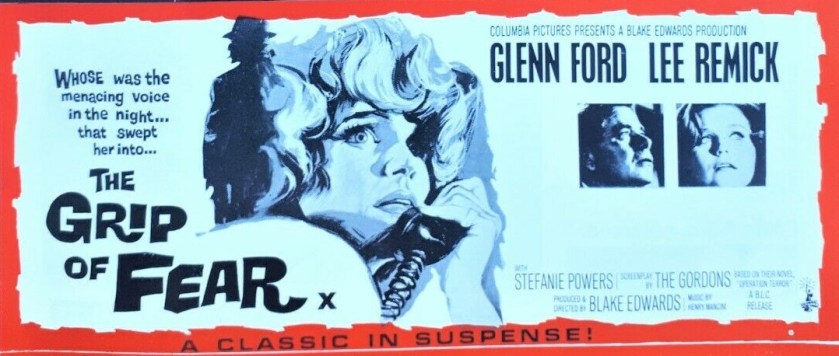
Released in Britain as “The Grip of Fear,” exhibitors tried to pull a fast one on the public by using as the support “Operation Mad Ball,” a Jack Lemmon number from 1957, in a bid to convince moviegoers that this program would repeat the successful pairing of Remick and Lemmon in “Days of Wine and Roses.”
There are red herrings aplenty. Tension is racked up so adroitly that any character entering the frame automatically arouses suspicion. Edwards takes a leaf out of the Hitchcock suspense book by finding constant ways to remind Kelly – and the audience – just what is at stake, Ripley promising her a “reign of terror” and not, as you might expect, lying to her about the threat she faces.
As Ripley digs further into the robber’s past, he uncovers not only a catalogue of crime including rape and three murders, but also an unusual personality. Yes, as you might expect, a control freak, but also a guy capable of affection and of lavishing thousands of dollars on those worse off than himself. And, of course, he is exceptionally good at planning crime, outwitting the F.B.I., and picking the kind of vulnerable victim susceptible to intimidation. Every time, the F.B.I. thinks it is closing in, he remains one step ahead. Eventually, the F.B.I. has amassed so many clues, including his identity, a photograph and previous lovers, that you think it’s impossible for him to escape – until he does.
Kelly is so on edge, in following instructions, that she picks up the wrong man in a bar, the police so antsy they mistake a drunk for the assailant. Drenched in atmosphere and rich in subsidiary characters, there’s scarcely a dull moment, from a mannequin repairer (Nancy Ashton) with a roomful of dangling inert bodies, a karate class with (ironically) a woman well able to defend herself, to a small boy desperate to see a G-man’s weapon, an informant (Ned Glass) with a penchant (as did director Edwards) for silent comedies, and a bank manager who promises Kelly a promotion even if she has to steal the money.
On top of this there are some genuine creepy moments that up-end our expectations. What Ripley doesn’t tell Kelly is that she’s also bait and clearly has little concern that she might end up collateral damage – anticipating at the very least she will have a nervous breakdown when it’s over, if, in fact, she survives – in his bid to snare the criminal. A terrified kidnapped Toby strips down to underwear in front a man we know is a rapist. And the movie touches on the woman-who-loves-a-killer motif, a theme very much in the contemporary vein.
Blake Edwards (Breakfast at Tiffany’s, 1961) delivers a directorial tour de force. The criminal is hidden for most the picture, drip-fed to the audience in glimpses, his mouth here, his back there, other times in disguise. Edwards establishes the F.B.I. as such a “very efficient organization” using the most up-to-date methods and involving a vast number of staff plus police that it seems impossible to fail – until it does. And there is an absolutely brilliant six-minute sequence at the outset, milking the best of film noir lighting, when the criminal surprises Kelly in her garage and spells out in detail her vulnerability and the basics of his plan. By keeping the criminal in the shade, and what little available light there is covering her face, Edwards makes the most of Lee Remick’s eyes – every bit as iconic as Audrey Hepburn’s outfits in Breakfast at Tiffany’s – and her acting skill.
Remick (Sanctuary, 1961) is superb, trapped by emotion as much as terror, placing her trust in an F.B.I. that lets her down time and again. This is an edgier role for Glenn Ford (Fate Is the Hunter, 1964) as he steps up from the trustworthy guy-next-door to reveal a more ruthless streak. Stefanie Powers (The Warning Shot, 1967) does well in a small role and there is sterling support from Ross Martin (The Ceremony, 1963), Patricia Huston (Synanon, 1965) and Clifton James (Live and Let Die, 1973). Gordon and Mildred Gordon wrote the screenplay based on their novel Operation Terror.
“Twin Peaks” in case you are wondering is the district in which Kelly lives. There’s a sign towards the end for Tarantino’s World-Famous Cocktails.
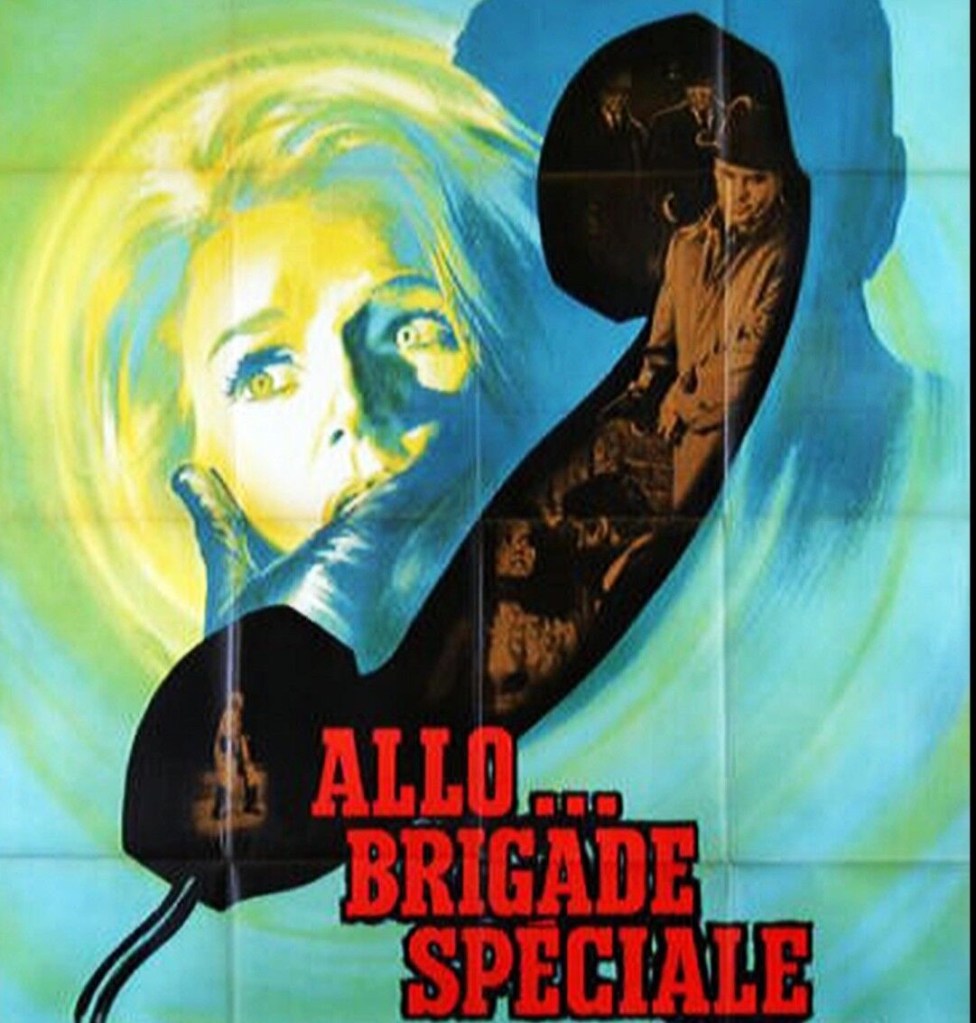
We’ve all been there. You are scrolling through a movie website and you come across a new Audrey Hepburn picture called The Loudest Whisper (1961) and you get all excited and wonder how on earth you could have missed it. You check it out. Something about the other credits sounds familiar – directed by William Wyler, co-starring Shirley Maclaine. Wait a minute, isn’t that The Children’s Hour? Yep, you got it. Welcome to the title jungle, the constant changing of the names of movies from country to country.
You could see how this was necessary, possibly even essential, as different languages and cultures struggled to make sense of Hollywood titles. There could be other reasons. What actually does To Kill a Mockingbird (1962) mean and is it translatable into Greek or Italian? What happens if the publisher of the bestseller-cum-movie has already changed the title? Or if an American bestseller sank like a stone in other countries and the whimsical title means nothing to nobody.
But The Loudest Whisper was the British title for the William Wyler picture. And Britain, it turns out, was not shy about changing titles. Elia Kazan’s America, America (1964), a straightforward title you might think, suggesting longing, was changed into the incomprehensible The Anatolian Smile, assuming the ordinary public knew where (or what) Anatolia was. Burt Kennedy western Mail Order Bride (1964), an idea too obvious for the sensitive Brits, became the meaningless West of Montana.
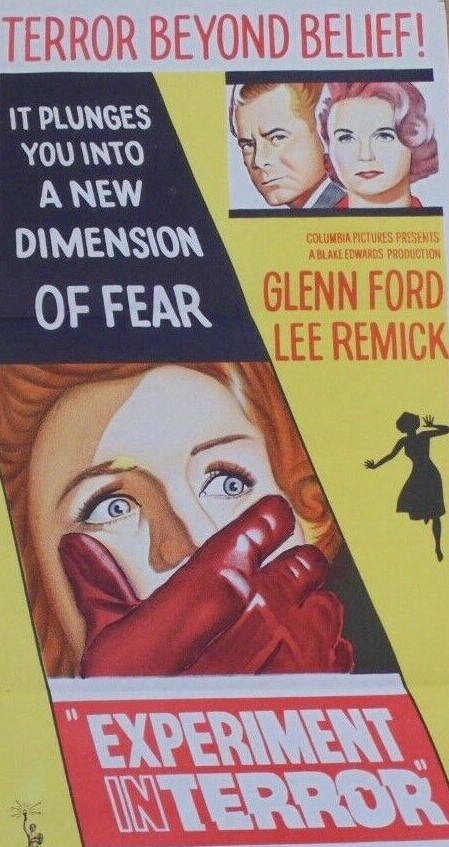
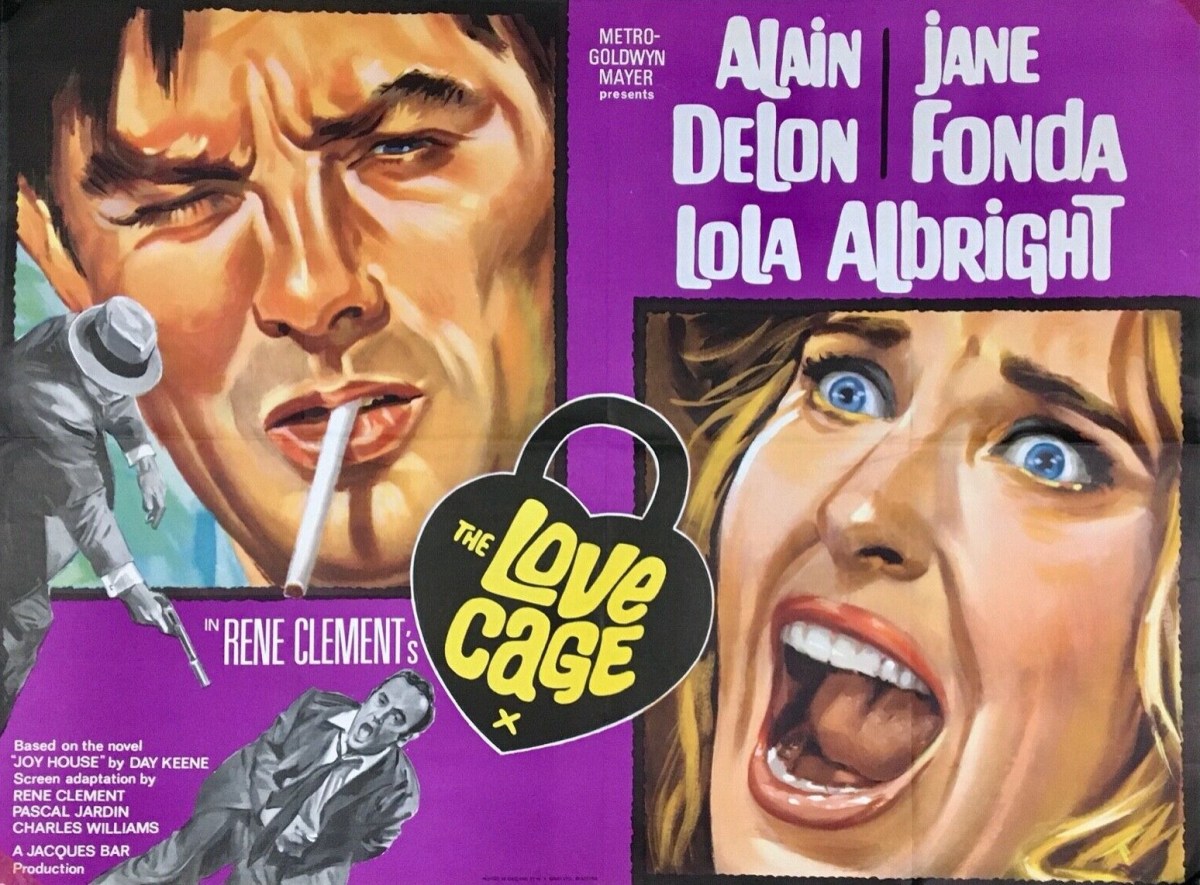
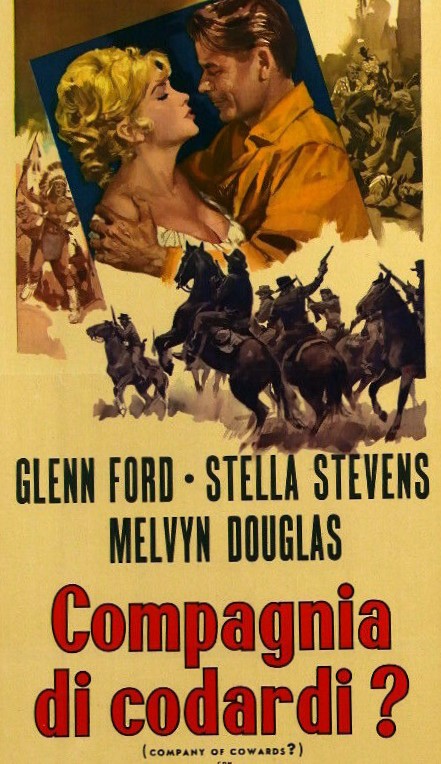
Glenn Ford-Stella Stevens western comedy Advance to the Rear (1964), a simple joke in any language unless your mind ran in cruder directions, turned into Company of Cowards. Glenn Ford again, Experiment in Terror (1962) was translated for British audiences as The Grip of Fear. Rene Clement French thriller Joy House, perhaps suggestive of a house of ill-repute, with Alain Delon and Jane Fonda became the no-less risqué Love Cage. And any notions that The Stripper would prove impossible to resist for any red-blooded male were scuppered by renaming it Woman of Summer.
In any case, the Italians had already co-opted the whole stripping thing, Warner Brothers musical Gypsy (1962) was translated as The Woman Who Invented Striptease, which was actually what Gypsy Rose Lee was famed for even if Hollywood did not want to admit it upfront. In fact, the people in charge of foreign titling often came up with a better choice than the original. Two Seducers was the Italian title for Bedtime Story (1964) starring Marlon Brando and David as, guess what, rival seducers.
In case you had no idea what The Prize (1963) referred to, what could be better than renaming it, as in Italy, Intrigue in Stockholm or, in accepting some knowledge of the Nobel Prize, the Greek version No Laurels for Murderers, both revamped titles a bit more persuasive above a marquee than the bland original, especially if the Irving Wallace bestseller on which it was based had not been a success in the respective countries.
Cape Fear (1962) – based on a book with the straightforward title of The Executioner – was improved upon in several countries, all taking a similar approach to the problem. In Switzerland it was known as Bait for a Beast, in West Germany Decoy for a Beast, both of which actually touched more succinctly on the main plot than the Hollywood version. And some countries believed in saying it as they saw it, Irma La Douce (1963) shown in Greece as The Streetwalker.
Clearly, some Hollywood titles provoked much head-scratching as titling experts tried to work out if they had, perhaps, a hidden meaning. Frank Sinatra comedy Come Blow YourHorn (1963) was variously called I’ll Take Care of the Women (Italy), If My Sleeping Room Could Talk (West Germany), If My Bed Could Talk (Greece) and the more straightforward Bachelor’s Apartment (Israel).
Some titles came with inbuilt bafflement. Italy had an interesting take on MGM musical The Unsinkable Molly Brown (1964), tabbing it I Want To Be Loved in a Brass Bed. Move Over Darling (1963) emerged as One Too Many in Bed (West Germany) and Her Husband Is Mine (Greece) while another Doris Day vehicle Lover Come Back (1961) became A Pajama forTwo (Switzerland), and A Pair of Pajamas for Two (West Germany). But some essential facet of the character of Hud (1962) was captured in Wildest Among a Thousand (West Germany) and Wild as a Storm (Greece).
And back to that To Kill a Mockingbird problem. Italian audiences were treated to Darkness Beyond the Hedge and Greek moviegoers to Shadows and Silence. Incidentally, in Israel The Stripper was known as Lost Rose while Advance to the Rear in West Germany appeared as Heroes without Pants.
SOURCE: “How U.S. Titles Are Retitled in Foreign Lands,” Variety, May 12, 1965, p108 and examination of movies on Imdb.
The success in 1968 of such disparate movies as The Graduate (1967), Valley of the Dolls (1968) and 2001: A Space Odyssey (1968) with no discernible stars got Hollywood thinking whether they needed stars anymore. Stars were viewed as insurance. Their names were attached to pictures in the hope that they would bring a sizeable audience.
But for some time that had proved not to be the case. Certainly actors with the box office clout of Paul Newman, Julie Andrews, Elizabeth Taylor, Lee Marvin, John Wayne, Richard Burton and Elvis Presley justified their extravagant salaries. But exhibitors had begun to complain that studios were forcing them to carry the cost of stars who did not deliver, the salaries inflating “the terms that theatres must pay for films.”
Big names viewed as box office poison in 1968 included Marlon Brando, Tony Curtis, William Holden and Natalie Wood. An investigation by trade magazine Variety uncovered the fact that in each case the last four pictures of each star – who earned $250,000 or more per movie – had flopped. Average movie budgets by now had climbed to $3-$4 million not counting marketing costs so most movies had to bring in over $10 million at the global box office to break even
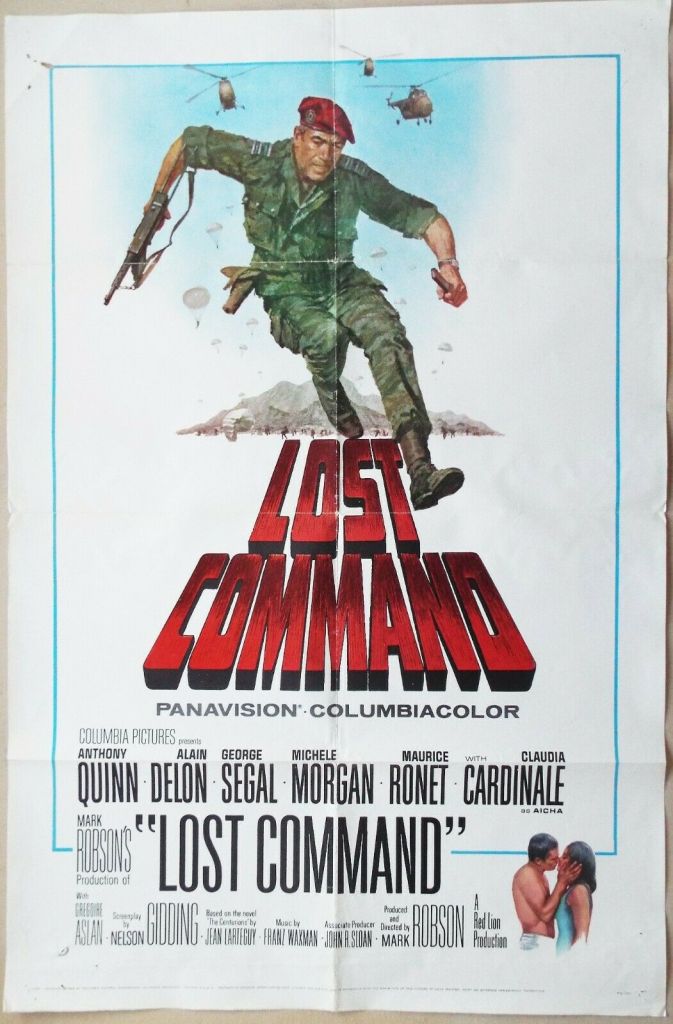
The star with the worst track record was Anthony Quinn. Average rental for his past four pictures – $800,000. While Zorba the Greek (1964) had been an unexpected hit, what followed was anything but. Discounting a cameo in Marco the Magnificent (1965), the box office duds comprised adventure A High Wind in Jamaica (1965), Lost Command (1965), war film The 25th Hour and misconceived hippie comedy The Happening (1967).
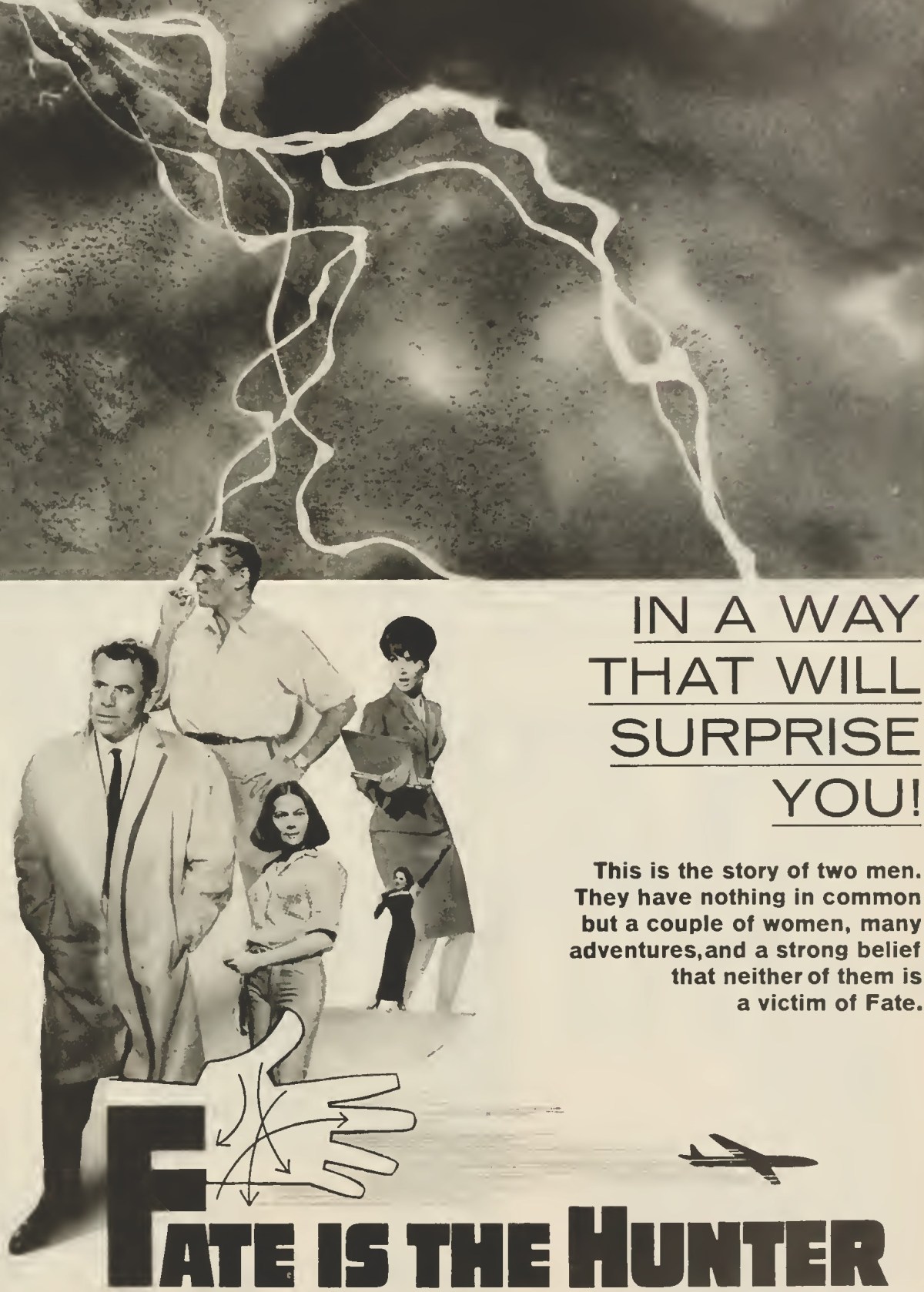
Not far behind was Glenn Ford, a star from the days of Gilda (1946), The Blackboard Jungle (1955) and The Sheepman (1958). He had begun the current decade badly with big-budget losers Cimarron (1960) and The Four Horsemen of the Apocalypse (1962) and his career never recovered. His last eight pictures brought in an average of less than $1 million apiece in rentals. The sad bunch were: comedy western Advance to the Rear, Dear Heart and aerial drama Fate Is the Hunter (all 1964) followed by western The Rounders and thriller The Money Trap (both 1965) as well big budget war epic Is Paris Burning? (1966), rabies drama Rage (1966) and western The Long Ride Home (1967).
Scarcely any better was William Holden, star of David Lean Oscar-winner Bridge on the River Kwai (1957), John Ford western The Horse Soldiers (1959) and The World of Suzie Wong (1960). His last four efforts – The Lion (1962), romantic comedy Paris When It Sizzles (1964), war drama The 7th Dawn (1964) and Civil War western Alvarez Kelly (1966) – returned an average of $1.05 million in rentals. Variety reckoned he was struggling with the problem of how to “gracefully mature his screen image.”
James Garner, once seen as the natural successor to Clark Gable, had failed to capitalize on the success of John Sturges’ The Great Escape (1963). Five of his last seven films had dredged up a mere $1.3 million average. Making up the awful quintet were thriller 36 Hours (1964), comedy thriller A Man Could Get Killed (1966), western pair Duel at Diablo (1966) and Hour of the Gun (1967) plus drama Mister Buddwing (1966). Quite why comedy The Art of Love (1965) had done better – $3.5 million in rentals – nobody could ascertain and even though roadshow Grand Prix (1966) was a hit Garner, who was billed below the title, was not considered a reason for it, with some insiders claiming his name had held it back and it would have done much better with someone else in his role.
Morituri (1965), Cast a Giant Shadow (1966), The Poppy Is Also a Flower (1966), western sequel Return of the Seven (1966), Triple Cross (1966) and The Long Duel (1967) had mustered an average of $1.4 million leaving observers to the conclusion that Yul Brynner’s “brand of sex appeal” no longer attracted audiences in America.
Marlon Brando had generated just $8.4 million in total rentals – an average of $1.6 million – for his previous six films. No matter what he did, regardless of genre, he had lost his box office spark whether it was comedies like Bedtime Story (1964) and The Countess from Hong Kong (1966), dramas like The Chase (1966) and Reflections in a Golden Eye (1967), western The Appaloosa (1966) or thriller Morituri (1965). From the industry perspective he was by far the worst performer since his movies cost so much in directors (Charlie Chaplin, John Huston), co-stars (Elizabeth Taylor. Sophia Loren) and sets.
A string of comedies had sounded the box office death knell for Tony Curtis. Boeing, Boeing (1964), Not with My Wife You Don’t (1966), Arrivederci, Baby! (1966) and Don’t Make Waves (1967) delivered a lamentable $1.77 million on average.
Rock Hudson had fallen far from the pedestal of being the country’s top male star in the early 1960s. Two romantic comedies Strange Bedfellows (1965) and A Very Special Favor (1965), a brace of thrillers Blindfold (1966) and Seconds (1965) plus war film Tobruk (1967) did nothing to restore his standing with just $1.86 million in average rental.
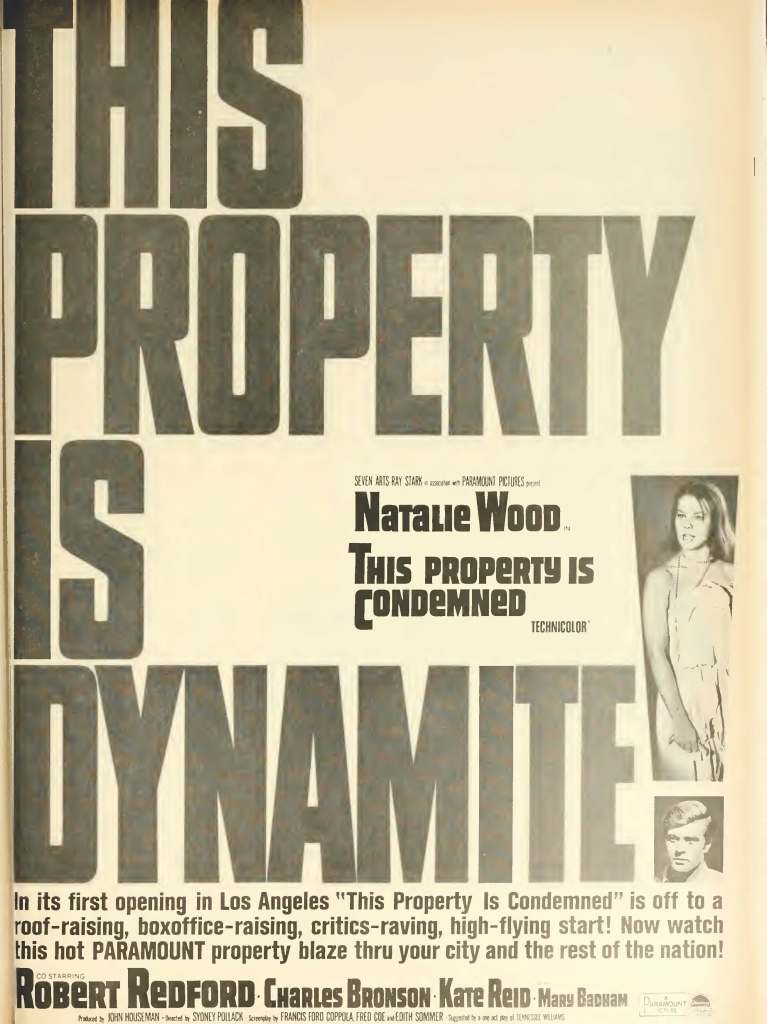
Added to the list of dubious stars was Natalie Wood whose career was considered to be in such jeopardy that she had not made picture in two years. Small wonder after dramas Inside Daisy Clover (1965) and This Property Is Condemned (1966) and crime caper Penelope (1966) which averaged $2.2 million.
Whether anybody’s career could be resuscitated after these disasters was anybody’s guess.
Strangely enough, some did regain at least a measure of their former glory, Marlon Brando the obvious example after The Godfather (1972). James Garner had his biggest-ever hit with Support Your Local Sheriff (1969). Tony Curtis revived his fanbase with The Boston Strangler (1968). William Holden returned to favor after the double whammy of The Devil’s Brigade (1968) and The Wild Bunch (1969). Natalie Wood hit the spot in Bob and Carol and Ted and Alice (1969) and Yul Brynner as a robotic gunslinger turned his career around in Westworld (1973).
But Glenn Ford’s career was coming to an end and Anthony Quinn followed up this bunch of flops with two more of the same ilk in the Shoes of the Fisherman (1968) and The Magus (1968) although he would still be offered starring roles for more than a decade.
Of course, luckily, decades on, we are not so much guided by the box office various films had and many pictures that were once dubbed flops are now being re-evaluated by a new generation of film fans.
SOURCE: Lee Beaupre, “Rising Skepticism on Stars,” Variety, May 15, 1968, p1








 The Magnificent 60s