The War Lord (1965) ***

Contemporary audiences will gib at a narrative that relies on legalised rape. Audiences at the time had the same response but since then it has picked up considerable critical acclaim on account of its down-and-dirty portrayal of a medieval era far removed from the knight in shining armour. But it still pivots on the distasteful notion of “droit de seigneur”, the right of any noble to take the virginity of any female underling on their wedding night – it was motivation for William Wallace’s rebellion in Braveheart (1995).

The idea that this was pervasive or even occurred at all has been proven to be historically inaccurate. Logic tells you that any ruler wanting to keep his subjects in check would scarcely resort to wholesale rape that could spark disloyalty among his subjects. Or that any no one would be unaware of the dangers of inbreeding should the nobleman’s seed result in pregnancy.
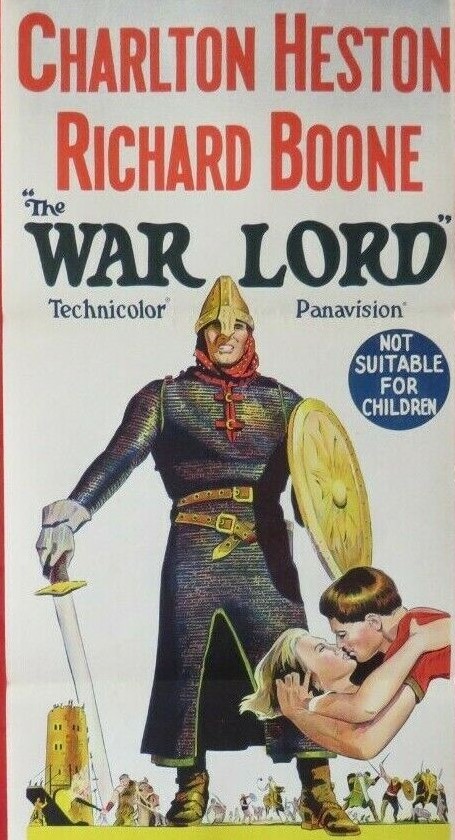
What of course the movie does get right is that women were treated as chattels – “she’s mine” / “you’re mine” a recurrent refrain – or were makeweights in deals uniting the vested interests of kings or dukes.

As reward for years of service to the Duke of Ghent, Chrysagon (Charlton Heston) is handed a fiefdom in Normandy, prone to attack by Frisian raiders from the neighbouring Netherlands. In interrupting such an assault, Chrysagon captures the enemy chief’s son without being aware of it, prompting a later battle.

While the area boasts vestiges of normality, a priest and a strong tower, the inhabitants are inclined to the pagan rather than Christianity with rites (reminiscent of Game of Thrones) involving stone and trees while anyone using herbs for medicinal purposes is likely to be accused of witchcraft. Chrysagon takes a fancy to Bronwen (Rosemary Forsyth) already bethrothed to Marc (James Farentino). Egged on by his brother Draco (Guy Stockwell), Chrysagon decides to take up the option of droit de seigneur, but refuses to return the bride after the allotted time period (before dawn), incurring the wrath of the villagers who recruit the Frisians to their cause.

So it’s siege time although it seems unlikely that the attackers would be capable of producing such dangerous siege weapons in such a short time or that they wouldn’t simply resort to starving out the beseiged. Chrysagon’s  troops engage the attackers in time-honoured fashion from the top of the tower by arrow, boulders and boiling oil. Chysagon slides down a rope like Errol Flynn to prevent the raised drawbridge being lowered and uses a boat anchor to dislodge the siege tower. Battering rams and catapults soon enter the equation.
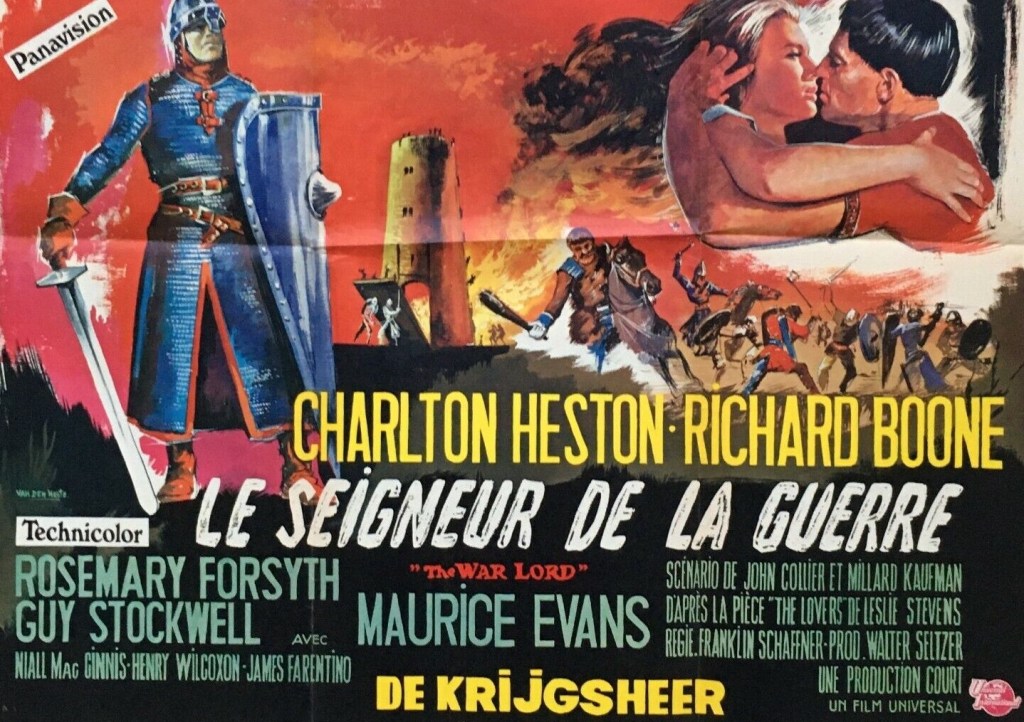
The only question-mark (unspoken) against Chrysagon’s employment of the “droit” privilege comes when the Duke demotes him and appoints Draco in his stead, prompting various endgame twists.

The battle is interesting enough, threat repeatedly countered, but there’s only so many times a director can cut to a soldier tumbling to his death. The ending is an anomaly, Chrysagon showing more respect to the son of his enemy than the wife of his villagers, and it seems odd that Draco is suddenly revealed as a bad guy, despite not being the one who triggered the conflict.

Chrysagon might have easily have fallen into the Martin Scorsese category of characters with “no redeeming features” – who are exempt apparently from the need for decency because of war – and it’s hard to summon up the necessary audience sympathy to make this picture work, especially given its starting point. Had Chrysagon merely fallen in love with Bronwen who reciprocated his feelings and that caused enmity among the villagers it would have been one thing but to start out from an historically inaccurate base is another.

One of the problems is that Bronwen doesn’t evolve. Her transition is from interesting to  passive. She has actually gone through a marriage ritual (of the Druid kind, but still binding as far as the villagers are concerned) and is therefore embarking on an adulterous relationship once the cock crows. It seems ludicrous, without allowing the woman dialog to express her feelings and acknowledge the peril of her actions, that she would believably take this route.  

So, if you like, accepting the droit de seigneur, in some ways it becomes a bolder picture, a major Hollywood star risking his reputation by playing a rapist, and in the way of all rapists justifying his action. And, like the characters in the recently-reviewed Play Dirty (1969) or Judith (1966), it becomes a question of individuals as pawns, the powerful taking advantage of position to abuse the weak. And it wouldn’t be the first time the innocent have suffered through a superior taking an indefensible approach.

Franklin Schaffner (Planet of the Apes, 1968) directed. Charlton Heston (Diamond Head) performs as if he’s the French equivalent of a Brit constantly biting on that stiff upper lip. Richard Boone (Rio Conchos, 1964) is wasted. Guy Stockwell (Tobruk, 1967) essays another weasel. It’s a picture of two halves for Rosemary Forsyth (Where It’s At, 1969) – while being wooed she’s good but then she’s pretty much dumped as far as the narrative goes.

Screenwriter John Collier, who later wrote the even creepier Some Call It Loving (1973) – an early Zalman King production – and Millard Kaufman (Raintree County, 1957) adapted the screenplay from an unusual source, a Broadway play by Leslie Stevens (Incubus, 1966) called The Lovers. The play had a different perspective, the bride ultimately committing suicide, while the War Lord and husband killed each other in a duel. Needless to say, there are no Frisians, so no siege, and no brother.

Before the arrival of Ridley Scott, this would been viewed as the best depiction of genuine medieval siege, so that part certainly still holds up. But the rest of it will only stand the test of time if you are willing to view it as an expression of the corruption of power.
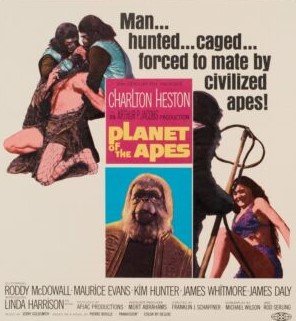
Behind the Scenes: “Planet of the Apes” (1968)

J. Lee Thompson (The Guns of Navarone, 1961) saw a much-needed boost to a drifting career vanish when he ducked out of this project – he had spent considerable time developing the project – in favor of Mackenna’s Gold (1969). Blake Edwards, first director attached, probably also lamented losing out. This was to have been Edwards last outside film before committing exclusively to Mirisch.

Producer Arthur P. Jacobs, who had bought the rights to Pierre Boulle’s Monkey Planet in 1963, could hardly believe his luck after the calamitous Doctor Dolittle (1967). Unusually, the two films were not cross-collaterized, a standard studio device whereby the losses on one film were played against the profits in the other, which would have almost certainly resulted in no profit payments to Jacobs.

And you could probably say the same for eventual director Franklin J. Schaffner, relegated to television and movie stiffs like The Double Man (1967) after the failure of big-budget historical drama The War Lord (1965) and his abortive attempt to film the Travis McGee novels of John D. MacDonald, whose total sales exceeded 14 million. He wasn’t involved in Darker than Amber (1970), the first McGee title to be filmed. Heston, who Schaffner had directed in The War Lord, pushed for his involvement.

Charlton Heston was also in dire need of career resuscitation, his past five movies – Sam Peckinpah’s Major Dundee (1965), The Agony and the Ecstasy (1965), The War Lord (1965), Khartoum (1966) and realistic western Will Penny (1967) – had all tanked. “In my view,” he opined, “I haven’t made a commercial film since Ben-Hur,” clearly ignoring the success of El id (1961).

And once it became a success Warner Brothers regretted letting it go. The studio had been involved in the project when Blake Edwards was to direct.  The movie was cancelled due to cost – it was budgeted then at $3-$3.5 million – and script and production problems. The studio might also have shied away after learning of the booming budget and lengthening schedule for MGM’s 2001: A Space Odyssey. Twentieth Century Fox ended up forking out $5.8 million to turn the project into reality.

As was often the norm in Twentieth Century Fox pictures, studio head honcho Darryl F. Zanuck found a part for his mistress, in this case Linda Harrison as Nova, the mute love interest. She  was a graduate of the studio’s program of investment in young talent. Others included Jacqueline Bissett (The Detective, 1968) and Edy Williams (The Secret Life of An American Wife, 1968).  Had Raquel Welch (One Million Years B.C, 1966) considered the opportunity to don a fur bikini again, it is doubtful Harrison would have won the role. But she turned it down as did Ursula Andress (The Southern Star, 1969). Angelique Pettyjohn (Heaven with a Gun, 1969) was auditioned

Former child star Roddy McDowall (Lassie Come Home, 1943), Kim Hunter (A Streetcar Names Desire, 1951) and Maurice Evans (The War Lord) fleshed out the ape contingent. Ingrid Bergman (The Visit, 1964), also in much need of a career uplift, turned down the role of Zira. Other stars in the frame for roles included Yul Brynner, Alec Guinness and Laurence Olivier. Edward G. Robinson should have played Zaius, but couldn’t manage with the make-up.

Source material was Monkey Planet by Pierre Boulle, author of Bridge on the River Kwai. Twilight Zone creator Rod Serling took a year and a reported 30 drafts to turn in a viable screenplay and the former blacklisted Michael Wilson, whose name had been removed from the credits of Bridge on the River Kwai (1957) and Lawrence of Arabia (1962), added the polish.  Wilson had won an Oscar for A Place in the Sun (1951) and another one for Friendly Persuasion (1956) although that was actually awarded to Jessamyn West since Wilson’s involvement was kept secret. If he had not been blacklisted, he would have been in the unusual position of having won four screenplay Oscars, although in the end the others were retrospectively awarded.

If you were looking for a sci-fi picture with dramatic heft, decent action, mysterious outcome and an examination of the human condition this was a more straightforward bet than 2001: A Space Odyssey (1968). While Fox reckoned its previous sci-fi venture Fantastic Voyage (1966) had worked out well, it had reservations about the cost of Planet of the Apes and the possibility of making an ape setting believable. In this case the special effects’ conundrum was make-up for the apes. If they just looked like humans wearing monkey suits the movie would not fly. Fox spent $5,000 on a test with Heston in a scene with two apes before it greenlit the movie.

Faces that could not express emotion and were as stiff as a botox overdose would invite audience ridicule. In the end the studio spent a reported million dollars on pioneering ape renditions by John Chambers, who  previously been a surgical technician repairing the faces of wounded soldiers. He had a team of 78 make-up artists There were almost as many scripts as crew and the changes wrought as the picture moved closer to being greenlit were to switch from a futuristic setting to a primeval one (which, incidentally, saved on costs), covering up the breasts of the female prisoners and inventing the stunning ending.

There were three possible endings, the one shot being that favored by the star.. Heston’s hoarse voice was not in the script, but an incidental by-product of him catching the flu. Apart from studio sets, the movie was filmed in blistering heat in Arizona. The rocket ship crashed into Lake Powell in Utah, ape city – modeled on the work of celebrated Spanish architect Gaudi – was constructed in Malibu Creek State Park, and the final scene was filmed on Zuma Beach in Malibu.

Unlike Fantastic Voyage which told audiences what the mission was, but in keeping with 2001: A Space Odyssey, Planet of the Apes opens with mystery. Like Rosemary’s Baby, the movie is viewed through the eyes of an innocent, one who cannot quite cotton on to his fall down the evolutionary food chain. Albeit more hirsute and muscular than Mia Farrow, nonetheless the casting of Heston dupes the audience into thinking he is somehow going to win, rather than just escape. He is an experiment who has wandered into the wrong planet. But there are few films that can top that shock ending.  And the movie more than fulfills the “social comment,” on which Heston was very keen, contained in the Boulle novel.

SOURCES: Russo, Joe, Landsman, Larry, and Gross, Edward, Planet of the Apes Revisited, The Behind the Scenes Story of the Classic Science Fiction Saga (New York: Thomas Dunne Books/St Martin Griffin, 2001); Hannan, The Making of The Guns of Navarone, 187. “Warners Ape World,” Variety, March 18, 1964, 4; “High Costs Impress Capital,” Variety, March 23, 1964, 3; “Planet of Apes Off for Present,” Variety, March 10, 1965. “Michael Wilson Under His Own Name For A.P. Jacobs,” Variety, December 14, 1966, 7. “MacDonald Novels Cue Major Pictures Corp.,” Variety, May 17, 1967, 5; Austen, David, “It’s All A Matter Of Size,” Films and Filming, April 1968, 5; “Fox’s Talent School,” Variety, June 26, 1968, 13; Film Locations for Planet of the Apes,” www.film-locations.com.

I have to confess this Behind the Scenes article would have been better if I had not loaned out – and never got it back – my copy of The Making of Planet of the Apes by JW Rinzler which was published five years ago.

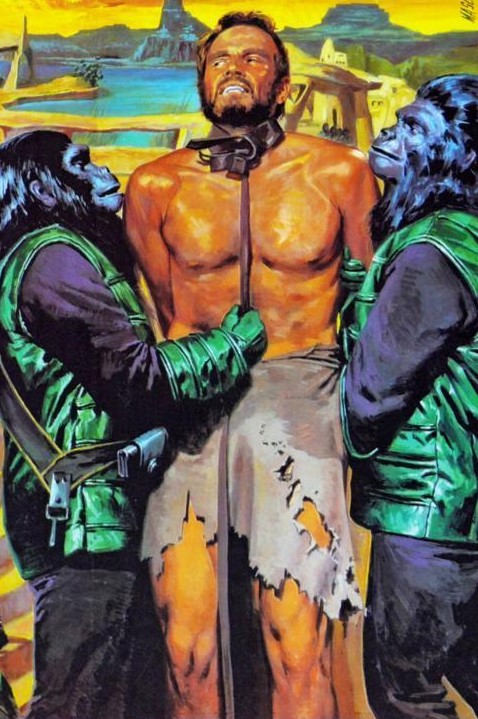
Planet of the Apes (1968) *****

Still astonishing that the two movies that rocked sci-fi to its core came out the same year. Initially beloved mostly by dopeheads 2001: A Space Odyssey quickly achieved ultra-academic status. But it’s difficult to ignore the fact that that Planet of the Apes had the greater long-term effect, given it spawned umpteen sequels and two sets of remakes.

You could also argue that the concept is even bolder than the Kubrick, not just man’s treatment of animals, but the idea of man being subject to a superior species, and inside an action-packed picture there’s plenty of time to digest the unimaginable and engage in debate about the nature of man. The elevator pitch might have been: “Take Hollywood’s strongest hero and torture him one way or another.”

Part of the movie’s genius is the unsettling opening, swirling, almost deranged, camerawork, a discordant score, the confident occupants of a spacecraft heading into the unknown finding the kind of unknown that fills them with dread rather than awe. Two thousand years into the future a spaceship doesn’t gently touch-down on a strange planet, but crashes into it, luckily landing in a lake, the three survivors escaping the sinking craft.

The audience knows a great deal more than they do, that the arid desert in which they find themselves stretches everywhere. But then they realize, with supplies that will last only three days, the soil here will not support life. But they are quickly upbeat when they find a small plant followed by substantial greenery. The sight of crucified figures on a hill is put to one side when they hear running water and rush to dive naked into a pool, confidence restored that they won’t die of thirst and should at least be able to eat vegetable matter.

The pool is a clever reversal. Usually open water is there for a female to disport herself. Now we’re seeing Charlton Heston’s bare backside. And another reversal: when clothes disappear it’s usually so a female has to come out of the water exposed.

But from the sight of the crucified apes, for the next seven minutes, their world is completely turned upside down. Chasing after their clothes they find inhabitants, automatically assumed to be inferior because they are mute and dressed like cavemen. But then the tribe hears a noise and panics. We see horses hooves, the tops of the flailing sticks used to beat prey out from the undergrowth, rifles, the natives, like dumb beasts, being driven into nets.

Then the first sight of an ape astride a horse wielding a gun. There can’t have been a more astonishing image, not even from the mind of Stanley Kubrick, in the whole of Hollywood sci-fi. Man is not just an alien in a world ruled by apes, but treated like an animal and only kept alive for scientific experiment. That man is rendered mute is hardly surprising because the apes don’t expect their captives capable of uttering an intelligent word.

From then on we’re in familiar and unfamiliar territory. There’s little more cliched than a captive trying to escape, success and failure the next beats. There’s little more cliched than a captive striking up a relationship with an imprisoned female, the pair contriving to achieve freedom.

Where this breaks new ground is that, in addition to making a connection with Nova (Linda Harrison), Taylor (Charlton Heston) woos a female ape scientist Zira (Kim Hunter) who tries to help him become accepted by her people. In the opening section, Taylor had opined, “somewhere in the universe there must be something better than man” but in the arrogance of humanity had assumed he be treated as an equal rather than an inferior.

So it becomes a duel of words. Taylor forced into being told how terrible humans are, and it’s hard to argue with the ape conclusion, while at the same time making the case for mankind, and especially himself, as a special type of species. There’s more than enough meat in the script, riddled with brilliant lines, to make audiences think deeply about the impact of man on the world. You could cast your mind back to the slaves of Spartacus (1961), trying to be accepted as equals, forced into revolt when that is denied. And to some extent that’s the imagined set-up here: Taylor will escape and establish some kind of resistance movement.

But that’s not what director Franklin J. Schaffner (The War Lord, 1965) has in mind at all. He’s been leading us by the nose to the most stunning ending in all of sci fi, and one of the most astonishing climaxes in the entire history of the movies, a shock wrung through with irony.

The movie is a supreme achievement, in springing its multitude of audience traps, turning  the world upside down. Jarring soundtrack and discomfited camerawork add to the stunning images. The ape world is revealed as complex, filled with engaging characters.

Outside of Number One (1969), this is Charlton Heston’s best performance as he moves through a range of emotions, cocky, puzzled, confident, baffled, captive, pleading, arguing the case for humanity, before spilling out into straightforward heroic mode of escapee. For the first time ever Hollywood now had a genuine box office star to headline sci-fi pictures and Heston would carry the torch for The Omega Man (1971) and Soylent Green (1973)

At every level a masterpiece.

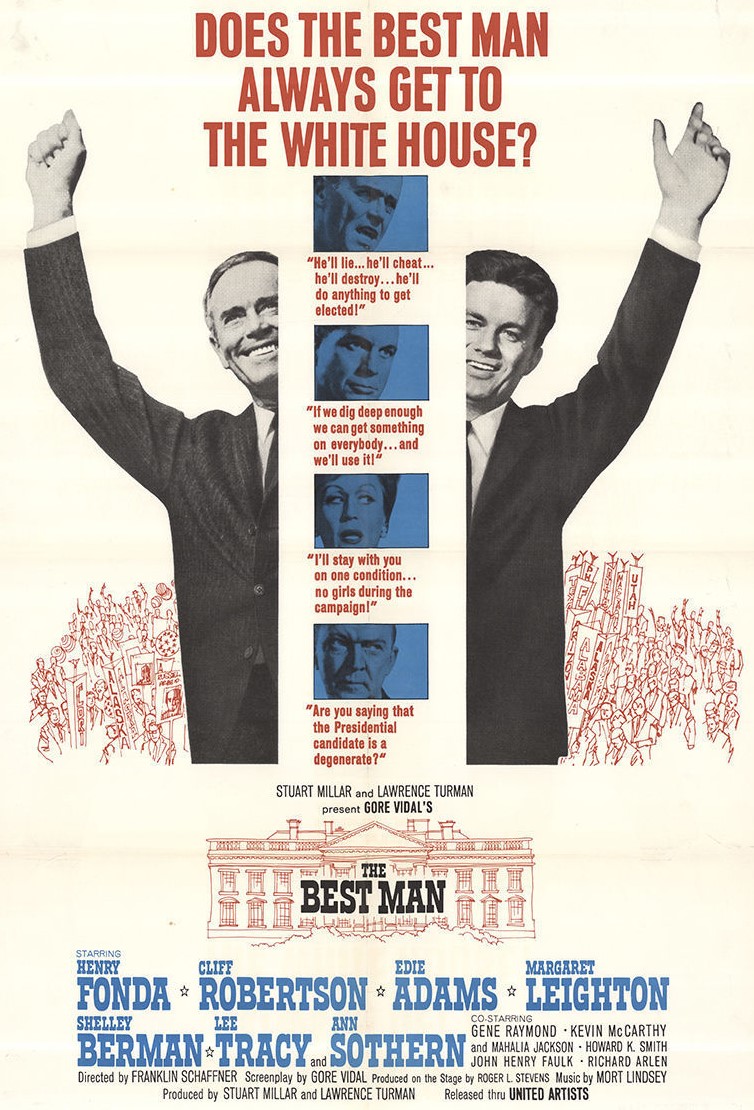
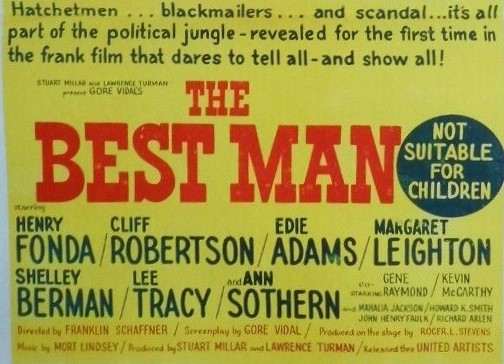
The Best Man (1964) ****

Current openness towards mental health issues has bestowed a contemporary vibe on this lively political drama. The other topic raised here has long ceased to be controversial. Not that far removed from Otto Preminger’s Advise and Consent (1961) in terms of dirty dealing and horse trading, flaw is the weapon used to cut opponents down to size.

The two principal candidates seeking their (un-named) party’s Presidential nomination could not be further apart, William Russell (Henry Fonda) a rich intellectual, Joe Cantwell (Cliff Robertson) a self-styled man of the people. Cantwell chases the populist vote with a  campaign built on fulminating against immigration and Communism, driving down taxes and spending more on the military. Russell seems unsuited for the cut-and-thrust of politics, too idealistic, too indecisive.

But he is a good judge of character whereas Cantwell most decidedly is not and in misreading the intentions of President Hockstader (Lee Tracy) shoots himself in the foot and leaves the nomination wide open, triggering his use of the dark arts, planning to circulate a file on his opponent’s problems with mental illness. Existing on a much higher plane, Russell refuses to fight back, although he has access to a witness claiming Cantwell was gay.

Apart from discussing these taboo issues – this was the first time the word “homosexual” was uttered in a movie – what’s interesting is that Russell’s philandering is not deemed damaging as long as his wife Alice (Margaret Leighton) is seen to publicly stand by him. Despite the fact that Cantwell is as clean as a whistle – doesn’t drink or smoke or have a lover – affairs are seen as such a fact of life of politics that Cantwell’s wife Mabel (Edie Adams) assumes he will have one. Cantwell, very much one to go for the jugular, clearly believes the public takes the same non-judgemental view otherwise he would easily skewer Russell on his marital discord.

In some respects, Cantwell is by far the better candidate if you were to judge him on personal behaviour, but he lacks the necessary savvy, “ a tragedy in a man and a disaster in a president.

As you might expect from a script written by novelist Gore Vidal, sometime political heavyweight, there are plenty zingers: “expect 22 minutes of spontaneity”; “I don’t object to you being a bastard, I object you being a stupid bastard;” and “I won’t throw my mud if you won’t throw your mud.”

It may be artistic irony that determined director Franklin J. Schaffner to film in black-and-white since politics is nothing but various shades of grey, but there was probably a more practical reason, to incorporate footage from conventions.

Somewhat surprisingly, both men are honest with their wives, Russell making a pact to divorce Alice if not elected, their marriage long ago defunct, while Cantwell’s wife is fully aware of the slur on her husband’s name. The women here are well-drawn, not quite the submissive types you might expect, certainly not Alice who has every right, given his infidelities, to act the shrew, instead of which she plays the shrewd card. Mabel proves a loving wife but a little indulged to the extent her teetotal husband has no idea how much alcohol she can shift and she reserves her right to keep him waiting. Alice, it might be noticed, is more vicious than her husband should it come to the down-and-dirty.

And there’s a stack of wannabe power-makers from pushy busybody Mrs Gamidge (Ann Sothern) – so full of her own importance that she fails to see the slight in being told that “talking to you is like talking to the average American housewife” – to walking timebomb Sheldon Bascomb (Shelley Berman).

Not so full of arcane American politics as Advise and Consent, and with a more straightforward narrative, it digs the dirt in compulsive fashion on the dirt-diggers. In questioning whether someone with mental health issues could be a worthy national leader, the movie naturally ignores the narcissism and megalomania that seemed essential criteria for any person achieving high office or excessive business success. It’s probably a subject that remains unresolved, although a good many personalities have admitted to such problems.

Cliff Robertson (The Honey Pot, 1967) takes the acting honours if only because we have seen a version of the Henry Fonda (Battle of the Bulge, 1965) political idealist before in Advise and Consent. Robertson essays a character of Donald Trump dimensions and Fonda is clearly modelled on Kennedy, but Robertson comes across stronger and even Fonda may have been getting fed up with being such a straight-shooter as seen by his later villainous choices. Edie Adams has a more complex part here than in The Honey Pot and Margaret Leighton (The Fighting Pimpernel, 1949) can play ramrod-stiff women till the cows come home.

Hollywood veteran Ann Sothern of Maisie fame is terrific as the interfering Mrs Gamidge and Shelley Berman (Divorce American-Style, 1967), making his movie debut, is one of the most irritating characters you will ever see. Kevin McCarthy (Mirage, 1965) plays Russell’s whip-smart aide with Lee Tracy (Dinner at Eight, 1933) in his first movie in nearly two  decades as the wily President. 

Audiences were denied the first glimpse of Penny Singleton (the Blondie series) in fourteen years when her part was excised. To make up for that, we get to see Mahalia Jackson sing.

Director Franklin J. Schaffner (The Double Man, 1967) keeps characters to the fore rather than relying on the many twists, and does a decent job, complete with aerial helicopter shots, of opening up Gore Vidal’s stage play. Vidal (Ben-Hur, 1959) had stood unsuccessfully for Congress so had an insider’s viewpoint.

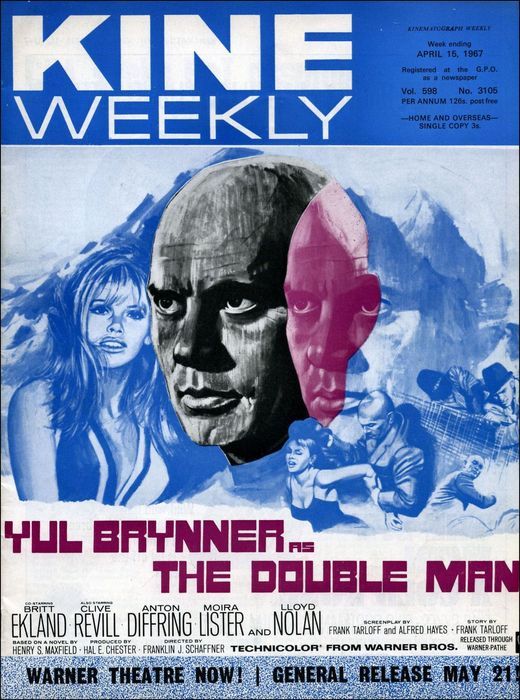
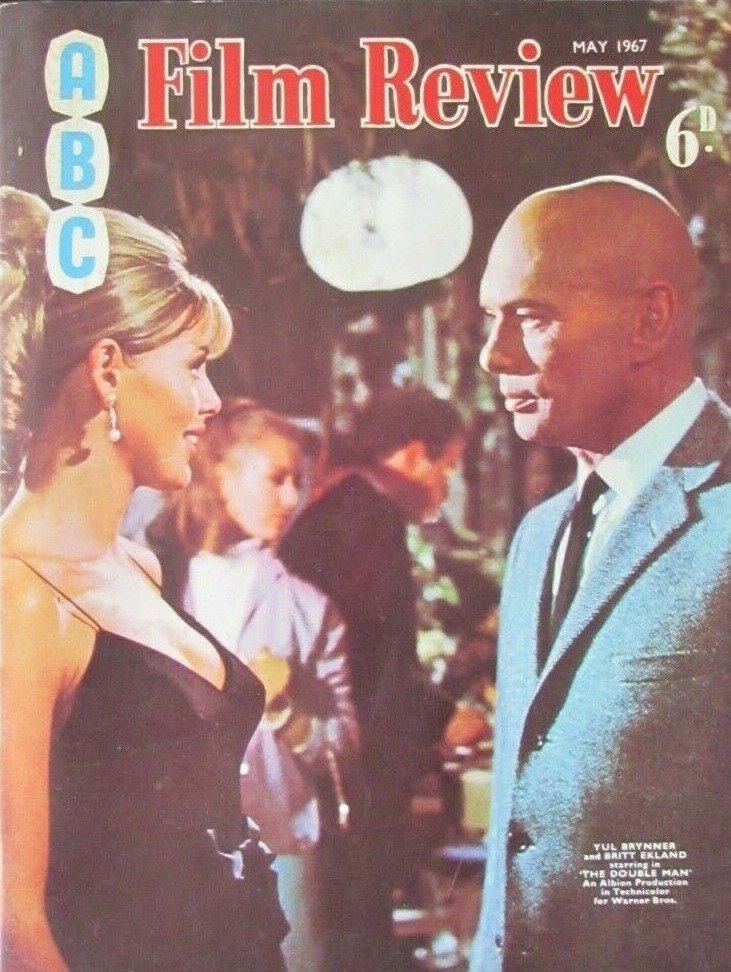
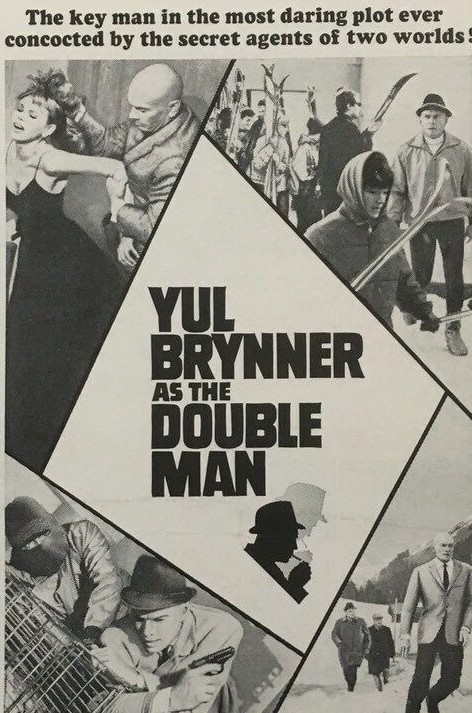
The Double Man (1967) ***

A bit more action and this could have been a John Wick-style winner because C.I.A. agent Dan Slater (Yul Brynner) is a big-time bad ass, all steely stare and resolve, and no time for anyone who gets in his way as he investigates the unexpected death of his son in the Austrian Alps.

It’s probably not this picture’s fault that any time a cable car hovers into view I expect to see Clint Eastwood or Richard Burton clambering atop all set to cause chaos, or any time a skier takes off down the slopes anticipate some James Bond malarkey. Luckily, director Franklin J. Schaffner (Planet of the Apes, 1968) avoids inviting comparison in those areas but rather too much reliance on the tourist elements of the ski world puffs out what would otherwise be a tighter storyline. And he also sets too much store by loud music to warn the audience of impending danger.

Slater is out of the ruthless espionage mold and, convinced on paltry evidence that his son has been murdered, determines to track down the perpetrators. There is a reversal of the usual plot in that those he asks for help are unwilling to give it, retired agent Frank Wheatly (Clive Revill) and chalet girl deluxe Gina (Britt Ekland) who initially views him as an older man to be fended off but turns out to have the vital information he seeks.

There’s a lot of tension but not much action and today’s modern vigilante would have beaten the information out of anybody who crossed his path rather than taking Slater’s path. Despite this, the relentless tone set by Slater ensures violent explosion is imminent. To be sure, you will probably guess early on, from the appearance at the outset of some Russians, that Slater is heading into a trap, but the reasons are kept hidden long enough.

There are some excellent touches. Slater’s boss (Lloyd Nolan) has a nice line in keeping his office underlings in check, chalet hostess (Moira Lister) is all style and snip, the Russian Col. Berthold (Anton Diffring) clipped and menacing. And the skiing sequences that relate to the picture are well done while the others are decently scenic.   

It’s a shame that Brynner is in brusque form for it gives Britt Ekland in a switch from her comedy breakthroughs not enough to do. Revill is excellent as the former agent who has had his fill of espionage and dreads being pulled back into this murky world. Producer Hal E. Chester clearly spent more on this than on The Comedy Man (1964) but with varying results, top-notch aerial photography but dodgy rear projection. And there are some screenwriting irregularities, such as why conduct the son’s funeral before the father is present.

Catch-Up: Yul Brynner performances previously reviewed in the Blog are The Magnificent Seven (1960), Escape from Zahrain (1962), Flight from Ashiya (1964), Invitation to a Gunfighter (1964), Return of the Seven (1966) and Villa Rides (1968). Britt Ekland movies already covered are: The Happy Thieves (1961), The Night They Raided Minsky’s (1968), Machine Gun McCain (1969) and Stiletto (1969).

Discover WordPress

A daily selection of the best content published on WordPress, collected for you by humans who love to read.

The Atavist Magazine

by Brian Hannan

WordPress.com News

The latest news on WordPress.com and the WordPress community.