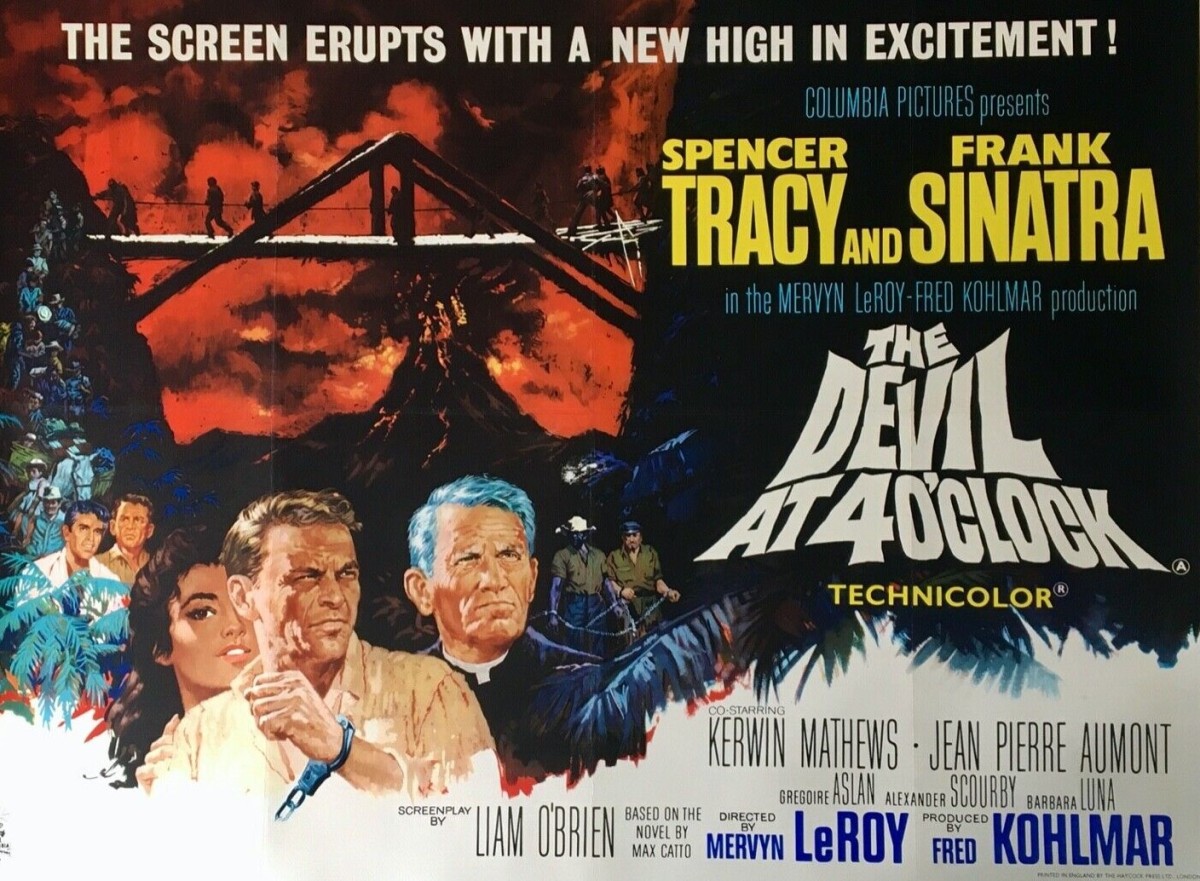
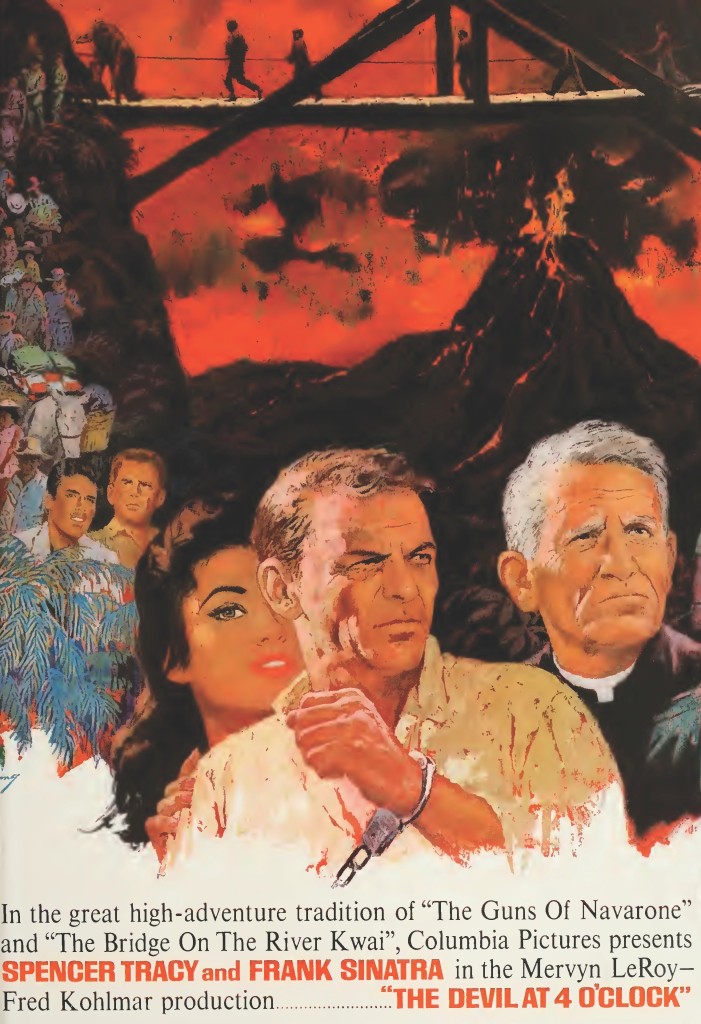
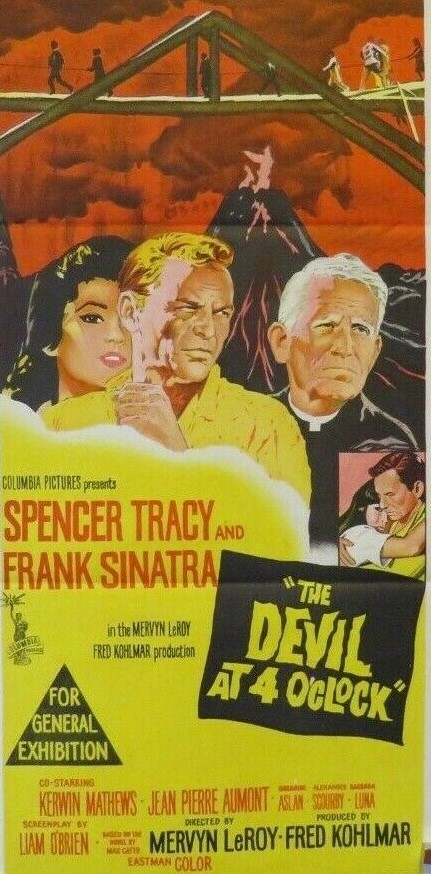
You took on Spencer Tracy (Judgment at Nuremberg, 1961) at your peril. Not even the best efforts of a volcano can wrest the screen from him. And certainly Frank Sinatra (The Detective, 1968) is put in the shade. And if you wanted to work with Tracy you had to cede, no matter how high-flying your career might be, top billing. Both names are above the title and if they were actually equally ranked they would appear in alphabetical order. And it wasn’t until a later disaster picture, The Towering Inferno (1974), that someone solved the tricky problem of designating equal billing by having Paul Newman’s name first on the left of the poster, but Steve McQueen’s name higher on the right.
Anyway, theoretically, nobody should be bothering much who is in a disaster picture when, again theoretically, the audience has come to gawk at the special effects – exceptional for the time but looking tame now. But Hollywood had learned from experience – and the same rules would apply in the disaster boom of the 1970s – that there was no point spending all that money on effects if there was not enough interest in the characters leading up to the disaster element, and also learned you needed stars to attract audiences in the first place.
In the tradition of…previous Columbia hits.Contractual billing agreements referred to the placing of names not faces on the poster , so Columbia could stick Sinatra in the center and there was nothing Tracy could do about it.
So this scenario has old whisky priest Fr Doonan (Spencer Tracy) getting ready to leave a Pacific island, replaced by the younger Fr Perrau (Kerwin Matthews), while three convicts, led by Harry (Frank Sinatra), on the way to long prison stretches elsewhere make an unexpected pit stop. The rule is that Fr Doonan can make use of any prison labor so he hives them up the mountain to fix the hospital housing lepers that the authorities wish to keep a secret in case it scares off the tourists. Naturally, it’s not long before Harry is making a romantic pitch for blind nurse (Barbara Luna) but that takes second place to hatching an escape plan.
Running away is only foiled when the volcano begins erupting and as the island authorities begin the evacuation it’s up to the priest and the convicts – Harry’s romantic instinct overcoming reluctance – to fetch the kids in the leper colony. Fr Doonan could have come straight from Boys Town (1938), the kind of two-fisted man of the cloth who tells it like it is, has no compunction about upsetting anyone who gets in his way, but with right on his side generally wins the day. The Governor (Alexander Scourby) isn’t viewed as a bad guy so much by refusing to acknowledge the lepers – especially as by that time the disease was not contagious, priest and hospital workers haven’t caught it, though begging the question why young kids still did – as by allowing brutal treatment of the prisoners, sticking three overnight in suffocating heat in a hole in the ground intended for one.
Narrative edge is added by the obstracizing of the lepers – at the time people contracting various illnesses would be treated as lepers and anyone with a serious mental condition stuck away out of sight. But the characters don’t occupy the moral twilight of the later disaster pictures, where the unscrupulous were often offered redemption. Here, the best we’ve got is a rehabilitated sex worker acting as hospital matron and the convicts agreeing to help out.
Kind of suffers from not enough scenes between the priest and Harry, they almost occupy separate narrative threads, but then Frank Sinatra’s got enough on his plate to avoid looking creepy when making advances on a woman who can’t see him. In fact, there’s a serious scene-stealer, another convict Marcel (Gregoire Aslan), getting in the way, his jovial devil-may-care attitude lifting the gloom.
As ever, the main audience concern is who lives and who dies and here the makers throw a curveball and you could interpret the ending as both triumphant and downbeat. The special effects are still pretty good – sensational for the time if truth be told – especially for the pre-CGI era, but the earthquake aspects come in ahead of the rolling lava, which no matter which way you cut it always resembles slow thick soup, although the explosion, done for real using tons of TNT, makes a mark. Technically, the makers pull a fast one in ignoring the tidal wave that follows an eruption, thus allowing most of the islanders to escape by sea.
It being the jungle there’s always a tricky bridge to navigate – Indiana Jones encountered a similar trope decades later – but there’s no snakes or big beasts to cause a narrative diversion. Whatever it is about Spencer Tracy’s screen presence that allows him to inhabit characters with such ease he brings in spades to the priest. Sinatra looks as though he’s learning a thing or two because his Harry bears some similarities in the the down-at-heel unkempt appearance and the lack of scene stealing.
In case you’re wondering, the “four o’clock” of the title is a deadline but appears too late in the picture to create the required tension. Hollywood veteran Mervyn LeRoy (Moment to Moment, 1966) is at helm. Screenplay by Liam O’Brian (The Great Imposter, 1960), in his last movie, from the bestseller by Max Catto (Seven Thieves, 1960).
Worth it for Tracy and Sinatra and Aslan and to see how they managed sfx in ye olden days.
Not my pick of the flicks, but yours, the films viewed most often since the Blog began in June 2020. Given that the number of hits for the blog has tripled over the last year, you might expect to see an entirely new Top 40. But that’s not been the case. Worth noting that the top five pictures star women. And some films have shown remarkable staying power with some stars – big round of applause for Ann-Margret, Angie Dickinson, Alex Cord, George Peppard, Gene Barry, Jean Seberg, Roger Moore, Alain Delon, Frank Sinatra, Kirk Douglas et al – featuring more than once.
The figures in brackets represent the previous year’s position.
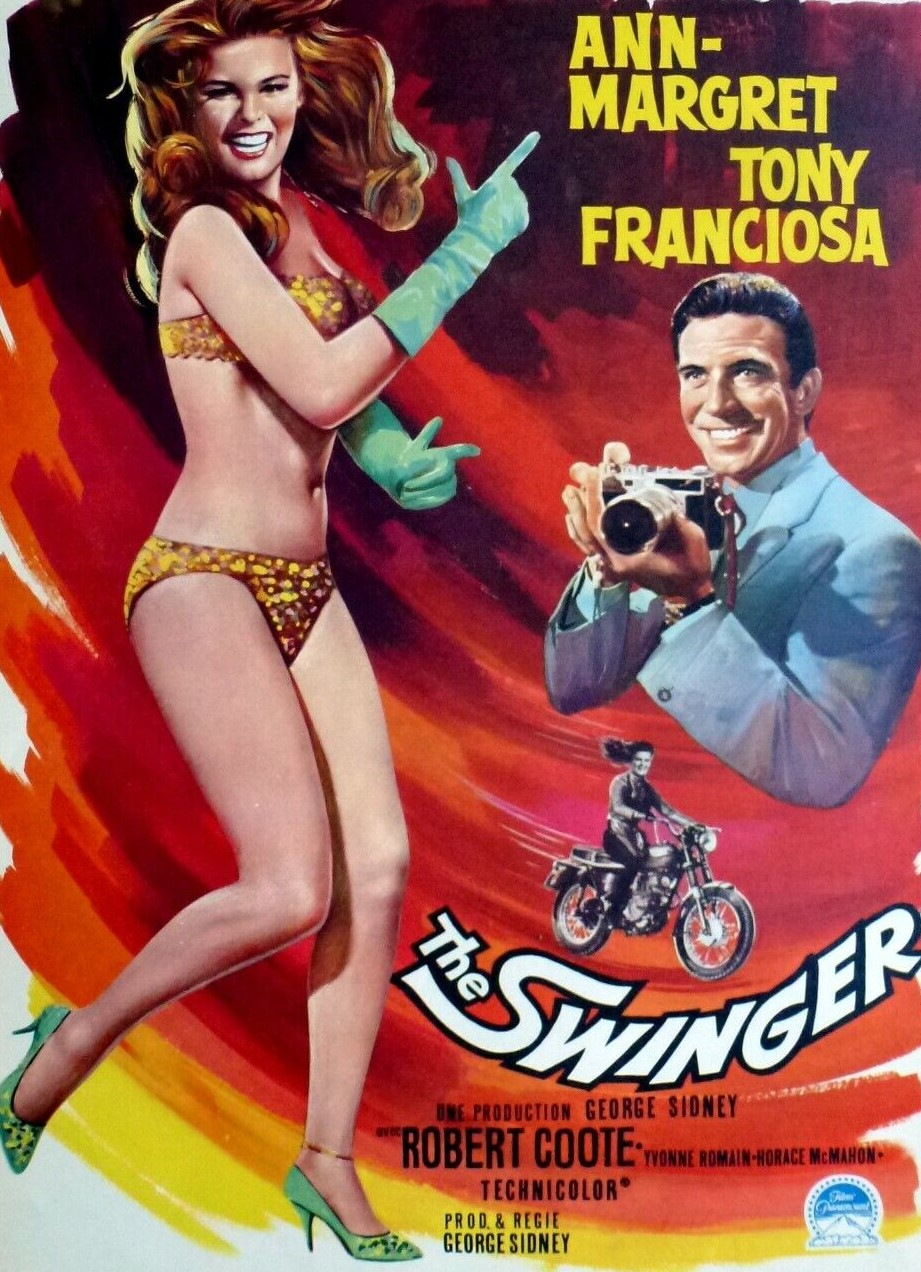
(4) The Swinger (1966). All hail Ann-Margret. Bouncy sex comedy that manages a sprinkling of innocence.
(40) Stagecoach (1966). No prizes for guessing that it’s the presence of Ann-Margret (again) rather than Alex Cord that has hit a chord in this decent remake of John Ford’s famous western.
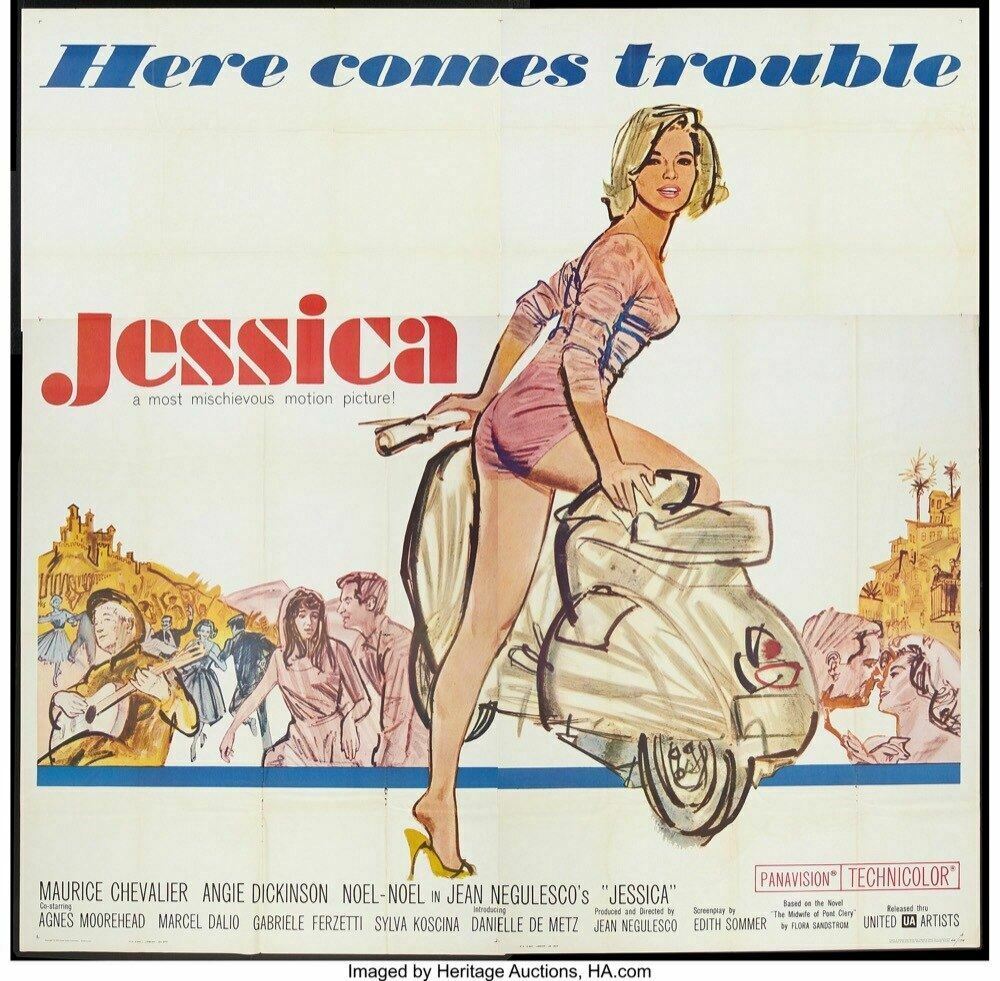
(1) Jessica(1962). Angie Dickinson as a young widow incurring the wrath of wives in a small Italian town.
(5) Fraulein Doktor (1969). Under-rated World War One espionage tale with Suzy Kendall out-foxing Kenneth More, grisly realistic battle scenes and a superb score from Ennio Morricone.
(New Entry) The Sins of Rachel Cade. Angie Dickinson as African missionary falling foul of the natives and commissioner Peter Finch. Roger Moore in an early role.
(3)Once Upon a Time in the West (1969). Sergio Leone masterpiece featuring the stunning cast of Claudia Cardinale, Henry Fonda and Charles Bronson and that fabulous Morricone score.
(New Entry) Fireball XL5. The famous British television series from Gerry and Sylvia Anderson, now colorized. “My heart will be a fireball…”
(3) The Secret Ways (1961). The first of the Alistair MacLean adaptations to hit the big screen features Richard Widmark trapped in Hungary during the Cold War.
(10) Moment to Moment (1966). Nod to Hitchcock in twisty Jean Seberg thriller set in the South of France. Also starring Honor Blackman.
(New Entry) Vendetta for the Saint . Who cares if it’s two television episodes combined? Roger Moore tackles the Mafia.
(32) Baby Love (1969). Controversy was the initial selling point but now it’s morphed into a morality tale as orphaned Linda Hayden tries to fit into an upper-class London household.
(15) TheSisters (1969). Nathalie Delon and Susan Strasberg in complicated love triangle of love and betrayal.
(7) Pharoah (1966). Polish epic set in Egypt sees the country’s ruler at odds with the religious hierarchy.
(9)Can Heironymus Merkin Ever Forget Mercy Humpe and Find True Happiness? Self-indulgence reaches new heights as singer Anthony Newley invokes his inner Fellini that somehow involves bedding lots of women. Then-current wife Joan Collins co-stars.
(New Entry) The Best House in London (1969). That’s a euphemism for a brothel, let’s get that right from the outset. David Hemmings tries to do right by the sex workers.
(New Entry) Pendulum (1968). The George Peppard (or perhaps Jean Seberg) reappraisal continues. Here he is the cop accused of murdering unfaithful wife Seberg.
(6) Oceans 11. Frank Sinatra heads the Rat Pack line-up, inspiring a couple of remakes and with Tarantino ripping off one scene.
(36) Lady in Cement (1969). Sinatra again as private eye Tony Rome who takes on Raquel Welch (and that’s a stretch?) as a client.
(8) The Golden Claws of the Cat Girl (1968). French cult film with Daniele Gaubert as a sexy cat burglar.
(New Entry) Go Naked in the World (1961). Gina Lollobrigida finds that her profession (the oldest) and true love (with rich Anthony Franciosa) don’t mix. Great turn from Ernest Borgnine as a doting father.
(17) Pressure Point (1962). No escape for racist patient Bobby Darin when psychiatrist Sidney Poitier is around.
(New Entry) A Dandy in Aspic (1968). Cold War thriller with Laurence Harvey as a double agent who wants out. Mia Farrow co-stars.
(22) Deadlier than the Male (1967). Espionage with a sting in the tale as venomous female villains including Elke Sommer and Sylva Koscina target Bulldog Drummond.
(New Entry) Once a Thief (1965). Change of pace for Ann-Margret as working mother whose ex-jailbird thief Alain Delon is forced into another job.
(12) Subterfuge (1968). Gene Barry-Joan Collins spy thriller set primarily in a dreary London.
(14) Fade In(1968). Not at all as bad as rising star Burt Reynolds believed – he disowned it. Romance set on a movie location.
(New Entry) The Girl on a Motorcycle / Naked under Leather (1968). Heavily-censored in the U.S., erotic drama with singer Marianne Faithfull as the titular fantasizing heroine. Alain Delon co-stars.
(New Entry) Some Girls Do (1969). Bulldog Drummond returns and a bevy of villainous women including Daliah Lavi and Beba Loncar await.
(New Entry) She Died with Her Boots On / Whirlpool (1969). Sleazy British film from cult Spanish director Jose Ramon Larraz sees kinky photographer Karl Lanchbury seduce real-life MTA Vivien Neves.
(New Entry) The Misfits (1960). Last hurrah for Clark Gable, fabulous turns from Montgomery Clift and Marilyn Monroe in John Huston tale of losers.
(New Entry) Rage (1966). Glenn Ford and Stella Stevens combat pandemic in Mexican town.
(23) A House Is Not a Home (1964). Not when it’s a brothel. Shelley Winters is the madam. Raquel Welch has an uncredited role.
(New Entry) In Harm’s Way (1965). John Wayne and Kirk Douglas in Otto Preminger WW2 epic set in Pearl Harbor and after.
(New Entry) Istanbul Express (1968). Gene Barry faces Senta Berger in espionage thriller. Shown on television in the U.S., but gained a cinematic release elsewhere.
(24) P.J. / New Face in Hell (1967). George Peppard’s private eye finds client Raymond Burr too tough to handle. Gayle Hunnicutt is the femme fatale.
(New Entry) Beat Girl / Wild for Kicks (1960). Another sleazy British drama. Gillian Hills is the youngster tempted into the striptease game. Christopher Lee puts in an appearance.
(27) The Brotherhood (1968). Brothers at war Mafia-style with Kirk Douglas and Alex Cord.
(New Entry) The Invitation (2022). Gothic conspiracy starring Nathalie Emmanuel from Game of Thrones.
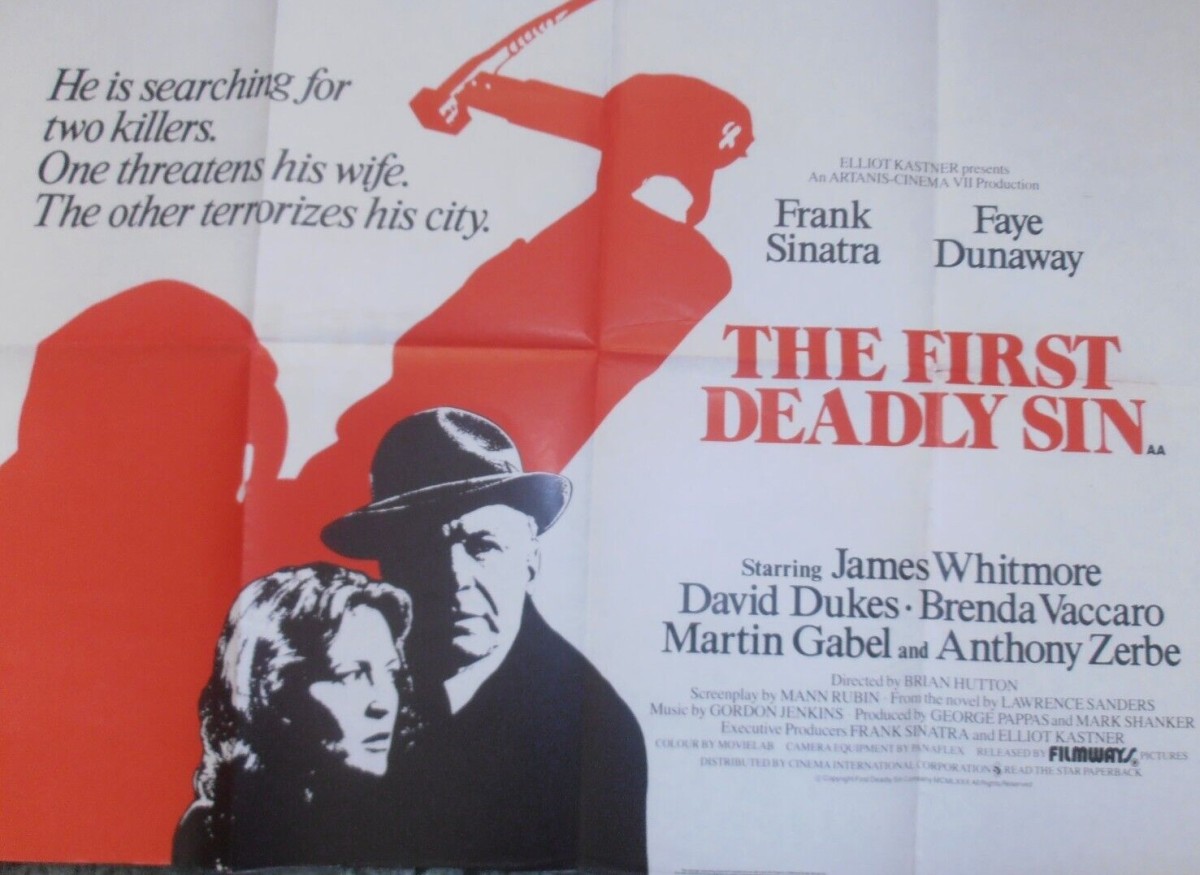
(New Entry) The First Deadly Sin (1980). Frank Sinatra’s last starring role as cop tracking serial killer. Faye Dunaway plays his dying wife.
(New Entry) The Family Way (1966). Hayley Mills sheds the child-star image with a vengeance, shedding his clothes in British family drama. Co-starring father John Mills and Hywel Bennett.
The boldest role ever undertaken by a major star of Frank Sinatra’s generation – and little thanks he got for it. Not only was he virtually unrecognisable under a slab of make-up that George Hamilton would have envied but the role was a complete reversal of his screen persona. Admittedly, he had flipped that persona for Tony Rome (1967) and as the cuckolded cop in The Detective (1968), but this was on a completely different level.
Sinatra was no Tom Hanks or Daniel Day-Lewis, known for inhabiting different types of characters, and, while he did have a vulnerability that he put to good use in The Manchurian Candidate (1962) and The Man with the Golden Arm (1955), he was best known on screen as the guy in charge.
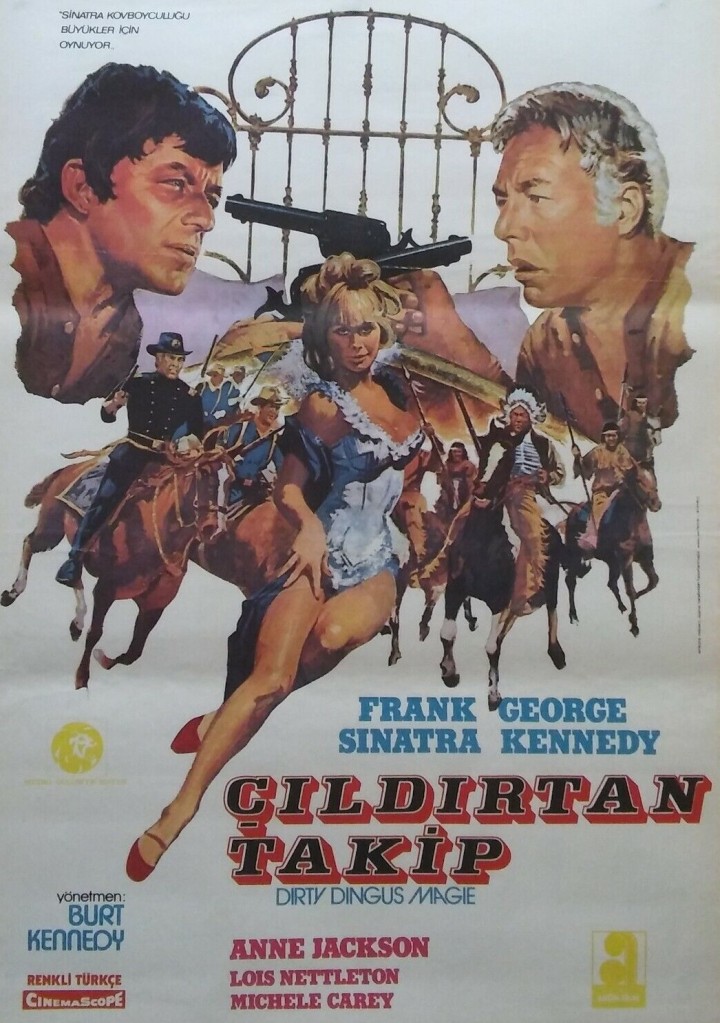
That was far from the case here. Dumb and dumber might be more apposite. Dingus Magee (Frank Sinatra) is a scamp, an outlaw so useless he is worth only $10 in reward money, who steals the stash of old rival Hoke Birdsill (George Kennedy), triggering a revenge caper that is complicated by a host of unnecessary complications by director Burt Kennedy (Welcome to Hard Times, 1967) who has set his heart on some kind of satirical comedy western with a revisionist slant.
So we get a female mayor, Belle (Anne Jackson), who happens to own the local brothel, whose commercial prospects are endangered when the local Cavalry are called away to fight the Native Americans, an Indian chief Crazy Blanket desperate to trade his daughter for a rifle, and when that looks like not working out calling on any available squaw to seal the deal, predatory schoolteacher Prudence (Lois Nettleton) and a running gag involving a Brown Derby hat that results in a gunfighter (Jack Elam) being mistaken for Magee.
It’s a bit long on complications and short on satire and is rescued by the double act of Magee and Birdsill, who constantly get in each other’s way or try to pull a fast one. Birdsill, as it happens, is appointed sheriff, since that’s in the purview of the mayor, and, on the right side of the law for the first time in his life, makes an ill-fated attempt to do good.
Magee tries to help him along. In exchange for the sheriff turning a blind eye for a period of time to Magee’s nefarious activities, the reward for the outlaw will mushroom, permitting greater kudos for the sheriff on his capture.
The main problem is that Kennedy directs with a very heavy hand, very obvious musical cues for a start, and there’s not enough that’s intrinsically funny. Though there is a reversal of an obvious joke of Birdsall being sent to the brothel to locate the mayor, expecting to find a client not the owner.
But both Sinatra and George Kennedy (The Sons of Katie Elder, 1965) are a delight, the latter also playing against type rather than his usual dominating character. Their dumbness takes some beating. Sinatra just about gets the upper hand, but there’s not much in it.
The best thing about the picture is the sense of reality. The U.S. Cavalry spend more time in the brothel than out hunting Native Americans. Law and order can go to hell as long as everyone is having illicit fun. The respectable schoolmarm proves a skilled seductress. Peace is desirable because it is more profitable than war. And the bulk of the outlaws in the Wild West are far from achieving legendary status, just two-bit punks.
Not surprisingly, this was a massive flop and killed off Sinatra’s movie career for the rest of the decade – not that he was overly concerned, “My Way” having reignited his singing career and he was a Vegas regular. But it’s a shame the acting was so vilified, Roger Ebert blamed Sinatra rather than the director for its failure, in particular taking him to task for the one-take approach that Gena Rowlands previously exalted (but what does she know, she’s just an acclaimed actress and knows how a movie works better than a critic).
Well overdue for a reappraisal and if you go in duly warned you might even enjoy it, or at least the Sinatra-Kennedy double act.
Effervescent mystery punching a hole in the traditional private eye caper. Look elsewhere for film noir as Frank Sinatra (The Manchurian Candidate, 1962) reinvents his screen persona. On the one hand he’s such a cool cat, living on a boat in Miami, you half expect him to burst into song just with joy. On the other hand, you wouldn’t cross him. Corpses tend to pile up in his vicinity.
There’s a surprising self-awareness that’s dealt with through considerable subtlety, not with the usual angst of film noir where flaws not only tend to be magnified but spill over and drench the plot. Addicted to gambling, Rome steers clear of marriage and any long-term relationship, knowing such a move would be disastrous for the other party. A former cop, he is touchy though about his father, also a cop, who blew his brains out when some murky deal went wrong.
High on the glamorous side, houses the sizes of small cities, women parading in either next to nothing or with the current year’s hot fashion items. You’d be surprised there wasn’t a horse-riding scene, or one set at a hi-hat ball. But this is pretty much a procedural as the canny detective probes the low life as much as the high, bars where go-go dancing is the least of the illicit activities, jewellers who act as fences, and plumbs the life of millionaire Rudolph (Simon Oakland), tough on the business side, dumb as donuts when it comes to romance with former cocktail waitress (a profession often bracketed with quote marks) wife Rita (Gena Rowlands).
And oddly enough, romance here turns out to be touching, sex coming with responsibility rather than a free-for-all as you are initially led to believe. A lesbian scene for once is not exploitative.
Begins with one of the humdrum cases that must consume the bulk of a gumshoe’s time – the hunt for a valuable diamond brooch, lost from the dress of married drunken heiress Diana (Sue Lyon). Turns out he’s not the only one, inexplicably, looking. He takes a beating from a couple of hoods.
When his ex-partner meets his maker in a bathtub, it’s a cinch Tony Rome is next, which means he has a lot of explaining to do to his endlessly frustrated ex-colleague Lt Santini (Richard Conte). If it was a question of whiling away the time, Rome could spend it in the arms of Diana or multiple divorcee Anne (Jill St John).
As you might expect, everyone has secrets they prefer to keep hidden, and happy to do so with violence. Otherwise, they’re going to be knocked sideways by the past. There’s no shortage of suspects including the elusive Nimmo.
I’m assuming the censor enjoyed a chuckle when Mrs Schuyler (Templeton Fox) appeared rather than pursing their lips in disapproval at the way Sinatra wrapped his lips around the word “pussy.” There’s a certain amount of light-hearted sexual jousting but if you were looking for predatory behavior it’s women you’d point the finger at, though given a free pass since in Miami, apparently, men were vastly outnumbered by men and lasses who had not developed a come-hither would be left on the sidelines.
To properly appreciate the picture, you’d have to cast your mind back to a time before there was a surfeit of television detectives and when the general mystery picture (also encompassing spy movies) had gone AWOL or awry with balderdash plot and outsize villains whose only satisfaction in life was holding the world to ransom. In fact, in retrospect, it’s refreshing to find a picture where the director doesn’t pull the wool over your eyes and your hero isn’t an arrogant preening bantam.
So what you’ve got is a properly-plotted plot, clues aplenty that only our clever private eye can unravel, and, inevitably, in the Raymond Chandler tradition some heavy bursting through a door with a gun, and, in this case, also a shovel. This private dick doesn’t fall into the hard-working category of legend, often favors a Bud over the harder stuff, and though he can knock out the cynical one-liners they often come with a tinge of truth or melancholy.
And for once the MacGuffin (Maltese falcon might be a more apt reference) bears significance to the plot.
One of the interminable pot-shots critics took at Sinatra was his preference for working in a single take, the impression given that he was a lazy sod and a bit more effort would have resulted in a better performance. On the other hand, you could just be in awe of an actor who can hit the button stone dead in a single take.
Co-star Gena Rowlands, with something of a hard-boiled reputation herself, found him to be a “wonderful actor; he could do a whole complicated scene in one take…there was nothing pretentious about him, he was just awfully nice.”
Sinatra is no Bogart but for a time afterwards audience were saying of other pretenders to the shamus crown “he’s no Sinatra.” Jill St John (The King’s Pirate, 1967) makes the most of a more interesting part, including delivering the stinger in the tale. Gena Rowlands (Machine Gun McCain, 1969) reveals the little girl under the glam, Richard Conte (The Lady in Cement, 1969) tones down his typical belligerence, Sue Lyon (Night of the Iguana, 1964) good as a young woman confused by sudden wealth.
The under-rated Gordon Douglas (Stagecoach, 1966) directed from a script by Richard L. Breen (A Man Could Get Killed, 1966) and Marvin H. Albert (Duel at Diablo, 1966), also author of the source novel.
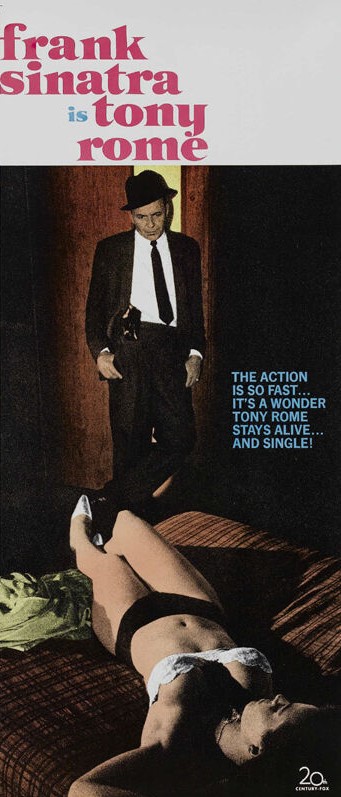
The poster designer pulled a fat one. In typical titillating fashion, you think Sinatra is staring down at a half-naked corpse. But, in fact, no female was harmed in this picture.
Takes a little while to get going but once it hots up it’s perfect entertainment.
Don’t you just love a really good bad movie? Where redemptive character is outlawed. When over-acting is the key. In which everyone gets the chance to spout off about someone else, generally to their face, and then is permitted, in the cause of balance, a quiet moment of bitter self-reflection. And even the most minor character gets a zinger of a line. Welcome to Hollywood.
Tale of an actor’s rise and not exactly fall because we leave Frank Fane (Stephen Boyd) at a pinnacle of his career, though, don’t you know, he’s empty inside and deserted by all his faithful companions. Lucky Frank has some kind of charisma or that he just fastens onto losers who see in him what they need because from the outset he is one mean hombre, living off stripper girlfriend Laurel (Jill St John), so dumb she switched to him from his so dependable best pal Hymie (Tony Bennett – yes, that Tony Bennett, the singer).
He hooks up with Kay (Elke Sommer), a designer who happens as a sideline to make costumes for off-Broadway productions. When King of Lowlife Punks Frank shows a pusillanimous stage actor what you do in a knife fight he strikes a chord with theater producer Sophie (Eleanor Parker), who happens to have a sideline as a talent scout for the movies.
She fixes him up with an agent Kappy (Milton Berle – yes that Milton Berle, the loudmouth comedian) and together they sell him to studio boss Regan (Joseph Cotten). The only good deed Frank does in the entire movie is to stand witness – not for marriage, but for divorce – for an ordinary couple, private detective Barney (Ernest Borgnine) and Trina (Edie Adams), he meets at a bullfight, huge fans, and thank goodness that action comes back to bite him.
The picture goes haywire in the third act. Fane’s career is crumbling in the face of audience indifference, exhibitor displeasure and, don’t you know it, a chance for revenge for Regan, who was stiffed in a previous contract. But instead of taking the traditional tumble into the forgotten category, his career is revived by an Oscar nomination.
From top to bottom – a fully-clothed Stephen Boyd, then in various states of undress, Elke Sommer, Jill St John and Eleanor Parker. That’s how to sell a picture apparently.
But that’s not enough for the ruthless Fane. Earlier in his life a corrupt sheriff had stuck him with charges of pimping. Using Barney, who seems to have the ear of the media, he plants a story about himself, hoping that Hollywood being the cesspool it is, everyone will assume one of his rivals did the dirty. “I can’t rig the votes,” rationalizes our poor hero,” but I can rig the emotions of the voters.”
What a scam. I was chortling all the way through this section and almost laughing out loud when it transpires Frank had misjudged how deep the cesspool is, because Barney then blackmails him. This gives everyone he has treated heinously over the years the chance to stick it to him. Nobody will lend him the dough to get this grinning monkey off his back. Salvation comes in the oldest of Hollywood maneuvers. Trina, who has always wanted to get into pictures, and is the kind of person who embodies A Grievance Too Far, supplies the information that will sink her ex-husband, in exchange for Frank using his influence to get her a small role.
There’s a brilliant climax. I should have said spoilers abound but I can’t resist telling you the ending it’s such a cracker. So there is Frank at the Oscars with Bob Hope (yes, that Bob Hope) as master of ceremonies and the audience studded with real stars like Frank Sinatra (yes, that…). Like an evil chorus – you can almost hear them hissing under their breath and they all fix him with baleful looks – are all those he treated badly.
The winner is announced. “Frank…” Assuming victory, Fane gets to his feet. “Sinatra.” The only way he can rescue his embarrassment is to make it look as he is giving the winner a standing ovation. But when the rest of the audience follows suit, he slumps to his chair, and in the only true cinematic moment in all the sturm and drang the camera pulls back from him sitting bitter, twisted and defeated in his seat.
Stephen Boyd (Shalako, 1969) is terrific because even when he was top-billed he tended to over-act and when he became a co-star or supporting player he was an inveterate scene-stealer, of the sharp intake of breath / vicious tongued variety. Here he shows both his charming and venomous side. If he was playing a gangster he couldn’t be more menacing – or charismatic. It’s a peach of a role – he can dish it out, dump women at will, and still embrace victimhood as “170lb of meat.”
Luckily, most of the rest of the cast take the subtle route. Although all disporting in various negligible outfits at one time or another, Jill St John (The Liquidator, 1965), Elke Sommer (The Prize, 1963) and Eleanor Parker (Eye of the Cat, 1969) and giving Frank his comeuppance wherever possible – St John slings him out – the performances are generally nuanced, Parker in particular evoking sympathy.
Tony Bennett is miscast, especially as he has to do double duty as an unwelcome voice-over, filling in bits of the narrative that, thankfully, has been skipped. But Milton Berle is pretty good as a quiet-spoken agent.
In the over-the-top stakes, Boyd has his work cut out to hold his own in scenes with Ernest Borgnine (The Wild Bunch, 1969) who revels in his scam, and Edie Adams (The Honey Pot, 1967) who is anything but a dumb blonde and delivers the most stinging of zingers.
Doesn’t tell us anything we didn’t know about Hollywood except in one delicious scene where, early in his career, Frank has to squire around a female star who relishes putting him in his place.
It’s not badly made just pell-mell and over-the-top. Russell Rouse (The Caper of the Golden Bulls, 1967) directs from a screenplay by himself and Harlan Ellison (yes that Harlan Ellison, the sci fi author) from the bestseller by Robert Sale.
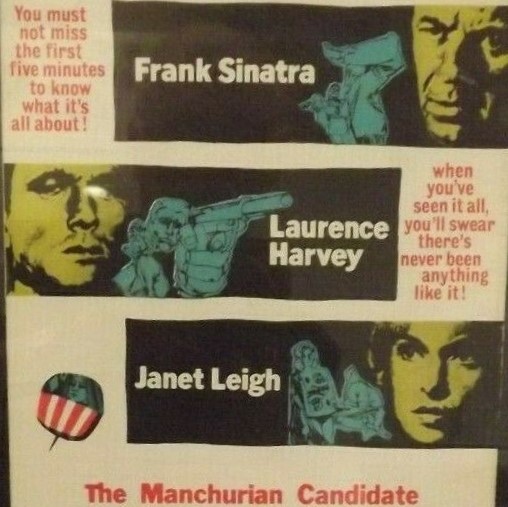
The most celebrated of the conspiracy thrillers and rightly so. But I’m not going to start with the Korean brainwashing, extraordinary cinematic sequence that that is, but with the scene on the train, the pickup scene as it might be known in those days, meet-cute now. There is little cute about this picture which stretches the bounds of normality. And I guess I was already so unsettled, and perhaps settling into film noir mode when an easily available woman was always to be distrusted, and thought that the sudden appearance of Eugenie (Janet Leigh) was a plant.
But that wasn’t in itself what lodged that scene in the caboose so firmly in my mind. But the superlative acting of Frank Sinatra as the investigative Major Marco. Sure, we’ve seen good, sometimes great acting before from Sinatra, generally under-rated due to the myth that nobody could seriously give a good performance after just one take, as if stage actors do not do this every night of the week. But this is above and beyond.
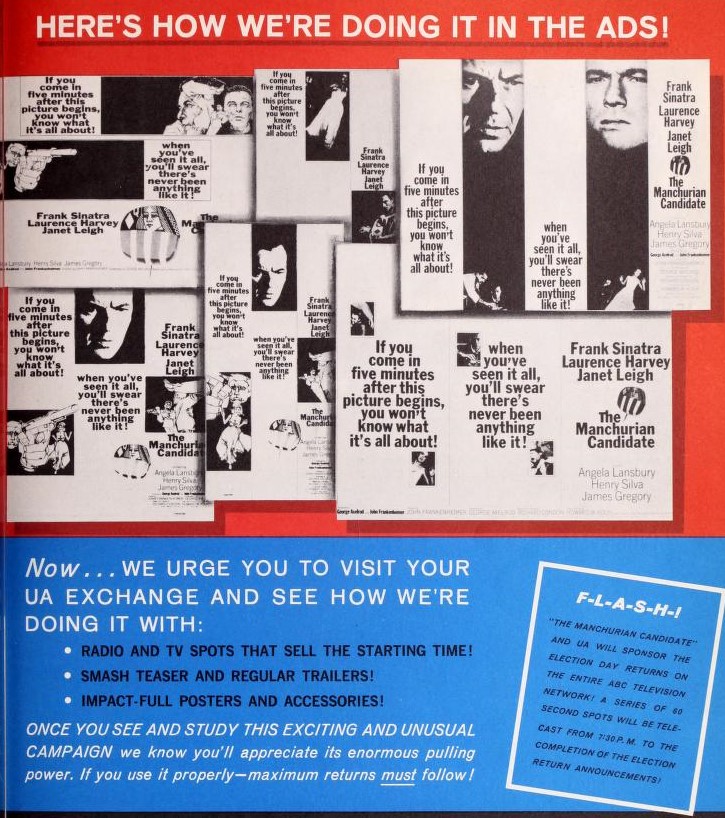
Ads aimed at the cinema manager.
What makes this so outstanding is the depth. Whatever he is saying, that’s not what he’s thinking. He is so dislocated his mind is elsewhere.
Now you give an actor punchy dialog and that’s the way he’s going to treat it, like a punchball, zing zing zing, but that’s not the case here. You can see from his expression that while he is responding well enough to this apparently sympathetic dame that his mind is not completely gone, but that he is barely holding himself together. Another actor would have shown greater signs of mental collapse, signs of a tear perhaps or using an artefact for support, a glass to crush in his hands. But not here. It’s all in the face.
He’s helped of course that the dialog is all about identity. Who is Eugenie? Not as in, who is she really, which would be a good question to ask at this point in the proceedings, but how does someone cope with a name like Eugenie and so the dialog rambles around the various shortenings of her name, while at the same time, recognising he desperately needs a port in a storm, she ensures she knows her address.
The way this movie is going that could be code, too, or a trigger, or that when he turns up at her apartment he’s going to encounter some obstacle, but it doesn’t turn out that way either, even though this is a movie where no one is what he or she seems. Insanely ambitious politician’s wife Eleanor (Angela Lansbury) double crosses her country, the Koreans double cross her by turning her son (rather than any old grunt) into an assassin, and in the end the son, the rather effete Raymond Shaw (Laurence Harvey), turns on the mother in the most murderous way imaginable. Much as she loves her son, she is willing to sacrifice him for the chance of becoming the President’s wife and when she does will exert her revenge on the Koreans.
The “exchange” is an old industry term, literally like a library, meaning where you would take the movie you had just screened and swap it for your next movie. You would pick up all your advertising material and campaign manual at the same time. Certainly saved on the postage. And the exchange manager, meanwhile, would try to sweet talk you into taking another movie you had never heard of.
I’ve gone on before about the beauty of the single-take movie (Grenfell, 2023) but here I’m in raptures at the single scene, how a movie pivots on superb acting. I could have used the brainwashing as an example, but that’s not about acting, but about directing, about perception, about how the audience as much as the participants is being led around by the nose by director John Frankenheimer, who would return to questions of identity and voluntary brainwashing in Seconds (1966).
But back to the brainwashing. This hits the mother lode. A troop of captured U.S. soldiers face an audience with a ringmaster demonstrating just how much they are under his command and can be hypnotised into carrying out any order, even cold-blooded murder. But each of the soldiers sees a different audience. That’s the cinematic coup. I would have loved to have been part of the original audience back in the day, brought up on war movies or thrillers that followed a straightforward narrative arc. Even critics singing the praises of the French New Wave would have never seen anything like this.
Anyway, it soon occurs to Major Marco that his ongoing nightmares are part of a deeper problem especially as his memory of Shaw does not tally with what he finds himself saying about his troop leader.
We follow two parallel stories, Marco trying to get to the truth before he fries his brain, and the audience being let in on much of the truth by tracking Shaw, who, to spite his hated mother, has taken a job with, effectively, the opposition and has fallen in love again with Jocelyn (Leslie Parrish), the daughter of one of her husband’s most implacable foes.
You couldn’t get a more twisty movie, set against the backdrop of the Communist witch hunt, when a politician could garner headlines just by pretending to name Communists in high office. The political element is just as cynical as the same year’s Advise and Consent and savage as the ineffectual Senator Iselin (James Gregory) is, he’s not much worse than the clowns in the Preminger picture. So it all rings true.
There’s scarcely a moment wasted as the movie screams towards a terrifying climax. The built-in control trigger I didn’t see coming, and Shaw’s transformation from strict man-in-charge to bumbling romantic fool is a joy.
Frank Sinatra (The Detective, 1968) gives the performance of his life, Laurence Harvey (Life at the Top, 1965) proof of the power of love, Angela Lansbury (In the Cool of the Day, 1963), the mother from Hell, are all outstanding. The support cast includes Janet Leigh (Psycho, 1960), Henry Silva (The Secret Invasion, 1964) and John McGiver (Breakfast at Tiffanys, 1961).
Frankenheimer directs with elan from the script by George Axelrod (Breakfast at Tiffanys) based on the Richard Condon (The Happy Thieves, 1961) bestseller.
Highly under-rated. Mostly because star Frank Sinatra has the audacity at the age of 65 to play an older cop as an older guy, with none of the wisecracking or physical zap of his previous crime movies like Tony Rome (1967) and The Detective (1968). Deliberately downbeat and surprisingly compassionate with a gallery of unusual and realistic supporting characters.
Sure, we start off with a cliché, cop Delaney (Frank Sinatra) about to retire sniffs out a serial killer operating across New York. But that’s about as far as the cliches go. His boss (Anthony Zerbe) is highly territorial and doesn’t want Delaney doing work that might benefit any precinct other than his own. On top of that an operation on artist wife Barbara (Faye Dunaway) has gone seriously wrong and now she’s hooked up to all sorts of machines in hospital, Delaney sitting by her bedside reading from a book.
Unable to use the department’s facilities, Delaney is forced back on improvisation and enlists a museum curator Langley (Martin Gabel), an expert on weaponry, to find the specific type of tool the assailant is using to crack open heads. Langley is old, too, lacking in either wisecracks or physical zap, likely to doze off at inopportune moments.
Delaney isn’t above taking the law into his own hands, gaining admittance by devious means to the apartment of suspect Daniel (David Dukes) only to be told in no uncertain terms that not only has he no just cause to arrest Daniel, a high-flying executive with legal connections, but that any judge would immediately throw out the case thanks to the cop’s law-breaking.
So the movie settles into two parallel stories, both, if you like about observation. Delaney follows the suspect and he watches his wife die, in both instances unable to intervene, not able to prevent the murderer killing again unless he should happen to catch him in the act and as far as the hospital is concerned having to listen to a doctor (George Coe) tell him that doctors aren’t infallible and often get it wrong. Even his only ally, forensic expert Dr Ferguson (James Whitmore), is warning him off.
And where you might expect in another film a bit of romance between Delaney and witness Monica (Brenda Vaccaro) that doesn’t go anywhere either because he is a faithful husband and doesn’t need any distractions from a dying wife and she’s not the kind of woman that often turns up in crime pictures to form an adulterous relationship. If anything, she turns her attention to mothering Langley.
So this isn’t a fast action tough-talking crime picture of the kind audiences had been familiar with from the late 1960s/early 1970s, there’s no car chase to add entertainment heft. In fact, Delaney is an old-fashioned cop, I don’t think you even see him in a vehicle, he’s mostly pounding a beat of one kind or another.
And it’s oddly compassionate. There’s a lot of cross-cutting between the two narrative strands, and it soon becomes pretty clear that this is a different kind of killer, not one carefully planning his next murder, or taking sexual delight from the agony he inflicts, and he isn’t into abduction either, nobody corralled away in a basement or attic, night-time providing murky cover for his activities.
What we’re actually witnessing, it turns out, is a killer’s meltdown, as he hunkers naked in a bath or hides under bedclothes in a closet. And Delaney recognizes that insanity and that this is someone who needs treatment rather than being locked up in a prison. Daniel justifies his acts as a kind of purity. His victims are “all living inside me, I love them and they love me.”
The idea of sacrifice is embedded in the initial image of a neon-lit cross hanging above a street, the crucifix cross-referenced in several other scenes, and Xmas wet and miserable rather than Hollywoodized snow and ho-ho-ho.
So get your downbeat boots on and join the trudge and don’t start complaining this is lazy acting from Sinatra when actually he is delivering one of his finest performances. Nobody complained that Tom Hanks was lazy when he acted old in A Man Called Otto, where sorrow is similarly repressed, or that Hanks had a shade too much zest for a man his age. Faye Dunaway (Three Days of the Condor, 1975) has made an equally bold decision to play a woman who never gets out of bed and she makes no attempt, as an actress, to invoke your sympathy, there’s none of the cuteness you might expect from doomed romance. Critics, in general, have been put off by the fact that she plays a dying woman as if she is actually dying rather than about to spring into a song-and-dance.
You might be surprised to learn that director Brian G. Hutton (Where Eagles Dare, 1968) came out of a self-imposed seven-year retirement to make this picture, in some respects a companion piece to the equally down beat Night Watch (1973). And he makes a terrific virtue out of keeping characters realistic. Add Martin Gabel to the principals for playing old and slow when age dictates he’s old and slow. Screenplay by Mann Rubin (The Warning Shot, 1967) from the Lawrence Sanders bestseller.
Thoughtful, brooding picture, fitting finale to Sinatra’s career. This is the last hurrah without any forced Hollywoodized hurrah.
“It won’t be the same without you,” says the reception desk cop as Delaney hands in is papers. “It’s always the same,” retorts the world-weary cop.
But please go into it with your eyes open and not in expectation of the more typical 1970s crime movies.
Incidentally, I had thought this one of the lost movies, out of circulation due to legal shenanigans, so was pleasantly surprised when it popped up on YouTube.
As is by now traditional (well, it’s the second full year) this isn’t my choice of the top films of the year, but yours, my loyal readers. This is a chart of the films viewed the most times over full calendar year of January 2022 – December 2022.
Jessica(1962). Angie Dickinson plays a young widow who turns so many heads in a small Italian town that their wives seek revenge. The film had debuted at No 30 in the previous year’s chart so showed remarkable staying power.
Once Upon a Time in the West (1969). Sergio Leone’s masterpiece now acclaimed as the greatest western ever made. Top class cast – Claudia Cardinale, Charles Bronson, Henry Fonda and Jason Robards – and one of the greatest scores ever written courtesy of Ennio Morricone.
The Swinger (1966). Ann-Margret sparkles as author reinventing herself by writing a sex novel.
Fraulein Doktor (1969). Suzy Kendall as German spy outwitting the British during World War One.
Can Heironymus Merkin Ever Forget Mercy Humpe and Find True Happiness? (1969). Fellini-esque musical with abundant nudity as writer-director-star Anthony Newley tries to unravel the meaning of life.
Father Stu (2022). Under-rated biopic with Mark Wahlberg as unlikely priest.
Blonde(2022). Andrew Dominik’s controversial reimagining of the life of Marilyn Monroe with Ana de Armas
For a Few Dollars More(1965).Sergio Leone re-teams with Clint Eastwood in the second in the spaghetti western trilogy with Lee Van Cleef as a rival bounty hunter.
A Place for Lovers(1968). Faye Dunaway and Marcello Mastroianni in Vittorio De Sica doomed romance.
Fade In(1968). Burt Reynolds disowned this romance filmed against the backdrop of making the Terence Stamp western Blue but it’s better than he thinks.
The Secret Ways (1961). Richard Widmark in spy thriller set in Hungary during the Cold War and adapted from the Alistair MacLean novel. Senta Berger has a small role. Top film for 2021, so demonstrating the ongoing popularity of films based on the author’s works.
The Sisters (1969). Complicated menage a trois that borders on the semi-incestuous starring Nathalie Delon and Susan Strasberg.
Pharoah (1966). Epic Polish picture about political shenanigans in ancient Egypt. Another film with legs – it was No 3 in the 2021 annual chart.
Water Gate Bridge / Battle at Lake Changjin II (2022). Another epic, non-stop action from the Chinese point-of-view in a sequel to one of the most famous battles of the Korean War.
Harlow (1965). Carroll Baker as the blonde bombshell who rocketed to fame in 1930s Hollywood.
Baby Love (1969). Morality tale as orphaned Linda Hayden tries to fit into an upper-class London household.
Moment to Moment (1966). Hitchockian thriller set in the South of France with adulterous Jean Seberg suspected of killing her lover.
Secret Ceremony (1968). Elizabeth Taylor, Mia Farrow and Robert Mitchum in atmospheric Joseph Losey drama.
Lady in Cement (1969). Gangster’s moll Raquel Welch steals the show in Frank Sinatra’s second outing as private eye Tony Rome.
Subterfuge (1968). Suzanna Leigh steals the show as a sadistic henchwoman trying to prevent Gene Barry uncovering a mole in M.I.5.
P.J. / New Face in Hell (1967). George Peppard taken to the cleaners as down-on-his luck private eye.
The Golden Claws of the Cat Girl (1968). Cult French movie starring Daniele Gaubert as a sexy cat burglar. This was No 6 last year.
The Gray Man (2022). Spectacular Netflix misfire with Ryan Gosling and Chris Evans as rival assassins and Ana de Armas adding some spice.
The Brotherhood (1968). Martin Ritt Mafia drama sees siblings Kirk Douglas and Alex Cord falling out.
Some Girls Do (1969). Richard Johnson returns as Bulldog Drummond battling archvillains Daliah Lavi and Beba Loncar.
Pressure Point (1962). Prison psychiatrist Sidney Poitier treats racist patient Bobby Darin. Very unusual imagery.
The Double Man (1967). C.I.A. operative Yul Brynner battles Russian espionage in Switzerland with Britt Ekland providing the glamor.
Operation Mincemeat (2022). Re-telling of “The Man Who Never Was” World War Two plot that duped Hitler over Sicilian invasion plans.
Orgy for the Dead (1965). Bizarre cult horror tale where most of the female characters appear to be auditioning for a nudie film.
Texas Across the River (1966). Alain Delon acts against type in Dean Martin comedy western.
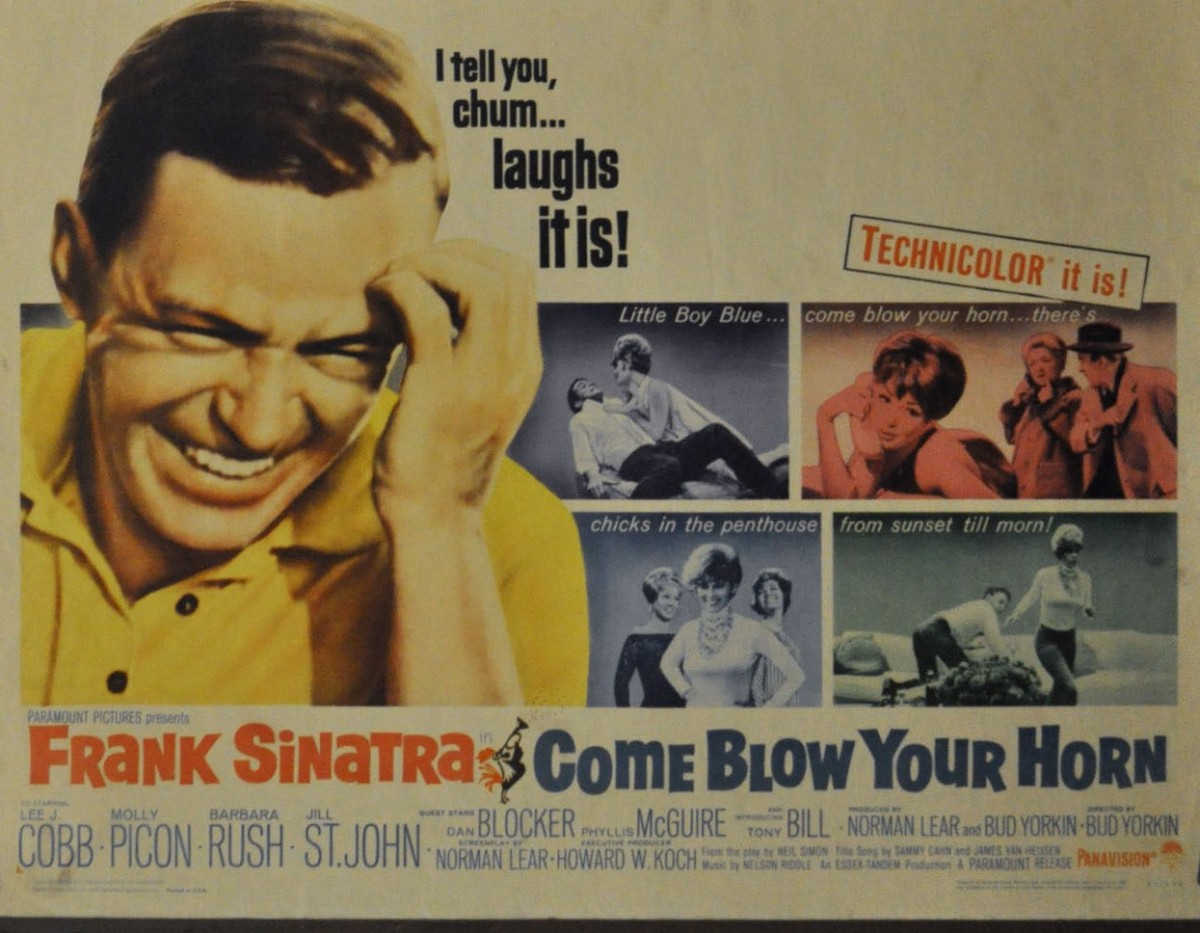
Wonderful upbeat performance from Frank Sinatra lifts this out of a misogynistic pit where women were either dumb, desperate to get married or passive-aggressive harridans. Bachelor playboy Alan (Frank Sinatra) has more women on a string than there is string. When younger brother Buddy (Tony Bill) moves in, Alan introduces him to the fun ways of the world, not expecting Buddy to be such an apt pupil.
Alan keeps main squeeze Connie (Barbara Rush) dangling while, pretending to have Hollywood connections, making hay with actress wannabe Peggy (Jill St John). He also keeps customer Mrs Eckman (Phyllis McGuire) sweet in transactional sex fashion and there’s no shortage of other women liable to appear out of the woodwork.
Meanwhile, his boss, apoplectic father Harry (Lee J. Cobb), goes around screaming at everyone, berating Alan for his lifestyle and moaning at harassed wife Sophie (Molly Picon). Most of the time it looks like it’s going to swerve into a more typical English farce with various women being hidden out of sight from various other woman or Harry or an equally apoplectic cuckolded husband (Dan Blocker).
But, with considerably more sophistication than that, the story takes the more interesting tack of character development. Alan, who might appear to be sitting pretty, woman at his beck and call, a glorious modern apartment, cocktails on tap, is brought up sharply by his brother’s delight at such a shallow life. Alan gets to play Hollywood honcho with Peggy while Connie delivers an ultimatum that threatens to bring Frank to his senses though, naturally, he believes it’s all hooey.
The fraternal business is well done, instead of the normal rivalry genuine affection and the older sibling offering guidance, though primarily in how to get drunk and get off with women rather than anything that might otherwise stand him in good stead. Though you might argue that being shown how to dress, and how converse with women, and organise a fun party might be as much education as a young gentleman in the Big Apple required.
The only thing better than one Frank Sinatra picture is two Frank Sinatras so to scoop up some extra cash these were paired for a speedy reissue.
Playwright Neil Simon, the toast of Broadway at this stage, exhibited such a keen sense of structure that the story never sagged. Any time that appeared a remote possibility, instead of a stranger coming in a la Raymond Chandler with a gun, it’s Harry stomping all over the place. There are some good catchphrases, genuinely funny moments, and some great lines, the best, I have to confess, from Peggy who bemoans the fact that she was stranded in a hotel room with Alan at a ski resort by all the snow outside. Redeeming factor: her homely kind of dumb serves narrative purpose, making the otherwise unbearably charming Alan come across as a heel.
This is quite a different Sinatra, like he’s channeling his record persona, none of the anguish, dramatic intensity or Rat Pack bonhomie he brought to other pictures. Often you hear of actors just playing the same character or a variation thereof, but this ain’t a Sinatra persona I’m familiar with and brings verve to the whole shebang.
Lee J. Cobb (Coogan’s Bluff, 1968) gives in to overacting. You can see how that loud style might work on the stage, but it’s less effective here. Jill St John (Tony Rome, 1967) is very good as the uncertain beauty, who could be incredibly seductive if only she could work out how, and not quite a victim either, and still managing vulnerability. Barbara Rush (Robin and the 7 Hoods, 1964) is wasted, though. Set up as a modern woman, she collapses at the first sniff of marriage, though framing her eyes in a mask of light in a taxi cab is about the only compositional mark of any note.
Quite what possessed director Bud Yorkin (Divorce American Style, 1967) to stick in the title song in the middle of the picture is anybody’s guess. Norman Lear (Divorce American Style) wrote the script but you can hardly go wrong with a Neil Simon template.
End up: it’s mostly about family and people coming to terms with themselves and each other.
These days fact-based magazine articles commonly spark movies – The Fast and the Furious (2001) was inspired by a piece in Vibe, A Beautiful Day in the Neighborhood (2019) started life in Esquire – but it was rare in the 1960s (see Note below).
However, a series of seven lengthy historical articles in the multi-million-selling Life magazine in 1959 about the Wild West, extensively illustrated with material from the time, captured the attention of the nation. Bing Crosby acquired the rights, not as a potential movie, but for a double album recorded in July 1959 on a new label Project Records set up specifically for the purpose – two months after the series ended – and a proposed television special.
When the latter proved too expensive, the rights were sold to MGM which then linked up in a four-film pact with Cinerama to create the first dramatic picture in that format, the three-screen concept that had taken the public by storm in 1952 with This Is Cinerama. Since then, Cinerama had focused exclusively on travelogs and coined $115 million in grosses from just 47 theaters, including $9 million in seven years at the Hollywood theater in Los Angeles. Eight years in its sole London location had yielded $9.4 million gross from a quartet of pictures, Cinerama Holiday (1955) leading the way with (including reissue) a 120-week run, followed by 101 weeks of Seven Wonders of the World (1956), 86 for This Is Cinerama and 80 weeks for South Seas Adventure (1958).
Box office was supplemented with rentals of the projection equipment. But the novelty had worn off, lack of product denting consumer and industry interest, many of the theaters set up for the project returning the equipment, so that by the time of this venture there were only 15 U.S. theaters still showing Cinerama. The company went from surviving primarily on equipment royalties to becoming a producer-distributor-exhibitor. Ambitiously, the company believed it could generate $5,000 a week profit for each theater, and, assuming growth to 60 houses, that could bring in $15 million a year.
Crosby initially remained involved – crooning songs to connect various episodes – but that idea was soon abandoned. Director Henry Hathaway (North to Alaska, 1960), claimed he came up with the movie’s structure. “The original concept was mine,” he said, “The first step in the winning of the West was the opening of the canal, then came the covered wagon, next the Civil War which opened up Missouri and the mid-West then the railroads, and finally the West was won when the Law conquered it instead of the outlaw gangs; which was the theme I worked out for the picture.
“So I conceived the whole idea and then got writers to work on the five episodes. Each episode was about a song originally. Then I travelled all over the country to find locations.”
For once this was a genuine all-star cast headed up by actors with more than a passing acquaintance with the western: John Wayne (The Man Who Shot Liberty Valance, 1962), Oscar-winner Gregory Peck (The Big Country, 1958), James Stewart (Winchester ’73, 1950), Richard Widmark (The Alamo, 1960) and Henry Fonda (Fort Apache, 1948) with Spencer Tracy (Broken Lance, 1954) as narrator plus George Peppard (Breakfast at Tiffany’s, 1961) in his first western.
The two strongest female roles were given to actresses playing against type, Carroll Baker (Baby Doll, 1956), who normally essayed sexpots, as a homely pioneer and Debbie Reynolds (The Tender Trap, 1955), more at home in musicals and comedies, as her tough sister. The impressive supporting cast included Lee J. Cobb, Eli Wallach, Walter Brennan, Robert Preston, Carolyn Jones and Karl Malden.
Glenn Ford and Burt Lancaster were unavailable. Frank Sinatra entered initial negotiations but ultimately turned it down. Gary Cooper, also initially considered, died before the film got underway.
Initially under the title of The Winning of the West screenwriter James R. Webb (The Big Country, 1958) was entrusted with knocking the unwieldy non-fiction story into a coherent fictional narrative. In effect, it was an original screenplay at a time when Hollywood was turning its back on bestsellers, “the pre-sold theory less compelling.” His first draft accommodated various montages covering the journey from the Pilgrim Fathers to the building of the Erie Canal and the Civil War and it was only in subsequent drafts that the tale of Linus Rawlings (James Stewart) emerged with surprising focus on female pioneers.
Webb’s initial ending had involved a father-son conflict, presumably a fall-out between the Rawlings played by James Stewart and George Peppard, but that was rejected in order not to finish on a “note of bitterness” out of keeping with the spirit of the movie. Although he did not receive a credit, John Gay (The Happy Thieves, 1961) also contributed to the screenplay.
Given the film’s episodic structure it is amazing how well the various sequences fit together and the narrative thrust maintained. The story covers a 50-year stretch beginning in 1839 with the river sequence bringing together James Stewart and Carroll Baker. After Stewart is bushwhacked by river pirates, he marries Baker and they set up a homestead. The next section pairs singer Debbie Reynolds with gambler Gregory Peck whose wagon train is attacked by Indians on the way to San Francisco. Later, Stewart and son George Peppard enlist in the Civil War (featuring John Wayne as an unkempt General Sherman).
Stewart dies at the Battle of Shiloh. Peppard joins the cavalry and later as a marshal in Arizona meets Reynolds and prevents a robbery that results in a spectacular train wreck. It took a superb piece of screenwriting to pull the elements together, ensure the characters had just cause to meet and to create solid pace with a high drama and action quotient.
The undertaking was too much for one director. Initially, it was expected five would be required but this was truncated to three – John Ford (The Searchers, 1956), Henry Hathaway and George Marshall (The Sheepman, 1958) although Hathaway carried the biggest share of the burden and Richard Thorpe (Ivanhoe, 1952) handled some transitional historical sequences.
The directors broke new ground, technically. The Cinerama camera was actually three cameras in one, each set at a 48 degree to the next and when projected provided a 146-degree angle view. Each panel had its own vanishing point so the camera could, uniquely, see down both sides of a building.
But there were drawbacks. The cumbersome cameras required peculiar skills to achieve common shots. Directors lay on top of the camera to judge what a close-up looked like. Sets were built to take account of the way dimensions appeared through the lens, camera remaining static to prevent distortion. When projected, the picture was twice the size of 65mm and before the invention of the single-camera lens led to vertical lines running down the screen. Trees were built into compositions to hide these lines.
“You couldn’t move the camera much,” recalled Hathaway, “or the picture would distort. You have to shove everything right up to the camera. Actors worked two- and three-feet away from the camera. The opening dolly down the street to the wharf was the first time it had ever been done.
He added, “Over 50 per cent of the stuff on the train was made on the stage (i.e. a studio set) and 60 per cent of the stuff coming down the rapids. I never took a principal up north to the river, the principals never worked off the stage. We never photographed the scenes with transparencies in three cameras with Cinerama – we photographed them with one camera in 70mm and then split the negative.
“I wouldn’t shoot close-ups in Cinerama – I shot the close-ups in 70(mm) and then separated the negative because in Cinerama it distorted their arms. When (George) Stevens shot The Greatest Story Ever Told he used only 70mm and split it all. So from then on they never used the three cameras again. Now they’re actually shooting it in 35(mm).”
Rui Nogueira, “Henry Hathaway Interview,” Focus on Film, No 7, 1971, p19.
After a year spent in pre-production, an eight-month schedule due to start on May 28, 1961, and a completion date of Xmas 1961, MGM anticipated a 1962 launch, Independence Day pencilled in for the world premiere. The original $7 million budget mushroomed to $12 million and then to £14.4 million, $1 million of that ascribed to adverse weather conditions, hardly surprising given the extent of the location work. A total of $2.2 million went on the 10 stars and 13 co-stars, virtually talent on the cheap given the salaries many could command, transport cost $1 million and the same again in props including an 1840 vintage Erie canal boat.
Rain and overcast skies added $145,000 to the cost of shooting the rapids sequence in Oregon and another $218,000 was required when early snowfall scuppered one location and required traveling 1,000 miles distant. Nearly 13,000 extras were involved as well as 875 horses, 1,200 buffalo, 50 oxen and 160 mules. Thousands of period props were dispersed among the 77 sets. Over 2,000 pairs of period shoes and 1500 pairs of moccasins were fashioned as well as 107 wagons, many designed to break on cue.
Virtually 90 per cent of the picture was shot on location to satisfy Cinerama customers accustomed to seeing new vistas and to bring alive the illustrations from the original Life magazine articles. Backdrops included Ohio River Valley, Monument Valley, Cave-in-Rock State Park, Colorado Rockies, Black Hills of Dakota, Custer State Park and Mackenzie River in Oregon.
The picture, including narration, took over a year to make. Cinerama sensation was achieved by shooting the rapids, runaway locomotive, buffalo stampede, Indian attack, Civil War battle and cattle drive. Motion was central to Cinerama so journeys were undertaken by raft, wagon, pony express, railroad and boat, anything that could get up a head of steam.
Initially, too, the production team had been adamant – “rigid plans for running time will be met” – that the movie would clock in at 150-155 minutes (final running time was 165 minutes) and there was some doubt, at least initially, on the value of going down the roadshow route in the United States. Roadshow was definitely set for Europe, a 15-minute intermission being included in those prints, for a continent where both roadshow and westerns were more popular than in the States.
Big screen westerns in particular in Europe had not been affected by the advent of the small-screen variety. Some films received substantial boosts abroad. “The Magnificent Seven and Cimarron (both 1960) took giants steps forward once they made the transatlantic crossing.” British distributors also reported “striking” success with The Last Sunset (1961) and One-Eyed Jacks (1962) which had toiled to make a similar impression in the U.S.
In the end the decision was made to hold back the release in the U.S. in favor of another Cinerama project The Wonderful World of the Brothers Grimm, which had begun shooting later and ultimately cost $6 million, double its original budget. Rather than bunch up the release of both pictures, MGM opted to kick off its Cinerama U.S. launch with Grimm in 1962 and shifted How the West Was Won to the following year. MGM adopted the anticipation approach, holding the world premiere in London on November 1, 1962, and unleashing the picture in roadshow in Europe.
A record advance of $500,000 was banked for the London showing at the 1,155-seat Casino Cinerama (prices $1.20-$2.15) on roadshow separate performance release. Before the advertising campaign even began in October, a full month prior to the world premiere, over 62,000 reservations had been made via group bookings. Critics were enamored and audiences riveted. The cinema made “unusually large profits” and after two years had grossed $2.25 million from 1722 showings.
Dmitri Tiomkin (The Alamo, 1960) was hired to compose the music, but an eye condition prevented his participation though he later sued for $2.63 million after claiming he was fired before the assignment began. Alfred Newman (Nevada Smith, 1966) wrote the thundering score but uniquely for the time MGM shared the publishing rights with Bing Crosby. In the U.S. Bantam printed half a million copies of a paperback tie-in, sales of the soundtrack were huge and there was a massive rush to become involved by retailers and museums with educational establishments an easy target.
Audience response was overwhelming, a million customers in the first month, two million by the first 10 weeks at just 36 houses, some of which had only been showing it for half that time. But it failed to hit ambitious targets – predictions that it would regularly run for three years in some situations “based on the star roster and the fact the pic offers more natural U.S. vistas than anything yet done on the screen” proving wildly over-optimistic. Still, it had enjoyed 80 roadshow engagements including eight months at the Cinerama in New York and grossed $2.3 million in 92 weeks in L.A, $1.14 million after 88 weeks in Minneapolis and $1.5 million after one week fewer in Denver.
By 1965, as it began a general release 35mm roll-out with 3,000 bookings already taken, it had already passed the $9 million mark in rentals including a limited number of showcase breaks the previous year.
Nominated for a Best Picture Oscar, it won for screenplay, sound and editing. The movie became MGM’s biggest hit after Gone with the Wind and Ben-Hur. In my recent book The Magnificent ‘60s, The 100 Most Popular Films of a Revolutionary Decade I placed it twelfth on the chart of the decade’s top box office films.
It provided a popularity fillip for most of the big stars involved, none more so than James Stewart who, prior to shooting, had been on the verge of retirement. Box office appeal diminishing, work on his next picture Take Her, She’sMine postponed by the Actor’s Strike, after the death of his father he had “quietly begun to make plans to get out of his Fox contract, retire, and move his family out of Beverly Hills.” He had spent $500,000 on a 1,100-acre ranch and was already well set to quit acting having accumulated a large real estate portfolio in addition to oil well investments.
NOTE: Robert J. Landry (“Magazines a Prime Screen Source,” Variety, May 30, 1962, 11) pointed to Cosmopolitan as the original publication vehicle for To Catch a Thief (1955) by David Dodge in 1951 and Fannie Hurst’s Back Street (1932), serialized over six months from September 1930. Frank Rooney’s The Cyclist’s Raid – later filmed as The Wild One (1953) – first appeared in Harpers magazine. Movies as varied as Edna Ferber’s Ice Palace (1960) and The Executioners by John D. MacDonald, later filmed as Cape Fear (1962), were initially published in Ladies Home Journal. The Saturday EveningPost published Alan Le May’s The Avenging Texan, renamed The Searchers (1956), and Donald Hamilton’s Ambush at Blanco Canyon, renamed The Big Country (1958) as well as Christopher Landon’s Escape in the Desert which was picturized under the more imaginative Ice Cold in Alex (1958).
SOURCES: Brian Hannan, The Magnificent ‘60s, The 100 Most Popular Films of a Revolutionary Decade (McFarland, 2022) p168-170; Marc Eliot, James Stewart A Biography (Aurum Press, paperback, 2007) p350-351; Rui Nogueira, “Henry Hathaway Interview,” Focus on Film, No 7, 1971, p19; Sir Christopher Frayling, How the West Was Won, Cinema Retro, Vol 8, Issue 22, p25-29; Greg Kimble, “How the West Was Won – in Cinerama,” in70mm.com, October 1983; “Reisini Envisions Cinerama Leaving Travelog for Fiction Pix,” Variety, December 14, 1960, p17; “Metro in 4-Film Deal with Cinerama,” Variety, March 1, 1961, p22; “Cinerama Action Awaits Plot Tales,” Variety, March 8, 1961, p10; “Fat Bankroll for How West Was Won,” Variety, May 24, 1961, p3; “Return to Original Scripts,” Variety, June 28, 1961, p5;“MGM-Cinerama Set 3-Hour Limit For West Was Won,” Variety, August 23, 1961, p7; “Hoss Operas in O’Seas Gallop,” Variety, August 23, 1961, p7; “Coin Potential As To Cinerama,” Variety, September 20, 1961, p15; “Changing Economics on Cinerama,” Variety, October 11, 1961, p13; “Bantam’s 22 Paperback Tie-Ups in Hollywood,” Variety, October 25, 1961, p22; “How West Was Won for July 4 Premiere,” Box Office, December 11, 1961, p14; “Crosby Enterprises Holds West Cinerama Songs,” Variety, January 24, 1962, p1; “Grimm First in U.S. for Cinerama but Abroad West Gets Priority,” Variety, April 4, 1962, p13; “Cinerama Fiscalities,” Variety, April 11, 1962, p3; “Cinerama Story Pair Burst Budgets,” Variety, May 16, 1962, p3; “Tiomkin’s $2,630,000 Suit Vs MGM et al,” Variety, June 27, 1962, p39; “Hathaway a Pioneer,” Variety, July 25, 1962, p12; “Bernard Smith Clarifies Fiscal Facts,” Variety, August 8, 1962, p3; Review, Variety, November 7, 1962, p6; “London Critics Rave Over West,” Variety, November 7, 1962, p19; “Brilliant World Premiere in London for West,” Box Office, November 12, 1962, p12; “West in Cinerama the Big Ace,” Variety, November 14, 1962, p16; Feature Reviews, Box Office, November 26, 1962; Bosley Crowther, “Western Cliches; How West Was Won Opens in New York,” New York Times, March 28, 1963; “Big Book Aid for West,” Box Office, April 1, 1963, pA3; “West Was Won Seen By 2,000,000 in 10 Weeks,” Box Office, June 3, 1963, p15; “How West Was Won for 19 Showcase Theaters,” Box Office, June 15, 1964, pE1; “West End,” Variety, November 11, 1964, p27; “How West Was Won Ends Roadshowing,” December 9, 1964, p16; “3,000 Bookings Expected for How the West Was Won,” Box Office, May 3, 1965.











 The Magnificent 60s