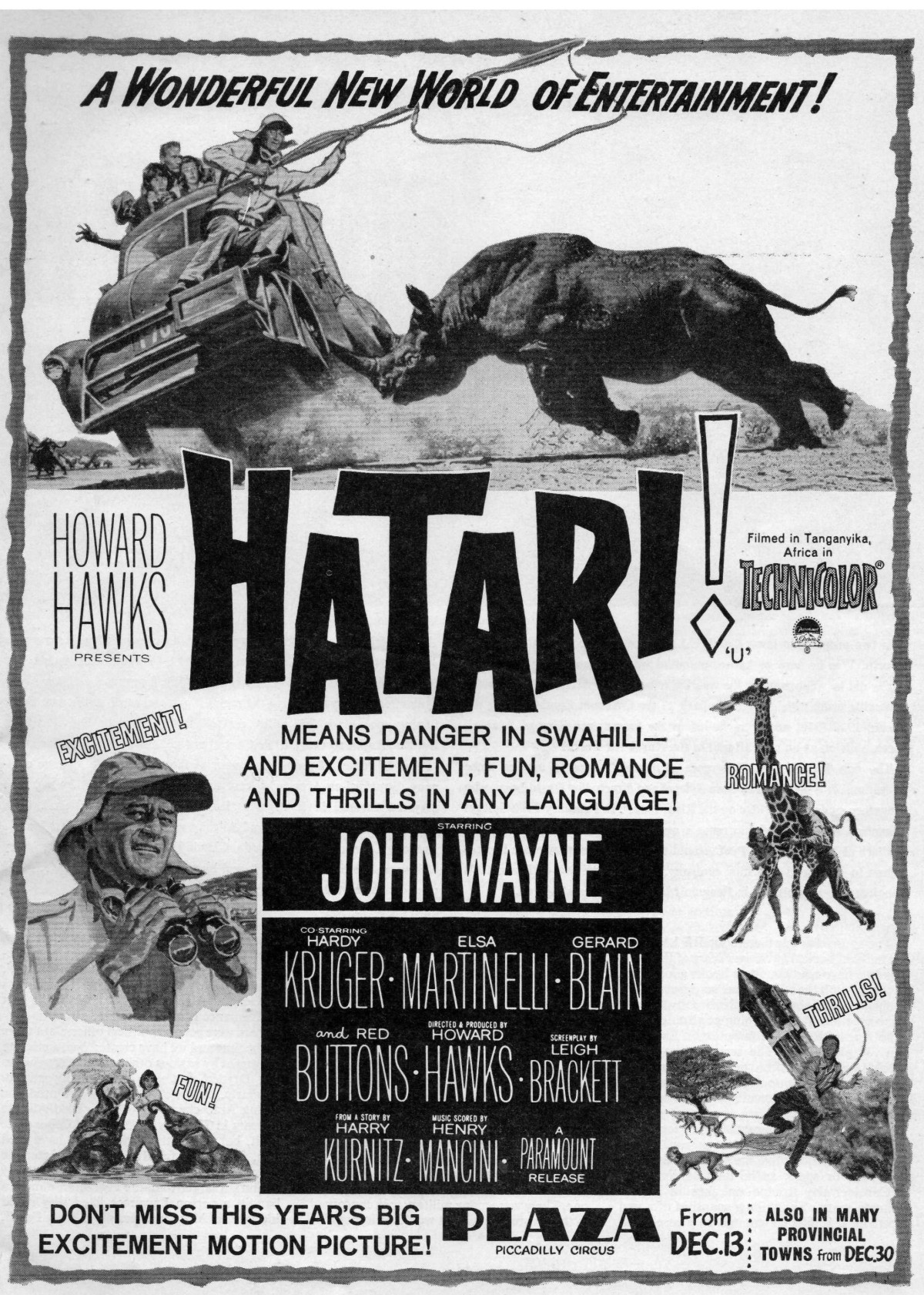
One on Top of the Other / Perversion Story (1969) ****

No idea how they thought they’d market this one. Neither of these titles would recommend it to first run, more likely sending it down the exploitation route. Which would be a pity because, although there is enough nudity and sex to satisfy those patrons, it is, almost to the very end, clever noir, femme fatales to the fore, and the kind of male patsy who would later decorate the likes of Body Heat  (1981). And if it played out as all instinct – except that of a happy ending – told you, it would have been an absolute cracker. As it is, it’s more Hitchcock than giallo, director Lucio Fulci’s, known at that time for comedies, first dabble in crime, and with excellent cinematography and plot twists.

As it is, said sucker has a hell of a time, turned inside, beset by paranoia and trickery until he’s all set for the electric chair and it boasts a classy cast. It’s set in San Francisco, though I found those hilly streets a distraction as any minute I expected to see Bullitt racing over the top or Sean Connery demolishing a streetcar before heading to The Rock.

Asthmatic sickly wife Susan of top surgeon George (Jean Sorel) dies from accidental overdose in the first few minutes. The good doctor isn’t so upset, he’s having an affair with fashion photographer Jane (Elsa Martinelli) and is astonished to discover he’s about to inherit a couple of million from her insurance. That’ll come in handy because his business is going down the tubes.

But an anonymous tip sends him into a topless bar where the star performer and sometime sex worker Monica (Marisa Mell) bears a startling resemblance to his wife, blonde where she was brunette, brown eyes rather than green, but otherwise almost a dead ringer. But he’s seen his wife’s stone-cold corpse so he gets the doppelganger heebie-jeebies. Still, it’s not long before he’s testing out his theory and in the most intimate fashion.

But there’s an insurance agent on his tail, taking note of the philandering, and his concerns force the cops to re-open the case and discover Susan was poisoned and with George the obvious beneficiary that makes him the obvious suspect. Meanwhile, Jane’s trying to find out what’s Monica’s game, to the extent of giving her a fashion gig that goes a few steps beyond the Blow-Up playbook.
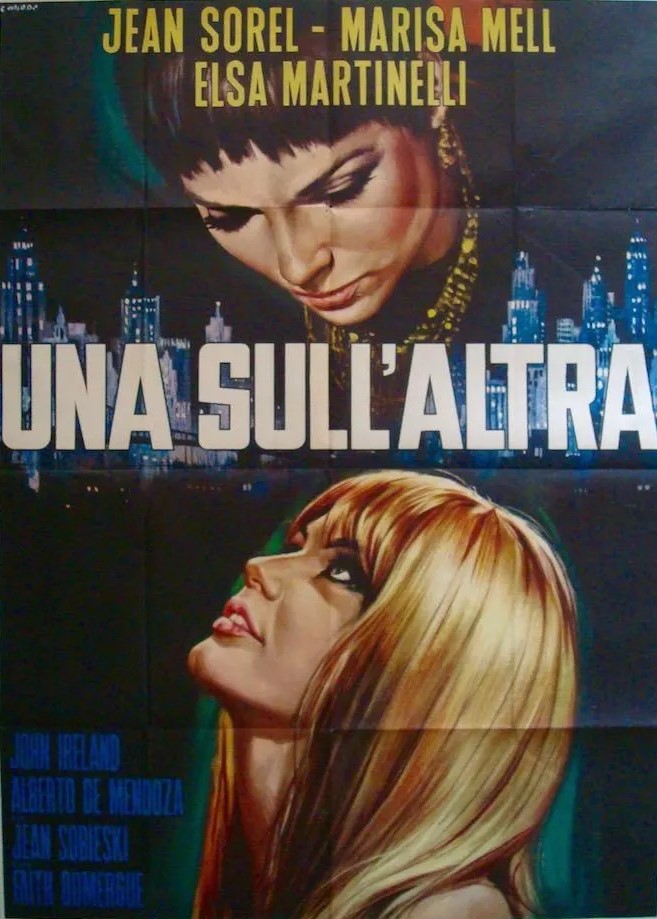
Top cop (John Ireland) isn’t slow to put two and two together and reckon Monica and George are in it together and bumped off Susan. He finds evidence of Monica perfecting Susan’s signature. But while Monica skedaddles, George is on the hook and eliminating all that annoying courtroom guilty/not guilty objection sustained  palaver, the movie cuts to the chase and the surgeon is lined up for an appointment with the chair, knowing full well he’s innocent.

In a terrific twist I didn’t see coming turns out his brother Henry (Alberto de Mendoza), partner in the business, has been having an affair for years with Susan who – yep – is Monica after all, and takes delight in telling George what a sucker he’s been. Henry will inherit the dosh and take up where he left off with Monica/Susan. George hasn’t exactly elicited audience sympathy, although he’s occasionally staring moodily in the camera as his brain can’t compute what’s going on, and he’s a two-timing swine – no, make that three-timing – no, two-timing if Monica actually is his wife. Anyway, he doesn’t cover himself in glory whereas Monica is a class act, not just sexy as all-get-out but playing him beautifully, so you kind of want her to get away with it especially as you didn’t see the brother angle coming, and you just marvel at how cleverly George has been duped.

George is saved and the picture unaccountably suffers at the last minute when out of the blue a jealous client Benjamin (Riccardo Cucciolla) turns on the getting-away-with-it pair and blasts them to high heaven.

George is an unusual character, dominated by both women. When we first encounter Jane she’s on the point of dumping him, after a bout of sex first of course, and he’s the one who chases after her. But Susan clearly enjoys stringing George along, taking control in their lovemaking in a manner she clearly didn’t when being Susan, as if her new-found has freed her from her inhibitions.

My guess is this was heavily cut for U.S. and U.K. release and also that the moviegoers coming along expecting sexploitation might have been somewhat surprised to find themselves watching a Hitchcockian homage, but with the bad girl as the heroine.

A few plot flaws don’t hole this beneath the waterline. Great acting all round, Marisa Mell (Danger: Diabolik, 1968) the pick, but Elsa Martinelli (Hatari!, 1962) every bit as calculating and seductive. You feel sorry for Jean Sorel (Belle de Jour, 1967) caught between the two.

Lucio Fulci (A Lizard in a Woman’s Skin, 1971) makes the most of the locations and ensures the women, rather than the man, take center stage.

Take away the exploitation elements and you’ve still got a great thriller that turns on its head all expectations.
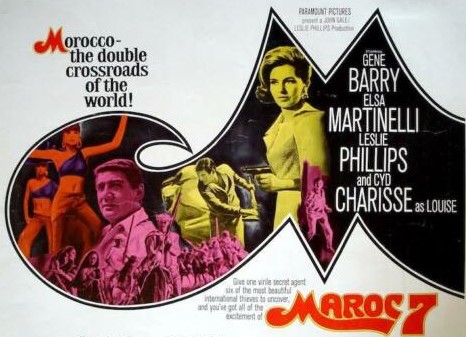
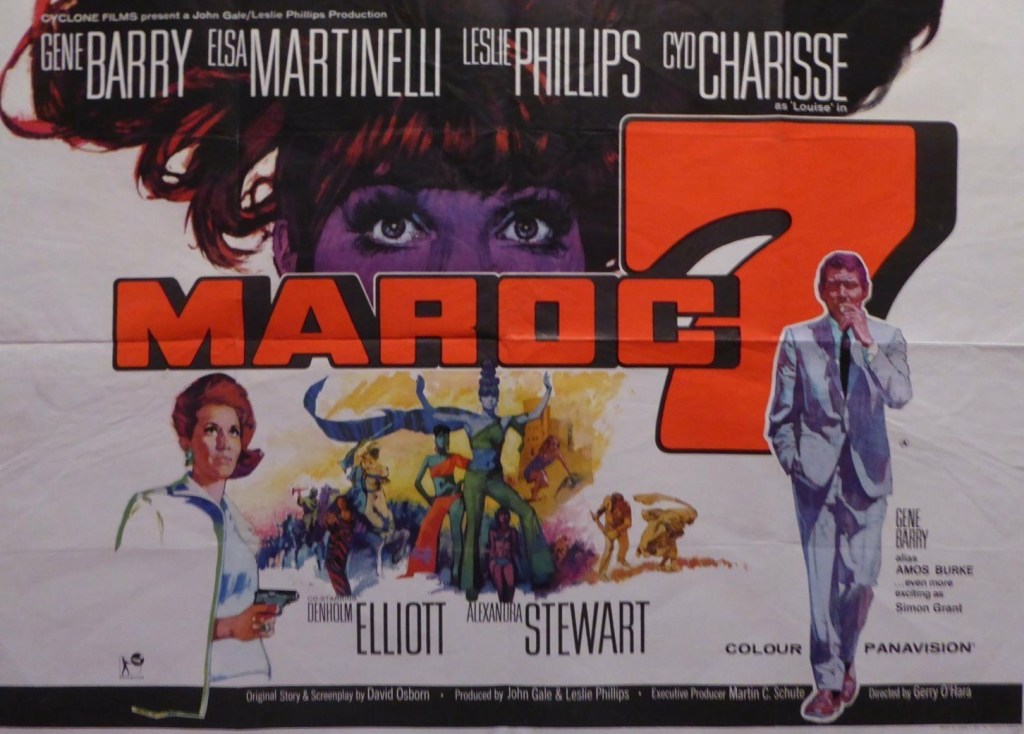
Maroc 7 (1967) ***

With a string of Swinging Sixties fashion models providing the requisite bevy of beauties, a gang of thieves, a Moroccan heist, superb locations, great cast and a touch of archaeology with secret chambers and a long-lost relic thrown, this splendid espionage frolic proves a welcome return to big screen top billing for Gene Barry after nearly a decade in television in Bat Masterson (1958-1961) and Burke’s Law (1963-1966).

Something of a cat burglar himself, Simon Grant (Barry) infiltrates a gang which uses fashion as a cover and whose ingenious specialty is to steal famous heirlooms and replace them with fake ones in the assumption that on their departure from a foreign country the customs officers will not be able to tell the difference. Louise Henderson (Cyd Charisse) and Raymond Lowe (Leslie Phillips) head up the gang while Claudia (Else Martinelli) may or may not be in on the act.

Her dalliance with Simon suggests an inclination towards the right side of the law justice but the fact that she has been involved with the pair for so long sets up the intriguing notion that she is stringing the American agent along. Initially, she rejects Simon’s advances until told by Louise to comply and pump him for information leading to one of the movie’s best lines (and innuendo that a British audience in particular would adore). Says Simon: “We haven’t done much about pumping but maybe that will come later.”  Doubts also surround the intentions of Michelle Craig (Alexandra Stewart).  On their trail is Inspector Barrada (Denholm Elliott).

There is mystery aplenty and a fair quotient of punch-ups, romance, shoot-outs and murder while the unearthing of the hidden treasure is more less heist than Indiana Jones. The fashion is the icing on the cake. The Moroccan fashion shoots are more than merely decorative, an excuse to bare the charms of the gorgeous models. Instead, the shoots would not disgrace Vogue or any of the other glossy magazine temples to haute couture, with that Sixties focus on fabulous clothes, genuine location and outlandish hairstyles.

On top of that, several of the stars are either playing against type or out of their comfort zones. Legendary Hollywood dancer Cyd Charisse famed for such classic musicals as The Bandwagon (1953) and Silk Stockings (1957) sets such fluff aside to essay a criminal mastermind, whose cunning often gets the better of Simon. Leslie Phillips (Crooks Anonymous, 1962), better known as a charming Englishman with an eye for the ladies, is as ruthless a photographer as he is a criminal. Director Gerry O’Hara (The Pleasure Girls, 1965) – from a script by David D. Osborn (Some Girls Do, 1969) has managed to get both Phillips and Denholm Elliott to drop their standard methods of delivery, usually embracing a drawl, making their characterizations a good bit fresher than normal. Phillips was clearly intending to make some kind of career change since he was the producer.

Gene Barry makes a perfect entrance as an adventurer-spy, as confident in his seduction techniques without women falling at his feet like James Bond, with a nice line in self-deprecation and more than able to look after himself. Before being side-tracked by television, Barry had shown movie star potential in Thunder Road (1958) and Hong Kong Potential, and now he delivers on that earlier promise. Elsa Martinelli (Hatari!, 1962) is the femme fatale who may or may not wish to play that role, keeping the audience completely on edge as to which side of the law she is likely to come down. Added bonuses are Alexandra Stewart (Only When I Larf, 1968), Angela Douglas (Carry On Screaming!, 1966), Tracy Reed (Hammerhead, 1968), dancer Lionel Blair (A Hard Day’s Night, 1964) and Maggie London.

Good fun with plenty diversion.

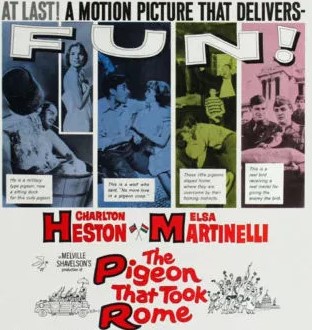
The Pigeon That Took Rome (1962) ***

Netflix would know how to sell this. Append the “based on a true story” credit and you’ll attract a global audience. I’ve no idea how true this tale is though I assume that at certain points in war using a pigeon may have been the most efficient method of communication. If this had been under the Netflix aegis there would surely have been a scene to explain that you can’t just point the bird in any old direction but that it automatically returns to its home, that aspect being pivotal to the movie, the reason it was made in the first place.

That is, if you believe in the rather fanciful notion, as shown in what appears to be an official newsreel, of said pigeon being presented with a medal for its part in the Allied invasion of Rome in World War Two. Luckily, there’s more to this picture than the intricacies of homing pigeons.

Not much more, I hasten to add, because the other significant plot point, which I suspect has a more substantial basis in truth, is that passing American soldiers had a tendency to  impregnate (and abandon) Italian women. If you were to argue that Elsa Martinelli (who had just put John Wayne in his place in Hatari!, 1962) is what saves the picture you wouldn’t be far wrong. But you can’t complain about Hollywood churning out lightweight movies in the 1960s since a chunk of the current output falls into that category.

For no apparent reason, no espionage experience for example, Yank soldiers Capt MacDougall (Charlton Heston) and Sgt Angelico (Harry Guardino) are delegated to sneak into Rome, disguised as priests, and spy on the Germans. They are put up in the household of Massimo (Salvatore Baccaloni), an underground figure, but his daughter Antonella (Elsa Martinelli) takes against the pair since they are extra mouths to feed and if only the Americans would hurry up and enter the city the populace wouldn’t be starving. However, she makes nice when her sister Rosalba (Gabriella Pallotta) reveals she is pregnant by a previous Yank (whether he was the espionage business, too, is never revealed) and is desperate need of a husband.

The sergeant is quite happy to romance the girl since a couple smooching in the park makes good cover for him transmitting messages by radio. And when that form of transmission becomes too dangerous, the Americans rely on pigeons. Soon Angelico realises his feelings for Rosalba are real and proposes to her, even after she reveals her condition. But that means celebration to announce their forthcoming nuptials.

Short of any food, Antonella slaughters the pigeons, convincing MacDougall that the meal consists of squab. To cover up, the Italians steal a bunch of pigeons from the Germans. Of course, as you’ll have guessed, that means the pigeons will return to the enemy. But once MacDougall works this out, he starts sending the Germans false messages that prove (apparently) pivotal to the Germans hightailing it out of the city (hence the medal awarding).

Pretty daft and inconsequential sauce to be sure, but Antonella keeps matters lively, knocking back MacDougall at every turn, taking every opportunity to condemn men for starting wars, and presenting herself as something of a conniver, possibly willing to lead on the Germans in return for food (MacDougall when burglarizing a German villa comes across her naked in the shower). Her occasional swipes give the picture a harder edge than you’d expect, but, her fiance killed in the war, she leads MacDougall a merry dance in the manner of the romantic comedies of the day. Otherwise, the comedy is for the most part lame, the old hitting your thumb with a hammer one such moment.

Despite co-starring with Wayne and here Heston and later Robert Mitchum (Rampage, 1963), Martinelli didn’t fit into the Hollywood pattern of taking European stars and slotting them into the female lead opposite a succession of top male stars. Think Sophia Loren with Heston in El Cid (1961), with Gregory Peck in Arabesque (1966) and with Marlon Brando in The Countess from Hong Kong (1967) and headlining a few pictures on her own. Gina Lollobrigida led Rock Hudson by the nose in Come September (1961) and Strange Bedfellows (1965) and Sean Connery a merry dance in Woman of Straw (1964).

Martinelli seemed to fade too quickly from the Hollywood mainstream which was a pity because she’s the glue here. Charlton Heston (Number One, 1969) spends most of the time looking as if he wondered how he managed to allow himself to be talked into this. You want to point the finger, then Melville Shavelson’s (Cast a Giant Shadow, 1966) your man – he wrote, produced and directed it.

Worth it for Martinelli.

Candy (1968) **

Ode to the male gaze. Once a cult vehicle, this will struggle to find favor these days what with its backward attitudes. Virtually impossible to excuse the rampant self-undulgence. The sexually exploited naïve Ewa Aulin in the title role didn’t even have the benefit of being turned into a star. The satire is executed with all the finesse of a blunderbuss. And while, theoretically, picking off a wild range of targets, if this movie has anything to say it’s to point out how easy it is for men to deify themselves at the slightest opportunity.

Not much of a narrative more a series of sketches slung together with the slightest connecting thread. Most its appeal lies in watching huge marquee names make fools of themselves. Or, if you’re that way inclined, seeing how much nudity will be imposed on the star, intimacy  rarely consensual, clothes usually whipped off her.  

Teenager Candy (Ewa Aulin) has father issues, daddy (Jack Austin) being a dumb angst-ridden teacher. Randy poet McPhisto (Richard Burton) drives a class of schoolgirls into a frenzy with his lusty reading, inveigles Candy into his chauffeur-driven car, ends up in her basement drunkenly humping a mannequin while Mexican gardener (Ringo Starr) with an accent as coruscating as that of Manuel from Fawlty Towers assaults her on pool table.  Scandalized father packs her off to his twin brother in New York, that notoriously safe haven for nymphettes, while on the way to the airport they are almost driven off the road by the gardener’s vengeful biker sisters (Florinda Balkan et al).

For no apparent reason she is hitching a lift on a military plane commanded by randy Brigadier Smight (Walter Matthau) who, on the grounds that he hasn’t had sex for six years, commands her to remove her clothes for the good of the nation. In the Big Apple, rock star surgeon Dr Krankheir (James Coburn), entering the operating theater to the same kind of waves of acclaim as McPhisto, finds an excuse to have her undress and submit to him, this just after she’s managed to avoid the attentions of her randy uncle. It should come as no surprise that Krankheit treats women as his personal property to the extent of branding them like cattle.

In due course, she encounters a gang of mobsters, an underground movie director and a hunchback (Charles Aznavour) who, in return for her showing pity for his condition, proceeds to rape her. She is arrested. Guess who wants to frisk her. Naturally, when she escapes she runs into a bunch of drag queens.   

Then she finds sanctuary in a semi-trailer truck, home to guru Grindl (Marlon Brando). He’d be convincing enough as a mystic except he, too, finds an excuse to rip her clothes off. There are more cops to contend with and another guru, facial features obscured by white clay. If they’re going to have sex then naturally it must be in a Hindu temple. Turns out the latest person to take advantage of her is her father but he’s been handed a get-out-of-jail-free card because by now he’s brain damaged.

This might all be a dream/nightmare. Candy might even be an alien. It’s dressed up in enough psychedelia to sink a battleship and its highly likely that any lass as gullible as Candy will find herself at the mercy of any man, so in that context it carries a powerful message. I’m sure many beautiful young girls will attest to the truth that men feel they have the right to paw anyone who comes their way without asking permission. And the other message is just as powerful – how many young actresses have been seduced by thoughts of fame to disport themselves in this fashion only to find that all the industry wants is their nudity not their acting talent.

You might say that the target is so obvious it hardly needs pointing out but the MeToo campaign will beg to differ and you would hope that Hollywood has wised up. It’s just a shame that the satire is so heavy-handed. The military and the medical profession are sorely in need to answering tough questions. Unfortunately, this picture doesn’t ask any. It’s like an endless casting couch.

Directed by Christian Marquand (Of Flesh and Blood, 1963) in, thankfully, his final picture, from a screenplay by Buck Henry (The Graduate, 1967) and Terry Southern (Dr Strangelove, 1962) based on the novel by Southern and Mason Hoffenberg. Nobody comes out of this well and it’s rammed full of cameos from the likes of Elsa Martinelli (The Belle Starr Story, 1968), John Huston (Myra Breckenridge, 1970), Anita Pallenberg (Performance, 1970), Marilu Tolo (Bluebeard, 1972) and boxer Sugar Ray Robinson.

Ewa Aulin (Start the Revolution Without Me, 1971) isn’t given much of chance, her character whimsical, pallid and submissive and she didn’t become a major marquee name.

A mess.

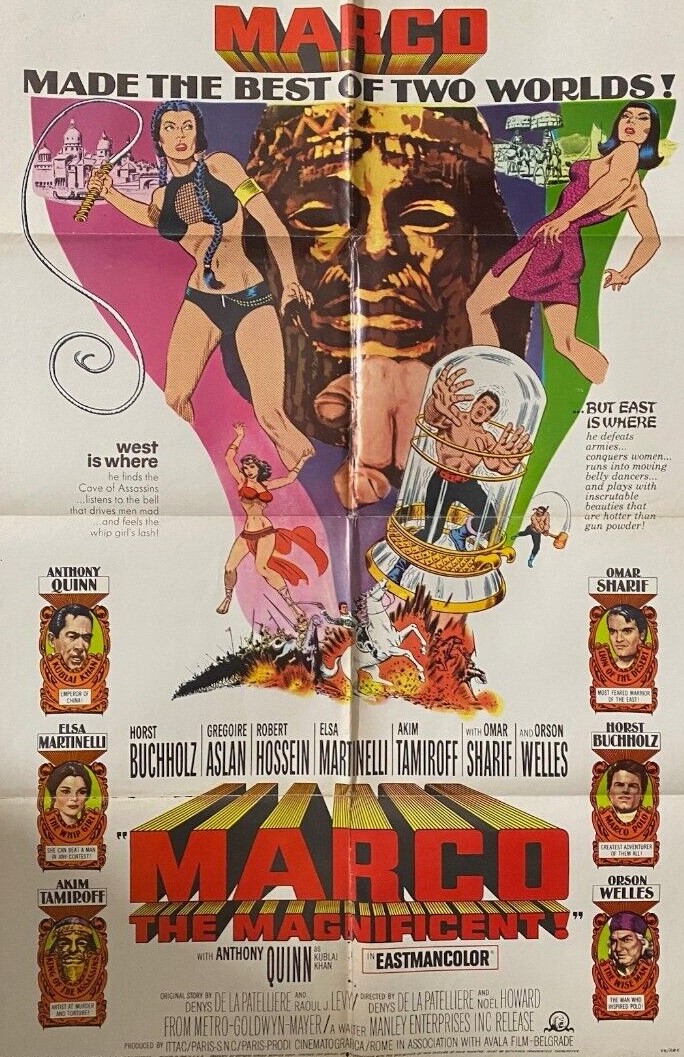
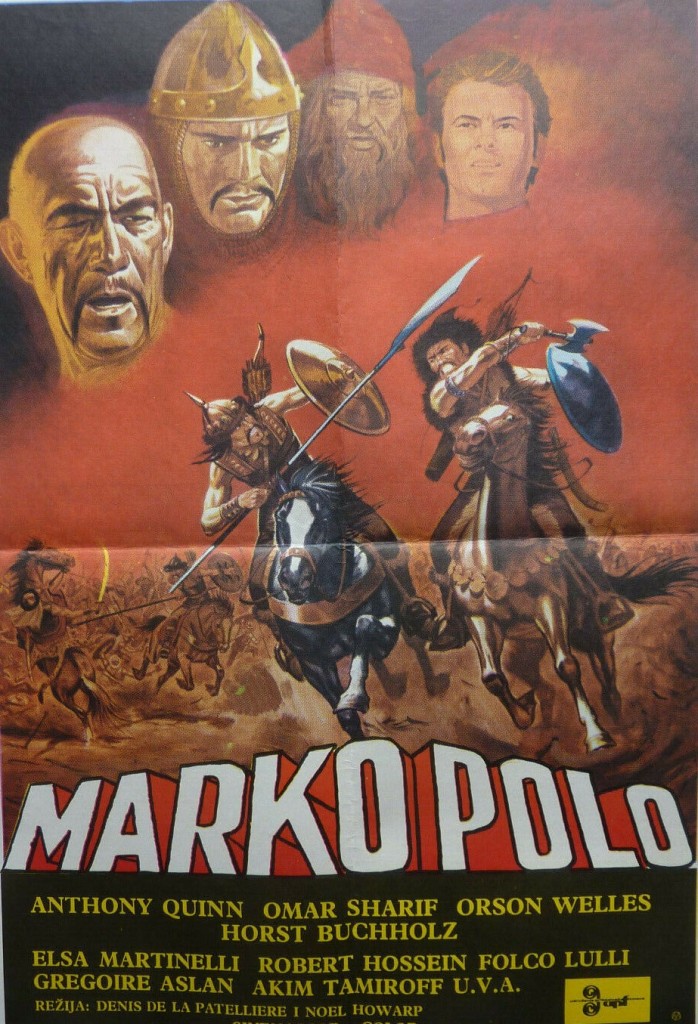
Marco the Magnificent (1965) **

Small wonder this flopped even with the requisite all-star cast of Omar Sharif (Doctor Zhivago, 1965), Anthony Quinn (Zorba the Greek, 1964), Orson Welles (Austerlitz, 1960),  Horst Buchholz (Nine Hours to Rama, 1963) and Elsa Martinelli (Hatari! 1962). Oddly enough, Quinn comes close to saving it. Although initially laughable, presented as a cross between Yul Brynner’s long-lost brother and Ming the Merciless, he tones down the trademark rasp and growl to deliver a powerful performance.

Of course, we also have to take the word of Marco Polos (Horst Buchholz) that he had all these adventures and that he did encounter The Old Man of the Mountains (Akim Tamiroff) and The Lady with the Whip (Elsa Martinelli). The former wore a mask of gold and if you ever saw his face that meant you were in for the chop. And he had a nice line in sonic torture. The latter chooses love above betrayal.

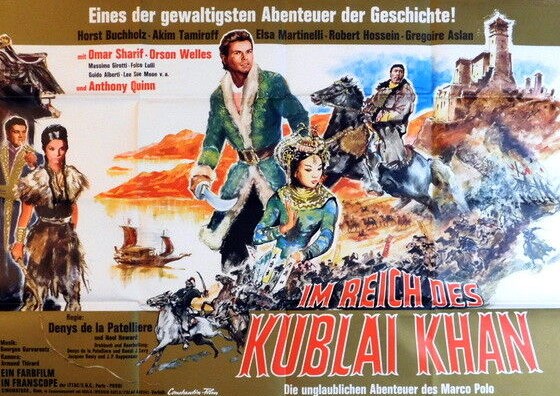
The name of Marco Polo either meant so little to German audiences or the title change was due to the producers hoping to capitalize on the success of “Genghis Khan.”

Love – or sex I guess – is a consistent theme. Marco is chosen for this adventure – whose main aim is to get a message to Mongol overlord Kublai Khan, now the ruler of China, that Italy, the dominant western power at the time, wants peace – in part because he is so handsome. He has no other pedigree that I can see. At the age of 20, he’s best described as an idler. But his father Nicolo (Massimo Girotto) is a renowned trader and has ventured along the Silk road to Samarkand.

But, would you believe it, following that old western genre trope where there’s always someone wanting to sabotage relations between Native Americans and soldiers, the idea of peace doesn’t sit well with everyone. Spies report on Marco’s every move and attempt to stop him completing his mission and when he reaches China discovers that another Mongol warlord Prince Nayam (Robert Hossein) prefers the traditional method of conquest, with the raping and pillaging that goes with it, rather than growing the economy through peaceful means.

Just as well Marco is so good-looking because whenever he is in a tight spot he is rescued by a beautiful woman, including the aforementioned Lady with the Whip, and, would you believe it, Princess Gogatine (Lynne Sue Moon), who has been chosen as a potential wife for Kublai Khan (Anthony Quinn). Multiple romance is the name of the game here – Arab chieftain Emir Alaou (Omar Sharif) has twenty-six wives, one of whom has the temerity to complain at his expanding harem.

Mostly, it’s a travelog – with a bucket of travel cliches thrown in such as Russian dancing – punctuated by occasional peril. But beyond looking handsome and putting his seductive powers to the test, there’s not much else for Marco to do.

The screenplay is so limited and haphazard you get the impression it must have been heavily truncated, that there was a three-hour roadshow covering the ground in a more sensible manner, but that appears not to have been the case. Producer Raoul Levy (who wrote and produced And God Created Woman, 1956, and wrote, produced and directed The Defector, 1966) ) spent so much assembling the cast he scrimped on a workable screenplay and was so intent on ramming it with oddly-named characters (Old Man of the Mountains and Lady with the Whip) that he took his eye off the narrative ball.

The final section with Kublai Khan trying to integrate through his own marriage the conquering Mongols and the conquered Chinese and dispensing with war in favor of peace makes more sense but by then you are so exhausted by the multiplicity of star names contributing nothing and the meandering plot that you have just about given up.

And it wasn’t as if Levy didn’t have time to get a screenplay in place. He’d been working on this since 1962 when an earlier version starring Alain Delon (Once a Thief, 1965) was abandoned when finance ran out. One of the most expensive French movies ever made, and extensively funded by Levy, it proved such a flop, it wiped him out financially and contributed to his suicide.

The inconsistency may have been caused by having three directors – Levy, Denys de la Patellier (Caroline Cherie, 1968)  and Noel Howard (D’Ou Viens-Tu, Johnny, 1963).

All-star cast wasted, promise unfulfilled.

https://m.media-amazon.com/images/I/6161DUBcazL._AC_SY445_.jpg

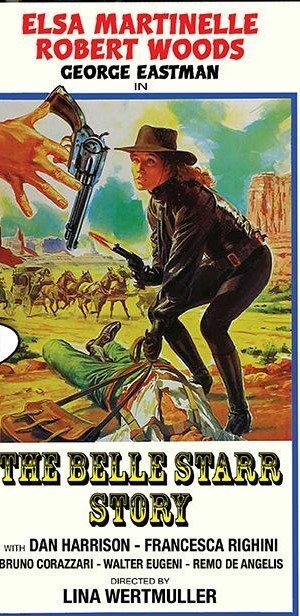
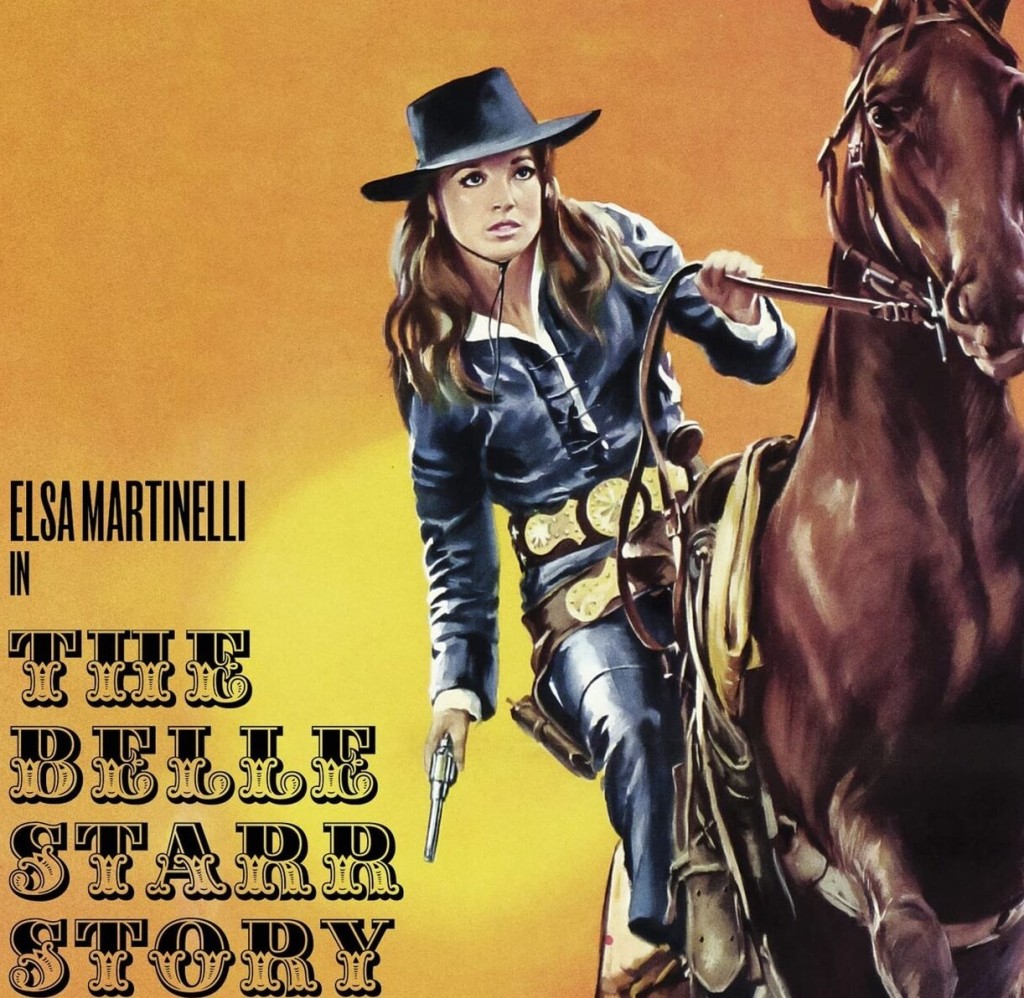
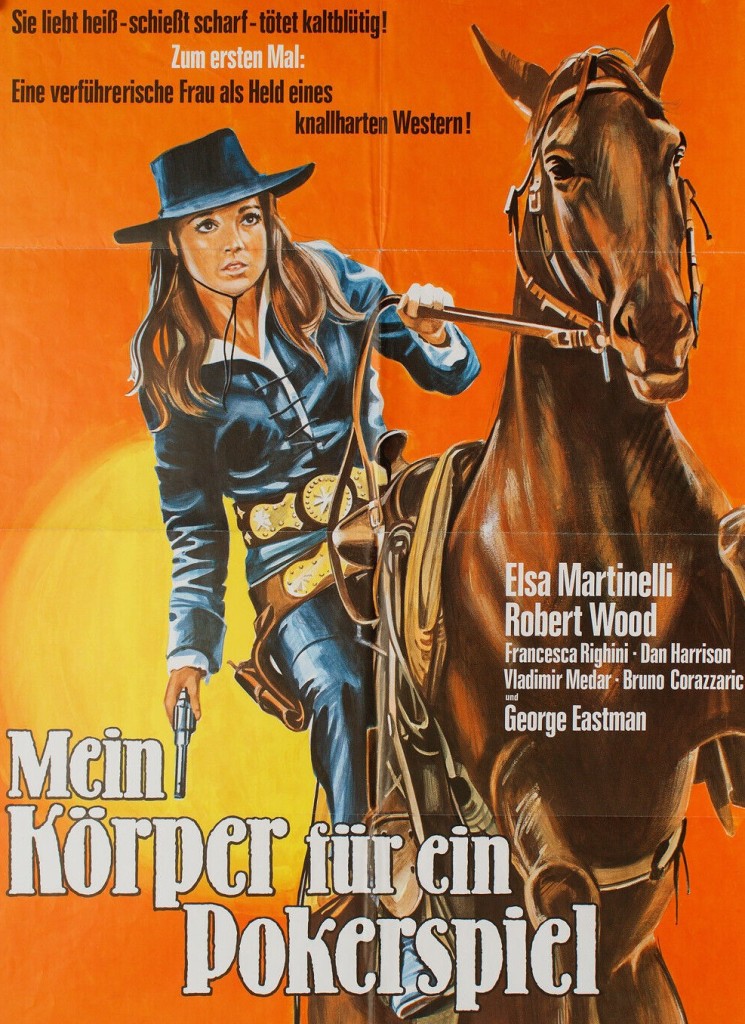
The Belle Starr Story (1968) ***

Only spaghetti western directed by a woman. Brings a distinctly feminist feel to that most sexist of the subgenres. You tend to forget that the sexy female Europeans imported to Hollywood as co-stars or to add spice further down the credits were actually top-billed stars in their natïve countries and demonstrated a greater range than the American industry allowed.

Not only do we have Elsa Martinelli (Maroc 7, 1967) as the leather-clad cigar-smoking titular gunslinger, whose watchword is female independence, but it was helmed by arthouse icon Lina Wertmuller (Swept Away, 1974).  There’s a thematic consistency lacking in most Italian-made westerns, for example predating Once Upon a Time in the West (1969) in its water imagery. But any potential for lyricism is undercut by the risk attached to being a lone woman. And there’s a Tracy-Hepburn tone to the endless bickering and battle for superiority in her niggling romance with outlaw Blackie (George Eastman).

And, unusually in that decade, a woman who throws caution to the wind and will even bet her body when the money runs out at the poker table, as twisty a meet-cute as a screenwriter could devise. But thereafter it’s a struggle for dominance between the pair. She won’t take orders from a man. He won’t accept female equality even when she shoots the wooden fence  he’s sitting on from under him, making him fall to the ground, and for good measure putting a bullet in his heels.

The first act builds up Belle Starr, cool at the poker table, even cooler in the bedroom, and demonstrating the gunplay that attracted her notoriety. The second act take an odd route, a lengthy flashback that digs deep into feminism, the orphaned Belle Starr running away after being sold into marriage by her uncle to an ugly old rich powerful man, traded, effectively, for political favor.

She returns to save a servant condemned to death for the crime of attacking the uncle when he tried to rape her. Sexual humiliation is a theme. Another outlaw Harvey (Robert Woods), who she regards as a platonic friend, steals her clothes as she swims in a lake, and then, having saved her from a posse, forcibly tries to take his reward.

The third act, like the duel between The Man With No Name and The Man in Black, is a case of double- and triple-cross. She refuses to join Blackie’s gang when he plans a million-dollar jewel heist, but hijacks the concept, recruiting her own gang to beat him to the robbery, and teach him a lesson.

But it backfires. Blackie is waiting. She has inadvertently hired his men. In the subsequence shoot-out he is captured. She rides to his rescue. But with their opposing ideas of a woman’s place in the world part on good terms.

The flashback was more subtly observed in Once Upon a Time in the West, and while she shared with Charles Bronson gunslinging skills he was not at any time viewed as a commodity or a piece of property or a candidate for rape. The flashback here fleshes out for the audience the powerlessness of women. But also the kind of camaraderie that is generally also usually only conferred on male characters.

We are pretty conversant with the notion that the gun rules the West. But less conscious of what happens when you are gun-less. Depriving someone of their fundamental weaponry makes them instantly impotent, as humiliating as denying someone water in a desert.

There are some nice directorial touches, blood dripping from a ceiling onto a dinner table, a saloon door opening to cast sudden light onto a corpse, waterfalls suggest sanctuary whereas open water attracts predatory males, and the finale, as they part, of Blackie, desperate to demonstrate his superiority, shooting off her hat from some distance.

Elsa Martinelli is a revelation as a star working to her own beat rather than playing second fiddle to some Hollywood marquee name. This wasn’t Lina Wertmuller’s first film and she had already made an impact with the Rita the Mosquito series, featuring another rebellious woman. Don’t be fooled by the co-directing credit, she replaced debut director Piero Cristofani after a few days.

It’s somewhat ironic that in a contemporary Hollywood attempt to create a female outlaw leader in Cat Ballou (1965), Jane Fonda was upstaged by Lee Marvin, and that in Bonnie and Clyde (1967), despite taking precedence in the title, Faye Dunaway was not the dominant one in the relationship.

By no means a great western but worth a look to see what Elsa Martinelli can achieve when not slotted in to the Hollywood co-star cliche and to get a preview of what Lina Wertmuller could offer.  

Decent print on YouTube.

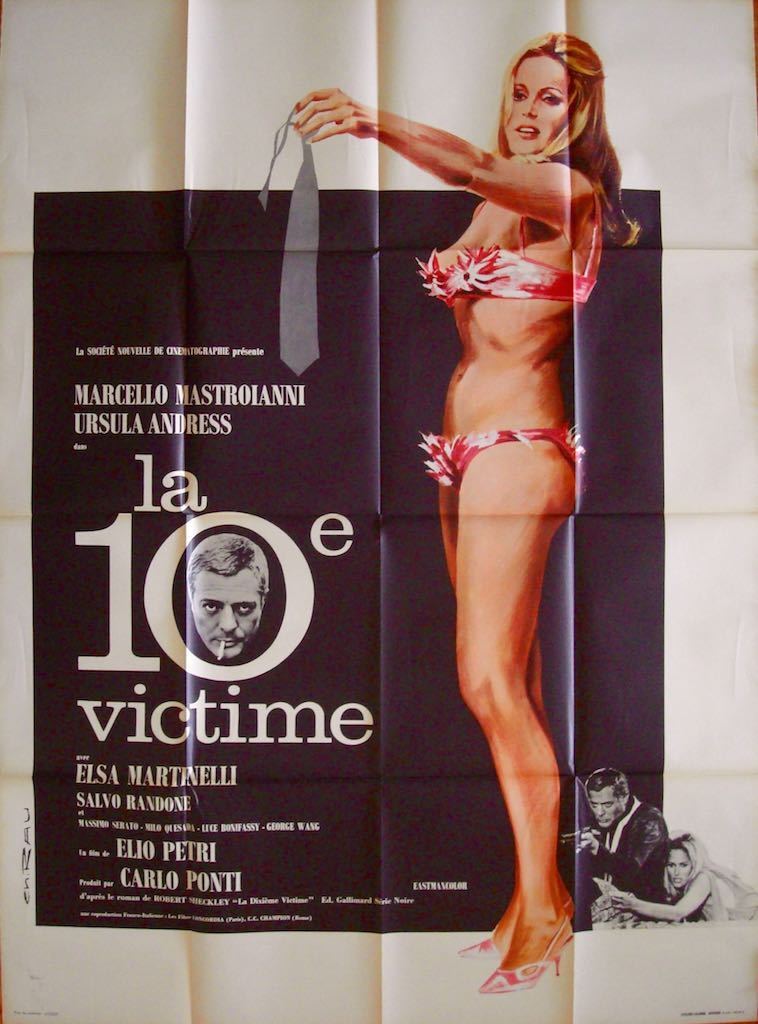
The 10th Victim (1965) ****

Sexy, stylish, sci-fi that spawned a host of imitators. Its key issue, population growth, has only  worsened since the movie appeared though killing for sport goes back to the Roman gladiators and government-sponsored killing – aka genocide – is hardly so novel. And it sets up a feminist perspective – the female killer is deadlier than the male, experience counting for everything in the assassination game.

None of the villainous females in the decade’s myriad spy films, not even the vicious pairs that gave Bulldog Drummond such a headache, could match the lethal striptease performed by authorized huntress Caroline (Ursula Andress) which culminates in a volley of bullets from her bra. Caroline is hoping to strike gold with her tenth killing, which not only brings a hefty financial bonus (and retirement) in itself, but could bring a massive bounty if captured on television and to that end she has negotiated a sponsorship deal with the Ming Tea Company, and adopts the façade of TV reporter.

Her potential victim is Marcello (Marcello Mastroianni) who would be rich enough from his six killings except his earnings have been squandered by ex-wife Lidia (Luce Bonifassy) and mistress Olga (Elsa Martinelli), not to mention the upkeep of his parents who he, illegally, has kept alive. To maintain his lifestyle he is the face of a cult worshipping the setting of the sun, but that gig is threatened by a rival cult of moon worshippers.

Set in 2079 in the aftermath of World War Three “The Big Hunt” is viewed as a legitimate method of curbing the instincts of those with violent tendencies, just the type to thirst for a fourth global conflagration. Participants must switch between being killer and potential victim, five times in each role. Naturally, victim can also take down assassin.

While attracted to Caroline, Marcello is nonetheless suspicious of the sexy reporter who in the course of claiming to be doing a story on the sexual habits of Italian men attempts to entice him to the ancient Temple of Venus in Rome where, naturally enough, sexy dancers in sexy costumes will be part of the show.

Assassination pictures are always complicated – check out The Manchurian Candidate (1962) or The Mechanic (1972) a decade later – and here the unexpected factor is love. But in the old love vs. money dynamic there’s a considerable twist, both protagonists seemingly more intent on worldly gain than enriching their souls. So it’s a twisty picture as killer and victim seek to outwit the other by any means, romance considered an acceptable weapon.

Stylistically, it’s a visual delight as director Elio Petri (A Quiet Place in the Country, 1968) meshes the burgeoning Pop Art movement with the classical architecture of ancient Rome, and the Colosseum, dismissed in the film as a unsuitable locale, though a reminder of the origins of single combat. Clever without being pretentious, sexy without veering on the side of voluptuousness, the approach is mostly ironic and can easily be viewed as a social and political commentary. Every serious element is undercut, even post-killing some bureaucrat rushes in with an official judgement on the murder. And how could you possibly take seriously the blond barnet of Marcello Mastroianni (A Place for Lovers, 1968)? That’s almost an ironic play in itself.

Austin Powers (1997) in comedic fashion took this as its stylistic cue, while other movies as wide-ranging as Death Race 2000 (1975), The Running Man (1987), Battle Royale (2000) and The Hunger Games (2012) emphasized the violence and/or political undertones. 

But none of these boasted such a stunning cast. Mastroianni performs these disaffected roles so well, while as a more than worthy adversary the generally-underrated Ursula Andress is in the form that made The Southern Star (1969) such a pleasure. Throw in Elsa Martinelli (Maroc 7, 1967) and what else could you ask for. Based on the short story The Seventh Victim – later novelized – by Robert Sheckley.

A fun ride that still makes you think.

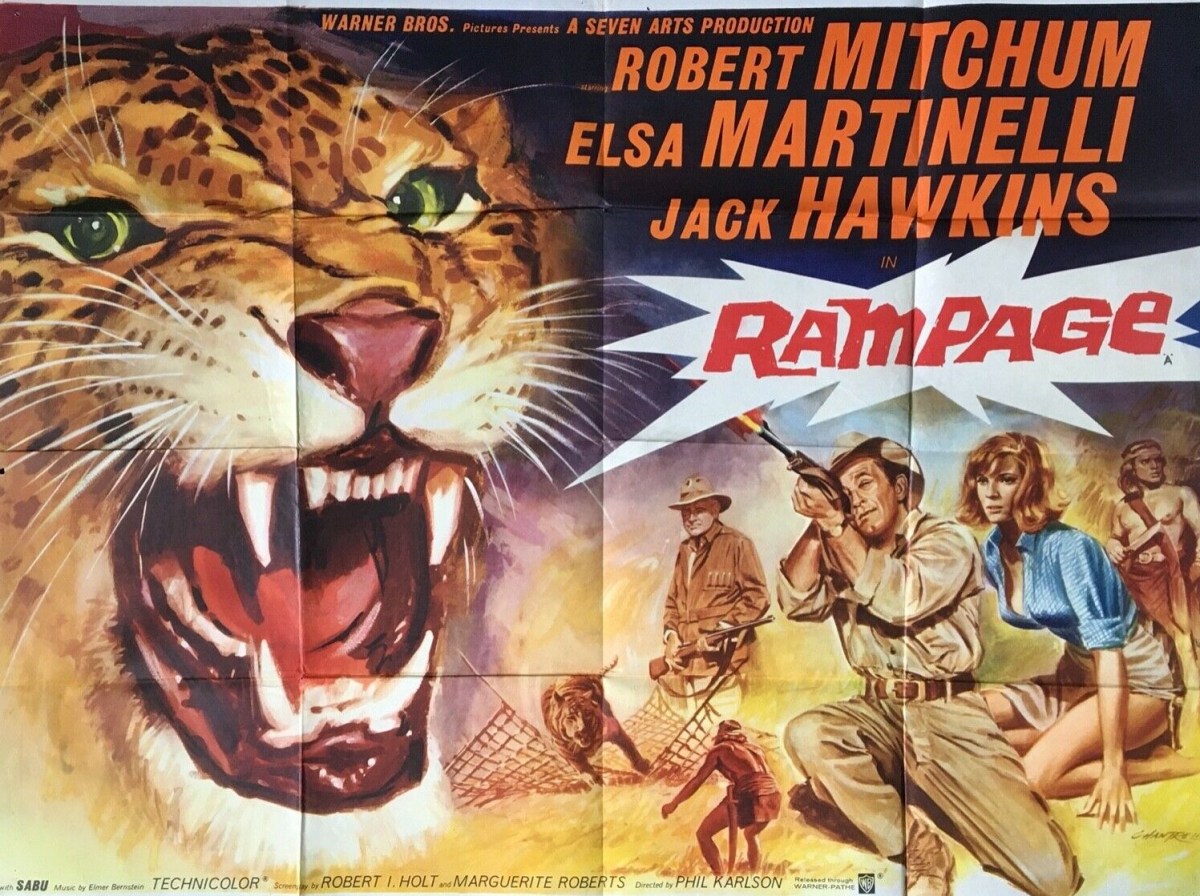
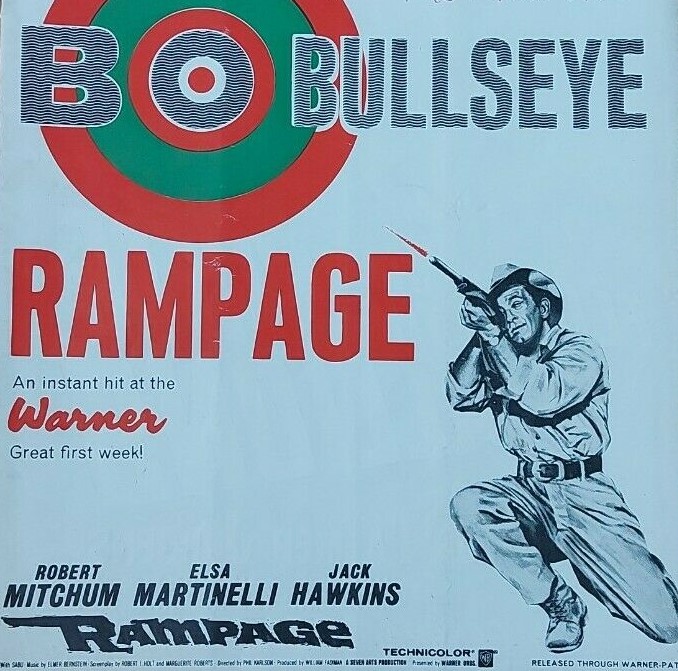
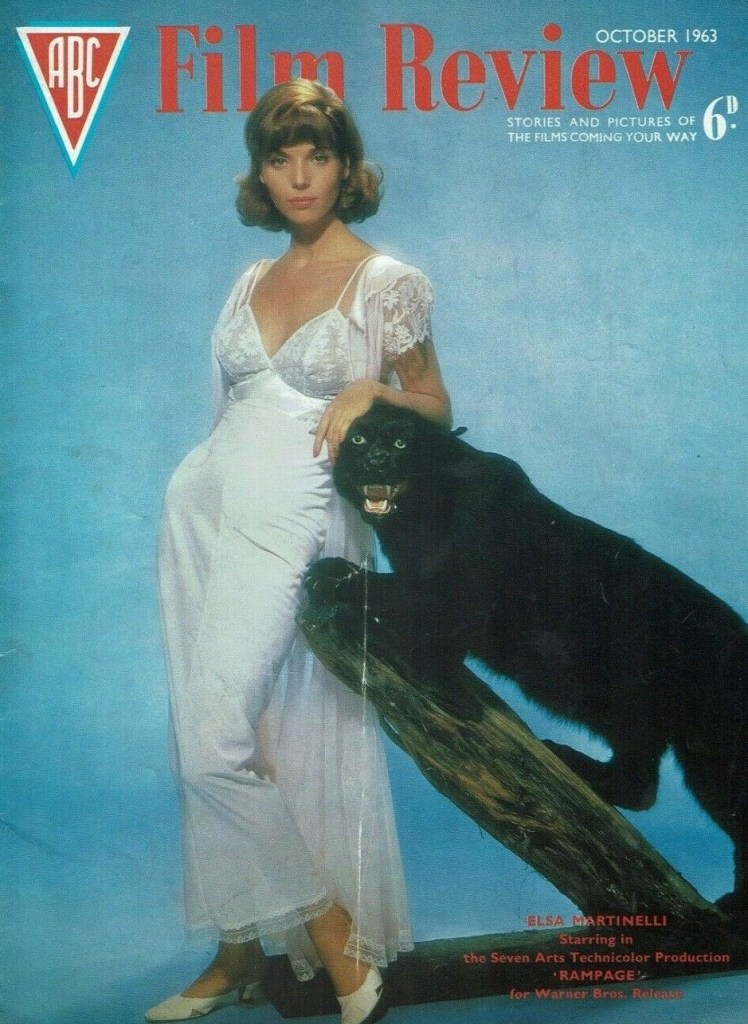
Rampage (1963) ***

A more misleading title you’d struggle to find. There’s no sign of a rampage until the last 20 minutes, and even then it plays out on a rooftop in a city. Not a patch, action-wise, on Howard Hawks’ Hatari! the previous year, but sharing the female lead Elsa Martinelli. More romantic drama than jungle adventurer, and not much Malaysian jungle at that given Hawaii was the stand-in.

Big on metaphor, women viewed as trophies to boost the male ego or requiring male protection. Surprisingly contemporary with reference to the grooming of young women. Though Hatari! went down the same line, hunting animals for zoos rather than sport, this again take  contemporary approach, animal conservation seen as a battle of cultures, between men for whom shooting an elephant or a rhino reinforces their macho tendencies, and those who want to preserve rare wildlife for future generations.  

Trapper Harry (Robert Mitchum) and hunter Otto (Jack Hawkins) team up to capture for a German zoo two tigers and a legendary panther-like creature known as “The Enchantress.” From the outset, sexual tension sizzles between Harry and Otto’s young partner Anna (Elsa Martinelli). Although Otto is possessive, he permits Anna to take male companions on the assumption that she will always return to him.

Anna’s not quite as submissive as Otto would like to believe and she puts Harry in his place more than once. There’s a 35-year age difference between Otto and Anna. But Harry is disturbed at how they became lovers, persistently asking how soon, after the older man saved the orphaned girl from poverty, he seduced her.

The love triangle is set against a more primitive background where women have no rights and are as likely to be offered up to any passing male. Native guide Talib (Sabu) feels duty-bound to pass his wife onto to Harry. The wife not only acquiesces, but is insulted when the American refuses.

The men represent different cultures, Otto a marksman who prefers to bring his trophies back dead, hanging his virility on every scalp, Harry more emancipated for whom capture is enough. There’s a stand-off with a local tribe when Otto is too hasty with his rifle.

Martinelli does better here in terms of panther, the creature in the film was
more of a leopard with some red marks.

Given the lack of budget and the consequent lack of action, it’s no surprise that the drama revolves around whether Anna will betray her lover. Despite his apparent laid-back approach, Otto watches Anna with an obsessive eye, her potential loss deemed a blow not just to his esteem but a sign of approaching death.

What sets this aside from the submissive female trope is that the decision rests with Anna. Harry certainly doesn’t push his luck and until his pride is dented Otto allows the situation to play out. The shift in Anna’s feelings is discreetly rather than dramatically handled. The traditional bathing scene is used to reveal that Anna is not actually married and therefore neither committing adultery nor under legal obligation.

When we finally get down to some action, the build-up is interesting, Harry using beaters to nudge tigers towards his traps, but, unfortunately the majority of these animals are a disgrace to their wild forefathers, on the whole appearing pretty obliging if not outright dumb. There’s one charging rhino and, heaven forfend, Otto commits the cardinal son of requiring two bullets to finish it off.

The movie picks up when they encounter “The Enchantress,” by a long way the smartest beast in this particular animal kingdom, who enhances her mythical status by hiding in a cave, clash of personalities between the alpha males triggering the movie’s final, more dynamic, phase, Anna coming into her own not just as a crack shot but as an independent woman, Otto making Harry his prey.

More interesting as an examination of contemporary mores, not quite as sexist as initially it appears, and nudging in the direction of a woman attempting to attain independence, and in discussing the issues surrounding conservation. Just as bold is the questioning of Otto’s motivation is saving Anna from poverty, an act of kindness or grooming? You might wonder how much better off Anna would be with a man two decades older rather than one three decades older, but nobody goes there.

The acting is uniformly under-played. Elsa Martinelli is given a better showcase for her talents here than in Hatari! and this is Robert Mitchum (Five Card Stud, 1968) at his laid-back best while Jack Hawkins (Masquerade, 1965) keeps his simmering under control until the end.

Without the budget to ape Hatari! director Phil Karlson (The Secret Ways, 1961) has no option but to focus on characters rather than animals, but finds interesting ways to put various messages across. Marguerite Roberts (Five Card Stud) and Robert I. Hope (White Commanche, 1968) based their screenplay on the novel by Alan Caillou a.k.a Alan Lyle-Smith.

Maroc 7 (1967) ***

With a string of Swinging Sixties fashion models providing the requisite bevy of beauties, a gang of thieves, a Moroccan heist, superb locations, great cast and a touch of archaeology with secret chambers and a long-lost relic thrown in, this splendid espionage frolic proves a welcome return to big screen top billing for Gene Barry after nearly a decade in television in Bat Masterson (1958-1961) and  Burke’s Law (1963-1966).

Something of a cat burglar himself, Simon Grant (Barry) infiltrates a gang which uses fashion as a cover and whose ingenious speciality is to steal famous heirlooms and replace them with fake ones in the assumption that on their departure from a foreign country the customs officers will not be able to tell the difference. Louise Henderson (Cyd Charisse) and Raymond Lowe (Leslie Phillips) head up the gang while Claudia (Else Martinelli) may or may not be in on the act.

Her dalliance with Simon suggests an inclination towards the right side of the law but the fact that she has been involved with the pair for so long sets up the intriguing notion that she is stringing the American agent along. Initially, she rejects Simon’s advances until told by Louise to comply and pump him for information leading to one of the movie’s best lines (and innuendo that a British audience in particular would adore). Says Simon: “We haven’t done much about pumping but maybe that will come later.”  Doubts also surround the intentions of Michelle Craig (Alexandra Stewart).  On their trail is Inspector Barrada (Denholm Elliott).

There is mystery aplenty and a fair quotient of punch-ups, romance, shoot-outs and murder while the unearthing of the hidden treasure is less heist amd more straightforward Indiana Jones. The fashion is the icing on the cake. The Moroccan fashion shoots are more than merely decorative, or an excuse to bare the charms of the gorgeous models. Instead, the shoots would not disgrace Vogue or any of the other glossy magazine temples to haute couture, with that Sixties focus on fabulous clothes, genuine location and outlandish hairstyles.

On top of that, several of the stars are either playing against type or out of their comfort zones. Legendary Hollywood dancer Cyd Charisse famed for such classic musicals as The Bandwagon (1953) and Silk Stockings (1957) sets such fluff aside to essay a criminal mastermind, whose cunning often gets the better of Simon. Leslie Phillips (Crooks Anonymous, 1962), better known as a charming Englishman with an eye for the ladies, is as ruthless a photographer as he is a criminal. Director Gerry O’Hara (The Pleasure Girls, 1965) has managed to get both Phillips and Denholm Elliott to drop their standard methods of delivery, usually embracing a drawl, making their characterisations a good bit more fresh than normal. Phillips was clearly intending to make some kind of career change since he was the producer.

Gene Barry makes a perfect entrance as an adventurer-spy, as confident in his seduction techniques without women falling at his feet like James Bond, with a nice line in self-deprecation and more than able to look after himself. Before being side-tracked by television, Barry had shown movie star potential in War of the Worlds (1953) and Thunder Road (1958) and now he delivers on that earlier promise. Elsa Martinelli (Hatari!, 1962) is the femme fatale who may or may not wish to play that role, keeping the audience completely on edge as to which side of the law she is likely to come down on. Added bonuses are Alexandra Stewart (Only When I Larf, 1968), Angela Douglas (Carry On Screaming!, 1966), Tracy Reed (Hammerhead, 1968), dancer Lionel Blair (A Hard Day’s Night, 1964) and Maggie London.

Hatari! (1962) ***

What this movie needed was Cinerama. That format blended exotic locale and thrills. The Tanganyika setting and jeeps belting across uneven terrain to capture myriad wildlife provide the two required elements. But the rest of the film struggles to keep up.

Here Howard Hawks combines his two most common themes, a group of men stuck together facing an unusual task and a battle of the sexes. But without the tension of an upcoming gunfight (Rio Bravo, 1959) or bizarre romantic comedy contrivance (Bringing up Baby, 1938), it falls short of the director’s highest standards. But as he set such high standards, virtually anything would.

Paramount went the extra mile on this one, producing, in addition to the normal pressbook, a special “Care and Handling Manual” such as had previously accompanied Psycho. This was a week-by-week breakdown of marketing activities – from arranging a John Wayne hat tie-up, to getting record stores and bookshops to prepare window displays, stencilling paws on the ground leading to the cinema and organising permits for a safari-parade on opening day. There was a tie-in with Jeep and the movie was a natural for involvement with schools and kids

The original concept intended to pair Clark Gable and John Wayne so that might have produced better results. Setting aside the gripe of the unlikely romance between a young Elsa Martinelli (rather than a mature Maureen O’Hara) and the ageing Wayne, this remains highly entertaining and a thrilling ride. Watching the actors do their own dangerous stunts, bouncing over potholes and battered in trucks moving at high speed, holding on for dear life (Wayne as the catcher unprotected on the outside)  as the vehicles swerved and twisted, the thunder of hooves, confronting extremely dangerous and extremely wild animals such as rhinos, makes up for other deficiencies.

Martinelli does not quite have the zap of a Hepburn or Monroe but does well as the photographer infiltrating a male enclave and her bonding with the baby elephant (triggering Henry Mancini’s “Baby Elephant Walk” theme) steals the picture. A pet leopard also provides a decent riff on the girl-in-the-bath number. Quite a number of plot lines are worked in to give actors of the calibre of Hardy Kruger something to do and to stretch the likes of Red Buttons who is rarely given any decent dramatic material.

In quite a different role, Wayne, for once not called upon to save the day, gives a good performance. Not only do they not make them like that anymore, they wouldn’t be allowed to make them like that these days, notions about working with animals (though none were harmed) much changed.  


Discover WordPress

A daily selection of the best content published on WordPress, collected for you by humans who love to read.

The Atavist Magazine

by Brian Hannan

WordPress.com News

The latest news on WordPress.com and the WordPress community.