A Shot in the Dark (1964) ***

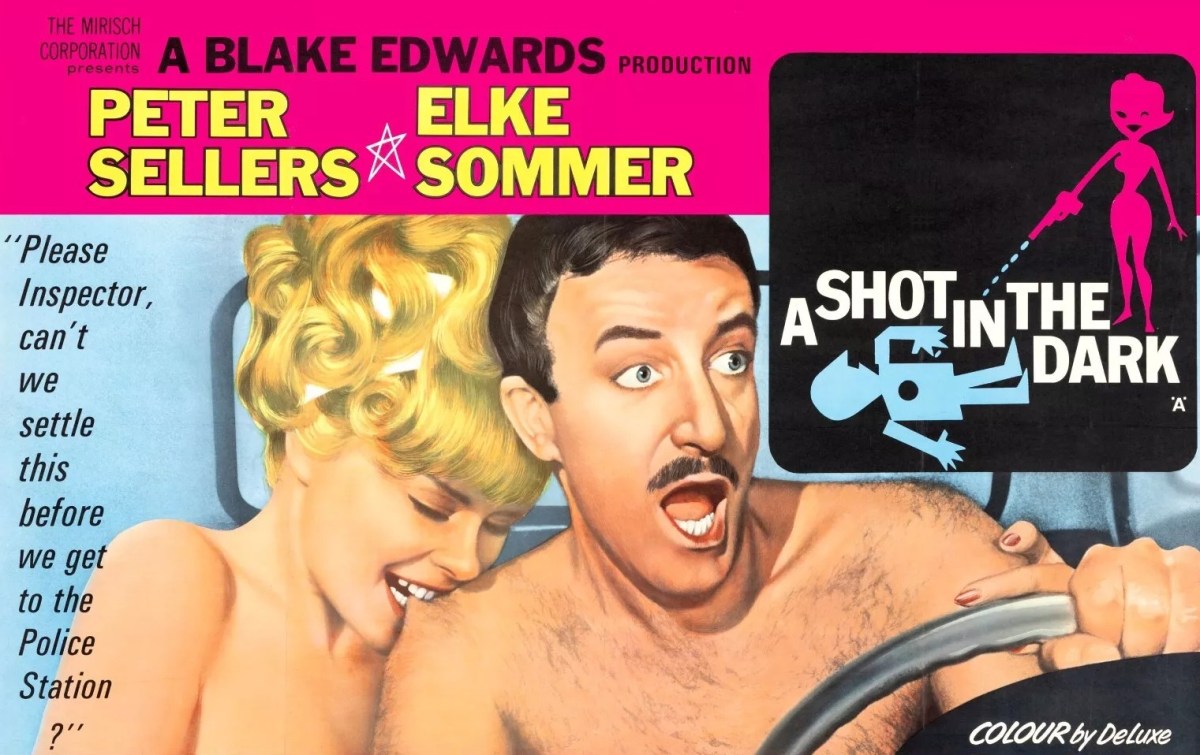
A pratfall still works wonders. An open door or window, anything that happens to be on the floor, or for that matter any object of any description – billiard cues, for example – within easy reach offers the opportunity for havoc – and a steady stream of laffs. Which is just as well, because this complicated farce, which might get a few extra brownie points today for its satire on serial killers, doesn’t do the movie any favors.

Inspector Clouseau (Peter Sellers) has acquired a more pronounced French accent than since his last incursion in The Pink Panther (1963) but it’s nothing like as excruciatingly hilarious as would be in later episodes. He still falls in love at the drop of a hat though this time the object of his affection is maid Maria (Elke Sommer) who, unfortunately, happens to be the prime murder suspect. She should be in jail but she is constantly released. Clouseau should be sacked for incompetence, but he is constantly reinstated.
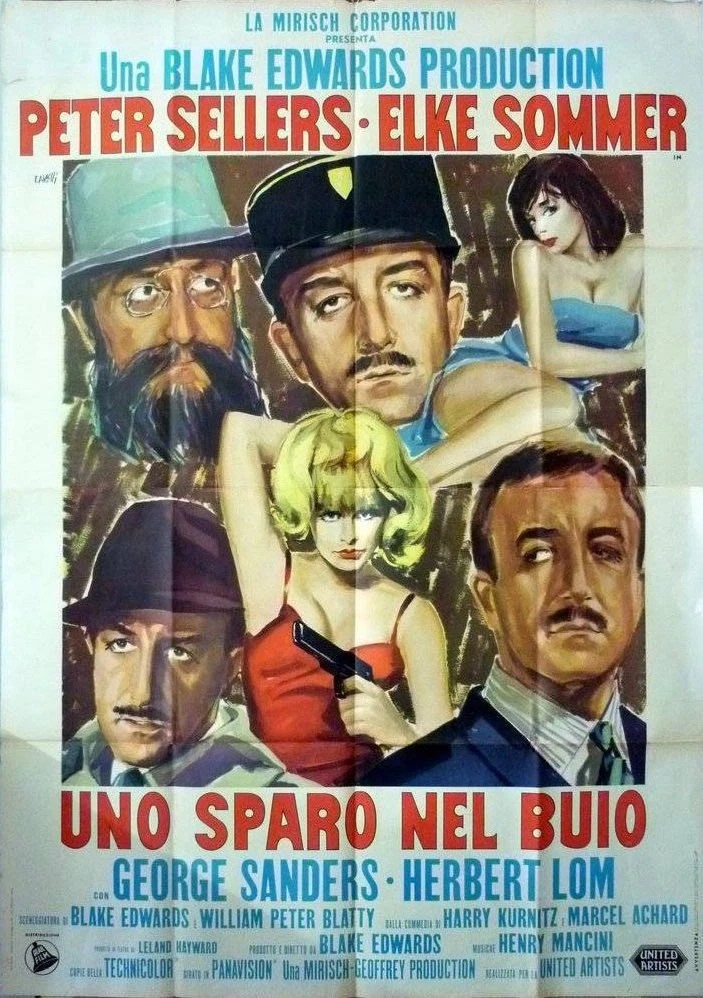
The repertory team of his frustrated boss Dreyfus (Herbert Lom) and karate teacher (Burt Kwouk) interrupt proceedings from time to time but don’t really add to the laugh quotient. A bit more effective is the satire on French bureaucracy, a running gag on the need for an official permit, for example, before you could think of selling balloons on the street or trying to earn a buck as a street artist.

I won’t go into the plot since it’s a series of baffling murders and you could argue that Peter Sellers needs neither plot nor love interest. All he needs is an open door beckoning.

I was astonished how often I laughed out loud at something I knew was coming. The minute someone walked through a door you knew Clouseau would be the other side of it waiting to be buffeted. Any open window and he’d be through it and likely as not water would await.

He doesn’t just get tangled up in words but ask him to replace a billiard cue and you’d think billiard cues had declared war on him. He’s forgetful to the point of forgetting to switch off his cigarette lighter and naturally ignores the signs that he’s set his coat on fire.
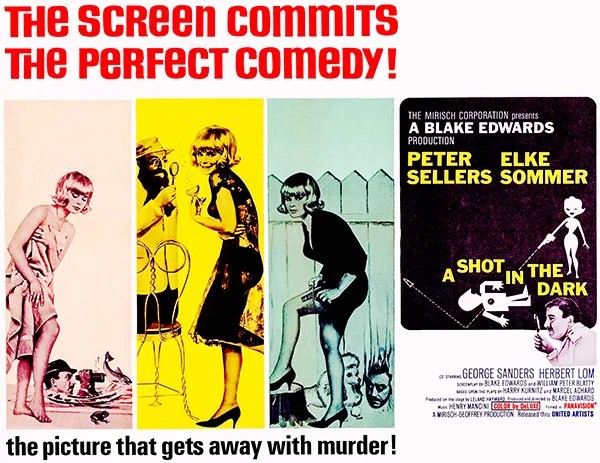
For those more censorious times, there’s a foray into a nudist colony which is primarily an exercise in the various ways that private parts can be hidden from the camera while suggesting the salacious opposite. Clothed or unclothed you can rely on Clouseau to fall down. The only hilarious scene that doesn’t involve him falling down is when Maria miraculously appears in his office and when an attached key tears a whole in his trousers.

The various twists – Dreyfus is the assassin stalking Clouseau – and the lax French attitude to adultery keep the plot going and when the narrative slackens you can always stick a bomb into the mix.

From the outset, there is plenty opportunity for farce, the wrong people entering the wrong doors, continuous mix-up, plenty occasions for the innocent person to be caught red-handed clutching the murder weapon.

It almost looks as though the two aspects of the picture are clashing. Director Blake Edwards (The Pink Panther) appears to be helming a farce within which Inspector Clouseau is encased. You might think there’s a limit to the number of pratfalls you can stick in a picture, but my answer is “try me”.

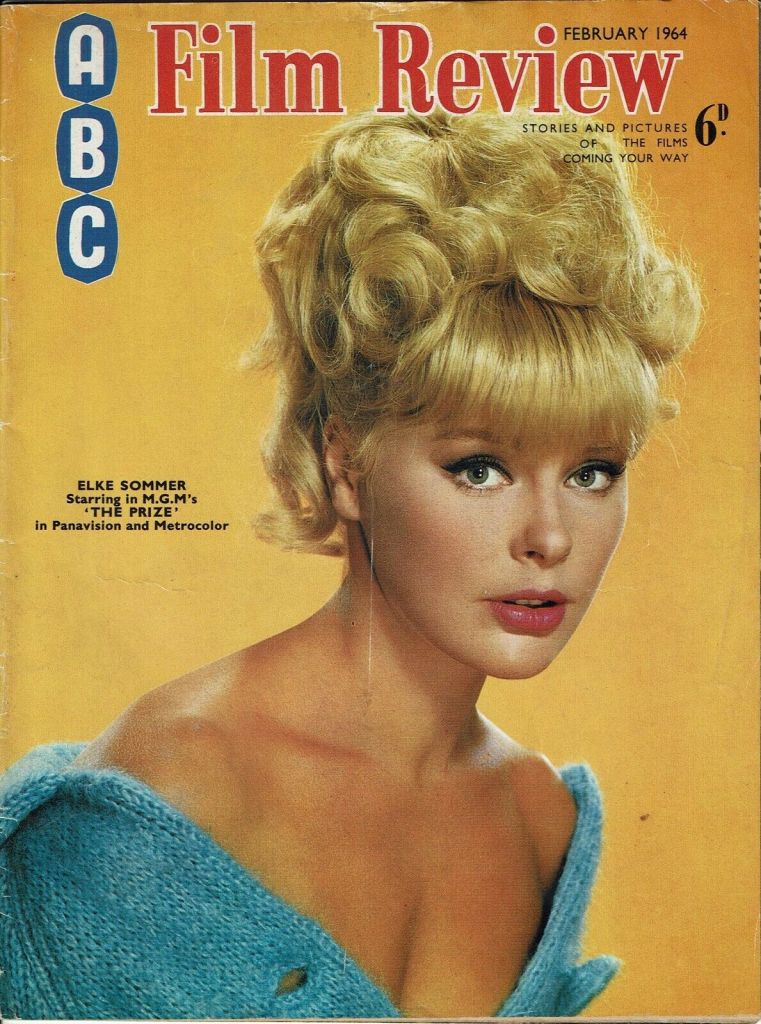
With Peter Sellers so dominant, the only way the supporting cast could compete was by over-acting (Herbert Lom) or under-acting (all the rest).  Elke Sommer (The Prize, 1963) needs do little more than look winsome.

Written by Edwards and William Peter Blatty (Gunn, 1967) based on the play by Harry Kurnitz.

Occasionally drags but lifted by the genius of Sellers.

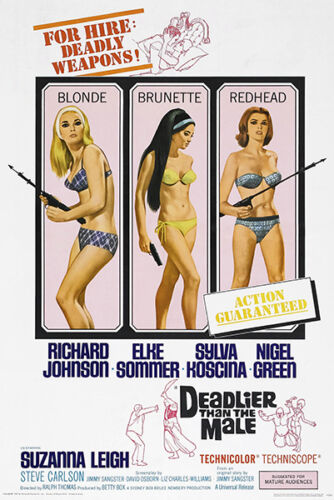
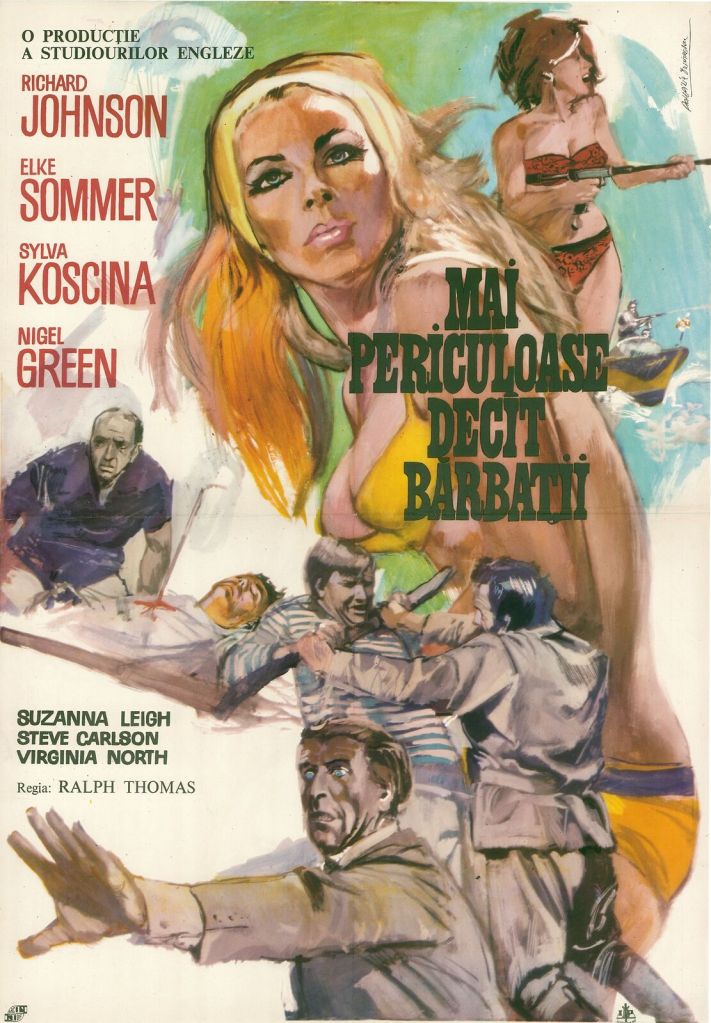
Deadlier than the Male (1967) ****

For a movie intended to set up a series character in the vein of James Bond, it was ironic that it was the women who stole the show, not just from their tendency to turn up in bikinis but for their outrageous villainy. Irma (Elke Sommer) and Penelope (Sylva Koscina) are the seductive assassins in the hire of Carl Petersen (Nigel Green) who has designs on an Arab oil empire. On her own Irma dispatches mogul Henry Keller (Dervis Ward) then the pair – emerging from the sea like a pair of latter-day Ursula Andresses – harpoon his colleague Wyngarde (John Stone).  

Soon Hugh Drummond (Richard Johnson), investigating the death of Stone, becomes a target  and that sets him off, with nephew Robert (Steve Carlson) in tow,  to the Mediterranean and the yacht of oil-rich King Fedra (Zia Mohyeddin) where, of course, the girls lie in wait.

Dispensing with the gadgets – except for one item employed by the villainesses – and gimmicks of Bond, but retaining the quips, this is a fun ride with a more down-to-earth leading man – like the early Bonds – smarter girls, a more old-fashioned mystery, hefty thug Chang (Milton Reid)  in the Oddjob mold, a castle doubling as the villain’s lair, a suave master criminal, some detective work, and a super scene involving giant robotic chess men.

The bickering between Irma and Penelope, not just a tad sadistic but a kleptomaniac especially as far as her partner is concerned, coupled with their overweening confidence, makes them much more human than any Bond Girl and the character traits explored have a pay-off at the climax. Equally interesting are the mind games, Drummond vs. Peterson but also Drummond vs. Irma. And that the female baddies see it as points on their scoreboard to seduce Drummond rather than the other way round.

Drummond is every bit as capable a seducer as Bond and equally ruthless, stripping one suspect naked. Petersen is also a clever character, faking his own death and running a very smooth operation, and certainly his recruitment techniques are second to none.

Some ideas were certainly ahead of their time, the chess men are the equivalent of a modern computer game while the human bomb has, unfortunately, entered the modern lexicon and there are enough female serial killers around to prevent anyone believing they are always (to use a sexist phrase) the gentle sex. However, in the middle 1960s, the concept that women would be partial to murder and torture not to mention repeatedly seducing males went so much against the grain of the male authority figures that the British censor slapped an X-certificate on the movie.

Shakespearian actor Richard Johnson was at one time an MGM contract player, but his only previous top-billed outing was the Italian-made The Witch (1966) but he certainly made a splash with this character, investing it with a great deal more gravitas than Derek Flint or Matt Helm. The Teutonic Elke Sommer (The Venetian Affair, 1966) is brilliant as one half of the assassin tag-team with a batch of one-liners for every occasion. Sylva Koscina (A Lovely Way To Die, 1968), nose always put out of joint, almost steals the show.  Nigel Green (Tobruk, 1967), while his usual sardonic self, has the playfulness of the rich and powerful.

Steve Carlsen, in his movie debut, doesn’t make much of an impact in a largely lame role. Zia Mohyeddin has a more interesting role as the oil kingpin wanting to help his people. As you can expect in a spy picture there are a host of beautiful women – Suzanna Leigh (The Lost Continent, 1968) a defector, Virginia North, also making her debut, Justine Lord (Night after Night after Night, 1969), and Didi Sydow in her only screen appearance.

The light comedy experience of director Ralph Thomas (Doctor in Distress, 1963) comes in very handy, as his sense of comic timing is excellent, but, perhaps learning from his previous brush with espionage in Hot Enough for June / Agent 8¾ (1964) brings a bigger punch to the action scenes. And it’s a bold ploy to start with an action sequence revolving around Irma and Penelope rather than our star man.

The screenplay was a team effort – Jimmy Sangster (The Devil-Ship Pirates, 1964), taking a break from Hammer duties, David D. Osborn (Maroc 7, 1967) and Liz Charles-Williams, making her screen debut  – all involved.  This was familiar territory for composer Malcolm Lockyer (Five Golden Men, 1967). British pop act The Walker Brothers had a hit with the theme tune.

This is more fun than camp, not a send-up of the genre like Derek Flint and Matt Helm, but a spy picture with a believable leading men and excellent villains. But the plot is more centered on filthy lucre rather than global control and there is a genuine understanding of how businesses work – takeovers, mergers, dirty dealings – though small wonder Petersen would like to be shot of pedantic boardroom nuisances like Bridgenorth (Leonard Rossiter) – wouldn’t we all?

Bulldog Drummond was an international crime-buster invented by “Sapper,” the pen-name of H.C. McNeile. Bulldog Drummond had been a Hollywood mainstay for over four decades, the twenty-plus pictures attracting stars like Ronald Colman (Bulldog Drummond, 1929, and Bulldog Drummond Strikes Back, 1934), Ray Milland (Bulldog Drummond Escapes, 1937), Walter Pidgeon (Calling Bulldog Drummond, 1951) and a young Ralph Richardson (The Return of Bulldog Drummond, 1934). But the notion, in the Swinging Sixties, of tagging any leading man by the moniker of ‘Bulldog’ did not seem like a good idea, so the character underwent wholesale reinvention, and his nickname is never mentioned. 

The title comes from a line in a poem by Rudyard Kipling, The Female of the Species. That was the original title of the film and also of a Sapper book.

The Prize (1963) ****

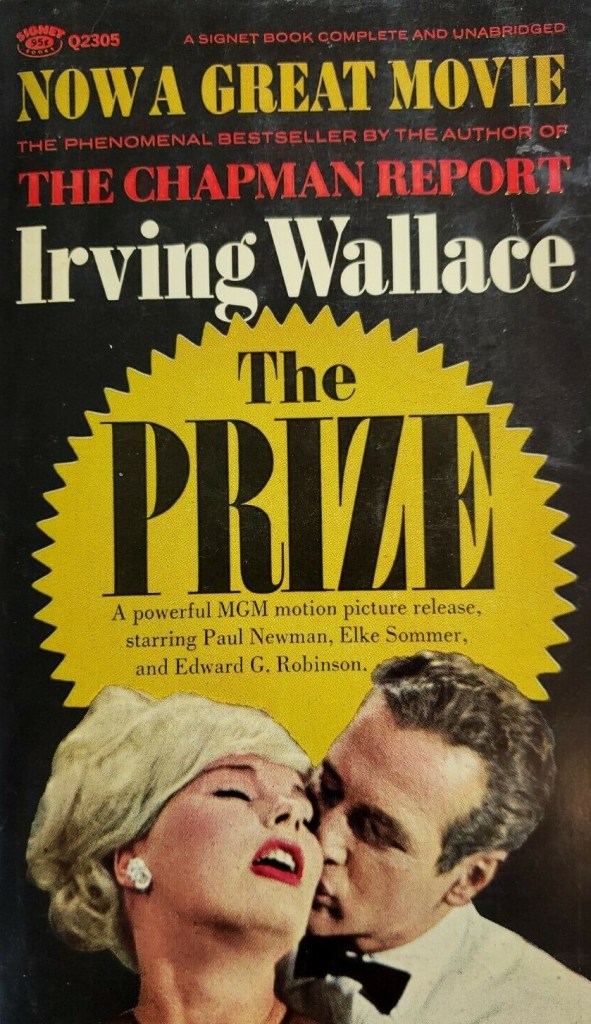
Thoroughly involving potboiler with alcoholic novelist Andrew Craig (Paul Newman) turning unlikely detective to uncover murky double-dealings at the annual Nobel Prize ceremony. Based on the Irving Wallace bestseller set in Stockholm, director Mark Robson (Von Ryan’s Express,1965) strings together a number of different stories that coalesce in a gripping climax. Screenwriter Ernest Lehman (North by Northwest,1959) brings alive what could have been a very soggy adaptation of a beefy bestseller with witty and literate dialog and a plot that hovers just the right side of hokum.

Inger (Elke Sommer), delegated to look after the author, starts out as a stuffed shirt not a sexpot, allowing Newman’s attention to drift towards Emily Stratman (Diane Baker) – daughter of another winner Dr. Max Stratman (Edward G. Robinson) – while he is dragged into romantic entanglement with neglected wife Dr Denise Marceau (Micheline Presle). Mostly, Newman just wants his next drink, and his almost continual inebriation sparks some good comedy and he is gifted good lines to extricate himself from embarrassment. Simmering in the background are warring winners – the Marceau husband-and-wife team and Dr John Garrett (Kevin McCarthy) convinced that Dr Carlo Farelli (Gerard Oury), with whom he is sharing a prize, has stolen his research.  

There are sufficient character clashes and plots to be getting along with if you were just intent on taking a Valley of the Dolls approach to the material, that is, cutting between various dramatic story arcs, but, without invalidating the other subsidiary tales, the movie takes quite a different turn, providing the potboiler with considerable edge. 

Turns out that Andrew is so impoverished that he has been writing detective novels under a pseudonym and suspecting that Dr Stratman is an imposter he starts investigating. So in some respects it’s a private eye procedural played out against the glamorous backdrop of the awards. But the clues are inventive enough and there is a femme fatale and once Inger comes along for the ride and with Andrew a target the picture picks up an invigorating pace. Echoing the humorous auction scene in North by Northwest is a sequence set in a nudist colony where Andrew seeks refuge to avoid villains while another terrific scene plays out in the docks.

Paul Newman looks as if he is having a ball. In most of his pictures he was saddled with seriousness as if every part was chosen with an eye on the Oscars. Here, he lets rip with a lighter persona, and even if he mugs to the camera once too often, the result is a screen departure that lifts the picture. Inebriation has clearly never been so enjoyable. Sommer is a delight, showing great dramatic promise. Edward G. Robinson (Seven Thieves,1960), more renowned for his gangster roles, convinces as a scientist. Diane Baker (The 300 Spartans, 1962), Kevin McCarthy (Invasion of the Body Snatchers,1956) and Leo G. Carroll (North by Northwest) provide sterling support.

Robson directs with dexterity, mostly with an eye on pace, but it is Lehman’s script with occasional nods to Hitchcock that steals the show.

The Venetian Affair (1966) ****

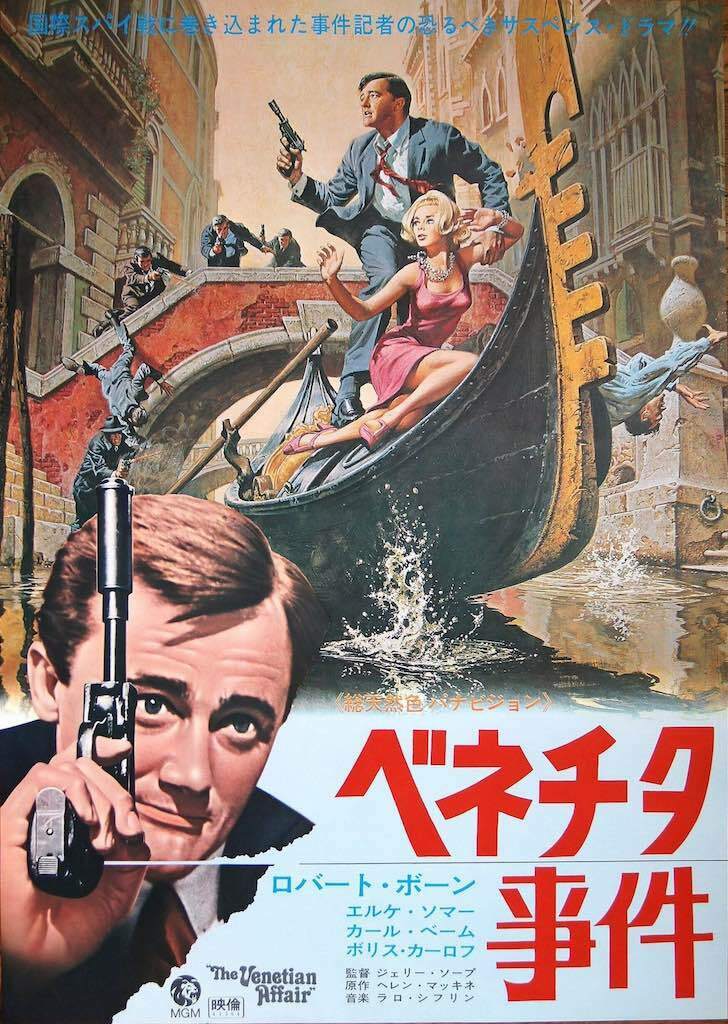
Robert Vaughn gives a terrific performance as a numbed alcoholic ex-C.I.A. journalist Bill Fenner drafted into Venice to investigate a plot involving ex-wife and Communist defector Sandra Fane (Elke Sommer). He’s the spy who lost it rather than a flashy contemporary of James Bond. This occasionally very stylish number kicks off with a terrific credit sequence that concludes with a suicide bomber blowing up a nuclear disarmament conference. Unshaven and with a Columbo cast-off overcoat, Fenner discovers Fane was key to the bombing, the bomber an otherwise distinguished diplomat with no known proclivities in the area of mass murder.

Although sold as an action picture, nobody is ripping through the canals as in a Bond film, and it is altogether a more somber, reflective, intelligent movie. Fenner’s feelings for his ex-wife are palpable when, in her apartment, he tenderly touches her clothes and smells her perfume. Far from being party to the plot, it appears Sandra has had a change of heart and wants to defect back, leaving Fenner in a perilous dilemma. Does he believe her or is she just using him? It is beginning to sound like a modern-day film noir, except he is already being used by the C.I.A., his presence in Venice a device to draw Sandra out, C.I.A chief Rosenfeld (Edward Asner) every bit as ruthless as the villains.

His investigations lead him to Dr Pierre Vaugiraud (Boris Karloff) and power broker Robert Wahl (Karl Boehm) who has a mind-altering drug that can make a man terrified of a mouse, send him into a trance and on his way to deliver savage retribution. There is death aplenty, fisticuffs and chases and Sandra, in hiding disguised as a nun, is worth waiting for.

Based on the bestseller by Scottish novelist Helen MacInnes, who challenged Alistair MacLean in her day, the project was at one point to be directed by Guy Hamilton. Coincidentally, David McCallum, Vaughn’s co-star in The Man from U.N.C.L.E. television series, was in Venice at the same time shooting Three Bites of the Apple.

Television stalwart Jerry Thorpe making his debut contributes some interesting moments. Interpreters listening in to the conference hear the magnified ticking of the bomb moments before explosion. The sequence on a train is well done and the activity surrounding the mouse is first class. Vaughn is superb in a downbeat role – shaking off his Napoleon Solo television persona- never sure if he is being duped, on the rack from falling back in love, and emerging from an alcoholic haze with a few decent ruses up his sleeve.

There’s a solid cast, Asner menacing even as a good guy, Karl Boehm a charismatic villain, Karloff memorable in his last performance in a non-horror picture, and interesting appearances by Felicia Farr as a C.I.A agent masquerading as the murderous diplomat’s unsuspecting mistress and Luciana Paluzzi as the girlfriend of an agent. Lalo Schifrin produces an outstanding score.

It was a flop first time round because audiences, partly duped by the title (all Uncle episodes incorporated the word “Affair” although the book, in fairness, was written long before the television series was envisioned) expected to pay to see Napoleon Solo, or something quite like him, on the big screen, with all the pizzazz and gimmickry of the small-screen show. Unfairly under-rated, this is a really satisfying thriller set against a murky Cold War background with Vaughn, trapped between love and redemption, the only character with a streak of morality.

Time to revive this.

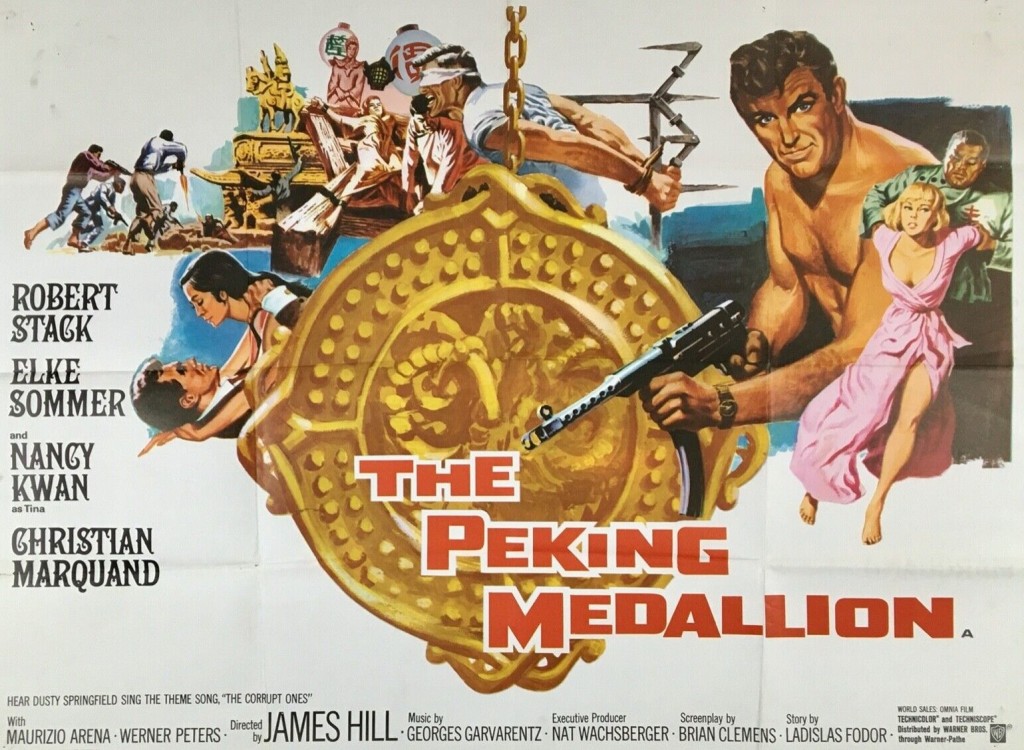
The Corrupt Ones / The Peking Medallion (1967) ****

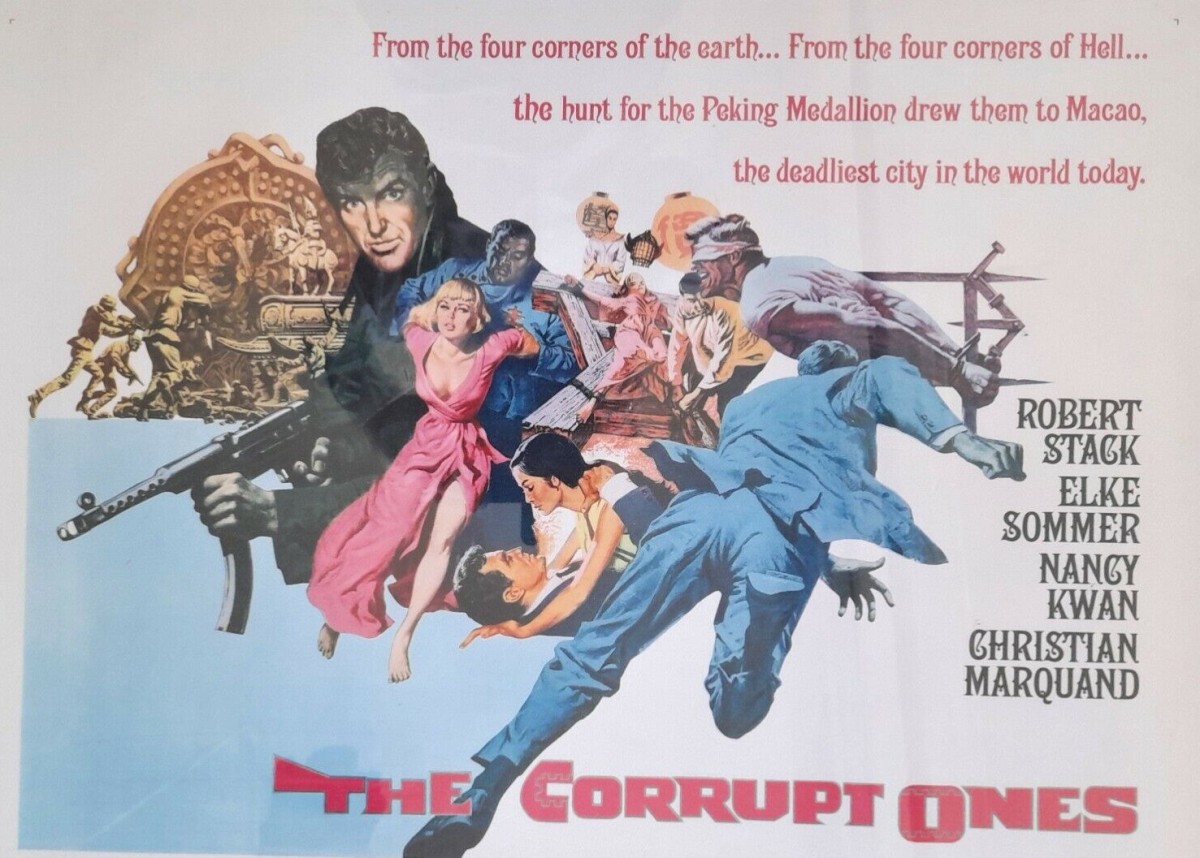
Non-stop action as spy Cliff Wilder (Robert Stack) battles a variety of crooks in Macao on the Chinese border as they seek to recover the legendary Peking medallion. Wilder hails from the James Bond school of espionage, duty bound to kiss every girl he meets. He might wonder at their compliance until he realizes they are only after his knowledge of the missing medallion.

The violence is criminally brutal – punch-ups, gunfights, samurai swordfights, murder and torture by blowtorch and acid and being dragged behind a motorboat. The string of sexy women is matched by handsome men, Brandon (Christian Marquand) and Danny (Maurizio Arena) in addition to Stack. The thriller pitches helter-skelter through nightclubs, casinos, caves, temples and palatial mansions, the pace only slowing down for, naturally, a scene in a stately rickshaw.

As well as Wilder who briefly – and unknowingly – has the medallion in his hands, others in the hunt include Lilly Mancini (Elke Sommer), wife of Danny who had passed it to Wilder before being killed. Mancini is on the wrong side of the femme fatale equation. Once Wilder  is wise to her seductive charm,s he quips, “Maybe you’re telling the truth but I can’t trust you.”

Also in hot pursuit are gangster Brandon and a Chinese mob headed by Tina (Nancy Kwan) That’s on top of a corrupt cop (“I have never feared death, only poverty” is his mantra) who doesn’t care who wins the prize as long as he gets his share. Double cross is the order of the day, alliances forged then broken. The action never stops long enough for one of those tension-building scenes of which Alfred Hitchcock or imitators like Stanley Donen (Charade, 1963, and Arabesque, 1966) were so fond.

Wilder faces danger with a quip, a kiss or gritted teeth, an old-fashioned tough guy without the James Bond self-awareness. He carries out his manly duties until his brain kicks in and he realizes this isn’t a spy picture after all but a genuine treasure hunt with clues that have to be deciphered. After that, the pictures sidetracks down another route. For a moment, the movie seems to have lost the plot. But then all hell breaks loose and we are back on the safe ground of fistfights, double-crossing and shooting.

Fans of improbable storylines, exotic settings, action, interesting bad guys and twists and turns will love this. How can you fail to love a movie with a samurai vs camera tripod swordfight?

An exemplary cast for this kind of malarkey, a French-Italian-German co-production with English as the mother tongue. Scarcely creditable that Robert Stack, in his biggest picture since The Untouchables tv series (1959-1963), was once Oscar-nominated given subtlety is never required. Nancy Kwan (The World of Suzie Wong, 1960) steals the show as the villainess but she’s run close by Elke Sommer (The Prize, 1963). In supporting roles are Werner Peters (Istanbul Express, 1968) and Christian Marquand (The Flight of the Phoenix, 1965).  

Might seem a considerable change of pace for director James Hill after Born Free (1966) but that’s only if you ignore his work on the equally complicated A Study in Terror (1965).  Screenplay punched out by Englishman Brian Clemens (And Soon the Darkness, 1970), Hungarian Ladislas Fodor (best know for the Dr Mabuse series) and Harald Bloom, his only known credit.

Great fun.

PREVIOUSLY REVIEWED IN THE BLOG: Robert Stack in Is Paris Burning? (1966); Elke Sommer in The Prize (1963), The Art of Love (1965), The Money Trap (1965), The Oscar (1966), The Venetian Affair (1966), Deadlier than the Male (1967), They Came to Rob Las Vegas (1968) and The Swiss Conspiracy (1976); and James Hill’s A Study in Terror (1965); Nancy Kwan in Tamahine (963), Fate Is the Hunter (1964), The Wild Affair (1965).

The Swiss Conspiracy (1976) ***

One of those thrillers that only makes sense at the end. Lazy critics, too annoyed to wait or not able to work it out themselves, take out their bafflement on the picture. Or they carp at what they see as overmuch tourist influence instead of admiring the clever use made of Switzerland’s scenic attractions, the twisty cobbled streets, corkscrew highways teetering over ravines, and the apparatus of skiing – the chug-chug trains and lifts.  

Attractive too for the cast. You might put me down as overly fond of leading lady Senta Berger (Bang! Bang! You’re Dead! / Our Man in Marrakesh, 1966) but I’m equally appreciative of the casual charm and realistic qualities brought to the screen by the underrated David Janssen (The Warning Shot, 1967). And that’s before we come to Elke Sommer (The Prize, 1963) and veteran Hollywood star Ray Milland (Hostile Witness, 1969), not to mention character actors John Saxon (The Appaloosa / Southwest to Sonora, 1966) and John Ireland (Faces in the Dark, 1961).

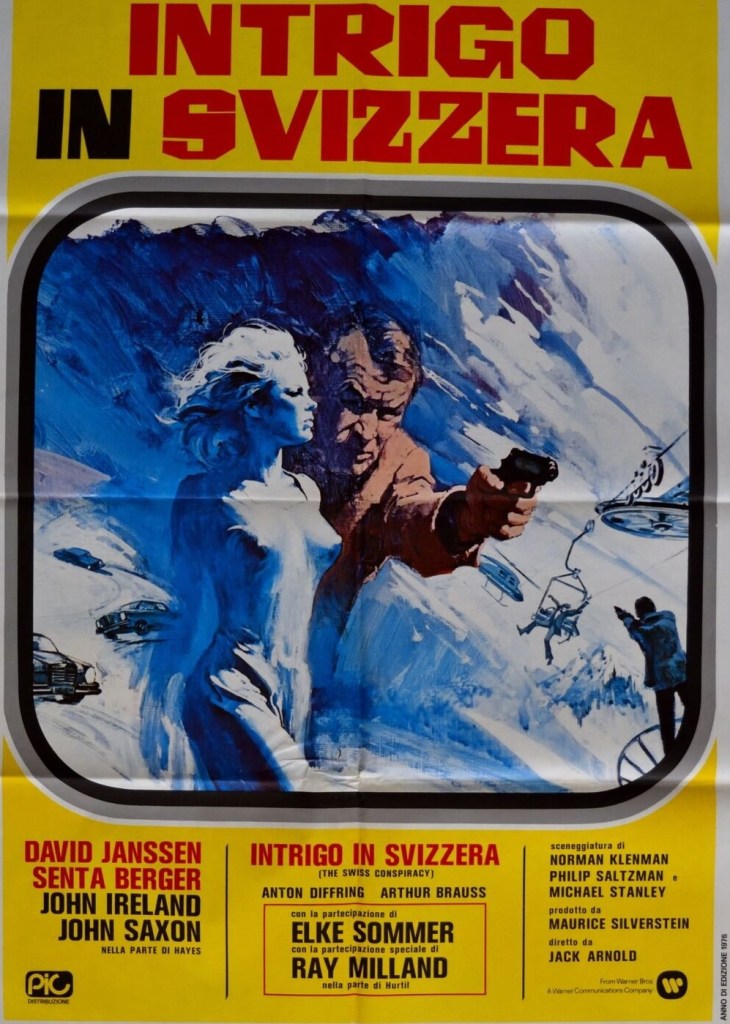
Poster designer gives himself a bit of leeway here, suggesting a lass is going to be striding around the Alps in such clingy clothing.

Former U.S. Treasury Agent David Christopher (David Janssen) is called in by Swiss bank owner Johann Hurtil (Ray Milland) to investigate a threat to expose the clients hiding behind the country’s infamous secret numbered accounts. Five clients, in particular, have been targeted including the glamorous Denise Abbott (Senta Berger), whom David first encounters in what would in other circumstances be deemed a clever meet-cute with the woman getting the upper hand.

One client is already dead, murdered in the opening sequence, as a warning. Of the others, Robert Hayes (John Saxon) is a mobster depositing illicit gains for money-laundering purposes, Dwight McGowan (John Ireland) a shady businessman on his last legs, while Kosta (Curt Lowans) equally operates in the shadows. And all is not well with the bank deputy Franz Benninger (Anton Diffring), involved in an affair with another client, Rita Jensen (Elke Sommer). On top of that, Swiss cops are on the trail of Hayes and hit men are tailing Christopher.

Christopher quickly surmises that the victims have been targeted for their undercover dealings, even the uber-glam Denise is blackmailing a former lover. But Hurtil, fearing a public and media scandal, and for whom the gangster’s demands are a mere drop in the ocean compared to the bank’s overall wealth, decides to meet their terms, which is payment of 15 million Swiss francs (equating to several million U.S. dollars, I guess) in uncut diamonds.

But before that we have a punch-up and shoot-out in a parking garage, a chase on foot on those famous narrow cobbled twisty streets with a speeding car giving the thugs unfair advantage, a race of seduction a la On Her Majesty’s Secret Service (1970) along those aforementioned treacherous mountainous roads, a literal cliffhanger in the vein of The Italian Job (1969), and one of those luscious romances beloved of the upmarket thriller (think The Thomas Crown Affair, 1968).  

While Christopher is painstakingly putting together the clues and keeping the suspicious Swiss police off his back and avoiding being killed, there’s a deadline to meet, the usual race against time, while the audience is having to fend off a surprising number of red herrings.

It’s not only glamorous, it’s short, and there’s more than enough going on, characters played by interesting actors, to keep the viewer involved. And I defy you to guess the ending. So, enough thrills, sufficient mystery, great scenery, and a female contingent (even Christopher’s secretary fits that category) with brains to match their sexiness who appear to have the upper hand in relationships with the opposite sex.

This is David Janssen at his best, that outward diffidence concealing a harder inner core, exuding a guy-next-door appeal that was never properly utilised by Hollywood, who preferred him just to reveal character by squinting. The scene where he takes in the extent of the luxury of Denise’s hotel penthouse is one of those that, while not knocking on Oscar’s door, demands true acting skills. He’s never in your face, and the camera loves him for it.

Of course, Senta Berger, what can you say, another under-rated actress never given her due in Hollywood, here finds a plum role that allows her to switch from confidence to vulnerability at the drop of a hat. John Saxon and John Ireland, as ever, are value for money. And Ray Milland keeps the show on the road.

A modern audience would be more at home with the multiplicity of plot angles and probably worked out in their own heads all that couldn’t find a place on screen, ensuring that what seemed like plot holes were anything but.

Jack Arnold (The Creature from the Black Lagoon, 1953) handles the scheming and dealing with ease. Norman Klenman (Ivy League Killers, 1959), and two television writers in their movie debuts, Michael Stanley and Philip Saltzman, wove the intricate screenplay.

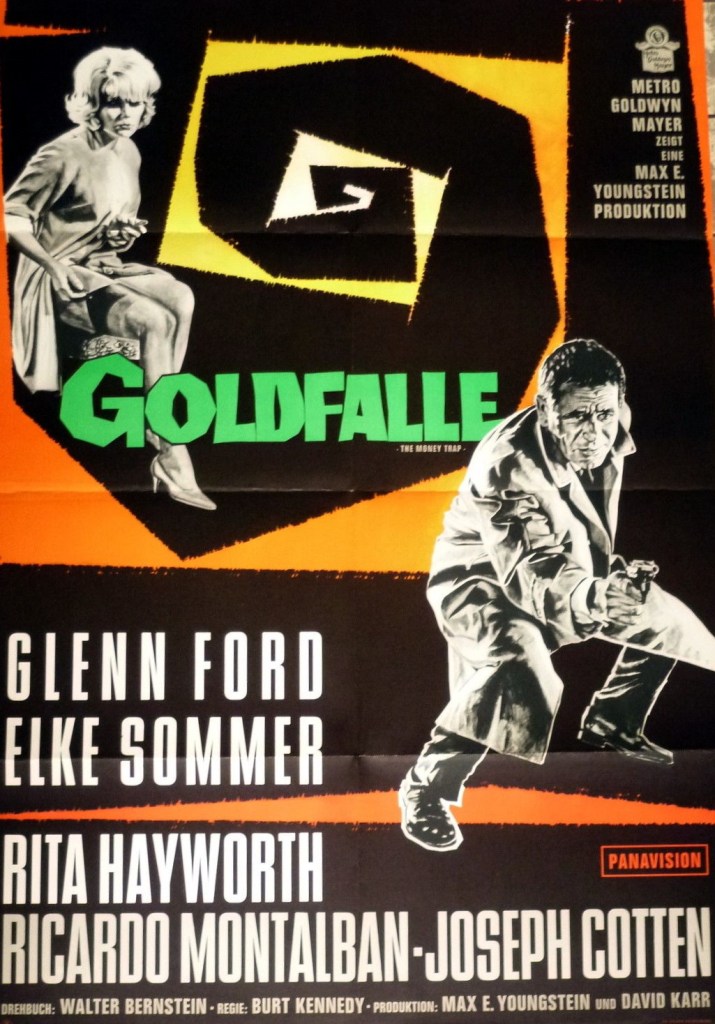
The Money Trap (1965) ****

Film noir morality play. Highly under-rated, especially unfair since all four principals put in excellent performances, plus a nifty screenplay, and generally erratic director Burt Kennedy on very solid cinematic ground, even if he has a predilection for showing legs, and not just of the female variety.

Film noir is at its best when the plot is simple, usually good guy inveigled into taking a wrong turn through avarice, revenge or a femme fatale. This takes an unusual route. Idealistic cop Joe (Glenn Ford) worries beautiful wealthy spendthrift wife Lisa (Elke Sommer) will abandon him for a richer guy since her allowance has dried up.

Assuming she is already making her play, Joe has a one-night stand with old flame Rosalie (Rita Hayworth), a lush married to a murdered burglar. His partner Pete (Ricardo Montalban), envious of his buddy’s wealth, blackmails him into robbing the safe of Mafia doctor Van Tilden (Joseph Cotten) who, in self-defence, killed the burglar. Meanwhile, as contrast,  the pair are investigating the murder of a sex worker trying to earn extra money to shore up her husband’s miserable income.  

While it’s got all the requisite of film noir, atmospheric use of light given it’s shot in black-and-white, that unusual footage of legs, and feet, especially when Rosalie is followed by Tilden’s thug Matthews (Tom Reese), cunning villain, the unexpected twist, neither of the femmes it transpires is much of a fatale, greater backbone than you might expect.

But mostly, it focuses on decision and consequence. Will Joe accept he could lose his wife, will Lisa make the jump into a lower standard of living in order to hold onto her husband, or will Joe distrust that his wife can change and find a way to bring the loot he thinks will keep her satisfied? Lack of trust all round proves their undoing.

There’s the usual, silent, heist, though quite where Joe and Pete acquired their safecracking skills is never discussed. It is the perfect robbery, a dodgy doctor unlikely to call in the cops, especially as they might get suspicious as to just why he is such a common burglary target. Except it’s not. For what’s in the safe is too hot for any cop and Van Tilden, more streetwise than the police, is always one step ahead. Instead of it being the greedy Lisa who could ruin their otherwise stable and loving marriage, it’s Joe.

There are a handful of clever twists, not least that Joe’s dalliance with Rosalie signs her death warrant, but I won’t give those away. It’s too tightly told to spoil it. That’s part of the beauty here, it’s a neat 90 minutes, short and to the point, temptation and consequence.

If ever there was an actor under-rated during this decade it’s Glenn Ford (Rage, 1966). He was hardly ever cast in a big-budget picture except as part of an “all-star cast”, and mostly, given the extravagances elsewhere, in A-pictures whose budgets in reality turned them into B-pictures, and he ended the decade in a rut of westerns, all as under-rated as him. But he brought a tremendous intensity to every role, equally believable as romantic hero and potential heel, and in action, as here, he moves with lethal speed. He had a unusual gift as an actor – you always knew he was thinking. And was very likely to be saying one thing and thinking or meaning another.

Here he acts his socks off. You wonder just what has he got to live in such a fancy house with a rich gorgeous damsel and it doesn’t take long to find out his attraction to him, that right stuff that would rarely come an heiress’s way, more likely to trundle her way through endless marriages and affairs seeking a stability that wealth does not bring.

Elke Sommer (They Came To Rob Las Vegas, 1968) is a revelation, mostly because the script builds her a proper character, loving wife temporarily distracted by potential loss of wealth, but knowing enough about her husband to recognise she’s be better off with him than without him.

Rita Hayworth (The Happy Thieves, 1961) makes the most of her last meaningful role, not lit to shimmering glory by a black-and-white camera, but while shown at her blowsy physical worst redeemed by mental strength. Ricardo Montalban (Cheyenne Autumn, 1964) , usually relegated to a supporting role, provides not only the narrative impetus, but his character twists and turns throughout. Joseph Cotten (Petulia, 1968) has cold blood running through his veins.

This is early-promise Burt Kennedy (Dirty Dingus Magee, 1970) and with a tight script by Walter Bernstein (Fail Safe, 1964) delivers a surprisingly effective very late period film noir.

Terrific acting, by twisty plot held in check by realistic consequence.

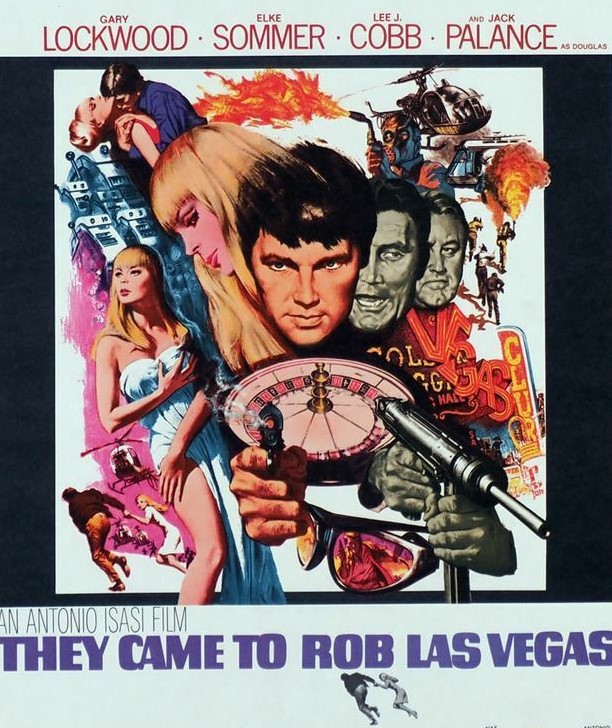
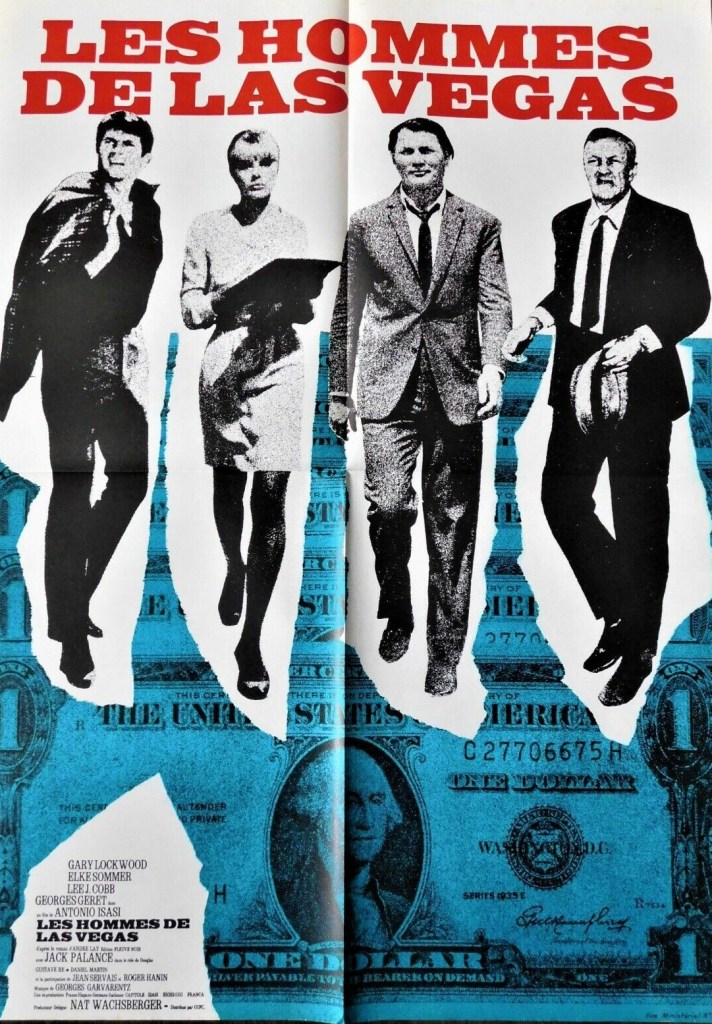
They Came To Rob Las Vegas (1968) ***

Actually, they didn’t. The thieves planned to pull off a heist of $7 million from a security truck as it travelled through the Nevada desert en route to Mexico. Las Vegas pops into the story every now and then, criminal mastermind Tony (Gary Lockwood) employed there as a croupier in order to romance the girlfriend Ann (Elke Sommer) of millionaire Steve (Lee J. Cobb) who owns the security business being targeted.

The picture’s overlong and a shade complicated but the robbery is terrific, if a bit unbelievable, while the ending is existential and almost Boorman-esque. It’s futuristic, too, with computers programming routes for security vehicles to make them harder to follow, pretty sophisticated visual communications for the era. The trucks are more like armored cars,  tough as tanks, steel so thick it’s impervious to an oxy-acetylene cutter, and with machine guns mounted on the roof.

You’ll scarcely have heard of the director, Spaniard Antonio Isasi (That Man in Istanbul, 1965) whose career only spanned eight movies. And while you might be familiar with Gary Lockwood (2001: A Space Odyssey, 1968), Elke Sommer (The Prize, 1963), Lee J. Cobb (Coogan’s Bluff, 1968), and Jack Palance (Once a Thief, 1965) who plays Douglas, an F.B.I. agent investigating Steve’s Mafia connections, you’ll struggle to keep tabs on the myriad other characters who flit in and out of what ends up as a four-way narrative.

So we start out with Tony’s brother (see, I told you it was complicated) who has bust out of jail and wants to go back to old-style heists that involve shoot-outs in the street, nostalgia getting the better of him as he winds up dead. Then we’ve got Steve who wants to quit the underworld. That seems to be a trope of the time, The Brotherhood (1968) and Stiletto (1969) going down a similar route.  When the truck is hijacked, Steve comes under suspicion from his Mafia buddies, who reckon he’s looking for an easy way to fund his retirement.

Meanwhile, as well as the $7 million in legitimate cash, the truck is also carrying millions in Mafia loot to be laundered across the border in Mexico, a notion that’s already attracted the attention of Douglas and his team.

Meanwhile, meanwhile, Tony is carrying out some low-grade casino theft, as croupier dealing Ann some very helpful cards and topping up his salary to the tune of $400-$500 a day. Ann, who could as easily be water ski-ing or living the high life in Acapulco with the married Steve, still takes time out of the mistress gig to undertake her ordinary job at the security company’s head office where she is in charge of the seemingly mindless task of feeding route cards into the computer.

While this takes quite a while to get all the wheels in motion and the various sub-plots and characters to fall into line, when finally we get to the robbery, it’s a cracker. Though you might find yourself asking who was funding the heist, with its five-man crew, helicopter, flame-thrower,  machine guns, plus what can only be described as a giant vault buried in the desert.  

At first, the heist appears patently old-fashioned. Gangsters dressed as guards replace the real guards but once in the back of the truck they have neither access to the loot nor the driver’s cabin. No matter, they know where the truck is headed, out into the desert, where they have made the road impassable with heaps of sand and just in case that didn’t work shoot out a tyre. The flame thrower finishes the job.

Thomas Crown would be impressed by their planning for they have another tyre buried in the sand to swap for the useless one and they also have metal tracks that can be laid over the sand to ease passage. They need the tracks because the truck goes off-road over the top of a dune and is lowered into the vault while the rotary blades of the whirligig serve to cover the top with a layer of sand, returning the desert to its normal pristine condition.

But we’re far from finished. We still have betrayal, underground paranoia, Steve being stalked by Douglas, the Mafia getting uppity with Steve, Steve becoming suspicious of Ann, a hapless motorist caught in the crossfire, squads of cops and goons descending on the hijack spot, and Tony still having to work out how to open the unbreakable truck.

At times, the plot comes together with devastatingly simplicity, but at other times the various strands merely serve to blow the whole thing apart. None of the principals is on their A-game, most appearing overly stiff and clichéd, while you’re still trying to work who all these other characters are.

The heist itself is splendidly done and the twist ending worthy of comment. Most of the time it’s pretty watchable but what should be a relatively seamless narrative is undone by over-plotting.

While the time was ripe for an ingenious heist, the crime thriller had taken one of those periodic leaps into new territory, what with Point Blank (1967) and The Thomas Crown Affair (1968), so it was virtually impossible to accommodate a movie with so many narrative jumps, where motive was unclear, characters diffuse and the tone widely variable.

On the other hand, as I said, the heist had me enthralled and the twist ending had me intrigued.

The Oscar (1966) ****

Don’t you just love a really good bad movie? Where redemptive character is outlawed. When over-acting is the key. In which everyone gets the chance to spout off about someone else, generally to their face, and then is permitted, in the cause of balance, a quiet moment of bitter self-reflection. And even the most minor character gets a zinger of a line. Welcome to Hollywood.

Tale of an actor’s rise and not exactly fall because we leave Frank Fane (Stephen Boyd) at a pinnacle of his career, though, don’t you know, he’s empty inside and deserted by all his faithful companions. Lucky Frank has some kind of charisma or that he just fastens onto losers who see in him what they need because from the outset he is one mean hombre, living off stripper girlfriend Laurel (Jill St John), so dumb she switched to him from his so dependable best pal Hymie (Tony Bennett – yes, that Tony Bennett, the singer).

He hooks up with Kay (Elke Sommer), a designer who happens as a sideline to make costumes for off-Broadway productions. When King of Lowlife Punks Frank shows a pusillanimous stage actor what you do in a knife fight he strikes a chord with theater producer Sophie (Eleanor Parker), who happens to have a sideline as a talent scout for the movies.

She fixes him up with an agent Kappy (Milton Berle – yes that Milton Berle, the loudmouth comedian) and together they sell him to studio boss Regan (Joseph Cotten). The only good deed Frank does in the entire movie is to stand witness – not for marriage, but for divorce – for an ordinary couple, private detective Barney (Ernest Borgnine) and Trina (Edie Adams), he meets at a bullfight, huge fans, and thank goodness that action comes back to bite him.

The picture goes haywire in the third act. Fane’s career is crumbling in the face of audience indifference, exhibitor displeasure and, don’t you know it, a chance for revenge for Regan, who was stiffed in a previous contract. But instead of taking the traditional tumble into the forgotten category, his career is revived by an Oscar nomination.

From top to bottom – a fully-clothed Stephen Boyd, then in various states of undress, Elke Sommer, Jill St John and Eleanor Parker. That’s how to sell a picture apparently.

But that’s not enough for the ruthless Fane. Earlier in his life a corrupt sheriff had stuck him with charges of pimping. Using Barney, who seems to have the ear of the media, he plants a story about himself, hoping that Hollywood being the cesspool it is, everyone will assume one of his rivals did the dirty. “I can’t rig the votes,” rationalizes our poor hero,”  but I can rig the emotions of the voters.”

What a scam. I was chortling all the way through this section and almost laughing out loud when it transpires Frank had misjudged how deep the cesspool is, because Barney then blackmails him. This gives everyone he has treated heinously over the years the chance to stick it to him. Nobody will lend him the dough to get this grinning monkey off his back. Salvation comes in the oldest of Hollywood maneuvers. Trina, who has always wanted to get into pictures, and is the kind of person who embodies A Grievance Too Far, supplies the information that will sink her ex-husband, in exchange for Frank using his influence to get her a small role.

There’s a brilliant climax. I should have said spoilers abound but I can’t resist telling you the ending it’s such a cracker. So there is Frank at the Oscars with Bob Hope (yes, that Bob Hope) as master of ceremonies and the audience studded with real stars like Frank Sinatra (yes, that…). Like an evil chorus – you can almost hear them hissing under their breath and they all fix him with baleful looks – are all those he treated badly.

The winner is announced. “Frank…” Assuming victory, Fane gets to his feet. “Sinatra.” The only way he can rescue his embarrassment is to make it look as he is giving the winner a standing ovation. But when the rest of the audience follows suit, he slumps to his chair, and in the only true cinematic moment in all the sturm and drang the camera pulls back from him sitting bitter, twisted and defeated in his seat.

Stephen Boyd (Shalako, 1969) is terrific because even when he was top-billed he tended to over-act and when he became a co-star or supporting player he was an inveterate scene-stealer, of the sharp intake of breath / vicious tongued variety. Here he shows both his charming and venomous side. If he was playing a gangster he couldn’t be more menacing – or charismatic. It’s a peach of a role – he can dish it out, dump women at will, and still embrace victimhood as “170lb of meat.”

Luckily, most of the rest of the cast take the subtle route. Although all disporting in various negligible outfits at one time or another, Jill St John (The Liquidator, 1965), Elke Sommer (The Prize, 1963) and Eleanor Parker (Eye of the Cat, 1969) and giving Frank his comeuppance wherever possible – St John slings him out – the performances are generally nuanced, Parker in particular evoking sympathy.

Tony Bennett is miscast, especially as he has to do double duty as an unwelcome voice-over, filling in bits of the narrative that, thankfully, has been skipped. But Milton Berle is pretty good as  a quiet-spoken agent.

In the over-the-top stakes, Boyd has his work cut out to hold his own in scenes with Ernest Borgnine (The Wild Bunch, 1969) who revels in his scam, and Edie Adams (The Honey Pot, 1967) who is anything but a dumb blonde and delivers the most stinging of zingers.

Doesn’t tell us anything we didn’t know about Hollywood except in one delicious scene where, early in his career, Frank has to squire around a female star who relishes putting him in his place.

It’s not badly made just pell-mell and over-the-top. Russell Rouse (The Caper of the Golden Bulls, 1967) directs from a screenplay by himself and Harlan Ellison (yes that Harlan Ellison, the sci fi author) from the bestseller by Robert Sale.

An absolute hoot.   

The Art of Love (1965) ****

Priceless. Effortless comedy from the same director, Norman Jewison, as Send Me No Flowers (1964) but minus the box office powerhouses of Doris Day and Rock Hudson and perhaps it’s their absence that makes this work so much better. Or perhaps you get more comedic leeway in Paris. Although the scripts were written by different people, I sense a directorial insistence that the supporting characters are believable, not just there to oil the plot.

The story here is fraud, penniless artist Paul (Dick Van Dyke) faking his own death to give his paintings the necessary burst of publicity to make them hot items. Except he doesn’t fake his death. He dives into the Seine to save a drowning girl Nikki (Elke Sommer) and his buddy Casey (James Garner), a wannabe writer for whom Paul is a meal ticket, and who you would have to say was instrumental in suggesting such a scam, assumes he has committed suicide.

Paul goes along with the scheme for as long as it takes art dealer Zorgus (Roger C. Carmel) to make a killing (no pun intended) from his paintings. Nikki ends up a housemaid at a risqué nightclub (though it being Paris what other kind is there) run by Madame Coco (Ethel Merman) where, coincidentally, heavily disguised, Paul hides out. Meanwhile, in the final piece of the complication jigsaw, Paul’s fiancée Laurie (Angie Dickinson), turns up. A bit like the lecherous friend in Send Me no Flowers, Casey knows how to make the most of the opportunity to give a potential widow a shoulder to cry on. “How can you make a play for this girl?” he asks his reflection, but she’s too gorgeous for qualms.

You can pretty much guess where it will go from here.

It works so well because none of the principals is permitted to milk their roles (though Van Dyke can’t resist making a meal out of a sneeze) and the supporting cast drive it along with selfish action. Dick Van Dyke (Divorce American Style, 1967) has none of his usual zaniness or limbs that refuse to obey orders. James Garner, though in part cloning his character from The Americanization of Emily (1964), plays it as drama. Elke Sommer (The Venetian Affair, 1966) is the best I’ve seen her, no longer the pouting sexpot but a girl-next-door from the suburbs fallen on hard times. Angie Dickinson (Jessica, 1962), further down the billing than I’d expect, has to play it for drama, almost the foil for Casey’s seductive tendencies.

There are some superb running gags. Paul is furious to find a red-headed woman in the bed of flat-mate Casey. But, sight gag number one, it belongs to a mannequin. The wig, sight gag number two, is used to disguise Paul. Casey gets ride of the mannequin by stuffing it into a furnace only it doesn’t fit so he has to saw off its legs and is discovered from above by a waiter, sight gag number three, who naturally thinks he is sawing a woman in half. (I always think the beauty of a good comedy is that you can see the gag coming and you still laugh.) That gag has even more miles to run.

The supporting cast, as I said, are all given just delicious lines. Paul and Nikki, soaking wet, are saved by a passing barge. Paul hangs out her clothes to dry. When the naked woman in the wheelhouse calls for her clothes, the barge skipper, enjoying the prurient scene, implores,  “Don’t give her her clothes back.” And when, after a row, that allows her to leave the barge, the skipper whines, “I told you not to give her her clothes back.”

. “I don’t want you to think I came for the rent you owe,” says Casey’s landlord. “What did you come for,” asks Casey. “The rent you owe, but I didn’t want you to think it.” The landlord’s wife comforts the grieving Casey (at this point he thinks Paul is actually dead) with some chicken soup. Casey admits the suicide was his idea. The woman snatches back her soup.

Having put Nikki on a bus, Paul, handing over few coins, asks the driver to keep an eye on her. Comes the reply, “I would whether you pay me or not.”

Sure, Ethel Merman (There’s No Business Like Show Business, 1954) gets to sing. Audiences expected that. But that’s understandable. What a voice. When you wonder why Ann-Margret wasn’t given more opportunity to sing in proper musicals, this is the answer. She lacks the voice of an Ethel Merman, Julie Andrews or Barbra Streisand.

The sly screenplay was concocted by Richard Alan Simmons (Della, 1965), William Sackheim (First Blood, 1982) and Carl Reiner, who had written for both Dick Van Dyke (his eponymous television show) and James Garner (The Thrill of It All, 1963).

The stars play proper roles, not just one-note characters driven by plot. Doesn’t take much to work out where it’s going all right but that doesn’t lessen the enjoyment of the journey.

I always wondered why, after making his name in comedy, Norman Jewison was selected for more serious works like The Cincinnati Kid (1965) or In the Heat of the Night (1967), but when you see the care he takes with each character, far more than standard directors in the fun genre, how he carefully builds the narrative, you do tend to agree he’s wasted in comedy.

A pure delight.

Discover WordPress

A daily selection of the best content published on WordPress, collected for you by humans who love to read.

The Atavist Magazine

by Brian Hannan

WordPress.com News

The latest news on WordPress.com and the WordPress community.