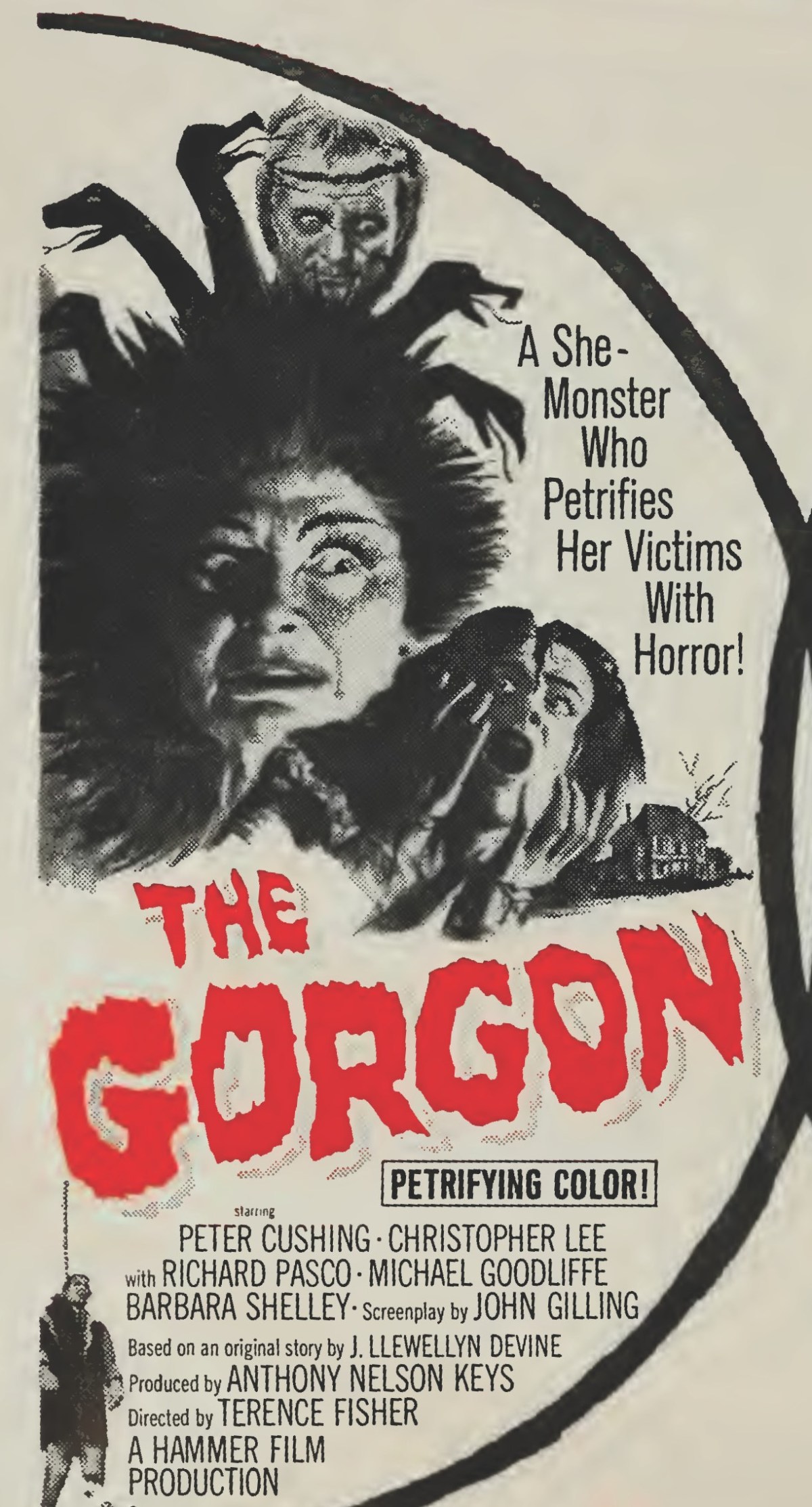
The Gorgon (1964) ****

This impressive Hammer conspiracy-of-silence slow-burner, more thriller than horror, features the triumvirate of Christopher Lee (The Devil Ship Pirates, 1964), Peter Cushing (The Sword of Sherwood Forest, 1960) and Barbara Steele (Black Sunday, 1960) in untypical roles. Lee and Cushing, of course, had locked horns before, namely in Hammer’s reimagining of the classic Dracula, with the former the charismatic fiend and the latter his nemesis.

Here Cushing is a  doctor in a an unnamed European turn-of-the-twentieth-century police state who knows more than he is letting on about seven inexplicable deaths in five years and the possibility of a 2,000-year-old myth coming to life and taking on a human form. And with quite a human side, jealous when his assistant Steele falls for a younger man. Lee is a professor coming late in the day to investigate. Steele, a gentle beauty, initially introduced as merely the love interest, becomes central to the story but without sucking up all the available horror oxygen by over-acting.   

Director Terence Fisher, who had shepherded the studio’s Dracula, Frankenstein, The Mummy and Dr Jekyll franchises through the starting gate, builds up the atmosphere with full moons, haunting voices, fog, sudden sounds, drifting leaves and an abandoned castle forever in shadow. The camera is often a weapon of stealth. Shock is kept to a minimum, fleeting ghostly apparitions and a finger falling off a corpse. Given the limitations of special effects in this era, that was a smart move. Far better to concentrate on fear of impending doom, a man knowing he is turning to stone, a woman living in terror of being taken over by the phantom. The title gives away the story somewhat – even if you didn’t know the Gorgon was a mythical monster with a headful of snakes and the ability to turn people to stone, that is soon explained. 

Death remains the trigger for action, the suicide of an artist after he has apparently murdered his pregnant girlfriend bringing his father onto the scene and then his brother accompanied by Lee. But all investigation hits a wall of silence after police chief (Patrick Troughton) refuses to instigate detection. At the heart of all the relationships is betrayal. The artist leading his girlfriend on, Cushing willing to endanger Steele, whom he professes to love, rather than revealing the truth. Even Steele spies on the brother, with whom she is falling in love, in order to gather information for Cushing. 

Forgive the pun, but Steele steals the picture. An amnesiac, a victim and finally the lure, she remains enigmatic, a whisper of a woman. It is a haunting portrayal far removed from Hammer’s traditional cleavage queens. This is a very human character who nonetheless must stand guard over herself. Cushing embroiders his character with little touches, smoking a cigarette in a holder, for example, but Steele’s character, her distrust of herself, shows in every move she makes.

Many of the films from the 1960s are to be found free of charge on TCM and Sony Movies and the British Talking Pictures as well as mainstream television channels. But if this film is not available through these routes, then here is the link to the DVD and/or streaming service.

Marketing: Black Stamps

You might be tempted to fork out for the range of James Bond Commemorative Stamps being brought out to celebrate No Time to Die when it eventually sees the light of day on movie screens.

But stamps either as collector’s items or for trading purposes have been around since the silent era.  A line of movie commemorative stamps issued in America in 1944 sold 1.1 million first day covers, the second highest-ever at the time, and in the late 1950s Movie Stamps Inc set up a business that worked in the same way as the Green Stamps given away in supermarkets and gas stations. In this system, if you collected enough you won a gift, usually, in regards to the movie business, a couple of free tickets.

So Columbia Pictures looking for a way to sell its Hammer double bill The Gorgon (1964) with Christopher Lee and Peter Cushing and The Curse of the Mummy’s Tomb (1964) starring the lesser-known Terence Morgan revived the idea.

Horror specialist Hammer was one of the British film studios going through a production boom – over 100 movies were being made in that country in that year – with The Secret of Blood Island (1965) in the works for Universal and She for MGM. But horror was still a difficult sell and Hammer had ignored the advice of Variety that The Gorgon would work best if teamed with “a lively comedy.”

American International had expanded the horror market away from the Frankenstein/Dracula axis by exploiting the Edgar Allan Poe back catalog and William Castle had achieved some success in modern tales of terror such as Dementia 13 (1963) and The Night Stalker (1964). But Castle could call upon the likes of Barbara Stanwyck and Robert Taylor, players with substantial marquee status despite their lately diminished careers, for radio and television interviews.

For Hammer the obvious exploitation options were limited to a spread in the quarterly Castle of Frankenstein magazine which could be purchased for 35 cents at newsstands.

So the marketing honchos dusted off the old movie stamps idea. In some advertisements, the studio offered free stamps to the first 10,000 ticket-buyers but in the advertisement shown above they appeared to be given away free to everyone. The faces of the various monsters and characters featured in both films were imprinted on the stamps. However, on the debit side, there was no sign of any redemption for the collected cards. You couldn’t, should you be so inclined, collect ten and get a guest ticket in return. You could probably trade them and build up a collection. I’m not sure they did much for the movie judging by the box office accounts that exist but if anyone remembers seeing them or collecting them let me know.

Sources: “Film Industry New 3c Stamps Sets Record,” Variety, Nov 15, 1944, 1; “Tease-In Kids with Movie Star Stamps,” Variety, Aug 21, 1957, 20; “Premium Stamp Set Up,” Variety, Aug 20, 1958, 7; Review of The Gorgon, Variety, Aug 26, 1964, 6;  advert, Box Office, Nov 16, 1964, 2; “Film Plugs and Pluggers,” Variety, December 30, 1964, 21; Mark Thomas McGee, Beyond Ballyhoo: Motion Picture Promotion and Gimmicks, p125-131.

Discover WordPress

A daily selection of the best content published on WordPress, collected for you by humans who love to read.

The Atavist Magazine

by Brian Hannan

WordPress.com News

The latest news on WordPress.com and the WordPress community.