aka Mr Chow (2023) ****

Pop quiz: name the only brother and sister who appeared in the same James Bond film. Hint: You Only Live Twice (1967). You might be more familiar with Tsai Chin (The Face of Fu Manchu, 1965, and three sequels) than Michael Chow. Though he had a bigger role in Joanna (1969) and The Touchables (1969) he was never more than a bit player, and often  uncredited (55 Days at Peking, 1963). He also appeared in The Brides of Fu Manchu (1966) and there’s a fair chance you might remember him from Modesty Blaise (1966).

But HBO isn’t noted for devoting a documentary to a bit part player, not even one who can recite the opening of any film you care to mention. This film begins with such a recitation – encompassing the likes of North by Northwest (1959). If ever there was a more arresting opening to a documentary, this is it.

If you’re a fashionista or restaurant fan or gulled by celebrity photos, you’ll more likely know him by the name of Mr Chow, under which he established a chain of spectacularly successful eateries in London, New York and Los Angeles. He wasn’t even a chef, an understandable subject for a docu, what with all the creative endeavor that involves. But there’s no doubt he was creative, if only in reinventing himself. Born Zhou Yinghun, he chose the name “Mr Chow” because it meant people addressing him such manner rather than treating him with a racist epithet.

He might well have deserved a documentary for other reasons. He was the son of one of most famous Chinese opera stars, who reinvented the genre, and he escaped the cull of the intelligentsia instigated by Chairman Mao. His father was imprisoned for years and his mother was “beaten to death.”

The young Chow was living in England at his point, having been sent at a young age to a boarding school there, where racism of course was endemic. He attended art school but when his paintings didn’t sell he made a living from bit parts in movies – he was the child mown down by a car in Violent Saturday (1960), for example.

A Chinaman wanting to set up a business in London in the 1960s had two options: a laundry or a restaurant. But Chow didn’t want to imitate the ubiquitous Chinese restaurant. His artistic side came to the fore via interior design. His venture, in the staid world of the restaurants of the era, was a culture shock. Everything about it was different – no chopsticks and Italian waiters and no dressing for dinner (wear what you like), an anomaly in a high-end operation at the time. But since he attracted more than his fair share of celebrities presumably what they wore was highly acceptable.  

An abundance of charm and connections gained through the movie business provided the funding. But it soon became the “in” place, and every evening was a performance.

By the time HBO came to make a documentary about him – and perhaps this fitted in more with that streamer’s agenda – he had become a proper artist. So much of the film, and indeed a good chunk of the opening section, is devoted to his modernistic artworks which often involved blowtorches, sheets of plastic and a rubber hammer. He exhibits under the name “M” so if you are familiar with the art world that might strike a better chord.

In the fashion of the current docu style, the makers seduce you with interesting material then hit you with a couple of blows you didn’t see coming. The “Shanghai trouble” is one such, which saw both parents killed. But there was also AIDS. His third wife Tina, a famous model, divorced at the time, died of that disease, contracted through a lover, not Chow, and she was one of the first non-homosexual people to be linked with the illness, and one of the first celebrities.

Abandoned, as he saw it, by his mother (in sending him to boarding school) family meant everything and you get the sense that the restaurants were as important as the various wives in creating a loving world. But he is also quite matter-of-fact about the personal calamities – you move on is his doctrine. The racism he endured cut deeper. Even as a famed restaurateur standing outside one of his own restaurants he found it hard to get a taxi to stop.

A handful of celebrities – hardly an all-star cast – pay tribute from Oscar-winning producer Brian Glazer (A Beautiful Mind, 2001) to LL Cool J and author Fran Lebowitz. But the pictures tell a story – Jack Nicholson, Mick Jagger etc are caught on camera having fun. I have to say the one time I went to the LA branch – as the guest of the publisher of Variety magazine – there was not a celebrity in sight (but it was lunch not dinner), though we were seated at Table No 1.

Cunningly directed by Nick Hooker (Agnelli, 2017).

As fascinating a docu as you will come across.

https://www.hbo.com/movies/aka-mr-chow

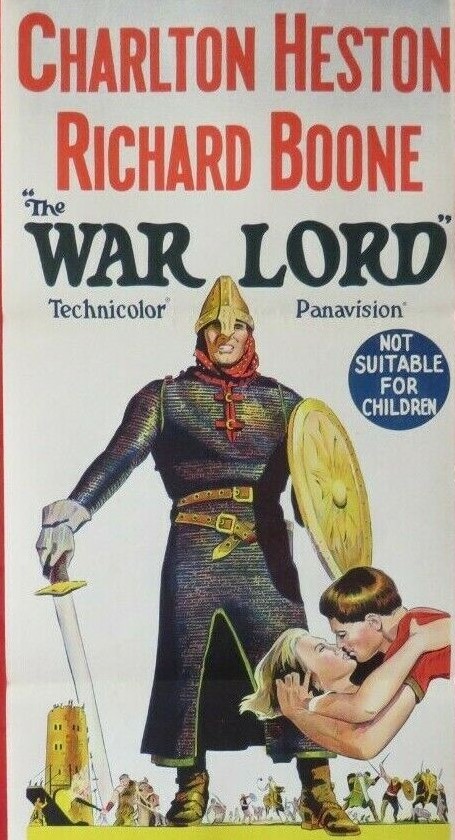
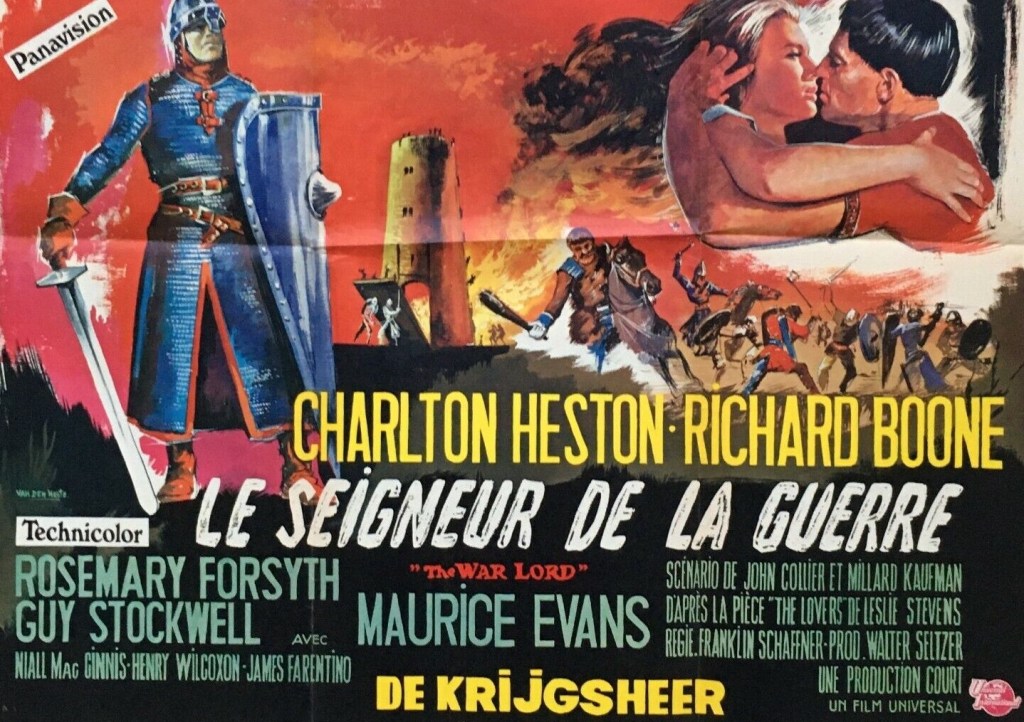
The War Lord (1965) ***

Contemporary audiences will gib at a narrative that relies on legalised rape. Audiences at the time had the same response but since then it has picked up considerable critical acclaim on account of its down-and-dirty portrayal of a medieval era far removed from the knight in shining armour. But it still pivots on the distasteful notion of “droit de seigneur”, the right of any noble to take the virginity of any female underling on their wedding night – it was motivation for William Wallace’s rebellion in Braveheart (1995).

The idea that this was pervasive or even occurred at all has been proven to be historically inaccurate. Logic tells you that any ruler wanting to keep his subjects in check would scarcely resort to wholesale rape that could spark disloyalty among his subjects. Or that any no one would be unaware of the dangers of inbreeding should the nobleman’s seed result in pregnancy.

What of course the movie does get right is that women were treated as chattels – “she’s mine” / “you’re mine” a recurrent refrain – or were makeweights in deals uniting the vested interests of kings or dukes.

As reward for years of service to the Duke of Ghent, Chrysagon (Charlton Heston) is handed a fiefdom in Normandy, prone to attack by Frisian raiders from the neighbouring Netherlands. In interrupting such an assault, Chrysagon captures the enemy chief’s son without being aware of it, prompting a later battle.

While the area boasts vestiges of normality, a priest and a strong tower, the inhabitants are inclined to the pagan rather than Christianity with rites (reminiscent of Game of Thrones) involving stone and trees while anyone using herbs for medicinal purposes is likely to be accused of witchcraft. Chrysagon takes a fancy to Bronwen (Rosemary Forsyth) already bethrothed to Marc (James Farentino). Egged on by his brother Draco (Guy Stockwell), Chrysagon decides to take up the option of droit de seigneur, but refuses to return the bride after the allotted time period (before dawn), incurring the wrath of the villagers who recruit the Frisians to their cause.

So it’s siege time although it seems unlikely that the attackers would be capable of producing such dangerous siege weapons in such a short time or that they wouldn’t simply resort to starving out the beseiged. Chrysagon’s  troops engage the attackers in time-honoured fashion from the top of the tower by arrow, boulders and boiling oil. Chysagon slides down a rope like Errol Flynn to prevent the raised drawbridge being lowered and uses a boat anchor to dislodge the siege tower. Battering rams and catapults soon enter the equation.

The only question-mark (unspoken) against Chrysagon’s employment of the “droit” privilege comes when the Duke demotes him and appoints Draco in his stead, prompting various endgame twists.

The battle is interesting enough, threat repeatedly countered, but there’s only so many times a director can cut to a soldier tumbling to his death. The ending is an anomaly, Chrysagon showing more respect to the son of his enemy than the wife of his villagers, and it seems odd that Draco is suddenly revealed as a bad guy, despite not being the one who triggered the conflict.

Chrysagon might have easily have fallen into the Martin Scorsese category of characters with “no redeeming features” – who are exempt apparently from the need for decency because of war – and it’s hard to summon up the necessary audience sympathy to make this picture work, especially given its starting point. Had Chrysagon merely fallen in love with Bronwen who reciprocated his feelings and that caused enmity among the villagers it would have been one thing but to start out from an historically inaccurate base is another.

One of the problems is that Bronwen doesn’t evolve. Her transition is from interesting to  passive. She has actually gone through a marriage ritual (of the Druid kind, but still binding as far as the villagers are concerned) and is therefore embarking on an adulterous relationship once the cock crows. It seems ludicrous, without allowing the woman dialog to express her feelings and acknowledge the peril of her actions, that she would believably take this route.  

So, if you like, accepting the droit de seigneur, in some ways it becomes a bolder picture, a major Hollywood star risking his reputation by playing a rapist, and in the way of all rapists justifying his action. And, like the characters in the recently-reviewed Play Dirty (1969) or Judith (1966), it becomes a question of individuals as pawns, the powerful taking advantage of position to abuse the weak. And it wouldn’t be the first time the innocent have suffered through a superior taking an indefensible approach.

Franklin Schaffner (Planet of the Apes, 1968) directed. Charlton Heston (Diamond Head) performs as if he’s the French equivalent of a Brit constantly biting on that stiff upper lip. Richard Boone (Rio Conchos, 1964) is wasted. Guy Stockwell (Tobruk, 1967) essays another weasel. It’s a picture of two halves for Rosemary Forsyth (Where It’s At, 1969) – while being wooed she’s good but then she’s pretty much dumped as far as the narrative goes.

Screenwriter John Collier, who later wrote the even creepier Some Call It Loving (1973) – an early Zalman King production – and Millard Kaufman (Raintree County, 1957) adapted the screenplay from an unusual source, a Broadway play by Leslie Stevens (Incubus, 1966) called The Lovers. The play had a different perspective, the bride ultimately committing suicide, while the War Lord and husband killed each other in a duel. Needless to say, there are no Frisians, so no siege, and no brother.

Before the arrival of Ridley Scott, this would been viewed as the best depiction of genuine medieval siege, so that part certainly still holds up. But the rest of it will only stand the test of time if you are willing to view it as an expression of the corruption of power.

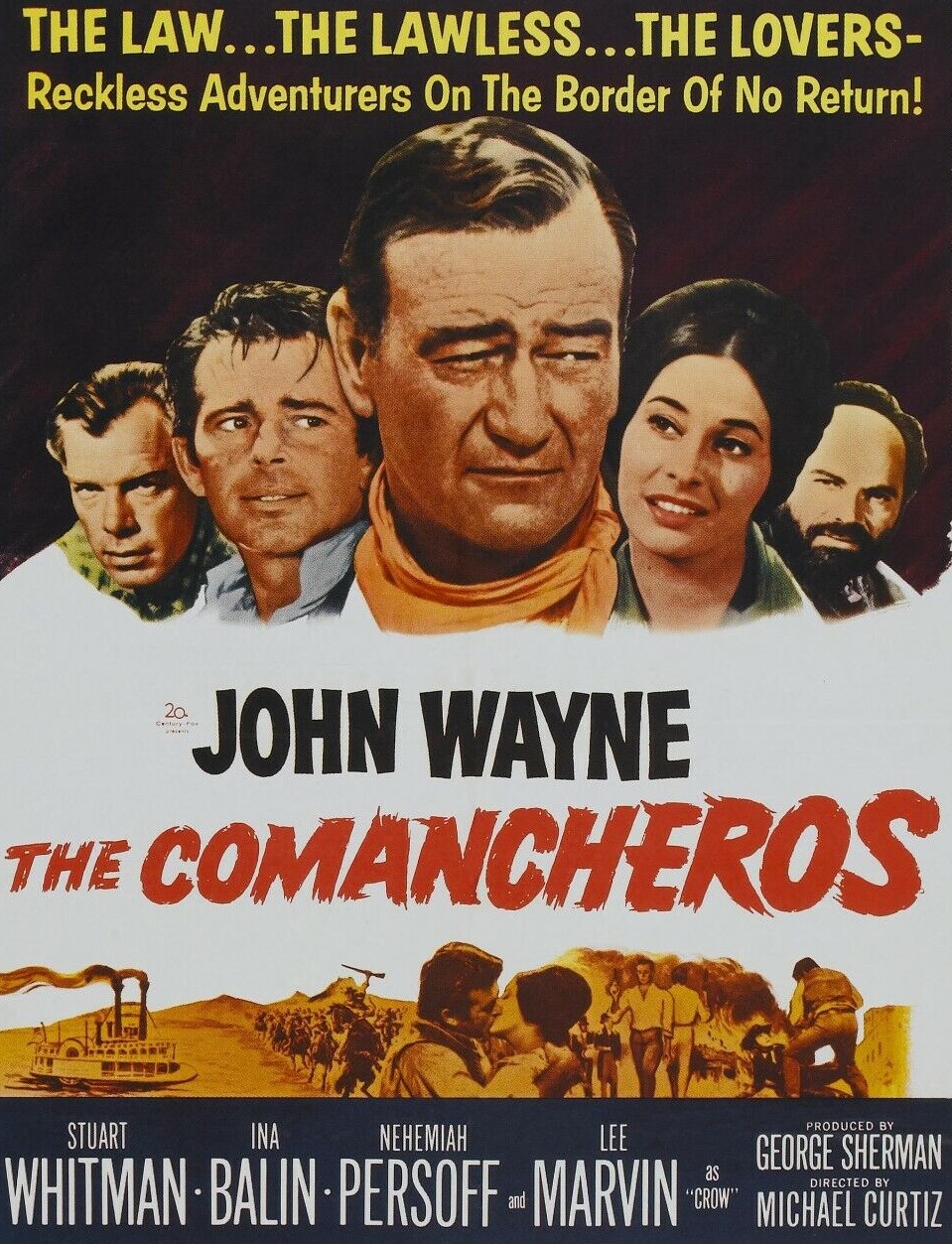
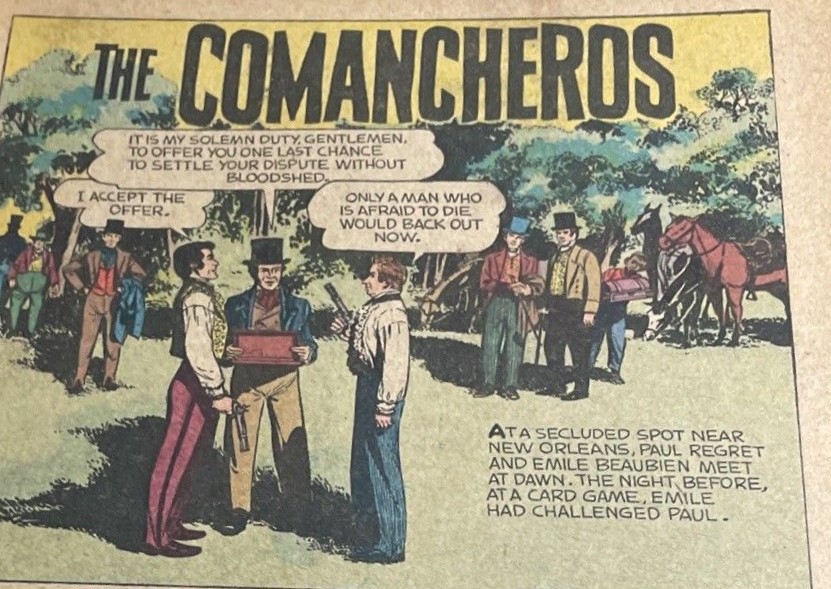
Behind the Scenes: “The Comancheros” (1961)

The making of this could have been a movie in itself. The novel, published in 1952, suffered from a long gestation involving four directors with seven actors at various points either signed up or mooted for the two top main roles.

Journalist-turned-author Paul Wellman specialized in westerns and historical non-fiction with a western bent. The Comancheros was the last of the half-dozen of his near-30 novels to reach the screen, following Cheyenne (1947) with Jane Wyman, The Walls of Jericho (1948) with Cornel Wilde and Linda Darnell, Alan Ladd as Jim Bowie in The Iron Mistress (1952), Burt Lancaster as Apache (1954) and Glenn Ford as Jubal (1956).

Originally earmarked by George Stevens as a follow-up to his Oscar-nominated Shane (1953), it was scheduled to roll before the cameras on completion of Giant (1956) in a Warner Bros production that contemplated re-teaming Vera Cruz (1954) pair Gary Cooker and Burt Lancaster.  When that failed to gel, next up were Gary Cooper and James Garner. That was kind of a tricky proposition given that Garner had taken on the might of Warner Brothers in a lawsuit in a bid to extricate himself from his contract.

But the producer didn’t seem to care as the day the actor won the lawsuit he received the script. “I didn’t like it, I didn’t want to do it,” recalled Garner, “but a couple of days later I heard Gary Cooper was going to do it,” resulting in a speedy change of heart. However, despite his verbal acceptance, no contract appeared and never hearing from Fox again assumed foul play from Warner studio head Jack Warner.

Meanwhile, Stevens’ interest had cooled and after settling on The Diary of Anne Frank (1959) he sold the film rights off to Twentieth Century Fox for $300,000, more than he had originally paid the author. Fox hired Clair Huffaker (Hellfighters, 1968) to write the script with Cooper’s sidekick role assigned to the up-and-coming Robert Wagner (Banning, 1967). But Cooper’s ill-health prevented that version going ahead.

Comic specialist Dell was a bit slow on the uptake, it’s tie-in copy (Issue 1300)
not appearing until three months after the movie opened.

Television director Douglas Heyes (Beau Geste, 1966) was set to make his feature film debut with the plum cast of John Wayne and Charlton Heston, fresh off global monster hit Ben-Hur (1959). Ironically, Wayne could have made this movie years before, in 1953 having been sent the novel by then-agent Charles Feldman (who had clearly also contacted Stevens).

Wayne had come back into the equation after signing a three-picture deal with Fox. But Heston,  on reflection, decided it would not be in the interests of his career at this point to take second billing and dropped out.

Wayne’s involvement meant re-shaping the script. In the novel the main character was Paul Regret, the Louisiana gambler wanted for murder for killing a man in a duel. Wayne was too old to play him so to puff up his part the Huffaker script was rewritten by James Edward Grant, better known originally as a short story writer, who had begun working for Wayne on The Angel and the Badman (1947) and would continue to do so for another 11 projects ending with Circus World (1964). 

Another newcomer, Tom Tryon (The Cardinal, 1963), was lined up to play Regret. Then Heyes dropped out leaving the way clear for the final teaming of Hungarian director Michael Curtiz (Casablanca, 1942), now a freelance after decades with Warners, and John Wayne.  

Stuart Whitman (Murder Inc, 1960) arrived from left field. While starring as Francis of Assisi (1961) he was shown the script by that film’s director, Curtiz. Tryon was eased out after Whitman managed to secure an interview with Wayne and the pair hit it off.

That Curtiz was already suffering from cancer was obvious to Whitman. Whatever sympathy his illness might have attracted was scuppered by the director’s rudeness. He had a predilection for sunbathing in the nude and blowing his nose on tablecloths, the actions of a powerful figure letting everyone know he could get away with it. His illness meant he restricted working to the mornings. After lunch he fell asleep in his chair, the crew placing umbrellas over his head to protect him from the sun.

While the director dozed, Wayne took over the directorial reins. When Curtiz was hospitalized, the actor finished the picture. It is estimated that he filmed over half of it, including the climactic  battle.

Ina Balin, a Method actor, found her acting style cut little ice with Wayne. When she demanded rehearsals and long discussions about her character, he simply shot the rehearsal. “Cut. Print. See how easy this is,”  explained the actor after wrapping her first scene with him using the rehearsal take.

“Duke was a terrific director,” observed Stuart Whitman, “as long as you did what he wanted you to do. Shooting with him was very easy although Ina Balin…pissed him off. Before each shot, she’d dig down and get emotional and he was a little impatient: get the goddam words out, he’d mutter to himself.”

Jack Elam, playing one of the heavies, had won in a poker game with their handler a pair of camera-trained vultures. The daily fee for the birds to sit on a branch was $100. Elam thought he’d get cute and ramp up the price to $250. That notion didn’t sit well with Wayne and he soon reverted to the original price.

While on the set, Curtiz fired third assistant Tom Mankiewicz, later a screenwriter, but currently  just a lowly nepo, owing his job to the fact he was son of director Joseph L. Mankiewicz. Tom’s downfall was arguing with Curtiz over his plans for the stampede scene for which he had rented dozens of Wayne’s prized longhorns. Asking the cattle to go over a 5ft drop and scramble up the other side was a good way of breaking their legs. Having informed Wayne of the director’s proposal, he was told by the star to turn up for work the next day, by the time the actor had finished chewing out the director that would be the least of his problems.

Despite friction with Curtiz, Wayne was surrounded by old friends and colleagues, including producer George Sherman, cinematographer William Clothier and screenwriter James Edward Grant. “Duke and George Sherman grew up together working at Republic for $75 a week and all the horses you could ride,” explained Clothier. “They were old friends. Duke didn’t understand old Mike Curtiz very well and I must say he didn’t try very hard. Mike was just plain out-numbered and I felt sorry for him.”

Although set in Texas in 1843, parts of the film were shot in Utah and the cast used weapons such as the Winchester lever-action rifles and the Colt Peacemaker which were not in production for another three decades.

Michael Curtiz, after nearly half a century directing movies, died shortly after the film’s release. The Comancheros, a box office smash, helped balance Wayne’s finances after the financial hit of The Alamo and solidified the notion that as far as is career went he was better concentrating on westerns than anything else.

For some reason, U.S. box office figures are sketchy but it was a huge hit around the world, finishing seventh for the year at the British box office for example, and re-emphasizing the Duke’s resounding global popularity.

SOURCES: Scott Eyman, John Wayne, His Life and Legend, (Simon and Schuster paperback, 2014) p352-357; Howard Thompson, “Wagner Steps Up Work In Movies,” New York Times, January 21, 1961, p18; Lawrence Grobel, “James Garner, You Ought To Be in Pictures,” Movieline, May 1, 1994

The Hawaiians / Master of the Islands (1970) ****

Contemporary audiences will find much to admire. Perhaps unintentionally, certainly unusual for the era in which it was made, this is driven by a strong feminist streak and the problems of  fusing different new cultures – Chinese and Japanese – on an island already dominated by white immigrants. In some respects a companion piece to Diamond Head (1962), which also starred Charlton Heston, but in reality a sequel to epic roadshow Hawaii (1966).

Nyuk Tsin (Tina Chen) has been kidnapped from her village in China with the intention of selling her into a brothel in Honolulu. But when her gender is discovered on board the ship, captained by Whip Hoxworth (Charlton Heston), transporting Chinese laborers to Hawaii, a fight breaks out, her owner is killed and she is taken over by Mun Ki (Mako). He fully intends, on making land, to sell her and keep the money but at the docks Whip’s wife Purity (Geraldine Chaplin) intervenes and the couple are offered jobs as husband-and-wife.

“Hawaii” (1966) was not such a big box office hit abroad as it was in the United States
hence the decision not to rely on the U.S. title “The Hawaiians” for the sequel.
In fact, unlike the U.S. poster the novel is not so upfront.

Mun Ki’s entrepreneurial spirit is obvious from the minute she reaches Whip’s plantation, as she starts planting seeds in a tiny area in front of the hovel that is their dwelling. That turns into a vegetable garden and eventually she has a side business feeding laborers. Her gardening skills encourage Whip to entrust to her to grow the seed pineapple plants he has stolen from French Guiana, a continent away in South America.

When that proves successful, and Whip manages to find an artesian well through the lava bed, he embarks on a career as a pineapple farmer, and as a reward, deeds her land.

Meanwhile, Nyuk Tsin discovers she is wife only in terms of procreation. Mun Ki already has a wife back home, so Nyuk Sin can only officially become an aunt to the five children she bears him, each named after a continent (Asia, Africa etc) and who do, it must be said, come in handy for her farming business. She is wealthy enough that attempts are made, as much from envy and fury at her success as anything else, to steal her property.

While officially disbarred from the position of wife, her feelings for her husband are so strong that when he contracts leprosy she accompanies him to the island of Molokai and looks after him until rescued by Whip. Now with a prosperous farm, and remaining unmarried, she is rich enough, and clever enough, to send one son to America to train as a lawyer. Through her own endeavors and willpower she becomes not the slavish wife, dependent on her husband and his whims, but a strong independent wealthy woman, and leader of her expanding clan.

Theoretically, this is a subplot in the film, but in reality director Tom Gries (Number One, 1969) affords it as much time as the supposedly main narrative which, in contrast to Diamond Head, sees Whip as the black sheep of the family, disinherited and left only with land that is useless until the cultivation of pineapples makes it viable. His wife, while ostensibly weak, is also of a feminist disposition, abandoning her husband after the birth of her only son Noel (John Philip Law) to return to her Hawaiian roots.

When the Japanese arrive on the island Whip takes as a mistress the educated self-sufficient Fumiko (Miko Mayama). The circle of interbreeding and cultural infusion is complete when Noel marries Mei Lei (Virginia Lee), Nyuk Tsin’s only daughter.  

It’s a lot more melodramatic than that, to be sure, Whip at odds with his family, Purity sending him bananas by denying him sex after Noel’s birth, and then withdrawing from his life. Various characters flit in and out, like the alcoholic well-digger Overpeck (Don Knight), and the tale embraces, like Diamond Head, the period when the United States annexed Hawaii.

Allotting so much screen time to Nyuk Tsin can’t have been accidental, maybe it was just visionary, but taking her as the focal point pivots more on her single-minded nature than the haphazard character of Whip, who achieves success through luck, theft and brutality. It’s remarkable that Nyuk Tsin has understood its importance of land ownership, the bedrock of any country’s institutional hierarchy, and strives so hard to achieve that footing and becomes in essence the family breadwinner. If the foreign title had been changed to Mistress of the Islands it would not have gone far wrong.

Fans of the second-billed John Philip Law (Hurry Sundown, 1967) will perhaps be disappointed that he appears so late in the proceedings, essentially to ensure the narrative can embrace the generations, but also to show how attitudes can change for the good from one generation to another.

I’m aware I’m asking you to watch the movie from a different perspective from that advertised but it’s far more rewarding.

Charlton Heston is good, especially when transitioning from commander of all he surveys while on board ship to a mere family footnote on dry land. He can rant with the best of them, for sure, but underneath the fury you can detect the pain, cast aside by family and wife. The scenes where he fails to reignite sexual relations with Purity reveal how great an actor he is. We more often associate Heston with the lower half of his face, the jutting jaw, the flashing teeth, the dominance of his words, rather than the upper half where his eyes are so revealing of inner torment. There’s a sea-change in the standard Heston performance that runs through Planet of the Apes, Number One and here of a powerful man drained by circumstance.

But Tina Chen (Three Days of the Condor, 1975) is the standout, moving from humiliation to pride, often called upon to mutely absorb pain, but fiercely protecting husband and brood, and clever enough to calmly negotiate her way past husband and Whip to potential success.

Tom Gries, in his third picture with Heston, manages to create an epic feel to a picture whose limited running time sabotages that aim. His sweeping tracking shots provide the bravura but that is underpinned in the more intimate moments by sensitivity to character emotion shown in a look rather than expressed in dialog.

Screenwriter James R. Webb (How the West Was Won, 1962) had the job of chiselling another cinematic chunk from James Michener’s door-stopper of a novel and turning this  sub-plot into a gem.

Well worth a look.

Diamond Head (1962) ****

Bold examination of racism years ahead of its time. Narrative not sweetened for audiences by a detective story (In the Heat of the Night, 1967) or grumpy father-of-the-bride comedy (Guess Who’s Coming to Dinner, 1967) or by protagonists unrepresentative of society by being criminal (The Defiant Ones, 1958) and criminally insane (Pressure Point, 1962), the issue of racism – miscegenation and interbreeding – smack bang in the middle. Though it takes place in Hawaii, theoretically at one remove from the violence emanating in the U.S. Deep South, the points made strike home.

If a shade melodramatic, that is undercut by a set of very fine performances by all the principals. Charlton Heston, later lacerated in democratic circles for his defence of the right to bear arms, here employs his marquee value to deal with the ticking time bomb.

Yep, that is an advert shaped as a diamond. Subtle, huh?

The tale is simple enough. Headstrong Sloane (Yvette Mimieux) decides to marry native-born Paul Kahana (James Darren) against the wishes of her older brother, widowed millionaire landowner “King” Howland (Charlton Heston). Despite using equality as an election platform in a bid to become a Senator, King fiercely objects to the marriage on the grounds that it will dilute his bloodline and, in effect, hand over control of his empire to an outsider. His spinster sister-in-law Laura (Elizabeth Allen) backs him on this score as does, oddly enough, Paul’s mother Kapiolani (Aline McMahon) who complains that interbreeding has reduced the number of native Hawaiians to a mere 12,000.

Complicating matters is King’s hypocrisy. His mistress, Mai Chen (France Nuyen), already is of mixed parentage. But when she announces she is pregnant, he demands she have an abortion. Spicing up that particular complication is her brother Bobbie (Marc Marno) who sponges off the perks King provides and now decides to hit the gold seam by blackmailing King. And just in case that’s not enough in the way of complications Sloane has always had a yen for Paul’s older and more successful brother Dean (George Chakiris), now a hospital doctor. In fact, as outlined in a flashback, Paul was decidedly second-best in Sloane’s eyes and there is a hint she romanced him to spite the more sensible brother.

Bobbie doesn’t get the chance to put his scheme into practice as he is implicated in the death of Paul, who had been trying to stop the blackmailer from drunkenly attacking King at a traditional engagement ceremony. Paul is killed accidentally by King.

That should have simplified matters, but it doesn’t. King is abandoned by Sloane and Laura leave and Mai Chen throws him out. The scandal of Paul’s death should have ended his political ambitions, but despite his backers dropping out, arrogantly he decides to go it alone until receiving the slow-handclap treatment from the public. He is fully aware of the consequences of his action, pointing out that $3 million spent on philanthropy wouldn’t “buy me a tear.”

It could have ended there, proud man brought down by ambition, institutional racism and stubbornness, but it follows a different, and reconciliatory, tack at the end.

And it could have been a heaving brew of melodrama with dilated nostrils and screaming matches but it’s redeemed from that by most of the actors downplaying their roles. There is some impressive playing by Charlton Heston (55 Days at Peking, 1964) who carries off his hypocrisy in some style, but doesn’t descend to the obvious ploy of disinheriting the defiant one or at the very least chucking her out and generally manages to keep the lid on his temper. George Chakiris (Flight from Ashiya, 1964) uncannily captures all the elements of his character. An educated man so can’t be downtrodden but has to watch his step in confronting such a powerful man, so he makes his point with quiet determination.

In an early starring role Yvette Mimieux  (Joy in the Morning, 1965) is given a lot more to do than in some later offerings. She exhibits defiance not just in regard to racism but sexism as well, determining that her marriage would be an equal relationship not one where she would be subservient to her husband. Had she been able to rein in her pig-headedness and present herself as more interested in the business than its perks  she might have allayed her brother’s fears that in endorsing the marriage he was risking handing over his empire to her idiot husband, so lacking in the brain department he needed extra years to graduate at college.

France Nuyen (Man in the Middle, 1964) has a peach of a part, plenty good lines, and the beneficiary of the few scenes not driven by narrative requirements, in particular her observations at watching her lover dress. James Darren (The Guns of Navarone, 1961), given  less to do, is not surprisingly more of a cliché. Oscar-nominated Alice McMahon (Cimarron, 1960) is quietly impressive as the equally torn parent who could, at one point, take legal revenge on King.

Director Guy Green (The Magus, 1968), aware the content is inflammatory enough without the principals going overboard, does pretty well to stick to the issues. Screenwriter Marguerite Roberts (5 Card Stud, 1968), in adapting the bestseller by Peter Gilman, makes several changes to keep the focus on the key element.

In his diary, Charlton Heston noted that that movie was overly melodramatic but with the proper treatment it could work. He was right. The plot has more cogs than any wheel could comfortably accommodate, but by keeping the central issue central the movie would be viewed today as the highpoint of Hollywood’s opposition to racism rather than being  superseded five years later by the pair starring Sidney Poitier.

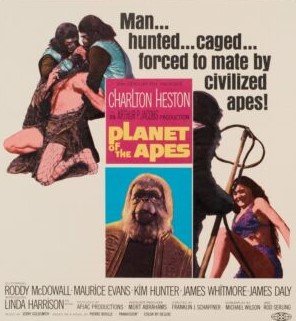
Behind the Scenes: “Planet of the Apes” (1968)

J. Lee Thompson (The Guns of Navarone, 1961) saw a much-needed boost to a drifting career vanish when he ducked out of this project – he had spent considerable time developing the project – in favor of Mackenna’s Gold (1969). Blake Edwards, first director attached, probably also lamented losing out. This was to have been Edwards last outside film before committing exclusively to Mirisch.

Producer Arthur P. Jacobs, who had bought the rights to Pierre Boulle’s Monkey Planet in 1963, could hardly believe his luck after the calamitous Doctor Dolittle (1967). Unusually, the two films were not cross-collaterized, a standard studio device whereby the losses on one film were played against the profits in the other, which would have almost certainly resulted in no profit payments to Jacobs.

And you could probably say the same for eventual director Franklin J. Schaffner, relegated to television and movie stiffs like The Double Man (1967) after the failure of big-budget historical drama The War Lord (1965) and his abortive attempt to film the Travis McGee novels of John D. MacDonald, whose total sales exceeded 14 million. He wasn’t involved in Darker than Amber (1970), the first McGee title to be filmed. Heston, who Schaffner had directed in The War Lord, pushed for his involvement.

Charlton Heston was also in dire need of career resuscitation, his past five movies – Sam Peckinpah’s Major Dundee (1965), The Agony and the Ecstasy (1965), The War Lord (1965), Khartoum (1966) and realistic western Will Penny (1967) – had all tanked. “In my view,” he opined, “I haven’t made a commercial film since Ben-Hur,” clearly ignoring the success of El id (1961).

And once it became a success Warner Brothers regretted letting it go. The studio had been involved in the project when Blake Edwards was to direct.  The movie was cancelled due to cost – it was budgeted then at $3-$3.5 million – and script and production problems. The studio might also have shied away after learning of the booming budget and lengthening schedule for MGM’s 2001: A Space Odyssey. Twentieth Century Fox ended up forking out $5.8 million to turn the project into reality.

As was often the norm in Twentieth Century Fox pictures, studio head honcho Darryl F. Zanuck found a part for his mistress, in this case Linda Harrison as Nova, the mute love interest. She  was a graduate of the studio’s program of investment in young talent. Others included Jacqueline Bissett (The Detective, 1968) and Edy Williams (The Secret Life of An American Wife, 1968).  Had Raquel Welch (One Million Years B.C, 1966) considered the opportunity to don a fur bikini again, it is doubtful Harrison would have won the role. But she turned it down as did Ursula Andress (The Southern Star, 1969). Angelique Pettyjohn (Heaven with a Gun, 1969) was auditioned

Former child star Roddy McDowall (Lassie Come Home, 1943), Kim Hunter (A Streetcar Names Desire, 1951) and Maurice Evans (The War Lord) fleshed out the ape contingent. Ingrid Bergman (The Visit, 1964), also in much need of a career uplift, turned down the role of Zira. Other stars in the frame for roles included Yul Brynner, Alec Guinness and Laurence Olivier. Edward G. Robinson should have played Zaius, but couldn’t manage with the make-up.

Source material was Monkey Planet by Pierre Boulle, author of Bridge on the River Kwai. Twilight Zone creator Rod Serling took a year and a reported 30 drafts to turn in a viable screenplay and the former blacklisted Michael Wilson, whose name had been removed from the credits of Bridge on the River Kwai (1957) and Lawrence of Arabia (1962), added the polish.  Wilson had won an Oscar for A Place in the Sun (1951) and another one for Friendly Persuasion (1956) although that was actually awarded to Jessamyn West since Wilson’s involvement was kept secret. If he had not been blacklisted, he would have been in the unusual position of having won four screenplay Oscars, although in the end the others were retrospectively awarded.

If you were looking for a sci-fi picture with dramatic heft, decent action, mysterious outcome and an examination of the human condition this was a more straightforward bet than 2001: A Space Odyssey (1968). While Fox reckoned its previous sci-fi venture Fantastic Voyage (1966) had worked out well, it had reservations about the cost of Planet of the Apes and the possibility of making an ape setting believable. In this case the special effects’ conundrum was make-up for the apes. If they just looked like humans wearing monkey suits the movie would not fly. Fox spent $5,000 on a test with Heston in a scene with two apes before it greenlit the movie.

Faces that could not express emotion and were as stiff as a botox overdose would invite audience ridicule. In the end the studio spent a reported million dollars on pioneering ape renditions by John Chambers, who  previously been a surgical technician repairing the faces of wounded soldiers. He had a team of 78 make-up artists There were almost as many scripts as crew and the changes wrought as the picture moved closer to being greenlit were to switch from a futuristic setting to a primeval one (which, incidentally, saved on costs), covering up the breasts of the female prisoners and inventing the stunning ending.

There were three possible endings, the one shot being that favored by the star.. Heston’s hoarse voice was not in the script, but an incidental by-product of him catching the flu. Apart from studio sets, the movie was filmed in blistering heat in Arizona. The rocket ship crashed into Lake Powell in Utah, ape city – modeled on the work of celebrated Spanish architect Gaudi – was constructed in Malibu Creek State Park, and the final scene was filmed on Zuma Beach in Malibu.

Unlike Fantastic Voyage which told audiences what the mission was, but in keeping with 2001: A Space Odyssey, Planet of the Apes opens with mystery. Like Rosemary’s Baby, the movie is viewed through the eyes of an innocent, one who cannot quite cotton on to his fall down the evolutionary food chain. Albeit more hirsute and muscular than Mia Farrow, nonetheless the casting of Heston dupes the audience into thinking he is somehow going to win, rather than just escape. He is an experiment who has wandered into the wrong planet. But there are few films that can top that shock ending.  And the movie more than fulfills the “social comment,” on which Heston was very keen, contained in the Boulle novel.

SOURCES: Russo, Joe, Landsman, Larry, and Gross, Edward, Planet of the Apes Revisited, The Behind the Scenes Story of the Classic Science Fiction Saga (New York: Thomas Dunne Books/St Martin Griffin, 2001); Hannan, The Making of The Guns of Navarone, 187. “Warners Ape World,” Variety, March 18, 1964, 4; “High Costs Impress Capital,” Variety, March 23, 1964, 3; “Planet of Apes Off for Present,” Variety, March 10, 1965. “Michael Wilson Under His Own Name For A.P. Jacobs,” Variety, December 14, 1966, 7. “MacDonald Novels Cue Major Pictures Corp.,” Variety, May 17, 1967, 5; Austen, David, “It’s All A Matter Of Size,” Films and Filming, April 1968, 5; “Fox’s Talent School,” Variety, June 26, 1968, 13; Film Locations for Planet of the Apes,” www.film-locations.com.

I have to confess this Behind the Scenes article would have been better if I had not loaned out – and never got it back – my copy of The Making of Planet of the Apes by JW Rinzler which was published five years ago.

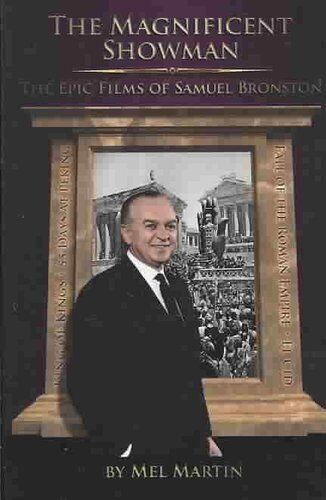
The Original Magnificent Showman – Samuel Bronston

Even by Hollywood’s notorious standards, independent producer Samuel Bronston went from boom to bust in record time – three years flat. But by the time he left he had fuelled the roadshow boom, infuriated Hollywood by raising the bar for actor salaries ($1 million for Sophia Loren) and delighted the industry by opening up Spain as a cheap production center. He wasn’t the first indie to make a big splash in the business, David O. Selznick, Edward Small and coming up fast Joseph E. Levine were all significant players. 

Whereas most indies raised finance from conventional sources, Bronston, born in what these days is known as Moldova, found investment from an unusual source. In probably the grandest Hollywood wheeze of all time, he became an oil broker. He sold DuPont oil to Spain. But since that country would not pay in American currency, he parlayed the pesetas into moviemaking. Like any industrialist convinced society had not recognized his efforts, Pierre DuPont III reckoned that dining at the Hollywood high table – guests including John Wayne, Sophia Loren and Charlton Heston – might provide sufficient recompense. Bronston used pesetas reaped from commodity broking to make movies and repaid DuPont from the revenue the movies accrued on the international market.

While their first venture John Paul Jones (1959) was a flop it opened up Spain as a potential source of low-cost production at a time when studios, most on the verge of collapse, were desperate to cut expenditure.  

Previously, Bronston had enjoyed a low-key Hollywood career, producer, credited or otherwise, on City without Men (1943), Jack London (1943) and A Walk in the Sun (1945) before disappearing off the movie map. But that short career was not without incident, and somewhat marred by the financial repercussions for which he would be later better known. He was sued by the backers of A Walk in the Sun – Hollywood outsiders Walter E. Heller & Co and Ideal Factoring Co. who had ponied up $1 million of the $1.25 million budget. And by a former partner who also claimed he had not been paid.

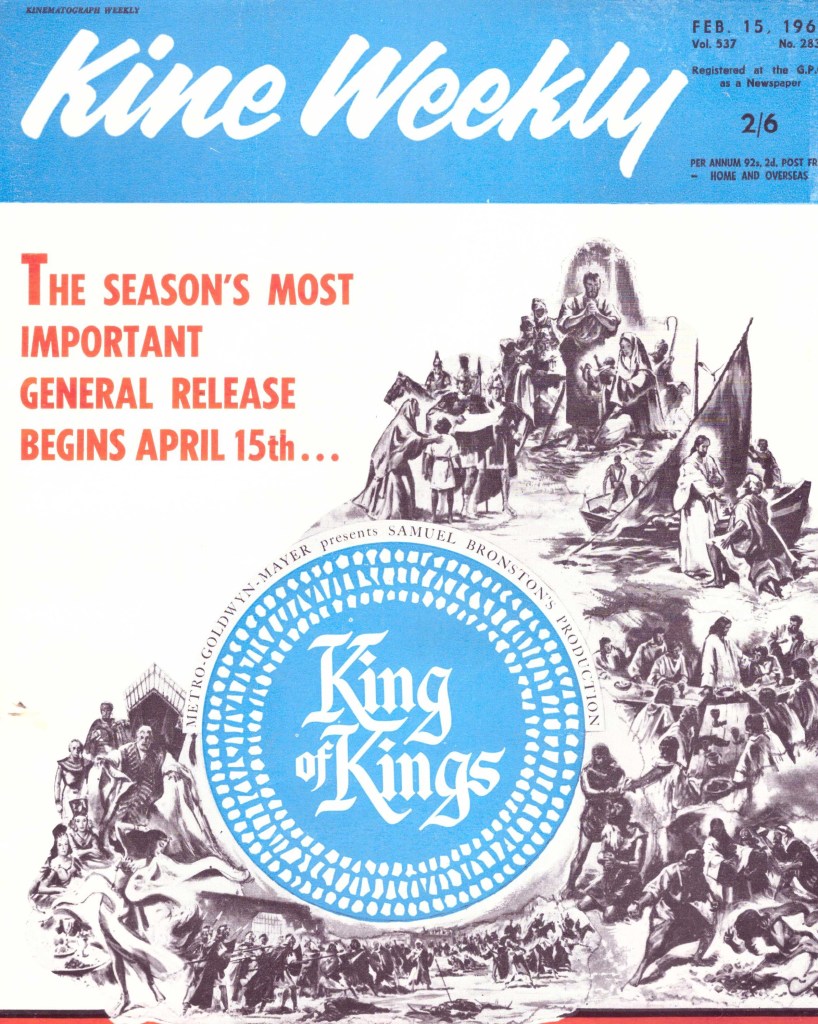
He resurfaced following a spectacular gambit, gaining access to the Vatican to make a documentary. Using a perceived Papal connection as some kind of approval he spun that into international distribution for his first roadshow King of Kings (1961), a good earner around the world, $24 million gross worldwide on an $8 million budget, and a reissue banker when Easter came round. Spain stood in for the Holy Land and although production began, possibly for publicity reasons, in April 1960, Bronston had begun pre-production two years earlier on developing costumes and sets.

Like Cecil B. DeMille, Bronston exhibited a mania for historical detail. He could bring in experts, make use of local craftspeople, and thousands of extras were available at a fraction of the cost of their Hollywood counterparts, not to mention the Spanish Army at his beck and call. But the set was riven with intrigue, screenwriter Philip Yordan pulling more weight with Bronston than director Nicholas Ray. Bronston soon had a production team established at his mini-studio.

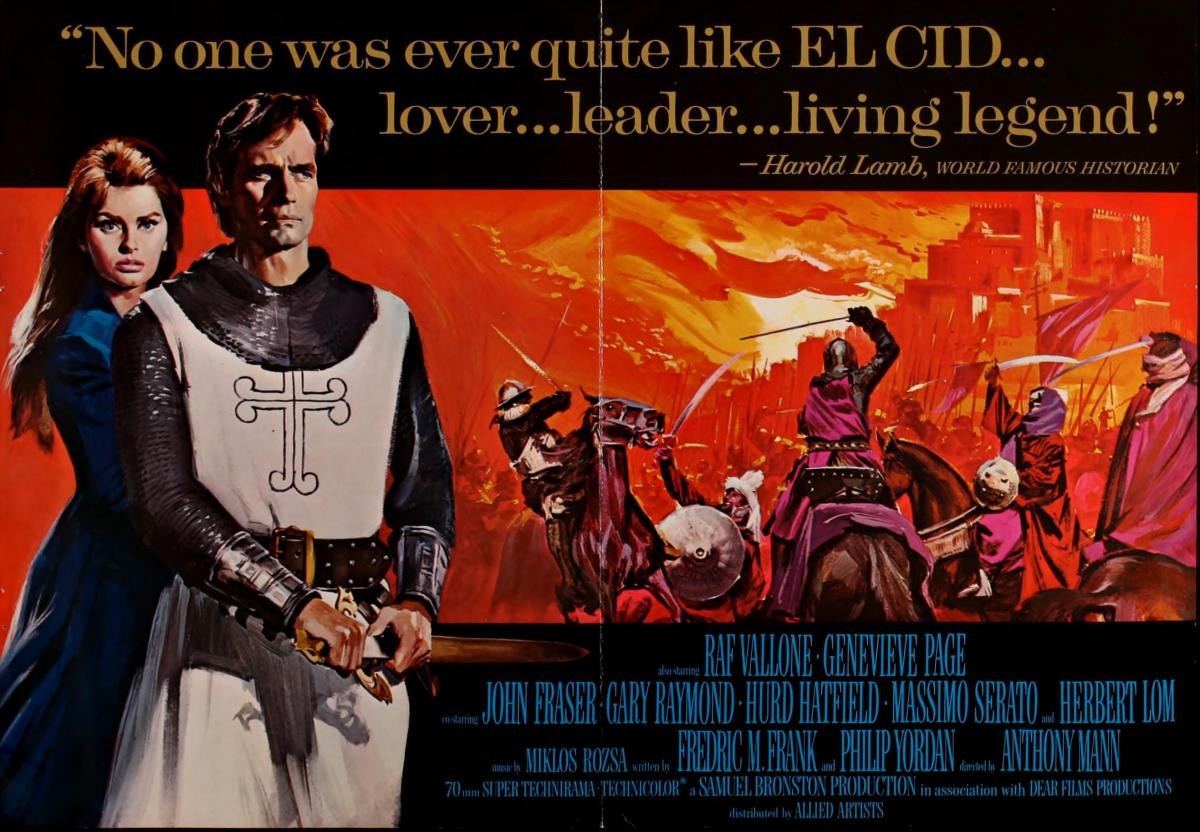
El Cid (1961) was a natural to establish cordial relationships with his national hosts, the character a legend in the country, many events depicted taking place in locations which still existed. But wooing Charlton Heston, at that time the biggest star in the world following the unbelievable success of Ben-Hur (1959), to make this his follow-up to the Biblical epic was a spectacular coup. The fact that he paid more – a reputed $1 million – to secure the services of Sophia Loren proved he could attract the biggest stars and, not as helpful, pay way over the odds.

Costing less than King of Kings and making far more, with superb direction by Anthony Mann and acting by the principals, it was both critically well-received and a massive hit at the international box office, running in roadshow for months. Perhaps more importantly, Bronston’s success attracted the attention of a major Hollywood studio, Paramount, which agreed to partner him in future endeavors and perceived him as the natural successor to Cecil B. DeMille.

Heston returned for 55 Days at Peking, one of the cycle of “siege” pictures – The Alamo (1960), Zulu (1964), Khartoum (1965) fall into the same category – popular if only among filmmakers during the decade. There was a lot more to the picture than art direction but it was not as well-received as the Bronston’s first pair of the decade, and the fact it went through three directors, Nicholas Ray retiring through ill health replaced by Guy Green (A Matter of Innocence, 1967) and finally Andrew Marton who had directed the chariot sequence in Ben-Hur, contributing to the notion of an organization in chaos.

With a $17 million budget, a $5 million U.S. gross ensured there was little profit to be had once the movie had completed the international round. However, luckily for Bronston, roadshows tended to be more popular abroad and could often play far longer in their initial bookings than would occur in the U.S.

When Heston turned down The Fall of the Roman Empire that should have proved a portent. Megalomania or extravagance or an inability to keep a budget in check fuelled the wild overspending on The Fall of the Roman Empire, a title that should have provided a roadshow par excellence, with action and drama of the kind that had driven Ben-Hur. But with a final tab of $24 million it would have required to be the biggest picture of all time just to break even.

By this time, Bronston’s financial mismanagement was catching up with him. Although Paramount kept the faith, signing up for Circus World (1964) and pictures beyond, and with a new partner, Cinerama, ploughing money into the John Wayne three-ringer, Pierre DuPont III had had enough and pulled the plug. Bronston’s debts were in the region of $5 million – $8 million. Subsequent investigation into Bronston’s operation revealed unparalleled levels of waste, unscrupulous hangers-on and the inability to rein back on spending.

Perhaps as critical was that he was churning out roadshow pictures at too fast a rate for control to prove possible. Of course, the unprofitable pictures all went into considerable later profit from sale to television – U.S. networks bid $1 million for El Cid alone in 1966 –  syndication, VHS, DVD and streaming, as any star-packed big-budget pictures from that era did. And they have all been reassessed as having greater critical worth than was appreciated at the time.

Bronston consistently argued that he was on the verge of a comeback. He had other irons in the fire – The Nightrunners of Bengal to be directed by Richard Fleischer, Suez helmed by Jack Cardiff, Brave New World with David Niven, The French Revolution, Paris 1900 and Isabella of Spain later linked with Glenda Jackson and John Philip law.

Bronston did work again, credited or otherwise, on Savage Pampas (1965) starring Robert Taylor, Dr Coppelius (1966), Brigham (1977) – reuniting him with writer Yordan – The Mysterious House of Doctor C (1979) which reworked Dr Coppelius  and Fort Saganne (1984) with Gerard Depardieu.

His former studios which had gone unsold at auction with a price tag of $1.8 million were bought by the Spanish government and renamed the Luis Bunuel Studios and at one point were scheduled to come out of mothballs for the filming of Rustler’s Rhapsody (1985) starring Tom Berenger.

While Bronston certainly turned Spain into a production powerhouse, he will be perhaps better remembered for his financial finesse. He had a million-dollar guarantee from DuPont but he used it over and over again with different banks without anyone actually stopping to check whether it was already being held as collateral for another movie. In any other world apart form movie-making this would be held up as scandalous behavior, but only in Hollywood would this be applauded as a master showman at work.

SOURCES: SOURCES:  Mel Martin, The Magnificent Showman (Bear Manor Media, 2007); “Bronston in 63G Suit,” Variety, February 12, 1947, p9; “Underwriters Reclaim Bronston’s Walk in Sun,” Variety, August 10, 1949, p7; “Sam Bronston’s Film Shot Inside Vatican,” Variety, March 22, 1950, p1; “Bronston’s Brave New World,” Variety, September 4, 1963, p4; “Bronston and Paramount in 4-Picture Deal,” Box Office, December 9, 1963, p7;  “Bronston-Cinerama Unite on 2 Films,” Box Office, February 24, 1964, p5; “Bronston’s Comeback Plan,” Variety, June 10, 1964, p3;“Du Pont-Bronston In Accord,” Variety, August 4, 1965, p3; “Bronston Readying Isabela,” Variety, April 13, 1966, p3.

Number One (1969) ****

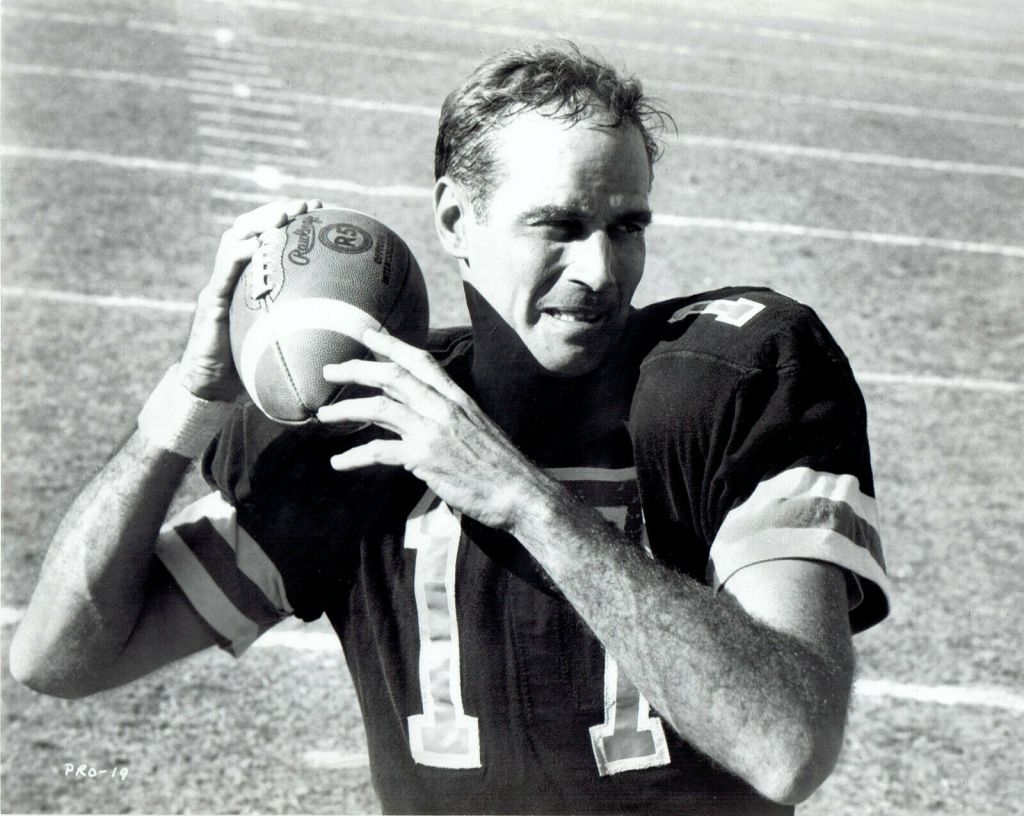
Quite possibly Charlton Heston’s best performance – as an ageing pro footballer refusing to bow down to the inevitable. Ron Catland (Heston) has much in common with Ned Merrill (Burt Lancaster) in The Swimmer (1968) as characters who believe they have been let down by the American Dream. And like that picture, plot is in short supply, it’s mostly a character study with sideswipes at the realities and inanities of American football.

An injury puts star quarterback Catland’s career in doubt. The media write him off, younger quarterback Kelly (Richard Elkins) is waiting in line, while former colleague Ritchie Fowler (Bruce Dern) offers him a job in his car leasing business, or he could opt for a second career in computers, but Catland wants the only life he has ever known to go on forever.

There’s nothing inherently likeable about Catland. In fact, he’s downright mean most of the time, in part because of the falsity of his profession, management buttering you up when it’s contract time, then on your back once you have re-signed. He’s got a hero’s arrogance, has ignored from the outset the coach’s instructions, at odds with independent fashion-designer wife Julie (Jessica Walter), no children to shore up their marriage. Hardly surprising he drifts into another affair, “an occupational hazard” his wife calls it, this time with the fey Ann (Diana Muldaur) who owns a tennis shop.

VHS cover

You are probably familiar with the kind of football picture which climaxes with a last-minute touchdown or the more realistic movies like North Dallas Forty (1979) or the superlative Any Given Sunday (1999) where nonetheless the focus is on winning and characters are ramped up for dramatic effect. Or you might imagine Hollywood had been routinely churning out football movies like Knute Rockne All-American (1940) and Jim Thorpe All American (1951) for decades. But strangely enough the movie industry had not focused on this particular sport for well over a decade until the NFL documentary They Call It Pro Football (1967) and comedy Paper Lion (1968).

Number One sets out to set the record straight on the reality of being a football hero. And it’s by far the most realistic of the species. For every good-looking gal wanting to pass him a note on a napkin in a restaurant there are plenty fans turning on him for refusing to sign an autograph. For every sports reporter writing a puff piece, there are others tearing him to pieces in print.

The documentary-style approach by director Tom Gries (100 Rifles, 1969) serves the film well. This is a different kind of football team to the later fictional depictions. It’s a lonely life for a start. The players are rivals, not comrades.  There’s little camaraderie. The dressing room is like a morgue. No practical jokes and tomfoolery. No over-the-top team talk by the coach and thank goodness no padre who pretends to walk every aching mile in their shoes. Any exhortation is almost a plea. Injury is mostly ignored. Legs are constantly strapped up. And when your career is over you might be reduced to bumming a loan from a current star. The politics are brutal.

New Orleans Saints cooperated with the production so the game scenes come across well though not obviously with the razzamatazz of Any Given Sunday and Heston has the physique for a sportsman. Primarily a television writer, David Moessinger (The Caper of the Golden Bulls, 1967) only crafted two films and this, the second and last, was an unusual effort, as the character twists and turns trying on the one hand to escape the cage of his career and on the other determined to squeeze the last drop out of his golden imprisonment.

Catlan still sees himself (at the age of 40, no less – but younger than today’s legendary Tom Brady) as the best quarterback in the business and simmers with anger that his body is letting him down and that he has nothing in place to fill the gap that abandoning the game will create. Underneath the volatility is a hole of pain. There’s no sense either that he has enjoyed his time at the top, just that it has always one way or another been a struggle.

Heston and Gries took a different approach to the western Will Penny (1968) and here they do the same to the sports picture. Although the movie was marketed with Heston as an aggressive individual, in fact it calls for a far wider range of emotions from Heston, and for this part he delivers in spades. Jessica Walter (Grand Prix, 1966) gives as good as she gets, Bruce Dern (Hang ‘Em High, 1968) as the fast-talking salesman who got out of the game in good time and Diana Muldaur (The Swimmer, 1968) are excellent. But this is Heston’s film. But it’s more of a reflective piece, none of the dramatic highs and lows of other football pictures, instead it is true to the cynicism and human exploitation of the game.

Advance Buzz – The Phenomenon Created in the 1960s

In 1964, Twentieth Century Fox created a new way of selling pictures by inventing the advance buzz.

Of course, movies had always had some kind of pre-launch push but mostly on a small-scale via gossip columnists, who, while they had some influence, did not actually receive much space in a newspaper. Fox set out to change all that and put movies on the front pages and gain big feature spreads inside, an event that only usually occurred through  unwanted scandal (Cleopatra, for example), death  or a photo of a big female star.

Fox revamped the press junket – at that time primarily used as a vehicle to announce a movie premiere – and turned it into a method of creating advance publicity and expanding awareness on new pictures long before they reached the screen. And did so with enormous style, transporting over 100 American journalists to Europe to watch the production of three major big-budget roadshows.

Cecil B. DeMille of all people had invented the movie press junket – for the world premiere of his swashbuckler The Buccaneer in 1938. At a time when world premieres were confined to New York and Los Angeles, Hollywood had begun experimenting on a small scale with different locales for a first showing – whaling picture I Conquer the Sea (1936) was unveiled in New Bedford, Massachusetts, The Petrified Forest (1936) in St Louis and Sutter’s Gold (1936) in Sacramento. But these were all local affairs, the selected city putting on a big show for local dignitaries but the media were drawn only from the immediate surrounding area with stories syndicated to bigger newspapers.

When he selected New Orleans for his world premiere, DeMille, as skilled in marketing as he was in direction, hired a deluxe train to bring journalists from the top newspapers and magazines down from New York and Chicago. The train had a special compartment kitted out with typewriters, telephones, radio, Dictaphones and even stenographers to “relay hot news as it happens.”

All expenses – accommodation, meals, alcohol and various other sundries – for an entire week were picked up by Paramount. Three radio stations made daily broadcasts and the journalists filed news stories and features about the stars and the city, and, most important of all, reviews of the film they were privileged to be the first to see. The city went to extraordinary trouble, proclaiming a local holiday, organizing parades, enlisting the help of local organizations to ensure there was some event worth reporting every day. Local retailers, hoteliers and restaurateurs made a fortune as hundreds of thousands of people piled in to see the stars and witness the festivities.

The press junket was born.

In the following years, world premieres were held all over America either in locations where the movie was filmed or places linked with a star or character. These varied from major metropolises like Detroit (Disputed Passage, 1939), Houston (Man of Conquest, 1939), Memphis (Dr Erlich’s Magic Bullet, 1940) and Philadelphia (Intermezzo, 1939) to smaller locales like Littleton, New Hampshire (The Great Lie, 1941) and South Bend, Indiana (Knute Rockne, All American, 1940).

But by the 1960s, the world premiere idea had been done to death. There was scarcely a town, city or venue that had not been the subject of premiere marketing.

So in 1964 with an unprecedented three roadshow pictures in production Twentieth Century Fox upped the press junket ante by flying a fleet of 110 journalists on a specially chartered Boeing 707 to Europe to watch filming on actual locations in Britain, Austria and Italy.

Over 40 cities were represented by reporters and included representatives of the New York Post, Los Angeles Times, UPI, Detroit Free Press, Kansas City Star, Boston Globe and the Seattle Times as well as The Mike Wallace Show (television) and NBC Radio and magazines as diverse as McCalls, Cue and Newsweek.

At the reconstructed Booker Airport in Britain, journalists watched stunts for Those Magnificent Men in their Flying Machines (1965) and interviewed stars like Sarah Miles, Terry-Thomas and Robert Morley. Each journalist had a photograph taken as a personal souvenir alongside a replica of a 1910 Antoinette airplane specially built for the film, but undoubtedly many such photographs found their way into the newspapers and magazines.

When the media cavalcade shifted to Austria they were treated to a massive banquet at Schloss Klessheim in Salzburg where The Sound of Music (1965) was being filmed. Julie Andrews was interviewed with her feet on a table and the reporters watched choreographer Marc Breaux rehearsing the “I Have Confidence” number (the music had been recorded in Hollywood and then played back synchronized to the action). Andrews and co-star Christopher Plummer were interviewed at Frohnburg Castle.

Italy – where The Agony and the Ecstasy (1965) was being shot – was the final destination. The visitors were conveyed up the perilous Carrera Mountains to the 4,700 ft Monte Altimissino to watch a scene being filmed in a quarry usually closed to visitors of a 200-ton block of marble being cut. Director Carol Reed, producer Darryl F. Zanuck and star Charlton Heston were on hand to welcome them. Rex Harrison (playing the Pope) was interviewed outside a restaurant in Rome that bore the Pontiff’s name 

Even before the journalists returned from the seven-day trip, they were sending stories back – over $8,000 (worth about $70,000 today) was spent on cable fees and nearly one million words had been written. Many of the journalists had never been to Europe before and took full advantage of the opportunity. Newspaper and magazines would not permit journalists to spend such a length of time away from the office without expecting a substantial bounty in the shape of news stories – the trip itself received extensive coverage.

Feature editors were deluged with stories and interviews that ran in the main sections of the newspaper and in weekend supplements, shifting the coverage of movies away from the  entertainment sections. In addition, to justify their time away, stories ran in the food, travel and fashion sections.

It was an unprecedented publicity bonanza for films that were still a full year away from release, creating a tsunami of public interest. For the first time a studio had created movie awareness on its own terms. While movies filmed in Europe had often received coverage based on reports by journalists living in that continent, this was rather cursory, had always appeared piecemeal in American newspapers, largely depended on an editor’s decision about reader interest in a particular star, and, more importantly, such stories usually coincided with the film’s launch rather than well in advance.

This huge media onslaught whetted public appetites well in advance. In addition, there were enough articles left over to be used up when the movies actually did open.

The trade press also widely reported on the event and Box Office magazine ran a 12-page feature one month later. In its evaluation of the junket, the studio concluded that it was the “most advanced type of industrial marketing.”

SOURCES: Brian Hannan, In Theaters Everywhere: A History of the Hollywood Wide Release 1913-2017, p32-36 (McFarland Publishing, 2019); “That Was the Week That Was…Fantastic,” Box Office, Jul 6, 1964, p10-21.

Major Dundee (1965) ***

Best viewed as a rehearsal for his classic The Wild Bunch (1969), this Sam Peckinpah western covers much of the same thematic ground – feuding friends, Mexico, betrayal, comradeship, brutality, and a grand gesture climax. But the set-up is more complicated than The Wild Bunch. This time out Unionist Charlton Heston in the titular role and former friend Confederate Richard Harris team up towards the end of the American Civil War to hunt down a band of Apaches. Heston’s prisoner, Harris faces the choice of joining his unit or being shot. Since both lived in the South, Harris sees Heston as a traitor for siding with the North. After the Apaches are destroyed, Harris plans to kill Heston.

If the set-up was as straightforward as that, it would have probably resulted in a better film. But once Heston’s soldiers cross the Rio Grande they also come up against the French. And the timescale of the picture covers a complete campaign from November 1864 to April 1865, barely a month before the end of the Civil War so the pace is sluggish despite being packed with incident.  And it struggles with allowing the weight of narration – via the cliched diary – to fall on a young bugler (Michael Anderson Jr.), the only survivor of an Apache attack.

That said, the action sequences are terrific, especially the battle on the Rio Grande itself. Like the best military movies, there are clever maneuvers and deceptions – from both sides. And since the unit comprises not only the quarreling Heston and Harris but warring Unionists and Confederates, freed former slaves and a bunch of criminals in the same league as Robert Ryan’s Wild Bunch gang the tension remains high throughout. Subsidiary characters are given a full story arc – the raw lieutenant (Jim Hutton) making his bones, the bugler losing his virginity. Added to this, Major Dundee is clearly in the last chance saloon, his posting seen as a punishment, and several times his military decisions are, rightly, called into question. His attitude to command is also questionable, minus his uniform in the field and legs on the table while addressing junior officers. And, as with The Wild Bunch, this is no idealized Mexico, but an impoverished, savaged, ravaged country.

There was no romance in Peckinpah’s original take on the story. But the presence of Senta Berger as a widowed Austrian stranded in Mexico brings out the humanity in Heston. Unlike many of her more volatile Latin counterparts, Berger is soft-spoken and gentle. Here, that acts very much as a counterbalance to the pugnacious Heston. She is fearless, effectively acting as the leader of the Mexican village the soldiers initially intend to pillage, persuading them otherwise. She demonstrates considerable intelligence: “The war won’t last forever,” says Heston; “It will for you,” she replies. But, ultimately, she is betrayed by the womanizing Heston.

In the duel between old friends, Harris comes off best in terms of principle. He defuses an ugly racial incident and clearly commands more authority among his men. When difficult action must be taken regarding a deserter again he does not hesitate to act. And he keeps to his word of honoring a flag he despises as long as he is under Heston’s leadership. In some senses, he has the better part since he has to keep normal impulse in check. Many critics considered Heston miscast but that was mostly after the fact when Peckinpah was able to line up a more dissolute William Holden in The Wild Bunch because by that time the actor was already wasted physically from alcoholism. But Major Dundee’s inability to meet his own high standards is exactly the kind of role you want to see a physical specimen like Heston take on.

Senta Berger was the cover girl for “Showtime,” the monthly magazine for the Odeon cinema circuit in the U.K. and there was also feature inside on the film’s star Richard Harris.

Half a century after initial release, another dozen minutes were added to the movie as part of an overall restoration, and the film was acclaimed by critics as a lost masterpiece. That was a rather rose-tinted perspective and, although the extra footage clarified some points, in general it did not lift the confusion surrounding the narrative. The movie needed fewer minutes not more. The deletion of the entire French section would have prevented the movie sinking under the weight of its own ambition. Certainly, the studio Columbia played its part in undermining the movie by shaving too much from the budget just as shooting was about to begin. It is still a decent effort and without it, and perhaps learning from his mistakes, the director might never had turned The Wild Bunch into a masterpiece.

Virtually the entire marketing program for “Major Dundee” was based around the military. The film appeared on the centenary of the ending of the Civil War. The movie most likely to take advantage of that anniversary – Gone with the Wind – was in cold storage, having already taken advantage of the centenary of the start of the war for its umpteenth reissue. So exhibitors were encouraged to put on displays of battle flags sourced from a museum or collector or to arrange a parade with buglers enrolled from youth groups or the church. A horseman dressed in Union colors could ride through the streets to raise awareness and the cinema lobby could be decorated with military equipment and both Union and Confederate flags. Any local person named Dundee might be rounded up. On a different note, Charlton Heston had rustled up his own version of Mexican chili and the recipe was being offered to newspapers. Harry Julian Fink had novelized his screenplay so there was the possibility of bookshop displays and Columbia Records had issued the “Major Dundee March” as a single. Unusually, there was an 8mm film about the film’s stunt men which was intended for sale in cinema lobbies.

Many of the films from the 1960s are to be found free of charge on TCM and Sony Movies and the British Talking Pictures as well as mainstream television channels. But if this film is not available through these routes, then here is the link to the DVD and/or streaming service.

Discover WordPress

A daily selection of the best content published on WordPress, collected for you by humans who love to read.

The Atavist Magazine

by Brian Hannan

WordPress.com News

The latest news on WordPress.com and the WordPress community.