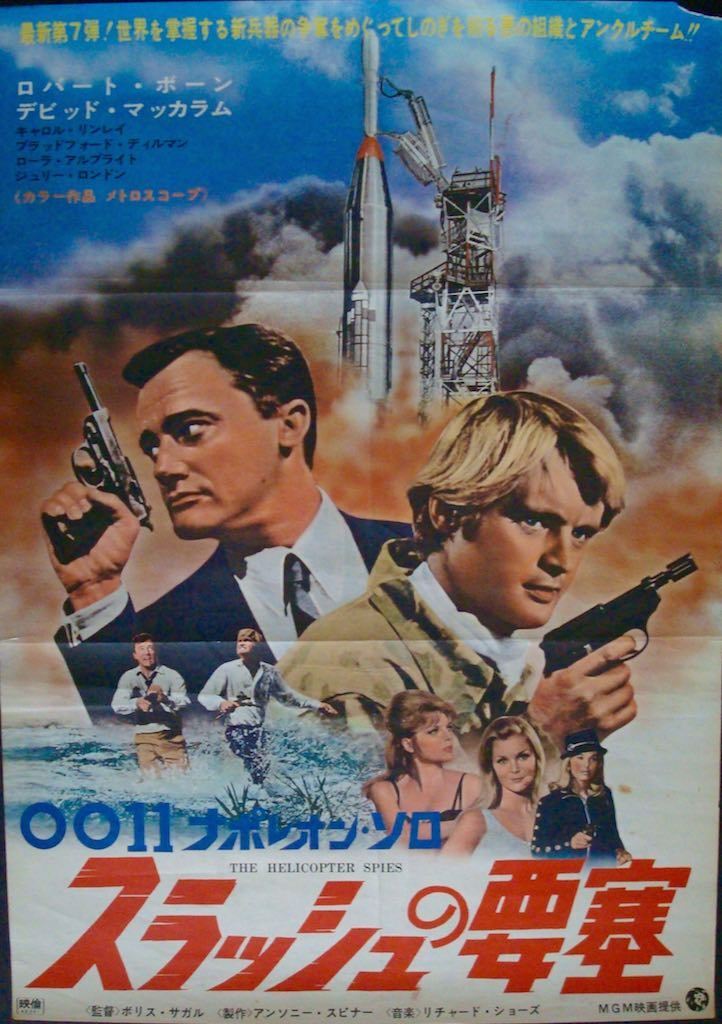
Takes a little while to come to the boil what with disreputable women, a crew of platinum-white-haired thugs, a religious cult, some very dry dialog, a high priestess with her own chorus line of psychedelic dancers, four identical brothers, and a female lead parading a prize shaggy dog story. Our intrepid heroes appear more capable this time round, the previously inept Napoleon Solo (Robert Vaughn) not beaten up quite so often, though he does end up being drowned in sand (water too precious to spare, apparently).
This time round, too, the good guys are taken for a ride by mad scientist Luther Sebastian (Bradford Dillman) who hoodwinks the U.N.C.L.E. organisation into stealing a “thermal prism” from the fortress of another mad scientist Dr Kharmusi (John Dehner). To put his own grand plan into operation Sebastian just has to hijack a rocket. And you should be aware going into this that there’s not the amount of helicoptering you might expect given the title.
This time round, too, there’s hardly a good gal in sight. Azalea (Lola Albright), aforementioned high priestess of cult The Third Way, has betrayed the good doctor in favor of Sebastian. Sebastian’s wife Laurie (Julie London) pretends to a) be out of contact with him for years and b) maintain a virtuous existence. And that’s before we come to the plainly bonkers, but still traitorous, Annie (Carol Lynley) who will make up any story in a bid to free an imprisoned unseen husband.
Sebastian has some neat touches as a leader, rewarding his team of thugs with booze and women as a prelude to killing them all off. He’s got an ejection seat in his car for getting rid of troublesome passengers. He prefers efficiency, to the point of iciness, to sexiness in his paramour and female underlings. And he has a very dry manner, which elicits a good few laughs.
But some of his thugs just ain’t that bright, the one instructed to follow Solo has just allowed him access to Laurie’s house. Laurie ain’t that bright, either, falling for an old trick by Solo who, as usual, is less bright that Ilya Kuryakin (David McCallum).
Some of the set pieces are excellent. Sebastian’s followers meet in an abandoned movie theater where Azalea gives the lowdown on the grand plan assisted by her bevy of dancers. Infiltrating the organisation by the simple device of dying his hair, Solo ‘s disguise is uncovered after being sprayed with champagne.
There are a surprising number of human touches. Head henchman Carl (Roy Jenson) vowing to take “Mom” away from her dingy life running her eponymous diner finds she enjoys too much her dingy life. Carl, appreciative of the disguised Solo’s efforts, apologises for making him ride in the baggage train. Annie can stretch innocence to breaking point, to an extent where nobody cares about her problems.
But where The Karate Killers had a straightforward storyline – find the five daughters of a dead scientist – this gets a tad lost in the first section introducing the thermal prism, the cult, doubling down on mad scientists, and giving Annie all the importance of a red herring.
I thought for a moment that this was the end of the line in my appreciation of the U.N.C.L.E. franchise, the one where it all fell flat on its face and we could see the joins, but after the shaky start it picked up and became quite enjoyable in the series’ inimitable barmy fashion. I suppose I should applaud the initial narrative boldness, audience pretty much fooled from the off, the fortress assault not much more than an extended MacGuffin, with neither Sebastian nor Azalea what they seemed.
I could quibble about the guest stars but in fact this is a superb deadpan performance from Bradford Dillman (Sanctuary, 1961) and quite a departure for the Carol Lynley of Bunny Lake Is Missing (1965). And you could say the same for Lola Albright, previously seen essaying a different kind of character in The Way West (1967).
Boris Sagal (The Omega Man, 1971) directed from a screenplay by Dean Hargrove (One Spy Too Many, 1966).
I’ve only got a couple to go to wrap up the entire series and for your sake I will persevere. If you’ve not already done so, it’s back to the box set.
In October 1962 Otto Preminger bought the rights to Harm’s Way, a thumping big bestseller by Ronald Basset with a host of characters and sub-plots which serve, like Advise and Consent by Allen Drury, to analyse an American institution, in this case the Navy, pre- and post-Pearl Harbor. In some respects, it was an odd choice, Preminger better known for pictures that filleted such august institutions, The Cardinal (1964) exposed the inner workings of the Catholic Church. On the other hand, it rubbed shoulders quite happily with Exodus (1960), a tale of battle against the odds.
Preminger’s aim was to blunt the current onslaught of movie pessimism with a picture that ended on an optimistic note. He observed: “We are attacked, we are unprepared in every way, and manage by sheer guts, character and resourcefulness to start to work out of it.” He concluded that such action “should remind us and perhaps other people that there is never any reason to give up or to give in to anything that is not right or dignified.”
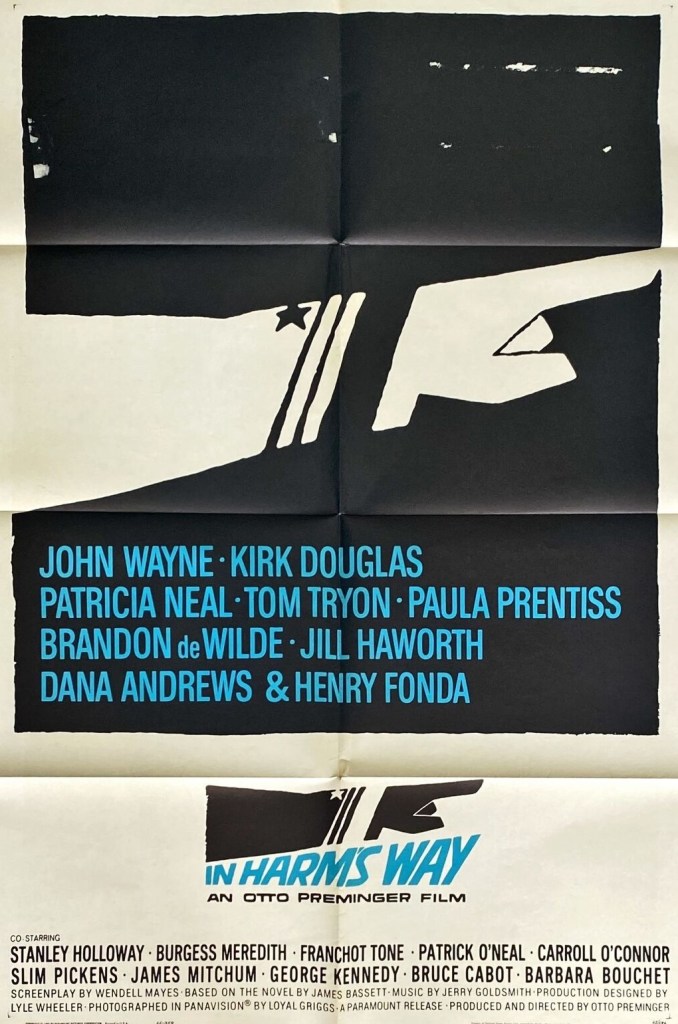
Celebrated Saul Bass poster.
“One of the reasons I made In Harm’s Way,” explained the director, “is that it is a big step away from most of the films I have made so far. I try not to repeat myself too much…not to make pictures in just one category…I was very fascinated by the characters and the story..,(which) shows that people will act even if they are unprepared and don’t want war.”
Wendell Mayes (Advise and Consent, 1962) started on the screenplay right away, taking it so far as embarking on a rewrite with the director in London. But the project was unexpectedly shelved for a couple of years. In the meantime Preminger assigned a different writer, Richard Jessup. But when the concept received the director’s full attention once again Mayes was at the wheel and with a different approach. “I had a fresher point of view and did many things that were not in the book at all. I think we improved it for that reason, since we had quite forgotten the novel.”
But collaboration with Preminger was exacting. “We sat together and and worked over almost every line,” explained the director. “I always work very closely with the writer on the screenplay…There is one man, the independent producer-director, who from very beginning takes the whole responsibility and has complete autonomy. I feel responsible for the script: I engaged the writer and I worked with him. Like I direct actors, I feel a director also directs the script.”
In particular, into sharper focus came the son, Jeremiah (played in the film by Brandon de Wilde) of Rockwell Torrey (John Wayne). In the book he had been a passing, insignificant character, who quickly befriended his father. “He had no feelings about the fact that his father had left his mother, and we changed that in the script,” said Mayes. This provided not just a source of dramatic tension but a more mature role for Wayne, who had to express regret for the estrangement, all his fault. (Although the idea of a son enlisting against the mother’s wishes reflect a similar situation in Rio Grande, 1950).
Wayne was Preminger’s first choice. “Because it has passive elements, a strong actor like Wayne is ideally cast,” said the director. Despite being sent an incomplete script, the star signed up – for $500,000. “I don’t look for stars and I don’t avoid them,” he said. The leading roles in Bunny Lake Missing (1965) and The Cardinal (1964) went to relative unknowns. “I would not ask John Wayne to play, say, a coward because his image is not the image of a coward, or have him play a Greek philosopher…He at least fulfilled all my expectations more than I could possibly hope for. Kirk Douglas, too, came to my mind almost immediately.”
The movie should have ended up at Columbia which had funded the director’s last two movies and would back Bunny Lake. But Preminger had just struck a deal for seven pictures with Paramount and in January 1964 that agreement was announced with the re-titled In Harm’s Way (a phrase associated with John Paul Jones).
Mayes completed the new draft two months later with the rest of the cast now assembled, including Preminger contract players Tom Tryon (The Cardinal) and Jill Haworth (Exodus) who replaced original choice Carol Lynley (Bunny Lake). Keir Dullea turned down the part of Jeremiah. Advise and Consent’s Henry Fonda came on board as the overall Navy commander at the expense of Chill Wills who was fired after shooting had begun.
One uncredited recruitment was Hugh O’Brian (Africa, Texas Style, 1967) who undertook the part of Liz Eddington’s lover. “He played a role as a favor without compensation,” recalled Preminger. “He did not want billing and only asked that I give some money to a charity. I needed somebody who was a secure actor and right for the part because I used a complete beginner (Barbara Bouchet) for the girl he plays opposite. And if I used some other young actor with her, people would have felt that this couple would disappear almost immediately at the beginning of the film. It was important to me to establish this young couple as an important episode at the beginning of the film and he helped that.”
The director spent three days scouting locations in Hawaii but decided to shoot in black-and-white because “ a picture like this has much more impact and you can create more of the feeling, the illusion of reality, than when you shoot it in color.” False guns mounts were attached to more recent ships since the older relevant vessels were no longer available.
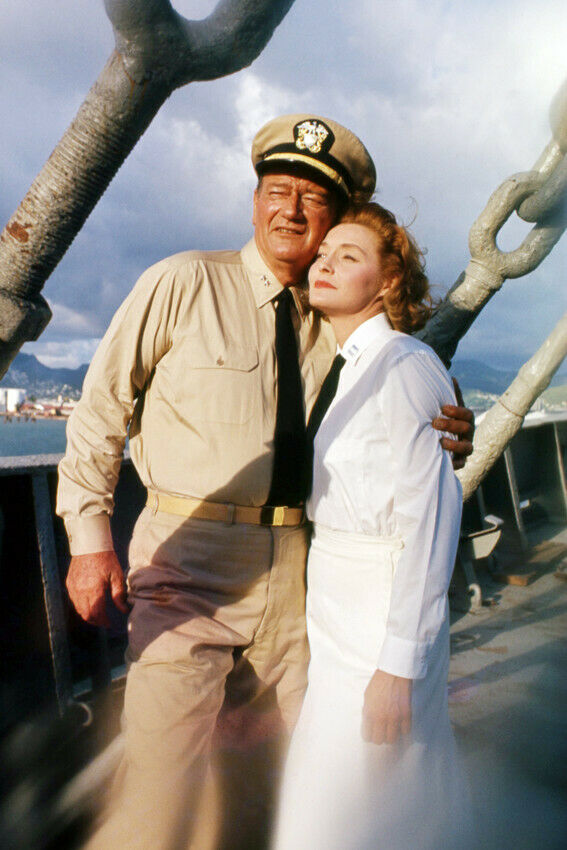
Wayne with co-star Patricia Neal.
Shooting started on June 23. The biggest issue was transportation, drivers getting lost reaching locations for the night-for-night sequences. Preminger struggled to meet his shooting schedule and the movie was soon over budget thanks to long hours, Sunday working and extra local staff. Even so, the Hawaii shoot came in 17 days ahead of schedule. Five days were assigned for shooting at sea. Larger than usual miniatures – some as much as 55ft long – were shot over a month on a lake in Mexico and in the Gulf of Mexico, the battle of Leyte Gulf costing an estimated $1 million. “I needed the real horizon,” said Preminger.
Some scenes were proving impossible to capture first time out. A second unit had two attempts filming a car going over a cliff, a marine landing was spoiled by water on the lens, and technical problems prevented Preminger achieving a “mystic-hour shot” of a plane taking off. Part of the director’s problem was his insistence on rehearsal. “I could make every picture in ten days if I slough it. Some actors just need more time and more rehearsal.”
Despite observers expecting – perhaps hoping – for volatile confrontation between the director and star, the pair enjoyed a cordial relationship based on mutual respect. Of Wayne, Preminger commented that he was “the most cooperative actor, willing to rehearse, willing to do anything as long as anybody. I was surprised really how disciplined a professional Wayne is and he liked this particular part very much.”
From Wayne’s perspective, “He had my respect and I had his respect. He is terribly hard on the crew and he’s terribly hard on people that he thinks are sloughing. But this is a thing that I can understand because I’ve been there (directing The Alamo) and I know that if a fellow comes on and he’s careless and he hasn’t thought at all about his…I come ready and that he appreciated that. I was usually there ahead of him on the set and he couldn’t believe that. So we had a really nice relationship.”
It was surprising Wayne remained on such an even keel since he was beginning to suffer from the cancer that would eventually kill him. “He looked ill,” Tryon remembered, “He was coughing badly, I mean, really awful. It was painful to see, so God knows what it was like for him. He’d begin coughing in the middle of a scene and Preminger would have to stop filming.” Although he refused to consult a doctor during filming, he agreed to a check-up once shooting of his role was complete, three weeks earlier than scheduled. He may indeed have owed his life to Preminger’s speedy shooting.
Kirk Douglas had a bone to pick with Preminger after the director stole the glory of being the first director to publicly announce, on Exodus, that he had employed a blacklisted writer, pre-empting Douglas who had done the same for Spartacus (1960). Although Douglas didn’t rank Preminger as a director he enjoyed a good relationship with him except for one minor confrontation.
Douglas got on well with Wayne: “There was a mutual respect…We got along quite well…He was a strange fellow. I’ll never forget the talk we had about my playing in Lust for Life (1956). Although emotionally we were not close and politically we were antipodal he asked me to work with him several times.” (Not entirely true – Douglas would have been the driving force for their collaboration on Cast a Giant Shadow in 1966 and he fell out spectacularly with Wayne on The War Wagon in 1967).
But others suffered from Preminger’s notorious temper, Tom Tryon in particular. The bullying became so bad Kirk Douglas once walked off the set. Douglas advised Tryon to fight back but Tryon could not pluck up the courage. Chill Wills who endured Preminger at his “absolute worst” did stand up to him and was fired. Patrick O’Neal turned on actors who refused to fight their corner. “Stand up to him once and find out he’s a human being,” was his advice.
Myth has it that Paula Prentiss’s role was truncated after she fell foul of the director but rumour was baseless. In fact, Prentiss was another of the director’s defenders, claiming he was “absolutely wonderful to work with. For a scene to work, tension needs to be put into a scene. There have to be genuine efforts to make the scene work. And Preminger understood this and was able to get much conflict and tension into the scenes.” And he was not all tough talk. She recalls him as particularly gentle guiding her through the scene where she asks her husband to make her pregnant.
Although surpassing the original $5 million budget, it was not by much, an extra $436,000. The Production Code had objected to the phrase “screw the captain,” a line Preminger refused to remove and despite further protest from the censor, who threatened to withhold the precious official approval,the director got his way. Preminger had shot the scene where Barbara Bouchet was dancing topless from the rear but the still photographs were sensational enough for publication in Playboy in its May 1965 issue.
The decision to shoot in black-and-white probably accounted for the picture’s relatively poor box office. Its length and the all-star cast should have qualified it for roadshow. (It was roadhsow for all of one day at two prestigious new York first houses; the next day it went continuous, but you could advance book a seat for an extra 50 cents). It was a sign of how quickly audience perceptions had changed that only three years previously the black-and-white The Longest Day had appeared as a roadshow and proved a resounding hit.
As a result of Wayne’s illness The Sons of Katie Elder was postponed. Preminger moved onto a smaller project, Bunny Lake Is Missing and Douglas reverted to top billing for The Heroes of Telemark (1965). Tom Tryon never worked for Preminger again and after top-billing in The Glory Guys (1965) faded from Hollywood view, re-emerging as the bestselling author of The Other. Paula Prentiss shifted sideways into television with He and She (1967-1968) and Jill Haworth made very few films after this, of which most were horror.
SOURCES: Chris Fujiwara, The World and Its Double, The Life and Work of Otto Preminger (Faber and Faber, 2008), p317-329; Scott Eyman, John Wayne, The Life and Legend, (Simon & Schuster, 2015) p385-387; Maurice Zolotow, Shooting Star, A Biography of John Wayne (Simon & Schuster, 1974) p361-362; Michael Munn, John Wayne: The Man Behind the Myth (Robson Books, 2003) p254-255; Kirk Douglas, The Ragman’s Son (Simon & Schuster, 2012), p387-381; Ian Cameron, Mark Shivas, Paul Mayersberg, “Interview with Otto Preminger,” Movie 13 (Summer 1965), p15-16; Patrick McGilligan, Backstory 3, p266; Otto Preminger, “Keeping Out of Harm’s Way,” Films and Filming, June 1965, p6; Newsweek, April 20, 1964; New York Herald Tribune, October 17, 1965, p55.
Unusually for an Otto Preminger project, this took an unconscionably long time to get off the ground, given he had purchased rights to the bestseller by Evelyn Piper which had been published in 1957. The first problem was that no one could lick the screenplay. Getting first bite was Ira Levin (Rosemary’s Baby, 1967), followed by “wholesale doctoring” by Dalton Trumbo (Exodus, 1960) who delivered a “polished script.” But that failed to satisfy the director either and triggered further attempts by Charles Eastman (Little Fauss and Big Halsy, 1970) and Arthur Kopit (Oh Dad, Poor Dad, Mummy’s Hung You in the Closet and I’m Feeling So Sad, 1967). But nobody seemed able to come up with a satisfactory job. The book had been set in New York as had the various subsequent screenplays. The solution appeared to be to shift the location some 3,000 miles to London. Penelope Mortimer (The Pumpkin Eater, 1964) wrote a draft but ended up having a fight with Preminger and withdrew and the project was completed by her husband John Mortimer (John and Mary, 1969).
The Levin screenplay was dismissed as being too faithful to the book, the kidnapper in this instance turning out to be a former teacher who was childless and afflicted with “menopausal psychosis,” a character Preminger found weak and uninteresting. Trumbo changed the villain into a wealthy woman, not just childless but judged unfit to adopt, an approach the director deemed “very theatrical and wrong.” The Kopit and Eastman versions offered no better solution. “I almost gave up Bunny Lake,” admitted Preminger, “because while working in the script I realized that women would not like the film…because they are afraid of all situations in which a child is in danger.” After considering transplanting the story to Paris, Preminger finally settled on London, and hired the Mortimers whose villain brought the picture a 2new dimension.”
Until now, and in keeping with the original novel, Newhouse, while assisting in the investigation, had been a psychiatrist. In the hands of the Mortimers he now morphed into a police inspector. Wilson who had been Newhouse’s quite respectable friend turned into a drunken reprobate. At this point the heroine’s name remained Blanche as in the book. There was one other significant element that changed between the initial Mortimer script and the final shooting script: at the start of the film the Ann and Steven were shown reacting as if the child was there, whereas when the movie went before camera the question of the child’s existence remained in doubt. Penelope Mortimer dropped out when, summoned with her husband to Honolulu where Preminger was filming In Harm’s Way, she was roundly ignored.
Filming was originally scheduled to slip in between Anatomy of a Murder (1959) and Exodus (1960) with a budget set at $2 million. But something always seemed to get in the way. Occasionally it was a bigger project. After Columbia announced filming was scheduled for 1961, Bunny Lake was pushed back to spring 1962 to permit the filming of Advise and Consent (1961). Then The Cardinal (1962) took precedence but only to the extent of shifting the Bunny project till later that year. Then it was set to be completed by fall 1963. Further cause of delay was the decision to accommodate the pregnancy of that Lee Remick who had signed for the leading female role. But when she was ready to go, Preminger was not and she fell out of the equation.
At one point, fearful of his schedule becoming too crowded – filled with expensive projects like The Cardinal and In Harm’s Way (1965) – Preminger had tried to wriggle out of the directorial commitment, planning to limit his involvement to producing only, but studio Columbia would not accept this. Preminger was in considerable demand, like a major movie star contracted to deals with rival studios, in 1961 for three pictures with United Artists and four for Columbia and by 1965 adding into the mix a seven-picture deal with Paramount, and most of these big pictures, leaving little time for a relatively low-budget – by his standards – picture.
A good example of the British distribution system. The film opened at the Odeon Leicester Square and quickly went into general release, first in cinemas in North London and a week later the prints shifted to South London. In the West End, it ran solo, in the suburbs as a double bill.
Finally, Bunny Lake received the green light with filming beginning in London on April 9, 1965. Unusually, the movie was shot entirely on location, the director expressing a “yen for realistic on the spot” filming in a dozen places including a pub, the Cunard office and Scotland Yard. A school in Hampstead doubled for the nursery, the mews flat was found just behind Trafalgar Square. He was quick to point this was not a matter of economy. “What you save in studio (time) you spend in other ways. But I think it leads to more urgent film-making.” Somewhat surprisingly, he aimed to shoot in black-and-white, colour now being predominant except for low-budget movies and those wishing to take advantage of black-and-white world War Two newsreel footage as was the case with his previous picture In Harm’s Way.
Carolyn Lynley (The Pleasure Seekers, 1964) was given the lead with Keir Dullea (David and Lisa, 1962) in the pivotal role of her brother. Neither could be considered a big star although Lynley had the second female lead in The Cardinal and moved up the credit rankings to female lead in the low-budget Shock Treatment (1964). But she was such a hot prospect Preminger in 1965 signed her to a four-picture deal although this was not exclusive as she also had contracts with Twentieth Century Fox and Columbia. Dullea was potentially a better prospect, picking up some acting kudos for David and Lisa, the designated star of that picture and The Thin Red Line (1964) but only second lead for Mail Order Bride (1963) and the Italian-made The Naked Hours (1963).
Although some decades away from his Hollywood box office prime, the casting of Oscar-winner and five-time nominee Laurence Olivier (Spartacus, 1960) was something of a coup, although he was only hired because another actor proved too expensive. Other parts were filled by actors experienced in the Preminger school of film-making, Martita Hunt from The Fan (1949)- and Bonjour Tristesse (1958), Victor Maddern (Saint Joan, 1958) and David Oxley (Saint Joan and Bonjour Tristesse).
The first day’s shooting was in a television studio to capture the newsreader and pop group The Zombies which the content of the show shown in the pub on television. Contrary to depictions of Preminger as a martinet on set, he was keen in rehearsals to “put everyone at ease” although he emphasised the need for “slow, thoughtful diction.” The famous Preminger wrath came down heavily on personnel failing to carry out their job correctly. But he accepted Olivier’s decision to omit a particular phrase. He was specific about the look he wished to achieve, required high contrast black-and-white cinematography while nothing was to be done “to enhance Carol Lynley’s beauty: instead…to deepen her features, bring out her emotions.”
And he was determined to get what he wanted, 18 takes required to complete a lengthy tracking shot that flows Inspector Newhouse (Laurence Olivier) and Miss Smollett (Anna Massey) as they negotiate a passage through a group of noisy children in a classroom and then across a hall. Accepting Lynley’s difficulty in expressing the pain of losing a child, he instructed her to forget about subtext and play the moment. However, 14 takes of a scene between Lynley and Olivier was too much for the actress but she was comforted when Preminger told her the famous actor was the problem not her. But on another occasion, Preminger ended up giving her an almost line for line reading of how he wanted the scene played. The only way he got what he wanted was to reduce her to “sobbing uncontrollably” and then start the camera rolling.
Without question, Keir Dullea came off first. “He would humiliate you, he would scream at you…his dripping sarcasm was the worst of it,” recalled Dullea. “I was always very prepared in terms of knowing my lines…but the stress, there was some action where I was supposed to put a glass down or pick up a glass” that Dullea kept getting wrong. In face of what he deemed incompetence, Preminger accused him of being “an actor who can’t even remember a line and if heremembers a line he can’t remember an action…what, you can’t do these two things at the same time.” In the end Dullea faked a nervous breakdown and after than “he never screamed at me again.”
Olivier would occasionally coming to rescue, persuading the director to ease off and “stop screaming at the children.” Olivier found Preminger such a bully that it “almost put me off his Carmen Jones, which I found an inspired piece of work…It’s a miracle it came from such a heavy-handed egotist.” On the other hand Noel coward, who played the landlord Wilson, believed Preminger an excellent director.
Preminger spun his marketing on a similar gimmick to that utilised by Alfred Hitchcock for Psycho (1960) in preventing the public from entering once the movie had started. To make this more dramatic, he had clocks installed in the lobbies of theaters that counted down the length of the performance and a sign that stated “nobody admitted while the clock is ticking.” Preminger was credited with coming up with a longer tagline for the advertisements: “Not even Alfred Hitchcock will be admitted after the film has started.”
The only problem was Return from the Ashes, released at the same time, had adopted a similar marketing ruse, nobody admitted “after Fabi enters the bath.” Despite this, Preminger went hell-for-leather for this marketing trick, to the extent of adding a rider to exhibitor standard contracts to that effect, not a problem in more sophisticated cities where by now patrons had become accustomed to turning up for a picture’s announced start time but a problem in smaller towns and cities where the whole point of continuous programme (i.e. no break between one film and another) was that moviegoers could walk in whenever they liked.
The whole tone of the marketing did not meet the approval of two important segments of the greater movie community. The National Association of Theater Owners opined that the marketing campaign was weak and were astonished to learn that there was nothing Columbia could so about it – Preminger had advertising-publicity approval. Allowing that some of the advertising images for Preminger pictures, courtesy of designer Saul Bass – The Man with the Golden Arm (1953), Anatomy of a Murder, Exodus etc – were among the most famous in Hollywood history, it would appear Preminger knew what he was doing. But, in fact, although the Saul Bass credit sequence showing pieces of newspaper being torn away made sense in the framework of the picture, the idea was not so effective taken out of that context.
Not intentionally, perhaps, Preminger also riled the critics, deciding that to “preserve the secrecy of the surprise ending,” the movie would open without the normal advance screenings for reviewers. Such action was more likely to set alarm bells ringing, it being a standard assumption among critics that the only films that went down this route were stinkers. From a practical point-of-view it also ensured that marketing was undercut since the lack of timed reviews denied the picture an essential promotional tool.
Finally, the movie ended up in a war with the censors. Many states in the U.S. had their own censors. Columbia objected to having to wait on the say-so of a local censor – in this case Kansas – before being able to release a movie. And for any release to be delayed if there was any nit-picking by the censor, especially as this movie had an undercurrent of incest. So Columbia refused to conform and failed to submit Bunny Lake Is Missing to the Kansas censors. After being promptly banned for such arrogance, Columbia objected again and the case went to the Kansas State Supreme Court which judged that the censor was unconstitutional. That resulted in the censors losing their jobs when the board was abandoned and the movie entering release a good while after its initial opening dates.
Although it made no impact at the Oscars, Village Voice critic Andrew Sarris picked it as one the year’s ten best and it was nominated for cinematography and art direction at the Baftas. The film was a flop, failing to return even $1 million in rentals at the U.S. box office. In fact it probably made more when it was sold to ABC TV for around $800,000.
SOURCES: Chris Fujiwara, The World and Its Double, The Life and Work of Otto Preminger, p330-342; (Faber and Faber, 2008) “Trends,” Variety, January 14, 1959, p30; “Ira Levin Pacted by Preminger for Bunny,” Variety, September 2, 1959, p2; “Col Primed To Start ½ Dozen Prods,” Variety, April 5, 1961, p3; “Otto Preminger Views Film Festivals As Important Marketplaces,” Box Office, May 1, 1961, p11; “Trumbo May Script for UA,” Variety, May 31, 1961, p5; “Bunny Lake Delayed,” Variety, June 7, 1961, p18; “Preminger Postpones One,” Box Office, June 12, 1961, p13; “Otto Preminger to Film Cardinal for Col,” Box Office, August 7, 1961, -10; “Otto Preminger Is Guest of Soviet Film Makers,” Box Office , May 14, 1962, pE-4; “Two Writers Signed,” Box Office, August 6, 1962, pSW-3; “Preminger,” Variety, September 12, 1962, p15; “Preminger’s New Rap at Costly U.S. Distribution,” Variety, October 10, 1962, p7; “Preminger Gets Rights to Hurry Sundown,” Box Office, November 23, 1964, p9; “Prem’s Next in London,” Variety, January 13, 1965, p18; “Preminger Signs Actress for Four More Pictures,” Box Office, February 8, 1965, pW-3; “Advertisement,” Variety, April 7, 1965, p1; “Preminger-Paramount Pact Calls for 7 Films,” Box Office, April 26, 1965, p7; “100% Location for Bunny,” Variety, May 5, 1965, p29; “Not Even Hitch,” Variety, September 1, 1965, p4; “Preminger’s Nix on Pre-Opening Critics,” Variety, September 22, 1965, p16; “2 Pix Enforce Entrance Time on Ticket Buyers,” Variety, September 29, 1965, p5; “Time Rules Are Set for Bunny Shows,” Box Office, October 4, 1965, p13; “Preminger’s Promotional Prerogative,” Variety, October 27, 1965, p13; “Clock for Bunny Lake,” Box Office, November 8, 1965, p2; “Village Voice Vocal on Bests,” Variety, January 26, 1966, p4; “Col Kayos Kansas Censoring,” Variety, August 3, 1966, p5.
If the producers had not signalled Bond-style ambitions with a big credit sequence theme song by Anita Harris, moviegoers might have come at this with more fitting expectations in the Harry Palmer and John le Carre vein. So although slipping into the late decade spy boom flourish don’t expect villains planning world domination, gadgets or a flotilla of bikinis.
Seth Holt’s bread-and-butter espionage thriller sets government agent Jonas Wild (Richard Johnson) – on his “last assignment” no less after eight licensed murders in five years – to kill off a defector in the far from exotic location of a Dorset country house not realizing that he is also being set up. That his liquidator will be a woman puts the mysterious Mari (Barbara Bouchet) in pole position.
The Eliminator was the source material for Danger Route.
Wild gains access to the heavily-guarded mansion by seducing housekeeper Rhoda (Diana Dors) but after completing his mission is captured and tortured by Luciana – pronounced with a “k” – (Sam Wanamaker) who explains he is a patsy and that there is a mole in M.I.5. When his boss Tony Canning (Harry Andrews) disappears and another friend is murdered, Wild goes on the run with Mrs Canning (Sylvia Syms) and eventually makes his way back to his bolt-hole in Jersey to solve the mystery.
There is a decent amount of action, including a fight with a guard dog and a battle on a fog-bound yacht. Clever maneuvers abound – a bug is planted in a bandage. Treachery is always just round the corner and there is no shortage of suspects.
The film’s down-to-earth approach is somewhat refreshing after half a decade of spy thrillers and spoofs. Wild doesn’t employ anything more hi-tech than masquerading as a brush salesman to win over Rhoda. And although that relationship ends up in bed, there is no sex, Wild having drugged her to avoid that complication. Tony Canning is nagged by his wife. Wild’s girlfriend (Carol Lynley) is a sweet girl, sexy in a languid rather than overt fashion. And Luciana takes enormous pride in telling Wild just how stupid he has been.
Sylvia Sims in a ticklish situation.
But that comes with a caveat. The plot doesn’t quite hang together and the movie sometimes fails to connect.
That said, Johnson (Deadlier than the Male, 1967) is excellent, quite an accomplished actor rather than a brand name. Both Barbara Bouchet (Casino Royale) and Carole Lynley (Harlow, 1965) play against type while Sylvia Sims (East of Sudan, 1964) and Harry Andrews (The Hill, 1965) present variations to their normal screen personas. Sam Wanamaker (The Warning Shot, 1967) has a peach of a role and Gordon Jackson (The Long Ships, 1964) and Maurice Denham (The Long Duel, 1967) are afforded small but critical parts.
This is not easy to come by, so you are best looking for a secondhand copy.