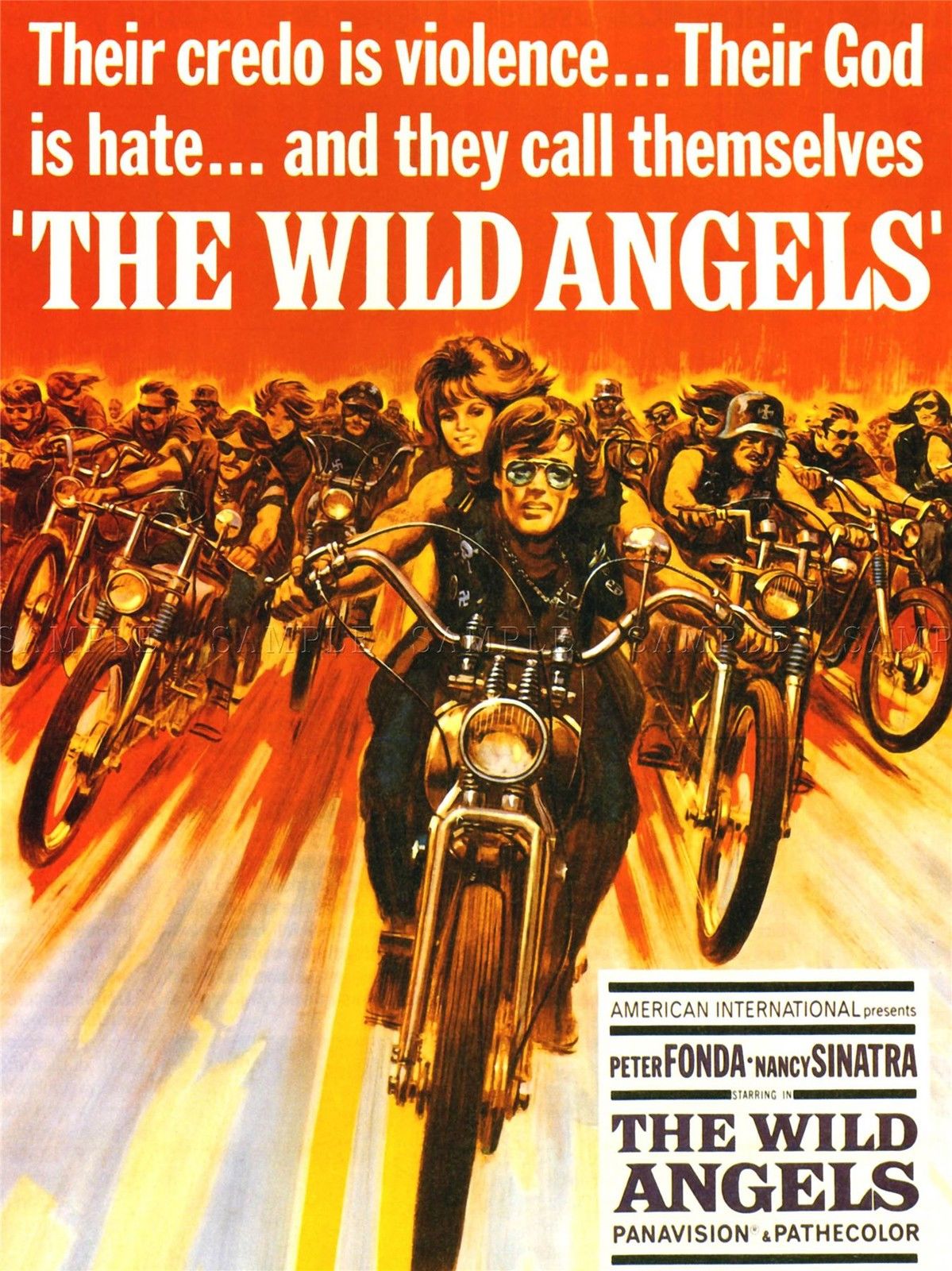
Riders stretched out across a sun-baked valley – you could be harking back to the heyday of the John Ford cavalry western instead of the biker picture, the first in the American International series, that sent shockwaves through society and laid the groundwork for the more philosophical Easy Rider (1969) a few years later. Long tracking shots are in abundance. You might wonder had director Roger Corman spent a bit more on the soundtrack, the bikers just worn beads instead of swastikas, and been the victims rather than the perpetrators of violence how this picture would have played out critics- and box office-wise.
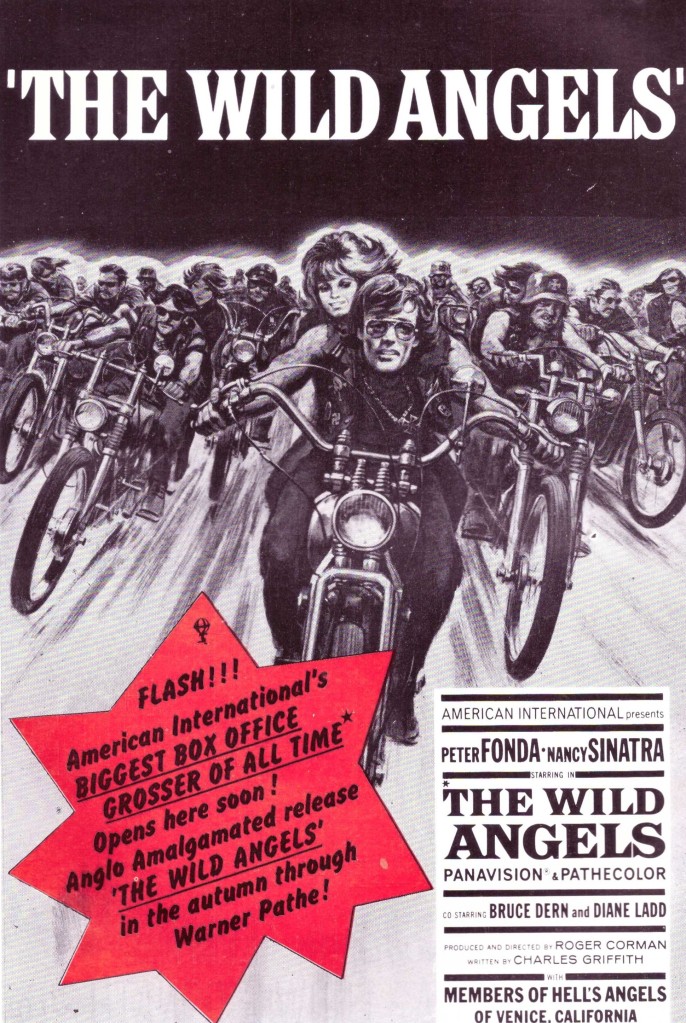
The Wild Angels set up a template for biker pictures, one almost slavishly followed by Easy Rider, a good 15 per cent of the screen time allocated to shots of the Harley-Davidson riders and scenery, and a slim plot. Here Heavenly Blues (Peter Fonda), trying to recover a stolen bike, leads his gang into a small town where they beat up a bunch of Mexican mechanics, are pursued by the cops, hang out and indulge in booze, drugs and sex, and then decide to rescue the badly-injured Joe (Bruce Dern) from a police station. This insane act doesn’t go well and after Joe dies they hijack a preacher for a funeral service that ends in a running battle with outraged locals and the police.
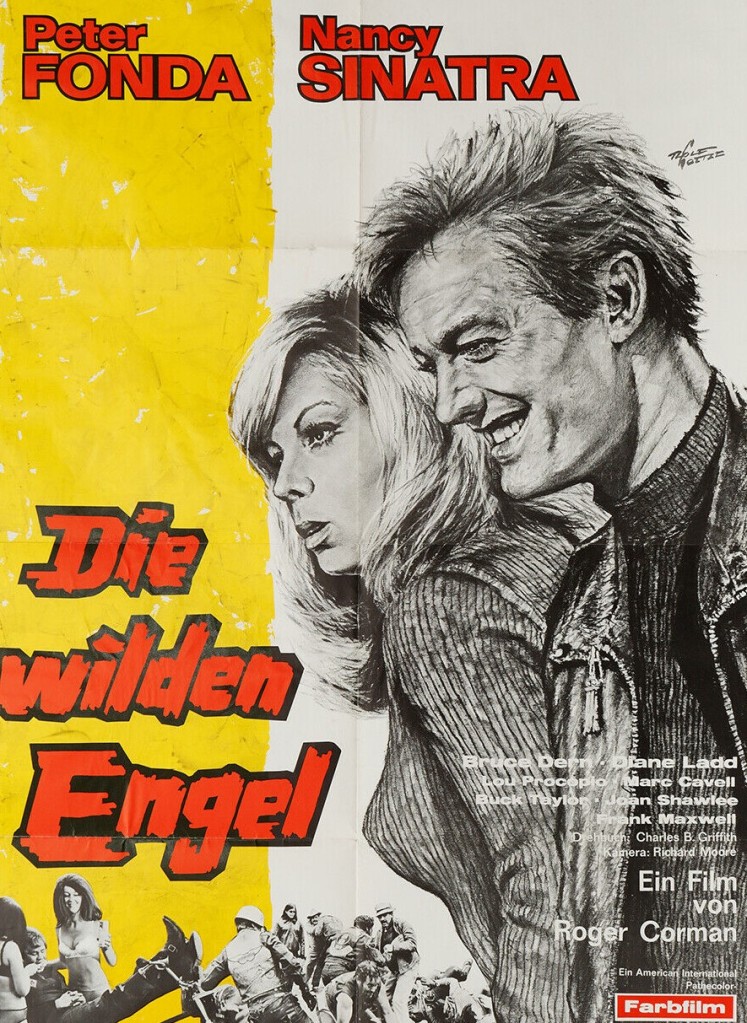
One of the weirdest posters of all time – at first sight it looks like Nancy Sinatra is holding the decapitated head of Peter Fonda in front of her.
There’s an odd subplot, given the lifestyle of freedom and independence, of Monkey (Nancy Sinatra) trying to get a romantic commitment out of Heavenly. Conversely, Heavenly, rejecting the traditional shackles of love, finds himself trapped by grief, eventually and quite rightly blaming himself for Joe’s death, and apparently turning his back on the Angels to mourn his buddy. The decline – or growing-up – of Heavenly provides a humane core to a movie that otherwise takes great pride in parading (and never questioning) excess, not just the alcohol and drugs, but rape of a nurse, gang-bang of Joe’s widow (Diane Ladd), violence, corpse abuse, and wanton destruction.
A ground-breaking film of the wrong, dangerous, kind according to censors worldwide and anyone representing traditional decency, but which appealed to a young audience desperate to find new heroes who stood against anything their parents stood for. In a decade that celebrated freedom, the bikers strangely enough represented repression, a world where women were commodities, passed from man to man, often taken without consent, and racism was prevalent.
Roger Corman (The Secret Invasion, 1964) was already moving away from the horror of his early oeuvre and directs here with some style, the story, though slim, kept moving along thanks to the obvious and latent tensions within the group. If he had set out to assault society’s sacred cows – the police, the church, funeral rites – as well as a loathing of everything Nazi, he certainly achieved those aims but still within the context of a group that epitomized some elements of the burgeoning counterculture.
In retrospect this appears an ideal fit for Peter Fonda, but that’s only if viewed through the prism of Easy Rider for, prior to this (see the “Hot Prospects” Blog) he was being groomed as a romantic leading man along the lines of The Young Lovers (1964). Bruce Dern (They Shoot Horses, Don’t They, 1969) was better suited, his screen persona possessing more of the essential edginess while Michael J. Pollard (Bonnie and Clyde, 1967) was the eternal outsider.
Rather surprising additions to the cast, either in full-out rebel mode as with Nancy Sinatra (The Ghost in the Invisible Bikini, 1966) or hoping appearance here would provide career stimulus as with movie virgins Diane Ladd (Chinatown, 1974) and Gayle Hunnicutt (P.J. / A New Face in Hell, 1968). Sinatra certainly received the bulk of the media attention, if only for the perceived outrage of papa Frank, but Hunnicutt easily stole the picture. Minus an attention-grabbing role, Hunnicutt, long hair in constant swirl, her vivid presence and especially her red top ensured she caught the camera’s attention.
Charles B. Griffiths (Creature from the Haunted Sea, 1961) is credited with a screenplay that was largely rewritten by an uncredited Peter Bogdanovich (The Last Picture Show, 1971).
Funny how you remember the circumstances of seeing a film for the first time. This was important for me because it was the start of me digging into the vast heritage of the movies rather than watching just what was showing at my local cinema. I can’t pin down the exact date, but I have a feeling I was still at school, though in the advanced stage of that academia. I saw this on a 16mm print in a terraced house sitting on the hard kind of seats you used to get in assembly halls.
The location was the Scottish Film Council, the predecessor of the Glasgow Film Theatre, which was located in the city’s West End. The occasion was the final film in an eight-movie retrospective of Elia Kazan pictures. Either before or after I attended a similar Fellini retrospective. Certain more controversial films were omitted, so no Gentleman’s Agreement (1947), Pinky (1948) or Baby Doll (1956) and although this was the early 1970s no room for Splendor in the Grass (1961), America, America (1963) or The Arrangement (1969). Afterwards, there was a cup of tea and a biscuit and a discussion hosted by John Brown, who in my memory smoked small cigars, later a television and screen writer.
It was an introduction for me to the power of the retrospective, to view a huge number of a director’s films back-to-back (the screenings were weekly) and to understand the thematic symmetry of their work. Kazan predated the New Hollywood of the late 1960s and 1970s, so, although his movies usually challenged existing norms, these days they are often viewed as more stolid than of the first rank, his cause not helped by revelations that he named names at the anti-Communist hearings of the 1950s.
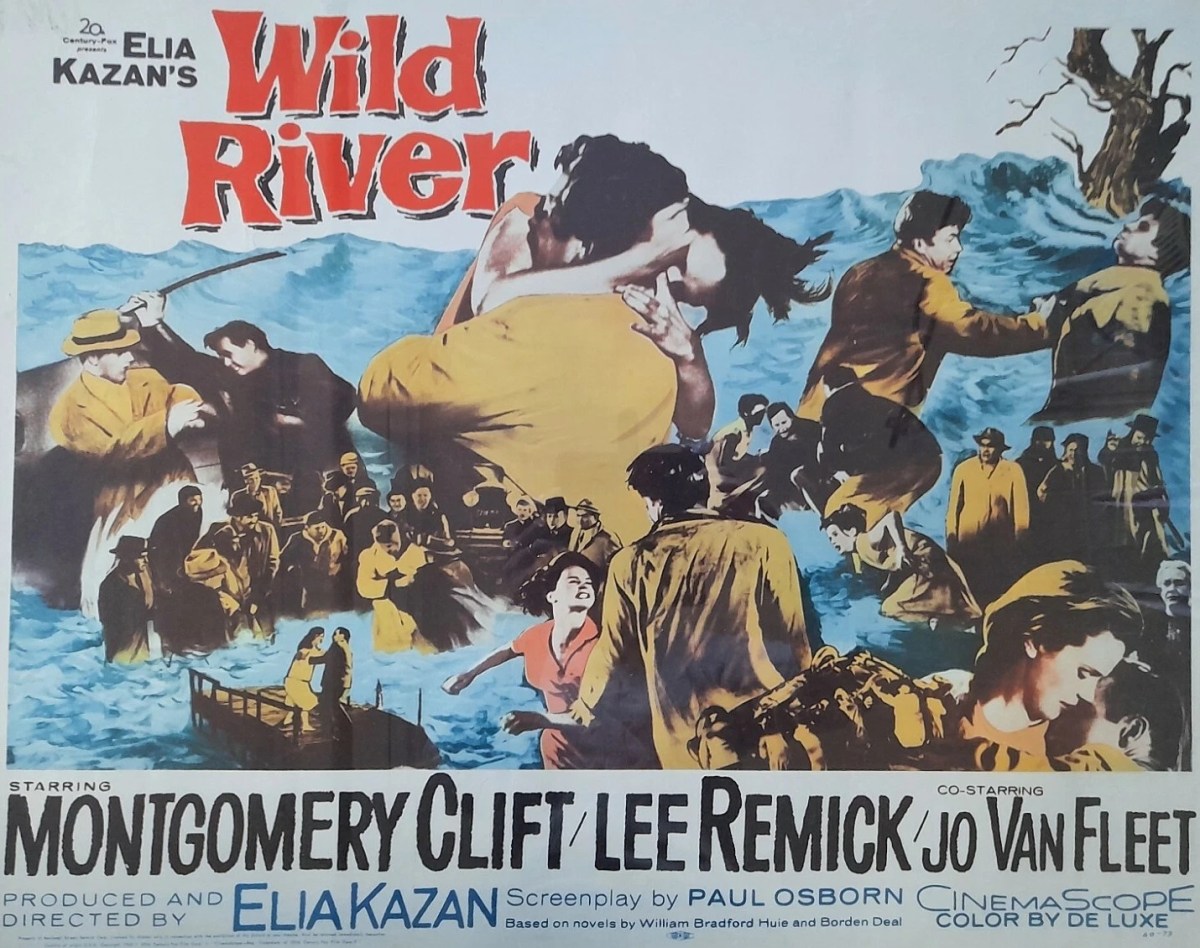
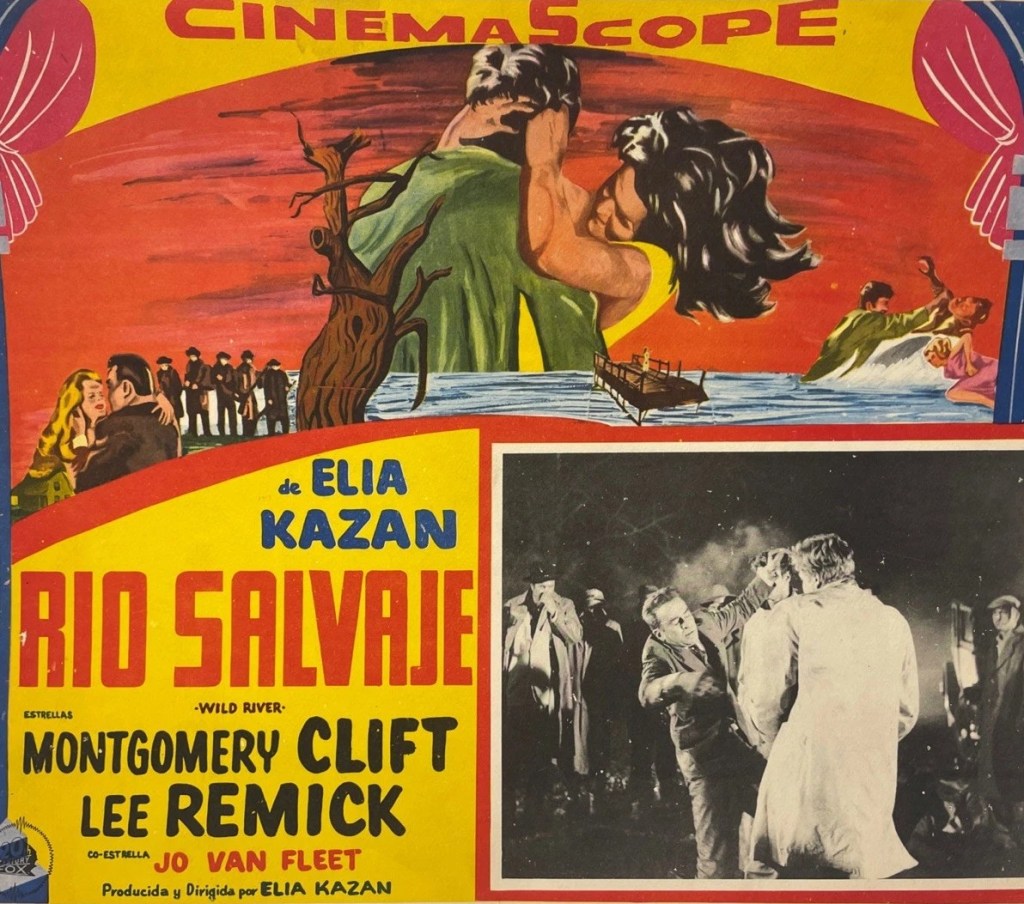
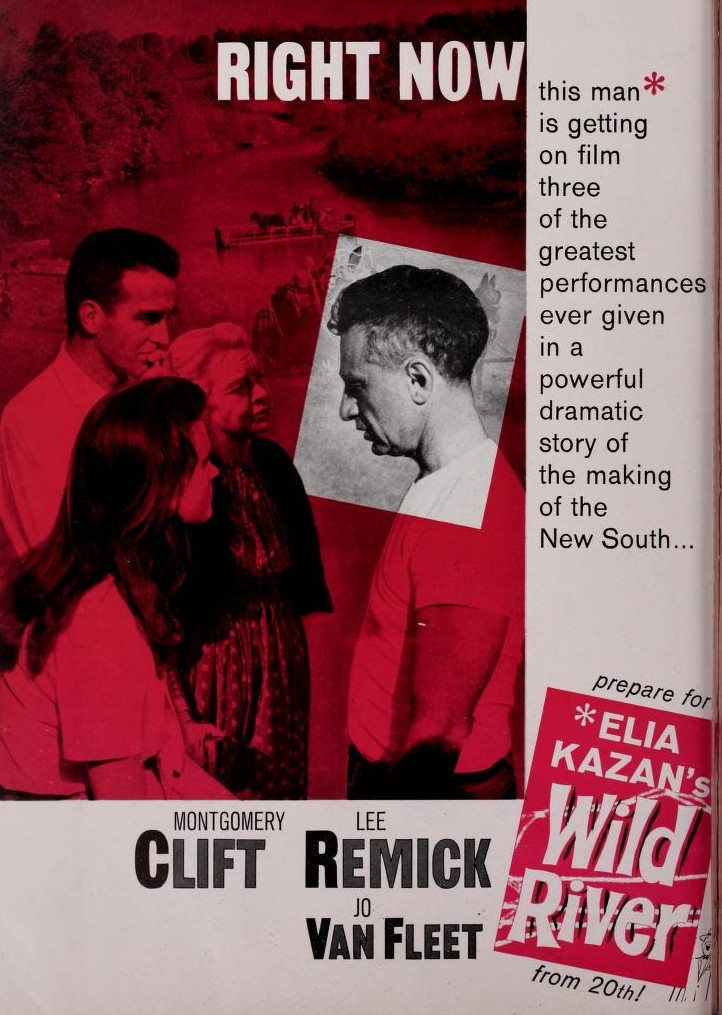
Wild River is one of those films that plays completely differently now thanks to the intervening decades. A contemporary audience is unlikely to sympathize with hero Chuck Glover (Montgomery Clift) whose job is to persuade farmers in the early 1930s to clear out of the way of land that is going to be swamped with water to supply a new dam that would serve to both control the catastrophic flooding in the Tennessee Valley and bring electricity to an impoverished area.
These days ageing landowner Ella Garth (Jo Van Fleet) would attract massive publicity in her fight to avoid being shifted from land that had been in her family for generations, especially as she claims that dams go “against nature.”. And no matter how sympathetic a character like Chuck might be to her circumstances he would be viewed as a more well-meaning-than-most government apparatchik.
And in some respects, this plays much better as one of the few movies exploring the plight of the African American at the hands of the racist authorities. Chuck incites local hostility when he recruits Blacks to work alongside Whites, in the end conceding that they should work in separate crews. But he comes unstuck when he sticks to the principle that they should be paid the same, more than double the going daily rate for Blacks.
In consequence he is beaten up and, worse, a gang of thugs attack the house inhabited by his lover Carol (Lee Remick) and her two young children and the cops, when they arrive, are apt to condone the violence.
Ella takes a maternal attitude to her Black workforce and while certainly nobody received abusive treatment at her hands she has a patronizing manner, though in the end she encourages them to leave.
Despite his democratic and anti-racist views, Chuck comes over as a clever dick, thinking his smooth eastern charm can convince the reluctant woman to move and for the racists to abandon their inherent racism.
I’m not sure about the widowed Carol either, she almost seems to be throwing herself at the first decent man who comes her way. While she is already being courted by a local fellow, who is more decent than the rest, that is clearly going to be a marriage of convenience, but what exactly makes Chuck so much more an attractive proposition is never made entirely clear except that, for narrative purposes, it creates a romantic deadline – is she just a fling, thrown over when he heads home – and a whiff of tension.
However, marriage to the other man would have made her just a passive housewife, whereas she realizes that in many ways she is smarter than Chuck, more grounded, and she would have more freedom in this kind of match.
Oddly enough, there’s a Hitchcock vibe here. At several points the camera tracks Glover in longshot as he appears to be heading for trouble.
The racist elements give this its bite rather than any ecological issues. The acting is certainly of high quality, Montgomery Clift (The Misfits, 1961), less mannered than in some of his work, in one of his last great roles. It’s an interesting part. At one point he wishes he could once in a while win a physical fight, and it’s Carol who is more likely to show the venom required in battle.
Lee Remick (No Way To Treat A Lady, 1968) continued to build on her exceptional promise. Jo Van Fleet (Cool Hand Luke, 1967) gets her teeth into the kind of role most actors dream of. You can spot Bruce Dern (Once Upon a Time in Hollywood, 2019) in his first role.
An unusual approach to the screenplay, too, by Paul Osborn (The World of Suzie Wong, 1960). Like The Towering Inferno (1974) a decade later, this derived from two novels – Dunbar’s Cove by Borden Deal and Mud on the Stars by William Bradford Huie (TheAmericanization of Emily, 1964).
Despite my ecological reservations, still stands up..
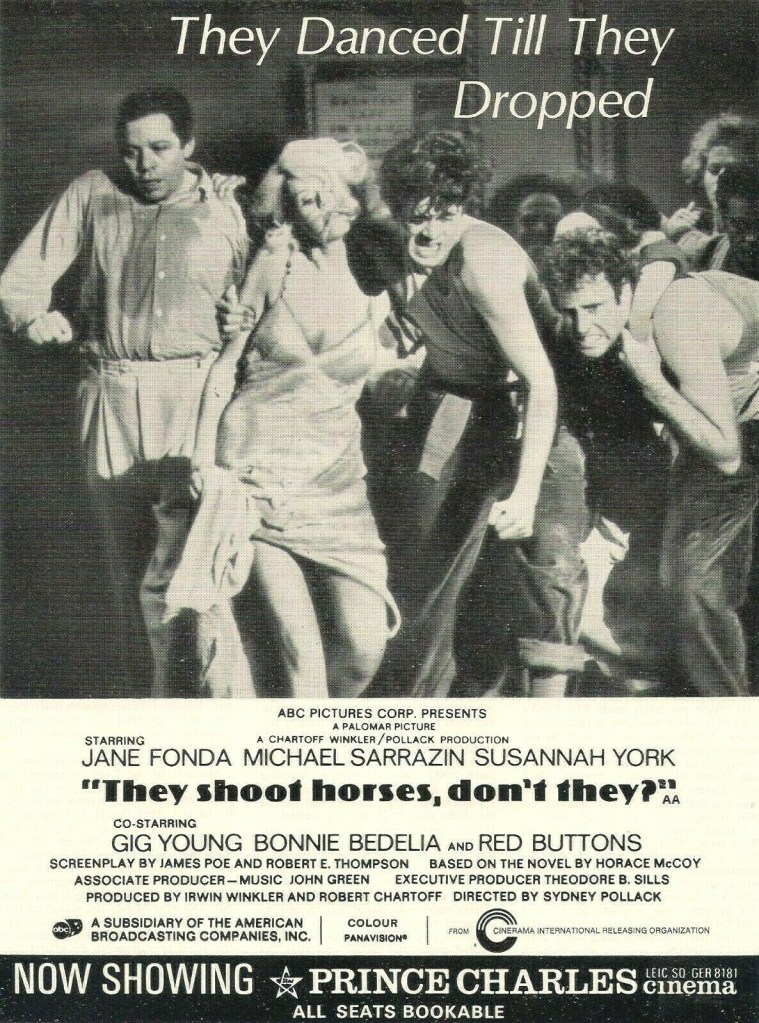
Fans of reality television shows will be only too aware how participants volunteer for ritual humiliation, but swallowing a few locusts and being stuck with a couple of snakes has nothing on the realities facing individuals during the Great Depression who would literally dance non-stop for days on end with a ten-minute break every two hours. It’s impossible to imagine that anybody could think of dreaming up such a degrading circus to take advantage of the desperate. But then this is America, land of opportunity and the MC Rocky (Gig Young) continues to spout aphorisms and continues to promote the American Dream even as it disintegrates in front of him.
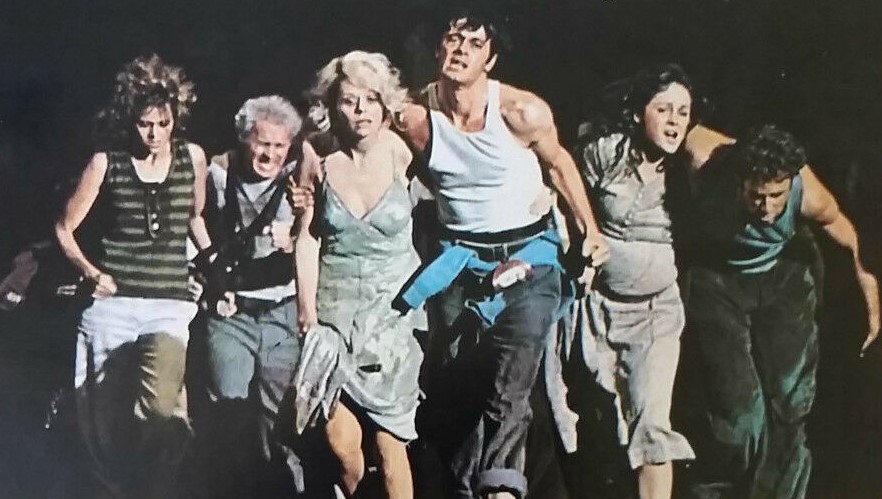
When the partner of Gloria (Jane Fonda), out-of-work actress and one of the more physical and cynical of the candidates hoping to scoop the $1,500 first prize (no prizes for coming second, of course), is ruled out through bronchitis – in case he passes it on to others rather than more any humane consideration – she pairs up with dreamer Robert who initially wanders in as spectator rather than participant. Glamorous platinum blonde aspiring actress Alice (Susannah York) is already coming apart. Sailor (Red Buttons) is a former war hero and James (Bruce Dern) drags his heavily pregnant wife (Bonnie Bedelia) around the dance floor.
There is not a great deal of story except to watch everyone grow mentally and physically incapacitated. There is betrayal and lust and survival instinct leads characters into sexual situations. When Alice seduces Robert, in retaliation Gloria dumps him and then has sex with Rocky, while attempting to retain control of that situation, but clearly needing at the very least consolation and confirmation of her attractiveness and at best some sign of favoritism.
As well as non-stop dancing, Rocky throws in stunts to keep the audience, who can sponsor a pair, interested. So there are 10-minute races, the last three to be eliminated. So determined are some of the competitors they will even lug their dead partner over the finishing line. Another of Rocky’s wheezes is to have Gloria and Robert marry, worth $200 in terms of the gifts they will receive from a sentimental audience, in the middle of the dance floor.
They are literally dancing for hours, over 1,000 in over 40 days so gradually the dance floor becomes less crowded as dancers collapse from exhaustion or cannot take it anymore. The spectators, we are reminded, are only there because “they want to see someone worse than them.” Just when you think nothing can shock you any more, it is revealed that the first prize is minus the cost of feeding, sheltering and looking after the winner.
Those who think they are tough find that the demands of mental and physical endurance are beyond them. This is a shocking film and there’s no doubt it will stay with you for a long time. I saw it first when it came out but not again until now and thank goodness for forgetfulness otherwise I doubt if I would have chosen to sit through it again.
It’s doubtful if any actress had achieved such a speedy transition from glamorous leading lady to serious actress as Jane Fonda. From stripping in space in Barbarella (1968) to stripping away the last vestiges of her humanity here. Suddenly, she appears in a brand-new screen persona with the grating voice, the chip on the shoulder, the feistiness and worthy inheritor of father Henry’s acting genes. It’s also a bold role for Susannah York, in an extension of the weak character she essayed in Sands of the Kalahari (1965) but far more delusional, believing in a rainbow that will never appear. Michael Sarrazin (In Search of Gregory, 1969) initially appears out of his league but his character calls for a gentle innocence that is well within his scope.
Gig Young steals the picture, offered the opportunity to bring alive a multi-faceted character, as big a spiel-merchant who ever crossed the screen, but engaging in a marathon of optimism, and at some points, such as when coaxing a demented Alice out of the shower, earning our sympathy. Red Buttons (Stagecoach, 1966), Bruce Dern (Castle Keep, 1969) and Bonnie Bedelia (Die Hard, 1988) also put in sterling work.
The movie received nine Oscar nominations but was ignored in the Best Picture category. Only Gig Young won for Best Supporting Actor. Jane Fonda and Susannah York both received their first Oscar nominations, for Fonda the first of many, for York the one and only. It was also a debut nomination for Pollack, a future winner.
Sydney Pollack directs with simplicity, concentrating on the indignities of the event and focusing mostly on the personalities draining away, and even the drama is undercut, most of those scenes directed in straightforward style. However, Pollack plays around with the innovative fast forward – flashes into scenes that have not yet taken place. James Poe (Lilies of the Field, 1963), at one time down to direct, and Robert E. Thompson, a television writer making his first venture on the big screen, wrote the screenplay from the Horace McCoy novel.
Check out the Behind the Scenes article on this one.
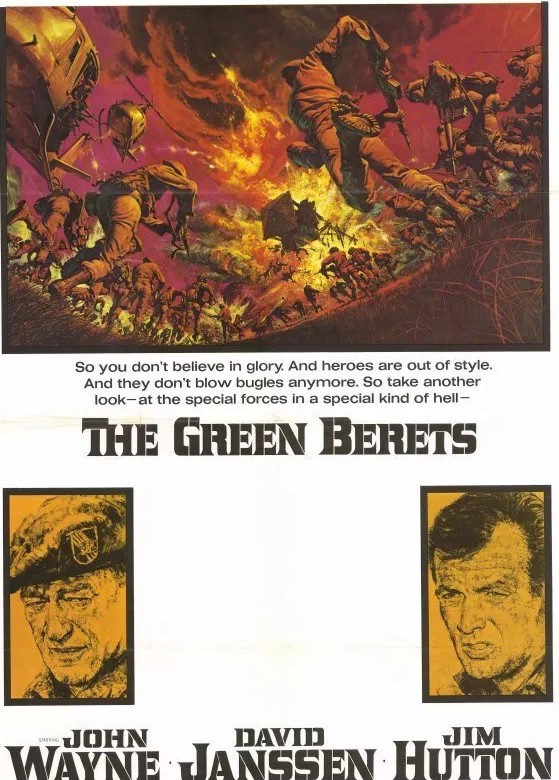
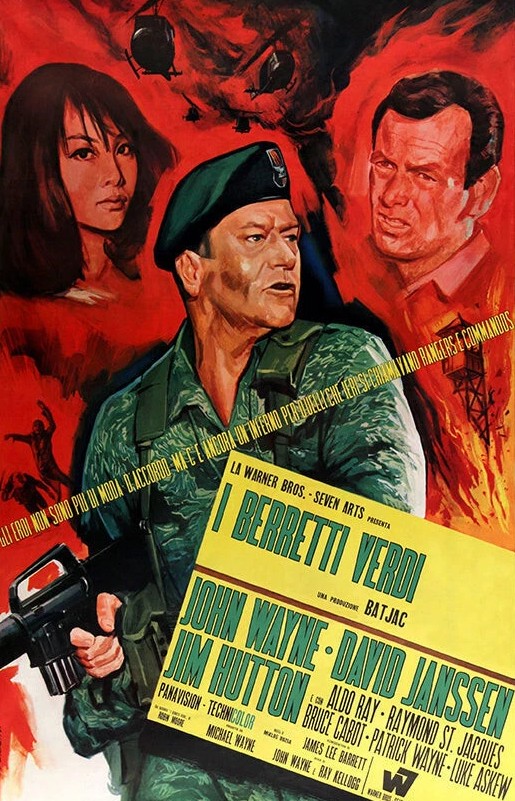
As if John Wayne hadn’t endured enough directing The Alamo (1960), he took on an even weightier task with this Vietnam War picture which, from the start, was likely to receive a critical roasting given the actor’s well-known stance on the conflict and his anti-Communist views that dated back to the McCarthy Era of the 1950s. Wayne had enjoyed a charmed life at the box office with three successive hit westerns, Henry Hathaway’s The Sons of Katie Elder (1965) with Dean Martin, Burt Kennedy’s The War Wagon (1967) co-starring Kirk Douglas, and best of all from a critical and commercial standpoint Howard Hawks El Dorado (1967) pairing Robert Mitchum. Outside of box office grosses, Wayne’s movies tended to be more profitable than his box office rivals because they were generally more inexpensive to make.
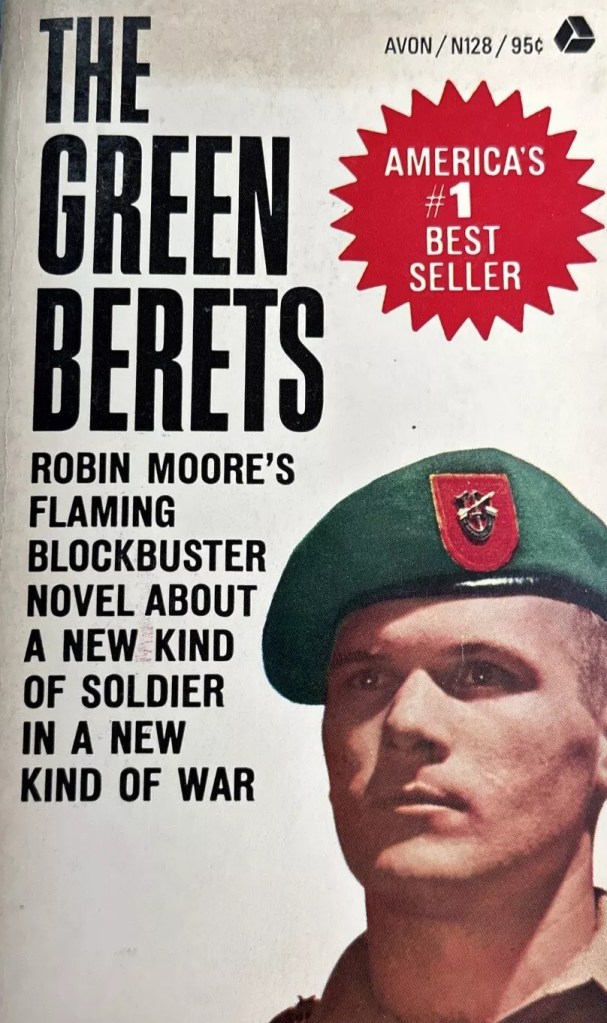
Columbia had been the first to recognize the potential of the book by Robin Moore and purchased the rights pre-publication in 1965 long before antipathy to the war reached its peak. A screenplay was commissioned from George Goodman who had served in the Special Forces the previous decade and was to to return to Vietnam on a research mission. But the studio couldn’t turn out a script that met the approval of the U.S. Army. Independent producer David Wolper (The Devil’s Brigade, 1968) was next to throw the dice but he couldn’t find the financing.
In 1966 Wayne took a trip to Vietnam and was impressed by what he saw. He bought the rights to the non-fiction book by Robin Moore (who also wrote The French Connection) for $35,000 plus a five per cent profit share. While the movie veered away in many places from the book, the honey trap and kidnapping of the general came from that source, although, ironically, that episode was entirely fictitious, originating in the mind of Robin Moore.
Universal originally agreed to back The Green Berets with filming scheduled for early 1967 but when it pulled out the project shifted to Warner Bros. And as if the director hadn’t learned his lesson from The Alamo, it was originally greenlit for a budget of $5.1 million, an amount that would prove signally inappropriate as the final count was $7 million. Wayne turned down the leading role in The Dirty Dozen (1967) to concentrate on this project. Wayne’s character was based on real-life Finnish Larry Thorne who had joined the Special Forces in Vietnam in 1963 and was reported missing in action in 1965 (his body was recovered four decades later).
As well as John Wayne, the movie was a platform for rising stars like Jim Hutton (Walk, Don’t Run, 1966), David Janssen (Warning Shot, 1967) and Luke Askew (Easy Rider, 1969) who replaced Bruce Dern. Howard Keel, who had appeared in The War Wagon, turned down a role.
Wayne holstered his normal $750,000 fee for acting plus $120,000 for directing. But it turned out The Alamo had taught him one important lesson – not to shoulder too much of the responsibility – and Ray Kellogg for the modest sum of $40,000 was brought in as co-director. It was produced by Wayne’s production company, Batjac, now run by his son Michael. But neither Wayne nor Kellogg proved up to the task and concerned the movie was falling behind schedule and over budget the studio drafted in veteran director Mervyn Leroy – current remuneration $200,000 plus a percentage – whose over 40 years in the business ranged from gangster machine-gun fest Little Caesar (1931) to his most recent offering the Hitchcock-lite Moment to Moment (1966).
But exactly what LeRoy contributed over the next six months was open to question. Some reports had him directing all the scenes involving the star; others took the view that primarily he played the role of consultant, on set to offer advice. Even with his presence, the movie came in 18 days over schedule – 25 per cent longer than planned. Unlike the later Apocalypse Now (1979), it didn’t go anywhere near South-East Asia so the location didn’t add any of Coppola’s lush atmosphere, though the almost constant rain in Georgia, while a bugbear for the actors, helped authenticity.
It was filmed instead on five acres of Government land around Fort Benning, Georgia, hence pine forests rather than tropical trees. President Lyndon B. Johnson and the Department of Defense offered full cooperation. But that was only after the producers complied with Army stipulations regarding the screenplay. James Lee Barratt’s script was altered to show the Vietnamese involved in defending the camp and the kidnapped was switched from being over the border. Also axed, though this time by the studio, was Wayne’s wish for a romantic element – the studio preferred more action. Sheree North (Madigan, 1968) was offered the role of Wayne’s wife but she also turned it down on political grounds. Vera Miles (The Hellfighters, 1968) was cast but she was edited out prior to release.
The Army provided UH-1 Huey helicopters, the Air Force chipped in with C-130 Hercules transports, A-1 Skyraiders and the AC-47 Puff the Magic Dragon gunship and also the airplane that utilized the skyhook system. Actors and extras were kitted out in the correct jungle fatigues and uniforms. Making a cameo appearance was Col Welch, commander of the Army Airborne School at Ft Benning. The sequence of soldiers doing drill was actually airborne recruits.
The attack on the camp is based on the Battle of Nam Dong in 1964 when the defenders saw off a much bigger enemy unit.
This set was built on a hill inside Fort Benning. The authentic detail included barbed wire trenches and punji sticks plus the use of mortar fire. While the camp was destroyed during filming the other villages were later used for training exercises. .
The pressure told on the Duke physically – he lost 15lb. But the oppressive heat and weather of that location – it was mostly shot in summer 1967 – was nothing compared to the reviews. It was slated by the critics with Wayne’s age for an active commander called into question, never mind the parachuting, the gung-ho heroics and the dalliance in an upmarket nightclub.
“In terms of Wayne’s directorial career,” wrote his biographer Scott Eyman, “The Alamo has many defenders, The Green Berets has none.” That assessment, of course, would be to ignore the moviegoers around the world who bought tickets and put the picture into reasonable profit.
Wayne was clear in his own mind about the kind of movie – “about good against bad” – he was making and accommodated neither gray areas nor took note of current attitudes to the war as exemplified by nationwide demonstrations. Co-stars David Janssen, Jim Hutton and George Takei were opposed to the war. Takei, a regular on the Star Trek series, missed a third of the episodes on the second season; his lines were written to suit the character of Chekov, who went on to have a bigger role in the television series. Composer Elmer Bernstein turned down the gig as it went against his political beliefs. “The Ballad of the Green Berets,” heard over the opening credits was not composed for the film, having been released two years earlier.
Most critics hated it – “Truly monstrous ineptitude” (New York Times); “cliché-ridden throwback” (Hollywood Reporter); “immoral” (Glamour). Even those reviews that were mixed still came down hard: “rip-roaring Vietnam battle story…but certainly not an intellectual piece” (Motion Picture Exhibitor). Not that Wayne was too concerned. At the more vital place of judgement – the box office – it took in $9.5 million in rentals (what’s returned to the studios once cinemas have taken their cut) – $8.7 million on original release and a bit more in reissue – in the U.S. alone plus a good chunk overseas.
It was virtually impossible to examine a movie like this without taking a political stance. Other movies covering the same topic were allowed greater latitude regarding authenticity, audiences and critics like appearing to accept that creating watchable drama often took precedence over the facts. Both The Deer Hunter (1978) and Apocalypse Now, considered the best of this sub-genre, clearly ventured away from strict reality. With over half a century distancing the contemporary viewer from those inflammatory times, it’s worth noting that it still divides critics. Or, rather, critics and the general public take opposing views.
Although Rotten Tomatoes deems it “an exciting war film”, the critics voting on that platform gave it a lowly 23 per cent favourable report compared to a generally positive 61 per cent from the ordinary viewer. That contrasts, for example, with a more even split for the likes of Exodus (1960) – 63 per cent from critics and 69 per cent from audiences. However, The Green Berets attracts twice as much interest, collaring 9,000 votes compared to just 4,300 for Exodus.
After this, Wayne’s fee went up to a flat million bucks a picture. “He wasn’t a guarantee of success,” explained his son Michael, “he was a guarantee against failure.” At this point in his career, he was gold-plated. Where other stars in his commercial league suffered the occasional box office lapse – Paul Newman’s career in the 1960s, for example, was riddled with flops like The Secret War of Harry Frigg (1968) – he did not. Especially with a global following, his pictures never lost money.
SOURCES: Michael Munn, John Wayne, The Man Behind the Myth, Robson, 2004; Scott Eyman, John Wayne, The Life and Legend, Simon and Schuster, 2014; Brian Hannan, The Magnificent 60s, The 100 Top Films at the Box Office, McFarland, 2023; Robin Moore, Introduction, The Green Berets, 1999 edition, Skyhorse Publishing; Laurence H. Suid, Guts and Glory, University of Lexington Press, 2002; The Making of The Green Berets, 2020; Review, Hollywood Reporter, June 17, 1968; Review, Motion Picture Exhibitor, June 19, 1968; Renata Adler, “The Absolute End of the ‘Romance of War’”, New York Times, June 30, 1968; Glamour, October 1968; “Big Rental Pictures of 1968,” Variety, January 8, 1969.
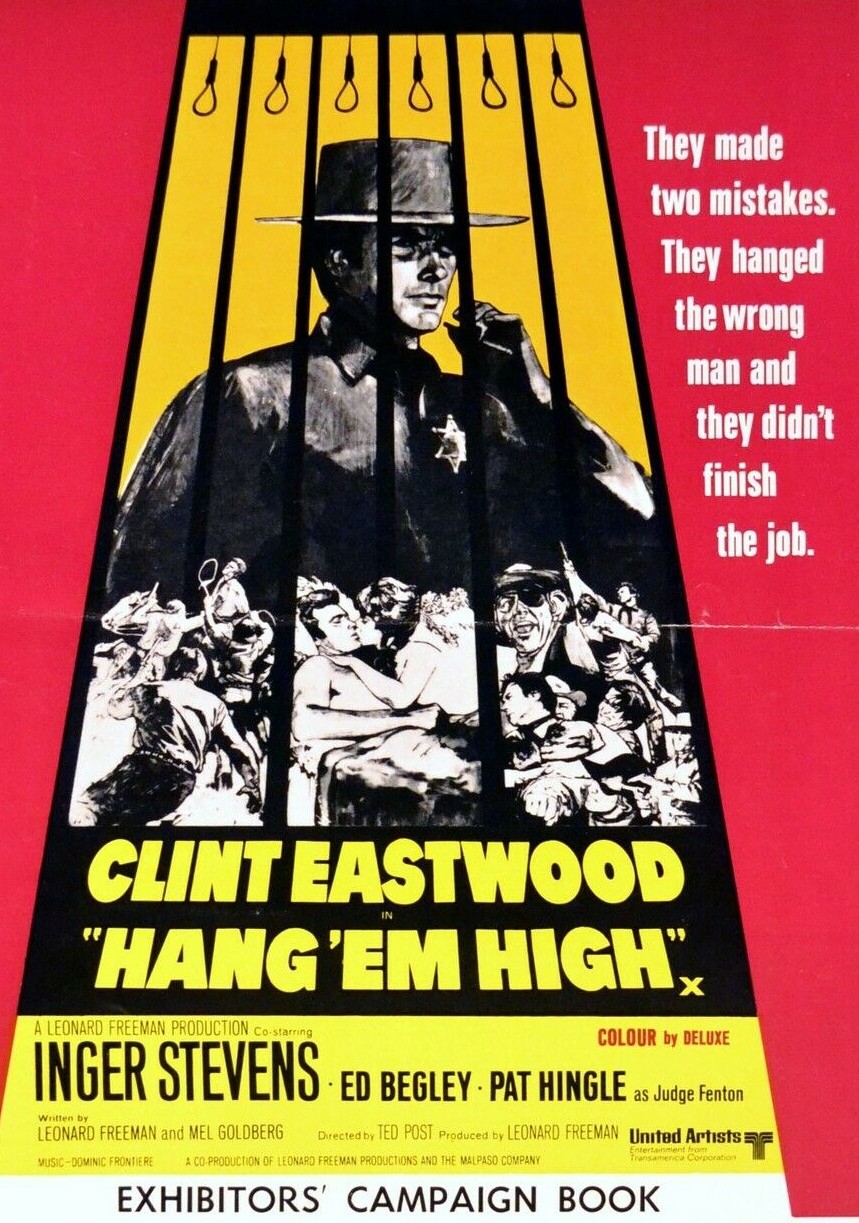
Clint Eastwood didn’t waste much time capitalizing on the unexpected success of the Dollars Trilogy. But the first was not released in the United States till 1967 and despite the success of the series across Europe was generally dismissed as a fluke, until American audiences suggested otherwise. The following year Eastwood appeared in three pictures, Hang ‘Em High, Coogan’s Bluff and Where Eagles Dare, which solidified his screen persona as portraying more with a twitch or a raised eyebrow than digging deep into the dialog.
Contrary to my expectations, Hang ‘Em High doesn’t quite fall into the trademark revenge mode of later westerns. It’s somewhat episodic, Jed (Clint Eastwood) often sent off on a tangent by Judge Fenton (Pat Hingle), allowing the lynch mob who failed to hang him in the first place a second chance at completing the job.
Following the success of the James Bond double bills, United Artists spun out its Clint Eastwood portfolio at every opportunity.
And while the presence of the second-billed Inger Stevens (Firecreek, 1968) suggests heady romance that doesn’t kick in until the third act and it’s more tentative than anything and its purpose is more, in narrative terms, to provide Jed with a correlative with which to compare his own obsession, bringing to justice the nine men who attempted to kill him.
Just to confuse things, the middle section isn’t about revenge or romance, but about justice. Specifically, it’s about showing that justice will be done, that in the unruly West, with insufficient enforcers of law and order, that crimes will not go unpunished, a gallows on constant display to make the point.
Surprisingly, it’s Jed who argues that some of this justice is just too summarily executed. He tries in vain to prevent the execution of two young rustlers who fell in with one of his potential assassins, Miller (Bruce Dern), but who refuse to take advantage of the situation when Miller overpowers Jed while he’s bringing the trio in to face the judge. Admittedly, they don’t go to his aid either, but the fact they resist piling in allows Jed to escape. However, rustling is a hanging offence, so they cannot escape the noose, certainly not in Fenton’s town.
There’s a switch in the mentality of Jed. Before he’s co-opted by Fenton to return to his former profession of lawman, Jed is of the school of thought that decides to take the law into his own hands. Even wearing a badge, you are allowed to shoot a man stone dead if he’s trying to escape, even if such action is severely hampered by him already being badly wounded, as lawman Bliss (Ben Johnson) demonstrates. But Bliss isn’t as callous as he sounds. He’s a contradiction, too, racing to the aid of Jed dangling in a noose in a tree, freeing him so he can face justice, even if that will most likely result in hanging.
So Jed upholds the law, preventing other citizens from taking the law into their own hands, Miller a target of the family of the owners he slaughtered before making off with their cattle.
We only see shop owner Rachel (Inger Stevens) fleetingly for most of the picture. She appears any time a new wagon load of criminals is jailed, scanning their faces for who knows what, though likely we’ve guessed it’ll be to find the killer of a loved one. Not only has her husband been killed by two strangers but while his corpse is lying on the ground beside her she’s raped. And although she eventually responds to Jed’s gentle moves, she still can’t let go of her “ghosts.”
Jed is put through the wringer. Not only an inch from death following the initial hanging but ambushed again by the same gang and nearly dying of pneumonia after being caught in a storm, the latter incidents permitting the kind of nursing that often fuels romance.
There’s an ironic ending. Captain Wilson (Ed Begley), leader of the gang, hangs himself rather than be shot by Jed.
The score by Dominic Frontiere (Number One, 1969) lurches. We go from heavy-handed villain-on-the-loose music to eminently hummable echoes of Ennio Morricone.
Clint Eastwood reinforces his marquee appeal, Inger Stevens delivers another of her wounded creatures, and Pat Hingle (The Gauntlet, 1977) is an effective foil. Bruce Dern (Castle Keep, 1969) does his best to steal every scene without realizing that over-playing never works in a movie featuring the master of under-playing.
Host of cameos include veterans Ben Johnson (The Undefeated, 1969), Charles McGraw (Pendulum, 1969) and L.Q. Jones (Major Dundee, 1965) plus two who had not lived up to their initial promise in Dennis Hopper (though he would revive his career the following year with Easy Rider) and James MacArthur (Battle of the Bulge, 1965).
Journeyman director Ted Post made a big enough impact for Eastwood to work with him again on Magnum Force (1973). Written by Leonard Freeman (Claudelle Inglish, 1961) and Mel Goldberg (Murder Inc., 1960).
More than satisfactory Hollywood debut for Eastwood and worth checking out to see that even at this early stage he had nailed down his screen persona.
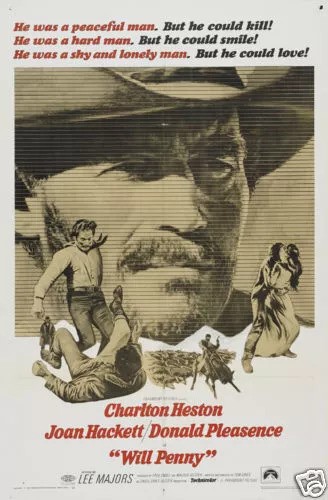
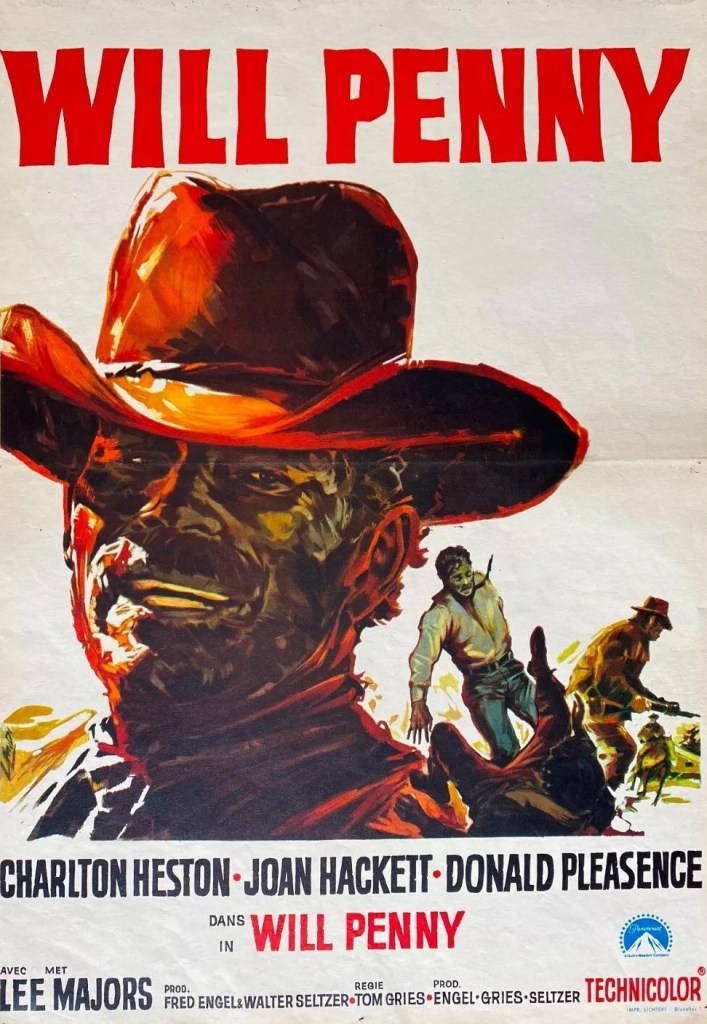
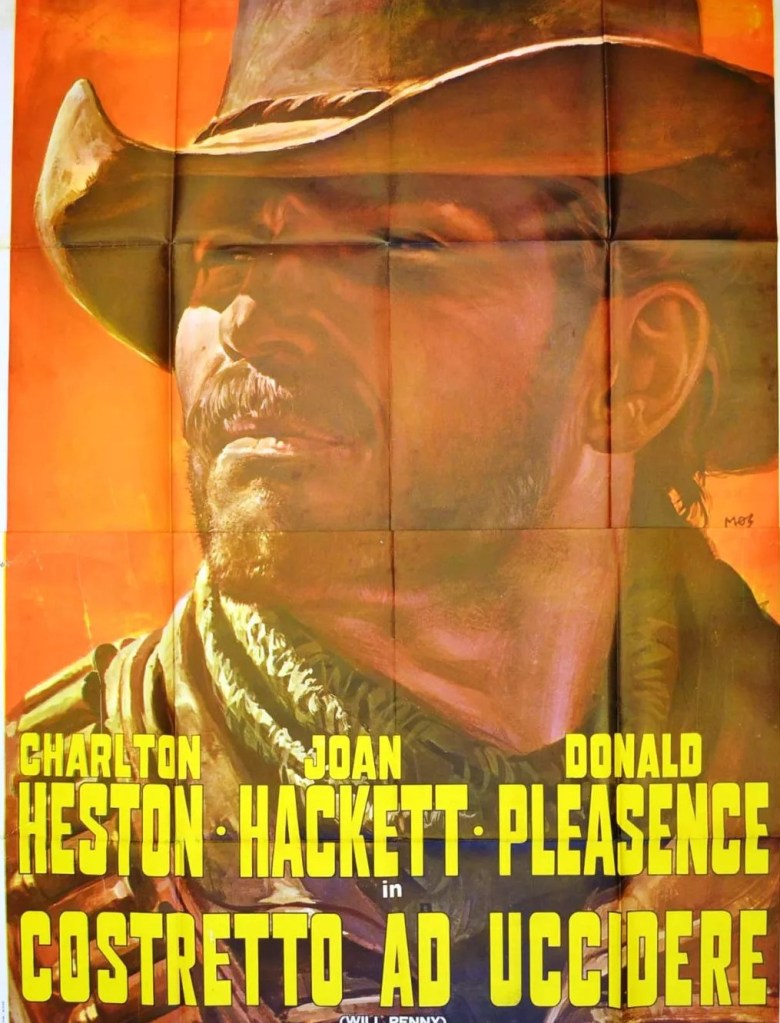
Tale of two westerns. On the one hand two undoubtedly fine performances contribute to an excellent realistic somewhat downbeat cowboy yarn. On the other hand a bunch of loonies jumping in every now and then as plot devices upset the wonderful tone. There had to be some other way, surely, to ensure itinerant illiterate 50-year-old cowhand Will Penny (Charlton Heston) and educated single mother Catherine (Joan Hackett) spend the winter together, other than him being bushwhacked by mad-eyed Preacher Quint (Donald Pleasance) and left to die.
This kind of sub-plot, you know where it’s going to end, even though, in this case, it goes down a few bizarre routes. Luckily, the main narrative continues to surprise in interesting fashion.
Like its modern equivalent The Misfits (1961), this mostly revolves around simple-minded cowboys who enjoy simple pleasures, drinking and fornicating, at the end of a hard trail ride. Will looks no further ahead than his next job. He’s easily the oldest of the cowboys and we’re introduced to him getting a telling off for trying to steal a few biscuits from the trail cook. He’s constantly razzed by the younger guys, though he’s able to take care of himself. At trail’s end, he hooks up with Blue (Lee Majors) and Dutchy (Anthony Zerbe) who, unexpectedly, find themselves in a shooting match with Quint’s family.
Dutchy comes off worst, a bad gunshot wound accidentally self-inflicted. The next few sequences are terrific. Dutchy, thinking he’s going to die, wants to go out drinking gutrot whisky and telling tall tales of heroism to Catherine who they encounter at a tiny trading post. There’s generally a callous disregard for the wounded. Even so, Blue and Will take the wounded, now drunk, man to the nearest town where the Dr Fraker (William Schallert) doubles as the local barber.
Will finds a job tending an outlying herd but finds the cabin that goes with it inhabited by Catherine and son Horace (Jon Gries). Out on the job, he’s attacked, robbed and left for dead by Quint and sons Rafe (Bruce Dern) and Rufus (Gene Rutherford). He manages to find his way back to the cabin and is tended by Catherine. Horseless and not fit for work, he decides to hole up in the cabin, fixing it up to withstand winter.
They’re wary of each other, but he bonds with the boy, and gradually they warm to each other, despite the two-decade age gap. She’s been let down so often by men, husband, trail escort etc, that she clearly finds something admirable in his dependability.
And we would probably be headed for a heartbreak ending. We’ve already seen how easy it is to be injured in the cowboy game, and how unemployable that renders a man, so the prospects of an ageing cowhand, who knows no other existence, settling down with an idealistic younger woman seem remote.
In any case, there’s a ways to go before that time comes since at Xmas the Quints reappear, beat Will up again and tie him up. You’d expect them to have their way with Catherine but there’s a twist in that Preacher has sized her up as a wife for one of her sons. While they are fighting over her, Will escapes.
Luckily, his old buddies come looking for him and he’s got a sack of sulphur (purpose never explained) so he smokes out the bad guys and they all get shot, leaving Will and Catherine with their heart-breaking moment.
As I said, two quite dfferent movies at odds with each other. Charlton Heston (Number One, 1969) is transformed. His trademark screen persona disappears under this quite different, diffident, awkward, character and there’s an argument to say this is his best-ever performance. The scenes where he tries to cover up his illiteracy, shies away from learning a Xmas tune, and explains his theories on the frequency of bathing are outstanding.
If you only know Joan Hackett from Support Your Local Sheriff (1969) you wouldn’t recognize her here, contained and watchful, rather than somewhat crazy in the James Garner picture.
While this pair gell, Donald Pleasance (Soldier Blue, 1970) et al stand out like a sore thumb as if they’ve decided to try and hijack the picture with some pointless over-acting. An excellent supporting cast includes Lee Majors (The Six Million Dollar Man) in his debut, Ben Johnson (The Undefeated, 1969), Slim Pickens (Rough Night in Jericho, 1967), Clifton James (Cool Hand Luke, 1967), Bruce Dern (They Shoot Horses, Don’t They, 1969) – in full chipmunk-teeth mode – and Anthony Zerbe (Cool Hand Luke).
Tom Gries (100 Rifles, 1969), as writer and director, makes an excellent impression.
The cowboy and homestead sections work incredibly well, what passes for action and plot drag it down. Still, on balance, well worth seeing.
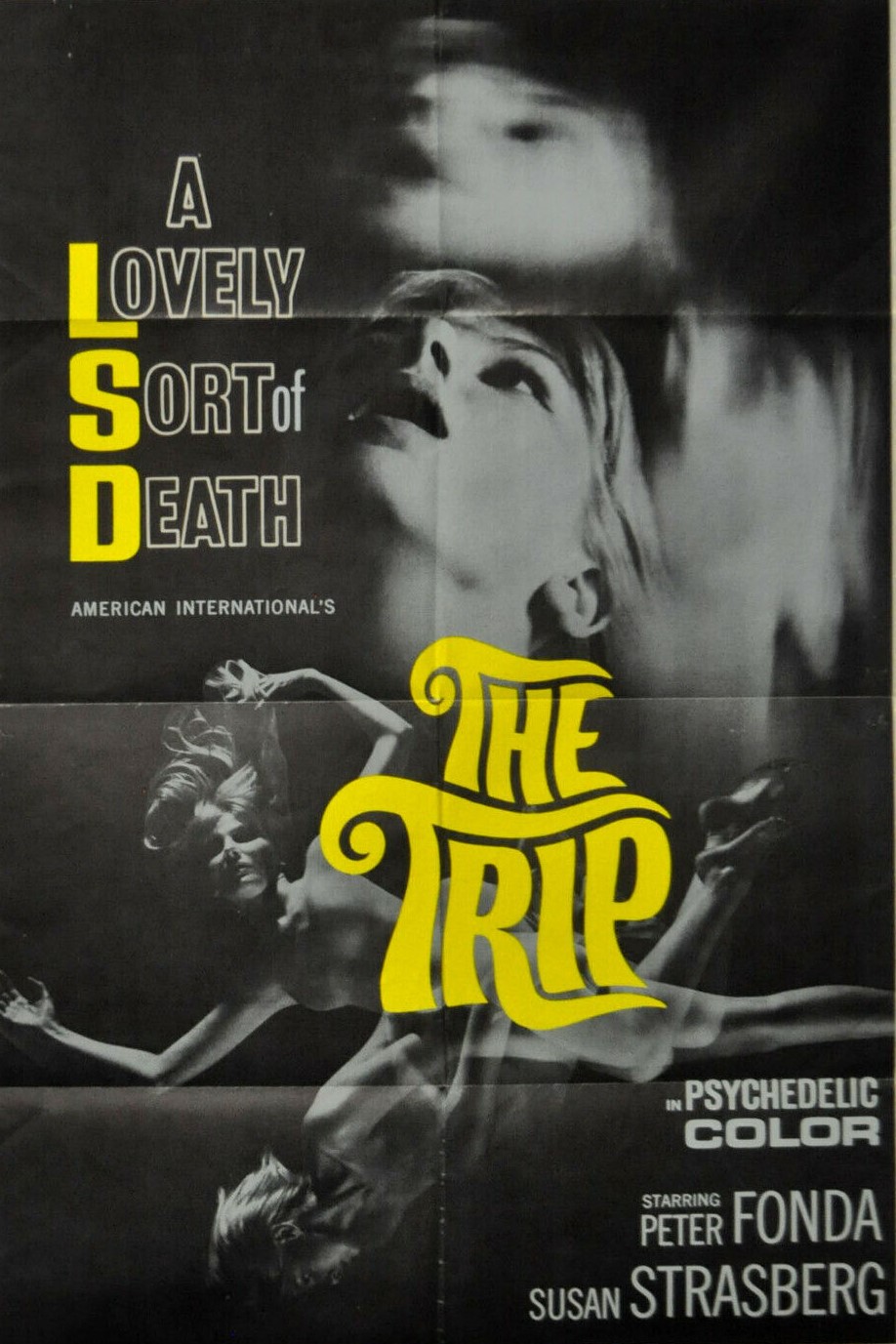
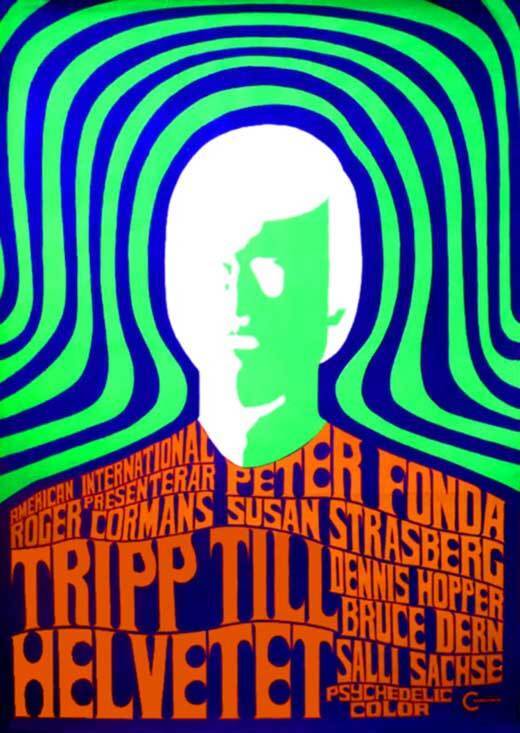
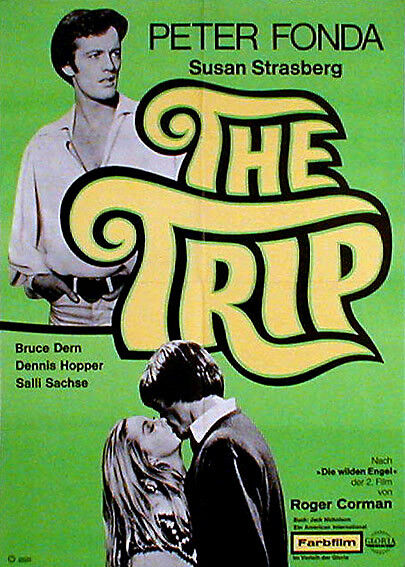
Give any neophyte (word of the week!) independent film director a camera and a small budget ($100,000 in this case) and they might well have come up with something like this. Has the feel of being an advert for promoters of LSD who felt they had to play fair and show the potential downside. Meanwhile, they can jam in an absolute phantasmagoria of imagery and sit back and wait for Stanley Kubrick to rip off some of their ideas and give the whole head-spinning malarkey some credence for the conclusion of 2001: A Space Odyssey.
If there’s a story, it’s as thin as they come. Commercials director Paul (Peter Fonda), trying to understand himself better, and why, for example, wife Sally (Susan Strasberg) has left him for another man, enlists the help of self-help guru John (Bruce) to guide him through an LSD trip. The notion that there are drug guides comes as a surprise to me, and this feels like the kind of the warning you get on the side of cigarette packets, although quite what guidance anyone can expect while under the influence is anybody’s guess. If you’re high as a kite, it’s unlikely you’re on an even enough keel to do what you’re told.
Anyway, off we go. And lo and behold, before you can utter the words “groovy” or even “psychedelic,” suddenly the screen is invaded with all sorts of images, coming so quick and fast that even the ones that might makes sense – i.e. indicating paranoia – get little time to settle before the next appear. Some of the images look like they’re offcuts from an AIP horror picture, haunted houses, medieval backdrops, torture, people being mummified or hanged or drowned or all three (maybe all at once).
And from there it’s an easy step into being dazzled by headlights or climbing a cliff or running through a desert or being chased by masked men on horseback and hearing high-pitched giggling. Some of the images, while dreamlike, remain realistic, such as topless body-painted go-go dancers. And the oddest image of a woman in curlers eating a chicken leg in a laundromat feels easily like something out of a bizarre dream when in fact it isn’t.
Some stuff you might expect. Items like an orange are experienced with more intensity. And Paul is disembodied when he observes people making love. Sometimes you’re looking through a kaleidoscope, other times it’s with grim clarity. Strobe lights, hallucination, add to the dreamy expressionistic quality. Not sure the movie had much to say except drugs can be fun – or not. But, inevitably, the imagery, instead of assisting with characterization, gets in its way.
Looks strange to see so many hippies with short hair. Peter Fonda, Dennis Hopper and Jack Nicholson (here only in his capacity as the screenwriter) would come together with greater effect in Easy Rider (1969). This resembles nothing more than an audition for the later film but directed by someone (Hopper) with a bit more sense, adding a proper narrative and cutting the tripping down to the minimum.
Roger Corman (The Secret Invasion, 1964) directed but Susan Strasberg (The Sisters, 1969), Bruce Dern (Castle Keep, 1969) and Dennis Hopper have such small parts they are almost only there to add marquee value. Not quite the ode to counter culture envisaged.
Dream Team Number One: Clark Gable and Jean Harlow. This was of course a good 30 years before the movie actually got made. The Horace McCoy novel was purchased in 1935 by MGM as a big-budget project teaming Clark Gable and Jean Harlow. This was despite Variety proclaiming it was “not screen material.” The premature death of Harlow put paid to the idea. Next, actor Wallace Ford (Freaks, 1932) bought it with Broadway in mind. A production was scheduled to open in 1939, but never did.
Dream Team Number Two: Charlie Chaplin and Marilyn Monroe. When the comedian purchased the rights in the early 1950s he intended Marilyn Monroe to play the leading female. Although she was a mere starlet Chaplin had form in building up newcomers. Author McCoy had by that point become an accomplished screenwriter with over 30 credits including Gentleman Jim (1942), film noir Kiss Tomorrow Goodbye (1950) and The Lusty Men (1952) That concept fell by the wayside when Chaplin was effectively banished from America while launching Limelight (1951) in Britain.
It was another 14 years before interest in the novel was revived by screenwriter James Poe, who purchased the rights from the McCoy estate. Although most famous within the trade for being accused of fraudulent behaviour in relation to his screenplay for Around the World in 80 Days (1956). Despite an Oscar for the film he was sued for $250,000. However, he had a sterling body of work including Cat on a Hot Tin Roof (1958), Sanctuary (1960), Lilies of the Field (1963), The Bedford Incident (1965) and Riot (1969) and two other Oscar nominations.
In 1965 he had signed a multi-picture writer-director deal with Columbia. He was either going to make his directorial on The Gambler or They Shoot Horses, Don’t They. It turned out to be the latter. Failing to get the movie off the ground with Columbia or under his own steam, he turned to new studio Palomar, which was a production entity set up by the ABC television network, which bought over his rights as well as his script but kept Poe on as director.
Dream Team Number Three: Faye Dunaway. Yep, one big star, not two. Poe’s screenplay, while not eliminating the male lead, spun on a female star. Dunaway, hot after Bonnie and Clyde (1967), was offered $600,000 to play the role. Mia Farrow was also in contention, for $500,000. The only problem was, the budget could not remotely stretch to that. As helmed by Poe, it was to cost no more than $900,000. The film was scheduled to begin shooting in spring 1968 but a month later the start date shifted to June.
Two relative newcomers Robert Chartoff and Irwin Winkler were brought in as producers to move the project along. Later they would be responsible for such classics as Rocky (1976), The Raging Bull (1980), The Wolf of Wall Street (2013) and The Irishman (2018), but at this point they had just three pictures under their belt, although that included Point Blank (1967), Their first task: persuade Poe to rewrite the script. They felt the third act needed work with restructuring elsewhere to make the pay-off work.
But Poe, believing his position was sacrosanct, refused to discuss a rewrite. He refused to discuss anything, period, treating the producers as his assistants rather than people with some power within the studio. According to Irwin Winkler, “Poe seemed unaware of the of the normal process of preparation, even though he’d been around movie sets for decades.”
Realising that getting a star on their budget was impossible, Chartoff and Winkler changed tack and talked to good actors, but even then few were interested. A less dramatic star than Jane Fonda you could not imagine, her resume filled with light comedies, French films that utilised her sexuality or the extravaganza that went by the name of Barbarella (1968). But the pregnant Fonda was keen on change. The film was delayed until after she had given birth. Michael Sarrazin should have been out of the equation. John Schlesinger had lined him up for the Jon Voigt role in Midnight Cowboy (1969) but Universal, to whom he was under contract, asked too much to send him out on loan.
With no sign of the rewrites, the producers became antsy about the director. However, they showed their true mettle as producers, convincing Palomar there was no way the original budget would cover the ballroom set, huge number of extras, live orchestra and salaries. It would need to at least triple.
In a picture of one predicament following another, there was one crisis the producers had not foreseen. They were going to be fired. Apart from anything else, they were only executives on the picture with any experience, it being not only Poe’s first movie but that of Chartoff and Winkler’s superiors at the studio. The outcome – the guy who had told the pair they were being fired was shown the door instead.
Susannah York was cast after the producers saw a sneak of The Killing of Sister George (1969) at the Robert Aldrich studios. She had committed to Peter O’Toole vehicle Country Dance/Brotherly Love (1970), written by her cousin James Kennaway (Tunes of Glory, 1960). After too many delays on They Shoot Horses she planned to pull out in favour of the other film. Although Sally Kellerman (Mash, 1970) was set as a last-minute replacement, the issue was resolved by asking MGM to delay the start on the rival picture.
Believing Poe was in no position to helm such a big-budget picture enterprise, Chartoff and Winkler began the process of removing him only for Jane Fonda to dig her heels in. She changed her mind after witnessing first-hand Poe’s directorial skills – or lack of them – when she took part in a screen test for Bonnie Bedelia. Winkler recollected, “On the set Jane asked Poe questions about the blocking of the scene, why she moves in one direction rather than another, why in front of a sofa rather than behind it etc. He couldn’t answer her questions and told her to talk to the cameraman.” Exit Poe.
In terms of a replacement, Chartoff and Winkler set their sights of Sydney Pollack (The Scalphunters, 1968) with whom they had previous dealings, and William Friedkin, then being hailed for The Homecoming (1968) – luckily The Night They Raided Minsky’s (1968) had yet to be released. But studio executives had a third director in mind, Jack Smight (No Way to Treat a Lady, 1968). Friedkin should have been in pole position, having only received $75,000 for The Homecoming. His agent, sensing an opportunity, demanded $200,000. Jack Smight’s agent also got greedy and wanted $250,000. Pollack’s agent was happy with the $150,000 on offer.
When Poe was eased out, filming was announced as beginning on February 17, 1969, the budget having now increased to $3.2 million – including $400,000 for extras. However, acoustic issues – seawater had eaten away the bottom of the pier – prevented use of the old Aragon ballroom in Santa Monica. That set was constructed on the Warner lot.
Pollack then turned it down. He had reservations about the script, which had still never been rewritten. When Robert E. Thompson, a television writer but “a Horace McCoy expert,” was mooted, Pollack changed his mind. The new script contained the “flash forward” scenes that prepared audiences for the shock ending. However, the new scenes and delays in starting increased the budget which now ballooned to $4.7 million.
It turned out the director was the best actor of all. “I was impressed with Sydney Pollack’s ease on the set,” recalled Irwin Winkler. “He never seemed to be working hard and yet was able to get marvelous performances out of the actors. Everybody in the company adored him.” Asked by Winkler how he remained so calm dealing with the actors and all the extras and the complicated camera set-ups, he replied, “it was really quite easy.” That same afternoon he collapsed on set and was diagnosed with “nervousness.”
The studio, the stars, the producers, all seemed confident about the picture. All they had to do was convince the audience. But at the first preview in San Francisco the audience roared with laugher at the climactic scene. That shocked the studio to the core until the producers were able to reassure the head honchos that the “fast forwards” would smooth over that problem. Which they did.
It was nominated for nine Oscars – Best Director, Best Screenplay, nods for Jane Fonda, Gig Young and Susannah York among others. Only Gig Young won.
SOURCES: Irwin Winkler, A Life in Movies, (Abrams Press, New York, 2019) p34-47; “Tough Stuff,” Variety, August 7, 1935, p59; “Ford Buys for B’Way,” Variety, September 11, 1939, p42; “Dance Marathon Reprise,” Variety, August 3, 1966, p24; “IT&T In No Way Slowing Down Theatrical Feature Program of ABC,” Variety, January 10, 1968, p4; “Crowded Slate for Palomar,” Variety, February 28, 1968, p18; “Bob Evans Chips-Service To Writers As Stars At Paramount,” Variety, May 1, 1969, p19; “Jane Fonda Gets Top Role in Palomar’s Horses,” Box Office, July 22, 1968, pW1; “Palomar Horses on W7 Space,” Variety, October 23, 1968, p3; “Jan 6 Filming Date for They Shoot Horses,” Box Office, December 16, 1968, pW5; “Cheery Side of Delay on Horses,” Variety, January 15, 1969, p21; “Winkler Wants Films With Social Comment,” Box Office, January 19, 1970, pW1.
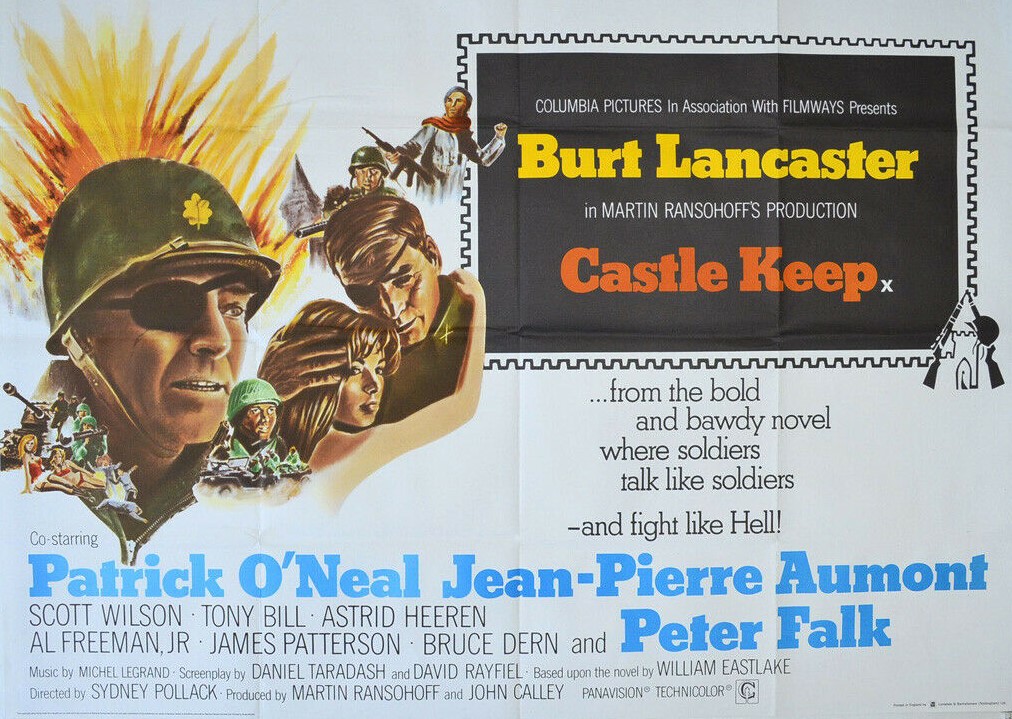
A bit more directorial bombast and this could have matched Apocalypse Now (1979) in the surrealist war stakes. Never mind the odd incidents surrounding a small unit of G.I.s taking over a magnificent Belgian castle towards the end of World War II prior to what turned out to be the Battle of the Bulge, this has on occasion such a dreamlike quality you wonder if it is all a figment of the imagination of one of the characters, wannabe writer Private Benjamin (Al Freeman Jr.). Throw in a stunning image, for the beleaguered soldiers at the start, of a horsewoman charging by in a yellow cloak, so out of place that it carries as much visual impact as the unicorn in Blade Runner (1982), and we are in definite cult territory.
One of the unusual elements is that, in this unexpected respite from battle, the soldiers are defined by character traits rather than dialogue or bravery as would be the norm. This ranges from baker Sergeant Rossi (Peter Falk) taking over the village boulangerie and bedding the baker’s wife (Olga Bisera), mechanic Corporal Clearboy (Scott Wilson) diving into a lake to rescue a Volkswagen he has adopted and the troops receiving a lecture on art history from Captain Beckman (Patrick O’Neal).
Commander Major Falconer (Burt Lancaster) is not only brilliant in the art of war, but calmly mentors Beckman through a firefight with an enemy airplane, teaches local sex workers how to make Molotov cocktails and, evoking ancient aristocratic tradition, enjoys conjugal relations with the conquered countess (Astrid Heeren), whose impotent husband (Jean-Pierre Aumont) encourages the relationship since the castle needs an heir.
There is wistful revelation, Beckman clearly hankering after his turn with the countess, a trainee minister who wishes he had the courage to join the boys in the brothel, the young soldiers there being treated as children rather than customers. And there are juvenile pranks – moustaches are painted on statues, wine bottles used for ten-pin bowling practice.
But the surreal moments keep mounting up. The Volkwagen, though riddled with bullets, refuses to sink in the lake, a hidden German reveals himself by playing the same tune on a flute as one of the enemy, the countess often appearing as an ethereal vision.
Through it all is rank realism. Falconer knows a German previously shared the countess’s bed. The count will do anything to safeguard his castle and maintain the family line, even to the extent of incest, since his wife is actually his niece. But above all, while his troops believe the war is at an end and enjoy the pleasures at hand, Major Falconer prepares for rearguard action by the Germans, filling the moat with gasoline, planning to pull up the drawbridge and control the high ground. The battle, when it comes, is vivid and brutal, the initial skirmish hand-to-hand in the village before the Germans advance to the castle.
Burt Lancaster (The Swimmer, 1968) is superb, far removed from his normal aggressive or athletic persona, slipping with pragmatic ease from the countess’s bed to battle stations. War films in the 1960s were full of great individual conflicts often won on a twist of ingenious strategy but seldom have we encountered a soldier like Falconer who knows every detail of war, from where and how the enemy will approach, to the details of the range of weaponry, and knows that shooting dead four soldiers from a German scouting mission still leaves one man unaccounted for.
Patrick O’Neal (Alvarez Kelly, 1966) also leaves behind his usual steely-eyed screen persona, here essaying a somewhat timid and thoughtful character. Peter Falk’s (Machine Gun McCain, 1969) baker is a beauty, a man who abandons war, if only temporarily, for a second “home,” baking bread, adopting a wife and child. In a rare major Hollywood outing French actor Jean-Pierre Aumont (Five Miles to Midnight, 1962) carries off a difficult role as a count willing to accept the humiliation of being cuckolded if it improves his chances of an heir. In one of only four screen appearances German actress Astrid Heeren (The Thomas Crown Affair, 1968) makes the transition from a woman going to bed with whoever offers the greatest chance of saving the beloved castle to one gently falling in love.
There is an excellent supporting cast. Bruce Dern (Support Your Local Sheriff, 1969) makes the most of a standout role as a conscientious objector. You will also find Scott Wilson (In Cold Blood, 1967), Al Freeman Jr. (The Detective, 1968), future director Tony Bill (Ice Station Zebra, 1968) and Michael Conrad (Sol Madrid / The Heroin Gang, 1968).
Two top-name writers converted William Eastlake’s novel into a screenplay – Oscar-winning Daniel Taradash (Hawaii, 1966) and newcomer David Rayfiel who would work with Lancaster again on Valdez Is Coming (1971) and with Pollack on Three Days of the Condor (1973) and Havana (1990)
Sydney Pollack (This Property Is Condemned, 1966), who had teamed up with Lancaster on western The Scalphunters, 1968), does a terrific job of marshalling the material, casting an hypnotic spell in pulling this tantalising picture together, giving characters space and producing some wonderful images, but more especially for having the courage to leave it all hanging between fantasy and reality.
Expressions like “we have been here before,” “once upon a time,” “the supernatural” and “a thousand years old” take solid root as the narrative develops and will likely keep spinning in your mind as you try to work out what it’s all about.
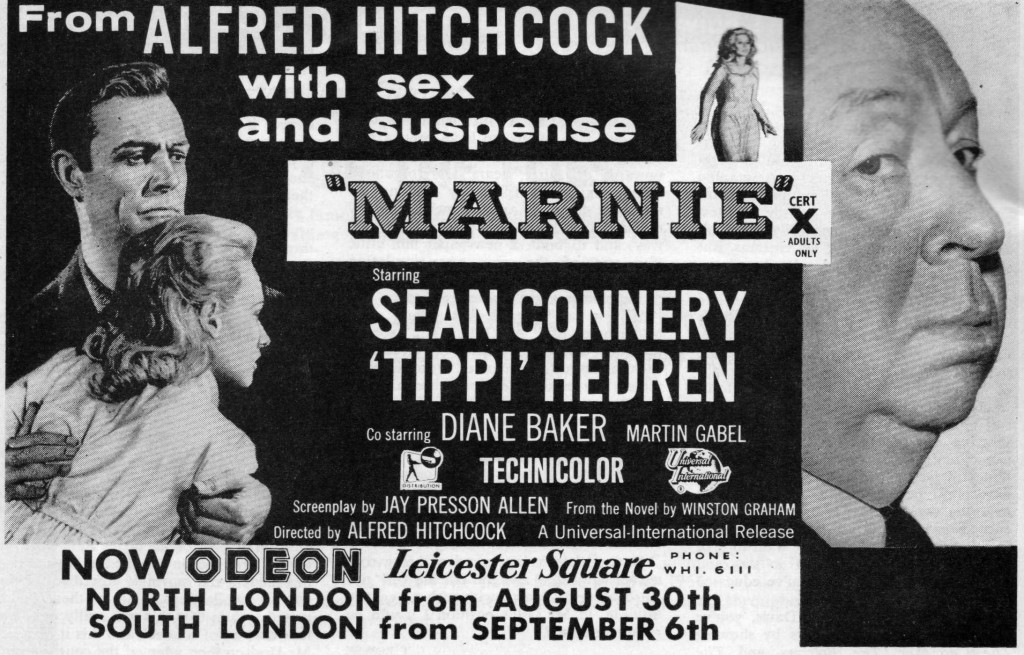
Arguably Alfred Hitchcock’s most difficult film and with some attitudes that will not sit well with today’s audiences nonetheless this is an assured work and the completion of an unofficial trilogy that tries to explain the unexplainable. The director had not been making what might be termed traditional Hitchcock pictures for well over half a decade if you take North by Northwest (1959) as the anomaly in a sequence that began with the obsessive Vertigo (1958). You could argue that Hitchcock had turned a bit “north by northwest” himself, the “hero” of Psycho (1960) a mother-obsessed serial killer, the “bad guys” in The Birds (1963) the titular rapacious creatures who besiege the leading characters and set the world on an apocalyptical course.
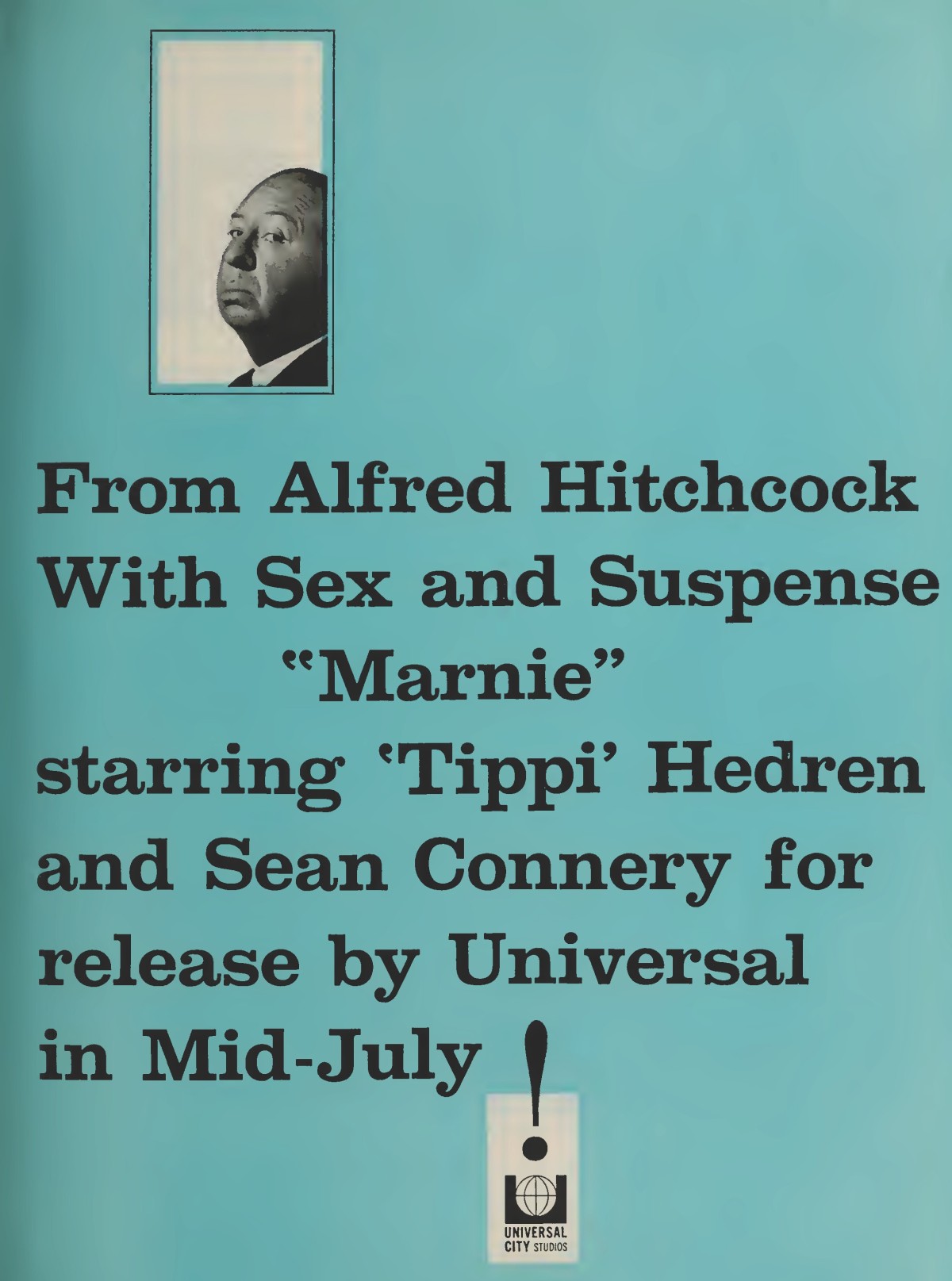
Attempts are made in both Psycho and The Birds to explain the actions of the predators, but such explanations are external, remote, and with Marnie Hitchcock takes the bold step of attempting to explain what makes such a devious, compulsive, frigid liar tick. Hitchcock called the movie a “sex mystery” but it was unclear whether he was just once again trying to tantalize his audience or whether he believed it was film about the mystery of sex, what causes attraction between two people and what sets others up to steadfastly reject the concept. To embellish his thesis he chose one of the world’s most beautiful actresses (Tippi Hedren) and the actor (Sean Connery) who could easily lay claim to being the world’s sexiest man (as he was later anointed in various polls).
It seemed almost an indecent proposal to deny the bed-hopper-par-excellence – as viewed from the James Bond perspective. And it certainly took all the charm Connery could muster to prevent audiences baulking at the almost perverse scientific aspects of his character, an amateur zoologist who welcomed a known criminal into his world for the chance to examine her at close quarters. The audience is constantly kept at one remove. In the first section we watch enthralled as Hedren carries out her bold thefts, as if she is capable of wrapping the entire male population around her little finger by the simple device of adjusting her skirt.
But in the middle section, it is Connery who is in control and the trapped Hedren who is twisting and turning searching for an escape route. In the final section, when it is clear that it is the lover, not the scientist, in Connery that tries to find a way round the problem, the tension is at its height because we have no idea whether she will run true to form and manage to steal and lie her way out or whether Connery’s patience will snap and he will throw her to the wolves who are certainly by this point circling.
The central device on which Hitchcock hooked an audience was the moviegoer demand for a happy ending. He duped cinemagoers in Psycho, slaughtering the heroine halfway through. In The Birds Rod Taylor and Tippi Hedren underwent a harrowing physical assault and while clearly romantically involved by the end Hedren was a wreck. Here, the assaults are mental. There is none of the romantic banter that defines the greatest of his traditional works. Hedren and Connery are together because he has forced the issue and loving though his blackmail is it is still an unequal relationship and one from which she will seek to escape at every opportunity. Hedren’s compulsive character is a mystery that appears insoluble as she resists every attempt to break down the wall she has erected to protect herself from her past.
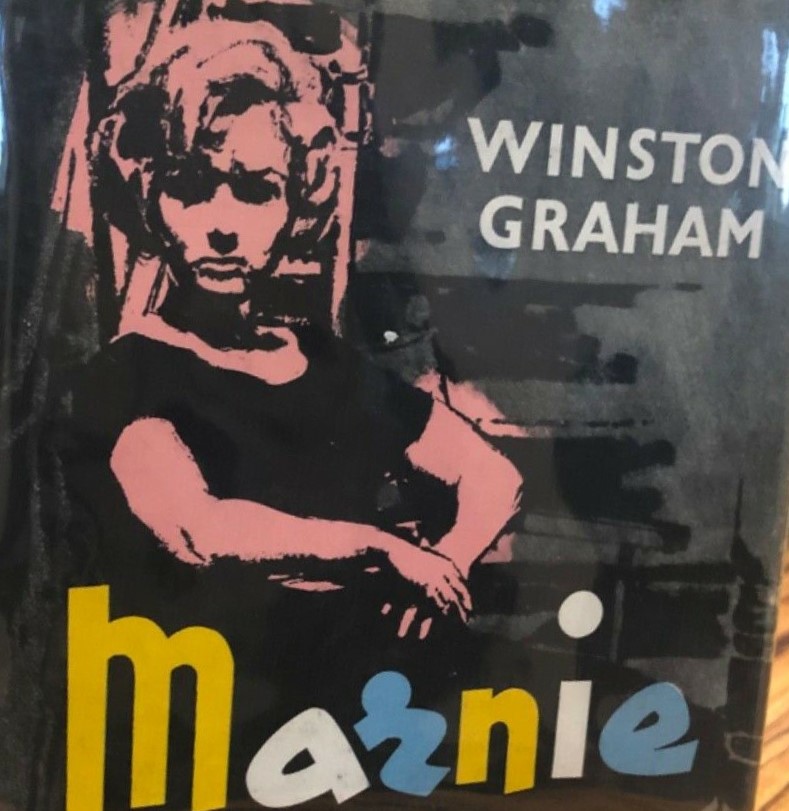
Cover of the Winston Graham source novel. In the book, Marnie is being pursued by two men but in the film this is turned to Connery being the one with two women in tow.
The story is straightforward with few of the twists of other pictures. We meet Hedren as she escapes with nearly $10,000 stolen from her employers. We learn quickly that she is a master of disguise, has several social security cards up her sleeve, can turn from brunette to blonde, and is so practiced in her deception that she can convince an employer to take her on without references. As that particular duped employer is spelling out his predicament to the police, an amused Sean Connery, a customer of her employer, appears. Hedren runs off to a bolthole, an upmarket hotel, close to the stables where she keeps a horse, Forio.
Shifting back to Hedren we find her visiting her mother in a tawdry street near the docks. The artifice of confidence is shredded away. She is jealous of the attention her mother gives a little girl whom she looks after. She wants love that her mother is unable to give. When she lays her head on her mother’s lap waiting for the soothing stroke of a hand all she receives is rebuke for leaning too heavily on her mother’s sore leg. The mother in North by Northwest was played for comedy, in Psycho an occasion for murder, and here a means of control. Here, too, we witness the color red sparking an inexplicable and frightening experience.
When Hedren applies for a new job it is at Connery’s firm, where he is the coming man. He watches amused as she is interviewed, intervenes to ensure she is hired. They have in common that they are widowed. Hedren is already planning her next big score, discovering that the combination to the safe is kept in a drawer to which her employer’s secretary has the key.
But he is ready for her and it seems almost perverse that he does not let her know he is aware of her true identity. Instead, under the guise of asking her to work overtime, he gives her an academic paper to type. The subject is predators, “the criminals of the animal world” in which females feature. His gentle pressure is almost sadistic and she is saved by a sudden storm which triggers another bad subconscious reaction.
Her theft of money from the office is a classic Hitchcock scene. It begins in complete silence. The screen is divided in two, the office and the corridor. Seeing a cleaner appear, Hedren removes her shoes to make her getaway. Almost as she reaches the safety of the stairs, a shoe falls out of her pocket and clatters on the floor. The cleaner does not look up. She is very hard of hearing.
But Connery is again prepared and when she disappears tracks her to her bolthole, confronts her, questioning her again and again until he thinks he is close to the truth. He can’t turn her in because he has fallen in love. Her choice is stark – him or the police. Soon they are married. But the honeymoon, despite his patience, is a disaster, she cannot “bear to be handled” and they return home further apart than ever.
Meanwhile, figures from her past begin to appear. Lil (Diane Baker) who lusts after Connery brings peril to their door. Connery persists with trying to get Hedren to open up.
Eventually, there is a break in her compulsive syndrome, brought on by love, and we head back to her mother’s to get to the root of the problem. Even when the problem is solved her mother remains distant, still won’t stroke her hair. If there is a happy ending it is like that of The Birds, an immediate problem solved but who knows when or if the crows will return, and there is a similar resolution here, Hedren learns the source of her nightmares but it would be a very blind person who did not see terrible ramifications for the future.
There are certainly a few jarring moments, Hitchcock’s insistence on back projection for a start, but then you didn’t really think in North by Northwest that the director was allowed to film in front of the United Nations, did you? Rather than a technical flaw, the back projection seems to fit another purpose, a device to make the audience stop and examine what is going on, for much of it occurs when Hedren is in her fantasy world. And you would have to take exception to Connery’s actions in the bedroom on honeymoon, no matter how gentle his caresses at other times. And certainly, the psychological assumptions ring hollow given our current knowledge of such conditions, but despite that make for tense viewing.
But the meat of the movie is self-deception. Hedren is convinced she can get away with a series of thefts. Connery is convinced her can cure her. His constant interrogation is what passes for lovers’ banter. In aligning himself as her moral guardian and perhaps her savior, “dying to play doctor,” Connery has entered a nightmare of his own making. Only an arrogant man would believe all women would fall at his feet and Hitchcock clearly makes a connection with Connery’s ongoing incarnation as James Bond where that is exactly the case. Connery is every bit as flawed, as obsessive, as Scottie in Vertigo, determined to shape a woman into perfect form, and, yes, expecting to eradicate the imperfect past.
Connery emanated such ease, such amazing grace, on the screen that it backfired. Critics often didn’t believe he was putting much into his acting when in reality he was acting his socks off. This is a tremendously difficult part, walking the tightrope between looking a deluded fool and retaining audience empathy and coming across badly when he pushes a vulnerable woman too hard. This is a very rounded character, a gentle adoring lover in the main, but not one to be crossed. His interrogations are intense and yet still you can see that it will kill him if he is double-crossed. The casual amusement with which he greeted her appearance at his office is replaced by fear at her sudden departure.
Hedren, too, whose acting ability was often called into question, carries on where she left off in The Birds. By the end of that picture her nerves had been shredded. Here, her emotions, which she cannot as easily control as the rest of her life, too often fly off into a high pitch. Half the time she is the cool collected customer of The Birds, the rest of the time she is demented. Except in The Birds she was self-confident around men. Any self-assurance she has now is skin deep. There was always a fragility about Hedren, hidden behind the glossy exterior and fashionable outfits, and here it is exposed. The touching scenes with her mother, the mouth tightened in jealousy over the little girl, are perfectly played. A little girl lost in wolf’s clothing. And trapped, she is almost snarling at her captor, the submissive dialogue concealing the mind hard at work looking for an exit.
The interrogative scenes between Connery and Hedren are extremely difficult to pull off. It would have been easier if Connery was not in love with her, and to some extent pulled his punches. It would be easier for her if he was an out-and-out predator who could be paid in kind to shut up and go away. Instead, they both have to walk a verbal tightrope and only actors of some excellence can pull off that trick without losing the audience.
Many of the films from the 1960s are to be found free of charge on TCM and Sony Movies and the British Talking Pictures as well as mainstream television channels. Films tend to be licensed to any of the above for a specific period of time so you might find access has disappeared. There is a particularly awful pan-and-scan version of this film on YouTube. But if this film is not available through these routes, then here is the link to the DVD and/or streaming service.








 The Magnificent 60s