Sinful Davey (1969) **

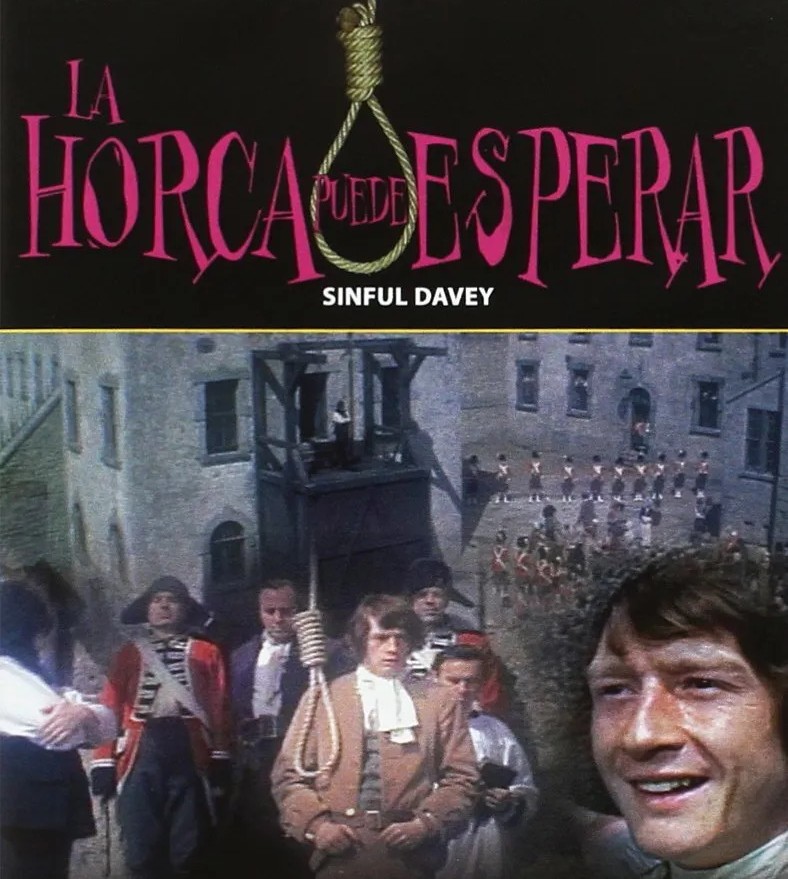
Major disappointment from a director of the caliber of John Huston. Granted, the quality of his output during the decade had been variable but this marked a new low and the suspicion lingers that he only took on the gig to spend time in Ireland – the movie was filmed there – where he had set up a home in the grand manner of a country squire. Equally odd is James Webb as screenwriter. Having chronicled  the American West via How the West Was Won (1962) and Cheyenne Autumn (1964), Webb had turned his attention to British history, beginning with Alfred the Great (1968).

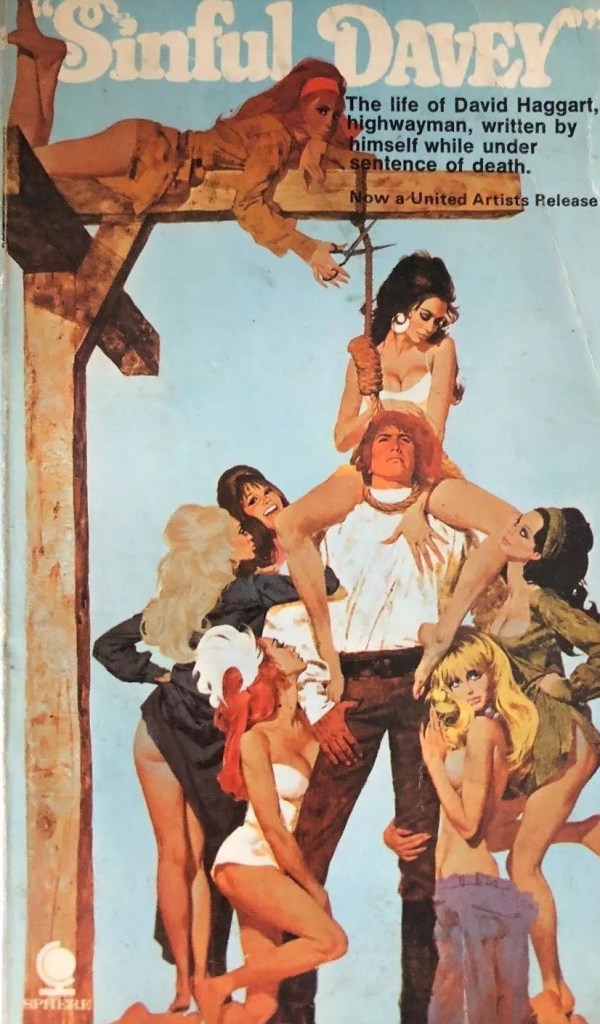
But where that had at least historical reality to guide the narrative, here Webb relies on the dubious autobiography of the titular subject, resulting in an episodic, picaresque, sub-Tom Jones (1963) and even sub-Where’s Jack? (1969) tale set in the Scottish Highlands.   And much as John Hurt later achieved considerable recognition for his acting, the role, as played, could have been handled just as easily by any number of rising male stars, since, beyond being able to affect two accents – broad Scots and upper-class English – little is required.

In fact, the director clearly couldn’t distinguish between the Irish and the Scottish accent as among the  joblot of accents, none more than serviceable, there is many an Irish lilt.  As if to make the point that he couldn’t care less, you will also discern on the soundtrack a refrain from “Danny Boy.”

Beyond that it made a good scene, quite why Davey Haggart (John Hurt) decided to announce his desertion from the British Army in such ostentatious manner is difficult to understand. He’s a drummer, marching along, banging said drum, when he takes it into his head to jump off the nearest bridge into the nearest river, complete with drum, only to find himself headed for a mill. In possibly the best line in the script, seeing the mill wheel blocking his escape, he mutters, “Who put that there?”

From here on it’s a tale of pursuit – two actually. Lawman Richardson (Nigel Davenport) leads the merry chase but he’s also got childhood sweetheart Annie (Pamela Franklin) on his tail to ease him out of scrapes in the hope that he’ll reform. Beginning as a pickpocket, he  switches to highway robbery and piracy, rarely with particular success. Loaded down with booty on the carriage he has stolen, for example, he loses control of the horses and is left at the side of the road, as poor as when he started. 

He’s certainly inventive but contemporary audiences will recoil from the notion of using the head a height-challenged man aloft another’s shoulders to test the rotting rafters inside a jail, leading not to escape but to a home-made pleasure parlor, since it provides entry to the female jail above where our hero establishes himself as a pimp.

But that’s as inventive as this picture gets and in the manner of Cat Ballou and Where’s Jack? you know that whenever a hero heads towards the gallows you can be sure the hanging will be thwarted. The period setting – the 1820s – offers little assistance, as the picture could be set any time before the invention of steam, and could as easily have taken place in a galaxy far far away long long ago called Brigadoon for all the period authenticity shown.

This didn’t lead to instant stardom for John Hurt and possibly just as well as he’d have been wasted in a series of ingenue roles. Pamela Franklin (And Soon the Darkness, 1970) doesn’t have much to do beyond trying to master a Scottish accent. Nigel Davenport (Play Dirty, 1968) was in his element playing yet another frosty authoritarian figure.

John Huston (Night of the Iguana, 1964) did prove one thing – that he lacked the knack for comedy.

Suspect / The Risk (1960) ****

Marvellous long-forgotten character-driven espionage drama exploring the twin themes of guilt and duty. It would appear to be stolen by two supporting actors, Ian Bannen and Thorley Walters, but in fact both play roles that have significant bearing not only on the narrative but on our understanding of the most important characters. Not only do we have the main plot, but we also have two well-worked sub-plots, one concerning disability and the other of more sinister relevance – a 1984 Big Brother theme.

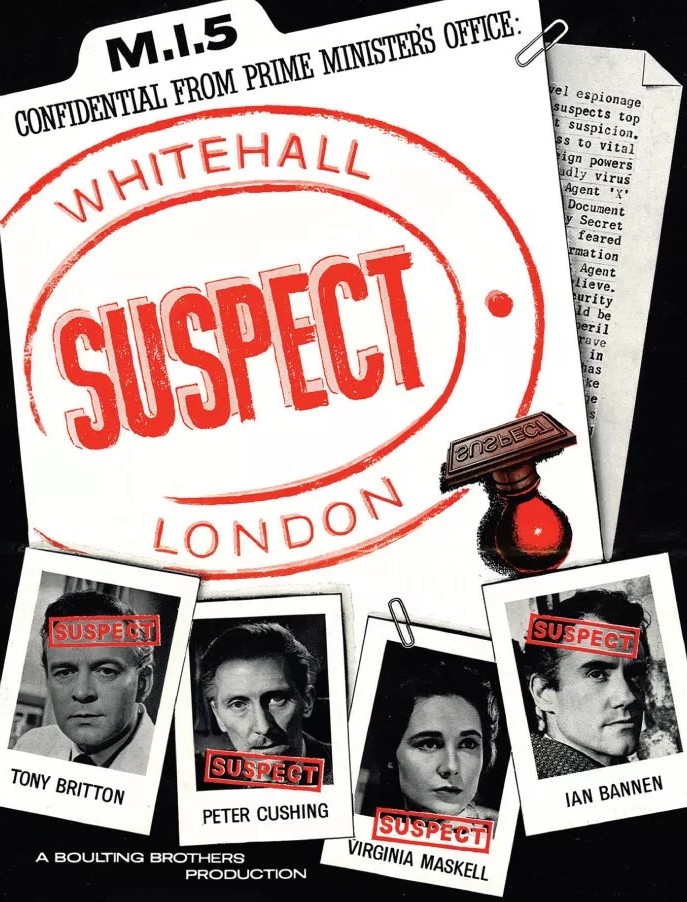
Basic tale concerns a laboratory that has discovered a bacteria that can cure plague. Hopes of  a celebratory drink all-round and academic kudos on publishing his paper for top boffin Professor Sewell (Peter Cushing) are dashed when the Government in the shape of the pompous Sir George Gatling (Raymond Huntly) steps in, steals the discovery and makes the staff sign the Official Secrets Act.

Romance No 1 – Virginia Maskell and Tony Britton in the lab.

While the revered professor takes it on the chin, colleague Bob Marriott (Tony Britton) is outraged so vocally in public that he attracts the attention of the shady Brown (Donald Pleasance) who suggests to the dupe that there is a way of getting the information out to the wider scientific community, especially to plague-ridden countries.

However, don’t let Sir George’s pomposity fool you. He doesn’t trust this bunch an inch and puts the Secret Service on their tail to assess “the risk” and we dip into the dark kind of web (not that kind of dark web) and the mundane business of deception and betrayal shortly to be explored by the likes of John Le Carre (The Spy Who Came in from the Cold, published in 1963) and Len Deighton (The Ipcress File, published a year earlier).

Rather than this outfit being headed by a version of the prim George Smiley, Mr Prince (Thorley Waters) has a lot more in common with the unkempt Jackson Lamb of the Slow Horses series. His incompetence is an act to make visitors to his shambles of an office under-estimate him.  But he’s got that Columbo knack of asking the most important question just when an interviewee thinks the interview is over.

Also in the background, coming more increasingly into the foreground, is an unusual love triangle between colleagues Bob and Lucy Byrne (Virginia Maskell), who kiss and hold hands in the cinema, and Lucy’s flatmate, the disabled war vet Alan Andrews (Ian Bannen). The fact that Lucy and Alan live together at a time when such a relationship was frowned upon and would be career death in certain circles and that they were once engaged to be married gives it an edge. That Alan has lost an arm and a hand so needs to be cared for – fed (as in food spooned into his mouth),  washed (you can guess that aspect), cigarette lit and removed between puffs, dressed – suggests significant intimacy for an adult.

Obviously, she’s the kind of lass who couldn’t abandon him to the welfare system, and he’s the kind of man who broke off their engagement so she wouldn’t feel tied to him for the rest of her life. But he also hates what he’s become, his desperate reliance on her, what he’s lost, and that’s turned him into not just a bitter individual but a particularly cunning one, who has developed the trick of torpedoing any nascent romance. “You can’t compete,” he gloats to Bob, “because you can’t make her feel good.”

Romance No 2 – Ian Bannen and Virginia Maskell.

But when that doesn’t work, he befriends Bob and surreptitiously eggs him on to betray his country and in so doing, hopefully, kill off the romance.

Mr Prince is a delight. Accorded the best lines, he makes great use of them. When his subordinate Slater (Sam Kydd) abrasively brings Dr Shole (Kenneth Griffith) in for questioning, he reprimands him with the rather coy, “Oh, you haven’t been rough again.” To Dr Shole (Kenneth Griffith), the most susceptible of the professor’s acolytes, he warns, “Tell him (Sewell) not to be a fool or you’ll smack him on the backside.”  Though Dr Shole has a superb retort, “We’re not exactly on those terms.”

Professor Sewell appears mostly on the back foot. While quietly seething at being denied his professional day in the sun, he accepts duty. Even so, he’s smart enough to outwit Prince when the traitor is caught.

The background of the wheels-within-wheels of Government, the silent overseeing of ordinary lives, the authorized level of spying, comes as something of a shock, since despite George Orwell’s best efforts Big Brother was seen as a clever fiction that could not occur in this most democratic and upright of countries where “fair play” was the rule. Visually, this is well done, we see eavesdroppers in mirrors in pubs and, as I said, Prince seems the least effective of operatives but with the kind of personality that you could easily have built a series around.

Disability from war was a constant of post-war British pictures, most often demonstrated by a character with a limp, as with general dogsbody Arthur (Spike Milligan) here. The Oscar-winning The Best Years of Our Lives (1946) was the most effective at dealing with the physical after-effects of the Second World War. But there, the worst-affected soldier, had prosthetic hands. Here, Alan does not, so the scenes of him being tended to by Lucy are emotionally more powerful.

She tends to his emotions, too, and will embrace him and kiss him on the mouth though he’s not dumb enough to read true romantic commitment into those demonstrations of affection. Clearly, there is emotional residue from their engagement, from which you guess she will ultimately be unable to entangle herself, unless he can find a more brutal way of helping her out of the dilemma.

The lab aspect is surprisingly well done. We don’t get any real information on the scientific breakthrough. Mostly, what we view is the grunt work, the laborious checking of thousands of samples for another experiment. At one point Bob thrusts his arm into a contraption packed with buzzing flies as if he was a competitor in I’m a Celebrity, Get Me Out of Here.

Ian Bannen (The Flight of the Phoenix, 1965) is the standout but character actor Thorley Waters (Sherlock Holmes and the Deadly Necklace, 1962) runs him close. Tony Britton (better known later for television comedy) has the least interesting role, but Virginia Maskell (Interlude, 1968) has too much to do without dialog to demonstrate her dilemma. Peter Cushing (The Skull, 1965) is solid as always and Spike Milligan provides light relief.

Joint direction by the Boulting Brothers (The Family Way, 1967), Roy and John. Screenplay by Nigel Balchin (Circle of Deception, 1960) based on his own novel.  

Exceptionally solid stuff. I was very much taken by the unusual approach, the themes and the acting.

Worth a look.

Sweeney! (1977) ****

The two-fisted trigger-happy cops that had changed the Hollywood landscape since Clint Eastwood burst onto the scene hadn’t found much correlation in the small-screen. Television producers were particularly averse to violence and even a new generation of sleuths were only a tad above the cosy crime of previous decades. Since James Bond easily covered the random killing aspect in British movies, there seemed little room for anyone else.

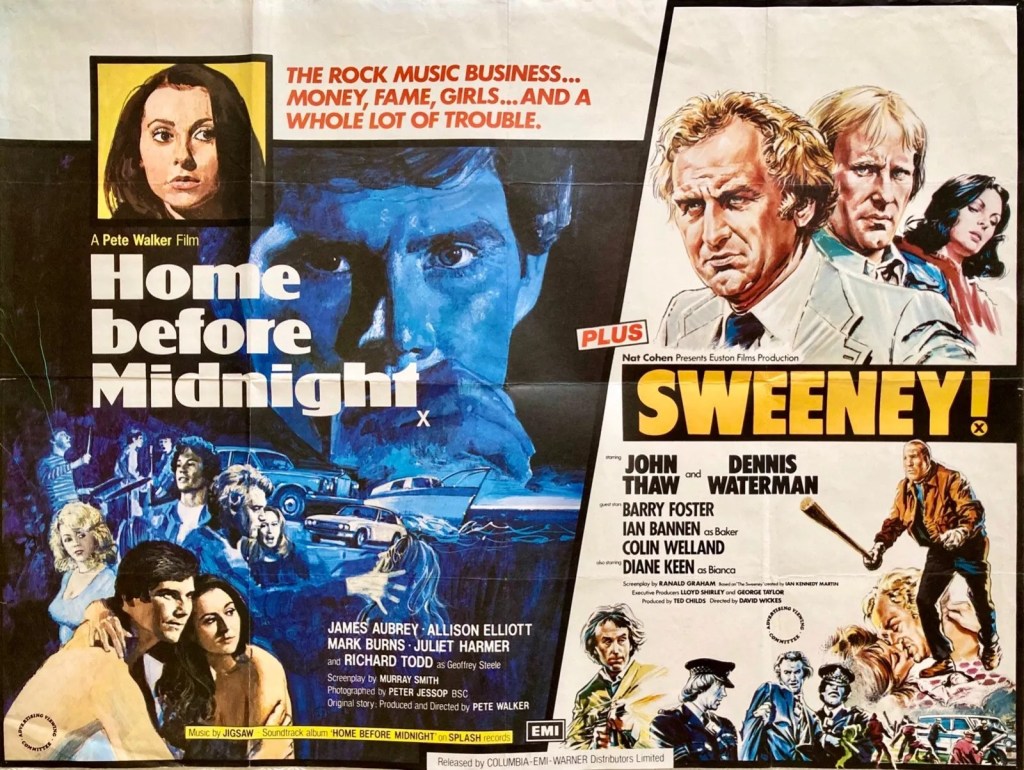
Sweeney! (1977), a speedy spin-off from a successful British independent television series, proved them wrong, the movie censor permitting considerably more leeway on the violence front.  These cops are just itching to lay a hand on gangsters and, as if transplanted from Chicago, bring baseball bats and pistols to a fight.

The action only slows down when the subplot gets mired in delivering a political message about big business and corruption or when one of the characters has to take time out to explain the meaning of the title. Turns out there’s a sneaky high-end operator Elliott McQueen (Barry Foster) who runs a string of high-class sex workers to hook politicians like Charles Baker (Ian Bannen). When Baker’s girlfriend Janice (Lynda Bellingham) ends up in the mortuary – suicide the official verdict – McQueen applies pressure to get an oil deal done.

Baker’s gals are expert in what these days would be known as providing the “Girlfriend Experience” though the blokes they service aren’t the ones paying. But a police informant, soft on Janice, believes she was murdered and calls in Detective Inspector Jack Regan (John Thaw) to informally investigate.

When Regan treads on McQueen’s toes it triggers a spate of violence. First the informant is blown away by a machine gun from thugs disguised as coppers. Then a nosy journalist (Colin Welland) is blown up. Then Regan is stitched up and suspended from duty. Naturally, Regan persists with a surreptitious investigation. But the thugs aren’t so covert and he interrupts a gangland hit on Bianca (Diane Keen), another of the “girlfriends” who knows too much.

Not much detection required, really, when the criminals are so open about their criminality and even the most high-ranking politician or sanctimonious cop is going to find it hard to let machine-gun-toting gangsters roam through London. So there’s plenty bloody action and  quite a clever pay-off.

The rampant violence in British cinema earlier in the decade had been confined to the gangsters of Get Carter (1970) and Villain (1971) and to pictures wrapped in halos of critical protection such as A Clockwork Orange (1971) and Straw Dogs (1971). Sweeney! ushered in a new era, when cops could adopt the same methods as criminals.

Regan was the rumpled cop, his sidekick Det Sgt Carter (Dennis Waterman) theoretically the more handsome, except his boss had as much success with women. What both were best at was riling superiors and arguing with everyone. You’d need a good grasp of the various policing departments to keep up – here we have Special Branch and The Flying Squad (The Sweeney) and ordinary coppers.

The predilection for selective use of Cockney rhyming slang was a feature of the British crime picture. Flying Squad translated as Sweeney Todd and was then truncated to The Sweeney. Oddly enough there was no rhyme for Special Branch and Scotland Yard, despite the advent of The Shard, has not made its way onto the rhyming dictionary.

British studios had increasingly turned to television as production levels tumbled, but generally in the comedy genre, Up Pompeii (1971), On the Buses (1971) and Steptoe and Son (1972), plus vaious sequels, registering the biggest box office.

John Thaw and sidekick Dennis Waterman proved to be long-term stalwarts of British television, the former heading up Redcap (1964), The Sweeney (1975-1978), Inspector Morse (1987-2000) and Kavanagh QC (1995-2001), the latter following The Sweeney with Minder (1979-1989) and New Tricks (2003-2015). Diane Keen starred in The Feathered Serpent (1976-1978), The Cuckoo Waltz (1975-1980), Rings on their Fingers (1978-1980), Foxy Lady (1982-1984), You Must Be the Husband (1987-1988) and various others. Lynda Bellingham, in a bit part as a naked corpse, would become a favorite through a long-running commercial.

By this time Britain had also produced a core of strong supporting actors, not of the quality of the previous generation of Laurence Olivier or John Gielgud, but with a considerable portfolio behind them, Barry Foster second-billed in Frenzy (1972), Ian Bannen Oscar-nominated in The Flight of the Phoenix (1966).

Directed with huge enjoyment by David Wickes in his movie debut from a screenplay by Ranald Graham (Shanks, 1974)  and Ian Kennedy Martin (Mitchell, 1975).

Gotcha!

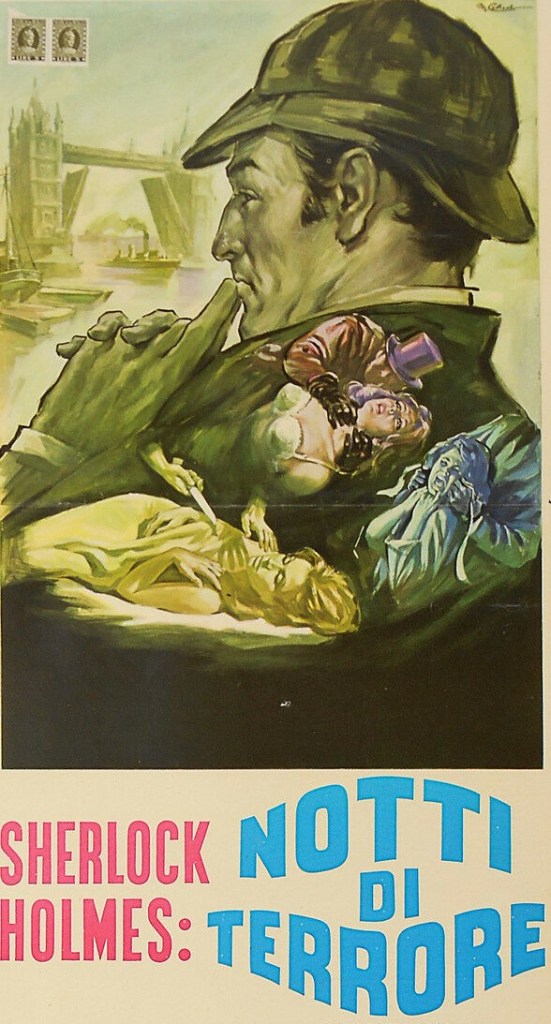
A Study in Terror (1965) ****

Excepting Sherlock Holmes and the Deadly Necklace (1962), the world’s most famous fictional detective had been absent from the big screen for over two decades so it seemed an inspired decision to set him on the trail of the world’s most infamous serial killer. The result is high-class comfort food, classic deduction coupled with barbaric murders in a fog-bound London replete with cobbled streets, Dickensian urchins and sex workers apop with cleavage and corset. Throw in sensitivity towards the abject poverty of the period, female exploitation and a nod towards an upper-class cover-up and you have a movie with a surprisingly contemporary outlook.

This is a tougher Holmes, handy with his fists, sporting a spring-loaded blade in his walking stick. The investigation draws in the Prime Minister (Cecil Parker) and the Home Secretary (Dudley Foster) as well as Sherlock’s pompous brother Myron (Robert Morley) and the ubiquitous Inspector LeStrade (Frank Finlay).

Pretty quickly it is Suspects Assemble. Due to a scalpel being the murderer’s instrument of choice, doctors are immediately implicated, the most likely candidate the philanthropic Dr Murray (Anthony Quayle) who operates s soup kitchen. Publican Max Steiner (Peter Carsten), with a sideline in blackmail, is another possibility. And there is the mysterious disinherited son of a lord, Michael Osborne, who has married sex worker Angela (Adrienne Corri).

As ever, the plot is complicated by red herrings and sleights of cinematic hand. But the highlight of a Holmes picture is the sleuth’s mastery of deduction based on clues missed by the ordinary mortal and every now and then the story grinds to a halt to allow time for the detective to demonstrate genius. Occasionally he dons a disguise. And thoroughly enjoyable these scenes are before he gets down to the main business of uncovering the killer.

A Study in Terror introduces social depth to the Holmes saga. When the crimes focus the media spotlight on Whitechapel Dr Murray draws attention to the constant “murder by poverty” ignored by the state. Female exploitation is of course the norm in the sex worker business and small wonder that such women are easy targets for the Ripper and although that is an overdone trope in this case a different angle comes into play. 

Shakespearian actor John Neville (Oscar Wilde, 1960) handles the main character with considerable aplomb with Donald Houston (The Blue Lagoon,1949) as his often baffled sidekick Watson. Robert Morley (Genghis Khan, 1965) is a splendid Mycroft although Anthony Quayle (East of Sudan, 1964) fails to nail down his Scottish accent.

The considerable supporting cast includes Judi Dench making her second film appearance, Barbara Windsor of Carry On fame, John Fraser (Operation Crossbow, 1965), John Cairney (Jason and the Argonauts, 1963), Peter Carsten (Dark of the Sun, 1968),  singer Georgia Brown (Nancy in the original stage production of Oliver!), Edina Ronay (The Black Torment, 1964), Corin Redgrave (The Girl with the Pistol, 1968), former British leading lady Kay Walsh (Oliver Twist, 1948) and future television comedy writer Jeremy Lloyd (Are You Being Served?, 1972-1985).

The picture was unusual in that it was not drawn from the existing Holmes stories but as an original devised by Derek and Donald Ford (The Black Torment), the former going onto a more extensive career as a director of British sexploitation pictures such as Suburban Wives (1972). Production company Sir Nigel Films had been set up to exploit the Holmes legacy.

Director James Hill (The Kitchen, 1961) had won an Oscar for the short Giuseppina (1960) and was a year away from his breakthrough Born Free. Given the low-budget this is a highly watchable picture.

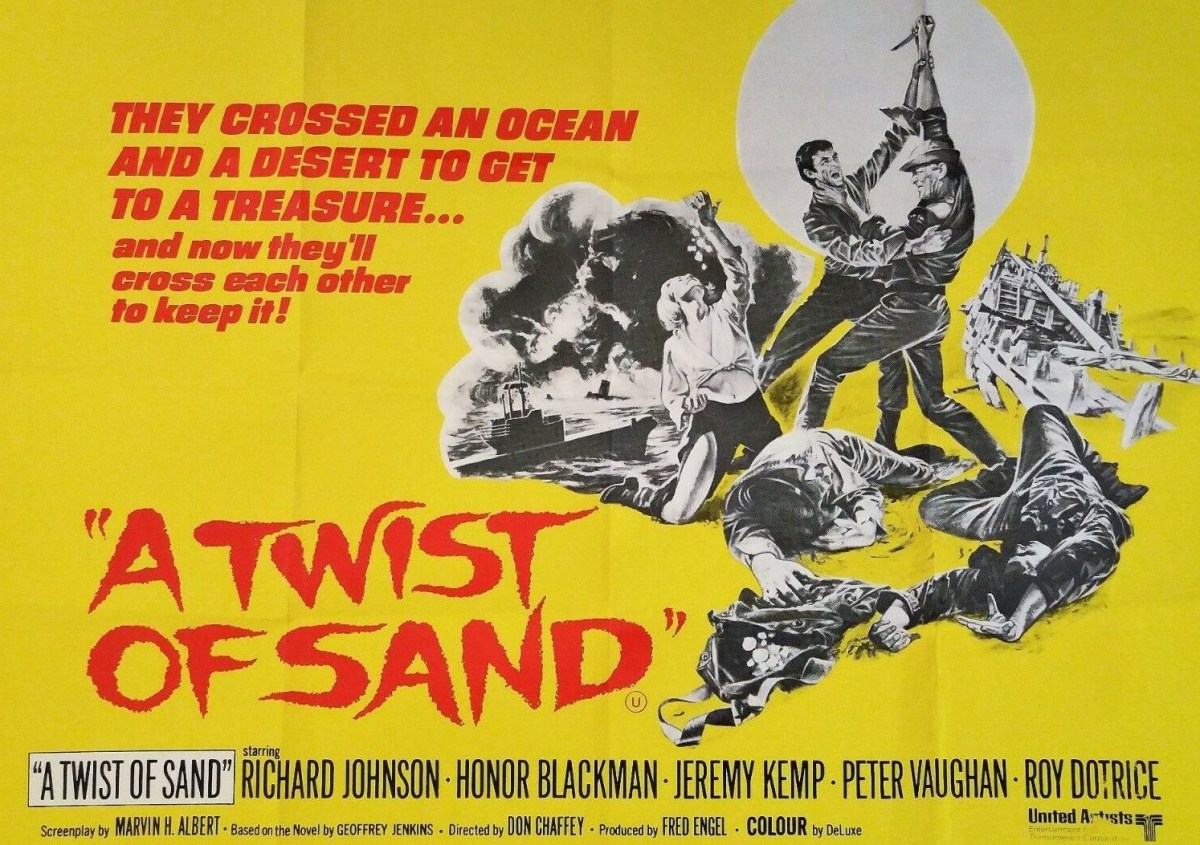
A Twist of Sand (1968) ***

Initially promising, ultimately disappointing thriller that proves you should not go to sea  without a big budget. Because he is the only skipper to have successfully negotiated the Skeleton Coast off Namibia in South Africa, smuggler Geoffrey Peace (Richard Johnson) gets roped into a scheme to collect stolen diamonds by Harry Riker (Jeremy Kemp) and Julie Chambois (Honor Blackman).

Peace knows his way around this area thanks to World War Two submarine exploits and that particular expedition is recalled both in a flashback and its repercussions form part of a plot. Also on board the boat are the goggle-eyed knife-wielding Johann (Peter Vaughn) and Peace’s shipmate David (Roy Dotrice).

Peace has to navigate through the treacherous waters of the Skeleton Coast before the team embark on a trek through the desert to find the diamonds, hidden in the unlikely location of a shipwreck, itself in imminent danger of being buried in an avalanche of sand that could be triggered by sudden movement or sound.

On paper – and it has been adapted from the bestseller by Geoffrey Jenkins – it has all the ingredients of a top-class thriller, but it doesn’t quite gel. For a start, the flashback, where Peace has to hunt down a new class of German submarine and not only sink it but make sure there are no survivors, gets in the way of the action.

The sexual tension you might expect to simmer between Peace and Julie does not appear to exist, the bulk of the threat coming from the villainous-looking pair, Riker and Johann, the former already known to be untrustworthy, the latter too fond of producing a knife at odd occasions. The trek into the desert takes way too long and rather than increase tensions slackens it off and there is no real explanation as to why the ship was lost so far into the desert without entering Clive Cussler archaeological territory.

Extracting the diamonds is certainly a taut scene, with the sand dunes threatening to collapse any moment but the climax you saw coming a long way off and although there is an ironic twist it is not enough to save the picture.

On the plus side, Richard Johnson (Deadlier Than The Male, 1967) shucks off the suave gentleman-spy persona of Bulldog Drummond to emerge as a snarly, believable smuggler. But Honor Blackman (Moment to Moment, 1966) is wasted and this is one of the least effective bad guy portraits from the Jeremy Kemp (The Blue Max, 1966) catalog. Roy Dotrice (The Heroes of Telemark, 1965) is better value while Peter Vaughn (Hammerhead, 1968), menacing enough just standing still, overplays the villain.

Set up as a thriller very much in the Alistair MacLean vein, this shows just how good MacLean’s material was, how great a command he had of structure and not just of action but twists along the way. A Twist of Sand wobbles once too often in its structure and never quite manages to build up the necessary tension between characters. Although the Skeleton Coast sea-scene falls apart due to defective special effects, the other two sequences at sea are well done, the opening section where Peace is chased by Royal Navy vessels, and the underwater attack on the German submarine where murky water manages to obscure the effects sufficiently they appear effective enough.

Don Chaffey (The Viking Queen, 1967) does his best with material that’s not quite up to standard. Marvin H. Albert (Tony Rome, 1967) doesn’t do as good a job of adapting other people’s work as he does his own. 

Beat Girl / Wild for Kicks (1960) **

More social document than drama, but that aspect somewhat diluted by the moviemakers’ attempts at exposing rebellious youth while taking for granted more sordid adult behavior. Narrative flow is interrupted now and then to showcase Adam Faith’s singing and to accommodate a few striptease acts. Probably more interesting is the array of new talent on show.

Spoiled teenager Jennifer (Gillian Hill) heads for the wild side of town to experience the beatnik lifestyle in Soho coffee shops and cellars. That there are no drugs involved, and that alcohol is considered “square” – as for that matter is violence – may come as a surprise to students of the period. Apart from one episode of road-racing and playing “chicken” along a railway track, most of the time the gang listen to music or dance until Jennifer gets it into her head that ejoining a striptease show might give her life the thrill it is missing.

This is prompted by the discovery that her new too-young stepmother Nichole (Noelle Adams) has been a stripper and most likely a sex worker in Paris before marrying wealthy architect Paul (David Farrar), cueing a round-robin of confrontations. Strangely enough, from the narrative perspective, none of the young bucks appear romantically interested in the provocatively dressed Jennifer and so it is left to creepy club owner Kenny (Christopher Lee) to make a move.

The gaping hole left by lack of narrative drive is not offset by immersion in the beatnik or striptease scene. Back in the day the British censors took the editing scissors to the striptease but although restored versions available now contain nudity you are left wishing that there was some lost element to the beatnik sections that would have given the picture the energy it required.

Gillian Hill (Les Liaisions Dangereuses, 1959), comes over as a cross between Brigitte Bardot and Diana Dors without having an ounce of the sex appeal of either. All pout and flounce, she is unable to inject any heart into her two-dimensional character, although given her youth and inexperience this was hardly surprising. Former British star David Farrar (Black Narcissus, 1947) was coming to the end of his career and in a thankless role as a frustrated father could do little to rescue the project.

French actress Noelle Gordon (Sergeant X of the Foreign Legion, 1960) could have been Jennifer’s mother given her own tendencies towards wiggle and pout but at least she makes a stab at trying to overcome her step-daughter’s hostility.

In the main, the picture’s delight is bringing to the fore a whole chorus of new faces. Pick of the supporting cast is Shirley Anne Field (Kings of the Sun, 1963) who doesn’t just have a knowing look but looks as if she knows what’s she doing acting-wise. Making his movie debut was teen pop idol Adam Faith, who had made his name playing in coffee bars. He had already notched up a couple of number one singles, but doesn’t quite set the screen on fire. Peter McEnery (The Fighting Prince of Donegal, 1966) plays his inebriated pal.

You can also spot Oliver Reed (Women in Love, 1969), Julie Christie (Doctor Zhivago, 1965), Claire Gordon (Cool It, Carol, 1970) and Nigel Green (Jason and the Argonauts, 1963).

Perhaps the most important debut belonged to composer John Barry. He had already been working with Adam Faith. Barry’s music for the film was the first British soundtrack album ever released, reaching number eleven on the charts, and opening the doors for future soundtrack albums, not least of which was the rich vein of theme tunes produced by Barry in the next few years. 

French director Edmond T. Greville, who brought little panache to the subject matter, would redeem himself with his next picture The Hands of Orlac (1960). 

This doesn’t fall into the “so-bad-it’s-good” category, nor has it been unfairly overlooked, and probably is better known as an example of the kind of exploitation B-picture that the Americans do so much better and a reminder that, except on rare occasions such as The Wild One (1953), older moviemakers seem incapable of capturing the essence of youth.

The Switch (1963) ***

Dr No (1962) was more famous for kick-starting nascent careers – step forward Sean Connery and Ursula Andress – rather than reviving careers that had looked dead and buried as was the case with Zena Marshall. I had just come across Ms Marshall in her last picture, The Terrornauts (1967), a cult sci fi from Amicus, that I had been asked to provide an audio commentary for (you’ll have to wait till next year for that) and was intrigued to discover that, while never becoming a big star, she had managed to eke out a decent living since her debut in Caesar and Cleopatra in 1945. She’d never achieved much more than rising star status, B-movies more her line. She hadn’t made a picture in five years until Dr No but thereafter managed leading lady once a year until her retirement.

Director Peter Maxwell (Serena, 1962) fell into much the same movie backwater but still had the knack of generating interesting narratives. The screenplay turns on some interesting realism, an unusual gadget (especially for this genre)  as well as a couple of entertaining happenstances and in  Zena Marshall one of two very self-assured females who light up a picture otherwise peppered with dour males.

The eagle-eyed among you will have noted that I’ve used a still from “Dr No” as the main picture. Similarly, this is one of Zena Marshall’s earlier movies.
Extant posters of “The Switch” are non-existent, it appears.

A joint police and customs operation has snared a smuggler in a sting. But, almost immediately after Inspector Tomlinson (Dermot Walsh) and Customs Agent Bill Craddock (Anthony Steel) latch onto their prey, their informant ends up in the River Thames and they hit a dead end trying to find the Mr Big behind the high-class watch smuggling racket.

Meanwhile model Carolyn (Zena Marshall), on holiday in France, is taken for a romantic meal by seductive Frenchman Lecraze (Arnold Diamond) while his colleagues stuff her petrol tank with watches.

Takes a while for Carolyn to become a suspect. There’s quite a lot of fun to be had from unexpectedly inept gangsters. When she returns home, she finds her flatmate’s cousin John Curry (Conrad Phillips) having a bath. With his car parked in her garage, she finds somewhere else to stay. His car is mistakenly stolen, as is the car she exchanges at the garage while the original one she brought back from France is in for repairs. The crooks repeatedly steal the wrong car.

Eventually, the cops break open her petrol tank and find the hidden watches. Although under suspicion she is freed, and, being a confident young lass, and quite accustomed to men of all ages taking her out for dinner and buying her presents, is nonetheless surprised when her latest admirer John presents her with his firm’s latest invention, a miniature radio transmitter hidden inside a cigarette case.

Which is just as well because the Frenchman reappears and kidnaps Carolyn hoping to find out from her what happened to her car. Meanwhile, the cops dig up gangster’s moll Janice (Dawn Beret) whose boyfriend is mixed up in the villainy and has herself unwittingly brought stolen goods into the country in her petrol tank after being chatted up by a smooth Frenchman. She’s a cheeky young thing,  as self-assured as Carolyn, suggesting to the straight-laced inspector that if he’s not doing anything at the weekend they could get married.

Meanwhile, John has teamed up with the good guys while they manage to survive Janice’s stream of quips and attempt to track down the kidnapped Carolyn. She doesn’t manage to hold out for long, not when Mr Big removes the gloves.

All in all, it’s cleverly done, playing all the time with audience expectation, not just the cocky confidence of the two women, who are clearly accomplished at leading men astray, but the quirks of the storyline – including a failed escape up a chimney – the details of the smuggling operation, and the introduction of the James Bond-style gadget. There’s even some cheeky self-awareness, John seen sitting up in bed reading the movie tie-in edition of Dr No which features Zena Marshall on the cover.

Apart from Zena Marshall, there’s an interesting cast. Anthony Steel (The Story of O, 1975), husband of Anita Ekberg, was just back from a stint in Rome. Conrad Phillips (The Secret Partner, 1961) had played William Tell in the television series and Dermot Walsh Richard the Lionheart in similar. It marked the last screen appearance of Susan Shaw (Fire Maidens from Outer Space, 1956) and perky Dawn Beret (Victim, 1961) looked promising. In bit parts look out for Carry On regular Peter Butterworth  and Rose Alba (Thunderball, 1965)

This sat on the shelf for a year before going out on the Odeon circuit as support to spy picture Hot Enough for June/Agent 8¾ (1964) starring Dirk Bogarde.

Except for horror, Britain didn’t stoop to having B-Movie Queens, but if they had Zena Marshall would wear the crown.

Dr No (1962) *****

Minus the gadgets and the more outlandish plots, the James Bond formula in embryo. With two of the greatest entrances in movie history – and a third if you count the creepy presence of Dr No himself at the beds of his captives – all the main supporting characters in place except Q, plenty of sex and action, plus the credit sequence and the theme tune, this is the spy genre reinvented.

Most previous espionage pictures usually involved a character quickly out of their depth or an innocent caught up in nefarious shenanigans, not a man close to a semi-thug, totally in command, automatically suspicious, and happy to knock off anyone who gets in his way, in fact given government clearance to commit murder should the occasion arise. That this killer comes complete with charm and charisma and oozes sexuality changes all the rules and ups the stakes in the spy thriller.

 Three men disguised as beggars break into the house of British secret service agent Strangeways (Tim Moxon) and kill him and his secretary and steal the file on Dr No (Joseph Wiseman). A glamorous woman in a red dress Sylvia Trench (Eunice Gayson) catches the eye of our handsome devil “Bond, James Bond” (Sean Connery) at a casino before he is interrupted by an urgent message, potential assignation thwarted.

We are briefly introduced to Miss Moneypenny (Lois Maxwell) before Bond is briefed by M (Bernard Lee) and posted out immediately – or “almost immediately” as it transpires – to Jamaica, but not before his beloved Beretta is changed to his signature Walther PPK and mention made that he is recovering from a previous mission. But in what would also become a series signature, liberated women indulging in sexual freedom, and often making the first move, Ms Trench is lying in wait at his flat.

Another change to the espionage trope, this man does not walk into the unknown. Suspicion is his watchword. In other words, he is the consummate professional. On arrival at Jamaica airport he checks out the waiting chauffeur and later the journalist who takes his picture. The first action sequence also sets a new tone. Bond is not easily duped. Three times he outwits the chauffeur. Finally, at the stand-off, Bond employs karate before the man takes cyanide, undercutting the danger with the mordant quip, on delivering the corpse to Government house, “see that he doesn’t get away.” 

Initially, it’s more a detective story as Bond follows up on various clues that lead him to Quarrel (John Kitzmiller), initially appearing as an adversary, and C.I.A. agent Felix Leiter (Jack Lord) before the finger of suspicion points to the mysterious Dr No and the question of why rocks from his island should be radioactive. Certainly, Dr No pulls out all the stops, sending hoods, a tarantula, sexy secretary Miss Taro (Zena Marshall) and the traitor Professor Dent (Anthony Dawson) to waylay or kill Bond.

But it’s only when our hero lands on the island and the bikini-clad Honey Rider (Ursula Andress) emerges from the sea as the epitome of the stunning “Bond Girl” that the series formula truly kicks in: formidable sadistic opponent, shady organization Spectre, amazing  sets, space age plot, a race against time. 

It’s hard not to overstate how novel this entire picture was. For a start, it toyed with the universal perception of the British as the ultimate arbiters of fair play. Yet, here was an anointed killer. Equally, the previous incarnation of the British spy had been the bumbling Alec Guinness in Our Man in Havana (1959). That the British should endorse wanton killing and blatant immorality – remember this was some years before the Swinging Sixties got underway – went against the grain.

Although critics have maligned the sexism of the series, they have generally overlooked the female reaction to a male hunk, or the freedom with which women appeared to enjoy sexual trysts with no fear of moral complication. Bond is not just macho, he is playful with the opposite sex, flirting with Miss Moneypenny, and with a fine line in throwaway quips.

Director Terence Young is rarely more than a few minutes away from a spot of action or sex, exposition is kept to a minimum, so the story zings along, although there is time to flesh out the characters, Bond’s vulnerability after his previous mission mentioned, his attention to detail, and Honey Rider’s backstory, her father disappearing on the island and her own ruthlessness. The insistently repetitive theme tunes – from Monty Norman and John Barry – was an innovation. The special effects mostly worked, testament to the genius of production designer Ken Adam rather than the miserable budget.

Most impressive of all was the director’s command of mood and pace. For all the fast action, he certainly knew how to frame a scene, Bond initially shown from the back, Dr No introduced from the waist downwards, Honey Rider in contrast revealed in all her glory from the outset. The brutal brief interrogation of photographer Annabel Chung (Marguerite LeWars), the unexpected seduction of the enemy Miss Taro and the opulence of the interior of Dr No’s stronghold would have come as surprises. Young was responsible for creating the prototype Bond picture, the lightness of touch in constant contrast to flurries of violence, amorality while blatant delivered with cinematic elan, not least the treatment of willing not to say predatory females, the shot through the bare legs of Ms Trench as Bond returns to his apartment, soon to become par for the course.

Future episodes of course would lavish greater funds on the project, but with what was a B-film budget at best by Hollywood standards, the producers worked wonders. Sean Connery (The Frightened City, 1961) strides into a role that was almost made-to-measure, another unknown Ursula Andress (The Southern Star, 1969) speeded up every male pulse on the planet, Joseph Wiseman (The Happy Thieves, 1961) provided an ideal template for a future string of maniacs and Bernard Lee (The Secret Partner, 1961) grounded the entire operation with a distinctly British headmaster of a boss.

Masterpiece of popular cinema.

Behind the Scenes: “The Psychopath” (1966)

Amicus was part of an unholy triumvirate – the others being Hammer and American International – serving up horror during the 1960s to a global audience. Less prolific than the others, Amicus, headed up by expatriate New Yorkers Milton Subotsky and Max Rosenberg, had an American distribution deal with Paramount.

However, the pair had been more successful, at least in Britain, on the sci fi front, Dr Who and the Daleks (1965), an adaptation of the highly successful BBC television series, had been a huge hit on the domestic front, with the sequel Daleks Invasion Earth 2150AD (1966) not too far behind. But both had landed like a damp squid in the U.S.

Nor had their previous incursion into the horror fields done much better. Dr Terror’s House of Horrors (1965) had only managed a release as a supporting feature in Britain. The same fate was accorded The Skull (1965), but only after sitting on the shelf for a year. So a great deal was riding on their third horror picture. The whopping success of Dr Who and the Daleks, at least in Britain, guaranteed them a stay of execution.

“I like making horror films,” said Subotsky, “or perhaps I should say films of imagination rather than reality. The second thing is I like silent pictures. I think you should be able to tell a story visually and not by talking. And in horror films you can have long stretches of action.”

The Psychopath – initially going before the cameras as Schizo – looked a promising venture. The biggest name attached was quite a catch, even if not one who would feature in the picture. Robert Bloch, courtesy of Pyscho (1960), filmed to enormous critical and commercial acclaim by Alfred Hitchcock, was the most famous name in horror. He had penned the story that became The Skull. In addition to buying the rights to his story, this time Amicus lined him up for screenwriting duties.

In front of the camera, Amicus gambled on Patrick Wymark, a big British television star courtesy of The Plane Makers (1963-1965) who was elevated to top billing after playing the second lead in The Skull. Direction was once again by Freddie Francis, who had won the Oscar for cinematography for Sons and Lovers (1960). Francis specialized in horror – helming The Brain (1962), Paranoiac (1963), Nightmare (1964) and The Evil of Frankenstein (1965) before becoming Amicus’s in-house director with Dr Terror’s House of Horrors (1965) – the first of the portmanteau features with which Amicus would later be associated – and The Skull

He was credited with a distinct individual visual style – attracting the attention of Cahiers du Cinema and French critics – and was considered a safe pair of hands. However, that last element was tested here. Halfway through shooting it was obvious the movie was going to come up short in terms of running time. It was already intended to be a tight little feature, at a projected 80 minutes. It was apparent that without substantial changes the movie would come in ten minutes shy of the planned time. Even at 80 minutes, it would struggle to qualify for main feature status. At 70 minutes, it would have no chance.

The producers did not always see eye-to-eye. Although Milton Subotsky had been responsible for setting up the project, Rosenberg soon took over. Complained Subotsky, “I found Max could really be a bully when he wanted and he had nasty temper. I’ll admit I was never good at standing up for myself and he just walked all over me.”

However, when the movie hit the running time stumbling block, Rosenberg had to turn to his colleague for help. Subotsky had written Dr Terror’s House of Horrors, Dr Who and the Daleks and The Skull. Taking a utilitarian approach, Subotsky availed himself of whoever was on set or available.

The burden fell on Robert Crewdon who played the sculptor Victor. Subotsky added his murder scene which was shot in a scrapyard created on the back lot at Shepperton with a batch of old cars purchased for £300. Subotsky apparently also directed the scene since Freddie Francis was busy elsewhere.

However, the running time wasn’t the only problem. Once the picture was complete, it was fairly obvious who the killer was. So Subotsky took over the task of re-editing the movie as well. “Apart from wanting to be a writer, (Milton) wanted to be an editor,” explained Freddie Francis.

Subotsky rearranged the picture so that “every time Patrick Wymark opens his mouth, we cut away from him, and overlaid his dialog, and every time someone replied we overlaid their dialog. And we changed the whole last scene with post-synched dialog and that way we changed the murderer.”

Though reviews were generally positive – “atmospheric thriller” (Box Office), “top grade shocker” (Variety), the   backers were not happy with the result, even the extended version. The extra 13 minutes of footage wasn’t sufficient to win a main release of the British ABC circuit – it went out as support and later was reissued with The Skull. In the U.S. it had a varied, though hardly wide, release. In some cities, Paramount sent it out as support to The Naked Prey. In first run in St Louis, Cincinnati, Boston and Portland, it was the main feature with supports including reissues of Nevada Smith (1966) and Lady in a Cage (1964) Box office was generally “tepid,” “mild” or “dull”. It supported A Study in Terror (1965) in Kansas City and Chamber of Horrors (1966) in Toronto. It didn’t make much money in either country, but did very well in Italy.

Robert Bloch wasn’t pleased either. “The idea is better than the film,” he complained. “It would have made a better one-hour teleplay than a feature.”

This was the third in Amicus’s four-picture deal with Paramount and after The Deadly Bees (1967), the Hollywood studio severed contact.

Perhaps the most interesting aspect of this company best known for its horror output is that for a considerable period it tried to shuck off that tag. To some extent, it became a horror specialist by default because other projects failed to get off the ground – for example in 1964 it was scheduled to make How I Won the War with Richard Lester for United Artists and Adventure Island based on an Arthur C Clarke tale for Universal – or because a switch into other genres failed to hit the box office mark.

After the dual flop of The Deadly Bees (1967) and Torture Garden (1967), the duo lined up spy thriller Danger Route (1969) and literary drama A Touch of Love/Thank You Very Much (1969) with Oscar winner Sandy Dennis. They should have been followed by adaptations of Ancient Pond by Courtney Brown – described as “a novel of passion and revenge in a war-ravaged city” – and sci fi satire The Richest Corpse in Showbusiness by Dan Morgan, both novels purchased in 1967. But neither was greenlit and eventually Amicus returned to what it did best – horror.

The Psychopath (1966) ****

As evidenced by its popularity in Italy often considered a forerunner of the giallo subgenre. While the involvement of Robert Bloch brings hints – mother-fixation, knife-wielding killer –  of his masterpiece Psycho (1960), here some of those themes as reversed. And the stolid detective and younger buddy suggests the kind of pairing that would populate British television from The Sweeney (1975-1978) onwards. Surprising, then, with all these competing tones that it comes out as completely as the vision of director Freddie Francis (The Skull, 1965), especially his use of a rich color palette that would be the envy of Luchino Visconti (The Leopard, 1963).

Theoretically mixing two genres, crime and horror, the resonance figures mostly towards the latter. Considering the crime element just for a moment, this features a serial killer, in the opposite of what we know as normal multiple murder convention, who leaves a memento at the scene of the crime rather than taking one away such as a lock of hair or something more intimate. Also, the list of suspects rapidly diminishes as they all turn into victims, still leaving, cleverly enough, a couple of contenders.

What’s most striking is the direction. Francis finds other ways rather than gore to disturb the viewer. The first death, a hit-and-run, focuses on the violin case, dropped by the victim, being crushed again and again under the wheels of the car. There’s a marvelous scene where a potential victim tumbles down a series of lifeboats.

The camera concentrates more on the villain’s armory than their impact: noose, knife, oxy-acetylene torch, jar of poison, the lifeboats, the aforementioned car. There are intriguing jump-cuts. We go from the smashed violin to a very active one, part of a string quartet. From toy dolls in rocking chair to skeletal sculpture. From a string of metal loops choking a victim to a man forking up spaghetti.

We go from the very conventional to the jarring, serene string quartet and loving daughter to wheelchair bound widow talking to the dolls, so real to her she shuts some naughty ones away in a cupboard. We move from one cripple to another, from real toys to human toys, to a human who talks like a wind-up toy.

It soon occurs to our jaded jaundiced cop Inspector Holloway (Patrick Wymark) that the victims are connected, all members of the string quartet who were on a war crimes commission during the Second World War. At each murder the memento left, a doll with the face of the victim, leads the detective to investigate doll makers and then a doll collector, Mrs von Sturm (Margaret Johnson), widow of a man the commission condemned. Could it be the simplest motive of all – revenge? But why now?

The string quartet are an odd bunch, and on their own, you wouldn’t be surprised to find all of them capable of murder – sleazy sculptor Ledoux (Robert Crewdson) with naked women in his studio, the wealthy Dr Glyn (Colin Gordon) so weary of his patients he wished he’d become a plumber instead, the selfish over-protective father Saville (Alexander Knox) whose neediness prevents his daughter Louise (Judy Huxtable) marrying. Her American fiancé, Loftis  (Don Borisenko), a trainee doctor, is also in the frame.

Mrs von Sturm could be the killer, her wheelchair a front – apparently housebound she manages a visit to Saville, though still in her chair. Her nervy son Mark (John Standing) also appears an odd fish.

As I mentioned, Holloway scarcely has to disturb his grey cells, the deaths of virtually all the suspects eventually make his job pretty darned easy. But Francis’s compositions let no one escape. Long shot is prime. Staircases fulfil visual purpose. The creepiness of the doll scenes wouldn’t be matched until Blade Runner (1982). Stunning twists at the end, and the last shot takes some beating.

Margaret Johnson (Night of the Eagle, 1962) is easily the standout, but she underplays to great effect. Patrick Wymark (The Skull, 1965) steps up to top-billing to act as the movie’s baffled center, with more of the cop’s general disaffection than was common at the time. Alexander Knox (Fraulein Doktor, 1969) knows his character is sufficiently malignant to equally underplay. The false notes are struck by Judy Huxtable (The Touchables, 1969) and Don Borisenko (Genghis Khan, 1964), both resolutely wooden.

Freddie Francis is on top form. Not quite in the league of The Skull. Commendably short, scarcely topping the 80-minute mark.

Well worth a look.

Discover WordPress

A daily selection of the best content published on WordPress, collected for you by humans who love to read.

The Atavist Magazine

by Brian Hannan

WordPress.com News

The latest news on WordPress.com and the WordPress community.