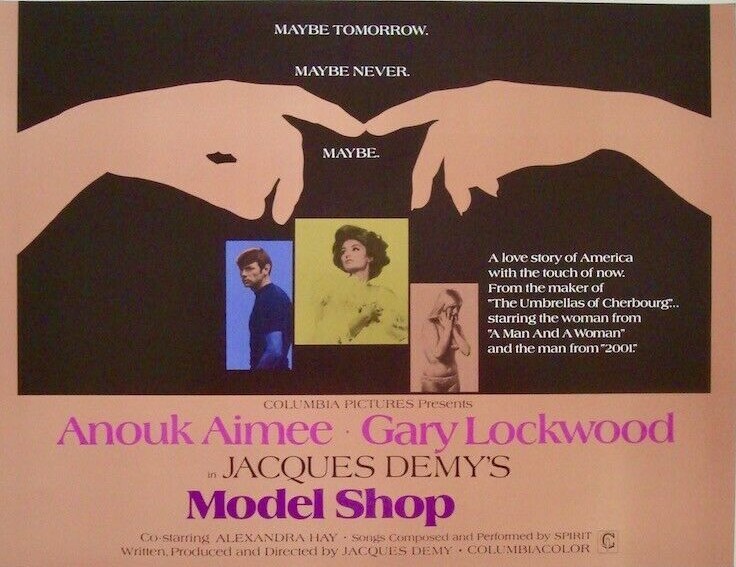
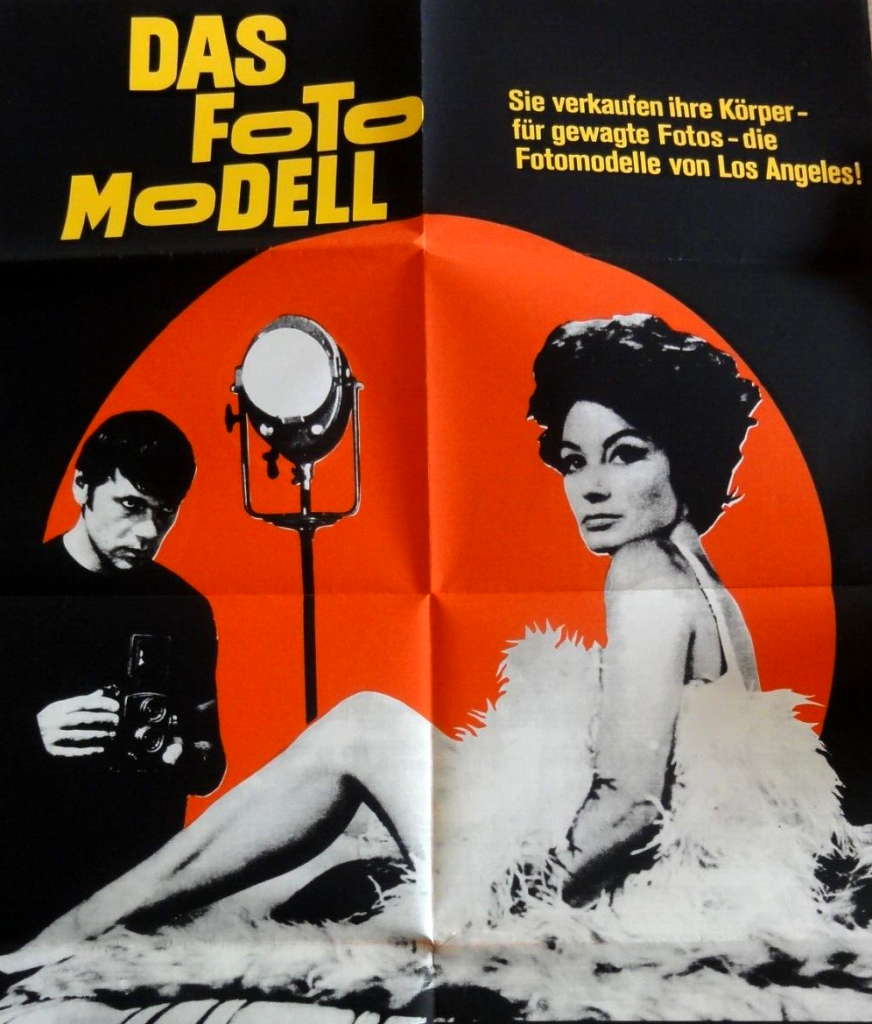
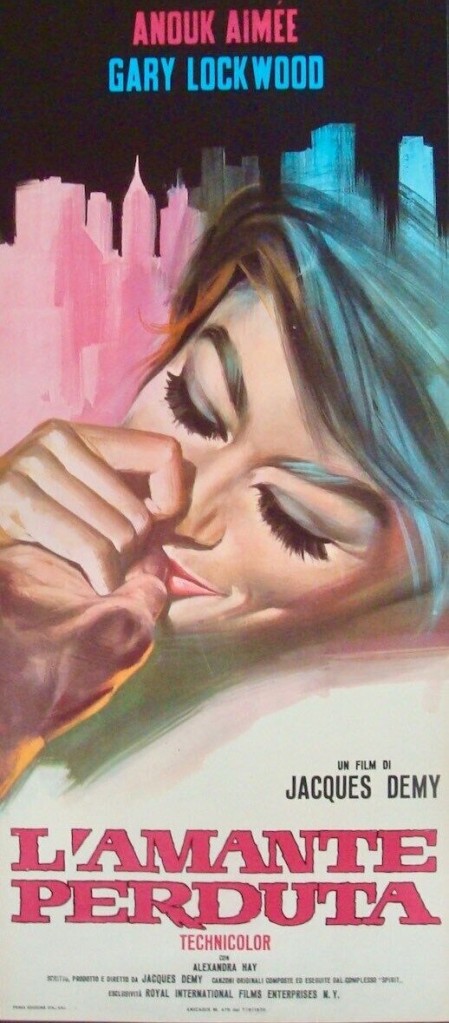
Surprising number of similarities to The Appointment (1969), including the aura of seediness, but lacking that film’s inherent tension or style. Lola (Anouk Aimee) is another model pursued by a another man who catches a glimpse of her in the street as in the Lumet affair. But it turns out a “model shop” is a tacky dive where men pay to take photographs of semi-naked women rather than anything to do with haute couture.
Lola is as depressed as Carla in The Appointment and for the same reason, abandoned by her boyfriend, who has gone off to gamble in Las Vegas. But new lover George (Gary Lockwood) is the antithesis of the successful Omar Sharif. You are inclined to give him a free pass because he’s got the draft hanging over him.
If he was disaffected, that could explain it. But he’s just bone idle, sponging off everyone in sight, musician friends and more ambitious girlfriend Gloria (Alexandra Hay), an actual model, though more in the commercial line than high fashion, but bringing in enough to pay his bills.
You might feel sorry for him that “the man” is trying to repossess his car until you see it’s an MG coupe that an unemployed guy could not afford and that when he does get enough cash to pay the outstanding payment he comes up with another excuse rather than parting with the money. He studied architecture but hasn’t the gumption to make his way in the adult world whereas Gloria accepts she might have to sit in a bathtub naked for a potential client if she wants to get on.
He won’t marry Gloria or give her a child so she’s full of empty threats to leave him but doesn’t carry that out until she discovers photos of Lola that he’s left lying around. There’s not much going on. It’s certainly a downmarket world. George and Gloria lived in a rundown suburb of Los Angeles with a pumpjack drilling for oil outside their front door.
A good chunk of time is spent on the road, not “out along the highway looking for adventure” as in Easy Rider (1969) and not in the great outdoors, but mindless drifting, or tailing Lola, around L.A.. There’s some kind of deadline on their romance – she’s headed home to France, his call-up is immediately imminent so unless there’s some expose of the seedier side of the city going on there’s not much else, just two people who lost their way finding brief solace in each other.
Anyone attracted by Anouk Aimee’s top billing is going to be disappointed, not in her performance, which reveals a markedly vulnerable gal beneath the glam (though she does dress haute couture). But Gary Lockwood (They Came to Rob Las Vegas, 1968) is front and central; she doesn’t turn up until about a third of the way through and only has a handful of scenes thereafter. So it’s that kind of slice-of-life movie, what the British used to term a “kitchen sink” picture, and takes place over a short time-span.
Gary Lockwood is excellent but he’s not asked to do very much, and you kind of get the impression he’s just being his charming self. Aimee seems to have cornered the market in playing “degrading” women, accused of being a sex worker in The Appointment and loaned out to high-class friends of her husband in Justine (1969). In some senses, bringing out the character behind the tawdry image appears her forte. Alexandra Hay (Skidoo, 1968) is equally good, the grit behind the glam, not just a pretty face.
But just nothing happens. The background – the draft, potential Vietnam peace talks, the occasional joint – is scarcely a visceral snapshot of America at the time. European director looks at America and doesn’t much like what he sees, but less obviously a commentary on society along the lines of Antonioni’s Zabriskie Point the following year or even the home-grown Medium Cool (1969).
And lacking the style of Demy’s previous outing, the exuberant musical The Young Girls of Rochefort (1967) and you keep on expecting – hoping – the characters are going to burst into song. Oddly enough, it suffers from an unexpected culture clash. Relocate the same characters and the same story to Paris, speaking French with subtitles, and it would have worked better no matter how slight the story because it would automatically be infected by Gallic charm and even the poorer streets there would be interesting.
Carole Eastman (Five Easy Pieces, 1970) a.k.a. Adrien Joyce contributed to Demy’s screenplay. Members of rock band Spirit appear in the film and provide several tracks but there was no soundtrack album to take advantage of their involvement.
You might be interested to know that Harrison Ford was at one time up to play the lead. Hay was a starlet under contract to Columbia who financed the film. Equally oddly, it was not sufficiently arthouse to appeal to the cognoscenti and it was little surprise that the studio eventually chose to promote the seedier aspects in the marketing.
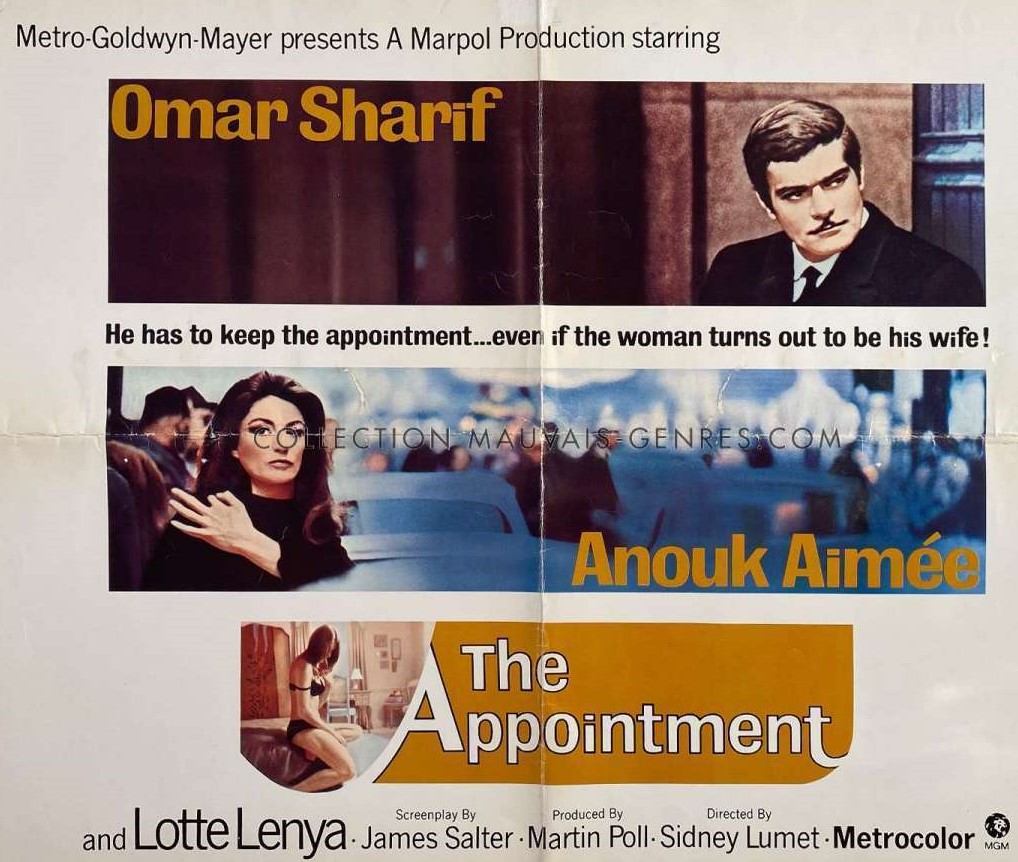
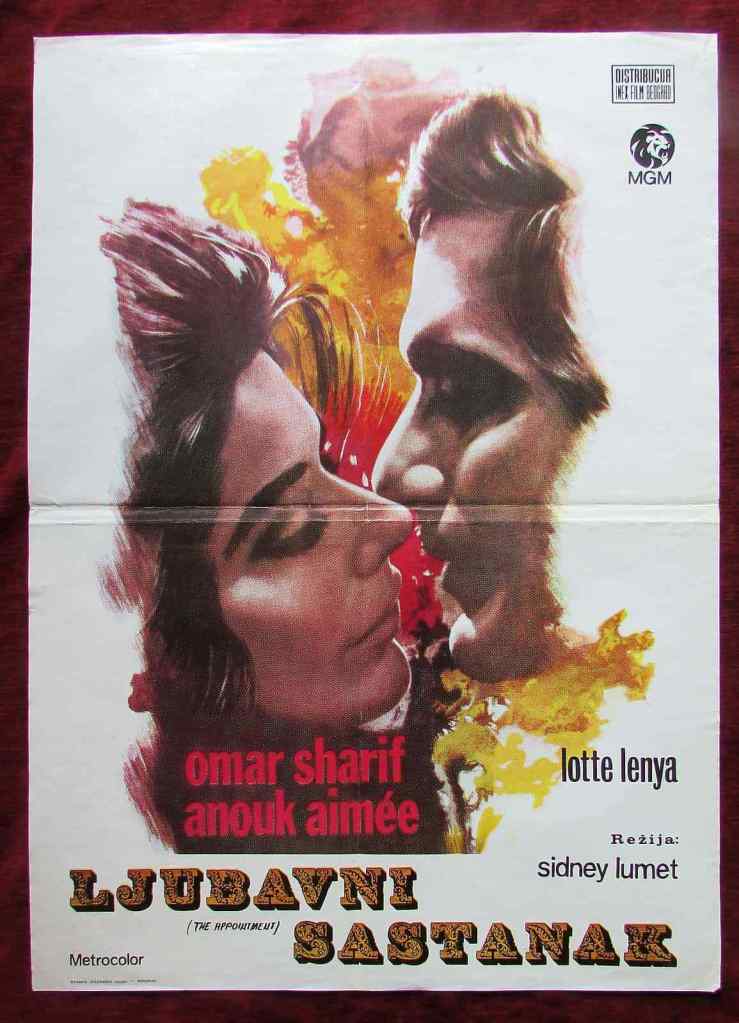
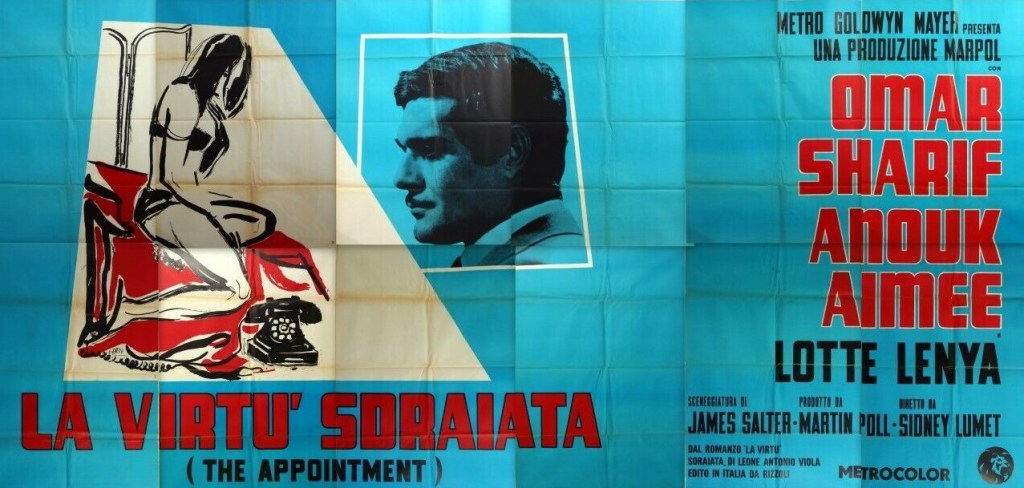
When the Cannes Film Festival in 1969 gave The Appointment the honor of being the first film invited to compete it looked like an exercise in kudos. Quite how that turned into a humiliation that would deny the Sidney Lumet picture a U.S. release was one of the oddest stories of the decade.
Lumet, it has to be said, was not exactly flying high. After the double whammy in 1964 of The Pawnbroker and Fail Safe, his career had stalled, The Group (1966) not delivering the expected box office, fired from Funny Girl (1967) and The Deadly Affair (1967), Bye Bye Braverman (1968) and The Seagull (1968) all misfires. So it probably seemed like the ideal career fillip to recharge his creative batteries in Italy, with a movie starring Omar Sharif and Anouk Aimee, both Oscar-nominated and still bathing in the warm afterglow of worldwide successes via Doctor Zhivago (1965) and A Man and a Woman (1966), respectively.
Aimee had made the list of female stars dominating the box office along with the likes of Barbra Streisand, Faye Dunaway, Jane Fonda, Catherine Deneuve, Julie Christie, Mia Farrow, Julie Andrews and Joanne Woodward. Although producer Martin Poll had a spotty record – just rom-com Love Is a Ball (1963) and thriller Sylvia (1965) on his dance card – that would change with his most ambitious project to date, The Lion in Winter (1968) pairing Peter O’Toole and Katharine Hepburn.
In truth, Lumet thought the original screenplay by the distinctively offbeat James Salter – undergoing a highly productive period, Three (1969) and Downhill Racer (1969) also on the launch ramp – “a silly story” but one that “could be salvaged with careful creation of mood, texture and dialog.” But he was virtually the only American on the project, Sharif Egyptian, Aimee French while the rest of the cast (excepting Austrian Lotte Lenya) and crew was Italian.
Shooting began at the end of February 1968. Martin Poll had been already working for seven months on the project ensuring it didn’t suffer from the production mishaps that had blighted another, bigger, MGM production, The Shoes of the Fisherman (1968). Interiors were shot at the Palatino studios (now fully soundproofed) in Rome, with a key sequence filmed at Lake Bolsena 100km to the north, and Poll had gained permission to shoot in key locations in the capital including Via Condotti leading to the Spanish Steps.
But the lake proved a trial. High in the mountains, located in a crater, it was prone to sudden squalls. First day of shooting coincided with “maverick” winds on the lake. The 40ft boat hired to transport the crew three kilometres across the lake to the tiny island was wrecked. A helicopter flew in two smaller replacements, and helped ferry passengers across, but only if they signed disclaimers absolving Poll of any redress should there be an accident.
Contract never fulfilled although it formed part of Avco embassy’s 20-page advert in Box Office magazine in November 1968.
Poll had also granted the director a week’s rehearsal time with the full cast, the movie was filmed with direct sound, rather than the traditional Italian post-production synching. And he had been hard at work on a fashion promotion campaign, highlighting the 40 haute couture designs that designer Ghelardi had created for one sequence.
A fashion show was being programmed as part of the world premiere in Rome on April 2, 1969, with the expectation that newspaper and television coverage would drive up global media interest. Poll had also set up 26 openings worldwide as the first wave of an ambitious release program to start a few days later to capitalize on the Easter break. It was all looking good – the movie had even come in under budget and a week ahead of schedule.
But the world premiere and the global release pattern were cancelled when, out of the blue, the movie was invited to compete at Cannes. The showing there would constitute the world premiere. The existing strategy was shelved in the hope that victory at the festival would provide a bigger marketing hook. Cannes had already suffered controversy that year after Carl Foreman quit the jury following censorship in France of his big-budget Cinerama roadshow western Mackenna’s Gold (1969), incidentally also starring Sharif.
Nothing went according to plan at Cannes. Festival audiences booed and whistled and waved white handkerchiefs in a sign of their disapproval. Variety called it a “flimsy love story” while condemning Sharif’s performance as “laughable.” What should have been a triumph turned into a disaster. MGM pushed back release a year until further work was done on the film.
But even as MGM was considering what to do to produce a version that might satisfy U.S. exhibitors, audiences in other parts of the world had decided there wasn’t much wrong with the version shown at Cannes. In fall 1969, the movie registered “sensational grosses.” In Japan rentals topped $1 million, in Manila there was an “unusually long run” and it broke records in Buenos Aires. Even so, Stateside executives were dismissive, “abroad, speed doesn’t mean that much,” they declared and set about changing the movie.
Under the terms of Lumet’s contract his right to final cut should have prevented any tampering with the picture. Unfortunately, he had gone along with the general consensus that the Michel Legrand score, minimalist though it was, required changing. But substituting John Barry music took the movie past its agreed completion date, thus negating Lumet’s contract and allowing MGM free rein.
At first, following a “disappointing” sneak preview in the U.S. in 1969, Lumet was involved in the editing but the studio found it easier to move forward if the original director was not looking over its shoulder. A new editor, Margaret Booth, was called in. She sliced 25 per cent out of the picture and added stock Italian footage to give the movie what MGM guessed would pass for “authenticity”, a more sun-kissed version of the country. MGM’s assessment was that the new version was “much better, much faster, playable.”
Lumet disagreed, “The MGM version now makes no sense. Characters appear and disappear, plot elements emerge and then are dropped. It’s ridiculous.” Being enraged was as close as the director came to affecting the outcome. It wasn’t the only box office disappointment facing MGM at the time. Much of the $20 million invested in four pictures – The Appointment, Goodbye Mr Chips (1969), Zabriskie Point (1970) and Captain Nemo and the Underwater City (1969) – was lost.
A “disappointing” test date in April 1970 in San Francisco confirmed what the studio feared. The movie was unreleasable. It might have been a different story if the two stars had unassailable box office track records. But Omar Sharif’s career had dipped. Mayerling (1968) though a success abroad barely hit the million-dollar mark in the U.S., while Mackenna’s Gold , Che! (1969), The Last Valley (1970) and The Horsemen (1971) were all expensive flops.
Anouk Aimee had done little better, pulling out of The Mandarins with James Coburn, Fox’s big-budget Justine (1969) a spectacular flop, Jacques Demy’s The Model Shop (1969) – “a really bad movie” according to Vincent Canby of the New York Times – also tanking and Columbia failing to find a release slot for One Night A Train (1968).
Lumet remained in a commercial wilderness. He was touted in a two-page advertisement as lining up two features for Avco Embassy, but they never appeared, nor did The Confessions of Nat Turner and We Bombed in New Haven, based on the Joseph Heller play, while Last of the Mobile Hot Shots (1970) with James Coburn flopped. He only managed an unexpected return to form with hit crime caper The Anderson Tapes (1971).
The 100 prints made by MGM – half in the original version, half the recut version – sat on the shelf as new studio management pondered whether the film was worth any further investment in the advertising and marketing required to shape a launch or even worth wasting any more time. In the end, it took the easier option, and without permitting any more cinematic screenings, sold it to CBS for its Late Movie slot – “the film buff graveyard” – which played host to such other lost pictures as The Picasso Summer starring Albert Finney and John Frankenheimer’s The Extraordinary Seaman (1969) with Faye Dunaway.
Beyond the abortive sneak preview and the test showing, the first anyone in America caught glimpse of The Appointment was on July 20, 1972 – three years after its Cannes disaster – on the small-screen on CBS.
SOURCES: “Roman Settings for Appointment,” Variety, February 28, 1968, p25; “Appointment Has Quick Dates with Squall,” Variety, March 20, 1968, p28; “Elated Poll Completes Appointment,” Variety, June 2, 1968, p22; Advertisement, Variety, November 13, 1968, p54-55; Shelagh Graham, “Film Industry in New Garbo Epoch as Femme Stars Dominate B.O,” Variety, January 8, 1969, p1; “Anouk of the Scram,” Variety, January 29, 1969, p26; “Holdbacks Explained,” Variety, February 26, 1969, p21; “Set Appointment Preem in Rome,” Variety, February 26, 1969, p38; “MGM Cancels Italo Appointment So As To Qualify at Cannes,” Variety, March 19, 1969, p5; “Appointment in Cannes,” Variety, April 16, 1969, p13; “Booing of Metro’s Appointment,” Variety, May 28, 1969, p28; Review, Variety, May 28, 1969, p34; “Re-edit Appointment After Cannes Booing,” Variety, July 9, 1969, p5; “Lumet Ponders Slave Revolt,” Variety, September 3, 1969, p6; “Capsized in Cannes,” Variety, September 19, 1969, p5; “Appointment Does Big Biz O’Seas,” Variety, October 8, 1969, p5; “MGM Delayed Appointment Pic,” Variety, January 20, 1970, p5; “MGM Write-Downs,” Variety, April 22, 1970, p5; “Cannes-Jeered Pic,” Variety, July 19, 1972, p7.
You can see why MGM dumped this. Just as easily as you can see its attraction for star Omar Sharif, his boldest-ever role, completely against type, burying the romantic hero in one fell swoop. It wasn’t just the arthouse pretensions – the absurdly long, by Hollywood standards, long shots held for an insanely long time and the greatest aerial shot, almost to the moon and back, ever devised – that made the studio cut and run faced with the impossibility of selling Omar Sharif as a creepy, repressed guy who drives his wife to suicide.
Luxuriant moustache trimmed to look like a ramrod British colonel, often bespectacled, unmarried middle-aged lawyer Federico (Omar Sharif) takes a fancy to the withdrawn Carla (Anouk Aimee), fiancée of legal buddy Renzo (Fausto Tozzi). She works as a model in a high-class fashion house.
So Federico is shocked to discover that Renzo has dumped her after discovering evidence, somewhat circumstantial it has to be said, that she moonlights as an equally high-class sex worker who takes occasional assignments from antiques dealer Emma (Lotte Lenya). Now that Carla is unencumbered in the marital stakes, Federico undertakes to discover whether the accusation is indeed correct. If not, then he reckons, she might well fall for him, if only on the rebound, after all he is very successful and, despite the geeky haircut and moustache, a handsome dude.
It’s left to your imagination whether Federico actually has sex with the young woman – who “could pass for 17” and arrives clutching schoolbooks – for whom he pays 100,000 lire (around $1,000) but my guess is he does, getting her to pretend he’s her Latin schoolmaster. So that’s the Omar Sharif romantic persona killed off right there and from then on it’s hard to muster any sympathy for the character, every bit as obsessive, say, as James Stewart in Vertigo (1958).
This has a Hitchcockian aura, an atmosphere of stealth and secrecy and chill. He ends up marrying her, turns into a control freak, refuses to let her go out to work, complains about her make-up, asks where she’s been. He gets it into his head that she’s back to her old tricks and rekindles the investigation. She becomes more withdrawn and eventually commits suicide. The ideal ending, the arthouse ending, would have left Federico forever puzzled, not knowing whether he had married a hooker or not, whether, for all his caution, he had been duped. But that’s not the way with what you would otherwise describe as a psychological thriller – calling it a big-budget arthouse picture from a major studio by a relatively unacclaimed (outside of The Pawnbroker, 1964) mainstream director would not be an option – so we get a twist at the end.
This isn’t your usual Italy either, it’s not set in a sun-drenched land with impeccable beaches and ladies wandering around with cleavage abounding. This is the Italy of traffic jams and rain and wind and huge brown waves battering the shore and buttoned-up women.
And audiences have rarely been presented with such a depressing insecure female character. You get the impression she wears fabulous clothes to hide, not glorify, her body. She might come across as playing with Federico, pretending to be asleep when he comes to bed during a romantic weekend on a remote island, the woman way out of his league who wants to keep him at a distance while she makes up her mind. But that interpretation would only be from Federico’s perspective. Otherwise, an attendant viewer would note that she doesn’t seem at all comfortable with life, and that abandoned by one lover without finding out why she can’t risk losing her heart to another.
Had this been made by Visconti or Antonioni (Blow-Up, 1966, went down a similar suspicious route) it might have been acceptable as a distribution vehicle for MGM (after all, they did pump millions into Zabriskie Point, 1970). The odd thing was, the arthouse mob didn’t like it either, showing disdain in the most publicly humiliating manner possible, audiences at Cannes booing it off the screen.
But once you accept the odd premise and equally fall in with the seedy character depicted by Omar Sharif, you begin to feel its power. The daring camerawork is exceptional, some of the scenes in extreme long shot contain as their essence elements of intimacy, and the world’s greatest aerial shot pulls away from the picture’s most romantic scene, as if giving indication of what is not well, rather than enveloping the characters with the usual background of nature at its most rapturous. And it’s pretty much silent, a John Barry theme dips in and out, but scarcely swells when it does, on a rare occasion, appear, so this plays out without much in the way of musical nods to the audience.
Outside of Lawrence of Arabia (1962), this is easily Omar Sharif’s greatest performance. His gamble in parlaying his box office marquee and universal romantic appeal (he appeared in Mayerling, the ultimate romantic tale, the same year) to take on this unappealing role showed a commitment to expanding his screen persona that went unrewarded. Anouk Aimee, anointed one of the screen’s biggest female romantic leads after the unexpected success of A Man and a Woman (1966), is also playing against type.
Sidney Lumet went through a distinctly lean period between The Pawnbroker and his 1970s output – The Anderson Tapes (1971), Serpico (1973), Dog Day Afternoon (1975) – and while The Pawnbroker presented an equally disaffected character he was crying out for your sympathy. You could almost view The Appointment as an exercise in style and the director trying to see, in terms of narrative and character, what he could get away with, and to become the director stars would trust when they wanted to shake up their screen persona – witness Sean Connery as a criminal and Al Pacino as a gay bank-robber.
Critics have avoided this like the plague – three reviews on imdb, only one on Rotten Tomatoes – so if that’s not a sign of being under-rated I don’t know what is.
It’s different for sure but that doesn’t make it any less worth seeing. And it would certainly fit in with the expectations of a contemporary audience.
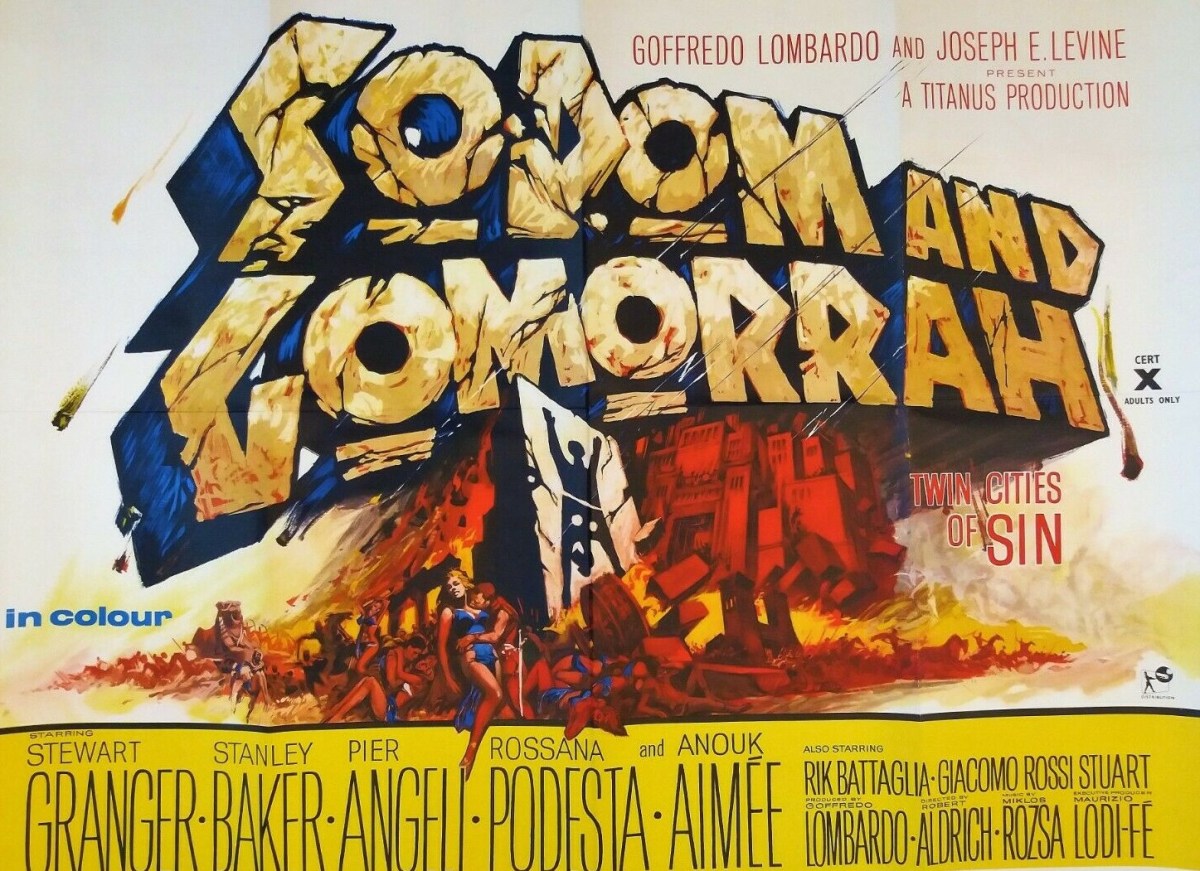
Setting aside the Biblical angle and the need to inject as much sin as the censor at that time would permit, this works very well as a historical drama filled with political intrigue, pivoting on the morality/sin axis, and with a terrific battle scene. The set up is superb. Bera (Anouk Aimee), Queen of the titular twin cities, allows Hebrew leader Lot (Stewart Granger) to settle his wandering tribe along the River Jordan in order to provide a buffer between her kingdom and the marauding Elamite tribe. Meanwhile, her treacherous brother Astaroth (Stanley Baker) intends using the Elamites to dethrone his sister.
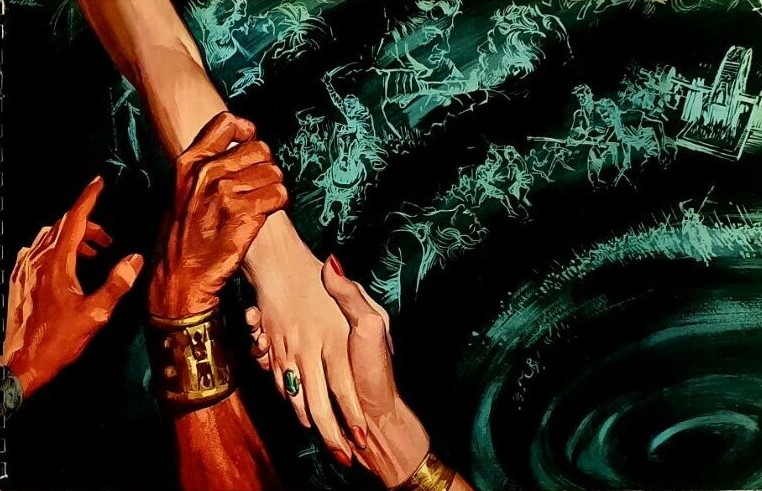
Stunning image from the Pressbook.
The Sodom-Hebrew arrangement is ugly from the start. Sodom owes its wealth to salt. And it relies for its salt mining and processing to thousands of slaves, literally worked to death, corpses piled high on wagons and dumped in the desert. The Hebrews abhor slavery. But having been homeless for so many years, Lot is in no position to argue and assumes that his people can live peacefully enough alongside the heathens, even accommodating Sodom to the point of returning fleeing slaves.
Another superb illustration from the Pressbook.
In fact, in agreeing to live in such close proximity to Sodom, Lot is already in the throes of seduction. In what appears a gesture to seal the deal, Bera presents Lot with her chief female slave Ildith (Pier Angeli). In reality this is a cunning move designed to undermine Hebrew culture. Naturally, Lot grants Ildith her freedom but her presence creates disharmony, Melchior (Rik Battaglia) leading the dissenters. Astaroth seduces both of Lot’s daughters Shuah (Rosanna Podesta) and Maleb (Claudia Mori).
Eventually, of course, the Hebrews succumb to many of the pleasures of Sodom, especially after discovering their own salt deposits which instantly make them wealthy, while Astaroth continues to stir up trouble. Lot the politician is more to the forefront than Lot the good and faithful servant, ignoring the slavery for the sake of peace. However, politics remain a sticky maneuver and, in the end, of course, it is God who intervenes, smiting the wicked.
There are surprising depths to the story. Ildrith initially rejects Lot’s overtures of marriage on the grounds that it will diminish his goodness. In trying to improve living conditions for the Hebrews, Lot does the opposite, jeopardizing their beliefs, his actions rendering virtually invisible the distinctions between the opposing cultures, especially when he is up close to the dancing female slaves and men being burned alive on a wheel. Queen Bera is a political genius, skilled at keeping her enemies closer, not just taking advantage of Lot’s weakness but ensuring that Astaroth never catches her cold.
It’s a very absorbing mix of power, politics, human weakness, the dangers of collaboration, sex and action. Although Lot takes center stage, it is only to watch his decline from man of principle to weak-willed politician, through the astute workings of Queen Bera, a far better manipulator of human emotions than her opposing number.
Images showing the capture of slave Tamar (Scilla Gabel)
Stewart Granger (The Secret Partner, 1961) is surprisingly good as the Hebrew leader. He might lack the physical presence of the likes of Charlton Heston but he proves himself no mean adversary in the various action scenes, two fights with Astaroth for example, the battle itself and in quickly dealing with dissent in the ranks. It would never have occurred to me that a shepherd’s crook was much of a weapon, but in Granger’s hands it proves very effective. He knows he is being seduced, first by Ildith, and then by Sodom, but, as a human being rather than figure of spirituality, is powerless to stop it. Stanley Baker (The Guns of Navarone, 1961) as the queen’s treacherous brother, on the other hand, just looks shifty and mean throughout.
Anouk Aimee (La Dolce Vita, 1960) is excellent as the politically astute monarch, and save for God’s intervention, would have got the better of everyone around her. Pier Angeli (The Angry Silence, 1960) is touching, initially angry at being cast out of Sodom, gradually warming to Lot, but only too aware that in succumbing to her charms he might spoil his own innate goodness, like a femme fatale only too wary of her own powers. Rosanna Podesta (Seven Golden Men, 1965) is good in a supporting role as is Rik Battaglia (Esther and the King, 1960) while Scilla Gabel (Colossus of the Arena, 1962) has a smaller part as the slave Tamar who meets a horrible death. Look out, too, for Gabrielle Tinti (Esther and the King, 1960), later best known for his marriage to Laura Gemser of the Black Emmanuelle series, and future spaghetti western anti-hero Anthony Steffen (Django the Bastard, 1969).
Novelisation of the screenplaywith a cover placing the focus strictly on sin.
Robert Aldrich (4 for Texas, 1963) creates an excellent addition to the genre, the pace of the drama, with various storylines, never slacking. As a historical picture this aims higher than mere pulp where sexiness and torture are the audience hooks. His battle sequence is outstanding, unusual in that the balance of power shifts throughout, in part through treachery, between the participants. Although Aldrich often disparaged this picture, he has done a really good job of working up the ingredients into a heady brew, notwithstanding the “deus ex machina” ending that met audience expectation. Ken Adam (Dr No, 1962) headed up the production design and Wally Veevers (The Guns of Navarone, 1961) among the half dozen experts contributing to the special effects. Mention also to Maurice Binder for the credit sequence and Miklos Rosza (Ben-Hur, 1959) for a nuanced score.
Catch-Up: Reviewed previously in the Blog are Robert Aldrich’s 4 for Texas (1963) and The Flight of the Phoenix (1965), Stewart Granger in The Secret Partner (1961) and The Secret Invasion (1964), and Stanley Baker in The Guns of Navarone (1961) and The Girl with a Pistol (1968).
I’ve been writing this Blog now for one year, beginning July 2020, so I thought I’d take a look at which posts proved the most popular (in terms of views) with my readers. So here’s the annual top 30 films, ranked in order of views.
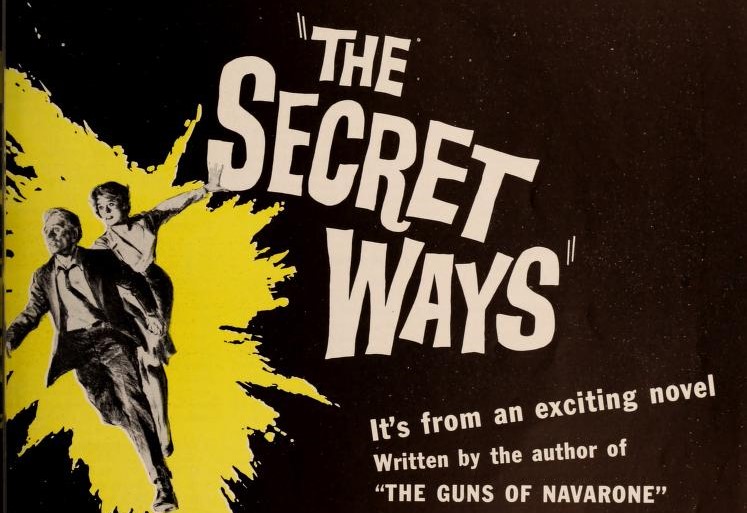
The Secret Ways (1961) – Richard Widmark and Senta Berger – making her Hollywood debut – behind the Iron Curtain in gripping adaptation of the Alistair Maclean thriller.
Ocean’s 11 (1960) – Frank Sinatra, Dean Martin, Sammy Davis Jr. and the Rat Pack in entertaining heist movie set in Las Vegas.
It’s Not All Rock’n’Roll (2020) – remarkable documentary about the other side of the music business as ageing rocker Dave Doughman tries to keep his dreams alive.
Age of Consent (1969) – British actress Helen Mirren makes her movie debut as the often naked muse for painter James Mason in touching drama directed by Michael Powell.
The Venetian Affair (1966) – Robert Vaughn shakes off his The Man from Uncle persona in taut Cold War thriller also starring Elke Sommer as his traitorous wife and Boris Karloff in a rare non-horror role.
The Golden Claws of the Cat Girl / La Louve Solitaire (1968) – French cult thriller starring Daniele Gaubert as sexy cat burglar forced to work for the government.
Pharoah / Faron (1966) – visually stunning Polish epic about the struggle for power in ancient Egypt.
The Swimmer (1968) – astonishing performance by Burt Lancaster as a man losing his grip on the American Dream.
Stiletto (1969) – Mafia thriller with hitman Alex Cord and and illegal immigrant girlfriend Britt Ekland hunted by ruthless cop Patrick O’Neal.
The Naked Runner (1967) – after his son is taken hostage businessman Frank Sinatra is called out of retirement to perform an assassination.
Marnie (1964) – Sean Connery tries to reform compulsive thief Tippi Hedren in Alfred Hitchcock thriller.
Our Man in Marrakesh / Bang! Bang! You’re Dead (1966) – Entertaining thriller sees Tony Randall and Senta Berger mixed up in United Nations plot involving the likes of Klaus Kinski and Herbert Lom.
The Happening (1967) – Anthony Quinn locks horns with Faye Dunaway and a bunch of spoiled rich kids in kidnapping yarn.
Dark of the Sun / The Mercenaries (1968) – Rod Taylor and Jim Brown head into the heart of darkness in war-torn Africa with a trainload of diamonds and refugees including Yvette Mimieux.
The Guns of Navarone (1961) – men-on-a-mission Alistair Maclean World War Two epic with all-star cast including Gregory Peck, David Niven, Anthony Quinn, Anthony Quayle, Stanley Baker, Irene Papas, James Darren and Gia Scala.
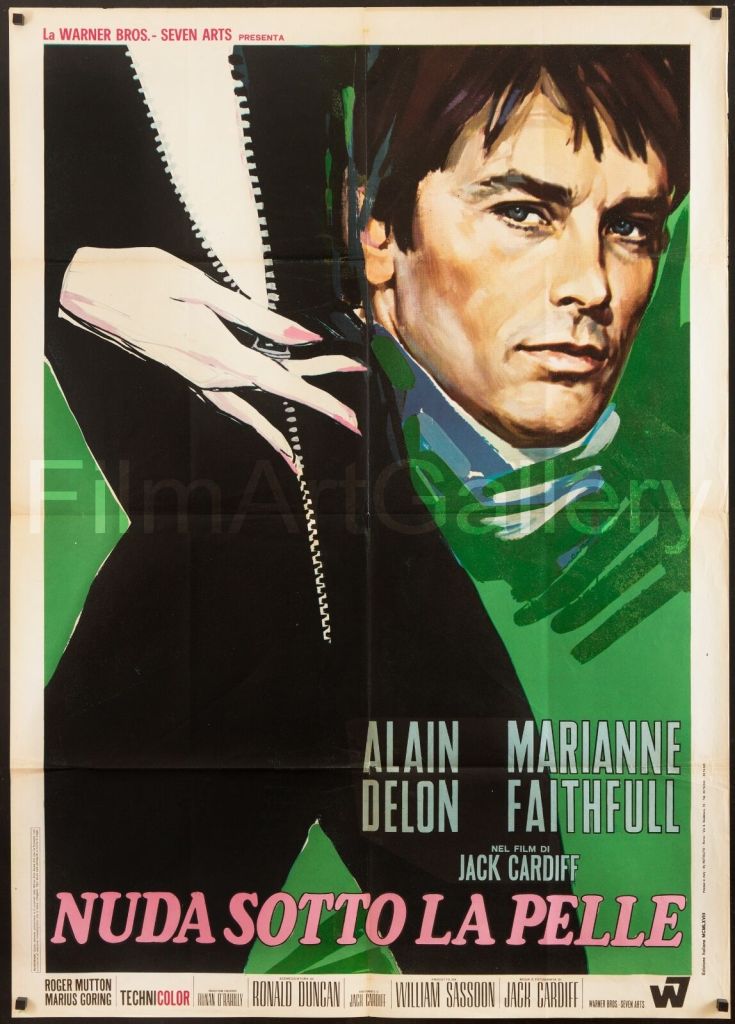
The Sicilian Clan (1969) – three generations of French tough guys – Jean Gabin, Lino Ventura and Alain Delon – clash in Mafia-led jewel heist.
4 for Texas (1963) – Frank Sinatra and Dean Martin as double-dealing businessmen in highly entertaining Robert Aldrich Rat Pack western starring Ursula Andress and Anita Ekberg.
Five Golden Dragons (1967) – Innocent playboy Robert Cummings becomes enmeshed with international crime syndicate led by Christopher Lee, George Raft and Dan Duryea.
Duel at Diablo (1966) – James Garner and Sidney Poitier team up to protect Bibi Andersson in Ralph Nelson western.
Move Over Darling (1963) – after years marooned on a desert island Doris Day returns to find husband James Garner just married to Polly Bergen.
Pressure Point (1962) – prison psychiatrist Sidney Poitier is forced to treat paranoid racist inmate Bobby Darin.
Wonder Woman 84 (2020) – in one of the few films to get a cinematic screening during lockdown, Gal Gadot returns as mythical superhero to battle supervillain Kristen Wiig.
Genghis Khan (1965) – Omar Sharif as the Mongol warrior who conquered most of the known world, tangling with rival Stephen Boyd and Chinese mandarin James Mason on the way.
A Fever in the Blood (1961) – Warner Bros wannabes Efrem Zimbalist Jr, Angie Dickinson, Jack Kelly and veteran Don Ameche in tough political drama.
The Prize (1963) – Paul Newman and Elke Sommer investigate murder in the middle of the annual Nobel Prize awards in Sweden.
In Search of Gregory (1969) – wayward Julie Christie embarks on pursuit of Michael Sarrazin who may – or may not – be a figment of her imagination.
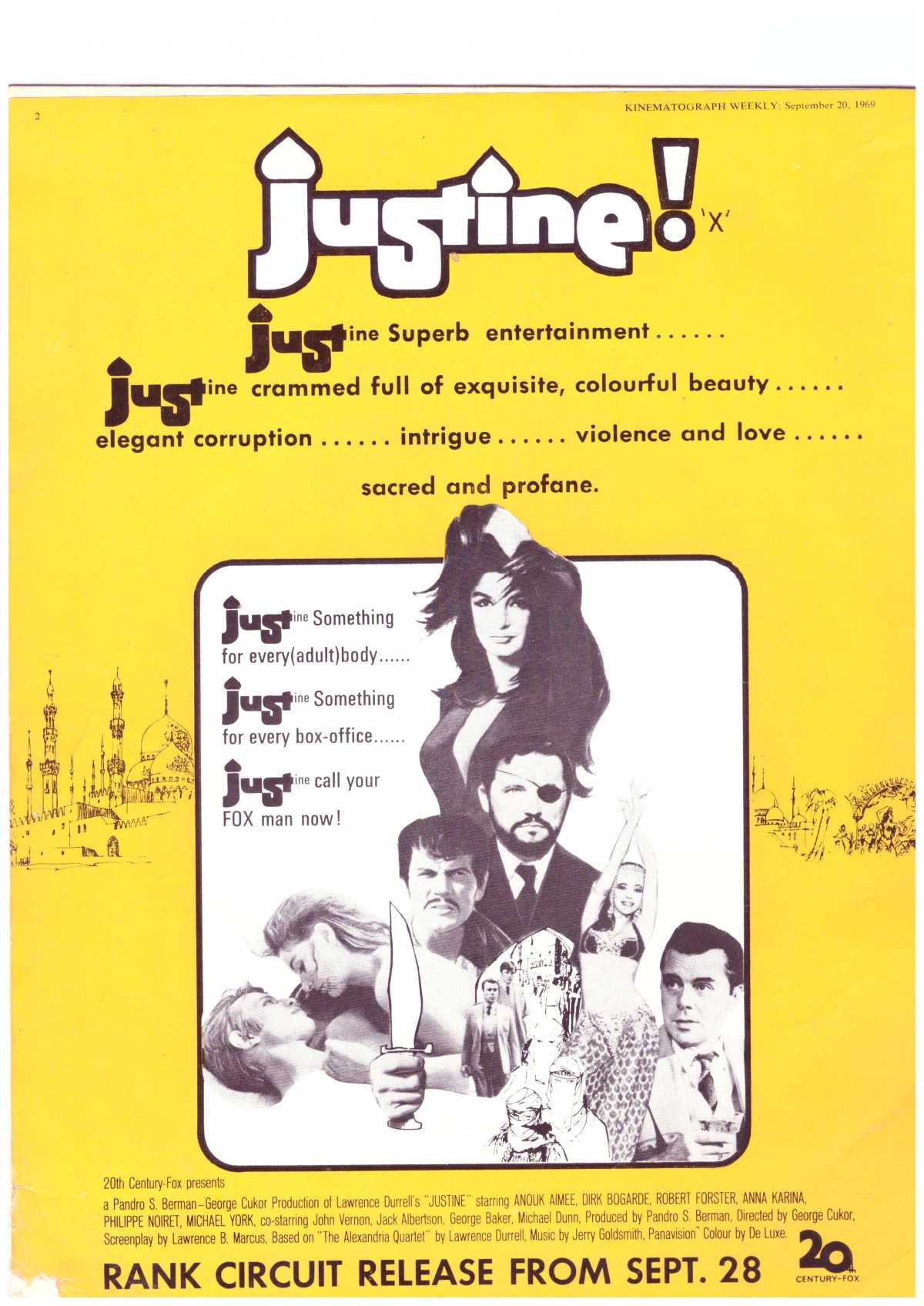
Justine (1969) – Dirk Bogarde and Michael York become entangled in web woven by Anouk Aimee in corrupt pre-World War Two Middle East.
The Girl on a Motorcycle (1968) – singer Marianne Faithful in a hymn to the open road and sexual freedom.
Blindfold (1965) – psychiatrist Rock Hudson and dancer Claudia Cardinale in highly entertaining mystery thriller about missing scientists.
Hammerhead (1968) – secret agent Vince Edwards and goofy Judy Geeson on the trail of evil mastermind Peter Vaughn.
In pre-WW2 Alexandria in the Middle East with the British on the point of departing, impoverished young poet Darley (Michael York) becomes the latest plaything for Justine (Anouk Aimee), wife to Egyptian banker Nessim (John Vernon) who encourages her multiple relationships in order to smooth the path for his gun-running activities. Matters are complicated since Darley is having an affair with belly dancer Melissa (Anna Karina) and some of Justine’s other lovers float in and out of the picture. Political intrigue which might have anchored the movie also shifts in and out of view. In this cross-cultural hotchpotch various groups – Jews, Moslems, Coptic Christians – look to seize control.
Cluttered is the best way to describe this. Despite excellent performances by Anouk Aimee and Dirk Bogarde it is still a mess. Whatever story there was has been buried by “atmosphere” and too many characters adding too little to the overall outcome. Entangled lives end up being just that – wrapped around each other with nowhere to go. Over-emphasis is placed on the louche background, nightclubs featuring cross-dressing belly dancers and a massive carnival. Luckily, we can’t entirely blame venerated Oscar-winning director George Cukor (My Fair Lady, 1964). He was picking up the pieces after Twentieth Century Fox fired Joseph Strick (Ulysses, 1967) but was stuck with a lot of footage that had already been shot and a screenplay that didn’t make much sense.
When you realize the movie encompasses religious prejudice, racism, same sex arrangements, incest, child prostitution, nymphomania, revolution, and police and political corruption and is hardly able to give any of these themes more than a fleeting glance you soon realize this is one of those films that is just going to go on and on until sudden conclusion rears up and all is revealed. And that would be fine since many movies of this decade meander at length and sometimes appear to be completely lacking in plot or logic, but whose flaws are more than compensated by outstanding direction or performances. Alas, even the stunning evocation of this city and period cannot save the day.
And it would have worked if Justine had been a femme fatale of the film noir school or if the politics been more grounded, but that doesn’t occur either and although Justine does have many influential men in her clutches you could hardly say that Darley is one of them. His role is merely to act as narrator and apologist.
One last point which has little to do with the film. In this film and in the same year’s Topaz, John Vernon gives very good dramatic performances, in both cases, coincidentally, wounded emotionally. So what happened that he is mostly remembered for villainous tough-guy roles from the following decade?





 The Magnificent 60s