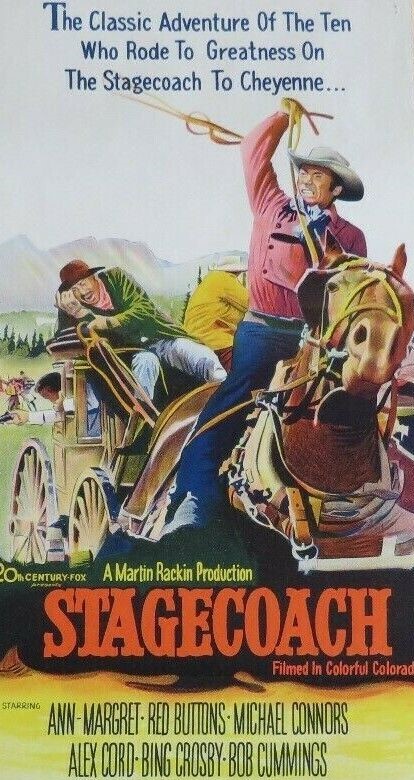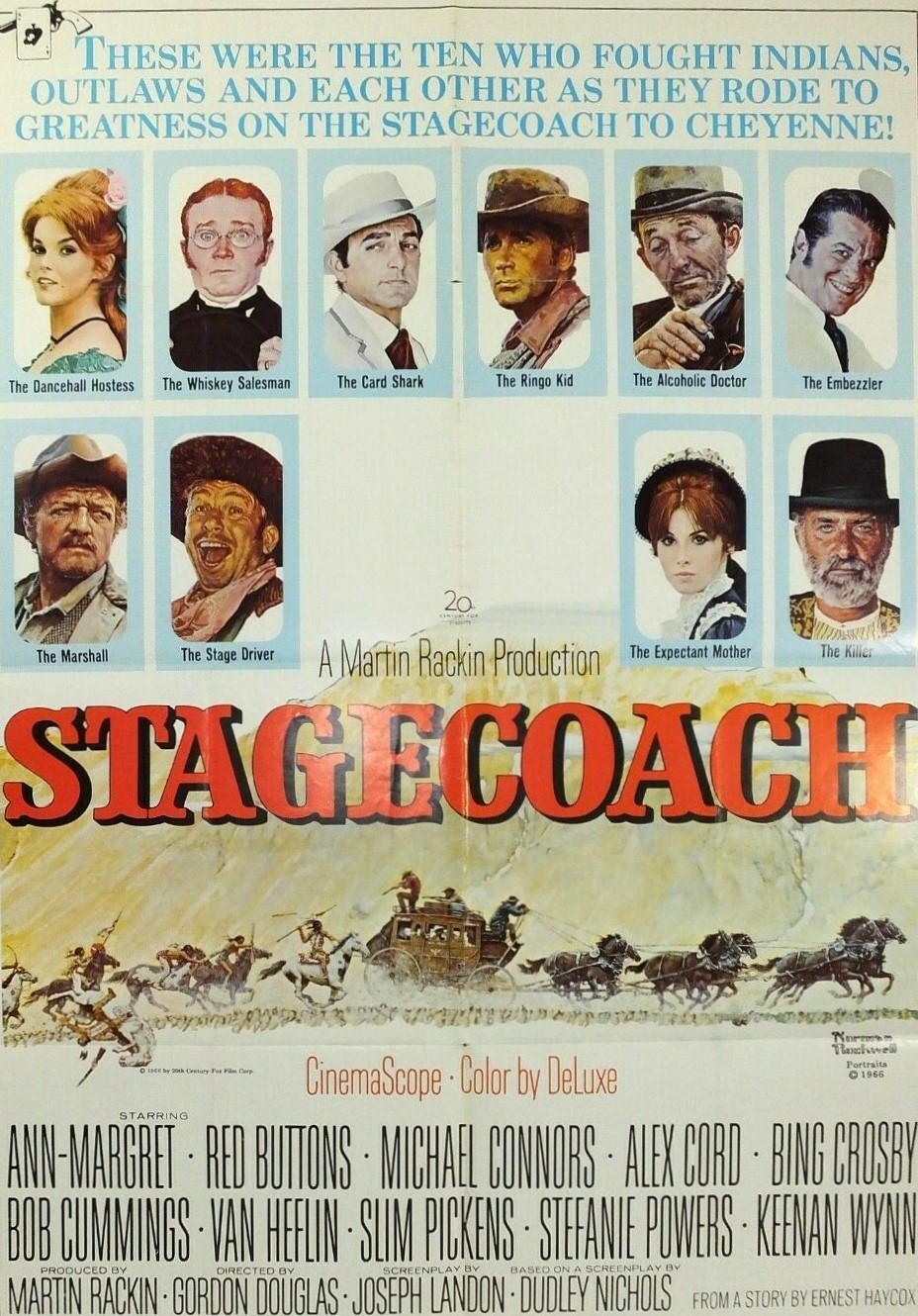
Stagecoach (1966) ****

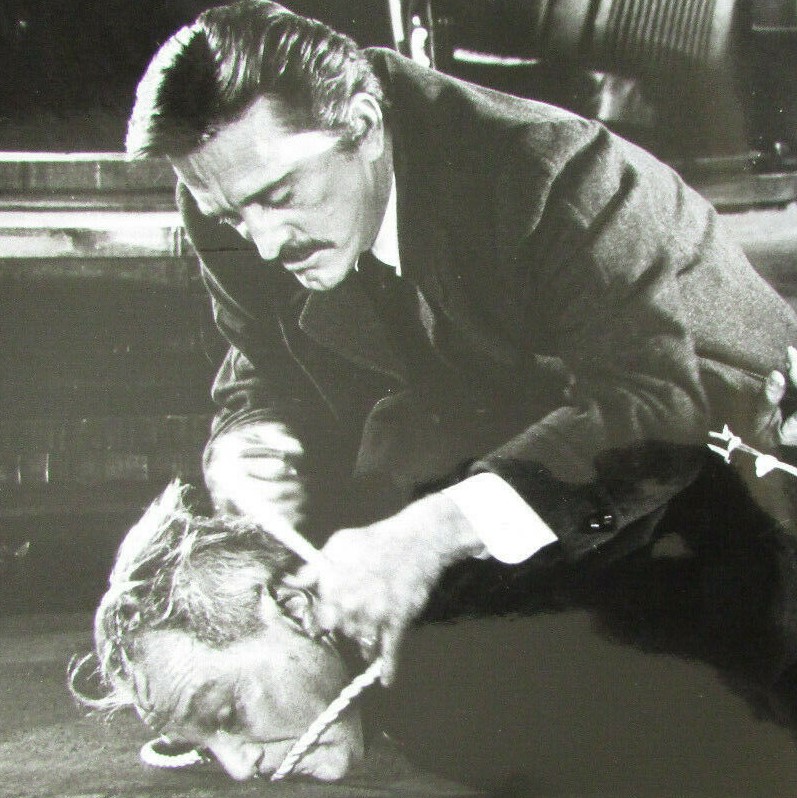
It’s probably sacrilege to admit that I quite enjoyed this. Also it’s been so long since I’ve seen the John Ford original that I could remember very little of the specifics and I haven’t seen the remake before so this was just like watching a new movie. Basically, it’s the story of a group of six passengers taking the stagecoach to Cheyenne for different reasons who are joined by an escaped murderer and shepherded along by the driver and a town marshal. There is some excellent action but mostly it’s a relationship picture, how the characters react to one another and their response to crisis.

Good-time girl Dallas (Ann-Margret) is on the run, banker Gatewood (Bob Cummings) is hiding a stash of stolen money, alcoholic doctor Boone (Bing Crosby) is penniless, liquor salesman Peacock (Red Buttons) is a coward, gambler Hatfield (Mike Connors) has Civil War secrets, pregnant Lucy Mallory (Stefanie Powers) is meeting her cavalry husband in Cheyenne. The ornery Buck (Slim Pickens) is the driver and Curley (Van Heflin) is riding shotgun and when he comes upon stranded escaped murderer the Ringo Kid (Alex Cord) promptly arrests him.
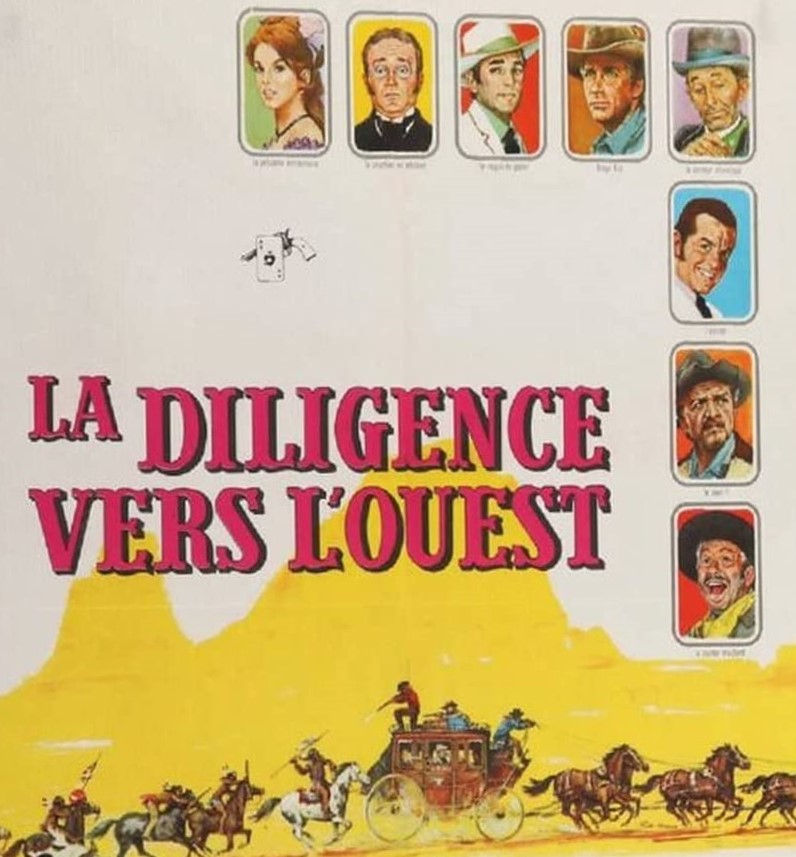
The passengers have heard rumors of the Sioux on the warpath. The audience knows it’s not a rumor because the picture starts with the Sioux slaughtering camped cavalry. Soon enough, the passengers know it, too, coming across a patrol dead at a staging post, and of course they are soon battling for their lives when ambushed.

The drama unfolds as the characters confront each other or their own weaknesses. Dallas, who has a high old time as a saloon girl, is way out of her depth in respectable company, feeling out of place even dining with the others, hiding the secret of her affair with the married Gatewood. Ringo coaxes her along, bringing her out of her shell, giving her back self-respect, and of course falling in love. Curley, with his eyes on the $500 reward for bringing Ringo in, has no intention of letting the gunslinger take his revenge in Cheyenne on Luke Plummer (Keenan Wynn) who killed his family. Boone and Peacock are the most fun, the doctor spending most of his time separating the salesman from his cargo of booze.

There are endless permutations with a story like this, the kind of material that was mined in the disaster movies of the 1970s like Airport (1970) and The Towering Inferno (1974), a group of disparate characters forced to battle for survival. The action is only part of the deal. The picture only truly works if the characters are believable. For that, you need a heap of good acting. The audience could certainly rely on old dependables like Bing Crosby (The Road to Hong Kong, 1962) in his big screen swansong, Van Heflin (Shane, 1953), Red Buttons (Oscar-winner for Sayonara, 1957), Robert Cummings (Saboteur, 1942) and cowboy picture veteran Slim Pickens to put on a good show. But the main dramatic load was to be carried by relative newcomers Ann-Margret and Alex Cord.
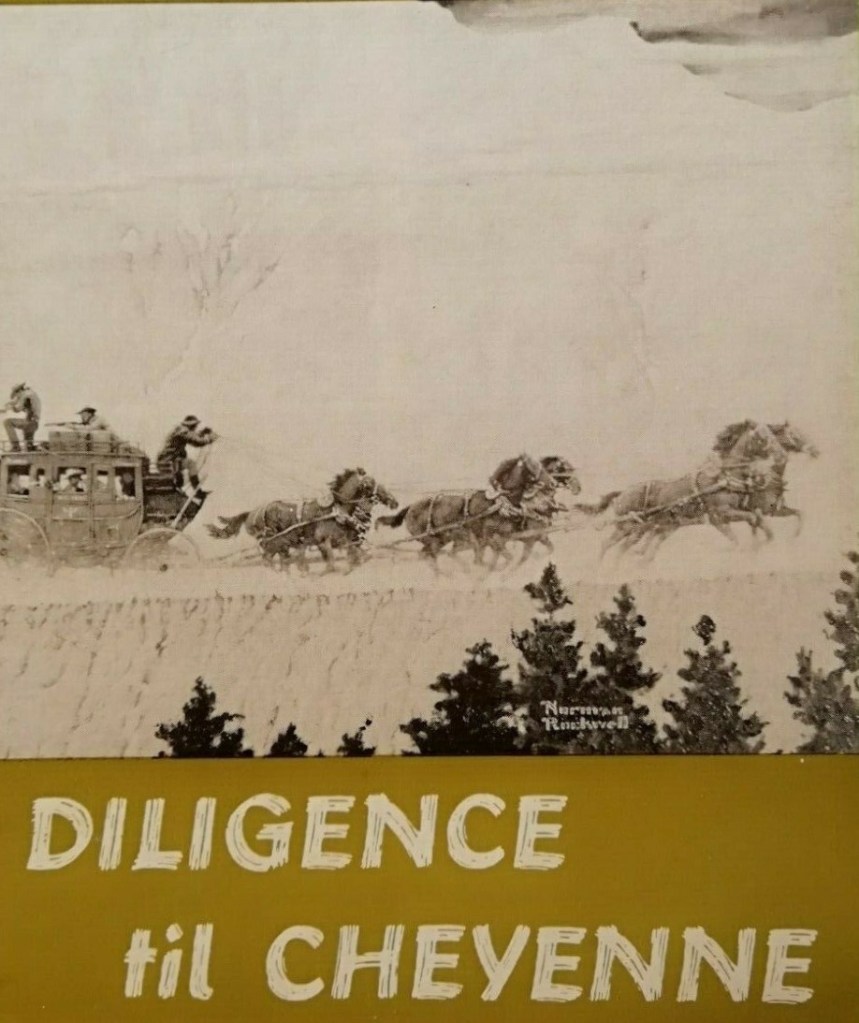
Ann-Margret has made her name with sassy light-hearted numbers like The Pleasure Seekers (1964) and had only just stepped up to the dramatic plate with Once a Thief (1965). This was Alex Cord’s sophomore outing after Synanon (1965) and he was stepping into some mighty big boots, the odds stacked against him playing the role John Wayne made famous – and which turned John Wayne into a star. 

Amazingly, the casting works. Ann-Margret moves from feisty to restrained, meek to the point of being cowed, and for most of the film, far removed from the false gaiety of the saloon, seeks redemption. The trouble-making minx emerges only once, to knock the wind out of Mrs Mallory, but, after taking a tumble down the humility route, gradually steers her way towards a better self, preventing Gatewood from causing chaos, nursing Mallory and inching her way towards true feelings for Ringo. As in the best movies, it’s not for her to open up about her woeful life but for another character, in this case Ringo, to identify her flaws: “What you doin’ about your scars, you got ‘em even if they don’t show…when you goin’ to stand up and stop crawlin’?” When they finally kiss it is one of the most beautiful tender kisses you will ever see and most of that is down to Ann-Margret’s reaction.

I had already taken back all my reservations about Alex Cord’s acting skills that were mostly due to his moustachioed performance in Stiletto (1969) after seeing him in The Scorpio Letters (1967) and this is another completely different portrayal. As much as he can deliver on the action front, it’s in the dramatic scenes that he really scores, gentle, vulnerable, caring. He certainly matches the Duke’s trademark diffidence in terms of romance. There’s a point where the camera just holds on their faces to nine depth of expression and we are not disappointed.

Gordon Douglas (The Detective, 1968) is the director who had the gall to take on the remake, and he delivers a character-sensitive picture shaded with action. Written by Joseph Landon (Von Ryan’s Express, 1965) based on the original by Dudley Nichols and Ernest Haycox.

Pretty damn good effort.

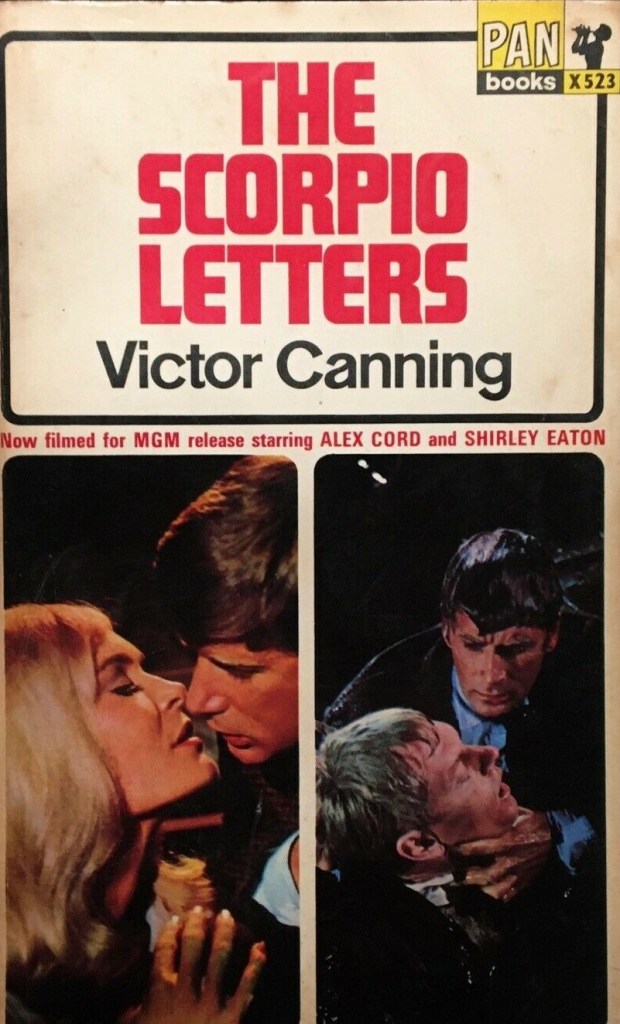
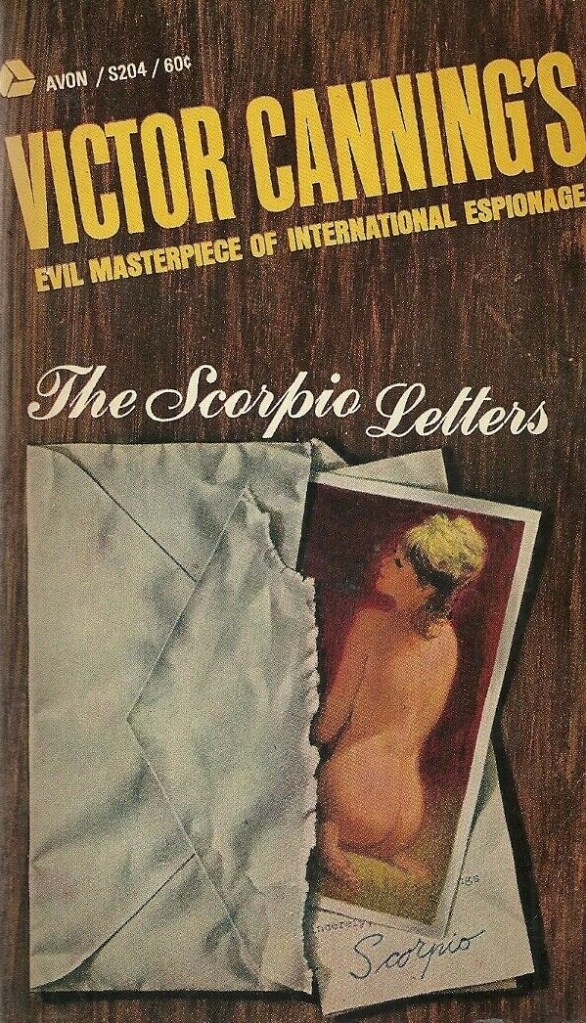
The Scorpio Letters (1967) ***

Desultory spy thriller with over-complicated story that’s worth a look mostly for the performance of Alex Cord (Stiletto, 1969). I can’t say I was a big fan of Cord and I certainly didn’t shower him with praise for his role as a disillusioned Mafia hitman in that movie. But now I’m wondering if I have been guilty of under-rating him.

Normally, critics line up to acclaim actors if they deliver widely differing performances – Daniel Day-Lewis considered the touchstone in this department after Room with a View and My Beautiful Launderette opened in New York on the same day in 1985. But usually screen persona rarely changes, a heightened or amalgamated version of the actor’s character or features. Once Charles Bronson, for example, started wearing his drooping mustache, for example, he was never seen without.  Actors may grow old, but never bald.

The macho mustachioed Cord of Stiletto is nowhere in sight. In fact, in The Scorpio Letters minus moustache and resisting attempts to reveal his musculature, he is almost unrecognizable. In this picture Joe Christopher (Alex Cord) is flip, resentful, thoughtful, occasionally pedantic, more natural than many of the current crop of Hollywood new stars, and for once in a movie that has transplanted an American in London rather scornful of British traditions.

There’s a realistic flourish here, too, he is so poorly paid – and on a temporary contract – that he has to take the bus. And although he is an ex-cop fired for brutality, that level of violence ain’t on show here. Virtually the opposite of the character Cord created for Stiletto, I’m sure you’ll agree. So full marks for versatility and talent.

Unfortunately, the rest of the movie is not up to much, at the very bottom of the three-star review, almost toppling into two-star territory. Christopher is investigating the death of a British agent who was the subject of a blackmail attempt. By coincidence – or perhaps not – another part of British Intelligence is investigating the same death, and this brings Christopher into contact with Phoebe Stewart (Shirley Eaton) and eventually they work together to unravel a list of codenames and uncover the conspiracy with a bit of risk to life and limb.

But the pay-off doesn’t work despite all the exposition attempting to build it up and you’re left with a kind of drawing-room drama rather than exciting spy adventure. It’s determinedly London-centric with red buses, red postboxes, Big Ben, Horse Guards Parade all putting in an appearance. The scene shifts to Paris and Nice without much increase in tension. There’s also an irate German chef.  Despite a couple of neat scenes – a chase held up behind a wedding party, an interrogation in a wine cellar – it’s much too formulaic.

Cord apart, Shirley Eaton (Goldfinger, 1964) adds some glamour, but her rounded portrait depicts a character with warmth rather than oozing sex. This is the kind of film that should be awash with character actors and up-and-comers, but I recognized few names except for Danielle De Metz (The Karate Killers, 1967), Oscar Beregi (Morituri, 1965) and Laurence Naismith (The Persuaders tv series, 1971).

One-time top MGM megger Richard Thorpe (The Truth about Spring, 1965) was coming to the end of a distinguished career which had included Ivanhoe (1952) and Knights of the Round Table (1953). This was his penultimate film. The appropriately named Adrian Spies (Dark of the Sun, 1968) wrote the screenplay based on the Victor Canning thriller. Making his movie debut was composer Dave Grusin (Divorce American Style, 1967)

Albeit with a limited budget of $900,000, MGM intended the picture for theatrical release but with a short cinema window to make it available for a speedy showing on ABC TV. It was originally scheduled for a May 1967 theatrical release but MGM decided to cut out the American release and so it made its debut in the “Sunday Night at the Movies” slot on February 19, 1967, and was shown in cinemas abroad. Nor was it shown first on U.S. television because the studio believed it a disaster. Variety (February 22, 1967, page 42) called it “very hip.”

The All-Time Top 40

Traditionally, this is an opportunity for me to blow the trumpet on behalf of my loyal and growing band of readers. But this time out I’m also taking the opportunity to blow my own trumpet or in the patois of my home city “bum ma load.” I began this blog in June 2020 and my monthly viewing figures scarcely topped a few hundred in the first year. Now I’m hitting 10,000 views a month. Being a self-effacing kind of guy, I thought the world should know.

Now, back to the main task in hand. It’s been a major aspect of the Blog to see which films are most favored by my readers.  As regular readers will know, I run this feature every six months.

It’s worth pointing out that for such a testosterone-driven decade the Top Ten is dominated by female stars with Ann-Marget and Angie Dickinson in the ascendancy.  Raquel Welch, Hayley Mills and Jean Seberg also make a splash. As well as top male figures like Frank Sinatra, John Wayne, Robert Mitchum and Dean Martin readers have been highly appreciative of underdogs like Alain Delon, Richard Johnson and Alex Cord.

Surprisingly high number of new entries include Young Cassidy, Fathom, The Appointment, Diamond Head, The Family Way and The Venetian Affair.

The figures in brackets represent the previous year’s position.

  1. (1) The Swinger (1966). Queen of the Blog Ann-Margret in bouncy sex comedy that manages a sprinkling of innocence. 
  2. (2) Stagecoach (1966). Double whammy from Ann-Margret in this more than acceptable remake of the John Ford western with the male lead taken by Alex Cord, another star in need of reassessment.  
  3. (4) Fraulein Doktor (1969). German spy Suzy Kendall out-foxes Kenneth More in this World War One adventure with surprisingly grisly battle scenes and a superb score from Ennio Morricone.
  4. (3) Jessica (1962). Angie Dickinson as a young widow incurring the wrath of wives in a small Italian town.
  5. (7) Once Upon a Time in the West (1969). For many, including myself,  the greatest western ever made. Sergio Leone fashions a masterpiece from a stunning cast of Claudia Cardinale, Henry Fonda and Charles Bronson and that fabulous Morricone score.
  6. (6) Fireball XL5. (1962) The height of a television cult. Famous British series from Gerry and Sylvia Anderson, now colorized. “My heart will be a fireball…”
  7. (5) The Sins of Rachel Cade. (1961) Angie Dickinson (again) as African missionary falling foul of the natives and commissioner Peter Finch. Roger Moore in an early role.
  8. (10) Vendetta for the Saint. (1968) More television cultism. Movie made by combining two episodes of the series featuring the immortal Simon Templar. Roger Moore tackles the Mafia.
  9. (12) The Sisters (1969). Complicated French love triangle featuring Nathalie Delon and Susan Strasberg.
  10. (11)  Baby Love (1969). Controversy was the initial selling point but now it’s morphed into a morality tale as orphaned Linda Hayden tries to fit into an upper-class London household.
  11. (13) Pharoah (1966). Sensational Polish epic set in Ancient Egypt centering on the battle between the country’s ruler and the religious hierarchy.
  12. (9) Moment to Moment (1966). Hitchcockian-style thriller set in the south of France with Jean Seberg caught out in illicit love affair. Co-starring Honor Blackman.
  13. (21) Go Naked in the World (1961). Steamy drama with Gina Lollobrigida discovering that her profession (the oldest) and true love (with rich Anthony Franciosa) don’t mix. Great turn from Ernest Borgnine as a doting father.
  14. (8) The Secret Ways (1961). The first of the Alistair MacLean adaptations to hit the big screen features Richard Widmark trapped in Hungary during the Cold War. Senta Berger has a small role.
  15. (36)  In Harm’s Way (1965). Otto Preminger’s Pearl Harbor epic sets John Wayne and Kirk Douglas at each other’s throats.
  16. (20) The Golden Claws of the Cat Girl (1968). Genuine French cult film with Daniele Gaubert as a sexy cat burglar.
  17. (14) Can Heironymus Merkin Ever Forget Mercy Humpe and Find True Happiness? (1969) Self-indulgence reaches new heights as singer Anthony Newley invokes his inner Fellini that somehow involves bedding lots of women. Then-current wife Joan Collins co-stars.
  18. (New Entry) Young Cassidy (1965). Rod Taylor and Julie Christie in Jack Cardiff’s Irish drama. He took over from an ill John Ford.
  19. (22) Pressure Point (1962). No escape for racist patient Bobby Darin when psychiatrist Sidney Poitier is around.
  20. (New Entry) The Appointment (1969). Complete change of pace for Omar Sharif in unusual Italian drama directed by Sidney Lumet. Anouk Aimee is the tantalizing female lead.  
  21. (New Entry) Fathom (1967) Raquel Welch swaps her skydiving kit for the more comfortable environs of a bikini in thriller. Anthony Franciosa co-stars.
  22. (22) Pendulum (1969). Cop George Peppard accused of murdering unfaithful wife Jean Seberg.
  23. (New Entry) The Family Way (1966). Hayley Mills grows up – and how – in marital drama with new British star Hywel Bennett.
  24. (New Entry) Diamond Head (1962). Ruthless hypocritical land baron Charlton Heston causes chaos in Hawaii. With Yvette Mimieux and George Chakiris.
  25. (26) A Dandy in Aspic (1968). Cold War thriller with Laurence Harvey as a double agent who wants out. Mia Farrow co-stars.  
  26. (New Entry) The Venetian Affair (1966). Robert Vaughn turns in a terrific performance as an ex-alcoholic spy dealing with former lover Elke Sommer in slippery Venice-set thriller.
  27. (21) The Best House in London (1969). That’s a euphemism for a brothel, let’s get that straight. David Hemmings tries to do right by the sex workers.
  28. (25) Lady in Cement (1969). Frank Sinatra reprises private eye Tony Rome with mobster’s moll Raquel Welch as his client.
  29. (31) The Girl on a Motorcycle / Naked under Leather (1968). Heavily-censored in the U.S., erotic drama with singer Marianne Faithfull as the titular fantasizing heroine. Alain Delon co-stars.
  30. (New Entry) Genghis Khan (1965). Omar Sharif as the all-conquering Mongol chieftain. Stephen Boyd, James Mason, Eli Wallach, Telly Savalas and Francoise Dorleac lend support.
  31. (New Entry) The Chalk Garden (1964). Hayley Mills again, being brought to heel by governess Deborah Kerr with a hidden secret.
  32. (New Entry) Plane (2023). Gerard Butler channels his inner Bruce Willis as he attempts to avoid dying hard on an island inhabited by rebels.  
  33. (23) Oceans 11.  Frank Sinatra heads the Rat Pack line-up, inspiring an industry of  remakes and with everyone starting with Tarantino ripping off one scene.
  34. (New Entry) Five Card Stud (1968). Surprising mix of feminism and noir in revenge western. Dean Martin, Robert Mitchum and Inger Stevens topline.
  35. (34) The Misfits (1960). Last hurrah for Clark Gable, fabulous turns from Montgomery Clift and Marilyn Monroe in John Huston tale of losers. 
  36. (28) Once a Thief (1965). Change of pace for Ann-Margret as working mother whose ex-jailbird husband Alain Delon is forced into another job.
  37. (27)  Deadlier than the Male (1967). Espionage with a sting in the tale as venomous female villains including Elke Sommer and Sylva Koscina target Bulldog Drummond
  38. (35) Rage (1966). Glenn Ford and Stella Stevens combat pandemic in Mexican town.
  39. (New Entry) Blonde (2022). Ana de Armas in stylized biopic of Marilyn Monroe
  40. (33) She Died with Her Boots On / Whirlpool (1969). Sleazy British film from cult Spanish director Jose Ramon Larraz sees kinky photographer Karl Lanchbury seduce real-life MTA Vivien Neves.  

Stiletto (1969) ***

The bursting of the B-movie bubble dealt a death blow to the careers of the two stars here. In the past, rising talent who failed to make the marquee grade could find almost a lifetime of contentment in low-budget westerns, neo-noir thrillers and down’n’dirty exploitationers with the hope of an occasional supporting role in a bigger picture to ease their path. By the end of the decade, just about the only option were Roger Corman biker flicks or spaghetti westerns. Especially if they had gone down the tough guy route, B-pictures might have provided an exemplary move for both Alex Cord and Patrick O’Neal. As it was, this was their last shot at the big time. And it was lean pickings.  

Retirement can be a tough call any time for a high-flying businessman. But when you’re at the top of your profession in the Mafia, loosening such ties can prove problematic. Count Cesare (Alex Cord) is a part-time assassin, spending the rest of his time as a fun-loving playboy with a string of women, fast cars and racehorses. Only problem is, he wants to retire from the Family – and not in normal fashion, weighted down by a block of cement. Unfortunately, his dilemma doesn’t solicit sympathy from boss Matteo (Joseph Wiseman).

Adding to his problems is tough cop Baker (Patrick O’Neal) on his tail who fastens onto illegal immigrant Illeana (Britt Ekland), Cesare’s girlfriend when he’s not pursuing Ann (Barbara McNair). A strictly by-the-numbers thriller it’s enlivened by two underrated tough screen hombres. Alex Cord (The Brotherhood, 1968) isn’t given enough of a character here to  tug at audience heartstrings although elsewhere he had proved better-than-expected value. If anything, he’s an existential kind of hero.

Cord made a brief splash as an action hero in the monosyllabic Clint Eastwood/Charles Bronson mold after debuting in the John Wayne role of the Ringo Kid in the remake of Stagecoach (1966) and didn’t have more than half a dozen stabs at making his name on the big screen before disappearing into the television hinterlands. So he’s something of an acquired taste, maybe the small output enough to qualify him for cult status. Here, he’s a decent fit for the violence but saddled with a role that makes little sense.

Patrick O’Neal (El Condor, 1970) followed a similar career trajectory, swapping television with the occasional movie and even managing a screen persona as a snarky type of villain/supporting character. A few more tough-guy roles and he might well have built a stronger footing in the business.

This is another thankless role for Britt Ekland (Machine Gun McCain, 1969), there to add glamor, but, surprisingly, she manages to bring pathos to the part. Barbara McNair (If He Hollers Let Him Go, 1968), always worth watching and who had made an auspicious debut the year before, hardly gets any screen time. 

Director Bernard L. Kowalski (Krakatoa, East of Java, 1968) proves better at the action than the characterization, though, luckily nobody needs to be anything other than tough. Three scenes, in particular, are well handled – the opening murder in a casino, a shoot-out a penthouse and the climax on a deserted island which has more than a hint of a spaghetti western. Joseph Wiseman (Dr No, 1962) rustles up another interesting performance and collectors of trivia might note Roy Scheider (Jaws, 1975) putting in an appearance.

This old-style tough-guy thriller would have been better off had the Cord vs. O’Neal set-up taken center stage, with the assassin on murderous overkill hunted down by the zealous cop. As it is, it’s a missed opportunity for Cord to develop an Eastwood/Bronson persona and enter the action star hall of fame.

Based on a thin Harold Robbins bestseller, the screenplay by W.R. Burnett (The Great Escape, 1963) and A.J. Russell (A Lovely Way to Die, 1968) doesn’t take any prisoners.

Doesn’t quite deliver what it says on the tin, but interesting to see Cord and O’Neal battle it out.

Top 30 Films for 2023

Ann-Margret is pipped to the post by…Ann-Margret. The Swinger and Stagecoach duked it out at the top of the All-Time Top 40 with the former taking it by a good margin. But it was the reversal in the annual stakes, with the western ahead just by a nose. The films viewed most this year. As ever some surprise picks.  

  1. Stagecoach (1966). Ann-Margret and Alex Cord in decent remake of John Ford classic western.
  2. The Swinger (1966). Ann-Margret as novelist who tries to live up to the sexy persona she has invented.    
  3. The Sins of Rachel Cade (1961). Angie Dickinson as African missionary with Peter Finch and Roger Moore in thrall.
  4. Fireball XL5. The famous British television series from Gerry and Sylvia Anderson, now colorized. “My heart will be a fireball…”
  5. Fraulein Doktor (1969). German spy Suzy Kendall out-foxes Kenneth More. Grisly realistic WWI battle scenes and a superb score from Ennio Morricone.
  6. Vendetta for the Saint (1968) Roger Moore vs the Mafia.
  7. Plane (2023). Gerard Butler channels his inner Bruce Willis in Die-Hard-on-a-desert-island adventure.
  8. Baby Love (1969). Orphan Linda Hayden proves too much of a temptation for upper-middle-class London family.
  9. The Best House in London (1969). David Hemmings goes into battle for sex workers.
  10. The Sisters (1969). Nathalie Delon and Susan Strasberg in complicated love triangle of love and betrayal.
  11. Pendulum (1968). Taut thriller with cop George Peppard accused of murdering unfaithful wife Jean Seberg.
  12. Moment to Moment (1966). Jean Seberg investigated for murder in Hitchcockian thriller set in the South of France.
  13. Rage (1966). Glenn Ford and Stella Stevens combat pandemic in Mexican town.
  14. The First Deadly Sin (1980). Frank Sinatra’s cop chases down a serial killer.
  15. Go Naked in the World (1961). Gina Lollobrigida finds that her profession (the oldest) and true love (with rich Anthony Franciosa) don’t mix. Great turn from Ernest Borgnine as a doting father.
  16. Lady in Cement (1969). Sinatra as private eye Tony Rome who takes on gangster’s moll Raquel Welch as a client.
  17. Champions (2023). Woody Harrelson as the basketball coach saddled with a bunch of misfits.
  18. A Dandy in Aspic (1968). Cold War thriller with Laurence Harvey as a double agent who wants out. Mia Farrow co-stars.   
  19. She Died with Her Boots On / Whirlpool (1969). Sleazy British film from cult Spanish director Jose Ramon Larraz sees kinky photographer Karl Lanchbury seduce real-life MTA Vivien Neves.   
  20. Once a Thief (1965). Less glamorous role for Ann-Margret as wife of ex-jailbird thief Alain Delon who is forced into another job.
  21. Diamond Head (1962). Charlton Heston chews the scenery in Hawaiian epic.
  22. Titanic (1997). Reissue in 3D of the James Cameron box office smash.
  23. Can Heironymus Merkin Ever Forget Mercy Humpe and Find True Happiness? (1969) Self-indulgence reaches new heights with writer-director-producer Anthony Newley’s autobiographical tale about stardom. Then-wife Joan Collins co-stars.
  24. Sergeant Ryker (1968). Lee Marvin in Korean War courtroom drama.
  25. The Misfits (1960). Clark Gable goes out on a high, ably supported by Montgomery Clift and Marilyn Monroe in John Huston tale of losers. 
  26. Once Upon a Time in the West (1969). Sergio Leone masterpiece featuring the stunning cast of Claudia Cardinale, Henry Fonda and Charles Bronson and that fabulous Morricone score.
  27. In Harm’s Way (1965). John Wayne and Kirk Douglas in Otto Preminger WW2 epic set in Pearl Harbor and after.
  28. The Invitation (2022). Gothic thriller starring Nathalie Emmanuel.
  29. Beat Girl / Wild for Kicks (1960). Gillian Hills is tempted into joining the striptease game. Christopher Lee puts in an appearance. 
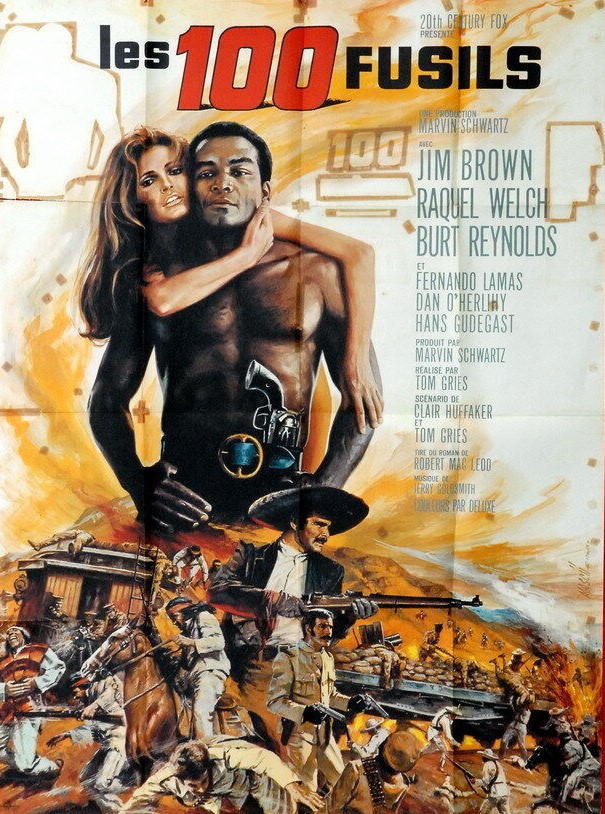
  30. 100 Rifles (1969). Raquel Welch, Jim Brown and Burt Reynolds heat up the screen in Tom Gries western set in Mexico.

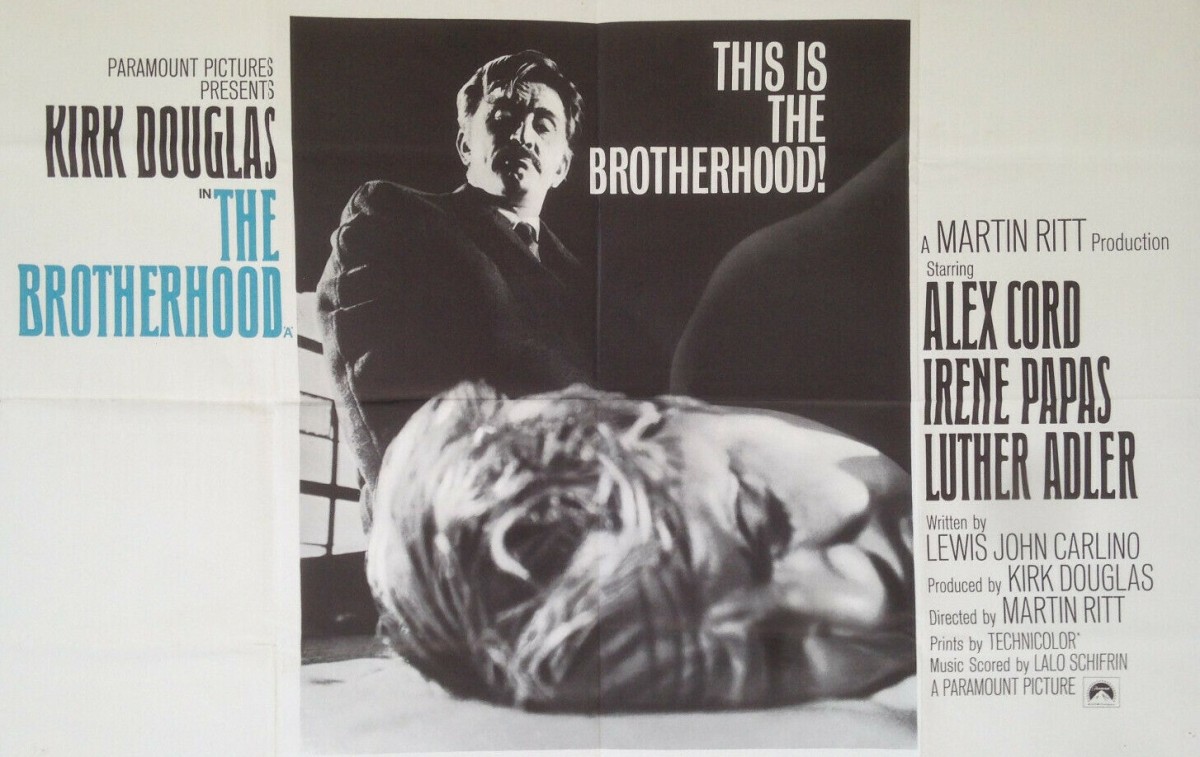
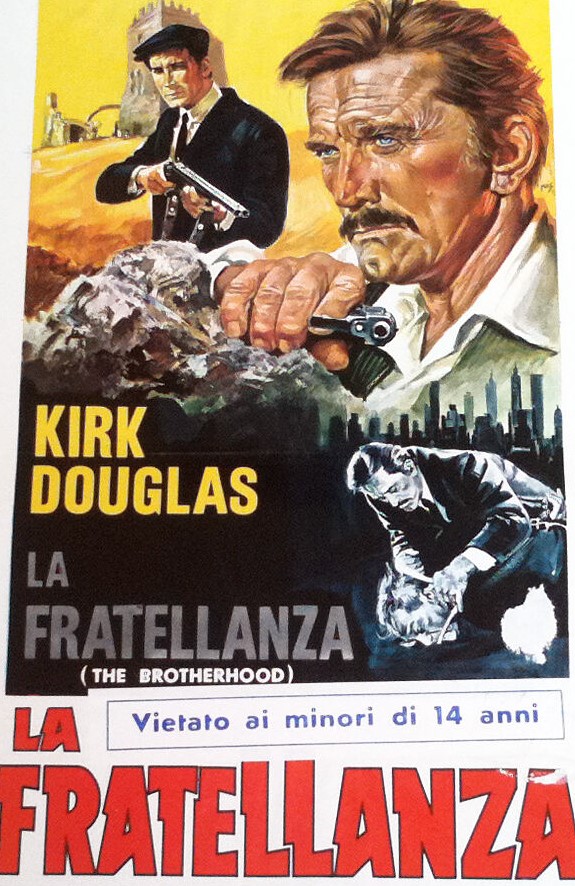
The Brotherhood (1968) ****

Minimal violence and no sex was the wrong recipe for this Mafia picture – as proven at the box office – but this is an absorbing, underrated drama nonetheless.

It bears a surprising number of parallels to The Godfather (1972). Pure coincidence, extraordinary though that may appear, because The Brotherhood premiered in December 1968 while the Mario Puzo novel was printed in March 1969 (and delivered to the printers long before), so no opportunity at all for plagiarism.

The two films could be opposite sides of the same coin. For a start, both begin with a wedding. Vince Ginetta (Alex Cord), brother of Mafia kingpin Frank (Kirk Douglas), is marrying Emma (Susan Strasberg), daughter of another Mafia chief Dominick (Luther Adler). Like Michael (Al Pacino) in The Godfather, Vince is just out of the army, well-educated and primed for a life outside the business. And like Michael is called upon to commit an act of supreme violence. There’s even a hint of Tom Hagen (Robert Duvall) in the relationship between the brothers, Frank having brought up the much younger Vince after his father’s premature death.

And just as Don Corleone (Marlon Brando) refuses to join the other Mafia families in a new business venture (in that case, drugs) so Frank bows out of an incredibly high risk (but amazingly prescient) scheme to invest in electronic firms involved in military work for the government, a deal that not only promises huge profits but a potential hold over the powers-that-be.

Frank’s wife Ida (Irene Papas) is like Don Corleone’s wife, not wanting to know anything about the business, but both Emma and Frank’s daughter Carmela (Connie Scott) are thematic cousins to Kay Adams (Diane Keaton) as initial implicit trust is wiped away. When Frank dances with Carmela at the wedding, that is reflected in Don Corleone dancing with his daughter at her wedding. Like The Godfather our first sight of the other Mafia chieftains – including Jim Hagen (Murray Hamilton) and Don Peppino (Eduardo Cianelli) – is at the feast where they are viewed with suspicion by Frank’s clan. And the scene where Frank uses a banana to tease his nephew will remind you of Don Corleone spooking his grandson with an orange.

However, the twist, if you like, is that, unlike Michael, Vince is desperate to join the Family and is instrumental in developing legitimate enterprises, which is echoed by Michael Corleone’s strategic shift to Las Vegas. In some respects, Frank is more like Sonny (James Caan), happy to take personal command of murders which the other Mafia chiefs now scrupulously delegate to “mechanics” in Los Angeles. He is more old-school whereas the others have assumed the personas of respectable businessmen.

And then it becomes a question of loyalty. Which side the ambitious Vinnie will take is crucial to the story. Frank is under pressure on all sides, from the other Mafia leaders, a government investigation, Vinnie, and the need to exact revenge on the man who caused his father’s death.

There is authentic detail here as well – religious procession in Sicily, Frank playing boccia (the Italian version of the French boules) with his old pals, family dinner, canary stuffed in the mouth of a stool pigeon, but it is less spaghetti-drenched than The Godfather. Screenwriter Lewis John Carlino (The Fox, 1967), also listed as technical adviser, claimed to be drawing on his intimate knowledge of organized crime.

There are only three moments of violence – four if you count a shocking moment of someone spitting on a corpse at a wake – a pair of straightforward murders that bookend the film, plus a scene of Godfather-style brutality in which a man slowly strangles himself to death after being hogtied. Everyone is happily married, Ida very old-school to the extent of removing her husband’s clothes (and shoes) when he returns home drunk, Vince in a good relationship.

Kirk Douglas (Cast a Giant Shadow, 1966) is excellent in a difficult role that presents a fully rounded character, playful with his daughter, loyal to his wife, holding his own against the other mob bosses, enjoying the company of the old-timers who resemble his father, and the changing nature of his relationship with brother Vince. Alex Cord, whose work I initially dismissed (Stiletto, 1969), I have come to more fully appreciate, especially here, where he makes the transition from adoring brother to threat. It is a masterpiece of restraint.

The supporting cast is terrific, a rare Hollywood sojourn for Irene Papas (The Guns of Navarone, 1961), Luther Adler  (Cast a Giant Shadow, 1966) as one of the hoodlums exasperated by Frank’s recalcitrance,  Murray Hamilton (The Graduate, 1967) but, except at the start, Susan Strasberg (The Trip, 1967) is underused.

While director Martin Ritt (Hombre, 1967) is at times guilty of melodrama, his rendering of family life is much more nuanced than Coppola’s. There are very tender moments between Frank and his wife and Frank and his daughter, as well as moments where Ida plays a more maternal role.

For nearly half a century, The Brotherhood has lain in the shadow of The Godfather simply because they both deal with the Mafia. But this is an excellent movie in its own right.

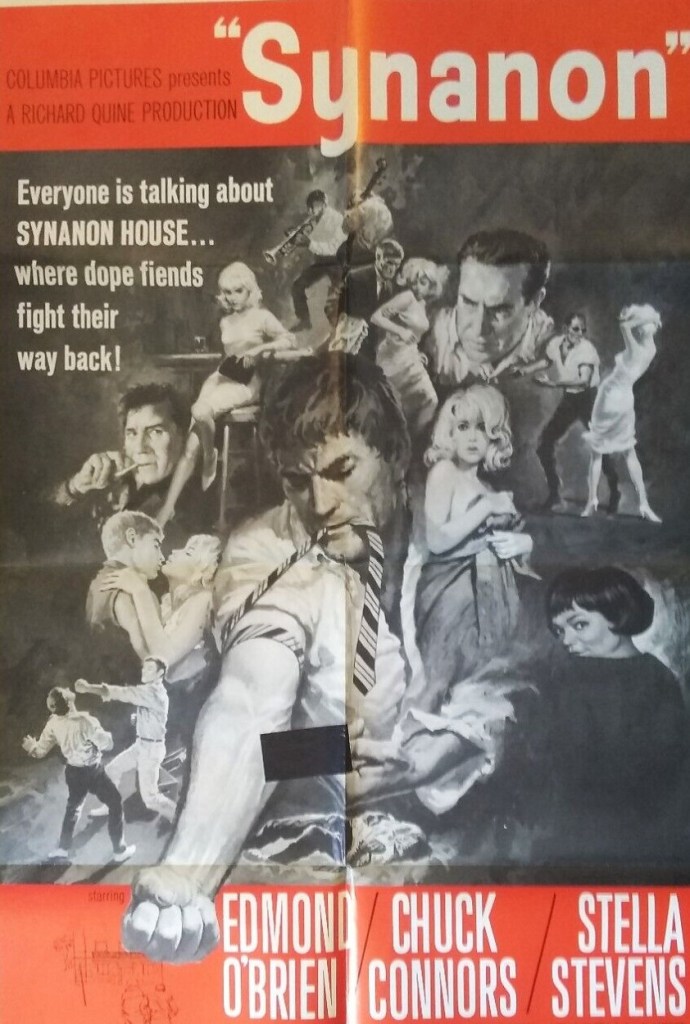
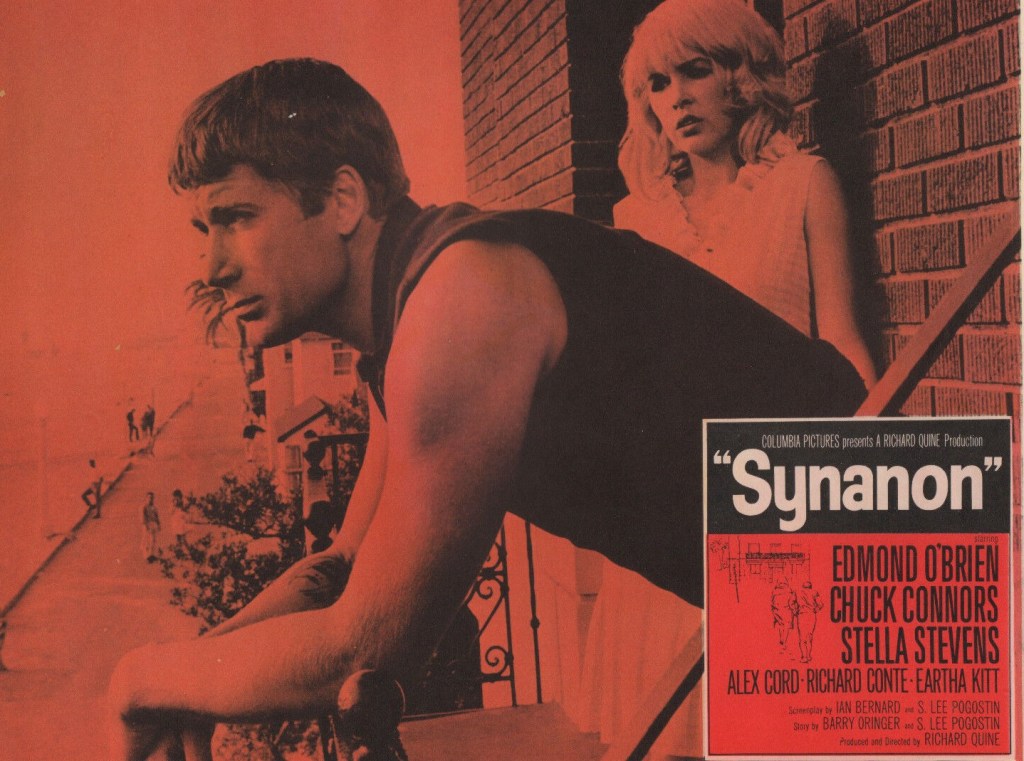
Synanon (1965) ***

Pre-dating Hollywood’s love affair with drugs, before sub-culture transformed into counter culture, before smoking a joint marked a generational divide, before marijuana symbolized freedom and was, well, the epitome of cool, before all that heroin was still seen as a scourge.

Addiction had rarely been viewed as persuasive audience fodder with the odd exception of The Man with the Golden Arm (1953) or the less-starry Monkey on My Back (1957). And this was also before Synanon became a byword for cult excess and was eventually closed down for committing the cardinal sin of employing tax exemption to get stinking rich.

At the time it was a byword for something else – rehabilitation. Its methods might have been controversial given leader Chuck (Edmond O’Brien) had no psychiatric training and was simply an ex-addict looking to find a way back. The main weapon in the community’s arsenal was confrontation. What became known as attack therapy. Rather than being permitted to stew in self-pity, inmates, all voluntary, had their weaknesses spelled out by others until they were ready to acknowledge them for themselves. The key to recovery was talking. Anyone not talking was hiding from their problems. (I’m not so well up on addiction therapy to know whether Synanon invented that kind of counselling of talking out problems in groups that then became the norm.)  If patients took to the scheme they were soon addicted to smoking and coffee; sex being considered too dangerous to contemplate.

Anyways, heroin addict Zankie (Alex Cord) is a newcomer helped along an entrant’s path by Joaney (Stella Stevens), a single mum so out of kilter with responsibility she kidnaps her son, and confronted by hardass Ben (Chuck Connors), so consumed with guilt over the death of his dope-fiend wife that he spurns all women. There’s a sub-plot of sorts. Chuck is being charged with various minor violations, including permitting convicted criminals out on parole to enter the establishment. But Chuck’s main job is to be sarcastic, challenging anyone’s notions that they could be cured, but occasionally analytically correct. “You put yourself in a position where you could lose control,” he tells Ben.

It’s a hothouse of emotions for sure. Zankie and Ben come to blows over Joaney. Zankie sees little wrong in knocking back some cough medicine. Eventually, Zankie skips out, pursued by Joaney, who goes back to turning tricks to fund her habit. There’s a surprising scene – for the time (likely excised from the British version and possibly the original) – of Chuck going through the whole candle, spoon, injection routine.

Set up as a sanitised public relations package promoting Synanon ideals with overmuch detail on the establishment’s background and conflict with authority, nonetheless it touches far better than most addiction movies on the lack of self-awareness that afflicts users, their creation of fantasy worlds where whatever they do is deemed right. The tension that comes from an entire house of jumpy characters, their dependence on a higher power (Chuck in this case) is well-drawn. Even the incessant smoking and the constant reliance on coffee suggests those with an addictive personality are only too likely to switch to something else.

You might question the casting. Alex Cord (Stagecoach, 1966), Stella Stevens (Rage, 1966) and Chuck Connors (Move Over Darling, 1963) are far too well-groomed to pass for skanky addicts even if on the road to recovery. And Edmond O’Brien (The Man Who Shot Liberty Valance, 1962) and his sidekick (Richard Conte, Lady in Cement, 1968)) come across like tougher versions of the tough priests tackling delinquency that used to be played by the likes of Spencer Tracy.

But Cord and Stevens do suggest the vulnerability of the delusional addict, Stevens little-girl-lost persona at odds with her glamor, actions devoid of the concept of consequence. Although boasting a six-pack, Cord’s portrayal of a man destroyed by weakness did not suggest he would segue from this screen debut into tough-guy leading roles. Better actors might have suggested a greater degree of internal conflict but externally, in the looks department, might have looked like this was always going to be their destination. So the casting works both ways, more surface, less depth, but a warning that even the prom king and queen are not immune from addiction.

Soberly directed by Richard Quine (How To Murder Your Wife, 1965) from a screenplay by Ian Bernard, in his debut, but feels it owes too much from input by the original Chuck Dederich.

All-Time Top 40

I started this Blog two years ago this month and to my astonished delight it is now read in over 120 countries. I am now well past over 500 reviews. So I thought you might be interested to know which of these reviews has attracted the most attention. This isn’t my choice of the top films in the Blog, but yours, my loyal readers. The chart covers the films viewed the most times since the Blog began, from June 1, 2020 to May 31, 2022.

  1. The Secret Ways (1961). Richard Widmark exudes menace in this adaptation of an early Alistair MacLean spy thriller set in Hungary during the Cold War. Senta Berger  has a small role.
  2. Jessica (1962). Innocently gorgeous widow Angie Dickinson finds her looks turn so many male heads in a small Italian town that the female population seeks revenge.
  3. Ocean’s 11 (1960). The Rat Pack makes its debut – Frank Sinatra, Dean Martin, Sammy Davis Jr. et al plan an audacious Las Vegas robbery. 
  4. Pharoah (1966). Priests battle kings in Polish epic set in ancient Egypt. Fabulous to look at and thoughtful.
  5. Fraulein Doktor (1969). Suzy Kendall in the best role of her career as a sexy German spy in World War One.
  6. The Golden Claws of the Cat Girl (1968). Cult French movie starring Daniele Gaubert as a sexy cat burglar.
  7. The Swinger (1966). Ann-Margret struts her stuff as a magazine journalist trying to persuade Tony Franciosca she is as sexy as the character she has written about.
  8. It’s Not All Rock’n’Roll (2020).  Ageing rocker Dave Doughman aims to mix a career with being a father in this fascinating documentary
  9. A Place for Lovers (1969). Faye Dunaway and Marcello Mastroianni in doomed love affair directed by Vittorio De Sica.
  10. The Venetian Affair (1966). Robert Vaughn hits his acting stride as a former CIA operative turned journalist investigating suicide bombings in Venice. Great supporting cast includes Elke Sommer and Boris Karloff.
  11. Moment to Moment (1966). Hitchcockian-style thriller with Jean Seberg caught up in  murder plot in the French Riviera. Also features Honor Blackman.
  12. 4 for Texas (1963). Frank Sinatra and Dean Martin face off in a Robert Aldrich western featuring Ursula Andress and Anita Ekberg with Charles Bronson in a smaller part.
  13. Age of Consent (1969). Helen Mirren stars as the nubile muse of jaded painter James Mason returning to his Australian roots.
  14. The Double Man (1967). Yul Brynner chases his doppelganger in the Swiss Alps with Britt Ekland adding a touch of glamour.
  15.  Subterfuge (1968). C.I.A. operative Gene Barry hunts an M.I.5 mole in London. Intrigue all round with Joan Collins supplying the romance and a scene-stealing Suzanna Leigh as a villain.
  16. A House Is Not a Home (1965). Biopic of notorious madam Polly Adler (played by Shelley Winters) who rubbed shoulders with the cream of Prohibition gangsters.
  17. Can Heironymous Merkin Ever Forget Mercy Humpe and Find True Happiness? (1969). Off-the-wall musical directed by star Anthony Newley that has to be seen to be believed. Joan Collins pops up. 
  18. Pressure Point (1962). Prison psychiatrist Sidney Poitier must help racist Nazi Bobby Darin.
  19. Deadlier than the Male (1967). Richard Johnson as Bulldog Drummond is led a merry dance by spear-gun-toting Elke Sommer and Sylva Koscina in outlandish thriller.
  20. Valley of Gwangi (1969). Special effects genius Ray Harryhausen the star here as James Franciscus and Gila Golen encounter prehistoric monsters in a forbidden valley.
  21. The Naked Runner (1967). With his son held hostage, Frank Sinatra is forced to carry out an assassination in East Germany.
  22. Orgy of the Dead (1965). Bearing the Ed Wood imprint, mad monster mash-up with the naked dead.
  23. Once a Thief (1965). Ann-Margret is a revelation in crime drama with ex-con Alain Delon coerced into a robbery despite trying to go straight. Supporting cast boasts Jack Palance, Van Heflin and Jeff Corey. 
  24. The Sicilian Clan (1969). Stunning caper with thief Alain Delon and Mafia chief Jean Gabin teaming up for audacious jewel heist with cop Lino Ventura on their trail. French thriller directed by Henri Verneuil. Great score by Ennio Morricone.
  25. Dark of the Sun / The Mercenaries (1968). More diamonds at stake as Rod Taylor leads a gang of mercenaries into war-torn Congo.  Jim Brown, Yvette Mimieux and Kenneth More co-star. Based on the Wilbur Smith bestseller
  26. Stiletto (1969). Mafia hitman Alex Cord pursued by tough cop Patrick O’Neal. Britt Ekland as the treacherous girlfriend heads a supporting cast including Roy Scheider, Barbara McNair and Joseph Wiseman.
  27. Maroc 7 (1967). Yet more jewel skullduggery with Gene Barry infiltrating a gang of thieves in Morocco who use the cover of a fashion shoot. Top female cast comprises Elsa Martinelli, Cyd Charisse, Tracy Reed and Alexandra Stewart.
  28. The Rock (1996). Former inmate Sean Connery breaks into Alcatraz with Nicolas Cage to prevent mad general Ed Harris blowing up San Francisco. Michael Bay over-the-top thriller with blistering pace.
  29. The Swimmer (1968). Burt Lancaster’s life falls apart as he swims pool-by-pool across the county. Superlative performance. 
  30. Hour of the Gun (1967). James Garner as a ruthless Wyatt Earp and Jason Robards as Doc Holliday in John Sturges’ realistic re-telling of events after the Gunfight at the O.K. Corral.
  31. Fade In (1968). Long-lost modern western with Burt Reynolds serenading low-level movie executive Barbara Loden whose company is actually filming Terence Stamp picture Blue.
  32. Dr Syn Alias the Scarecrow (1963). The British movie version of Disney American television mini-series sees Patrick McGoohan as a Robin Hood-type character assisting local smugglers.
  33. P.J./New Face in Hell (1968). Private eye George Peppard is duped by shady millionaire Raymond Burr and mistress Gayle Hunnicutt in murder mystery.
  34. Sol Madrid/The Heroin Gang (1968). In his second top-billed role David MacCallum drags hooker Stella Stevens to Mexico to capture drugs kingpin Telly Savalas.
  35. A Twist of Sand (1968). Diamonds again. Smugglers Richard Johnson and Jeremy Kemp hunt long-lost jewels in Africa. Honor Blackman is along for the voyage.
  36. Genghis Khan (1965). Omar Sharif plays the legendary warlord who unites warring Mongol tribes. Stellar cast includes Stephen Boyd, James Mason, Francoise Dorleac, Eli Wallach, Telly Savalas and Robert Morley.
  37. Interlude (1968). Bittersweet romance between famed conductor Oskar Wener and young reporter Barbara Ferris.
  38. Woman of Straw (1964). Sean Connery tangles with Gina Lollobrigida in lurid tale of murder and inheritance.
  39. Bedtime Story (1964). Marlon Brando and David Niven are rival seducers on the Riviera targeting wealthy women.
  40. Sisters (1969). Intrigue, adultery and incest haunt Nathalie Delon and Susan Strasberg as they try to recapture the innocence of the past.

Year-End Round-Up: Top 30 Films Chosen by You

Top 30

This isn’t my choice of the top films of the year, but yours, my loyal readers. This is a chart of the films viewed the most times over the full calendar year of January 2021 – December 2021.

  1. The Secret Ways (1961). Richard Widmark in spy thriller set in Hungary during the Cold War and adapted from the Alistair MacLean novel. Senta Berger has a small role.
  2. Ocean’s 11 (1960). Frank Sinatra, Dean Martin and the Rat Pack embark on an audacious Las Vegas robbery.  
  3. Pharoah (1966). Epic Polish picture about political shenanigans in ancient Egypt.
  4. Age of Consent (1969). Helen Mirren stars as the nubile muse of jaded painter James Mason returning to his Australian roots.
  5. The Venetian Affair (1966). Robert Vaughn hits his acting stride as a former CIA operative turned journalist investigating suicide bombings in Venice. Great supporting cast includes Elke Sommer and Boris Karloff.
  6. The Golden Claws of the Cat Girl (1968). Cult French movie  starring Daniele Gaubert as a sexy cat burglar.
  7. Moment to Moment (1966). Jean Seberg is caught up in a Hitchcockian murder plot in the French Riviera. Also features Honor Blackman.
  8. It’s Not All Rock’n’Roll (2020).  Ageing rocker Dave Doughman aims to mix a career with being a father in this fascinating documentary.
  9. 4 for Texas (1963). Frank Sinatra and Dean Martin face off in a Robert Aldrich western featuring Ursula Andress and Anita Ekberg with Charles Bronson in a smaller part.
  10. Once a Thief (1965). Trying to go straight ex-con Alain Delon is coerced into a robbery. Ann-Margret is a revelation as his wife. Jack Palance, Van Heflin and Jeff Corey add up to a great supporting cast.  
  11. Stiletto (1969). Alex Cord as a Mafia hitman wanting to retire is pursued by tough cop Patrick O’Neal. Britt Ekland heads a supporting cast which includes Roy Scheider, Barbara McNair and Joseph Wiseman.
  12. Subterfuge (1968). C.I.A. operative Gene Barry is called to London to uncover a mole in M.I.5. Joan Collins provides the romance. Richard Todd, Tom Adams, Suzanna Leigh and Michael Rennie lend a touch of class.
  13. The Swimmer (1968). Burt Lancaster delivers a superlative performance as a man whose life is falling apart.
  14. The Rock (1996). Blistering thriller starring Sean Connery as an ex-inmate of Alcatraz helping Nicolas Cage infiltrate the island to prevent mad general Ed Harris destroying San Francisco. Michael Bay directs.
  15. The Sicilian Clan (1969). Alain Delon joins forces with Jean Gabin to pull off an daring jewel heist with tenacious cop Lino Ventura on their trail. French thriller directed by Henri Verneuil.
  16. The Naked Runner (1967). With his son held hostage, Frank Sinatra is forced to carry out an assassination in East Germany.
  17. A House Is Not a Home (1965). Biopic of notorious madam Polly Adler (played by Shelley Winters) who rubbed shoulders with the cream of Prohibition gangsters.
  18. Pressure Point (1962). Prison psychiatrist Sidney Poitier must help racist Nazi Bobby Darin.
  19. Genghis Khan (1965). Omar Sharif plays the legendary warlord who unites warring Mongol tribes. Stellar cast includes Stephen Boyd, James Mason, Francoise Dorleac, Eli Wallach, Telly Savalas and Robert Morley.
  20. A Twist of Sand (1968). Beleaguered smuggler Richard Johnson spars with Jeremy Kemp in thriller about hidden diamonds in Africa. Honor Blackman is along for the voyage.
  21. Jason and the Argonauts (1963). Ray Harryhausen special effects dominate this legendary tale of the hunt for the Golden Fleece.  
  22. Dr Syn Alias the Scarecrow (1963). Disney movie that was turned into a mini-series in the U.S. starring Patrick McGoohan as the eponymous Robin Hood-type character who assists smugglers.
  23. The Hitman’s Wife’s Bodyguard (2021). Ryan Reynolds and Samuel L. Jackson reunite for wild sequel also featuring Salma Hayek and Antonio Banderas.
  24. Dark of the Sun / The Mercenaries (1968). Rod Taylor leads a private army into the war-torn Congo to rescue a cache of uncut diamonds. Jim Brown, Yvette Mimieux and Kenneth More co-star. Based on the Wilbur Smith bestseller.
  25. The Guns of Navarone (1961). Classic war mission picture with an all-star cast of Gregory Peck, David Niven, Anthony Quinn, Stanley Baker, Irene Papas and Gia Scala. Adapted from the Alistair McLean bestseller.
  26. Maroc 7 (1967). Gene Barry infiltrates a gang of jewel thieves in Morocco operating under the cover of a fashion shoot. Dazzling female cast includes Elsa Martinelli, Cyd Charisse, Tracy Reed and Alexandra Stewart.
  27. The Satan Bug (1965). John Sturges adaptation of Alistair MacLean pandemic thriller stars George Maharis, Richard Basehart and Dana Andrews.
  28. Five Golden Dragons (1967). Cult thriller with Robert Cummings as the playboy caught up in an international crime syndicate. Klaus Kinski and Christopher Lee head an exceptional supporting cast that also includes Margaret Lee, Brian Donlevy, George Raft, Dan Duryea and Maria Rohm.
  29. Claudelle Inglish (1961). Diane McBain as the poor farmer’s daughter who wants to get rich quick.
  30. Jessica (1962). Angie Dickinson plays a young widow who turns so many heads in a small Italian town that their wives seek revenge.

The Brotherhood (1968) ****

Minimal violence and no sex was the wrong recipe for this Mafia picture – as proven at the box office – but this is an absorbing, underrated drama nonetheless.

It bears a surprising number of parallels to The Godfather (1972). Pure coincidence, extraordinary though that may appear, because The Brotherhood premiered in December 1968 while the Mario Puzo novel was printed in March 1969 (and delivered to the printers long before), so no opportunity at all for plagiarism.

The two films could be opposite sides of the same coin. For a start, both begin with a wedding. Vince Ginetta (Alex Cord), brother of Mafia kingpin Frank (Kirk Douglas), is marrying Emma (Susan Strasberg), daughter of another Mafia chief Dominick (Luther Adler). Like Michael (Al Pacino) in The Godfather, Vince is just out of the army, well-educated and primed for a life outside the business. And like Michael is called upon to commit an act of supreme violence. There’s even a hint of Tom Hagen (Robert Duvall) in the relationship between the brothers, Frank having brought up the much younger Vince after his father’s premature death.

And just as Don Corleone (Marlon Brando) refuses to join the other Mafia families in a new business venture (in that case, drugs) so Frank bows out of an incredibly high risk (but amazingly prescient) scheme to invest in electronic firms involved in military work for the government, a deal that not only promises huge profits but a potential hold over the powers-that-be.

Frank’s wife Ida (Irene Papas) is like Don Corleone’s wife, not wanting to know anything about the business, but both Emma and Frank’s daughter Carmela (Connie Scott) are thematic cousins to Kay Adams (Diane Keaton) as initial implicit trust is wiped away. When Frank dances with Carmela at the wedding, that is reflected in Don Corleone dancing with his daughter at her wedding. Like The Godfather our first sight of the other Mafia chieftains – including Jim Hagen (Murray Hamilton) and Don Peppino (Eduardo Cianelli) – is at the feast where they are viewed with suspicion by Frank’s clan. And the scene where Frank uses a banana to tease his nephew will remind you of Don Corleone spooking his grandson with an orange.

However, the twist, if you like, is that, unlike Michael, Vince is desperate to join the Family and is instrumental in developing legitimate enterprises, which is echoed by Michael Corleone’s strategic shift to Las Vegas. In some respects, Frank is more like Sonny (James Caan), happy to assume personal command of murders which the other Mafia chiefs now scrupulously delegate to “mechanics” in Los Angeles. He is more old-school whereas the others act as respectable businessmen.

And then it becomes a question of loyalty. Which side the ambitious Vinnie will take is crucial to the story. Frank is under pressure on all sides, from the other Mafia leaders, a government investigation, Vinnie, and the need to exact revenge on the man who caused his father’s death.

There is authentic detail here as well – religious procession in Sicily, Frank playing boccia (the Italian version of the French boules) with his old pals, family dinner, canary stuffed in the mouth of a stool pigeon, but it is less spaghetti-drenched than The Godfather. Screenwriter Lewis John Carlino (The Fox, 1967), also listed as technical adviser, claimed to be drawing on his intimate knowledge of organized crime.

There are only three moments of violence – four if you count a shocking moment of someone spitting on a corpse at a wake – a pair of straightforward murders that bookend the film, plus a scene of Godfather-style brutality in which a man slowly strangles himself to death after being hogtied. Everyone is happily married, Ida very old-school to the extent of removing her husband’s clothes (and shoes) when he returns home drunk, Vince in a good relationship.

Kirk Douglas (Cast a Giant Shadow, 1966) is excellent in a difficult role that presents a fully rounded character, playful with his daughter, loyal to his wife, holding his own against the other mob bosses, enjoying the company of the old-timers who resemble his father, and the changing nature of his relationship with brother Vince. Alex Cord, whose work I initially dismissed (Stiletto, 1969), I have come to more fully appreciate, especially here, where, in a masterpiece of restraint, he makes the transition from adoring brother to threat.

The supporting cast is terrific, a rare Hollywood sojourn for Irene Papas (The Guns of Navarone, 1961), Luther Adler  (Cast a Giant Shadow, 1966) as one of the hoodlums exasperated by Frank’s recalcitrance,  Murray Hamilton (The Graduate, 1967) but, except at the start, Susan Strasberg (The Trip, 1967) is underused.

While director Martin Ritt (Hombre, 1967) is at times guilty of melodrama, his rendering of family life is much more nuanced than Coppola’s. There are very tender moments between Frank and his wife and Frank and his daughter, as well as moments where Ida plays a more maternal role.

For nearly half a century, The Brotherhood has lain in the shadow of The Godfather simply because they both deal with the Mafia. But this is an excellent movie in its own right.

Discover WordPress

A daily selection of the best content published on WordPress, collected for you by humans who love to read.

The Atavist Magazine

by Brian Hannan

WordPress.com News

The latest news on WordPress.com and the WordPress community.