All-Time Top 50

It’s five years now since I started this Blog.  This little exercise that I generally undertake twice a year reflects the films viewed most often since the Blog began in June 2020. There’s no shaking Ann-Margret, a brace of her movies embedded in the top three, though the sequence has been punctured by the sudden arrival of Anora (2024) and followed by Pamela Anderson as The Last Showgirl (2024), both films making the highest ranking of any contemporary films I’ve reviewed, though I hated the former and adored the latter.  

The figures in brackets represent the positions in December 2024 and New Entry is self-explanatory. I’ve expanded the list from 40 movies to 50, which still represents a small fraction of the 1600 pictures I’ve reviewed since I started.

  1. (1) The Swinger (1966). Despite shaking her booty as only she knows how, Ann-Margret brings a sprinkling of innocence to this sex comedy.. 
  2. (New Entry) Anora (2024). Mikey Madison’s sex worker woos a Russian in Oscar-winner.
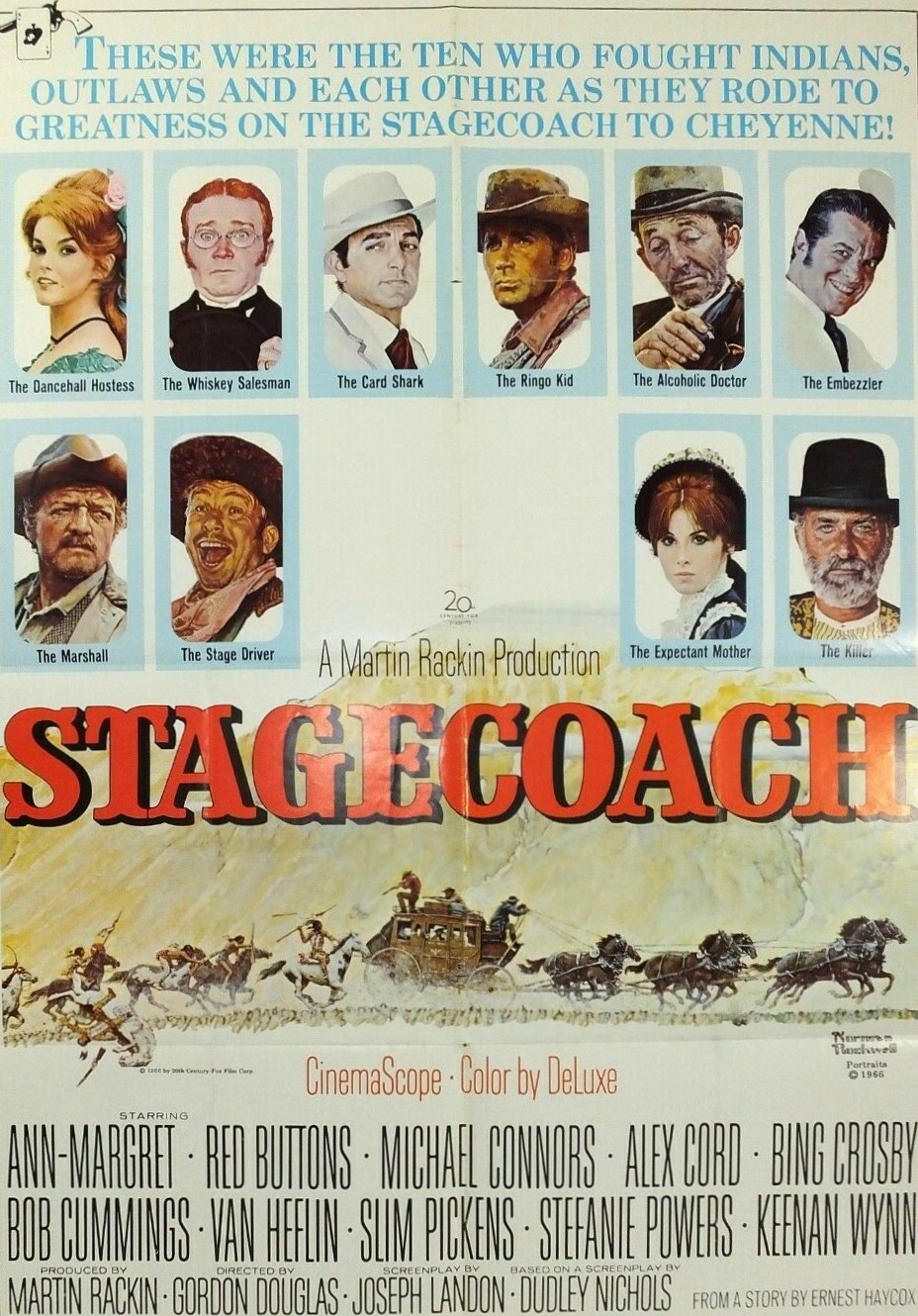
  3. (2) Stagecoach (1966). Under-rated remake of the John Ford western. But it’s Ann-Margret who steals the show ahead of Alex Cord in the role that brought John Wayne stardom.  
  4. (New Entry)) The Last Showgirl (2024). Pamela Anderson proves she can act and how in this touching portrayal of a fading Las Vegas dancer.
  5. (4) In Harm’s Way (1965). Under-rated John Wayne World War Two number. Co-starring Kirk Douglas, Patricia Neal, Tom Tryon and Paula Prentiss, director Otto Preminger surveys Pearl Harbor and after.
  6. (3) Fraulein Doktor (1969). Grisly realistic battle scenes and a superb score from Ennio Morricone help this Suzy Kendall vehicle as a World War One German spy going head-to-head with Brit Kenneth More and taking time out for romantic dalliance with Capucine.
  7. (5) Fireball XL5. The famous British television series (1962-1963) from Gerry and Sylvia Anderson, now colorized. “My heart will be a fireball…”
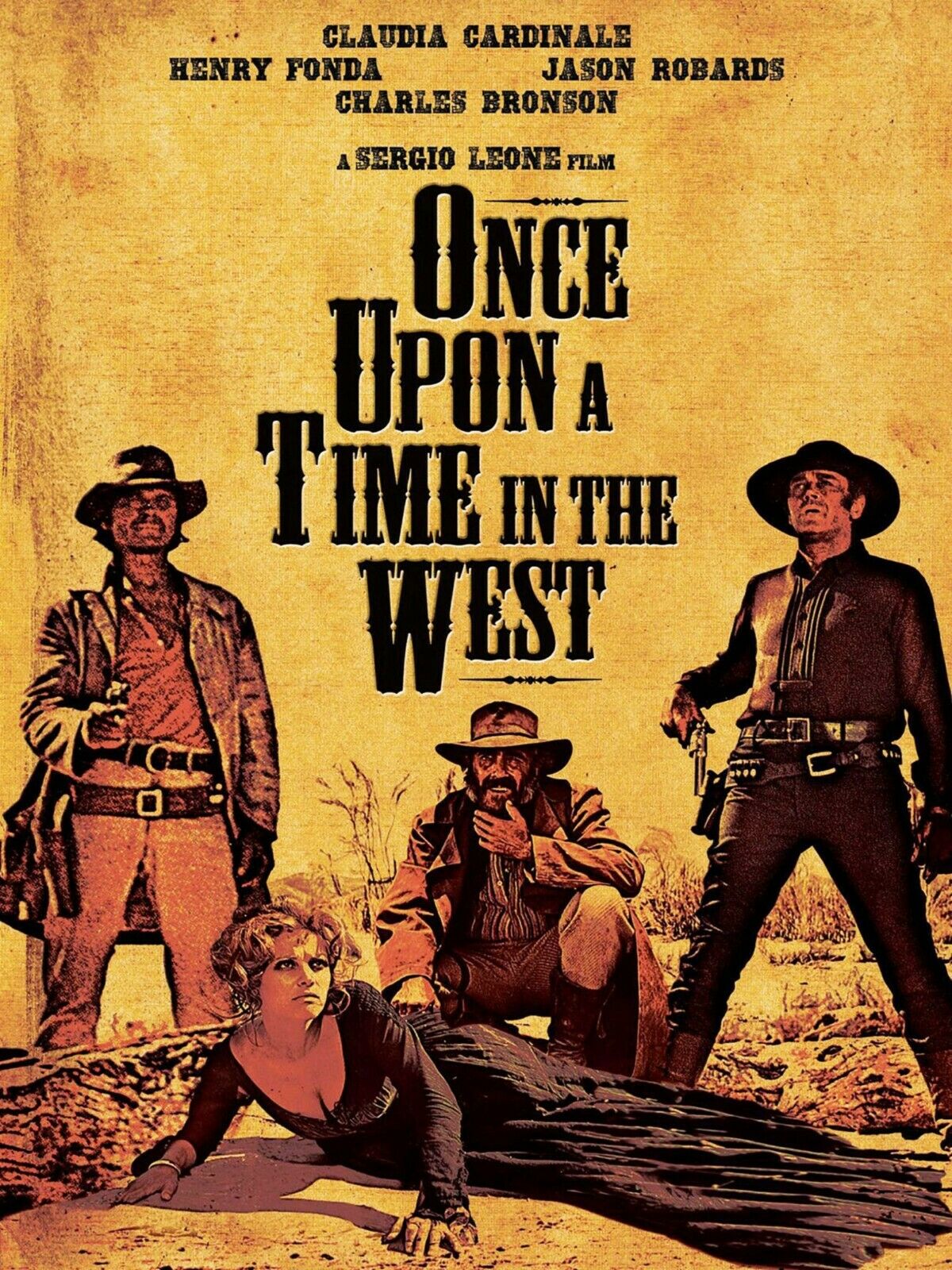
  8. (6) Once Upon a Time in the West (1969). Along with The Searchers (1956) now considered the most influential western of all time. Sergio Leone rounds up Claudia Cardinale, Henry Fonda and Charles Bronson and that fabulous Morricone score.
  9. (New Entry) Squad 36 / Bastion 36 (2025). Corruption and interdepartmental rivalry fuel this French flic directed by Olivier Marchal.
  10. (7) Jessica (1962). Angie Dickinson doesn’t mean to cause trouble but as a young widow arriving in a small Italian town she causes friction, so much so the local wives go on a sex strike..
  11. (20) Young Cassidy (1965). Julie Christie came out of this best, winning her role in Doctor Zhivago as a result. Rod Taylor as Irish playwright Sean O’Casey.
  12. (8) Thank You Very Much/ A Touch of Love (1969). Sandy Dennis dazzles as an academic single mother in London impregnated by Ian McKellen.
  13. (10) Baby Love (1969). Controversy was the initial selling point but now it’s morphed into a morality tale as orphaned Linda Hayden tries to fit into an upper-class London household.
  14. (30) The Girl on a Motorcycle / Naked under Leather (1968). How much you saw of star Marianne Faithfull depended on where you saw it. The U.S. censor came down heavily on the titular fantasizing heroine, the British censor more liberal. Alain Delon co-stars. These says, of course, you can see everything.
  15. (9) Pharoah (1966). Polish epic set in Egypt sees the country’s ruler at odds with the religious hierarchy.
  16. (24) A Dandy in Aspic (1968). Cold War thriller with Laurence Harvey as a double agent who wants out. Mia Farrow co-stars.  
  17. (31) Claudelle Inglish (1961). Diane McBain seeks revenge for being stood up at the altar in the Deep South.
  18. (New Entry) The Family Way (1966). Hayley Mills comes of age in this very adult drama. Co-starring her father John Mills and Hywel Bennett.
  19. (12) Vendetta for the Saint (1969). Prior to James Bond, Roger Moor was better known as television’s The Saint. Two television episodes combined sees our hero tackle the Mafia.
  20. (15) Go Naked in the World (1961). Gina Lollobrigida finds that love for a wealthy playboy clashes with her profession (the oldest). Look out for highly emotional turn from the usually taciturn Ernest Borgnine.
  21. (13) The Appointment (1969). Inhibited lawyer Omar Sharif discovers the secrets of wife Anouk Aimee in under-rated and little-seen Italian-set drama from Sidney Lumet.
  22. (New Entry) Istanbul Express (1968). Gene Barry plays a weird numbers game in spy thriller that sets him up against Senta Berger.
  23. (19) Pressure Point (1962). Nazi extremist Bobby Darin causes chaos for psychiatrist Sidney Poitier. Stunning dream sequences.
  24. (25) Pendulum (1968). Fast-rising cop George Peppard accused of murdering unfaithful wife Jean Seberg
  25. (11) The Sins of Rachel Cade (1961) Angie Dickinson (again) as African missionary falling foul of the natives and Commissioner Peter Finch. Roger Moore (again) in an early role.
  26. (16) Diamond Head (1962). Over-ambitious hypocritical landowner Charlton Heston comes unstuck in love, politics and business in Hawaii. George Chakiris, Yvette Mimieux and France Nuyen turn up the heat.
  27. (27) Fathom (1967). When not dodging the villains in an entertaining thriller, Raquel Welch models a string of bikinis as a skydiver caught up in spy malarkey.
  28. (36) Prehistoric Women / Slave Girls (1967). Martine Beswick attempts to steal the Raquel Welch crown as Hammer tries to repeat the success of One Million Years B.C
  29. (18) The Golden Claws of the Cat Girl (1968). Cults don’t come any sexier than Daniele Gaubert as a French cat burglar.
  30. (14) The Sisters (1969). Incest rears its head as Nathalie Delon and Susan Strasberg ignore husbands and lovers in favor of each other. 
  31.  (17) Moment to Moment (1966). Hitchcockian thriller set in Hitchcock country – the South of France – as unfaithful Jean Seberg is on the hook for the murder of her lover.  Also featuring Honor Blackman. 
  32. (New Entry) Age of Consent (1969). Helen Mirren frolics nude in her debut as the freewheeling damsel drawn to disillusioned painter James Mason.
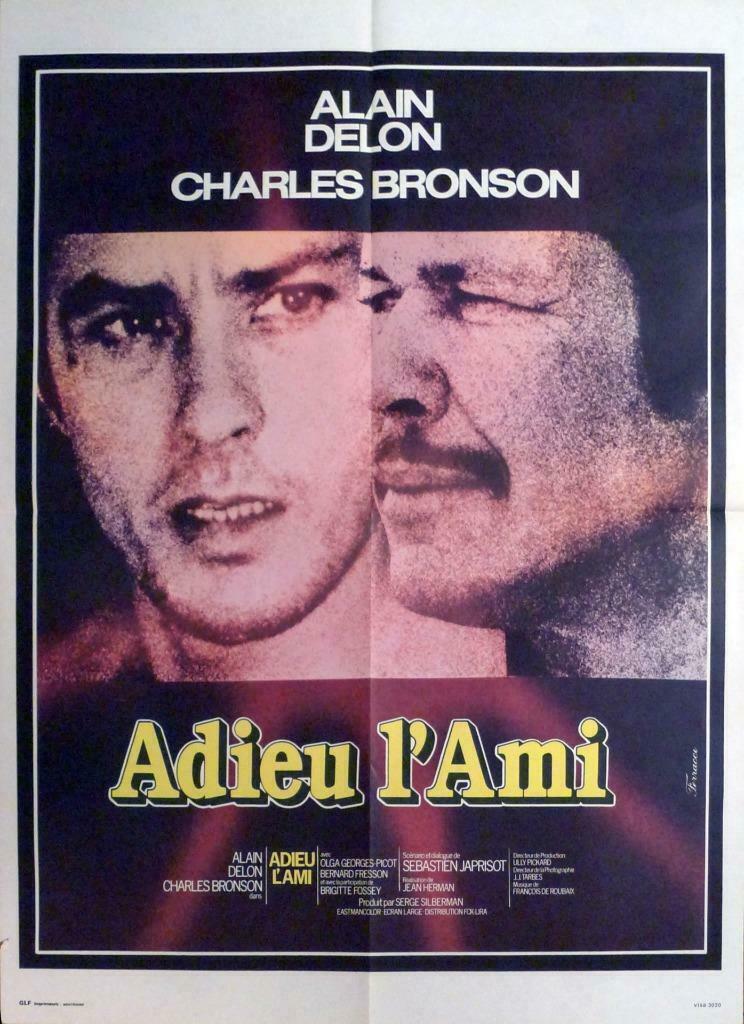
  33. (28) Farewell, Friend / Adieu L’Ami (1968). A star is born – at least in France, the States was a good few years behind in recognizing the marquee attractions of Charles Bronson. Alain Delon co-stars in twisty French heist thriller featuring Olga Georges-Picot and Brigitte Fossey.
  34. (35) Horizon: An American Saga – Chapter 1 (2024). Kevin Costner’s majestic western that became one of the biggest flops of the year was underrated in my opinion.
  35. (New Entry) Genghis Khan (1965). Omar Sharif as the titular warrior up against Stephen Boyd. Co-starring James Mason and Francoise Dorleac. Robert Morley is hilariously miscast as the Chinese Empteror.
  36. (26) Once a Thief (1965). Ann-Margret again, in a less sexy incarnation, as a working mother whose ex-jailbird thief Alain Delon takes a detour back into crime.
  37. (29) Woman of Straw (1964). More Hitchockian goings-on as Sean Connery tries to frame Gina Lollobrigida in a dubious scheme.
  38. (New entry) The Demon / Il Demonio (1963). Extraordinary performance by Daliah Lavi in Italian drama as she produces the performance of her career.
  39. (New entry) Guns of Darkness (1962). David Niven and Leslie Caron on the run from South American revolutionaries.
  40. (New Entry) Operation Crossbow (1965). George Peppard is the man with the mission in Occupied France during World War Two. Co-stars Sophia Loren.
  41. (34) She Died with Her Boots On / Whirlpool (1969). More sleaze than cult. Spanish director Jose Ramon Larraz’s thriller sees kinky photographer Karl Lanchbury targeting real-life MTA Vivien Neves.  
  42. (21) Can Heironymus Merkin Ever Forget Mercy Humpe and Find True Happiness? Fellini would turn in his grave at the self-indulgence of singer Anthony Newley who manages to lament that women falling at his feet cause him so much strife. Joan Collins co-stars.
  43. (23) The Chalk Garden (1964). Wild child Hayley Mills, trying to break out of her Disney straitjacket, duels with governess Deborah Kerr.
  44. (New Entry) Dark of the Sun / The Mercenaries (1968). Rod Taylor’s guns-for-hire break out the action in war-torn Africa. Jim Brown and Yvette Mimieux co-star.
  45. (New entry) La Belle Noiseuse (1991). Emmanuelle Beart is the mostly naked model taking painter Michel Piccoli to his artistic limits.
  46. (New Entry) A Fine Pair (1968). Rock Hudson and Claudia Cardinale join forces for a heist picture.
  47. (33) Lady in Cement (1969). Raquel Welch models more bikinis as the gangster’s moll taken on as a client by private eye Frank Sinatra in his second outing as Tony Rome.
  48. (New Entry) Carry On Up the Khyber (1968). The most successful of the Carry On satires poking fun at the British in India.
  49. (New Entry) The Venetian Affair (1966). Robert Vaughn investigates spate of suicide bombs. Elke Sommer provides the glamor.
  50. (22) The Secret Ways (1961). The first of the Alistair MacLean adaptations to hit the big screen features Richard Widmark trapped in Hungary during the Cold War. Senta Berger in an early role.

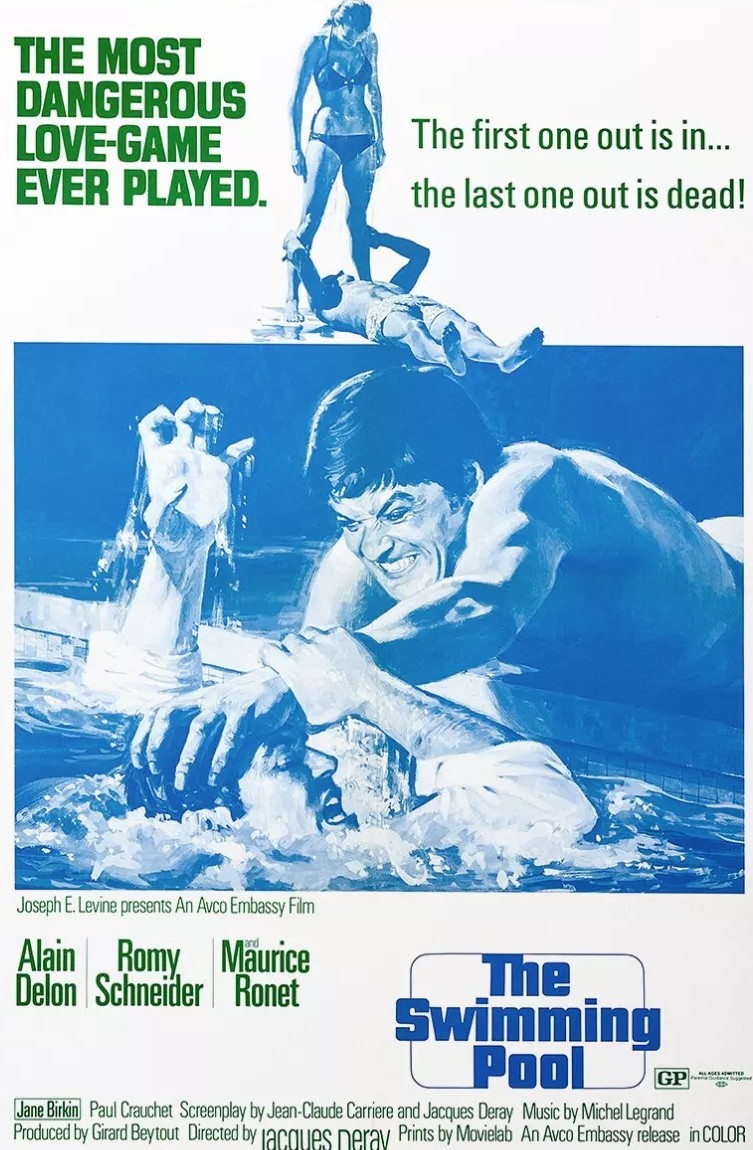
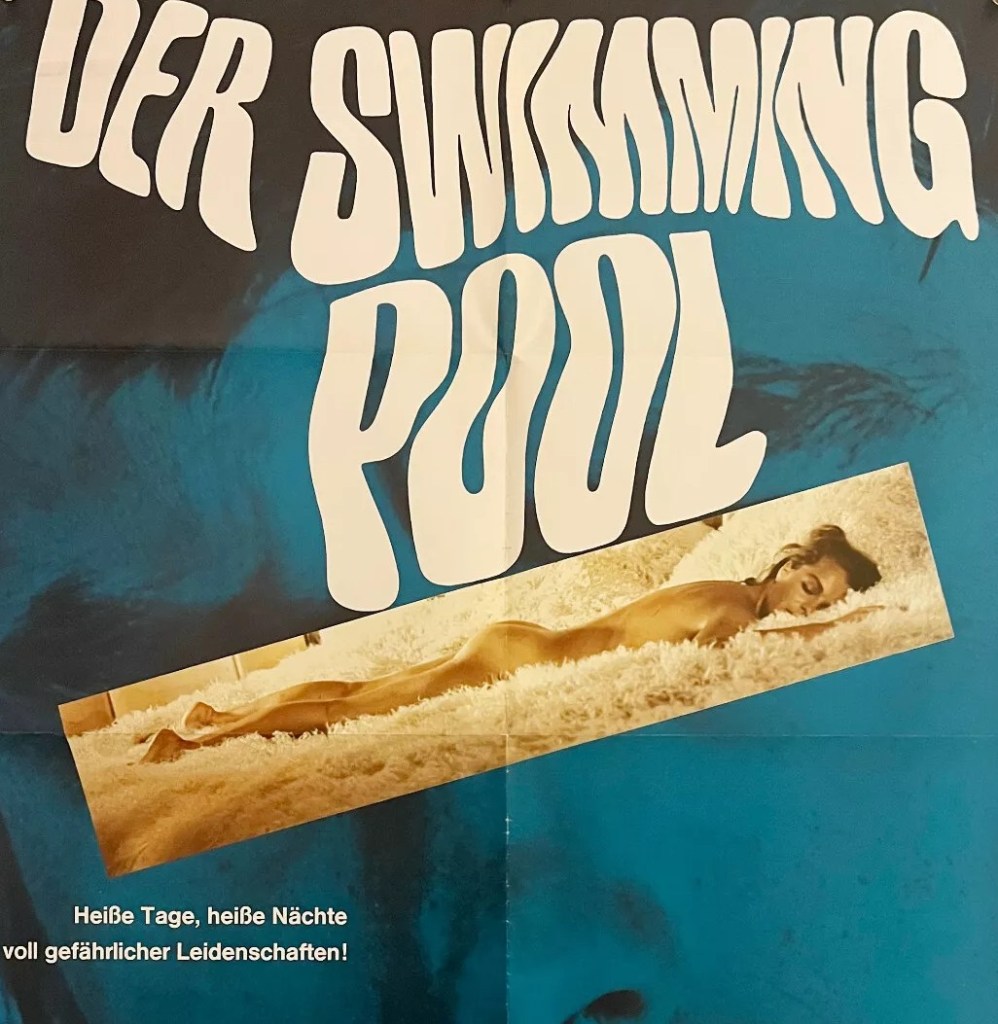
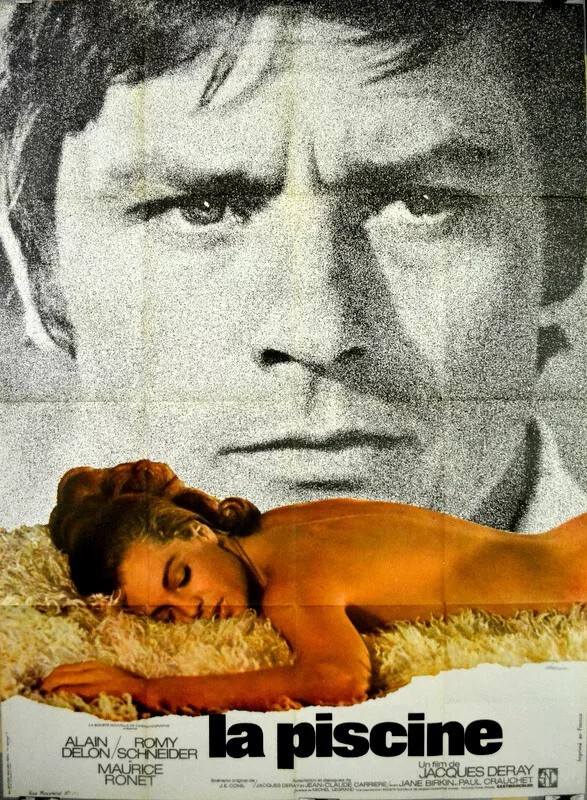
The Swimming Pool / La Piscine (1969) ****

A drunk falls into a swimming pool in the middle of the night and drowns. He has already crashed his car into the gate post of the villa. There’s no sign of foul play. No sign of the fact that his attempts to clamber out are hindered by someone holding his head down under the water until he loses consciousness.

The perfect murder? Well, no, actually, because in the aftermath of the murder, recovering alcoholic killer Jean-Paul (Alain Delon) does about the dumbest thing you’ve ever seen. And that significantly detracts from what otherwise is a superb examination of sexual tension and hidden secrets.

So instead of leaving the corpse of best friend Harry (Maurice Ronet) floating fully clothed in the titular pool, Jean-Paul decides it would look better if it appeared that Harry had foolishly gone for a late night swim. So he pulls the dead guy out, strips off his clothes and decks him out in swimming trunks and slides him back into the watery grave.

He hides the sodden clothes somewhere and at the side of the pool puts a small stack of fresh clothes stolen from Harry’s wardrobe – he was a guest at the villa. But for some reason in pulling off Harry’s shirt he omits to remove his expensive watch which isn’t waterproof. Inspector Leveque’s (Paul Crauchet) suspicions are aroused by that simple fact. Although, theoretically, Harry might have been too drunk to notice, even though, obviously, the watch strap and the bulky watch would have caught on his shirt sleeve as he was taking off the item of clothing.

So the cop, in examining the clothes, is mightily surprised to discover they are fresh, unworn, not a sign of sweat or crumpled-ness, which is odd given Harry had been out dancing and enjoying himself for hours.

Psychologically, most of the aftermath is not just whether the cold-blooded killer – the otherwise very handsome, relatively charming writer Jean-Paul – will get away with it  but whether his girlfriend Marianne (Romy Scheider), who has her own suspicions, will stand by him.

They have enjoyed a very intense sexual relationship and she clearly adores him. But she’s also the ex-lover of Harry and when Jean-Paul’s old pal, who is decidedly smooth with the ladies, turns up, the old sexual jealousy is rekindled. Either to get revenge or because he’s in any case that way inclined Jean-Paul has been making discreet moves on Harry’s eighteen-year-old daughter Penelope (Jane Birkin) who clearly despises her father.

We discover that Jean-Paul owes a great deal of his success to Harry who nurtured him through a severe depression that ended in attempted suicide. Rather than making Jean-Paul eternally grateful, it’s turned him into a spoiled brat, focused primarily on his own needs and without a loyal bone in his body when it comes to women.

For quite a while it looks like record producer Harry is going to steal away Marianne, if only for a brief affair, as Jean-Paul gives in to the sulks. But since Jean-Paul is already eyeing up Penelope, you would have thought any slip by Marianne would provide him with justification.

The murder is spur-of-the-moment. Jean-Paul has been drinking again and when Harry turns up drunk and launches into an attack on Jean-Paul’s character and hidden past, that’s when he ends up in the pool. Every time he tries to get out, Jean-Paul pushes him back in and eventually holds his head down underwater.

And he might have got away with the perfect murder except for stripping the body and forgetting about the watch, but when he decides to end his relationship with Marianne, the focus switches to whether she will betray him or not. There are a couple of twists on that score at the end.

So severely flawed psychological thriller. I’m guessing you could argue that anyone who kills someone out of the blue could easily be suffering from the kind of brain overload that prevents him thinking straight, but I didn’t fall for it. It would have been as easy to continue with the psychological stuff enough with Marianne maybe finding the wet clothes and facing the same choices that she eventually does.

What does elevate it are the performances. Austrian actress Romy Scheider (Otley, 1969), who had previously had an affair with Delon, is superb as a woman not sure if she has any principles given she is so easily in the thrall of attractive men. Although Alain Delon (Le Samourai, 1967) had played bad guys and immoral sorts before, this still feels like a fresh approach, the watchful, withdrawn calculating killer masquerading as something else.

Maurice Ronet (Lost Command, 1966) and Jane Birkin (Blow-Up, 1966) make significant contributions.

And director Jacques Deray (Borsalino, 1970) would have turned out another masterpiece had the movie not stumbled over the oddness of the murder. Written by the director, Alain Page (in his debut) and Jean-Claude Carriere  (Viva Maria!, 1965).

Excepting the murder mishmash, superb.

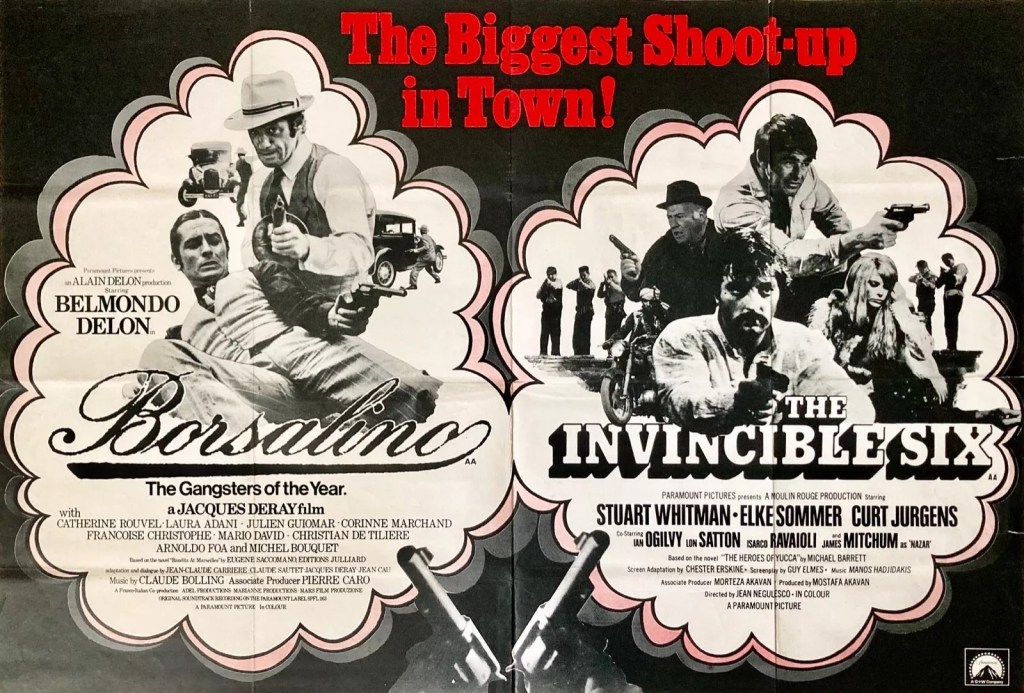
Borsalino (1970) ****

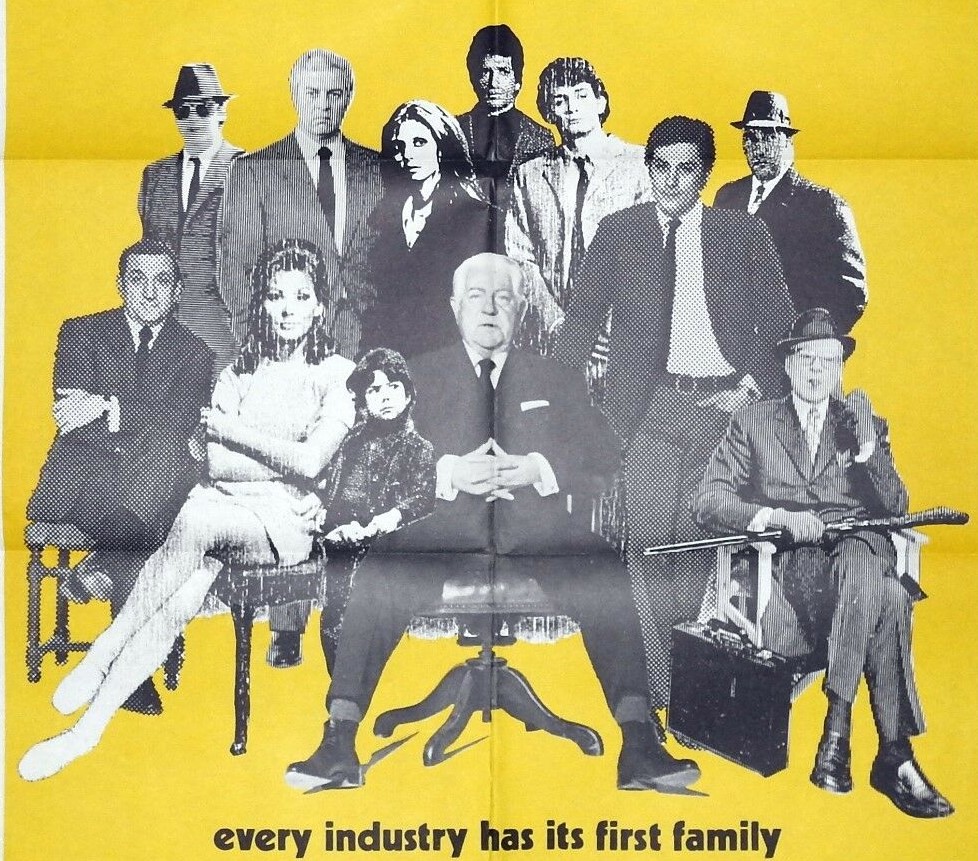
You wonder how much the unexpected success of this French gangster picture encouraged Paramount to invest in The Godfather (1972). The studio had gone down the Mafia route with The Brotherhood (1968) but to a significantly muted response. But where that film was heavy on family and drama, Borsalino went wild with charismatic performances and, as important, machine-gun-driven violence. And you couldn’t ignore the success the previous year of the French The Sicilian Clan (1969).

While Borsalino doesn’t go into the weighty issues and family sensibility that elevated The Godfather in the eyes of critics, its starting point owed more to Butch Cassidy and the Sundance Kid (1969) with two likeable hoods, even, initially at least, sparring over the same girl. The family element here concentrates on fraternity, brothers in crime, rather than the father-son dynamic that drove The Godfather. And it’s just so much goddam fun.  

Francois (Jean-Paul Belmondo) and Roch (Alain Delon) are petty crooks in Marseilles in the early 1930s working their way up to the top, initially just with scams like presenting a longshoreman who can’t speak a word of German as a German regional boxing champion, hijacking the favorite in a horse race, setting up a slot-machine business, disrupting the city’s fish market, until graduating to more serious crime and challenging Marello (Arnoldo Foa) and Poli (Andre Bollet), kingpins of the area’s organized crime. They set fire to an abattoir, establish their own fiefdoms, running legitimate businesses like casinos. But the higher they climb the closer they come to a devastating irony which cannot be ignored. Once they’ve eliminated everyone else, their only competition is with each other, and both realize that, inevitably, one will begin to want to become the undisputed top gangster.

Roch is the more thoughtful of the pair, the one looking ahead, sensing opportunity, the strategist, Francois more likely to indulge his playboy instincts, but both enjoy the high life, mixing with celebrities, politicians and archbishops. There’s plenty collateral damage. Try to steal a bigwig’s girlfriend away and you are virtually condemning her to death.   

Unexpectedly, for the genre, it’s huge fun, in part helped along by the genial earworm of a score by Claude Bolling, as evocative of the period as Scott Joplin’s rags were to The Sting (1973).  We don’t have to suffer any sanctimonious prig on the sidelines offering commentary or the gangsters making out that they’re better than they are because they don’t indulge in certain types of crime. But the biggest contributory factor is the teaming of Alain Delon (Once a Thief, 1965) and Jean-Paul Belmondo (Is Paris Burning?, 1966), the two biggest French male stars of the decade, the former enjoying substantially more success overseas than the latter.

Remember that Robert Redford was a not star when he made Butch Cassidy and the Sundance Kid so the pairing of two huge marquee names was not a regular feature anywhere in the world. It was Alain Delon, in his capacity as producer, who snared his rival, ceding top billing to achieve it.

This was the second of nine movies that Delon made with director Jacques Deray and could not have been more different from their previous outing La Piscine/The Swimming Pool (1969), a claustrophobic psychological thriller. Deray had history with Belmondo, too, Crime on a Summer Morning (1965). The characters were a great fit for their screen personas. And the photography, with some sepia tint, is distinctive.

Written by Jean-Claude Carriere (Viva Maria!, 1965), Claude Sautet (Nelly and Monsieur Arnaud, 1995), Jean Cau (Jeff, 1969) and the director, based on the book Bandits a Marseille by Eugene Saccomano.

Buddy movie breakout. Highly enjoyable.

Texas Across the River (1966) ****

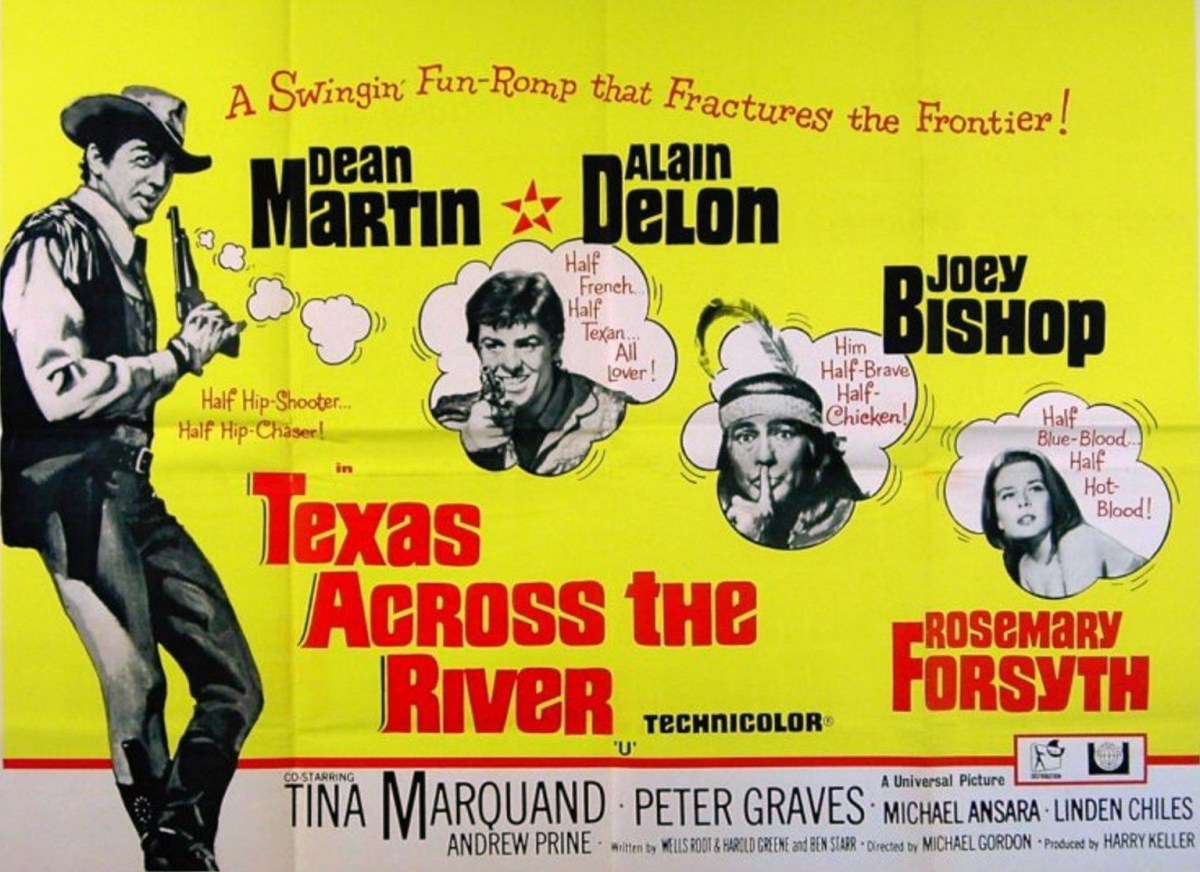
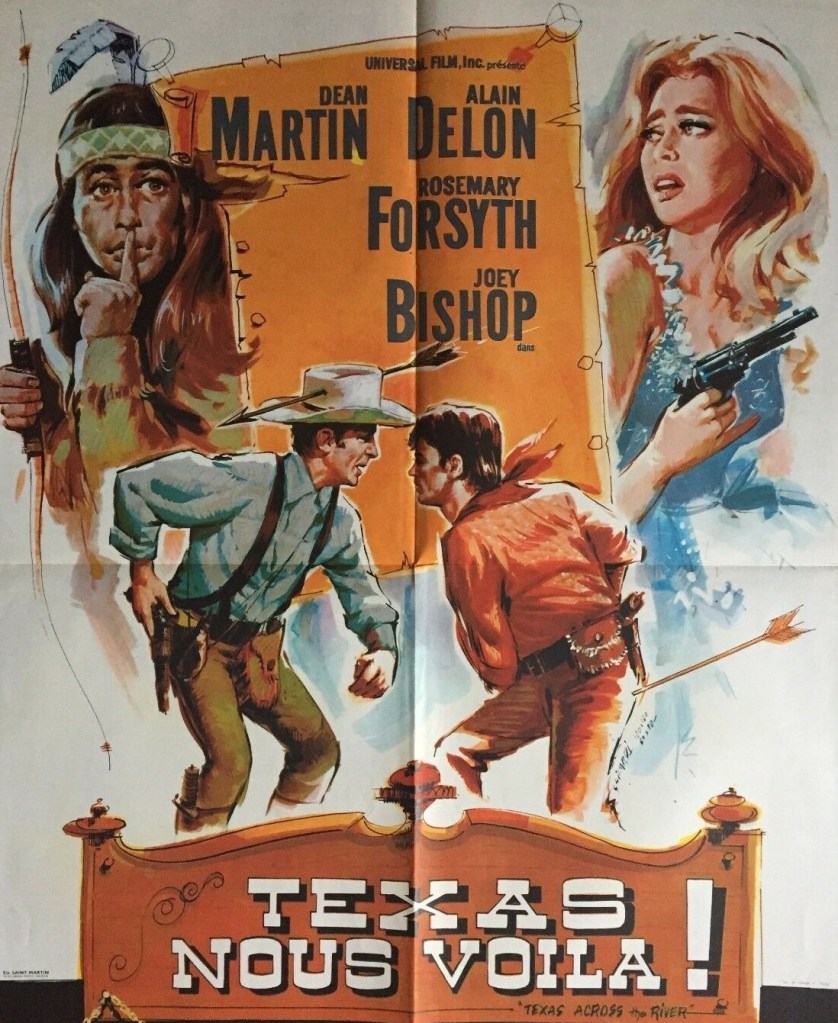
Excellent comedy western mixing dry wit and occasional slapstick to joyous effect. The wedding between Spanish duke Don Aldrea (Alain Delon) and Louisiana belle Phoebe (Rosemary Forsyth) is interrupted by her previous suitor Yancy (Stuart Cottle) who is killed in the resulting melee. Escaping to Texas, Don Aldrea’s marksmanship leads settler Sam (Dean Martin) to recruit him to help fight raiding Comanches. Romantic entanglement ensues when the Don rescues Native American Lonetta (Tina Marquand) and Sam has more than a passing interest in Phoebe.

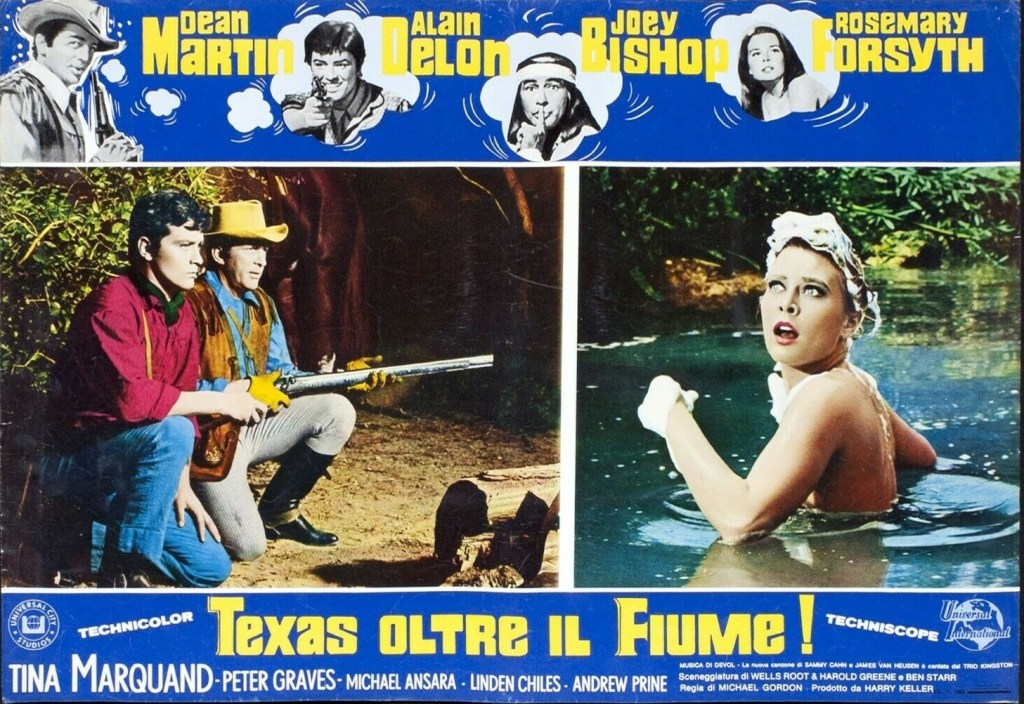
It is so tightly structured that nothing occurs that doesn’t have a pay-off further down the line. Bursting with terrific lines – including a stinger of a final quip – and set pieces, it pokes fun at every western cliché from the gunfight, the cavalry in hot pursuit, and fearsome Native Americans to the snake bite and the naked bathing scene. Incompetence is the order of the day – cavalry captain Stimpson (Peter Graves) issues incomprehensible orders, chief’s son Yellow Knife (Michael Linden) cannot obey any.

The Don, with his obsession with honor and his tendency to kiss men on the cheeks, is a comedy gift. Despite his terrific head of hair, he is stuck with the moniker “Baldy” and every time he is about to save the day he manages to ruin it. Sam is the kind of guy who thinks he is showing class by removing his spurs in bed while retaining his boots. His sidekick Kronk (Joey Bishop), a mickey-take on Tonto, mostly is just that, a guy who stands at the side doing nothing but delivering dry observations.

Lonetta is full of Native American lore and has enough sass to keep the Don in his place. “What is life with honor,” he cries to which she delivers the perfect riposte, “What is honor without life?” Phoebe is a hot ticket with not much in the way of loyalty.

Two sequences stand out – the slapping scene (whaat?) and a piece of exquisite comedy timing when Sam, Phoebe and the Don try an iron out a complicated situation.

Good as Dean Martin (Rough Night in Jericho, 1967) is the picture belongs to Alain Delon (Once a Thief, 1965) and I would argue it is possibly his best performance. Never has an actor so played against type or exploded his screen persona. Delon was known for moody, sullen roles, cameras fixated on his eyes. But here he is a delight, totally immersed in a role, not of an idiot, but a man of high ideals suddenly caught up in a country that is less impressed with ideals. If he had played the part with a knowing wink it would never have worked.

Martin exudes such screen charm you are almost convinced he’s not acting at all, but when you compare this to Rough Night in Jericho it’s easy to see why he was so under-rated. Joey Bishop (Ocean’s 11) is a prize turn, with some of the best quips. Rosemary Forsyth (Shenandoah, 1965) is surprisingly good, having made her bones in more dramatic roles, and Tina Marquand (Modesty Blaise, 1966) more than holds her own. Michael Ansara (Sol Madrid, 1968) played Cochise in the Broken Arrow (1956-1958) television series. Under all the Medicine Man get-up you might spot Richard Farnsworth. Peter Graves of Mission Impossible fame is the hapless cavalry leader.

Director Michael Gordon (Move Over, Darling, 1964) hits the mother lode, the story zipping along, every time it seems to be taking a side-step actually nudging the narrative forward. He draws splendid performances from the entire cast, knowing when to play it straight, when to lob in a piece of slapstick, and when to cut away for a humorous reaction, and especially keeping in check the self-indulgence which marred many Rat Pack pictures – two of the gang are here, Martin and Bishop. There’s even a sly nod to Sergio Leone spaghetti westerns when the electric guitar strikes up any time Native Americans appear. Frank De Vol (Cat Ballou, 1965) did the score. Written by Wells Root (Secrets of Deep Harbor, 1961), Ben Starr (Our Man Flint, 1966) and Harold Greene (Hide and Seek, 1964).

Terrific fun.

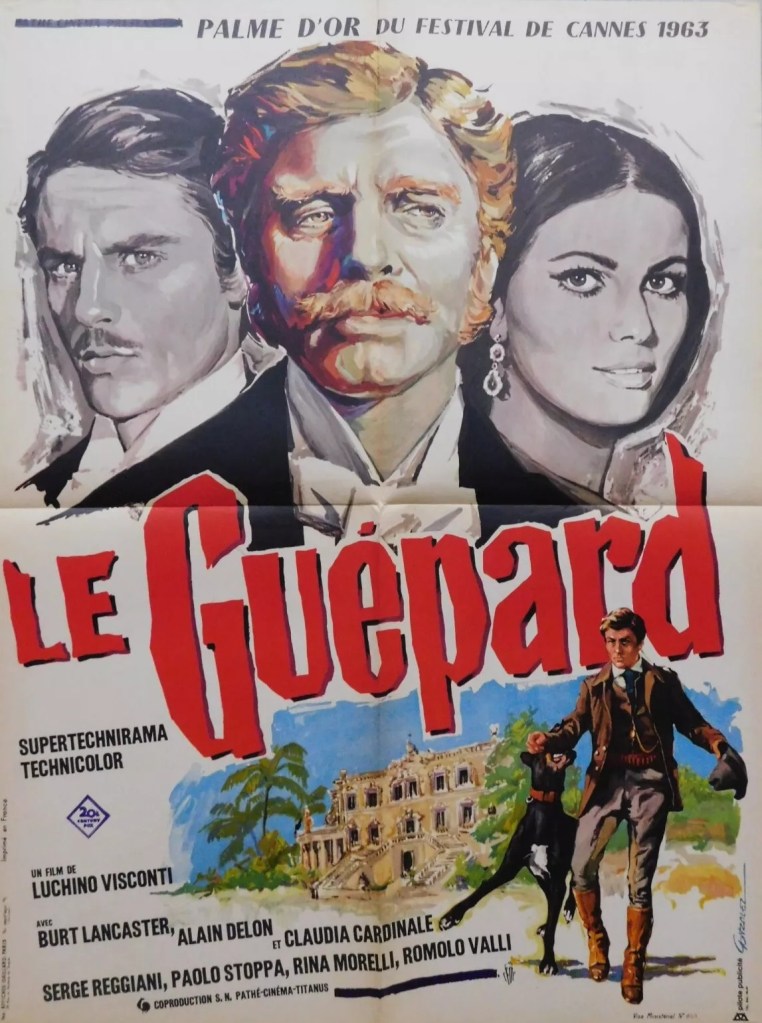
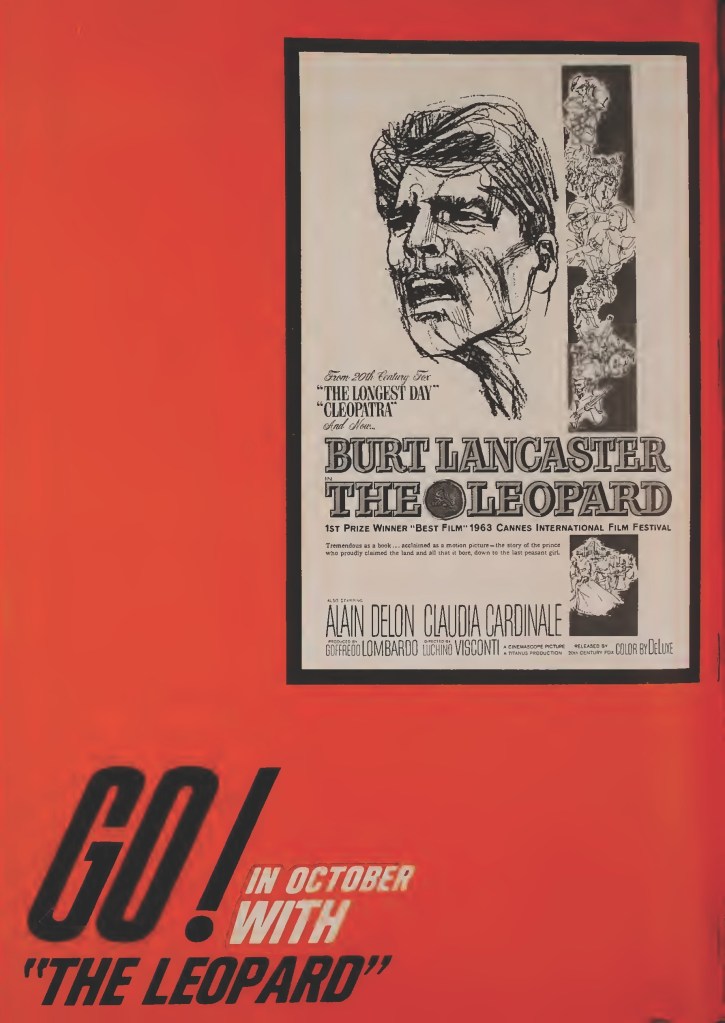
The Leopard (1963) *****

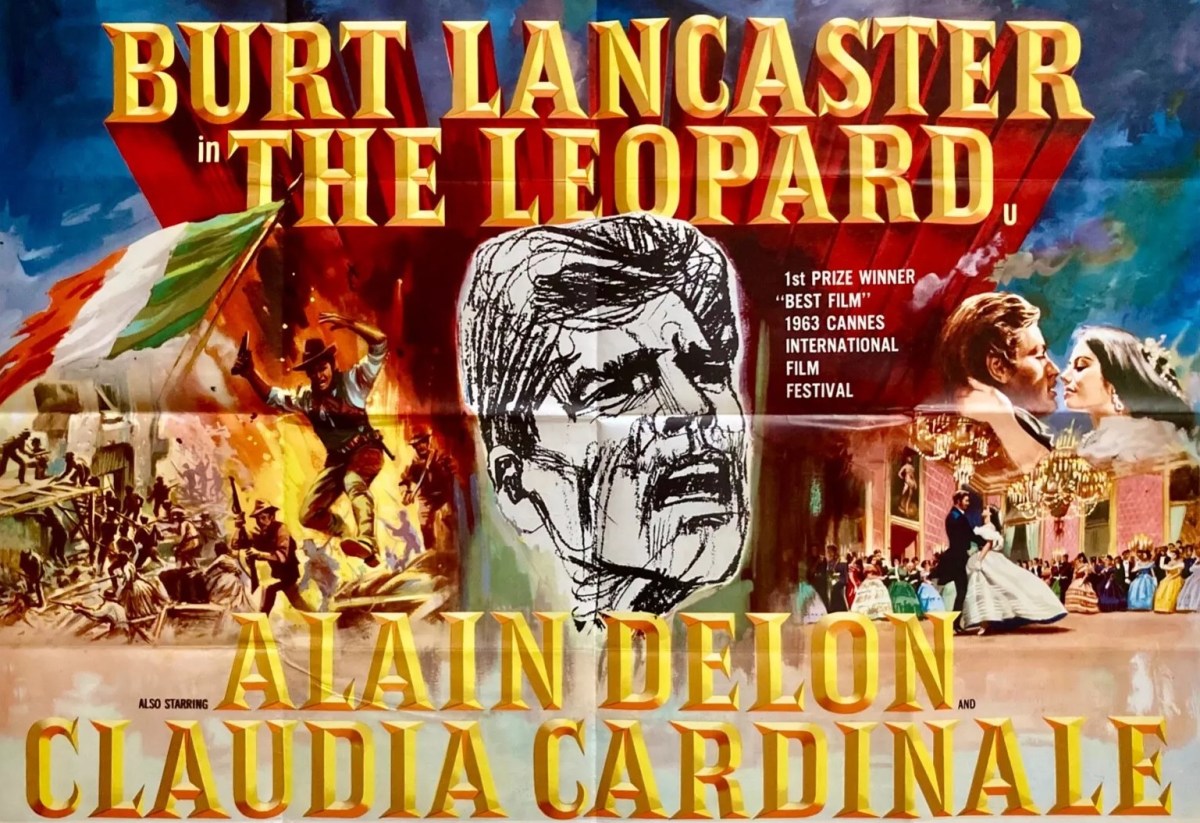
Masterpiece. No other word for the way director Luchino Visconti commands his material with fluid camera and three terrific performances (four, if you count the wily priest). An epic in the old-fashioned sense, combining intelligence, action and romance, though all three underlaid by national or domestic politics. And if you’re going to show crumbling authority you can’t get a better conduit than Burt Lancaster (check out The Swimmer, 1969, for another version of this), physical prowess still to the fore but something missing in the eyes. And all this on sumptuous widescreen.

Only a director of Visconti’s caliber can set the entire tone of the film through what doesn’t happen. We open with a religious service, not a full-scale Mass but recitations of the Rosary, for which the family is gathered in the massive villa of Prince Don Fabrizio Salina (Burt Lancaster). There is an almighty disturbance outside. But nobody dare leave or even react, children silently chided for being distracted, because all eyes are on the Prince and he has not batted an eyelid, worship more important than domestic matters.

Turns out there’s a dead soldier in the garden, indication of trouble brewing. Italy has been beset with trouble brewing from time immemorial so the Prince isn’t particularly perturbed, even if the worst comes to the worst an accommodation is always reached between the wannabes and the wealthy ruling elite.

There’s a fair bit of political sparring throughout but this is handled with such intelligence it’s involving rather than off-putting. Rebel Garibaldi is on the march, it’s the 1860s and revolution is on the way. But it’s not like the French Revolution with aristocrats executed in their thousands and when Garibaldi’s General (Guiliano Gemma) comes calling he addresses the Prince as “Excellency.”

The Prince is a bit of a hypocrite, not as devout as he’d like everyone to believe. He’s got a mistress stashed away for one thing and for another he blames his wife for the need to satisfy his urges elsewhere, complaining that she’s “the sinner” and that despite him fathering seven children with her he’s never seen her navel. Furthermore, the person he makes this argument to is the priest Fr Pirrone (Romolo Valli), who, knowing which side his bread is buttered on, doesn’t offer much of a challenge.

If you’re not going down the more perilous route of taking up arms, advancement in this society is still best achieved through marriage and the Prince’s ambitious nephew Don Tanacredi (Alain Delon), more politically astute, does this through marriage to Angelica (Claudia Cardinale), daughter of Don Calogeo Sedara (Paolo Stoppa).

Brutality and elegance sit side by side. You’re not going to forget the mob of women hunting down and hanging a Government police spy nor, equally, the astonishing ball that virtually concludes proceedings, showing that, whatever changes in society take place, those with money and privilege will still hold their own. But that’s only if they do a little bit of bending the knee to the new powers-that-be, something that Tancredi, by now a rebel hero wounded in battle, is more than happy to do, since that procures him even further advancement, but a step too far for the Prince, who at the end retreats into his study, as if this will provide sanctuary from the impending future.

Don’t expect battle on the scale of Lawrence of Arabia (1962), this action is a more scrappy affair, undisciplined red-shirted hordes sweeping through a town and eventually overwhelming cavalry and ranks of infantry.

But if you’re aiming to hold an audience for three hours, a decent script, romantic entanglement and camerawork isn’t enough. You need the actors to step up. Luckily, they do, in spades. Burt Lancaster is easily the pick, towering head and shoulders, and not just in physicality, above the rest, a man who sees his absolute authority draining away in front of his eyes. Alain Delon (Once a Thief, 1965) comes pretty close, though, not afraid to challenge his uncle’s beliefs nor point out his hypocrisy, and adept at picking his way through the new emerging society, his potential ascension to newfound power demonstrated by wearing a war wound bandage wrapped piratically around one eye, as though keeping a foot in both camps. Though American audiences never quite warmed to Delon, he was catnip for the arthouse brigade, courtesy of being anointed by Visconti and Antonioni in, respectively, Rocco and His Brothers (1960) and L’Eclisse  (1962).

Far more than U.S. cinemagoers could imagine, Claudia Cardinale (The Professionals, 1966) also easily straddled commercial and arthouse – Rocco and His Brothers, Fellini’s (1963) – and on her luminous performance here you can see why. You might also spot future Italian stars Terence Hill (My Name Is Nobody, 1970) and Giuliano Gemma (Day of Anger, 1967). Adapted from the bestseller by Giuseppe Tomasi de Lampedusa by the director and his Rocco and his Brothers team of future director Pasquale Festa Campanile (The Libertine, 1968), Suso Cecchi D’Amico,  Enrico Medioli and Massimo Franciosa.

I can’t quite get my head round the audacity of Netflix in attempting a mini-series remake. I’m assuming they’ve had the sense to buy up the rights to the Visconti to prevent anyone comparing the two.

One of the decade’s greatest cinematic achievements.

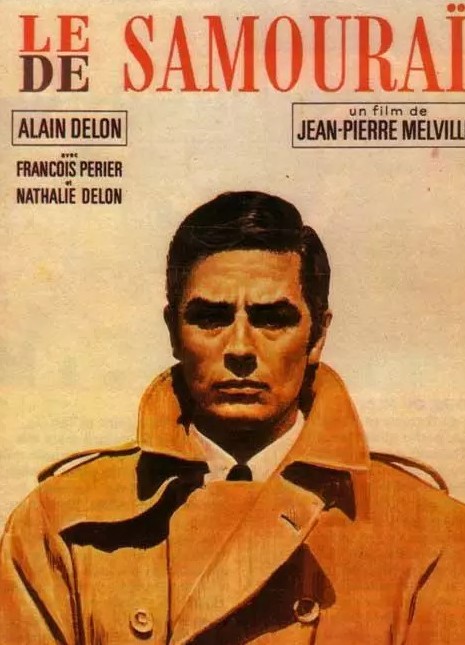
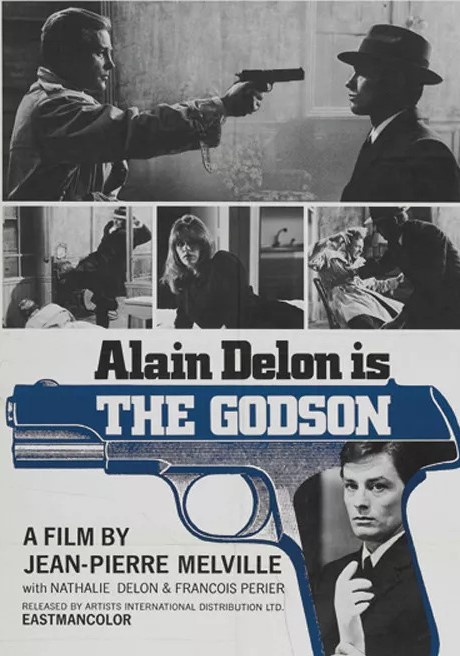
Le Samourai / The Godson (1967) ****

The current trope for giving assassins nicknames – viz Day of the Jackal (2024) – doesn’t stem from Jean-Pierre Melville’s spare picture, the title here more suggestive of the idea of killing as an honorable profession. One of the most influential crime movies of all time, it resonates through Michael Winner’s The Mechanic (1972) – though few critics would give that the time of day -Walter Hill’s The Driver (1978), John Woo’s The Killer (1989), Anton Corbijn’s The American (2010), Nicolas Winding Refn’s Drive (2011) and David Fincher’s The Killer (2023). Even so, few acolytes can match the opening scene of a room empty except for a whiff of smoke in a corner that indicates the presence of recumbent killer Jef (Alain Delon).

There’s none of the false identity malarkey of Day of the Jackal and no high-echelon ultra-secret secret service figures involved in tracking him down. In fact, one of the delights of the movie is the police procedural aspect, with the top cop, here known only as the Commissaire (Francois Perier), insisting on dragging in at least 20 “usual suspects” from each district. Though living a Spartan existence, Jef at least has the sense to acquire an alibi from the lover Jane (Nathalie) he shares with a wealthier man. Nor is he killing public figures. Instead, more like someone from Murder Inc., rubbing out other gangsters.

Shameless attempt to cash in on “The Godfather” after U.S. distributors held off for five years from releasing it.

The witnesses provide conflicting information on the man they saw, but the Commissaire does not entirely trust Jef’s alibi, putting pressure on Jane to recant. Her paying lover Weiner (Michel Boisrond) provides a pretty accurate description of Jef. While the cops bug his apartment and  start to shadow him, Jef falls foul of his anonymous employer who is alarmed at the attention the assassin has attracted and to avoid the possibility of being implicated sets an assassin onto the assassin.

Wounded, refusing to accede to Jane’s demand that he acknowledge he “needs” her, he tracks down the assassin’s boss, Oliver Rey (Jean-Pierre Posier), who happens to be the lover of Valerie, a nighgclub singer Jef takes a shine to. It’s worth noting that there’s an innocence – or perhaps an honor matching that of the samurai – in the police behavior. The Commissaire exists in a world where rules are not bent or broken, where suspects are not beaten up, and where often the cops are hamstrung by procedure and must take special care in arriving at a conclusion. To convince himself that Jef is indeed the correct suspect, the Commissaire makes him swap hat and coat with others in a line-up, only for the witness to identify the coat, hat and face that he believes he saw. It’s only Jane’s unbreakable alibi that keeps Jef safe.

Most of the picture is pure bleak style. You never enter the assassin’s head. There’s no background or backstory to shed any light on action. Even the most appealing characters, Jane and Valerie, occupy moral twilight. I’m not sure Melville’s in a mood for homage, though Robert Aldrich was in the Cahiers du Cinema hall of fame, but the ending comes close to replicating that of Aldrich’s The Last Sunset (1961), not just for the climactic action but for the inherent self-realization of unavoidable consequence.

Despite sparseness of the style, there’s enough going on emotionally and action-wise to keep an audience enthralled. While his outfit echoes the Humphrey Bogart private eye of the 1940s, and while walking the same mean streets, Jef is the antithesis of that untarnished hero.

Melville belonged to the hard-boiled school of cinematic crime, summoning up the gods of noir, and providing a new breed of French star with tough guys to kill for.  He died young, just 55, and left behind 14 pictures, at least three or four considered masterpieces including Army of Shadows (1969) and The Red Circle (1970). You might have thought his minimalist style would appeal more to critics than moviegoers but in his native France, in part because stars queued up to be in his movies,  he was highly popular.

When you compare the Delon of this to Once a Thief (1965) or Texas Across the River (1966) you can see how much acting goes into the restraint of the character here, producing one of Delon’s best performances. His wife of the time, Nathalie Delon (The Sisters, 1969) shines but briefly.

Recommended.

Farewell, Friend / Adieu, L’ami (1968) ****

This heist picture made Charles Bronson a star, though, like Clint Eastwood a few years previously, he had to go to Europe, in this case France, to find an audience appreciable of his particular skill set. This was such a box office smash in France that it was the reason that Once upon a Time in the West (1968), a major flop virtually everyone else, turned into a huge hit in Paris. After a decade as a supporting actor, albeit in some quality offerings like The Magnificent Seven (1960), The Great Escape (1963) and The Dirty Dozen (1967), Bronson developed a big following, if only initially in Europe.

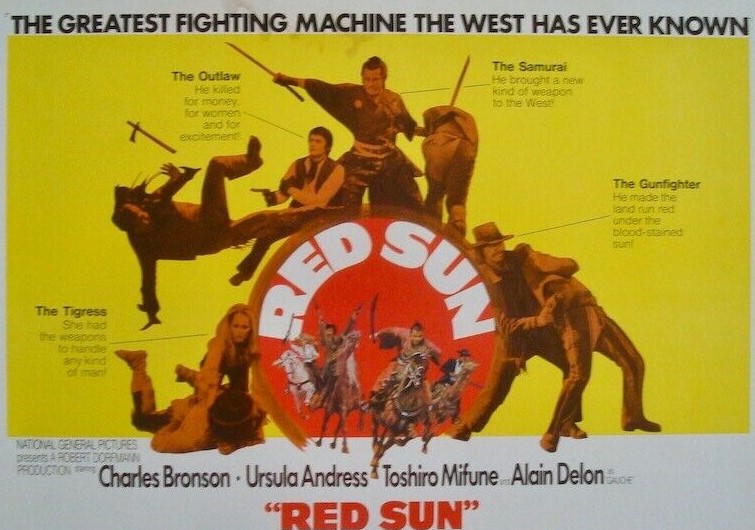
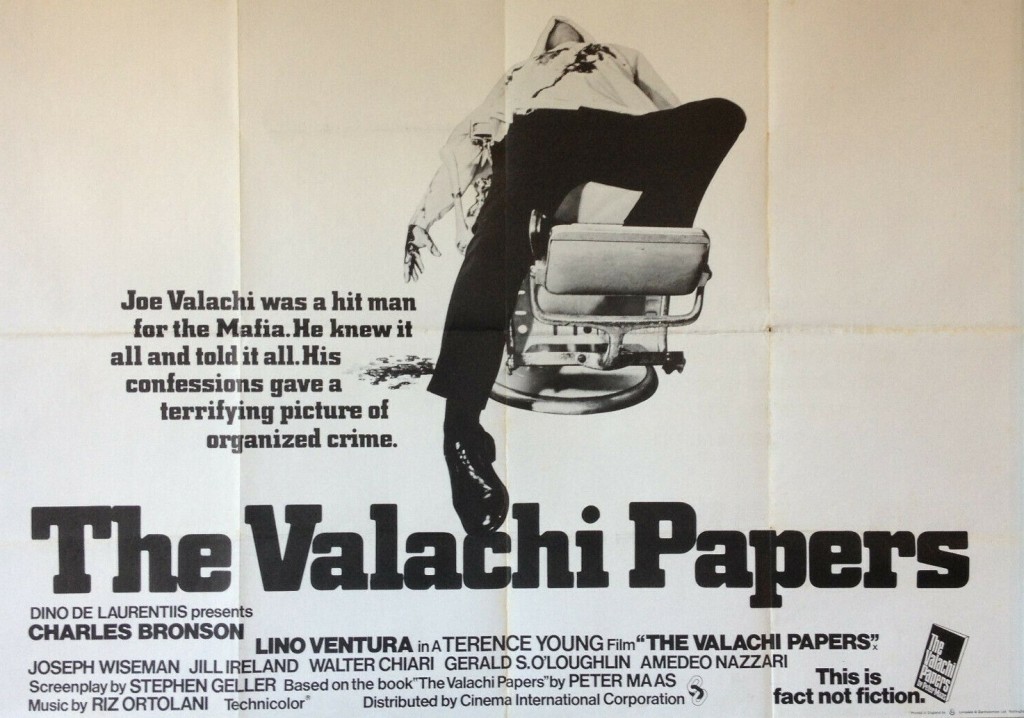
It could also lay fair claim to stealing the title of  “first buddy movie” from the following year’s Butch Cassidy and the Sundance Kid (1969) because, apart from the heist that is central to the story, it is essentially about the forging of a friendship. But it wasn’t released in the U.S. for another five years, in the wake of Bronson’s Hollywood breakthrough in The Valachi Papers (1972), and then under a different title, Honor Among Thieves.

And you can see why it was such a star-making vehicle. Bronson goes toe-to-toe with France’s number one male star Alain Delon. He had the walk and the stance and the look and he was given acres of screen time to allow audiences to fully appreciate for the first time what he had to offer. Like Butch Cassidy, the duo share a lot of screen time, and after initial dislike, they slowly turn, through circumstance and a shared code of honor, into friends.

Dino Barran (Alain Delon) is the principled one, after a final stint as a doctor in the French Foreign Legion, originally turning down Bronson’s overtures to become involved in a separate major robbery. Franz Propp (Charles Bronson) is an unsavory customer, making his living as a small-time thief who uses a stripper to dupe wealthy marks. Barran agrees to rob a corporation’s safe during the three-day Xmas holiday of two million dollars as a favor to the slinky widow Isabelle (Olga Georges-Picot) of a former colleague, for whose death he retains guilt. Propp more or less barges his way into the caper.

It’s a clever heist. Isabelle gets Barran a job as a company doctor whose office is next door to the giant vault. But there’s a twist. Surveillance reveals only three of the seven numbers required to open the vault. But Barran reckons three days is sufficient to try out the 10,000 possible combinations.

Barran and Propp despise each other and pass the time playing juvenile tricks, locking each other into a room, stealing all the food from the one dispensing machine, winding each other up, while they take turns trying different combinations. But it opens after only 3,400 attempts and they face a shock. The vault is empty. They have been set up to take the fall for a previous robbery that must have been completed before the building closed for Xmas.  

And there’s no way out. They are in lockdown, deep in a basement. The elevators can only be opened by a small squadron of guards upstairs. Food long gone, they are going to run out of water. If they use a lighter to see in the dark, or build a fire to get warm, the flames will eat up the oxygen they need to survive in the enclosed space. So the heist turns into a battle for survival and brute force, facing a deadline to escape before the building re-opens and they are discovered, exhausted and clearly guilty.

But that’s only the second act. There is a better one to follow, as their friendship is defined in an unusual manner. And there are any number of twists to maintain the suspense and tension. Butch Cassidy and the Sundance Kid were close friends when that western began. Here, we see the evolution of a friendship between two forceful characters who express their feelings with their fists.

Delon was a known quantity, but Bronson really comes to the fore, more than holding his own against a top star who oozed charisma. This is Bronson in chrysalis, the emergence of the tough guy leading man screen persona that would turn him into one of the biggest stars in the world. Surprisingly, given his later penchant for the monosyllabic, here he does a lot of talking, perhaps more actual acting than he ever did later when his roles tended to fall into a stereotype.

He has the two best scenes, both character-defining, but in different ways. He has a little scam, getting people to gamble on how many coins it would take for an already full-to-the-brim glass to overflow when a certain number of coins were dropped in. While this is a cute, it’s that of a small-time con artist, but watching it play out, as it does at critical moments, is surprisingly suspenseful. The second is the strip scene which shows him, as a potential leading man, in a very poor light, and although thievery is the ultimate aim, it is not far short of pimping, with Bronson standing back while the woman (Marianna Falk) is routinely humiliated. It’s the kind of scene that would be given to a supporting actor, for whom later redemption was not on the cards. It says something for Bronson’s command of the screen and the development of his character that by the end of the picture the audience has long forgotten that he could stoop so low.

It is a film of such twists I would not want to say much more for fear of giving away too much, suffice to say that Olga Georges-Picot and her friend, mousy nurse Dominique (Brigitte Fossey), are also stand-outs, and not just in the sense of their allure.

Director Jean Herman, in his sophomore outing, takes the bold step of dispensing with music virtually throughout, which means the audience is deprived of the usual musical beats, indicating threat or suspense or change of mood, during the critical heist sequence, but which has the benefit of keeping the camera squarely on the two leading characters without favoring either. Most pictures focusing on character rely on slow-burn drama. In the bulk of heist pictures characters appear fully-formed. Here, unusually, and almost uniquely in the movie canon, character development takes place during an action film.

Even without Bronson, this would have been a terrific heist picture. With him, it takes on a new dimension.

The All-Time Top 40

Traditionally, this is an opportunity for me to blow the trumpet on behalf of my loyal and growing band of readers. But this time out I’m also taking the opportunity to blow my own trumpet or in the patois of my home city “bum ma load.” I began this blog in June 2020 and my monthly viewing figures scarcely topped a few hundred in the first year. Now I’m hitting 10,000 views a month. Being a self-effacing kind of guy, I thought the world should know.

Now, back to the main task in hand. It’s been a major aspect of the Blog to see which films are most favored by my readers.  As regular readers will know, I run this feature every six months.

It’s worth pointing out that for such a testosterone-driven decade the Top Ten is dominated by female stars with Ann-Marget and Angie Dickinson in the ascendancy.  Raquel Welch, Hayley Mills and Jean Seberg also make a splash. As well as top male figures like Frank Sinatra, John Wayne, Robert Mitchum and Dean Martin readers have been highly appreciative of underdogs like Alain Delon, Richard Johnson and Alex Cord.

Surprisingly high number of new entries include Young Cassidy, Fathom, The Appointment, Diamond Head, The Family Way and The Venetian Affair.

The figures in brackets represent the previous year’s position.

  1. (1) The Swinger (1966). Queen of the Blog Ann-Margret in bouncy sex comedy that manages a sprinkling of innocence. 
  2. (2) Stagecoach (1966). Double whammy from Ann-Margret in this more than acceptable remake of the John Ford western with the male lead taken by Alex Cord, another star in need of reassessment.  
  3. (4) Fraulein Doktor (1969). German spy Suzy Kendall out-foxes Kenneth More in this World War One adventure with surprisingly grisly battle scenes and a superb score from Ennio Morricone.
  4. (3) Jessica (1962). Angie Dickinson as a young widow incurring the wrath of wives in a small Italian town.
  5. (7) Once Upon a Time in the West (1969). For many, including myself,  the greatest western ever made. Sergio Leone fashions a masterpiece from a stunning cast of Claudia Cardinale, Henry Fonda and Charles Bronson and that fabulous Morricone score.
  6. (6) Fireball XL5. (1962) The height of a television cult. Famous British series from Gerry and Sylvia Anderson, now colorized. “My heart will be a fireball…”
  7. (5) The Sins of Rachel Cade. (1961) Angie Dickinson (again) as African missionary falling foul of the natives and commissioner Peter Finch. Roger Moore in an early role.
  8. (10) Vendetta for the Saint. (1968) More television cultism. Movie made by combining two episodes of the series featuring the immortal Simon Templar. Roger Moore tackles the Mafia.
  9. (12) The Sisters (1969). Complicated French love triangle featuring Nathalie Delon and Susan Strasberg.
  10. (11)  Baby Love (1969). Controversy was the initial selling point but now it’s morphed into a morality tale as orphaned Linda Hayden tries to fit into an upper-class London household.
  11. (13) Pharoah (1966). Sensational Polish epic set in Ancient Egypt centering on the battle between the country’s ruler and the religious hierarchy.
  12. (9) Moment to Moment (1966). Hitchcockian-style thriller set in the south of France with Jean Seberg caught out in illicit love affair. Co-starring Honor Blackman.
  13. (21) Go Naked in the World (1961). Steamy drama with Gina Lollobrigida discovering that her profession (the oldest) and true love (with rich Anthony Franciosa) don’t mix. Great turn from Ernest Borgnine as a doting father.
  14. (8) The Secret Ways (1961). The first of the Alistair MacLean adaptations to hit the big screen features Richard Widmark trapped in Hungary during the Cold War. Senta Berger has a small role.
  15. (36)  In Harm’s Way (1965). Otto Preminger’s Pearl Harbor epic sets John Wayne and Kirk Douglas at each other’s throats.
  16. (20) The Golden Claws of the Cat Girl (1968). Genuine French cult film with Daniele Gaubert as a sexy cat burglar.
  17. (14) Can Heironymus Merkin Ever Forget Mercy Humpe and Find True Happiness? (1969) Self-indulgence reaches new heights as singer Anthony Newley invokes his inner Fellini that somehow involves bedding lots of women. Then-current wife Joan Collins co-stars.
  18. (New Entry) Young Cassidy (1965). Rod Taylor and Julie Christie in Jack Cardiff’s Irish drama. He took over from an ill John Ford.
  19. (22) Pressure Point (1962). No escape for racist patient Bobby Darin when psychiatrist Sidney Poitier is around.
  20. (New Entry) The Appointment (1969). Complete change of pace for Omar Sharif in unusual Italian drama directed by Sidney Lumet. Anouk Aimee is the tantalizing female lead.  
  21. (New Entry) Fathom (1967) Raquel Welch swaps her skydiving kit for the more comfortable environs of a bikini in thriller. Anthony Franciosa co-stars.
  22. (22) Pendulum (1969). Cop George Peppard accused of murdering unfaithful wife Jean Seberg.
  23. (New Entry) The Family Way (1966). Hayley Mills grows up – and how – in marital drama with new British star Hywel Bennett.
  24. (New Entry) Diamond Head (1962). Ruthless hypocritical land baron Charlton Heston causes chaos in Hawaii. With Yvette Mimieux and George Chakiris.
  25. (26) A Dandy in Aspic (1968). Cold War thriller with Laurence Harvey as a double agent who wants out. Mia Farrow co-stars.  
  26. (New Entry) The Venetian Affair (1966). Robert Vaughn turns in a terrific performance as an ex-alcoholic spy dealing with former lover Elke Sommer in slippery Venice-set thriller.
  27. (21) The Best House in London (1969). That’s a euphemism for a brothel, let’s get that straight. David Hemmings tries to do right by the sex workers.
  28. (25) Lady in Cement (1969). Frank Sinatra reprises private eye Tony Rome with mobster’s moll Raquel Welch as his client.
  29. (31) The Girl on a Motorcycle / Naked under Leather (1968). Heavily-censored in the U.S., erotic drama with singer Marianne Faithfull as the titular fantasizing heroine. Alain Delon co-stars.
  30. (New Entry) Genghis Khan (1965). Omar Sharif as the all-conquering Mongol chieftain. Stephen Boyd, James Mason, Eli Wallach, Telly Savalas and Francoise Dorleac lend support.
  31. (New Entry) The Chalk Garden (1964). Hayley Mills again, being brought to heel by governess Deborah Kerr with a hidden secret.
  32. (New Entry) Plane (2023). Gerard Butler channels his inner Bruce Willis as he attempts to avoid dying hard on an island inhabited by rebels.  
  33. (23) Oceans 11.  Frank Sinatra heads the Rat Pack line-up, inspiring an industry of  remakes and with everyone starting with Tarantino ripping off one scene.
  34. (New Entry) Five Card Stud (1968). Surprising mix of feminism and noir in revenge western. Dean Martin, Robert Mitchum and Inger Stevens topline.
  35. (34) The Misfits (1960). Last hurrah for Clark Gable, fabulous turns from Montgomery Clift and Marilyn Monroe in John Huston tale of losers. 
  36. (28) Once a Thief (1965). Change of pace for Ann-Margret as working mother whose ex-jailbird husband Alain Delon is forced into another job.
  37. (27)  Deadlier than the Male (1967). Espionage with a sting in the tale as venomous female villains including Elke Sommer and Sylva Koscina target Bulldog Drummond
  38. (35) Rage (1966). Glenn Ford and Stella Stevens combat pandemic in Mexican town.
  39. (New Entry) Blonde (2022). Ana de Armas in stylized biopic of Marilyn Monroe
  40. (33) She Died with Her Boots On / Whirlpool (1969). Sleazy British film from cult Spanish director Jose Ramon Larraz sees kinky photographer Karl Lanchbury seduce real-life MTA Vivien Neves.  

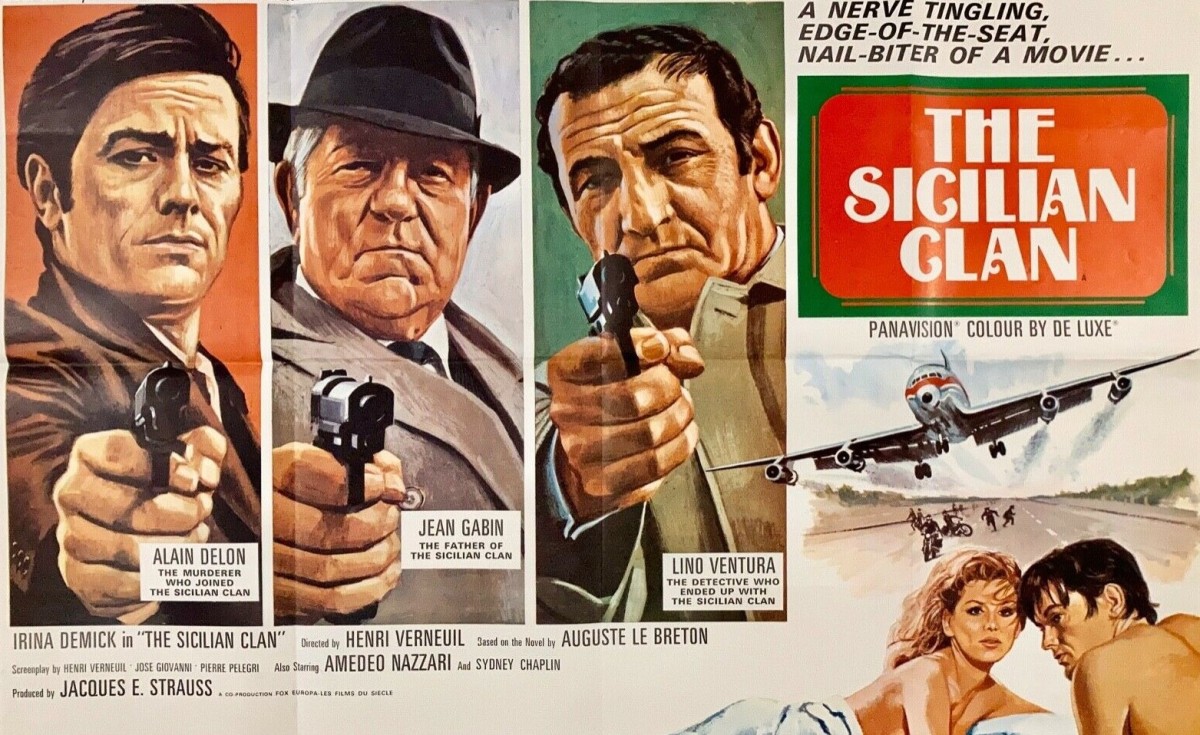
The Sicilian Clan / Le Clan des Siciliens (1969) *****

Absolutely cracking, brilliantly structured, gangster thriller featuring two fabulous heists and three legendary French stars in Jean Gabin, Alain Delon and Lino Ventura. Roger Sartet (Delon) is a trigger-happy robber whose terrific prison escape is organized for a hefty fee by French-based Mafia chieftain Vittorio Manalese (Gabin). Le Goff (Ventura) is the rugged cop hunting down the escapee which brings him into the orbit of Manalese, about whose existence he is completely unaware, the gangster having kept an extremely low profile, never engaging in violence, hiding behind the legitimate front of a pinball machine business.  Veteran French director Henri Verneuil (Guns for San Sebastian, 1968) dukes between the twin storylines with ease.

Sartet brings Manalese the opportunity to pull off the most audacious jewel robbery in history, even though the older man despises Sartet’s penchant for violence and sex. We often see Manalese at family gatherings, head of the dinner table, the family watching television together, frowning on one son’s liking for alcohol, playing with his grandson. He is not just a calm and clever businessman, but very quick-thinking, his sharp mind in a couple of instances preventing disaster. Sartet, on the other hand, will happily endanger his life and freedom by consorting with prostitutes and breaking an unspoken code of honor in an affair with Manalese’s son’s wife (Irina Demick).

The result combines dogged detective work by Le Goff and the inspired planning and execution of the jewel robbery until the two worlds collide. The investigation alone would have made this an outstanding picture. Le Goff, always seen with an unlit cigarette in his mouth although he is trying to give up smoking, concentrating initially on Sartet, sets up surveillance on the thief’s innocent sister and begins an involved – and engrossing – process of tracking down every potential lead and when at last he has Sartet in his sights it brings him up close to Manalese.

Le Goff’s professionalism is matched by that of Manalese and the picture develops into an absorbing battle of wits and the latter’s family values and moral compass puts him at odds with loner Sartet. There is some brilliant invention, the sacrificial watch, for example, and the unexpected appearance of a faithful British wife, although you do guess just how long Le Goff will go before lighting his ever-tempting cigarette. 

The ultra-cool Alain Delon (Once a Thief, 1965) excels in this kind of amoral part, but Jean Gabin (Any Number Can Win, 1963) and Lino Ventura (Army of Shadows, 1969) as old-style gangster and cop, respectively, steal the show. Irina Demick (Prudence and the Pill, 1968) thrives as the bored wife of a dull gangster who is attracted by the violent Delon, at one point deliberately putting herself in the line of his potential fire for the thrill. Actually, it’s the jewel heist that steals the show. Unlike other heist pictures where you have fair idea in advance of the details of the theft, here the audience is kept completely in the dark. Just as important in any heist is that the thieves get away with their plunder and the plan in this instance is breath-taking.

As proved by The Burglars (1971) director Henri Verneuil has the nose for a heist, but this tops that for sheer audacity and elan. Verneuil, Delon and Gabin had worked together on Any Number Can Play. Written by Verneuil and Jose Giovanni (Rififi in Tokyo, 1963) from the novel by Auguste Le Breton (Rififi, 1965).

Preceding The Godfather (1972) in its exploration of family and Mafia code of conduct, it offers plenty in the humanity department while dazzling with ingenuity in the criminality stakes.

Unmissable.

Lost Command (1966) ***

Derring-do and heroism were the 1960s war movie default with enemies clearly signposted in black-and-white. This one doesn’t fall into that category, in fact doesn’t fall into any category, being more concerned with the military and political machinations pervasive on both sides in war. Movies about revolutions generally succeed if they are filmed from the perspective of the insurrectionists. When they take the side of the oppressor, almost automatically they lose the sympathy vote, The Green Berets (1968) in this decade being a typical example, although the sheer directorial skill of Francis Coppola turned that notion on its head with Apocalypse Now (1979) when slaughter was accompanied by majesty. 

In the 1950s-1960s the French had come off worse in two uprisings, Vietnam and Algiers. This movie covers the tail end of the former and the middle of the latter and it’s a curious hybrid, part Dirty Dozen, part John Wayne, part dirty tricks on either side, with a few ounces of romance thrown in.

Col Raspeguy (Anthony Quinn, in unlikely athletic mode – that’s him leaping in the poster) is the officer of a paratroop regiment who sees out the debacle of the final battle of the French war in Vietnam, loses his commission, and then, reprieved, is posted to Algeria, where the fight for independence is in full swing, with a ragbag of rejects plus some faithful comrades from his previous command. In any spare moment, the colonel can be seen keeping fit, doing handstands, swinging his arms, puffing out his chest, and a fair bit of running (presumably to avoid the contention that Quinn was too old for this part). Sidekick Capt Esclavier (Alain Delon) is a bit too moralistic for the dangerous business of war, plays his sidekick. The colonel is an ideal anti-hero for a hero, an officer who ignores, challenges or just plain overrides authority, adored by his men, hated by the enemy, ruthless when it matters.

The brutal realism, which sometimes makes you quail, is nonetheless the best thing about the picture, no holds barred here when it comes to portraying the ugly side of battle. The training in The Dirty Dozen is a doddle compared to here, soldiers who don’t move fast enough are actually shot, rather than just threatened with live ammunition, and there’s no second chance for the incompetent – at the passing out ceremony several are summarily dismissed. The only kind of Dirty Dozen-type humor is a soldier who fills his canteen with wine. Otherwise, this is a full-on war.

Battles are fought guerilla style, the enemy as smart as the Vietnamese, catching out the French in ambushes, using infiltrators sympathetic to the cause and terrorism. Unlike Apocalypse Now where the infantry appeared as dumb as they come, relying on strength in numbers and superior weaponry, Lost Command at least has an officer who understands strategy and most of what ensues involves clever thinking. The battles, played out in the mountains, usually see the French having to escape tricky situations rather than blasting through the enemy like cavalry, although having sneakily pinched a mayor’s helicopter gives Raspeguy’s team the opportunity to strafe the enemy on the rare occasions when they can actually be found, their camouflage professionally done.

Arab rebel chief Lt Mahidi (George Segal, unrecognizable under a slab of make-up apart from his flashing white teeth), matches the French in terms of tactics and brutality, shooting one of his own men for disobeying orders. His sister Aicha (Claudia Cardinale) is the femme fatale making a play for Esclavier, though he’d have to be a lot dumber than the audience to fall for her obvious ploys (guess what, he is dumber). With both sides determined to win at all costs, atrocities are merely viewed as collateral damage, so in that respect it’s an unflinching take on war.

The picture could have done with another 15 minutes or so to allow characters to breathe and develop some of the supporting cast. The movie did well in France but sank in the States where my guess is few of the audience would even know where Algeria was. Gilles Pontecorvo’s The Battle of Algiers, out the same year, gave the revolutionaries the leading role.

For the most part Anthony Quinn (Guns for San Sebastian, 1968) is in bull-in-a-china-shop form but his character is more rounded in a romantic interlude with a countess (Michele Morgan), his ability to outsmart his superior officers, his camaraderie with his own soldiers and, perhaps more surprisingly, the ongoing exercise routines which reveal, rather than a keep-fit fanatic, an ageing soldier worried about running out of steam. Alain Delon (Texas Across the River, 1967) is entrusted with the morally ambivalent role. George Segal (The Quiller Memorandum, 1966) presumably didn’t realize how culturally inappropriate he would be.

Mark Robson (The Prize, 1963) lets worthy get in the way of action. Screenwriter Nelson Gidding (Nine Hours to Rama, 1963) had the same problem.

Set the politics aside and it becomes much more interesting.

Discover WordPress

A daily selection of the best content published on WordPress, collected for you by humans who love to read.

The Atavist Magazine

by Brian Hannan

WordPress.com News

The latest news on WordPress.com and the WordPress community.