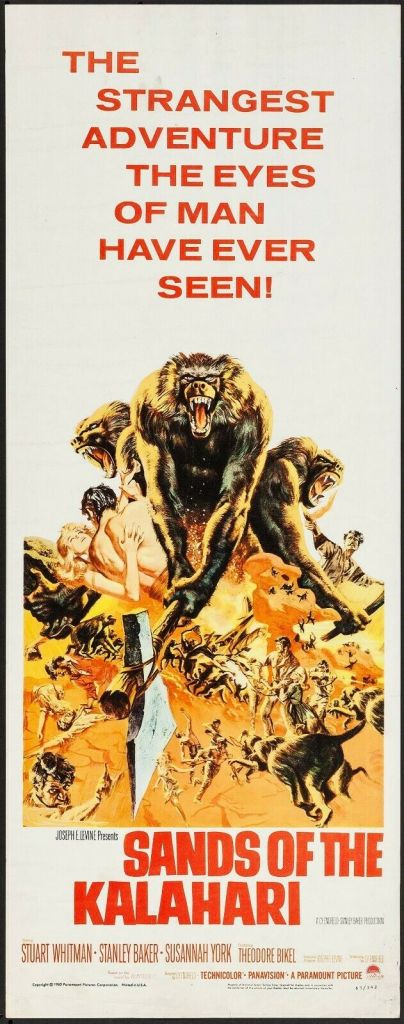
Sands of the Kalahari (1965) ****

You know the score: plane crashes in inhospitable territory (in this case a desert), personalities clash as food/water is rationed, tempers run high and/or depression sets in as attempts to attract attention fail, someone goes for help, someone else has an ingenious idea and eventually everyone rallies round in common cause. That template worked fine in The Flight of the Phoenix (1965).

It doesn’t here. This is not quite as inhospitable. There is water. Caves offer shelter from the blazing sun. There is food – lizards trapped, game hunted with telescopic rifle. But the food is lean, not fattened through farming for human consumption.  And you have to watch out for marauding baboons not to mention scorpions. And this group is split, two alpha males intent on exerting dominance with little interest in common cause.

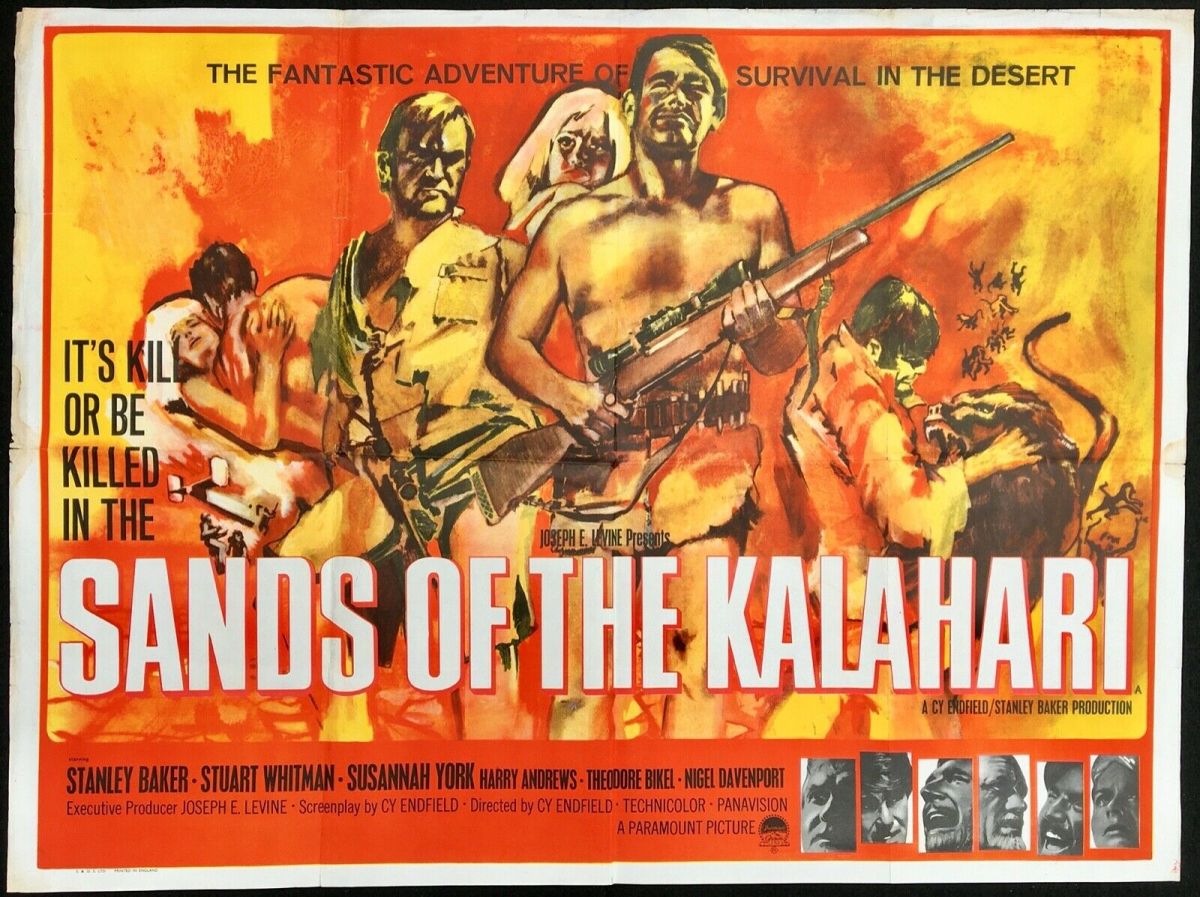
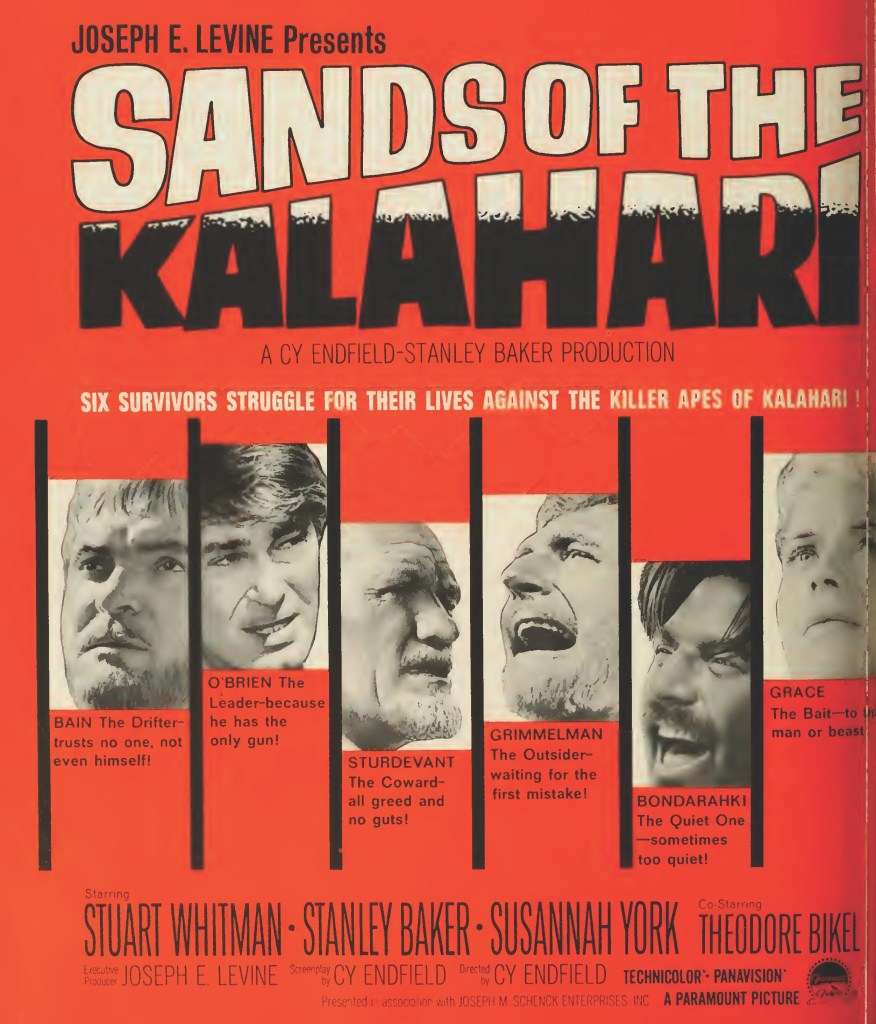
Producer Joseph E. Levine came up with the poster
without close examination of the picture’s content.

Of the six survivors of this crash, Sturdevan (Nigel Davenport) decides his leadership status entitles him to sole claim over the only woman, Grace (Susannah York). But when he accepts the genuine responsibilities of leadership, he sets off across the desert to get help. That leaves Grace to fall into the hands of O’Brien (Stuart Whitman), so alpha he could be auditioning for Tarzan, shirt off all the time.

It soon transpires O’Brien has a rather unusual idea of survival – getting rid of his companions so that he will have no shortage of food until rescue arrives. It takes a while for the others to catch on to his plan. And then rather than common cause and camaraderie, it becomes every man/woman for himself, a battle for individual survival, a return to the primeval.

The most likely challenger to O’Brien’s authority is Bain (Stanley Baker), but he has been badly injured in the crash and no match for the other man’s brawn or his weapon. So it becomes a game of cat and mouse. Except it’s in the desert, it’s the law of the jungle and the rule of autocracy brought home with sudden force to people accustomed to the comforts of civilization and democracy.  

The movie’s structure initially takes us down the obvious route of common purpose – Grimmelman (Harry Andrews) knows enough survival lore to devise a method of water transportation that would permit the group to escape the desert, Dr Bondrachai (Theodore Bikel) formulates  a method of trapping lizards, and O’Brien, at least at first, appears willing to take on the role of protector, warding off baboons with his gun.

The change into something different is subtle. While the others are desperate to escape, it becomes apparent that O’Brien has found his metier. We discover little about the lives of each individual prior to being stranded. Whatever O’Brien’s standing in society, it would not have been as high as here, where his superior skills stand out. Reveling in his supremacy, he doesn’t particularly want to go home.

Like any psychopath Bain knows how to manipulate so at first it seems his decisions are for the greater good. And only gradually does it emerge that he blames others for his own mistakes and intends to eliminate his rivals for the food supply one by one. Because he is so handsome, it is impossible to believe he could be so devious or so evil.

The three principals all play against type. Stanley Baker (Zulu, 1963) and Stuart Whitman (Murder Inc., 1960) made their names playing heroic types. Here Baker is too ill for most of the picture to do any good and Whitman plays a ruthless killer. But Susannah York (Sebastian, 1968) is the big revelation. Audiences accustomed to her playing glamorous, perhaps occasionally feisty, gals will hardly recognize this portrayal of a coward, not just abjectly surrendering to the alpha male but seeking him out for protection and guilty of betrayal.

Even though this picture is set in the days before gender equality and the independent woman was a rarity, Grace’s acquiescence to the powerful male is disturbing, in part because it takes us back to the days when a woman was impotent in the face of male dominance. Such is York’s acting skill that rather than despise this woman, she earns our sympathy.

While for the most part Harry Andrews (Danger Route, 1967) and Nigel Davenport  (Sebastian, 1968) appear in their usual screen personas of strong males, here their characters both are changed by the circumstances. Theodore Bikel (A Dog of Flanders, 1960) has the most interesting supporting role, the only one who takes delight in the adventure.

Director Cy Endfield (Zulu) – who also wrote the screenplay based on the William Mulvehill novel – delivers a spare picture. There is virtually no music, just image. Aerial shots show tiny figures in a landscape. The absence of character background frames the story in the present. As a reflection on the animal instinct, how close to the primordial a human being still operates, no matter how enlightened, this works exceptionally well, and melds allegory with thriller.

The Sins of Rachel Cade (1961) ***

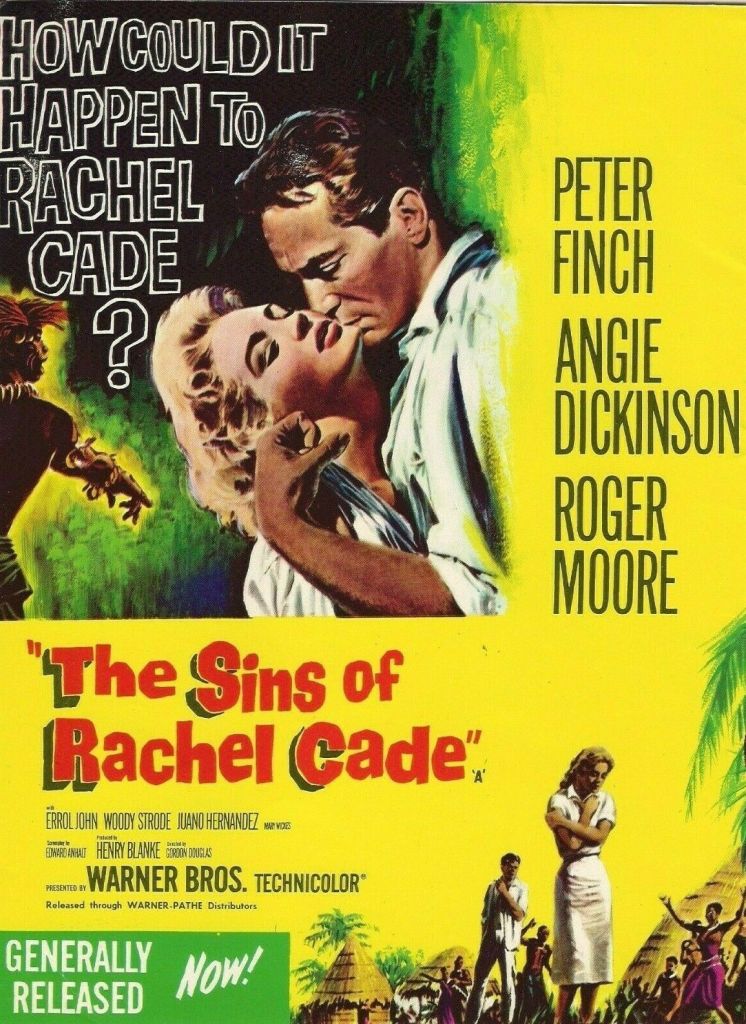
In her first top-billed role Angie Dickinson (Jessica, 1962) delivers a strong performance as an American nurse/missionary in the Belgian Congo at the start of the Second World War. The usual Hollywood trope of “heathens” needing to be educated by imperialists – from The Bitter Tea of General Yen (1933) and The Keys of the Kingdom (1944) through to The Nun’s Story (1959) – was to some extent turned on its head here.

Just as Rachel Cade (Angie Dickinson) arrives at a hospital in a small village, resident Dr Bikel  (Douglas Spencer) dies. Not only does the hospital have no patients, the local Belgian commissioner Col Derod (Peter Finch) wants her to leave, believing her presence will act as provocation to the local high priest Kalanumu (Juano Hernandez) and witch doctor Muwango (Woody Strode). After standing up to all three, Rachel embarks on refurbishment of the hospital aided by assistant Kulu (Errol John).

Patients remain non-existent until she cures a small boy of appendicitis, as a result of which Muwango places a curse on her that she will lose her Protestant faith and promises the local god will take his revenge on anyone who supports her. Of course, her skills are not infinite and not only is there another boy who dies in her care but she cannot cure – and does not attempt to cure – the infertile third wife of the local chief.

While she warms to her patients and they to her, she cannot come to terms with their acceptance of incest (if a husband is called away, his brother must make love to his wife), polygamy, vaginal mutilation, the sexuality of their dancing and the fact that sin does not exist in their culture. Meanwhile, she distrusts the visions seen by the most convinced of her converts, Kulu.    

When the sexually repressed Rachel rejects Derod’s advances in favour of the  dashing but money-oriented Dr Paul Winton (Roger Moore), thus violating her own teachings, she becomes enmeshed by the principles she holds so dearly and which the Africans refute. A twist in the tale pivots the picture on whom she will marry, the sensible Derod, the cavalier Winton, or retain her own independence in defiance of the standards of the time.  

A battle of the hierarchies – the female nurse and her supporters versus male supremacy – maintains the tension but underneath is a philosophical struggle between the two faiths. The Christian religion which boasts of forgiveness is in the end unforgiving of those who break its moral code, while the African religion does not force onto its believers such ludicrous rules. On top of that is Rachel’s acceptance of her own passion, the realization that love cannot be restrained by commandment, and that men are more likely to betray her.

The reality of imperialist rule is not underplayed but since this predates the Mau Mau uprising in Kenya in the 1950s that precipitated widespread rebellion and Derod can call on soldiers for protection in the Belgian colony and is in fact a generally tolerant (though at times patronising) overseer, political issues remain in the background.

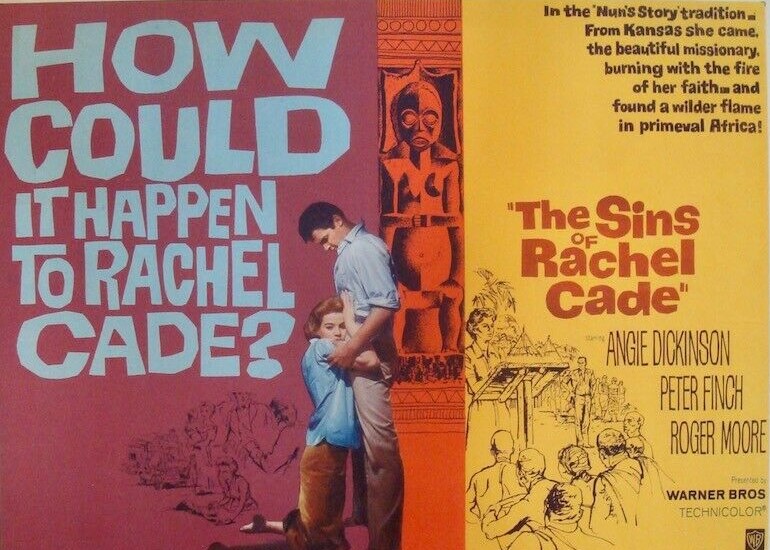
Angie Dickinson gets the movie star build-up in this British trade advertisement.

Director Gordon Douglas (Claudelle Inglish, 1961) keeps the focus on the transition of the naïve American while not ignoring nor appearing to ridicule the rituals and beliefs of the tribe – although a cynic might consider that the sexuality of the dancing, while repellant to Rachel, might be included more with an eye to attracting an audience. Overall, it appears an honest even-sided presentation, with the high priest getting the better of Rachel in arguments over the frailties of Christianity. Angie Dickinson brings conviction to a role that sees her start out a shade saintly until brought back down to earth by human weakness. Peter Finch, by coincidence the leading man to Audrey Hepburn role in The Nun’s Story, fills out his normal stoic screen personality with touches of grief. Roger Moore (Vendetta for the Saint, 1969) had not yet mastered the art of the raised eyebrow and so brought a more rounded performance to his role and is entirely believable as the lover with the mercenary streak.

The pick of the supporting parts is Mary Wickes (Sister Act, 1992) as Derod’s wisecracking housekeeper. Woody Strode (The Professionals, 1966), Scatman Crothers (The Shining, 1980),  Juano Hernandez (The Pawnbroker, 1964) and Errol John (The Nun’s Story)  provide stiff opposition for the incomers.  Edward Anhalt (The Satan Bug, 1965) based his screenplay on the bestseller by Charles Mercer.

CATCH-UP: Featured in the Blog so far are the following Angie Dickinson pictures: Ocean’s 11 (1960), A Fever in the Blood (1961), Jessica (1962), The Chase (1966), Cast a Giant Shadow (1966) and Point Blank (1967).

The Lion (1962) ***

For such a harmless picture The Lion raises a couple of troubling issues. The first concerns the titular beast. Doubt if you’d get the authorities these days to greenlight a movie where a pre-pubescent girl was in such close proximity to a full-grown lion. Having as a safety measure two sharpshooters on the sidelines out of camera range, as director Jack Cardiff did here, might not cut it.

Secondly, we’ve got censor double standard. I remember my shocked parents forbidding me from seeing Zulu (1964), a massive hit in Britain, on account of the toplessness of the indigenous females. The censor didn’t slap an X-certificate on that sequence on the assumption that such nudity, in the context of tribal tradition, wouldn’t apparently incite the lewd male gaze. Had this been white breasts on show, in whatever tradition, the censor would not have been so lenient, signifying an inherent racism. Here, surprisingly, we’ve also got female toplessness, somewhat more discreet than Zulu, but coming as a surprise to your reviewer.

Perhaps the oddest feature of the picture is the contradictory message: Africa is wonderful but it’s not the place to bring up a young girl. Certainly not one who embraces the wildness with considerably more conviction than a passing wildlife tourist. As the imdb stub puts it: the young girl Tina (Pamela Franklin) must be brought “back to civilization.”

And there’s a distinctly old-fashioned tint to a storyline that demands the appearance of her father Robert (William Holden), long divorced from wife Christine (Capucine), as the firm male hand required to drag his estranged daughter back to said civilization. Christine’s current partner John (Trevor Howard), grizzled poacher-turned-gamekeeper, former big game hunter now eking out a living as a game warden, appears more sanguine about the girl’s lifestyle but less welcoming to the visitor. Tina has raised the wild lion King from a cub and as their bond is intense she is reluctant to give him up.

Disney would have taken a different approach, buffing up the cuter aspects. That the studio could show adult and child perspective in tandem is instanced by Pollyanna (1960) and in the later The Jungle Book (1967) solved the problem of a young boy becoming too involved with his wild playmates by having an intriguing young girl tempt him away. Or a touch of the Born Free (1966) playbook might have seen Tina simply mutate from childhood to an adult job in the animal preservation business

Instead, playing out in almost literal fashion, are two human male beasts battling it out (though not physically, unfortunately) over the mother with the needs of the child seemingly swept to one side as the love triangle takes hold.

The best scenes concern Robert and Tina, especially her early disinterest in his presence, and her later delight at leading him a wild dance through the jungle and seeing how his terror of her lion pal equates with her complete lack of fear. While John’s role is to keep a grip on poaching, he’s not so friendly to the animals, almost determined to torment them by running his jeep recklessly at or around them to elicit maddened response and alarm the visitor with their wildness rather than their apparent, at a distance, docility.

Perhaps the lack of a punch-up ensures this movie never catches fire. There’s quite a perplexing sub-plot that dictates the outcome. The son  of the local tribal chief has his eye on Tina and during the aforementioned tradition it’s clear the young girl wants to participate in the frenzied dance courtship ritual.

But this kind of tradition is at the polar opposite of civilization as is the tradition that an old man, succumbing to fatal illness, should be left out in the wild to die. Christine intervenes to save him. Meanwhile, believing his father dead, the son sets out to achieve manhood by killing the lion and in the ensuing tangle John kills both young man and lion. The tribal response to the death of their new chief goes unrecorded but Bullit’s action drives Tina towards her parents. With the lion dead, it’s a lot easier to winkle the girl away from Africa and back to civilization.

Plenty of wildlife for your buck, but plot and characters are not a patch on Hatari! (1962) or The Last Safari (1967). William Holden, whose yen for making movies as far away from the U.S. tax authorities as possible was destroying his career, is good value as the estranged father and if you are looking for smouldering then Trevor Howard (The Long Duel, 1967) is your man. Capucine would tee up with Holden – the pair had an affair – again in The 7th Dawn (1964) but she was more effective in the later picture than here.

Jack Cardiff (Girl on a Motorcycle, 1968) directs from a script by Irene and Louis Kamp (The Sandpiper, 1965) based on the bestseller by Joseph Kessel (L’Armee des Ombres/Army of Shadows, 1969).

Might have preferred the Disney version.

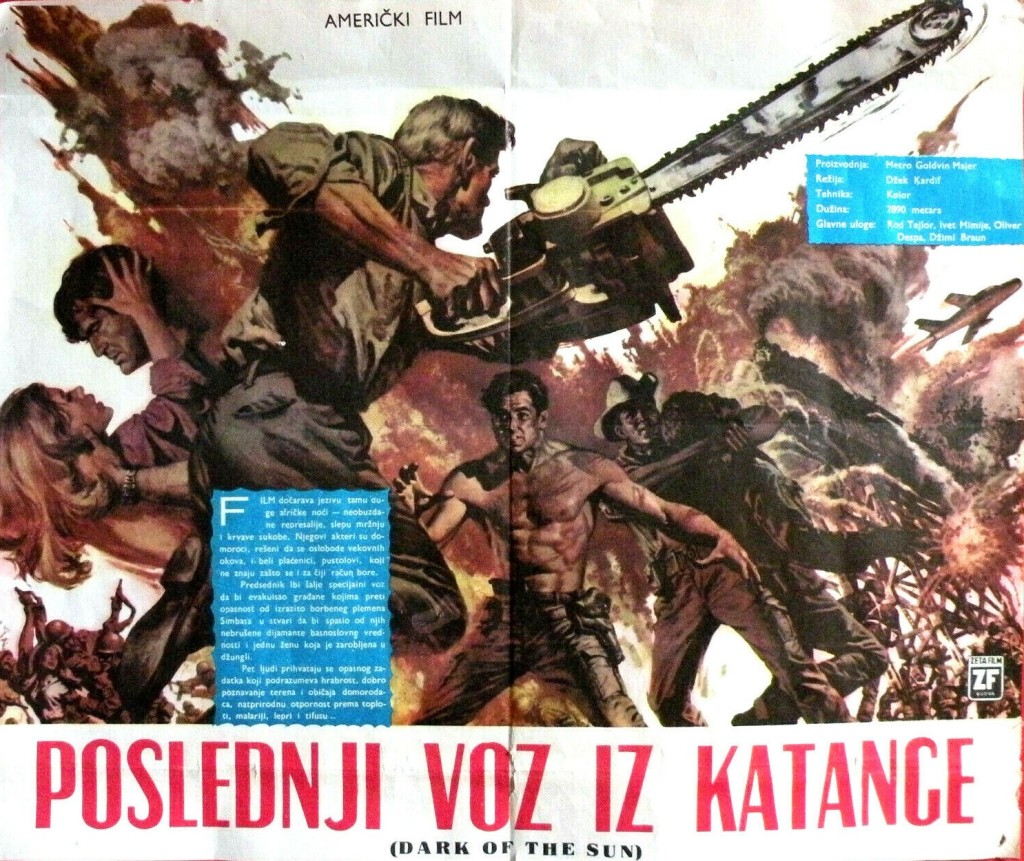
Dark of the Sun / The Mercenaries (1968) ****

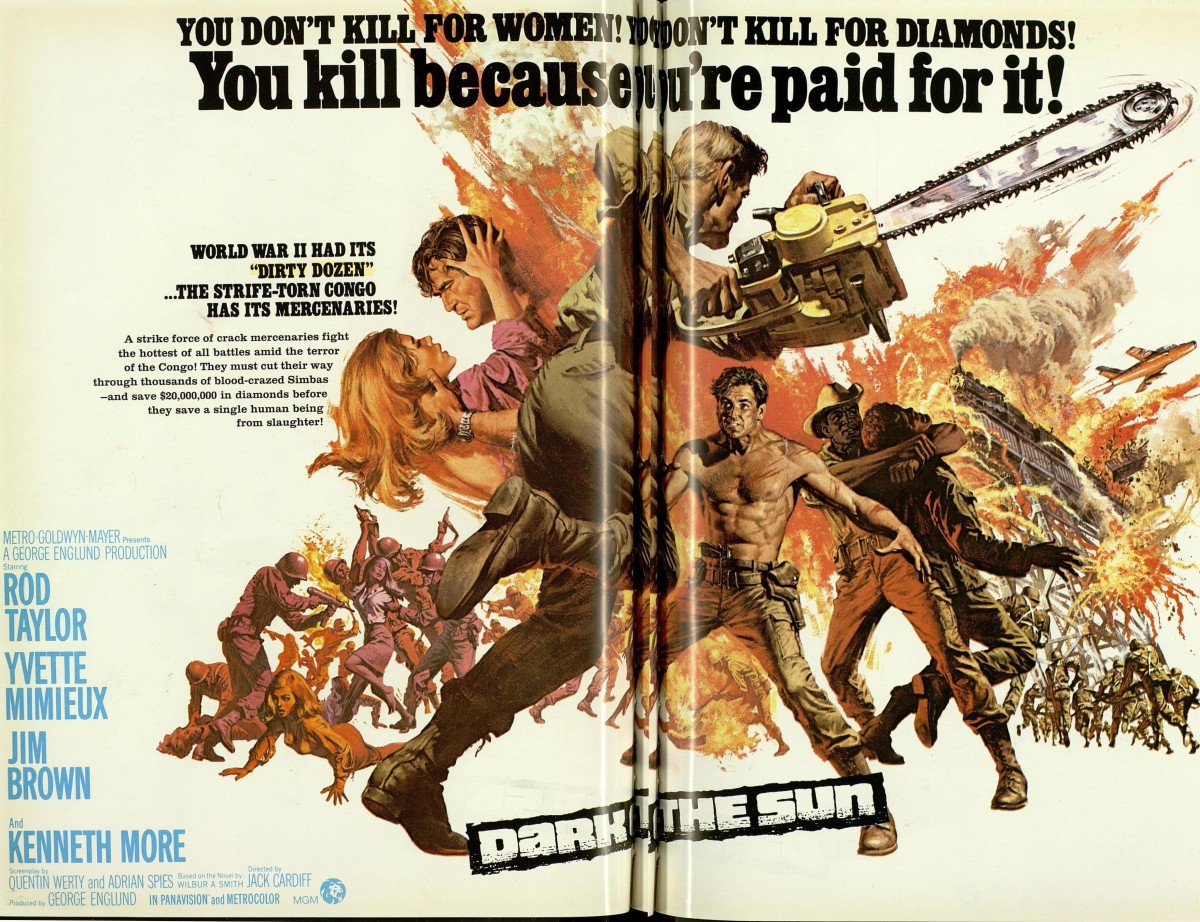
Rod Taylor made a brisk transition to two-fisted action hero from his previous forte of drama (Hotel, 1967) and comedy foil to Doris Day (The Glass Bottom Boat, 1966) in this violent adventure set in the Congo in the early 1960s. As Captain Curry, assisted by sidekick Sgt Ruffo (Jim Brown) and 40-man local outfit Striker Blue Force, he leads an ostensibly humanitarian mission to rescue settlers cut off by the Simba rebels as a cover for collecting $50 million in diamonds. The loot is essential to save the toppling regime of President Ubi (Calvin Lockhart).  The only feasible transport is train. There is a three-day deadline.

Problems immediately ensue, not least a clash with Capt. Heinlein (Peter Carsten), former Nazi leader of Blue Force, who is even more ruthless than Curry, mowing down two native children who stray too close to the train, and apt to go into a fistfight with a chainsaw. The train is attacked by a United Nations plane and on reaching its destination Curry is forced to wait three hours until the time-controlled giant diamond vault can be opened, giving the rebels time to catch up. Then it’s an ongoing battle of one kind or another.

Although the worst of the violence is carried out by the rebels – rape, torture and massacre – a core element of the drama is how a lifetime of killing has affected Curry. Ruffo, a man of principle who grew up in a primitive tribe, acts as his conscience – and that of the audience – spelling out how violence is more than a money-making scheme and essential to upholding order in terrorist times. Curry has some redemptive features, saving widow Claire (Yvette Mimieux) from Heinlein, sending the alcoholic Doctor Wreid (Kenneth More) to help a woman give birth, and eventually acknowledging his strong bond with Ruffo. Although Curry would like to think he is the opposite of Heinlein, they are carved from the same stock and when the savage beast is loose blood lust takes over. 

Claie is more or less there as bait, tempting Heinlein and any rebels in the vicinity, but coming into her own in convincing Wreid, paralytic by this stage, to carry out a section on the pregnant woman, and as a reminder of civilization for Curry.

The action scenes are terrific, particularly the plane strafing the train, and there is a particularly good ruse, instigated by Ruffo, to outwit the enemy. Hollywood never managed to portray the terror of the native Vietnamese on being overrun by Viet Cong, and this film could easily be that substitute, especially when some of the rescued white settlers realize they will not escape.

This is not one of those films like Born Free (1966) or Out of Africa (1985) which are scenic odes to the continent, in part because the picture was shot in Jamaica, but in the main because director Jack Cardiff (Our Mother’s House, 1967) chooses to focus on the mechanics of the mission. And in so doing, he writes a love letter to a train. There had a mini-vogue for war movies set on trains – Von Ryan’s Express (1965) and The Train (1965) come to mind – but none reveal an adoration for the power and perhaps the beauty of the locomotive. Every move it makes (to steal an idea from pop group The Police) is noted on screen and on the soundtrack, the hissing, the belching smoke, the wheels, cabooses, engine, the coupling and uncoupling of links, the screech of brakes, and various tracking and crane shots as the train snakes its way through enemy terrain.

Rod Taylor is excellent in the kind of role he is made for. Jim Brown in a major step up the billing after The Dirty Dozen (1967) is surprisingly good in a part that calls as much for reflection as action. Peter Carsten is the all-time Nazi scum. Yvette Mimieux, who had partnered Taylor in The Time Machine (1960), is also in transition mode, her role a meatier dramatic departure from the likes of the innocuous Monkeys, Go Home! (1967). In what was essentially his last major role – even though it doesn’t amount to much in screen time – Kenneth More (Sink the Bismarck!, 1960) wavers considerably from his stiff-upper-lip default.

The score by Jacques Loussier is particularly good, as Quentin Tarantino attested when he incorporated elements of it for Inglorious Bastards, which was a boon for the composer since up till then he was best remembered for the music accompanying the advert for Hamlet cigars. You might get a laugh out of the screenplay credits. Quentin Werty (i.e. Qwerty, the first six letters on a typewriter) the pseudonym of Ranald McDougall, Oscar-nominated for Mildred Pierce (1945), co-wrote the screenplay, adapted from the novel by Wilbur Smith, with television writer Adrian Spies.

An outstanding example of the all-out action mission picture, its occasional outdated attitudes do not get in the way of the picture and half a century later from what we now know of how wars are fought the levels of violence will appear realistic rather than exploitative.    

The Last Safari (1967) ***

Producer Hal Wallis was known as a star maker. He had launched the careers of Burt Lancaster, Kirk Douglas, Lizabeth Scott, Dean Martin, Jerry Lewis and Shirley MacLaine and was instrumental in shaping Elvis Presley’s screen persona. Continually on the lookout for new talent and with a roster of pictures to cast, he had swooped in the mid-60s on Suzanna Leigh (Boeing Boeing, 1965), Broadway rising star Tanya Everett and on the basis of a television pilot Lithuanian-born Kaz Garas.

So if The Last Safari appears both overcooked and undercooked, put that down to Wallis saddling director Henry Hathaway with the untried Garas as his star, billed ahead, much to his fury, of veteran Stewart Granger (The Secret Invasion, 1964). The film’s way too long as the producer keeps finding ways to insert the youngster into the older man’s tale of hunting an elephant that killed his buddy. In fact, it’s another youngster, Gabriella Licudi (The Unearthly Stranger, 1965) who, with a fraction of Garas’s dialog, steals the show.

The safari picture was by now fast out of fashion, the days of glorifying hunting, even just to supply zoos as in Hatari! (1962), losing its appeal especially with the softer conservationist approach of Born Free (1966) and Africa, Texas Style (1967). So while issues regarding poaching, native self-determination, tribal tradition and colonial interference are given more coverage than you might expect, it still boils down to great white hunter Gilchrist (Stewart Granger) setting out to kill an elephant. That millionaire playboy Casey (Kaz Garas) keeps getting in his way is down to an odd screenplay and the top-billing error that seems determined to find more space for the younger irritant than for the older guy coming to terms with himself.

By the time Casey lands in Kenya in a zebra-striped private plane with native guide Grant (Gabriella Licudi), Granger has already torn up his hunter’s license. Much of the initial narrative is simply Casey pursuing him and being turned down, until the American simply decides to tag along, despite inexperience of the bush.

It’s unclear whether Grant is a guide-with-benefits but she milks him at every turn and filches anything she can, including a lucky charm belonging to Gilchrist. But where Casey drones on, the camera is kind to her, showing her character in tiny snippets, concealing the lucky charm at Gilchrist’s approach, for example, or not being at all perturbed at being excluded from dinner on the grounds that’s she’s a servant and astonished that Casey gets himself so wound up at what he sees as an injustice. She’s perfectly happy dancing the Watusi on her own away from the boring grown-ups. And she puts him in his place, “You want a trophy…I’m not for sale.”

Quite why Gilchrist is obsessed with this particular elephant is never satisfactorily explained. There’s guilt of course since he was the protector but any observer would see that the buddy had stupidly put himself in harm’s way for the sake of getting a better photo of a charging elephant. You get the impression that Gilchrist is just finding a long slow way to die, now he has little else to live for, and his profession is being swamped by idiots, and the work involves dealing with entitled nincompoops like Casey.

Every now and then the movie takes a different, occasionally cute, turn, like watching the baby hippos clamber all over their parents in the water, repetition of this item explained by Gilchrist’s preference for that animal rather than that someone dug up some interesting library shots. But, more likely, it’s dangerous intrusion on tradition. Both Grant and Casey take it upon themselves to participate in a tribal dance, which leads to fisticuffs after a native, following her response to his moves, takes a fancy to the woman. Another time Gilchrist has to rescue some white people trapped in a village because they had violated tradition or were upholding tradition (the reason was unclear). Another chap is trampled to death because his watch alarm went off at the wrong time.

Once the movie settles down to what Hathaway is expert at, old men heading off on quests, long vistas, unwanted traveling companion, it picks up though audiences were probably let down by the ending, not the expected savage slaughter. By the time Casey admits he has learned humility you’ve long lost interest in him.

Howard Hawks would have swung in with a gender switch to make this work, turning Grant into an annoying female, introducing a romantic tussle, hoping the age gap wouldn’t act as too much of a deterrent. Frustratingly, this is excellent in patches, primarily when Gilchrist gets to demonstrate tradecraft and understanding of tribal tradition.

Stewart Granger, in festering in his guilt far removed from the traditional hero, is surprisingly good. Kaz Garas’s career told its own story, this being his only top-billed movie. He’s been thrown in at the deep end and sunk not swam. I was surprised to see Gabriella Licudi not popping up elsewhere because she makes a good stab at the self-sufficient sassy heroine. Hathaway looks overburdened with Wallis’s star-making. John Gay (Soldier Blue, 1970) adapted the Gerald Hanley novel.

Despite the flaws, still interesting.

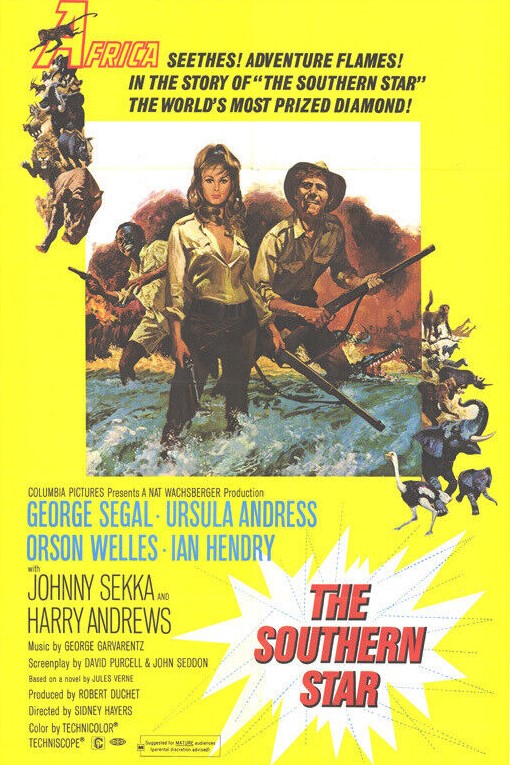
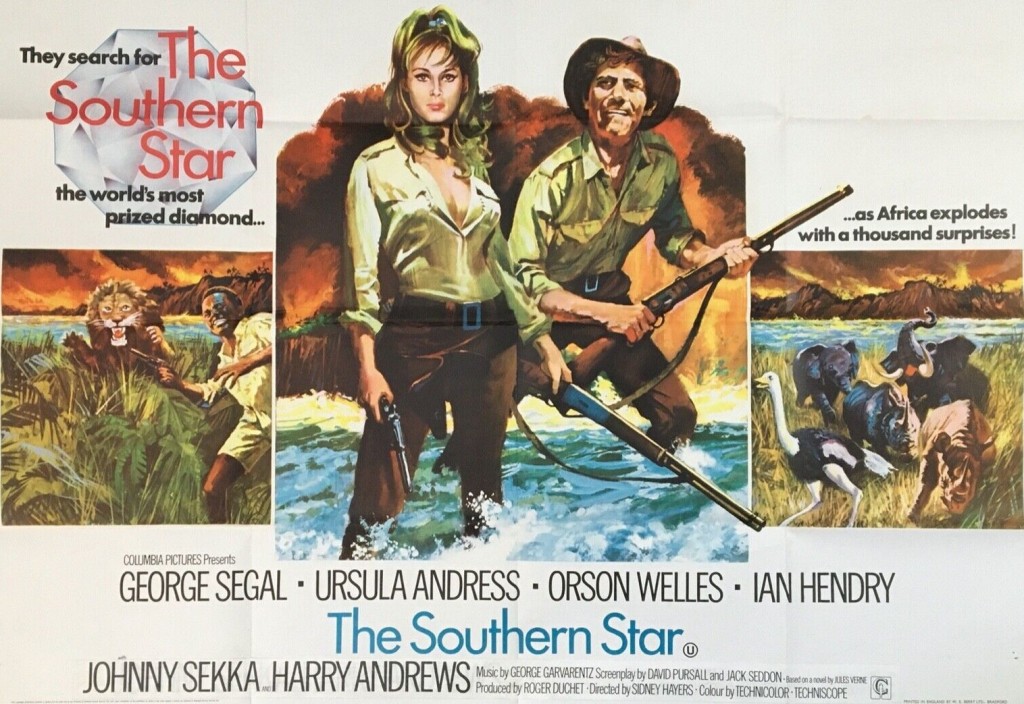
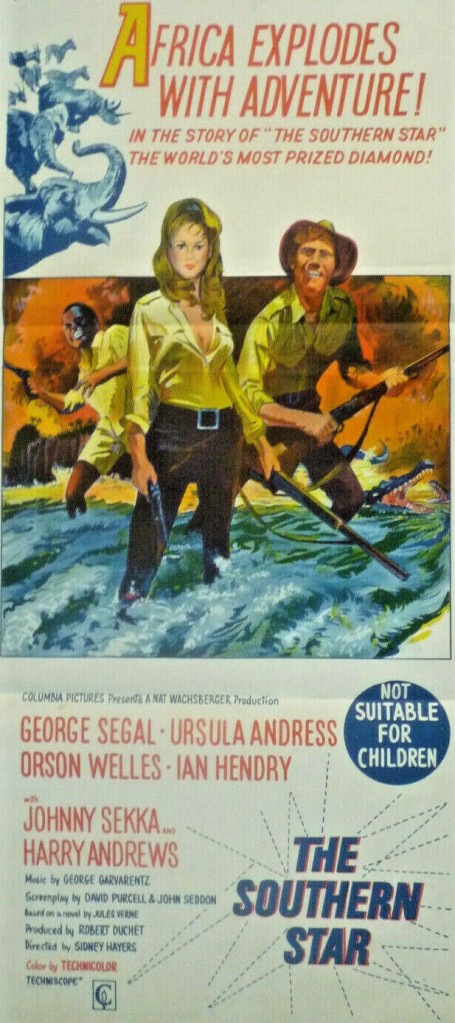
The Southern Star (1969) ***

There’s a surprisingly good movie here once you strip out the cliché jungle stuff and the racist elements. The diamond of the title is actually a MacGuffin, just enough to get you started on two parallel tales of revenge.

Dan (George Segal) is a mining engineer-cum-adventurer and Erica (Ursula Andress), daughter of mine owner Kramer (Harry Andrews), as far from the traditional jungle heroine (except in one regard) as you could get. She saves him from crocodiles, rescues him from jail and quicksand, swims across a hippo-infested river and is a better shot than him (or anybody for that matter) with a rifle. This is female empowerment with a vengeance.

Suspected of stealing the diamond, he is hunted by ranger Karl (Ian Hendry), Dan’s love rival, who intends to win Erica back using the simple expedient of killing the thief. Lying in wait is all-purpose rogue Plankett (Orson Welles) who seeks revenge on Karl. The second unit had a whale of a time filming anything that moved –  lions, leopards, zebras, giraffes, buffaloes, monkeys, antelopes, the aforementioned hippos and crocodiles and what looked like a cobra – and at one point everything does move in coordinated fashion if you can call a stampede coordinated.

But the main focus is an Erica who constantly confounds Dan’s sexist expectations. Docility is her disguise. Anytime she appears to be doing what she’s told you can be sure she’s planning the opposite. While Dan does have his own specific set of jungle skills, he often looks a fool. But they do make a good screen partnership and their dialogue is lively.

Hollywood spent millions of dollars trying to create screen chemistry between various stars and although it seemed to work very well in the industry’s golden age with Clark Gable and any number of MGM female stars, Bogart/Bacall and Tracy/Hepburn and I guess you could chuck John Wayne-Maureen O’Hara into that particular mix, the formula seemed to have gone awry by the 1960s discounting the Doris Day/Rock Hudson combo, big budget romances like El Cid (1961) and Doctor Zhivago (1965) and an occasional home run with whomever Cary Grant was romancing on screen. So it was usually hit-or-miss whether any sparks flew between the stars.

Andress had certainly been a European femme fatale par excellence as seen in Dr No (1962) and The Blue Max (1966), but it was certainly not a given that she would more than hold her own for an entire picture. Segal was nobody’s idea of a romantic leading man although the notion had been given a tryout in The Girl Who Couldn’t Say No (1968) with Virna Lisi. But here the whole enterprise works in an It Happened One Night vein with the supposedly superior male recognizing that perhaps his companion was more than a match.

Harry Andrews and Orson Welles both try to steal the picture, with polar opposite characterizations, Andrews loud and menacing, Welles soft and menacing. You can tell Scottish director Sidney Hayers (The Trap, 1966) was an editor because he cuts for impact and mostly does an efficient job of sticking to the story. Supposedly, Orson Welles directed his own scenes, but that might be to make sure he got to hog the camera. He has enough choice lines and bits of business to keep him happy and gives his venomous character a camp edge. Matakit (Johnny Sekka), Dan’s buddy, who actually has the diamond, is separately pursued and subjected to racism and being whipped.

Despite my reservations, this is well constructed and keeps one step ahead of audience expectation with plenty twists to subvert those, although the music by Johnny Dankworth gets in the way, offering musical cues opposite to what is required.

As it is a jungle picture there is the obligatory heroine’s bathing scene – and to balance the books on that score Segal does whip off his shirt at one point. Except for the clichés and the racism, it would have gone higher in my estimation for by and large it is well done and Andress is once again (see The Blue Max) a revelation.   

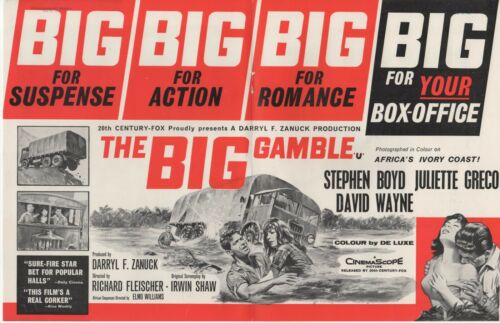
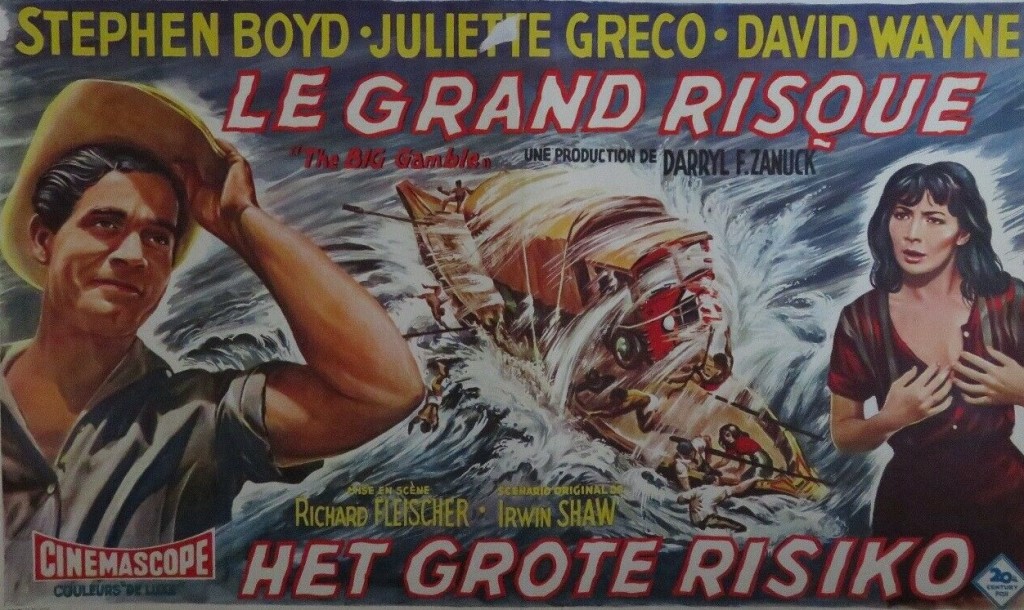
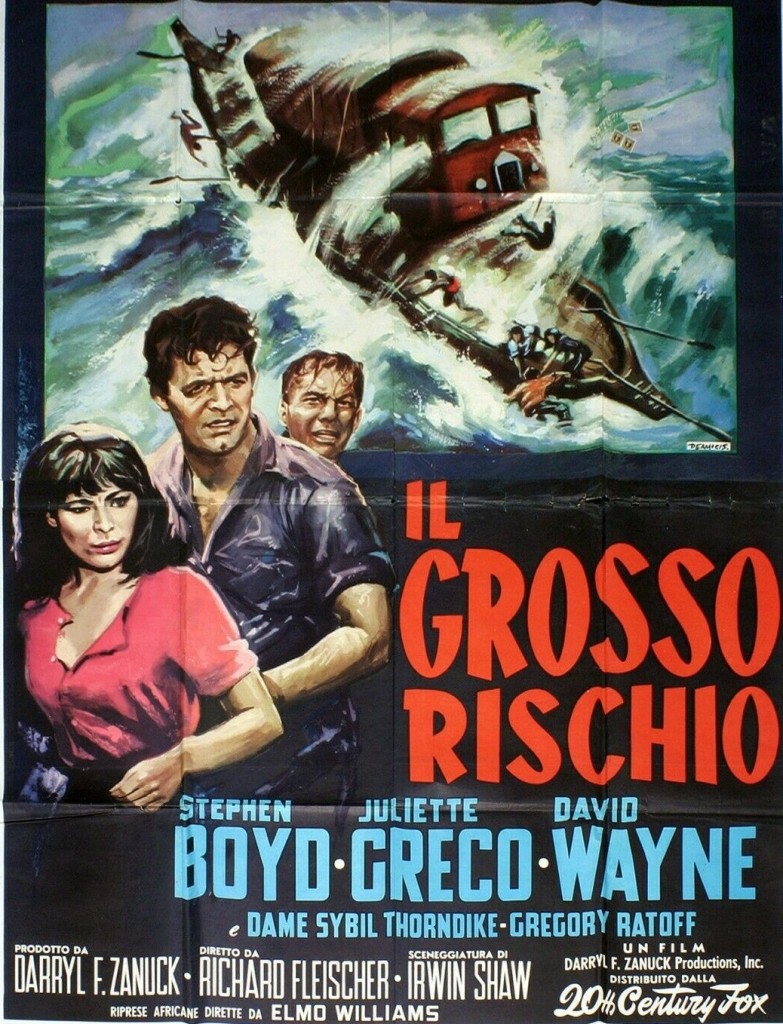
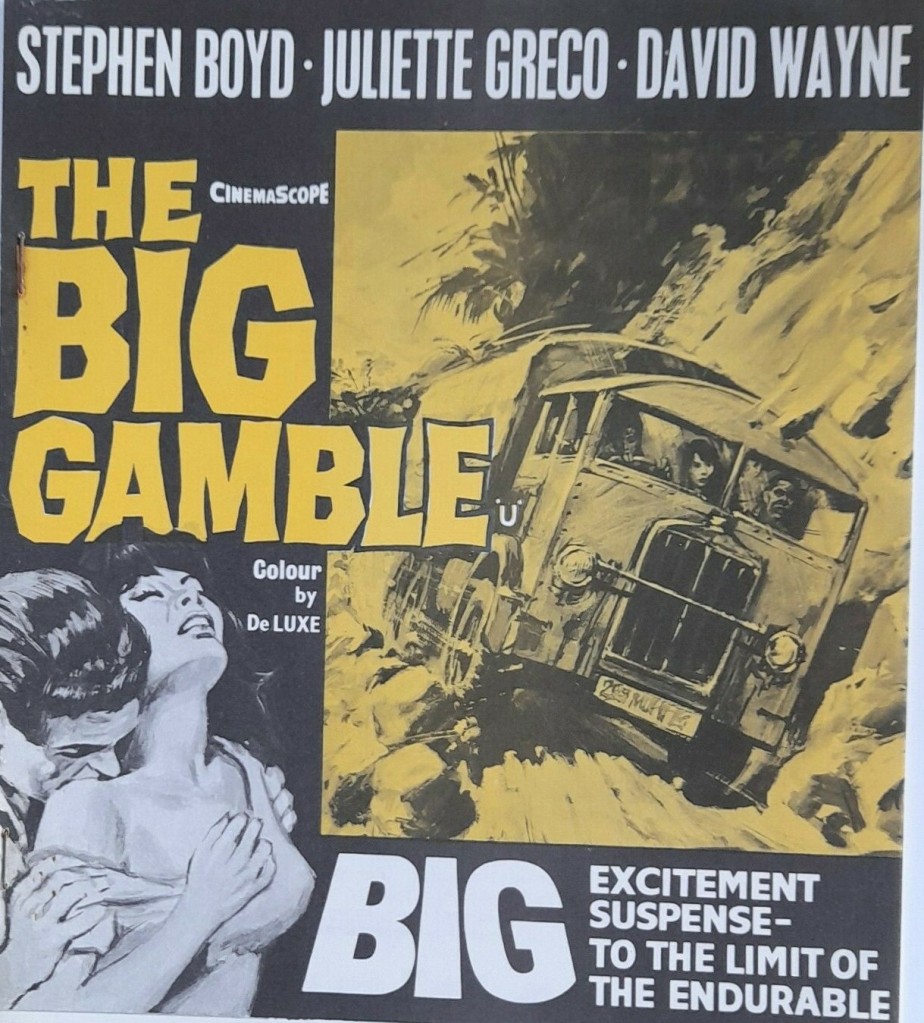
The Big Gamble (1961) ***

If only there had been some serious money put behind this picture it would have been an absolute cracker, custom-made for the likes of Cinerama which didn’t go down the dramatic route until a few years later. It’s a bit “Hell Drivers or Wages of Fear Goes to Africa” but with some really quite stunning sequences.

Whatever French chanteuse Juliette Greco (Crack in the Mirror, 1960) had to offer on stage and in a personal capacity – lovers included Miles Davis and this film’s producer Darryl F. Zanuck – never seemed to translate to the screen in this particular role and the most we get is a kind of tomboyish perkiness. It’s a medium-grade cast, the lead taken by Northern Irishman Stephen Boyd (here playing a Dubliner). David Wayne (The Three Faces of Eve, 1957) is the sad sack brother who joins the other two in a bold plan to set up a haulage business on the Ivory Coast in Africa.

The opening sequence demonstrates the dreary Irish life Boyd is trying to escape with a sparkling cameo from Sybil Thorndike (Shake Hands with the Devil, 1959) as the family matriarch before the African sequences kick in. Apart from scenes shot at Ardmore Studios in Bray, Ireland, the rest is clearly filmed on pretty dangerous locations if the unloading of a lorry onto what looks like little more than a large canoe is anything to go by. After an unpromising start, the intrepid trio (well, two are bold, Wayne is not) set off into the wilderness.

There are two edge-of-the-cliff sequences that would have The Italian Job fans frothing at the mouth, a runaway lorry in the best Cinerama tradition and an astonishing section crossing a swollen river where clearly the actors did their own stunts (and Boyd was in reality saved from drowning by his co-star). In between we have snippets of genuine Africa, especially canoeists braving the surf and an African funeral party. Emotionally, beyond Boyd sticking out his chin as much as possible, the main drama focuses on fraternal rivalry with Wayne trying to pull himself together in the face of a mission he believes doomed to failure.  Their plans are further hit by sabotage by the German Kaltenberg (Gregory Ratoff in his final role).

While some of the posters highlight the river crossing, others focus on the cliff-top sequences.

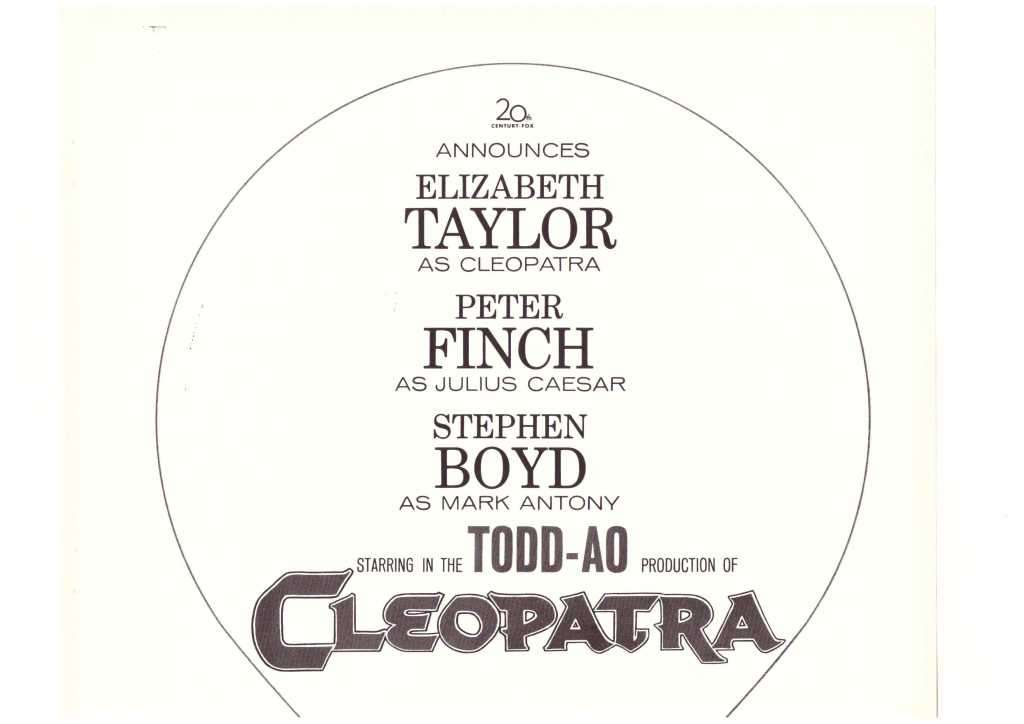
This was Boyd’s bid for stardom. Five years into a seven-year contract with Twentieth Century Fox, he had worked his way up the ranks at that studio to become male lead to top-billed females like Susan Hayward (A Woman Obsessed, 1959) and Hope Lange (The Best of Everything, 1959) before his career received a massive boost after a loan-out deal to MGM for Ben-Hur (1959). He might have been hotter yet had Fox not abandoned its first Rouben Mamoulian-directed version of Cleopatra in which he played Mark Anthony, a role that later brought Richard Burton worldwide fame and a new wife. Boyd would be hot at various times during his short-lived career (he died at 45) while equally never making the transition to major star.

One of the great Hollywood what-ifs – how would Boyd’s career have developed
if he had followed up “Ben-Hur” with “Cleopatra.”

Directed by the underrated Richard Fleischer, best known for 20,000 Leagues under the Sea (1954), Compulsion (1959), Crack in the Mirror (1960) and later The Boston Strangler (1968) and here with some help for the African sequences from Elmo Williams (The Longest Day, 1962) – the nerve-wracking clifftop sequences and river crossing were actually shot in France – it has a decent enough script from novelist Irwin Shaw (The Young Lions).

All-in-all this tight little film more than does justice to its miserable budget with some genuinely exciting sequences.  Filmed in CinemaScope, this is one of the films of the era which does justice to the widescreen. As a wee bonus, if you listen hard to Maurice Jarre’s score you will hear strains of some themes that turned up in Lawrence of Arabia.

Africa – Texas Style (1967) ***

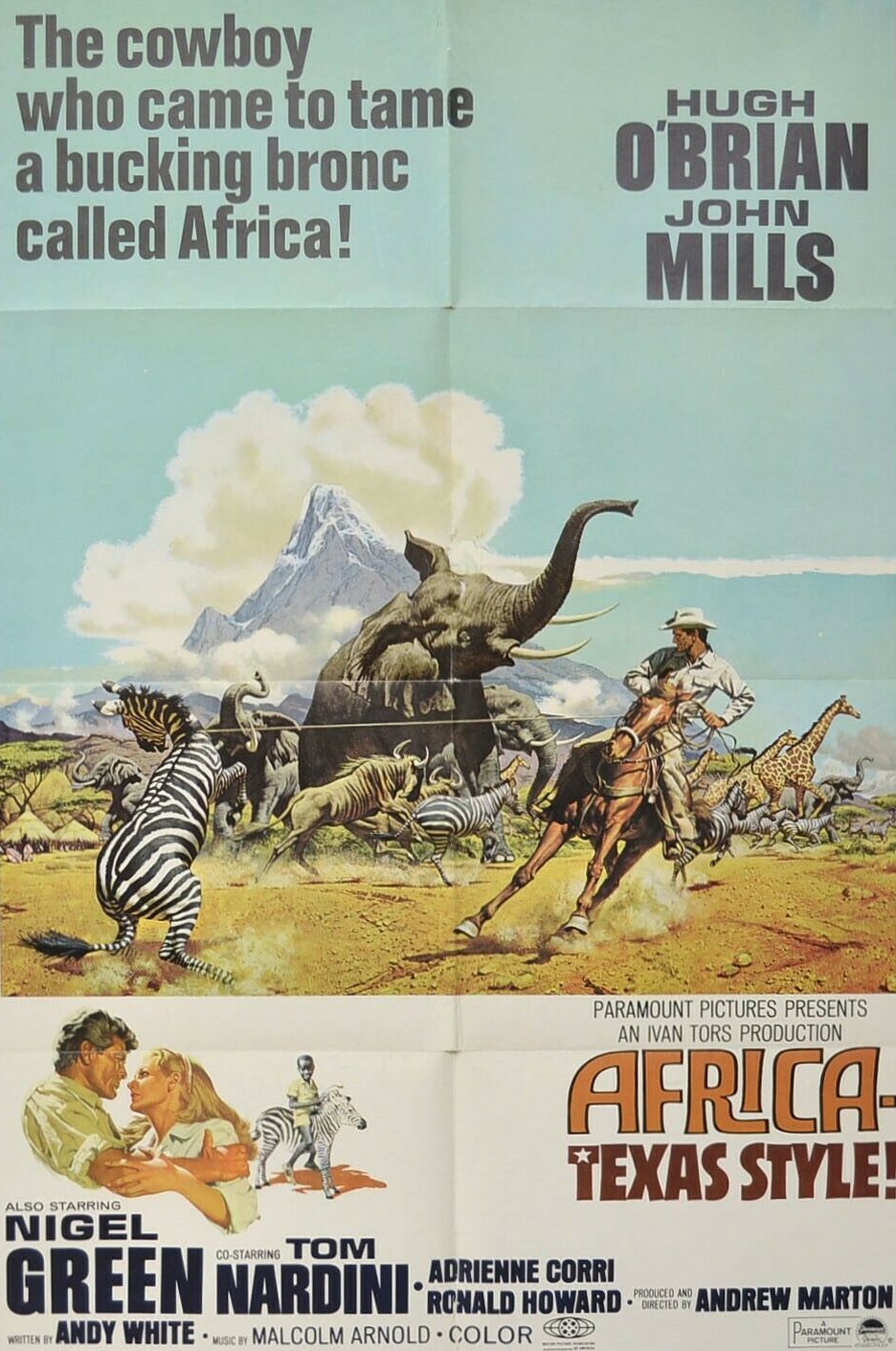
Falling into the unusual category of Saturday afternoon matinee with a message, American cowboy Jim Sinclair (Hugh O’Brian) and sidekick Jim Henry (Tom Nardini) hightail it across the Atlantic to help the wildlife conservation efforts of game rancher Wing Commander Hayes (John Mills) who faces sabotage at every turn by another rancher Karl Bekker (Nigel Green). It combines Hatari!-style action and interesting storylines with Disney-animal-cuteness (a domesticated zebra called Pyjama Tops).

To get the conservation element out of the way – Hayes is concerned that letting animals roam free will result in overgrazing, turning the countryside into a dustbowl and endangering a variety of species. That Hayes is already talking about animals becoming extinct is way ahead of the common perception of Africa at the time. His plan is to round up the wild animals and fence them in, this kind of ranching preventing foodstocks becoming depleted. Bekker’s objection is that wild animals carry infections such as East Coast Fever that will endanger his herd.  

Romantic interest is supplied by the already-engaged nurse Fay Carter (Adrienne Corri) while orphan Sampson (Charles Malinda) tugs at the heart strings. There is a fair measure of authenticity, glorious aerial shots of elephants and buffalo and other species, tribal dances by the Masai while the Sinclair/Henry rodeo-style method of catching wild animals, with lasso rather than giants nets as in Hatari!, ramps up the excitement quotient, not least when Sinclair goes one-on-one with an enraged rhino. As you might expect, there is also ample opportunity for Sinclair to encounter a deadly snake and crocodile and it wouldn’t be an African picture without a stampede.  

Although villainous, Bekker is not without logical argument, not just the fear of infection which would decimate wildlife as much as soil erosion, but his own concerns that taming wild animals would upset the balance of nature, and, on a personal level, the lack of respect for territorial rights. Of course, when push comes to shove, he resorts to rifle and fist to settle  arguments.

Atmospheric, well-made, engaging and at times exciting, there is enough going on here to keep the picture ticking along – a hunt for a lost and bewildered Sinclair, questions about home, and the spectacular wildlife rodeo show. Unlike Born Free (1966) and any other animal picture for that matter although wildlife takes narrative center stage we are not subjected to countless cute four-legged specimens.

Hugh O’Brian (Ambush Bay, 1966) could be a latter-day Tarzan (or more correctly Jungle Jim since he is never in loincloth) but Scottish actress Adrienne Corri (The Viking Queen, 1967) is less jungle adventuress more principled counter to his easy manner. With every chance to rely on the stiff-upper-lip of an English war hero, John Mills (The Family Way, 1966) does anything but and turns in another engaging performance and if you are looking for a decent chap to deliver a conservation message he is definitely your man without being obsessively annoying. Nigel Green (The Skull, 1965) adds to his portfolio of interesting characters as a smooth-talking rough-edged bad guy while Tom Nardini (Cat Ballou, 1965) impresses. Look out for a fleeting glimpse of Hayley Mills  at the start.

Director Andrew Marton, who had been involved in helming The Longest Day (1962) and second unit director of Ben-Hur (1959) and Cleopatra (1963), was something of a wild animal specialist with Clarence, the Cross-Eyed Lion (1965) in the kitty as well as a dozen episodes in total of television series Flipper (1965) and Daktari (1966). But he is at home as much with the human aspects of the story as with the animal. Producer Ivan Tors was a sometime rival to Walt Disney in the family film market with Flipper (1963) and Zebra in the Kitchen (1965) as well as small-screen Flipper and Daktari.

Mistakenly described on imdb as a TV pilot, this was a genuine feature film that happened to produce a television spin-off series Cowboy in Africa. It was screened for the trade in the U.S. on May 5, 1967, reviewed in the feature film section of Variety on May 17, and its U.S. box office figures can be tracked through Variety – opening in 1967 in San Francisco and Kansas City in June, for example, Baltimore in July, Detroit in August and Boston and Louisville in September. In some situations it was double-billed with El Dorado (1967).

CATCH-UP:  John Mills’ versatility can be seen from movies already reviewed in the Blog: The Truth About Spring (1965), Operation Crossbow (1965), The Wrong Box (1966) and The Family Way (1966).

Book Into Film – “She” (1965)

Hammer made a substantial number of changes for its version of She. For a start, H. Rider Haggard’s novel was published in 1886, three decades before the time in which the film which took place at the end of World War One.  While the three main characters – Horace Holly (Peter Cushing in the film), his manservant Job (Bernard Cribbins) and the younger Leo (John Richardson)  – remain the same, their relationships are significantly different, in that in the book Holly is the legal guardian of Leo.

The book is far more Indiana Jones than sheer adventure, the journey into the unknown instigated by a piece of parchment and a translation of a potsherd from the fourth century B.C. In the film the spur towards the journey into the unknown is a vision. But in the book the adventurers already know before they set off that ancient Egyptian high priest Kallikrates found Ayesha and the sacred flame and was killed by her because he loved another.

Unlike the film the book has no trek through the desert either which renders them hungry, thirsty and exhausted and leads to visions of Ayesha for Leo. Instead, they are shipwrecked. And their peril comes from swamps and wild animals such as lions and crocodiles. In fact, the filmmakers clearly resisted the opportunity to include one of the tropes of jungle adventure, namely a wild animal battle, in this case crocodile vs. lion, which was a feature of the book.

While they shoot a water buck for food, nonetheless they do later face exhaustion, only rescued by the sudden appearance of an Arab, who mentions She-Who-Must-Be-Obeyed and arranges for them to be transported in litters to a mysterious land in the heart of African darkness. This land is rich and fertile, with herds and plenty of food.

Two important elements introduced here shape the book but are ignored in the film. The first is that Leo, seriously ill at this point – and not capable of being strung up for the movie’s sacrifice –  remains ill  for the rest of the book so that it is Holly who enjoys most of the encounters with Ayesha. Secondly, and a rather advanced notion for the times, the women in this country are independent, neither considered chattels nor subordinate to men, and are free to choose their own lover. But it is only now that Leo meets Ustane (Rosenda Monteros) rather than in the film which brought them together almost immediately.  Here, they also meet Billali (Christopher Lee) whom Holly rescues from a swamp.

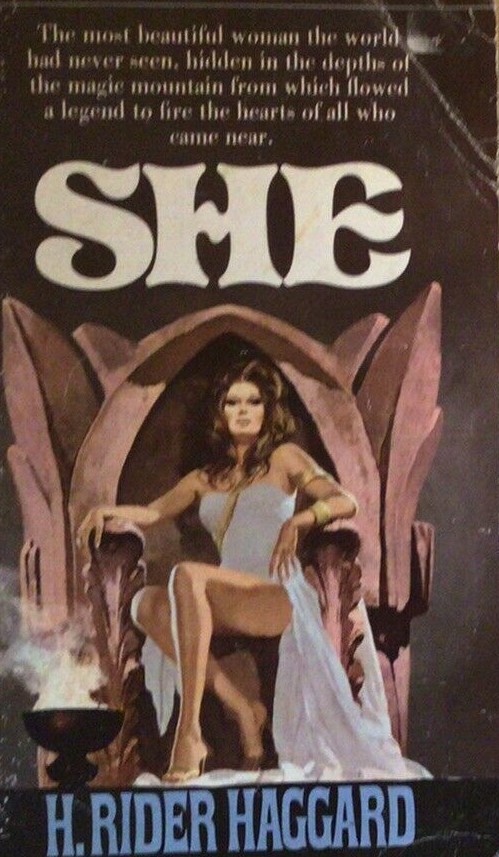
With Leo still ill, it is Holly who first encounters Ayesha, who dresses as she will in the film, in a gauzy white material. In the writer’s eyes her beauty lay in her “visible majesty” as well as more obvious physical features, which could not be dwelt on at such length in a Victorian novel. Holly falls in love with her on the spot, even though he is “too ugly” to be considered a potential suitor, and learns of the fate of the earlier Killikrates and also catches a glimpse of her bemoaning her fate, imprisoned in immortality for two thousand loveless years.

“It is hard for a woman to be merciful,” proclaims Ayesha as she puts to death the villagers. Throwing them down the pit was invented by the screenwriters. By this point Leo is nearly dead and only saved by a phial administered by Ayesha. She also decrees that Ustane must die because “she stands between me and my desire.” In the film it is Leo who intervenes to attempt to save Ustane. But in the book it is Holly. He blackmails Ayesha, threatening to reveal her secret, that she had killed Killikrates in the past. Ustane claims she has taken Leo as her common-law husband. Ayesha promises to spare Ustane if she will give up her claim to Leo and go away. But Ustane refuses. In the book, there is an astonishingly visual and terrifying scene where, in revenge, Ayesha claws at Ustane’s black hair, leaving there the imprint of three white fingers. 

It is the film that introduces the element of palace intrigue, with rebellious subjects and Billali believing he is entitled to immortality. That is not in the book.

When Leo finally wakes up, he is reunited with Ustane, but Ayesha catches them and kills Ustane, not by throwing her down the pit, but by her magic power. Despite being appalled, Leo cannot resist Ayesha. Even so, he is fully aware of his predicament, believing he has been “sold into bondage” and forced to love a murderess. But when she enters the sacred flame – naked, it has to be said, in the book, which was an exceptionally daring image for that era – she dies.

Holly in the book is more a narrator than a protagonist and shifting the emphasis more squarely back to Leo suits the film’s dramatic purpose. There was no real reason the film could not have followed the thrust of the book except that it would perhaps cost more costly to bring a jungle and swamps  to life than a desert and arid mountains. More importantly, perhaps, was the need to introduce the physical Ayesha more quickly than in the book.

It is worth pointing out that the concept of She-Who-Must-Be-Obeyed was not so alien to British readers. After all, when the book was published, the country was ruled by a woman, Queen Victoria. And although democracy had reduced elements of her absolute power, the people still had to bow down before her. In addition, the British celebrated the rule of a previous female monarch, Queen Elizabeth I, who had been an absolute ruler, in the days before there was any notion of democracy and Parliament, and in those days anyone who opposed such a figure was liable to meet as swift a death as that meted out by Ayesha.

She (1965) ****

Ursula Andress certainly knows how to make an entrance. Emerging out of the sea in a bikini in Dr No (1962) proved a Hollywood calling-card but failed to put her center stage. She fixed that with She and dominates this superior adventure hokum. Studio Hammer lucked into a solid piece of storytelling, a classic, and all it had to do – with the help of a bit more finance than was usual for their productions courtesy of MGM – was not muck it up.

Three soldiers are celebrating the end of the First World War in a Palestinian night club and while archaeologist Holly (Peter Cushing) and his bowler-hatted valet Job (Bernard Cribbins) are tripping the light fantastic with belly-dancers, blond-haired Leo (John Richardson) is seduced away by Ustane (Rosenda Monteros) because he bears a stunning resemblance to an ancient medallion. Encountering a vision of Ayesha (Andress) he is urged to embark on a dangerous journey to the lost city of Kuma where she awaits.  

Despite the theft of their camels and loss of water, the trio trek exhausted across desert and mountains, Leo sustained by his vision, by the fact that he seems to know the way and with the assistance of Ustane. But a savage tribe reckon Leo would make an ideal sacrifice to the gods. Just as the tribe are driving themselves into ritualistic frenzy, high priest Billali (Christopher Lee) comes to the rescue, escorting the explorers into Kuma.

The regal Ayesha is as beautiful in the flesh as in the vision, but more ruthless, condemning slaves to a terrible death for disobedience and, noting the attraction between Leo and Ustune, planning also to rid herself of her rival. Leo’s arrival will fulfil an ancient prophecy with the Englishman attaining immortality, and he seems to be able to “float through the sea of time” and remember events from two thousand years ago. However, Ayesha has a dubious past, providing one of several unexpected twists.

Most films of this sub-genre rely on improbable mumbo-jumbo and are loaded down with wearying amounts of exposition. But here is nothing but clarity, the ancient backstory tale told with minimum visuals and verbals and the intellectual sparring between Holly and Ayesha on the one hand and the archaeologist and the high priest on the other are intelligently-put, presenting opposing options for the development of civilisation, absolute monarchy vs. democracy and immutability vs. change.

But that takes place within a highly-charged drama, the enfolding romance between Ayesha and her chosen man both touching and perilous, while the battle for the life of Ustane is brilliantly presented. Lack of reliance on special effects and art direction  utilizing the MGM millions – the mountain-sized statue outside Kuma (prefiguring perhaps Game of Thrones) and the set for Ayesha’s room especially magnificent, as is her golden crown – prevents the picture falling into the camp camp. Instead, it emerges as an adventure classic.

Ursula Andress (4 for Texas, 1963) is stunning, every inch a goddess and yet believably mortal. Her looks tended to mask her abilities and while she rarely received credit for her acting she holds her own in some redoubtable company. John Richardson (Black Sunday, 1960) doesn’t quite step up and remains more a creature of adoration. But the supporting cast more than compensates. Peter Cushing (The Skull, 1965) has had a persona transplant, replacing his normal grim demeanor with fun and enthusiasm, not lacking courage where required, and delivering a very fine performance. Bernard Cribbins (Crooks in Cloisters, 1964) provides the humor. And we still have Christopher Lee (The Gorgon, 1964), filled to bursting with self-entitlement, in malevolent form, Andre Morell (The Vengeance of She, 1968) and Rosenda Monteros, scandalously under-used in films since The Magnificent Seven (1960). It’s interesting to see Cushing and Lee, who dealt with immortality in the Dracula series, engage in conflict without coming to blows.

Director Robert Day (Tarzan’s Three Challenges, 1963) keeps up a brisk pace at the same time as focusing on character and provides Hammer with a marvelous adventure template for the future.  Five features and two shorts had already been adapted from the H. Rider Haggard classic, but the last was in 1935, starring future U.S. House of Representatives member Helen Gahagan. This version presents the best shot at visual interpretation of the classic.

Catch-Up: Ursula Andress was reviewed in the Blog for 4 for Texas (1963), The Blue Max (1966) and The Southern Star (1969). Christopher Lee pictures already reviewed are: The Devil-Ship Pirates (1964), The Gorgon (1964), The Skull (1965), The Brides of Fu Manchu (1966), Five Golden Dragons (1967) and The Curse of the Crimson Altar/The Crimson Cult (1968).

Discover WordPress

A daily selection of the best content published on WordPress, collected for you by humans who love to read.

The Atavist Magazine

by Brian Hannan

WordPress.com News

The latest news on WordPress.com and the WordPress community.