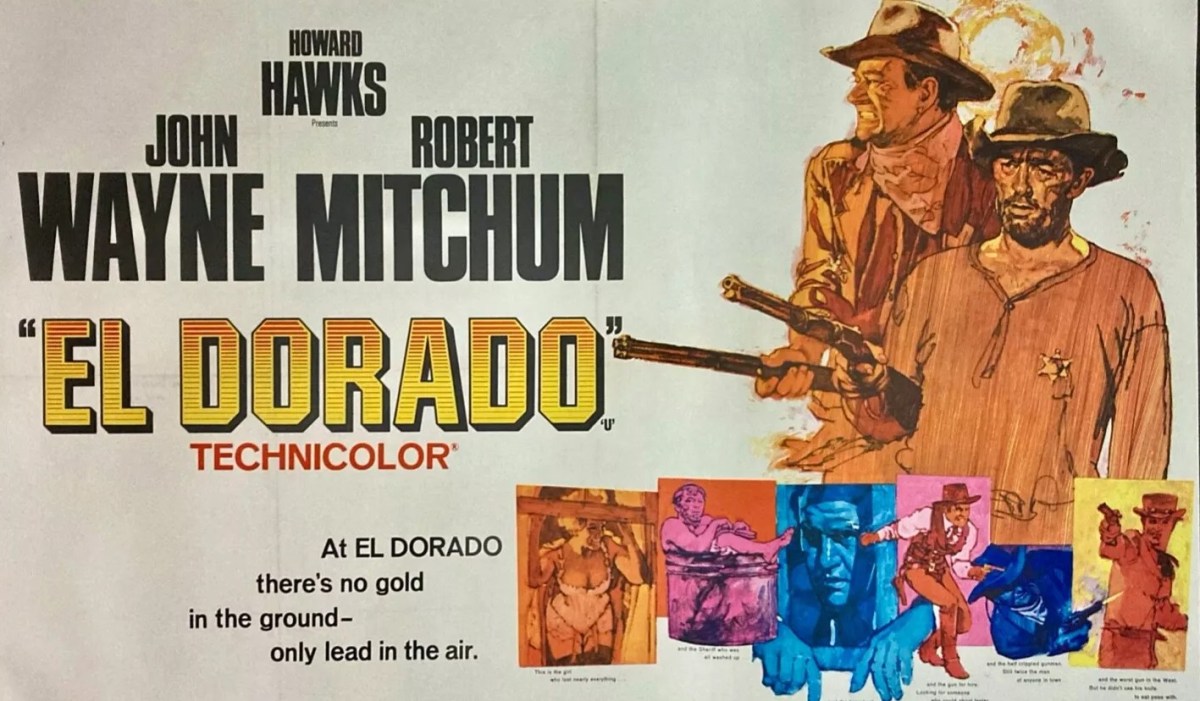
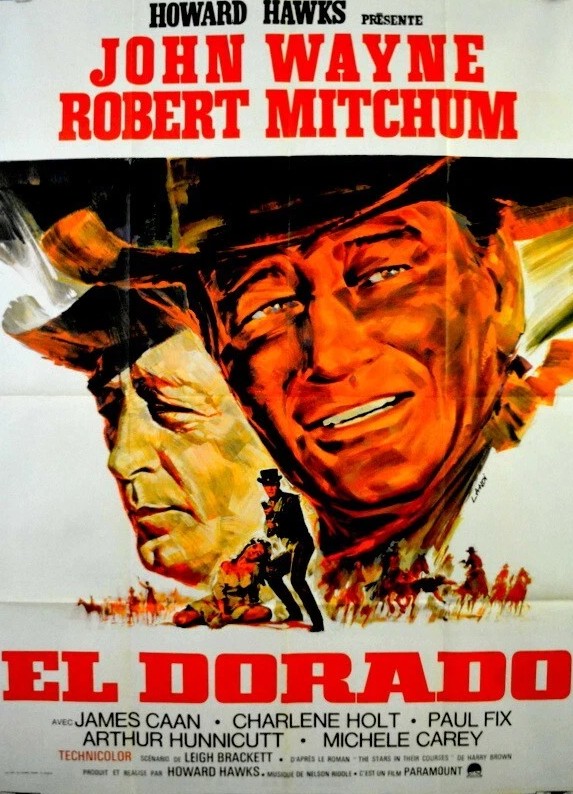
El Dorado (1966) ****

John Wayne incapacitated? Robert Mitchum a liability? The hell you say! You bring together two of the greatest male action figures only to turn the genre upside down and inside out. And I know it’s tradition for heroes to be unable to listen to their hearts, never mind deal with emotion, but it’s a heck of a stretch for them to just completely fall apart when spurned. And I know also that Duke is not invulnerable, this isn’t the MCU for heaven’s sake, and he’s been known in his long career to take a bullet, but to be shot by a woman! That’s very close to taking the proverbial.

Also, westerns usually operate on fairly tight timeframes. If the situation takes place over a longer period that’s usually because it involves a journey. Here, there’s a split of six months between the opening section and the main action, and it does kinda defy belief that the bad guys don’t make the necessary hay while the sheriff is drunk and his main assistant has scarpered.
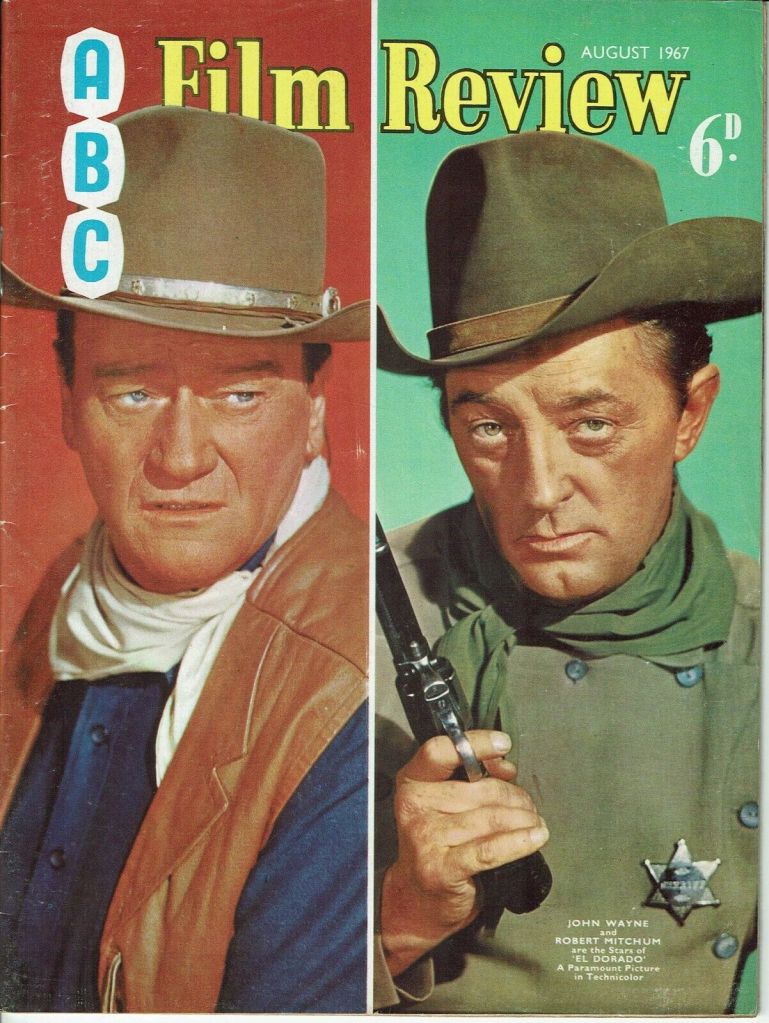
There’s hardly a word spoken here – between the good guys again for heaven’s sake – that isn’t an insult. Never mind The Magnificent Seven (1960) this is teed up as The Bickering Quartet. And I do have to point out a couple of elements that won’t go down so well with a contemporary audience, one character imitating a Chinese, and a scene where one of our heroes is constantly interrupted in the bath by females, a twist to be sure on the usual scenario of the female lead skinny dipping in a handy pool or river, but it’s like a lame comedy sketch.

This won’t have been influenced by the spaghetti western, the first Sergio Leone game-changer wasn’t screened in the U.S. until the following year, so it’s also worth pointing out that some of the action is pretty savage, both John Wayne and Robert Mitchum indulging in the kind of mean behavior that was usually the prerogative of the villains. Wayne even cheats when it comes to the traditional shoot-out. And while there’s none of the blood-letting that later became synonymous with the genre, director Howard Hawks does something else that is far more realistic than anything that has gone before and would count as a genuine shock to our senses. The gunfire is incredibly loud. Imagine that on Imax and you’d be jumping out of your seat every few minutes.

And just in case you think this is nothing more than a remake of Rio Bravo (1959) where a gunslinger and a drunken sheriff are holed up in jail, here the jail is mostly used as a base, the good guys racing out every now and then to pick someone off. That running, too, by older guys certainly prefigures later action pictures like Taken (2008).

We need the time gap to allow Sheriff J.P. Harrah (Robert Mitchum), one of the three best gunslingers alive, to disintegrate. He goes from tough lawman keeping an unruly town in order and holding back the worst instincts of land-owner Bart Jason (Ed Asner) planning to go in mobhanded against rival rancher Kevin MacDonald (R.G. Armstrong) in an argument over water rights.

Hired gun Cole Thornton (John Wayne), one of the three best gunslingers alive, turns up for a job with said Jason but is turned off the idea when J.P. gives him the lowdown on the situation. He dallies long enough to set up the notion that he’ll try to win back saloon-owning old flame Maudie (Charlene Holt) from J.P.

Thornton moseys off to the Mason spread to give the owner the bad news. On the way back, Luke Macdonald (Johnny Crawford), Kevin’s youngest son, on guard duty, mistakes Thornton for the enemy and shoots at him. Which results in his death. So Thornton does not get a good welcome when he arrives at the Macdonald farm toting a corpse.

Turns out the young whelp, although taking bullet in the gut, committed suicide because the pain was too much and Luke had been told by his dad that he wouldn’t recover anyway and just suffer a hideous death. While the father accepts this, his daughter Joey (Michele Carey) does not and ambushes Thornton, putting a bullet in his back. Said bullet is mighty inconveniently lodged close to his spine and needs more than the town quack to remove it. Despite sparking up old feelings for said old flame and the prospect of stealing her back from old buddy J.P., Thornton doesn’t dally longer than it takes to get temporarily fixed up, bullet still in place to cause later problems.

Now the tale takes a detour. Not only has six months passed and Thornton miles away from El Dorado, but we’ve got to hold up proceedings to introduce naïve youngster Mississippi (James Caan). Howard Hawks certainly hasn’t learned the knack of the compact introduction from John Sturges a la The Magnificent Seven (1960) so we learn that this young whelp is best with the knife and has spent two years tracking down the four killers of his foster father. The last man to die happens to be an employee of Nelse McLeod (Christopher George), one of the three best gunslingers alive, on his way to take up the job Thornton turned down, a task made a helluva lot easier because J.P is now the town drunk, having hit the bottle when spurned by a woman, not Maudie I hasten to add.

Thornton heads for El Dorado with Mississippi tagging along, armed with of a sawn-off shotgun. First task is to sober up the sheriff – by fistfight and awful concoction – and stop him becoming a worse figure of fun. On the evidence here Deputy Bull (Arthur Hunnicutt) was probably one of the three best riflemen – not to mention archers – alive. He also totes a bugle.
The sober J.P. strolls into the saloon and arrests Bart Jason and sticks him in jail, and to avoid being in a complete siege situation, the quartet, sometimes as a group, sometimes a pair, sometimes alone, venture out, as I mentioned, to pick off the enemy. This allows Mississippi a meet-cute with Joey who’s planning a short-cut to justice by shooting Jason. Maudie re-enters the frame.

The bullet in the back sporadically paralyzes Thornton and J.P. is wounded in the leg so eventually the pair are hobbling around on crutches. Maudie also turns out to be a liability, taken hostage, ensuring Thornton goes to the rescue. But the bullet in the back plays up at exactly the wrong time and Thornton’s also captured, trussed up like a hog (what, John Wayne?) then traded in for the prisoner.

Having by now reduced the odds and not wanting to be caught in a siege, the quartet take the battle to the enemy, ambushing them front and back in the saloon, Thornton ridding Nelse of the notion that he and Thornton will enjoy a winner-takes-all shootout by killing him with a rifle while lying on the ground.

While it could be trimmed – television screenings generally eliminate the racist Chinese impersonation – the action when it comes is blistering. There’s a terrific scene in a tower when Bull targets the bells to disorientate the enemy with their horrendous ear-jarring clanging. And the final shoot-out is exceptionally well done.

In ways not usually gone into, the quartet are experts in their fields. Thornton backs up his horse to get out of a difficult situation, J.P. detects a man hidden behind a piano in the saloon, Mississippi stalks a potential lone assassin, Bull uses bow-and-arrow when silence is required.

Theoretically, Robert Mitchum (Five Card Stud, 1968) steals the show as the drunken sheriff, but that’s only if you are taken in by the surface. The sight of John Wayne with his useless twisted right hand harks back to the arm in The Searchers (1956) and his one-armed rifle action predates True Grit (1969). James Caan (The Rain People, 1969) tries to steal scenes but what chance does he have with these two stars at the top of their game and past master at the scene-stealing malarkey Arthur Hunnicutt (The Cardinal, 1963). Charlene Holt (Red Line 7000, 1965) and Michele Carey (The Sweet Ride, 1968) come out honors even as do Edward Asner (The Venetian Affair, 1966) and Christopher George (The Thousand Plane Raid, 1969).

I don’t put this in the same bracket as Howard Hawks’ Red River (1948) and Rio Bravo, but it’s certainly one of the best westerns of the decade. Written by Leigh Brackett (Hatari!, 1962) from a novel by Harry Brown.

Not one to miss.
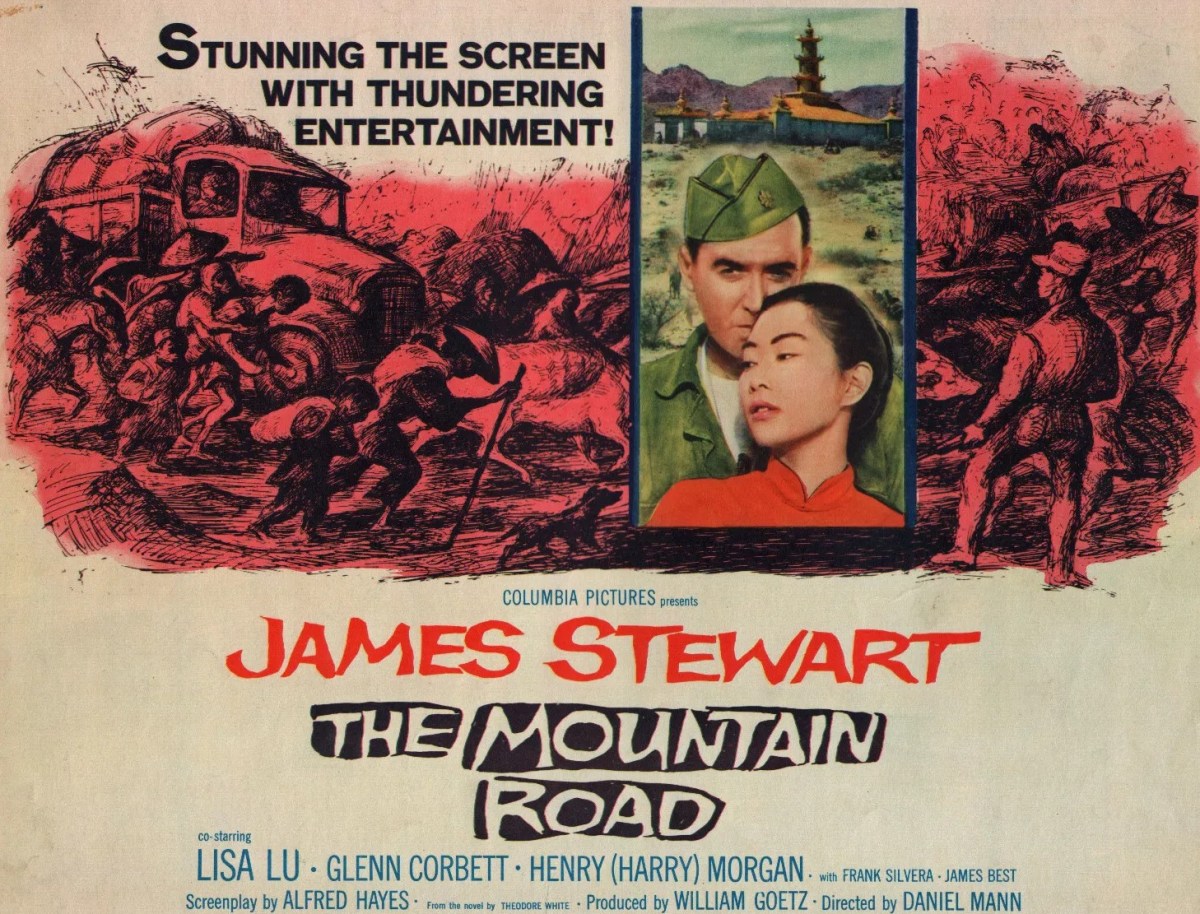
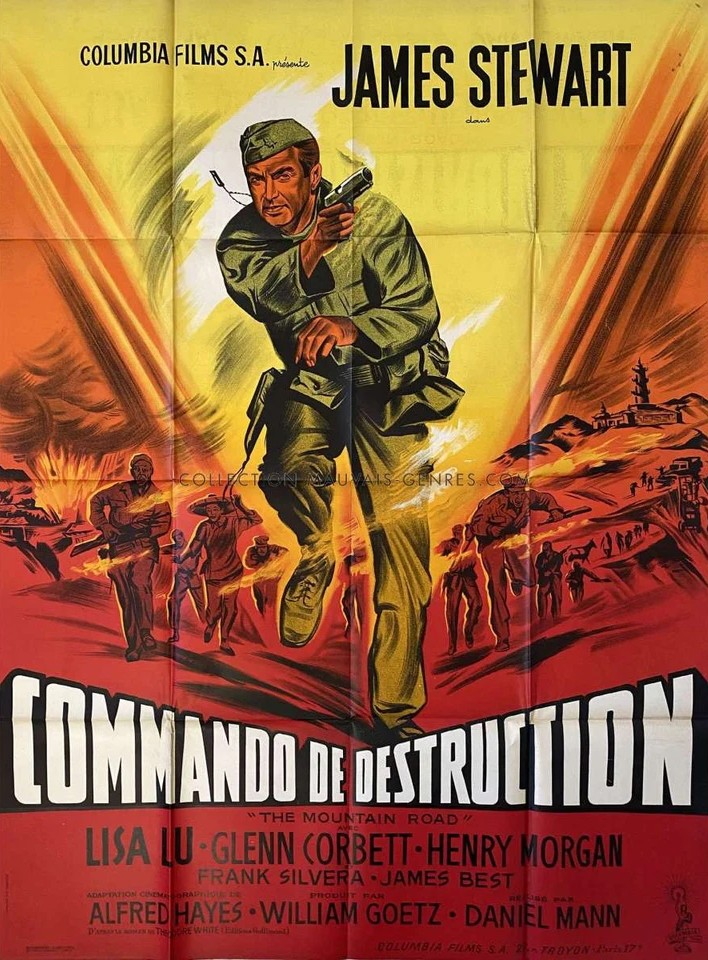
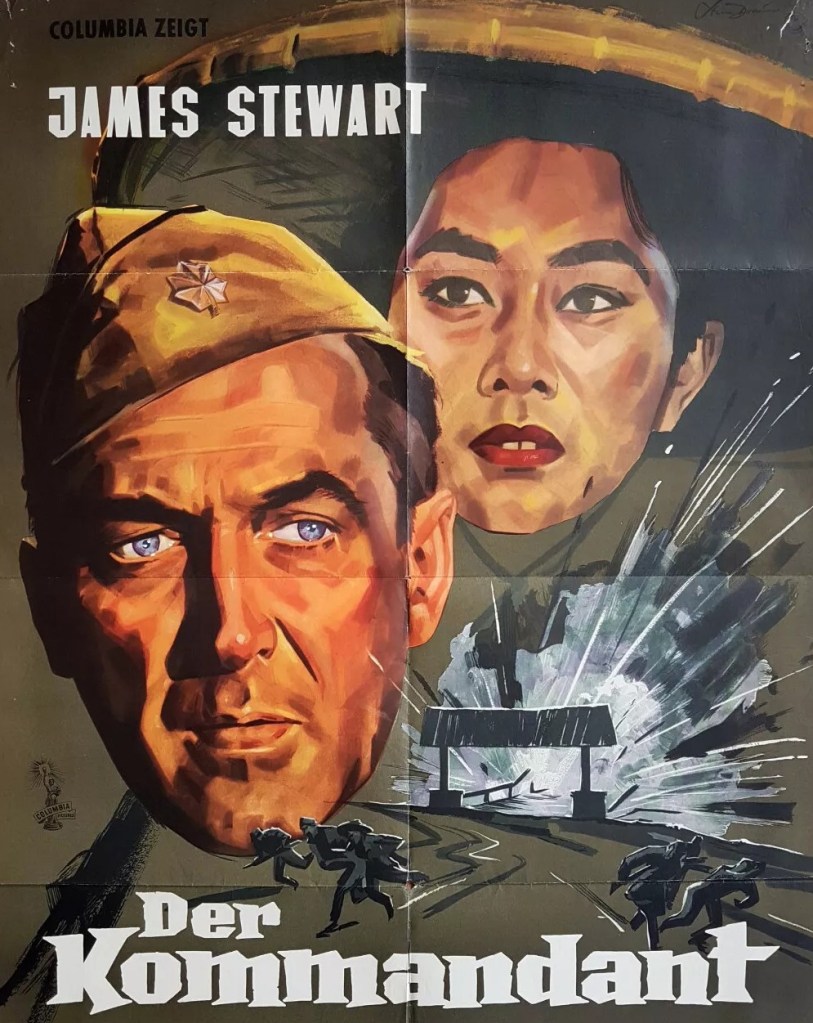
The Mountain Road (1960) ****

First film to deal with U.S. Army war crimes. Though here’s it’s tabbed as abuse of power but amounts to the same thing when it relates to the wanton killing of innocents. Not the first film to examine a commander totally unsuited to command – The Caine Mutiny (1953) would be your first port of call for that, although that was a career officer rather than a conscript. But the blistering under-rated Oscar-ignored performance by James Stewart (The Rare Breed, 1966) is easily comparable to the Oscar-nominated Humphrey Bogart.

And director Daniel Mann (A Dream of Kings, 1969) is helluva sly. He dupes the audience into thinking this is a mission picture, blowing up a massive ammunition dump to prevent it falling into enemy hands. And if you’re one for the easy action of explosions, this is for you, the kind of fireworks not seen till MCU entered the equation.

And here’s a line that’s going to knock you for six. “China and America are friends.” Say again? You what? As far as I can remember in all my decades of moviegoing, China has always been the enemy, either providing a succession of nefarious villains, or on the brink of starting a nuclear war, or just totally ungrateful for all the efforts the West has made bringing to the country Christianity and the western idea of civilization.

But it’s true. Before Communist China reared its ugly head, the U.S. and China were allies against the Japanese in the Second World War. But towards the end of that conflict, the Japanese had invaded and the Yanks were pulling out. Not wanting to leave anything behind for the enemy – like a huge arsenal or thousands of gallons of diesel – is the trigger for the story.

Except it’s not. Major Baldwin (James Baldwin) doesn’t have to go on any mission. His job is just to blow up a much smaller ammunition dump that’s easily accessible without the need to go on a long trek through the mountains. It’s his choice to take on the bigger job. There’s not even any pressure to do so. It’s entirely at his “discretion.” And you can see in the tone of his superior’s voice that it’s not such a good idea. He can just complete the small job and high-tail it out of there.

But Major Baldwin wants to experience command in action. He’s not a glory hunter in the normal sense but there’s definitely something off in a backroom soldier who’s got that on his wish list. It never occurs to him that there’s more to command than ordering about grunts, many of whom he considers “slobs,” and that the position comes with the task of making difficult decisions.

He’s got a very small team, chief among whom is Sgt Michaelson (Harry Morgan) and translator Collins (Glenn Corbett). Chinese officer Col Kwan (Frank Silvera) is meant to smooth his path and the widow of a Chinese general, Sue Mei (Lisa Lu), is thrown his way, initially you would guess to sweeten the load by becoming a love interest, but actually to become his conscience.

Just to fill you in on the background. China and Japan had been at war since 1937. After Pearl Harbor China became critical to US operations in the Pacific by tying down Japanese forces and after the fall of Burma the US airlifted supplies over the Himalayas.

Baldwin soon discovers that leadership equates to callousness. He has little sympathy for the refugees swarming over the mountain roads seeking sanctuary from the invading Japanese. He blows up a bridge and creates an impasse on the road to delay the Japanese without giving any thought to how that will endanger the natives.

He’s pretty inhuman in his treatment of one of his men, suffering, it later transpires, from pneumonia and might be taking all his cues from General Patton who hated all wounded soldiers. While he’s trying to convince the soldier to get back on his feet all the grunt can do is whimper, “Milk! Milk” like a child. Baldwin even sees little problem in stacking the ill man beside a corpse on the back of a lorry.

It would help if Baldwin had been trained in command, in making decisions, rather than picking faults everywhere and letting the pedantic side of his nature run wild. Sei Lei to some extent tries to rein him in, accusing him of blatant racism, treating the Chinese as if they were a lower form of humanity.

When he does relent and orders surplus food to be handed out one of his men is killed in the stampede. The last straw is Chinese bandits who kill and strip three of his men. So he leads a raid on a Chinese village, rolling a barrel of fuel stacked with dynamite down a hill to destroy the village and innocent villagers.

Up till then things were going along nicely on the romantic front, Sei Lei clinging to him when the massive ammunition dump goes up, and kissing on the cards. She’s westernized after all, spent a lot of time in America, well educated, and so easily a contender for marriage. But she tries to stop the barrel-rolling, telling him this action is unjustified, pure revenge.

He thinks she’ll accept an apology, that some madness came over him, he was consumed by power. But she’s having none of it.

Mission accomplished but human flaws exposed.

This isn’t the James Stewart you’ve come to expect, far from it. There’s certainly times in his career when he’s been mean or ornery and in his Hitchcock excursions a bit creepy, but he’s never been so awful as here, the guy desperate for power without knowing how to use it or draw the line. Purely in a technical capacity, working out where to plant explosives and plan a demolition, he’s in his element, but let him loose on human beings and he’s a loose cannon trying to rein himself in, stuck in a mess of his own making, unable to understand consequence. But sometimes even guilt isn’t enough.

This was an unlikely role for Stewart because, after his own experience in World War Two, a pilot in Bomber Command flying missions over Europe, he had turned down every war picture. Perhaps this movie reflected the guilt he felt of dropping bombs and knowing there would be civilian collateral damage, that sense of power over the powerless might equate to the feelings Baldwin has over the Chinese.

This is by far the most human character Stewart ever played, doing away with both the aw shucks everyman and the commanding often truculent cowboy, and instead portraying someone who’s way out of his comfort zone.

Ace scene-stealer Harry Morgan (Support Your Local Sheriff, 1969) is the pick of the support though Lucy Lu (One Eyed Jacks, 1961), being the conscience of the piece, has all the best lines.

Just as with A Dream of Kings, Daniel Mann takes a flawed individual and doesn’t hang him out to dry. But in retrospect, the war crime, of blowing up the innocent civilians, would not have received such a free pass, which puts a different slant on Baldwin. Alfred Hayes (Joy in the Morning,1965) wrote the script from the Theodore H. White bestseller.

Much to ponder.

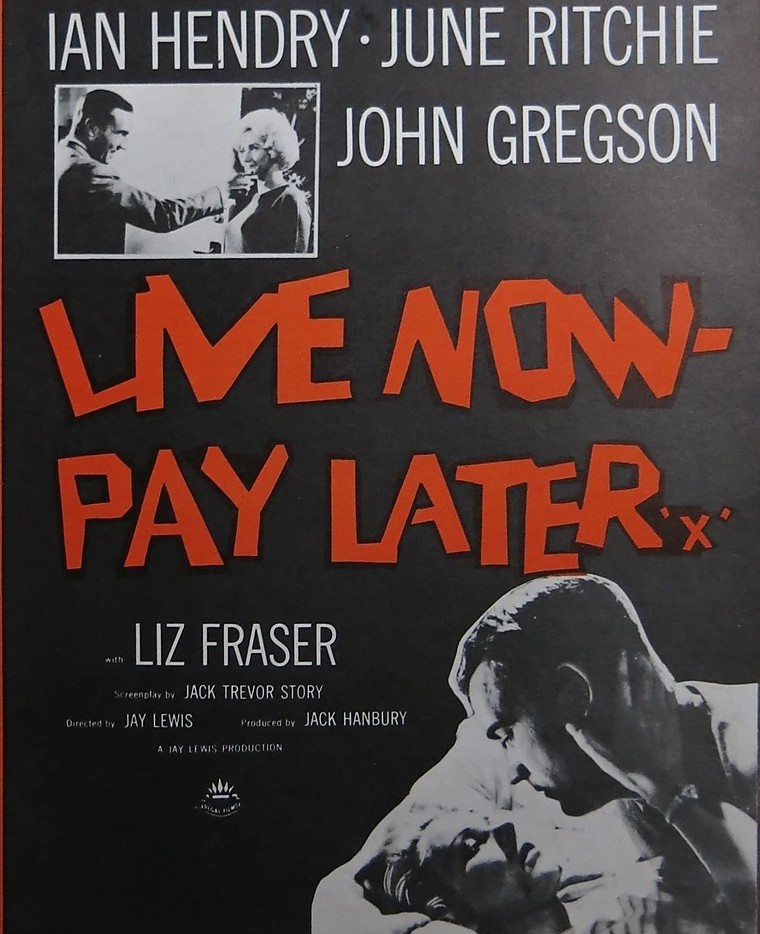
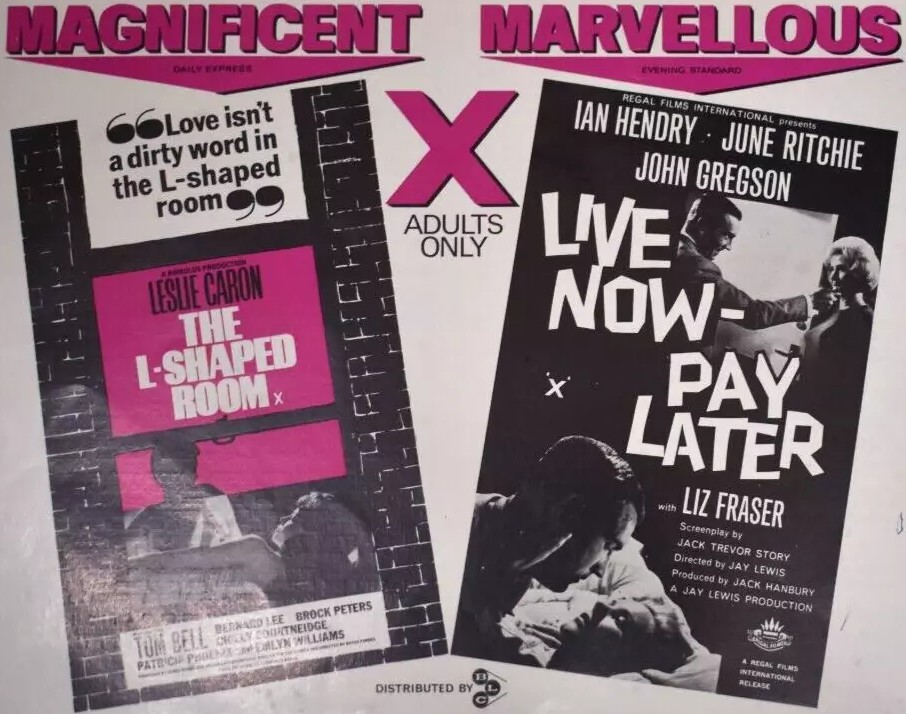
Live Now, Pay Later (1962) ***

Easy credit led to a boom in the standard of living but also created global recession after the sub-prime mortgage scandal. Back in the day you couldn’t borrow money except from a bank and they only lent to people with money. To get a mortgage you needed to prove you could save, you required at least a 10 per cent deposit before any bank would loan you money for a mortgage, and you needed to go through a stiff criteria test. Even then, you were at the mercy of inflation. If you were absolutely desperately you could go to money-lenders and pay back inflated sums, the notorious “vig” of the Mafia.

But then someone invented the notion of buying on credit from largely unlicensed brokers. You could live the dream – television, white goods, carpets, furnishings, a car – even if you couldn’t afford it and you didn’t have to go through any kind of procedure to qualify. Of course, you ended up paying two or three times the original price but the payments were spread over years so, theoretically at least, affordable. These days, credit cards lure people into the ease of purchasing and giving no thought to repayment. You don’t have to repay at all – or only a very small fraction – if you don’t mind your debt accruing exponentially.

In Britain it was called “hire purchase” or more colloquially the “never-never.” Nobody was called to account for selling goods to people who were inherently unable to afford it, were clearly incapable of managing money or, just as likely, were apt to get carried away.

While on the one hand this is one of the saddest movies you’ll ever see, lives crushed by debt, the tone is so mixed the reality gets lost in the characterization of the kind of chancer who would later be epitomized by the likes of Alfie (1965). But whereas the Michael Caine character has oodles of charm and eventually comes good, here equally charming  ace salesman Albert (Ian Hendry) never sees the error of his ways.

One of the dichotomies of the tale is that despite his earnings and his financial wheezes on the side Albert never has enough money to fund his lifestyle – snazzy sports car, great clothes – and lives in a squalid flat while ostensibly living the dream, string of women on the side. Like Werner Von Braun (I Aim at the Stars, 1960), he can’t face up to consequence much less take responsibility for his actions. But he’s not the only one using easy credit as a means of moving up in society, his boss Callendar (John Gregson) has taken up golf with a view to rubbing shoulders with estate agent Corby (Geoffrey Keen), whom he views as rising middle class without being aware that Corby also has unsustainable delusions of grandeur, hosting dinner parties for local politicians, ensuring his house is filled with desirable items.

Without doubt Albert is a superb salesman, adept at not only overcoming initial customer reluctance but persuading them to invest in far more than they ever dreamed. He is so good that his boss is more than willing to overlook his various pieces of chicanery.

But too often the comedy gets in the way. The idea that Albert can weasel his way out of any difficult situation – twice he dupes the man coming to repossess a car on which he has evaded payments for years – take advantage in unscrupulous fashion of any opportunity (he takes over an empty flat, steals the orders of rivals) and even offers advice on how to outwit, legally, bailiffs, sets him up as the kind of character (the little guy) who can defeat authority. But cheap laughs come at the expense of more serious purpose.

He leaves a trail of destroyed lives in his wake. He abandons his illegitimate daughter, fruit of a supposed long-term fling with Treasure (June Ritchie). One of his many married lovers, Joyce (Liz Fraser), wife of Corby, commits suicide – and he then proceeds to blackmail the husband. Albert’s boss is on the verge of losing out to a bigger rival.

For women, he is at his most dangerous when being kicked out, at his most persuasive and charming when trying to weasel his way in. He always finds some new woman and generally has a few on the go at the one time. The only time he appears to have any standards is when he walks away from one lover on discovering that her husband is a scoutmaster and therefore the seduction has required little skill.

But all Albert’s charm can’t disguise the brutality of debt. The arrival of the bailiffs strikes terror in hearts. A dream can turn to dust in an instant. Consequent shame unbearable. And there are no shortage of characters pointing out to Albert how heinous his actions are.

Ian Hendry (The Hill, 1965) captures the smooth-talking salesman. June Ritchie (The World Ten Times Over, 1963) has a meaty role as does Liz Fraser (The Family Way, 1966). John Gregson (The Frightened City, 1961) is unrecognizable while Geoffrey Keen (Born Free, 1966) essays the kind of grasping businessman that would become his forte. Nyree Dawn Porter (The Forsyte Saga, 1967) has a small part.

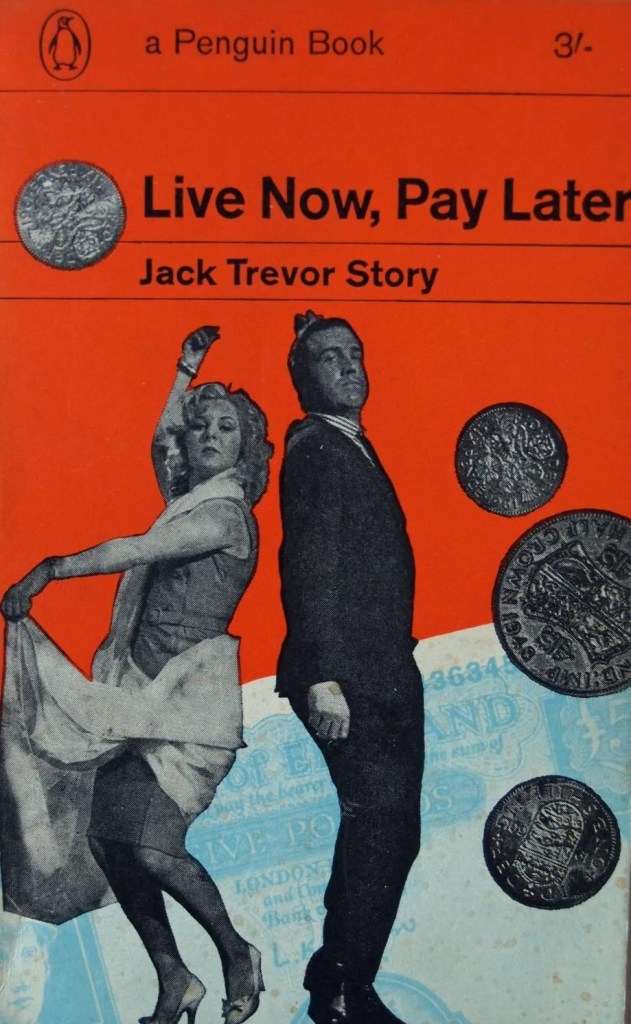
Directed somewhat unevenly by Jay Lewis (A Home of Your Own, 1964) from a script by Jack Trevor Story based on the bestseller by Jack Lindsay.

Prophetic.

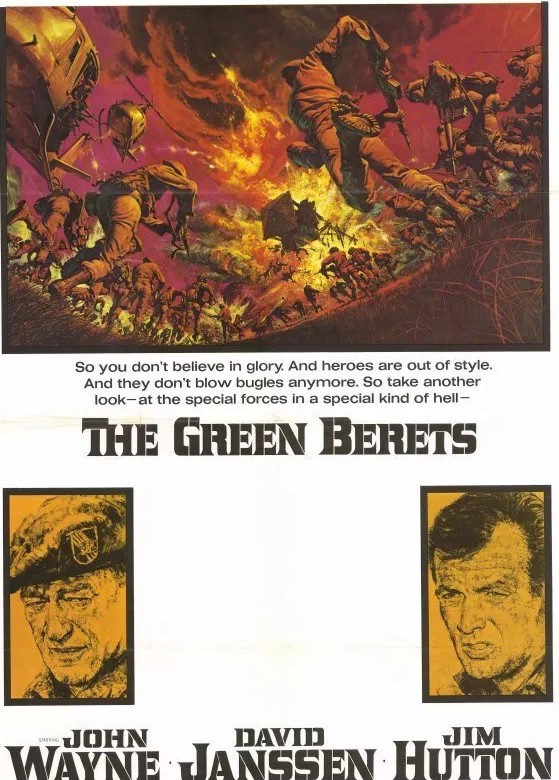
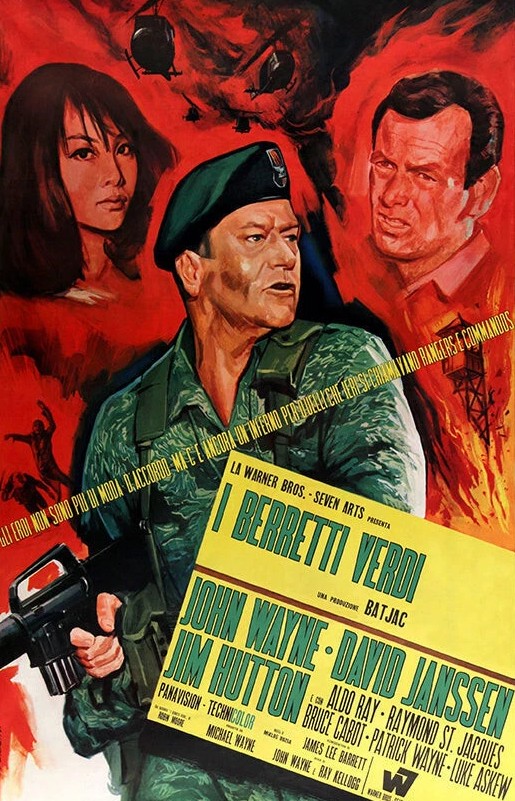
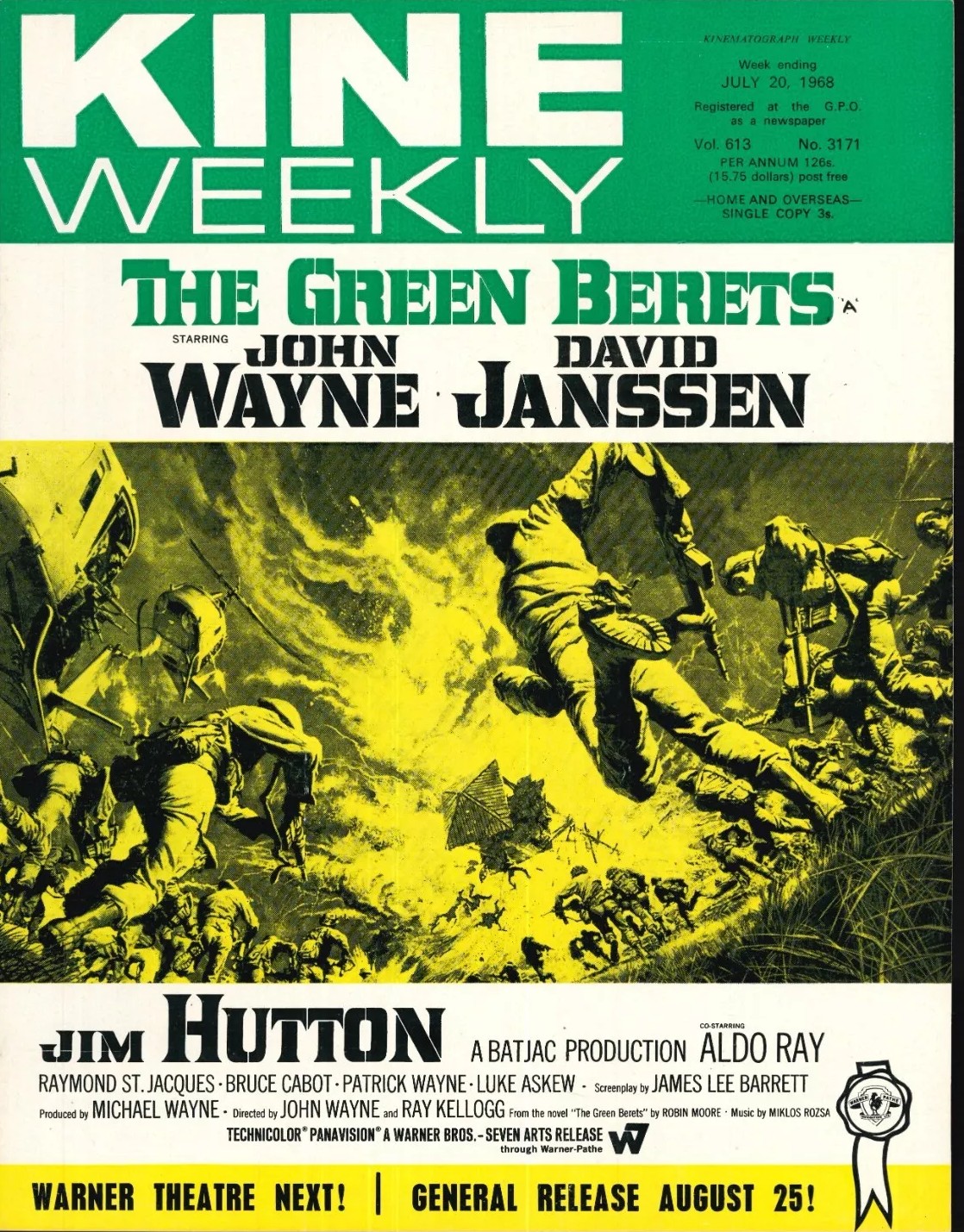
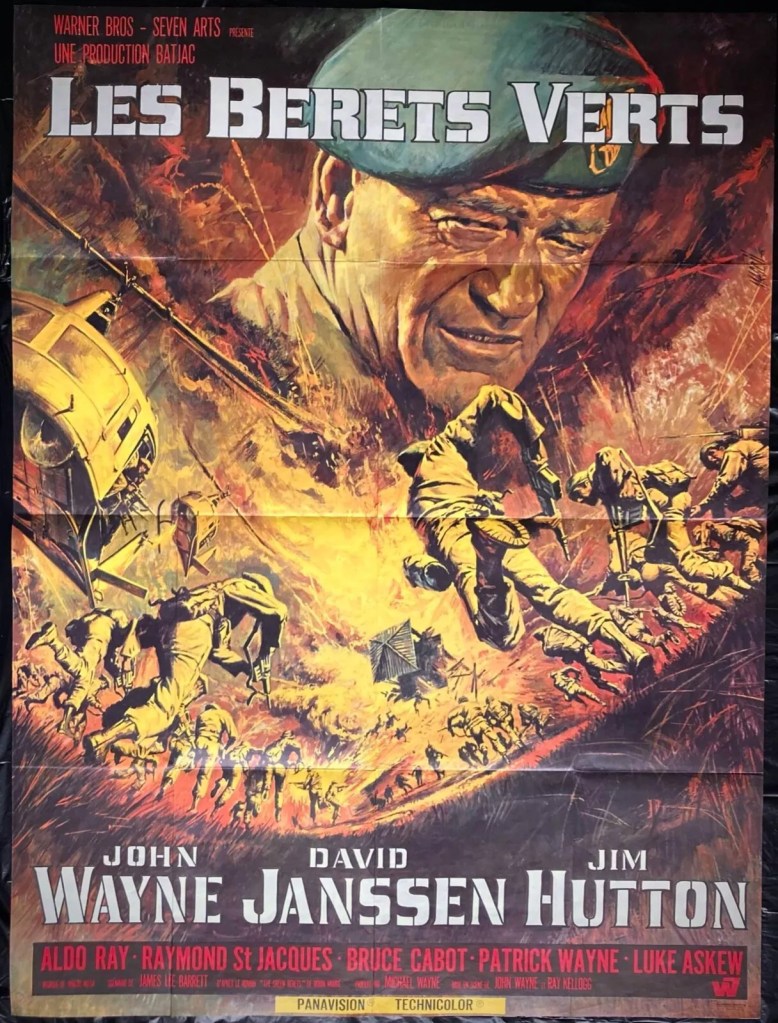
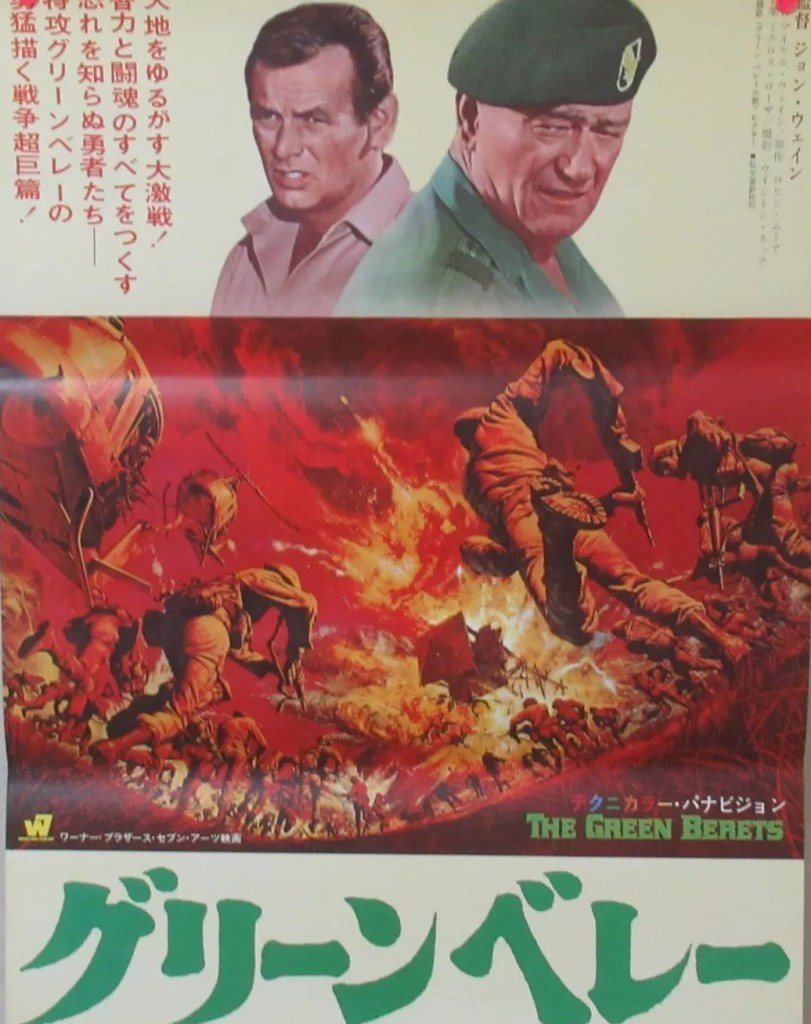
Behind the Scenes: “The Green Berets” (1968)

As if John Wayne hadn’t endured enough directing The Alamo (1960), he took on an even weightier task with this Vietnam War picture which, from the start, was likely to receive a critical roasting given the actor’s well-known stance on the conflict and his anti-Communist views that dated back to the McCarthy Era of the 1950s. Wayne had enjoyed a charmed life at the box office with three successive hit westerns, Henry Hathaway’s The Sons of Katie Elder (1965) with Dean Martin, Burt Kennedy’s The War Wagon (1967) co-starring Kirk Douglas, and best of all from a critical and commercial standpoint Howard Hawks El Dorado (1967) pairing Robert Mitchum. Outside of box office grosses, Wayne’s movies tended to be more profitable than his box office rivals because they were generally more inexpensive to make.

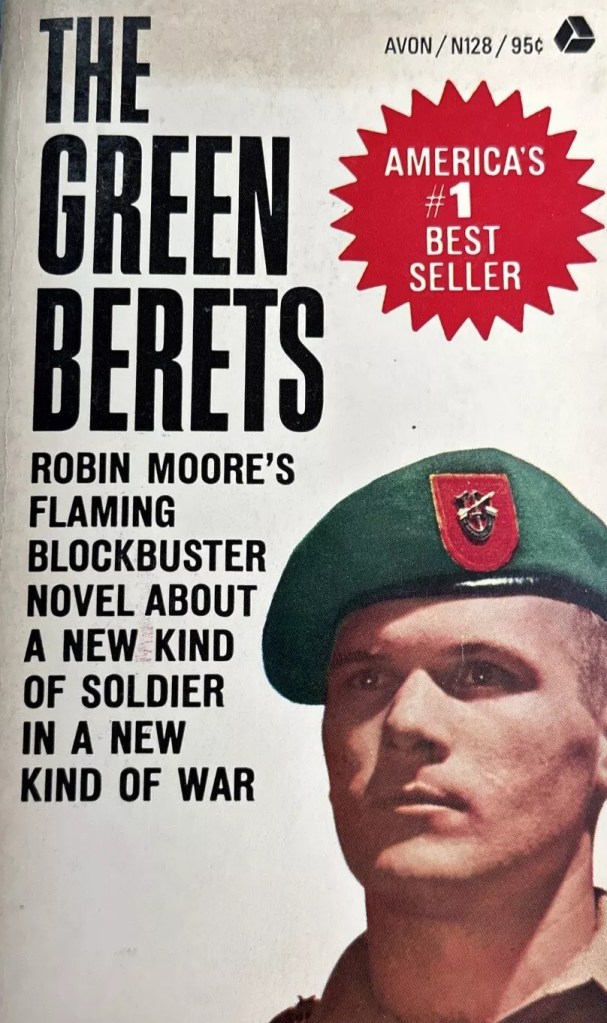
Columbia had been the first to recognize the potential of the book by Robin Moore and purchased the rights pre-publication in 1965 long before antipathy to the war reached its peak. A screenplay was commissioned from George Goodman who had served in the Special Forces the previous decade and was to to return to Vietnam on a research mission. But the studio couldn’t turn out a script that met the approval of the U.S. Army. Independent producer David Wolper (The Devil’s Brigade, 1968) was next to throw the dice but he couldn’t find the financing.

In 1966 Wayne took a trip to Vietnam and was impressed by what he saw. He bought the rights to the non-fiction book by Robin Moore (who also wrote The French Connection) for $35,000 plus a five per cent profit share. While the movie veered away in many places from the book, the honey trap and kidnapping of the general came from that source, although, ironically, that episode was entirely fictitious, originating in the mind of Robin Moore.

Universal originally agreed to back The Green Berets with filming scheduled for early 1967 but when it pulled out the project shifted to Warner Bros. And as if the director hadn’t learned his lesson from The Alamo, it was originally greenlit for a budget of $5.1 million, an amount that would prove signally inappropriate as the final count was $7 million. Wayne turned down the leading role in The Dirty Dozen (1967) to concentrate on this project. Wayne’s character was based on real-life Finnish Larry Thorne who had joined the Special Forces in Vietnam in 1963 and was reported missing in action in 1965 (his body was recovered four decades later).

As well as John Wayne, the movie was a platform for rising stars like Jim Hutton (Walk, Don’t Run, 1966), David Janssen (Warning Shot, 1967) and Luke Askew (Easy Rider, 1969) who replaced Bruce Dern. Howard Keel, who had appeared in The War Wagon, turned down a role.

Wayne holstered his normal $750,000 fee for acting plus $120,000 for directing. But it turned out The Alamo had taught him one important lesson – not to shoulder too much of the responsibility –  and Ray Kellogg for the modest sum of $40,000 was brought in as co-director. It was produced by Wayne’s production company, Batjac, now run by his son Michael. But neither Wayne nor Kellogg proved up to the task and concerned the movie was falling behind schedule and over budget the studio drafted in veteran director Mervyn Leroy – current remuneration $200,000 plus a percentage – whose over 40 years in the business ranged from gangster machine-gun fest Little Caesar (1931) to his most recent offering the Hitchcock-lite Moment to Moment (1966).

But exactly what LeRoy contributed over the next six months was open to question. Some reports had him directing all the scenes involving the star; others took the view that primarily he played the role of consultant, on set to offer advice. Even with his presence, the movie came in 18 days over schedule – 25 per cent longer than planned. Unlike the later Apocalypse Now (1979), it didn’t go anywhere near South-East Asia so the location didn’t add any of Coppola’s lush atmosphere, though the almost constant rain in Georgia, while a bugbear for the actors, helped authenticity.

It was filmed instead on five acres of Government land around Fort Benning, Georgia, hence pine forests rather than tropical trees.  President Lyndon B. Johnson and the Department of Defense offered full cooperation. But that was only after the producers complied with Army stipulations regarding the screenplay. James Lee Barratt’s script was altered to show the Vietnamese involved in defending the camp and the kidnapped was switched from being over the border. Also axed, though this time by the studio, was Wayne’s wish for a romantic element – the studio preferred more action. Sheree North (Madigan, 1968) was offered the role of Wayne’s wife but she also turned it down on political grounds. Vera Miles (The Hellfighters, 1968) was cast but she was edited out prior to release.

The Army provided UH-1 Huey helicopters, the Air Force chipped in with C-130 Hercules transports,  A-1 Skyraiders and the AC-47 Puff the Magic Dragon gunship and also the airplane that utilized the skyhook system. Actors and extras were kitted out in the correct jungle fatigues and uniforms. Making a cameo appearance was Col Welch, commander of the Army Airborne School at Ft Benning. The sequence of soldiers doing drill was actually airborne recruits.

The attack on the camp is based on the Battle of Nam Dong in 1964 when the defenders saw off a much bigger enemy unit.

This set was built on a hill inside Fort Benning. The authentic detail included barbed wire trenches and  punji sticks plus the use of mortar fire. While the camp was destroyed during filming the other villages were later used for training exercises. .

The pressure told on the Duke physically – he lost 15lb. But the oppressive heat and weather of that location – it was mostly shot in summer 1967 – was nothing compared to the reviews. It was slated by the critics with Wayne’s age for an active commander called into question, never mind the parachuting, the gung-ho heroics and the dalliance in an upmarket nightclub.

“In terms of Wayne’s directorial career,” wrote his biographer Scott Eyman, “The Alamo has many defenders, The Green Berets has none.” That assessment, of course, would be to ignore the moviegoers around the world who bought tickets and put the picture into reasonable profit.

Wayne was clear in his own mind about the kind of movie – “about good against bad”  – he was making and accommodated neither gray areas nor took note of current attitudes to the war as exemplified by nationwide demonstrations. Co-stars David Janssen, Jim Hutton and George Takei were opposed to the war. Takei, a regular on the Star Trek series, missed a third of the episodes on the second season; his lines were written to suit the character of Chekov, who went on to have a bigger role in the television series. Composer Elmer Bernstein turned down the gig as it went against his political beliefs. “The Ballad of the Green Berets,” heard over the opening credits was not composed for the film, having been released two years earlier.

Most critics hated it – “Truly monstrous ineptitude” (New York Times); “cliché-ridden throwback” (Hollywood Reporter); “immoral” (Glamour). Even those reviews that were mixed still came down hard: “rip-roaring Vietnam battle story…but certainly not an intellectual piece” (Motion Picture Exhibitor). Not that Wayne was too concerned. At the more vital place of judgement – the box office – it took in $9.5 million in rentals (what’s returned to the studios once cinemas have taken their cut) – $8.7 million on original release and a bit more in reissue – in the U.S. alone plus a good chunk overseas.

It was virtually impossible to examine a movie like this without taking a political stance. Other movies covering the same topic were allowed greater latitude regarding authenticity, audiences and critics like appearing to accept that creating watchable drama often took precedence over the facts. Both The Deer Hunter (1978) and Apocalypse Now, considered the best of this sub-genre, clearly ventured away from strict reality. With over half a century distancing the contemporary viewer from those inflammatory times, it’s worth noting that it still divides critics. Or, rather, critics and the general public take opposing views.

Although Rotten Tomatoes deems it “an exciting war film”, the critics voting on that  platform gave it a lowly 23 per cent favourable report compared to a generally positive 61 per cent from the ordinary viewer. That contrasts, for example, with a more even split for the likes of Exodus (1960) – 63 per cent from critics and 69 per cent from audiences. However, The Green Berets attracts twice as much interest, collaring 9,000 votes compared to just 4,300 for Exodus.

After this, Wayne’s fee went up to a flat million bucks a picture. “He wasn’t a guarantee of success,” explained his son Michael, “he was a guarantee against failure.” At this point in his career, he was gold-plated. Where other stars in his commercial league suffered the occasional box office lapse – Paul Newman’s career in the 1960s, for example, was riddled with flops like The Secret War of Harry Frigg (1968) – he did not. Especially with a global following, his pictures never lost money.

SOURCES: Michael Munn, John Wayne, The Man Behind the Myth, Robson, 2004; Scott Eyman, John Wayne, The Life and Legend, Simon and Schuster, 2014; Brian Hannan, The Magnificent 60s, The 100 Top Films at the Box Office, McFarland, 2023; Robin Moore, Introduction, The Green Berets, 1999 edition, Skyhorse Publishing; Laurence H. Suid, Guts and Glory, University of Lexington Press, 2002; The Making of The Green Berets, 2020; Review, Hollywood Reporter, June 17, 1968; Review, Motion Picture Exhibitor, June 19, 1968; Renata Adler, “The Absolute End of the ‘Romance of War’”, New York Times, June 30, 1968; Glamour, October 1968; “Big Rental Pictures of 1968,” Variety, January 8, 1969.

The Green Berets (1968) ***

Apart from attempts to justify the Vietnam War and a hot streak of sentimentality, a grimly realistic tale that doesn’t go in for the grandiosity or self-consciousnesss of the likes of Apocalypse Now (1979), The Deer Hunter (1978) and Platoon (1978). It’s been so long since I’ve watched this that my DVD is one of those where you had to turn the disc over in the middle.

The central action sequence is a kind of backs-to-the-wall Alamo or Rorke’s Drift siege. There’s no sense of triumphalism in the battle where the best you can say is that a reasonable chunk of the American soldiers came out alive but only after evacuating the staging post they were holding, more like Ridley Scott’s Black Hawk Down (2001) where survival is all there is to savor. It’s all pretty brutal stuff, the Americans handicapped by having to also look after the fleeing Vietnamese villagers taking refuge in their camp.

There are plenty grim reminders of how war has become even more devastating in the aftermath of World War Two. The Vietcong take, literally, no prisoners, seen as killing civilians as easily as soldiers. The Americans, for their part, have no compunction in using more sophisticated weaponry, with the addition of targeted air strikes.

Into the mix, somewhat unnecessarily, comes left-wing journo George (David Janssen) whose main job is to change his mind about the work the soldiers are doing, though admitting that to report the truth will lose him his position. He’s slung into the middle of a defensive action headed up by Col Kirby (John Wayne) to hold a position under threat against superior (in numbers) forces. There’s a fair bit of the detail of war but virtually zero about the strategy, whether that’s the U.S. Army’s plan to defeat the enemy or this individual unit’s method of defending this position. Apart from extending the perimeter of the camp to create a more effective killing zone, it’s hard to work out what the heck is going on, no matter how often orders are barked through field telephones or walkie talkies. There are squads out in the field and units in the camp and how the whole operation is meant to mesh is beyond me.

There’s not much time to flesh out the characters, save for “scrounger” Sgt Peterson (Jim Hutton) who adopts an orphan, Vietnamese soldier Capt Nim (George Takei) and Sgt Provo (Luke Askew). The rest of the motley bunch are the usual crew of monosyllabic tough guys and friendly medics and whatnot.

Though the emotional weight falls on Lin (Irene Tsu), fearing shame and being ostracized by her family for befriending the Vietcong general who killed her father and for whom she now lays a honeytrap, Kirby expresses guilt at having to kill anybody.

Despite being sent out to reinforce the position, the Americans are forced to retreat and enjoy only a Pyrrhic victory when the cavalry, in the shape of an airplane, arrives to mow down the enemy after they have captured the position.

The fighting is suitably savage, and there is certainly the notion that the Americans are not only being out-fought but out-thought and that no amount of heavy weaponry is going to win the day.

Possibly to prevent the idea of defeat destabilizing the audience, the movie shifts into a different gear, more the gung-ho commando raid picture that the British used to do so well, where Kirby heads up an infiltration team to capture the Vietcong general who has been seduced by Lin. This sets up a completely different imperative, all stealth and secrecy, the kind of operation that in the past would have been a whole movie in itself rather than the tag-end of one.

While the prime aim of this is to have the audience leave the cinema happier than if they had just witnessed the retreat from the camp, in fact it also serves two purposes. One is worthwhile, to emphasize the sacrifices made by the Vietnamese. Lin, having agreed to prostitute herself, fears being cast out as a result. But the other outcome of this mission is to kill off Sgt Peterson thus leaving the little Vietnamese lad even more orphaned than before.

John Wayne (The Sons of Katie Elder, 1965) doesn’t attempt to gloss over the weariness of his character. Jim Hutton (Walk, Don’t Run, 1966) shifts with surprising ease from comedy to drama. Even as a cliché David Janssen (Warning Shot, 1966) is underused. Watch out for Aldo Ray (The Power, 1968), George Takei (original Star Trek series), Raymond St Jacques (Uptight, 1968), Luke Askew (Flareup, 1969) and Irene Tsu (Caprice, 1967).

Three hands were involved in the direction: John Wayne, veteran Mervyn Leroy (Moment to Moment, 1966) and Ray Kellogg (My Dog, Buddy, 1960). Written by James Lee Barrett (Bandolero!, 1968) from the book by Robin Moore. Worth pointing out the score by triple Oscar-winner Miklos Rosza (The Power, 1968) especially the low notes he hits to provide brooding tension.     

Certainly a mixed bag, the central superb action sequence weighted down by the need to find something to shout about.

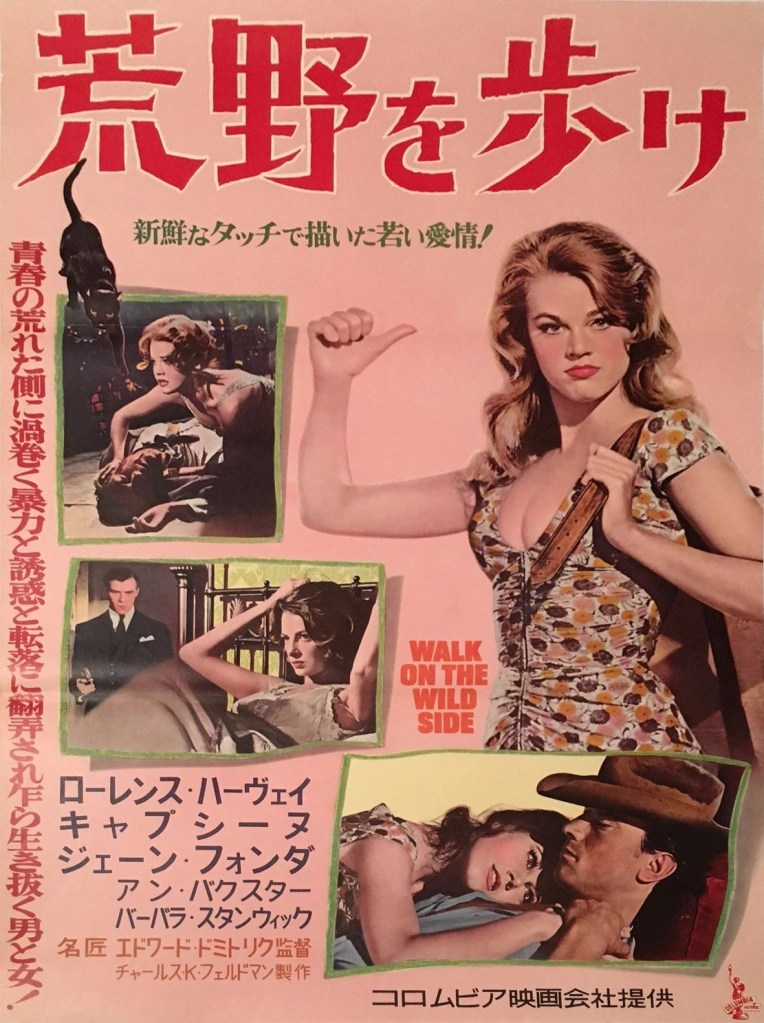
Walk on the Wild Side (1962) ***

As much as the censor would permit – would be the subtitle. While not as harsh as the Nelson Algren source novel, it’s still, wrapped up in a bitter romance, a more brutal than heretofore expose of the sex worker, far removed from the gloss of Butterfield 8 (1960) or the romantic comedy of Never on Sunday (1960) and Irma La Douce (1963).

The initial thwarted romance lacks the tragic element. It falls apart due to the mundane. After a four-month affair Dove (Laurence Harvey) can’t commit to artist Hallie (Capucine) because his father is too ill to leave. So she ups sticks and heads for New York, hooks up with buyer Jo (Barbara Stanwyck) who turns out to invest in more than art, and ends up in a New Orleans brothel where as well as servicing the clients she can continue making sculptures.

After his father dies three years later, Dove heads to New Orleans to find her, but with no idea where to look. He falls in with vagabond-cum-thief Kitty (Jane Fonda) and eventually having dumped her due to her thieving ways takes refuge in a café whose owner Teresina (Anne Baxter), a victim of Kitty, offers him employment. She suggests he puts an advert in a New Orleans newspaper and just when he’s giving up hope and Teresina is getting up her hopes that she can win him over romantically he gets a phone call.

He’s clearly unaware that Hallie is a sex worker and after romancing her sets them up in an apartment. Hallie abandons the reunion after a night or possibly just an idyllic afternoon. Hallie’s reluctance is twofold. She’s become accustomed to the relative laziness of her life, she’s a high-class lady and is not worked too hard, plus she’s got accommodation and a studio to work in and she knows her boss Jo is sweet on her. On the other hand, it would be difficult to quit, the brothel employs tough guy Oliver to keep the girls in line and nobody’s going to want her to be giving it away for free.

Kitty, now working in the establishment, annoyed that he previously rejected her advances, gives Dove a full run-down on his lover. And there’s a legal catch that Jo is quick to take advantage of. Since Kitty is now a sex worker and it was Dove who took her with him to New Orleans he could be prosecuted for sex trafficking of a minor. When that doesn’t work, Dove receives a beating.

Kitty now decides Dove isn’t so bad after all, feels remorse at her role in his downfall, and helps him get back to café where Teresina cares for him and gets her hopes up once again. Then she helps Hallie escape and then fesses up to Oliver where she is. It doesn’t end well – although the censor would be pleased since after the climactic fracas the brothel is closed down and Jo and Co jailed.

It’s got a Tennessee Williams feel, though everything set in the South appeared to come into his bailiwick, but most of the realism is understated, as it would have to be in those times. Jo’s a groomer of the vulnerable, and for all Hallie’s artistic ambition she’s every bit as easy pickings as Kitty who is grateful to be freed from prison where she was arrested as a vagrant and reckons being given money for fancy clothes and having a roof over her head is good enough reward for selling body and soul. Her role in the denouement is a mite too convenient from the narrative perspective but it will do as a means of tacking on a tragic ending.

It helps enormously that most of the performances are understated. Laurence Harvey (A Dandy in Aspic, 1967), more commonly a scene-stealer, is good value and Barbara Stanwyck (The Night Walker, 1964) only requires a stare to make her feelings known. Though Capucine (Song without End, 1960) was criticized at the time I felt her performance was measured. Jane Fonda (Barbarella, 1968) was more of a wild card and it didn’t seem believable that such a flighty piece was going to become principled.

You can thank director Edward Dymytryk (Shalako, 1968) for keeping the actors in line and maintaining an even tone without spilling over into the melodramatic. John Fante (My Six Loves, 1963) and Edmund Morris (The Savage Guns, 1961) adapted the book. Special nod of appreciation to Saul Bass for the credits.

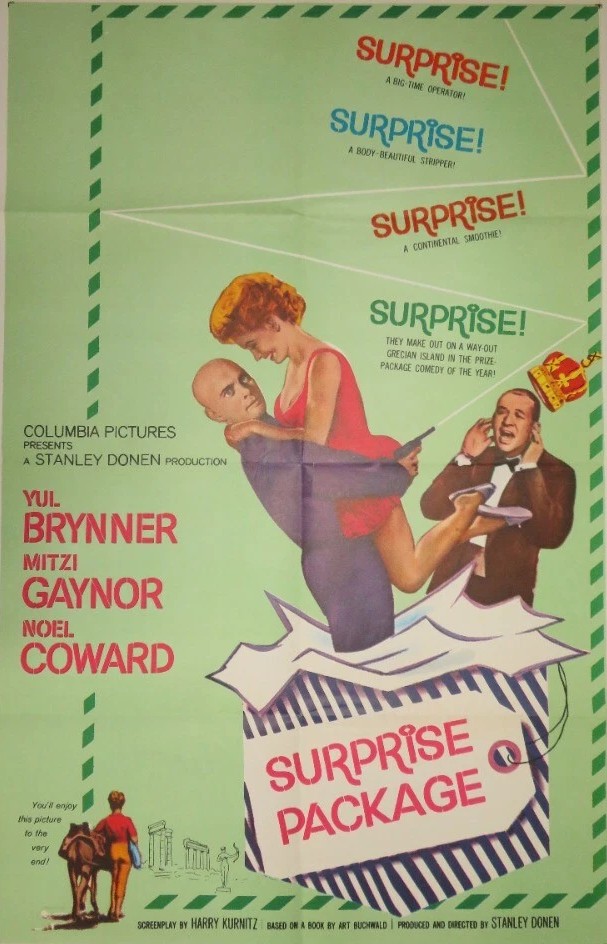
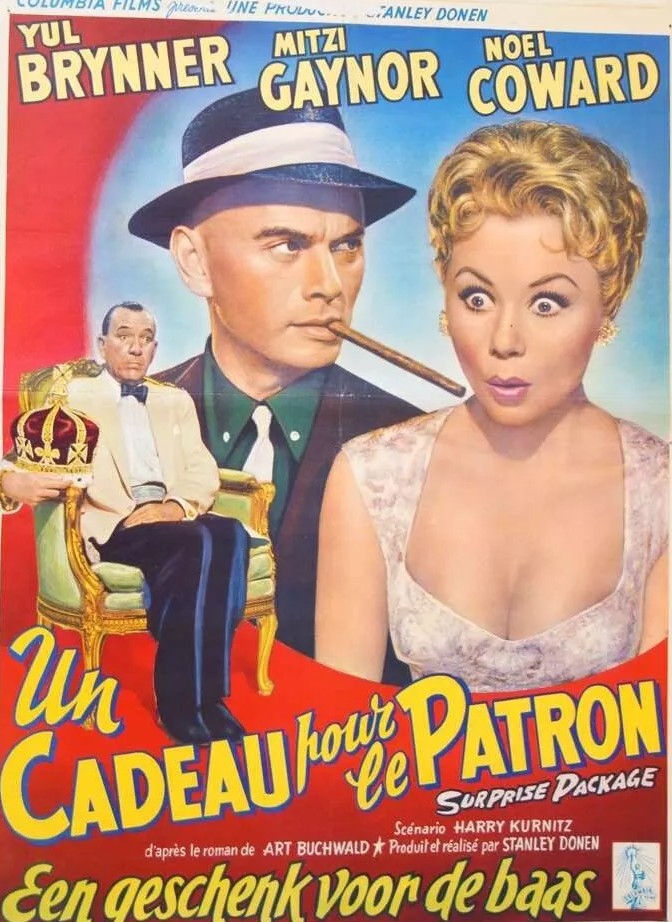
Surprise Package (1960) **

Poses two questions. Is this every bit as bad as Once More with Feeling, Stanley Donen’s previous picture? Yep, sorry, it’s every bit as wretched. The second question is: how on earth did Donen go from this mess to sublime romantic thriller Charade three years later? Well, the answer might simply be in the casting. Yul Brynner is no Cary Grant. And in this movie he’s not even Yul Brynner.

My guess is he’s meant to be a humorous twist on the Brynner screen persona. But playing a gangster with a thick Noo Yoik accent was always the preserve of the dumb supporting actor not the star. And since Yul Brynner isn’t any more convincing in this than in Once More with Feeling the project is in trouble from the start.

We’re given too much of this faux gangster drivel at the start when mob kingpin Nico (Yul Brynner) is collecting tributes from his underlings. Then, for no particular reason, he is deported, sent back into exile to his homeland of Greece. There he encounters the only smart guy in the picture, the corrupt chief of police Stefan (Eric Pohlmann) who’s so astute in the bribery department that all Nico receives in return for his thousand dollar bribe is to be told he won’t be arrested for bribery.

Stefan sets up Nico to meet another exile, deposed King Pavel II (Noel Coward), whose accent makes no sense either unless he was exclusively raised in high class British society, schooled at Eton, a member of upper class clubs etc etc, otherwise how to explain the plummy tones unless this is also meant to be as over-the-top gag as Nico’s Noo Yoik accent. Nico plans to buy the king’s crown for a million bucks. But the boys back home stiff him and instead of the cash send him instead his girlfriend – the surprise package of the title – mob moll Gabby (Mitzi Gaynor), and the ongoing gag here is that, what with Nico trying to elevate himself in society, Gabby’s table manners and speech let him down.

So with no cash forthcoming, what’s a gangster to do to pad out his exile? So Nico decides to steal the crown. And if there had been either a hint of the classic heist a la Grand Slam (1960) or Topkapi (1964) or its alternative, the totally inept thief, then we might have been onto something. But instead we’ve got much what we might expect from such a poor piece – not much. And in any case, the laffs are meant to come from another party, representing the king’s citizens, and led by Dr Panzer (George Coulouris) who wants the crown restored to its proper home. Two crooks chasing the same prize? What a crazy idea. But this works as well as the rest of the picture.

Thanks to Gabby’s principles, the crown goes in neither’s pockets. To make a buck, Nico and the king transform the latter’s villa into a casino with Gabby, now Mrs Nico, employed as the hat check girl.

Stanely Donen made three pictures in 1960 and then not another man for three years, which suggested he was a) working on too many projects at once and b) that break sure refreshed his cinematic skills. Just like Once More with Feeling he gets wrong virtually most of the directorial decisions, beginning with the accents and ending up with the storyline and characters you don’t care a button for, which wouldn’t have mattered if they could generate a laugh.

Yul Brynner followed this up with his iconic performance in The Magnificent Seven (1960) so perhaps he can be excused. This pretty much killed off the career of Mitzi Gaynor (South Pacific, 1958) – it was another three years till she appeared on screen again, and that was her final picture. It took Noel Coward (Bunny Lake Is Missing, 1965) four years to get another screen role.

Written by Harry Kurnitz (Once More with Feeling) from the Art Buchwald novel so I am assuming this was greenlit before the results of the previous Donen-Brynner teaming were known.

At least Charade revived Donen’s career.

Born Free (1966) ***

Unusual mix of the sentimental and the unsentimental, mixing soft-centered animal features like That Darn Cat (1966) where cute beasts cause mayhem with the kind of realism espoused by Sir David Attenborough (Planet Earth, 2006) where nature is red in tooth and claw, though skipping the irony of game warden-cum-conservationist George Adamson (Bill Travers) bringing up the cubs of the leonine parents he has shot dead.

With wife Joy (Virginia McKenna) they decide to rear the baby animals. Joy is most attracted to the runt of the litter, Elsa. Cue much hilarity as the animals destroy their house, knocking over anything standing, pulling down curtains, breaking plates, and like any youngsters resisting bedtime. Joy is so distraught at having to get rid of the grown-up cubs, despatched to zoos, that her husband holds onto Elsa.

If Joy can’t face shipping the cub overseas, she’s unwilling to face up to the fact that the only other alternative is to groom her for a life in the wild. A tame animal let loose would hardly survive a minute. So they’ve got to train Elsa to hunt. This doesn’t work out, Elsa finding herself at the wrong end of the hunting business – attacked by a warthog – or too inexperienced to know not to go near a herd of wild elephants. When she crawls home nursing her wounds, George is on the verge of giving up, but Joy wishes to persevere, resulting in scenes of the cute Elsa now suddenly red in tooth and claw and savoring her kill.

Now, all that’s left is finding her a willing mate. When that’s achieved, it’s job done, though when Elsa returns for a visit she’s accompanied by her own cubs.

And if you’re occasionally bored by the cutesy elements and wish the movie would get a move on, you can always savor, as I did, the Oscar-winning music by John Barry. It’s what these days would be deemed a feel-good movie but that’s only if you wriggle out of the irony.

The problem for the big cats in Kenya was that they were prey to illicit big-game hunters and if that had been the reason for the cubs being orphaned it would be a better fit for the general theme. But, basically, what lions don’t seem to realize is that they can’t treat humans like any other prey. There’s some weird supposition that they can prefer the taste of human flesh, rather than the more obvious reason why humans are attractive being that, unless armed, they can neither run away nor defend themselves like all the other jungle occupants.

There’s an unspoken rule – to which the lions are obviously not privy – that if you get a reputation as a man-eater then that friendly game warden who’s otherwise on your side is going to come after you and shoot you dead. It would only be luck that your offspring might end up with a couple of friendly humans rather than as dinner for other predators.

So being “born free” comes with the proviso of not getting in the way of humans.

Real life couple Bill Travers (The Bridal Path, 1959) and Virginia McKenna (Carve Her Name with Pride, 1958) were considered well past their sell-by date, neither having made a picture in five years. But they seem to embody the characters well, McKenna’s acting recognized by the Golden Globes.

James Hill (A Study in Terror, 1965) directs from a screenplay by Lester Cole (Operation Eichmann, 1961), blacklisted as one of the Hollywood Ten, and Joy Adamson, author of the eponymous bestseller.

While you’re probably not as nit-picky as me, you might well figure this is well past its sell-by date or, equally, you might hail it as the precursor of an animal rights campaign.

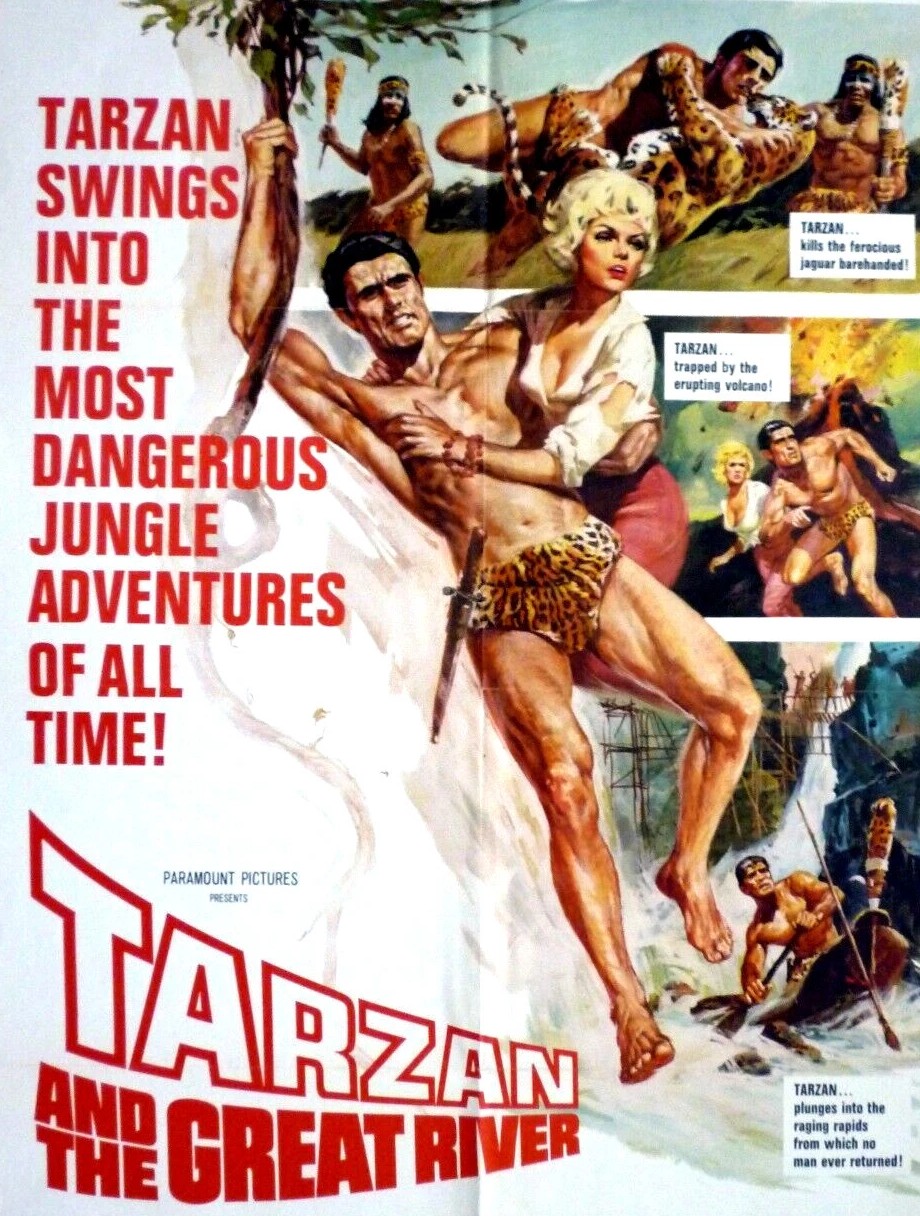
Tarzan and the Great River (1967) ***

Tarzan (Mike Henry) has been repurposed as an international adventurer dropped into trouble spots an ocean away from his African roots. He’s the male equivalent of the bikini-clad females peppering the espionage genre, kitted out in only a loincloth, torso kept bare for the titillation of the ladies. And just like the James Bond series, there’s an evil personage, and while not in the business of taking over the world still wanting to dominate a good chunk of it in South America. Barcuna (Rafer Johnson), espouses the Jaguar death cult, terrorizing villages and enslaving their inhabitants for the purpose of searching for diamonds.

To fill out the narrative, a good chunk of the picture is spent with riverboat Captain Sam Bishop (Jan Murray) and the native orphan Pepe (Manuel Padilla Jr.) he has unofficially adopted and their comic shtick mostly involving the older man cheating at cards is all we’ve got to keep the drama going until the female in distress, Dr Ann Philips (Diana Millay), turns up. But, as you know, Tarzan is no lothario, unlike his colleagues in the espionage department, so we don’t have to wonder if romance is going to raise its ugly head.

Wrong continent. No tigers were used in this film.

In the meantime the producer has scoured the vaults for stock footage and clearly is of the opinion that if you can transplant Tarzan from his natural African habitat you can do the same with hippos. Tarzan wrestles a lion and a crocodile and despatches Barcuna’s henchmen on land and in the river, swimming underwater and tipping over canoes to do his part in keeping the local crocodiles well-fed.

Barcuna, meanwhile, roasts alive anyone caught trying to escape, though he allows the good doctor to escape either because he’s not partial to blondes or he reckons she won’t be much good at hunting for diamonds or, as suggested once he burns her village, because he wants her to let everyone know that he’s the big cheese around here.

There’s the usual plague subplot. Dr Millay is waiting on the arrival of a vaccine to fight a new plague – Bishop is delivering the stuff – but she has a job getting the natives to accept inoculation and it’s only when Pepe offers himself as a guinea pig that the others queue up.

Devoid of the gadgets, speedboats and fast cars of the espionage genre, Tarzan relies on the speed of his legs as if he was auditioning for the Tom Cruise role in Mission Impossible or that of Liam Neeson in the Taken series. There’s a spectacular fight between Tarzan and Barcuna for the climax.

Harmless stuff, as innocuous as the others in the trilogy featuring former football player Mike Henry (The Green Berets, 1968). They were filmed back-to-back in 1965 and released at the rate of one a year from 1966. This was the third time producer Sy Wintraub’s had reinvented Tarzan. He had previously shepherded home a pair – starting with Tarzan’s Great Adventure (1959) – starring Gordon Scott. Jock Mahoney inherited the mantle with Tarzan Goes to India (1962) and lasted for one more adventure.

This was the last of a quartet of outings with Tarzan for director Robert Day (She, 1965). Written by Bob Barbash (The Plunderers, 1960).

Perfect Saturday matinee material.

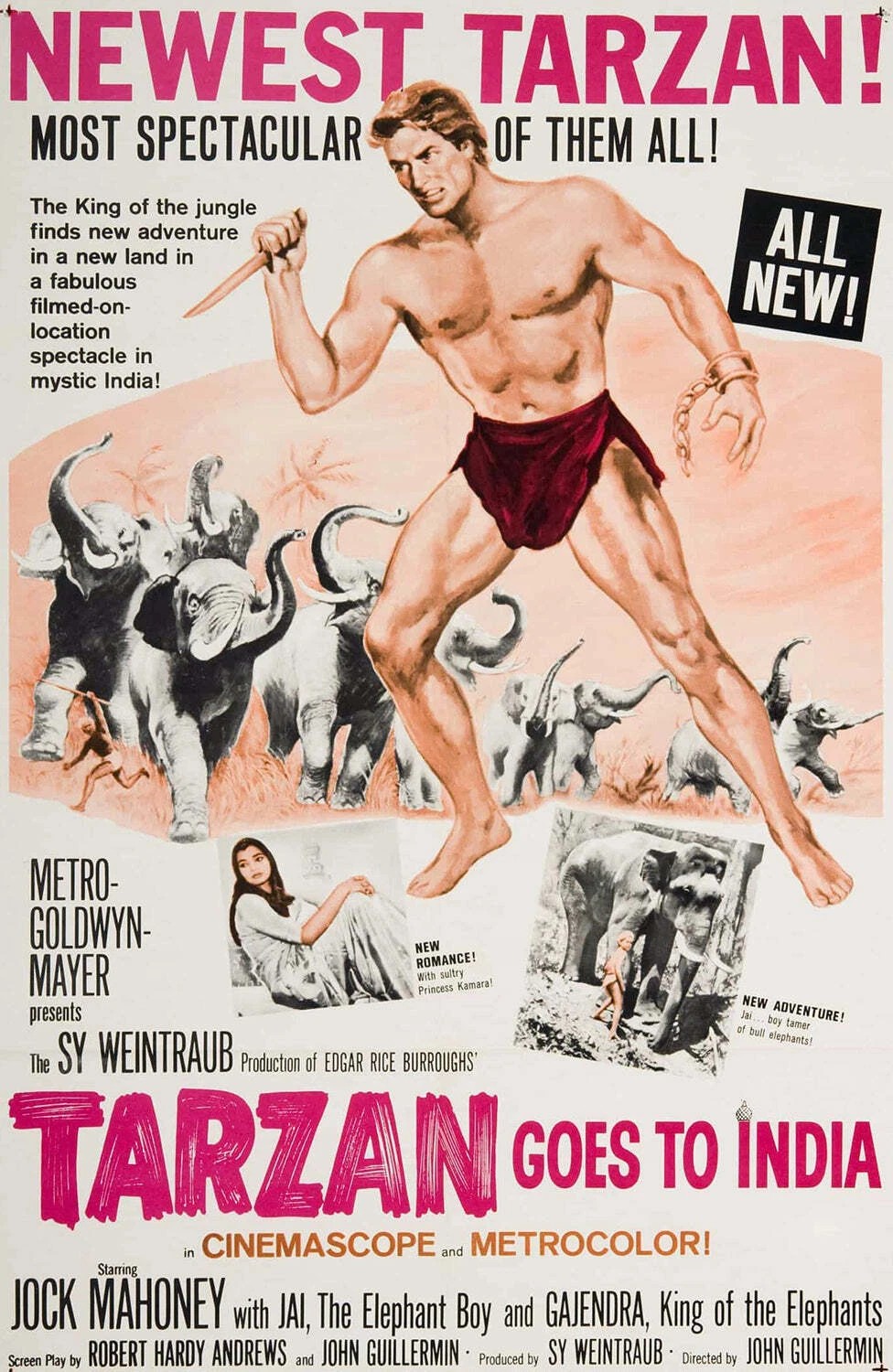
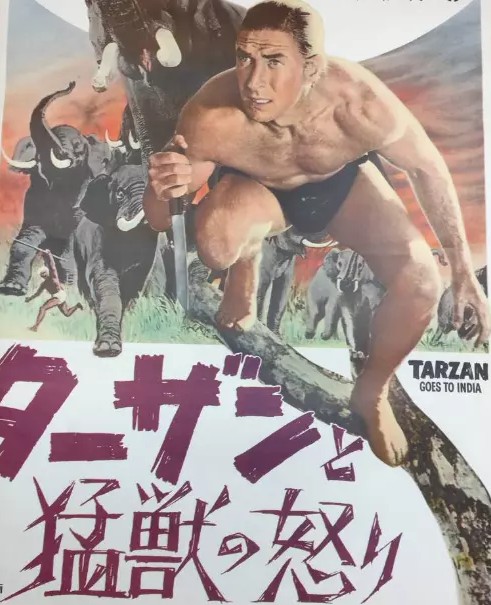
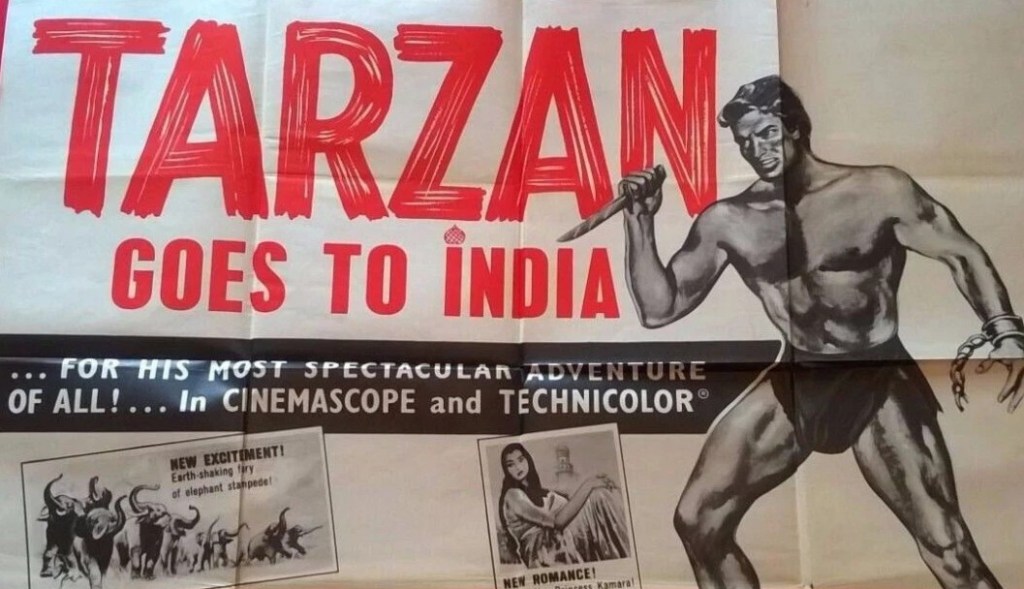
Tarzan Goes to India (1962) ***

Helluva fillip for reissue and credibility purposes to be able to point to the picture being helmed by the director – John Guillermin – of The Towering Inferno (1974), not to mention King Kong (1976) and The Blue Max (1966) – which suggested top-notch skills if not the budget to match. Guillermin, who also had a share in the screenplay, does a pretty good job of tailoring the picture to highlight issues that in others of the series are treated in more comedic fashion and making tremendous use of the location, far more than subsequent directors do with South American scenery. Elephants go mano a mano, Tarzan has a tussle with a leopard, but for sheer realism there’s little to beat a tiny mongoose putting a cobra in its place.

But what could be more timely for today’s audiences than presenting Tarzan (Jock Mahoney) as an eco-warrior. He is brought in to rescue a herd of 300 wild elephants being drowned when a much-needed hydroelectric dam is opened. Dam engineers Bryce (Leo Gordon) and O’Hara (Mark Dana), who show no compunction about the high death rate among the native laborers, are even less concerned about the fate of the elephants especially as have very tight deadline – the onset of the monsoon season  – to meet. Princess Kamara (Simi Garewal), daughter of an old friend from Tarzan’s Africa days, is trying to get villagers out of the way as well. She’s not helped by Bryce’s top engineer Raj (Jagdish Raj) who sides with Bryce.

The main problem is that elephants can’t climb hills and are led by Bala, a rogue of the species, whom Tarzan determines he’ll have to eliminate. He’s helped by a small boy Jai who rides his own elephant Gajendra. Jai’s not there for comedic purpose and Tarzan helps him grow up, their bond facilitated by Tarzan saving the ivory-tusked beast from Bryce in white hunter mode.

Baits abound. Tarzan is chained to a tree by Bryce to entice a leopard. The boy is used, again by Bryce, as lure to draw Tarzan out into the open at the climax. Raj changes sides on seeing how cheaply Bryce treats life, but there’s no time for him to get lovey-dovey with the princess. Which is just as well because Tarzan’s got a lot on his plate. His plan to put an arrow through Bala’s brain goes awry, triggering the Gajandra-Bala duel, which is very well done.

Although set in India, this feels more like the real thing than the sojourns in South America. We never see Tarzan in a suit but I don’t think anyone thought to compare his entrance, emerging from a river clad only in loin-cloth, with the other more famous screen entrance of the year, that of Ursula Andress in Dr No. Tarzan does plenty of swimming, even employing the breathing through a reed trick, and swings through the trees, and runs a lot barefoot, and gets to ride on the back of an elephant. The absence of his usual animal sidekicks is no hindrance. His scenes with the young boy are touching rather than sentimental or clumsily jokey. The kid’s pretty smart, which helps.

Kamara’s there merely to help along the subplot rather than for romantic purposes. Given the lean running time (86 minutes) that kind of palaver would only get in the way. This was shot entirely on location, and it shows, no awkward switches to studio set-ups, glorious scenery all the way.

Best of all John Guillermin, who also helmed Tarzan’s Greatest Adventure (1959), knows how to construct a scene, and how to get the best out of actors whose acting skills would not be considered their main attributes. So it looks good whichever way you cut it.

Former stunt man and athlete Jock Mahoney makes the switch from Tarzan nemesis (Tarzan the Magnificent, 1960) to Tarzan with ease. Less muscle-bound than his predecessors, he brings a more mature tone to proceedings, exuding thoughtfulness more than being gung-ho.

One of the better Tarzans of the decade.

Discover WordPress

A daily selection of the best content published on WordPress, collected for you by humans who love to read.

The Atavist Magazine

by Brian Hannan

WordPress.com News

The latest news on WordPress.com and the WordPress community.