You get the impression this is the kind of movie that contemporary “visionary” directors think they are making when they focus on an unlikeable obsessive character causing chaos all around. It’s not just star quality they are missing – who wouldn’t give their eyeteeth for a Paul Newman to get behind a movie with poor commercial prospects, especially one tackling a sport that is guaranteed to put off the female element of the audience. Without Newman’s involvement you didn’t have a hope in hell of getting anywhere near the female audience.
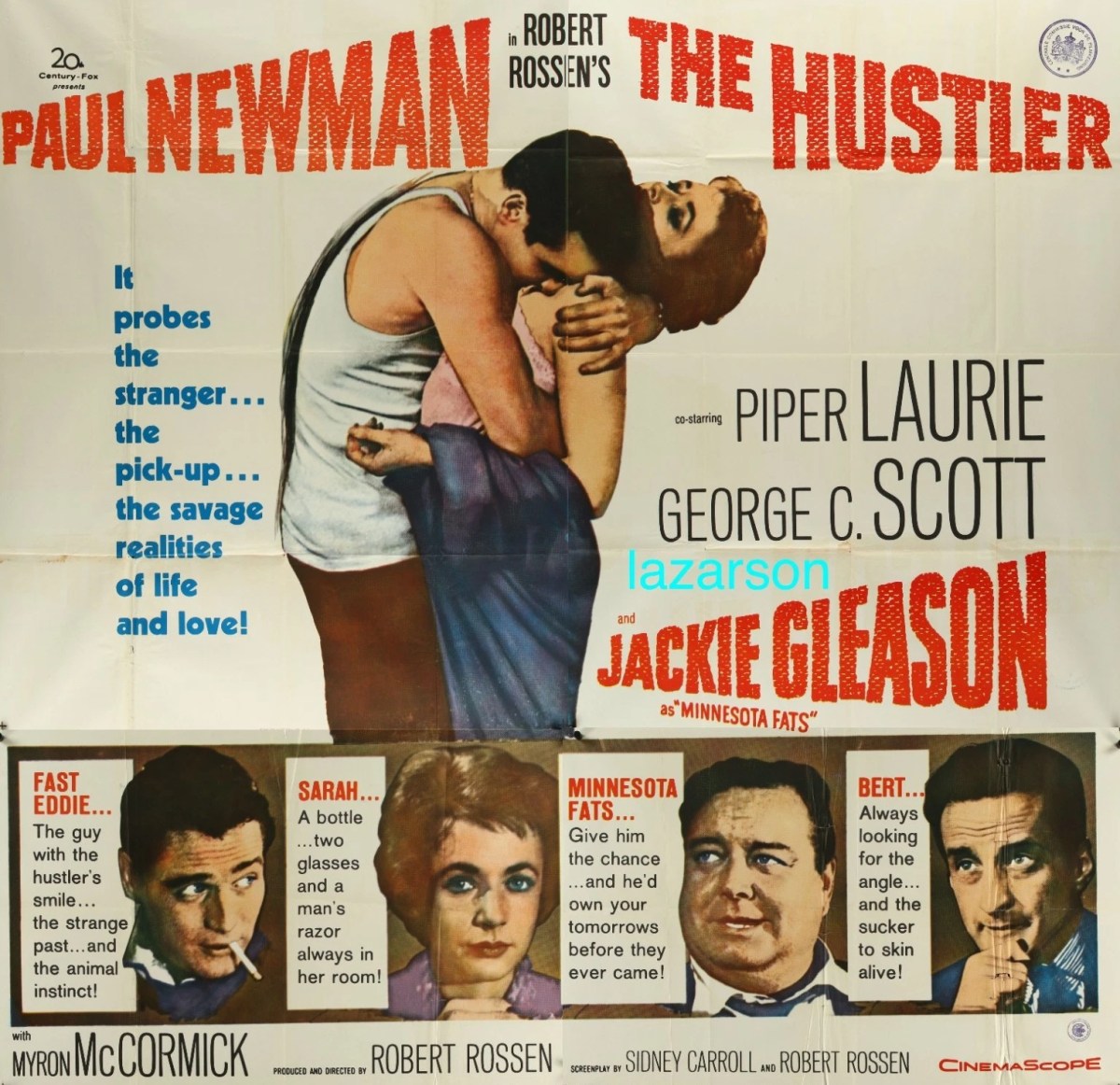
And this was quite a different Paul Newman. In the first of his iconic roles, he’s far from the traditional hero. He’s an obsessive loner. But you are drawn towards him because of both the intensity and vulnerability of this character. He could as easily be the loser, the last thing an audience wants, he’s often accused of being, the bottler looking for an excuse for not going the extra mile it takes to win. And even when he does win, triumph comes with loss, of love and his avowed profession.
And it takes a heck of a confident director – Robert Rossen (Lilith, 1964) – to lock us into the dark prison of a pool room for virtually the first 30 minutes of the picture. If you don’t know the rules of American pool – as opposed to billiards and snooker – you’re not going to learn them here. “Fast” Eddie Felson (Paul Newman) has spent years on the road, hustling in small town poolrooms, to built up the kind of cash stack he requires to take on the greatest name in pool, Minnesota Fats (Jackie Gleason) whose unbeaten run stretches back a decade and a half.
And the movie should be over in that first half hour – or at the very least turned into a very different kind of picture, the one where the champ squanders his fortune – because Felson has thumped Fats. He’s $18,000 ahead at one point. In any other sport that should be mean he’s not just won but he’s won in style. Except it doesn’t work that way here. Fats has to concede. And Fats won’t concede because this is a marathon and despite his bulk Fats is better built for a 40-hour match than his slimmer opponent. And so it proves.
Felson is back to the beginning, welshing on his business partner Charlie (Myron McCormick) and heading out into the night. Where he meets alcoholic Sarah (Piper Laurie) who’s sitting in a bus station in the early morning sipping coffee until the liquor stores open. She’s not your usual easy pick-up, she knocks him back easily and in an idiosyncratic manner. She nearly does the same again, but relents and they start a relationship that’s built on nothing except ships passing in the night. She’s a lush, he’s a has-been. She’s a bit of a cultured lush, reads, writes short stories, but still booze is her first love.
If he’s not down enough, here comes the kicker. Thugs in a poolroom object to being hustled and break his thumbs. But she’s not very maternal and he’s not the kind of man who wants to be looked after in that fashion.
Eventually, he hooks up with another backer, a shady underworld character, Bert Gordon (George C Scott) whose first move is to break up Felson’s relationship, attempting to belittle Sarah, getting her smashed and putting the moves on her as if free sex is part of the deal. Felson gets badly hustled by wealthy Louisville Findley (Murray Hamilton), duped into playing billiards instead of pool, and the potential loss might well have slammed the door on the deal with Gordon. But Gordon gets his pound of flesh, literally, and Sarah, clearly better versed in the ways of the world than Felson, gives in to her lover’s manager and then is so disgusted with herself that she commits suicide.
Felson gains his revenge on both Minnesota Fats and Gordon but at a cost, lover lost, and kicked out of his profession. Victory has never been so negative.
While the acting all round is superb, all four principals plus the director Oscar-nominated, it’s the feel of the piece and the obsessiveness of the characters that resonates. Robert Rossen makes no concessions to the audience. He doesn’t explain the game and he doesn’t, as would be par for the course anywhere else, show how Felson learned how to handle a cue a different way after his thumbs were broken and there’s a distinct lack of the triumphalism that generally comes with the territory.
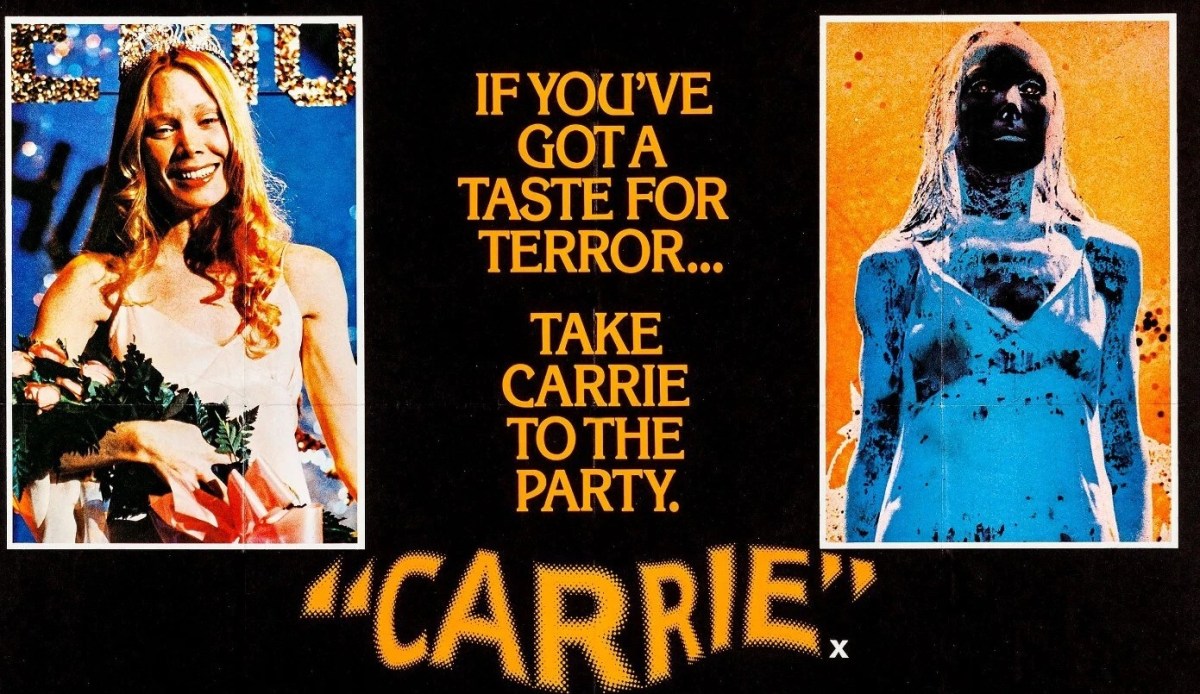
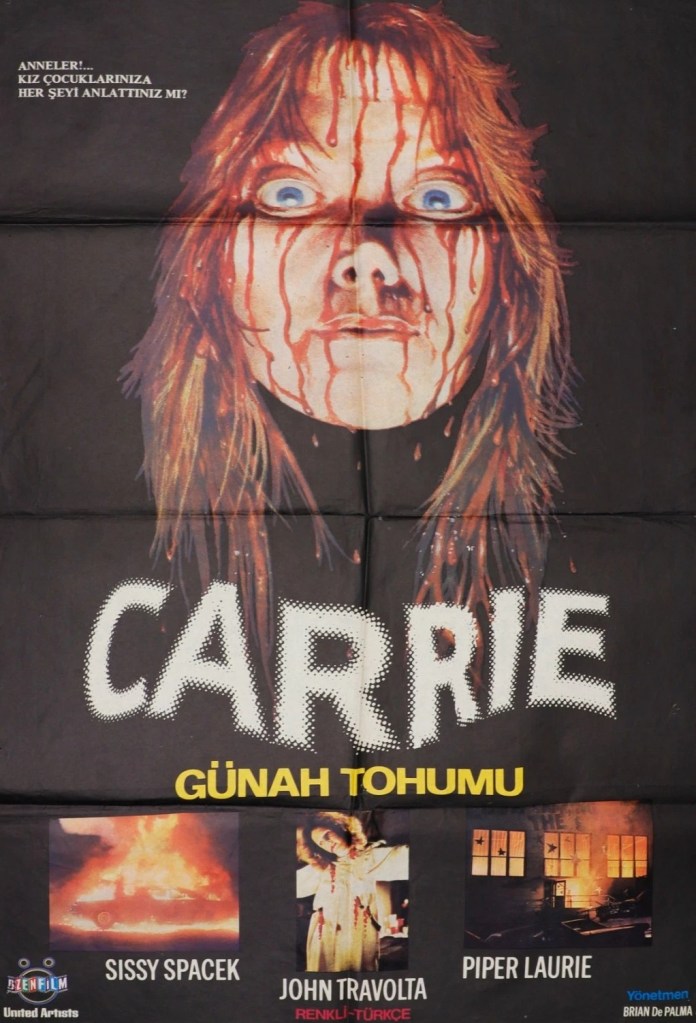
Could have easily gone so badly wrong. You got Mean Girls vs Teen Romance. Demented Mother of Elmer Gantry vs Demented Daughter of Psycho. Why did nobody ever think before that slow-mo that used to be the preserve of lovers gambolling in fields and cowboys being bloodily gunned down could be as easily employed to watch naked girls in the shower. Throw in split-screen and a couple of other technical devices. And the shock ending which triggered a new cycle.
There’s a heck of lot of face-slapping that wouldn’t pass muster today and not exclusively male either, hard-ass teacher Miss Collins (Betty Buckley) setting about venal pupil Chris (Nancy Allen), Chris giving as good as she gets from boyfriend Billy (John Travolta). And if you were a rising star like John Travolta you might think twice about the effect on your career of battering a pig to death with a sledgehammer. Try those capers now and you’d run into the woke police.
But it’s surprisingly feminist. Women twist their men round their little finger, the headmaster does the bidding of Miss Collins, All-American Boy Tommy (William Katt), decked out in a super perm, accedes to the barmy request of his girlfriend Sue (Amy Irving), attempting to assuage her guilt over her role in bullying Carrie (Sissy Spacek), to give up her place at the Senior Prom to the nerd, and Chris has no problem getting Billy to go along with her scheme for humiliating vengeance.
In another movie, Carrie, an eternal victim, would have been the Final Girl but such is her wrath nobody’s left standing to qualify for that position. Nobody escapes, innocent and guilty alike, put to the sword. There’s sex in all its disguises, ranging from a virgin’s first tender kiss to a blowjob to sin to rampant voyeurism.
That it works so well is in part due to the malevolence of all concerned, the above mentioned whacking, the mother locking the child in a closet, the gleeful girls tormenting Carrie, and Carrie spiteful in her blood-soaked vengeance. The telekinesis on which the tale depends is cleverly introduced, a few minor incidents hinting at this unnatural power, Carrie herself doing the research rather than consulting a specialist and weighting the picture down with turgid exposition.
The neat running time – barely topping 90 minutes – eliminates any slack. And director Brian De Palma (The Untouchables, 1987) has sufficient command of the tension and occasional moments of bravura that it’s touched on the ironic climax before you realize quite where it’s going. Atmospheric score by Pino Donaggio (Don’t Look Now, 1973) guides us along, the haunting melody that wouldn’t be out of place as a love theme lets us know there’s more to the shower scene than we might expect while the sharp chords accompanying the slaughter reminiscent of Psycho (1960).
Announced to the world Stephen King as writer of immensely cinematic books, and made De Palma a commercial name. Sissy Space (Prime Cut, 1972) and Piper Laurie (The Hustler, 1961) were nominated for Oscars and the movie served as launch pad for several of the cast, most notably John Travolta (Saturday Night Fever, 1977), including Nancy Allen (Dressed to Kill, 1980), William Katt (Big Wednesday, 1978) and Amy Irving (Micky + Maude, 1984). Written by Lawrence D. Cohen (Ghost Story, 1981).
Complication. The keenest weapon in the screenwriter’s armory. And the most overused and, conversely, not employed to its greatest potential. Generally, it’s the only device for a romance – boy meets girl, (enter complication as…) boy loses girl, boy gets girl. But, just occasionally, it appears with some skill, layer after layer of deft complication until a whole story is tied up in acceptable and believable knots.
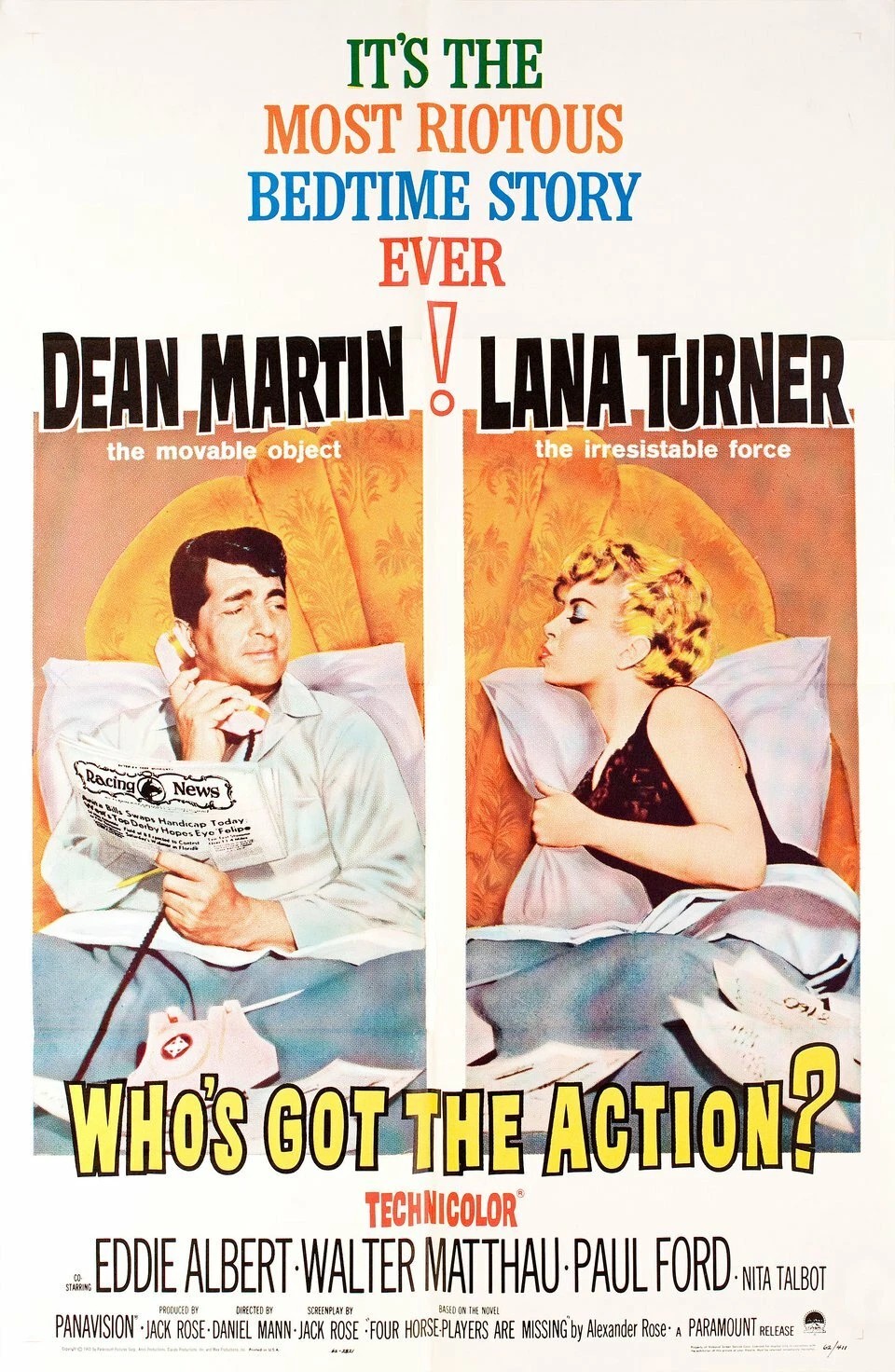
Before we get into all that it’s worth pointing out how language changes. These days mention of “action” will carry connotations of a sexual nature, so, just to be clear, here we’re talking about gambling, betting on horses, the mythical sure thing. And if you want to take a more cosmic perspective, we can apply the scientific rule that every action has a re-action, in other words consequence.
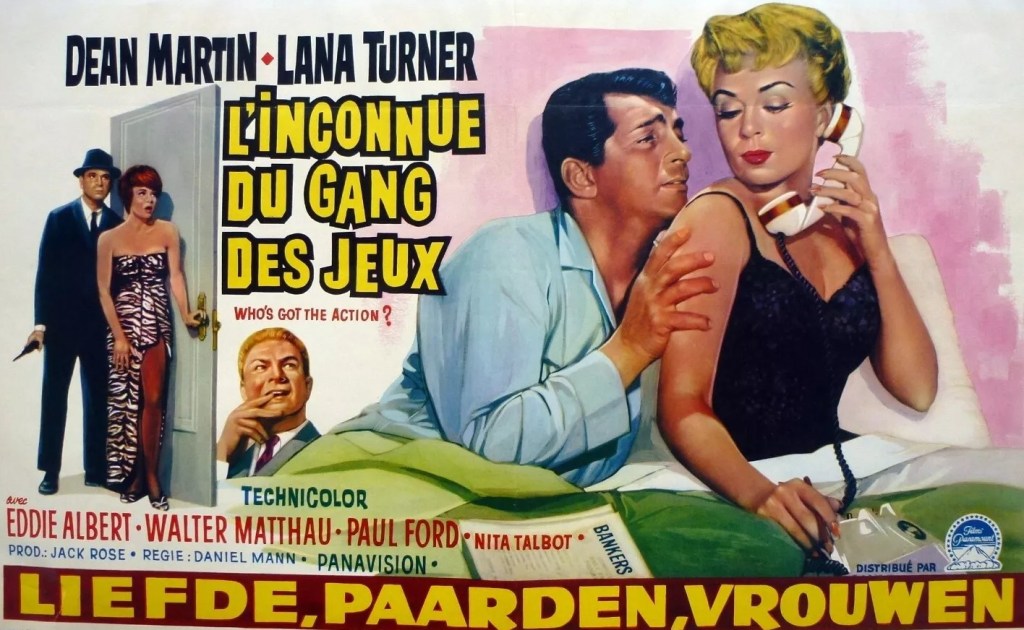
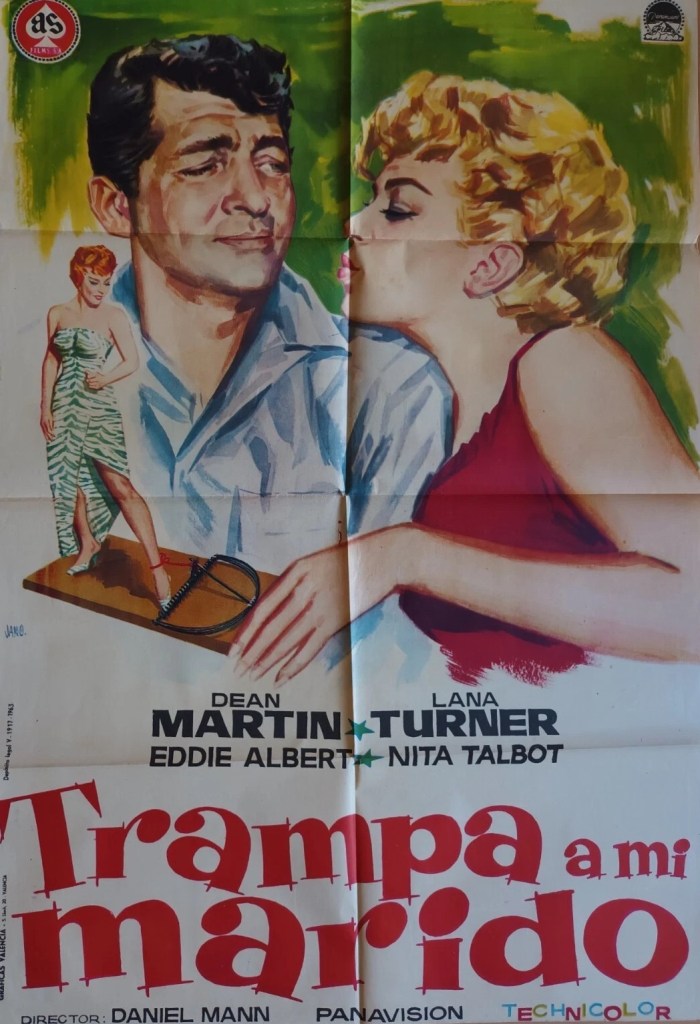
Attorney Steve Flood (Dean Martin) has a gambling addiction. He’s $8,000 in the hole to illegal bookie Clutch (Lewis Charles). Steve’s wife Melanie (Lana Turner) comes up with a clever idea to wean him off his addiction, by creating a fictional bookie, so that her husband’s losses will come to nothing. So she calls in Steve’s partner Clint Morgan (Eddie Albert) triggering Complication No 1. Clint’s always had the hots for Melanie and hopes to take advantage of Steve’s problems, helping her out by agreeing to act as the mythical bookie.
And that would be fine except for Complications No 2 and No 3. Instead of losing, as has been the trend, Steve wins big on his first bet, so now Melanie has to find a large chunk of dough. In dumping Clutch, Steve has come to the attention of mobster Tony Gagouts (Walter Matthau) who’s wondering about the mysterious new bookie queering his pitch and denying him a good customer (such is the definition of a loser).
Steve’s gambling success creates Complication No 4, attracting the interest of a pair of judges who are happy to stake the gambler, whose winning streak shows no sign of stopping.
Complication No 5 – Melanie turns to nightclub singer Saturday Knight (Nita Talbot), her next door neighbor and girlfriend of Tony, for help in raising cash and she obliges by buying some of the couple’s furnishing while Melanie also pawns jewelry.
Complication No 6 is created by Tony, who, trying to trace the rival bookie, installs a wiretap that leads him to the Flood apartment. And that should be the end of the tale, and little chance of a happy ending, except for Complication No 7. Tony has incriminated himself via the wiretaps and with an attorney ready to exploit the situation, it all works out fine, original debt to the gangster wiped out and the mobster blackmailed into marrying Saturday.
Now, with so many complications and sub-plots, this isn’t a Dean Martin picture the way the Matt Helm series is, especially not with a co-star like Lana Turner (By Love Possessed, 1961) who, not weighed down by the kind of heavy romantic tangle that seemed her remit at this point of her career, has the chance to steal a good deal of the limelight.
But the strong supporting case also do their best to chisel scenes away from the big stars. Eddie Albert’s (Captain Newman M.D., 1963) idea of a seductive lunch is a cracker and Nita Talbot (Hogan’s Heroes series, 1965), fashion ideas like Audrey Hepburn on speed, can’t help but play up to the camera. Walter Matthau is trying out a characterization for Charade (1963).
The beauty of this is that the narrative follows a neat logic. You can’t just muscle in on the illegal gambling business.
Director Daniel Mann ( A Dream of Kings, 1969) whips up an entertaining Runyonesque comedy from a screenplay by Jack Rose (It Started in Naples, 1960) based on a novel by namesake Alexander Rose who you might have spotted wearing his acting hat in The Hustler (1961).
They seemed to be a lot better at these effortless concoctions back in the day.
Funny how you remember the circumstances of seeing a film for the first time. This was important for me because it was the start of me digging into the vast heritage of the movies rather than watching just what was showing at my local cinema. I can’t pin down the exact date, but I have a feeling I was still at school, though in the advanced stage of that academia. I saw this on a 16mm print in a terraced house sitting on the hard kind of seats you used to get in assembly halls.
The location was the Scottish Film Council, the predecessor of the Glasgow Film Theatre, which was located in the city’s West End. The occasion was the final film in an eight-movie retrospective of Elia Kazan pictures. Either before or after I attended a similar Fellini retrospective. Certain more controversial films were omitted, so no Gentleman’s Agreement (1947), Pinky (1948) or Baby Doll (1956) and although this was the early 1970s no room for Splendor in the Grass (1961), America, America (1963) or The Arrangement (1969). Afterwards, there was a cup of tea and a biscuit and a discussion hosted by John Brown, who in my memory smoked small cigars, later a television and screen writer.
It was an introduction for me to the power of the retrospective, to view a huge number of a director’s films back-to-back (the screenings were weekly) and to understand the thematic symmetry of their work. Kazan predated the New Hollywood of the late 1960s and 1970s, so, although his movies usually challenged existing norms, these days they are often viewed as more stolid than of the first rank, his cause not helped by revelations that he named names at the anti-Communist hearings of the 1950s.
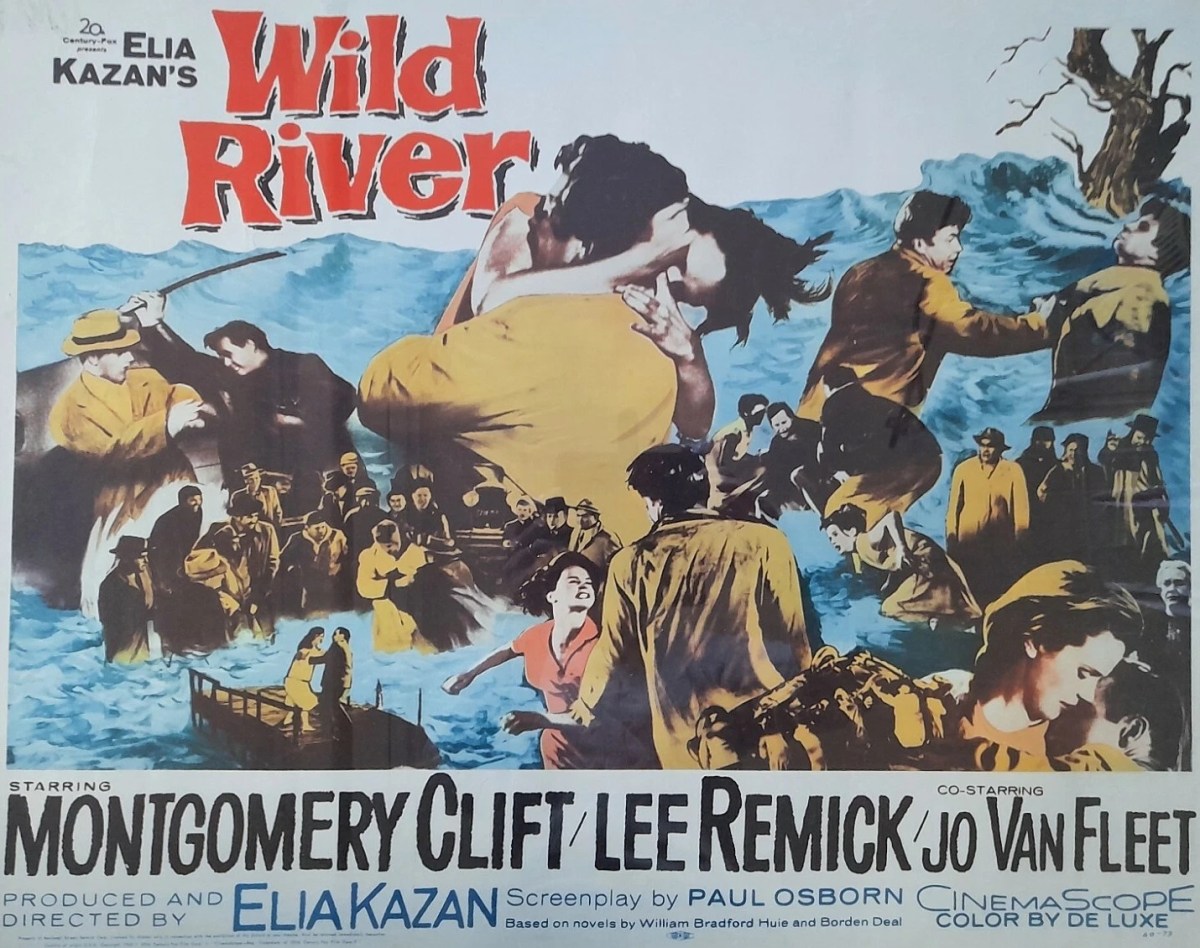
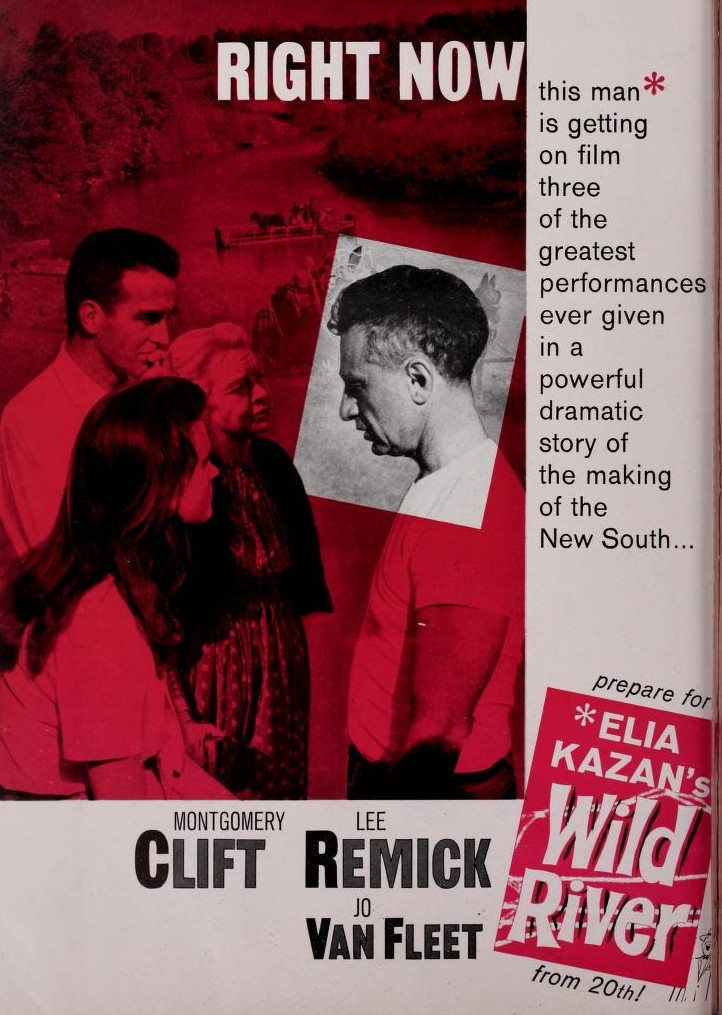
Wild River is one of those films that plays completely differently now thanks to the intervening decades. A contemporary audience is unlikely to sympathize with hero Chuck Glover (Montgomery Clift) whose job is to persuade farmers in the early 1930s to clear out of the way of land that is going to be swamped with water to supply a new dam that would serve to both control the catastrophic flooding in the Tennessee Valley and bring electricity to an impoverished area.
These days ageing landowner Ella Garth (Jo Van Fleet) would attract massive publicity in her fight to avoid being shifted from land that had been in her family for generations, especially as she claims that dams go “against nature.”. And no matter how sympathetic a character like Chuck might be to her circumstances he would be viewed as a more well-meaning-than-most government apparatchik.
And in some respects, this plays much better as one of the few movies exploring the plight of the African American at the hands of the racist authorities. Chuck incites local hostility when he recruits Blacks to work alongside Whites, in the end conceding that they should work in separate crews. But he comes unstuck when he sticks to the principle that they should be paid the same, more than double the going daily rate for Blacks.
In consequence he is beaten up and, worse, a gang of thugs attack the house inhabited by his lover Carol (Lee Remick) and her two young children and the cops, when they arrive, are apt to condone the violence.
Ella takes a maternal attitude to her Black workforce and while certainly nobody received abusive treatment at her hands she has a patronizing manner, though in the end she encourages them to leave.
Despite his democratic and anti-racist views, Chuck comes over as a clever dick, thinking his smooth eastern charm can convince the reluctant woman to move and for the racists to abandon their inherent racism.
I’m not sure about the widowed Carol either, she almost seems to be throwing herself at the first decent man who comes her way. While she is already being courted by a local fellow, who is more decent than the rest, that is clearly going to be a marriage of convenience, but what exactly makes Chuck so much more an attractive proposition is never made entirely clear except that, for narrative purposes, it creates a romantic deadline – is she just a fling, thrown over when he heads home – and a whiff of tension.
However, marriage to the other man would have made her just a passive housewife, whereas she realizes that in many ways she is smarter than Chuck, more grounded, and she would have more freedom in this kind of match.
Oddly enough, there’s a Hitchcock vibe here. At several points the camera tracks Glover in longshot as he appears to be heading for trouble.
The racist elements give this its bite rather than any ecological issues. The acting is certainly of high quality, Montgomery Clift (The Misfits, 1961), less mannered than in some of his work, in one of his last great roles. It’s an interesting part. At one point he wishes he could once in a while win a physical fight, and it’s Carol who is more likely to show the venom required in battle.
Lee Remick (No Way To Treat A Lady, 1968) continued to build on her exceptional promise. Jo Van Fleet (Cool Hand Luke, 1967) gets her teeth into the kind of role most actors dream of. You can spot Bruce Dern (Once Upon a Time in Hollywood, 2019) in his first role.
An unusual approach to the screenplay, too, by Paul Osborn (The World of Suzie Wong, 1960). Like The Towering Inferno (1974) a decade later, this derived from two novels – Dunbar’s Cove by Borden Deal and Mud on the Stars by William Bradford Huie (TheAmericanization of Emily, 1964).
Despite my ecological reservations, still stands up..
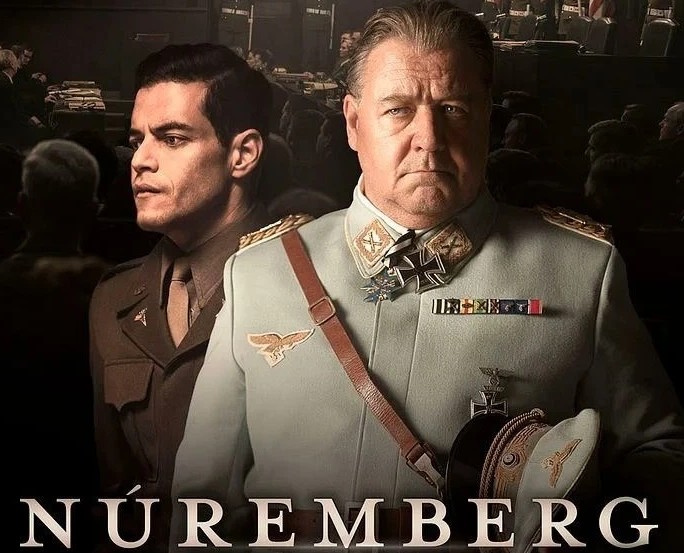
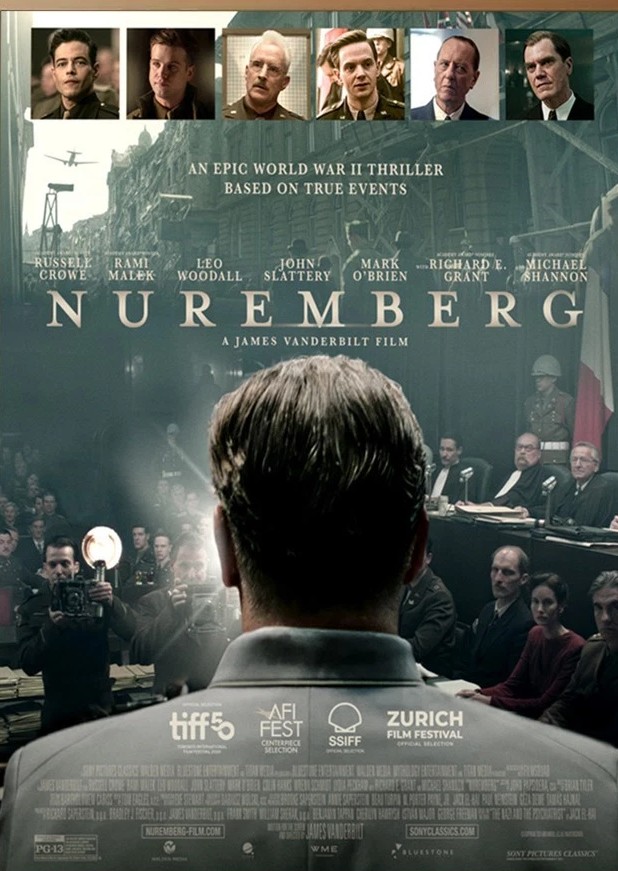
Richly satisfying drama of the kind they don’t make any more. For a start writer-director James Vanderbilt isn’t spoiling everything by preening with the camera, trying to draw attention to himself at the expense of what is a very solid narrative. Where you might expect all the hypocrisy to be laid at the door of the Nazi High Command, in fact it’s evenly spread, two prime examples among the legal team hoping to bring Hitler’s second-in-command Goering (Russell Crowe) to his knees. And although lazy journalists, and even lazier marketeers, are hyping Crowe (The Exorcism, 2024), if they took a closer look they would find four other performances worth more than a passing mention.
Of course, everyone knows how this ends. Or do they? Theoretically, it’s about making an example of Goering and the other top Germans who greenlit the Holocaust. But, in fact, the reality is that it has never ended, and that other rulers, in the same almighty positions of power as the Nazis, have continued to commit genocide long after Hitler’s regime was disbanded.
Like Judgement at Nuremberg (1961) this in part sets out to discover what was it about the German character that permitted them to carry out their atrocities. Psychiatrist Dr Kelley (Rami Malek) commits professional suicide by determining that there was nothing, particularly unique about the Germans and that given the right circumstances it could as easily happen in the United States or any other civilized country.
Although it’s promoted as a duel between Goering and Kelley, there’s more at stake. The whole concept of war crimes for a start, the idea that a group of countries can legally arbitrate in the affairs of another country, here the USA, Britain, France and Russia must come to together to argue the case against Germany. Nobody wants to get their hands dirty should the whole idea fall flat on its face, so Justice Jackson (Michael Shannon), leading the American legal attack, could as easily be fall guy as hero.
Goering is more humanized than Kelley. Following an unusual meet-cute, there’s an opportunity – but the director doesn’t fall for it – to set up Kelley in a romantic relationship with journalist Lila McQuaide (Lydia Peckham) but instead the card tricks that appeared to melt her heart become a different magical metaphor. Goering is a doting husband and father and Kelley becomes surreptitiously involved with his loving wife and piano-playing daughter. And despite appearing smart in his profession, Kelley is out of his depth with women, given a sharp lesson by Lila.
Kelley has taken on this job in the hope of writing a bestseller about his experience. Jackson expects to be nominated to the Supreme Court. Goering just wants to stay alive. Kelley takes the measure of Goering far better than the intellectually arrogant Jackson. In fact, Kelley is fearful that if Jackson doesn’t tread carefully, then Goering will wipe the floor with him.
The prosecutors have a few clever tricks up their sleeve. Kelley, under the guise of befriending Goering, uncovers his legal plan, which stops the German in his tracks.
But only for a moment. Goering is such a smooth operator that he skewers Jackson and it takes the last-minute intervention from languid Brit Sir David Maxwell-Fyfe (Richard E. Grant) to save the day.
There’s a fifth peripheral character here in Sgt Howie Triest (Lee Woodall), a German-speaking American, who has two of the best scenes. In a reversal of the usual trope where it’s the hero in an idle moment who divulges his past, here it’s the supporting actor. And where Kelley has only pretended compassion with Goering its Triest who provides another condemned German with the dignity to walk to the gallows.
Usually when you have a writer-director, the writer aspect is subservient to the director, but here James Vanderbilt (Truth, 2015) is fully in command of the narrative without resorting to tricksiness. The screenplay is littered with cutaways that maintain the tension as the story leaps ahead from one narrative point to the other. There’s a classical structure here, Vanderbilt laying the ground rules, what’s a stake for everyone, heightening the tension as it plays out, and throwing a few spanners in the expected works to keep it brimful of twists right to the end.
Virtually everyone gets the chance to be haughty, virtually everyone thinks they have a winning hand and how hopes are dashed makes for a terrific tale.
For sure, Crowe is ahead in the lazy journalist’s eyes in terms of plaudits, but Rami Malek (The Amateur, 2024) runs him close and in the supporting actor stakes it’s a toss-up between Michael Shannon (Death by Lightning TV mini-series, 2025), who switches from confidence to despair in the twinkle of an eye, and Lee Woodall (One Day TV mini-series, 2024) who waits and waits and waits before snipping in and stealing chunks of the picture.
Adapted by Vanderbilt from a book by Jack El-Hai.
For once, zippy dialog and nippy narrative merge. Supremely confident direction turns this into an engrossing, adult, movie.
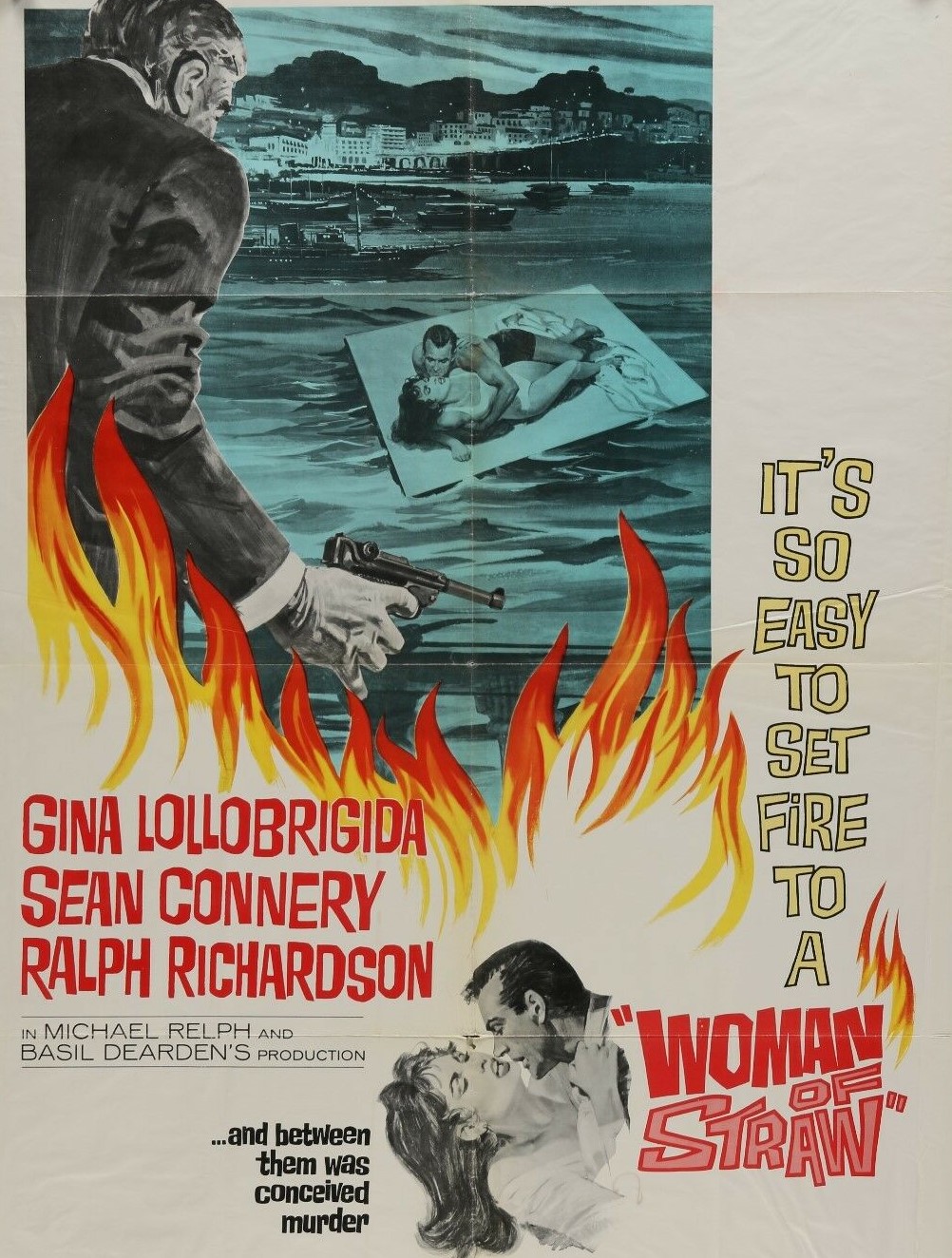
In a plot worthy of Hitchcock without that director’s sly malice, rich playboy Tony (Sean Connery) conspires with not-so-innocent nurse Maria (Gina Lollobrigida) to rid himself of heinous upper-class racist misogynistic bully Charles (Ralph Richardson), his uncle. Beyond a savage case of entitlement, Tony has good reason to hate the wheelchair-bound multi-millionaire, blaming him for his father’s suicide and for seducing his widowed mother, now dead. Tony’s ploy, in part by opposing the very idea, is to get Maria to marry Charles, inherit his fortune and provide himself a £1 million finder’s fee when the seriously ill old man dies.
Maria’s refusal to kowtow to the old man and her initial resistance to Tony make her all the more desirable to both. When Maria saves the old man from a potential heart attack, he is moved enough to marry her and draw up exactly the will the pair want. But when he suddenly dies, Maria surprises herself by the depth of emotion she feels.
But that soon changes when she comes under suspicion. A bundle of complications swiftly change the expected outcome. A police inspector (Alexander Knox) doubts cause and place of death.
The first half is the set-up, the various figures being moved into place, not quite as easily as might have been anticipated, which adds another element of tension. Charles is such a hideous person nobody could lament his passing, but still his vulnerability, not just his wheelchair confinement but his love of music, his better qualities coming to the fore as the result of Maria’s presence, accord him greater sympathy than you would imagine.
That the otherwise gallant Tony’s entitled life depends entirely on his uncle’s good wishes lends him an appealing frailty. The nurse’s principles safeguard her against being taken in by riches alone, but there is a sense that she has used her physical attraction in the past to her advantage.
After the first two James Bond pictures, this was Sean Connery’s first attempt to move away from the secret agent stereotype and in large part he is successful. As amoral as Bond, he could as easily be a Bond villain, smooth and charming and larger than life and superbly gifted in the art of manipulation, the kind of putting all the pieces in place that Bond villains excelled in.
It will come as a surprise to contemporary viewers that he is merely the leading man, not the star. Gina Lollobrigida (Go Naked in the World, 1961) receives top-billing because she carries the emotional weight, initially perhaps as cold as Tony, but her attitude to Charles changing after marriage, meeting a need that Tony would not consider his to fulfill, and beginning to regret going along with any devious plan. That she then discovers she may merely be a pawn rather than a partner creates the dilemma on which the final section of the film depends for tension.
Both actors are excellent, exuding star wattage, the screen charisma between them evident, and audiences craving the pairing of Connery with an European female superstar will be well satisfied. Lollobrigida has the better role, requiring greater depth, but it is romance as duel most of the way. Ralph Richardson (Khartoum,1966) has never been better as one of the worst human beings ever to grace a screen. Johnny Sekka (The Southern Star, 1969) brings dignity to the maligned servant and Alexander Knox (Khartoum) is a crusty cop.
A slick offering from Basil Dearden (The Mind Benders, 1963), with one proviso – see seaparate article for the racism in this film. Written by Robert Muller (The Beauty Jungle, 1964) and Stanley Mann (The Collector, 1965) based on the novel by Catherine Arley.
Could have done with expending less time on the set-up and getting to the meat of the thriller quicker.
Occasionally I get to wondering when one of these British crime B-pictures is exceptionally well-plotted, refreshing and above all logical, whether it might have benefitted from grander treatment Hollywood-style. You could easily see Cary Grant or Gregory Peck wriggling around in this one and with a Grant or Peck involved they’d be accompanied by a glamor puss of the Sophia Loren, Deborah Kerr vintage. And that would put the whole movie in an entirely different light and ensure it wasn’t lost for decades, as was the fate of this one.
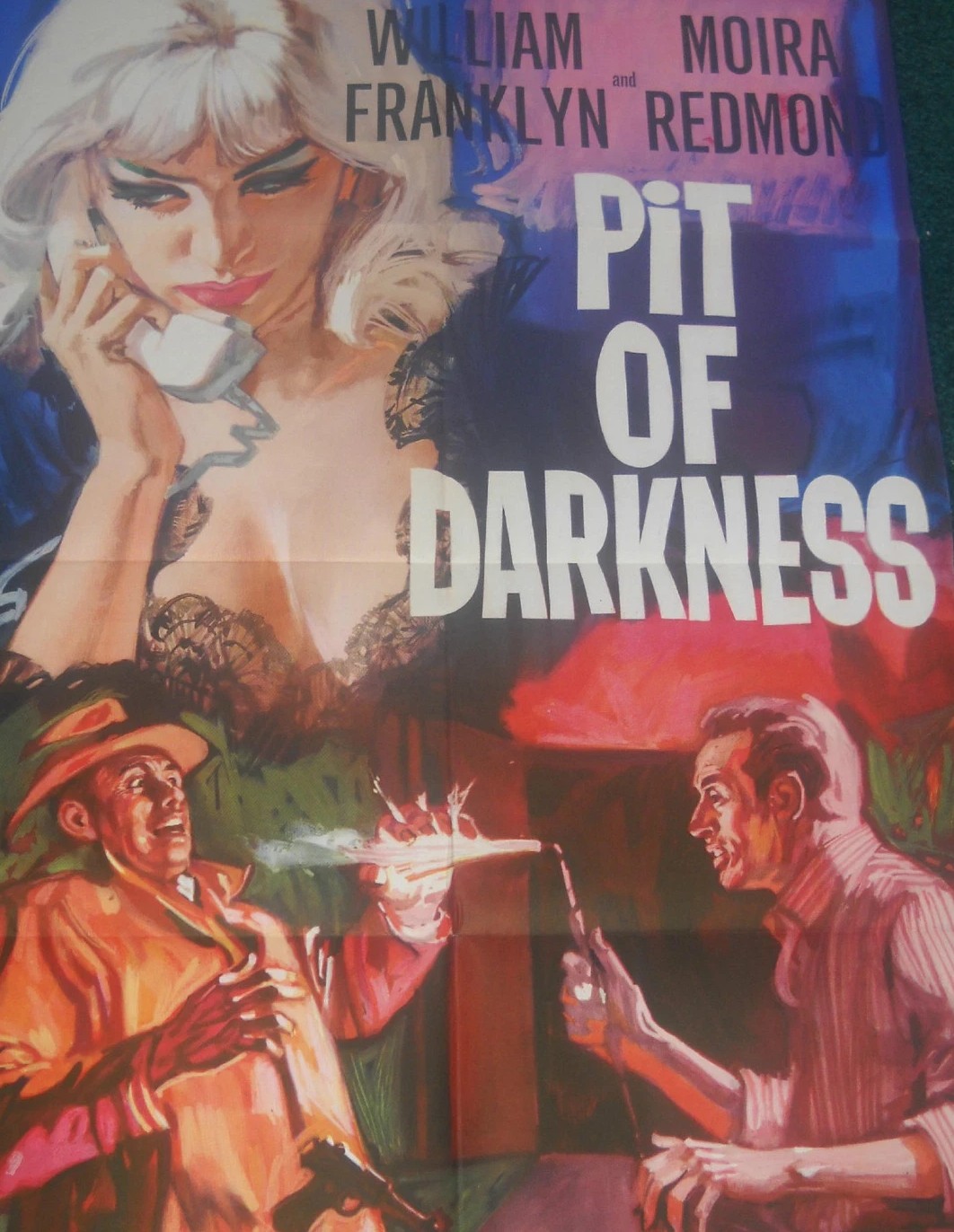
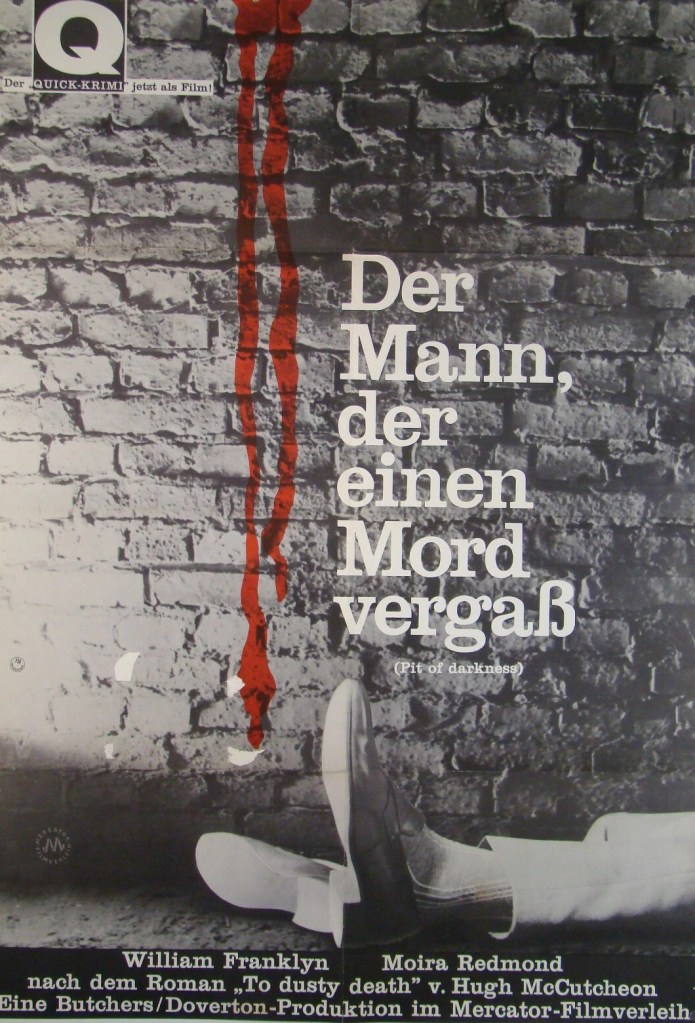
What struck me most about the opening section here, an attitude maintained for about half the picture, was that the actress wife Julie (Moira Redmond) of amnesiac Richard (William Franklyn) didn’t believe for a minute his story that he couldn’t remember where he’d been for the last three weeks. There wasn’t an ounce of sympathy. That struck me as an entirely believable reaction. Rather than going all soppy at his return, she reckoned he’d run off with another woman and only came back because the affair had gone sour.
And it doesn’t help his case that he was found unconscious on a piece of London waste ground where four days before the private detective she had hired to find him was discovered murdered. Then there are the suspicious phone calls, leaving him to deny the existence of anyone called Mavis.
But just when we start to believe him, suddenly we don’t. He seems to be too familiar with the Mavis who calls him and agrees to meet her at a remote cottage. And then we’re back on his side, as he just avoids being blown up in the cottage. But he leaves his hat behind.
And he doesn’t own up to Mavis about being nearly killed and gives a spurious reason for buying a new hat and not keeping the old one. So we’re on her side, something is going on for sure. And then back on his, when someone tries to sideline him in a hit-and-run accident.
In turn, he’s suspicious of everyone, including his wife, and his colleagues at work, especially Ted (Anthony Booth) who seems an unlikely candidate to have won the heart of his delectable secretary Mary (Nanette Newman).
He works for a firm that makes safes and whatever’s going on appears to be linked to a burglary that occurred in his absence involving one of the safes the company made. Eventually, Julie comes round to his way of thinking. Clues lead him to a nightclub, whose mysterious owner Conrad (Leonard Sachs) somehow seems familiar. He encounters Mavis, a dance hostess, and she agrees to help him but when he goes round to her apartment finds a corpse. There’s something distinctly odd going on in the building across the street from his office. On further investigation, he uncovers an assassin. Luckily, our man is armed with the office pistol and the villain is chucked from the roof.
But, still, nothing makes much sense, even though bit by bit memory is returning. He realizes he shouldn’t have been found unconscious on the waste ground, but dead, murder only interrupted by the sudden arrival of a gang of boys.
But in retracing his steps in order to unlock the lost memories he finds himself undergoing a perilous process a second time. He works out that he was kidnapped and locked in a cellar in the club. When he confronts Conrad, that instigates a repeat.
Conrad locked him away and when bribery and the seductive wiles of Mavis didn’t work, Conrad convinced Richard that his wife was in danger if he didn’t go along with the burglary. And Conrad isn’t one to let a good opportunity go to waste, so second time around, using the same threat that worked the last time, he forces Richard to commit another burglary. But this time there’s a catch and one that Richard’s secretary hasn’t known about to pass on to Ted.
So the bad guys are caught, and in the way of the obligatory happy ending the audience is left to assume that the police will ignore his part in the robbery and the death of the man on the roof.
Not just exceptionally well-plotted, but the addition of the marital strife, the suspicious wife, adds not just to the tension but makes it all the more believable and turns the amnesia trope on its head.
Having wished for a Cary Grant or a Gregory Peck, I have to confess I was more than satisfied with William Franklyn (The Big Day, 1960) who managed to look innocent and guilty at the same time. Certainly Deborah Kerr would have managed more in the acerbic look department than Moira Redmond (The Limbo Line, 1968) but I have no complaints.
Interesting support cast at the start of their careers, so Anthony Booth (Corruption, 1968) displays just a hint of his later trademark sarcastic snarl and there’s no chance for Nigel Green (The Ipcress File, 1965) to put his steely stare into action or effect his drawl. Nanette Newman (Deadfall, 1968) has little to do except look fetching. Leonard Sachs was taking time off from presenting TV variety show The Good Old Days (1953-1983).
More kudos for the script than the direction this time for Lance Comfort (Blind Corner, 1964).
Given it’s from the Renown stable. I would normally have expected to come upon this picture on Talking Pictures TV, so I was surprised to find it as one of the latest additions to Amazon Prime.
Mirisch could easily lay claim to be the top independent production outfit of the 1960s generating hits like The Magnificent Seven (1960), West Side Story (1961), The Great Escape (1963), The Pink Panther (1964) and its sequel A Shot in the Dark (1964), The Russians Are Coming, Russians Are Coming (1966), In the Heat of the Night (1967) and The Thomas Crown Affair (1968) plus a shelf load of Oscars and Oscar nominations. But dependence on a partnership with Billy Wilder in the 1970s and a more lackluster performance at the box office – with the noted exception of Fiddler on the Roof (1971) – spelled the end of its 17-year relationship with United Artists, which was reeling from financial losses and under new management.
The company found a new partner in Universal which had a series of deals with other major producers like Alfred Hitchcock, Zanuck and Brown (Jaws, 1975) and George Seaton (Airport, 1970). Mirisch was not in any financial trouble, having severed ties with UA after Mr Majestyk (1974), a major success abroad, and recovered its development costs for Wheels, based on the Arthur Hailey novel but the script rejected by UA, from Universal which turned it into a mini-series.
The Universal deal was initially not as good as that enjoyed at UA. Universal charged a twenty-five per cent overhead whereas UA had charged nothing and Universal was now doing direct deals with directors rather than relying on the likes of Mirisch to tie up the talent.
Many years before, Mirisch had commissioned a script on the Battle of Midway from Donald S. Sanford who specialized in war pictures but of the distinctly low-budget variety – Submarine X-1 (1968), The Thousand Plane Raid (1969) and Mosquito Squadron (1969), none of which had enjoyed any success.
Though all of the Mirisch war pictures had concentrated on Europe, Walter Mirisch, generally the creative driving force for the production company, in his previous incarnation with Allied Artists had some experience of the Pacific War, having produced Flat Top / Eagles of the Fleet (1952), set around an aircraft carrier during the Battle of Leyte Gulf, and was an avid reader of books about the Second World War.
John Ford and Louis de Rochmont had made documentaries about the Pacific naval battles. UA rejected the script twice, a shrewd move in the end because Tora! Tora! Tora! (1970) lost a packet for Twentieth Century Fox. The Sanford screenplay had initially taken more of a documentary approach but after gaining the interest of Charlton Heston, who had starred in Mirisch’s The Hawaiians (1970), the script was tweaked.
Programming a war picture was a risk for the studio. There hadn’t been a big-budget war picture in five years. And while Patton (1970) and Kelly’s Heroes (1970) ended up on the right sight of the ledger book, Tora!, Tora! Tora! and Too Late the Hero (1970) were stiffs.
Mirisch signed a two-picture deal with Universal, for Midway and Wild Card with a screenplay by Elmore Leonard (Mr Majestyk). Mirisch proposed to reduce costs by using footage from naval archives, converting the original 16mm film to 35mm. The producer also took footage from Japanese film Storm over the Pacific / I Bombed Pearl Harbor (1960) – the rights cost him $96,000. Footage of the Pearl Harbor attack in Tora! Tora! Tora! doubled for shots of the attack on Midway Island. A clip of the Dolittle raid on Tokyo from Thirty Secondsover Tokyo (1944) was used in the credit sequence after “subjecting it to a sepia bath.”
After the success of Earthquake (1975), Heston was back in the top ranks of box office stars and his involvement guaranteed the green light. The U.S. Navy offered its support, not surprising since Midway was considered its greatest success.
John Guillermin (The Towering Inferno, 1974) was hired to direct and Stirling Silliphant (In the Heat of the Night) signed up for a screenplay rewrite. Mirisch had determined to employ the all-star-cast device that had been an essential ingredient of many of the 1960s roadshow pictures, kicking off with Henry Fonda (The Boston Strangler, 1968), by now pretty much a spent force at the box office – he hadn’t made a picture in three years – but still a well-known name.
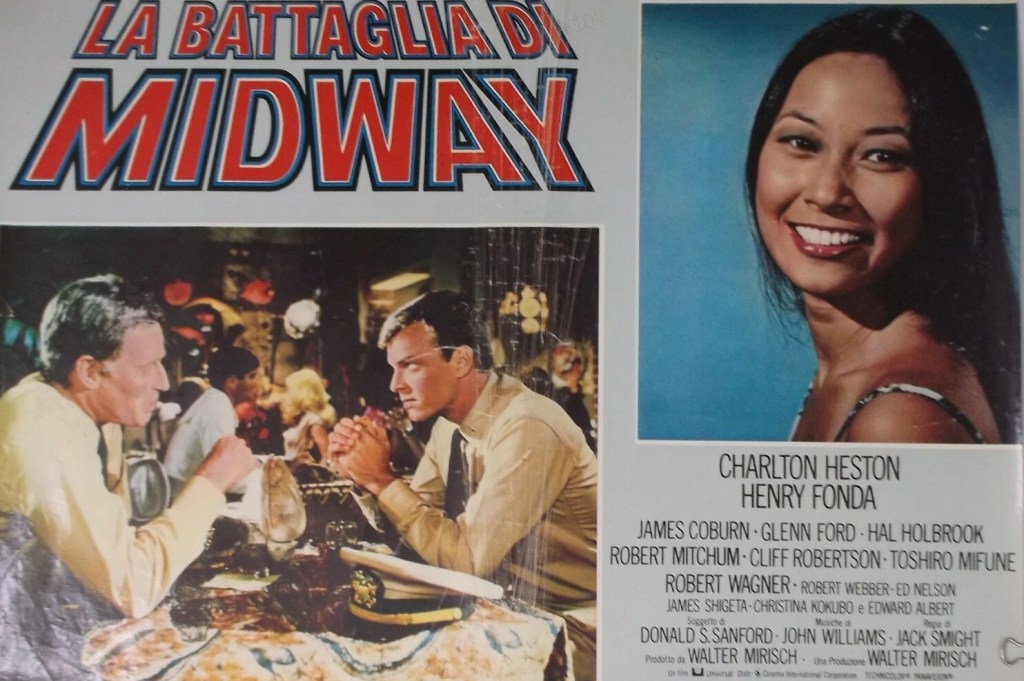
The amount of work involved for the other stars was minimal – mostly just one day – and, astutely, Mirisch called on stars who had worked for him in the past and who, like James Coburn (The Great Escape), Cliff Robertson (633 Squadron, 1964) and Christopher George (The Thousand Plane Raid) owed him something in terms of a career leg-up. Others included Robert Mitchum (The Sundowners, 1960), Robert Wagner (The Biggest Bundle of Them All, 1968) and Tom Selleck in an early role. Mitchum was the first of these stars to sign up, in March 1975, six weeks before the scheduled start date of April 27, followed two days later by Coburn.
Toshiro Mifune (Red Sun, 1971) headed up the Japanese cast and proved so meticulous in his preparations that he had his uniform made by Japanese tailors. The white gloves he wore had a finger shortened on the left hand because his character Admiral Yamamoto was missing a pinky. However, despite coaching in English by actress Miko Taka (Walk, Don’t Run, 1966), his dialog was revoiced by Paul Frees.
Guillermin demanded a bigger budget to accommodate more airplanes and equipment and a longer shooting period. Two months before filming was due to start, Mirisch put his foot down and told the director he couldn’t accommodate his requests as Universal had only provided funding on the basis of Mirisch’s original idea. Guillermin walked. As far as the public was concerned, the parting of the ways was due to a “conflict of schedules.” Jack Smight, who had directed Airport ’75 (1974), a box office success and also starring Heston, was his replacement.
The Navy lent aircraft carrier U.S.S. Lexington – the last remaining World War Two carrier – while it was at sea training pilots as long as the shoot didn’t interfere with those exercises. A limited number of World War Two vintage planes – in great condition having been cared for by their owners – were permitted on board. The Navy charged the crew for accommodation – Mirisch was housed in Admiral Strean’s quarters – and meals. “We had a detailed contract with the Navy,” recalled Mirisch, “in which we agreed to stay out of their way when asked.”
On board, the crew filmed scenes, some silent and others with dialog, and “made plates for rearview projection and aerial shots of our vintage planes so positioned that we could print them into flights of six or nine.” Charlton Heston, Glenn Ford (Rage, 1966) and Hal Holbrook (The Group, 1966) were aboard and the shoot went well. A scene involving Henry Fonda was shot at Pensacola. The Florida coast stood in for the Pacific. Additional exteriors were filmed in Los Angeles at Long Beach and Point Dune with interiors at Universal.
The construction of the interiors for the Japanese aircraft carriers was so authentic Mirisch was later asked to reassemble the set for the Smithsonian Institute for a presentation there. The interpolation of the old footage was crucial and it was planned in advance where such shots would appear. The old footage was precut and scenes were shot with actors with “scene missing” in those sequences into which the old footage could be dropped. Other devices were used to ensure the background in the old footage was more lively.
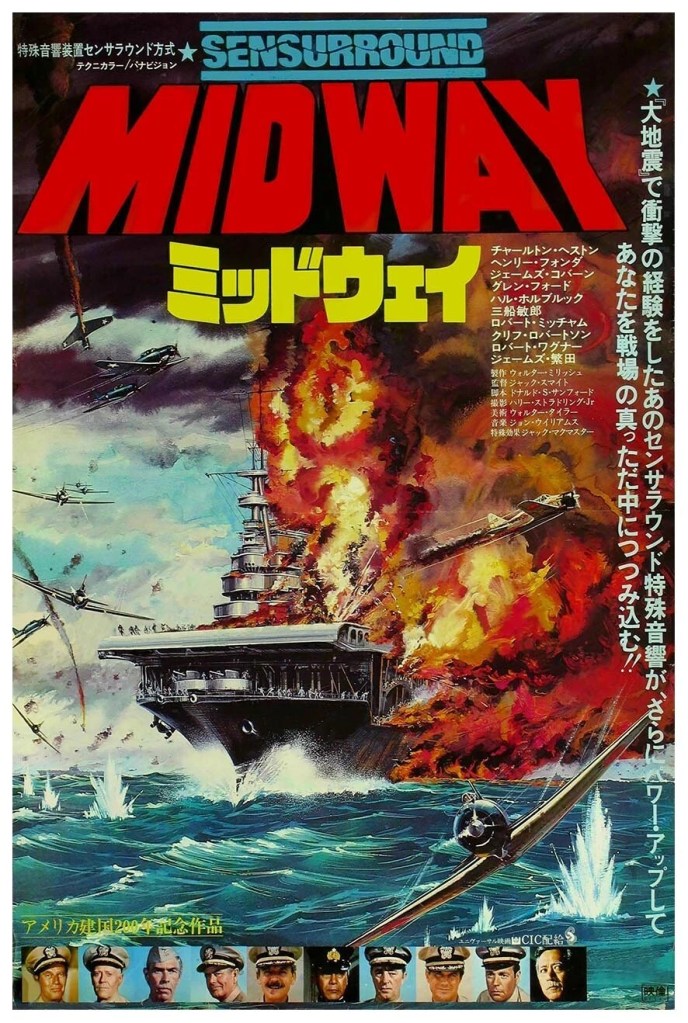
The final element was in cinematic presentation. Sensurround, a precursor of Imax, had been introduced with great success by Universal to Earthquake and this added greater realism to the battle scenes. While limited to those theaters which had installed the expensive equipment, and although the roadshow was long gone, it created an “event” aspect to those viewing it in that system. In his autobiography Mirisch suggested the addition of Sensurround was last minute and sparked by the success of Earthquake. But, in fact, Universal had announced a year in advance of opening that Battle of Midway would utilize Sensurround.
Some cinema owners were outraged at the stock footage, whose proposed inclusion had been kept from them when they went into the blind-bidding process at the start of the year. Mirisch countered that there was no alternative. “A great many aircraft,” he argued, “used in the battle no longer exist.” Universal’s terms were stiff – a minimum nine-week run starting at a 70/30 split for the first three weeks in the studio’s favor, a $75,000 advance guarantee from cinemas and 5% of the gross for use of Sensurround.
With the budget kept as low as a reported $4 million it was a massive hit, picking up $20.3 million in rentals (what the studio retains of the box office gross) – sixth in the annual box office league beaten only by Oscar-winner One Flew over the Cuckoo’s Nest, All the President’s Men with Robert Redford and Dustin Hoffman, demonic The Omen, Walter Matthau baseball comedy The Bad News Bears and Mel Brooks’ Silent Movie and just ahead of such offerings as Sidney Lumet’s Dog Day Afternoon with Al Pacino, and comedy Murder by Death but nearly doubling the take of the more critically-acclaimed Taxi Driver, Clint Eastwood western The Outlaw Josey Wales and thriller Marathon Man also starring Hoffman. The final domestic figure amounted to $21.8 million.
Foreign figures were astonishing, especially in Japan, where its gross exceeded $4 million. The benefits of the promotional tour undertaken by Heston in the Far East were soon obvious – in Manila it beat both Jaws and Earthquake. In the annual box office league there and Hong Kong, it ranked third. In Italy it proved a “big surprise”, coming in fourth behind King Kong, Taxi Driver and a local offering.
While a successful movie could expect to benefit from television viewings – this was before the video revolution – the movie had an unusual afterlife. NBC, which had bought the rights, wanted the film to be longer, so it could be shown over two nights, thus increasing advertising and setting it up as a more prestigious event. Largely by adding plotlines to the Heston character, the running time increased by nearly an hour, which proved a bonus for the future home screening revolution.
“Of all the films that I have made,” noted Mirisch, “it produced the greatest amount of profit.”
SOURCES: Walter Mirisch, I Thought We Were Making Movies Not History (University of Wisconsin Press, 2008) pp324-339; “Readying Midway,” Variety, February 5, 1975, p6; “Universal in New Shake,” Variety, July 23, 1975, p3; “Admiral Mitchum,” Variety, March 12, 1975, p18; ”Jap Feature Footage Inserted into Midway,” Variety, June 6, 1976, p7; “Midway Big in Manila,” Variety, August 11, 1976, p24; “Big Rental Films of 1976,” Variety, January 5, 1977, p14; “Jaws Led Bangkok,” Variety, February 9, 1977, p39; “International,” Variety, June 29, 1977, p35.
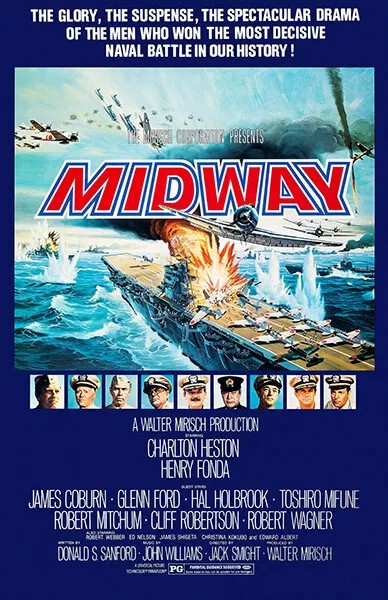
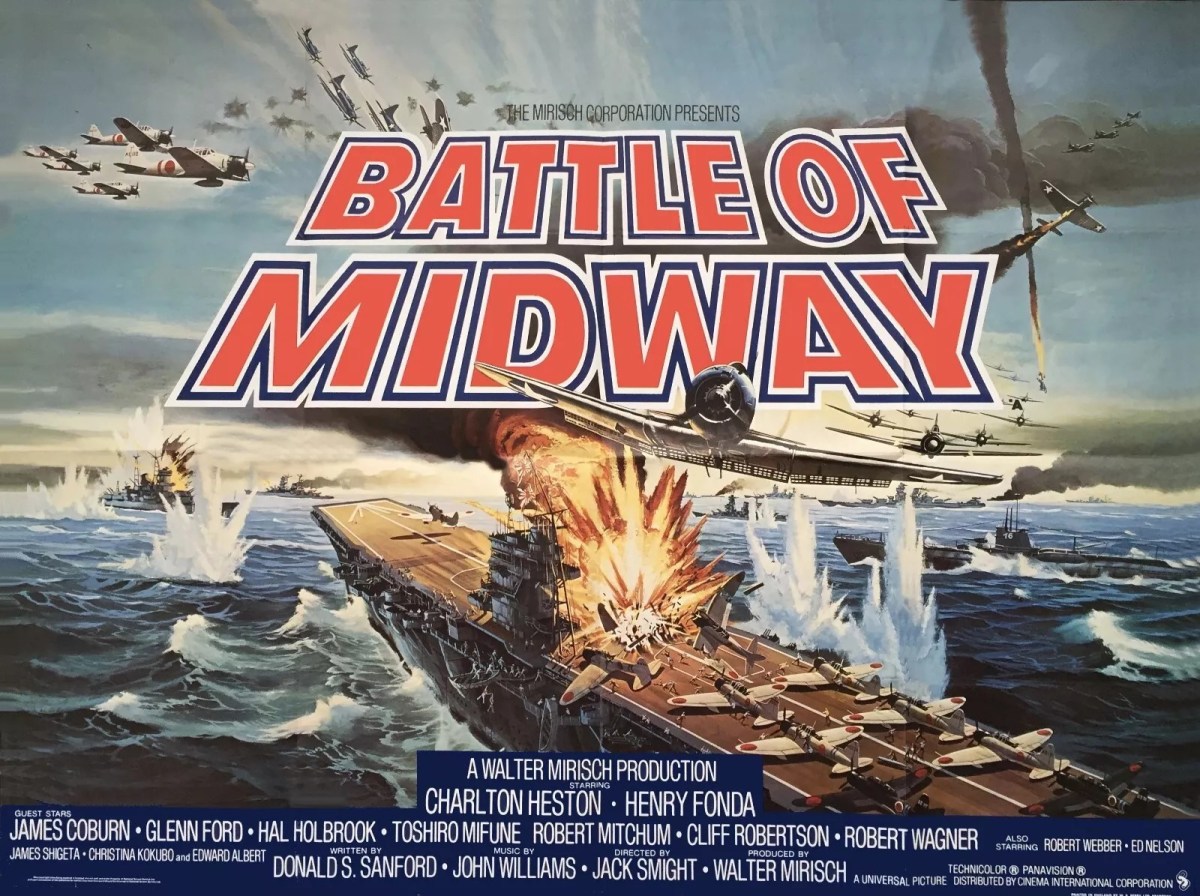
Even-handed documentary-style tale recounting of the most famous U.S. naval battle of all time, a turning point in the struggle for control of the Pacific in 1942. Both sides make mistakes, luck and judgement play an equal part.
I’d always assumed Midway was some abstract geographical position without any idea of its strategic importance – did the name mean it was halfway between the U.S. (or Hawaii) and Japan? But here I learned it was an actual island that the Japs planned to invade and the Americans intended to stop them. In some senses, it was bait, a way to draw the U.S. Navy out of Pearl Harbor. But the bait ran both ways. If the Yanks could coax the enemy out into the Pacific, they had a chance of gaining an advantage, even though the Americans were inferior in shipping tonnage.
The Japs have been stung into action by the audacious American bombing of Tokyo. Admiral Yamamoto (Toshiro Mifune) uses the perceived threat of further attacks to gain official approval for his plan to invade Midway.
This is strictly a male show. However, in a bid to lower the testosterone levels a romantic subplot is inserted. The aviator son, Lt Thomas Garth (Eddie Albert), of top aide and former pilot Captain Matthew Garth (Charlton Heston) has an American-born lover Haruko (Christina Kobuko) of Japanese descent who’s being investigated for espionage and subsequently interned. On intervening, the father digs up a hodgepodge of racism – from both sides, Haruko’s parents against her forming a relationship with a non-Japanese. But the plan backfires causing a breakdown between father and son.
But that’s very much on the fringes and although it raises interesting cultural aspects, the movie concentrates mostly on the nuts-and-bolts of heading into a major engagement.
American intelligence, headed by Commander Joe Rochefort (Hal Holbrook), gets wind of the planned attack. But the clues are scant – the old trope of increased radio traffic not enough to convince – and while the audience knows the Japs are on the move with a mighty naval force including four top-class airplane carriers, the Americans remain ignorant almost until it’s too late.
Luckily, Admiral Nimitz (Henry Fonda), heading up the American naval contingent, is keen to inflict a blow on the enemy, even though he’s limited to two carriers and another just out of the repair yard. Each side relies on spotter planes to detect the enemy. But the Japanese, by imposing radio silence, shoot themselves in the foot, unable to switch tactics until too late. The hunch plays an important part.
There’s rarely much opportunity for individual heroics on a ship under fire, beyond rescuing someone. The fighter pilots are a better bet, especially since some of their forays are nearly suicidal given the firepower they attract. Matt Garth, who for most of the picture is an upscale backroom boy, is called into action with unexpected results.
Most battle films tend to concentrate on the heroics often at the expense of understanding in any detail what’s going on. Thankfully, this is different. We are kept informed of every change in the conflict. And whereas you might think that dull, in fact I wouldargue that it adds substantially to the tension, and the fact that the only one of the commanders who looks as if he could throw a punch (Robert Mitchum) in the manner of John Wayne is confined to his bed thus forcing the movie to concentrate as much on brain as brawn.
Audiences at the time welcomed all the talking and this was a substantial hit. Snippets of old war footage were carefully sewn into the lining of the action, bringing the kind of authenticity that moviemakers reckoned moviegoers craved. For me, there was more than enough going on already.
Nimitz’s decision to go for broke rather than dive for cover results in victory but he’s no gung-ho commander, rather presented as a thoughtful but determined individual. The lack of backstage effort especially in the communications department was partly to blame for the humiliation of Pearl Harbor but here these guys share the glory.
Boasting the kind of all-star cast that used to be the hallmark of the 1960s roadshow, this has a bunch of top-notch actors, albeit most just flit in and out of the picture. Charlton Heston (Planet of the Apes, 1968) effortlessly shoulders the main burden with Henry Fonda (Once Upon a Time in the West, 1969) the fulcrum of all decision-making. Robert Mitchum (The Way West, 1967) , James Coburn (Our Man Flint, 1966), Glenn Ford (Rage, 1966), Cliff Robertson (The Devil’s Brigade, 1968) and Toshiro Mifune (Red Sun, 1971) all feature.
Jack Smight (Harper / The Moving Target, 1966) directs from a script by Donald S Sanford (Mosquito Squadron, 1969).
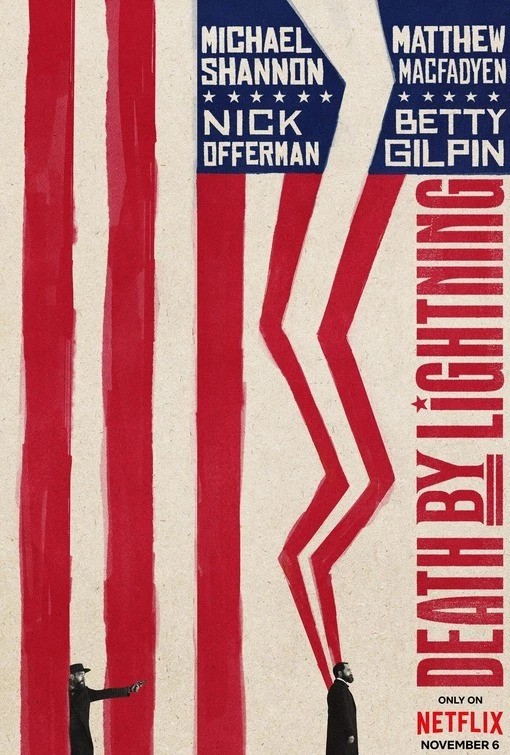
Streaming at its best. Take an obscure subject, a long-forgotten character, an incident that’s a mere blip in history, actors of less than middle rank in box office terms, and by breaking it down into easily consumable parts turn a history lesson that might be an indigestible three hours on the big screen into a riveting, enthralling drama of the highest quality that takes a no-holds-barred approach to politics
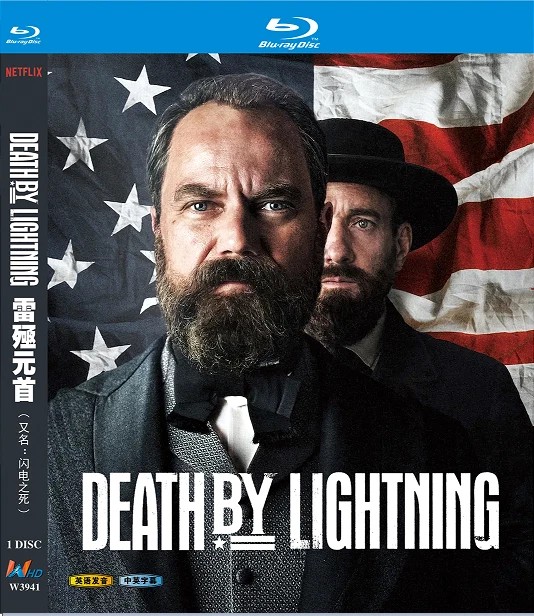
Small wonder you won’t have heard of U.S. President James Garfield (Michael Shannon) given he held office for around three months. Or of his misfit assassin Charles Guiteau (Matthew Macfadyen), less than a footnote in history for making the grave mistake of gunning down a President nobody had ever heard of.
Garfield shouldn’t even have been President. A mid-level politician on the verge of retirement, he wasn’t even in the running for the Republican nomination, which should have gone to Civil War hero Ulysses S. Grant. But in one of those quirks of politics, the voters liked what they heard of Garfield and in a grass roots rebellion shooed him in. He won the Presidential election by a whisker.
And then his troubles started. He was too honest for the job. Unwilling to follow the standard corruption and hand out highly-paid posts to rank-and-file unfitting for the job, he found himself up against the New York political powerhouse headed by Roscoe Conkling (Shea Whigham) who controlled the bulk of the revenue entering the country. And the battles with Conkling would have easily made a House of Cards-style series in itself as the dueling politicians attempt to outwit each other.
But in the background, and weaseling his way into the foreground, is con man, thief, forger, misfit Guiteau with as much entitlement as could sink a battleship who, nonetheless, grasps the key essential of politics of the era which is that helping to grease the greasy pole is all you need to reap the benefits. Except his efforts to become anyone’s righthand man fall way short, as his ambition and lack of any relevant skills are widely mocked – he expects to be handed an ambassadorial role although he speaks no foreign languages – despite occasionally finding an opening.
Having been dismissed by the President himself, he decides Garfield is totally the wrong person for the highest position in the land and takes it upon himself to rid the nation of this burden. Even the assassination is ham-fisted and Garfield would have survived except for the efforts of the ham-fisted surgeon who killed him through septic poisoning.
That’s the climax to a thoroughly involving mini-series where no punches are pulled as far as politics are concerned. Conkling doesn’t mind being the man behind the throne as long as he gets credit for pulling the strings. Political wheeling-and-dealing has never been so ruthlessly exposed.
But it’s not as if Garfield is an innocent in that department. While not stooping to corruption, he pulls the legs from under Conkling by appointing Conkling’s righthand man Chester Arthur (Nick Offerman) as his Vice-President, a scheme that while initially backfiring eventually pays dividends. And it’s ironic that Conkling’s demise is down to a thwarted mistress.
The narrative switches on like a thriller, twists and turns every inch of the way. But as much as the riveting narrative, the joy of this is in the performances. Matthew Macfadyen, double Emmy award-winner for Succession (2018-2023), is rightly going to be considered to have landed the plum role, a fellow so much of a misfit that in a “free love” community nobody wants to have sex with him. But it’s a close-run thing. Michael Shannon (A Different Man, 2024) is outstanding, and Shea Whigham (F1, 2025) has immense fun especially with his eyebrows and dominating curl, while Nick Offerman (Civil War, 2024) in shifting from oaf to man of honor has a peach of a role, not forgetting Betty Gilpin (The Hunt, 2020) as the straight-talking wife of the President.
None of these are stars, not even of the indie persuasion, and yet it’s amazing what they can do with their characters.
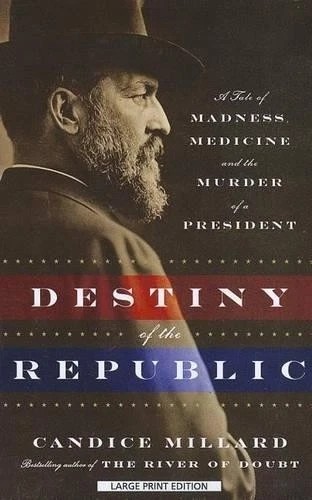
Directed with effortless style by Matt Ross (Captain Fantastic, 2016) from a script by Mike Makowsky (Bad Education, 2019) adapting the bestseller Destiny of the Republic by Candice Millard.