British espionage team embarking on a scheme to fool Adolf Hitler during the Second World War find they are susceptible to deceit and deception in their own lives. What could have been a plodding step-by-step documentary-style picture is given a huge fillip by examination of the lives of those involved. The twists and turns of this extraordinary tale, both in the professional and personal sense, make for a very enjoyable picture. It is no less thrilling for, like The Day of the Jackal (1973), being aware of the outcome.
Planning to invade Sicily in 1943, the Allies are determined to convince Hitler that they are instead more likely to attack Greece. The British come up with “Operation Mincemeat,” a variation on the Trojan horse with the “gift” this time being secret papers referring to the Greek assault that are contained in a briefcase attached to a corpse which washes up on the shores of Cadiz in Spain. The assumption is that the German high command is predisposed to being hoodwinked after having ignored the papers on a genuine corpse that came their way prior to the invasion of north Africa.
Tasked with devising the operation are the accomplished Ewen Montagu (Colin Firth) and the gawky Charles Cholmondeley (Matthew Macfadyen) into whose orbit comes Jean Leslie (Kelly Macdonald) whose persona is used to provide a romantic background for the corpse. Although the project has been given the green light from the highest authority i.e Winston Churchill (Simon Russell Beale) not everyone is in favour and the team face obstacles, since technically the plan comes under the remit of the Royal Navy, from Admiral John Godfrey (Jason Isaacs).
The romantic intrigue that ensues creates sufficient resentment for one member of the team to spy on the other at the behest of the admiral, thus ensuring that those charged with deceiving Hitler through moral means are entering into immoral personal activity.
But what drives this picture is the detail. Finding the correct type of corpse, ensuring it is preserved and has sufficient water in the lungs to make a convincing drowned man at the same time as creating a suitable legend for the character. Films dependent on the inner workings of espionage science, for want of a better word, do not always work. Enigma (2001), a riveting book, did not translate well onto the screen while The Imitation Game (2014), covering similar territory, did. Here, the minutiae of minutiae are presented in such detail it is an education, down to the importance of an eyelash, how to extract a letter without breaking the seal on an envelope, and, critically how to judge whether the Germans have examined the material closely enough to ensure they have taken the bait.
The story has already been told though not in such detail as “The Man Who Never Was” (1956) but with Hollywood stars Clifton Webb and Gloria Grahame playing the leads.
And that’s before other twists and turns. The corpse was a down-and-out, abandoned, so it appeared, by all and sundry, until out of the blue his sister arrives to claim the body. The coroner on duty in Cadiz turns out, against all expectations, to be an expert in drowning. The British Attache in Spain must seduce both genders to ensure smooth passage of the secret documents. On the more human side, widows abound, husbands lost in combat. A spy on the British side must be unmasked or rendered harmless. A host of other smaller stories unfold within the larger narrative. Above all lies the tension of the necessity for the operation’s success, failure would mean the deaths of thousands of men on the Sicily beachheads and possibly a thwarted invasion.
Matthew Macfadyen (Succession, 2018-2021) steals the show as the over-sensitive individual with the sense of entitlement that comes from having too big a brain, Oscar-winner Colin Firth (Kingsman: The Secret Service, 2014) the imperturbable figure who finds emotion wreaks havoc, Kelly Macdonald (Goodbye Christopher Robin, 2017) the secretary drawn deeper into a world where genuine emotion has little place.
The cream of British character actors providing sturdy support include Johnny Flynn (Emma, 2020) as spy writer Ian Fleming, Penelope Wilton (Downton Abbey: A New Era, 2022), Mark Gatiss (The Father, 2020), Alex Jennings (Munich: The Edge of War, 2021), Jason Isaacs (The Death of Stalin, 2017) and Mark Bonnar (Guilt, 2019-2021). ,
Oscar-nominated John Madden (Shakespeare in Love, 19980 directs with something approaching verve, never letting the pace drop, zipping from scene to scene, from the war effort into more intimate moments, without any sign of the tension flagging. In her movie debut Michelle Ashford (The Masters of Sex, 2014-2016) does an excellent job of distilling Ben McIntyre’s bestselling book.
Sure, this is one of those British pictures in a long line of movies that show the country at its best, generally in the thick of war, but the story is so involving that it merits viewing. It is still showing at the time of writing in British cinemas but in the United States and Latin America it will air on Netflix on May 11.
Unusually for an Otto Preminger project, this took an unconscionably long time to get off the ground, given he had purchased rights to the bestseller by Evelyn Piper which had been published in 1957. The first problem was that no one could lick the screenplay. Getting first bite was Ira Levin (Rosemary’s Baby, 1967), followed by “wholesale doctoring” by Dalton Trumbo (Exodus, 1960) who delivered a “polished script.” But that failed to satisfy the director either and triggered further attempts by Charles Eastman (Little Fauss and Big Halsy, 1970) and Arthur Kopit (Oh Dad, Poor Dad, Mummy’s Hung You in the Closet and I’m Feeling So Sad, 1967). But nobody seemed able to come up with a satisfactory job. The book had been set in New York as had the various subsequent screenplays. The solution appeared to be to shift the location some 3,000 miles to London. Penelope Mortimer (The Pumpkin Eater, 1964) wrote a draft but ended up having a fight with Preminger and withdrew and the project was completed by her husband John Mortimer (John and Mary, 1969).
The Levin screenplay was dismissed as being too faithful to the book, the kidnapper in this instance turning out to be a former teacher who was childless and afflicted with “menopausal psychosis,” a character Preminger found weak and uninteresting. Trumbo changed the villain into a wealthy woman, not just childless but judged unfit to adopt, an approach the director deemed “very theatrical and wrong.” The Kopit and Eastman versions offered no better solution. “I almost gave up Bunny Lake,” admitted Preminger, “because while working in the script I realized that women would not like the film…because they are afraid of all situations in which a child is in danger.” After considering transplanting the story to Paris, Preminger finally settled on London, and hired the Mortimers whose villain brought the picture a 2new dimension.”
Until now, and in keeping with the original novel, Newhouse, while assisting in the investigation, had been a psychiatrist. In the hands of the Mortimers he now morphed into a police inspector. Wilson who had been Newhouse’s quite respectable friend turned into a drunken reprobate. At this point the heroine’s name remained Blanche as in the book. There was one other significant element that changed between the initial Mortimer script and the final shooting script: at the start of the film the Ann and Steven were shown reacting as if the child was there, whereas when the movie went before camera the question of the child’s existence remained in doubt. Penelope Mortimer dropped out when, summoned with her husband to Honolulu where Preminger was filming In Harm’s Way, she was roundly ignored.
Filming was originally scheduled to slip in between Anatomy of a Murder (1959) and Exodus (1960) with a budget set at $2 million. But something always seemed to get in the way. Occasionally it was a bigger project. After Columbia announced filming was scheduled for 1961, Bunny Lake was pushed back to spring 1962 to permit the filming of Advise and Consent (1961). Then The Cardinal (1962) took precedence but only to the extent of shifting the Bunny project till later that year. Then it was set to be completed by fall 1963. Further cause of delay was the decision to accommodate the pregnancy of that Lee Remick who had signed for the leading female role. But when she was ready to go, Preminger was not and she fell out of the equation.
At one point, fearful of his schedule becoming too crowded – filled with expensive projects like The Cardinal and In Harm’s Way (1965) – Preminger had tried to wriggle out of the directorial commitment, planning to limit his involvement to producing only, but studio Columbia would not accept this. Preminger was in considerable demand, like a major movie star contracted to deals with rival studios, in 1961 for three pictures with United Artists and four for Columbia and by 1965 adding into the mix a seven-picture deal with Paramount, and most of these big pictures, leaving little time for a relatively low-budget – by his standards – picture.
A good example of the British distribution system. The film opened at the Odeon Leicester Square and quickly went into general release, first in cinemas in North London and a week later the prints shifted to South London. In the West End, it ran solo, in the suburbs as a double bill.
Finally, Bunny Lake received the green light with filming beginning in London on April 9, 1965. Unusually, the movie was shot entirely on location, the director expressing a “yen for realistic on the spot” filming in a dozen places including a pub, the Cunard office and Scotland Yard. A school in Hampstead doubled for the nursery, the mews flat was found just behind Trafalgar Square. He was quick to point this was not a matter of economy. “What you save in studio (time) you spend in other ways. But I think it leads to more urgent film-making.” Somewhat surprisingly, he aimed to shoot in black-and-white, colour now being predominant except for low-budget movies and those wishing to take advantage of black-and-white world War Two newsreel footage as was the case with his previous picture In Harm’s Way.
Carolyn Lynley (The Pleasure Seekers, 1964) was given the lead with Keir Dullea (David and Lisa, 1962) in the pivotal role of her brother. Neither could be considered a big star although Lynley had the second female lead in The Cardinal and moved up the credit rankings to female lead in the low-budget Shock Treatment (1964). But she was such a hot prospect Preminger in 1965 signed her to a four-picture deal although this was not exclusive as she also had contracts with Twentieth Century Fox and Columbia. Dullea was potentially a better prospect, picking up some acting kudos for David and Lisa, the designated star of that picture and The Thin Red Line (1964) but only second lead for Mail Order Bride (1963) and the Italian-made The Naked Hours (1963).
Although some decades away from his Hollywood box office prime, the casting of Oscar-winner and five-time nominee Laurence Olivier (Spartacus, 1960) was something of a coup, although he was only hired because another actor proved too expensive. Other parts were filled by actors experienced in the Preminger school of film-making, Martita Hunt from The Fan (1949)- and Bonjour Tristesse (1958), Victor Maddern (Saint Joan, 1958) and David Oxley (Saint Joan and Bonjour Tristesse).
The first day’s shooting was in a television studio to capture the newsreader and pop group The Zombies which the content of the show shown in the pub on television. Contrary to depictions of Preminger as a martinet on set, he was keen in rehearsals to “put everyone at ease” although he emphasised the need for “slow, thoughtful diction.” The famous Preminger wrath came down heavily on personnel failing to carry out their job correctly. But he accepted Olivier’s decision to omit a particular phrase. He was specific about the look he wished to achieve, required high contrast black-and-white cinematography while nothing was to be done “to enhance Carol Lynley’s beauty: instead…to deepen her features, bring out her emotions.”
And he was determined to get what he wanted, 18 takes required to complete a lengthy tracking shot that flows Inspector Newhouse (Laurence Olivier) and Miss Smollett (Anna Massey) as they negotiate a passage through a group of noisy children in a classroom and then across a hall. Accepting Lynley’s difficulty in expressing the pain of losing a child, he instructed her to forget about subtext and play the moment. However, 14 takes of a scene between Lynley and Olivier was too much for the actress but she was comforted when Preminger told her the famous actor was the problem not her. But on another occasion, Preminger ended up giving her an almost line for line reading of how he wanted the scene played. The only way he got what he wanted was to reduce her to “sobbing uncontrollably” and then start the camera rolling.
Without question, Keir Dullea came off first. “He would humiliate you, he would scream at you…his dripping sarcasm was the worst of it,” recalled Dullea. “I was always very prepared in terms of knowing my lines…but the stress, there was some action where I was supposed to put a glass down or pick up a glass” that Dullea kept getting wrong. In face of what he deemed incompetence, Preminger accused him of being “an actor who can’t even remember a line and if heremembers a line he can’t remember an action…what, you can’t do these two things at the same time.” In the end Dullea faked a nervous breakdown and after than “he never screamed at me again.”
Olivier would occasionally coming to rescue, persuading the director to ease off and “stop screaming at the children.” Olivier found Preminger such a bully that it “almost put me off his Carmen Jones, which I found an inspired piece of work…It’s a miracle it came from such a heavy-handed egotist.” On the other hand Noel coward, who played the landlord Wilson, believed Preminger an excellent director.
Preminger spun his marketing on a similar gimmick to that utilised by Alfred Hitchcock for Psycho (1960) in preventing the public from entering once the movie had started. To make this more dramatic, he had clocks installed in the lobbies of theaters that counted down the length of the performance and a sign that stated “nobody admitted while the clock is ticking.” Preminger was credited with coming up with a longer tagline for the advertisements: “Not even Alfred Hitchcock will be admitted after the film has started.”
The only problem was Return from the Ashes, released at the same time, had adopted a similar marketing ruse, nobody admitted “after Fabi enters the bath.” Despite this, Preminger went hell-for-leather for this marketing trick, to the extent of adding a rider to exhibitor standard contracts to that effect, not a problem in more sophisticated cities where by now patrons had become accustomed to turning up for a picture’s announced start time but a problem in smaller towns and cities where the whole point of continuous programme (i.e. no break between one film and another) was that moviegoers could walk in whenever they liked.
The whole tone of the marketing did not meet the approval of two important segments of the greater movie community. The National Association of Theater Owners opined that the marketing campaign was weak and were astonished to learn that there was nothing Columbia could so about it – Preminger had advertising-publicity approval. Allowing that some of the advertising images for Preminger pictures, courtesy of designer Saul Bass – The Man with the Golden Arm (1953), Anatomy of a Murder, Exodus etc – were among the most famous in Hollywood history, it would appear Preminger knew what he was doing. But, in fact, although the Saul Bass credit sequence showing pieces of newspaper being torn away made sense in the framework of the picture, the idea was not so effective taken out of that context.
Not intentionally, perhaps, Preminger also riled the critics, deciding that to “preserve the secrecy of the surprise ending,” the movie would open without the normal advance screenings for reviewers. Such action was more likely to set alarm bells ringing, it being a standard assumption among critics that the only films that went down this route were stinkers. From a practical point-of-view it also ensured that marketing was undercut since the lack of timed reviews denied the picture an essential promotional tool.
Finally, the movie ended up in a war with the censors. Many states in the U.S. had their own censors. Columbia objected to having to wait on the say-so of a local censor – in this case Kansas – before being able to release a movie. And for any release to be delayed if there was any nit-picking by the censor, especially as this movie had an undercurrent of incest. So Columbia refused to conform and failed to submit Bunny Lake Is Missing to the Kansas censors. After being promptly banned for such arrogance, Columbia objected again and the case went to the Kansas State Supreme Court which judged that the censor was unconstitutional. That resulted in the censors losing their jobs when the board was abandoned and the movie entering release a good while after its initial opening dates.
Although it made no impact at the Oscars, Village Voice critic Andrew Sarris picked it as one the year’s ten best and it was nominated for cinematography and art direction at the Baftas. The film was a flop, failing to return even $1 million in rentals at the U.S. box office. In fact it probably made more when it was sold to ABC TV for around $800,000.
SOURCES: Chris Fujiwara, The World and Its Double, The Life and Work of Otto Preminger, p330-342; (Faber and Faber, 2008) “Trends,” Variety, January 14, 1959, p30; “Ira Levin Pacted by Preminger for Bunny,” Variety, September 2, 1959, p2; “Col Primed To Start ½ Dozen Prods,” Variety, April 5, 1961, p3; “Otto Preminger Views Film Festivals As Important Marketplaces,” Box Office, May 1, 1961, p11; “Trumbo May Script for UA,” Variety, May 31, 1961, p5; “Bunny Lake Delayed,” Variety, June 7, 1961, p18; “Preminger Postpones One,” Box Office, June 12, 1961, p13; “Otto Preminger to Film Cardinal for Col,” Box Office, August 7, 1961, -10; “Otto Preminger Is Guest of Soviet Film Makers,” Box Office , May 14, 1962, pE-4; “Two Writers Signed,” Box Office, August 6, 1962, pSW-3; “Preminger,” Variety, September 12, 1962, p15; “Preminger’s New Rap at Costly U.S. Distribution,” Variety, October 10, 1962, p7; “Preminger Gets Rights to Hurry Sundown,” Box Office, November 23, 1964, p9; “Prem’s Next in London,” Variety, January 13, 1965, p18; “Preminger Signs Actress for Four More Pictures,” Box Office, February 8, 1965, pW-3; “Advertisement,” Variety, April 7, 1965, p1; “Preminger-Paramount Pact Calls for 7 Films,” Box Office, April 26, 1965, p7; “100% Location for Bunny,” Variety, May 5, 1965, p29; “Not Even Hitch,” Variety, September 1, 1965, p4; “Preminger’s Nix on Pre-Opening Critics,” Variety, September 22, 1965, p16; “2 Pix Enforce Entrance Time on Ticket Buyers,” Variety, September 29, 1965, p5; “Time Rules Are Set for Bunny Shows,” Box Office, October 4, 1965, p13; “Preminger’s Promotional Prerogative,” Variety, October 27, 1965, p13; “Clock for Bunny Lake,” Box Office, November 8, 1965, p2; “Village Voice Vocal on Bests,” Variety, January 26, 1966, p4; “Col Kayos Kansas Censoring,” Variety, August 3, 1966, p5.
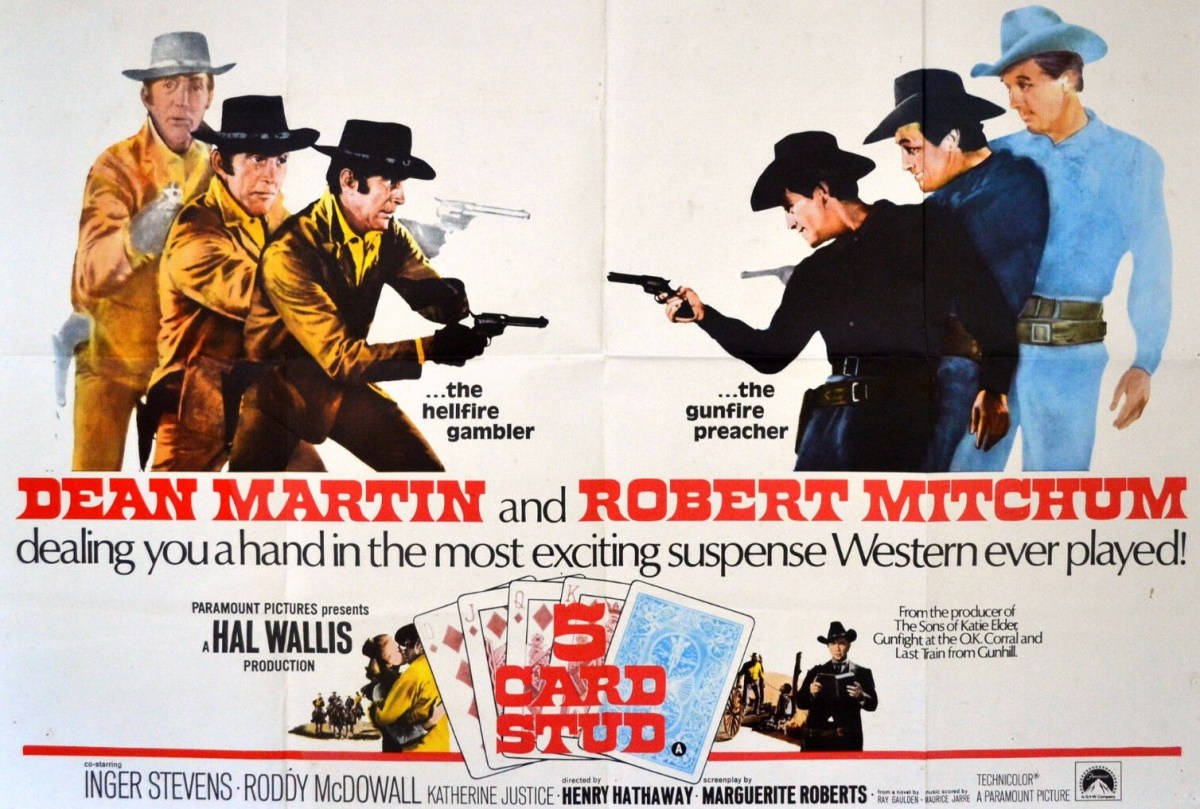
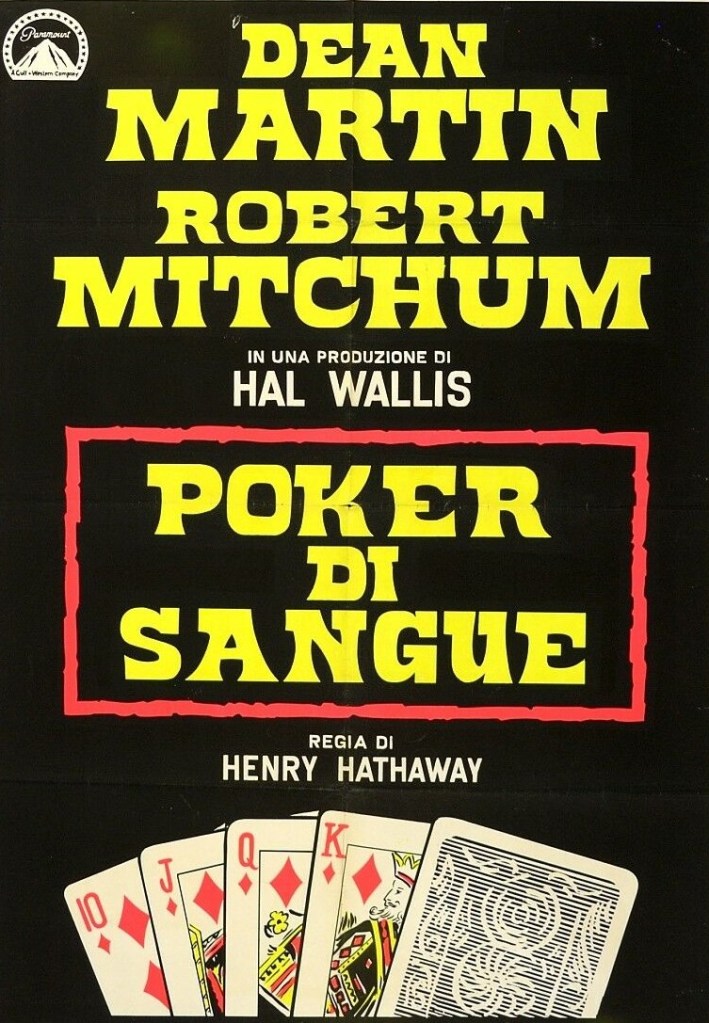
Another western in sore need of re-evaluation. Largely dismissed as a routine oater trading on the gimmick of a whodunit and packed with old stagers, this is in fact about a serial killer, a treatise on law and order, and almost acts as a conduit between the decade’s previous westerns when the good guys and the bad guys are easily defined to the end of the decade when such distinctions were muddied after The Wild Bunch (1969) and Butch Cassidy and the Sundance Kid (1969) invited audiences to root for the bad guys. In this rather well-structured picture, full of action and romance, we don’t know who the bad guy is.
The whodunit, however, is really a MacGuffin. The movie is more concerned with investigating the changing mores and hypocrisies of the West and predicting the inherent dangers in the proliferation of weaponry. It’s worth remembering that the movie came out at time when mass murderers such as Charles Whitman (the subject of Peter Bogdanovich’s Targets, 1968) who went on a killing spree in 1966 were becoming the norm.
A card sharp is lynched for cheating at poker in the quiet town of Rinchon where late-night gambling is the height of entertainment. One of the players, professional gambler Van (Dean Martin), attempts to stop the hanging but is beaten up for his troubles. No surprise then, that he ambles off to Denver. Sometime later the hangmen begin dying off and Van returns not just to solve the mystery but to ensure that his name isn’t on the list. “If someone is out to kill you, you don’t sit around and let him pick the time,” he concludes. With the number of killings, not to mention brawls and shoot-outs, it’s almost continuous action.
On his return, Van discovers, with a gold strike nearby, the incipient boom town has attracted unsavory elements, not just the high murder quotient but a whorehouse and loud music in the saloon. Acting as counterbalance is gun-toting preacher Jonathan Rudd (Robert Mitchum) who announces his presence by spraying bullets in the saloon floor, emerging as the self-proclaimed “conscience” of the town.
For a sometime protector of law and order, Van is rather lax in the morals department, unwilling to commit to main squeeze rancher’s daughter Nora (Katharine Justice) when the likes of Lily (Inger Stevens), the unlikely proprietor of a barbershop-cum-whorehouse, are on hand. Van is an interesting study. Once he becomes aware that the only people likely to end up in an early grave are the six men who played poker with the lynched individual, it doesn’t occur to him to fess up to Marshal Dana (John Anderson) which would ease the fears of the ordinary public. Awareness the only corpses belonged to the guilty would have prevented further outbursts of violence among a disaffected population. Interestingly, too, Dana makes no attempt to investigate the lynching.
At the core of this picture are a couple of amazing scenes as paranoia takes hold. One miner, without the slightest sense of irony, complains that in the old days a gunfight took place face to face, not by a murderer slinking round in the dark. Rudd adds some prophetic advice: “wear a gun and use it fast, wear a gun and use it slow – I say don’t wear a gun and you won’t use it at all.”
Van likes to think he has the measure of women, when in fact they have the measure of him. The story avoids the obvious lure of a love triangle, of jealous women competing for Van’s affections. Both the young Nora and the more mature Lily are pretty well grounded. “One wore-out no-account kiss” is Nora’s dismissive description of Van’s attempts at romance while Lily lets Van know she has taken a shine to him as a matter of convenience, he’s just a man and she hasn’t had one in three years. Expecting to be treated as a pariah, Lily, expressing the notion that “women don’t usually like women who like men,” strikes up a friendship with Nora.
Marshal Dana finds it increasingly difficult to maintain any kind of peace since as the death count mounts, paranoia grows rife, exacerbated by the kind of greed gold fever brings, resulting in citizens determined to challenge authority and take matters into their own hands.
The most antsy character is Nick (Roddy McDowall), Nora’s brother and the leader of the lynch mob. Nick seems to stir up bad feelings, provoking the ire of both his father and Van. The guilty are despatched in original ways, one man “drowns” in a barrel of flour, another strangled by barbed wire, a third wakes the town at night when the church bell to which his neck is attached starts ringing out. It’s not too hard in the end to work out who the killer is, but as I said, that is not the point of the picture, although the ending is satisfactory.
There a mass of small detail of the kind that director Henry Hathaway (True Grit, 1969) tends to work into his pictures. Van is a cut above. He travels to Denver and back by stagecoach not on horseback. Citizens can purchase Pocahontas Remedies and beer from the Denver Brewery. Shaves and haircuts at the Tonsorial Parlor are reasonably priced but “miscellaneous” comes in at $20. After the preacher shoots up her floor, saloon owner Mama (Ruth Springford) smooths out the holes.
And there is some distinctive direction. Rudd’s sermon that lasts nearly 90 seconds is delivered in virtually one take, a fistfight is conducted in silence except for a soundtrack punctuated by grunts and punches hitting their target, a dying man tries to leave a physical clue about the identity of the mysterious killer. And there is a superb main street gunfight with Van trying to rescue the marshal and Rudd striding down the street in old-fashioned gunslinger mode.
Dean Martin (Rough Night in Jericho, 1967) and Robert Mitchum (The Way West, 1969), both with apparently easy-going but magisterial screen personas, come off well together. Inger Stevens (Firecreek, 1968) always a great screen presence, an ethereal beauty, is vulnerable and strong at the same time. Katherine Justice (The Way West, 1967) is sassy and independent-minded and has a terrific facial response to coming across the first murder. John Anderson (The Satan Bug, 1965) leads a fine supporting cast including Yaphet Kotto (Live and Let Die, 1973), Denver Pyle (Shenandoah, 1965) and Whit Bissell (Seven Days in May, 1964).
Screenwriter Marguerite Roberts, adapting the novel by Ray Gaulden, contributes some classic lines. “If that is a Bible, read it,” Van instructs Rudd, assuming the preacher has a gun planted in the Holy Book, “If it ain’t a Bible, drop it.” There’s a nod to a James Coburn scene in The Magnificent Seven (1960). Congratulated on his marksmanship in hitting the spinning wheels of a windmill six times out of six, Rudd protests his shooting was a failure since he was aiming for the spaces in between. It was ironic that her next assignment concerned a lawman who took much the same no-holds-approach to the criminal fraternity (True Grit, 1969) as the killer in this picture.
I was so intrigued by this picture, realizing it had much more to offer than a whodunit, that I watched it again within a few days and was pleasantly surprised by its depths.
Originally intended to pair Audrey Hepburn with William Holden and entitled variously Wherever Loves Takes Me, Ten Days to Penang, The Durian Tree (title of the source novel), Year of the Dragon, The Third Road, and Ten Days to Kuala Lampur, the picture eventually released as The 7th Dawn marked the entrance of British director Lewis Gilbert (HMS Defiant/Damn the Defiant, 1962) into the Hollywood big-time courtesy of producer Charles K. Feldman (Casino Royale, 1967). Gilbert had already been assured of a step-up from the budgetary confines of Britain to something more substantial after being signed in 1962 to direct Susan Hayward in Summer Flight, but that had fallen through.
William Holden was always interested in making movies outside the United States, in part down to a sense of adventure, in part to avoid paying taxes. He hadn’t worked in the States since 1958. “I’ve got a reputation for going to various part of the world to take advantage of background. There’s always new stories,” he said, adding, “I have to do things that satisfy me.” Actually, he could afford not to work. He had pocketed by far the biggest-ever Hollywood payout – over $3 million from his share of the profits from Bridge on the River Kwai (1957) and his current fee was in excess of $750,000.
Gilbert agreed to take the assignment on the basis of a script by Karl Tunberg (Ben-Hur, 1959) who had adapted the novel by Michael Keon. But what appeared relatively straightforward was soon anything but as the British director became enmeshed in clashes over production, the script and the casting. While Gilbert was tussling with the problems of working on location, where he was expecting the imminent arrival of a film crew, he was summoned to Hollywood and told that two-time Oscar-winning screenwriter Ben Hecht (Circus World, 1964) had rewritten the script.
Feldman was known for playing fast and loose with scripts, much to the surprise of director Edward Dmytryk and the frustration of star Laurence Harvey when new writers were brought in for Walk on the Wild side (1962), earning the producer a reputation for interference. On reading the new script Gilbert recalled, “The basic plot was similar, but apart from that it wasn’t like the old script at all. Bill Holden’s part kept shrinking while the part of the mixed race girl kept getting bigger.” This may have been a ruse to attract Audrey Hepburn. Although Holden and Hepburn were due to be paired in June 1962 on Paris When It Sizzles in a part more in keeping with her screen persona, that film was delayed (not released till 1964) leaving both free for the Malaysian picture. Despite Feldman’s assurances, Gilbert later questioned whether Hepburn had ever been committed.
Gilbert hated the new script so much that he threatened to quit, only placated when Feldman promised he could work with Hecht on a revised version of the new script. But Hecht insisted on working closer to his home near New York. Their flight from Los Angeles to New York was delayed because of engine trouble, but by the time passengers were instructed to leave the plane, Hecht, who was addicted to sleeping pills, was fast asleep and could only be removed by ambulance. Facing a three-day deadline, Gilbert discovered that Hecht refused to work in the New York hotel assigned them by Feldman so they were decanted to the writer’s home in upstate New York. That scarcely improved the script, described by Gilbert as a “cockamamie affair.” However, that would not have unduly worried the producer who was of the opinion that performers with box office clout “can make successes of weak properties.”
Six months before release “The 7th Dawn2 was still being promoted as “Ten Days to Penang.” Incidentally, “The Dubious Patriots” was released as “Secret Invasion” (1964), although its original title did not go to waste, used as an alternative to the Charles Bronson-Tony Curtis “You Can’t Win ‘Em All” (1970).
The script in whatever version offered a key role for a Eurasian woman. Initially Gilbert and director of photography Freddie Young planned to scour the Shaw Brothers portfolio of budding stars to fill the role, and if not finding what they wanted in Malaysia aimed to head for Hong Kong and “seek her among the actresses there” according to Holden. However, once the compromise script was approved, Feldman proposed his real-life mistress Capucine (North to Alaska, 1960) for the part.
That was the first difference of opinion between director and producer, not to mention star and producer, and an education for Gilbert on just how little power he wielded when it came to confronting Feldman. William Holden objected strenuously to the involvement of Capucine, his opposition based on his experience of working with her on flop The Lion (1962). It may have counted against the actress that the duo had engaged in an affair on the African set. Holden may have wanted to treat the affair as one of those things that happened on location – and ended once the film is completed. “Whatever you do, Lewis,” Holden advised the director, “you must resist having her in the picture. I’ve just made a movie with her…and she was not very good. I think, really, the picture suffered for it and so if I make my next movie with her I’m going to look pretty stupid.”
Expecting Holden to back him up, Gilbert was surprised when the actor shied away from any confrontation with the producer, only learning later that Holden was somewhat in awe of Feldman, who had given him his big break in Golden Boy (1939) and, in his capacity as agent – the first to demand a $750,000 fee plus hefty percentage for his client – helped oversee his career. Although her three-year contract with Columbia had begun in 1961, Capucine had only made one film for the studio, Walk on the Wild Side (1962), more likely to turn up in pictures for Twentieth Century Fox, United Artists or independents. Feldman claimed Capucine was “in greater demand for roles after being starred in Walk on the Wild Side.” His position as star-maker-supreme was strengthened when he merged his agency with Ashley-Steiner and bought the rights to Mary McCarthy bestseller The Group, which boasted great parts for four women. Probably Gilbert did not quite realize what he was taking on when he raised his and Holden’s objections to Capucine. Feldman responded, “We’re not making the film for Bill, we’re making it for the world.”
Gilbert was also having problems with Karl Tunberg who was also functioning as a co-producer “and therefore my producer,” according to the director. “As I’ve often done the job myself I haven’t worked with many producers but I can safely say this one was hopeless.” As a result of Tunberg’s “inertia” the production manager Bill Kirkby resigned, and Gilbert ended taking on the role of producer as well.
Holden’s career, while not yet in the box office trough that would envelop him later in the decade, was enjoying an unexpected movie hiatus, his planned starring role in The Americanization of Emily, to be directed by William Wyler, having fallen through. Paris When It Sizzles was on the shelf for an interminably long time given the supposed box office pulling power of the stars. Made in 1962, it was not released until 1964, by which time Hepburn was back on top thanks to Charade (1963) and My Fair Lady (1964). By the time The 7th Dawn hit theaters, Holden had four box office flops on the trot.
Jack Hawkins was originally intended to play the Governor and for the role of his daughter Candace, who makes a play for Holden, Gilbert suggested Susannah York who had worked on his Loss of Innocence (1961), and who was beginning to attract attention in Hollywood. By the time the crew got to Malaya, where the film was to be shot, there was one notable absentee – the wardrobe mistress. Gilbert’s wife Hylda supplied York with a beautiful sarong purchased from a girl she spotted passing on a bike. Shooting was delayed due to a strike by Asian extras on the first day. They claimed discrimination because white extras were being paid more. Around 1,000 extras were required to play peasants and the security forces.
Although it was known Holden had an alcohol problem, prior to filming he had undergone aversion therapy in Switzerland and consequently remained dry throughout the filming. Gilbert admired the actor’s approach: “Bill Holden was a delight. He was an old time star.” If you asked him to crawl across a room, and climb up onto a chair, he would do it. “Whatever the director says, you do it. That’s how film actors were trained in his day and that was certainly his training.”
Capucine was the opposite. “Because she was untrained and didn’t understand what you were saying anyway, there was little you could do with her.” When the actress complained to her lover that she was being ignored on set, Gilbert had to take the producer aside and explain her deficiencies. “She doesn’t know about working with other actors. When I’m doing a scene where Susannah’s talking to her, I’m not just working with Susannah. I’m working with her too because I will be filming her reactions, how she listens to Susannah, that sort of thing. When I get back to the cutting room I can put all that together and even improve her performance.” (That said, I felt Capucine gave the best performance of her career.)
Unlike many top productions of the era, the film was not given an exclusive run at a New York city center cinema, but went straight into a Showcase (wide) release in 300 theaters simultaneously with its opening at the Astor and Trans-Lux East arthouses in the Big Apple.
William Holden, unable to stay off the wagon, succumbed to his affliction, hitting his head while on a bender alone in a cabin and dying at the age of 63 from his injury. Capucine was 62 when she committed suicide in 1990.
SOURCES: Lewis Gilbert, All My Flashbacks, (Reynolds & Hearn, 2010) p213-231, p234-235; Matthew Field, “Gilbert Goes to War,” Cinema Retro, Vol 6, issue 18, p46; “Capucine Option Renewed,” Box Office, November 27, 1961, NC2; “Mary Magdalene to Star Capucine,” Box Office, January 29, 1962, p13; “Feldman Sees Wild Side as New Break-Through,” Box Office, February 5, 1961, p14; “Actor Harvey no Fan of Feldman,” Variety, May 9, 1962, p5; “Ransohoff Signs William Holden,” Box Office, May 28, 1962, p15; “Lewis Gilbert to Direct Summer Flight for UA,” Box Office, June 11, 1962, pE8; “William Holden Plans Continue Produce Pix in Overseas Spots,” Variety, November 20, 1963, p2; “Bill Holden Party Primes Malaya Pic,” Variety, December 19, 1962, 4; “Chatter,” Variety, April 10, 1963, p69; “West Side in Malaya,” Variety, April 17, 1963, p21; “Liz’s Cleo 10% Mebbe Soon; But Holden Coin Tops,” Variety, May 15, 1963, p1; “Holden Follows Wyler Leaving Emily,” Box Office, October 7, 1963, pW2; “Feldman Acquires Rights to Mary McCarthy Novel,” Box Office, December 16, 1963, pE11; “New UA Title,” Variety, December 23, 1963, p6; Advertisement, Variety, January 8, 1964, p51; “300 July Dates for Dawn,” Box Office, June 1, 1964, p8; Advertisement, “UA’s Blockbuster for Summer Release,” Variety, June 17, 1964, p12-13; “UA Opens 7th Dawn as Showcase Presentation,” Box Office, August 31, 1964, pE2.
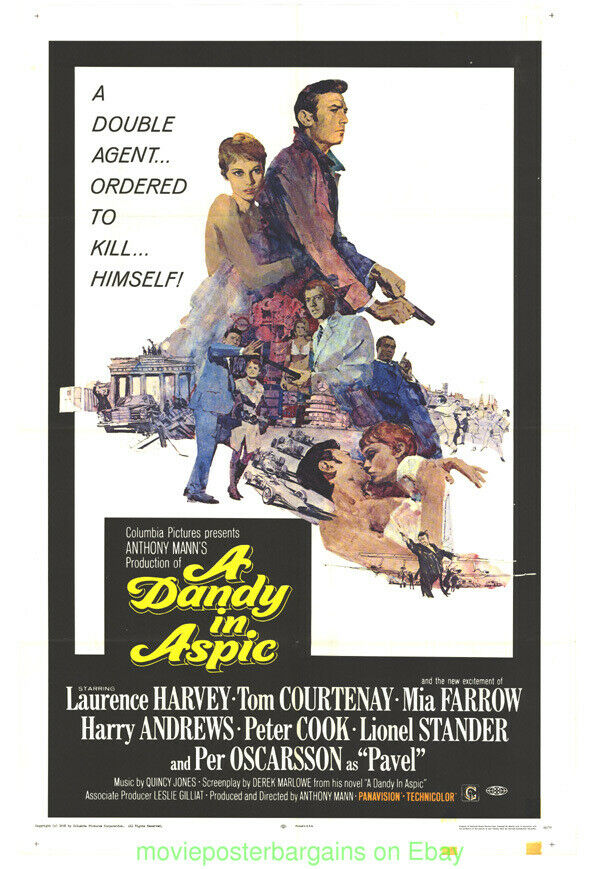
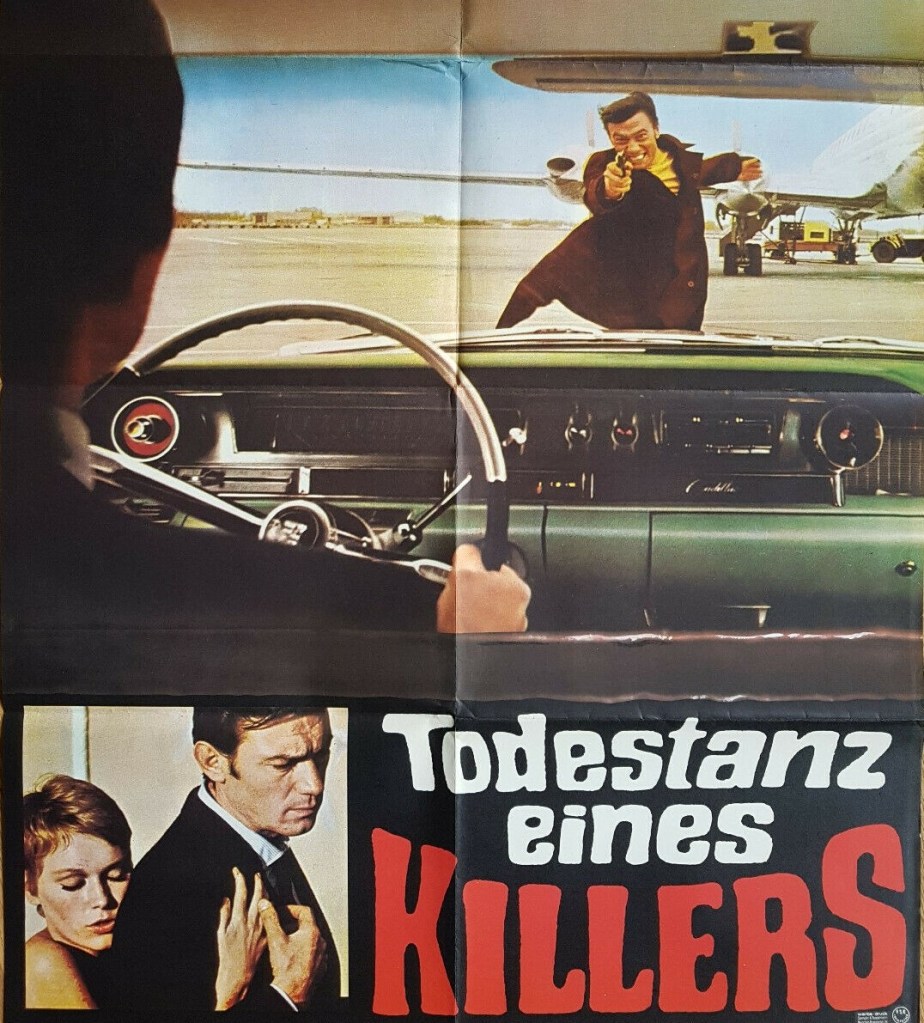
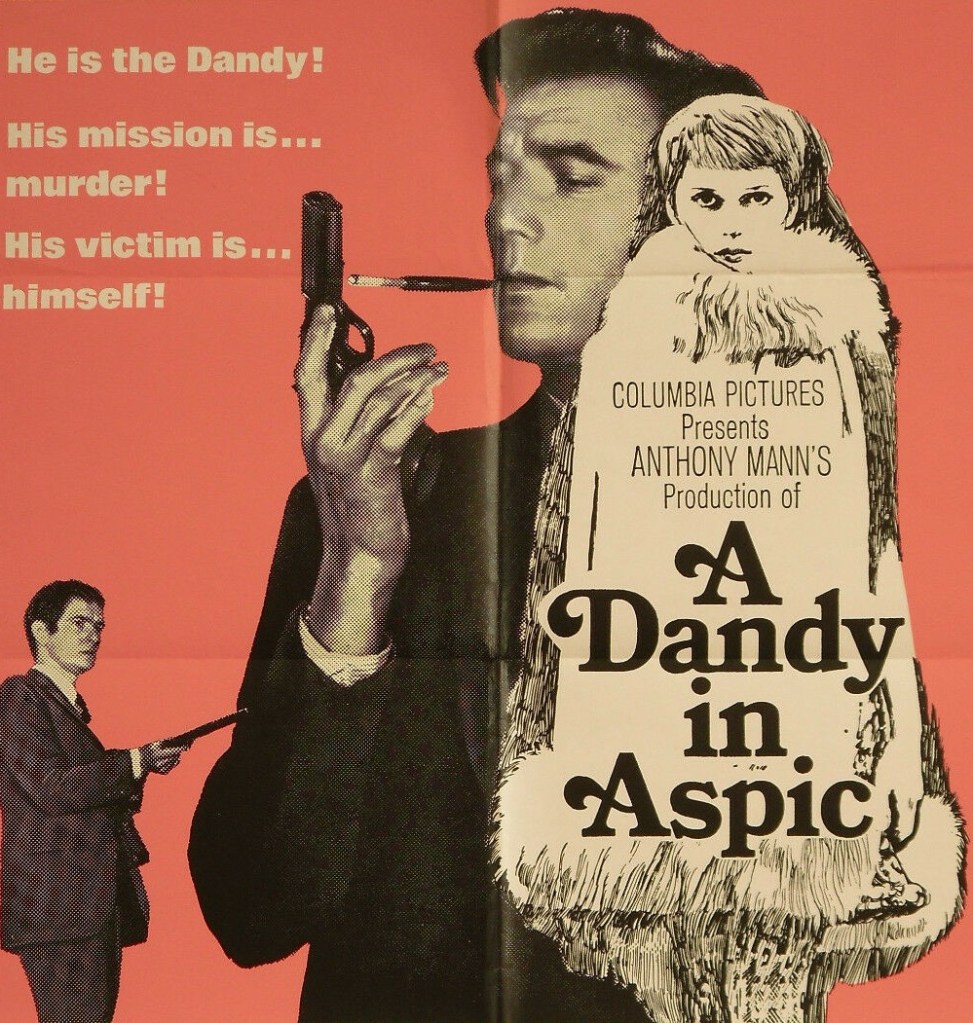
Belongs to the “serious spy” genre that exposed the nitty-gritty espionage business, often more concerned with the impact of the job on the spy than on the mission on which they have been sent. The biggest successes came early on – The Spy Who Came in from The Cold (1965), The Ipcress File (1965) and The Quiller Memorandum (1966). A Dandy in Aspic is one of the latest in the series of sad spies and like The Defector (1966) it’s more of a character study than an action picture. The tone is set with the credits, a puppet dangling to the point of being tormented, on a string.
The character in question is Eberlin (Laurence Harvey), a spy who wants to quit and go home. He knows only too well what happens to the burnt-out case, one of his colleagues is a drug addict. Only in this case home is Russia. But the feedback he receives is that nobody back home wants him to quit. His British bosses send him to go to Berlin to assassinate a dangerous Russian spy called Krasnevin. The only problem is, Eberlin is Krasnevin and so begins a game of bluff and double bluff while he fails to uncover the supposed foreign assassin his ruthless British unwanted colleague Gatiss (Tom Courtenay) is helping him locate.
Thrown into the mix is a girl, Caroline (Mia Farrow) a casual pick-up, a photographer he met in London who turned up in Berlin. Happenstance? Perhaps. But there is no such thing for a suspicious spy and to tell the truth even the moviegoer will treat her as just too good to be true even though she is a delightful personality and beautiful to boot. The fact that Eberlin has a girlfriend Miss Vogler (Barbara Murray) doesn’t seem to bother him, spies, as you will know by now, discarding women like old shoes.
If a noose is closing in, it’s a strange one, and feels more like it’s coming from the East rather than the West. He is blocked from taking a trip to East Berlin. Cops are tipped off when he makes contact with someone who could get him over/through the Wall. His Eastern masters seem willing to pay good money to find out the identity of Krasnevin.
It’s all twisted and complex and all sorts of strange characters come out of the woodwork. For no reason at all one sequence is set at a Grand Prix race, one of the drivers paid to cause a distraction to allow someone to be shot. Like The Defector, this is a movie that unravels backwards. Once you get to the end it makes a lot more sense. If you were asked to choose, on the basis of the characters presented, whether the Russians or British had more principles you would be hard put to decide.
Laurence Harvey (The Running Man, 1963) is one of the few actors with the vicious fragility to carry this off. He is coming apart at the seams. He can hold onto his good looks far longer than his mental stability. His rare acts of violence seem petulance. And since we are never allowed inside his head, since he cannot confess his feelings to Caroline, he cannot explain what it’s like to be abandoned by your native country, cast aside like an old lover. It’s left to the audience to work this out for themselves, that a true patriot risking his life for his country is refused sanctuary.
He’s doomed and soon he knows it, nowhere left to run, the sense that the trap is closing and perhaps the few hours spent with Caroline are like a condemned man’s final wishes.
Filmed in bleak London and Berlin, the setting reflects the character’s mindset. There’s a bit too much fancy cinematography and sound effects, but otherwise it’s solid entry into the “more real than reality” subgenre. Director Anthony Mann (The Heroes of Telemark, 1965) died during the making of the film, Laurence Harvey taking the helm for the last two weeks of shooting and post-production so it’s possible this is not quite the film Mann had in mind.
You can see here elements of the documentary style Mann developed in The Heroes of Telemark and it’s possible that when it came to the editing director Harvey accorded himself more prominence than Mann might have, leaving a complex tale more difficult to follow than necessary.
Harvey is very good in the role of the ruthless narcissist, Mia Farrow – she followed this with Rosemary’s Baby (1968) – with a creditable English accent is excellent as the lover though Tom Courtenay (Operation Crossbow, 1965) seems miscast. Excellent support is provided by Lionel Stander (Once Upon a Time in the West, 1968), Harry Andrews (Danger Route, 1967) and Per Oscarsson (Who Saw Him Die?. 1968). Look out for comedian Peter Cook (Bedazzled, 1967) as an unlikely lothario, Barbara Murray (television series The Power Game, 1965-1969) and Calvin Lockhart (Dark of the Sun, 1968).
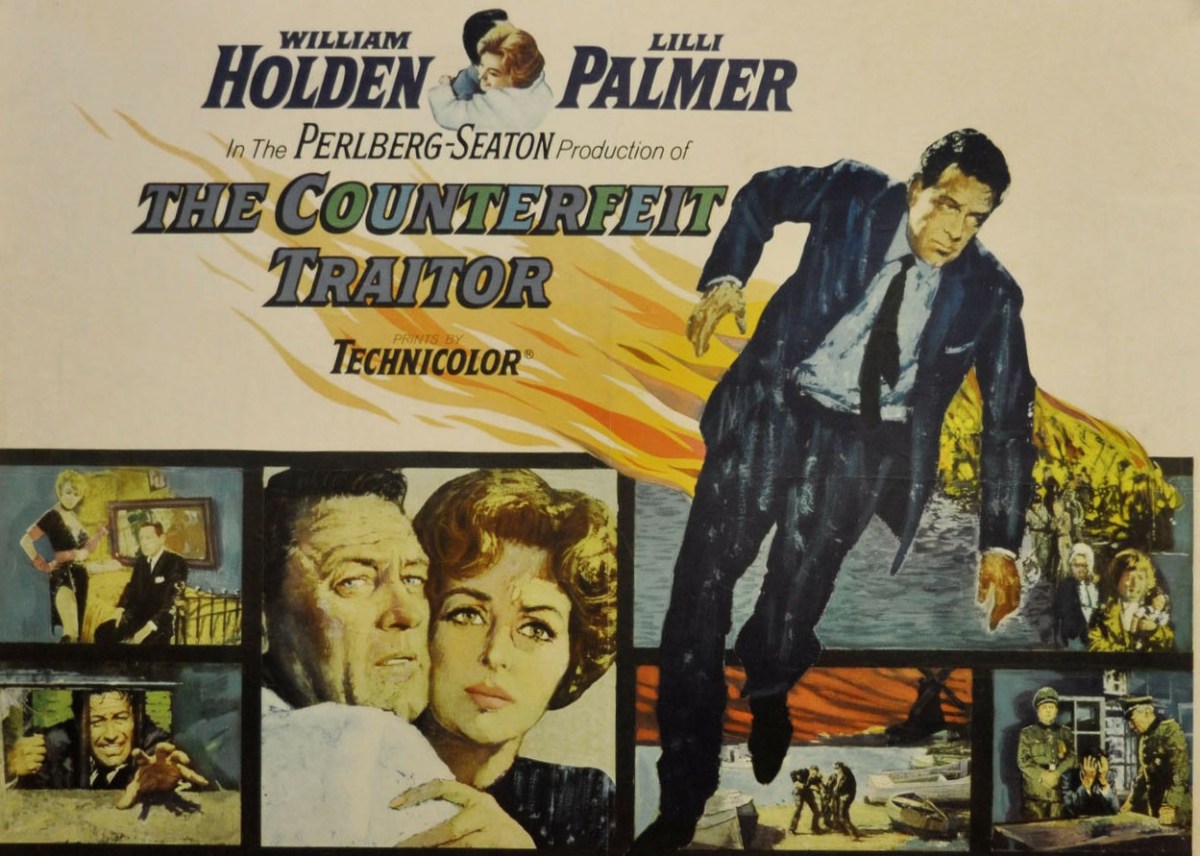
Authenticity came at a cost. In electing to film in Europe veteran producer-director team of William Perlberg and George Seaton, their partnership stretching back two decades, incurred the ire of U.S. movie unions campaigning against “runaway” productions and tax-avoiding stars like William Holden. Feelings ran so high the movie was picketed on release, even though it had received a Presidential seal of approval after John F. Kennedy requested a screening.
Perlberg and Seaton were lucky not to be indicted for a further act of anti-Hollywood behavior, the hiring of so many European actors and actresses in favor of the home-grown variety, but with the incursion of Sophia Loren, Brigitte Bardot and Gina Lollobrigida into the U.S. box office introducing another big female star into the Hollywood firmament would likely have been welcomed.
Producer Perlberg bluntly defended the decision to film abroad a movie set in war-torn Europe (where much of the damage caused by the war had not been rectified). “Where would you find three solid blocks of rubble but Berlin?” he demanded. “Or a prison like Moabit? Our company was yesterday filming in a partially bombed out section of the Altona railway station, six stories high. Action involved a 14-car German train (which Union Pacific can’t reproduce). How can we build Stockholm in Hollywood.” More to the point, he added, “Of course where in the world can you get weather like this? It’s been raining every day.”
Perlberg and two-time Oscar winner Seaton (Airport, 1970), separately and together, had considerable experience of war pictures, having between them made The Proud and the Profane (1956) and The Bridges at Toko-Ri (1954), both pictures, incidentally, starring Holden. The Alexander Klein bestseller The Counterfeit Traitor, purchased in 1957 for a modest $75,000, appeared to follow a similar trajectory. “Competition for the entertainment dollar has wedded us to big films and global stories,” maintained Perlberg despite complaint by Hollywood unions that such films, in the face of shrinking U.S. production, denied their members work.
Although the European locations would shave $500,000 from the budget of The Counterfeit Traitor, still coming in at a hefty $3.4 million and originally to be filmed under the title Man in the Middle, Perlberg was adamant that “the picture could never be made in Hollywood with justice to the subject and story… We are shooting this picture where it happened. On the streets that Eric Erickson (the character William Holden plays) walked; in the houses that were his hideouts.”
Perhaps key to this philosophy was the ability to shoot inside the notorious and still-active Moabit Prison, housing 1,300 prisoners and located close to Berlin’s famous Tiergarten. Amazingly, the prison warden granted permission not just to shoot in the courtyard but also inside the actual building. The prison officials initially denied that anyone was shot in the courtyard (a key scene in the film) until Erickson turned up and testified to the contrary, standing in the cell through whose bars he had witnessed the execution. You could not buy such authenticity and certainly not recreate it in a Hollywood back lot.
Paperback movie tie-in.
The 100-day shooting schedule included a month in Berlin, two months in Hamburg and scenes set in Copenhagen and Stockholm. It was the epitome of a multi-country adventure – the cameraman French (Jean Bourgoin who shot Tati’s Mon Oncle), wardrobe coordinator Italian, sound mixer German and assistant director British. But in Denmark, they worked with a Danish crew, in Sweden a Swedish crew. “I doubt that any other picture has been made with this type of operation – changing crews with each country involved. It has certain pitfalls but we’ve found in Germany alone that it would have been foolish to do it any other way,” added Perlberg.
“Hollywood set dressers, for instance, are great but no amount of research can match actual experience. Our interior decorators lived in the environment, witnessed the events and dressed the sets accordingly.” Apart from language problems, in Germany, where the bulk of filming took place, the lack of a centrally located “movie town” like Hollywood caused issues. Actors and crew were drawn from Berlin, Munich and Hamburg, with all the cast put up in first class hotels and paid a per diem of $15. With over 70 speaking roles, the movie also called on 2,000 extras. The producers also worked in the oldest film studio in the world, Nordish Film in Copenhagen built in 1906, and the rebuilt Palladium, which had been blown up by the Germans during World War Two.
Actors and directors worked abroad to limit their U.S. tax exposure. Anyone taking advantage of foreign income was viewed as a tax cheat. William Holden, who would only make one movie in Hollywood in seven years, epitomized the wealthy tax dodger. Living abroad also cut down on paying U.S. tax. Switzerland, for example, where Holden took up residence, calculated tax on the amount you spent on the annual rental of your home, resulting in huge savings – Yul Brunner claimed this legitimate move alone had saved him $2 million.
Holden complained that he was unfairly being singled out. “How about Clark Gable in Naples, Tony Quinn, Charlton Heston in Ben- Hur? Why do they pick on me? I pay U.S. taxes in the highest brackets and will continue doing so for years.” He was a prime target not just because he was outspoken about living and working abroad but because he was, along with John Wayne, the highest-earning male actor, on $750,00 per picture plus percentage. He had the pick of the projects, linked with The Guns of Navarone (1961), The Alamo (1961), The Americanization of Emily with William Wyler in the director’s chair, The Visit with Ingrid Bergman and Melody for Sex where he would be paired with both Sophia Loren and Gina Lollobrigida. He had followed up The World of Suzie Wong (1961) filmed in Hong Kong, with Satan Never Sleeps (1961) filmed in Britain, and then was lining up The Lion in Kenya, Together in Paris (aka Paris When It Sizzles) in France and The 7th Dawn in Malaya.
Although Prussian-born Lili Palmer (Sebastian, 1968) was an established Hollywood import, the movie offered a wide range of parts to fast-rising European talent. Most major studios had already invested in “new faces from abroad” so Perlberg-Seaton were not going against the grain on this one. Paramount, for example, had hired the German Hardy Kruger and the French Gerald Blain and Michele Girardon for Hatari! (1962). Columbia lined up Frenchman Alain Delon for Lawrence of Arabia (1962) and Greek actress Irene Papas in the female lead in The Guns of Navarone (1961). MGM chose Ingrid Thulin for The Four Horsemen of the Apocalypse (1962) and United Artists set Maximilian Schell in Judgement at Nuremberg (1961). Claudia Cardinale was intended to make her Hollywood debut opposite Sidney Poitier in Iron Men – never made.
Heading the list of potential break-out stars were Ingmar Bergman protegees Sweden’s Eva Dahlbeck (Smiles of a Summer Night, 1955) and Ulf Palme (Dreams, 1955). They had appeared in two films together, Dreams and Meeting in the Twilight (1946). German Wolfgang Preiss would later appear in The Train (1965) and Von Ryan’s Express (1965). But the biggest casting coup was Klaus Kinski. “No German producer lightly engages him because most of his engagements in German theaters have ended with a resounding quarrel or scandal,” explained journalist Peter Baker, “(but he is) nevertheless regarded with awe and respect as one of the greatest actors to merge from post-war Germany.” His three days in The Counterfeit Traitor won him a role in Perlberg-Seaton’s next picture The Hook (1963).
SOURCES: William Perlberg, “Searching Europe for Authenticity,” Films and Filming, February 1961, p9; Peter Baker, “The Tour of Babel,” Films and Filming, February 1961, p10-11, 41; “Lazar Percenting Ericson Spy Tome,” Variety, October 16, 1957, p3; “Lament for B.O. Stars,” Variety, January 29, 1958, p14; “Holding Money via Residence in Switzerland,” Variety, August 5, 1959, p12;“Par’s Sex Stars,” Variety, September 2, 1959, p3; “Holden, Seaton Invade Berlin for War Film,” Variety, October 28, 1959, p7; “H’wood – O’Seas Row Boils Up,” Variety, August 24, 1960, p7; “Bill Perlberg’s Back and Loves Hollywood,” Variety, November 2, 1960, p7; “New Faces from Abroad To Make Debuts in U.S. Films During 1961–62 Season,” Box Office, September 4, 1961, p12-13; “President Kennedy Sees Counterfeit Traitor,” Box Office, May 7, 1962, pW8; “Warm-Up for Picketing Strategy,” Variety, June 6, 1962, p4.
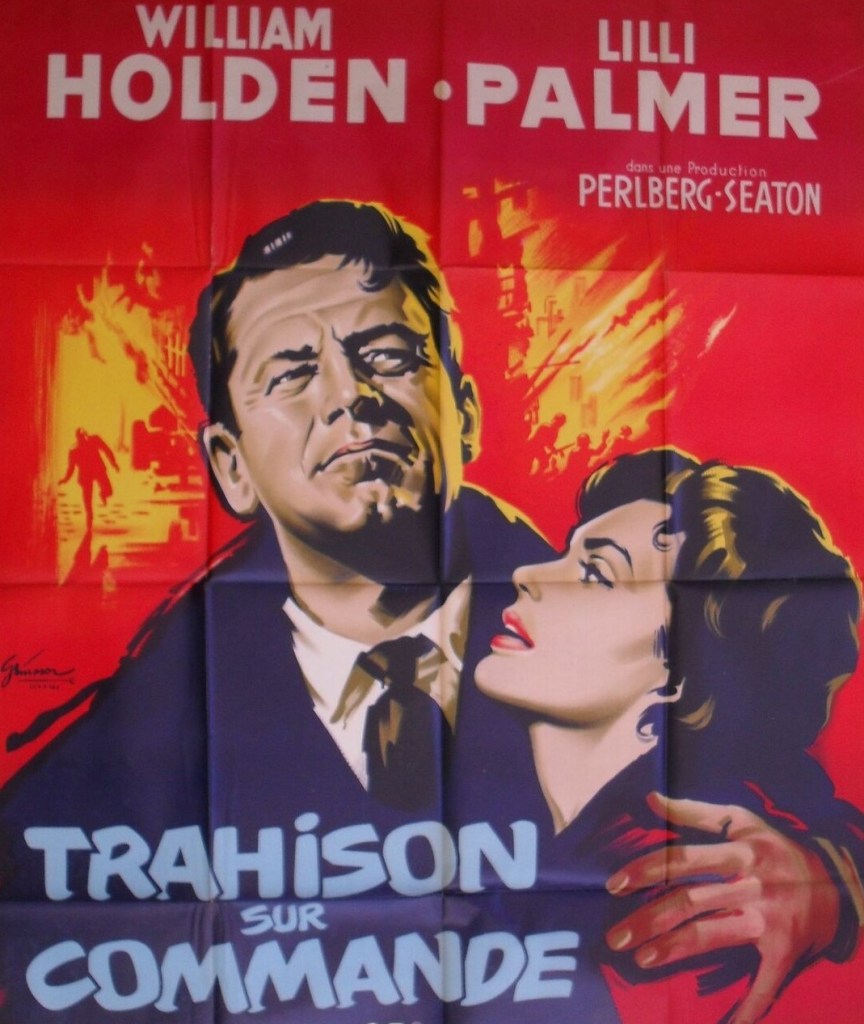
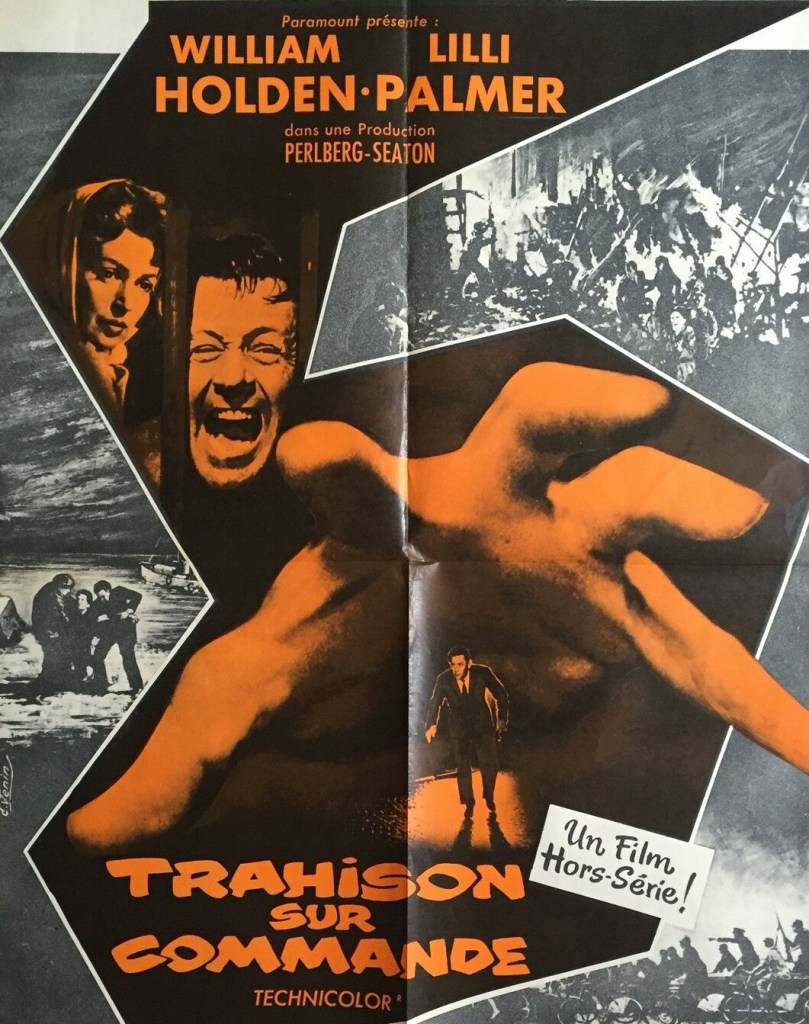
Cynical and opportunistic Swedish oil executive Eric Erickson (William Holden) blackmailed into World War Two espionage finds redemption after witnessing first-hand the horrors of Nazi Germany. Two extraordinary scenes lift this out of the mainstream biopic league, the first Erickson witnessing an execution, the second a betrayal. While some participants in the espionage game pay a terrible price, others like spy chief Collins (Hugh Griffiths) manage to maintain a champagne lifestyle.
Structurally, this is something of a curiosity. The first section, with over-emphasis on voice-over, concerns Holden’s recruitment and initial attempts at spying on German oil installations on the pretext of building a refinery in Sweden. Although resenting the manner in which he was recruited, Erickson has no qualms about resorting to blackmail himself to enlarge his espionage ring.
But it’s only when Marianne Mollendorf (Lili Palmer) enters the frame as his contact in Germany that the movie picks up dramatic heft. As cover for frequent meetings, they pretend to be lovers, that charade soon deepening into the real thing. While abhorring Hitler, she suffers a crisis of conscience after realising that the information she is passing on to the Allies results in innocent deaths. The final segment involves Erickson’s thrilling escape back home.
The picture is at its best when contrasting the unscrupulous Erickson with the principled Marianne. Virtually every character is trying to hold on to a way of life endangered by the war or created by the conflict and there are some interesting observations on the way Erickson manages to harness foreign dignitaries while being held to hostage in his home country. Loyalties are sparing and even families come under internal threat.
Sweden was neutral during the Second World War so in assisting the Allied cause Erickson was effectively betraying his country and once, in order to keep proposed German investors sweet, he begins to spout Nazi propaganda at home finds himself deserted by friends and, eventually, wife.
In some respects, Holden (The Devil’s Brigade, 1968) plays one his typical flawed personalities, easy on the charm, fluid with convention, but once he learns the true cost of his espionage a much deeper character emerges. The actor’s insistence, for tax reasons, on working abroad – this was filmed on location in Europe – would hamper his box office credibility and although not all his movie choices proved sound this was a welcome diversion. Whether American audiences were that interested in what a Swede did in the war was a moot point, as poor box office testified. And the title might have proved too sophisticated for some audiences, given there was no counterfeiting of money involved.
Lili Palmer (Sebastian, 1968) is excellent as the manipulative Marianne, betraying her country in order to save it from the depredations of Hitler, not above using her body to win favour, but paralyzed by consequence. Hugh Griffith (Exodus, 1960) provides another larger-than-life portrayal, disguising his venal core. Werner Peters (Istanbul Express, 1968) puts in an appearance and Klaus Kinski (Five Golden Dragons, 1967) has a bit part.
Double Oscar-winner George Seaton (Airport, 1970) makes a bold attempt to embrace a wider coverage of the war than the film requires and could have done with concentrating more on the central Erickson-Mollendorf drama, especially the German woman’s dilemma, but, made before James Bond reinvented the idea of espionage, this remains a more realistic examination of duplicity in wartime.
CATCH-UP: William Holden pictures reviewed in the Blog are Alvarez Kelly (1966) and The Devil’s Brigade (1968); Lili Palmer movies reviewed are Operation Crossbow (1965), Sebastian (1968) and Hard Contract (1969).
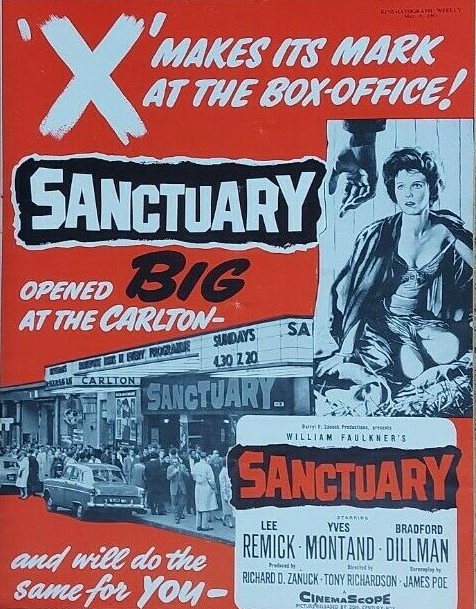
This overheated melodrama stands as a classic example of Hollywood’s offensive attitudes to women. Nobel prize-winning author William Faulkner could hardly blame the movies for sensationalising his misogynistic source material since if anything the movie took a softer line. Told primarily in flashback as headstrong southern belle Temple Drake (Lee Remick) attempts to mitigate the death sentence passed on her maid Nancy (Odetta). Given that such appeals are directed at Drake’s Governor father (Howard St John), and that the maid has been condemned for murdering Drake’s infant child, that’s a whole lot of story to swallow.
Worse is to follow. Drake takes up with Prohibition bootlegger Candy Man (Yves Montand) after being raped by him and thereafter appears happy to live with him in a New Orleans brothel – the “sanctuary,” no irony intended, of the title – despite him slapping her around. The film steers clear of turning her into the prostitute of the original book, but pretty much sets up the notion that high class women will fall for a low-class tough guy whose virility is demonstrated by his brutality. In other words a “real man” rather than the dilettantes she has previously rejected.
After the Candy Man dies, Drake returns home and marries wealthy suitor Gowan Stevens (Bradford Dillman) who blames himself, rightly, for Drake falling into the clutches of the gangster in the first place. But a past threatening to engulf her precipitates the infanticide.
Faulkner was a Hollywood insider, adapting Sanctuary for The Story of Temple Drake (1933) and earning high praise for his work on Bogart vehicles To Have and Have Not (1944) and The Big Sleep (1946). The success of The Tarnished Angels (1957) starring Rock Hudson, The Long, Hot Summer (1958) with Paul Newman and The Sound and the Fury (1959) headlined by Yul Brynner had sent his cachet rocketing. But all three were directed by Americans – Douglas Sirk and Martin Ritt – who had a distinctive visual style and an ear for what made melodrama work.
Sanctuary had been handed to British director Tony Richardson (Look Back in Anger, 1959) and he didn’t quite understand how to make the best of the difficult project. So while Lee Remick manages to suggest both strength and fragility, and makes her character’s wanton despair believable, Yves Montand is miscast and Bradford Dillman fails to convince even though portraying a weak character. Too many of the smaller roles appear as cliches. And it’s hard to believe the maid’s motivation in turning murderer. Watch out for Strother Martin (Cool Hand Luke, 1967).
What was acceptable steamy melodrama in the 1930s fails to click three decades on. Faulkner’s thesis that high-falutin’ women want a man to master them and furthermore will fall in love with their rapist seems to lack any understanding of the female mind and will not appeal any more to the modern sensibility than it did on release. Lee Remick is what holds the picture together, in part because she plays so well the role of a woman embracing degradation, and refusing – no matter how insane the idea appears – to let go of the man she believes is the love of her life. It’s not Fifty Shades of Grey, but it’s not that far off that kind of fantasy figure, and given the success of that book, it’s entirely possible there is a market for what Faulkner has to peddle.
Not easy to find. This is actually on YouTube if you go onto that channel and search. Strangely enough, if I post a link, it says it is no longer playing there – but just as strangely if you go looking you will find it.
Screenwriters Ben Maddow and Mitch Lindemann earned their keep on this one. The source was a literate historical novel by A.B. Guthrie which, despite winning the Pulitzer Prize, was seen primarily as a western. In considerable detail, it covered what a wagon train heading to Oregon needed to do and know in order to make the 2,000-mile trip. It is a fascinating read, told from many points of view. But very little of the book found its way into the film.
It wouldn’t have been much of a film if the screenwriters had simply followed the book structure, for much of that was internalized, thoughts and feelings of the settlers, dramatic incident not so much. So if this was going to be a big-budget western it needed a lot more.
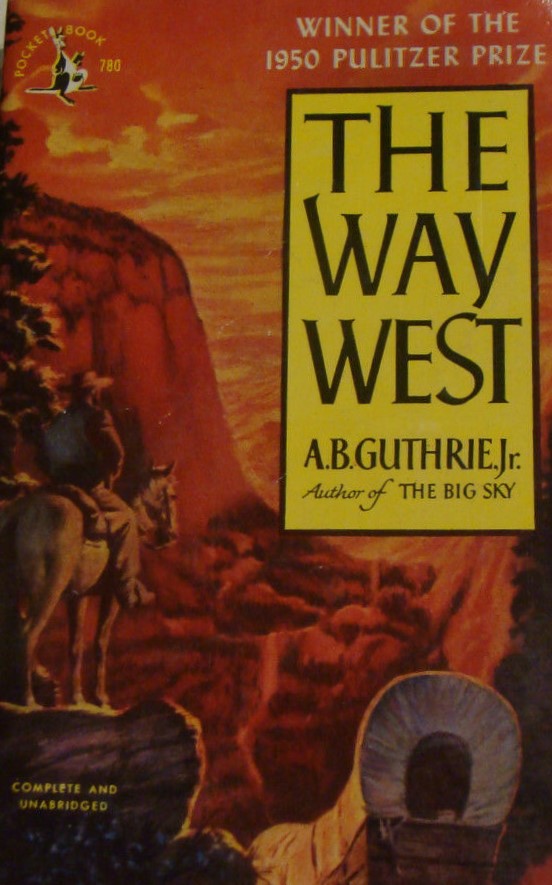
The paperback was sold as a western not as a novel of literary merit so it was inevitable that the Native Americans who played a minor role in the book took center stage on the book cover to target the expected audience.
What isn’t in the book: Tadlock (Kirk Douglas) isn’t a Senator for a start, he’s not a widow and doesn’t have a child. He’s not a visionary either with some grandiose map of how he envisages the town he’ll build. He doesn’t hang a man, get a whipping or die falling over a cliff. He’s quit the wagon train long before the cliff section. And he stopped being the leader of the expedition less than halfway through the book.
What isn’t in the book: Evans (Richard Widmark) isn’t overfond of alcohol, doesn’t create an unforced halt in order to celebrate Independence Days several days too soon, doesn’t have a grandfather clock whose loss causes him to lose his rag with Tadlock, in fact it’s he who picks the fight after discovering Tadlock intends to hang a thieving Native American.
What isn’t in the book: Dick Summers (Robert Mitchum) isn’t losing his eyesight, though recently widowed his wife wasn’t a Native American, and he doesn’t have a lucky necklace to pass on to a young man or woman.
So there’s a whole passel of wonder right there. The screenwriters have instantly dramatized all three leading characters by providing them with different attributes, making Tadlock and Summers more sympathetic than in the book, rendering Evans less sympathetic. The problem with the book’s Summers is that what makes him interesting is his lore, his knowledge of everything to do with the West, little of which translates to the screen. So providing the toughest of them all with an impediment allows him an immediate story arc.
What isn’t in the book: a Native American child is not killed by a settler, there’s no settler hanged by Tadlock to placate the warring tribe. There’s no warring tribe. There’s no race with other wagon trains at the outset and no racing across a river to get ahead of a rival. There’s no stowaway preacher either, though there is a preacher (Jack Elam). There is only one stop along the way in the film, at Fort Hall, but two in the book, the other being Laramie.
What isn’t in the book, I’m sorry to say, is the wonderful sequence of lowering wagons down a cliff, and Brownie (Michael McGreevy) marries Mercy (Sally Field) because otherwise she’s going to leave the wagon train at Fort Hall and he doesn’t make a pledge in public that her unborn child is his. And there’s no part for Stubby Kaye.
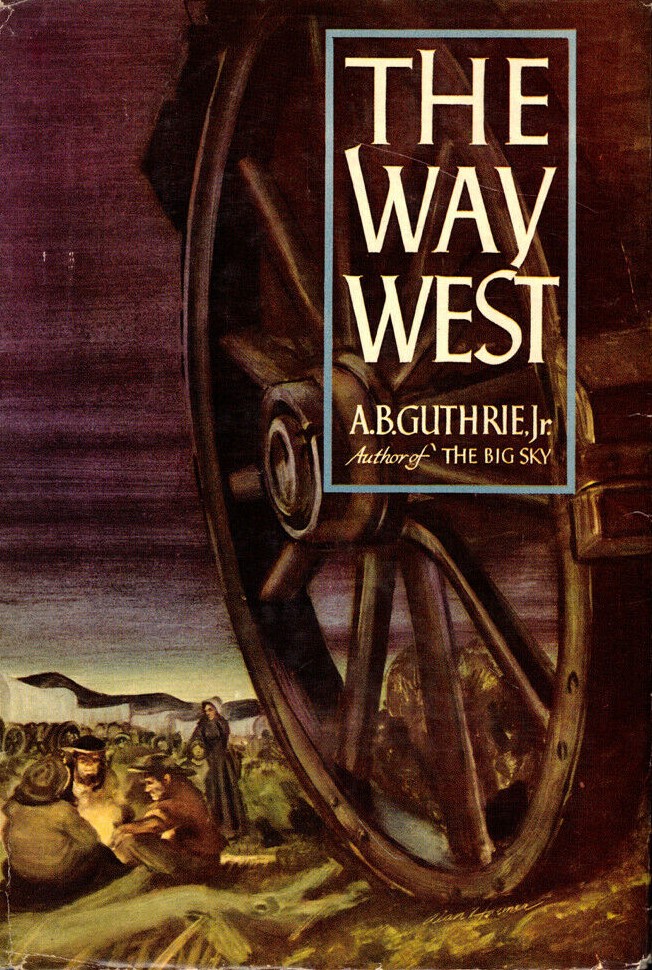
This hardback cover gives far better representation of the novel’s content.
Some of the more solid emotional material is retained. The frigidity of Mrs Mack (Katherine Justice) remains, giving her husband (Michael Witney) the excuse to seduce Mercy, considerably more innocent in the book, where she is described not as sassy but awkward in adult company, “growed up in body and not in knowing.” While not loving Brownie, she marries him for convenience, though she learns to love him. Brownie gets advice on handling Mercy from Summers and much of that dialog is imported straight from the book.
From the book comes the idea of the settlers chiseling their names on the rock, of Brownie, while doing so, being captured by Native Americans and being traded back to his father.
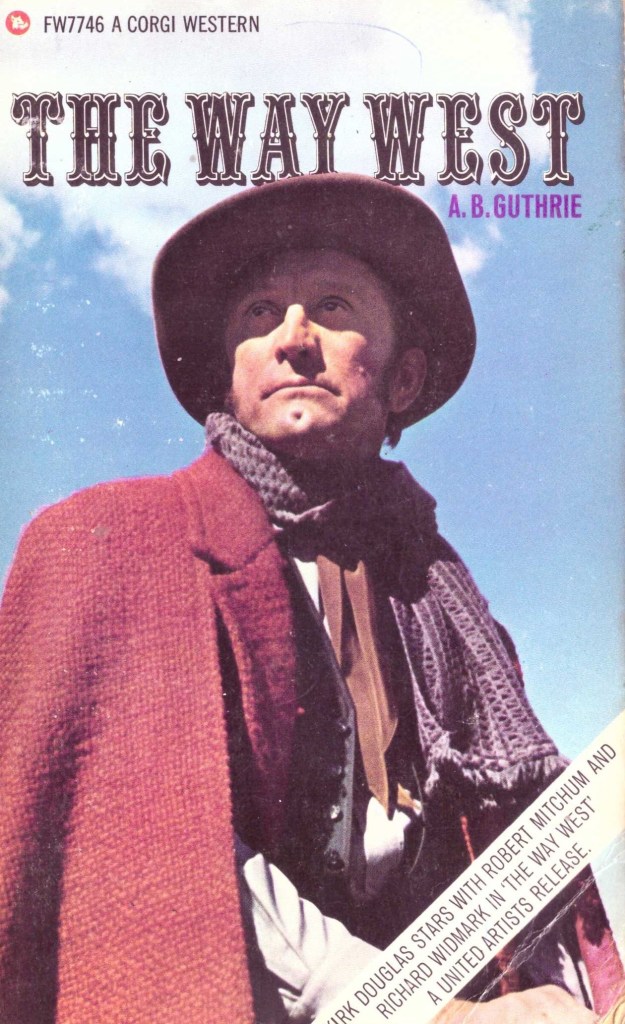
Cover of the British Corgi movie tie-in paperback printed in 1967.
But there are some ideas lifted from the book out of sequence that the screenwriters build up into major dramatic incidents. The river crossing at the start of the film is taken from the river crossing near the end of the book. Close to the start of the novel, Mack kills a Native American, whose tribe seek justice but are sent away empty handed by Tadlock. That becomes a key sequence in the film when Mack is hanged by Tadlock. A child is killed by a rattlesnake and that is transferred to a different father who gives full expression to his grief.
The screenwriters exacerbate the tensions between the characters, create more moments of high drama, invent the visionary element, and are responsible for the vast bulk of crisp dialogue. While the dialogue in the book sounds authentic, it lacks the brittleness and thrust of the words spoken in the film.
A.B. Guthrie was a celebrated American novelist, a journalist who had come to fiction late, over 40 when he produced his first book, a mystery novel set in the West. But after winning a fellowship to Harvard, his writing took a literary turn, and his West did not take the traditional romanticized view. Two of his novels had been filmed – The Big Sky (1952) starring Kirk Douglas and These Thousand Hills (1959) directed by Richard Fleischer – and he had written an Oscar-nominated screenplay for Shane (1953), based on the Jack Schaefer novel, as well as for The Kentuckian, based on the Felix Holt book. The Way West had become such a touchstone for originality and an acclaimed masterpiece that it seemed impossible to turn it into a film.
Whether the film’s negative critical reaction and audience disregard was down to the screenplay veering so far away from what was considered a classic novel is hard to say. This is a very good example of a book that appeared unfilmable being somehow turned into a more than watchable film.
It was the heist of the century – the biggest steal in Hollywood history. Movie rights to The Godfather should have cost in the region of $1 million – i.e. boosting the original budget by around 20 per cent – given that Twentieth Century Fox shelled out a million bucks plus add-ons for The Love Machine published the same year and even Portnoy’s Complaint, a difficult book to transfer to the screen, went for $400,000. It was quite extraordinary that the movie rights to a bestseller which outsold the Jacqueline Susann novel and virtually everything in sight arrived at Paramount for the measly sum of $85,000. In other words, the greatest film of all time, according to the current 50th anniversary publicity splurge and notwithstanding Vertigo, had one of the cheapest starts.
Initially, around 1966, the studio had optioned a 20-page treatment entitled Mafia and paid small sums in the region of $5,000 and $7,500 and then $25,000 on publication and another $25,000 when hardback sales reached 150,000 copies, but its maximum exposure was $85,000. Had there been a Hollywood bidding war at the time of publication or shortly after it would easily have overtaken the sum paid for Portnoy’s Complaint or more likely that matched or bettered The Love Machine.
The movie tie-in edition appeared after the paperback had already shifted eight million copies. interestingly, it had already reached saturation point, only another couple of million sales added after the release of the film, though future instalments of the series brought in further sales. So you could easily argue that the book benefitted the movie far more than the other way round.
To add fuel to the fire, Puzo was paid only $100,000 for the screenplay at a time when William Goldman had received $400,000 for Butch Cassidy and the Sundance Kid (1969) and The Godfather was an hour longer than the western. And as if that wasn’t enough it was quite clear by the time the movie appeared that the tail was wagging the dog. Puzo had laid the groundwork for public hysteria about the movie by his book selling a staggering eight million copies.
In theory, Puzo enjoyed some largesse when Fawcett paid a record $410,000 for the paperback rights. However, paperback rights were split with the publisher of the hardback and were essentially an advance on sales. And in any case that sum was easily topped by the amount paid for Papillon published the same year. Paperbacks would bring in a royalty of about 15 cents a copy whereas the author’s share of hardback revenues would be five times that amount. So in some respects it was better for Puzo that the book remained in hardback, especially as, one year on from publication in March 1969, it was still topping the New York Times hardback bestseller chart. The Putnam hardback had sold close on one million copies split between bookshop sales and book club deals, netting the author around $700,000.
The problem with such a big hardback sale was that it invariably ate into the paperback revenues so it was in the author’s financial interest, especially for a novel still flying so high, to keep it in hardback for as long as possible. Conversely, for Fawcett, the paperback house, the longer it remained in hardback, the greater the risk of not getting its money back. So Fawcett enforced its contract and insisted the paperback appear one year after hardback publication. Although Fawcett’s initial print run for the paperback was a record 3.5 million copies that would bring Puzo less in royalties than he had accumulated from the hardback. Luckily, it didn’t work out that way.
Two years later the paperback, priced at $1.50 had sold eight million copies. In February 1972, Fawcett upped the price of the paperback to $1.65 and brought out a movie tie-in edition with 32 pages of stills. In addition, Mario Puzo, who had been paid $100,000 for The Godfather screenplay, and felt, overall, that he had been chiseled, was publishing The Godfather Papers, which was less than fulsome about his employers Paramount. But it was still extraordinary, even by Hollywood standards, that the biggest beneficiary of this publishing fairy story was the studio itself.
When the rumor mill started working overtime about who would play Don Corleone, it was reported that Puzo was dining with Ernest Borgnine and that studio production chief Robert Evans favored John Marley from Love Story. The situation at all studios towards the end of the 1960s was dicey and it was symptomatic of the continuing financial crisis that when Robert Evans passed the five-year mark as head of production at Paramount in September 1971 he was the industry’s longest-running production chief. Even so, the glory days of huge roadshow budgets were long gone. The Godfather was the most expensive project, topping out eventually at $6 million. But given its length and complexity – 102 New York locations for a start – it was surprisingly inexpensive given that Love Story had cost £2.1 million and less prestigious projects like Plaza Suite and Such Good Friends came in at $2 million.
The film was initially set to be released at Xmas 1971 – publication of The Godfather Papers was to coincide with that. But in summer 1971 Paramount changed its mind. It already had 85-100 cinemas lined up for the movie in its first big release splash. And now it was considering holding back the picture until May-June 1972. Despite perceived pressure on the director, the message Paramount’s Frank Yablans gave to the media was one of total support. “We will not sacrifice one-tenth of one per cent of quality just to hit a release date…(we are) not locked into any kind of release pattern.” And despite later reported concerns about Coppola’s production, in July 1971, while filming was not complete, Yablans commented: “the rushes have a fantastic look.”
Although it was intended as a wide release – a fraction of the 3,000 theaters that would constitute a wide release these days – Yablans was careful to distinguish the release from “saturation.” He defined saturation, wrongly as it happened, as a concentrated release in one specific area, the 50 or 100 houses in a “Showcase” strand in New York for example. He explained the difference – two or three cinemas per city across the entire country. There was nothing revolutionary about this apparently revolutionary approach. Hollywood had a habit of playing fast and loose with its own history and day-and-date releases of movies into 500-plus theaters all at once had been going on for decades. In fact the 300-odd cinemas making up the first run of The Godfather was about the same as for Billy Jack a year earlier.
What in fact was more significant was the length of the run. A really successful Showcase saturation might run four or five weeks but that was dependent on the week-by-week performance of the picture at the box office. A film that was “retained by public demand” was effectively that, it had punched so high that it was foolish to let it go. Paramount effectively fell back on the roadshow device of insisting on a cinema agreeing a specific length of run before the movie opened. Paramount specified this as twelve weeks – the original roadshow “season” was 13-15 weeks. In other words this was the “Box Office Un-Equalizer,” everything in revenue terms favoring the studio.
Then Paramount pulled the film forward from its projected May-June slot to Easter 1972 – which meant effectively Good Friday, March 31. Three months before opening, the studio had a trio of Loew’s first run theaters lined up – Loew’s State 1 and 2 and Loews’ Orpheum, all in Manhattan. Finally, it opened a fortnight before Easter, on March 15, in five top houses in New York. The first five days brought in a record $410,000 and it was another two weeks before the picture opened anywhere else. Limiting release proved highly successful in profit terms. Out of an initial gross of $101 million, Paramount received $64 million, an exceptionally high ratio for the times.
I hope you got the chance like I did this week to marvel all over again at The Godfather on the big screen. I can hardly add anything to the critical tsunami that greeted this picture 50 years ago and again in the last week so I’m not going to try. instead, I’ve rummaged through my files to uncover these few nuggets of information and look forward to next week’s episode of the saga.
SOURCES: Brian Hannan, In Theaters Everywhere, A History of the Hollywood Wide Release, 1913-2017 (McFarland, 2019), p179, 187-188; “Puzo’s Jackpot,” Variety, February 26, 1969, p76; “Paramount’s Bargain Price (80G) for Godfather Rights,” Variety, September 17, 1969, p1; “Record Paperback Order,” Variety, February 11, 1970, p58; “As To That Godfather,” Variety, May 20, 1970, p30; “Peak 600G Paperback deal,” Variety, August 26, 1970, p53; “Paramount’s Bargain on Godfather,” Variety, October 7, 1970, p21; “Godfather Not on Paramount Christmas Tree,” Variety, July 21, 1971, p3; “Bestsellers As Trailers,” Variety, Jul 21, 1971, p5; “Egomania Equals Fiscal Lunacy,” Variety, July 28, 1971, p18; “Record 451G Paperback Deal,” Variety, August 4, 1971, p54; “Five Years in Hot Seat Makes Bob Evans Coast’s Longest Running Production Chief,” Variety, September 29, 1971, p2; “Yablans Strategy on Godfather,” Variety, November 17, 1971, p4; Puzo Books Tells About Godfather Experiences,” Variety, December 15, 1971, p2; “Godfather at Easter,” Variety, December 22, 1971, p65; “Godfather at $1.65,” Variety, February 2, 1972, p70; Advert, Variety, February 2, 1972, p13; Advert, Box Office, March 27, 1972, p4.











 The Magnificent 60s