Fraulein Doktor (1969) ****

Surprisingly good World War One spy yarn full to bursting with clever ruses and pieces of deception and ending with a stunning depiction of carnage on the Western Front.  Loosely based on the life of Elsbeth Schragmuller, it fell foul on release to British and American hostility over the Germans actually winning anything.

The film breaks down into three sections: the unnamed Doktor landing at the British naval base in Scapa Flow in Orkney to plan the death of Lord Kitchener; a flashback to France where she steals a new kind of poison gas; and finally on the Western Front where, disguised as a Red Cross nurse, she masterminds an attempt to steal vital war plans. She is hampered by her emotions, romance never helpful for an espionage agent, and her addiction to morphine.

Duelling spymasters the British Colonel Foreman (Kenneth More) and the German Colonel Mathesius (Nigel Green) both display callousness in exploiting human life. The films is so full of twists and turns and, as I mention, brilliant pieces of duplicity that I hesitate to tell you any more for fear of introducing plot spoilers, suffice to say that both men excel at the outwitting game.

I will limit myself to a couple of examples just to get you in the mood. Foreman has apprehended two German spies who have landed by submarine on Scapa Flow. He knows another one has escaped. The imprisoned Meyer (James Booth) watches his colleague shot by a firing squad. Foreman, convinced Meyer’s courage will fail at the last minute, instructs the riflemen to load up blanks. Before a shot is fired, Meyer gives up and spills the beans on the Doktor only to discover that Foreman faked the death of his colleague.

And there is a terrific scene where the Fraulein, choosing the four men who will accompany her on her final mission, asks those willing to die to step forward. She chooses the ones not willing to die. When asking one of these soldiers why he stayed back he replied that she wouldn’t want to know if he could speak Flemish if he was so expendable.

The Fraulein is always one step ahead of her pursuers, changing clothes and hair color to make redundant any description of her, and knowing a double bluff when she sees one. In France as a maid she turns seductress to win the trust of scientist Dr Saforet (Capucine) who has developed a new, deadlier, strain of poison gas. It’s unclear whether, appalled at the potential loss of life to her fellow Germans, this is her motivation to turn spy or whether at this point she is already an accomplished agent. In the final section she takes command of the entire operation.

What distinguishes this from the run-of-the-mill spy adventure is, for a start, not just the female spy, how easily she dupes her male counterparts, and that the British are apt just to be as expedient as the Germans, but the savage reality of the war played out against a British and German upper class sensibility. When a train full of Red Cross nurses arrives at the front, the wounded men have to be beaten back; Foreman thinks it unsporting to use a firing squad; a German general refuses to award the Fraulein a medal because Kitchener was a friend of his; and the Doktor’s masquerade as a Red Cross nurse goes unchallenged because she adopts the persona of a countess.

Far from being an evil genius, the Doktor is depicted as a woman alarmed at the prospect of thousands of her countrymen being killed and Germany losing the war. In order to cram in all the episodes, her later romance is somewhat condensed but the emotional response it triggers is given full vent. And there is tenderness in her affair with Dr Saforet, hair combing a prelude to exploring feelings for each other.

Apart from King and Country (1964), The Blue Max (1966) and Oh, What a Lovely War (1969), depictions of the First World War were rare in the 1960s, and the full-scale battle at the film’s climax is exceptionally well done with long tracking shots of poison gas, against which masks prove little deterrent, as it infiltrates the British lines. The horror of war becomes true horror as faces blister and, in one chilling shot, skin separates from bone and sticks to the barrel of a rifle.

If I have any quibbles, it’s a sense that there was a brilliant film to be made here had only the budget been bigger and veteran director Alberto Lattuada (Matchless, 1967) had made more of the suspense. Suzy Kendall (The Penthouse, 1967) easily carries the film, adopting a variety of disguises, accents and characters, yet still showing enough of her own true feelings. Kenneth More (Dark of the Sun, 1968), in more ruthless mode than previous screen incarnations, is excellent as is counterpart Nigel Green (Deadlier than the Male, 1967) but James Booth (Zulu, 1963) has little to do other than look shifty. Capucine (North to Alaska, 1960) has an interesting cameo.

Ennio Morricone (Once upon a Time in the West, 1969) has created a masterly score, a superb romantic theme at odds with the discordant sounds he composes for the battles scenes. Collectors of trivia might like to know that Dita Parlo had starred in a more romantic British version of the story Under Secret Orders (1937) with a German version, using the same actress, filmed at the same time by G.W. Pabst as Street of Shadows (1937), both revolving around this infamous secret agent.

This is far from your normal spy drama. Each of the main sequences turned out differently to what I expected and with the German point-of-view taking precedence makes for an unusual war picture. I enjoyed it far more than I anticipated.

Another freebie on YouTube. I could not find a DVD so you might need to check out secondhand dealers on Ebay.

The Plank (1967) ****

Hilarious credit sequence – I dare you not to laugh at the banana gag – sets the standard for this virtually silent slapstick vehicle featuring the cream of British television comedians. Hapless construction workers Eric Sykes (The Liquidator, 1965) and Tommy Cooper (The Cool Mikado, 1963) meet their match in the shape of a piece of wooden flooring. Running gags involve a car, a policeman with a bigger eye for a pretty girl than his duty, a car that is soon denuded of all its working parts, paint, rubbish and a pub.

But mostly this is driven by the antics of the bewildered pair, masters of the double-take and pained expression. Even when you think you can see the joke coming a mile off, some other piece of clever invention will take the idea in a completely different direction. Not reliant on clever dialogue, it’s one brilliantly imagined sequence after another. The plot, such as it is, is nothing but a succession of funny incidents.

British audiences were enjoying a small run of semi-silent comedies from A Home of Your Own (1965) through to Futtock’s End (1970), the hand of Bob Kellett behind this series of unlinked movies, but the difference between these and a gem like The Plank is that the latter was written and directed by a comedian (Eric Sykes) who understood timing and above all comic possibility. Clearly silent comedy classics provided much of the inspiration and Sykes has the sense not to spoof that genre but to create twists on originals.

The all-star comedy cast includes Jimmy Edwards (Bottoms Up, 1960), Carry On alumni Hattie Jacques and Jim Dale, Roy Castle (Dr Who and the Daleks, 1965), Sunday Night at the London Palladium television host Jimmy Tarbuck making his movie debut, Graham Stark (The Wrong Box, 1966) and the only straight actor among them Stratford Johns (BBC’s crime drama Z Cars, 1962-1965).

Too short at 45 minutes to qualify as a feature, it played for several years as a support to different movies and was often far more entertaining than the films it supported.

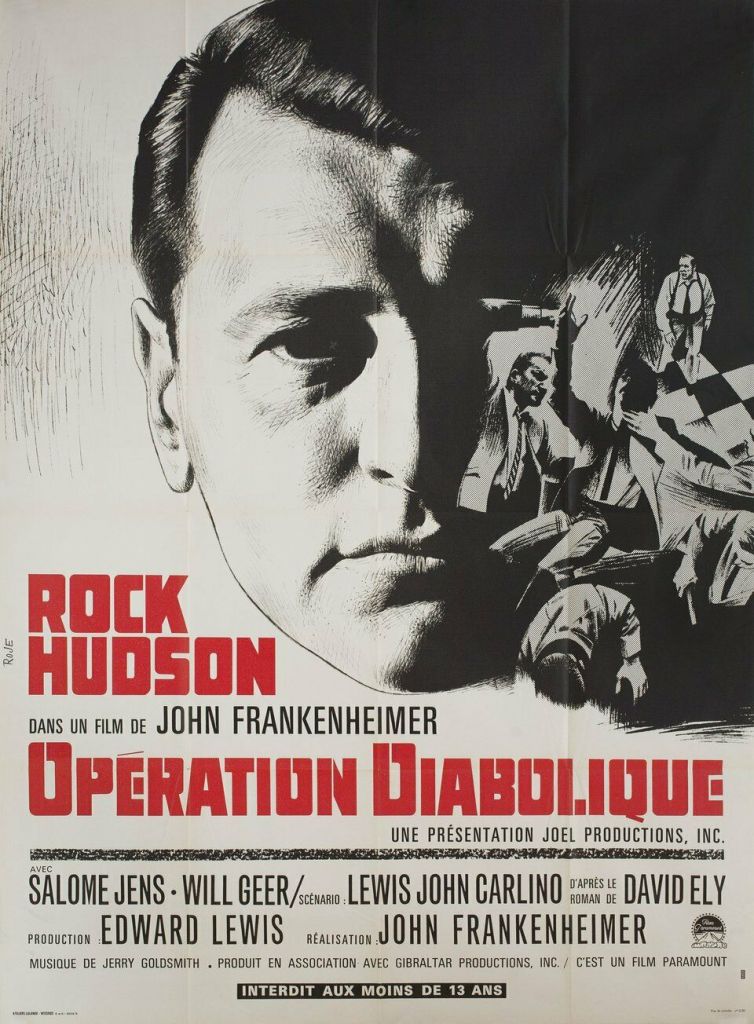
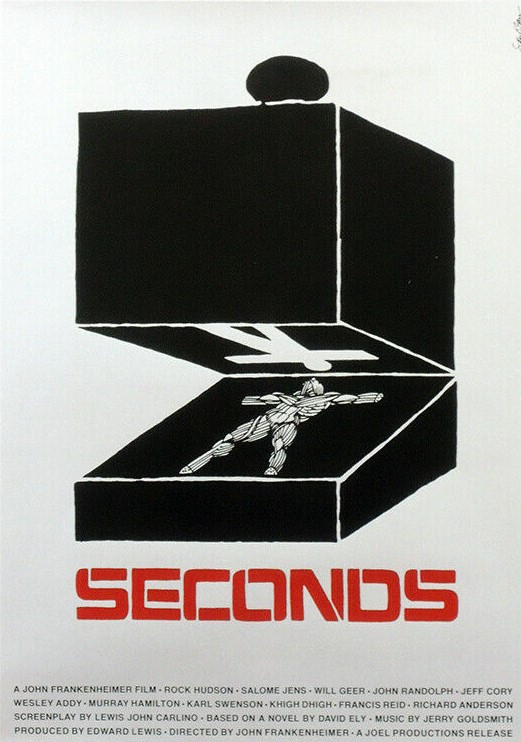
Seconds (1966) *****

John Frankenheimer’s censor-baiting and game-changing paranoia drama was decades ahead of its time – it created the template for Blade Runner (1982), The Swimmer (1968), The Stepford Wives (1975), The Parallax View (1974) and The Truman Show (1998) to mention just a few –  and underneath the sci-fi surface asked deeper questions about identity, reality and depression. And it might well qualify as reaching for the impossible dream. Kafkaesque aspects intrude. It’s as much an essay on hopelessness as it is on hope, a scorching portrayal of the human condition. Unusual camera angles and depth of field make this a visual, if occasionally challenging, delight.

Disillusioned banker Arthur (John Randolph), marriage off-kilter, reacting to a call from someone he believes is dead, gets hooked into a deal which promises rebirth. After plastic surgery and a faked death, he is reborn as a much more handsome figure (Rock Hudson), pursues a new career as an artist, is sexually re-born during an orgy, but finds memories of his old life resurfacing at  inopportune moments and takes against the notion that he has to recruit friends or colleagues to go through the same process.

Although audiences had been treated to some paranoid impulses like The Manchurian Candidate (1962) and films dealing with mental health such as Lilith (1964), this was the first film to touch on paranoia about big business, the unseen conglomerates controlling lives in unseen ways that directors in the 1970s pounced upon. Although a piece of breakthrough technology, the rebirth business is now just that, a business, wherein an anonymous  corporation, known here only as The Company, seeks to maximize profit from human misery.  

You could almost view the men who had more successfully undergone the experiment than Arthur as Stepford Husbands, guys who had created an ideal version of themselves. They could be body snatchers who have stolen a more convenient body. In another respect, the conventional Arthur turns into the rebel in society, refusing to accept this new creed. And he is gullible enough to believe his employers will accommodate his demands.   

On the one hand it is a self-destructive horror story. Arthur willingly gives in to his desire for a better life regardless of the emotional cost and is somewhat surprised to find that the community in which he lives is a construct, almost as fictional as any computer game.

It is an amazing mixture of sci-fi and horror. But the sci-fi has the bleakness of Blade Runner,  the hospital and offices where the future unfolds are drab, while the beach locations have an uncanny unreality. The horror is for the most part confined to two scenes – the new Arthur waking up swathed in bandages and later, strapped to a gurney, realizing too late his destiny.

But mostly what I found resonating was the examination of male psyche and its inability to deal with adversity and depression. Arthur isn’t so much desperate to wake up as a handsome hunk as to enter a new existence where he does not feel so lonely and displaced, where he can discover the humanity he has lost. It is not that he wants to be absolved of all responsibilities but wishes to be free of his current joyless life. While he becomes an improved physical specimen, he finds to his consternation that he has not shaken off the gloominess lurking in his brain.

The futuristic aspects are compounded by brilliant down-to-earth scenes. Company executive Ruby (Jeff Corey) goes into all the details of their contract while eating a chicken dinner, an old friend Charlie (Murray Hamilton) is deskbound, when Arthur arranges in his new skin to meet wife Emily (Frances Reid) he discovers his old true self had been only too apparent, cursed with unspoken longing and divorced from reality. Even romance with the outgoing Nora (Salome Jens) only offers brief reinvigoration after he partakes in an orgiastic grape-stomping event.

This is Frankenheimer’s masterpiece, and given he also directed The Manchurian Candidate, that is some accomplishment. He exercises total control in a film about total control but he is indebted to cinematographer James Wong Howe for developing new techniques to achieve a quite different, often austere, look.

It incurred the wrath of the Production Code – the U.S. censor – with scenes of full-frontal female nudity. These were all cut (though you will find them on the DVD). Whether their inclusion would have turned the film into a hit – rather than being booed at the Cannes Film Festival and a big flop at the American box office – is a moot point since, at that time, films as obscure as Blow Up (1966) had attracted big audiences due their more permissive approach. This should have been a late career transition for Rock Hudson (Strange Bedfellows, 1965) into more mature work but his excellent and brave performance was dismissed by the critics.

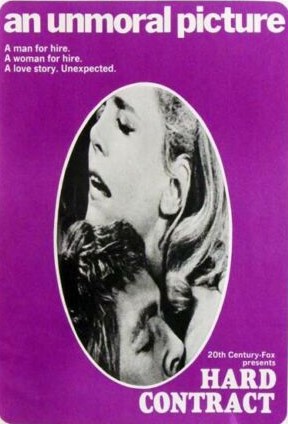
Hard Contract (1969) ***

A hitman movie that verges on the existential is always going to be intriguing. Stone cold killer John Cunningham (James Coburn) manages to keep the world at a distance until he runs into the vibrant Sheila (Lee Remick) in Spain. The film is a curiosity of an admittedly small genre dominated by such disparate offerings as The Killers (1946 and 1964), Yojimbo (1961), Le Samourai (1967) and Stiletto (1969). Here, although Cunningham does bump people off, you never see the violence. We’ve come to expect hitmen to be introspective, but there’s never been anyone as closed-off as Cunningham. No romance in his life, only hookers, no apparent depth, in fact we learn very little about him.

He only runs into Sheila because for a laugh she pretends to be a sex worker. In reality she’s a wealthy divorced socialite running with a fast set that include Adrianne (Lili Palmer) and ex-Nazi Alexi (Patrick Magee) whom she loves to taunt but whose contacts allow Cunningham to be effectively stalked. And as unsavory that might be from today’s perspective, it sheds light both on her power and whimsicality.

There’s an unusual background. Amid the extensive jet-setting in Torremolinos, Madrid and Tangiers, there are reality counterpoints, reflecting the issues of the decade – violent demonstrations with police using water cannon to control the crowds, the American elections and discussions about God, world hunger, the Holocaust, terrorism and population growth.

No doubt the script is wordy, but there’s hardly a word that doesn’t challenge convention. It’s steeped in amorality – a touchstone of the decade – good only occurs “when evil takes a rest” and the world is “immune to murder.” And you certainly get the impression that the rich can confront anything because, not having to live in the ordinary world, they can get away with it. Conversely, this is also one of those films where you wonder who did the wardrobe (Gladys de Segonzac, since you ask, who ran fashion house Schiaparelli in the 1950s) because not only does Sheila sport clothes that would have delighted Audrey Hepburn but Cunningham gets away with wearing a white jacket.

And if Korean vet Cunningham is enigmatic, the insomniac Sheila is cut from a similar cloth, and while a potential source for redemption is as likely to have sex with a casual pickup in a filthy alley. The story does not go quite the way you would expect – Cunningham’s growing dissatisfaction with his profession revealed when he can’t perform in a Brussels brothel. And his mindset allows him to consider mass murder as a solution to an emotional problem he cannot solve.

At core, of course, is whether once Cunningham’s emotional defenses are breached he can continue as a hitman, and  whether Sheila can accept his profession. The stakes rise when it transpires that (like Stiletto made the same year) retirement is not an option.

And for all the seriousness on show, there are some imaginative moments of hilarity – Cunningham’s idea of a love song is “To the Shores of Tripoli” and Adrianne proves determinedly indiscreet. In keeping with the paranoia cycle that was about to explode, you never find out why people are being murdered, or even who they are, far less the group which his boss Ramsay (Burgess Meredith) is fronting.

Far removed from the Derek Flint persona that had turned him into a star, James Coburn delved deeper into the amoral territory he had previously explored in Waterhole 3 (1967). Lee Remick (The Detective, 1968) is sheer madcap delight even when espousing her odd takes on philosophy. Lili Palmer (The Counterfeit Traitor, 1962), who by this point in her career was usually the wife or girlfriend, creates a very original character. Veteran Sterling Hayden had only made one film (Dr Strangelove, 1962) in a decade and is excellent as a contemplative retired hitman. Patrick Magee (The Skull) gives another of his tight-lipped performances. Karen Black (Easy Rider, 1969) has a small role as does Sabine Sun (The Sicilian Clan, 1969).

This marked both the debut and the demise of the directorial career of S. Lee Pogostin, best known at this point as the screenwriter of Pressure Point (1962) and Synanon (1965). In terms of argument over issues it stands comparison with Pressure Point but without that film’s intensity.

I remember being baffled by the picture when it came out and I was a teenager because the action I believed I had been promised never materialized but otherwise I could remember little about it so now it appears as an interesting antidote to the mindless action pictures.  

This is another freebie available on YouTube.

https://www.youtube.com/results?search_query=hard+contract+1969

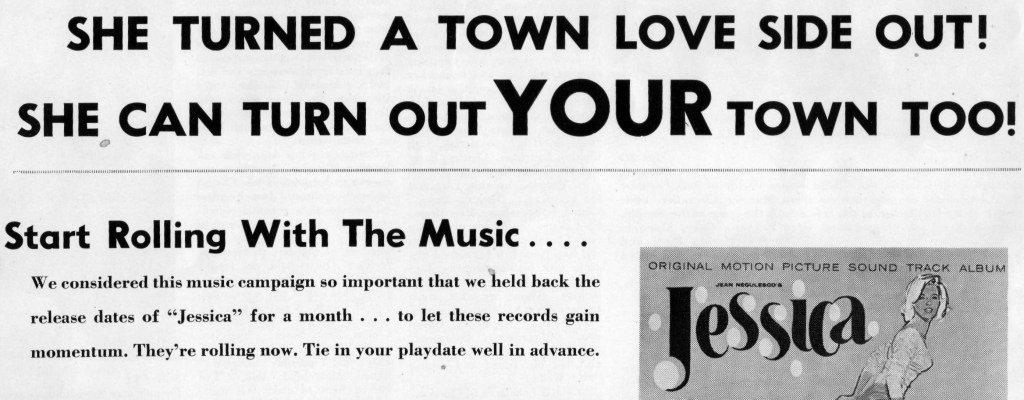
Selling Angie Dickinson – “Jessica” (1962)

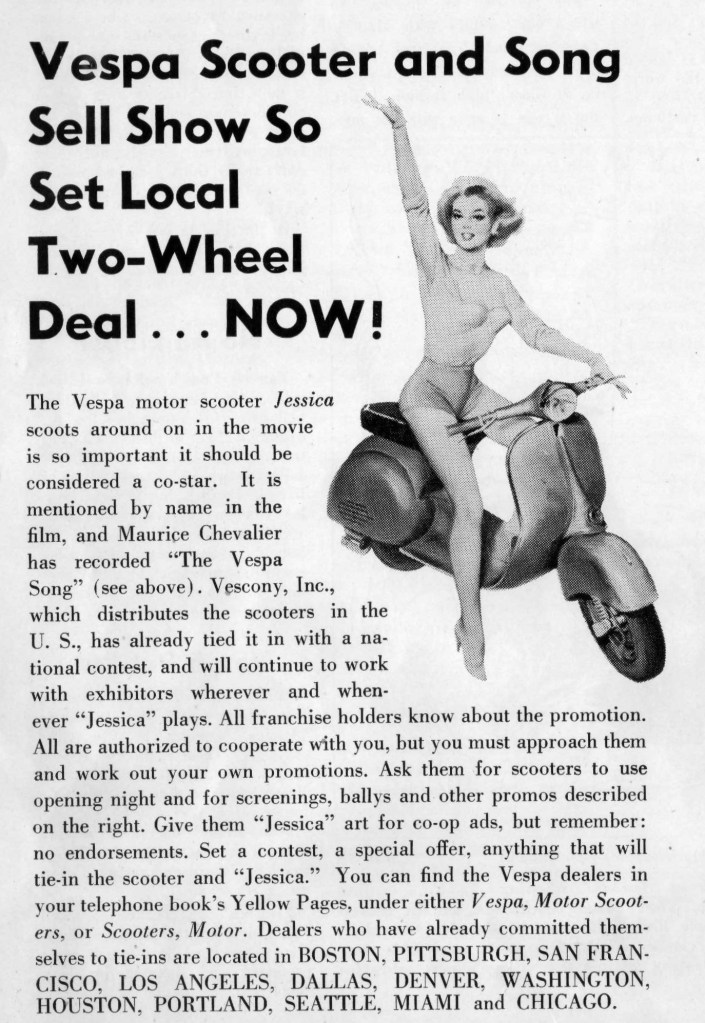
There was an age-old rule of thumb in Hollywood marketing. You can ignore iron-clad contracts as regards credits and billing if you have a sexy girl to promote. The top-billed Maurice Chevalier had been a major Hollywood star for nearly three decade from the likes of The Merry Widow (1934) to Gigi (1958) and twice Oscar-nominated. But you can scarcely see his face in any of the posters. He was passed over in favor of the glorious image of Angie Dickinson astride a Vespa scooter. And, unusually, for an industry that sold females in terms of facial features and bosom, Dickinson’s posterior was given as much prominence as the rest of her figure.

Bearing in mind the Vespa trick had already been used in more fashionable fashion by Audrey Hepburn in Roman Holiday, this was probably a more sensible approach. While there’s no doubt Dickinson was stylish nobody would ever beat Hepburn when it came to haute couture so there was no point trying, although it has to be said the sweater look was something of a throwback to the 1940s.

However, there were two other pieces of more stylish artwork as back-up for an exhibitor looking askance at the obvious and with more discerning patrons. While Mitchell Hooks was responsible for the main poster, also turning their hand to  promotional material were director Jean Negulesco (whose effort is pictured at the top) and artist Bernard Buffet who both concentrated on face to the exclusion of figure. Negulesco had begun his career as an expressionist artist in the 1920s and the Pressbook marketeers took this idea further by claiming that “every frame of the film was composed with such care that the picture…can be said to be painted with a camera.” 

Negulesco was a noted art collector and paintings by Bernard Buffet, also a French expressionist, adorned his walls. In 1955 Buffet was named the top post-war artist and his first retrospective at the age of just 30 was held three years later.

As readers of these occasional articles on Pressbooks will know, marketing a movie around one image was rare but the image of Jessica (Angie Dickinson) mounting a scooter was used exclusively in all posters even though the background and taglines might change. The background showed the locale, some subsidiary characters and dancing. You have to look close to catch a glimpse of top star Maurice Chevalier – he’s the guy in black toting a guitar.

The taglines centered on the mischievous Jessica causing marital mishap in sun-filled Italy. “Here comes trouble. The most delightful, delicious siren who ever scooted into town and put marriages on the skids!” was the main tagline. The rest were along similar lines. “She’s the most luscious forbidden fruit that ever dropped into the screen’s lap.” / “She lives it up saucily in Italy.” / “Meet the gal who took Italy by storm with a scooter, sweater and a smile.”   

The more artistic posters by Negulesco and Buffet had different taglines: “Not in a month of Never on Sundays have you heard such wonderful songs” and “Jean Negulesco, who put Rome on the map with Three Coins in the Fountain, now works wonders on the shores of the blue Mediterranean in Jessica, a most mischievous girl.” The marketeers of course were taking some artistic license since Roman Holiday preceded Three Coins in the Fountain.

The Pressbook offered a couple of pages of nuggets for hungry newspaper editors with Chevalier at last getting some attention – the “crooning cleric” was described as “the perennially youthful Frenchman (who) had sung, danced and acted his way across the stages of the world enjoying the adulation of several different generations.”  Chevalier was given tips on his guitar by a local singing cleric, apparently.

But there was little chance, even in print, of Chevalier stealing Dickinson’s thunder especially when particular reference was made to her nude swimming scene, for which she wore a skin-colored bikini to the disappointment of the hundreds of locals who climbed up a steep slope to the waterfall location.

Jean wasn’t the only artistic member of the Negulesco clan. His wife Dusty, also a painter,  designed the wardrobe, wrote lyrics for the film’s songs and taught Dickinson how to ride a scooter. The movie was filmed on location in the village of Forza d’Agro on a clifftop 1,000 feet high. The shoot lasted 55 days with 2,600 people from the surrounding area employed as support staff or in bit parts and extras. The production spent about $113,000 (over $1 million at today’s prices) on accommodation and meals and purchased 8,300 gallons of fuel. Traditional Sicilian music was incorporated into the film.

Given Chevalier was singing it was inevitable and promotionally essential to put out a single, this was “Jessica” backed by “The Vespa Song.” There was also an original soundtrack album. Both were ideal material for local radio stations to play during the film’s launch.

A key element of the promotion was a tie-up with Vescony inc which distributed Vespa scooters in the U.S. There was a national competition and franchisees were ready to lend scooters to theaters for openings and special screenings or just to sit in the lobby attracting attention. A subplot involving gardening inspired marketeers to suggest exhibitors give away orchids to women named Jessica and had tied up with supplier Orchids of Hawaii. Other ideas included targeting local midwives – both male and female – and a “Jessica Jump” reflecting the film’s wedding scene. There was book tie-in based on the source novel The Midwife of Pont Clery by Flora Sandstrom published by Pocket books.

Bernard Buffet’s involvement was something of a coup and promised an opportunity to create a promotion appealing to art lovers. “Not since Toulouse-Lautrec made advertisements for nightclubs has an artist of this stature contributed to ads for popular entertainment.”  

Vendetta for The Saint (1969) ***

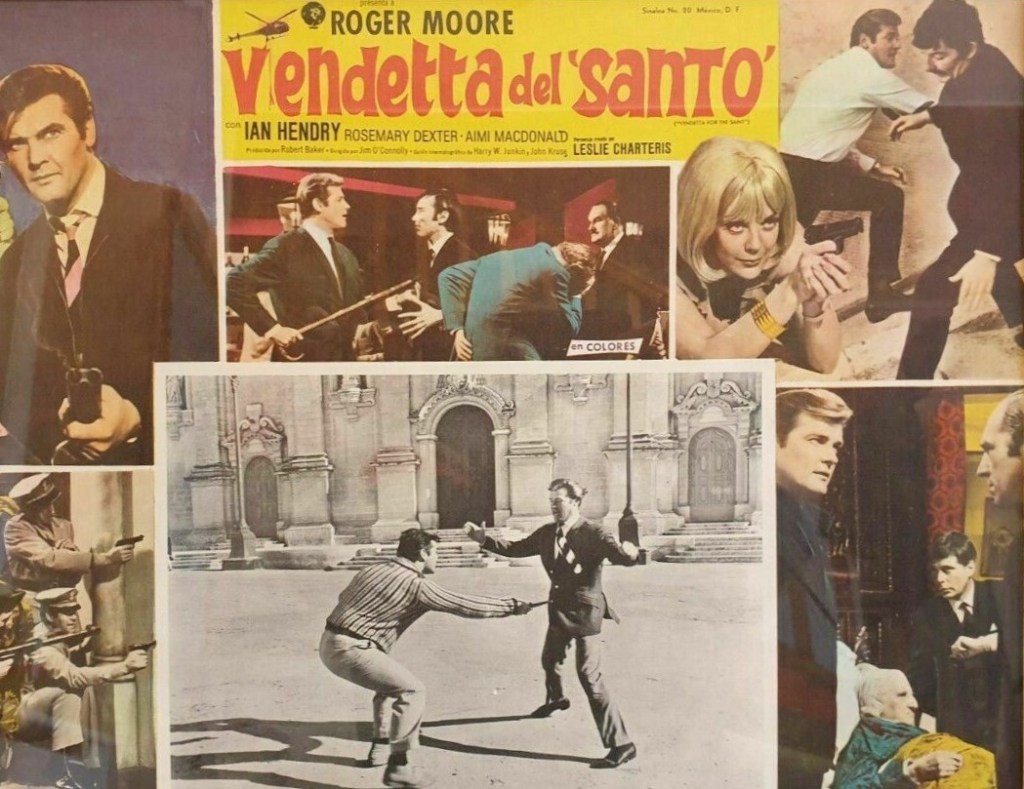
This big-screen version of small-screen hero is as pleasant a diversion as you can get. Nostalgia pretty much gives it a free pass and in any case the action, which punctuates the drama at regular intervals, was always going to be budget-restricted. Despite being in almost constant danger the insouciance of gentleman thief Simon Templar dictates that the pace is no more than languid.

As the title suggests, we’re in Mafia country, Templar (Roger Moore) drawn into a Cosa Nostra succession scenario as the result of a casual encounter with former bank clerk Houston (Fulton Mackay) later found dead. Houston has cast doubts on the real identity of  Mafia Don Destiamo (Ian Hendry) one of several contenders to become the next Mafia overlord. Templar sneaks into Destiamo’s world by pursuing his niece Gina (Rosemary Dexter). Although outwardly respectable, Destiamo a bit too fond of using his cigar as a weapon of disfigurement, threatening his blonde English moll Lily (Aimi McDonald) in this fashion.

Part of Templar’s attraction is that although he has a nefarious side he is happy to walk those mean streets and has a strict moral code. And he moves in such elevated circles that he has a nodding acquaintance with dying Mafia chieftain Don Pasquale (Finlay Currie) who has yet to pick his successor.

The other part of his attraction is that he’s played with such suaveness by Roger Moore. For a good chunk of the time someone is trying to knife him, shoot him, blow him up, capture him, jab him with a truth serum, and generally trying to stop him. In fending off such attacks, or out-smarting the villains, there’s rarely a hair out of place. It’s not so much devil-may-care as devil-is-wasting-his-time with such an imperturbable fellow.

Although the action is pretty straightforward, Templar is not above a clever ruse – jamming a bus in a gateway preventing his pursuers continuing the chase – nor an old one such as tying sheets together to climb out of a window. While Malta stands in for Italy, the locations still look authentic enough, ancient stone buildings, the occasional horse pulling a cart. When the action/drama eases up, there’s always pleasant scenery.

Following MGM’s success in stitching together into a movie two episodes of The Man From U.N.C/L.E. television series (an idea of course the studio had pinched from Walt Disney’s cinematic re-presentation of Davy Crockett episodes) it was no surprise that ATV, then under the control of future movie mogul Sir Lew Grade (Raise the Titanic, 1980), decided to adopt the same idea. Although The Saint had been showing on British television since 1962, by the end of its run in 1969 it had stepped up to bigger budgets, 35mm and color. Given each episode lasted around 50 minutes, it was relatively simple to devise a two-part program shown over consecutive weeks on ITV in Britain and then release it throughout the rest of the world as a feature film. The first such project was The Fiction Makers (1968) followed by Vendetta for the Saint.

Roger Moore’s movie career had been in limbo since Romulus and the Sabines (1961) and there’s no doubt that his performance as Simon Templar and later in another glossier British television series The Persuaders (1971-1972) made him a candidate for James Bond. While his interpretation of Templar, especially the wry delivery, does bear some similarities to his incarnation as 007, that only holds true as long as you set aside the year’s supply of Brylcreem dumped on his hair, the shoulder-padded shoulders and the fact that he had not yet perfected his trademark move, the raising of the single eyebrow.

While no match for the quips prevalent in James Bond, Canadian screenwriter Harry W. Junkin – best known for his television work, his only other movies being a similar melding of television episodes of The Persuaders – and John Kruse (Hell Drivers, 1957) – had some neat one-liners. Despite the obvious limitations, director Jim O’Connelly (Berserk, 1967) does a decent enough job.

But Moore carries the show. Ian Hendry (The Hill, 1965) makes a passable villain but not a passable Italian. In general, not surprisingly since most characters were played by British actors, the accents are all over the place though Moore, courtesy of squiring Luisa Mattioli (later his wife) managed to deliver his Italian lines in an acceptable accent. Otherwise the only one who comes close is Rosemary Dexter (The Shoes of the Fisherman, 1968) and that’s because she was Italian. Worth checking out in the supporting cast are Finlay Currie (Ben Hur, 1959) and Fulton Mackay (BBC series Porridge, 1974-1977).

You can find a lot wrong with this without looking very hard but if you switch off your over-critical faculties you will be pleasantly surprised.

Rough Night in Jericho (1967) ****

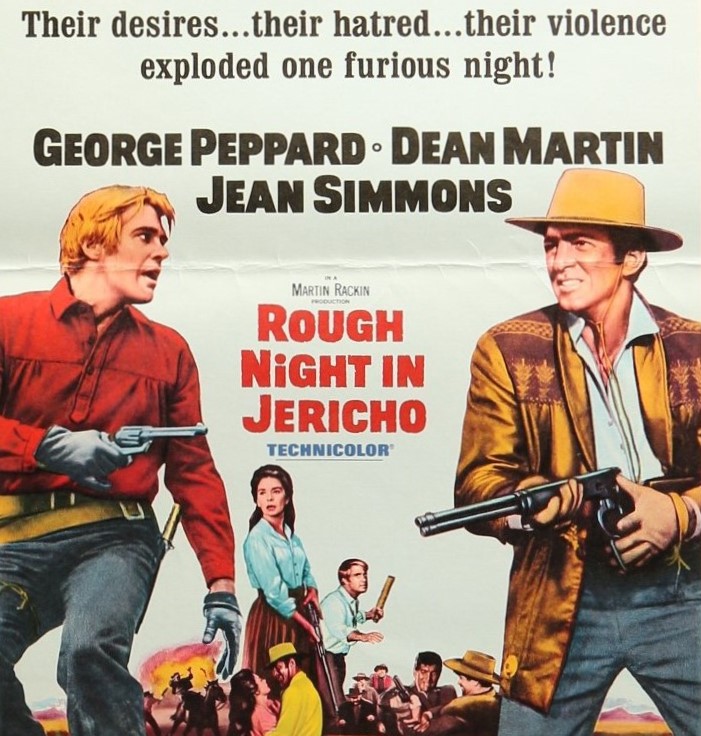
Woefully under-rated western with three A-list stars at the top of their game in a taut drama with an explosive ending. Not surprising it was overlooked at the time with John Wayne duo El Dorado and The War Wagon, Paul Newman as Hombre and an onslaught of spaghetti westerns garnering more attention at the box office. Though a rewarding watch, be warned this is more of a slow-burn drama than a traditional western and both male leads play against type.

Former lawmen Dolen (George Peppard) and Ben Hickman (John McIntiyre) have invested in a stagecoach business owned by twice-widowed Molly Lang (Jean Simmons), just about the only business in Jericho in which Alex Flood (Dean Martin) does not have a controlling interest. Dolen’s first reaction on surmising Flood’s power is to quit, “stepping in’s a habit I outgrew.” And it’s not a bad approach given that Flood is judge, jury and executioner and apt to leave victims strung up to dissuade dissent.

Dolen and Flood have a great deal in common, moving from ill-paid law enforcement into business, Flood, having cleaned up the town, staying on the reap the profit. While Dolen avoids confrontation, Molly aims to stir up opposition, invoking ruthless reaction.

What’s unusual about this picture is it’s mostly a duel of minds, Dolen and Flood testing each other out, neither backing down even while Dolen intends quitting and when he happens to win a bundle in a poker game with Flood you have the notion that was somehow an inducement to help him on his way.  It’s a power game of sorts, too, between Dolen and Molly, she determined to give no quarter to the point of drinking him under the table.

But when violence occurs it is absolutely brutal, Flood’s knuckles bloodied raw as he batters a man foolish enough to challenge his rule of law, Dolen taking an almighty whipping from Yarbrough (Slim Pickens), Molly viciously slapped around by Flood for daring to look at Dolen. When Dolen does move into action it is with strategic skill, gradually reducing the odds before the inevitable shoot-out between respectable citizens and gangsters.

A good half century before the notion took hold, this is a movie as much about entitlement, about those doing the hard work receiving just reward, Flood, having risked his life to tame the town, deciding he should be paid more than a sheriff’s monthly salary. And the western at this point in Hollywood development had precious few female businesswomen in the vein of Molly.

Cover of the Pressbook

Both Dean Martin and George Peppard play against type. An unexpected box office big hitter through the light-hearted Matt Helm series, Martin explodes his screen persona as this vicious thug, town in his thrall, contemptuous of his victims, turning politics to his advantage, but still happy to hand out a beating when charm and chicanery fail. This is one superb, and brave, performance.

For Peppard, this picture is the bridge between the brash persona of The Blue Max (1966) and Tobruk (1967) and the thoughtful introspective characters he brought to life in P.J. / New Face in Hell (1968) and Pendulum (1969). Perhaps the most telling difference is a little acting trick. His blue eyes are unseen most of the time, hidden under the shade of his wide-brimmed hat. He is not laid-back in the modern sense but definitely unwilling to plunge into action, movement both confined and defined, a man who knows his limits and, no longer paid to risk his life, unwilling to do so.

Jean Simmons (Divorce American Style) is in excellent form, neither the feisty nor submissive woman of so many westerns, but clever and determined, perhaps setting the tone for later female figures like Claudia Cardinale in Once Upon a Time in the West (1969) and Raquel Welch in 100 Rifles (1969).

And this is aw-shucks Slim Pickens (Major Dundee, 1965) as you’ve never seen him before. John McIntire had spent most of the decade in Wagon Train but he punches above his weight as a mentoring lawman. If you are trying to spot any other unusual figures keep an eye out for legendary Variety columnist Army Archerd  who was a walk-on part as a waitperson.

More at home in television, director Arnold Laven took to the big screen on rare occasions, only twice previously during the decade for Geronimo (1962) and The Glory Guys (1965), but here he handles story and character with immense confidence and considerable aplomb. The direction is often bold – major incidents occur off screen so he can concentrate on the reactions of the main characters. There is a fabulous drunk scene, one of the best ever – plus an equally good hangover sequence –  the violence is coruscating, all the more so because it is not delivered by gun.

The screenplay by Sidney Boehm (Shock Treatment, 1964) and Marvin H. Albert (Duel at Diablo, 1966) swings between confrontation and subliminal menace.

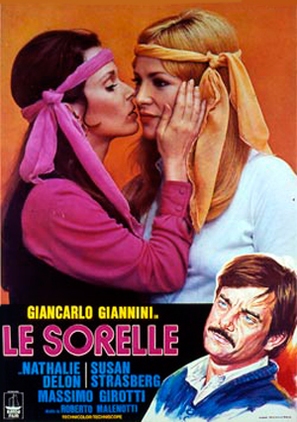
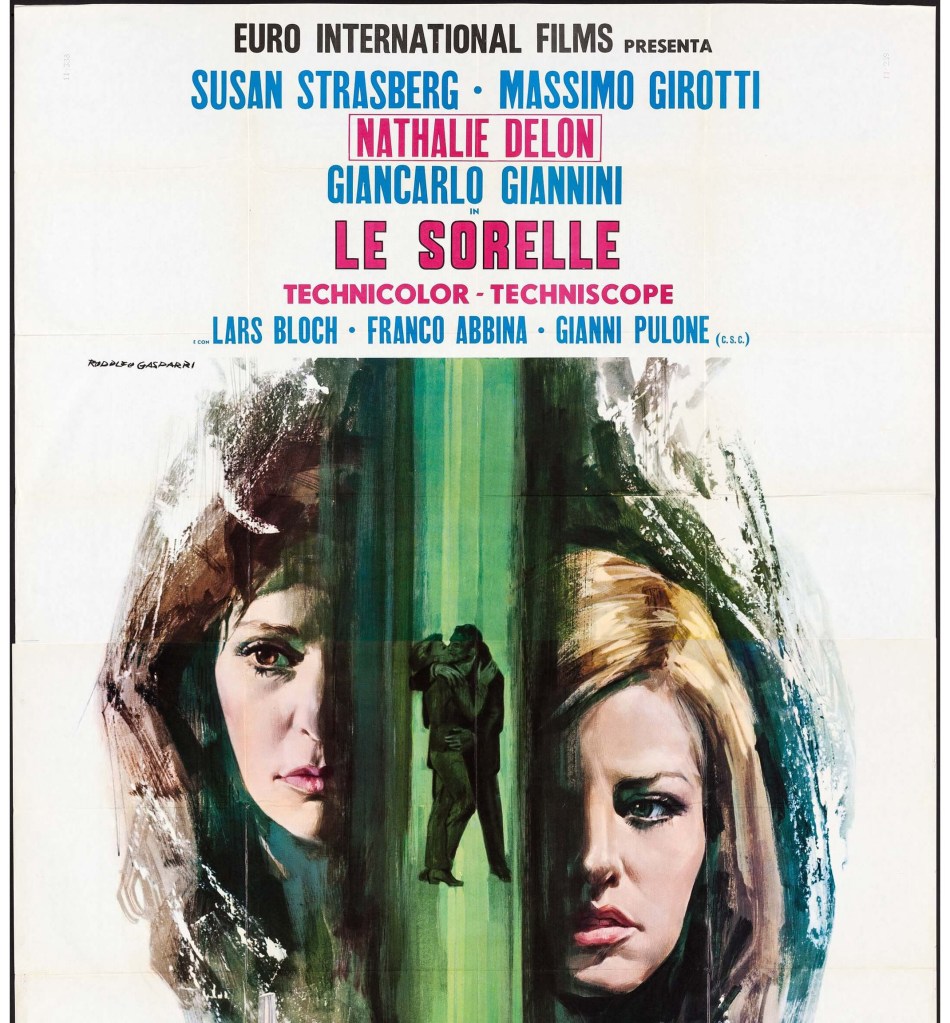
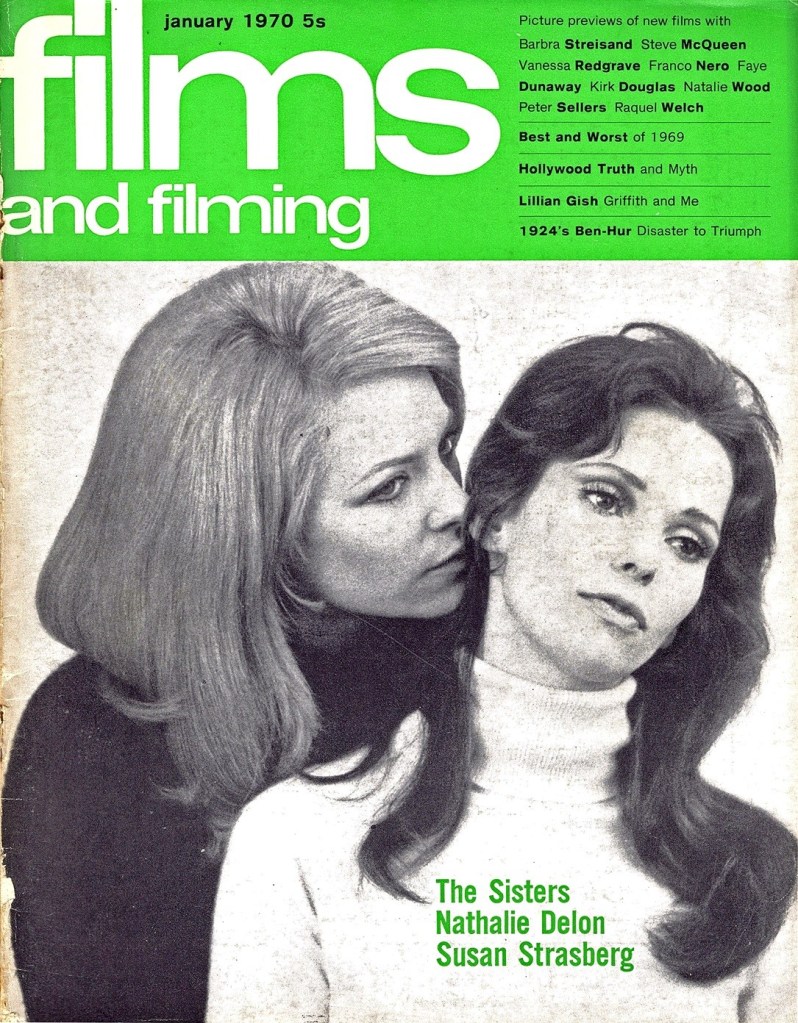
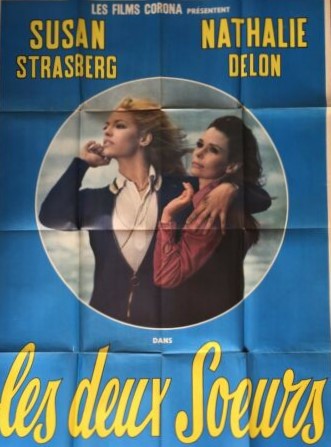
Sisters (1969) ****

Erotically-charged, symbolically-heavy French drama of siblings trying to re-establish the intense relationship they enjoyed as teenagers. After a nervous breakdown and on the point of divorce, blonde translator Diana (Nathalie Delon) seeks respite at the home of younger sister Martha (Susan Strasberg), a brunette happily married to the wealthy and indulgent Alex (Massimo Girotti).

Initially, the more worldly Diana, the more flamboyant dresser, appears the superior but it soon transpires she is the more fragile. The apparently timid Martha allows her husband to control her life to the point of buying all her clothes and she confesses to feeling as if she is on “a perpetual cruise.” While on the surface, it seems as if she has given up too much, in reality she disapproves of disorder and seeks perfection. She comes across as needing protection, and believes the woman’s role is to sacrifice, but in fact has managed to arrange her life to her own satisfaction.

Their competitive streaks emerge in different ways, Diana in obvious fashion, seeking to beat her sister while out horse-riding, Martha in more subtle and sensual manner, flaunting her sexual relations with her husband, almost offering her sister to her husband, and having a lover (Lars Bloch) on the side. There is a sense of each attempting to impose their world view on the other. Diana gives her sister a make-over, a new look which Alex adores, Martha hates it. There’s a sense of a chess game, males the obvious pawns.

Sensuality is never far away. Diana nuzzles her sister’s neck to smell her perfume. Alex is photographed, encouraged by Martha, in almost intimate mode with Diana. Dario (Giancarlo Giannini) is brought in to tempt Diana. And a scene where the girls experiment with colorful scarves suggests libertarianism. 

But it is clear that both sisters live empty lives devoid of true love and equally obvious as the picture progresses that both have arrived at the conclusion that they were at their most happiest when together. There are subtle hints of incest, comforting each other in bed, the sensuality electric and the film begins to examine whether this taboo can be crossed and, if so, will it provide the necessary escape.

Despite Martha’s apparent subjugation, there is more than an inkling of feminism, the girls involved in a complicated scenario in which males are either rejected or made to look fools. While not fulfilled, Martha has turned as much as possible to her own advantage and Diana seems perfectly capable of taking what she wants.

Alex provides the symbolism. He cultivates rare plants in a greenhouse that need to hide from the sun, lengthy exposure to whose atmosphere would be fatal to humans. He endlessly photographs them because they won’t last long. And in similar fashion provides a haven for the apparently vulnerable Martha.

Nathalie Delon (When Eight Bells Toll, 1970), married at this point to Alain Delon, shows a subtlety of expression that is rare for someone appearing in just her third film, and effects a gradual character transition throughout. Susan Strasberg, daughter of famed acting coach, Lee Strasberg, inventor of the Method Style of Acting, was one of the boldest actors of her generation, appearing in drug pictures The Trip (1967) and Psych Out (1968). She delivers an excellent portrait of a woman who manages to keep her true personality hidden, and for whom sexuality has few barriers.

This is the puppy-fat version of Giancarlo Giannini (Swept Away, 1974), barely recognizable as the future arthouse superstar whose physical appearance relied on gaunt, angst-riddles features.  Massimo Girotti (Theorem, 1968) is good as the husband who thinks he has everything, not realising how little he has.  

Although this was an accomplished directorial debut from Roberto Malenotti, he only made one more movie. Perhaps he made enough from directing the famous Coke commercial I’d Like To Teach The World To Sing (1971).

Always intriguing, revelations continually undercutting what we think we know of the characters, but delivered in subtle European tones rather than employing Hollywood shock, each of the four main people involved changing considerably due to their interaction with the others. While certainly skirting close to the borders of what was permissible at the end of the 1960s, it does so without exploiting the actresses.

Not an easy one to find, your best bet is a secondhand copy on Ebay.

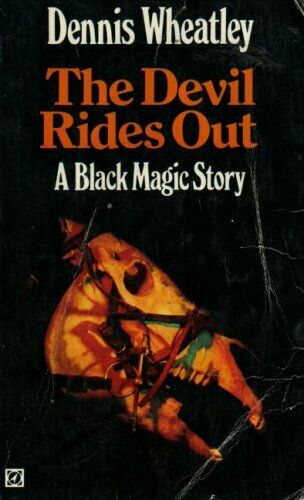
Book Into Film – “The Devil Rides Out”/ “The Devil’s Bride” (1968)

Dennis Wheatley was a prolific bestseller producing three or four titles a year, famous for a historical series set around Napoleonic times, another at the start of the Second World War and a third featuring the “four modern musketeers” that spanned a couple of decades. In addition, he had gained notoriety for books about black magic, which often involved series characters, as well as sundry tales like The Lost Continent.  Although largely out of fashion these days, Wheatley set the tone for brisk thrillers, stories that took place over a short period of time and in which the heroes tumbled from one peril to another. In other words, he created the template for thriller writers like Alistair MacLean and Lee Child.

The Devil Rides Out, his fourth novel, published in 1934, featured the “musketeers” involved in his phenomenally successful debut The Forbidden Territory (1933), and introduced readers to his interest in the occult. Although of differing temperaments and backgrounds his quartet – the Russian-born Duke De Richleau (Christopher Lee in the film), American aviator Rex Van Ryn (Leon Greene) and wealthy Englishmen Richard Eaton (Paul Eddington) and Simon Aron (Patrick Mower) – are intrepid. And while screenwriter Richard Matheson stuck pretty much to the core of the Wheatley story, the film was hampered by the actors. The laid-back Paul Eddington hardly connects with the Wheatley characterization and Patrick Mower is too young for Aron.

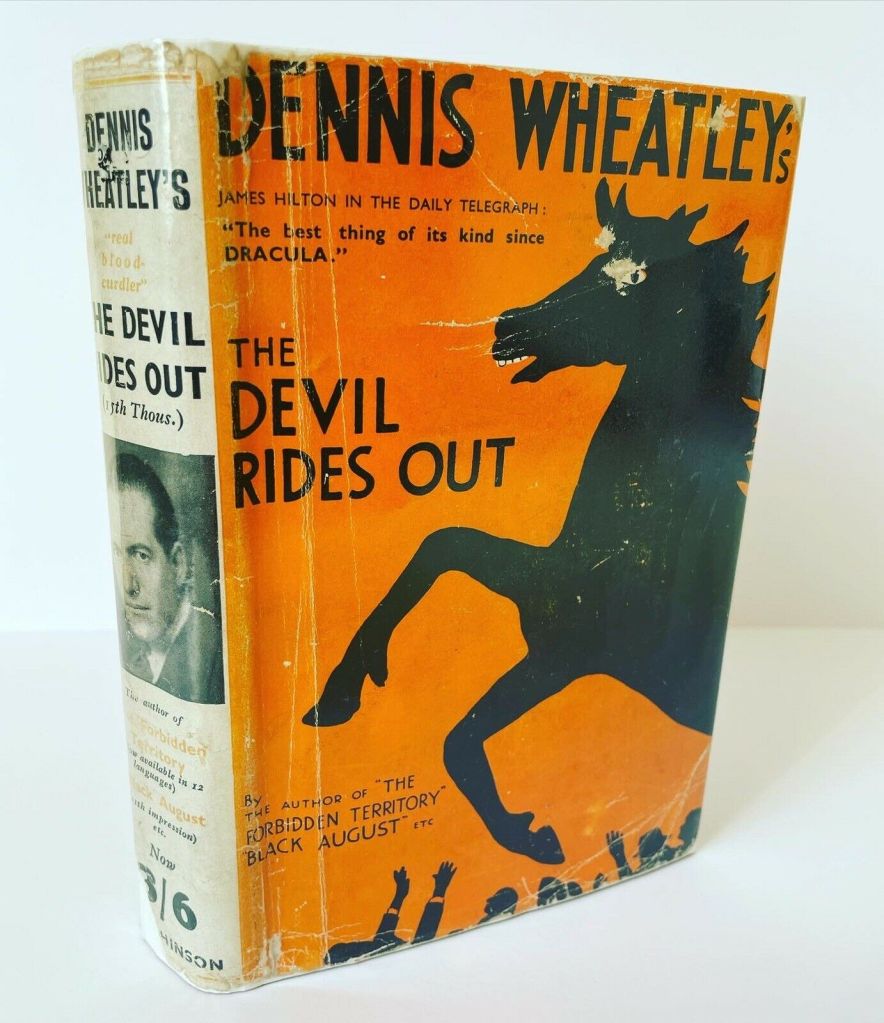
Original British hardback cover.

As with the book, the story moves swiftly. Worried that   Aron is dabbling in the black arts, De Richleau and Van Ryn go haring down to his country house where they meet black magic high priest Mocata (Charles Gray) and discover tools for satanic worship.  And soon they are embroiled in a duel of wits against Mocata, climaxing in creating a pentagram as a means of warding off evil.

In order not to lose the audience by blinding them with mumbo-jumbo the script takes only the bare bones of the tale, bringing in the occult only when pivotal to the story, and that’s something of a shame. A modern audience, which has grown up on enormously  complicated worlds such as those created for Game of Thrones and the MCU, would probably have welcomed a deeper insight into the occult. While out-and-out thrillers, Wheatley’s novels often contained copious historical information that he was able to dole out even when his heroes were in harm’s way. The Devil Rides Out is not a massive tome so it’s a measure of the author’s skill that he manages to include not just a condensed history of the occult but its inner workings. Every time in the film De Richleau goes off to the British Library for some vital information, his departure generally leaves a hole, since what he returns with does not always seem important enough to justify his absence.

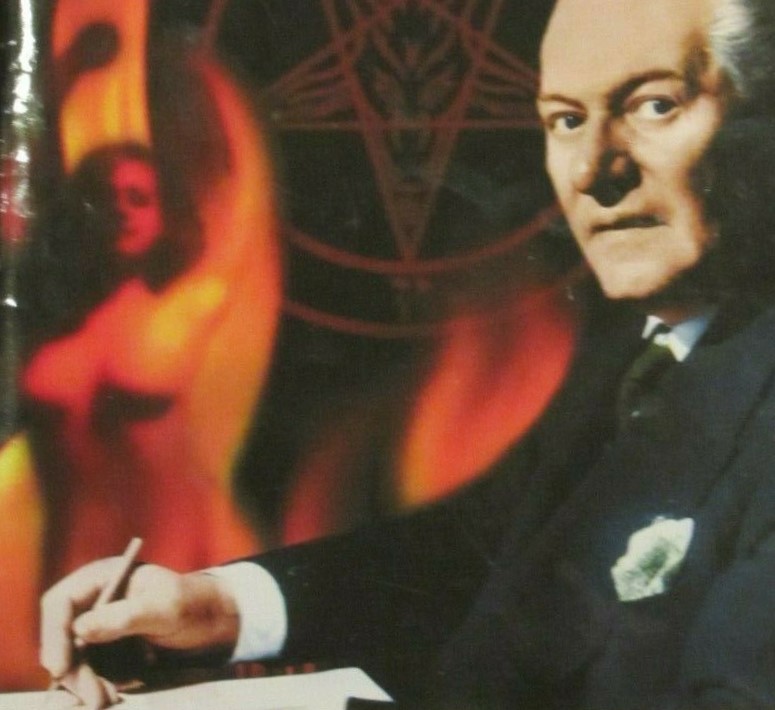
Author Dennis Wheatley.

But then the screenwriter was under far more pressure than a novelist. In some respects, this book like few others demonstrates the difference between writing for the screen and writing for a reader. With just 95 minutes at his disposal, Matheson had no time to spare while Wheatley had all the time in the world. Wheatley could happily leave the reader dangling with a hero in peril while dispatching De Richleau on a fact-finding mission, the action held up until his return. It’s interesting that Matheson chose to follow Wheatley’s characterization of De Richleau, who didn’t know everything but knew where to look. Matheson could easily have chosen to make De Richleau all-knowing and thus able to spout a ton of information without ever going off-screen.

But here’s where the book scores over the film. The reader would happily grant Wheatley his apparent self-indulgence because in the book what he imparted on his return, given the leeway to do so, was so fascinating. There are lengthy sections in the book which are history lessons where De Richleau supplies readers with the inside track on the satanic. In the opening section, once De Richleau and Van Ryn have rescued Aron, the author devotes a full seven pages to a brief introduction to the occult that leaves the reader more likely to want more of that than to find out how the story will evolve.   He has hit on a magic formula that few authors ever approach. To have your background every bit as interesting as the main story is incredibly rare and it allowed Wheatley the opportunity to break off from the narrative to tell the reader more about the occult, which in turn, raised the stakes for the characters involved.

Effectively, there was too much material for a screenwriter to inflict upon an audience ignorant of the occult. Some decisions were clearly made to limit the need for lengthy exposition. But these often work against the film. For example, Mocata wants the Talisman of Set because it bestows unlimited power with which he can start a world war, but in order to accomplish that he needs to find people with the correct astrological births, namely Simon and Tanith. But this element is eliminated from the story, making Mocata’s motivation merely revenge.  Matheson also removed much of the historical and political background, replaced the swastika as a religious symbol with the more acceptable Christian cross, and deleted references to Marie’s Russian background. Her daughter Fleur becomes Peggy. Matheson also treats some of the esoteric light-heartedly on the assumption that seriousness might be too off-putting.

Overall, the adaptation works, you can hardly argue with the movie’s stature as a Hammer classic, but the more you delve into the book the more you wish there had been a way for much of the material to find its way onscreen and to inform the picture in much the same way as the depth of history and character backstory adds to Game of Thrones.

https://www.amazon.co.uk/The-Devil-Rides-Out/dp/B00B1U3FPK/ref=sr_1_1?keywords=devil+rides+out&qid=1637411453&qsid=257-2054786-9327728&s=books&sr=1-1&sres=1448213002%2CB00I628KRY%2CB002SQ7XSG%2C0553824635%2CB00I60ZHNG%2CB09KH2QQVL%2CB00CJB9CVQ%2CB0018H7LPG%2CB07VQ8RZBJ%2CB003Z0IJKA%2C912409160X%2CB07N94V4ZM%2C0241476178%2C1734704144%2C0571311458%2CB092RHPZ93&srpt=DOWNLOADABLE_MOVIE

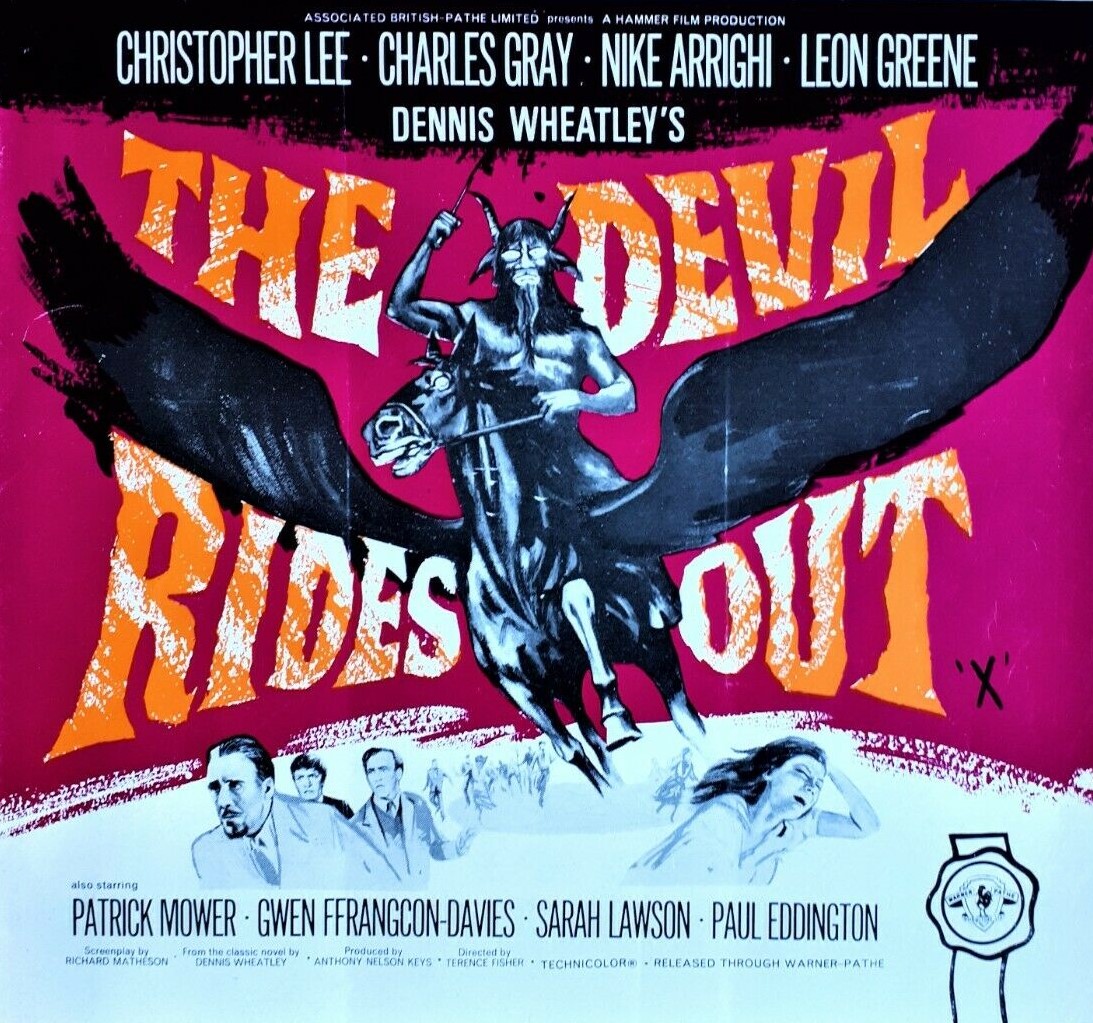
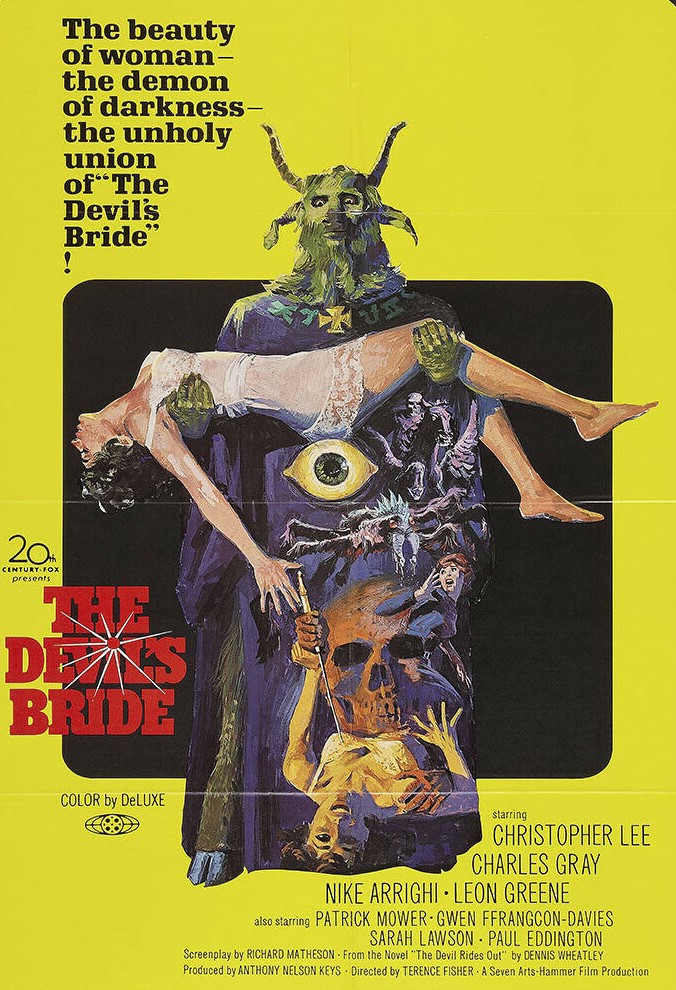
The Devil Rides Out / The Devil’s Bride (1968) ****

Strong contender for Hammer’s film of the decade, a tight adaptation of Dennis Wheatley’s black magic classic with some brilliant set pieces as Nicholas de Richleau (Christopher Lee) battles to prevent his friend Simon (Patrick Mower) falling into the hands of satanist Mocata (Charles Gray).

Initially constructed like a thriller with Simon rescued, then kidnapped, then rescued again, plus a car chase, it then turns into a siege as Richleau and friends, huddled inside a pentagram, attempt to withstand the forces of evil. Sensibly, the script eschews too much mumbo-jumbo – although modern audiences accustomed to arcane exposition through MCU should find no problem accommodating ideas like the Clavicle of Solomon, Talisman of Set and Ipsissimus – in favour of confrontation.  

The title was changed for American audiences.

Unlike most demonic pictures, de Richleau has an array of mystical weaponry and a fund of knowledge to defend his charges so the storyline develops along more interesting lines than the usual notion of innocents drawn into a dark world. In some senses Mocata is a template for the Marvel super-villains with powers beyond human understanding and the same contempt for his victims. And surely this is where Marvel’s creative backroom alighted when it wanted to turn back time. Though with different aims, De Richleau and Mocata are cut from the same cloth, belonging to a world where rites and incantations hold sway.  

While special effects play their part from giant menacing tarantulas and the Angel of Death, the most effective scenes rely on a lot less – Simon strangled by a crucifix, Mocata hypnotizing a woman, a bound girl struggling against possession. Had the film been made a few years later, when Hammer with The Vampire Lovers (1970) and Lust for a Vampire (1971) increased the nudity quotient, and after The Exorcist (1973) had led the way in big bucks special effects, the black mass sequence would have been considerably improved.

The main flaw is the need to stick with the author’s quartet of “modern musketeers” which means the story stretches too far in the wrong directions often at the cost of minimizing the input of De Richleau. In the Wheatley original, the four men are all intrepid, but in the film only two – De Richleau and American aviator Rex van Ryn (Leon Greene) – share those characteristics. At critical points in the narrative, De Richleau just disappears, off to complete his studies into black magic. Where The Exorcist, for example, found in scholarship a cinematic correlative, this does not try.

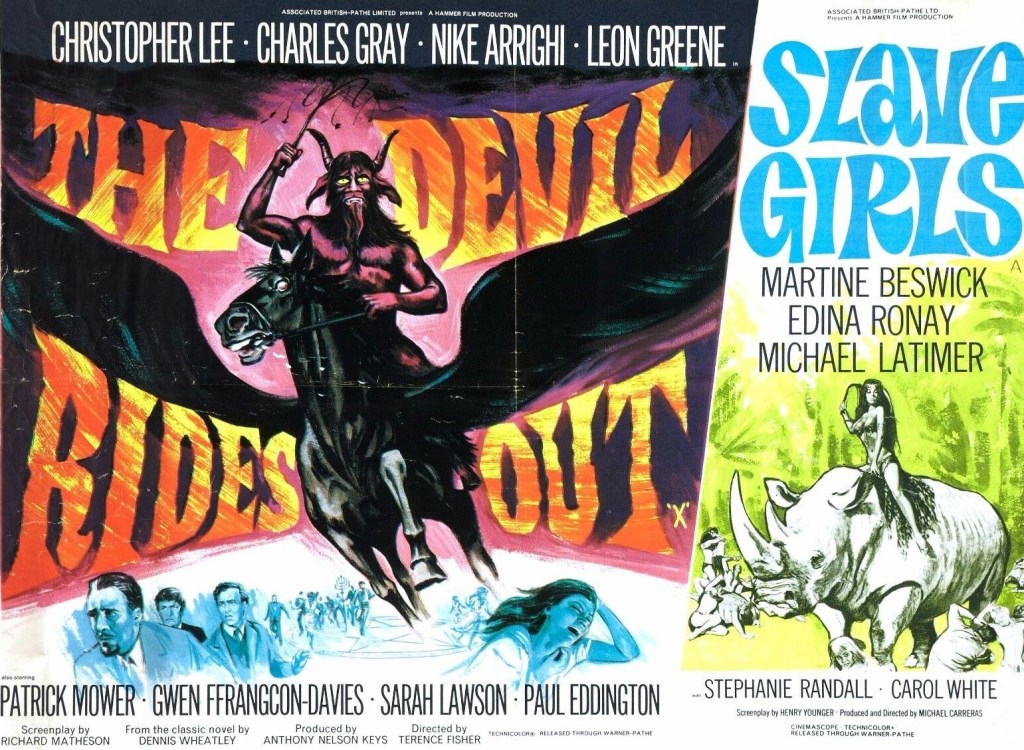
In Britain it was double-billed on the ABC circuit with Slave Girls.

Christopher Lee (She, 1965), pomp reined in, is outstanding as De Richleau, exuding wisdom while fearful of the consequences of dabbling in black magic, both commanding and chilling. Charles Gray (Masquerade, 1965) is in his element, the calm eloquent charming menace he brings to the role providing him with a template for future villains.  The three other “musketeers” are less effective, Patrick Mower in his movie debut does not quite deliver while Leon Greene (A Challenge for Robin Hood, 1967) and Paul Eddington (BBC television’s Yes, Minister 1980-1984) are miscast. Nike Arrighi, also making her debut as love interest Tanith, is an unusual Hammer damsel-in-distress.

Hammer stalwart Terence Fisher (The Gorgon, 1964) creates a finely-nuanced production, incorporating the grand guignol and the psychological.  Richard Matheson (The Raven, 1963) retains the Wheatley essence while keeping the plot moving.

Catch-Up: far from ubiquitous and with a wide range of roles Christopher Lee has appeared several times in the Blog – for Sherlock Holmes and the Deadly Necklace (1962), The Whip and the Body (1963), The Devil-Ship Pirates (1964), The Gorgon (1964), She (1965), The Skull (1965), The Brides of Fu Manchu (1966), Five Golden Dragons (1967), The Curse of the Crimson Altar / The Crimson Cult (1968) and The Oblong Box (1969).

Discover WordPress

A daily selection of the best content published on WordPress, collected for you by humans who love to read.

The Atavist Magazine

by Brian Hannan

WordPress.com News

The latest news on WordPress.com and the WordPress community.