A belated entry into the Cold War thriller genre that appeared to have peaked with Dr Strangelove (1964), Fail Safe (1964) and Seven Days in May (1964). The Bedford Incident, filmed in black-and-white with a less-than-stellar cast nonetheless holds its own as an examination of men under pressure, a cat-and-mouse actioner, as well as a stark warning of the dangers of nuclear war. Perhaps you could not find a more contemporary theme,
Capt Eric Finlander (Richard Widmark) is a maverick U.S. Navy destroyer commander hunting down Russian submarines should they stray into territorial waters. He has been passed over for promotion, despite having previously successfully forced a Russian sub to the surface. Into his meticulously-run ship are dropped photo journalist Ben Munceford (Sidney Poitier) – re-teamed with Widmark after The Long Ships – and Lt. Commander Chester Potter (Martin Balsam), a ship’s doctor. In effect, their presence is a simple device to put Widmark under the spotlight, in some respects to challenge his operational methods, and, as a narrative device, to provide an excuse to tell the audience everything they need to know. Among the ship’s crew are young ensign Ralston (James MacArthur) and former German former U-boat commander Commodore Wolfgang Schrepke (Eric Portman) who acts as an advisor.
The newcomers are afforded insight into how this ship is run and into its hunting methods, for example, dredging up waste from the sea in order to examine it for evidence of a Russian presence. There is a bundle of interesting technical data – a submarine has to surface for air, as another example – and the soundtrack mostly consists of endless sonar. Apart from the German, who appears to subsist on Schnapps, the crew is unusually top-quality, the sick bay deserted, the enterprise run under wartime conditions, every person on board dedicated to fulfilling the captain’s every wish.
The tension is in triplicate. First of all, there is the obsessive captain who could at any time just explode; secondly, there is the hunt for the submarine replete with tactical maneuvers and hunches; and finally, always in the background, there is the nuclear element and the fear that untoward action could trigger a holocaust. And there’s also time to take down a peg or two the holier-than-thou visitors, Dr Potter revealed as a civilian medic returning to the service as a refuge, Munceford as a rather spoiled individual who complains when dangerous maneuvers interrupt his shower. Schrepke has the unenviable task of trying to rein in his boss, Ralston one of the few on board finding the pressure hard to handle.
But Widmark steals the show. His over-acting often stole the show when he had a supporting role, but this is a finely nuanced performance. An admirable, instinctive commander, he is loved by his men (such adoration not easily won) with a gift for battle and outfoxing an opponent, often barely containing his own tension. It would have been easy to ramp up the pressures he felt in the way of Humphrey Bogart as Captain Queeg in The Caine Mutiny (1954) but there’s a big difference between a man about to crack and one who loves battle and is desperate to score victory.
Sidney Poitier (Duel at Diablo, 1966) is excellent in a more relaxed role, combative only in matters of intelligence, and probably benefitting from not having to carry the picture. James MacArthur (The Truth about Spring, 1964) shows acting maturity is moving away from the easier Disney roles in which he came to prominence. Character actor Martin Balsam (Harlow, 1965) excels as always in this kind of role, a man with hidden weakness. Eric Portman (The Man Who Finally Died, 1963), somewhat typecast as a German officer, is given a deeper role where villainy is not his only ace. If you keep your eyes peeled you might spot a fleeting glimpse of The Dirty Dozen (1967) alumni Donald Sutherland, as part of the medical crew, and Colin Maitland as a seaman.
The top-billed Richard Widmark turned producer on this one, as he had done for The Secret Ways (1961), not so much as to greenlight a pet project but to keep a place at Hollywood’s high table just when that seemed to be slipping out of his grasp after the commercially disastrous John Ford roadshow Cheyenne Autumn (1964). In truth, Widmark’s position as an outright star appeared questionable. He seemed to transition all too easily between top billing (Warlock, 1959, The Long Ships, 1964) and second billing (Two Rode Together, 1961, Judgement at Nuremberg, 1961, and Flight from Ashiya 1964).
But the billing oddity from today’s perspective if to find Sidney Poitier – coming off an Oscar win for Lilies of the Field (1963) and later a box office smash in his annus mirabilis of To Sir, With Love (1967), Guess Who’s Coming to Dinner (1967) and In the Heat of the Night (1967) – subordinate to Widmark in the credits department. The Long Ships featured the same billing arrangement.
Also putting his neck on the line was James B. Harris who was making the jump to director from producer of Stanley Kubrick’s The Killing (1956), Paths of Glory (1957) and Lolita (1962). Screenplay honors go to James Poe (They Shoot Horses, Don’t They, 1969) who adapted the bestseller by Mark Rascovich.
Harris makes a sound debut, the decision to film in black-and-white paying off, and enough going on through personality clash and the sub hunt to keep the pace taut. Authenticity was added by filming aboard naval vessels (although British in this case) and what little model work there is does not look out of place. A bigger budget would have made better use of the actual hunt (as The Hunt for Red October, 1990, later proved) but sound effects rather than visual effects suffice. I had not at all expected the shock ending. Another point in this film’s favor is that the threat of nuclear apocalypse has not gone away and the fact remains that the world as we know could disappear at the touch of a button.
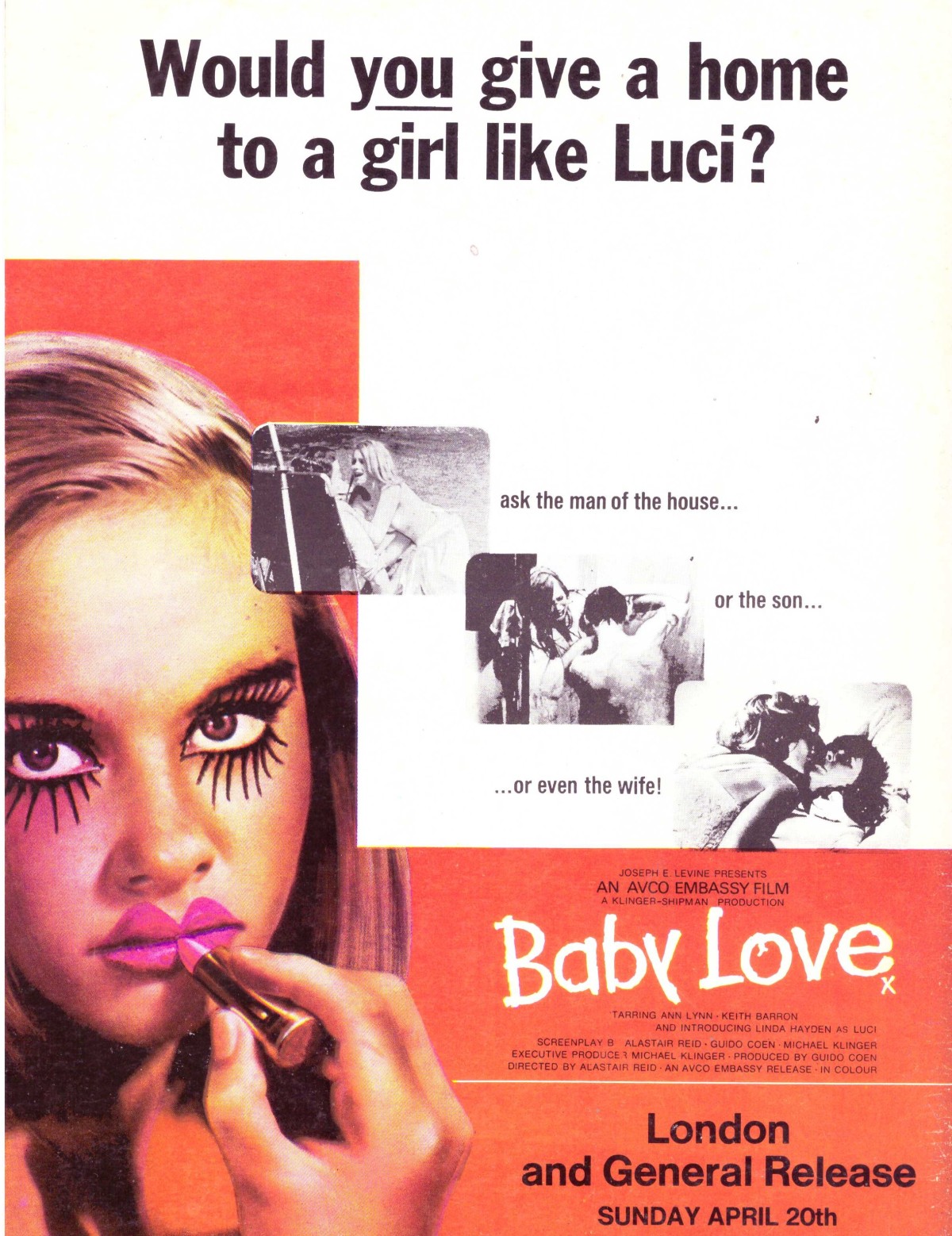
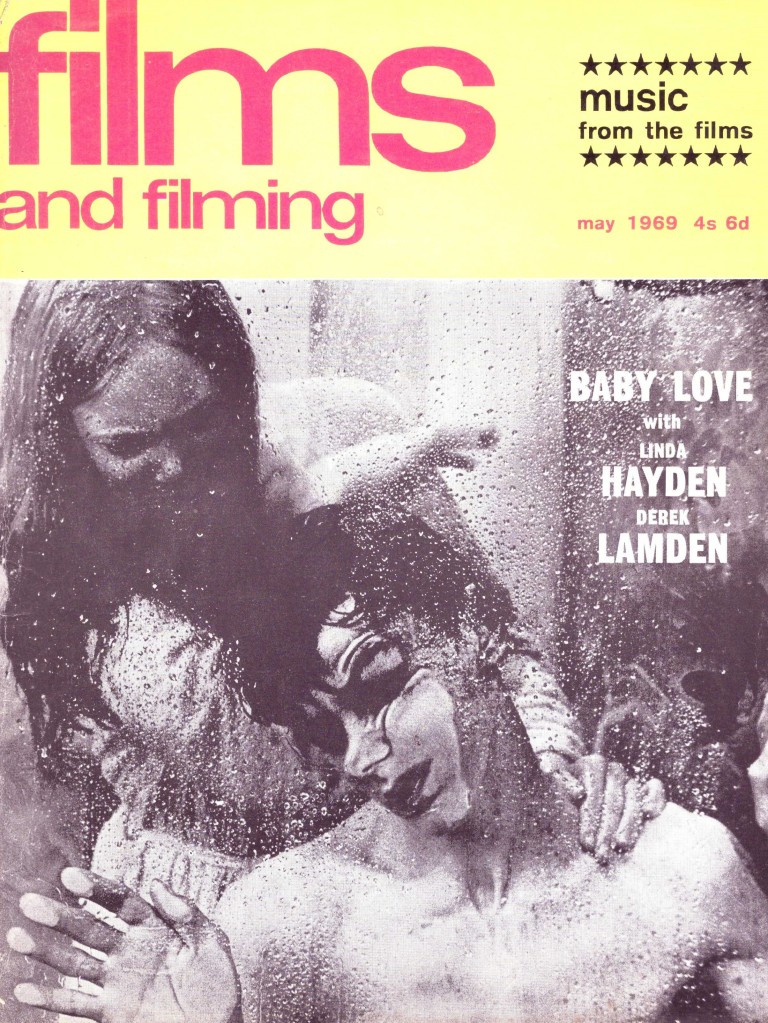
Disturbing tale about grooming marking the debut of Linda Hayden could not more accurately reflect changes in public perception from over half a century ago. What had originally seemed a movie about a young woman wreaking havoc on a middle-class family is now more easily recognized as a more sympathetic study of a young girl denied familial attention attempting to find a stable and welcoming home.
After the suicide of her mother (Diana Dors) Luci (Linda Hayden) is taken in by Robert (Keith Barron), a highly successful doctor and ex-lover of her mother, and his wife Amy (Ann Lynn). His marriage to sophisticated housewife Amy is distinctly rocky. They live in a fabulous three-storey house on the bank of the Thames with son Nick (Derek Lamden), a typical teenager the same age as Luci but who is sexually naive, confused and hypersensitive. Amy comforts Luci when the young girl has terrible nightmares and ends up sleeping in the same bed until she realizes how inappropriate is such behavior.
Nick chances his arm with Luci but is continually rejected, not surprisingly since his approach is more than a tad creepy, spying on her in the bathroom, entering her bedroom when she is naked, leching after her in the garden. Robert is the only one to try and keep his distance and in the absence of her own father becomes the subject of a father fixation.
Conditioned to accept the advances of older men finds her in potentially unsavory situations in a cinema, a club, and with a friend of the couple (Dick Emery). That she apparently welcomes such attention reveals the depth of her grooming, not just forced to watch her mother make love, but, as suggested in a flashback, the mother complicit in not preventing her lovers making a play for her. If Luci appears sexually confident that only disguises her inner turmoil, a desperate need to be loved, lack of proper parenting and setting of boundaries and having chanced on a proper home determined to do whatever it takes to remain there.
It is actually Ann who is the disturbing element, eventually overcoming her own inhibitions and not only seducing the girl but telling her that if she wants to remain in the house she will need to twist Robert round her little finger. And the only way she knows how to do that is follow her mother’s example and exploit her sexuality. If Luci appears exploitative in the context of the family that is only because they are not privy – as is the audience – to the depth of her nightmares, the constantly reappearing image of her mother dead in the bath, her mother’s leering lovers. Even when she goes over-the-top with make-up or clothing there is an innocence to such behavior, little more than a young woman testing boundaries and trying to find her way. Any intelligent assessment of what is going on would clearly see the child as the victim.
The grandeur of her new potential home bears no comparison to the poky working-class council house she occupied up north. For a child with such an impoverished upbringing, she is fairly grounded. She is not the wild child you might expect from her upbringing. She fits well into family life, happy to listen to classical music, and to Ann’s astonishment can actually cook breakfast and knows how to lay a table, skills her spoiled son patently lacks.
Considerable efforts are made to make each character more rounded. Robert hates his wife’s sophisticated parties and is an insomniac judging from the stack of books on his bedside. The guilt he feels for abandoning Luci’s mother, apparently his one true love, in favor of ambition, is exacerbated by Luci’s presence that reminds him not only of a path wrongly chosen but of what he has lost, that relationship ripped asunder when abortion entered the frame.
Ann clearly needs to project success, expensive clothes and champagne the least of their lifestyle, and with little outlet for pent-up emotion and a need to mother settles on Luci as the object of, initially at last, her affection. Nick hides his cigarette ends in a matchbox, would accept Luci as just a friend, occasionally rising to the role of protector, delighted to be seen in the company of a beautiful girl. Teenage fantasy in other words but with an edge of entitlement that goes too far.
In her debut Linda Hayden (Taste the Blood of Dracula, 1970) is superb in an extremely difficult role and it was a shame that it was the sexual part of her portrayal that made its biggest impact on future movie producers rather than the sensitivity of her performance, the look in her eyes when she is shown her bedroom for the first time is amazing. Also making a movie debut Keith Barron (Nothing But the Night, 1973) lacks the mellifluous tones that were later his hallmark and his performance as unloved husband and guilty ex-lover is very well observed.
Ann Lynn (I’ll Never Forget Whatsisname, 1967) has the most challenging role of a woman tortured by desire she has until now kept hidden or under control. Derek Lamden did not make another movie. Diana Dors (Hammerhead, 1968) has a fleeting role.
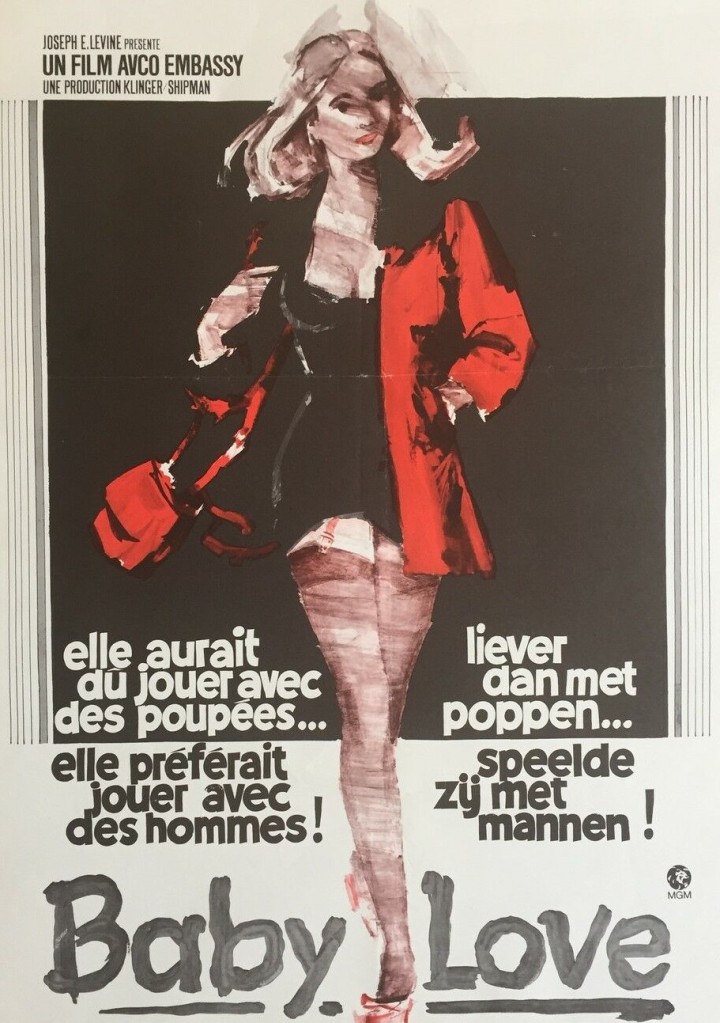
It wasn’t the fault of director Alasdair Reid that uber-producer and marketing kingpin Joseph E. Levine (The Carpetbaggers, 1964) wanted to sell a different movie from the one that was made, focusing on titillation and turning Luci’s sexual confusion into something predatory. The idea that this movie is a sexualized film noir is a marketing trick. Closer re-examination reveals that Luci is entering a disturbed household, one she lacks the skills to negotiate and is in reality the exploited one.
In fact, Reid (Something to Hide, 1972) did a very commendable job. He made some bold decisions especially relating to sound. The opening credits are accompanied by the sound of a dripping tap that would turn into a cascade of water. That would become a recurring motif, along with steam. Most scenes lacked music. Although most nightmares are image-driven, the initial one is full of clashing sound as well as disturbing sights. As the movie hits its stride, a clever device is adopted, showing disturbing images outside the house that are actually, you quickly discover, another nightmare. Mostly the camera remains fairly static but it occasionally swoops to represents anxiety from one point-of-view. The bulk of the story takes place in the house but when the camera goes outside, to a disturbing scene on the river for example there are original ideas, one character speaking through a megaphone.
Passed by the British censor with an X-certificate then and an 18-certificate DVD today, it still has the power to shock. However as far as I can see it was last classified in 1994 and I have written to the BBFC to see if that classification should still stand.
Unusually for an Otto Preminger project, this took an unconscionably long time to get off the ground, given he had purchased rights to the bestseller by Evelyn Piper which had been published in 1957. The first problem was that no one could lick the screenplay. Getting first bite was Ira Levin (Rosemary’s Baby, 1967), followed by “wholesale doctoring” by Dalton Trumbo (Exodus, 1960) who delivered a “polished script.” But that failed to satisfy the director either and triggered further attempts by Charles Eastman (Little Fauss and Big Halsy, 1970) and Arthur Kopit (Oh Dad, Poor Dad, Mummy’s Hung You in the Closet and I’m Feeling So Sad, 1967). But nobody seemed able to come up with a satisfactory job. The book had been set in New York as had the various subsequent screenplays. The solution appeared to be to shift the location some 3,000 miles to London. Penelope Mortimer (The Pumpkin Eater, 1964) wrote a draft but ended up having a fight with Preminger and withdrew and the project was completed by her husband John Mortimer (John and Mary, 1969).
The Levin screenplay was dismissed as being too faithful to the book, the kidnapper in this instance turning out to be a former teacher who was childless and afflicted with “menopausal psychosis,” a character Preminger found weak and uninteresting. Trumbo changed the villain into a wealthy woman, not just childless but judged unfit to adopt, an approach the director deemed “very theatrical and wrong.” The Kopit and Eastman versions offered no better solution. “I almost gave up Bunny Lake,” admitted Preminger, “because while working in the script I realized that women would not like the film…because they are afraid of all situations in which a child is in danger.” After considering transplanting the story to Paris, Preminger finally settled on London, and hired the Mortimers whose villain brought the picture a 2new dimension.”
Until now, and in keeping with the original novel, Newhouse, while assisting in the investigation, had been a psychiatrist. In the hands of the Mortimers he now morphed into a police inspector. Wilson who had been Newhouse’s quite respectable friend turned into a drunken reprobate. At this point the heroine’s name remained Blanche as in the book. There was one other significant element that changed between the initial Mortimer script and the final shooting script: at the start of the film the Ann and Steven were shown reacting as if the child was there, whereas when the movie went before camera the question of the child’s existence remained in doubt. Penelope Mortimer dropped out when, summoned with her husband to Honolulu where Preminger was filming In Harm’s Way, she was roundly ignored.
Filming was originally scheduled to slip in between Anatomy of a Murder (1959) and Exodus (1960) with a budget set at $2 million. But something always seemed to get in the way. Occasionally it was a bigger project. After Columbia announced filming was scheduled for 1961, Bunny Lake was pushed back to spring 1962 to permit the filming of Advise and Consent (1961). Then The Cardinal (1962) took precedence but only to the extent of shifting the Bunny project till later that year. Then it was set to be completed by fall 1963. Further cause of delay was the decision to accommodate the pregnancy of that Lee Remick who had signed for the leading female role. But when she was ready to go, Preminger was not and she fell out of the equation.
At one point, fearful of his schedule becoming too crowded – filled with expensive projects like The Cardinal and In Harm’s Way (1965) – Preminger had tried to wriggle out of the directorial commitment, planning to limit his involvement to producing only, but studio Columbia would not accept this. Preminger was in considerable demand, like a major movie star contracted to deals with rival studios, in 1961 for three pictures with United Artists and four for Columbia and by 1965 adding into the mix a seven-picture deal with Paramount, and most of these big pictures, leaving little time for a relatively low-budget – by his standards – picture.
A good example of the British distribution system. The film opened at the Odeon Leicester Square and quickly went into general release, first in cinemas in North London and a week later the prints shifted to South London. In the West End, it ran solo, in the suburbs as a double bill.
Finally, Bunny Lake received the green light with filming beginning in London on April 9, 1965. Unusually, the movie was shot entirely on location, the director expressing a “yen for realistic on the spot” filming in a dozen places including a pub, the Cunard office and Scotland Yard. A school in Hampstead doubled for the nursery, the mews flat was found just behind Trafalgar Square. He was quick to point this was not a matter of economy. “What you save in studio (time) you spend in other ways. But I think it leads to more urgent film-making.” Somewhat surprisingly, he aimed to shoot in black-and-white, colour now being predominant except for low-budget movies and those wishing to take advantage of black-and-white world War Two newsreel footage as was the case with his previous picture In Harm’s Way.
Carolyn Lynley (The Pleasure Seekers, 1964) was given the lead with Keir Dullea (David and Lisa, 1962) in the pivotal role of her brother. Neither could be considered a big star although Lynley had the second female lead in The Cardinal and moved up the credit rankings to female lead in the low-budget Shock Treatment (1964). But she was such a hot prospect Preminger in 1965 signed her to a four-picture deal although this was not exclusive as she also had contracts with Twentieth Century Fox and Columbia. Dullea was potentially a better prospect, picking up some acting kudos for David and Lisa, the designated star of that picture and The Thin Red Line (1964) but only second lead for Mail Order Bride (1963) and the Italian-made The Naked Hours (1963).
Although some decades away from his Hollywood box office prime, the casting of Oscar-winner and five-time nominee Laurence Olivier (Spartacus, 1960) was something of a coup, although he was only hired because another actor proved too expensive. Other parts were filled by actors experienced in the Preminger school of film-making, Martita Hunt from The Fan (1949)- and Bonjour Tristesse (1958), Victor Maddern (Saint Joan, 1958) and David Oxley (Saint Joan and Bonjour Tristesse).
The first day’s shooting was in a television studio to capture the newsreader and pop group The Zombies which the content of the show shown in the pub on television. Contrary to depictions of Preminger as a martinet on set, he was keen in rehearsals to “put everyone at ease” although he emphasised the need for “slow, thoughtful diction.” The famous Preminger wrath came down heavily on personnel failing to carry out their job correctly. But he accepted Olivier’s decision to omit a particular phrase. He was specific about the look he wished to achieve, required high contrast black-and-white cinematography while nothing was to be done “to enhance Carol Lynley’s beauty: instead…to deepen her features, bring out her emotions.”
And he was determined to get what he wanted, 18 takes required to complete a lengthy tracking shot that flows Inspector Newhouse (Laurence Olivier) and Miss Smollett (Anna Massey) as they negotiate a passage through a group of noisy children in a classroom and then across a hall. Accepting Lynley’s difficulty in expressing the pain of losing a child, he instructed her to forget about subtext and play the moment. However, 14 takes of a scene between Lynley and Olivier was too much for the actress but she was comforted when Preminger told her the famous actor was the problem not her. But on another occasion, Preminger ended up giving her an almost line for line reading of how he wanted the scene played. The only way he got what he wanted was to reduce her to “sobbing uncontrollably” and then start the camera rolling.
Without question, Keir Dullea came off first. “He would humiliate you, he would scream at you…his dripping sarcasm was the worst of it,” recalled Dullea. “I was always very prepared in terms of knowing my lines…but the stress, there was some action where I was supposed to put a glass down or pick up a glass” that Dullea kept getting wrong. In face of what he deemed incompetence, Preminger accused him of being “an actor who can’t even remember a line and if heremembers a line he can’t remember an action…what, you can’t do these two things at the same time.” In the end Dullea faked a nervous breakdown and after than “he never screamed at me again.”
Olivier would occasionally coming to rescue, persuading the director to ease off and “stop screaming at the children.” Olivier found Preminger such a bully that it “almost put me off his Carmen Jones, which I found an inspired piece of work…It’s a miracle it came from such a heavy-handed egotist.” On the other hand Noel coward, who played the landlord Wilson, believed Preminger an excellent director.
Preminger spun his marketing on a similar gimmick to that utilised by Alfred Hitchcock for Psycho (1960) in preventing the public from entering once the movie had started. To make this more dramatic, he had clocks installed in the lobbies of theaters that counted down the length of the performance and a sign that stated “nobody admitted while the clock is ticking.” Preminger was credited with coming up with a longer tagline for the advertisements: “Not even Alfred Hitchcock will be admitted after the film has started.”
The only problem was Return from the Ashes, released at the same time, had adopted a similar marketing ruse, nobody admitted “after Fabi enters the bath.” Despite this, Preminger went hell-for-leather for this marketing trick, to the extent of adding a rider to exhibitor standard contracts to that effect, not a problem in more sophisticated cities where by now patrons had become accustomed to turning up for a picture’s announced start time but a problem in smaller towns and cities where the whole point of continuous programme (i.e. no break between one film and another) was that moviegoers could walk in whenever they liked.
The whole tone of the marketing did not meet the approval of two important segments of the greater movie community. The National Association of Theater Owners opined that the marketing campaign was weak and were astonished to learn that there was nothing Columbia could so about it – Preminger had advertising-publicity approval. Allowing that some of the advertising images for Preminger pictures, courtesy of designer Saul Bass – The Man with the Golden Arm (1953), Anatomy of a Murder, Exodus etc – were among the most famous in Hollywood history, it would appear Preminger knew what he was doing. But, in fact, although the Saul Bass credit sequence showing pieces of newspaper being torn away made sense in the framework of the picture, the idea was not so effective taken out of that context.
Not intentionally, perhaps, Preminger also riled the critics, deciding that to “preserve the secrecy of the surprise ending,” the movie would open without the normal advance screenings for reviewers. Such action was more likely to set alarm bells ringing, it being a standard assumption among critics that the only films that went down this route were stinkers. From a practical point-of-view it also ensured that marketing was undercut since the lack of timed reviews denied the picture an essential promotional tool.
Finally, the movie ended up in a war with the censors. Many states in the U.S. had their own censors. Columbia objected to having to wait on the say-so of a local censor – in this case Kansas – before being able to release a movie. And for any release to be delayed if there was any nit-picking by the censor, especially as this movie had an undercurrent of incest. So Columbia refused to conform and failed to submit Bunny Lake Is Missing to the Kansas censors. After being promptly banned for such arrogance, Columbia objected again and the case went to the Kansas State Supreme Court which judged that the censor was unconstitutional. That resulted in the censors losing their jobs when the board was abandoned and the movie entering release a good while after its initial opening dates.
Although it made no impact at the Oscars, Village Voice critic Andrew Sarris picked it as one the year’s ten best and it was nominated for cinematography and art direction at the Baftas. The film was a flop, failing to return even $1 million in rentals at the U.S. box office. In fact it probably made more when it was sold to ABC TV for around $800,000.
SOURCES: Chris Fujiwara, The World and Its Double, The Life and Work of Otto Preminger, p330-342; (Faber and Faber, 2008) “Trends,” Variety, January 14, 1959, p30; “Ira Levin Pacted by Preminger for Bunny,” Variety, September 2, 1959, p2; “Col Primed To Start ½ Dozen Prods,” Variety, April 5, 1961, p3; “Otto Preminger Views Film Festivals As Important Marketplaces,” Box Office, May 1, 1961, p11; “Trumbo May Script for UA,” Variety, May 31, 1961, p5; “Bunny Lake Delayed,” Variety, June 7, 1961, p18; “Preminger Postpones One,” Box Office, June 12, 1961, p13; “Otto Preminger to Film Cardinal for Col,” Box Office, August 7, 1961, -10; “Otto Preminger Is Guest of Soviet Film Makers,” Box Office , May 14, 1962, pE-4; “Two Writers Signed,” Box Office, August 6, 1962, pSW-3; “Preminger,” Variety, September 12, 1962, p15; “Preminger’s New Rap at Costly U.S. Distribution,” Variety, October 10, 1962, p7; “Preminger Gets Rights to Hurry Sundown,” Box Office, November 23, 1964, p9; “Prem’s Next in London,” Variety, January 13, 1965, p18; “Preminger Signs Actress for Four More Pictures,” Box Office, February 8, 1965, pW-3; “Advertisement,” Variety, April 7, 1965, p1; “Preminger-Paramount Pact Calls for 7 Films,” Box Office, April 26, 1965, p7; “100% Location for Bunny,” Variety, May 5, 1965, p29; “Not Even Hitch,” Variety, September 1, 1965, p4; “Preminger’s Nix on Pre-Opening Critics,” Variety, September 22, 1965, p16; “2 Pix Enforce Entrance Time on Ticket Buyers,” Variety, September 29, 1965, p5; “Time Rules Are Set for Bunny Shows,” Box Office, October 4, 1965, p13; “Preminger’s Promotional Prerogative,” Variety, October 27, 1965, p13; “Clock for Bunny Lake,” Box Office, November 8, 1965, p2; “Village Voice Vocal on Bests,” Variety, January 26, 1966, p4; “Col Kayos Kansas Censoring,” Variety, August 3, 1966, p5.
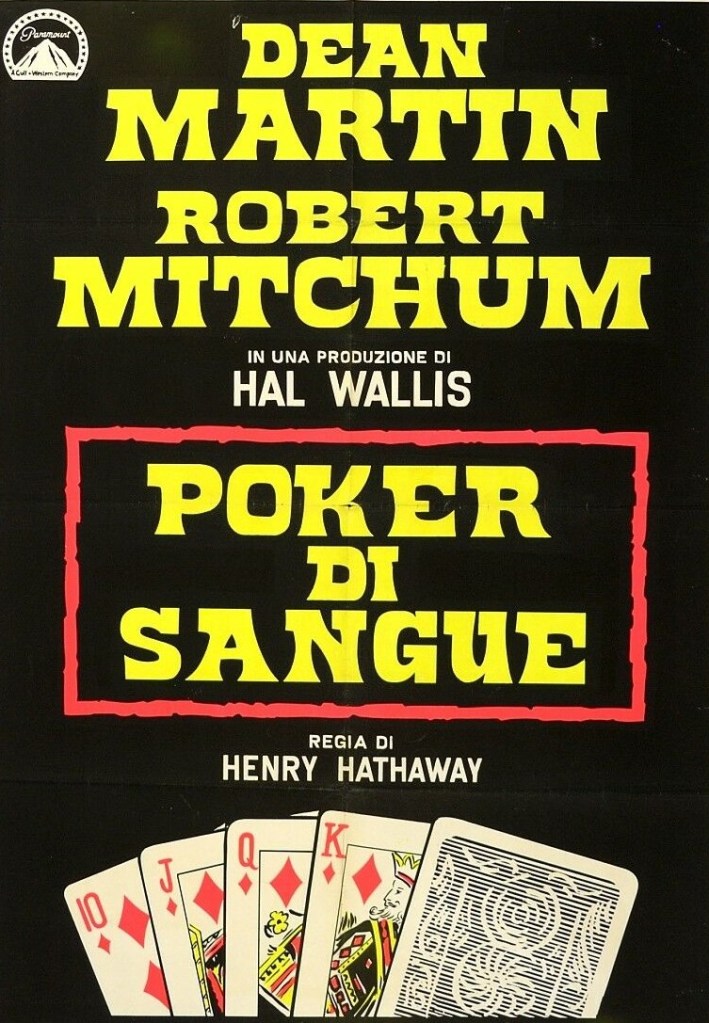
Another western in sore need of re-evaluation. Largely dismissed as a routine oater trading on the gimmick of a whodunit and packed with old stagers, this is in fact about a serial killer, a treatise on law and order, and almost acts as a conduit between the decade’s previous westerns when the good guys and the bad guys are easily defined to the end of the decade when such distinctions were muddied after The Wild Bunch (1969) and Butch Cassidy and the Sundance Kid (1969) invited audiences to root for the bad guys. In this rather well-structured picture, full of action and romance, we don’t know who the bad guy is.
The whodunit, however, is really a MacGuffin. The movie is more concerned with investigating the changing mores and hypocrisies of the West and predicting the inherent dangers in the proliferation of weaponry. It’s worth remembering that the movie came out at time when mass murderers such as Charles Whitman (the subject of Peter Bogdanovich’s Targets, 1968) who went on a killing spree in 1966 were becoming the norm.
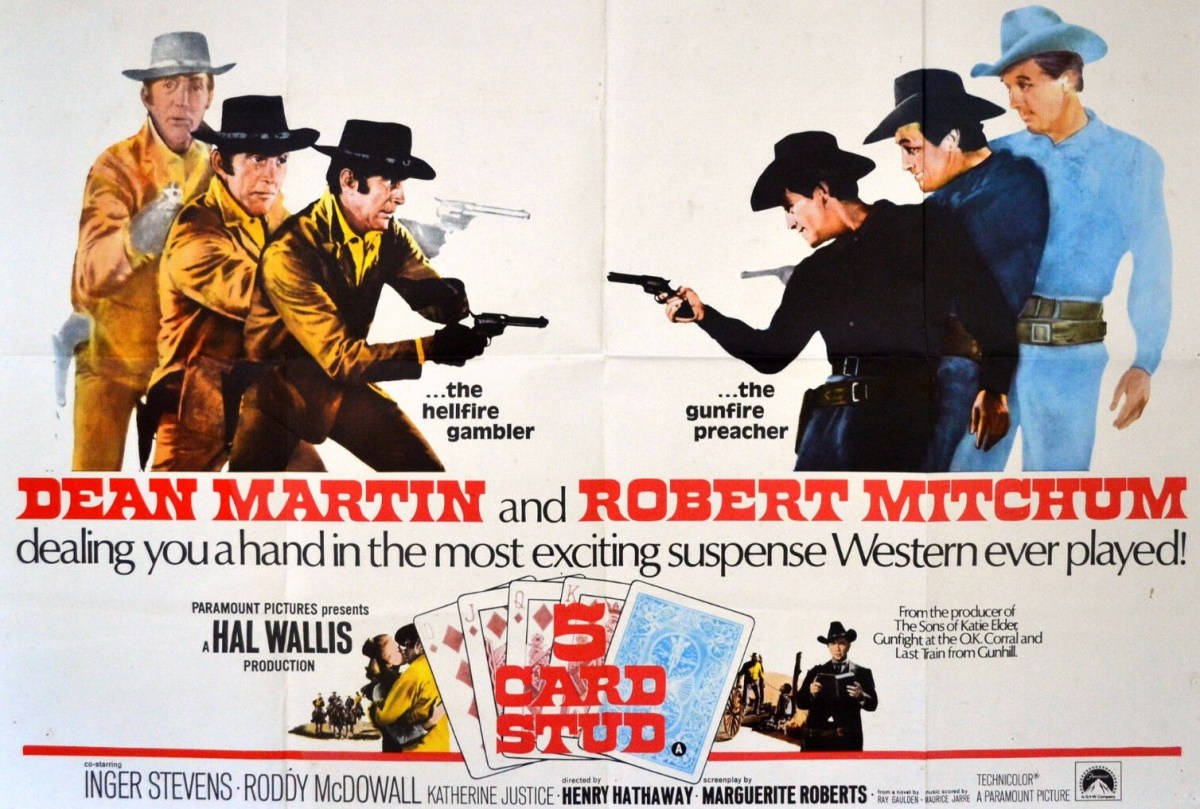
A card sharp is lynched for cheating at poker in the quiet town of Rinchon where late-night gambling is the height of entertainment. One of the players, professional gambler Van (Dean Martin), attempts to stop the hanging but is beaten up for his troubles. No surprise then, that he ambles off to Denver. Sometime later the hangmen begin dying off and Van returns not just to solve the mystery but to ensure that his name isn’t on the list. “If someone is out to kill you, you don’t sit around and let him pick the time,” he concludes. With the number of killings, not to mention brawls and shoot-outs, it’s almost continuous action.
On his return, Van discovers, with a gold strike nearby, the incipient boom town has attracted unsavory elements, not just the high murder quotient but a whorehouse and loud music in the saloon. Acting as counterbalance is gun-toting preacher Jonathan Rudd (Robert Mitchum) who announces his presence by spraying bullets in the saloon floor, emerging as the self-proclaimed “conscience” of the town.
For a sometime protector of law and order, Van is rather lax in the morals department, unwilling to commit to main squeeze rancher’s daughter Nora (Katharine Justice) when the likes of Lily (Inger Stevens), the unlikely proprietor of a barbershop-cum-whorehouse, are on hand. Van is an interesting study. Once he becomes aware that the only people likely to end up in an early grave are the six men who played poker with the lynched individual, it doesn’t occur to him to fess up to Marshal Dana (John Anderson) which would ease the fears of the ordinary public. Awareness the only corpses belonged to the guilty would have prevented further outbursts of violence among a disaffected population. Interestingly, too, Dana makes no attempt to investigate the lynching.
At the core of this picture are a couple of amazing scenes as paranoia takes hold. One miner, without the slightest sense of irony, complains that in the old days a gunfight took place face to face, not by a murderer slinking round in the dark. Rudd adds some prophetic advice: “wear a gun and use it fast, wear a gun and use it slow – I say don’t wear a gun and you won’t use it at all.”
Van likes to think he has the measure of women, when in fact they have the measure of him. The story avoids the obvious lure of a love triangle, of jealous women competing for Van’s affections. Both the young Nora and the more mature Lily are pretty well grounded. “One wore-out no-account kiss” is Nora’s dismissive description of Van’s attempts at romance while Lily lets Van know she has taken a shine to him as a matter of convenience, he’s just a man and she hasn’t had one in three years. Expecting to be treated as a pariah, Lily, expressing the notion that “women don’t usually like women who like men,” strikes up a friendship with Nora.
Marshal Dana finds it increasingly difficult to maintain any kind of peace since as the death count mounts, paranoia grows rife, exacerbated by the kind of greed gold fever brings, resulting in citizens determined to challenge authority and take matters into their own hands.
The most antsy character is Nick (Roddy McDowall), Nora’s brother and the leader of the lynch mob. Nick seems to stir up bad feelings, provoking the ire of both his father and Van. The guilty are despatched in original ways, one man “drowns” in a barrel of flour, another strangled by barbed wire, a third wakes the town at night when the church bell to which his neck is attached starts ringing out. It’s not too hard in the end to work out who the killer is, but as I said, that is not the point of the picture, although the ending is satisfactory.
There a mass of small detail of the kind that director Henry Hathaway (True Grit, 1969) tends to work into his pictures. Van is a cut above. He travels to Denver and back by stagecoach not on horseback. Citizens can purchase Pocahontas Remedies and beer from the Denver Brewery. Shaves and haircuts at the Tonsorial Parlor are reasonably priced but “miscellaneous” comes in at $20. After the preacher shoots up her floor, saloon owner Mama (Ruth Springford) smooths out the holes.
And there is some distinctive direction. Rudd’s sermon that lasts nearly 90 seconds is delivered in virtually one take, a fistfight is conducted in silence except for a soundtrack punctuated by grunts and punches hitting their target, a dying man tries to leave a physical clue about the identity of the mysterious killer. And there is a superb main street gunfight with Van trying to rescue the marshal and Rudd striding down the street in old-fashioned gunslinger mode.
Dean Martin (Rough Night in Jericho, 1967) and Robert Mitchum (The Way West, 1969), both with apparently easy-going but magisterial screen personas, come off well together. Inger Stevens (Firecreek, 1968) always a great screen presence, an ethereal beauty, is vulnerable and strong at the same time. Katherine Justice (The Way West, 1967) is sassy and independent-minded and has a terrific facial response to coming across the first murder. John Anderson (The Satan Bug, 1965) leads a fine supporting cast including Yaphet Kotto (Live and Let Die, 1973), Denver Pyle (Shenandoah, 1965) and Whit Bissell (Seven Days in May, 1964).
Screenwriter Marguerite Roberts, adapting the novel by Ray Gaulden, contributes some classic lines. “If that is a Bible, read it,” Van instructs Rudd, assuming the preacher has a gun planted in the Holy Book, “If it ain’t a Bible, drop it.” There’s a nod to a James Coburn scene in The Magnificent Seven (1960). Congratulated on his marksmanship in hitting the spinning wheels of a windmill six times out of six, Rudd protests his shooting was a failure since he was aiming for the spaces in between. It was ironic that her next assignment concerned a lawman who took much the same no-holds-approach to the criminal fraternity (True Grit, 1969) as the killer in this picture.
I was so intrigued by this picture, realizing it had much more to offer than a whodunit, that I watched it again within a few days and was pleasantly surprised by its depths.
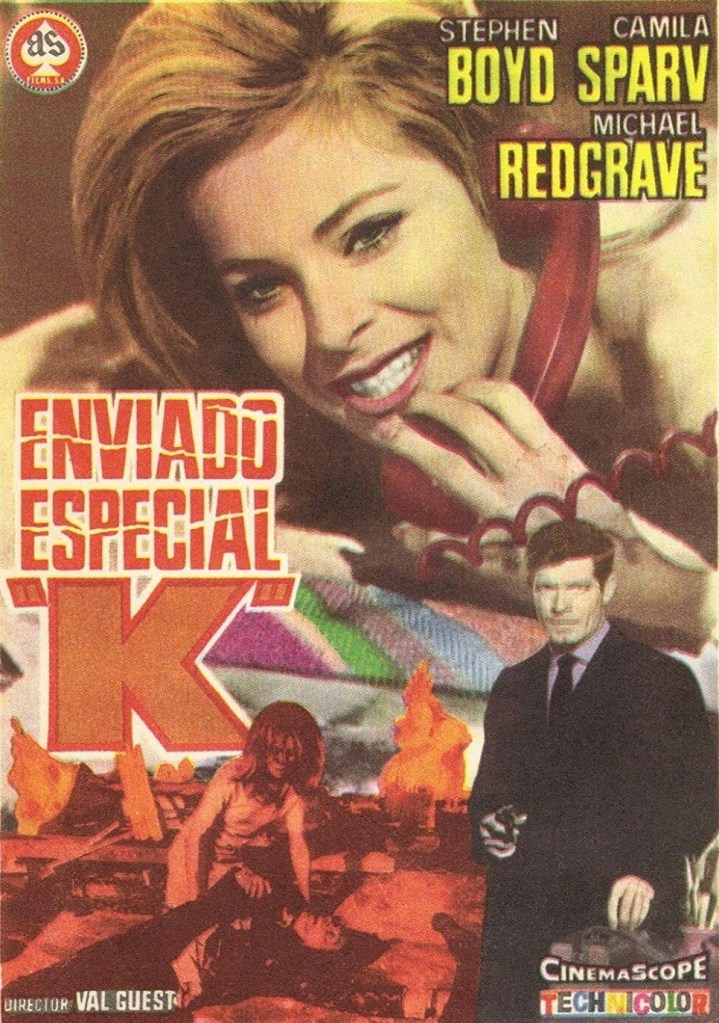
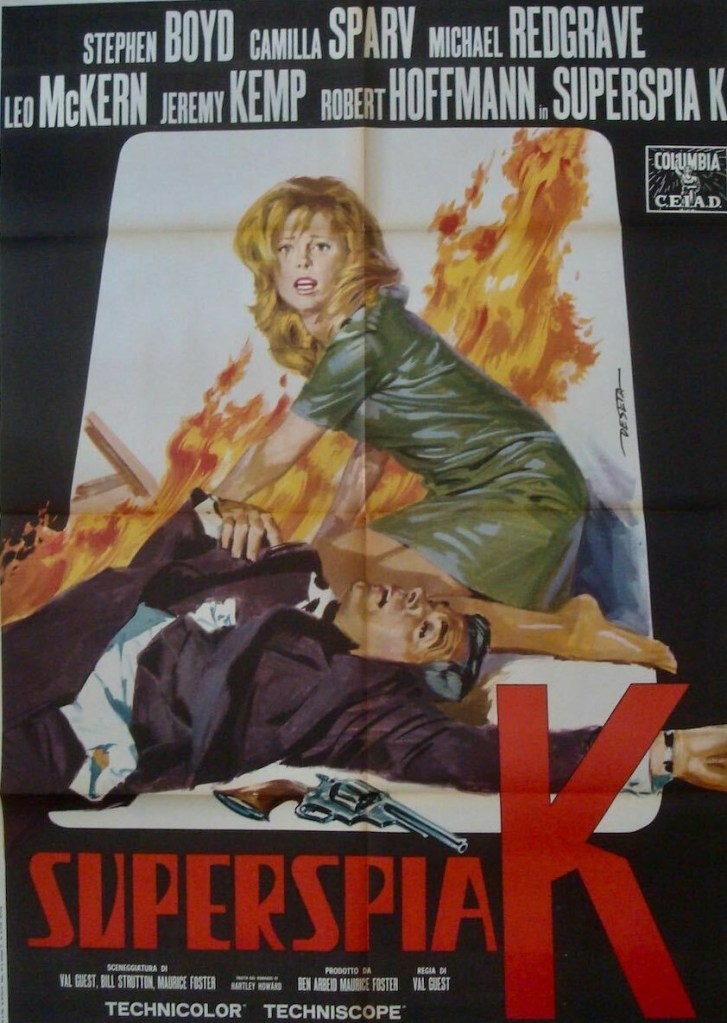
A good notch above the routine spy thriller, this deserves another look. By the mid-1960s the screen was awash with spies so other than trying to invent a new hero in the Matt Helm/Derek Flint vein or revamping older characters such as Bulldog Drummond or sending up the entire genre in the style of Casino Royale (1967), it was difficult to find a fresh angle.
Assignment K does in some measure succeed, in part by going down the grimy route of The Spy Who Came in from the Cold (1965), in part by stuffing the picture full of glorious scenery – the Austrian Alps – and in part by turning Stephen Boyd into the kind of spy who has begun to question the entire business. For reasons unspecified, former racing driver turned toy salesman Boyd (The Big Gamble, 1961) is running his own spy operation loosely linked into British intelligence but when the network is compromised his life and that of new love interest Camilla Sparv (Nobody Runs Forever/The High Commissioner, 1968) endangered. Things get trickier when she is kidnapped and he has to save her while not compromising his own agents.
There is enough mystery to keep the plot, uncoiling like Russian dolls, ticking along and the entire effort is underwritten by some decent tradecraft, dead letter drops, microfilm hidden inside cigarette filters and so on. Tension is surprisingly high. And Boyd is surprisingly human, falling properly in love for one thing, not just treating women in the James Bond/Matt Helm fashion as notches on a bedpost, not ice-cool under pressure either, face knotting in fury on occasion, and not so accomplished in the old fisticuffs department. There is less reliance on just sticking out his chin and looking handsome and this is a more assured performance than in The Big Gamble.
Michael Redgrave (The Hill, 1965), Leo McKern (Nobody Runs Forever) and a pre-Please, Sir John Alderton provide decent support though Jeremy Kemp (The Blue Max, 1966) is somewhat subdued. But Boyd is a revelation. Here, his screen charm and charisma are at their best and while he was never going to attract the attention of the Oscar fraternity is entirely believable as a spy coming to wonder at decisions taken.
Sparv, too, is much better than I have ever seen her. Unlike her turn in Murderers Row (1966), her role is not merely decorative and the unfolding romance would work perfectly well just as a love story never mind tucked away in the guise of a spy thriller. There is a lovely demonstration of her acting skill, although an odd one to describe, as she pulls on a bathrobe and shimmies out of the towel underneath; I can’t believe that was ever scripted, but if you watch it you will see what I mean. Swedish Sparv was often viewed just as another of the decade’s ubiquitous European starlets but in fact she shows genuine acting ability.
Director Val Guest was usually labelled a “journeyman” despite a repertoire that included The Quatermass Xperiment (1955) and its sequel, Yesterday’s Enemy (1959) and sci-fi The Day the Earth Caught Fire (1961) and he had previous form in this genre with Where the Spies Are (1966) which played more to the comedy gallery and did some work on Casino Royale to boot. Guest was also involved in the screenplay along with two first-timers Bill Strutton and Maurice Foster, the former primarily a television writer, the latter a producer. Guest’s work here falls into the efficient category, but it does zip along at the same time as allowing Boyd and Sparv to develop their characters and make their relationship believable. All in all quite enjoyable.
CATCH-UP: The Blog has reviewed Camilla Sparv in Dead Heat on a Merry-Go-Round (1966) Nobody Runs Forever/The High Commissioner (1968) and Downhill Racer (1969). Stephen Boyd pictures reviewed so far are The Big Gamble (1961), The Fall of the Roman Empire (1964) and The Third Secret (1964).
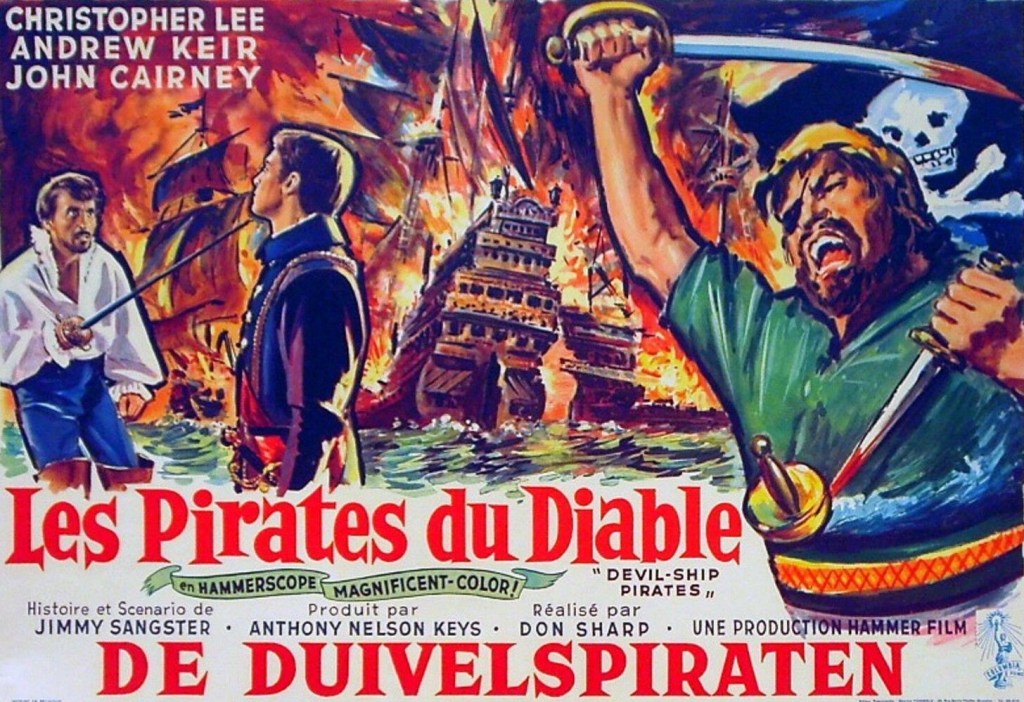
Despite the title and Hammer’s penchant for the unholy, there is nothing satanical about this picture. Christopher Lee (The Whip and the Body, 1963) less cadaverous than in his better-known incarnation as Dracula, plays the captain of ship called Diablo, part of the defeated Spanish Armada, who lands in 1588 on British shores and by convincing the locals that the British have been defeated imposes an occupation.
Writer (and later director) Jimmy Sangster’s clever premise works, the lord of the manor (Ernest Clark) immediately surrendering and befriending the invaders, most of the villagers succumbing, a few more doughty lads (Andrew Keir and son John Cairney to the fore) rebelling.
Running alongside its regular horror output, Hammer had a sideline in swashbucklers, the Men of Sherwood Forest (1954), Sword of Sherwood Forest (1960), The Pirates of Blood River (1962) and The Scarlet Blade (1963) – aka The Crimson Blade – preceding this, and all, interestingly, aimed at the general rather than adult market. Australian director Don Sharp, in the first of several teamings with Lee, does extraordinary well with a limited budget. Although the village square was a leftover from The Scarlet Blade, there is a full-size galleon, swamps, fog, floggings, a hanging, fire, chases, a massive explosion, and a number of better-than-average fencing scenes.
In other hands, more time could have been spent exploring the psychology of occupation, but despite that there is enough of a story to keep interest taut. Lee has a high-principled lieutenant who secretly subverts his master’s wishes. Tension is maintained by Lee’s ruthlessness, the efforts of captured women to escape, and attempts to seek outside help. While the intended audience meant toning down actual violence, Sharp creates a menacing atmosphere. The final scenes involving sabotage are tremendously well done.
A rare outing for Lee outside of the horror genre, he truly commands the screen, an excellent actor all too often under-rated who holds the picture together. Andrew Keir (The Viking Queen, 1967) and Ernest Clark (Masquerade, 1965) provide sterling support. Suzan Farmer (The Crimson Blade, 1963) plays the requisite damsel in distress. Director Don Sharp (Bang! Bang! You’re Dead!, 1966) was another horror regular responsible for, among others, Curse of the Fly (1965) and Rasputin: The Mad Monk (1966), the latter reuniting him with Lee.
I should acknowledge a vested interest as John Cairney was a distant relative and I do remember as a child being taken to see his previous outing Jason and the Argonauts (1963) but, strangely enough, this one was given a miss by my parents. I wonder if the title put them off.
CATCH-UP: Christopher Lee was so prolific I have only so far reviewed a fraction of his 1960s output: Beat Girl/Wild for Kicks (1960), Sherlock Holmes and the Deadly Necklace (1962), The Whip and the Body (1963), The Gorgon (1964), She (1965), The Skull (1965), The Brides of Fu Manchu (1966), Five Golden Dragons (1967). The Devil Rides Out (1968), The Curse of the Crimson Altar/The Crimson Cult (1968) and The Oblong Box (1969). Quite enough to be getting on with if want an idea of this fine actor’s range and ability.
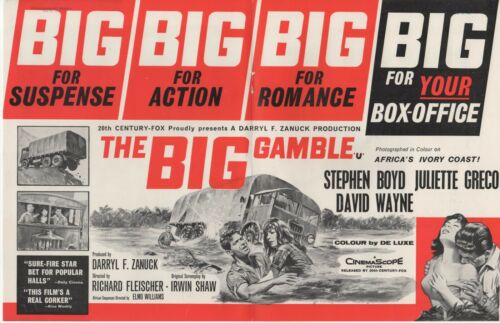
If only there had been some serious money put behind this picture it would have been an absolute cracker, custom-made for the likes of Cinerama which didn’t go down the dramatic route until a few years later. It’s a bit “Hell Drivers or Wages of Fear Goes to Africa” but with some really quite stunning sequences.
Whatever French chanteuse Juliette Greco (Crack in the Mirror, 1960) had to offer on stage and in a personal capacity – lovers included Miles Davis and this film’s producer Darryl F. Zanuck – never seemed to translate to the screen in this particular role and the most we get is a kind of tomboyish perkiness. It’s a medium-grade cast, the lead taken by Northern Irishman Stephen Boyd (here playing a Dubliner). David Wayne (The Three Faces of Eve, 1957) is the sad sack brother who joins the other two in a bold plan to set up a haulage business on the Ivory Coast in Africa.
The opening sequence demonstrates the dreary Irish life Boyd is trying to escape with a sparkling cameo from Sybil Thorndike (Shake Hands with the Devil, 1959) as the family matriarch before the African sequences kick in. Apart from scenes shot at Ardmore Studios in Bray, Ireland, the rest is clearly filmed on pretty dangerous locations if the unloading of a lorry onto what looks like little more than a large canoe is anything to go by. After an unpromising start, the intrepid trio (well, two are bold, Wayne is not) set off into the wilderness.
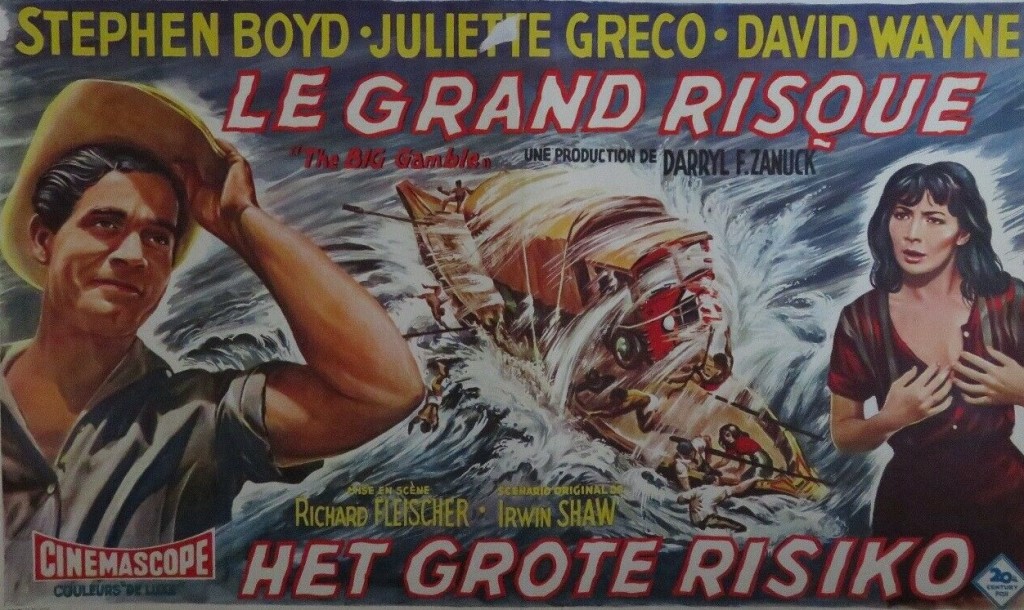
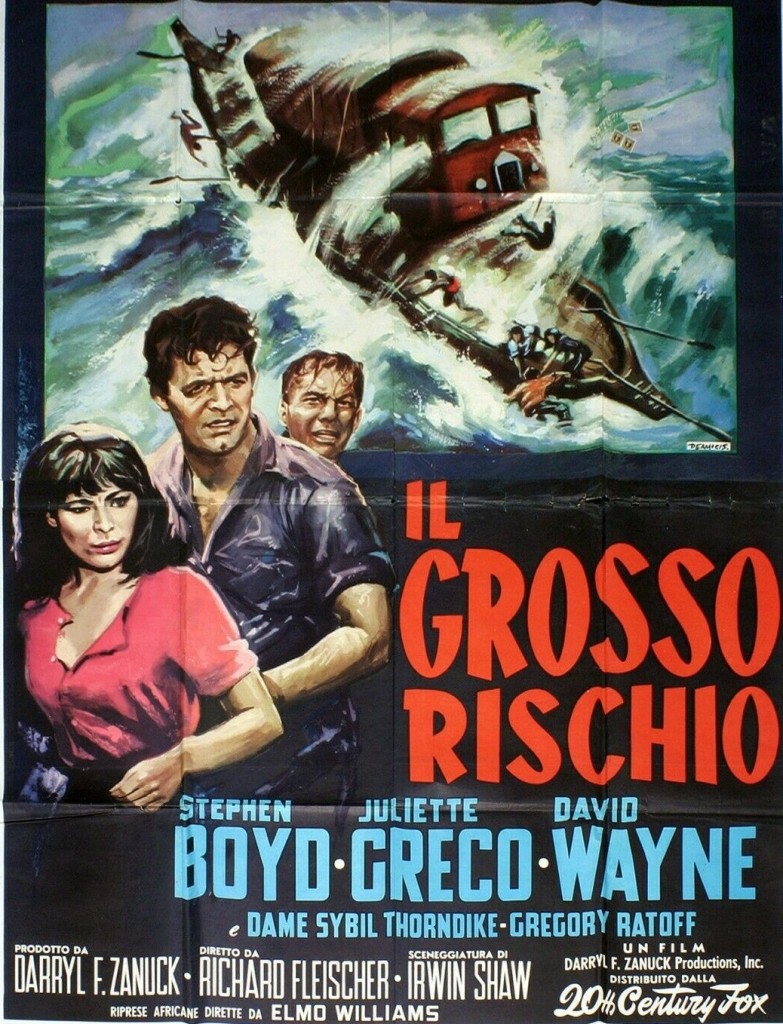
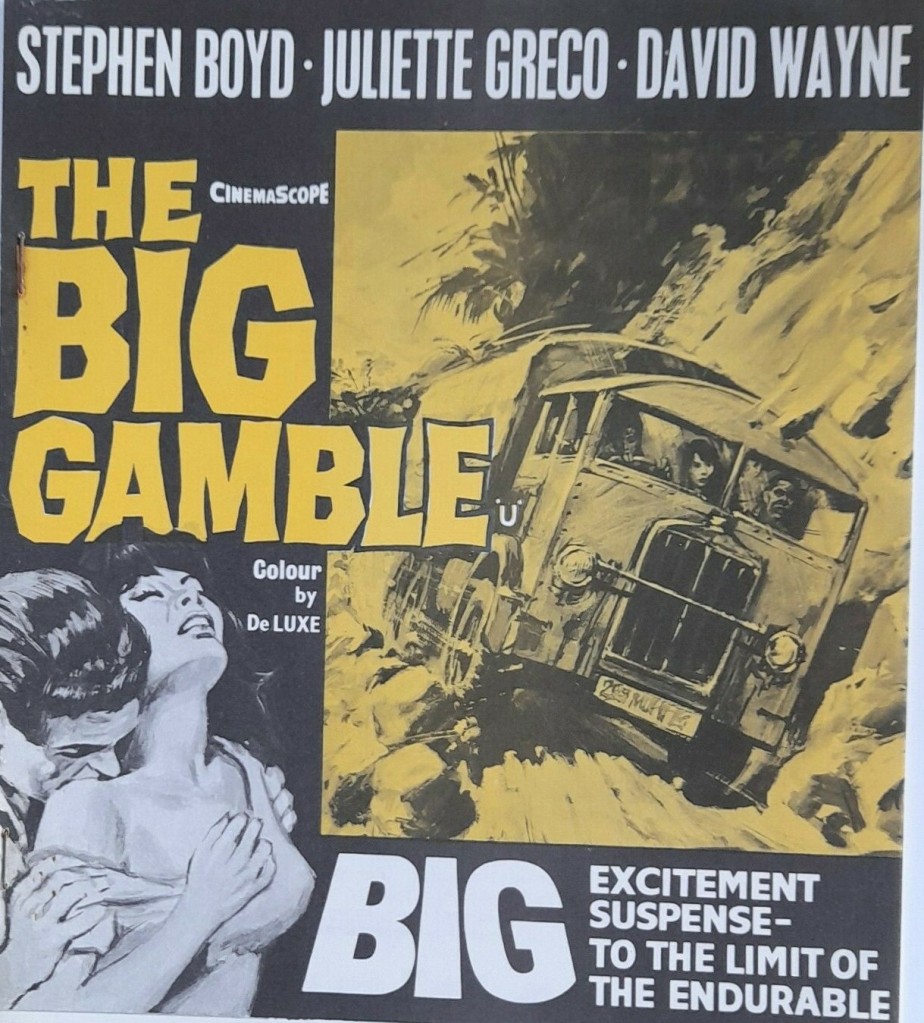
There are two edge-of-the-cliff sequences that would have The Italian Job fans frothing at the mouth, a runaway lorry in the best Cinerama tradition and an astonishing section crossing a swollen river where clearly the actors did their own stunts (and Boyd was in reality saved from drowning by his co-star). In between we have snippets of genuine Africa, especially canoeists braving the surf and an African funeral party. Emotionally, beyond Boyd sticking out his chin as much as possible, the main drama focuses on fraternal rivalry with Wayne trying to pull himself together in the face of a mission he believes doomed to failure. Their plans are further hit by sabotage by the German Kaltenberg (Gregory Ratoff in his final role).
While some of the posters highlight the river crossing, others focus on the cliff-top sequences.
This was Boyd’s bid for stardom. Five years into a seven-year contract with Twentieth Century Fox, he had worked his way up the ranks at that studio to become male lead to top-billed females like Susan Hayward (A Woman Obsessed, 1959) and Hope Lange (The Best of Everything, 1959) before his career received a massive boost after a loan-out deal to MGM for Ben-Hur (1959). He might have been hotter yet had Fox not abandoned its first Rouben Mamoulian-directed version of Cleopatra in which he played Mark Anthony, a role that later brought Richard Burton worldwide fame and a new wife. Boyd would be hot at various times during his short-lived career (he died at 45) while equally never making the transition to major star.
One of the great Hollywood what-ifs – how would Boyd’s career have developed if he had followed up “Ben-Hur” with “Cleopatra.”
Directed by the underrated Richard Fleischer, best known for 20,000 Leagues under the Sea (1954), Compulsion (1959), Crack in the Mirror (1960) and later The Boston Strangler (1968) and here with some help for the African sequences from Elmo Williams (The Longest Day, 1962) – the nerve-wracking clifftop sequences and river crossing were actually shot in France – it has a decent enough script from novelist Irwin Shaw (The Young Lions).
All-in-all this tight little film more than does justice to its miserable budget with some genuinely exciting sequences. Filmed in CinemaScope, this is one of the films of the era which does justice to the widescreen. As a wee bonus, if you listen hard to Maurice Jarre’s score you will hear strains of some themes that turned up in Lawrence of Arabia.
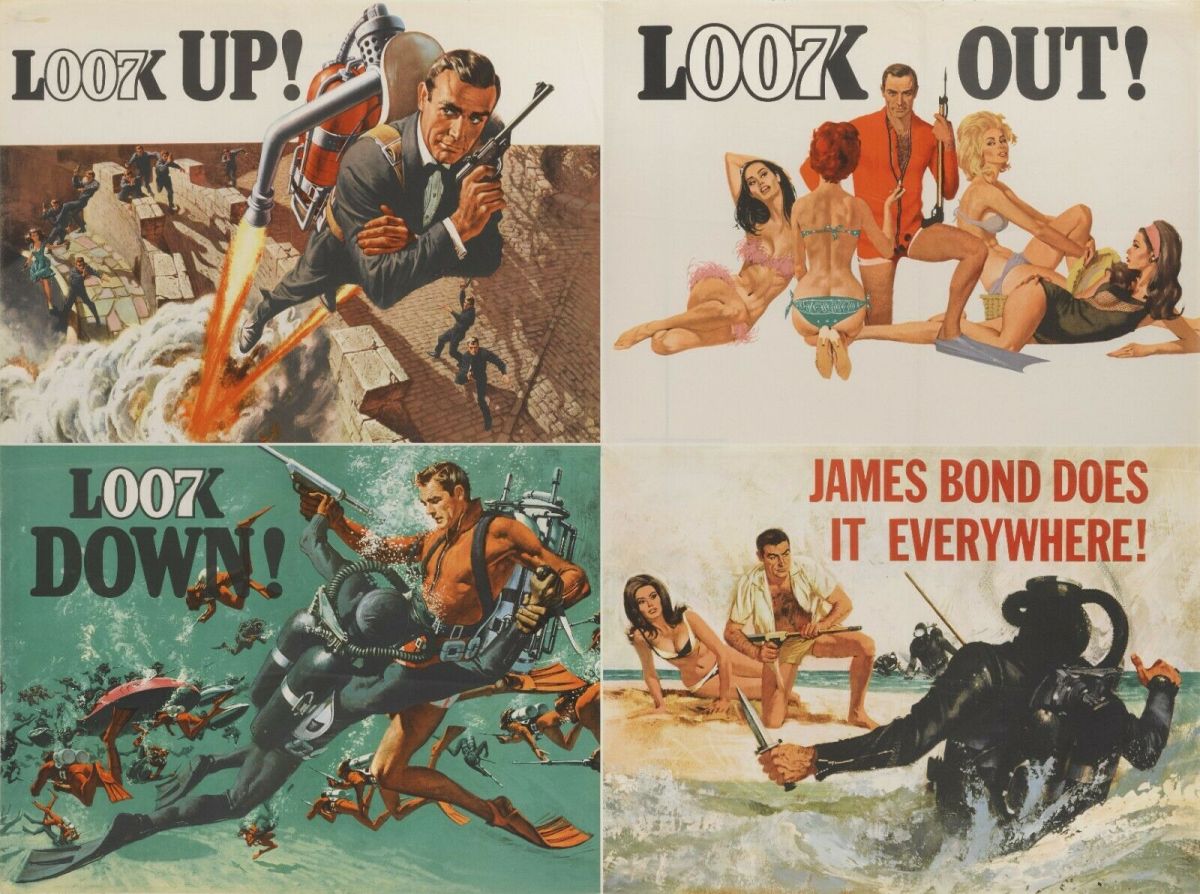
Wooing the audience was no longer required after Goldfinger (1964) had broken the box office bank. Thunderball, claimed producers Cubby Broccoli and Harry Saltzman, was “the hottest merchandise campaign you have ever handled” as the first four pages of the Pressbook went to show. No longer was there a retailer free-for-all with companies which had nothing to do with endorsements jumping on the Bondwagon.
The potential for promotional tie-in was so high that retailers and manufacturers were willing to spend a fortune to become involved and, in so doing, provide a massive spread of free advertising. Colgate had an entire line of toiletries for men including after shave, shaving lotion, deodorant, and talcum powder, each item branded with the 007 logo with Colgate investing in a massive advertising campaign aimed not just as men but the women who buy for men.
Shoe-wear manufacturer Endicott Johnson set up a nationwide contest through the Montgomery Ward chain of stores. Customers were invited to participate in a free sweepstake and store managers were encouraged to become active in promoting Thunderball at sales points throughout their shops.
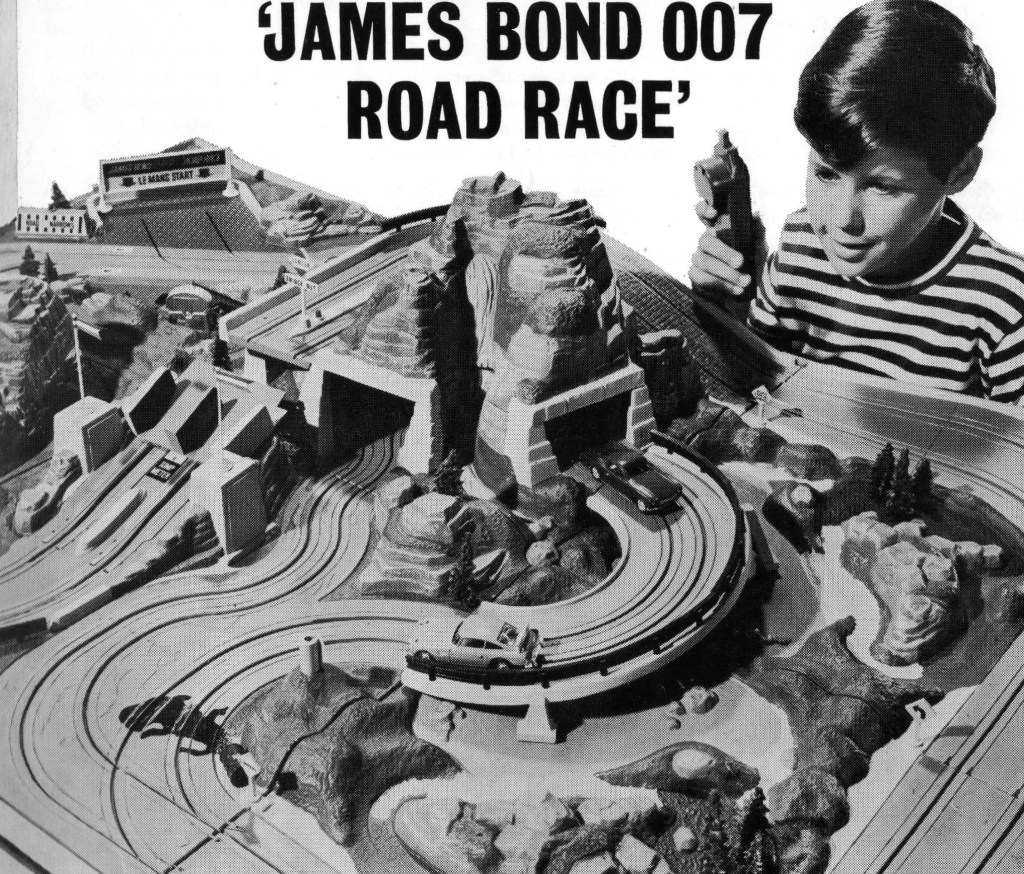
Toy manufactuer A.C. Gilbert had devised a James Bond 007 Road Race which would be promoted in the biggest marketing campaign in Sears Roebuck history to 60 million homes. The catalog would feature a five-page spread. “Beatles fans will be reached through a TV buy that Sears has made advertising the Road Race on ABC-TV’s Beatles Cartoon Show.” Adlers Slacks was the exclusive licensee for James Bond 007 Boys Slacks – with two hidden pockets. Revere Knitting Mills was promoting four sweaters “as worn by James Bond.”
Other licensed products included The Official James Bond Secret Agent 007 Shooting Attache Case, Harry Diamond sports shorts with the Bond logo, Allison tee-shirts and sweat shorts, bubble gum and trading cards from the Philadelphia Chewing Gum Corp, and a walkie-talkie set from Gabriel. In addition, Weldon was selling “007 Pyjamas – Go to Bed Dressed to Kill,” Voit manufactured underwater equipment, Spatz advertised its trenchcoats in Playboy, Trimount clothing range included items for men and boys, and Milton Bradley had four board games and six jigsaw puzzles.
So for the first time in history, exhibitors had to do nothing to attract customers, no zany attention-grabbing gimmicks required, because the massive cross-promotional campaign devised by the producers ensured that potential moviegoers could hardly go anywhere without coming across something alerting customers to the movie.
All this was in addition to the normal standard promotional tools such as original soundtrack album and paperback movie tie-in. Tom Jones had released a single and six other artists had brought out instrumental singles and albums. Trade magazine Cash Box noted that the Bond name signified “something big in the worlds of film and music…many labels have themed LPs after the valuable James Bond Agent 007 image.” Signet had brought out the movie tie-in paperback with artwork on front and back covers.
The bulk of the Pressbook was taken up with advertising and information about the licensed products leaving just three pages for the editorial section. By now of course Sean Connery was a big box office star so he received considerable coverage, explaining that he had been chosen for Dr No as a result of a London newspaper poll. There was space too for the movie’s playgirls – former Miss France Claudine Auger, villainess Luciana Paluzzi best known to American audiences through the Five Fingers television series, Molly Peters and a return for Martine Beswick who had appeared in From Russia with Love.
Not surprisingly, the Aston Martin DB5, which had caused a sensation in Goldfinger, also returned. The customised version cost $45,000 (worth $400,000 today), compared to the usual price of $13,000, and came complete with twin Browning machine guns, tire slashers, revolving number plates, radar screen, ejector seat, and retractable bullet proof shields.
Fred MacMurray doesn’t actually wear a woman’s hat in this picture, he just imagines himself wearing one. But that image was all it took for the marketeers to do it to death. Warner Brothers clearly believed the picture was going to be a winner and produced a whopping 32-page A3 Pressbook (double the normal size) in a bid to persuade exhibitors of its potential. That included a blockbusting two dozen adverts. Although in the 1960s as this series on Pressbooks has shown, movies were not sold just on the basis of one core image, but even so a limit was generally called when the number of options reached eight or nine.
On top of that, the Pressbook writers provided interesting copy for editors who might file a snipper or two around the movie’s launch. Arlene Dahl, for instance, contended that a large proportion of the most prominent women in history – Salome, Cleopatra, Elizabeth I – had, like her, red hair. Writing a syndicated beauty column, Dahl also offered advice on wearing perfume.
Eli Wallach put forward a convincing argument for remaining a supporting actor. “Get your name above the title,” he opined, “and if you make a hit you have to play the same thing over and over – the actor gets sick of the monotony and sooner or later so does the public.” Polly Bergen, who based her screen wardrobe on Jackie Kennedy, argued that ordinary women were well turned out in America whereas abroad that was the preserve of the wealthy. Starting out in Wisconsin Fred MacMurray scraped paint off cars for $20 a week.
To get exhibitors in the mood to sell a political comedy, the Pressbook offered eight “punchy and funny” spoof campaign posters, suggesting they be positioned in door panels or along one wall in a straight line and on a voting booth in the lobby. Expanding on the concept in their local area, exhibitors were encourage to recruit an important woman “holding some office” who could be corralled into acting as a “president” embarking on an imitation tour backed up by supporters carrying placards.
Silent screen star Carmel Myers, who manufactured a fragrance line for men, was enrolled by Warner Brothers for a nationwide tour in part talking about the subject that is key to the movie’s subplot – “can a beautiful and glamorous woman be a successful business executive?” A high-flying vamp of the silent era, Myers starred in Ben-Hur: A Tale of the Christ (1925) and later had her own short-lived television series before entering the beauty business.
Except twice, each of the other myriad adverts stuck with a photo of MacMurray wearing a hat. The taglines, running on the theme of what happened to the female President’s male consort, varied only slightly. “When a woman becomes President, what happens when her poor husband becomes First Lady?” / “President arrives in New York today, leaves First Lady home with knitting”/ “Women rise, men revolt, everybody cheer”
Inevitably, advertising focused on politics. “Republicans and Democrats agree this is the funniest picture you’ll ever see” / “First male First Lady takes Washington by storm” / “Is America prepared for the first woman president and her First Lady?
Some taglines took a different approach. “This year a woman will be elected President of U.S….and a man will be elected to the Comedy Hall of Fame” /”Vote the sdtraight ticket (the movie ticket, we mean” / “When you cast your next vote for President, be sure to do it at (this) theatre” / My father is the hostess with the moistest.”










 The Magnificent 60s