Happily married after five years Tom Harrison (Don Murray) turns to wife Eve (Inger Stevens) and asks: “Who are you?” No, we’re not tumbling down some existential rabbit hole. Reiterating his love for her, he continues, “Don’t you want to know who I am?”
They’re living an effective lie, nice house in the suburbs, Tom catching the train every morning with neighbor Hal (Barry Nelson), joshing with Hal’s youngest son about the giraffe that took the elephant’s seat one morning, Eve a contented housewife, cocktails and sex at the ready, charity work to occupy her idle day.
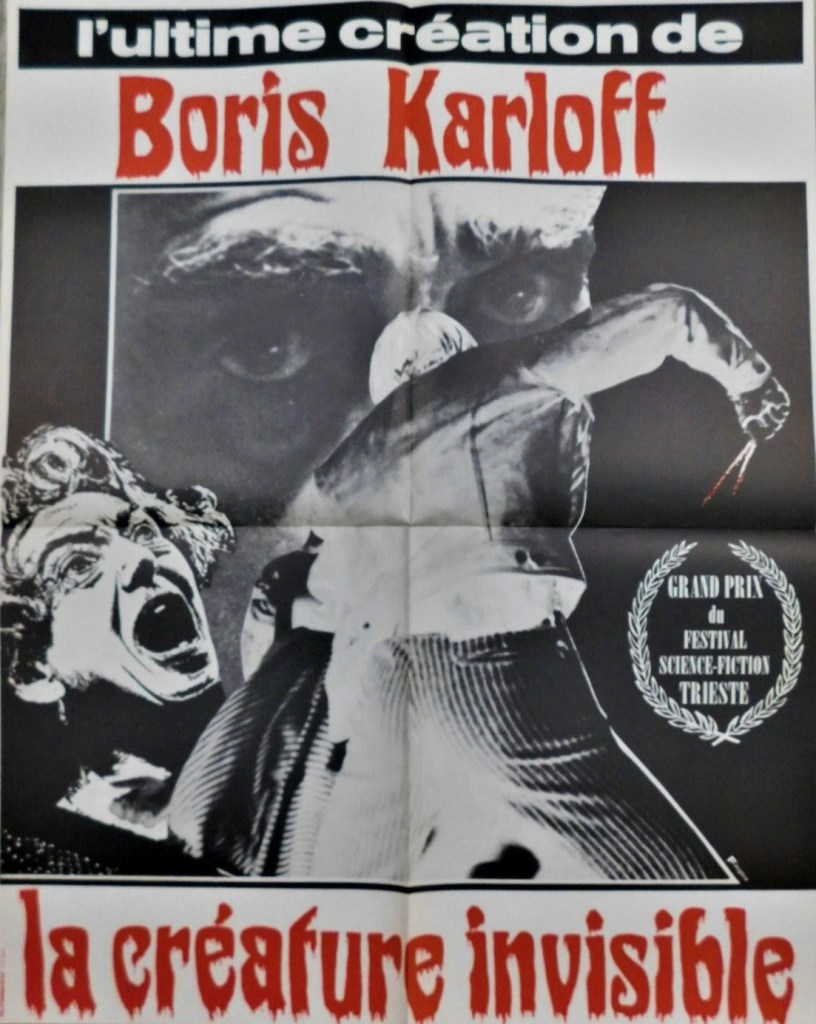
Since nobody knew what money-laundering was in the 1960s and any mention of Borgia took audience minds in a historical direction it was best to play safe in the title department.
They work for The Company aka The Mob. Nothing nasty though. He’s not in the drugs/enforcement/prostitution departments. He’s a money launderer. He goes round the country opening accounts in obscure banks and helping deposit Mafia cash as a means of buying other companies. “It’s not illegitimate, but it’s legal,” he’s informed.
This isn’t the Mafia that Coppola and Scorsese would later invest with grandeur, it’s closer to the faceless corporation of Point Blank (1967) but taking the business aspect to a higher level. There’s computerisation for a start, personnel files appear as a printout, and some hefty degree of organisation required to keep tabs of the $100 million-plus that enters legitimate business each year. And you would think they were spies, everyone uses code names, “Borgia Stick” being Tom’s, telephones have particular numbers, even conversation is some kind of code.
Trouble is, what was supposed to be an arrangement with benefits has turned into true love, and Tom wants to find a way out, live a different life, have kids. Eve backs off from that kind of commitment. But eventually the decision is taken out of their hands. A guy called Prentice (Ralph Waite) comes snooping around, claiming he knew Tom as Andy Mitchell from Toledo.
“Murder Syndicate” in one country translated into “Gangster Syndicate” in another, no mention of the FBI.
Cover potentially blown, Tom’s boss Anderson (Fritz Weaver) plans to give him a new life – his employers are not “unfeeling monsters” after all – pack him off to Rio with $83,000 to get him started. But only Tom. Eve is sent back to her old life, to prove she can be trusted, the life she was trying to keep from her husband. She is put to work in a clip joint.
Of course, it doesn’t work out that way and there are about a dozen twists before we reach an unexpected climax, especially given the opening scene which I won’t disclose.
Although The Godfather is seen as the high point of humanising the Mafia, in that picture Michael’s constant concealment from his wife of his true life means it avoids the real drama of the situation. Here, that drama is the crux. A clever big boss would try to avoid a marital mismatch. The wrong kind of love match can endanger the Family – just look at Meghan and Harry – and it’s a pretty clever device to splice two souls rescued from potential prison and a more sordid life, give them life’s trappings, assured that a woman who has sold herself to so many different men might be grateful just to be assigned a single one, and that a man who otherwise might have been a dull banker could receive, almost as an “extra,” a glamorous wife.
That they might have feelings for each other may well have been calculated into the equation. What would that matter? Surely, it would only benefit the relationship. Every manager knows that an employee with a happy home life is one less problem to worry about.
As long as company loyalty remained uppermost. Eve reminds Tom he’s no less guilty in helping the company get rid of tainted money than the guys on the ground who made it in the first place. Quite why Tom has a stab of conscience and hasn’t the smarts to work out that gangsters can be happily married is never made clear. However, once he sets rolling the particular ball of quitting the Mafia, it can only end in trouble.
Director David Lowell Rich (A Lovely Way To Die, 1968) does an exemplary job, spinning emotion and angst, humanising a couple we should really despise, and every now and then throwing in a corker of a twist. Unlike the experience of Lee Marvin in Point Blank, the employers are shown to be far from rigid, with an apparent touching regard for their employees.
Rich even manages to slip in a couple of scenes that provide greater insight. One of Tom’s co-workers talks like any successful salesman about the pressure of hitting his targets. And he fears the effect of computerisation, that it could make the Mafia vulnerable to Government investigation (rather than, as would later transpire, harnessing it to massive financial effect). And there’s a little nugget about how 200 businesses who controlled the entire U.S. economy in 1932 held the country to ransom for a year by refusing to accede to the wishes of President Roosevelt.
Inger Stevens (Firecreek, 1968) is the pick here, by turn confident, vulnerable, loving, hating, and with a terrific scene as she tries to control her emotions when tossed back into bargain basement of prostitution. Don Murray (The Viking Queen, 1967) spent his entire career trying to live up to the promise shown in Bus Stop (1956), for which he was Oscar-nominated, without quite getting the roles consistently enough that he deserved. But he is pretty convincing here.
This was television regular Barry Nelson’s first movie role in a decade. Fritz Weaver (The Maltese Bippy, 1969) is good as the boss whose game face is “understanding” and you might spot John Randolph (Seconds, 1966). George Benson wrote the songs for the nightclub sequence.
If you’ve never heard of this, it’ll be because David Lowell Rich is a very under-rated director and because it started life as a made-for-television movie in the heyday of that particular notion, but, as was often the norm with such projects, was released as a movie abroad under the alternative title.
Terrific little film, well worth a look. Way ahead of its time regarding money-laundering, sexual business arrangements (Homeland, 2011-2020), the pressures of working for the Mafia (The Sopranos, 1999-2007) and quitting that organization (Stiletto, 1969). You can catch it on YouTube but be warned this was filmed on video so the quality ain’t great.
I should point out before we go any further there’s a Raquel Welch connection. Husband Patrick Curtis was a producer and La Welch is down as an assistant producer, at a time when the pair were setting up their own production company Curtwel. Hard to see where Raquel would have fitted in but wouldn’t it have been sensational to have her as the devious mastermind?
The concept is better than the execution. There is an inconvenient truth about science. Successful experiments often require guinea pigs. Brain-washing was one such scientific notion, generally seen as an invention of those dastardly Communists a la The Manchurian Candidate (1962) although The Mind Benders (1963) suggested it was as common in the British halls of academe. As indicated by the title here brain washing could be termed modern-day witchcraft.
But where government scientists could hide behind the greater good, personal advantage is the notion here. And it did make me wonder how many scientists took vicarious pleasure in seeing guinea pigs doing their bidding, enjoying the power to inflict change on the potentially unwilling.
Professor Monserrat (Boris Karloff) and wife Estelle (Catherine Lacey) have invented a machine that through hypnotism can alter a subject’s mind in the longer term, make them prone to acts of savagery. Their chosen target is young man-about-town Mike (Ian Ogilvy). Bored with gorgeous girlfriend Nicole (Elizabeth Ercy) and ripe for adventure he is despatched on an orgy of violence, rape and murder.
What makes this potentially fascinating is that while the Professor draws back from the experiment, Estelle wants to continue. The sadistic female was coming into her own during this decade, Elke Sommer and Sylva Koscina as a deadly tag-team in Deadlier than the Male (1967), Suzanna Leigh in Subterfuge (1968), but these were sidekicks, pawns in the control of devious men.
Estelle wins a battle of wills against her husband and his weak opposition fails to deter her from authorizing ever more despicable acts, as if she is unleashing her own pent-up aggression. Not only can she control her husband but she is in command of the virile young Mike. Sensibly, the film stops short of setting her up as a James Bond-style megalomaniac, but there is something more infernal in committing these acts from a small run-down apartment rather than some underground space-age cavern.
Turning Boris Karloff into a bad guy tripped up by conscience is a neat casting trick. But making him prey to his initially subservient wife is a masterstroke. Her violence is gender-neutral, as happy to force Mike into battering a work colleague as attempting to rape a young woman.
And there is also a sense of the old taking revenge on the young. The old have been left behind in a Swinging London awash with discos and barely-existing morals. Why shouldn’t old people tap into base desire, and better still, not have to lift a finger, their victim carrying the can for every deed.
It’s stone cold creepy. And would been a much tighter – and scarier – picture if director Michael Reeves (Witchfinder General, 1968) had not wasted so much time with the dull youngsters, complete with pop groups performing in a nightclub. Ian Ogilvy (Witchfinder General) doesn’t bring much to the party, no more than your standard good-looking young fellow.
Boris Karloff (The Crimson Cult, 1968) is much better value especially when excitement at his new discovery wears off and he realizes he is playing second fiddle to his wife. For once, there’s nothing inherently evil in him. But Catherine Lacey (The Servant, 1963) is easily the pick, delivering a well-judged performance, assisting her husband in his endeavors until the time is right to take over. You might spot Susan George (The Straw Dogs, 1971) and Sally Sheridan, both a Fu Manchu and Bond girl. Tom Baker (Witchfinder General) co-wrote the script with Reeves.
Provides more to ponder than actually appears on the screen.
The “Behind the Scenes” articles have become increasingly popular in the Blog. This used to go out under the more generic title of “Other Stuff” but now, whoopee, is a category of its own. As regular readers will know I am fascinated about the problems incurred in making certain movies. In many instances, a “Behind the Scenes” story was backed up by another article on how the book was adapted into a movie or how the film was released. In the Blog, these stories run one after the other, but in the book I wrote I put them all together to make access easier.
Perhaps one of the more interesting aspects of this category is that every now and there is out of nowhere massive interest in the making of a particular movie and it shoots up the all-time tree. Most of the material has come from my own digging, and sources are always quoted at the end of each article, but occasionally I have turned to books written on the subject of the making of a specific film.
(5) The Girl on a Motorcycle (1968). Cult classic starring Marianne Faithful and Alain Delon had a rocky road to release, especially in the U.S. where the censor was not happy.
(3) The Satan Bug (1965). The problems facing director John Sturges in adapting the Alistair MacLean pandemic classic for the big screen. One of four Alistair MacLean titles in the top 20.
(1) The Guns of Navarone (1961). The ultimate template for the men-on-a-mission war picture with an all-star cast and enough jeopardy to qualify for a movie of its own.
(NE) Waterloo(1970). Massive flop but intriguing reading, based on a book on the subject.
(NE) Ice Station Zebra(1968). A complete cast overhaul and ground-breaking special effects are at the core of this tale.
(NE) Cast a Giant Shadow (1965). Producer Melville Shavelson wrote a book about his experiences and this and other material relating the arduous task of bringing the Kirk Douglas-starrer to the screen are related here.
(2) Spartacus(1961).Not so much about the making of theStanley Kubrick epic, but about the rival Yul Brynner version.
(NE) Secret Ceremony(1969). Quite how director Joseph Losey persuaded uber glam-queen Elizabeth Taylor to go dowdy in this creepy drama.
(NE) Cincinnati Kid(1965). Sam Peckinpah sacked as director, nudity controversy, Sharon Tate and Steve McQueen, what a combination.
(NE) The Ipcress File (1965). The other iconic 1960s spy picture that brought Michael Caine fame.
(NE) In Harm’s Way (1965). Otto Preminger black-and-white epic about Pearl Harbor and after.
(19) Genghis Khan (1965). A venture into epic European filmmaking with an all-star cast led by Omar Sharif.
(NE) The Biggest Bundle of Them All (1968). Raquel Welch, release delay controversy.
(NE) Battle of the Bulge (1965). There were going to be two versions, so the race was on to get this one to the public first.
(NE) Valley of the Dolls (1968). Sensational story behind the sensational adaptation of the sensational bestseller.
(NE) The Secret Ways (1961). A family affair – star Richard Widmark was producer and sometime director, his wife wrote the script. Not necessarily what author Alistair MacLean intended.
(NE) The Wicker Man (1973). Cult film and its release problems.
(NE) The Birds (1963). The most controversial film Alfred Hitchcock ever made.
(NE) Once Upon a Time in the West (1969). How Sergio Leone put together what is now acclaimed as the greatest western ever made.
(NE) Hour of the Gun (1967). Complicated story behind the re-telling of the gunfight at the O.K. Corral.
As is by now traditional (well, it’s the second full year) this isn’t my choice of the top films of the year, but yours, my loyal readers. This is a chart of the films viewed the most times over full calendar year of January 2022 – December 2022.
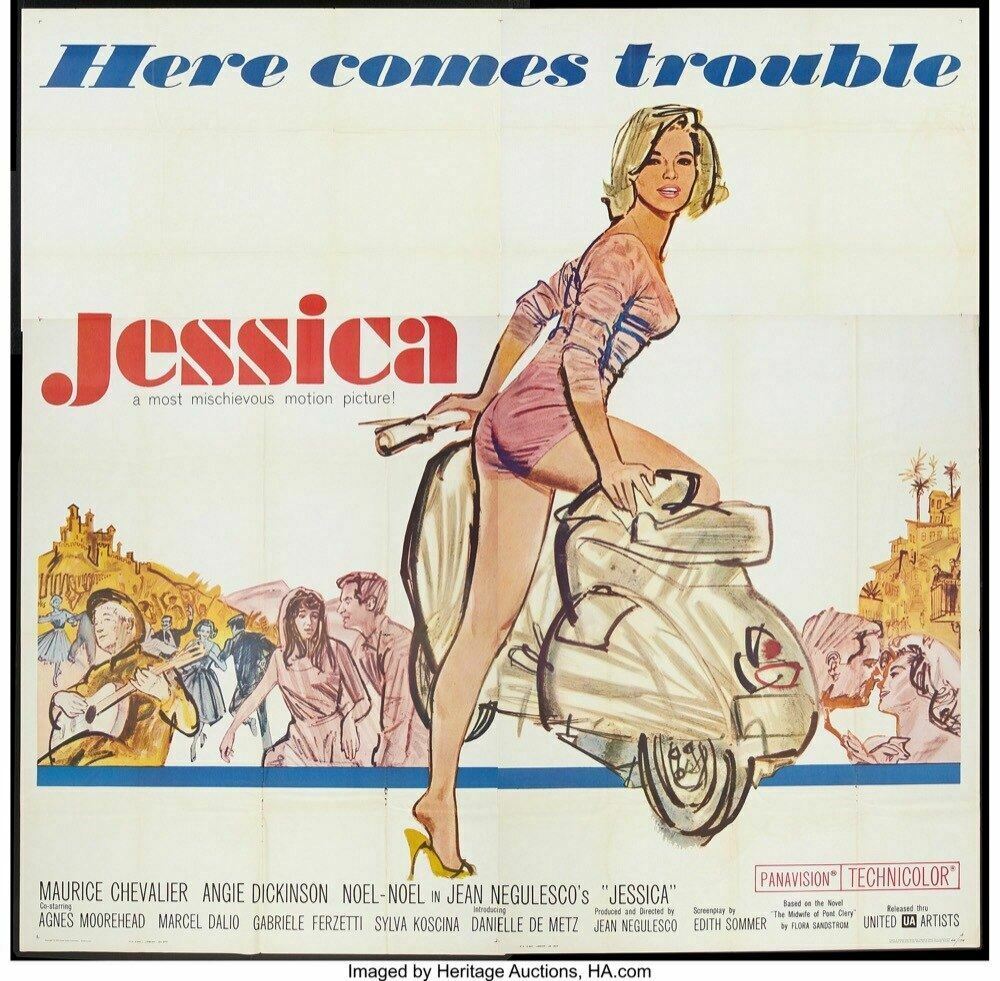
Jessica(1962). Angie Dickinson plays a young widow who turns so many heads in a small Italian town that their wives seek revenge. The film had debuted at No 30 in the previous year’s chart so showed remarkable staying power.
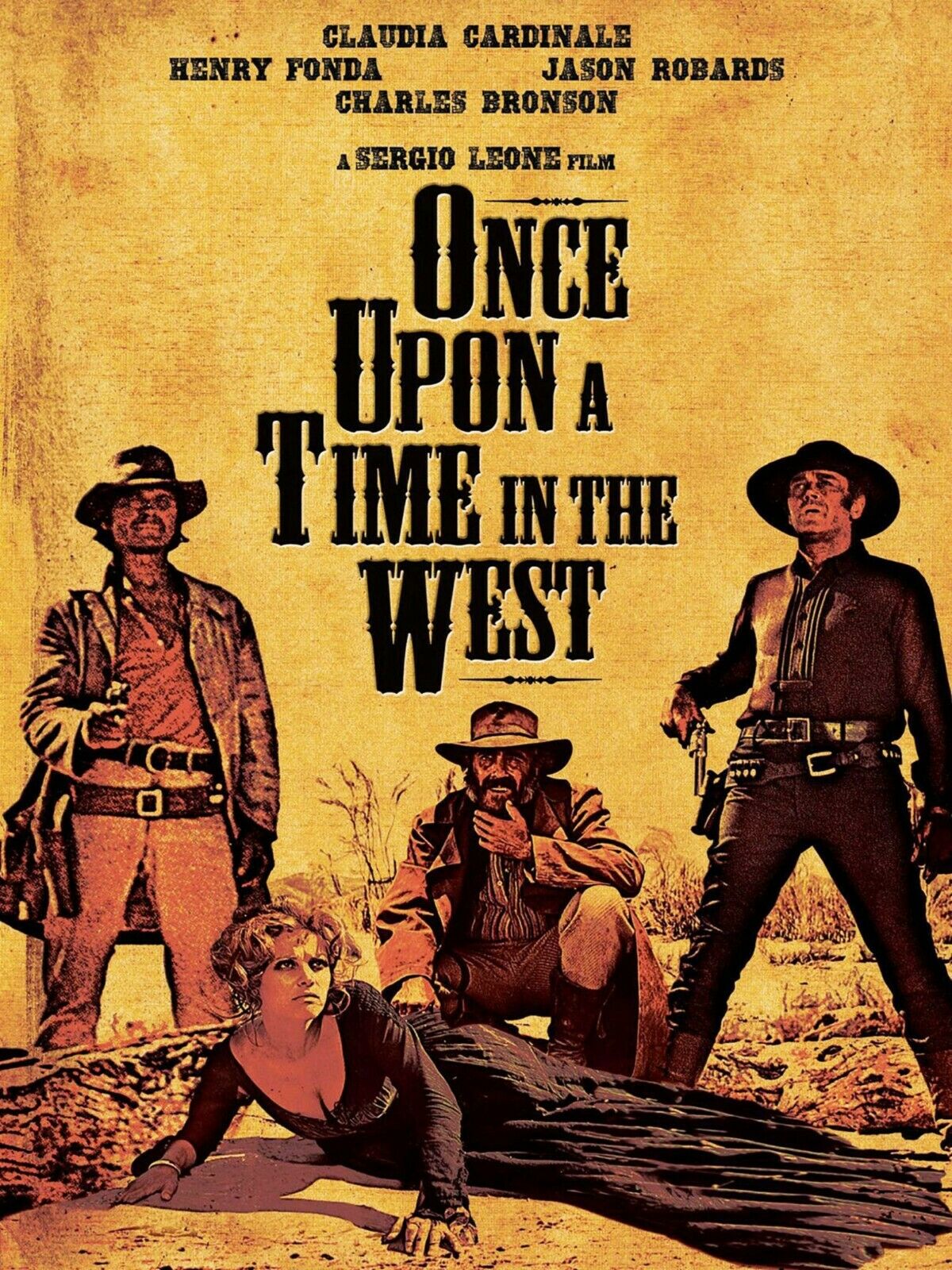
Once Upon a Time in the West (1969). Sergio Leone’s masterpiece now acclaimed as the greatest western ever made. Top class cast – Claudia Cardinale, Charles Bronson, Henry Fonda and Jason Robards – and one of the greatest scores ever written courtesy of Ennio Morricone.
The Swinger (1966). Ann-Margret sparkles as author reinventing herself by writing a sex novel.
Fraulein Doktor (1969). Suzy Kendall as German spy outwitting the British during World War One.
Can Heironymus Merkin Ever Forget Mercy Humpe and Find True Happiness? (1969). Fellini-esque musical with abundant nudity as writer-director-star Anthony Newley tries to unravel the meaning of life.
Father Stu (2022). Under-rated biopic with Mark Wahlberg as unlikely priest.
Blonde(2022). Andrew Dominik’s controversial reimagining of the life of Marilyn Monroe with Ana de Armas
For a Few Dollars More(1965).Sergio Leone re-teams with Clint Eastwood in the second in the spaghetti western trilogy with Lee Van Cleef as a rival bounty hunter.
A Place for Lovers(1968). Faye Dunaway and Marcello Mastroianni in Vittorio De Sica doomed romance.
Fade In(1968). Burt Reynolds disowned this romance filmed against the backdrop of making the Terence Stamp western Blue but it’s better than he thinks.
The Secret Ways (1961). Richard Widmark in spy thriller set in Hungary during the Cold War and adapted from the Alistair MacLean novel. Senta Berger has a small role. Top film for 2021, so demonstrating the ongoing popularity of films based on the author’s works.
The Sisters (1969). Complicated menage a trois that borders on the semi-incestuous starring Nathalie Delon and Susan Strasberg.
Pharoah (1966). Epic Polish picture about political shenanigans in ancient Egypt. Another film with legs – it was No 3 in the 2021 annual chart.
Water Gate Bridge / Battle at Lake Changjin II (2022). Another epic, non-stop action from the Chinese point-of-view in a sequel to one of the most famous battles of the Korean War.
Harlow (1965). Carroll Baker as the blonde bombshell who rocketed to fame in 1930s Hollywood.
Baby Love (1969). Morality tale as orphaned Linda Hayden tries to fit into an upper-class London household.
Moment to Moment (1966). Hitchockian thriller set in the South of France with adulterous Jean Seberg suspected of killing her lover.
Secret Ceremony (1968). Elizabeth Taylor, Mia Farrow and Robert Mitchum in atmospheric Joseph Losey drama.
Lady in Cement (1969). Gangster’s moll Raquel Welch steals the show in Frank Sinatra’s second outing as private eye Tony Rome.
Subterfuge (1968). Suzanna Leigh steals the show as a sadistic henchwoman trying to prevent Gene Barry uncovering a mole in M.I.5.
P.J. / New Face in Hell (1967). George Peppard taken to the cleaners as down-on-his luck private eye.
The Golden Claws of the Cat Girl (1968). Cult French movie starring Daniele Gaubert as a sexy cat burglar. This was No 6 last year.
The Gray Man (2022). Spectacular Netflix misfire with Ryan Gosling and Chris Evans as rival assassins and Ana de Armas adding some spice.
The Brotherhood (1968). Martin Ritt Mafia drama sees siblings Kirk Douglas and Alex Cord falling out.
Some Girls Do (1969). Richard Johnson returns as Bulldog Drummond battling archvillains Daliah Lavi and Beba Loncar.
Pressure Point (1962). Prison psychiatrist Sidney Poitier treats racist patient Bobby Darin. Very unusual imagery.
The Double Man (1967). C.I.A. operative Yul Brynner battles Russian espionage in Switzerland with Britt Ekland providing the glamor.
Operation Mincemeat (2022). Re-telling of “The Man Who Never Was” World War Two plot that duped Hitler over Sicilian invasion plans.
Orgy for the Dead (1965). Bizarre cult horror tale where most of the female characters appear to be auditioning for a nudie film.
Texas Across the River (1966). Alain Delon acts against type in Dean Martin comedy western.
The only thing Hollywood liked better than whooping with delight over a hit was crowing with delight over a flop. In the 1960s you couldn’t move for hindsight. And far from it being the end of the decade that Hollywood was kicked in the financial teeth, mostly from over-investment in musicals, there was also a sea of red ink at the start.
Comparing budget with rentals returned to the studios (i.e. their share of the takings once cinemas had taken their cut of the box office gross) produced a league table that nobody wanted to scale.
Atop the pillar of shame, sitting on a monumental $18.1 million loss (reached by comparing budget to U.S. rentals – see Note below) was the last of the Samuel Bronston epics, The Fall of the Roman Empire (1964), directed by Anthony Mann and starring Alec Guinness, Sophia Loren and Stephen Boyd.
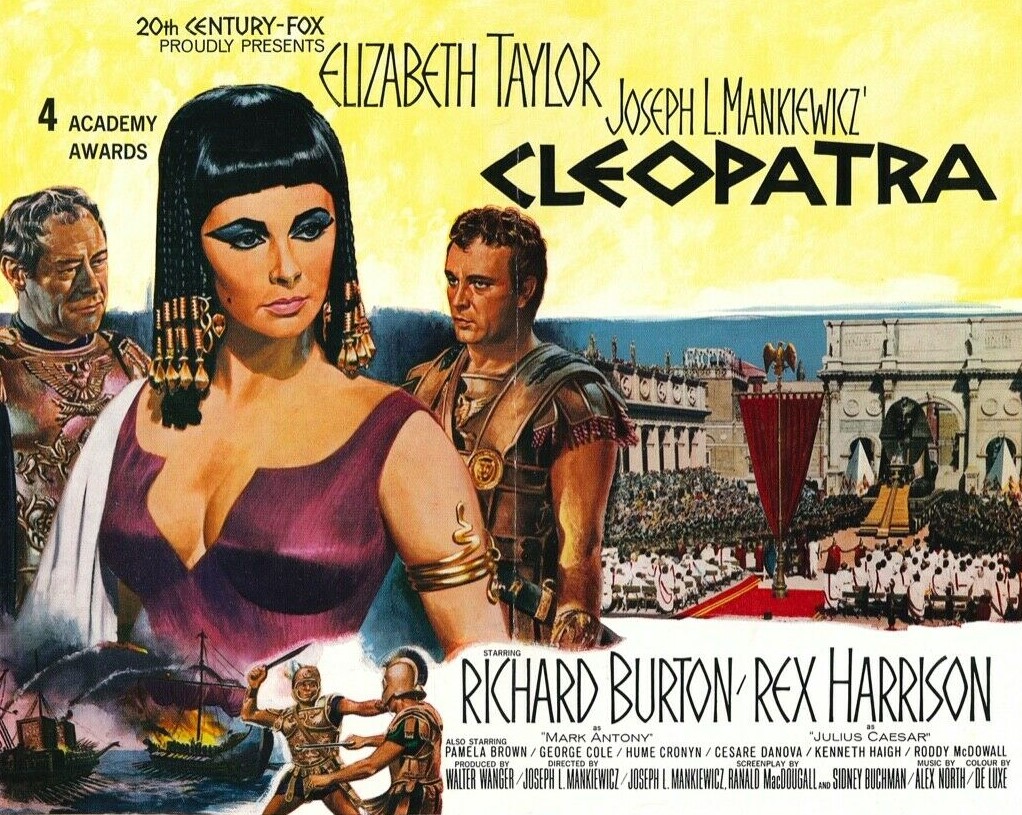
You won’t be surprised to find Cleopatra (1963), driven to publicity heights by the ruckus over the adulterous affair of stars Elizabeth Taylor and Richard Burton, in second place. If it hadn’t cost so much – $44 million – it might have easily turned a profit since box office rentals were a massive $26 million. But you can’t deny the arithmetic that meant this showed an $18 million shortfall, and therefore on paper a staggering flop.
Not far behind was Doctor Dolittle (1967), one of the biggest musical fiascos in an era of musical disasters. Although Oscar-winning Rex Harrison was the star, audiences couldn’t be persuaded it was anything more than a glorified Disney-style picture for children, and it lost $15.8 million.
The Greatest Story Ever Told (1965) should have been the greatest box office story ever told had director George managed to inject a bit more humanity into the sanctimonious retelling. Without a box office miracle this came in short by $13.1 million.
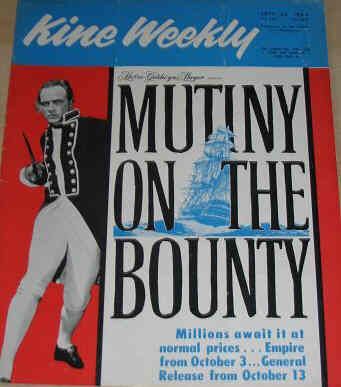
And no prizes for guessing that Mutiny on the Bounty (1962), with Marlon Brando stranded on an island by Trevor Howard, found income did not go far enough to offset cost. It underperformed to the tune of $12.6 million..
Star! (1968) must have seemed like a safe bet given Julie Andrews’ last three musicals had turned hefty profits. But it was so off the pace that it fell $10.8 million shy of break-even.
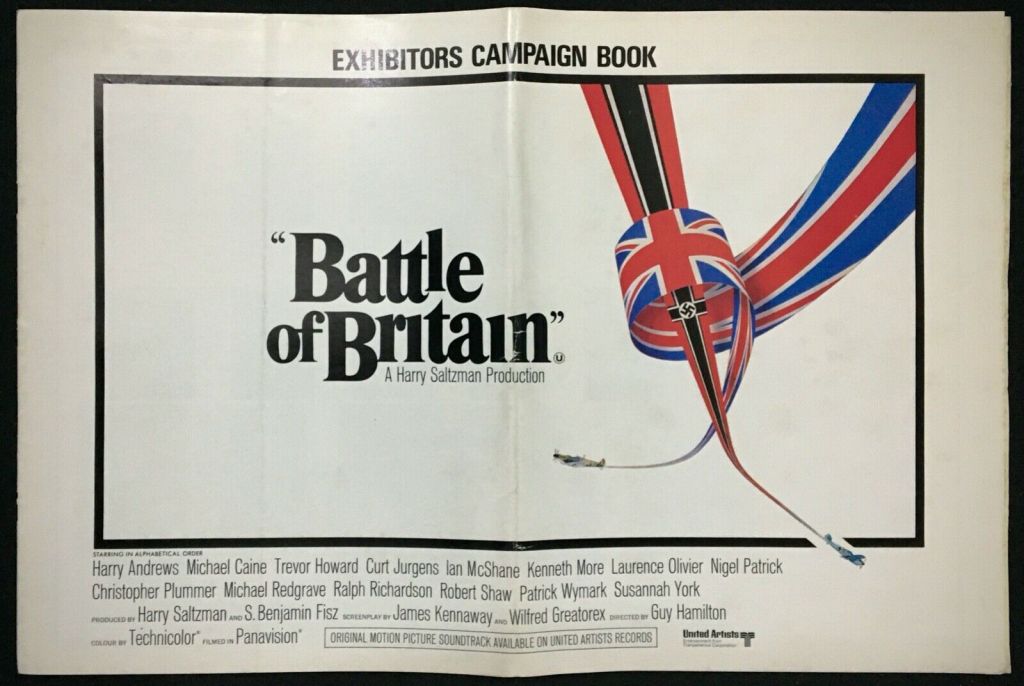
Bond producer Harry Saltzman was astonished, not to say humiliated, to discover there was such little appetite Stateside for an all-star version of how The Battle of Britain (1969) was won. Hadn’t every Hollywood movie insisted that war pictures only succeeded with a prominent Yank in the cast? One of the biggest hits of the year in Britain, it would still have to go some to overcome a $10 million discrepancy.
The problem with Hollywood was it was greenlighting projects that had to do phenomenal business just to reach a profit. And although Barbra Streisand’s debut Funny Girl (1968) had struck box office and critical gold, even she could not save Hello, Dolly! when it racked up such high costs. The downside was $8.8 million.
The unlikely casting of three non-singers – Lee Marvin, Clint Eastwood and Jean Seberg – in the principal roles of Paint Your Wagon (1969) seemed an act of incalculable hubris, but surprisingly, the musical did better than expected, not enough to turn the corner into profit, but losses limited to $5.5 million in the U.S. part of the course.
In tenth place was a second Samuel Bronston miscalculation, 55 Days at Peking (1963). Why would American audiences be interested in an obscure war in China even if Charlton Heston took top-billing? Such disinterest ensured it fell $5 million short of the target.
Overruns on John Wayne’s pet project The Alamo (1960) meant he ended up in debt. His fans were disinclined to line up for a roadshow, which put the dampers on the launch. Hollywood was stunned that a John Wayne movie lost money – $4.1 million – it was such a career rarity.
Another Bond alumni Albert Broccoli took the financial tumble this time when Dick Van Dyke failed to work his Mary Poppins magic in another musical aimed more at children than adults, Chitty, Chitty, Bang, Bang (1968).
Three other pictures ended up in the red as the result of over-expenditure. The Bible (1966) missed break-even by $3 million, Spartacus (1961) by $1.7 million, and another musical, Camelot (1967) starring non-singer Richard Harris and Vanessa Redgrave by $1 million.
But if Hollywood thought it had weathered the worst of the financial storm it was in for a shock the following year when top-heavy star vehicles hit the skits. Waterloo with Rod Steiger and Christopher Plummer lost $23.6 million, The Molly Maguires with Sean Connery and Richard Harris $9.9 million and The Only Game in Town toplining Elizabeth Taylor and Warren Beatty $8.5 million
NOTE: It’s entirely possible that once you calculated a movie’s long tail all these films turned profit. The foreign performance of films on initial release often out-grossed their domestic revenues, especially if roadshown in Europe. Revenue from half a century’s worth of countless television sales in countless countries followed by satellite, VHS, DVD, satellite, syndication, Blu-Ray and streaming had the potential to turn any loss into profit.
But there was a proviso. Generally, what a television station paid for a movie depended on its initial gross, box office seen to be indicative of public demand – and of advertising interest . The leasing of Cleopatra first time round to U.S. television, for example, added an extra $3 million to the coffers but that small screen executives were willing to pay such a record sum was driven by the vast numbers that had seen it at the cinema. And, to a large extent, future response to these movies still appeared to depend of how well they had done or how well they were known – a long-term version of word-of-mouth – at the time of their initial release..
On initial global release Cleopatra probably closed the gap between profit and loss but I doubt that would be the case for The Fall of the Roman Empire or The Greatest Story Ever Told or Doctor Dolittle or Mutiny on the Bounty. While The Battle of Britain was a huge success in Britain and in countries belonging to the British Commonwealth, I doubt it went into the black. But something like Spartacus or Camelot or The Alamo or Paint Your Wagon, which ran for a year in roadshow in London, most certainly turned a profit on overall worldwide receipts.
SOURCE: “Big-Buck Scorecard 1956-1987,” Variety, January 20, 1088, p64, 66.
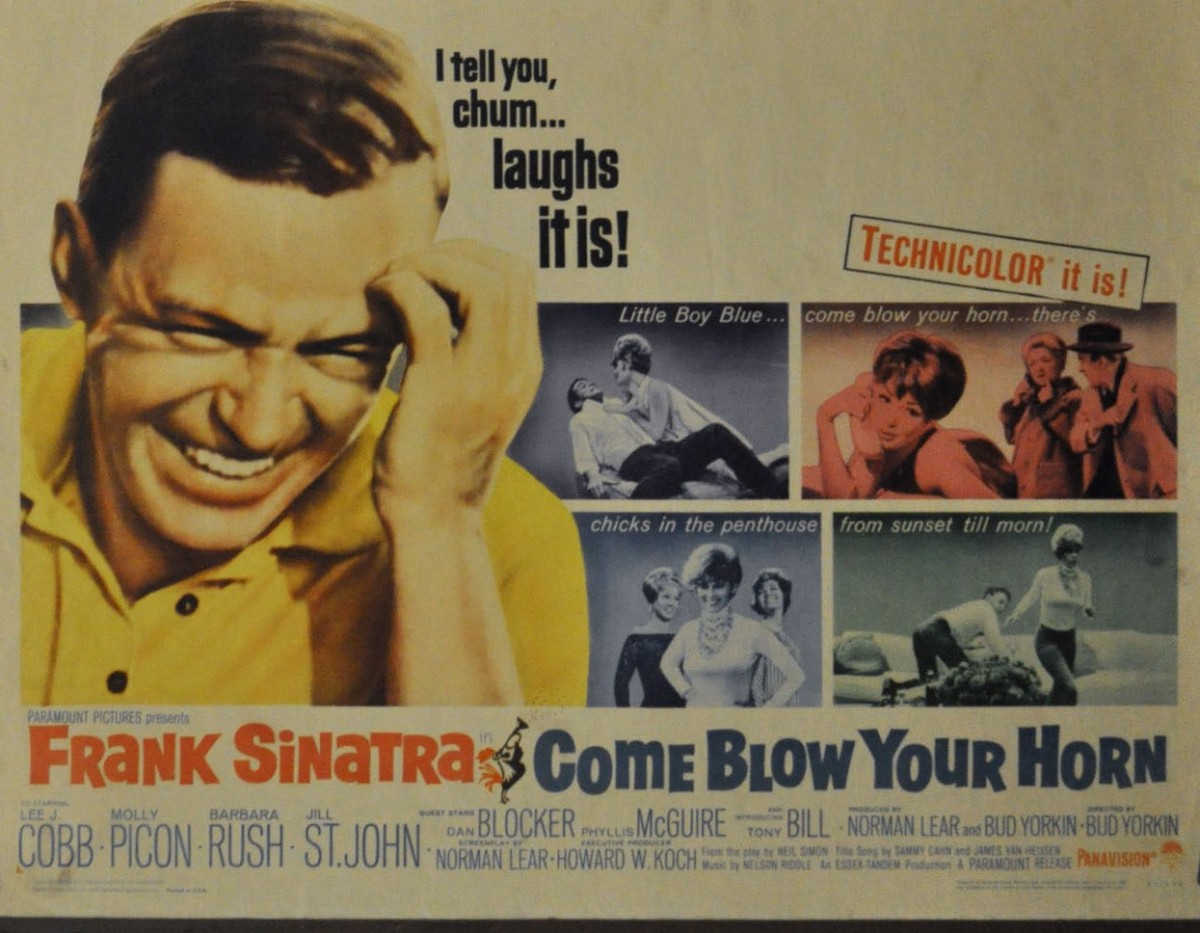
Wonderful upbeat performance from Frank Sinatra lifts this out of a misogynistic pit where women were either dumb, desperate to get married or passive-aggressive harridans. Bachelor playboy Alan (Frank Sinatra) has more women on a string than there is string. When younger brother Buddy (Tony Bill) moves in, Alan introduces him to the fun ways of the world, not expecting Buddy to be such an apt pupil.
Alan keeps main squeeze Connie (Barbara Rush) dangling while, pretending to have Hollywood connections, making hay with actress wannabe Peggy (Jill St John). He also keeps customer Mrs Eckman (Phyllis McGuire) sweet in transactional sex fashion and there’s no shortage of other women liable to appear out of the woodwork.
Meanwhile, his boss, apoplectic father Harry (Lee J. Cobb), goes around screaming at everyone, berating Alan for his lifestyle and moaning at harassed wife Sophie (Molly Picon). Most of the time it looks like it’s going to swerve into a more typical English farce with various women being hidden out of sight from various other woman or Harry or an equally apoplectic cuckolded husband (Dan Blocker).
But, with considerably more sophistication than that, the story takes the more interesting tack of character development. Alan, who might appear to be sitting pretty, woman at his beck and call, a glorious modern apartment, cocktails on tap, is brought up sharply by his brother’s delight at such a shallow life. Alan gets to play Hollywood honcho with Peggy while Connie delivers an ultimatum that threatens to bring Frank to his senses though, naturally, he believes it’s all hooey.
The fraternal business is well done, instead of the normal rivalry genuine affection and the older sibling offering guidance, though primarily in how to get drunk and get off with women rather than anything that might otherwise stand him in good stead. Though you might argue that being shown how to dress, and how converse with women, and organise a fun party might be as much education as a young gentleman in the Big Apple required.
The only thing better than one Frank Sinatra picture is two Frank Sinatras so to scoop up some extra cash these were paired for a speedy reissue.
Playwright Neil Simon, the toast of Broadway at this stage, exhibited such a keen sense of structure that the story never sagged. Any time that appeared a remote possibility, instead of a stranger coming in a la Raymond Chandler with a gun, it’s Harry stomping all over the place. There are some good catchphrases, genuinely funny moments, and some great lines, the best, I have to confess, from Peggy who bemoans the fact that she was stranded in a hotel room with Alan at a ski resort by all the snow outside. Redeeming factor: her homely kind of dumb serves narrative purpose, making the otherwise unbearably charming Alan come across as a heel.
This is quite a different Sinatra, like he’s channeling his record persona, none of the anguish, dramatic intensity or Rat Pack bonhomie he brought to other pictures. Often you hear of actors just playing the same character or a variation thereof, but this ain’t a Sinatra persona I’m familiar with and brings verve to the whole shebang.
Lee J. Cobb (Coogan’s Bluff, 1968) gives in to overacting. You can see how that loud style might work on the stage, but it’s less effective here. Jill St John (Tony Rome, 1967) is very good as the uncertain beauty, who could be incredibly seductive if only she could work out how, and not quite a victim either, and still managing vulnerability. Barbara Rush (Robin and the 7 Hoods, 1964) is wasted, though. Set up as a modern woman, she collapses at the first sniff of marriage, though framing her eyes in a mask of light in a taxi cab is about the only compositional mark of any note.
Quite what possessed director Bud Yorkin (Divorce American Style, 1967) to stick in the title song in the middle of the picture is anybody’s guess. Norman Lear (Divorce American Style) wrote the script but you can hardly go wrong with a Neil Simon template.
End up: it’s mostly about family and people coming to terms with themselves and each other.
Having complained about lists and then recanted when one of my favorites got the nod at the top of the heap, I’m doing the same again.
The recent Sight & Sound once-in-a-decade Directors Poll did the unthinkable and placed Once Upon a Time in the West ahead of John Ford’s The Searchers (1956) which, virtually since release, had been anointed the top western of all time. The critics who participated in the Critics Poll, which ran concurrently with the Directors Poll, were not, I hasten to add, quite so convinced. According to the critics, the John Ford picture was still top dog, ahead of the Leone masterpiece in second place. But in a battle between directors, who make a living making pictures, and critics, whose only skill is writing about them, I know which side I would come down on. And in any case I had long sided with the directors on this issue.
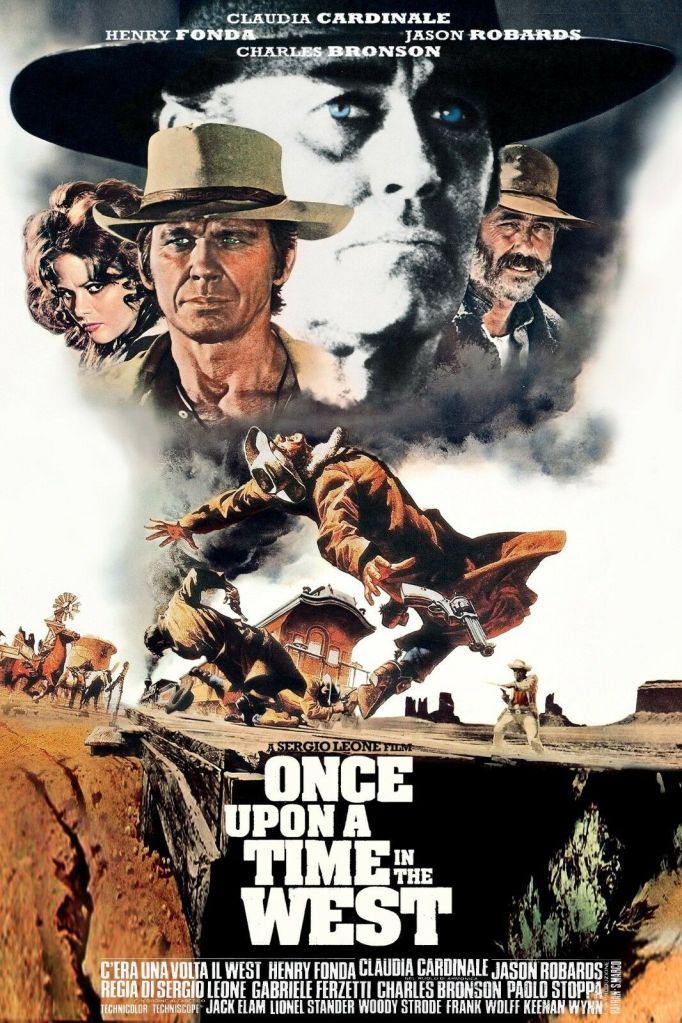
A masterpiece to savor. The greatest western ever made. Sergio Leone’s movie out-Fords John Ford in thematic energy, imagery and believable characters and although it takes in the iconic Monument Valley it dispenses with marauding Native Americans and the wrecking of saloons. That the backdrop is the New West of civilisation and enterprise is somewhat surprising for a movie that appears to concentrate on the violence implicit in the Old West. But that is only the surface. Dreams, fresh starts are the driving force. It made a star out of Charles Bronson (Farewell, Friend, 1968), turned the Henry Fonda (Advise and Consent, 1961) persona on its head and provided Claudia Cardinale (Blindfold, 1965) with the role of a lifetime. And there was another star – composer Ennio Morricone (The Sicilian Clan, 1969)
New Orleans courtesan Jill (Claudia Cardinale) heads west to fulfil a dream of living in the country and bringing up a family. Gunslinger Frank (Henry Fonda), like Michael in The Godfather, has visions of going straight, turning legitimate through railroad ownership. Harmonica (Charles Bronson) has been dreaming of the freedom that will come through achieving revenge, the crippled crooked railroad baron Morton (Gabriele Ferzetti) dreams of seeing the ocean and even Cheyenne (Jason Robards) would prefer a spell out of captivity.
The beginnings of the railroad triggers a sea-change in the west, displacing the sometimes lawless pioneers, creating a mythic tale about the ending of a myth, a formidable fable about the twilight and resurgence of the American West. In essence, Leone exploits five stereotypes – the lone avenger (Harmonica), the outlaw Frank who wants to go straight, the idealistic outlaw in Cheyenne, Jill the whore and outwardly respectable businessman Morton whose only aim is monopoly. All these characters converge on new town Flagstone where their narratives intersect.
That Leone takes such stereotypes and fashions them into a movie of the highest order is down to style. This is slow in the way opera is slow. Enormous thought has gone into each sequence to extract the maximum in each sequence. In so doing creating the most stylish western ever made. The build-up to violence is gradual, the violence itself over in the blink of an eye.
Unusually for a western – except oddities like Five Card Stud (1968) – the driving force is mystery. Generally, the western is the most direct of genres, characters establishing from the outset who they are and what they want by action and dialogue. But Jill, Harmonic and Cheyenne are, on initial appearances, mysterious. Leone takes the conventions of the western and turns them upside down, not just in the reversals and plot twists but in the slow unfolding tale where motivation and action constantly change, alliances formed among the most unlikely allies, Harmonica and Cheyenne, Harmonica and Frank, and where a mooted alliance, in the romantic sense, between Jill and Harmonica fails to take root.
There’s no doubt another director would have made shorter work of the opening sequence in Cattle Corner, all creaky scratchy noise, in a decrepit railroad station that represents the Old West, but that would be like asking David Lean to cut back Omar Sharif emerging from the horizon in Lawrence of Arabia (1962) or Alfred Hitchcock to trim back the hypnotic scenes of James Stewart following Kim Novak in Vertigo (1958). Instead, Leone sets out his stall. This movie is going to be made his way, a nod to the operatic an imperative. But the movie turns full circle. If we begin with the kind of lawless ambush prevalent in the older days, we end with a shootout at the Sweetwater ranch that is almost a sideshow to progress as the railroad sweeps ever onward.
No character is more against audience expectation than Jill. Women in westerns rarely take center stage, unless they exhibit a masculine skill with the gun. There has rarely been a more fully-rounded character in the movies never mind this genre. When we are introduced to her, she is the innocent, first time out West, eyes full of wonder, heart full of romance. Then we realise she is a tad more mercenary and that her previous occupation belies her presentation. Then she succumbs to Frank. Then she wants to give up. Then she doesn’t. Not just to stay but to become the earth mother for all the men working on the railroad.
Another director would have given her a ton of dialogue to express her feelings. Instead, Leone does it with the eyes. The look of awe as she arrives in flagstone, the despair as she approaches the corpses, the surrender to the voracious Frank, the understanding of the role she must now play. And when it comes to close-up don’t forget our first glimpse of Frank, those baby blue eyes, and the shock registering on his face in the final shoot-out, one of the most incredible pieces of acting I have ever seen.
And you can’t ignore the contribution of the music. Ennio Morricone’s score for Once Upon a Time in the West has made a greater cultural impact than even the venerated John Williams’ themes for Star Wars (1977) and Jaws (1975) with rock gods like Bruce Springsteen and Metallica among those spreading the word to successive generations and I wonder in fact how people were drawn to this big-screen showing by the opportunity to hear the score in six-track Dolby sound. There’s an argument to be made that the original soundtrack sold more copies than the film sold tickets.
The other element with the music which was driven home to me is how loud it was here compared to, for example, Thunderball (1965), which as it happens I also saw on the big screen on the same day. Although I’ve listened to certain tracks from the Bond film on a CD where the context is only the listener and not the rest of the picture, I was surprised how muted the music was for Thunderball especially in the action sequences. Today’s soundtracks are often loud to the point of being obstreperous, but rarely add anything to character or image.
If you live in the U.K. you should get the opportunity to see this once again on the big screen because the British Film Institute, which coincidentally owns Sight & Sound, is planning to screen all the 100 films in its latest poll. Other countries might take note.
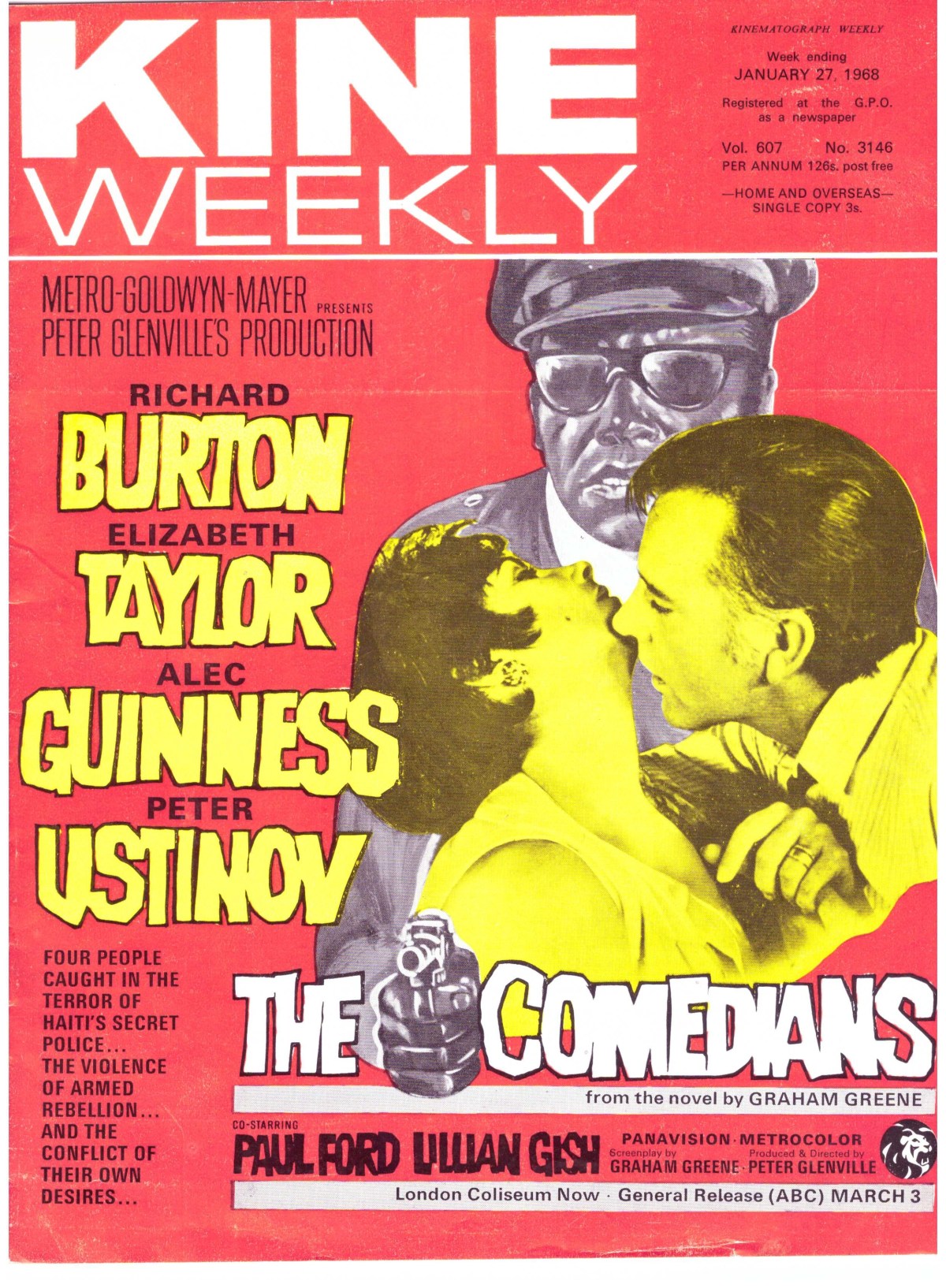
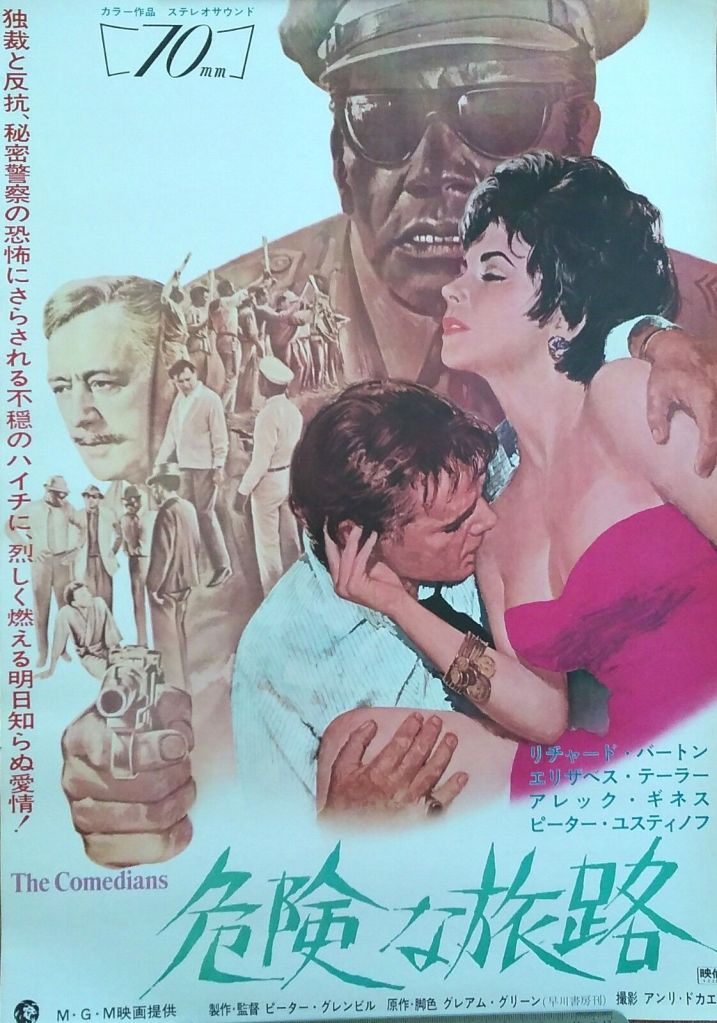
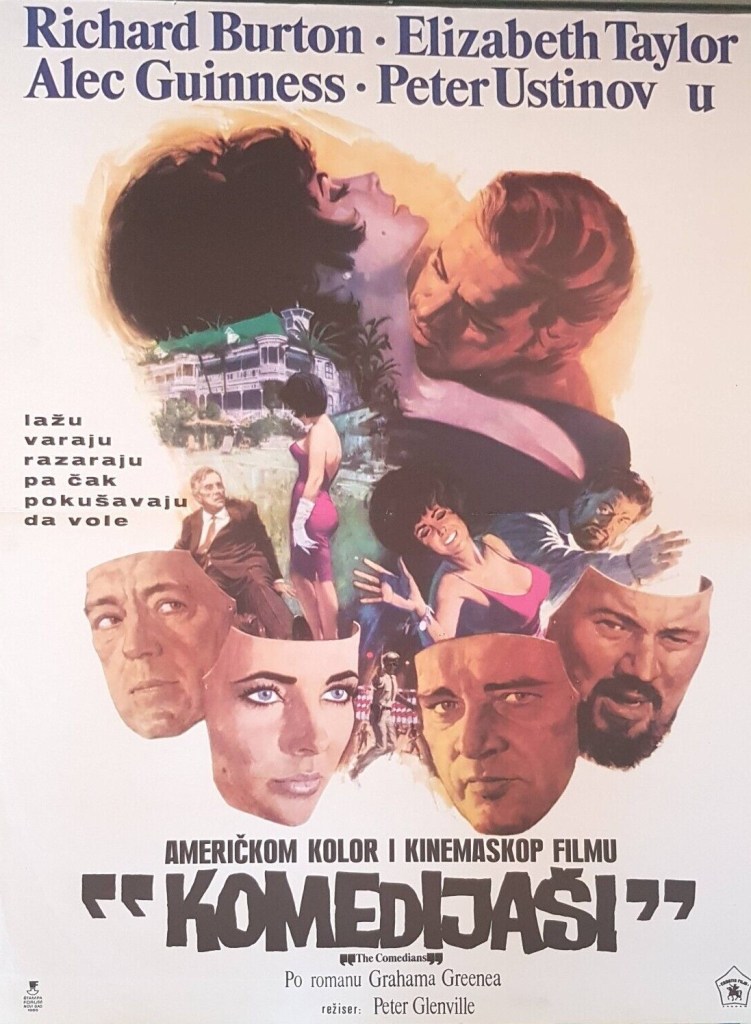
Richard Burton was at his box office peak. From Cleopatra (1963) through The VIPs (1963), Becket (1964), The Night of the Iguana (1964), The Spy Who Came in from the Cold (1965), The Sandpiper (1965), Who’s Afraid of Virginia Woolf (1966) and The Taming of the Shrew (1967) he had enjoyed massive box office success and notched up three Oscar nominations. He was being pursued for Camelot (1967) – the part he played on Broadway – and himself pursued the rights to Bernard Malamud’s The Fixer. But out of admiration for novelist Graham Greene he accepted, sight unseen, the leading role in The Comedians.
Director Peter Glenville, better known at the time as a stage director, owed his career to the two male principals. Alec Guinness had backed him for his debut The Prisoner (1955) and starred in his latest film, the farce Hotel Paradiso (1966). Burton had been one of his two incendiary stars of Becket (1964), a box office smash, as a consequence of which the director signed a four-picture deal with MGM. All three of his previous films had begun life as plays directed by Glenville.
Before the picture could get off the ground it faced a potential legal minefield from producer George Glass. He owned the rights to a short story The Prisoner, written by screenwriter Ernest Lehman (North by Northwest, 1959) and published in the January 1952 edition of Cosmopolitan magazine. It had since been turned into a television play directed by john Frankenheimer for the Playhouse 90 series in February 1957. Glass argued the new picture would infringe his copyright.
Although without doubt Taylor was the bigger box office star, the better remunerated and the more acclaimed, at least by Oscar standards (two wins to his five nominations), in their personal life the roles were reversed. “There seems little doubt,” wrote Burton biographer Melvyn Bragg, “that although he was drawn into what he saw as the mystery and fun of Elizabeth he was the dominating partner. She soothed him. She sought him in bars.” Burton himself said, “We never had any question of who was boss. She always realised I was to run the show.”
Whether that was the reason she took what was no more than a supporting role in The Comedians at half her usual salary (for the first time Burton on $750,000 versus her $500,000 was the financial top dog) is unclear, but she certainly, as was attested on The Spy Who Came in from the Cold, did not like to leave him footloose and fancy free on a film set where he could indulge his liking for liquor and pretty women. On her previous film, Reflections in a Golden Eye (1967) “she resented playing second fiddle” to Marlon Brando, and might have preferred making a picture where she regained a sense of her own importance, but instead she accepted a role that was not up to her usual high standard.
Director Peter Glenville (Becket) had not particularly wanted Taylor for the role, possibly feeling she might over-balance the project. It would be the couple’s seventh movie together, a pairing that was being discussed in the same hushed tones as the legendary Tracy-Hepburn. Alec Guinness was somewhat apprehensive about the film. Calls he had made to the couple’s suite at the Dorchester Hotel in London had gone unanswered and gifts returned. Burton was mortified. It turned out his staff had been too protective of their employer.
Shooting began in January 1967 before the novel was published. Although producers often purchased books while still in galley stage, they generally preferred the book to have acquired a substantial readership before embarking on a costly movie investment. However, Graham Greene could fairly lay claim to being the greatest living English writer and his involvement appeared to add gravitas to the project, although it would be fair to say that none of the translations of his works into movies had enjoyed anything like the success of The Third Man (1949). He had not written for the screen since Our Man in Havana (1960), also starring Guinness.
Unusually for a novelist, he had acquired a reputation for setting his stories in trouble spots. Often, he would take on a journalistic assignment from the likes of the British Sunday Times to investigate conditions in countries undergoing brutal change. His literary reputation often gave him access to the inner sanctum from which an ordinary reporter would have been barred. The author had adored Haiti before the Duvalier takeover and hated that Papa Doc ruled by terror, backed by the dreaded Tonton Macoutes. The Comedians was a determinedly political novel, the author hoping his expose of an “unique evil” might put pressure on the dictator.
Greene described Haiti as a “a tormented little country” and had feared for his life on his last visit. The author told an Italian journalist that he had clearly got under Duvalier’s skin. “A writer is not so powerless as he usually feels,” he once wrote, “and a pen, as well as a silver bullet, can draw blood.” Martha (the Elizabeth Taylor character) was based on a woman the author had known in Martinique who ran a hotel and had a son.
Initially, Glenville had envisaged making the film in Haiti, where the book was set, but, given the author had taken careful aim at country it was a concern that the dictator might take revenge on stars who had the audacity to film in his own backyard. Dahomey, in West Africa, about the size of Cuba, was its replacement.
When accidents plagued the shoot, and since voodoo was a story element, rumors spread that Duvalier had ordered witch doctors to curse the production. “Apparently voodoo spells cannot travel over water,” recollected Guinness, “and have to be operated at hand…(but) on the first day of filming one of the unit stumbled on the beach, possibly from a heart attack, and drowned in a foot of water before anybody could assist him. Several people complained of difficulty in breathing, suffering from acute headaches and deep depression; one or two had to be sent home….there was something a little sinister in the atmosphere.” Guinness, in conversation with the French Consul, was informed the country was still inhabited by cannibals, a threat he took seriously enough to warn actor Paul Ford’s wife not to sit around alone on her porch, but which was later discounted by the local archbishop as the kind of joke a foreigner would too easily fall for
Guinness also saved the director from drowning. Not realizing how treacherous the sea, with an infamous undertow, could be, Glenville had gone for a swim. Reading on the beach nearby, Guinness heard him calling for help and had to drag him to safety. Guinness suffered from a mysterious rash for four days.
Of course, Burton and Taylor were treated like royalty, They were met by President Soglo and given use of the presidential compound. And it was also a humbling experience. Washing was strung along lines in the presidential courtyard, the Queen’s closet was filled with “a perfectly ordinary rack of shoes.” Burton had mixed feelings, commenting in his diary, about the President: “his clothes were ill-made…he obviously likes women and was forever taking E (Taylor) by the arm…We both found the experience oddly moving. Here was this huge, mosaiced palace, only completed three years ago, and outside the immense Salle de Reception, capable of receiving 3,000 people at one time, there was washing on the line.”
But this treatment did not extend everywhere, and for the better. Most people in Dahomey had never heard of the couple so they were able to dine out without harassment. “Glenville noticed that the lack of outside stress helped them relax in front of the camera.”
But the heat was intolerable, temperatures some days reaching 110 degrees, hitting 138 degrees under movie lights. This resulted in no one dallying over takes. The situation was exacerbated by Burton’s drinking. “I hardly find him the same person,” commented Guinness, recalling the times the pair had occasionally spent together in the late 1940s when he was by far the bigger star. “Drink has taken a bit of a toll.” Breakfast for Burton on the first day of shooting was a Bloody Mary. On one occasion Burton was so inebriated he failed to turn up for a presidential dinner in their honor in front of two hundred guests. He was an ugly drunk and his wife bore the brunt of it. Being top dog financially and in terms of screen credit did not appear to bring him the solace he required.
The Burtons’ extensive entourage recruited an additional member with a specific skill. Photographer Gianni Bozzachi was “considered the number one re-toucher in Italy,” his job solely to ensure that any photographs of Taylor sent to the press were “as beautiful as humanly possible.” He became the couple’s official photographer, often taking candid pictures unobtrusively.
Bozzachi believed Taylor more beautiful in person – her left and right profiles were equally symmetrical, a rare physical gift – than on camera and was attempting to capture that inner beauty. He said, “without make-up she glows. There’s a sensuality always present.” But he also exuded a sensuality that disturbed Burton. That a tall curly-haired handsome young man was showering attention on his wife made Burton jealous.
Burton and Alec Guinness respected each other’s talent. In one four-minute scene where Guinness took center stage and Burton was simply listening, Guinness commented, “That was the greatest support I’ve had from an actor in my life.”
Burton was not particularly enamored of Dahomey. Although he retained a “certain amount of nostalgia” for the country, he also referred to the “dangerous sea,” the arrogance of the Americans, the “mad palace, the President and his dowdy provincial wife.” But then Burton in his diaries was particularly waspish. Guinness was even more forthright. “I was glad to leave Dahomey. I couldn’t help feeling it was sinister…ideas of voodoo are never absent from one’s mind.” The final stages of filming were completed in Nice.
In the wake of the violence in The Dirty Dozen (1967) and, more especially, Bonnie and Clyde (1967), which stirred up huge controversy, not least against the Production Code which had passed both films, MPAA president Jack Valenti took against the violence in the film and persuaded Glenville to “mute” one particularly bloody scene.
This proved a difficult film to market outside of the star names and the adaptation of a literary bestseller. However, Duvalier inadvertently helped, launching a furious tirade in the press against the picture, threatening legal action against what he termed “inflammatory libel” and exciting the U.S. media so much it triggered a four-part television series. There was a major article in Look magazine which had sent a reporter and photographers to the set in Dahomey. And the marketing team pulled off something of a coup in persuading the Museum of Modern Art in New York for the first time to devote a complete exhibition to a movie.
Despite the top-heavy English cast, the movie premiered in New York at the Coronet where it ran concurrently at the DeMille. Although it opened in the same week as Cool Hand Luke, it trailed the Paul Newman prison drama at the box office, taking $64,000 from two cinemas compared to $92,000, also from a pair. But that was still deemed a good result and initial U.S. first run bookings were brisk – the box office termed “socko” and “boffo.”
Post-production MGM had considered turning it into a roadshow for the U.S. market but decided against it. However, for the later British launch, in January 1968, it was blown up into 70mm and presented as roadshow in London’s West End at the Casino Cinerama and in various countries around the world. The American version, running at 156 minutes, was edited by nine minutes though the programme was effectively lengthened to accommodate the necessary roadshow intermission.
Though named by three critics as one of the top ten films of the year, the movie received no Oscar nominations. It proved to be Glenville’s last film although he lived for another 30 years.
SOURCES: Chris Williams (editor), The Richard Burton Diaries (Yale University Press, 2012) p130-131, 152-157; Melvyn Bragg, Rich, The Life of Richard Burton (Hodder and Stoughton, 1988) p223, 231-232, 236-237; Sam Kashner and Nancy Schoenberger, Furious Love, Elizabeth Taylor, Richard Burton, The Marriage of the Century (JR Books paperback, 2011) p196-204; William J. Mann, How to Be a Movie Star, Elizabeth Taylor in Hollywood (Faber and Faber, 2009) p378-379; Alec Guinness, Blessings in Disguise (Hamish Hamilton, 1985) p209-210; Leopold Duran, Graham Greene, Friend and Brother (Harper Collins, 1994) p153, 238, 258; “Burton-Guinness Teamed,” Kine Weekly, September 8, 1966, p4; “Burton-Guinness Teamed,” Box Office, September 16, 1966, p4; “George Glass Protests Metro’s Comedians Treads on his Teleplay,” Variety, October 26, 1966, p5; “Elizabeth Taylor to Co-Star in Comedians for MGM,” Box Office, October 10, 1966, p7; “Comedians Looms as Metro Roadshow,” Variety, April 12, 1967, p26; “Plan Comedians Premiere,” Box Office, September 11, 1967, pE3; “Urge Films Shun Shock’n’Violence for Own Sake,” Variety, October 25, 1967, p1; “Museum to Devote Entire Exhibit to Comedians,” Box Office, October 30, 1967, pE7; “Haiti Protests Showing of Comedians,” Box Office, November 6, 1967, pE4; “Comedians on Roadshow at London Coliseum,” Variety, January 3, 1967, p5; “Year-End Best Picks,” Variety, January 10, 1968, p8.
Over-long, over-hyped and over-cast. Pretty much an early example of virtue-signalling, exposing corruption in a dictatorship (Haiti), but offering more through the singular self-deception of the main characters. An element of sleight-of-hand is also practiced on an audience enticed by four big stars “above the title” comprising three Oscar winners and one multiple nominee. Luckily, the ironic in-joke of naming characters with traditional English names – Smith, Jones and Brown – would probably pass most people by.
Brown (Richard Burton), a hotelier, is present throughout but Major Jones (Alec Guinness) appears only briefly at the beginning then disappears until late on to spike the plot. Martha (Elizabeth Taylor), the adulterous love interest, pops up sporadically as does her husband Ambassador Pineda (Peter Ustinov). There’s not much of a story, Brown, cynical about the dictatorship, is friendly with a rebel leader, Jones is an ineffectual arms dealer, and missionary couple the Smiths (Paul Ford and Lillian Gish) offer comic relief until barbarity rears its head.
Great play is made of naivete but the film suffers from the Hollywood curse of only being able to examine foreign politics through the prism of a (white) American or Englishman. At the time it might have been shocking to see brutality so convincingly dispensed, and there is, also, in Mondo Cane fashion, too much time spent on strange ritual, but at the same time, of course, the U.S. was inflicting its own barbarities on the Vietnamese.
On the other hand, Brown is exactly the kind of foreigner who believes things must improve because, damn it all, he’s British and bad things can’t happen to a Brit in a strange land. He is convinced he will be able to sell a hotel located in a war-torn country, persists in believing Martha will abandon husband and son, and convinces himself he is the very man the rebels have been looking for.
Jones mistakenly believes everyone is taken in by his hail-fellow-well-met routine and his tales of heroism in World War Two jungles, thinks he is in with a chance with Martha and that his gun-running activities will avoid detection. The ambassador thinks his wife will not leave him as long as he turns a blind eye to her affairs. And Martha, probably wondering why she married such a buffoon, can’t work out to dump him. Everyone who has much to lose appears to be continually on a precipice and it’s hard to see what they could gain from their actions.
They are all misfits, “comedians,” stuck in the rut of their own destiny, unable to change.
Nobody is more gullible than those who dupe themselves and the film comes into its own when it sets personal delusion against political naivete. In narrative terms Jones is the most obviously unmasked but the others are no less shown to be foolhardy in their expectations.
This had all the hallmarks of a prestige picture, initially planned as a roadshow, around $2 million spent on the above-the-line cast, another chunk on buying the rights to the Graham Greene bestseller and assigning the author the screenplay, location shooting in Dahomey.
Don’t expect oratorical fury from Richard Burton (The Bramble Bush, 1960) nor outbursts of angst from Elizabeth Taylor (Secret Ceremony, 1969). There’s something almost comically homely in their deception and in the outwardly confident Brown perceiving Jones as a love rival. Alec Guinness (The Quiller Memorandum, 1966) is the big treat, an upmarket con man, his boisterous voice and mannerisms far removed from his more usual introspective performances. Peter Ustinov (Topkapi, 1964), a bit too fidgety for my liking, nonetheless attracts sympathy as the man who is batting above his weight in snaring a trophy wife he knows he cannot hold onto.
Burton was the odd one out in the Oscar rankings. Despite five nominations by this stage, he had never taken home the statuette. Elizabeth Taylor, by contrast, had won twice, for Butterfield 8 (1960) and Who’s Afraid of Virginia Woolf (1966), Guinness once for Bridge on the River Kwai (1957) and Ustinov also twice Spartacus (1961) and Topkapi.
However, in some senses if you remove the star turns, you are left with a rawer picture, and director Peter Glenville (Becket, 1964) captures much of the personal intensity of the novel. Taylor, in particular, misses the mark. Although playing a German, she never once bothers attempting an accent. Had Burton been the sole star, the movie would have worked much better since his low-key playing would not have been so much at odds with other actors.
There’s a host of striking turns from supporting stars, ranging from silent film star Lillian Gish (The Unforgiven, 1960) to Roscoe Lee Brown (Topaz, 1969), James Earl Jones (The Great White Hope, 1970), Raymond St Jacques (Uptight, 1968) and Cicely Tyson (Sounder, 1972).
Intellect can present as powerful a sexual magnetism as wealth. And for young women, unlikely to come into the orbit of powerful movie magnates or wealthy businessmen, they are most likely to experience abuse of power in academia, especially in top-notch universities like Oxford and Cambridge or Harvard and the Sorbonne.
Young students, unsure of their place in the world, depend on praise for their self-esteem. To be on the receiving end of flattery from a renowned scholar, a young person (males included) might be willing to overlook other unwanted attention. For young women and men accustomed to being assessed on looks alone this might be a drug too powerful to ignore.
The British system ensured that potential prey was delivered to potential predators. As well as attending lectures, each student was allocated a tutor and could spend a considerable amount of time with them in private in congenial surroundings behind closed doors. And since essays marked by tutors played a considerable element in an overall mark, there was plenty of opportunity for transactional sex.
And it was easy for women to think they wielded the sexual power. I once employed a woman who boasted that she had seduced her university tutor, little imagining that that took any opposition on his part, and that, in reality, she was just another easy conquest.
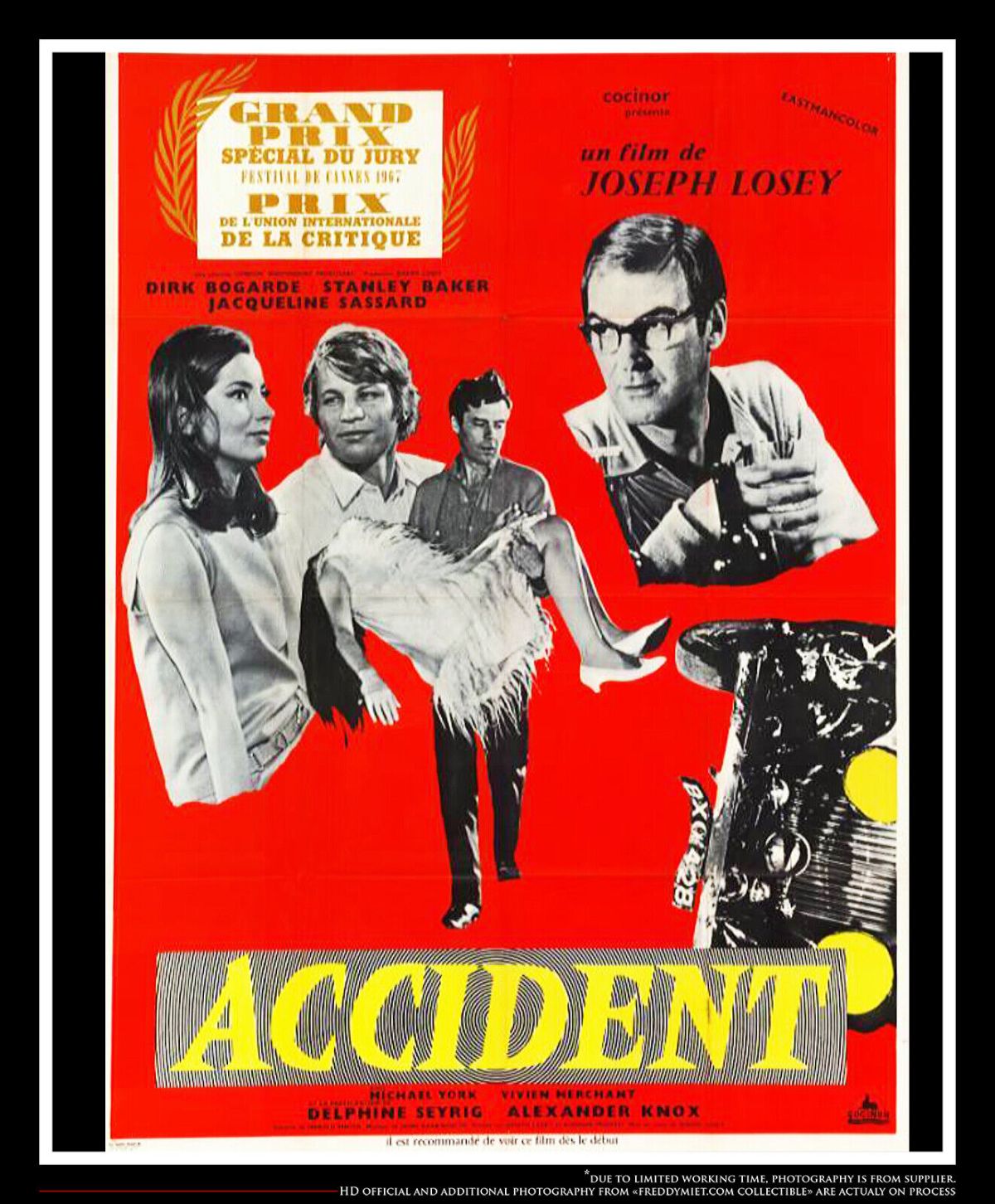
So you might be surprised to learn that when this movie about inappropriate behavior in a university of the caliber of Oxford appeared, nobody gave a hoot about the grooming and exploitation of young Austrian Anna (Jacqueline Sassard) by two professors, Stephen (Dirk Bogarde) and Charley (Stanley Baker).
The story is told in flashback in leisurely fashion. Hearing a car crash outside his substantial house in the country, Stephen finds inside the vehicle an injured Anna and her dead boyfriend William (Michael York). Then we backtrack to Anna’s arrival in Oxford, and how the love quadrangle is created. The presence of William suggests Anna has predatory instincts, but there is no sign of sex in their relationship, rather that he is forever frustrated at being kept on a leash and clearly suspecting he is losing out to others.
Stephen, a professor of philosophy, no higher calling in academe, endless discussion on the meaning of life manna to every student, has a purported happy home life, wife Rosalind (Vivien Merchant) pregnant with their third child. He’s no stranger to infidelity, reviving an affair with the estranged daughter Francesca (Delphine Seyrig) of a college bigwig (Alexander Knox).
But he can’t quite make his move on Anna, despite idyllic walks in the fields and their hands almost touching on a fence. The uber-confident Charley, novelist and television pundit in addition to academic celebrity, has no such qualms and seduces her under the nose of his friend and sometime competitor.
When opportunity does arise for Stephen it does so in the most horrific fashion and, that he takes advantage of the situation, exposes the levels of immorality to which the powerful will stoop without batting an eyelid.
The web Stephen is trying to weave around his potential victim is disrupted by William and Charley and if any anguish shows on Stephen’s face it’s not guilt at the grief he may cause or about his own errant behavior but at the prospect of losing a prize.
Director Joseph Losey (Secret Ceremony, 1968) sets the tale in an idyllic world of dreaming spires, glasses of sherry, tea on the lawn, glorious weather, punting on the river, old Etonian games, the potential meeting of minds and the flowering of young intellect. The action, like illicit desire, is surreptitious, a slow-burn so laggardly you could imagine the spark of narrative had almost gone out.
Stephen is almost defeated by his own uncontrolled desire, taking advantage of his wife entering hospital for childbirth, the children packed off elsewhere, to have sex with Francesca, not imagining that Charley will take advantage of an empty house.
And the young woman as sexual pawn is given further credence by the fact that at no point do we see the events from her perspective.
Anguish had always been a Dirk Bogarde (Justine, 1969) hallmark and usually it served to invite the moviegoer to share his torment. So it’s kind of a mean trick to play on the audience to discover that this actor generally given to playing worthy characters is in fact a sleekit devious dangerous man. Of course, the persona reversal works very well, as we do sympathise with him, especially when relegated to second fiddle in the celebrity stakes to Charley and humiliated in his own attempts to gain television exposure.
Stanley Baker (Sands of the Kalahari, 1965) was the revelation. Gone was the tough guy of previous movies. In its place a charming confident winning personality with a mischievous streak, a far more attractive persona when up against the more introspective Bogarde.
Jacqueline Sassard (Les Biches, 1968) is, unfortunately, left with little to do but be the plaything. There’s an ambivalence about her which might have been acceptable then, but not now, as if somehow she is, with her own sexual powers, pulling three men on a string. In his debut Michael York (Justine, 1969) shows his potential as a future leading man.
You might wonder if Vivien Merchant (Alfred the Great, 1969) was cast, in an underwritten part I might add, because husband Harold Pinter (The Quiller Memorandum, 1966) wrote the script and Nicholas Mosley, who had never acted before, put in an appearance because he wrote the original novel.
Losey, a critical fave, found it hard to attract a popular audience until The Go-Between (1971) and you can see why this picture flopped at the time despite the presence of Bogarde and Baker. And although it is slow to the point of infinite discretion, it’s not just a beautifully rendered examination of middle class mores, and a hermetically sealed society, but, way ahead of its time, and possibly not even aware of the issues raised, in exploring abuse of power, a “Me Too” expose of the academic world.
The acting and direction are first class and it will only appear self-indulgent if you don’t appreciate slow-burning pictures.