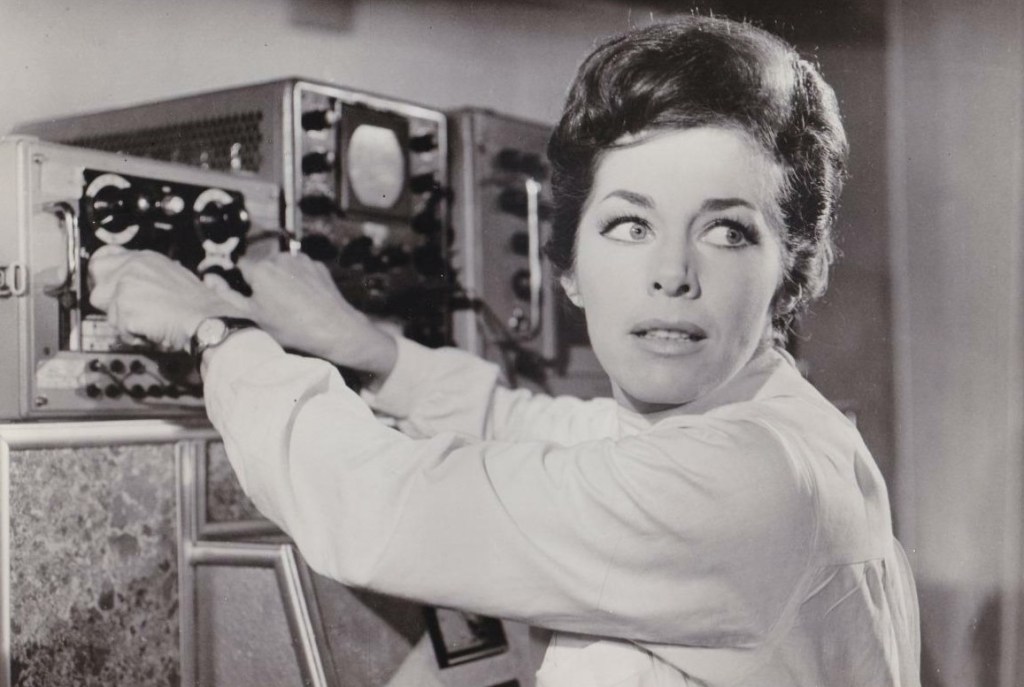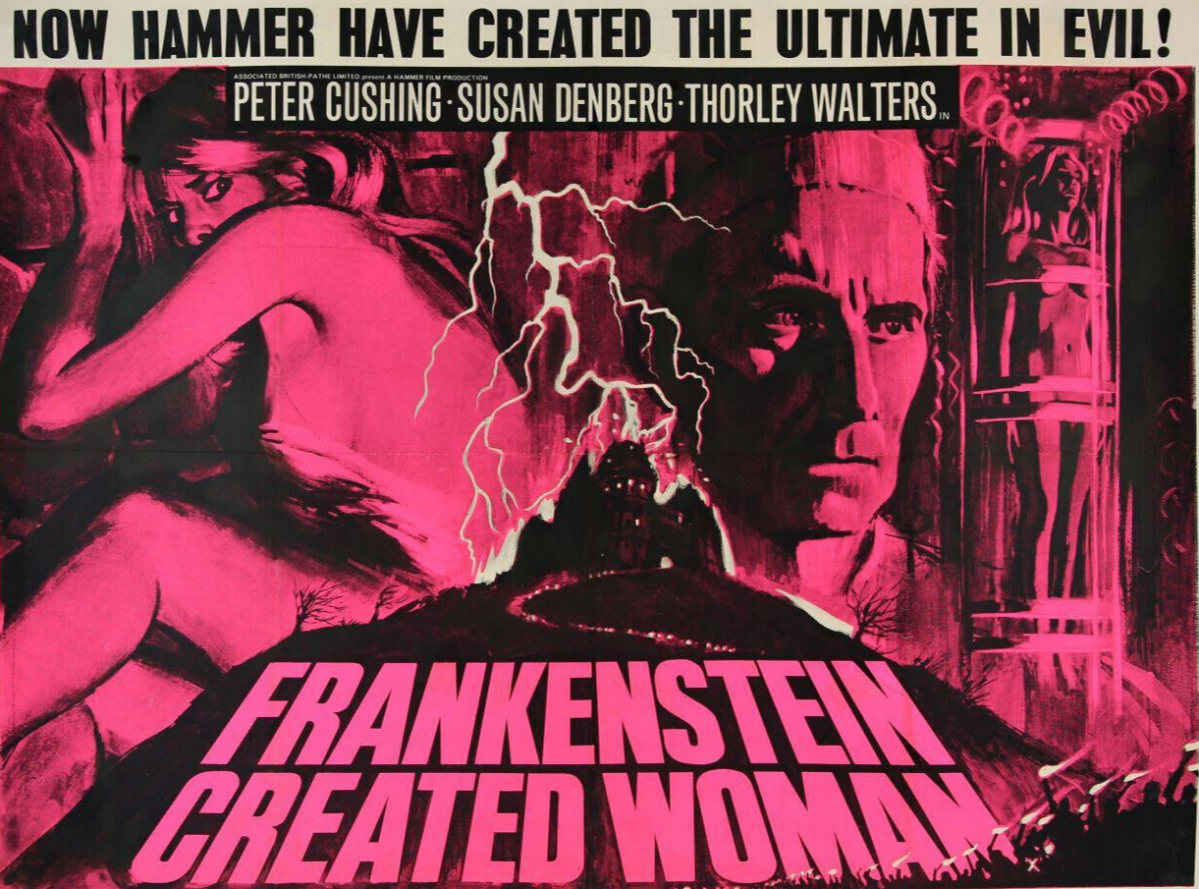
Frankenstein Created Woman (1967) ***

Custom-made for a contemporary audience. How can you fail with a tale about a male brain taking over a female body. Male soul if you want to be strictly correct and metaphysical about it or if you are Martin Scorsese for whom discussion about whether the soul leaves the body after death and exists on some other plane was of the greatest interest. But, yes, so although our hero/villain Baron Frankenstein (Peter Cushing) does create a female instead of a male, and not just with the misogynistic purpose of supplying a monster with a mate, unfortunately in the act of creation the poor woman is saddled with the soul/brain of a man, and, even worse, one with  bloody revenge on his mind.

These days for sure audiences would not have any trouble with female stars carving a swathe through any populace and nobody would require transplanting of  male hormones-soul-brain-whatever to take off on a rampage. But, back in the day, before Hammer went full-tilt-boogie down the lesbian vampire route, it was rare, outside of film noir and exploitationer pictures, for a woman to be so savage. So her actions are viewed with regret rather than roars of approval. But, for once, nobody is taking a torch or axe to the good old Baron.

That’s not all that takes the audience by surprise. The use of a guillotine, ideal for a post-task  dripping of blood, turns out to be widely used in central Europe in the 19th century, hardly surprising since it was a German invention. The movie opens with a young boy, Hans, witnessing his father’s execution on such a device, a point that seems arbitrary but proves pivotal.

The grown-up Hans (Robert Morris) assists Dr Hertz (Thorley Walters) assisting the Baron in some kind of resurrection experiment, the guinea pig being Frankenstein himself. Naturally, for purely metaphysical purposes you understand, the Baron would like to experiment on as barely-dead a cadaver as possible to prove his theories. That this takes a good while to materialize is largely because the narrative has to go all around the houses.

Hans’s lover, disfigured and lame innkeeper’s daughter Christina (Susan Denberg), is taunted by a trio of young swells that results in Hans attacking them. Later, for no particular good reason, the toffs kill the innkeeper, but Hans gets the blame and is sentenced to death. After he is  guillotined, Christina commits suicide by drowning. Both bodies turn up in Frankenstein’s lab at roughly the same time. Complication of course being that a guillotine doesn’t deliver a body intact. Quite how Frankenstein achieves his soul-body transplant is left up to your imagination – the scene promised in the poster is a marketing fiction.

And there’s a touch of Poor Things about the result as Christina wakes up minus scars and disfigurement but with no recollection of her past and needs to be taught who she is. Not that she requires much education in the feminine wiles department and is soon stalking the three young toffs, seducing them with hints of sexual promise before taking savage revenge.

There also a Curse of the Undead element when villagers discover her grave is empty. In fairness to the Baron, he soon realizes what fate had befallen her and tries to ensure that, once her revenge is complete, she can live a different life, although in the way of horror films a happy ending is rarely an option. And in fairness to the Baron the villagers aren’t queueing up to set him alight.

With various subplots to get through, this leaves the Baron out of the picture for considerable periods of time. From a contemporary perspective, there’s a freshness here that will appeal, especially the creation’s desire to discover her purpose in life, her not being bred to fulfil a romantic purpose, and the battle of the male-female will.

Peter Cushing (The Skull, 1965) is as usual splendid, Thorley Walters (Sherlock Holmes and the Deadly Necklace, 1962) presents as an inebriated and impecunious assistant while Austrian Susan Denberg (An American Dream, 1966) does well in the dual role.

Fourth outing in the Hammer series, directed with occasional verve by the reliable Terence Fisher (The Devil Rides Out, 1968) from a screenplay by Anthony Hinds (The Mummy’s Shroud, 1967).

Contemporary appeal and can never go wrong given that it is purportedly one of Martin Scorsese’s favorite films.
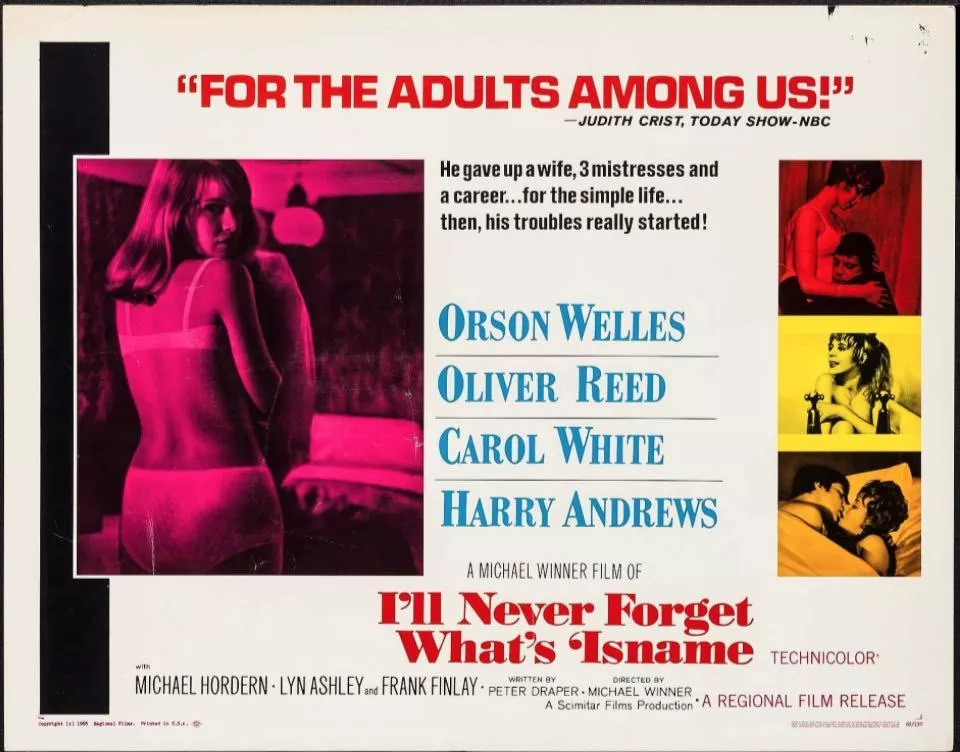
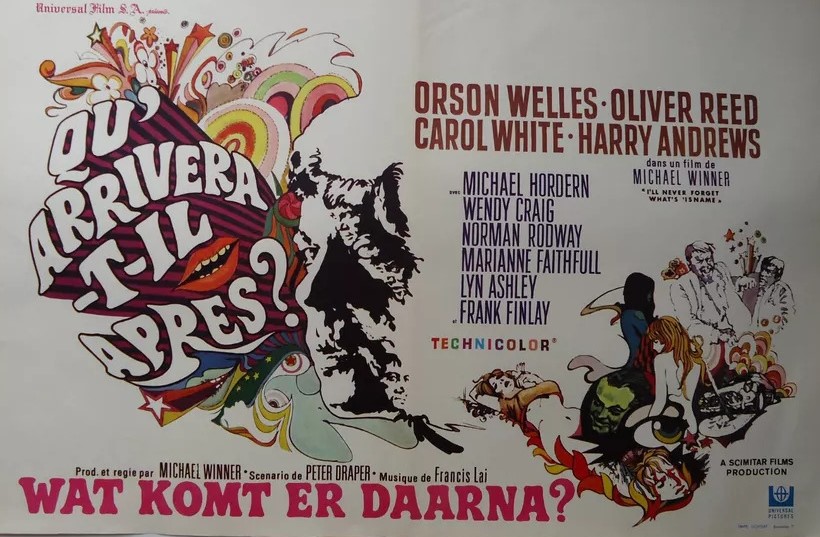
I’ll Never Forget Whatsisname (1967) ****

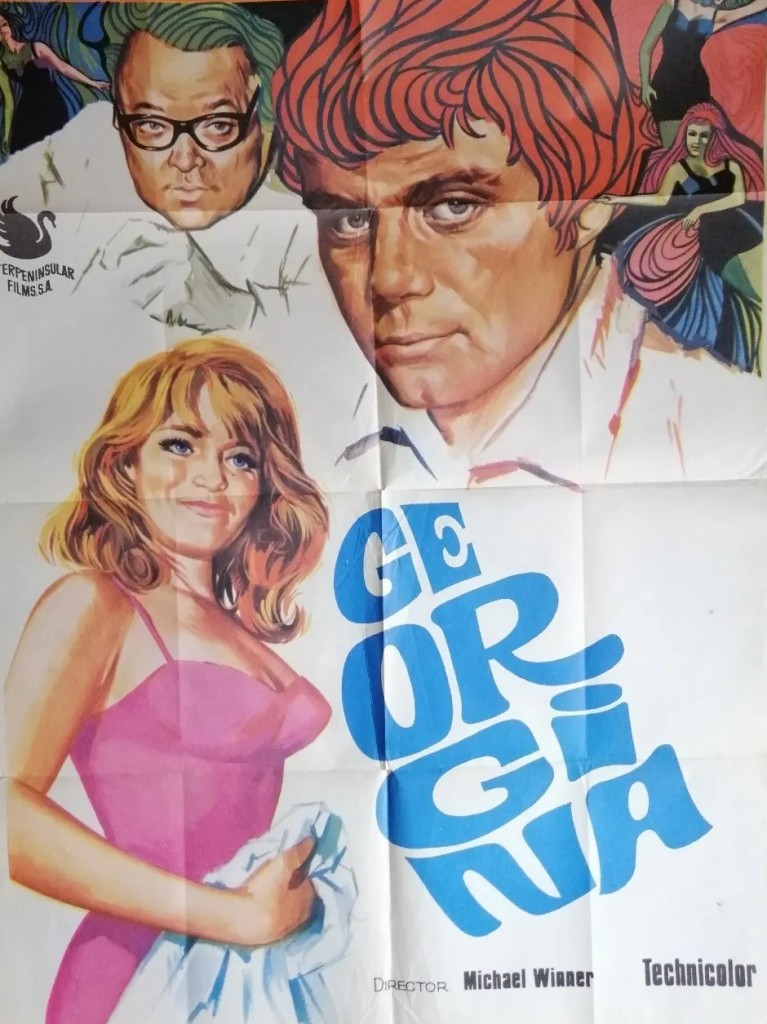
Director Michael Winner’s proudest moment – from a critical perspective. Rave reviews all round and hailed as a rising star of British cinema. Such adulation didn’t last long, of course, Hannibal Brooks (1968) and The Games (1970) elicited little critical reposnse and whatever kudos he achieved from a couple of westerns was soon blown away once he went down the Death Wish (1974) brutal revenge route. So this fits into the anomaly department in his canon and, although pretentious in spots, it does show a fine intelligence at work and a singular prophetic quality that should have contemporary reverberation.

For a start, he highlights the creativity of the advertising world that became the training ground for such British directorial talents as Ridley Scott (Alien, 1979), his brother Tony (Top Gun, 1986), Alan Parker (Midnight Express, 1978) and Adrian Lyne (Fatal Attraction, 1987) as well as producers in the vein of David Puttnam (Chariots of Fire, 1981). Perhaps more interesting are the ecological aspects, predicting the importance of waste both as an issue and a financial opportunity.

And although If… (1969) was viewed as the pre-eminent depiction of public school immorality, this provided a much shorter introduction to the prevalence of public school attitudes in society. You might also suggest, should you be so bold, that Winner envisioned the boom in reality televison, when the camera is not used to create illusion but to pick at the scabs of society. And we might also fast forward to Jaws (1975) whose meanest character shares the same surname as our hero here, whose personality defects are what drives the picture.

Within all this there’s a fair chunk of satire. And it’s rare for this director to so obviously poke fun at his heroes.

The narrative follows disillusioned advertising ace Quint (Oliver Reed) as he tries to extricate himself from various romantic entanglements in order to concentrate on first playing a more meaningful role via literary creativity and then, when that option is pulled out from under him, exposing the hypocrisy from which he has made his fortune.

The movie opens with a stunning image. Quint wielding an axe. Despite this being in the  middle of London, he scarcely receives a second glance – as if this might be construed as typical English eccentricity – as he marches towards his posh headquarters, proceeds to smash his office and hand in his notice to boss Lute (Orson Welles). He finds work in a literary magazine with old school chum Nicholas (Norman Rodway) where, unfortunately given he already has a wife and several mistresses, he falls for virgin secretary Georgina (Carol White).

But despite his success he is tormented by his schooldays, which instead of toughening him up made him more vulnerable to abuse from a teacher and to bullying from fellow pupils led by entitled thug Maccabee (Harvey Hall). The nightmarish glimpses of school are sharply brought into focus when he encounters Maccabee again and witnesses the savage hounding of another innocent man.

Meanwhile, Lute keeps popping up, either to try and seduce Quint back to his job or to sabotage his existing one. When a fight breaks out at one of Lute’s parties he wants it stopped before another of his precious artworks is broken rather than before a participant ends up in hospital. Lute takes English eccentricity to the extreme, enjoying a massage while playing Scalextrix, the epitome of avuncular decency except that he’s twisting the rules.

Even with his diabolical childhood, it’s hard to sympathize with Quint. He’s little more than a charming lout, but I suspect his is a more universal condition, those who have so much easy wealth inclined to poke at the foundations of success, and seek a more worthwhile profession. The ending is contrived, but, then, the fun has to stop somewhere.

That said, Oliver Reed (The Assassination Bureau, 1969) presents a more rounded character than in many of his later films. From the confidence of his delivery you get the impression that Orson Welles (House of Cards, 1968)  – top-billed ahead of Reed – improvised many of his lines. He’s certainly having some fun with his role, but then that is the seductive part of his character. Carol White (Daddy’s Gone A-Hunting, 1969) is the big surprise, bringing a genuine freshness to her role, before she conformed to the Hollywood dictat. And you won’t forget the malicious Harvey Hall (The Games, 1970).

The quite amazing cast includes Edward Fox (Day of the Jackal, 1973),  Michael Hordern (Where Eagles Dare, 1968) as a demented headmaster, Marianne Faithfull  (The Girl on a Motorcycle, 1968), Harry Andrews (The Long Duel, 1967) as a writer with a creepy hobby, Wendy Craig (TV series Not in Front of the Children, 1967-1973), Ann Lynn (Baby Love, 1969) and Frank Finlay (The Shoes of the Fisherman, 1968).

It’s entirely possible that it was pure coincidence that Winner covered so many topics relevant to today but I’m giving him the beenfit of the doubt. Written by Peter Draper (The System / The Girl-Getters, 1964).

Great – and meaningful – fun.

Our Mother’s House (1967) ***

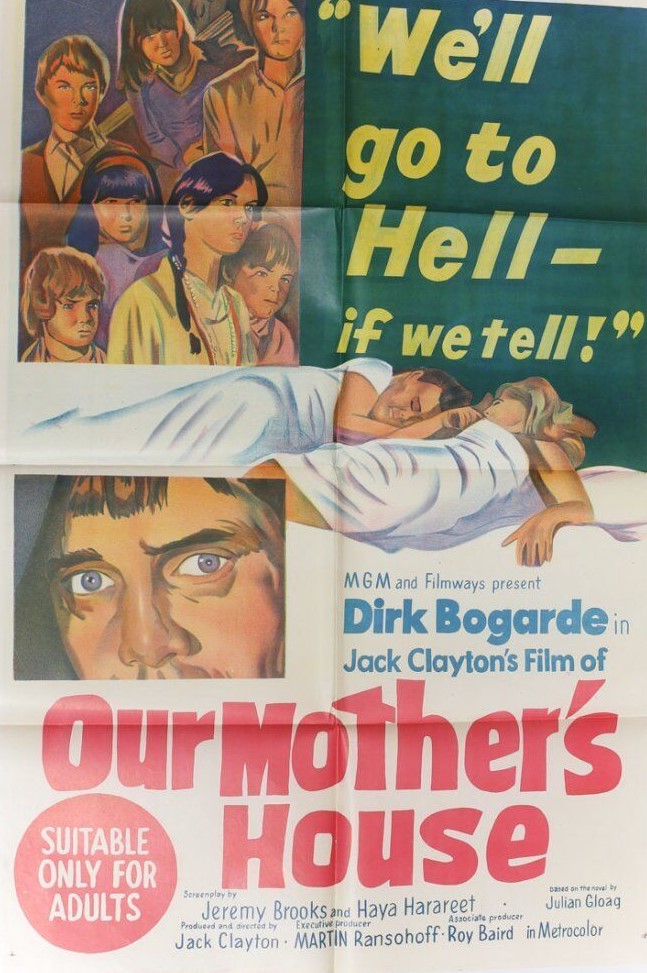
Lord of the Flies set in a sprawling London Victorian mansion. At its best when kids give rein to vivid imagination, not so strong when melodrama intrudes.

After the death of her invalid mother and dreading being sent to an orphanage, eldest child Elsa (Margaret Brooks), who has been with the help of a maid running the house anyway, determines that she and the rest of the brood will pretend their mother is still alive. They bury the body in the garden, manage financially after Jimimee (Mark Lester) discovers an aptitude for forging their mother’s signature on the monthly cheques she receives from a trust fund, and hold séances in the shed to commune with the deceased one.

To maintain the pretence, they get rid of the nosey and querulous maid Mrs Quayle (Yootha Joyce) and come up with all sorts of reasons to explain their mother’s absence to school teachers and neighbors. Child fears run rampant as they visualize the terrible lives they would lead in an orphanage. But the generally tolerant community lifestyle is disturbed by the dictatorial rule of Elsa, determining that Gerty (Sarah Nicholls), for example, must have her long hair sheared off for innocently breaking a house rule and, in keeping with their mother’s fundamentalist beliefs, refuses to call a doctor when the girl falls ill. But the séance takes on a creepier aspect, Elsa the one in communion with her mother and therefore using the supposed other-worldy presence to enforce her will.

So far, so Lord of the Flies, and excellent in its depiction of a world ruled by children according to their fears and beliefs and without adult intercession. But it loses its grip when melodrama takes hold.

Their mother’s dissolute husband Charlie (Dirk Bogarde) returns, romancing Mrs Quayle, and, initially, spoiling the children, who are delighted to see him. He soon reverts to form, spending all their money, getting Charlie to forge his mother’s signature on the house deeds, planning to pocket the proceeds and dispatch the kids to an orphanage. Worse, he breaks the spell their seemingly devout mother had over their children, informing them that their mother’s conversion to religion only came after a life of debauchery and that, in fact, every single one of them is illegitimate and not his offspring. That’s too much for Diana (Pamela Franklin) who kills him with a poker.

Too many twists for sure and by diverting a fascinating dissertation of childhood into adult melodrama robs the film of much of its power.

Director Jack Clayton had been here before with The Innocents (1961) but, there, less was spelled out. Dirk Bogarde (Justine, 1969) is surprisingly good as the charming rough layabout with an eye to the main chance but it’s the children who captivate especially Pamela Franklin (And Soon the Darkness, 1970) and Mark Lester (Oliver!, 1968). The children’s innocence in any case would have been despoiled as they challenged Elsa’s rule and it would have been more satisfying to go down that route.

It was based on the bestseller by Julian Gloag and for anyone wondering what happened to Haya Harareet (Ben-Hur, 1959, and The Secret Partner, 1961) she married Clayton and is credited with the screenplay of this along with Jeremy Brooks.

Slow-burn that trips the wrong way.

Rocket to the Moon / Those Fantastic Flying Fools (1967) ***

The Jules Verne express grinds to a halt in part because the promise of outer space adventure fails to materialize and in part because the treatment is comedic in the manner of  The Great Race (1965). A series of sketches with a shifting array of characters rarely works. Occasionally it hits the mark in a laugh out loud fashion but too often the jokes are labored  although as a tribute to a maze of inventive invention it’s a treat.

Unusually for such an all-star cast venture, we are, long before the titular action  and a race (of sorts) commences, treated to the greatest hits from the book of all-time failures. So we have electricity setting on fire the first country house, belonging to the Duke of Barset (Dennis Price), to be so illuminated; a new-fangled suspension bridge, courtesy of Sir Charles Dillworthy (Lionel Jeffries), that collapses when Queen Victoria cuts the ribbon; and a new type of explosive invented by German von Bulow (Gert Frobe) that proves a tad overpowering. Meanwhile, making possible the idea of sending a man to the moon is the arrival in Britain of the diminutive General Tom Thumb (Jimmy Clitheroe) accompanied by the bombastic and greedy Phineas T. Barnum (Burl Ives).

Combining the various scientific advances of propulsion and engineering have the flaw of not being able to bring a manned rocket back home. And sinister forces are at work, spies and fraudsters.

As with all these all-star comedies you spend half the time wondering how your favorite star is going to be worked into the equation and, having been squeezed into the narrative, justify their ongoing involvement. Daliah Lavi (Old Shatterhand, 1964), not particulary known for her comic gifts, is a case in point. On her wedding day she (as Madelaine) jilts French groom Henri (Edward de Souza) in favor of balloonist Gaylord (Troy Donohue) who has, literally, appeared on the horizon. Henri trying to down said balloon triggers an awful joke about a shotgun wedding.

To gain revenge, Henri funds the project on the basis of Gaylord being the moon pilot, and, in anticipation of the craft’s failure, that he will regain his bride. Madelaine, having been sidelined by all the developments, suddenly rushes back to center stage when she uncovers the devious plot and is shipped off to a home for wayward girls, run by the very wayward Angelica (Hermione Gingold). But that requires she escape and find her way back to her beloved, that aspect complicated because she loves both men (it transpires).

As the script is in the invidious position of having to place the participants into similar frying pans in order to effect similar rescues it’s as much a game of ping-pong as a movie. But there are some nice gags, a rocket attached to a helmet, the ruination of a teleprinter and the criminally-inclined Washington-Smythe (Terry-Thomas) who rooks billiard players with a magnet. And there’s a very contemporary financial element in that large wagers are placed on failure rather than success, the equivalent of betting on stocks going down rather than up  (short selling in the modern idiom)

The rocket is launched, with rather a different crew than originally anticipated following further skullduggery, and although it’s something of a cosmic joke that it only gets as far as Russia it’s rather a disappointing ending for fans of Verne who anticipated a more rigorous approach. Verne’s novel From the Earth to the Moon was surprisingly accurate in imagining how a projectile would achieve its aims. The novel had even more of a contemporary feel since it left the crew floating in space, a daringly artistically inconclusive climax, leaving the way open – again the contemporary flair – for sequel Around the Moon that explained their fate.

Oddly enough, Daliah Lavi, as the bride who can’t make up her mind, has one of the better parts, more fleshed out than most of the other flimsy characterizations. The likes of Troy Donohue, caught between heroism and doing nothing much at all, often looks flummoxed. Terry-Thomas (How To Murder Your Wife, 1965) in wily mode is the pick of the rest.

Director Don Sharp (The Brides of Fu Manchu, 1966) proves that comedy is not his metier. Screenplay by Dave Freeman (British TV sitcom writer making his movie debut) after Harry Alan Towers (Five Golden Dragons, 1967) altered the author’s original premise. While it could be skewered for taking such liberties with the august author, it is far better than you might expect, but not as good as it could, or should, be.

Three into Two Won’t Go (1969) ***

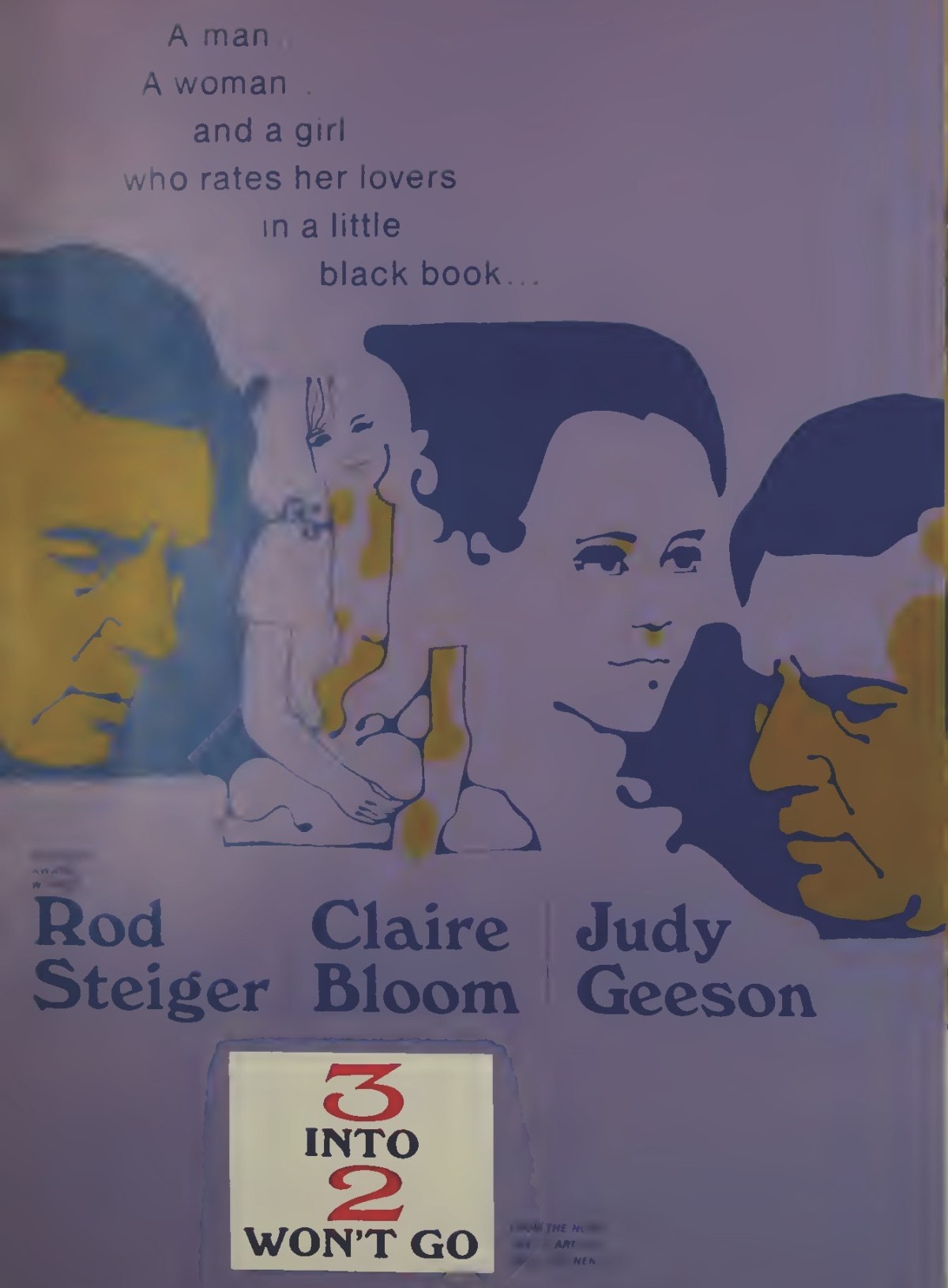
Unhappily married and childless salesman Steve (Rod Steiger) begins an affair with kooky promiscuous hitchhiker Ella (Judy Geeson). A free spirit in control of her life – no VD and on the Pill – and happy to drift from mundane job to mundane job, Ella ranks her many lovers on their sexual performance. Steve has just moved into a new house on a dreary new estate, perhaps in the hope of revitalizing his staid marriage to Frances (Claire Bloom).

While Steve is away on business, Ella turns up at his home where, revealing, without implicating Steve, that she is pregnant, she convinces Frances to let her stay the night. Naturally, it is Steve’s baby, but Ella plans an abortion. Steve wants the baby and so, too, still unaware of the father, does Frances, seeing adoption as the solution to their marital woes. And so a love triangle, or more correctly a baby triangle, plays out, with a few unexpected twists.

Like most of the marital dramas of the 1960s, especially in the wake of the no-holds-barred Who’s Afraid of Virginia Woolf (1966), this is riddled with outspoken protagonists who have no idea how to find real happiness. Based on the book by Andrea Newman and adapted by Edna O’Brien, who both have previously marked out this kind of territory, the picture shifts sympathy from one character to the next. While no one is entirely culpable, none are blameless either. Yet there is an innocence about Steve and Frances in the way they fling themselves in the direction of unlikely salvation. They are not the first couple to find themselves in a marital cul de sac, nor the first to do nothing about it, hoping that somehow through a new house or job promotion things will right themselves.

Audiences, accustomed to seeing Steiger (In the Heat of the Night, 1967) in morose roles, might have been shocked to see him happy and he manages to present a more rounded character than in some previous screen incarnations. In burying herself in domesticity, Claire Bloom (Charly, 1968) essays a far from fragile character, whose resilience and pragmatic character will always find a way forward. Geeson is the surprise package, at once knowing and in charge, and at other times completely out of her depth, and to some extent enjoying the chaos she sparks. The exuberant screen personality she presents here is almost a grown-up more calculating version of the character she portrays in Hammerhead (1968).

Director Peter Hall (Work is a Four-Letter Word, 1968) generates more universal appeal by ensuring the movie is not so obviously grounded in the 1960s that it would quickly become outdated and the snatching at last-minute fantasy to avert marital disharmony will still strike a note. The performances are all excellent, including a turn by Peggy Ashcroft (Secret Ceremony, 1968) and bit parts from British character actors Paul Rogers (Stolen Hours, 1963) and Elizabeth Spriggs in her second movie.

Complex but not hard work.

Two Weeks in September (1967) ***

Soubriquets were not common currency in Hollywood. Names might be shortened to a Christian name or a surname, as in Marilyn or Garbo, and occasionally a reporter might suggest an unlikely familiarity by referring to a star as “Coop” and for sure Bogie must have been desperate for people to call him anything other than Humphrey, hardly a name that spun off the tongue for a supposedly hardbitten hero eschewing his middle-class origins. But the world swung on its axis when simple use of the star’s initials were enough to guarantee universal acceptance.

BB was born on a wave of controversy. After And God Created Woman (1956) broke box office records all over the world, a star was born. But one who seemed to live as much on the pages of newspapers as on the screen. She could forever be guaranteed to provide a revealing photograph to spice up the more puritan newspapers.

But BB’s global fame didn’t translate into worldwide box office in part because her movies were mostly X-certificate in the U.K. and, being made generally by foreign companies, slipping past the Production Code in the U.S. and therefore into arthouses or shady emporiums in both countries rather than mainstream houses.

This isn’t the best introduction to her canon, but in many senses it’s pretty typical. The camera adores BB and shuns anyone else in her presence. There’s not much story here – bored wife dashes off to a model assignment in London and has an affair and can’t decide whether he’s ready for divorce.

To fill in the time we get plenty Carnaby St fashion shoots, certainly put into the shade by the likes of Blow-Up (1966), but of the kind that used to be so common, beautiful women in outlandish clothes against backdrops like zoo animals or suits of armor and all the while flirting with photographers and being chatted up in night clubs by all and sundry. As you might expec, red buses and mini cars are common, though the chances of a cop on horseback at night seems to stretch it a bit.

Cecile (Brigitte Bardot) seems too lively for staid husband Philippe (Jean Rochefort) and burdens him with ensuring her happiness. But he seems, I guess unusually for the time for such a wealthy character, to be happy for her to continue in her profession. She’s never been unfaithful unlike model buddy Patricia (Georgina Ward). But all this cavorting brings out the lech in photographer Dickinson (Mike Sarne) and while she flirts with him she fancies for no apparent reason the doe-eyed Vincent (Laurent Terzieff) although his doe-eyed dog is livelier.

Anyway, off they go to Scotland for a romantic idyll since every filmmaker in the world has been duped by Scottish Tourist Board fantasies of sunshine, tartan, heather and miles of unspoiled beaches (unaware they are empty because the natives have more sense than to go diving into icy water in freezing temperatures). Mostly, what they get is damp streets and grey skies, though if you have BB romping  in the water then nobody’s really going to notice the awful weather. And, naturally, the highways and byways are filled with tartan-clad gents so Brigadoon rides again.

Not quite sure how “To Their Heart’s Content” – clumsy in translation as it is –
is turned into the dull “Two Weeks in September.” Though she hardly seems happy in the poster.

In any case, by the time September comes round, the sun has already packed up for the winter in Scotland, so there’s your get-out-of-jail-card in the title. Not much happens in Scotland either, mostly soulful camera work, soulful BB and dull-as-ditchwater Vincent. There’s a contrived ending.

What impresses most is how little BB you need to make a picture work, even one as patchy as this. It is almost the same template as an Elvis picture minus the songs. Just like BB, Elvis scarcely required a working script, just any excuse to get him on screen. Some stars possess screen charisman that it’s impossible to shift. Shame it was left to Serge Bourguignon (The Picasso Summer, 1969) to get more out of the faint storyline because he  was never that bothered with narrative and inclined just to get by on close-ups and scenery. With BB she was as much scenery as audiences ever seemed to require.

Hardly falls into the recommended bracket but nonetheless an interesting example of how Bardot could get away with the mildest of trifles.

Behind the Scenes: “The Long Duel” (1967)

Due some unexpected reverence after being chosen by Quentin Tarantino for his inaugural eponymous festival that kicked off at the Dobie theater in Austin, Texas, in 1996. I thought I’d throw that in since my opinion alone may not have swayed you as to this film’s merits. Ken Annakin (Battle of the Bulge, 1965) wasn’t first choice as director. It was initially on the slate of Jack Cardiff (The Girl on a Motorcycle, 1969) and should have also made waves as the first big British-Indian co-production. After his World War Two tank epic, Annakin’s career unexpectedly stalled.

He backed out of a project to make a Las Vegas version of Grand Hotel (1931), another, the $1.5 million The Fifth Coin, written by Francis Coppola and to star George Segal, got snarled up on the starting grid. He balked at Texas Across the River (1966) – when the females leads were going to be Shirley MacLaine and Catherine Deneuve – due to concerns about the schedule. He actually shot half of The Perils of Pauline (1967) with Terry-Thomas, Pat Boone and Pamela Austin, wife of super-agent Guy McIllwhaine, before being fired, for reasons that were unclear. Still, he remained in demand and was immediately off to Italy to shoot Raquel Welch heist picture The Biggest Bundle of Them All – not released until two years later as explained in my Behind the Scenes blog on that movie.

However, before jetting off to Italy, he had been sounded out by British producer Sydney Box who had a commitment from Yul Brynner and Trevor Howard to star in the $3 million The Long Duel being financed fifty-fifty by British studio Rank and fourteen Indian investors taking advantage of a tax-shelter deal. Annakin was in line for his biggest-ever fee. For Rank it was a brave new world. The British studio after years of relative inactivity was back on the production front foot, initially in co-production deals with American majors and British investment outfits like the National Film Corporation. It planned to invest $12 million in eight pictures. Initially, its stake in The Long Duel was limited to 60 per cent at a time when the movie was budgeted at $2.3 million. This was “particularly surprising because it came at a time when Britain was caught in a severe economic freeze” although the surprise success of the Bond pictures suggested the country’s movie industry was, in contrast, riding the crest of a wave.

Things turned sour on the location scouting trip to India. A “bottomless pit” of laborers was on standby to build a rope bridge across as soon as the money came through. Timber had been ordered to build a fort on a plateau with stunning views of snow-capped mountains, but nothing would arrive until money changed hands. While Rank had committed three-fifths of the finance with the rest coming from the release of blocked rupees guaranteed by a Maharajah, without any immediate cash and with the stars on pay-or-play contracts, there was no option but for Rank to pick up the entire cost and seek out alternative locations. That meant it was the single biggest British production financed domestically without a foreign partner.

Matters worsened when producer Sydney Box suffered a heart attack, triggering his departure from the business, in which he had been a mainstay for 33 years, movies ranging from The Seventh Veil (1945) to Accident (1966). In addition, Annakin was negotiating to make a permanent move to France while his wife was at home in England dealing with an adopted new-born baby. Annakin – acting also as producer for the first time – gambled on shifting the movie to Spain.

After the success of Doctor Zhivago (1965), Spain was fast being viewed as an ideal terrain, Custer of the West (1967), Camelot (1967), Fathom (1967) and The Bobo (1966) jostling for space. Having made a couple of movies there, Annakin assured the backers, the terrain was “not dissimilar” to the locations he had viewed in India. “I believe we can make Spain into India, so long as the crowds are dressed as Indians, which will cost quite a lot more because it means providing all the costumes whereas in India they already exist,” he explained. He had three weeks before the actors were due.

Yul Brynner and Trevor Howard would have seemed best buddies by now, having appeared in three films together over the past two years – Morituri (1965), The Poppy Is Also a Flower (1966) and Triple Cross (1966). Brynner’s career had revived thanks to Return of the Seven (1966). He was considered poor box office in the U.S. but made up for it with his global marquee appeal. Howard had been on an unexpected box office roll following Father Goose (1964), Operation Crossbow (1965), Von Ryan’s Express (1965) and The Liquidator (1965).

Annakin turned to the Sierra Nevadas to double as the Himalyas, located the rope bridge in a ravine near Ronda, the villages transplanted to the dusty Andalusian plains, and found sufficient horse-riding extras among the gypsies of Dacoit country. The Alhambra was called in to action for part of the Indian palace. A steam train of sufficient vintage was found.

Brynner supplied his own motor home, one of the most luxurious on the market, but required considerable assistance to move it around, especially on narrow country roads linking locations. Over 300 horses were required, with complications when the animals had to be moved in the dark. The major scenes required extensive lighting and nobody had taken into account the fierce winds which nearly blew everything away. The dancing bear was supplied by Chipperfield Zoo near Windsor, England. In the scene where Brynner returns to find his tribe massacred, the bear is also a victim. But, when the bear was knocked out by an injection, it didn’t wake up again. Cast and crew were so shocked that filming was abandoned for the day.

Howard’s alcoholism was another issue, liable to leave the actor so disoriented during the shooting of dangerous scenes that his close-ups were often shot at a later date, though, eventually informed of this accommodation, the veteran sobered up. If you felt when watching the movie that the female stars were out of place, you wouldn’t be far wrong. In the original tale there was no significant female role. But acceding to the demands of studio and distributor required various love interests. Suzanna Leigh (Subterfuge, 1968) turned down the lead, providing Charlotte Rampling (Three, 1969) with a worthy role.

Convinced it was onto a winner, Rank took out adverts in the trades claiming “all signs point to it being…among the greats” and it took the bold step of launching it in roadshow at the Odeon Marble Arch simultaneous with continuous performance at the Odeon Leicester Square in London’s West End.

SOURCES: Ken Annakin, So You Wanna Be a Director (Tomahawk Press, 2001) p186-189, 197-206; “Sydney Box $10-Mil Prod Program,” Variety, January 26, 1966, p14; “Rank Now Measuring Up,” Variety, July 27, 1966, p25; Advert, Variety, August 24, 1966, p27; “$3-Mil Rank Duel May Be Costliest British Film Ever,” Variety, October 26, 1966, p5; Advert, Variety, November 9, 1966, p27; “Sydney Box Quits Film Posts,” Variety, August 7, 1967, p2.

The Wackiest Ship in the Army (1960) ***

A more misleading title would be hard to find – and that goes for the posters too. This is a misfit movie – a bunch of raw recruits knocked into shape by an unwilling captain tasked with sailing a ship into a South Pacific war zone in WWII. Admittedly, Jack Lemmon is in exasperated double-take default in the opening section, but it quickly shifts from comedy to drama as Lemmon shepherds his inexperienced crew into a more compact team.

Screenwriter Frank Murphy has an exceptionally good portfolio – Panic in the Streets (1950), The Desert Rats (1953), Broken Lance (1954) and Compulsion (1959) – but brings less to the table as a director, this only his second – and final – outing in that capacity. But given he is directing from his own screenplay, he must take the blame for the incongruous hybrid. Add in an unnecessary tune from Ricky Nelson and the briefest of brief romances and no wonder it’s hard to make head or tail of the movie until it does eventually head out to sea.

Once Lemmon is given more to do than shake or scratch his head the picture moves into more satisfactory territory. Instead of dismissing the crew as idiots, he takes command and shows dramatic chops that are a hint of things to come (Days of Wine and Roses just two pictures away) when he sloughed off comedy for more serious undertakings.

Reason for Lemmon being assigned this motorized sailing ship rather than something more obviously U.S. Navy is that he is in the last chance saloon. Once under sail, setting aside some dodgy process work, and it becomes clear they are heading into harm’s way rather than simply delivering the boat to General MacArthur in more harmless waters, the story switches into perilous wartime perilous adventure with decent battle, a couple of twists and some dramatic confrontation.

Lemmon is always watchable, and I always thought he could have done with more self-belief when it came to tackling more dramatic parts. When he goes ramrod-stiff and starts barking out orders and has to out-maneuver superiors and enemy, he is entirely convincing, as, too, safeguarding his charges or rescuing them and leading them in battle. Setting aside the need for Nelson to register his credentials as a singer, he is not bad either, as an ensign making his way, an ingenue role that suits this ingenue.

Veteran John Lund (My Friend Irma) appears as a crusty, wide admiral and Chips Rafferty, the only Australian actor anybody had ever heard of at that point outside of Rod Taylor, has a cameo. Irishwoman Patricia O’Driscoll manages a passable Aussie accent as the brief romancer, her role mostly confined to looks of longing while Lemmon is at sea. Raspy-voiced Mike Kellin as an out-of-his-depth chief mate turned up in the television series based on the picture. If ever there was a film of two halves (well, one-third and two-thirds) it’s this, but the second section passes muster.

Not quite shipshape but getting there.

The Great Race (1964) **** – Seen at the Cinema

And not just any old cinema, but the 87-year-old Fine Arts in Los Angeles, I guess the second oldest movie house still standing there, with admission a princely 50 cents and the whole place done out in a gaudy red. I was taking time out from a research mission to the Academy of Motion Pictures Arts and Sciences’ (the Oscar people) equally famous Margaret Herrick Library, where I was digging up stuff for my next book about the films of Alistair MacLean.

And where I discovered to my unimaginable delight they they had my books on their shelves. I’ll never win an Oscar and bestsellerdom will continue to evade me, but for a writer of books on movies, there can be no greater honor than to have your works on the shelves of Hollywood’s most important library. Since data protection will prevent me from discovering who has checked out my books, I can safely imagine that it was bound to be Harrison Ford, Greta Gerwig, Christopher Nolan and/or Steven Spielberg.

Anyway, enough of that self-congratulatory nonsense and on with the show. If you’ve any memory of this picture – jaunty jalopies battling it out at the start of the 20th century when suffragettes were raising hell – it’ll be for the slapstick. The upfront feminism most likely  passed you by. A savvier female you would be hard put to find, especially one that susses out exactly that when a male falls in with her views it’s just to get her into bed. So, from the contemporary perspective, this is a far harder-nosed picture than the fluffy narrative suggests.

Setting aside the famous pie-throwing homage to silent film pie-throwing (and every circus clown act since Doomsday) and a couple of sequences that outlive their welcome and the odd decision to find a plotline that can accommodate Jack Lemmon going down the (almost) identical twin route, this is pretty much sheer delight.

Characters could not be more black-and-white – in visual terms as well – than rival mechanical whizzes The Great Leslie (Tony Curtis) and Professor Fate (Jack Lemmon) except for the much more rounded (in character terms) interloper Maggie Dubois (Natalie Wood) as a reporter. Not content with being a legend in his own lunctime, the mad professor follows the Gore Vidal tack of being upset by any rival’s successes. However, he’s such an incompetent saboteur he doesn’t realize he’s merely the feed for a number of superb visual gags.

The Great Leslie, smile resounding with the Colgate audible zing, doesn’t have much to do except expound the principles of fair play and occasionally demonstrate his fencing skills when the plot turns sideways. Maggie is the ace inveigler, and when that doesn’t work resorts to handcuffs to ensure she will not be moved or someone else will be stuck fast. Standard bearer for female equality, she manages to put all the arguments without sounding dull, especially as, verbally, she is dealing with a keen dueller. And when she’s not switching sides, she’s rooting for the good guy.

The plot could have come out of a dishwasher but roughly equates to a round-the-world road race with most countries conveniently missed out, ending up in Paris with a stop-off somewhere in Germany. The deliberately cartoonish feel shouldn’t work at all, especially for a contemporary audience, but then we all laughed at Dumb and Dumber and plenty comedies with even less of a one-note touch. Thankfully, there was no such thing as deconstructed comedy in those days so everyone enters the spirit of the thing. And it’s quite refreshing to watch stuff being blown up and falling apart not for overblown thriller or comicbook reasons.  

I wasn’t taken with the overlong sequence in the saloon – extended singing and brawl (heck, what else are saloons for) – and wasn’t so hot on the legendary pie section either and certainly the notion that Professor Fate could be such a doppelganger for a dumb German prince that the powers behind the throne plan to substitute one for the other seems to belong in the furthest reaches of the Far Fetched Highway.

But there are so many gags and the characters, no matter how cartoonish at times, seem true to themselves, and with Maggie on hand to constantly upset the misogynistic applecart it seems a tad picky to be so picky. I was astonished that the audience I watched it with, primarily much younger than I, were so tickled.

Tony Curtis (The Boston Strangler, 1968) and Jack Lemmon (How to Murder Your Wife, 1965) repeat the magic of Some Like it Hot (1959) thanks to the strong directorial hand of Blake Edwards (The Pink Panther, 1963). Natalie Wood (Bob and Carol and Ted and Alice, 1969) shines. Rare comedy role from Peter Falk (Penelope, 1966). Excellent support from Keenan Wynn (Warning Shot, 1966). Edwards co-wrote the script with Arthur A. Ross (Brubaker, 1980).

Certainly more than stands the test of time.

Frozen Alive (1964) ***

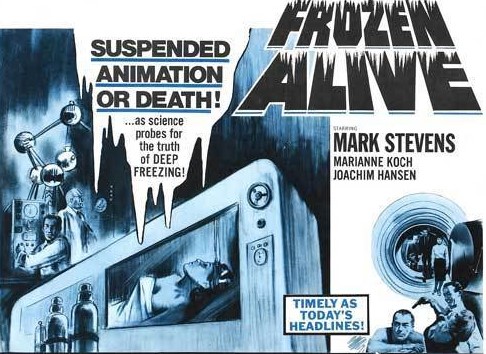
Sometimes the stars fail to align, initial promise fizzling out. Mark Stevens, rising post-war star, top-billed in film noir The Street Has No Name (1948) and Between Midnight and Dawn (1950), paired with Olivia de Havilland in The Snake Pit (1949), seemed all set for major stardom. No go. By the end of the 1950s he was mostly seen in low-budget westerns, and too few of them. September Storm (1960) was his first picture in two years. He had tried his hand at direction, but landed in B-movie hell with titles like Escape from Hell Island (1963) and after a bit part in Fate Is the Hunter (1964) hightailed it to Germany for this.

Not quite the sc-fi or noir number it says on the tin, more an exploration of personal and professional jealousies in the scientific community. You probably didn’t know the World Health Organization ran a Low Temperature Unit engaged in cryogenics experiments. Maybe they did, this being promoted as a timely movie.

Dr Overton (Mark Stevens) along with lab partner Dr Wieland (Marianne Koch) are on the verge of a breakthrough in their cryogenic experiments with monkeys. Although she has a lover Tony (Joachim Hansen), his unfaithful alcoholic journalist wife Joan (Delphi Lawrence) is jealous of his success and of Wieland and dreads leaving the fast lane for life in  the country and potential motherhood.

Professional jealousy results in the successful scientific team being split up, so before that can be actioned, Overton decides to embark on a human experiment with himself as the guinea pig.

All the tension of watching an inert frozen human being relies on wondering whether he’s going to wake up and will he have all his working parts, brain especially. So, just to heighten that tension, Overton could face a murder charge when he does emerge. And Wieland, in love with him, has to decide whether it’s better to let him die than go to prison.

Marianne Koch at the controls. Will she let the suspected murderer live – or die?

The crime aspect is something of an oddity. The time element puts Overton potentially in the frame. And there’s a definite Hitchcockian element to the death, that in one sense robs it of tension, but in the other jacks it up to eleven. Because what we know but Wieland doesn’t is that Joan died by accident, playing with the gun of her lover.

So not only could an innocent man go to jail in the first place, stacked up against him his potential anger at potentially discovering his wife has a lover, but Wieland could let him die only to find out afterwards that he’s innocent all along.

It’s a good job Joan did die because she was stealing the picture. But even being soused in booze doesn’t dampen her zest for life, the kind of woman whose life mostly exists in cocktail bars and smart parties, dressed to the nines, showing enough cleavage to annoy her husband but tease potential suitors, and with enough toughness to dump any lover that gets too close. She’s sassy fun and married the wrong dull guy.

And she’s smart enough with her “intelligent anticipation” to figure out that husband is soon going to cosy up to lab buddy. Overton’s boss notices the signs when he’s not too busy covering his own back. “You sit on the fence and if someone makes a fuss later I take the rap.”

The Mind Benders the previous year covered similar territory but concentrated on the post-experiment after-effects, so this is almost a prologue to that, and interestingly, setting Joan aside, delivered with almost a British stiff upper lip, secret passion kept under wraps, lust revealed in lingering looks, while the cut-throat elements of ambition are played out under the guise of a civil service mentality.

Not quite what you’d expect from the title, but then it’s kind of a cul de sac in sci fi terms, as it’s generally the awakening that produces the problems and this doesn’t go there. But still a decent watch. British actress Delphi Lawrence (Farewell Performance, 1962) steals the show but the simmering turn from Marianne Koch (A Fistful of Dollars, 1964) comes close. Mark Stevens doesn’t have as much to play with and he’s pretty much kept his emotions tamped down up to this point so hardly going to let rip now.  Wolf Rilla (The Secret Ways, 1961) has a small part.

Bernard Knowles (Hell Is Empty, 1967) directed television writer Evelyn Frazer’s only screenplay. You might dwell on the irony that Delphi Lawrence’s star turn here led to nothing as much as Mark Steven’s career dwindled.

Something of a cult possibly because it’s hard to find.

Watchable.

Discover WordPress

A daily selection of the best content published on WordPress, collected for you by humans who love to read.

The Atavist Magazine

by Brian Hannan

WordPress.com News

The latest news on WordPress.com and the WordPress community.