Inherit the Wind (1961) ****

As timely as ever with America seemingly always on the brink of dictating what freedoms people can enjoy. At the time the target was the oppression engndered by McCarthysim, rather than the more basic tale of whether State law could forbid its citizens to talk about evolution. It was set almost a century ago, based on a real-life case, and even now fundamentalists reject Darwin’s theories. Setting aside the context, the principle contested is still the same – not just free speech but the right to be different. You could even argue that scientists and fundamentalists are all agreed these days, that out of nothing came the universe, whether created by a Deity or someone operating a contraption called the Big Bang.

Setting aside the various arguments for and against Darwin’s theory, what we have, nonetheless, is an acting highpoint, a fabulous courtroom battle, of the kind adored by audiences, full of objections sustained, attorneys being warned by the judge, inadmissible evidence, smart remarks and witty rejoinders. This all takes place in a sweltering courtroom, temperature so high that the judge agrees to depart from court procedure and permit the verbal duellists to shed their jackets.
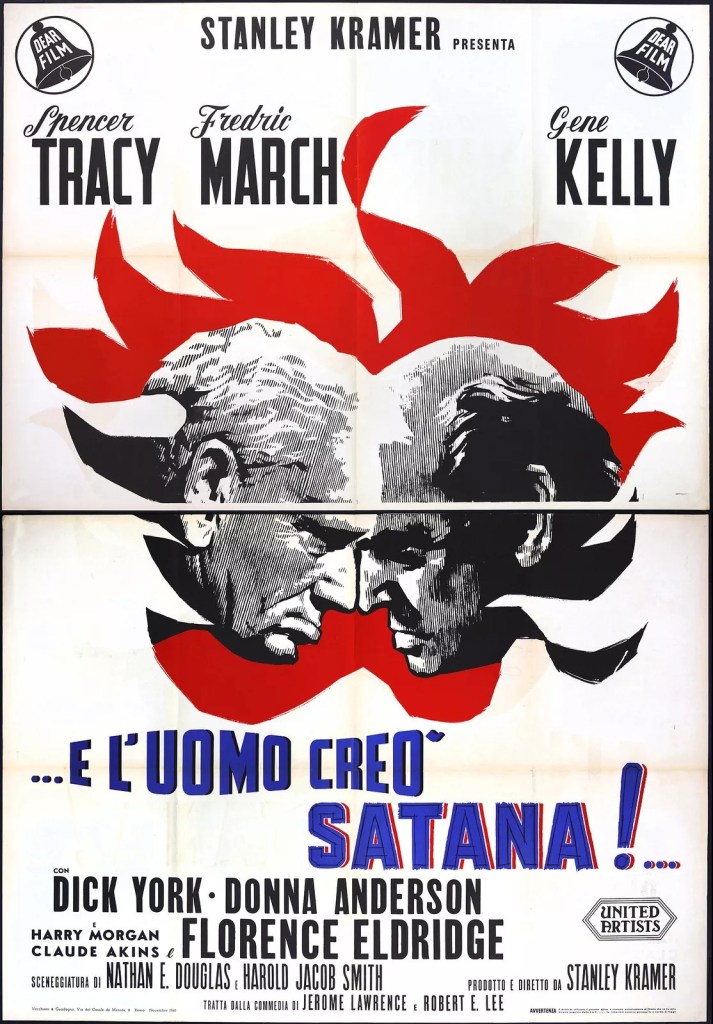
Given further depth because the antagonists, Henry Drummond (Spencer Tracy) and Matthew Harrison Brady (Fredric March), were once the best of pals, political allies, on the same side in the latter’s failed bid for the Presidency, and willing to accept the other’s personal foibles. Probably the first legal drama to accept that outside the courtroom the participants could be friends.

Luckily, most of it isn’t long speeches, but sharp comebacks, plus the detours, twists and turns that come about from concentrating more on the court than on any surrounding action, though there is forbidden romance, pastor’s daughter Rachel (Donna Anderson) defying her father over her love for the accused, schoolteacher Bertram (Dick York) whose teaching is in conflict with the Bible.

The most outraged denizens of the town get into a right tizzy, marches, religious songs, protest, but that’s leavened by commercial interests, a bank manager worrying that the town being ridiculed by those cleverer folks back east will harm his business, hoteliers, sideshow operators licking their lips at the financial bounty of reporters and gawkers descending on the town.

This is as you’d like to see Spencer Tracy, not the silent judge of Judgement at Nuremberg (1961), personality reined in by the weight of his decisions and the need to do right by those accused of even the most heinous of crimes, but the exuberant character, confident, up for battle, able to fend off any criticism and come back to any witticism at his expense with stinging repartee.

Fredric March, too, has a ball with a loudmouth character, convinced of his infallibility (except of course in terms of the Presidential Race), apt to stuff his face at dinner, but still with an intellectual thrust capable of parrying anything Tracy can throw at him. Tucked somewhere in between is weaselly reporter E.K. Hornbeck (Gene Kelly) whose newspaper has hired Drummond to defend Bertram in the hope of filling the front pages for days with the Trial of the Century (taking the prize from Leopold and Loeb the year before – both cases in real-life handled by Clarence Darrow).

Harry Morgan (The Flim-Flam Man/One Born Every Minute, 1967) plays the snipppy judge trying to maintain order while Claude Akins (Claudelle Inglish, 1961) the hellfire preacher. With so many interesting characters on parade, there’s never a dull moment, especially with each actor trying to wring every ounce of drama and/or pathos from their part.

Director Stanley Kramer (Judgment at Nuremberg) looks as if early on he made up his mind to give the actors their sway. There’s no reining in, even in the early scenes, with the populace up in arms and carrying very professionally-made signs and banners (no handwritten scrawls here, no sirree). And once Tracy and March hit their stride, it’s all an audience can do to sit back and admire. Sentiments expressed will still strike a chord, but, mostly it’s a testament to two great actors at the top of their game.

If you only remember March from the likes of The Condemned of Altona (1962) or Seven Days in May (1964) you should know he was a huge marquee attaction in his day, double Oscar-winner (and three nominations besides), as at home in swashbucklers like The Buccaneer (1938) as drama and comedies, leading man who could more than hold his own against top female stars – Greta Garbo (Anna Karenina, 1935), Katharine Hepburn (Mary of Scotland, 1936), Merle Oberon (Dark Angel, 1935) and Janet Gaynor (A Star Is Born, 1937).

Written by Nedrick Young (The Train, 1964) and Harold Jacob Smith (The McMasters, 1970) from the play by Jerome Lawrence and Robert E. Lee.

A terrific watch.

The Dark at the Top of the Stairs (1960) ****

Surprisingly frank, for the times, exploration of a failing marriage that tackles sexuality, racism, bullying, teenage angst. In those days there was no such concept as midlife crisis, so the general attitude of grin-and-bear-it results in a melancholy that suffuses the picture. Adapted from the Broadway hit by William Inge (Splendor in the Grass, 1961), provides more insight into American family life than the more souped-up soap operas of the Peyton Place variety. Except for crisis escalating action, could well have been misery memoir.

Opens with a surprisingly tender scene that’s again pretty raw for the period. In the morning, salesman husband Rubin (Robert Preston) strokes the arms and face of waking wife Cora (Dorothy McGuire), clearly hoping to initiate sex, when she abruptly rebuffs him. Before he sets off on a week-long business trip he tries to toughen up bullied friendless overly-mothered son Sonny (Robert Eyer), afraid of the dark, and bolster the flagging confidence of inhibited teenage daughter Reenie (Shirley Knight), only succeeding in inadvertedly punching his son in the face and triggering a row with his wife.   

But, without warning, he’s fired from his job and not equipped to compete in the employment arena with a flood of younger people with college degrees and greater stamina. Pride prevents him owning up to Cora, rejection sends him to the bottle and a lady friend, hairdresser Mavis Pruitt (Angela Lansbury) who scandalizes the town by (and this dates it) always leaving the top button of her blouse open. Cora plans escape, hoping to go and live, temporarily until she can find a job, with bossy sister Lottie (Eve Arden) in Oklahoma City.

Meanwhile, following an accidental meeting, the hesitant shy Reenie strikes up a rapport with the more outgoing confident Sammy (Lee Kinsolving). Lottie isn’t so keen to help out her beleaguered sister. When Rubin finally returns after a four-day absence it’s to a welter of home truths.

He still can’t bear to admit the loss of his job. The uneasy truce is shattered when Sammy is chucked out of a party he attends as Reenie’s escort at the country club for being a Jew. Subsequently, he attempts suicide and dies, leaving Reenie in shock. Cora determines to find out for herself the rumors concerning Rubin’s affair. But it turns out, although Mavis is deeply in love with Rubin, they’ve never slept together, providing Cora with a second chance to make her marriage work.

What distinguishes the movie is the revelatory dialog you’d expect from an award-winning playwright like Inge. Characters reveal their inner selves, not always with prompting, and not always in argument, and such lines often bring characters to life. Included in that are some of the subsidiary characters.

For example, Ralston (Ken Lynch) whom Rubin openly dislikes because he successfully got away with an insurance scam that turned him into a millionaire, hides away in the back room of a pharmacy, drinking away his guilt. “I know what I am. Who I am,” says Ralston, “the town scandal.” And you think this is maybe just a passing character, but this is the guy, guilt or no guilt, who enforces the country club ban on admitting Jews.

The controlling Lottie suspects her husband’s need for a long walk in the evening is to get away from the sound of her voice. Unusually, the sisters broach the subject of intimacy. Lottie confesses, “I never enjoyed it the way most women say they do.”

What’s keeping Cora and Rubin apart is their lack of intimacy, caused by their battles over money, the husband refusing to get into debt to satisfy his wife’s yearnings not necessarily for the finer things of life, but to avoid the endless scrimping and saving, getting maximum wear from a dress for the growing Reenie by turning it into a skirt.

Rudin laments, “Was a time you liked what I had…If you can’t remember sowing all those wild oats with me, I just plain give up.” Finally, they get to the crux of the matter (again bold language for the times). Rubin asks, plaintively, “How come you don’t enjoy sleeping with me any more?” Retorts Cora, “I can’t fight with you all day and then go to bed with you at night.”

If there is a flaw it’s some attitudes that will jibe with contemporary audiences. “If I had a real wife,” argues Rubin, “I wouldn’t have to go high-tailing it to Mavis Pruit.” And I winced at this particular line: “I wished someone loved me enough to hit me,” says a wistful Lottie hearing that, for the first time in his life, Rubin slapped his wife. Lottie clearly equates manliness and ardor with such violence.

But on the whole, the dialog is a cut above. I’m not sure how much came directly from the play itself and how much was added by screenwriters Harriet Frank Jr and Irving Ravetch (Hud, 1963). The opening certainly, such a situation might be mentioned in the play but a bedroom scene like that would never be staged.

More at home in the theater than on screen Robert Preston (he only appeared in five pictures the whole decade including The Music Man, 1962) exudes such energy as the salesman that you can see how denial of sex would destroy his self-confidence. Dorothy McGuire (Swiss Family Robinson, 1960) is excellent as the wife trying her best not to end up as a put-upon stereotype. Shirley Knight (Petulia, 1968) was Oscar-nominated, Angela Lansbury (The Manchurian Candidate, 1962) came across as too wise to be a loose woman, and Eve Arden (in her only movie of the decade) impresses as the bossy sister.

With such terrific material and an excellent cast, Oscar-winning director Delbert Mann (Buddwing/Mr Buddwing, 1966) doesn’t need to do much to guide this one home.

Well worth a look.

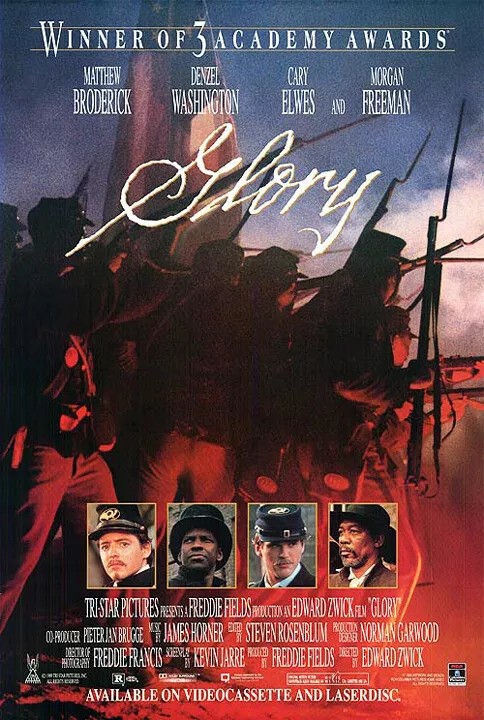
Behind the Scenes: “Glory” (1989)

Want to hire Matthew Broderick? Then you better be prepared for his mother. Worse, there was no get-out clause. Tri-Star Pictures, an offshoot of Columbia, was only making the movie because of Broderick, whose marquee value was based solely on a completely different type of picture, namely Ferris Bueller’s Day Off (1986). Yes, he had won a Tony aged 21, and this was his sixth picture, of which only War Games (1983) hit the box office mark.

But the actor had a great deal to contend with in his personal life, grief and guilt as a result of driving his car into the wrong lane, crashing into an oncoming vehicle, killing two and seriously injuring himself and his passenger Jennifer Grey. His mother had been seriously ill, also. Glory proved another ordeal. “Nothing I might have done could possibly rival Matthew’s role in the theater of cruelty that was about to begin,” wrote director Ed Zwick in his memoir, Hits, Flops and Other Illusions (2024).

The same accusation of being a lightweight could as easily been levelled at Zwick, his only movie being About Last Night (1986), which though with serious undertones, was basically a modernized rom-com. He was best known for television, as writer-producer on thirtysomething (1987-1991), that “despite its success was an intimate, whiny talkfest.”

Broderick’s mother, Patsy, made her presence felt almost immediately. Before shooting commenced, the actor quit. Patsy didn’t like the script. By this point, Zwick hadn’t even met Broderick. Zwick received the news while on holiday in a cabin in the mountains. Communication was primitive, virtually walkie-talkie style. Eventually, Zwick agreed to look at the actor’s notes on the screenplay.

The script issues should have warned Zwick what he was taking on. At that time the film was called Lay This Laurel, the title of a monograph by Lincoln Kirstein, about the assault on Morris Island by the 54th Massachusetts Regiment, the project initially on the slate of Bruce Beresford, Oscar nominated director of Tender Mercies (1983). Kevin Jarre, with just a ‘story by’ screen credit, for Rambo: First Blood Part II (1985), to his name, had written the screenplay. “The script is perfect,” averred Jarre when Zwick demanded a rewrite. Beyond a slight polish and a shifting around of some scenes, Jarre wouldn’t budge. So Zwick took on the rewrite.

Broderick’s notes were within the realm of expectation, mostly to do with his character. But then he sent the script to Horton Foote (To Kill a Mockingbird, 1962), whose daughter he was dating. Then to Bo Goldman (One Flew over the Cuckoo’s Nest, 1975). Neither writer took on the script and Goldman assured Zwick the script was fine. Then, the final bombshell. At her son’s insistence, Patsy was to work on the script. “I’m sure she was capable of warmth,” noted Zwick, “but I was never treated to that side of her, from the moment we met,” going through the script page by page, “she was contemptuous, demeaning and volatile,” her son sitting in silence. Amendments suggested by Patsy were readings from Ralph Waldo Emerson and Harriet Beecher Stowe, and a scene where Broderick’s character was persuaded to take command of the regiment by his screen mother, to be played by his real mother.

As it happened, long before Broderick turned up, Zwick had been shooting footage from the 125th anniversary of the Battle of Gettysburg where 20,000 men in full uniform and weapons re-enacted the conflict. On a $25,000 budget, Zwick shot 30,000 feet including a cavalry charge, and created what was known in Hollywood parlance as a “sizzle reel.” Many of the re-enactors turned up as extras.

Cary Elwes (The Princess Bride, 1987) took a salary cut for his role. Zwick had been impressed by Denzel Washington in A Soldier’s Story (1984) and Cry Freedom (1987) but couldn’t afford him until producer Freddie Fields chipped in some of his fee. Morgan Freeman’s career was on an upward turn after an Oscar nomination for Street Smart (1987). Zwick found acting chemistry between this pair and Jihmi Kennedy and Andre Braugher. The actors “were hearing music I couldn’t even imagine,” wrote Zwick, “yet during each session, a transcendent moment, usually unwritten, could occur.”

Initially, however, Zwick felt he was making a disaster, “the lighting was too bright, the costumes were too new, and Matthew (Broderick) seemed uncomfortable in his role.” Luckily, a storm intervened. Not to provide rest or for Zwick to regroup. A mere storm wasn’t sufficient cause to postpone the scene of the regiment’s arrival in Readville. In the attendant fog, they were bedraggled, ankle-deep in mud, shoulders hunched against the lashing rain. Zwick realized that was the look he was after. He approached cinematographer Freddie Francis to shoot “without lights” in order to capture a similar mood. “Why didn’t you say so, dear boy?” was Francis’s encouraging response.

The next day, the first tent scene, provided another surprise. “I stared open-mouthed at the utter transformation that had taken place. Overnight he (Denzel Washington) has become Trip. Volatile. Funny. Mesmeric…it was impossible to take your eyes off Denzel…I had been in the presence of greatness. I’d never seen an actor command the focus by doing so little.”

Andre Braugher, in his debut, was also a revelation, after he’d mastered the art of hitting his marks. Once, during rehearsal for a scene, Zwick noticed that Morgan Freeman never looked Broderick in the eye. “Just as I was just about to move the camera to catch his look, I realized he was making a point of not looking at him…as a black man who had lived a lifetime wary of being punished.” Despite the traumas over the script, Broderick’s performance was “pitch perfect.”

The most emotionally powerful scene is the whipping. Twice, Zwick filmed Washington receiving three lashes. “But there was something more to be mined.” Making an excuse, Zwick asked Washington to re-do the scene, but then told John Finn, applying the whip, not to stop until Zwick called “cut.” Finn had delivered eight strokes before Zwick found what he was looking for. “The shame and mortification were real now… and in the magic of movies…a single tear appeared, catching the light at the perfect moment.”

Directorial sleight of hand in the battle scene compensated for limited budget and insufficient extras. Taking note of Kurosawa’s Ran (1985), Zwick filmed one “big image of each significant moment of the battle using the entire contingent.” The trick was to go back and shoot it all over again with a smaller group but each time filling the frame top to bottom with soldiers fighting. “When it’s cut together, the larger image stays in the audience’s mind as long as they’re never allowed to see blank space at the peripheries of the frame.”

To add to the battle, they let loose rockets and explosions on the night sky, almost losing a $300,000 camera car in the process. Much of the exposition, including the Patsy Broderick scenes, ended up on the cutting room floor. While Kevin Jarre had become a “cheerleader” for the film, Broderick and his mother walked out of a preview with the actor demanding to do his own cut of the movie. Zwick refused.

Released in December 1985, Glory was nominated for four Oscars including best director. Washington won Best Supporting Actor, Freddie Francis for Cinematography and Donald O. Mitchell, Greg Rudloff, Elliot Tyson and Russell Williams II for sound. Tri-Star refused to advertize in Black media. Zwick considered any “pushback” of Broderick’s character being perceived as a “white-savior narrative” as a “left-wing canard.”

SOURCE: Ed Zwick, Hits, Flops and Other Illusions, My Fortysomething Years in Hollywood (Gallery Books) 2024, pp69-105.

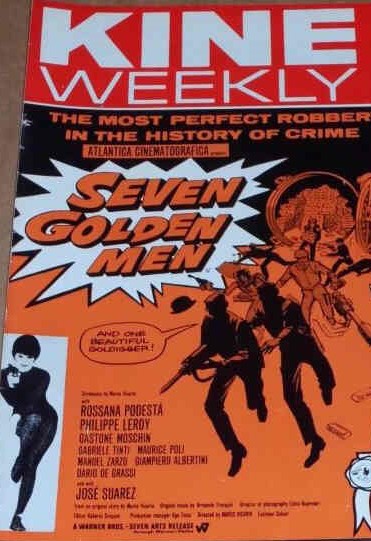
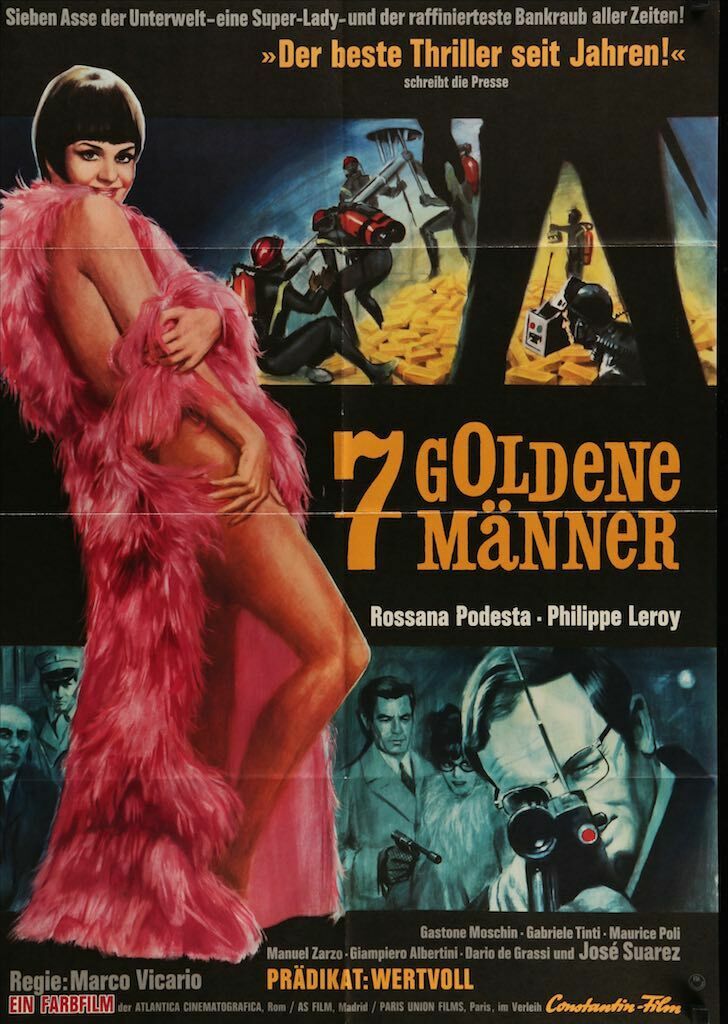
Seven Golden Men (1965) ****

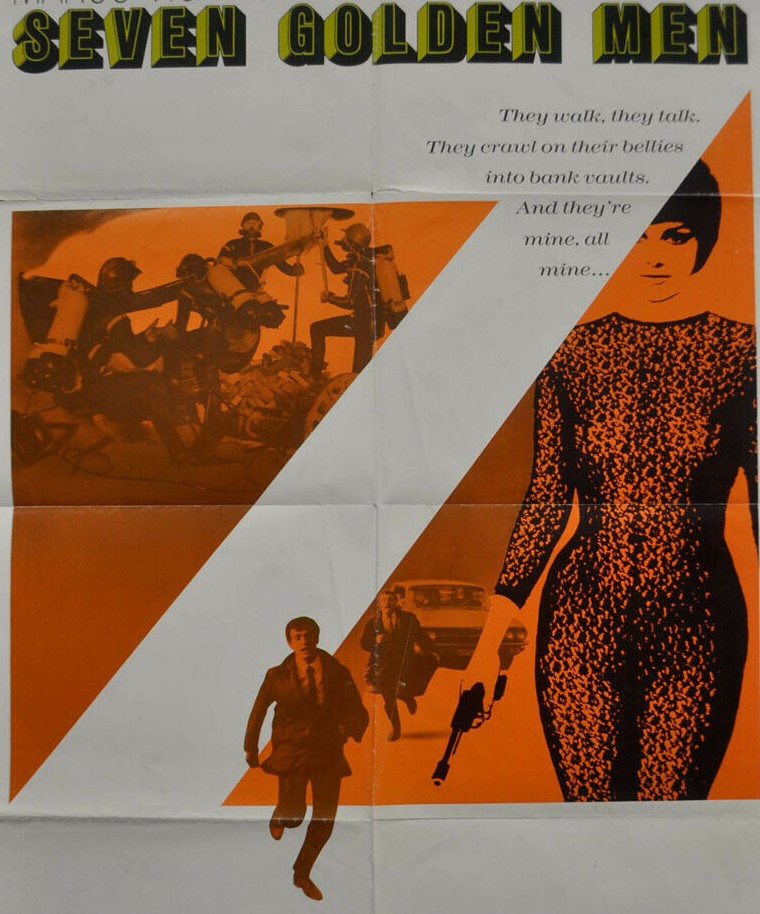
Very stylish caper picture that dispenses with the recruitment section, the ingenious hi-tech robbery accounting for the first half, escape and double-cross the second, a slinky Rosanna Podesta an added attraction/distraction. The Professor (Phillippe Leroy), in bowler hat and umbrella, orchestrates the gold bullion theft from an uber-secure bank using hidden microphones and cameras and a host of electronic equipment, the inch-perfect heist organized to mathematical perfection and timed to the second.

His team, disguised as manual workers, dig under the road, don scuba gear to negotiate a sewer, drill up into the gigantic vault and then suck out the gold bars using travelators and hoists. Giorgia (Podesta), sometimes wearing cat-shaped spectacles, a body stocking and other times not very much, causes the necessary diversions and plants a homing device in a safety deposit box adjacent to the vault. Occasionally her attractiveness causes problems, priests in the neighboring block complaining she is putting too much on show.

It’s not all plain sailing. A cop complains about the workmen working during the sacrosanct siesta, a bureaucrat insists on paperwork, a radio ham picks up communication suggesting a robbery in progress, the police appear on the point of sabotaging the plan.

But the whole thing is brilliantly done, the calm professor congratulating himself on his brilliance, Giorgia seduction on legs. The getaway is superbly handled, the loot smuggled out in exemplary fashion, its destination designed to confuse. Then it is double-cross, triple-cross and whatever-cross comes after that, with every reversal no idea what is going to happen next. It is twist after twist after twist. Some of the criminals are slick and some are dumb. As well as the high drama there are moments of exquisite comedy.

Italian writer-director Mario Vicario (The Naked Hours, 1964) handles this European co-production with considerable verve and although, minus the normal recruitment section, we don’t get to know the team very well except for the professor and Giorgia, each is still given some little identity marker and in any case by the time they come to split the proceeds we are already hooked.

Frenchman Phillippe Leroy (Castle of the Living Dead, 1964) is the standout as a mastermind in the British mold, stickler for accuracy, calm under pressure, working with military precision. Podesta (also The Naked Hours) has no problem catching the camera’s attention or playing with the emotions of the gang to fulfill her own agenda. The gang is multi-national – German, French, Italian, Spanish Portuguese, Irish – with only Gabriel Tinti likely to be recognized by modern audiences.

And there is a terrific score by Armando Trovajoli (Marriage Italian Style, 1964) that changes mood instantly scene by scene. One minute it is hip and cool jazz, the next jaunty, and then tense.

Worth a watch.

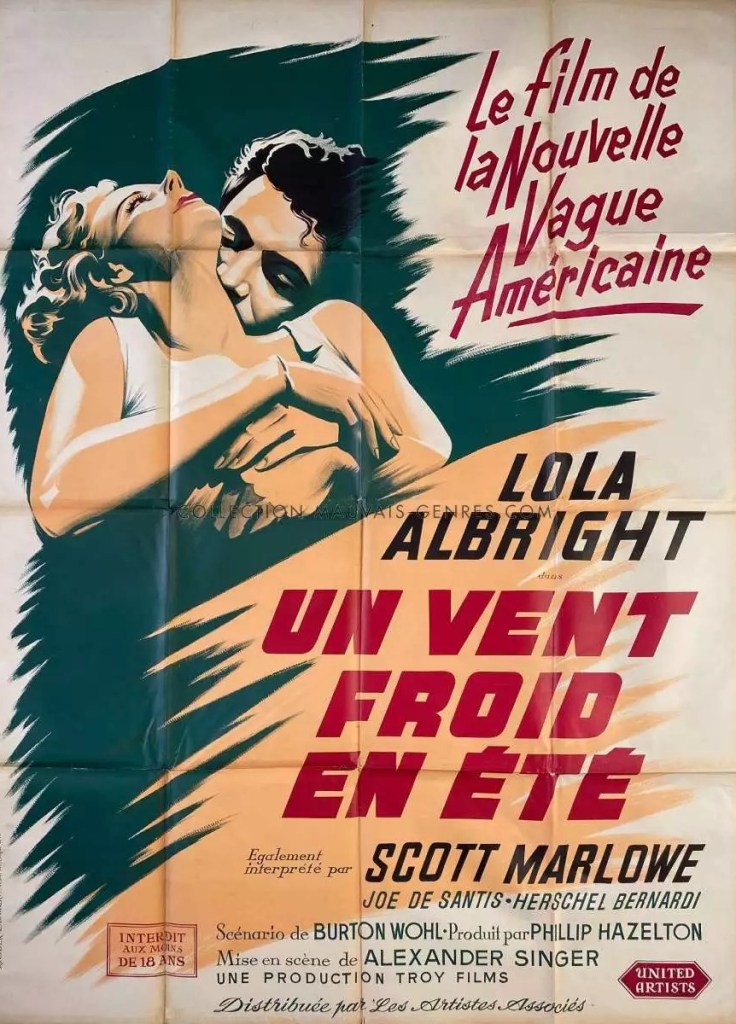
A Cold Wind in August (1961) ***

Touching low-budget B-movie shot in black-and-white of a young man receiving his sexual education from an older woman. Motherless Vito (Scott Maxwell), the son of an apartment block super, is seduced by the older Iris (Lola Albright), three-time divorcee, looking for a son to mother. 

This is not the transactional sex of The Graduate, and seduction is too strong a description for the yearning Iris whose advances are sensual and romantic, stroking Vito’s head, trapping his hand with her foot, and there is nothing clandestine about their affair either, no false names on a hotel register. They dally in the park, eat hotdogs, and he buys her flowers. 

But as he experiences love for the first time, he also experiences more difficult emotions like jealousy and finds it difficult not just to cope with what seems like another man in her life, the wholesaler Juley (Herschel Bernardi), but the fact that she treats him with such contempt. Spoiler alert – well, not really, because you know from the off this is not going to turn out well – the affair ends when he discovers she is a stripper. And while she is left bereft, he now appears more attractive to girls his own age.

In contrast to the powerful emotions stoked up when the pair are together, director Alexander Singer (Psyche ‘59) fills us in on the rest of Vito’s humdrum life, working for his father during the school holidays, goofing off with his pals, and generally failing to make headway with girls his own age.  But Iris’s life is not humdrum. Although she has a rule not to work in her own area, she breaks that to accommodate her estranged husband, whom she seems to tolerate, while at the same time drinking herself into oblivion to avoid any moves from Juley. Nor is she ashamed of her profession. It is an act, a job like any other, and provides her with a nice apartment.

Small wonder she treats men with contempt. Perhaps what she falls in love with is untainted innocence. In some senses she is adrift, at other times in full command. And her love for Vito is convincing.

It is full of incidentals. He gulps down ice-cream, she teaches him to drink one sip at a time, without being patronizing the father (Joe De Santis) tries to educate him to honor his inner feelings.

Lola Albright (Peter Gunn television series) carries off a difficult role very well indeed. Without laughs to help him out as it did Dustin Hoffman in The Graduate, Scott Maxwell is believable both as the youth growing into adulthood and the youth wanting to remain a youth with no adult responsibilities. The low-key performance of Joe De Santis is worth a mention.

While the picture no doubt attracted attention for the risqué material, which would have certainly given the Production Code pause for thoughts, it provided a more rounded picture than was normal at the time of a woman working in the sex industry, even if only in the stripping department. Iris did not fall into any of the cliches. She is presented as a woman first and foremost rather than a stripper.   

Alexander Singer sticks to the knitting and doesn’t come unstuck. John Hayes (Shell Shock, 1964) wrote the screenplay based on the Burton Wohl bestseller.

Unusual variation on the theme.

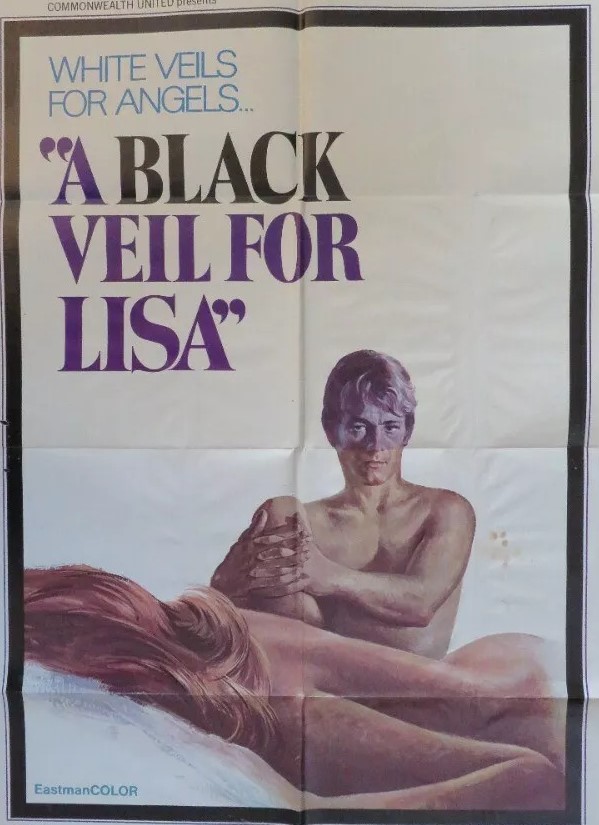
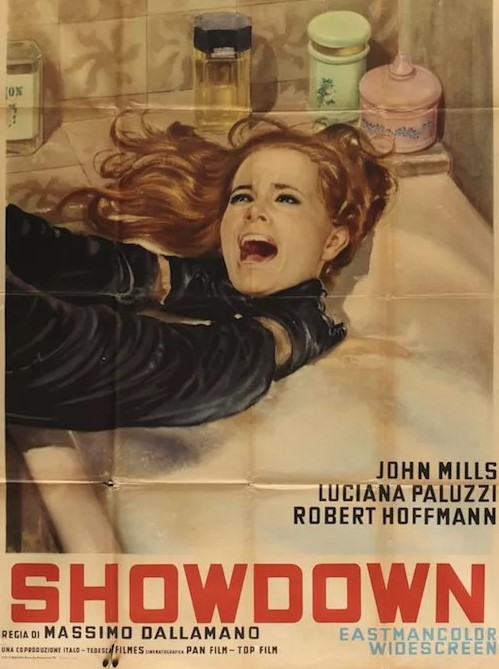
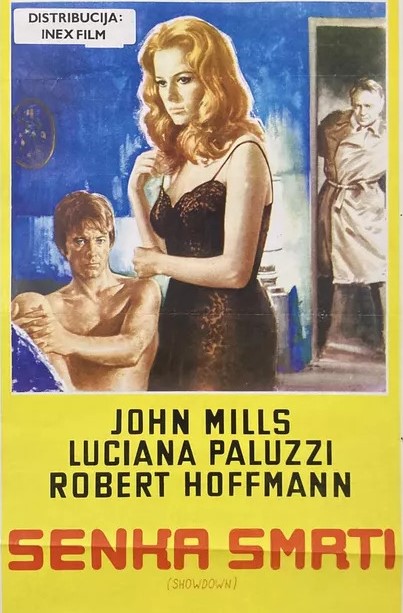
A Black Veil for Lisa (1968) ***

John Mills ventures back into Tunes of Glory (1960) territory as a top official coming apart at the seams. This time it’s not the British Army but the Italian Police where, as Franz Buloff, he heads up the narcotics squad. And this time he’s not the complacent victim but decides to take action against his tormentor.

Closing in on drugs kingpin Scheurermann, he finds that one witness after another is being silenced by an assassin with a deadly knife. He suspects a leak in his department, unaware the traitor is much closer to home. And despite the usual dissatisfied boss Ostermeyer (Tillio Altamura) breathing down his neck, he would be making more headway if it wasn’t for the fact that his head is constantly filled with images of his wife Lisa making love to another man.

For her part, Lisa seems determined to unhinge her husband, eliciting jealousy at every turn, by never answering the phone at night and always an excuse, when he tracks her down, for not being where was supposed to be. Rather than calming him down, her occasional seduction of her husband only serves to ramp up his fury.

In any case, it’s an odd set-up, he’s much older and the security he offers is not just financial. She was once a suspect herself and being married to a top cop has put a force field between her and suspicion. There’s clearly an unspoken assertion that somehow she has duped the cop, making him fall in love with an apparently innocent woman. They couldn’t be more opposite. “I like danger,” is her mantra.

He breaks open the case after following up a clue dropped at the scene of the crime. After arresting Max (Robert Hoffman), he strikes a deal with the killer. In return for his freedom, the murderer has to take out Lisa. But, of course, it’s not as simple as that. When Buloff realizes the deep water he is treading, he calls off the assassination. But then when he discovers that Max has helped himself to a bonus – beginning an affair with Lisa – he recants and puts the man back on the spot.

So, now, it’s Max who faces the quandary of having to kill his lover. And that puts up square in cat-and-mouse territory.

This isn’t quite giallo, the genre was still in the process of being born, in part because there’s no mystery about the killer, in part because the murders aren’t bloody enough, and in part because the dead aren’t sexy young women. So it’s more a series of character studies, each driven to an edge by an action that otherwise would be out of character.

A top cop like Buloff should have been a better judge of character than to fall for Lisa’s wiles in the first place. Lisa, too, should have recognized her penchant for the seedier side of life rather than being as she puts it “too young to be buried alive” in a stifling marriage to a jealous husband. But, she, too, is a poor judge of character, expecting to win back the favor of the drug overlord after she had so openly crossed the tracks to the other side of the law.

And Max, one of the first of a series of killers in movies who wanted out (see The Brotherhood, 1968, and Stiletto, 1969), is trapped into more killing because nowhere is safe. Getting rid of Buloff was never in his plans, as that would draw even more unwelcome attention. But then neither was falling in love with the cop’s wife. There’s still a few twists to go not least when Lisa discovers that the husband she felt she had under control had broken free and was intending to have her killed.

John Mills, a surprising addition to the Brits heading for Italy, is excellent especially as the big flaw in Tunes of Glory was his inability to find the cunning to strike back at his chief tormentor. Here, he might have second thoughts about dispatching his wife, but revenge is always the best weapon.

Luciana Paluzzi (Chuka, 1967, which, incidentally, also featured Mills) gets her teeth into a decent role rather than been saddled in lightweight fare since swanning around in swimwear in Thunderball (1965). Austrian Robert Hoffman (Assignment K, 1968) is given a surprising range of emotions to deal with.

Massimo Dallamano (Venus in Furs, 1969) handles the material well and gets the best out of his cast without taking the bloodier route of the later giallo. He was one of four writers contributing to the screenplay. This was one of the feature films made by new American mini-major Commonwealth United, one of the stack of “instant majors” popping up around this time.

John Mills is always watchable and the twists make this one play.

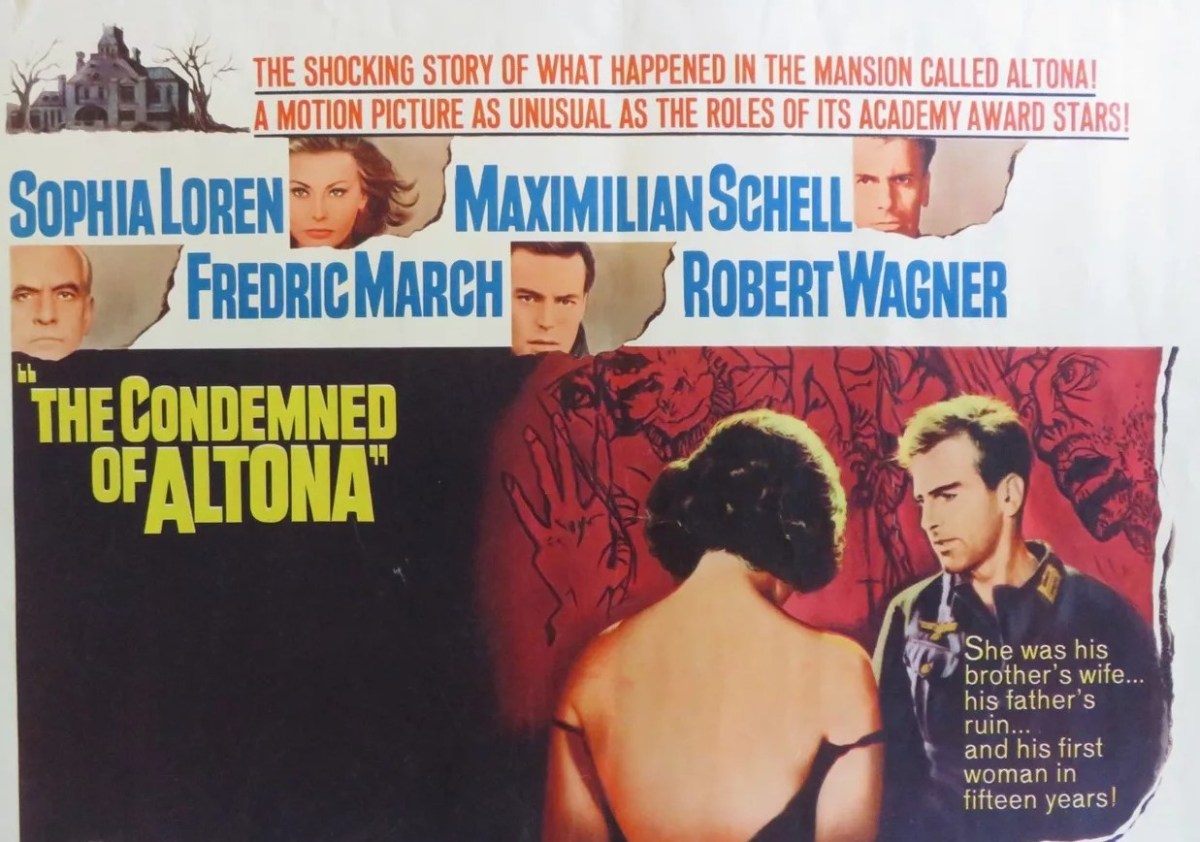
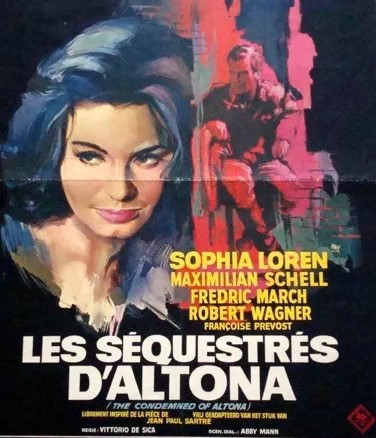
The Condemned of Altona (1962) ****

Shades of last year’s Oscar-winning Zone of Interest but with more guilt, some characters dodging it, others driven mad by remembrance of what they did or didn’t do during the Holocaust of World War Two. But mostly, an object lesson in how to expland a play (written by French philosopher Jean-Paul Sartre). Despite top class performances from Sophia Loren (Arabesque, 1966), Maximilian Schell (Counterpoint, 1967), Fredric March (Seven Days in May, 1964) and even, astonishingly, from Robert Wagner (Banning, 1967) it’s director Vitttorio De Sica (A Place for Lovers, 1968), with stunning images and clever camerawork, who steals the show.

You won’t forget in a hurry the outstretched hand of a prisoner in a blizzard condemned to die, nor the skeletal jaw seen through an x-ray machine. The backward crab crawl will remind you of a later movie. De Sica moves the camera every whichway. Aerial and overhead shots are mixed in with the camera swivelling from character to character or suddenly pulling back from a scene and then suddenly he stops you his restraint. But that doesn’t prevent him getting to the heart of the narrative matter and adding in some frisson of accuser attracted to accused.  

Set at the end of the 1950s, we begin on a Succession note, but without the contemporary angst and back-stapping. German shipping entrepreneur Albrecht (Fredrich March), a war profiteer turned post-war profiteer having taken advantage of demand in the Germany industrial boom, and now with only months to live, wants to pass on his business to son Werner (Robert Wagner). But Werner shies away, disgusted by his father’s unspoken collaboration with the Nazis during the war, ignoring the argument that the businessman was simply dealing with whatever party was in power. And this would be the narrative, father explaining actions, hoping for expiation, planning for the business to pass down the family line rather than be sold off.

Except that Werner’s left-winger actress wife Johanna (Sophia Loren) discovers there is another contender, the supposedly dead older son Franz (Maximilian Schell) who, instead of being sentenced to death for war crimes and fleeing to Argentina, where he purportedly died, as was the story given out, is actually hiding in the family mansion. He’s pretty much been driven mad, the walls of his substantial hidey-hole daubed with disconcerting images. Windows blocked-up and no knowledge of the outside, wearing his Nazi uniform he envisages a Germany languishing in decay, poverty and hunger. He lives on champagne, oysters and chocolate (so not quite the tough prison regime), and, as discreetly portrayed as was possible at the time, has an incestuous relationship with doting sister Leni (Francoise Prevost), the only human being with whom he is in contact. The inmate, knocking back handfuls of Benzedrine, occupies his time by recording messages to be delivered, he hopes, to Germans many centuries ahead.

Johanna wonders how this mentally-ill man came to be obsessed with guilt and we discover that when he was growing up his father rented out spare land around the mansion to the Nazis for a concentration camp where 30,000 people died. But Franz hid a Jew in the house, was reported to the S.S. by his father, and witnessed the man’s execution, then was punished by being forced to join the Army where he was known as a torturer. Finally, he emerges from isolation and sees a different Germany and confronts his father in a shock ending.

Both Loren and Schell had just won Oscars, for Two Women (1960) – incidentally directed by De Sica – and Judgement at Nuremberg (1961), respectively, so their confrontation, where his initial male dominance (the poster image reflects this scene) settles into a more equal power dynamic. Frederic March is good as the father convinced he has done no wrong and I had to check that this was the same Robert Wagner who had often been indifferent in pictures. De Sica draws great performances from all and layers the whole movie in a doom-laden atmosphere. Written by Abby Mann (Judgement at Nuremberg) and Cesare Zavattini (Woman Times Seven, 1967)

Remains surprisingly potent.

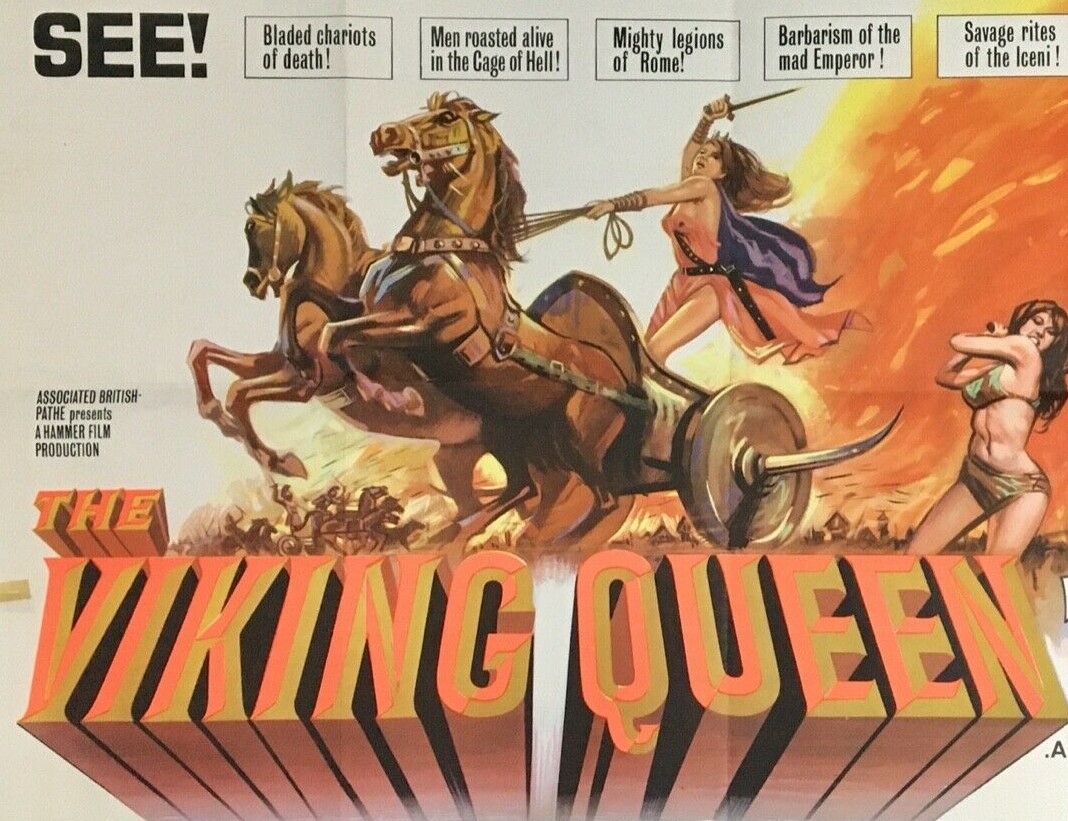
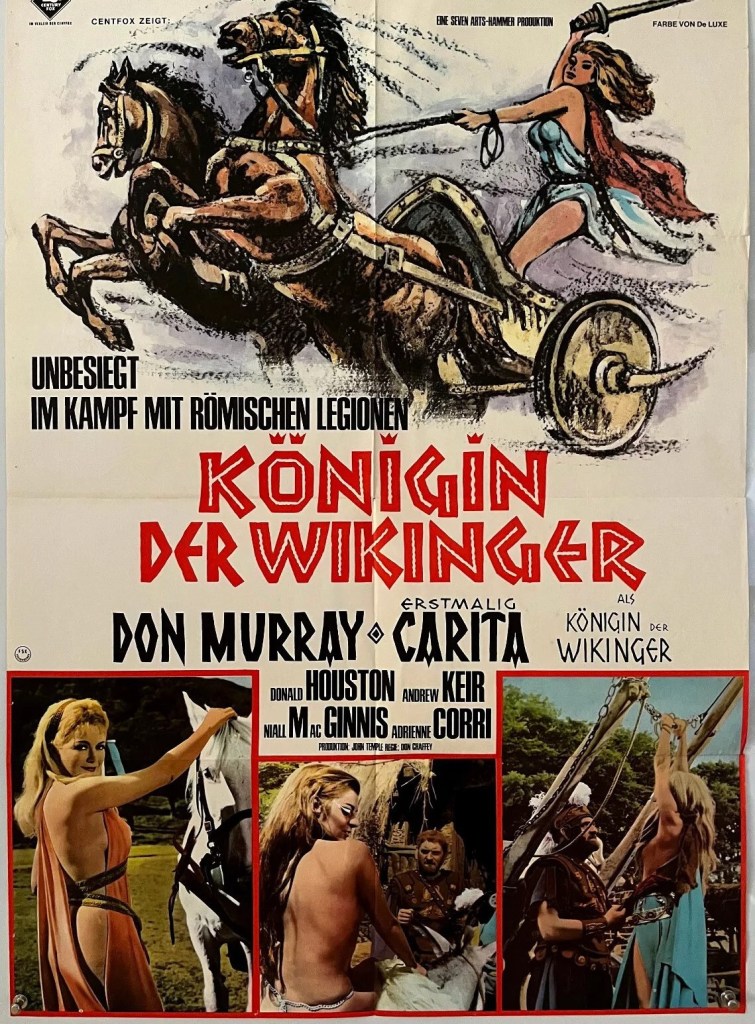
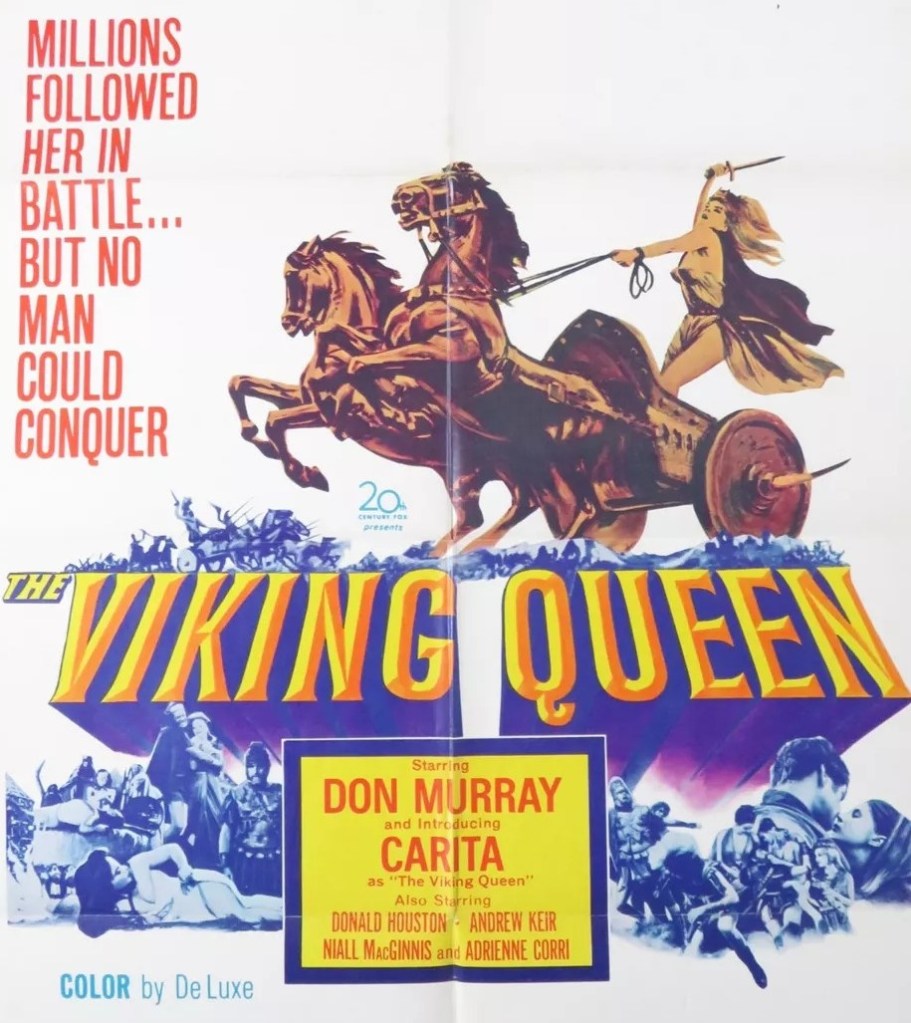
The Viking Queen (1967) ***

Politics, conspiracy, thwarted romance and historical inaccuracy take center stage in this Hammer romp that attempted to create another sex symbol to follow in the footsteps of Ursula Andress (She, 1965) and Raquel Welch (One Million Years B.C., 1966) in the shape of Finnish model Carita. Let’s put the dodgy historical elements to one side given Hollywood trampled over history all the time, but the title is a misnomer, the story owing more to folk heroine Boadicea than anyone who came from longship land.

On his deathbed British tribal king (Wilfred Lawson), against the wishes of powerful Druid chieftain Maelgan (Donald Houston), signs a peace treaty with Roman governor general Justinius (Donald Murray) against the wishes of his lieutenant Octavian (Andrew Keir). In different ways, the Druid and Octavian conspire to end the peace. Had new queen Salina (Carita), after falling in love with Justinius, been permitted to marry him that would have created a peaceful bond, but that is also prevented.

There’s a lot more sex and violence than you would have expected for the period, plenty scantily-clad slaves administering to the rich and the Romans, an extended brutal flogging sequence involving Salina, an offscreen rape, a cageful of Roman prisoners dropped into a burning pit, and when the British strap scythes onto the wheels of their chariots it’s a bloodbath. (Quite why the Romans never thought of importing their own chariots, given their popularity in the Colosseum, is never explained.) The chariots, whether in a race or battle, are the best thing about the picture, adding tremendous energy.

It takes quite a while for Salina to take up arms but when she does the film catches fire. She leads from the front, tearing through the Roman legions, and handy too with a sword. Ambushes appear the order of the day so any marching column or peaceful village soon ends up in a spot of bother.

There’s some of “what did the Romans ever do for us” with a snatch of Robin Hood thrown in – Justinius takes from the rich to give to the poor – plus religious fanaticism to stir the pot into a heady brew.  But mostly it’s hokum, if rather plot-heavy. Quite how the Oscar-nominated Don Murray (Advise and Consent, 1962) was talked into this is anybody’s guess. Carita, of course, would have believed she was on a surefire route to stardom but in fact this was her last picture. The two stars don’t really have that much to do and do it well enough. In supporting roles you will spot Patrick Troughton (a BBC Dr Who), Nicola Pagett making her movie debut and Adrienne Corri (Africa – Texas Style, 1967). Director Don Caffey (One Million Years B.C., 1966) is better at action than drama.

Directed by Don Chaffey (Jason and the Argonauts, 1963) from a screenplay by Clarke Reynolds (Genghis Khan, 1965) and the movie’s producer John Temple-Smith.

More Olinka Berova than Ursula Andress.

Behind the Scenes: “The Chairman / The Most Dangerous Man in the World” (1969)

Had things run according to the original plan, we could have seen Frank Sinatra return to a Communist country for the first time since The Manchurian Candidate (1962). But if you had wanted to write a script about the guy who wrote The Chairman, you couldn’t have invented a more interesting character than Samuel Richard Solomonick. He was one of those guy who held every job under the sun before reinventing himself as an anticommunist going by the name of Jay Richard Kennedy and subsequently entering the fields of real estate, radio and brokerage, then landing a gig managing Harry Belafonte and writing the screenplay for I’ll Cry Tomorrow (1955).

By the time he ended up as an executive at Sinatra Enterprises he had a couple of ideas to sell. Forming Jade Productions in 1966 with director Richard Quine (How To Murder Your Wife, 1965), the pair hooked Sinatra’s interest in two projects, Follow the Runner (which would have co-starred Sammy Davis Jr) and The Chairman plus William Holden eyeing the lead in The Wordlings about the population explosion.

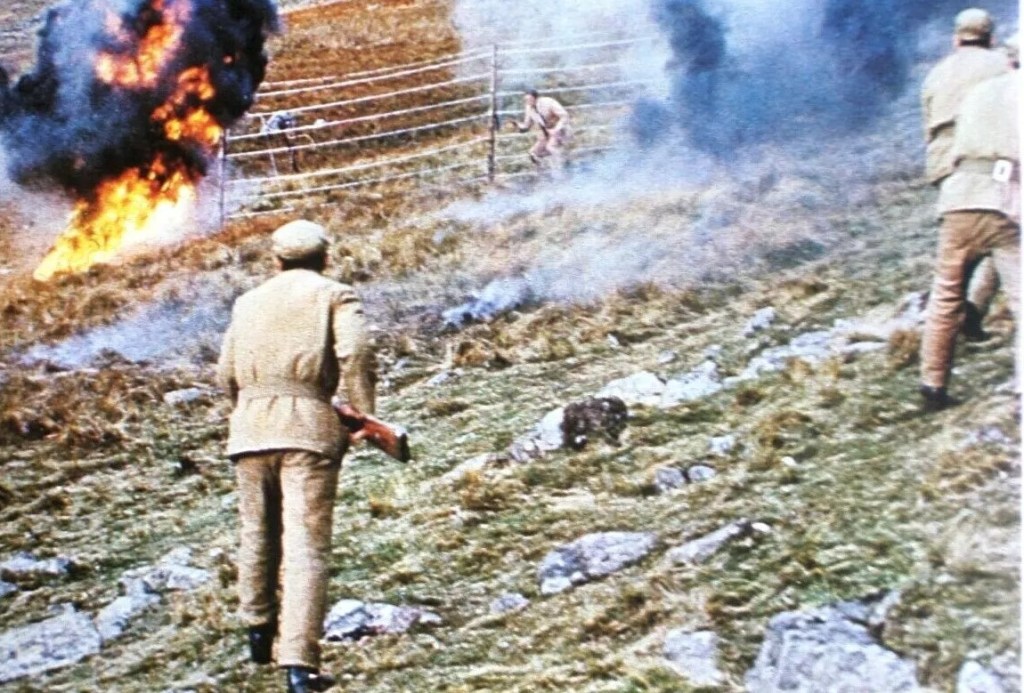
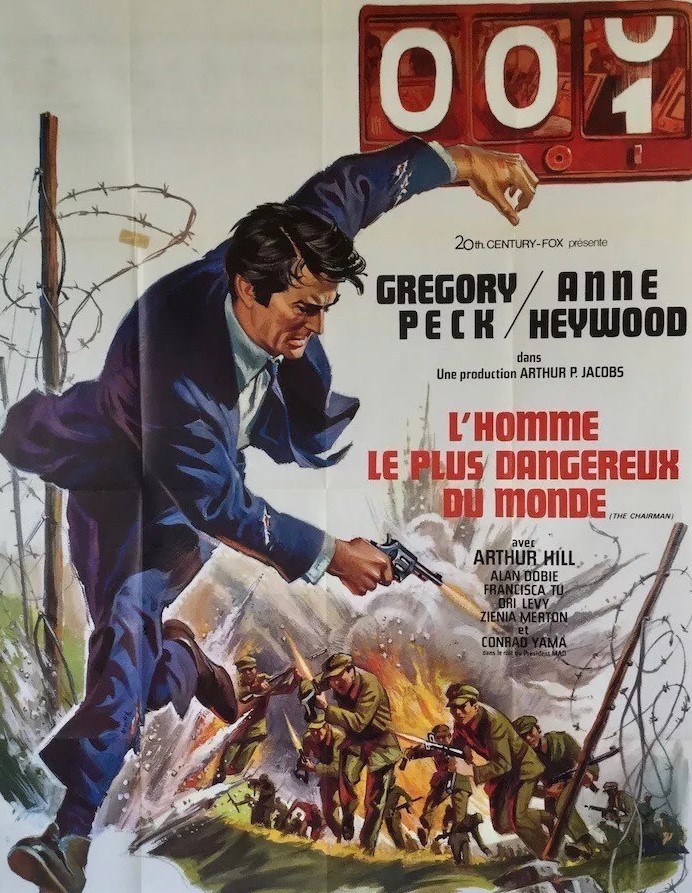
That’s Gregory Peck trapped on the wrong side of the Russian border with Chinese soldiers closing in.

Sinatra was known for falling out with directors, shunting Mark Robson off The Detective (1968), so whether Quine would have lasted the pace is anybody’s guess. After success with Tony Rome (1967), Twentieth Century Fox briefly toyed with the prospect of pairing Sinatra and new wife Mia Farrow in The Chairman. Originally scheduled to begin shooting on January 1967, that later shifted to early 1968. The notion that the movie also had parts for Spencer Tracy and Yul Brynner was one of those puff pieces that some journalists swallowed.

Despite some enticing projects – he was first name down to direct Catch 22, after Columbia had spent $150,000 buying the novel, and to helm the screen translation of Broadway hit The Owl and the Pussycat – Richard Quine’s career teetered after the flop of Hotel (1967). Making no headway with Sinatra he made instead another flop, Oh Dad Poor Dad (1967) and was effectively put on furlough for three years after failing to finance a movie to star Alex Guinness and Lee Radziwill.

Quine exited The Chairman in May 1967 when former PR bigwig Arthur P. Jacobs took over the production and with Sinatra in absentia turned to British director  J. Lee Thompson who had helmed the producer’s debut picture What a Way to Go (1964).  And that proved a lucky break for Thompson who had yet to match the success of The Guns of Navarone (1961).  

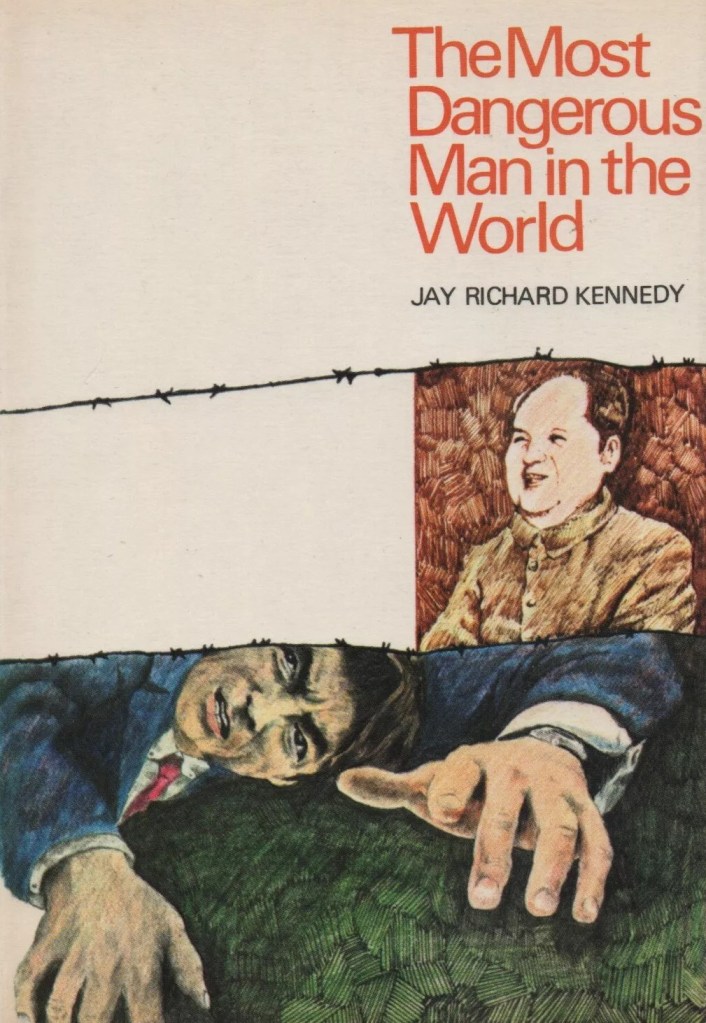
The book cover.

After successive flops – Return from the Ashes (1965) and Eye of the Devil (1966) – Thompson had plenty projects on the boil including a musical remake of Alexander Korda’s The Private Life of Henry VIII (1933) with a score by Richard Rodgers and Peter Ustinov playing the lead. Also on his slate was High Citadel based on the Desmond Bagley bestseller; The Harp That Once for Columbia; an adaptation of James Clavell bestseller Tai Pan; a sequel to The Guns of Navarone called After Navarone that would reunite the director with star Gregory Peck and writer-producer Carl Foreman; and Planet of the Apes (1968) to which he and Jacobs held the rights.

While none of these projects – except Planet of the Apes and minus Thompson – came to fruition, the Navarone connection would lead to Mackenna’s Gold for Foreman. In the meantime he had helmed a modest drama, Before Winter Comes (1968) starring Broadway star Topol. When Arthur P. Jacobs greenlit The Chairman, he hired Thompson who looked no further than Peck, connection re-established via the Navarone sequel.  They were a four-time pairing – Cape Fear (1962) and Mackenna’s Gold and The Guns of Navarone. Peck was a controversial choice from the Twentieth Century Fox perpsective given he had broken a contract with the studio in 1960 to star in Let’s Make Love. But Jacobs smoothed ruffled studio feathers and paid his star $500,000 plus a percentage. With Jacobs on hands-on duty with Planet of the Apes (1968) –  Mort Abrahams oversaw the production of The Chairman  and immediately engaged in a budget dispute with the director. Jacobs had initially stipulated $4 million, Thompson believed he required another million. They didn’t quite split the difference, Fox had the film come in at $4.9 million.

Thompson recognized the problems of the script, pointing out that “the hardest thing for Americans about the film’s concept is accepting that China has some competent scientists.” Rather ingenuously, he averred that the movie would have “no political overtones,” while Abrahams retorted that it might have “some political overtones.” It would been obvious to anyone that a picture featuring Mao was bound to have political repercussions, his Little Red Book a massive bestseller on the campus, an album cut of recitations from the book and Edward Albee in 1968 premiering a play called Quotations from Chairman Mao Tse-Tung.

Denied access to China, the production team spent four months “reading everything we could get our hands on.” At one point they considered dropping the scene featuring Chairman Mao and lengthening the sequence relating to Peck’s arrival in Hong Kong. In any case, different versions of the Hong Kong environs were shot, some with nude shots of girls in a house of pleasure.

The British Colonial Office in Hong Kong blocked filming there after fears of riots due to the production daring to portray Mao Tse-Tung on screen. Taiwan substituted for China although the locals there were also incensed, so much so they burned an effigy of Peck. Wales, funnily enough, was another location as was London University. Filming began on August 28 and finished on December 3.

Although it might appear that Ben Maddow (The Way West, 1967) wrote his script based on Jay Richard Kennedy’s novel, in fact the novel appeared after the screenplay with Kennedy writing the novelizaton, and it’s more likely that what Maddow adapted was the original Kennedy screenplay. Interestingly enough, around this time Maddow had first crack at the Edward Naughton western novel that became McCabe and Mrs Miller (1971).

It wasn’t the first time Variety got a prediction wrong: “powerful box office attaction” fell far short of the actual results. This proved an annus miserabilis for Gregory Peck. In fact, he had four films, not three, released in 1969. By release date The Stalking Moon technically belonged to the previous year, but it only played a handful of cinemas in 1968, its general release taking place in 1969.

Despite pocketing a total of over $2 million, Peck’s marquee value was in clear decline. Of the Peck quartet, Marooned did best, placing 33rd on the annual box office chart, with $4.1 million. Mackenna’s Gold (31st) took $3.1 million in rentals (the amount returned from the gross once a cinema has taken its cut), The Stalking Moon (38th) on $2.6 million, and The Chairman (41st) with $2.5 million.

SOURCES: Gary Fishgall, Gregory Peck (Scribners, 2002) p267; James Caplan, Sinatra: The Chairman, (Doubleday, 2015), p724;  “7 from 7 Arts,” Variety, March 3, 1965, p4; “Richard Quine,” Variety, July 7, 1965, p20; “Return of Advances,” Variety, October 6, 1965, p7; “Form Jade Prods,” Variety, December 15, 1965, p4; “J Lee Thompson Nearly Finished on 13,” Variety, February 2, 1966, p28; “Catch As Catch 22 Can,” Variety, February 23, 1966, p4; “Rodgers and Hammerstein’s Musical Henry VIII,” Variety, Mar 16, 1966, p1; “Inside Stuff – Pictures,” Variety, March 30, 1966, p22; “Lee Thompson Busily Blueprints His Musical Version of Henry VIII,” Variety, April 27, 1966, p17; “Jay Kennedy Script,” Variety, July 6, 1966, p5; “After Navarone,” Variety, April 19, 1967, p14; “Scripting Red Chinese,” Variety, May 21, 1967, p4; “”Personality Chemistry,” Variety, May 24, 1967, p4; New York Soundtrack,” Variety, Sep 20, 1967, p27; “Pat Hall Noel to Col,” Variety, December 27, 1967, p5; “N.Y. Indie Label Grooves Chairman Mao’s Thoughts,” Variety, April 10, 1968, p56; “Man About Town,” Variety, July 17, 1968, p68; “Jas Clavell to Roll Siege,” Variety, August 21, 1968, p7; “Thompson Wraps Up,” Variety, August 28, 1968, p29; “New York Soundtrack,” Variety, October 23, 1968, p18; “British Bar Fox’s Chairman,” Variety, December 4, 1968, p17; Big Rental Films of 1969,” Variety, January 7, 1970, p15; “Big Rental Films of 1970,” Variety, January 6, 1971, p11.

The Chairman / The Most Dangerous Man in the World (1969) ****

The sci-fi elements in this tidy paranoia thriller set in Communist China are not the only issues overlooked at the time and worthy of reconsideration now. Anyone who blasted it for supposedly political jingoism conspicuously failed to read a subtext that chimed with young left-wingers for whom Chairman Mao was not, as now, perceived as a tyrant du jour but as a political god. There’s a distinct whiff of Philip K. Dick in the implanting in a spy’s head of not just a tracking/listening device but one laced with explosive that can be remotely triggered for suicidal or murderous gain. Needless to say, the spy, ignorant of this fact, was a de facto sacrificial lamb. And a key plot thread about genetically modified crops as a means of solving world hunger came about four decades too early.  

Widowed Nobel prize winning scientist Dr Hathaway (Gregory Peck) is despatched into China via Hong Kong to contact a missing scientist with a revolutionary formula for an enzyme. A series of crisp flashbacks set up the scenario of the tracking device and a reverse echo of Marooned (1969) where Army chiefs back at base, led by one-eyed Shelby (Arthur Hill,) can listen in but are helpless to intervene – except in sinister manner. Shelby considers Hathaway “the wrong brilliant man” for the task and that they have sent in “a civilian to do a soldier’s job.”

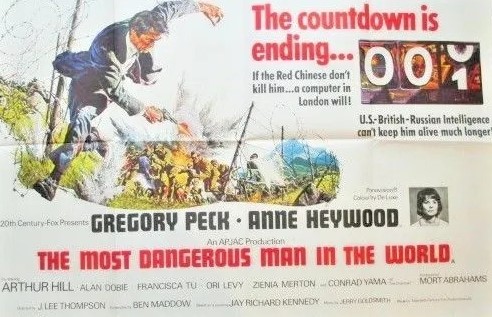
Not able to trust the Brits to know who the title referred to, they came up with a lame alternative. The taglines reveal way too much of the plot.

The hidden transmitter allows Hathaway to keep his superiors posted but the listening device also picks up a creaking bed as Hathaway almost falls into a honey trap in Hong Kong. Amazingly, he doesn’t have to sneak into China but is welcomed with open arms and hustled along to a meeting, and a game of ping-pong (the real thing and the verbal equivalent) with Chairman Mao (Conrad Yama). While spouting some propaganda, Mao is surprisingly open about sharing the secret of the enzyme rather than blackmailing a starving world. Meanwhile, it’s the Americans who are more interested in the double cross, Shelby itching to blow up Hathaway’s head in the assumption the explosion would dispose of the Chinese leader.

Emissions from the transmitter are tangling up the airwaves, making the Chinese secret police highly suspicious of Hathaway as he heads for the secret scientific compound housing Professor Soong Li (Keye Luke), creator of the enzyme, and his daughter Chu (Francesca Tu).

Turns out Hathaway has been summoned by the professor to help find a missing link in molecular chains. Hathaway has to burgle his way to steal the formula, but fails to find it, but when the professor commits suicide and is denounced by his daughter and the Chinese secret police close in, Hathaway has to scarper and head for the Russian border, that country, oddly enough for a spy movie, being on the same side as the Yanks. Meanwhile, Shelby’s trigger finger it itching to blow his man sky high for fear he might give away details of his mission.  

The French, too, had trouble with the original title.

Turns on its head many of the spy film’s truisms: firstly that Hathaway effectively fails in his mission; secondly that patriotism doesn’t blind him to his country’s greed or folly; thirdly that’s he not in constant seduction mode.

Political argument that one point seemed to excessively delay the narrative thrust, now, at half a century’s move, seems more considered and providing an interesting balance between opposing views.

Gregory Peck (Marooned, 1969) is at his quizzical best, deeply-rooted scepticism helping to anchor his character. But if you were attracted by seeing Anne Heywood (The Fox, 1967) second-billed you’re in for a disappointment as she just tops and tails the picture. Arthur Hill (Moment to Moment, 1966) is good value as always.

But it’s testament to J. Lee Thompson (Mackenna’s Gold, 1969, also starring Peck) that his direction brings together diverse political/sci fi/spy/thriller elements in a winning formula, ignoring the obvious. Some interesting detail: someone handing out coffee on a tray to the inmates of the command station; Hathaway’s guilt at his role in the death of his wife barely touched upon, but it explains a lot; Mao’s famous Little Red Book provides a twist.

Occasional flaw: surely the Chinese would have bugged Hathaway’s room and catching him, however soft voiced, filling in his superiors. The idea that the Chinese could be technologically more advanced than the U.S. would have had John Sturges in a fit of fury, but Thompson takes it in his stride. Screenplay by Ben Maddow (The Way West, 1967) and Jay Richard Kennedy (I’ll Cry Tomorrow, 1955).

Reassessment overdue.

Discover WordPress

A daily selection of the best content published on WordPress, collected for you by humans who love to read.

The Atavist Magazine

by Brian Hannan

WordPress.com News

The latest news on WordPress.com and the WordPress community.