The Doomsday Flight (1966) ***

Early entry to the hijack subgenre – this one pivoting on the bomb-on-a-plane. Could almost deem it a template for what to do and not do in this particular field. Airport (1970) was the most obvious beneficiary although Speed (1994) could be reckoned to be something of a homage. And though “what if” was largely the preserve of sci fi, this posed very scary questions for audiences only beginning to enjoy the benefits of cheaper international travel. A quartet of excellent twists and three examples of men under pressure heat up the concept.

Unusually, the writer was the main selling point, Rod Serling (Seven Days in May, 1964) being more famous than most screenwriters thanks to The Twilight Zone (1959-1964) scaring the pants off viewers in ways that nobody thought television would dare to do.

Propped up by an interesting cast – Jack Lord (The Name of the Game Is Kill!, 1968), former major league movie star Van Johnson (Wives and Lovers, 1963), Edmond O’Brien (Rio Conchos, 1964), John Saxon (The Appaloosa, 1966), Ed Asner (The Satan Bug, 1965) and Michael Sarrazin (They Shoot Horses, Don’t They, 1969).

Unusual in that the two main characters lose it and the movie is probably the first to touch upon PTSD in Vietnam. While Special Agent Frank Thompson (Jack Lord), leading the task force on the ground, appears to be in complete control, in fact he’s hidden the fact that his wife is on the hijacked plane. That’s only revealed in the final climactic twist, so you have to cast your mind back over the movie and reassess Jack Lord’s apparently unflappable performance.

The anonymous hijacker (Edmond O’Brien) is a pretty cunning individual. He’s set a bomb to explode on the plane’s descent and removed the easy option of making a speedy landing by forcing the jet to remain above a certain height otherwise an altitude-sensitive trigger will blow the passengers to kingdom come. He demands a $100,000 ransom which the airline is only too willing to pay.
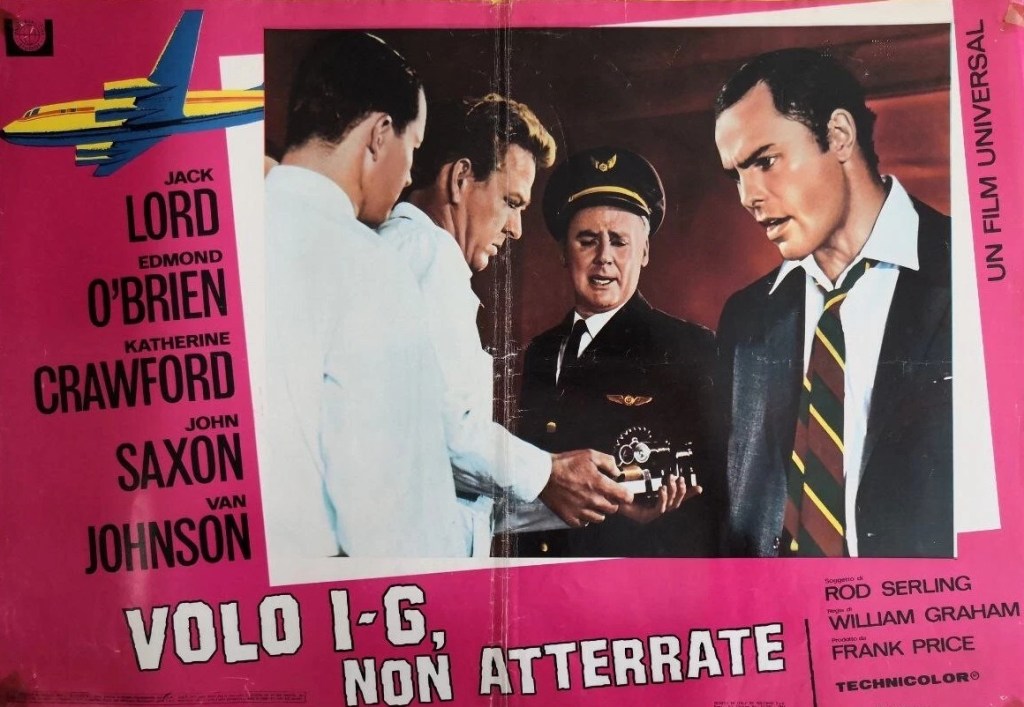
Meanwhile, Capt Anderson (Van Johnson), who had appeared the insouciant handsome epitome of the airline pilot of the kind you saw in advertisements, is sweating profusely under the pressure as the cabin crew begin to search for the bomb. The passengers are not quite as terrified as you’d expect, most sitting in their seats, and i’ts left to celebrity George Ducette (John Saxon) to kick up a ruckus until put in his place by an anonymous army corporal (Michael Sarrazin) who has a distinct aversion to bombs and so far has sat rigid in his seat.

The hijacker keeps everyone on their toes by constantly moving from phone to phone. There’s a hiccup when the delivery van carrying the ransom has an accident and the cash is obliterated. By this point the hijacker, in a bar, is getting drunk and his iron control is tested by the news. The plane, meanwhile, is running out of fuel and Capt Anderson has long run out of patience.

Turns out the bomber isn’t the evil genius you expect. He’s been cast aside by the American dream, his considerable talents overlooked, and he wants everyone to know that he’s worth more. Unfortunately, he doesn’t get his moment in the sun, either literally having made off with the money, or by having his face splashed over the front pages of newspapers.

When he dies of a heart attack, the plane still circling and fuel levels dangerously low and now unable to locate the bomb, that’s a heck of a fabulous twist. But what Rod Serling takes away with one hand, he gives with the other, and the pilot soon works out that if he lands at a high altitude airfield he’ll prevent the bomb exploding.

Safely on the ground, we come to the third twist. The hijacker had deposited the bomb in Capt Anderson’s flight bag, carelessly left lying around at the airport. The final twist is the revelation that Thompson’s wife was on board.

What had every opportunity of becoming a run-of-the-mill thriller, especially since we are light on passenger drama (no pregnant women about to give birth, no kids or nuns to claw at our sentiments), segues into something more interesting as it delves into the cracking up of the hijacker and intimation that soldiers returning from Vietnam do not feel like heroes.

Edmond O’Brien is the pick, but Van Johnson possibly the most courageous in filleting his screen persona. You wouldn’t have predicted Michael Sarrazin’s later success from this performance, nor that Jack Lord would hit a home run in television’s Hawaii Five-O (1968-1980).

Ably directed by William Graham (Waterhole #3, 1967) and although, technically, all he has to do is point the picture in the direction of the twists, he brings more by allowing Edmond O’Brien to humanize his character.   

I saw this as the supporting feature to Carry On Doctor and as a youngster never came out of a cinema more scared. Originally it was a made-for-television number though yanked after only one screening after airlines, not surprisingly, objected, so, as with many hard-to-find pictures it entered the cult zone in the USA.

As YouTube is often the curator of cult you can find it there.
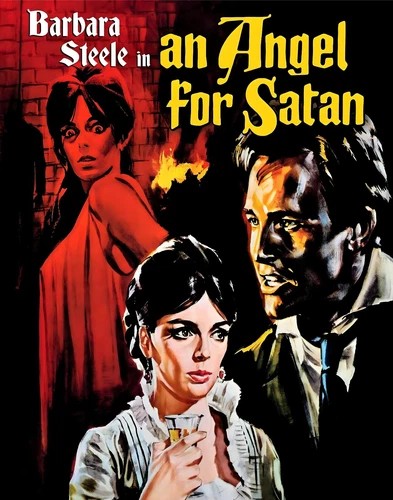
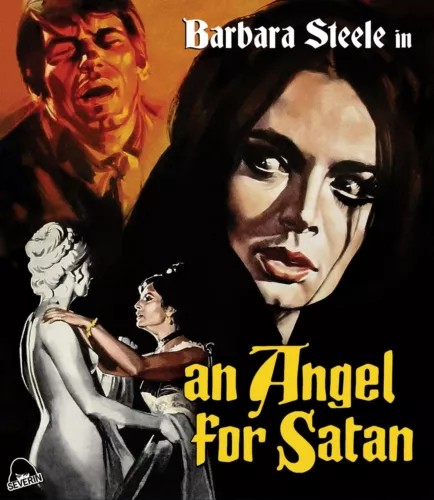
An Angel for Satan / The Devil’s Angel (1966) ***

Scream Queen Barbara Steele (The Crimson Cult / Cult of the Crimson Altar, 1968) is the big attraction in this heady brew of witchcraft, ancient curse, hypnotism and plain ordinary seduction, with an ingenious double twist. And elegantly mounted, crisply photographed as if a Hollywood picture of the 1940s.

After a drought lowers the water level, a 200-year-old statue of the beautiful Countess Melena is recovered from the seabed. The locals fear it carries a curse. Artist Roberto (Anthony Steffen),  hired to restore the artwork, arrives only days before the young countess Harriet (Barbara Steele) returns to claim her inheritance. With some clever sleight-of-hand, veteran Italian director Camillo Mastrocinque (Crypt of the Vampire, 1964) misleads the audience into thinking this is all about secret love affairs, Harriet’s uncle the Count (Claudio Gora) in an illicit relationship with housekeeper Ilda (Marina Berti), maid Rita (Ursula Davis) tempting timid schoolteacher Dario (Vassilli Karis), nascent love between Harriet and Roberto hitting a stumbling block and various shades of unshackled lust from woodcutter Vittorio (Aldo Berti) and village strong man Carlo (Mario Brega).

But pretty quickly, the picture takes a different turn. Turns out it’s not Melena who’s the problem – but her jealous ugly cousin Belinda who threw the statue into the water in the first place. Whatever the cause, there’s an outbreak of malevolence, mostly emanating from Harriet.

She strips naked for Carlo then savagely beats him for daring to stare at the nude body. She seduces Dario, looks like she’s making a play for Rita, goads Roberto and tells him she likes violence and has Carlo in her thrall.

In short order a female villager is raped and murdered, another barely escaping a similar fate, the schoolteacher commits suicide, several villagers are axed to death,  the strong man sets fire to his cottage, killing wife and seven children, and the woodcutter is speared by pitchforks.

You can tell this is a classier number because the violence is minus any gore and there’s little attempt at deliberate shock, more of a slow burn as Harriet torments those around her. Roberto is permitted small touches of investigation, and there’s a clever special effect of a painting appearing to talk.

The traditional horror elements – lightning, slamming windows, storms – are primarily employed to nudge Harriet and Roberto together;  it just so happens that she is scared of lightning and he’s the person most conveniently placed to comfort her. There’s a hint of the narcissism found in Hammer’s later lesbian horror pictures, and only the censor or the director’s discretion prevents more full-blown nudity as a prelude to seduction of both male and female. Harriet’s a dab hand at inveigling males to be in the wrong place at the wrong time invariably with her clothes in disarray to lend substance to her claims of being attacked.

While, as regular readers will know, I’m generally in favour of the climactic twist – the more the merrier – here I’m not so sure this was the road to go down. As Roberto already knows that the curse applies to wicked cousin Belinda rather than Melena, it would have been enough for him to declare this and find a way of removing it, most likely adopting the simple solution of chucking the statue back in the sea, which is what the villagers have been demanding all along.

It’s quite clear that much of the rape and killing is down to hypnotism by Harriet, but once we discover she’s being hypnotized by the Count, in one fell swoop what had been an intriguing horror story transforms into a more run-of-the-mill crime tale since if Harriett is committed to an asylum then he can continue to rule the roost.

But he’s in the thrall of Ilda who turns out to be the ancestor of Belinda. So not quite the satisfactory ending unless the criminal element had been introduced earlier on.

I doubt if Barbara Steele fans will care as the actress is very much in her element and, although in the end a victim, for the bulk of the picture she is in total – and seductive – command. Nobody’s going to compete with her and sensibly nobody tries. Anthony Steffen didn’t need any help with his career because had had already headed down the spaghetti western route.

Classically directed – excellent composition and camera movement – from a script by Mastrocinque and Giuseppe Mangione (Anzio / Battle for Anzio, 1968) from a novel by Antonio Fogazarro.

Superior stuff in which Barbara Steele shines.

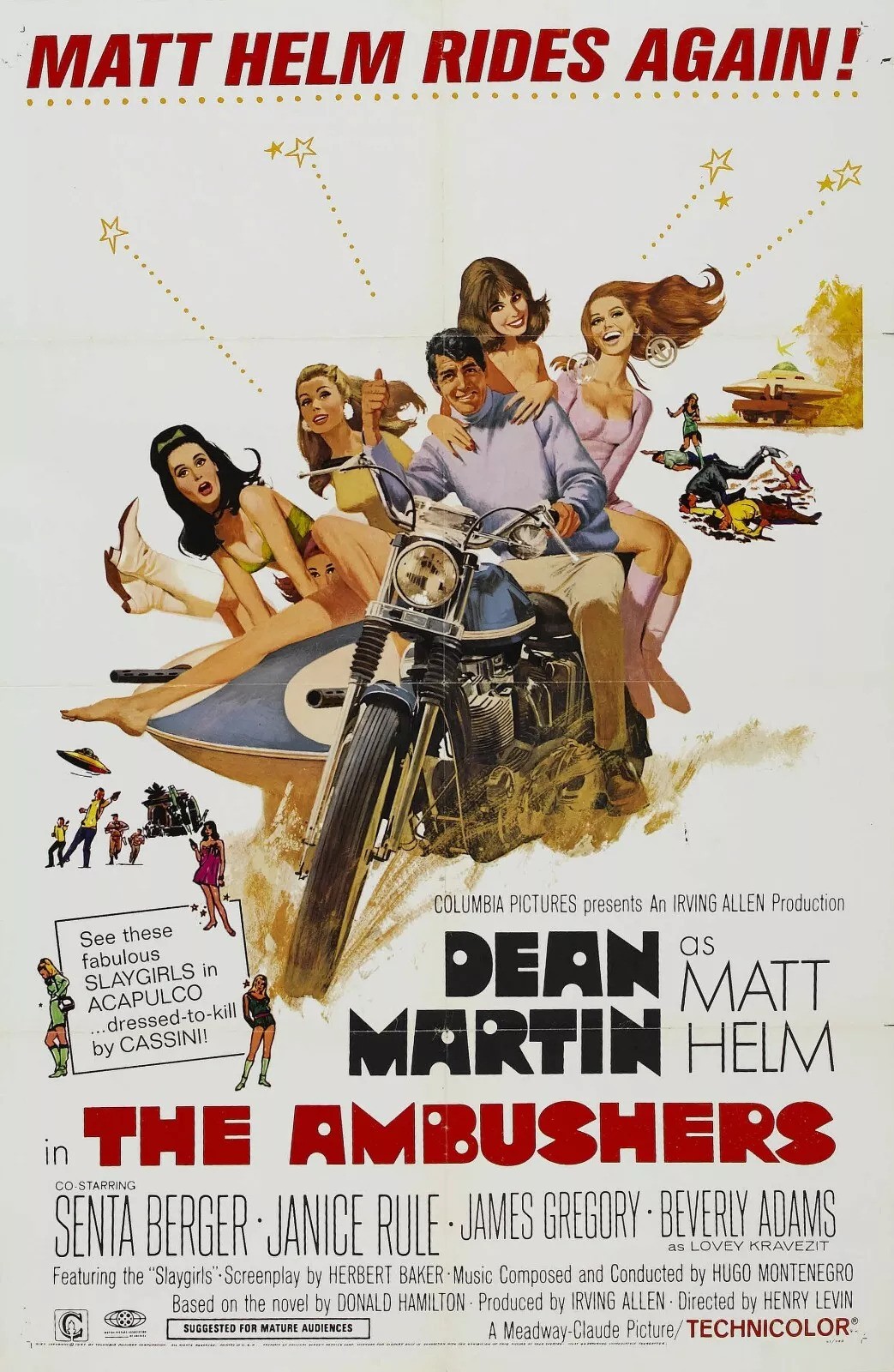
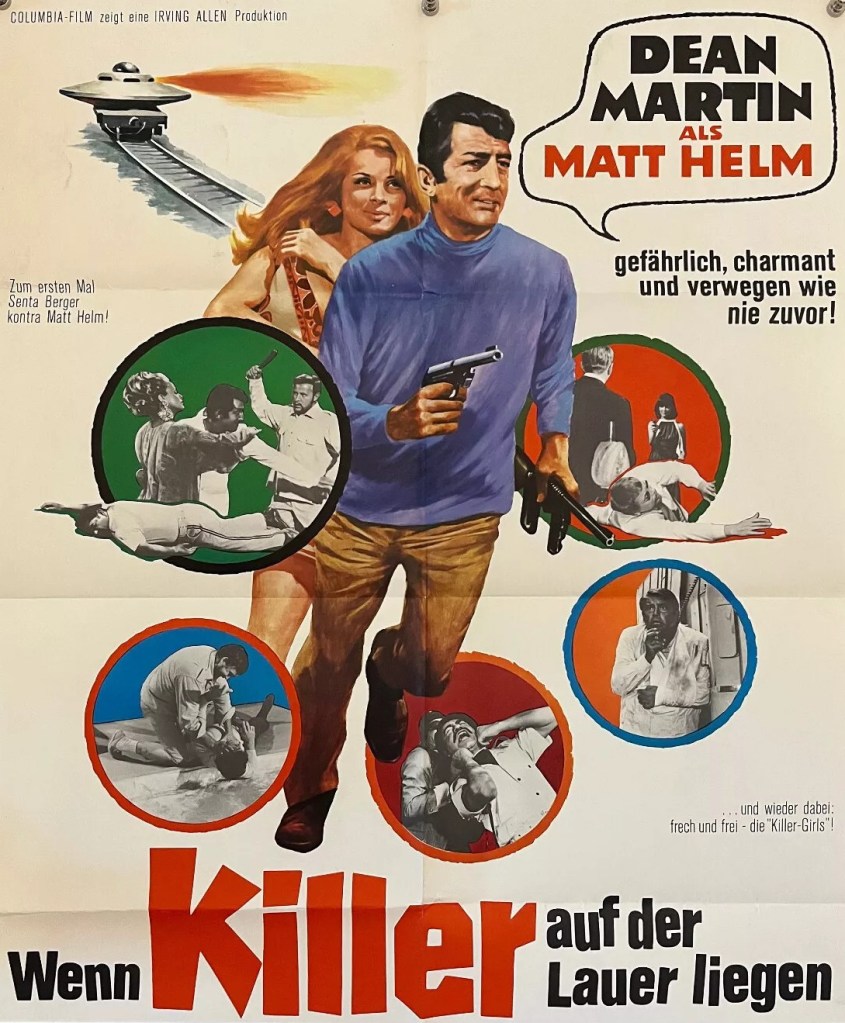
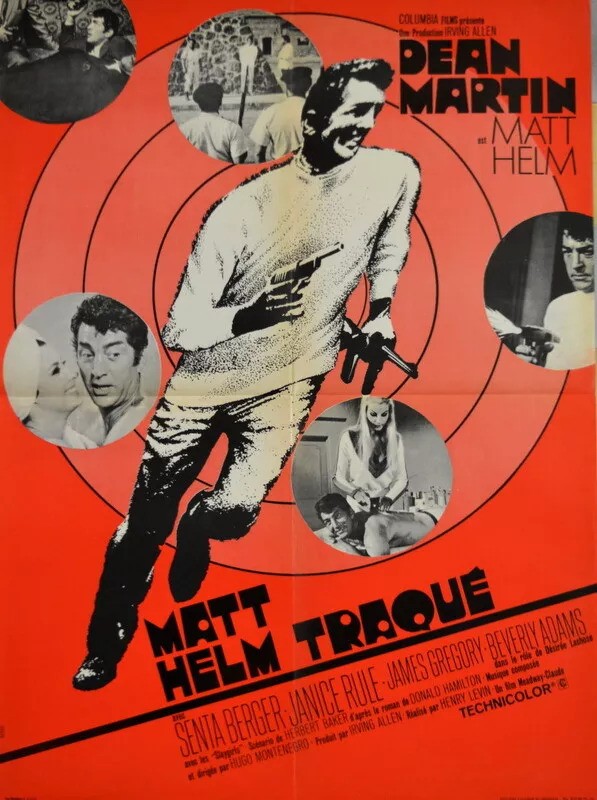
The Ambushers (1967) ***

Don’t get too hung up on the supposed rampant sexism in this third iteration the Matt Helm series. These women – bikini-clad or not – are weaponized to the hilt rather than our hero Matt Helm (Dean Martin) who has to make do with a gun disguised as a camera. In fact, he makes pretty good use of the gadget created for the females – the one that melts metal, designed to get rid of the clasp on men’s belts, forcing their trousers to fall down, which, as any student of farce knows, is the easiest way to disable the male.

There’s also a weapon triggered from a bra and a sedative concealed inside lipstick so that males seduced into intimacy will soon be snookered. And it’s also a woman, secret agent Sheila (Janice Rule), who’s impervious to the electromagnetic waves which kill off the opposite gender. Of course, to be fair, it’s not Matt Helm we see sinuously dancing around a playboy mansion in Acapulco the way the women do, although for Francesca (Senta Berger) that appears a clever method of entering the enemy’s lair. Who’s going to question another sexy dancing queen? And the bad guy has one of those devices that make the zips on female attire unzip. (James Bond purloined that one.) But it’s Matt who has the ideal rescue weapon, the levitation gun.

If you’re looking for a more male-oriented theme, how about beer? At various points Matt Helm is literally swimming in the stuff. I wouldn’t have been at all surprised had the plot concerned beer manufacturer Ortega (Albert Salmi) planning world domination through poisoning the global supply of beer or arming his beer gals with bullet-spraying bras. Even though this is largely a spoof, more so than the first in the series, it’s not that much of a spoof and Ortega has more serious intent. Using lasers, he’s hijacked the U.S. Government’s secret flying saucer and plans to sell it to the highest bidder.

Sheila, the pilot, also hijacked, has gone off piste after her experience, and is thrown together with Matt Helm as husband-and-wife, a role they previously played on another mission, to hunt down the villain and recover the missing spaceship. Francesca is also after same, and happy to seduce, trick or sedate Matt in order to achieve that end. Despite believing (from the previous encounter) that she is still Matt’s wife, Stella, despite an instant blow-up tent being laid on, takes a while to understand her duties include getting hot’n’heavy even if she’s less comfortable in the bikini department. Eventually, Matt and Sheila team up with Francesca. Turns out she works for supervillain Big O but is first to find the flying saucer.

More than the earlier entries in the series, this one relies on a series of unlikely events. The switcheroos when the lights in the train go out. But the firing squad sequence is hilarious. The in-jokes about Dean Martin’s recording rivals continue, but the bevy of bikini girls disappear from view pretty much after the opening section.

Janice Rule (Alvarez Kelly, 1966) is generally seen as a class above the previous female leads in the series but that would only be if you ignored Ann-Margret’s performance in Once a Thief (1965), the Stella Stevens of Rage (1966), the Senta Berger of The Quiller Memorandum (1966) and especially the stunning playing of Daliah Lavi in The Demon (1964). Dean Martin was on the cusp of much finer work in Rough Night in Jericho (1967) and Firecreek (1968) so this might just have been a warm-up.

Directed by Henry Levin (Genghis Khan) from a screenplay by Herbert Baker based on the Donald Hamilton novel.

Doesn’t take it itself seriously, which is just as well.

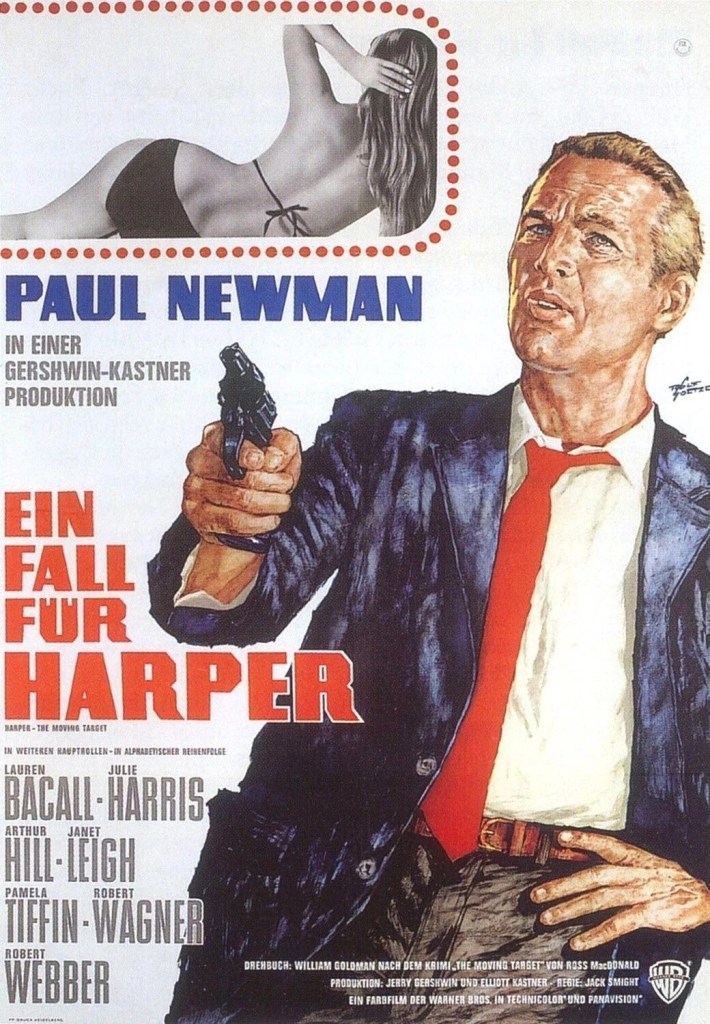
Harper / The Moving Target (1966) ****

Inventive screenplay by William Goldman (Masquerade, 1965), the ideal combination of witty lines and others that strike to the heart, and Paul Newman’s most naturalistic performance, and a family at each other’s throats, create a genuine addition to the private eye genre. Punch-ups are limited, generally the sleuth comes out worse, his skull an easy target apparently for any villain wanting to give him a good biff.

Most people remember the celebrated credit sequence. But, in fact, most people do not. They remember that this is a guy who will reuse old coffee grinds, which is as good a character definition as you’re going to get. But the opening sequence says much more – he sleeps in a pull-out couch, he falls asleep with the television on, dunking his face in ice suggests a hangover, and – the killer – he sleeps in his office. You won’t forget the ending either, the freeze frame, as fed-up Harper (Paul Newman) just gives up on the stupidity of mankind. And just before that there’s a delicious moment when crippled mother Elaine Sampson (Lauren Bacall) trills to the daughter she loathes Miranda (Pamela Tiffin) in a voice that would denote happiness but is anything but, “I’ve got some news for you,” as she looks forward to informing the child that the father she adores and that Elaine equally loathes is dead.

Not surprisingly, Harper’s on the verge of divorce from wife Susan (Janet Leigh), but he still hankers after being a knight in shining armor, those few days every year when he puts the world to rights rather than chasing down errant husbands in seedy hotel rooms.

The tale is a tad convoluted, involving initially tracking down Elaine’s estranged missing millionaire husband that turns into kidnapping and then murder with a side order of a fake cult headed by Claude (Strother Martin) that’s a front for an illegal immigrant operation, and going through the gears, character-wise, with malicious wife, an extremely flirtatious Miranda who gets her come-uppance when she tangles with Harper, faded alcoholic star Fay Estabrook (Shelley Winters) and junkie Betty (Julie Harris) sometime lover of lothario pilot Allan Taggert (Robert Wagner).

Two distinctive thugs Dwight Troy (Robert Webber) – Fay’s husband – and Puddler (Roy Jenson) offset the dumbest of dumb cops led by Sheriff  Spanner (Harold Gould) and lovesick attorney Albert Graves (Arthur Hill), Harper’s longtime buddy, who pines for Miranda.

Torture comes in two guises – the junkie gets the treatment from Dwight and Harper is put through the wringer listening to the endless whining of Fay as he tries to pump her for information. Harper avoids beatings and takes beatings and various characters bounce through doors with a gun – both Taggert and Graves save Harper from being shot.

Harper’s got a slick way about him, but mostly his charm is used to weasel information. He hasn’t got enough of it left to work on his wife.

When Harper’s not racing his sports car along twisting mountain roads, the action shifts to a cult temple, the docks and an abandoned oil tanker. Even when Harper works out who’s in on the kidnapping, it turns out he’s now got a murder to solve since someone’s bumped off the kidnappee.

Despite the endless complications, this whizzes along, helped enormously by Paul Newman’s (Cool Hand Luke, 1967) winning characterization. He’s brought a new trick to his acting arsenal, mastering a method of not listening to a conversation by tilting his head away from the speaker, and there’s a number of novel gestures. The scene where he rejects Miranda is a cracker. Tough guy running short of a soft center, he makes a very believable human being. And he’s got his work cut out because Lauren Bacall (Shock Treatment, 1964) is on scene-stealing duties. As is Pamela Tiffin (The Pleasure Seekers, 1964) though she can hardly match the older woman for arch delivery.

It’s a top-notch cast all the way down. Fans of Strother Martin (Cool Hand Luke) will enjoy his fake healer, Arthur Hill (Moment to Moment, 1966) is engaging, Robert Wagner (Banning, 1967) adds another notch to his rising star bow while Robert Webber (Don’t Make Waves, 1967) emanates menace with his “old stick” routine. Shelley Winters (The Scalphunters, 1968) is a great lush, Julie Harris (The Split, 1968) a junkie trying to pretend she’s not and Janet Leigh (Psycho, 1960), having kicked her husband out, still hoping he might come back in more acceptable form.

Jack Smight (The Third Day, 1965) directs with some zap. This should have had everyone singing the praises of crime writer Ross MacDonald, who in inventing the character (Lew Archer in the original) had inherited the Raymond Chandler mantle, but instead they came away whistling Dixie for screenwriter William Goldman.

Class act.

Behind the Scenes: Selling Judy Garland – “A Child Is Waiting” (1963) Pressbook

This proved the impossible sell. And Judy Garland was no help. The star was well past her best and if she wasn’t singing it was difficult to attract audience interest. So beyond her name above the title, United Artists did very ittle to use her presence as a distinct marketing tool.

Just like I Thank a Fool the previous year, the subject matter of A Child is Waiting did not lend itself to cross promotion. That did not prevent marketeers doing their level best. However, it was a rather bold suggestion to assume banks would be a natural port of call even under the guise that every child was waiting for their parents to start a savings account to see them through college. 

The title seemed to incite temporary madness in the marketing department. How about this for a tie-in approach to a toy department? “A child is waiting for the most exciting game ever devised – Monopoly.”

Groups most likely to respond were identified as psychiatrists, teachers and PTA members but cinemas were warned to avoid giving the “impression that the film is a clinical or documentary one.”

By far the easiest avenue for promotion was a book tie-in. Popular Library had issued a paperback novelization by Abby Mann of his original screenplay with stars Burt Lancaster and Judy Garland on the cover and at the very least that would receive window displays in bookstores and on the carousels of drugstores.

Also limited were the number of taglines on a poster. In those days a movie could be advertised with as many as a dozen different taglines appealing to different market sectors. United Artists stuck to three main taglines with two subsidiary ones. Sometimes both subsidiaries were on the same poster, other times only one.

“Burt Lancaster and Judy Garland ignite a motion picture that gives so much…goes so far…looks so deep into the feelings of man and woman.” This alternated with “Burt Lancaster and Judy Garland take an untouched theme – and make it touching and unforgettable” and “Only Burt Lancaster and Judy Garland could take this untold story…and make your heart tell it over and over again.”

The subsidiary taglines ran to: “If this were flesh of your flesh – would you hold it close…Protect it…Love it…Or would you turn your back and run” and “A child can be so many things, warmth…love…laughter…and sometimes a child can be heartbreak!”

Mainly what marketeers were asking of Lancaster and Garland was a miracle, as if their names alone could drag audiences into theaters.

Even though the Pressbook was relatively small – eight pages A3 – two-thirds of the space was allocated to repeating the adverts, just in different sizes.

The section normally aimed at getting editors to carry snippets of news about the movie provided scant material. There was little to catch the journalistic eye, nothing new about either of the stars, just a rehash of careers. Usually, cinema managers would scour this section looking for a titbit to offer to a reporter, an unusual hobby, something odd that occurred during filming, details about the location or an element that went wrong during shooting.

If you were relying on this Pressbook to fuel demand from exhibitors, you would be sorely disappointed.

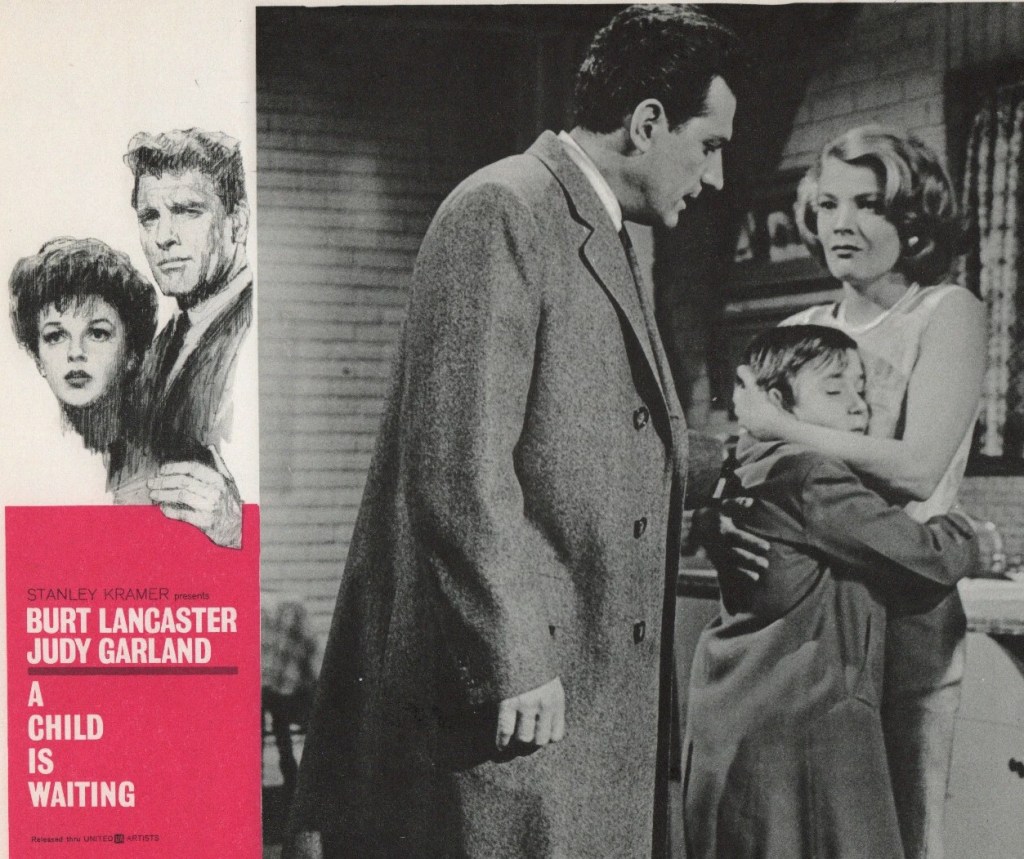
A Child Is Waiting (1963) ****

While once the main interest in this piece would have come from fans of Judy Garland, lapping up her penultimate movie appearance, the prevalence of mental illness these days especially among the young, in part due to Covid and the scourge of social media, should switch audience attention – especially among contemporary viewers – back to the subject matter.

Garland’s stock had risen somewhat after her performance in Judgement at Nuremberg (1961), her first movie in seven years, but, given the travails of her private life, would most likely have been sympathetic to anything that cast a light on mental illness. The bulk of movies covering this ground tended towards the lurid, as exemplified by Shock Corridor (1963) and Shock Treatment, (1964) rather than the more tragic Lilith (1962). Whatever the approach, they focused on adult conditions. Here it’s the treatment of children.

Appreciation of the social conscience of star Burt Lancaster has largely gone unnoticed but this was the era when his movies touched upon crooked evangelism (Elmer Gantry, 1960), teenage gangs (The Young Savages, 1961), the Holocaust (Judgement at Nuremberg, 1961) and the effects of long-term imprisonment (The Birdman of Alcatraz, 1962). He was even an animal rights protester in The List of Adrian Messenger (1963).

Parental attitude to offspring with mental conditions is encapsulated in the opening sequence. Outside a hospital a young boy is tempted out of an automobile. Once out, the driver (the father) races off so fast the car door is still swinging open. Mentally or emotionally disturbed children were dumped, ostracized or abandoned by society, sometimes shut up in institutions along with adults, with treatment belonging to the Dark Ages.

Drawing on the ground-breaking approach of Vineland Training School in New Jersey and the Pacific Hospital in Pomona, California (pupils from the latter played the students in the film), the movie attempts to cast a light on the forgotten and to show that, with proper care and education, they need not be such victims of their circumstances.

The movie focuses on Dr Clark (Burt Lancaster), head of the Crawthorne State Training School, whose pioneering work combines tender encouragement with firm application, and the new music teacher Jean (Judy Garland) who challenges his approach. Instigating this crisis is 12-year-old Reuben, the child we see offloaded at the start, for whom Jean develops an unhealthy bond. She thinks Dr Clark is too strict and that his methods don’t work with someone as vulnerable as Reuben. Clark’s aim is to make the children so self-sufficient they are not condemned to a life in an adult institution.

Jean’s intervention creates a crisis in the child’s life but also brings home the unwelcome truth of the difficulties parents have of dealing with their children.

And while the tale is essentially confected to make the necessary points and Dr Clark and Jean epitomize opposite attitudes to handling the treatment of children, the story is really a documentary in disguise, bringing to light advances in care, and with the children not played by actors, brings a greater reality to the work.

Burt Lancaster, as ever, is good value and Judy Garland steps up to the plate. Gena Rowlands (Machine Gun McCain, 1969) and John Marley (Istanbul Express, 1968) also feature.

While this fits neatly into Lancaster’s portfolio, it stands out for the wrong reasons in the pantheon of critically-acclaimed actor-turned-director John Cassavetes (Faces, 1968). In fact, what he produced went against what producer Stanley Kramer (better known as a director – Judgment at Nuremberg, for example) wanted and the version we see is the one Kramer recut. Written by Abby Mann (Judgment at Nuremberg) from his original teleplay.

You might expect this to be awash with sentimentality but that’s far from the case.

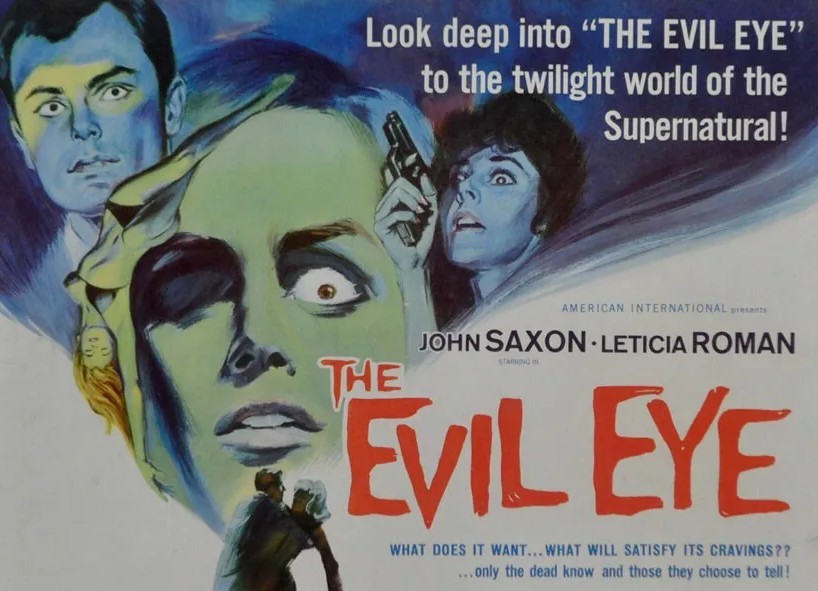
The Evil Eye / The Girl Who Knew Too Much (1963) ***

Don’t be taken in by claims that, since it was directed by Mario Bava, it kicked off the giallo sub-genre. More of the tropes come from mainstream horror – windows banging shut, locked doors, disembodied voices, stalkers, gaslighting, mysterious phone calls, premonition, retrocognition. And just for good measure, striking compositions that wouldn’t be out of place in an arthouse picture. But essentially it’s neo-noir – a woman can’t prove she’s witnessed a murder.

The Evil Eye was the American title, which makes little sense, although eye-popping eyes were in fashion from movies like Village of the Damned (1960), but in fact the original title of The Girl Who Knew Too Much is much more appropriate. This film is about a female character and what she discovers that threatens her life. The American version was chopped about by the distributor but, apparently, copies of that have gone astray so if locate a copy of the picture what you are likely to see if the Italian original.

American tourist Nora (Leticia Roman) is knocked out by a robber in Rome. On waking up she sees a murderer sticking a knife into a woman’s back. Only problem is – there’s no corpse to be found. But, strangely, a murder was committed on that spot a decade ago. So she might be having a vision of the past. But the murderer Straccianeve was caught.

The victim was the sister of Laura (Valentina Cortese), a new friend, whose apartment Nora temporarily occupies. There, Laura discovers newspaper clippings relating to the “alphabet killer”, a serial murderer whose victims’ surnames began with A, B, and C. Once Nora begins her investigations, it looks like she’ll be next on the list since her surname begins with “D”.  Meanwhile, she has struck a romantic vibe with Dr Marcello Bassi (John Saxon). But, of course, he might be not what he seems, sneaking off for assignations with strange women, following her.

Much of this is played out on deserted streets where the tourist sites acquire a dangerous veneer.

The finger points at journalist Landini (Dante DiPaulo), who has been following her. But he is as much a basket case as a potential murderer. He was instrumental in collecting the evidence that trapped the murderer but now believes Straccianeve was innocent.

In due course, after some more deaths, Nora traps the murderer, who comes out of left field, one of those where you think the writer has decided to pin the blame on the least likely suspect and come up with a spurious reason for the murders, so the twists pile up in helter skelter fashion at the end, including one which suggests Nora might well have the gift of seeing into the future.

Leticia Roman, in her debut, is mostly called upon to look baffled or frightened, there’s rather too much of the pop-eyes, and John Saxon (The Appaloosa, 1966) has the rare opportunity to play a hero. Valentina Cortese (Barabbas, 1961) drifts in and out of the tale. Written by future director Sergio Corbucci (Django, 1966), Oscar-winner Ennio De Concini (Divorce, Italian Style, 1963) and Eliana De Sabato (Marco Polo, 1962).

If it hadn’t been directed – and occasionally so stylishly – by Mario Bava (The Whip and the Body, 1963), it would have attracted considerably less contemporary attention. One of this main themes – the conflict between illusion and reality – is given a good airing. You can well believe that Nora is going mad. But it’s atmospheric enough and the director makes unusual use of the standard Rome tourist traps and this picture gives notice that he will move onto greater movies.

Tiger by the Tail (1968) ***

Back to those ingénues – or whatever-happened-to-Tippi Hedren. Christopher George’s villainous turn in El Dorado (1967) brought him as much immediate attention as James Caan and though he quickly achieved leading man status he never parlayed it beyond the likes of low-budget numbers such as The Thousand Plane Raid (1969).

But there was a more interesting ingénue on show here. Tippi Hedren had made the instant stardom type splash as Alfred Hitchcock’s go-to leading lady in The Birds (1963) and Marnie (1964). She reckoned she could do better without Hitchcock’s patronage, the director reckoned she was more trouble than she was worth, so there was a relatively amicable parting of the way.

Hedren didn’t find other directors queuing up for her services. Two small screen appearances and a supporting role in A Countess from Hong Kong (1967) were all she had to show for her stand of independence or hubris. Whereas in other circumstances signing up for this picture would have been seen as slumming it, this turned into more of an audition for a steady place in the B-movie division.

In the end she isn’t the stand-out any more than Christopher George is. The movie is too humdrum for that. But it’s the kind of narrative with murder, revenge, robbery, double-dealing and a sadistic villain that in the hands of bigger names with established screen charisma – say George Peppard and Jill St John – might have sparked more substantial interest.

There are three villainous schemes afoot. Vietnam war hero Steve (Christopher George) returns to his home town where his brother runs a race track. No sooner has Steve checked in than the brother is murdered during a million-dollar robbery. The murderers are then bumped off in an airplane explosion by heist mastermind Polk (Dean Jagger), the inside man.

Following on from that, the other four stockholders of the race course plan to ease out Steve, who’s inherited the majority stake from his brother, and buy the racetrack on the cheap, circumstances and the company’s own rules tilting the odds heavily in their favor. Sheriff Jones (John Dehner) also figures Steve for the murder of his brother, so he’s first of all got to prove his own innocence before going after the guilty.

He does a fair bit of running around, aided by barmaid-cum-singer Carlita (Charo) trying to put the jigsaw in place. He’s got some cute ideas how to winkle out the potential bad guys, one of which fingers stockholder Ware (Lloyd Bochner) who gets taken out before he can spill the beans.

Former girlfriend Rita (Tippi Hedren), one of the stockholders, runs hot and cold. Initially discouraging, she eventually warms to her old flame, then turns down the heat when she realizes he considers her a suspect in the robbery. Steve takes a good thrashing every now and then, but proves assiduous and occasionally spot-on in his deductions, though most of his investigation relies on fishing expeditions. Some of the finger-pointing is obvious but the denouement is not.

There was another ingénue here. Commonwealth United intended going down the “mini-major” or “instant major” route as exemplified by United Artists and Avco Embassy, where a new production outfit set up a hefty portfolio of movies, aiming for a release strategy of 6-12 a year, sufficient to be recognized by cinema owners desperate for product as a potential player. Established by real estate supremo Milton T. Raynor, it kicked off in 1968 with Tiger by the Tail and A Black Veil for Lisa starring John Mills and Luciana Paluzzi, followed by a heftier slate of seven pictures the following year.

Big-budget items packed with marquee names such as Battle of Neretva with Yul Brynner and Sylva Koscina, The Magic Christian headlined by Peter Sellers and Raquel Welch, and Oscar-winner Sandy Dennis in Robert Altman’s That Cold Day in the Park were mixed in with low-budget thrillers Paranoia starring Carroll Baker, Tippi Hedren comeback The Girl Who Knew Too Much and It Takes All Kinds with Vera Miles plus a pair of Jess Franco exploitationers, 99 Women and Venus in Furs. The project foundered almost immediately and by 1971 was $80 million in debt.

Whether Tippi Hedren ever acknowledged her debt to Hitchcock, it’s pretty clear here that she owed a ton to the way he presented her, not just the glossy façade, but bringing out the best of her acting. Her trademark fragility is little in evidence here without anything notable taking its place. Away from center stage, she doesn’t light up the movie.

Final picture of  R.G. Springsteen (Operation Eichmann, 1961) from a screenplay by Charles A. Wallace (The Money Jungle, 1965).

Run-of-the-mill crime picture or whatever-happened-to Tippi Hedren.

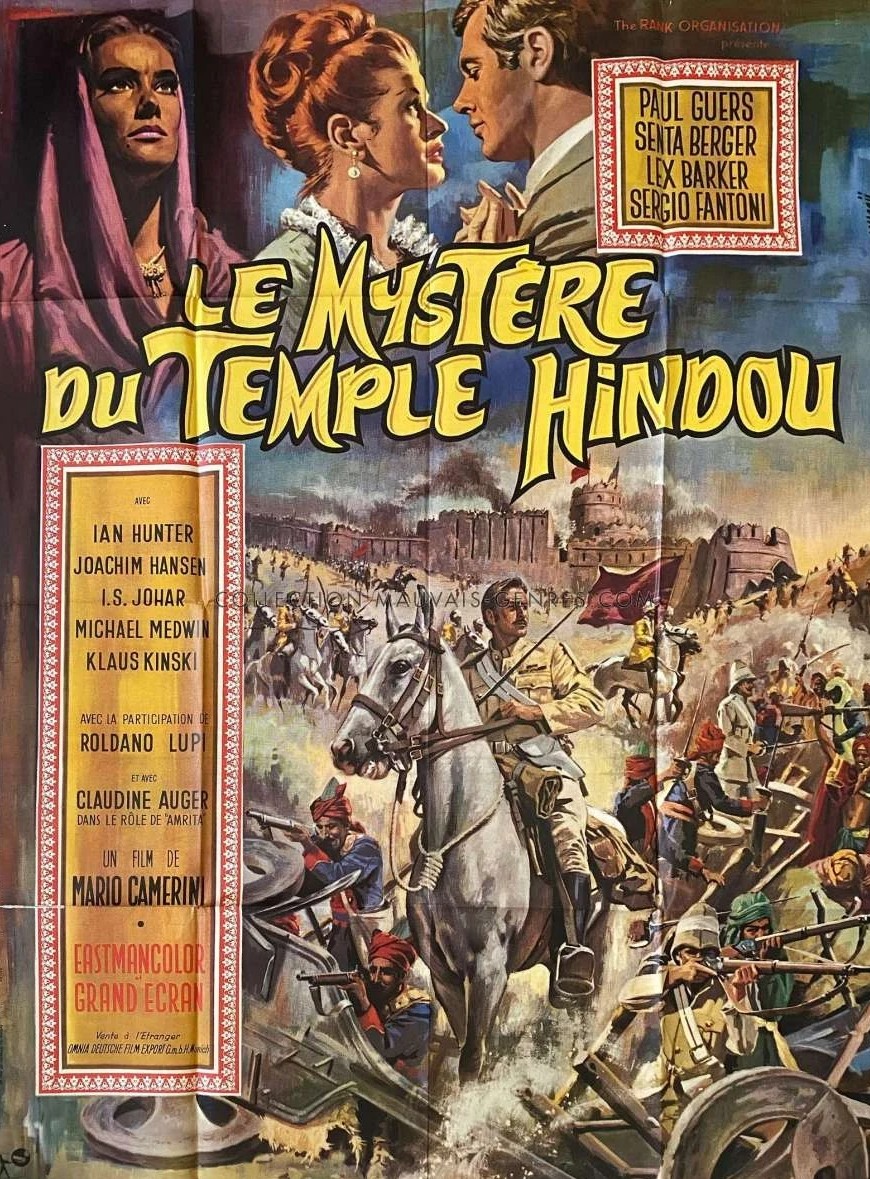
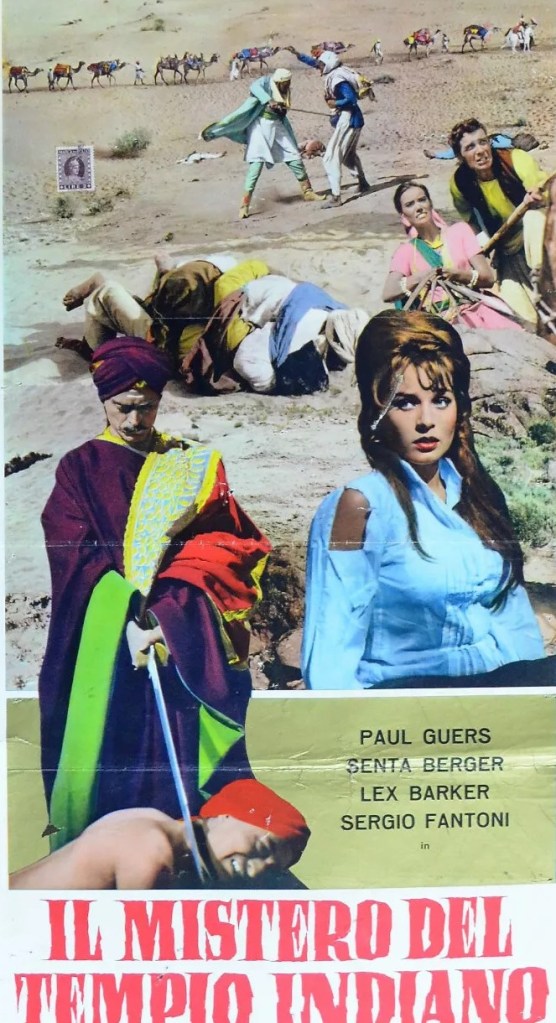
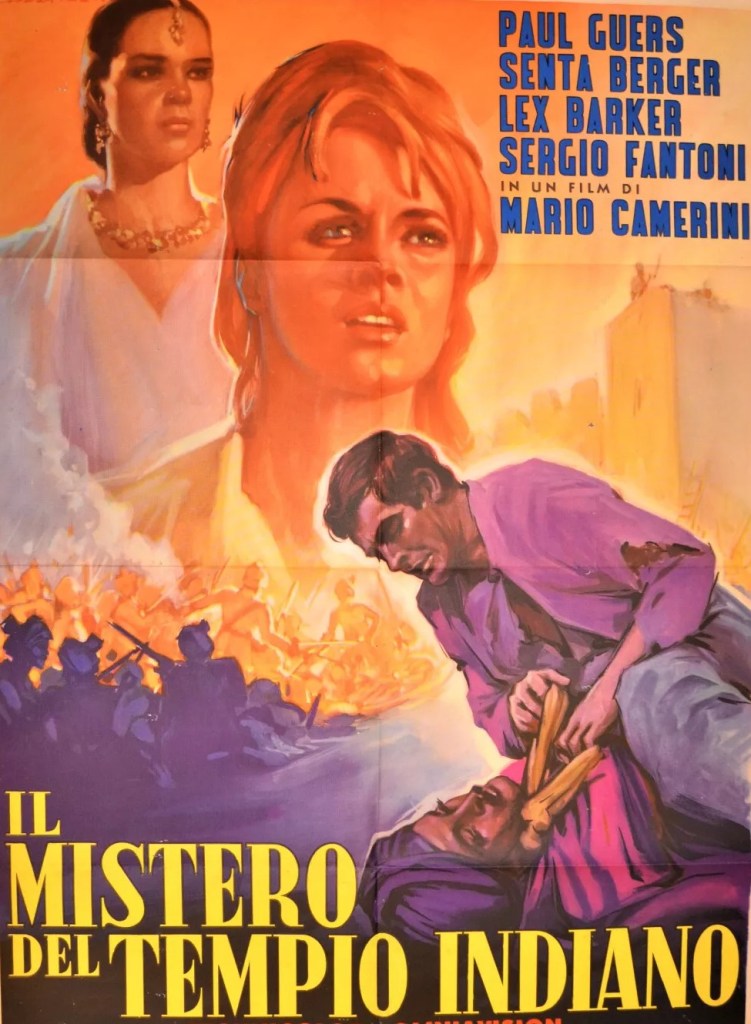
Kali-Yug Part II: The Mystery of the Indian Temple (1963) ***

Earnest students of the Senta Berger Syllabus may be somewhat disappointed, I’m afraid. This turns out to be an epic movie – in two parts – but even with a three-hour running time there’s hardly any space for the second-billed Ms Berger. Instead it’s the second female lead Claudine Auger who leads the way.

And as if it’s forerunner of the contemporary serial there’s a (longish) recap of part one, though this time recounted as if it’s nightmare into which our hero Englishman Dr Simon Palmer (Paul Guers) has unwittingly tumbled. He’s not, as I had imagined from the end of episode one, free. He’s still imprisoned by the Maharajah (Roldano Lupi) along with servant Gopal (I.S. Johar) although he has begun to deduce that all is not what it seems and that an insurrection may be on the cards under the guise of a revival of the cult devoted to the Goddess Kali.

And when exotic dancer (in the old sense, not the contemporary) Amrita (Claudine Auger) fails to convince the Maharajah of Palmer’s innocence she organizes his escape via the old snake in the basket trick. But this is not altogether from altruism. The good doctor is whisked away to treat three children who have caught diphtheria, unaware one of them is the Maharajah’s grandson, kidnapped (in Part One) by the Kali cult of which she is a key participant. However, she is beginning to thaw in her attitude to the Englishman and wonder why the goddess Kali, to whom she is bound by oath, is so determined to kill such a good man.

They end up in the caravanserai of cult leader Siddhu (Klaus Kinski), but Amrita, who’s undergoing a crisis of faith, organizes their escape, along with the boy. She has betrayed her calling – her father was a priest of Kali – in order to save Palmer. They manage to evade the pursuing pack of thugs. When the road back to Hasnabad is blocked, they decide to make for the enemy lair, an abandoned fort in the desert turned into the rebel stronghold, on the basis of hiding in plain sight, nobody expecting them to head in that direction.

Meanwhile, on his way to the fort, the Prince (Sergio Fantoni), now showing his true colors, has kidnapped Catherine Talbot (Senta Berger), planning to trade her for the Maharajah’s grandson who is “absolutely essential” to his plans. Theoretically, there’s nothing her husband can do to save her. According to the Treaty of Delhi, British forces cannot cross state lines. However, Talbot (Ian Hunter) reckons that, as he’s technically a civilian, that rule doesn’t apply to him and Major Ford (Lex Barker) comes up with a similar ploy, explaining that he’s given his soldiers ten days’ leave leave and to his “great surprise” they all decided to spend it in the fort.

Meanwhile, to complicate matters, Amrita decides Palmer is so far from being a bad guy that he’s worth kissing. But that romance is nipped in the bud when Palmer spots Catherine being dragged along in the Prince’s caravanserai and decides to rescue her. Furious at discovering that Catherine takes precedence in Talbot’s romantic scheme, and correctly assuming she’s going to be dumped, she knocks him out and turns him and the boy over to the Prince. While the child is acclaimed as the “sacred prince” and figurehead of the revolution, Palmer is to be sacrificed to the goddess. While waiting for that, he’s chained up next to Catherine.

So now you know we’re going to be perming two from four. This doesn’t feel like it’s heading in the bold direction of everyone coming out of it bitterly disappointed on the romance front.

And so it transpires. Talbot the Resident, more courageous than you might expect, dies in the attack on the fort while Amrita is killed trying to protect Palmer. Although for a time it’s a close run thing, what with the attackers outnumbered and running out of ammunition, luckily they are saved by the arrival of the Maharajah’s army. And with Amrita and the Resident out of the way, the path is clear for the old flames to renew their romance though that’s implied rather than shown.

No tigers or elephants this time round, wildlife limited to a dancing bear and a performing monkey.

Hardly a story that requires such an epic scale and I’m wondering if it was so long they had to edit it into two parts or whether it was filmed in the fashion of The Three Musketeers (1973)/The Four Musketeers (1974) with both sections shot at the same time. I’m not sure how audiences reacted. From what I can gather moviegoers in some parts of the world only saw part one while others were limited to part two, that recap helping make the narrative comprehensible.

Senta Berger (Cast a Giant Shadow, 1966) completists will come away disappointed given how restricted her role is. But she does bring the necessary emotions of remorse and humiliation to the part. Claudine Auger (Thunderball, 1965) has the better role, femme fatale, conspirator, lovestruck, spurned, and at various points leaping into action. Lex Barker (24 Hours to Kill, 1965) looks as though he’s signed up for a role requiring a hero only to be not called upon to act as one. Fans of Klaus Kinski (Five Golden Dragons, 1967) will be similarly disappointed.

Paul Guers (The Magnificent Cuckold, 1964) looks thoroughly puzzled throughout although he gives plenty lectures on general fairness while Sergio Fantoni (Esther and the King, 1960) concentrates on how unfair the British – considered the exponents of fair play – actually are.

Given it was made outside the British studio system, the producers are free to be quite critical of the British in India and there are pointed remarks about “dirty little Hindus” and about how the British treat even the Indian elite with obvious contempt. In order to retain autonomy, the Maharajah has been forced into becoming a merchant to save his people from starvation thanks to the amount he is taxed. And the story pivots on the lack of medication supplied by the British to natives. The Resident hasn’t even bothered to reply to Palmer’s letters begging for medicine.

The picture is even-handed in its depiction of British rule. Film makers were always in a dichotomy about rebels. Sometimes they were the good guys rising up against despicable authority, sometimes they were the bad guys disrupting a just system. Here, since the rebels belong to a vicious cult that would kill regardless of cause, they come off as the villains of the piece.

Mario Camerini (Ulysses, 1954) directs without the budget to make the most of the story, the battles or the location. Along with writing partners Leonardo Benvenuti and Piero De Bernardi (Marriage Italian Style, 1964) and Guy Elmes (Submarine X-1, 1968), he had a hand in the script adapted from the Robert Westerby novel.

Not complex enough to be an epic, and not enough of Senta Berger to satisfy your reviewer, still interesting enough if you are thinking of seeking it out. Good prints of both parts are on YouTube.

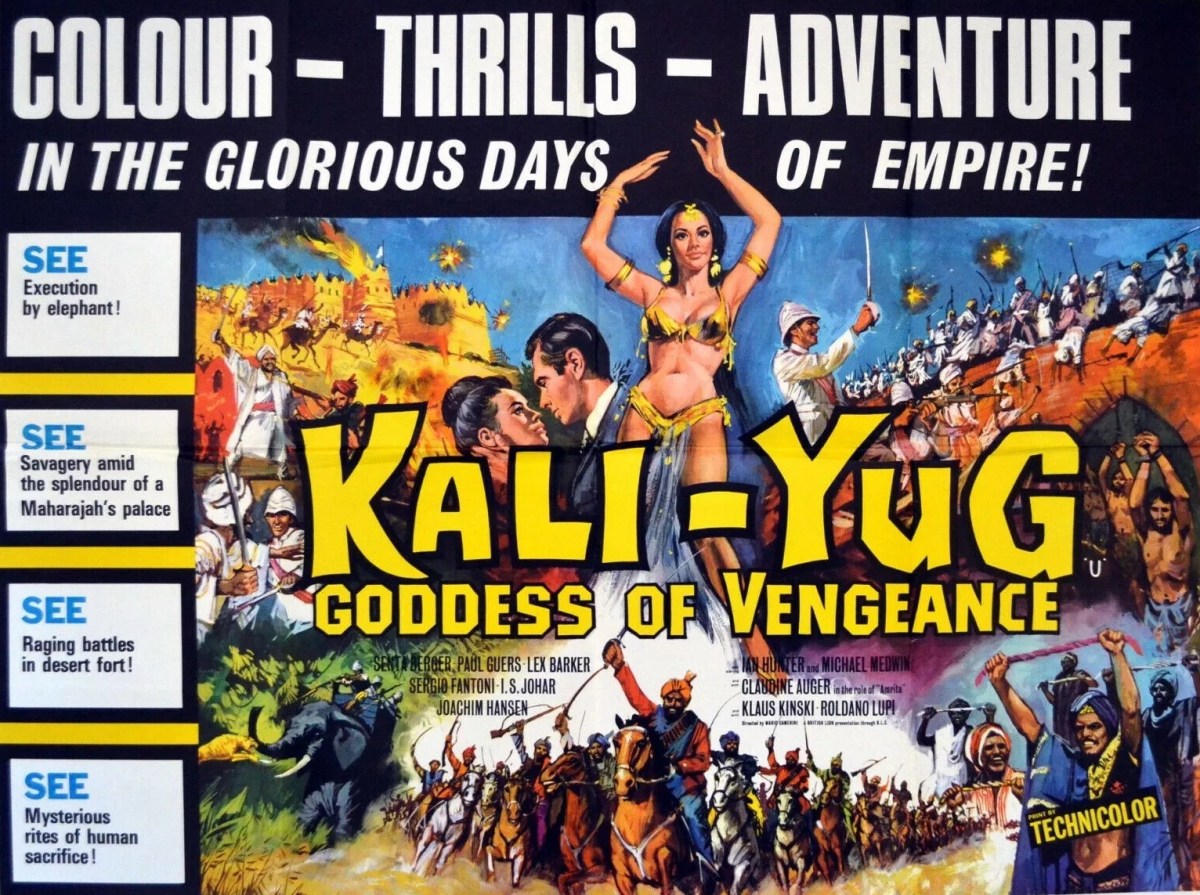
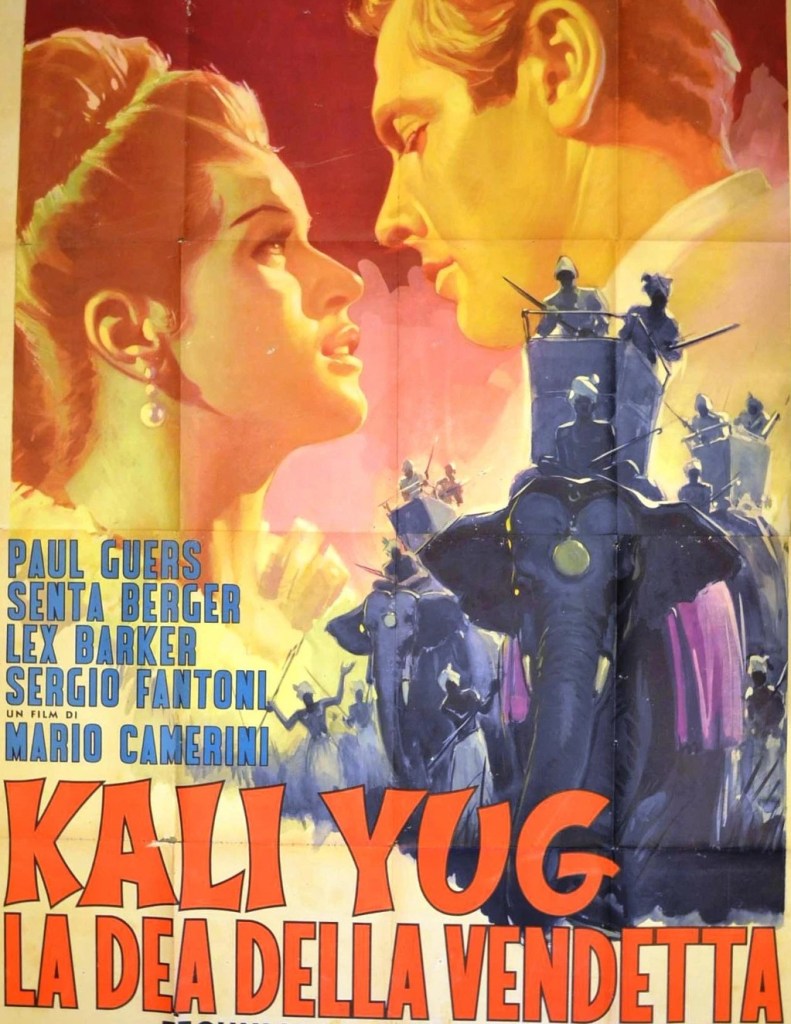
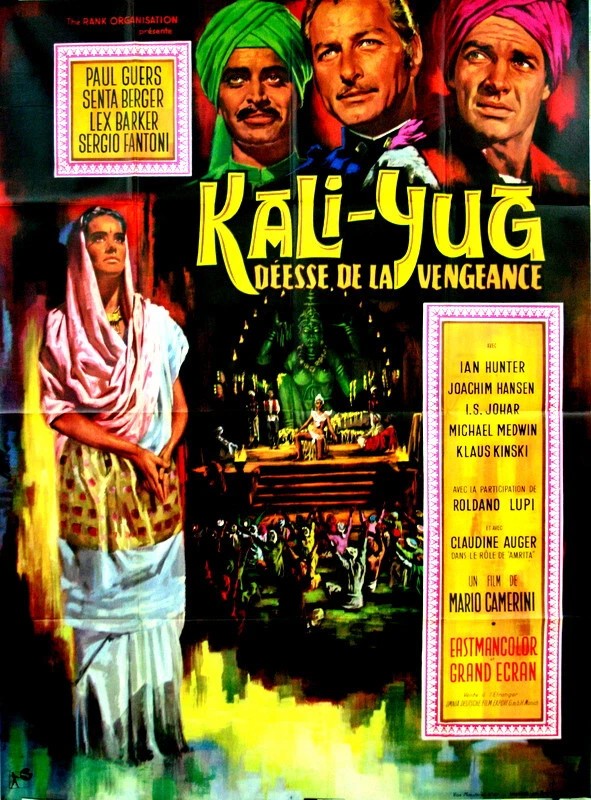
Kali-Yug Goddess of Vengeance (1963) ***

You can’t aspire to being Emeritus Professor of Senta Berger Studies unless you are willing to track down this early effort. Your curiosity can now be sated without much effort since it’s currently playing on YouTube. You’ll notice a preponderance of brownface (Klaus Kinski, Sergio Fantoni, Claudine Auger and eventually, though in legitimate disguise, Paul Guers) among a multicultural cast comprising actors from Germany, Poland, Switzerland, France, Italy, Austria, South Africa, the USA and Britain.  

To avoid confusion, the title of this German-made Indian adventure requires some explanation and once again I have undertaken the necessary research. As long as you make the distinction between “Kali-Yug” and “Kali Yuga” you will be on safe ground. The former refers to a cult while the latter refers to Hindu cosmology and the final age of the yuga cycle – the one predominant at the time – defined as an age of darkness, of moral and spiritual decline.

Even with that out of the way it takes quite a while to get your bearings here. This is India in the 1880s, four years after Queen Victoria has been declared Empress of India, at the height of British rule.  

We begin in rather traditional style with the kind of tale that would provide an Englishman with good reason to be in an impoverished Indian village. Dr Simon Palmer (Paul Guers) is fighting an epidemic of smallpox. Running out of medicine, he despatches a servant with a small convoy to the capital of Madanpur to secure further supplies to combat the disease. On its return this group is ambushed, so Palmer takes it upon himself to personally plead with local Governor (known here as The Resident) Talbot (Ian Hunter) of Madanpur..

It’s worth pointing out that, as this is relevant to the later narrative, a Resident has been appointed in those states such as Madanpur which the British took by force. Other states, which gave in to the British without a fight, such as the neighboring state of Hasnabad continue to enjoy autonomous rule by a Maharajah or Prince, but only in return for paying massive tributes to their conquerors.

After a satisfactory meeting with the Resident, Palmer encounters drunken British officer Capt Walsh (Michael Medwin) and retaliates when insulted. He also meets old flame Catherine Talbot (Senta Berger) who married the Resident. She’s not a gold-digger in the standard sense. Palmer had met her in Calcutta but when he went off to London to complete his medical studies her father died, leaving her impoverished, so in his continued absence she married the older man for security.

Capt Walsh is murdered and after their previous altercation blame falls on Palmer. He should get off scot-free. He has an alibi. At the time of the murder he was dallying with Mrs Talbot. But that wouldn’t go down well in British society. There would be a scandal. A good deal would be read into a moonlit assignation with a man other than her husband. And Palmer, in traditional stiff upper lip fashion, wouldn’t like to get her into trouble.  

So Palmer contacts elite dancer Amrita (Claudine Auger) because he thinks she knows who killed Walsh. Although promising to help, Amrita, it turns out, apart from charming the pants off (possibly quite literally) everyone in sight, is secretly in league with the characters, led by Siddhu (Klaus Kinski), responsible for the robbery and murder. So while Palmer is ambushed yet again, she is sent to Hasnabad where she will undertake her “next mission.”  

Which appears to be to dance for the Maharajah (Roldano Lupi) as entertainment for visiting merchants. Helped by servant Gopal (I.S. Johar), Palmer goes on the run and manages to fake his own death. In this regard, an entire corpse is not required as proof, just a torn limb, stolen from the local vultures, and a torn jacket. (Thus far the highlight of the show with white hunters and Mrs Talbot swaying in baskets atop elephants). To keep him safe, Gopal provides Palmer with brownface disguise. They witness a Kali ritual and follow Siddhu’s gang as they break into the palace to prevent the kidnap of his Maharajah’s grandson.

But Palmer is blamed for that too and condemned to death. That involves being buried up to  your neck in the sand while an elephant stomps on your head. But he is released because the Maharajah doesn’t want trouble with the English. Meanwhile Catherine has fessed up to her husband which, as expected, does not go down at all well.

The End.

So you can imagine my puzzlement. YouTube promotes Klaus Kinski (Grand Slam, 1967) as the reason to watch this, but so far, he’s only appeared briefly, though clearly wielding significant power as chief thug. But we’ve seen as little of third-billed Lex Barker (Old Shatterhand, 1964) as Major Ford. His contribution is to prevent Capt Walsh get even drunker and, as a member of the shooting party, pick up Mrs Talbot when she faints at the thought of Palmer being dead. Sightings of fourth-billed Sergio Fantoni (Hornets’ Nest, 1970) have been as fleeting, his main role as Prince Ram Chand to try and score points off The Resident by arguing about the unfairness of British rule and to partner Catherine briefly on the dance floor.

So this is beginning to look as though it’s a small-scale version of those big-budget pictures featuring an “all-star cast” which consists either of marquee names long past their best or various foreign stars recruited to cover all the bases for the international release rollout.  

The ending is so sudden and with so much unresolved, I also began to think it was one of those elaborate foreign jobs with stars who meant so little to British and American moviegoers that it was drastically edited to fit domestic distribution patterns.

On further research (the bane of any Emeritus Professor’s life) I got to the bottom of the problem.

This was only Part One. It wasn’t the end after all.

Luckily, I’ve found Part Two and will review that (as no doubt you’re delighted to hear) tomorrow.

Discover WordPress

A daily selection of the best content published on WordPress, collected for you by humans who love to read.

The Atavist Magazine

by Brian Hannan

WordPress.com News

The latest news on WordPress.com and the WordPress community.