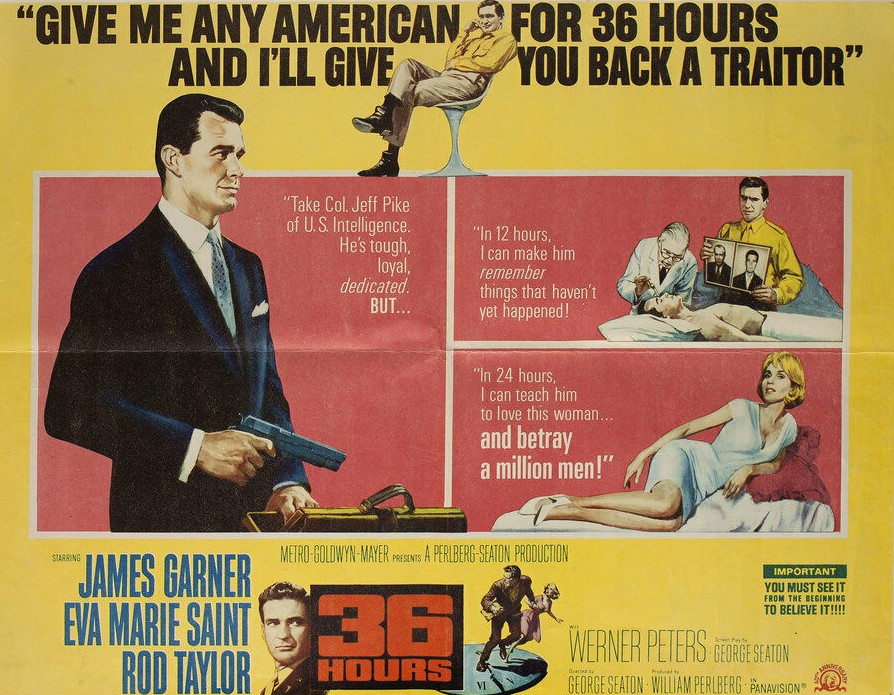
High concept thrillers that derails two-thirds of the way through. While it’s a battle of wits between German psychiatrist Major Gerber (Rod Taylor) and kidnapped spy Major Pike (James Garner), and between the German and his cynical superior, S.S. chief Schack (Werner Peters), it’s a fascinating insight into the power of mind games, almost slipping into the sci fi genre. Pike has intimate knowledge of the Allied D-Day plans but instead of submitting him to routine torture, he is handed over to Gerber who convinces him he has been suffering from amnesia for six years.
Pike finds himself in what he perceives to be an Allied hospital where everyone wears Yank uniforms, speaks English and listens to baseball scores on the radio. Pike has aged, thanks to greying hair and vision blurred so badly he requires spectacles. There’s even a wife, Anna (Eva Marie Saint), he doesn’t remember marrying. On the eve of D-Day the Germans expect the main invasion thrust to target Calais, the shortest crossing from England, not the Normandy beaches further to the south. Someone who knows the truth might well be willing to suffer extreme torture to keep the secret out or enemy hands, therefore justifying this approach.
While the idea of a prefabricated existence would not be foreign to today’s audience, it was an unusual idea at the time, although films as diverse as The Wizard of Oz (1939) and 1984 (1956) revolved around alternative reality. That the whole scheme is entirely plausible is down to Gerber. Rather than the one-dimensional villain, he’s an early version of the “good German,” whose scientific breakthroughs have alleviated suffering. Yes, he’s charming and suave and clever enough to hurry Pike along, but also very humane.
As you might expect, the best part is the constructed universe, Pike’s understandable disbelief at suffering from amnesia, and for so long, the shock to his vanity that his hair and eyes show signs of ageing. Just like Battle of the Bulge (out the next year) where American-born Germans were dropped behind enemy lines as saboteurs, Gerber’s ease with American idiom and culture is key to making the enterprise work. An easy-on-the-ear scientist, he employs a cupboard as a prop to explain the differences in the various types of amnesia. Pike is fooled and does inadvertently betray his country and the twist is that Schack, with so much invested in the notion of the invasion at Calais, refuses to believe it.
As ever in this kind of semi-sci-fi film it’s something incredibly simple (along the lines of the aliens susceptible to water in Signs or the common cold in War of the Worlds) that makes the clever construct unravel. In this case it’s Pike finding a paper cut on his finger and working out it should not be so sore after six years. So, thereafter, the film shifts into escape mode, which is considerably less thrilling compared to the sci-fi hi-jinks. A sub-plot involving Anna, a Jew willing to do anything to avoid the concentration camp, adds some depth to the proceedings.
Oddly enough, despite the title there’s no real sense of a deadline, nor does it come close to achieving the tension racked up in Day of the Jackal (1973) for an event the audience knew never took place, since 36 Hours fails to convince us the D-Day landings were ever in jeopardy.
It’s much more involving, not to mention highly successful, in the middle section where Pike is being duped, the lengths to which Gerber has gone to create the perfect fiction under audience scrutiny, while we watch Pike twist and turn as he comes to terms with what in those days would be perceived as serious mental illness, and from which there is no defined cure. That the escape is triggered by Gerber’s ego adds another element.
The picture did not hit the box office target on release in part I guess because by that time no enemy had to kidnap anyone to fill in the blanks in their scientific knowledge since there was such a plethora of defectors and in part because it seems insane that anyone would go to such excesses when less costly and proven torture implements were to hand.
That it works at all is down to the acting. James Garner (Hour of the Gun, 1967) straddles a number of his screen personas, from his instantly recognisable cocky character of The Great Escape (1963) to the befuddled double-takes of A Man Could Get Killed (1966) and tougher incarnation of Grand Prix (1966). Rod Taylor (Dark of the Sun, 1968) is his match with one of his best performances, infusing the mad scientist with surprising humanity at the same time as wriggling out from under the maw of the inhuman Schack, and, despite clearly being desperate to see his plan work, managing to keep his character on an even, chatty, keel. Eva Marie Saint (The Stalking Moon, 1968), the go-to choice for a vulnerable woman, brings an edge to her role.
Audiences glimpsing the name Roald Dahl in the credits in those days would not have been expecting an imaginative confection in the Willie Wonka and the ChocolateFactory (1971) vein but something much more adult given the twist-ridden short stories which had made his name. This was based on his Beware of the Dog (1946) tale, the first of his pieces to be made into a film although some of the best of Alfred Hitchcock Presents (1958-1961) had lent heavily on his work.
Writer-director George Seaton put the project together, with occasionally some elan, but as with The Counterfeit Traitor (1962) it’s a film of two distinct parts, but whereas with that film the latter stage was the more interesting here it is the first section. This is best approached as an offshoot of the kind of sci fi themes that inform the work of Philip K. Dick.
Catch-Up: Rod Taylor’s acting development can be traced through films already reviewed in the Blog – Seven Seas to Calais (1962), Fate Is the Hunter (1964), The Liquidator (1965), The Glass Bottom Boat (1966), Hotel (1967), Dark of the Sun (1968) and The High Commissioner (1968). James Garner pictures previously reviewed are: Doris Day comedy Move Over, Darling (1963), spy spoof A Man Could Get Killed (1966) and the westerns Duel at Diablo (1966) and Hour of the Gun (1967).
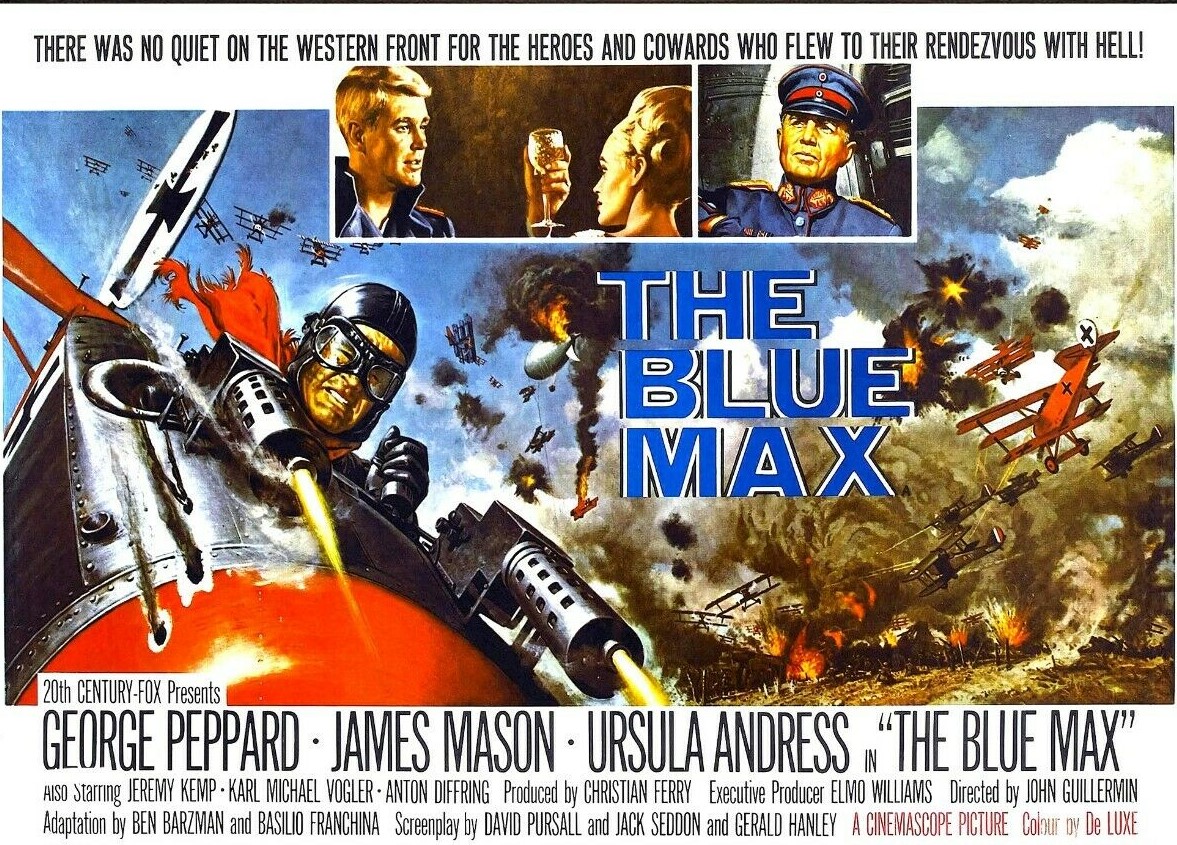
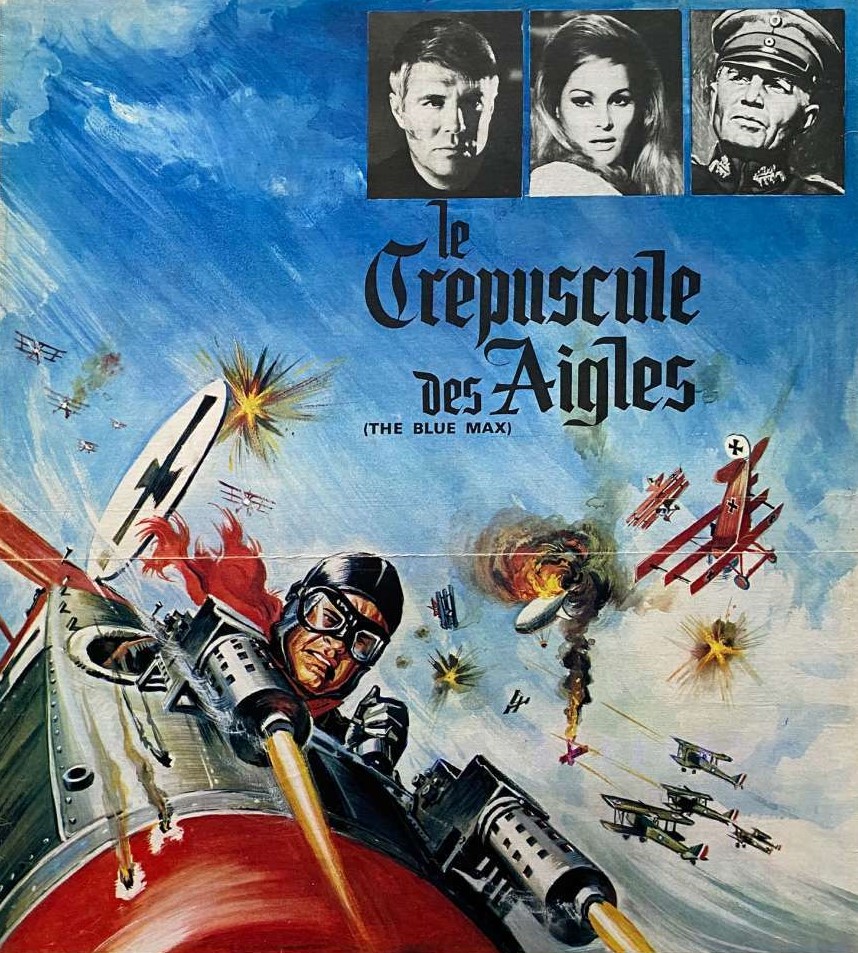
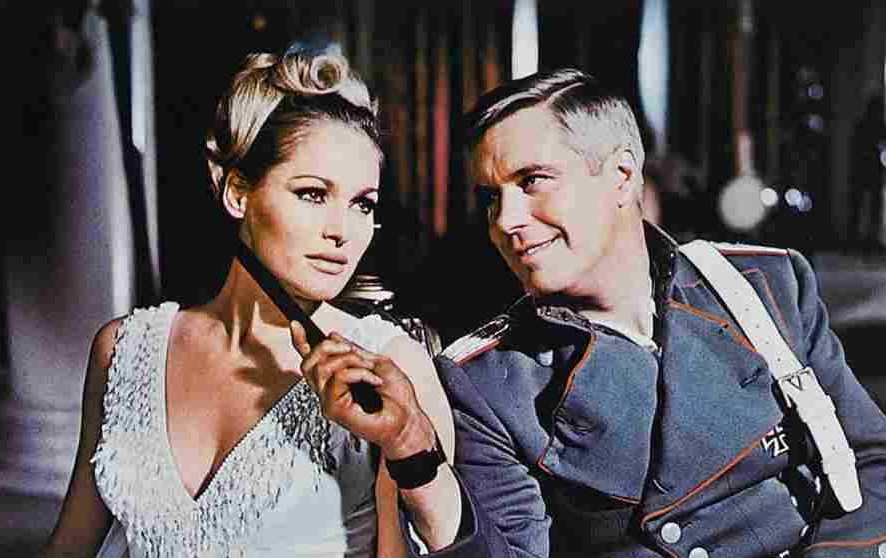
Watching The Bridge at Remagen sent me back with renewed admiration to John Guillermin’s take on World War One in The Blue Max. Again, a tale of two men battling for supremacy, although in this case they are both on the same side. Flying aces Lt Bruno Sachel (George Peppard) and Willi von Klugerman (Jeremy Kemp) could easily be accommodated within the highest echelons of the German fighter pilot division except that each wishes to be known as the country’s number one pilot and there is also a question of class and nepotism.
Quite how working-class Sachel Peppard makes the transition from grunt in the trenches to Germany’s elite flying corps is never made clear in this glorious aerial adventure. But he certainly brings with him an arsenal of attitude, clashing immediately with upper-class colleagues who retain fanciful notions of chivalry – harking back to the days of cavalry charges – in a conflict notorious for mass slaughter.
He climbs the society ladder on the back of a publicity campaign designed by General Count von Klugerman (James Mason) intent on creating a new public hero. On the way to ruthlessly gaining the medal of the title, awarded for downing twenty enemy aircraft, he beds Mason’s playful mistress Kaeti (Ursula Andress).
While the human element is skillfully drawn, the innate jealousy and petty rivalries that threaten to spoil the camaderie so essential to any war effort, it is the aerial element that captures the attention. The planes are both balletic and deadly. Because biplanes fly so much more slowly than World War Two fighters, the aerial scenes are far more intense than, say, The Battle of Britain (1969) and the dogfights, where you can see your opposite number’s face, just riveting. Recognition of the peril involved in taking to the sky in planes that seem to be held together with straw is on a par with Midway (2019) while the ability of the best pilots to dodge trouble in the sky has been more recently highlighted in top Gun: Maverick (2022).
I was astonishing to discover not only was this a flop – in part due to an attempt to sell it as a roadshow (blown up to 70mm for its New York premiere) – but critically disdained since it is an astonishing piece of work. Guillermin makes the shift from small British films to a full-blown Hollywood epic with ease. His camera tracks and pans and zooms to capture emotion and other times is perfectly still.
The best scene, packing an action and emotional wallop, will knock your socks off. Having eliminated any threat from an enemy plane, rather than shoot down the pilot, Peppard escorts it back to base, but just as he arrives the tail-gunner suddenly rouses himself and Peppard finishes the plane off over the home airfield, the awe his maneuver originally inspired turning to disgust.
The action sequences are brilliantly constructed, far better than, for example 1917 (2019) – which by contrast appears labored. One battle involving planes and ground troops is a masterpiece of cinematic orchestration, contrasting raw hand-to-hand combat between enemy soldiers with aerial skirmish. Guillermin takes a classical approach to widescreen with action often taking place in long shot with the compositional clarity of a John Ford western. Equally, he uses faces to express emotional response to imminent or ongoing action.
George Peppard (Pendulum, 1969) is both the best thing and the worst thing about the picture. He certainly hits the bull’s eye as a man whose chip on one shoulder is neatly balanced by arrogance on the other. But it is too much of a one-note performance and the stiff chin and blazing eyes are not tempered enough with other emotion, and he fails to portray the kind of complex character he would essay so brilliantly in P.J./New Face in Hell (1968) and House of Cards (1968) It would have been a five-star picture had he brought a bit more savvy to the screen, but otherwise it is at the top of the four-star brigade.
James Mason (Age of consent, 1969) is at his suave best, his aristocratic German somewhat redeems the actor after his appalling turn the same year as a Chinaman in Genghis Khan. Jeremy Kemp (A Twist of Sand, 1968) is surprisingly good as the equally ruthless but distinctly more humane superior officer. For once given the chance to act, Ursula Andress (The Southern Star, 1969) is more than mere eye candy, the kind of mistress with an eye more on the main chance than true love, although she does manage to swan around in one scene clad in only towels.
Look out for Derren Nesbit (The Naked Runner, 1967), Anton Diffring (Where Eagles Dare, 1968), Harry Towb (The Bliss of Mrs Blossom, 1968) and Karl Michael Vogler (The Dance of Death, 1967).
Guillemin’s technical skill is outstanding. In Bridge at Remagen it was the tracking camera and the blitz of war that captured the eye, here it is fabulous aerial photography. In the later picture, it was often hard to delineate individuals within the overall frame since the whole point of the film was the absolute messiness of war, but The Blue Max, dealing with one-on-one duels, presented a better opportunity to take advantage of cinematic elan. The screenplay, based on the bestseller by Jack Hunter, was courtesy of the team of David Pursall and Jack Seddon (The Southern Star) and Gerald Hanley (The Last Safari, 1967) after initial work by Ben Barzman and Basilio Franchina (both The Fall of the Roman Empire, 1964).
There had been a marked trend towards even-handedness in terms of presenting both sides during World War Two, as exemplified by Battle of the Bulge (1965), but this was the first to present the Germans in such heroic fashion.
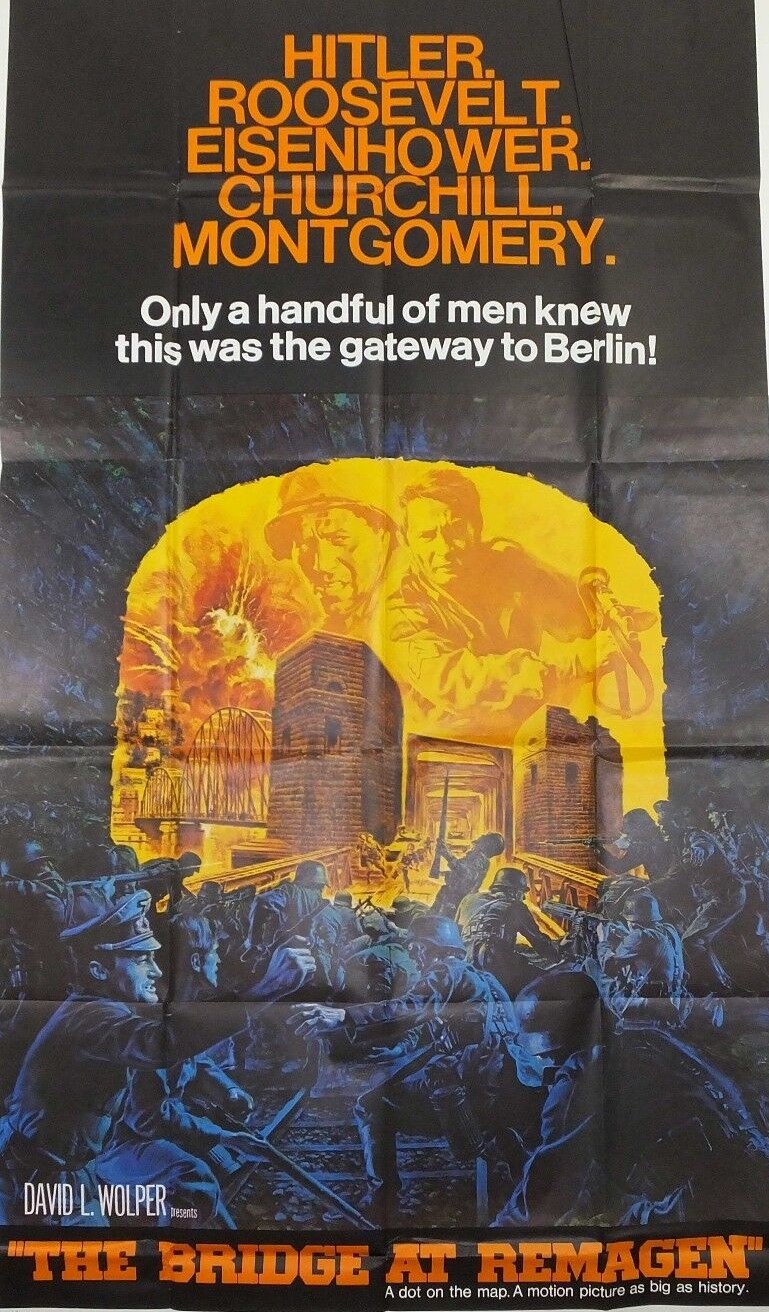
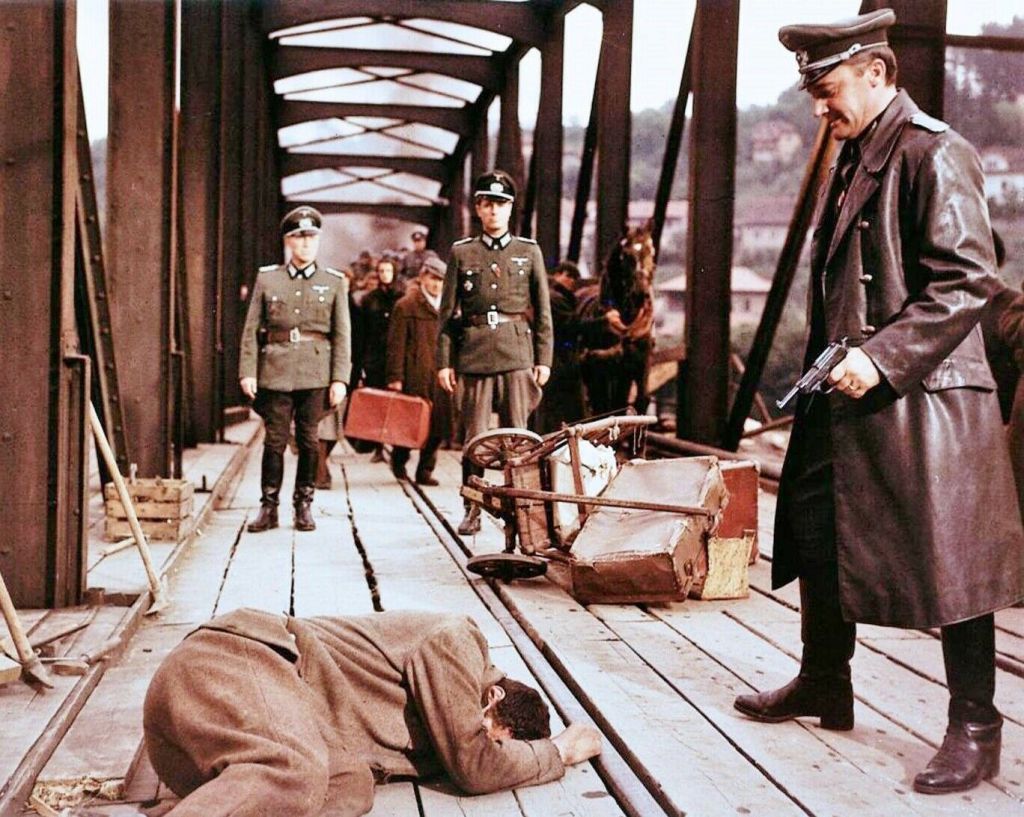
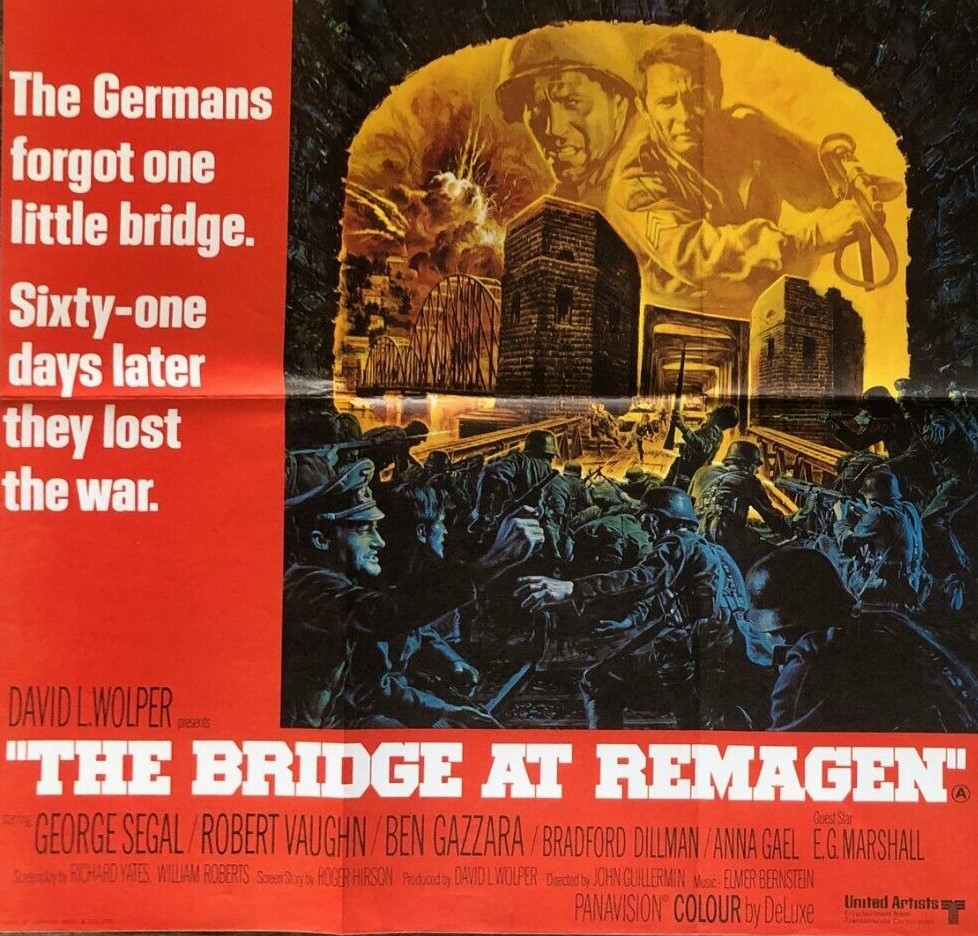
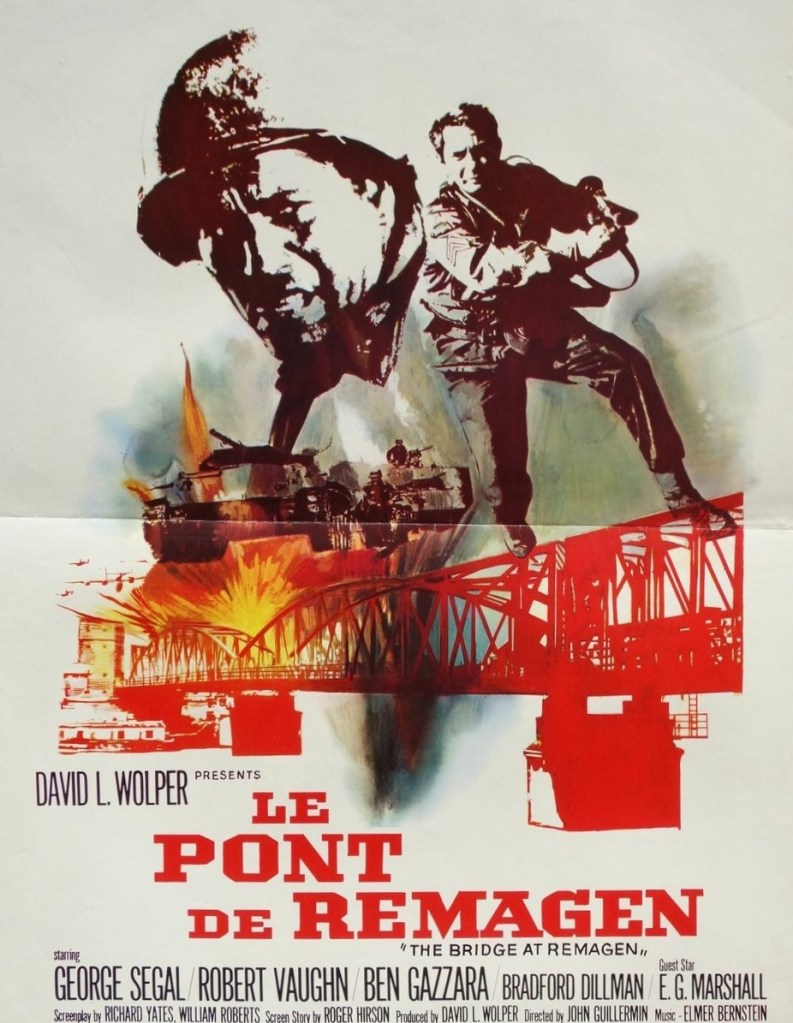
A million-and-a-half dollars potentially went down the drain when, thanks to the Russian invasion two months into production, producer David L. Wolper had to shift location shooting of World War Two picture The Bridge at Remagen from Czechoslovakia to Italy and Germany. Actors and crew woke up on August 21, 1968, to find their hotel surrounded by Russian tanks. Only quick action saw 80 personnel ferried in a taxi convoy through the only remaining open checkpoint to the airport, their departure coinciding with the arrival of the Russian paratroopers.
This had not been the first international incident for the movie, based on the destruction of the Ludendorff Bridge over the Rhine at Remagen in Germany. Previously, Wolper had been accused of being a C.I.A. spy and reports were circulating that armaments were being brought in to support Czech leader Dubcek while rumours flew of “busloads of American troops…arriving in Prague disguised as tourists and film technicians.” Matters were so bad that the Czech army placed under lock and key the film’s entire TNT and dynamite inventory amounting to over 6,000 sticks of the former and 800lb of the latter.
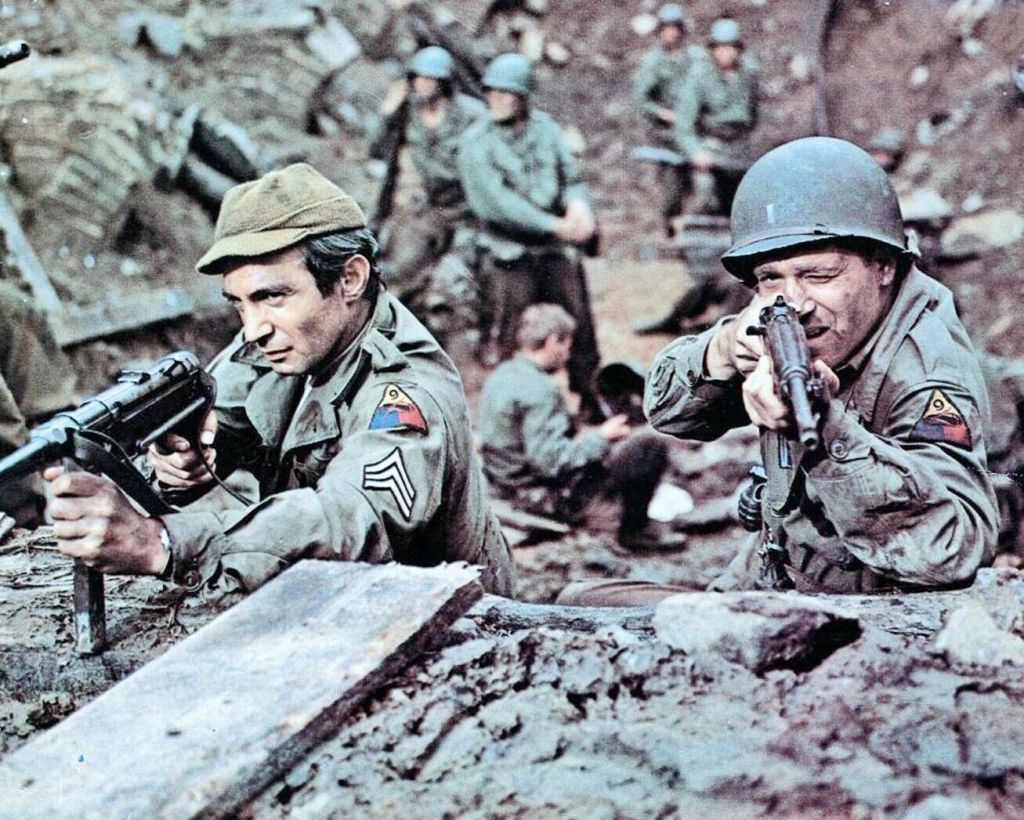
Ben Gazzara and George Segal open fire.
Small wonder the Russians were alarmed because the production had arrived with a massive cache of weaponry – an inventory over 1,000 pieces strong – including eight Sherman tanks and over 130 Browning and Thompson machine guns, MI rifles and carbines and Colt pistols as well as 300 dummy rifles. Luckily, most of the film’s battle scenes action had been completed when production was interrupted but that still meant a month of interiors and exteriors.
Wolper was something of a Johnny-come-lately to the Remagen scene. Budd Schulberg (On the Waterfront, 1954), who had fought at Remagen, and his brother Stuart were first into the frame, planning in 1958 to film for Warner Brothers Ken Hechler’s 1957 bestseller on the battle, as a follow-up to their first production, Wind Across the Everglades (1958). Stanley Kubrick was being lined up to direct. When WB bowed out the Schulberg Brothers moved it first to Columbia and then United Artists. When that gamble failed to come off, United Artists assigned Phil Karlson (The Secret Ways, 1961) as director but that also hit the buffers. Although Wolper started work developing a treatment in 1965 – Irvin Kershner in his mind as director – he had Ihe had to deal with another contender in Flaum and Grinberg Productions which in 1966 announced this as their debut production.
Wolper had come to movies on the back of documentaries. Using his Metromedia outfit as an umbrella, he had struck a six-picture deal with United Artists. The first movie had been the documentary Four Days in November (1964). But the next was intended to be a “plotted dramatic film based on fact with a big star cast” known at the time as The Remagen Bridge. From the outset this was seen as a “harsh recreation of actual slogging combat with some four letter words and not a glorification of war but underlining its hellishness.”
In the event, this was overtaken on the Wolper schedule by another war movie The Devil’s Brigade (1968). Further pictures planned were Europe U.S.A. (a.k.a. If It’s Tuesday It Must Be Belgium, 1968) and All the Conquerors (never made). Wolper had also in 1965 purchased the source material for The Green Beret, that proved to be a war movie too far and the project ended up with Warner Brothers and John Wayne.
After Roger Hirson delivered a story treatment for Wolper in 1965, the screenplay of The Bridge at Remagen went through the hands of Richard Yates, paid $25,000, the uncredited Ted Strauss (a Wolper executive with writing credits on documentaries) and Sam Watson who stiffened the treatment, with input from Wolper determined to “reinforce the image of Michaels (Segal) as one of the walking dead.”
While veteran William Roberts (The Magnificent Seven, 1960) finalized many of the film’s elements, Wolper also turned to Ray Rigby (Operation Crossbow, 1965) to “deepen the characters and create scenes with more punch” and Rod Serling (another $25,000). But Hirson could lay claim to setting up the movie’s dynamic. “This is the story of two men and a bridge,” he wrote. Initially, the American was called Earl Ammerman then Floyd Love before hitting on Michaels and finally Hartman, although that first name went from Curt to Vic to Phil. The German originally Hans Heller transitioned to Major Krueger, based on the real-life Hans Scheller.
Early drafts contained references to German secret weapons, a chaplain, a group of Polish sex workers and a brief glimpse of the woman (Anna Gael) at the end. Anthony Hopkins, then unknown, and Robert Vaughn were considered for the role of Major Krueger. Vaughn could read German and had an Oscar nomination and was a leading television star. George Segal faced no competition for his starring role, having already been in uniform for King Rat (1965). But Alex Cord (Stagecoach, 1966) declined a supporting role and Robert Blake (Tell Them Willie Boy Was Here, 1969) was considered
Filming on the original Rhine bridge was no longer possible given it had fallen ten days after the battle. Depending on which report you read, finding a replacement took around three years or 18 months or maybe just six months and involved a global search. One usable bridge was found in Washington State but with bare hillsides rather than town and mountain. John Frankenheimer on The Fixer (1968) had set a precedent for filming behind the Iron Curtain by using Budapest in Hungary to represent Russia.
Robert Vaughn about to open fire.
Not far from Prague in what was then known as Czechoslovakia the production unit alighted on the Davle road bridge, and struck a deal in October 1967. It was almost a perfect match for Ludendorff once towers had been added at either end, the bridge itself raised by 14ft and been augmented for authenticity by wooden and steel girders. To complete the transformation an 80ft tunnel was blasted out of the surrounding mountains. And a false church, another key scene, was built on a hill.
For $20,000 Wolper also bought a village called Most which the government had marked for demolition, allowing him to blow up designated buildings in a three-square block, providing the location for a key sequence in which the town was devastated by tank bombardment. (As I mentioned in my review, the collapse of these buildings looked incredibly real, and no wonder given they were not plaster-and-lathe imitations but genuine stone.)
Prague’s Barrandov Studios supplied 188 crew, up to 5,000 extras, interiors and transport. As part of the deal Czech labs would carry out the processing but not the synching or mixing. The decision to shoot in Czechoslovakia was primarily financial. Wolper reckoning shooting there could be done for $3.5 million, saving the production an estimated $2 million-$2.5 million if filmed in Hollywood. For the Czechs The Bridge at Remagen was a “test situation.” Should the country’s movie industry prove amenable to Hollywood it could result in an influx of hard currency and a stampede of U.S. productions. Already The Reckoning was heading for Bratislava.
Ironically, the success of a Communist-ruled country like Czechoslavakia in embracing Hollywood business lay in its acceptance of capitalism. It was ironic that what Wolper demanded of his Czech counterparts would have been impossible to achieve in a democratic country. “No western society could suspect traffic from a public thorough fare for three months to benefit a private enterprise.” Motorists were forced to use a temporary ferry and river traffic was held whenever required.
Englishman John Guillermin, a World War Two veteran, was hired on the basis of World War One picture The Blue Max (1966). That he had completed A New Face in Hell (1968) by the time shooting began was a bonus. Vaughn credited Guillemin with the film’s success. “I think he did a lot of research to make it more than just another war movie.”
George Segal concurred, “That was a movie constructed by John Guillermin and cinematographer Stanley Cortez. They shot a war and Guillermin made sense out of it – the angles were so dramatic….It was an epic… (P.J./A New Face in Hell) was a tough-as-nails movie at that time and I knew that’s what Remagen needed…Developing the war-weary character of Hartman was a little bit of me and a little bit of working it out with Guillermin…He brought so much texture to it that you fed off him and his attitudes and the way he conducted himself… Very focused, very concentrated, Guillermin was very economical in his shooting…He was a great influence on me in that film because I was the one who had to take charge and he demonstrated to me how to take charge.”
There was another side to Guillermin that almost caused him to be fired. “He was kind of a martinet,” explained Vaughn, “but I got along very well with him.” Added Segal, “I know sometimes he was implacable and I know that Wolper had problems with him.” That was putting it mildly. “The first day of shooting,” recalled Bo Hopkins, “John Guillermin hollered so loud his veins stuck out.” But when Guillermin attempted to bar Wolper from the set for a complicated battle scene, the producer promptly fired him. “When he realized I was serious,” Wolper recollected, “he apologized so I rescinded his firing. But I wasn’t kidding. Without that apology, he would have been gone. I had learned early that, as a producer, you have to be tough and you have to be tough right away.”
That it was truly a war out there can be judged from the armoury. The rolling stock came courtesy of the Austrian army by way of a sale from the U.S. in 1947. These included eight M-24 Chaffee tanks, three M-3 half-tracks, three M-8 armoured cars, eight 2½ ton trucks and six jeeps. The German actors and extras were armed with 250 Mauser rifles, 28 M-P machine guns, 14 P-38 pistols, 14 Lugers and eight Bren machine guns on top of four 88mm anti-aircraft guns, eight troop carriers and a dozen assorted armoured vehicles. In total the picture drummed up 150,000 rounds of ammunition, and in addition to the TNT and dynamite consignment mentioned above over three tons of smoke-producing powder.
The German and American stories were filmed separately, with little crossover between the two units. Remagen battle tank veteran Col Cecil E. Roberts, retired, oversaw the training of extras as U.S. and German soldiers. Hal Needham took charge of the stunts.
Part of the Czech Hollywood education was understanding the hospitality needs of the stars. Usually for a long shoot abroad, principals would be lodged in private houses, but here the 35 most important personnel were pup up in hotels. To the Czech way of thinking “deluxe hostelry was inappropriate” was actors who would be playing tough soldiers so the worst of the modern hotels, The International, was where many ended up.
The mollycoddled Hollywood contingent, wherever accommodated, found service uniformly slow, water supplies liable to vanish at short notice, no water at all one day, and drycleaning facilities that took two days. The normal contingent of wives had little confidence in the Czechs reaching the necessary standards. Janice Rule (Mrs Ben Gazzara) lasted three weeks before skipping off to Paris. Mrs Segal and her child remained in Switzerland for the duration. Although the three top stars dined each night Segal drank little on the grounds that “it interferes with my suffering.”
The stars were suddenly newsworthy when they became the first refugees from Czechoslovakia. Robert Vaughn and most of the world had expected a different outcome when Alexander Dubcek took over, a basic form of democracy heralded as the “Czech Spring.” Recalled the actor, “By the time we started filming (on June 6, 1968) it was a joyous time to be in Prague…the smiles (the public) wore and their exuberant anything-is-now-possible mood exemplified the socialism with a human face then making headlines the world over.” Ben Gazzara commented: “They were closing down the borders. If one of our people hadn’t called the U.S. Embassy we would have gone to the wrong border checkpoint, one already closed by the Russians.” Gazzara smuggled out a local waitress. The taxi convoy was met at the border by a fleet of buses organized by Wolper.
Stuck with an incomplete movie, and having to come to terms with the volume of equipment equipment left behind, Wolper took three weeks to reorganize. Most of the action sequences had been completed, but the vast arsenal borrowed from Austria would require substantial compensation if not returned. In addition, also lost were 40 reels of unprocessed colour negative worth $250,000 and crucial plates for rear projection work. In the end, the Russians were not willing to go to war with a Hollywood studio and returned 5,200 items of materiel, arms, costumes and film as well as 47 heavy-duty military vehicles straight to Vienna. .
Wolper found two locations to replicate the lost Dalve bridge – a crossing near Hamburg employed to represent the underside of the historic bridge for a key scene and at Castel Gandolfo close to Rome in Italy he built a half-scale replica. The addition of a small part of the bridge and a tunnel allowed the director to complete a number of vital sequences including when Hartman runs under enemy fire.
A second unit under the direction of William Kronick was permitted to return to Czechoslovakia to film 12,000 feet of “critical shots that couldn’t be duplicated.” These comprised long shots of the Germans trying to blow up the bridge and the eventual crossing of the bridge by 600 American soldiers – played by Czech Army personnel in the relevant uniform – and tanks and half-tracks. This was done, however, under the watchful eye of 500 armed Russian troops. Wolper had to pony up an extra $1 million for reconstructing sets originally used in Prague, for building the new bridge in Italy, for transport and for an extraq five weeks in salary.
“We defy anyone to identify what was shot near Prague and what was shot near Hamburg or outside Rome,” boasted Wolper (although in fact such mismatches provoked negative comment). He was especially proud of the scene of George Segal running across the bridge which was begun in Czechoslovakia nine weeks before it was completed at Castel Gandolfo on the reconstructed bridge. “You cannot tell the difference,” he said. Considering the unexpected interruption, he could be justifiably smug that the movie completed shooting in just 93 days.
Wolper had no illusions about the movie business and did not believe in the notion that any studio or producer possessed a magic touch, much though that was a line given out by any filmmaker enjoying a bout of success. “Audiences are very selective nowadays,” he said. “The moviegoer has an antenna that goes up if they like a film. If the antenna doesn’t go up nothing will drag him in.”
Wolper decide to launch the picture with an old-fashioned “local” world premiere. Ever since Cecil B. DeMille premiered The Buccaneer (1938) in New Orleans, this had turned into a major marketing device, with movies having first showings in a variety of small towns and cities all over America linked to a location shoot or birthplace of a star. The idea had long been out of fashion but since the original author was now a respected West Virginia Congressman, the movie premiered at the Keith-Albee cinema in Huntingdon, the mayor declaring a “Remagen Week” and tanks rolling through the streets as part of a publicity blitz.
By the time The Bridge at Remagen appeared, Wolper was a big-time indie producer, having splashed out $500,000 pre-publication on John Updike’s Couples to be directed by Joseph L. Mankiewicz (never made). Also on his agenda were: The Confessions of Nat Turner to star James Earl Jones with first Norman Jewison at the helm then Sidney Lumet, an original screenplay by Mort Fine (The Pawnbroker, 1964) called The Blessed McGill, The Great Cowboy Race from a screenplay by Abe Ginnes, Three Women (renamed I Love My Wife, 1970) and King, Queen Knave (1972) based on the Nabokov novel.
It’s axiomatic of the vagaries of Hollywood for even the most successful producers that two of these films never saw the light of day. Wolper stopped making movies after 1972, concentrating on television mini-series and documentaries for over two decades before returning to Hollywood in triumph with L.A. Confidential (1997).
SOURCES: Steven Jay Rubin, The Making of The Bridge at Remagen, Cinema Retro, Vol 12, Issue 33, pages 26-37 and Vol 12, Issue 34, pages 18-25; “Schulberg Next for WB Rhine Crossing Saga,” Variety, August 13, 1958, p7; “Schulberg Freres Will Roll Book by Congressman,” Variety, June 3, 1959, p7; “Rolling in Germany,” Variety, November 16, 1960, p5; “Phil Karlson Will Direct Mirisch Film in Europe,” Box Office, Jul 26, 1961, pW4; “Remagen Bridge As Plotted Film for UA,” Variety, March 3, 1965, p17; “Wolper Purchases Rights to GreenBeret,” Box Office, July 5, 1965, pW2”; “Flaum and Grinberg Form Production Firm,” Box Office, May 30, 1966, pW1; “Wolper Forms New Company To Produce Features, “ Box Office, February 27, 1967, p5; “Borrow Span, Blow Up Town,” Variety, November 8, 1967, p7; “UA Signs Wolper for Couples Release,” Box Office, February 26, 1968, p5; “Representative Hechler Is Adviser on Bridge at Remagen,” Box Office, April 22, 1968, p8; “Czechs Learn Fast What Yanks location Wants,” Variety, July 3, 1968, p31; “E Germans: Remagen a C.I.A. Front,” Variety, August 14, 1968, p14; “Czechs Want Western Production,” Variety, August 21, 1968, p16 – astonishingly this story ran on the day the Czechs ended any chance of Western movie investment when the Russians invaded the country; “Remagen Crew Safe, Will Finish at Hamburg Studio Site,” Variety, August 28, 1968, p3; “Remagen Weapons List,” Variety, August 14, 1968, p14; “Actors Cross Borders in Nick of Time,” Box Office, September 2, 1968, p12, “Wolper Retreat From Prague Costs Him Vast Arsenal for Remagen,” Variety, September 25, 1968, p32; “Remagen, 2nd Unit Shoots with USSR Troops Watching,” Variety, November 6, 1968, p2; “Despite Reds Czech Invasion, Wolper Winds His Remagen,” Variety, November 27, 1968, p28; Advertisement, Variety, January 15, 1969, p33; Advertisement. “Bridge at Remagen, The Incredible Log of the Motion Picture that Became An International Incident,” Variety, May 7, 1969, p132-133. “Audiences Still Puzzle for Producer David Wolper,” Box Office, July 14, 1969, pWC2; “Photograph,” Box Office, August 18, 1968, pB2.
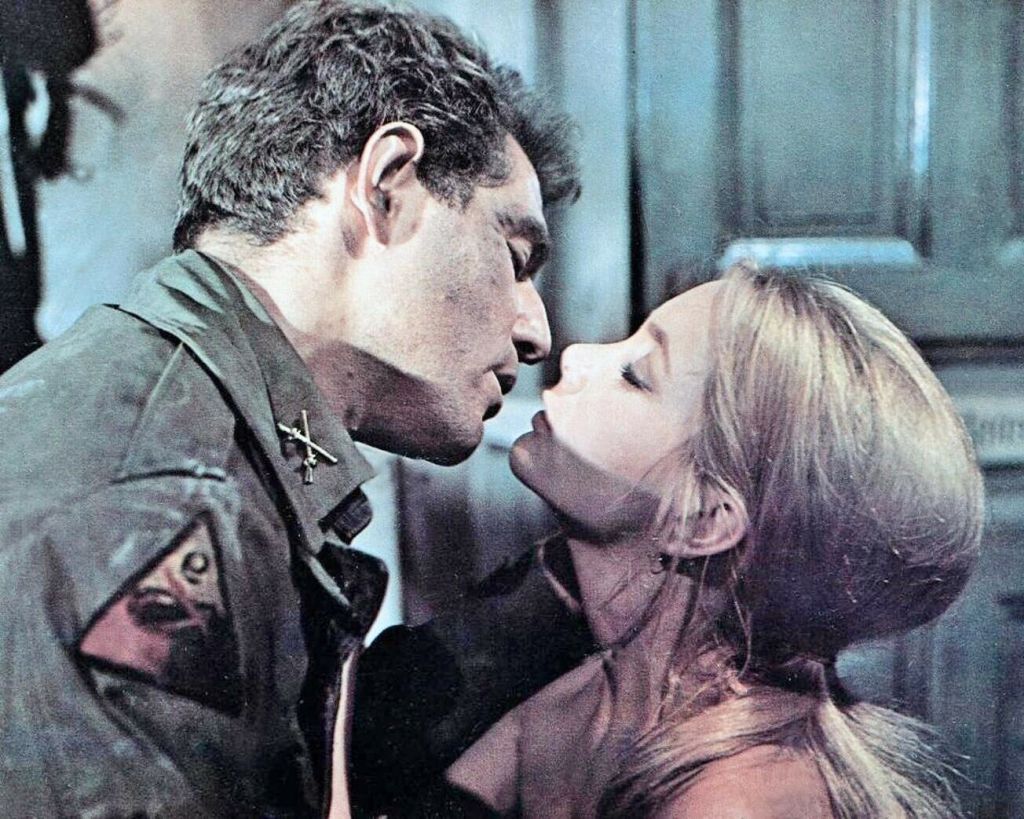
Superior war film, somewhat underrated. Not just realistic battle scenes, but realistically weary soldiers and taking an even-handed approach to war in the manner of Battle of the Bulge (1965). The Americans want to destroy the bridge to trap 75,000 German soldiers on the wrong side of the Rhine, the German Major Krueger (Robert Vaughn) overrides his orders to also destroy the bridge and prevent the Allies with a direct route to Berlin. Instead with depleted forces – think Zulu (1963) – and hugely outnumbered he attempts to keep the bridge open so the cornered Germans can escape.
Unlike most war films there’s no time for comedy to lighten the spirits, it’s gruelling non-stop action. Even when the advance company, headed by grizzled Lt. Hartman (George Segal) find an abandoned village where the exhausted squad could rest up for a bit, they are ordered to keep going until they find more enemy to engage. Unlike the humane Krueger, the Allied high command are merciless, gung-ho Major Barnes (Bradford Dillman) and glory-hunter Brigadier Shinner (E.G. Marshall) drive their troops on, the latter not bothered how many of his men die in an attempt to blow up the bridge – “it’s a crap shoot” is the closest he gets to apology, claiming his actions will shorten the war.
When Allied attempts to blow the bridge fail and with the enemy so close Krueger has to proceed with detonating the explosives littering the bridge and that plan is also scuppered, it’s a battle to the death to secure the crossing. And the story itself is accentuated by nods to the grisly cost of war – on both sides. Heartless Sgt Gazzaro (Ben Gazzaro), whose freebooting Hartman despises, is brought up short when he kills a youth commandeered into action by Krueger in a bid to bolster his meagre outfit – barely 200 men when he expected a force of around 1600. Krueger is sickened to see a German firing squad executing deserters, but has little sympathy for an innkeeper who has lost a son to the fighting when four million Germans are already dead.
While reining in the worst excesses of Angelo, preventing him taking advantage of a captured woman (Anna Gael) and refusing himself to accept her offer of sex, Hartman does not rail (like Patton, 1970) against those of his men who succumb to pressure. Finding one soldier collapsed, he sympathizes, “sometimes it hits you like that,” and he refuses to put his men in unnecessary line of fire, prompting Barnes into almost killing him. Unlike Battle of the Bulge, however, there is no arrogant German commander (like Robert Shaw) nor complacent Americans.
The action is not only non-stop but hectic and the film begins brilliantly with tracking cameras scarcely able to keep up with American tanks barrelling along the road and aerial shots showing the destruction of another bridge over the Rhine. American tanks and German artillery exchange fire over the river. Buildings are blown out or majestically collapse (turns out these were real buildings, not mock-ups). Bridge stanchions fall in slow motion into the water. Refugees are collateral damage, the camera hardly registering a crying child or an abandoned doll.
As in the best war pictures, strategy and tactics are laid out for the audience, the American blunderbuss approach compares poorly to Krueger’s desperate attempts to utilise every advantage to the point of arming a barge in the river. Hartman and Krueger are well-matched in courage, the former thrown endlessly into action by cynical superiors, the latter, having discharged himself from hospital to fight on, landed with the task of rallying defeatist troops, and leading them into harm’s way in a manner that the American’s immediate superior, Barnes, point-blank refuses to do. Pride drives on the German, the war is almost lost, but surrender would be tantamount to humiliation. All Hartman has to fall back on is an inner core and the chain of command, soldiers obey orders.
Both George Segal (The Quiller Memorandum, 1966) and Robert Vaughn (The Venetian Affair, 1966) are well outside their acting comfort zone. Two stars whose hallmarks are cocky characters and suave charm turn into determined men who barely crack a smile. Segal has done cynical before but not to this degree and what catches the eye more is his sheer physical exhaustion. This is an early career highlight for Vaughn, rarely offered such juicy roles.
Although associated in the general audience mind for playing creepy, not to mention sleazy, characters, Ben Gazzara (Capone, 1975) had not made much impact on 1960s moviegoers, and beyond a handful of supporting roles best known to Americans for a starring role in television series Arrest and Trial (1963-1964). The general untrustworthy screen persona he would come to inhabit is given a good work-out here except for two scenes where his character takes unselfish action. Bradford Dillman, also best known for television (Court Martial, 1965-1966), portrays a largely one-dimension character lifted out of the ordinary in a couple of scenes.
E.G. Marshall (The Defenders, 1961-1965) and Peter Van Eyck (Station Six Sahara, 1963) are the opposing commanders. You can also spot Hans Christian Blech (Battle of the Bulge), Anna Gael (Therese and Isabelle, 1968), Sonja Zieman (The Secret Ways, 1961) and Bo Hopkins (The Wild Bunch, 1969).
John Guillermin (The Blue Max, 1966) directs with aplomb from a screenplay by William Roberts (The Devil’s Brigade, 1968) and novelist Richard Yates (Revolutionary Road, 2008) in his only work for the screen.
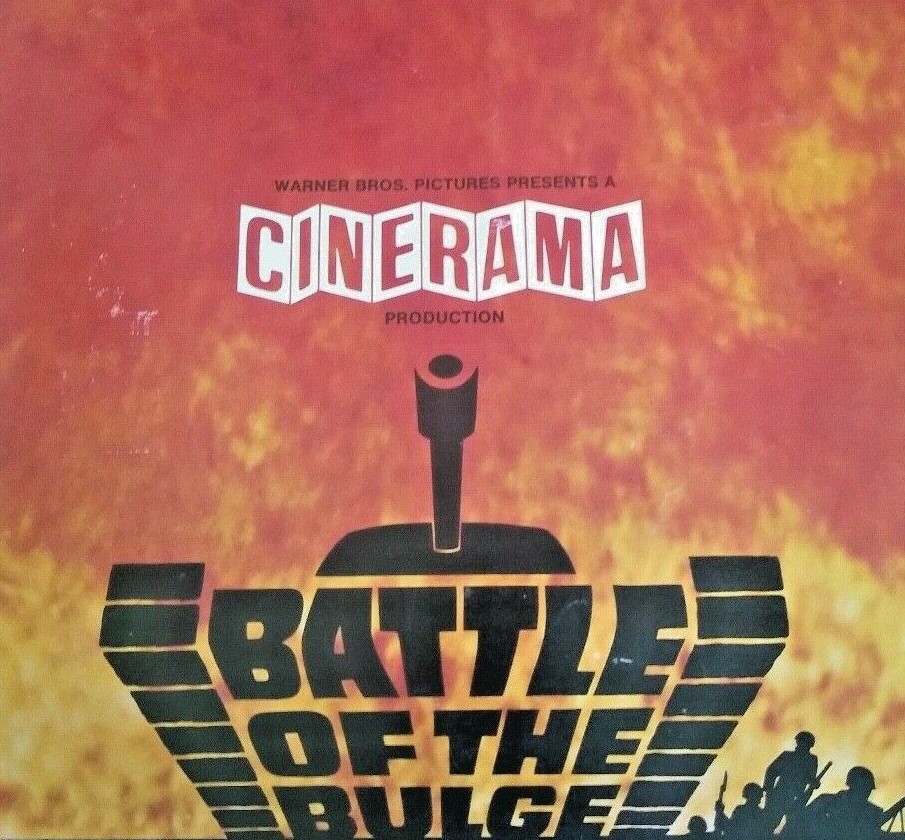
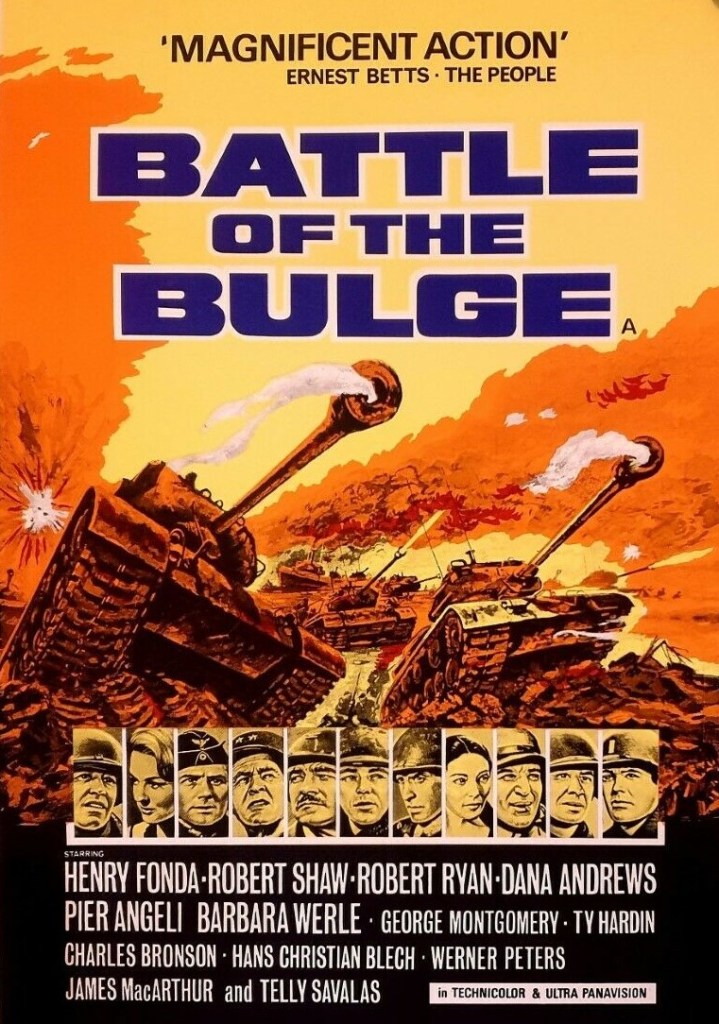
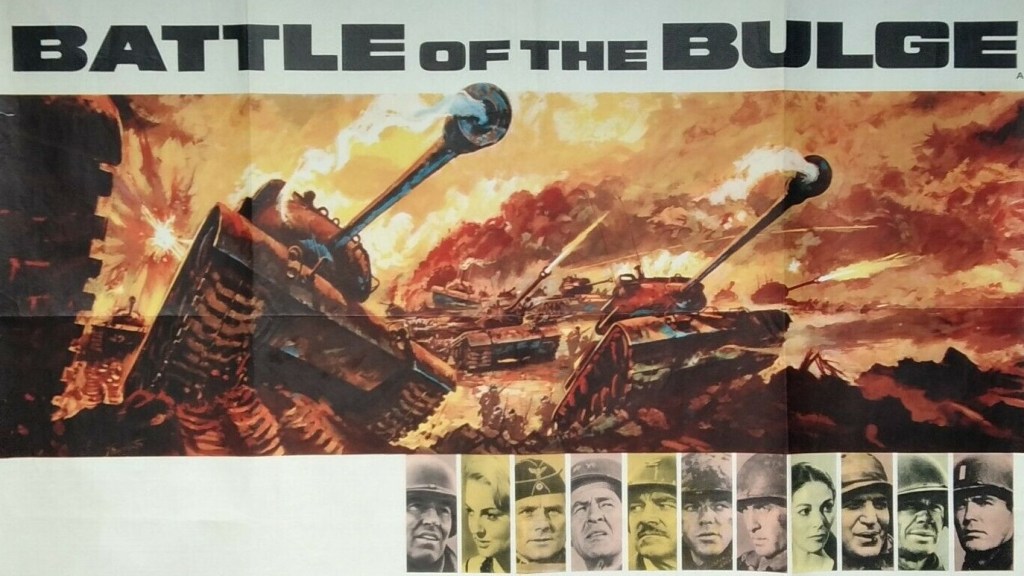
Superb even-handed depiction of war, far better than I remembered. Most war films of this era and even beyond showed the action primarily from the view of the Americans/British – even the acclaimed The Deer Hunter (1978) and Apocalypse Now (1979) show nothing of the skills of the Vietnam forces that would prove victorious. And while The Longest Day (1962) shows reaction to the invasion, the Germans are revealed as caught on the hop. Given the basis for this picture is the unexpected German offensive in the Ardennes, France, in December-January 1944-1945, you might expect the Germans to be accorded some attention. But hardly given as much of the picture as this, so that in the early stages the Germans are portrayed as powerful, clever and patriotic while the Americans are slovenly and complacent, their greatest efforts expended on preparing for Xmas.
With tanks the main military focus, Cinerama is deployed brilliantly, the ultra-wide screen especially useful as the unstoppable vehicles rampage through forests and land and allowing true audience involvement when opposing armies meet head-to-head. Of course, it being Cinerama, there are a couple of scenes that play to the strength of this particular process: a car careening round bends and a train racing along twisting tracks, the kind of scenes that previously would have had the audiences out of their seats with excitement, but here mainly used to raise the tension in the battle.
It’s to the film’s benefit that the all-star cast doesn’t feature a single actor who is truly a star in the John Wayne/Gregory Peck/Steve McQueen mould so that prevents the audience rubbernecking to spot-a-star that afflicted The Longest Day. The biggest name, technically, is Henry Fonda, and although he received top billing in many pictures, you would have to go back to The Wrong Man (1956) to find an actual box office hit. The only previous top billing for Robert Shaw (From Russia with Love, 1963) had been in The Luck of Ginger Coffey (1964), a flop few had seen. And the top-billing days of Robert Ryan (Horizons West, 1952) and Dana Andrews (Laura, 1944) were long gone. In fact, the actor with the biggest string of hits was Disney protégé James MacArthur (Swiss Family Robinson, 1960). Anybody who had seen The Magnificent Seven (1960) and The Great Escape (1963) would recognize Charles Bronson in a supporting role. So fair is the movie that it’s the blond-haired Shaw who steals the show with a dynamic performance.
So it helped the almost documentary-style of the film that it was filled with familiar faces rather than dominant stars and the director was not bound to give a star more screen time or provide them with one brilliant scene after another, or establish a redundant love story in order to provide them with more emotional heft. In fact, the only romance goes to a sly black marketeer who views his relationship more as a business asset.
Initially, the role of Lt. Col. Kiley (Henry Fonda), a former cop, seems only to be to rile his superiors General Grey (Robert Ryan) and Colonel Pritchard (Dana Andrews), his pessimistic view contrasting with the accepted notion that the Germans are well and truly defeated and the war would be over soon. On airplane reconnaissance he takes a photograph of an officer later identified as Panzer tank genius Colonel Hessler (Robert Shaw). While Grey and Pritchard over-ride his conclusions, the movie concentrates on the German build-up, their discipline, efficiency, leadership and determination juxtaposed to the American inefficiency and sloppiness.
Where the Americans just want to get home, Hessler – more charismatic than any of the dull Yanks – is in his element, wanting the war to never end, convinced at least that a tank-driven assault would drive a wedge between the Allied forces, and by reaching the target Antwerp in Belgium in the north extend the war by another year by which time Germany’s V2 rockets would give them greater firepower. The Germans also have a clever idea, the type that the British were always coming up with (and likely would have made a film about had it been their idea) of parachuting American-born Germans (i.e. speaking English with American accents and knowing American cultural references) behind enemy lines, dressed in American uniforms, to carry out vital sabotage and hold crucial bridges across the River Meuse.
In one of the best scenes in the film, his tank commanders burst spontaneously into a patriotic song with much stamping of boots. And while Hessler’s immediate superior (Werner Peters) , ensconced in a superior bunker, can enjoy a comfortable lifestyle, no better illustrated by the fact that he has courtesans to hand, one of whom, offered to Hessler, is furiously dismissed. And the clock is ticking, the Germans have limited supplies of fuel and must reach the enemy’s supply dumps before they run out of gas.
The maverick Kiley manages to be everywhere – the River Meuse bridge, in the air in the fog determinedly hunting for the panzers he believes are hidden, is the one who realizes how critical the fuel situation is for the enemy, and at the fuel depot for the movie climax. Otherwise, the picture uses its cast of supporting characters to cover other incidents, the massacre of prisoners-of- war at Malmedy, the chaos as the Germans over-run American-held towns.
Best of all is the human element. It would be easy on a picture of this scope to lose emotional connection, as you would say was the prime flaw of The Longest Day. Not only is Kiley the outsider trying to beat the system, but we have the cowardly Lt Weaver (James MacArthur) who would rather give up without a fight than lose his life, the weaselly Sgt. Guffy (Telly Savalas) representing the worst instincts of the grunts, the confused General Grey who can’t make up his mind how to respond to the sudden attack, and Hessler’s driver Conrad (Hans Christian Blech) who is fed up with paying the price of war.
The action scenes are outstanding. If you’ve never been up against a tank in full flight, you will soon get the idea how fearsome these metal battering rams are, as they rear up, fell trees, race across open fields, and either with machine gun or shells wreak havoc. As with the best war films, you are given very precise insights into the battles, the tactics involved, the ultimate cost. Wolenski (Charles Bronson) is in the thick of the fighting.
While Robert Shaw is easily the biggest screen personality, Henry Fonda is solid, and holds the various strands of the picture together, while Charles Bronson enjoys a further scene-stealing role. But the pick of the acting, mostly thanks to bits of improvisation, is Telly Savalas (The Slender Thread, 1965) as the thieving Guffy. In one memorable scene he kicks out in resentment at his collection of hens and in another shakes his body at the tanks. No one else, beyond Shaw, comes close to his infusing his character with elements of individual personality.
Pier Angeli (Sodom and Gomorrah, 1962) as Guffy’s mistress and Barbara Werle (Krakatoa, East of Java, 1968) as the courtesan are inexplicably billed above Charles Bronson, Telly Savalas and James MacArthur perhaps in a ploy to deceive audiences into thinking there was more female involvement.
Full marks to British director Ken Annakin (The Biggest Bundle of Them All, 1968) for visual acumen and for simplifying a complicated story and peppering it with human detail. His battles scenes are among the best ever filmed. Credit for whittling down the story into a manageable chunk goes to Philip Yordan (The Fall of the Roman Empire, 1964), Milton Sperling (The Bramble Bush, 1960) and John Melson (Four Nights of the Full Moon, 1963).
A genuine classic, still somewhat under-rated I feel. There are a variety of versions around – make sure you get the 163-minute cut such as shown below. And it will help if you watch it in widescreen.
A belated entry into the Cold War thriller genre that appeared to have peaked with Dr Strangelove (1964), Fail Safe (1964) and Seven Days in May (1964). The Bedford Incident, filmed in black-and-white with a less-than-stellar cast nonetheless holds its own as an examination of men under pressure, a cat-and-mouse actioner, as well as a stark warning of the dangers of nuclear war. Perhaps you could not find a more contemporary theme,
Capt Eric Finlander (Richard Widmark) is a maverick U.S. Navy destroyer commander hunting down Russian submarines should they stray into territorial waters. He has been passed over for promotion, despite having previously successfully forced a Russian sub to the surface. Into his meticulously-run ship are dropped photo journalist Ben Munceford (Sidney Poitier) – re-teamed with Widmark after The Long Ships – and Lt. Commander Chester Potter (Martin Balsam), a ship’s doctor. In effect, their presence is a simple device to put Widmark under the spotlight, in some respects to challenge his operational methods, and, as a narrative device, to provide an excuse to tell the audience everything they need to know. Among the ship’s crew are young ensign Ralston (James MacArthur) and former German former U-boat commander Commodore Wolfgang Schrepke (Eric Portman) who acts as an advisor.
The newcomers are afforded insight into how this ship is run and into its hunting methods, for example, dredging up waste from the sea in order to examine it for evidence of a Russian presence. There is a bundle of interesting technical data – a submarine has to surface for air, as another example – and the soundtrack mostly consists of endless sonar. Apart from the German, who appears to subsist on Schnapps, the crew is unusually top-quality, the sick bay deserted, the enterprise run under wartime conditions, every person on board dedicated to fulfilling the captain’s every wish.
The tension is in triplicate. First of all, there is the obsessive captain who could at any time just explode; secondly, there is the hunt for the submarine replete with tactical maneuvers and hunches; and finally, always in the background, there is the nuclear element and the fear that untoward action could trigger a holocaust. And there’s also time to take down a peg or two the holier-than-thou visitors, Dr Potter revealed as a civilian medic returning to the service as a refuge, Munceford as a rather spoiled individual who complains when dangerous maneuvers interrupt his shower. Schrepke has the unenviable task of trying to rein in his boss, Ralston one of the few on board finding the pressure hard to handle.
But Widmark steals the show. His over-acting often stole the show when he had a supporting role, but this is a finely nuanced performance. An admirable, instinctive commander, he is loved by his men (such adoration not easily won) with a gift for battle and outfoxing an opponent, often barely containing his own tension. It would have been easy to ramp up the pressures he felt in the way of Humphrey Bogart as Captain Queeg in The Caine Mutiny (1954) but there’s a big difference between a man about to crack and one who loves battle and is desperate to score victory.
Sidney Poitier (Duel at Diablo, 1966) is excellent in a more relaxed role, combative only in matters of intelligence, and probably benefitting from not having to carry the picture. James MacArthur (The Truth about Spring, 1964) shows acting maturity is moving away from the easier Disney roles in which he came to prominence. Character actor Martin Balsam (Harlow, 1965) excels as always in this kind of role, a man with hidden weakness. Eric Portman (The Man Who Finally Died, 1963), somewhat typecast as a German officer, is given a deeper role where villainy is not his only ace. If you keep your eyes peeled you might spot a fleeting glimpse of The Dirty Dozen (1967) alumni Donald Sutherland, as part of the medical crew, and Colin Maitland as a seaman.
The top-billed Richard Widmark turned producer on this one, as he had done for The Secret Ways (1961), not so much as to greenlight a pet project but to keep a place at Hollywood’s high table just when that seemed to be slipping out of his grasp after the commercially disastrous John Ford roadshow Cheyenne Autumn (1964). In truth, Widmark’s position as an outright star appeared questionable. He seemed to transition all too easily between top billing (Warlock, 1959, The Long Ships, 1964) and second billing (Two Rode Together, 1961, Judgement at Nuremberg, 1961, and Flight from Ashiya 1964).
But the billing oddity from today’s perspective if to find Sidney Poitier – coming off an Oscar win for Lilies of the Field (1963) and later a box office smash in his annus mirabilis of To Sir, With Love (1967), Guess Who’s Coming to Dinner (1967) and In the Heat of the Night (1967) – subordinate to Widmark in the credits department. The Long Ships featured the same billing arrangement.
Also putting his neck on the line was James B. Harris who was making the jump to director from producer of Stanley Kubrick’s The Killing (1956), Paths of Glory (1957) and Lolita (1962). Screenplay honors go to James Poe (They Shoot Horses, Don’t They, 1969) who adapted the bestseller by Mark Rascovich.
Harris makes a sound debut, the decision to film in black-and-white paying off, and enough going on through personality clash and the sub hunt to keep the pace taut. Authenticity was added by filming aboard naval vessels (although British in this case) and what little model work there is does not look out of place. A bigger budget would have made better use of the actual hunt (as The Hunt for Red October, 1990, later proved) but sound effects rather than visual effects suffice. I had not at all expected the shock ending. Another point in this film’s favor is that the threat of nuclear apocalypse has not gone away and the fact remains that the world as we know could disappear at the touch of a button.
British espionage team embarking on a scheme to fool Adolf Hitler during the Second World War find they are susceptible to deceit and deception in their own lives. What could have been a plodding step-by-step documentary-style picture is given a huge fillip by examination of the lives of those involved. The twists and turns of this extraordinary tale, both in the professional and personal sense, make for a very enjoyable picture. It is no less thrilling for, like The Day of the Jackal (1973), being aware of the outcome.
Planning to invade Sicily in 1943, the Allies are determined to convince Hitler that they are instead more likely to attack Greece. The British come up with “Operation Mincemeat,” a variation on the Trojan horse with the “gift” this time being secret papers referring to the Greek assault that are contained in a briefcase attached to a corpse which washes up on the shores of Cadiz in Spain. The assumption is that the German high command is predisposed to being hoodwinked after having ignored the papers on a genuine corpse that came their way prior to the invasion of north Africa.
Tasked with devising the operation are the accomplished Ewen Montagu (Colin Firth) and the gawky Charles Cholmondeley (Matthew Macfadyen) into whose orbit comes Jean Leslie (Kelly Macdonald) whose persona is used to provide a romantic background for the corpse. Although the project has been given the green light from the highest authority i.e Winston Churchill (Simon Russell Beale) not everyone is in favour and the team face obstacles, since technically the plan comes under the remit of the Royal Navy, from Admiral John Godfrey (Jason Isaacs).
The romantic intrigue that ensues creates sufficient resentment for one member of the team to spy on the other at the behest of the admiral, thus ensuring that those charged with deceiving Hitler through moral means are entering into immoral personal activity.
But what drives this picture is the detail. Finding the correct type of corpse, ensuring it is preserved and has sufficient water in the lungs to make a convincing drowned man at the same time as creating a suitable legend for the character. Films dependent on the inner workings of espionage science, for want of a better word, do not always work. Enigma (2001), a riveting book, did not translate well onto the screen while The Imitation Game (2014), covering similar territory, did. Here, the minutiae of minutiae are presented in such detail it is an education, down to the importance of an eyelash, how to extract a letter without breaking the seal on an envelope, and, critically how to judge whether the Germans have examined the material closely enough to ensure they have taken the bait.
The story has already been told though not in such detail as “The Man Who Never Was” (1956) but with Hollywood stars Clifton Webb and Gloria Grahame playing the leads.
And that’s before other twists and turns. The corpse was a down-and-out, abandoned, so it appeared, by all and sundry, until out of the blue his sister arrives to claim the body. The coroner on duty in Cadiz turns out, against all expectations, to be an expert in drowning. The British Attache in Spain must seduce both genders to ensure smooth passage of the secret documents. On the more human side, widows abound, husbands lost in combat. A spy on the British side must be unmasked or rendered harmless. A host of other smaller stories unfold within the larger narrative. Above all lies the tension of the necessity for the operation’s success, failure would mean the deaths of thousands of men on the Sicily beachheads and possibly a thwarted invasion.
Matthew Macfadyen (Succession, 2018-2021) steals the show as the over-sensitive individual with the sense of entitlement that comes from having too big a brain, Oscar-winner Colin Firth (Kingsman: The Secret Service, 2014) the imperturbable figure who finds emotion wreaks havoc, Kelly Macdonald (Goodbye Christopher Robin, 2017) the secretary drawn deeper into a world where genuine emotion has little place.
The cream of British character actors providing sturdy support include Johnny Flynn (Emma, 2020) as spy writer Ian Fleming, Penelope Wilton (Downton Abbey: A New Era, 2022), Mark Gatiss (The Father, 2020), Alex Jennings (Munich: The Edge of War, 2021), Jason Isaacs (The Death of Stalin, 2017) and Mark Bonnar (Guilt, 2019-2021). ,
Oscar-nominated John Madden (Shakespeare in Love, 19980 directs with something approaching verve, never letting the pace drop, zipping from scene to scene, from the war effort into more intimate moments, without any sign of the tension flagging. In her movie debut Michelle Ashford (The Masters of Sex, 2014-2016) does an excellent job of distilling Ben McIntyre’s bestselling book.
Sure, this is one of those British pictures in a long line of movies that show the country at its best, generally in the thick of war, but the story is so involving that it merits viewing. It is still showing at the time of writing in British cinemas but in the United States and Latin America it will air on Netflix on May 11.
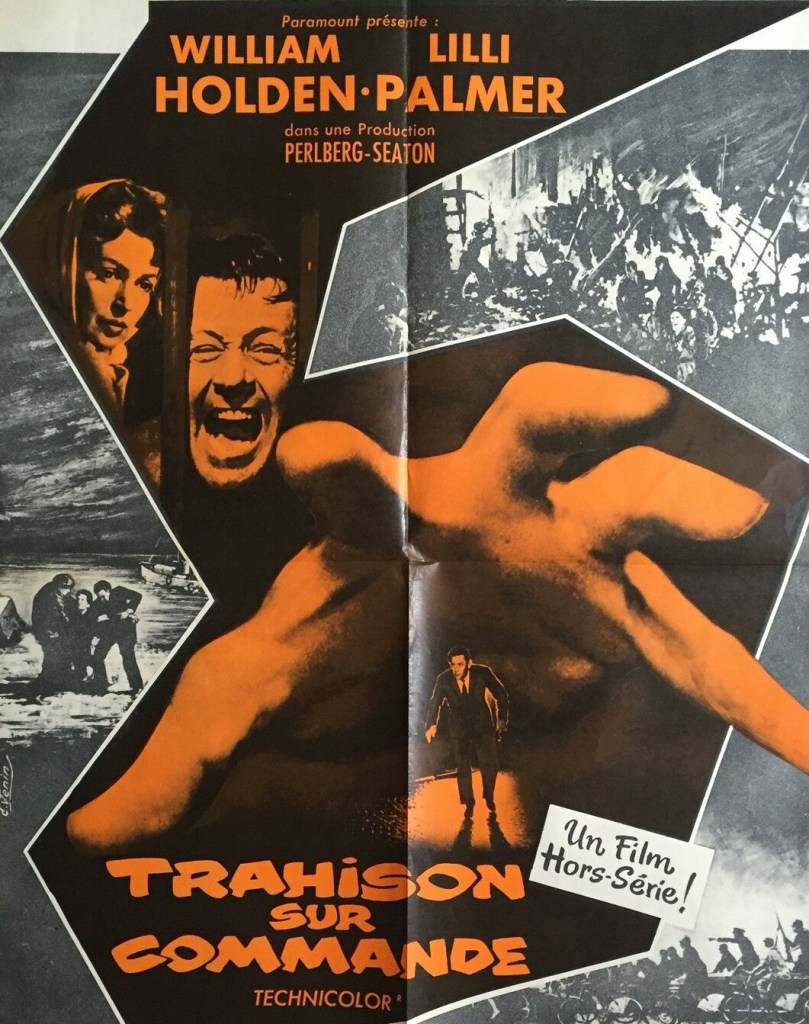
Cynical and opportunistic Swedish oil executive Eric Erickson (William Holden) blackmailed into World War Two espionage finds redemption after witnessing first-hand the horrors of Nazi Germany. Two extraordinary scenes lift this out of the mainstream biopic league, the first Erickson witnessing an execution, the second a betrayal. While some participants in the espionage game pay a terrible price, others like spy chief Collins (Hugh Griffiths) manage to maintain a champagne lifestyle.
Structurally, this is something of a curiosity. The first section, with over-emphasis on voice-over, concerns Holden’s recruitment and initial attempts at spying on German oil installations on the pretext of building a refinery in Sweden. Although resenting the manner in which he was recruited, Erickson has no qualms about resorting to blackmail himself to enlarge his espionage ring.
But it’s only when Marianne Mollendorf (Lili Palmer) enters the frame as his contact in Germany that the movie picks up dramatic heft. As cover for frequent meetings, they pretend to be lovers, that charade soon deepening into the real thing. While abhorring Hitler, she suffers a crisis of conscience after realising that the information she is passing on to the Allies results in innocent deaths. The final segment involves Erickson’s thrilling escape back home.
The picture is at its best when contrasting the unscrupulous Erickson with the principled Marianne. Virtually every character is trying to hold on to a way of life endangered by the war or created by the conflict and there are some interesting observations on the way Erickson manages to harness foreign dignitaries while being held to hostage in his home country. Loyalties are sparing and even families come under internal threat.
Sweden was neutral during the Second World War so in assisting the Allied cause Erickson was effectively betraying his country and once, in order to keep proposed German investors sweet, he begins to spout Nazi propaganda at home finds himself deserted by friends and, eventually, wife.
In some respects, Holden (The Devil’s Brigade, 1968) plays one his typical flawed personalities, easy on the charm, fluid with convention, but once he learns the true cost of his espionage a much deeper character emerges. The actor’s insistence, for tax reasons, on working abroad – this was filmed on location in Europe – would hamper his box office credibility and although not all his movie choices proved sound this was a welcome diversion. Whether American audiences were that interested in what a Swede did in the war was a moot point, as poor box office testified. And the title might have proved too sophisticated for some audiences, given there was no counterfeiting of money involved.
Lili Palmer (Sebastian, 1968) is excellent as the manipulative Marianne, betraying her country in order to save it from the depredations of Hitler, not above using her body to win favour, but paralyzed by consequence. Hugh Griffith (Exodus, 1960) provides another larger-than-life portrayal, disguising his venal core. Werner Peters (Istanbul Express, 1968) puts in an appearance and Klaus Kinski (Five Golden Dragons, 1967) has a bit part.
Double Oscar-winner George Seaton (Airport, 1970) makes a bold attempt to embrace a wider coverage of the war than the film requires and could have done with concentrating more on the central Erickson-Mollendorf drama, especially the German woman’s dilemma, but, made before James Bond reinvented the idea of espionage, this remains a more realistic examination of duplicity in wartime.
CATCH-UP: William Holden pictures reviewed in the Blog are Alvarez Kelly (1966) and The Devil’s Brigade (1968); Lili Palmer movies reviewed are Operation Crossbow (1965), Sebastian (1968) and Hard Contract (1969).
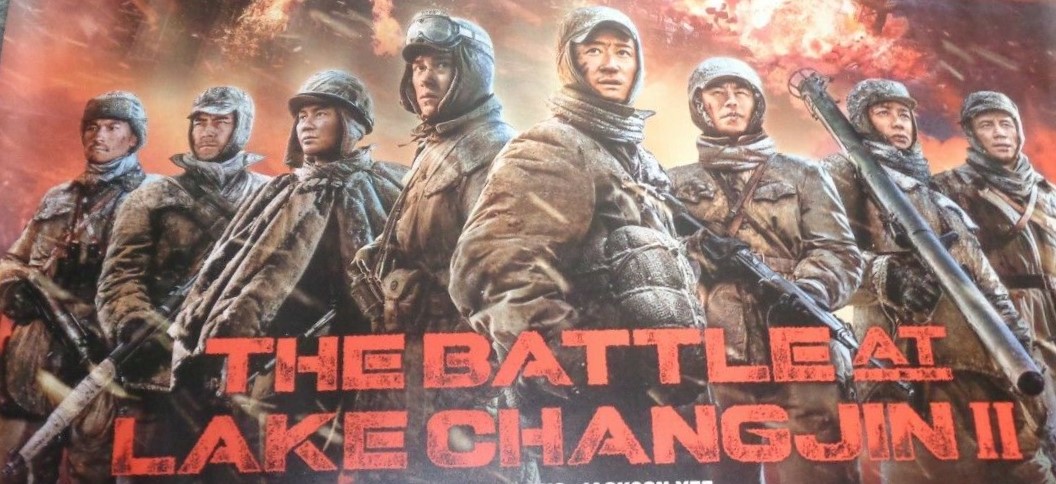
A raw visceral cinematic experience. After defeating superior American forces at Lake Changjin at the start of the Korean War, Chinese soldiers must prevent their retreat – and the arrival of reinforcements – by blowing up the Watergate Bridge in a blizzard. The bitter winter conditions, making it impossible to see more than a few yards ahead as the troops cross a mountain, freeze their weapons, compass and radio batteries. The assault is uphill over exposed ground.
This is non-stop battle told from the perspective of the grunts. Exposition regarding characters is minimal. That first hour or so in most Hollywood war movies where little happens except to build tension between participants and explore romantic elements is eliminated here. It’s all battle, beginning, middle and end, with no respite, brutal, bloody, horrific. The Americans have tanks, flamethrowers and airpower, the Chinese don’t, so they are strafed, burned and blown up.
Setting aside politics and propaganda, and the questions of historical accuracy that haunt all war pictures, this is the most extraordinary on-the-ground combat as the Chinese seek to employ various strategies against another superior force, knowing U.S. reinforcements are on their way, and the defending Americans seek to suck them into a trap. The fighting is intense, sacrifice the order of the day.
Best performances are delivered by brothers Wu Qiangli (Wu Jing), commander of the seventh company, and the undisciplined Wu Wanli (Jackson Lee) who grows up during battle. While emotions are necessarily reined in, no time for showboating here, intensity of feelings are still revealed, several wordless scenes between disparate characters show everything with just the eyes. As with all war pictures, comradeship under fire is all that matters, the connections between the band of brothers no less applicable here than when William Shakespeare invented the phrase.
Like the best war films, strategy is vital. Here, the Chinese employ a variety of diversionary tactics while attempting to destroy key American positions, the HQ, the pump room. There are some brilliant battlefield observations. The Chinese work out the Americans have positioned their forces twenty meters apart because in between are their military supplies, so these are also targeted via mortar rounds. But basically it is scrapping for position inch by inch.
And this is not a film devoid of irony. Using captured American weapons, the Chinese, unable to read English, fire an ineffective piece of artillery against a tank. Seizing the HQ, the Chinese, unable to speak English, ask for the commanding office while the Americans, unable to speak Chinese and intent on surrender, respond they are unarmed, the matter resolved by an explosion. A flamethrower burning to death a wounded soldier melts the ice sufficiently for his companion to slide downhill to safety. And there are rare bursts of humour, one soldier preferring to chew “plastic” – captured chewing gum – in preference to beans so frozen they could chip your teeth.
This is as much a picture about the effect of war, and special effects show the impact of not just the destructive power but the energy imparted by exploding bombs, the part played in dismembering soldiers by the metal and stone of the defences, the flamethrowers that turn men from walking one minute to charred skeletons the next.
There are occasional cuts to the American high command, General Douglas Macarthur (James Filbird) attempts to persuade President Truman (Ben Z. Orenstein) to use the atom bomb. The Americans are not shown as idiots and there’s no upbraiding of their society and there is, among the carnage, at least one American hero in Bradley Bixler (Rudy van Gelderen). And there’s none of the bombastic or poetic influence of Apocalypse Now (1979) or The Thin Red Line (1998), no attempt to glamorize war, except of course that for the victors victory is always unforgettable. But the cost here is easily measured, the mortality rate enormous, at least two-thirds of the attackers died in the assault and in one company, out of 137 men involved, only one man was left standing.
I never saw the first film so I’ve no idea how this compares, but generally that movie got poor reviews, I guess as much to do with political stances as anything else. I suspect this picture will get as derisory a stack of reviews and, without taking sides, that would be unfair from a cinematic perspective because this is a wholly immersive encounter, with some brilliant action direction and stunning visuals in the main by Tsui Hark (The Taking of Tiger Mountain, 2104) with some assistance from the uncredited Kaige Chen (Farewell My Concubine, 1993) and Dante Lam (The Stool Pigeon, 2010).
This is what comes of being an inveterate moviegoer and on those weeks when you have seen virtually everything else worthwhile on offer and still want to go to a movie, you end up seeing anything. Usually, this turns out to be some bedraggled horror picture or a lame rom-com like Marry Me (2022) but occasionally it means that you stumble across something exceptional.
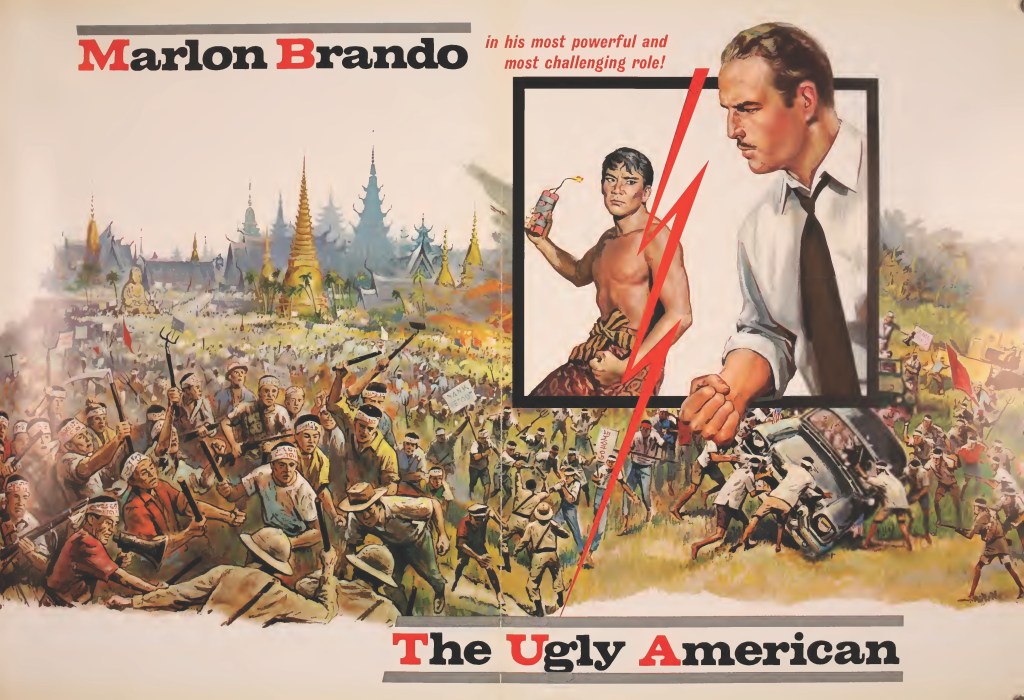
Terrific performance from Marlon Brando saves this prescient but preachy meditation on Vietnam. Harrison MacWhite (Marlon Brando) is the new ambassador, whose political credentials are questioned by many, parachuted into the fictional South-East Asia country of Sarkhan, knee-deep in civil war, communist north versus westernized south. The battleground is the American construction of a “Freedom Road” north to China which dissenters fear will be a conduit for the military. MacWhite owes his appointment to his friendship with Deong (Eeji Okada), a charismatic leader.
On arrival, the ambassadorial car is engulfed in a riot, car rocked, windscreens smashed. MacWhite shakes up a complacent embassy and though articulate and scholarly believes he holds the solution to the tricky situation while unwilling to accept that national self-determination does not necessarily mean complete hatred of the Americans. There is duplicity on both sides, rebels blaming U.S. truck drivers for deaths they caused, the Americans so used to getting their way they don’t stop to think if it is the right way.
Anxious not to be seen as a lapdog for Communism, MacWhite’s actions inflame the situation, while Deong falls victim to internal forces. Construction boss Homer Atkins (Pat Hingle) promotes the clever use of building hospitals along the road, thus encouraging locals to back it, but nobody falls for such honest skull-duggery masquerading as well-meaning intent.
Friends turning into enemies is a decent premise for any movie but this is over-burdened with debate that while interesting and providing a reflection of the times is basically a mixture of virtue-signalling and apportioning blame and, most heinous of failings, doesn’t really advance the story.
First-time director George Englund handles the action sequences well and captures the essence of a country about to explode against a background of growing tension and political machination. Use of Thailand as a location added authenticity.
The movie was based on a controversial novel by political scientist Eugene Burdick (who also wrote a more straightforward cold War thriller Fail Safe) and William Lederer, navy veteran and CIA officer, so it carried the stamp of authority in terms of putting forth the arguments for both sides. However, while the film bore only a “passing resemblance” to the book, according to co-author Burdick, he deemed it a superior achievement on the basis of its more dramatic treatment. Stewart Stern (Rebel Without a Cause, 1955) was the screenwriter who received blame and praise in equal measure.
Marlon Brando (Bedtime Story, 1964) exudes authority, broad shoulders packed into a suit, and brilliantly captures the anguish of a man led into disaster by arrogance. Coming off back-to-back flops One-Eyed Jacks (1961) and Mutiny on the Bounty (1962), this was a considerable change of pace for the actor, the first of several excursions into political territory. Eeji Okada (Hiroshima, Mon Amour, 1958) proves a worth opponent. Pat Hingle (Sol Madrid, 1968), Arthur Hill (Moment to Moment, 1965) and Jocelyn Brando (The Chase, 1966) provide sterling support.
The movie did not just predict what would happen if the U.S. lost the battle for hearts and minds but a similar situation confronting the U.S. Ambassador to Indonesia in 1965 whose appointment was unwelcome in that country.





 The Magnificent 60s