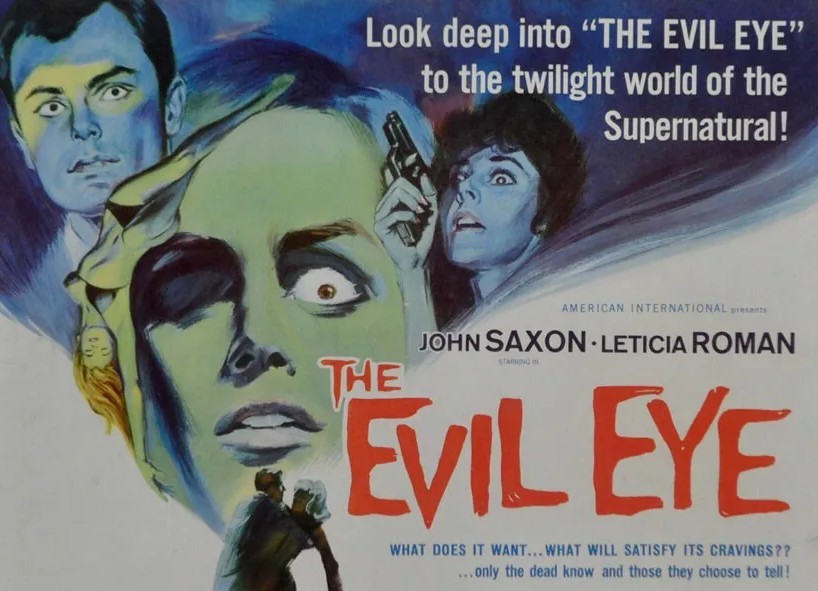
The Evil Eye / The Girl Who Knew Too Much (1963) ***

Don’t be taken in by claims that, since it was directed by Mario Bava, it kicked off the giallo sub-genre. More of the tropes come from mainstream horror – windows banging shut, locked doors, disembodied voices, stalkers, gaslighting, mysterious phone calls, premonition, retrocognition. And just for good measure, striking compositions that wouldn’t be out of place in an arthouse picture. But essentially it’s neo-noir – a woman can’t prove she’s witnessed a murder.

The Evil Eye was the American title, which makes little sense, although eye-popping eyes were in fashion from movies like Village of the Damned (1960), but in fact the original title of The Girl Who Knew Too Much is much more appropriate. This film is about a female character and what she discovers that threatens her life. The American version was chopped about by the distributor but, apparently, copies of that have gone astray so if locate a copy of the picture what you are likely to see if the Italian original.

American tourist Nora (Leticia Roman) is knocked out by a robber in Rome. On waking up she sees a murderer sticking a knife into a woman’s back. Only problem is – there’s no corpse to be found. But, strangely, a murder was committed on that spot a decade ago. So she might be having a vision of the past. But the murderer Straccianeve was caught.

The victim was the sister of Laura (Valentina Cortese), a new friend, whose apartment Nora temporarily occupies. There, Laura discovers newspaper clippings relating to the “alphabet killer”, a serial murderer whose victims’ surnames began with A, B, and C. Once Nora begins her investigations, it looks like she’ll be next on the list since her surname begins with “D”.  Meanwhile, she has struck a romantic vibe with Dr Marcello Bassi (John Saxon). But, of course, he might be not what he seems, sneaking off for assignations with strange women, following her.

Much of this is played out on deserted streets where the tourist sites acquire a dangerous veneer.

The finger points at journalist Landini (Dante DiPaulo), who has been following her. But he is as much a basket case as a potential murderer. He was instrumental in collecting the evidence that trapped the murderer but now believes Straccianeve was innocent.

In due course, after some more deaths, Nora traps the murderer, who comes out of left field, one of those where you think the writer has decided to pin the blame on the least likely suspect and come up with a spurious reason for the murders, so the twists pile up in helter skelter fashion at the end, including one which suggests Nora might well have the gift of seeing into the future.

Leticia Roman, in her debut, is mostly called upon to look baffled or frightened, there’s rather too much of the pop-eyes, and John Saxon (The Appaloosa, 1966) has the rare opportunity to play a hero. Valentina Cortese (Barabbas, 1961) drifts in and out of the tale. Written by future director Sergio Corbucci (Django, 1966), Oscar-winner Ennio De Concini (Divorce, Italian Style, 1963) and Eliana De Sabato (Marco Polo, 1962).

If it hadn’t been directed – and occasionally so stylishly – by Mario Bava (The Whip and the Body, 1963), it would have attracted considerably less contemporary attention. One of this main themes – the conflict between illusion and reality – is given a good airing. You can well believe that Nora is going mad. But it’s atmospheric enough and the director makes unusual use of the standard Rome tourist traps and this picture gives notice that he will move onto greater movies.

28 Years Later (2025) ** – Seen at the Cinema

The most expensive trailer ever made. Setting up in the very last scene the character of Jimmy (Jack O’Connell), straight out of Peaky Blinders, and his gang, who, presumably, are the main characters of the sequel. And, for sure, they are a big improvement on the iodine-doused philosophy-spouting Dr Kelson (Ralph Fiennes) who has built the skull pillar used in all the advertising.

This is the kind of horror film that doesn’t just want to be another zombie picture. You can argue that the “infected” once killed do stay dead but they don’t appear to be aware that most of the time they rampage around just like zombies, so it’s a fairly moot point. Meanwhile, the director makes umpteen points about conservation in a Fisherman’s Friend type of village where the one thing, judging from the party scene, they are never going to run out of is home-made booze. Despite the conservation message, the survivors are happy to desecrate the forests for fuel.

You could have the written the plot on a pinhead. Young lad Spike (Alfie Williams) makes his bones killing an infected. Not that hard since it’s the size of a giant slug and can hardly move. The conservation message seems lost on young Spike since he burns some essential house to the ground to create a diversion, something so essential it’s going to make the guards guarding the causeway abandon their posts while he escapes the village.

And although, nearly three decades on from the original adventures in this saga, the world has changed – would you believe it, there’s such a thing as mobile phones and cosmetic surgery (information drop courtesy of a wandering shipwrecked Swedish sailor) – it seems that breast cancer was also unknown back in the day and Jamie’s addled mother Isla (Jodie Comer) is so addled that even in her moments of clarity hasn’t realized that those strange lumps all over her body are cancer.

Anyways, luckily, she’s an obliging soul and rather than put her son through the agony of watching her dying, she elects for assisted dying, courtesy of the good doctor. And boy that kid is some kid, and in the barmiest scene in the whole movie, goes along with the barmy notion that he let the doc chop off his mum’s head and boil up her skull so he (Spike, that is) can stick it atop the skull pyramid.

Did I mention there was a baby? My guess is Jodie Comer took the part on the basis of the scene where she bonds with the pregnant infected woman, helping her through her incredibly speedy labor, presumably speedy birth being an unknown side effect of infection.

Another side effect is that infected babies don’t cry, which is heck of a useful when you are trying to hide in the woods or the wilderness from the scavenging monsters, including the aptly-named Samson, who can tear heads (and attached spinal column) off with his bare hands and since he is permitted to survive my guess is he’s turn up again in the sequel.

The baby might even be some nod to virgin birth for all I know, the only child born uninfected. I only mention that because as well as the cod philosophy there’s a dose of cod spirituality, the Angel of the North statue brought into the equation for no apparent reason.

Aaron Taylor-Johnson, at one point a contender for the vacant James Bond slot, does very little except roister and upset his son by indulging in a bit of adultery. It’s all very Robin Hood what with the emphasis on bow-and-arrow as the weapon of choice, and just to show how effective they are in case we’re not paying attention and seeing how easily they kill off the infected punters, every now and then director Danny Boyle chucks in a clip from I guess Henry V which shows how effective a hail of arrows can be, though anyone paying attention to any Ridley Scott historical picture would be aware of this.

There’s a note on immigration as well. Britain is quarantined, so no Brits can emigrate abroad, European patrol boats operating in the North Sea and presumably the English Channel to deter anyone setting off in a dinghy, the opposite of the current situation.

Waste of an otherwise talented cast – Jodie Comer (The Last Duel, 2021), Aaron Taylor- Johnson (Kraven the Hunter, 2024) and Alfie Williams in his big role debut.

Directed by Danny Boyle (Yesterday, 2019) and written by Alex Garland (Civil War, 2024) too determined to make points at the expense of going to the trouble of creating an involving story.

Complete absence of thrills, I’m afraid, and too much preaching.

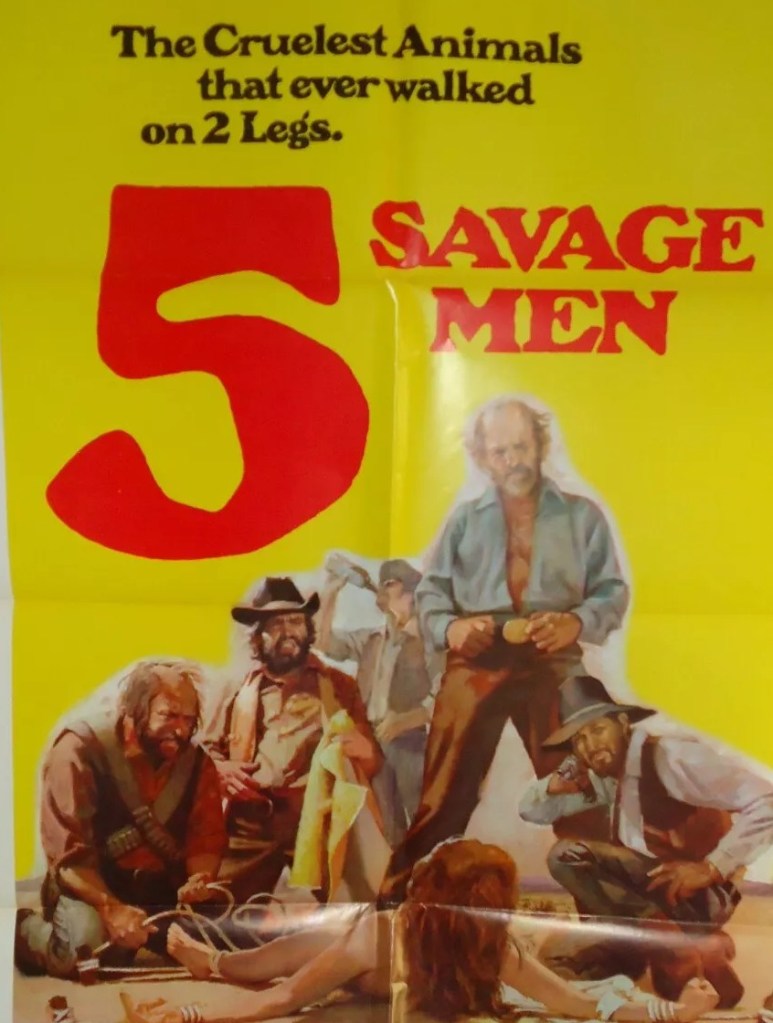
The Animals / Five Savage Men (1971) ***

Every now and then I get a notion to see what happened to  ingénues who made an initial splash. In El Dorado (1967) there were three. We all know how James Caan’s career panned out though he had a tricky time of it working his way through low-budgeters like Submarine X-1 (1968) and Journey to Shiloh (1968) graduating to arthouse flops like The Rain People (1969) before making his box office bones in The Godfather (1972). Christopher George I’ve had a look at in The Thousand Plane Raid (1969) and another picture tomorrow.

Michele Carey, James Caan’s squeeze in the Henry Hathaway western, didn’t have the same luck or anyone showing her anything like the same perseverance in her talent. So when I came across this item it looked as if she had found her first top-billed role and since it also featured cult figures Henry Silva (Johnny Cool, 1969) and Keenan Wynn (Point Blank, 1967) I reckoned it was worth a peak.

It was the first rape-revenge movie, with the victim hunting down her attackers, a subgenre that picked up more heft when Raquel Welch headlined Hannie Caulder later that year. But it also seems close cousin to Will Penny (1968) and The Stalking Moon (1969) where the inarticulate make a connection. There’s also racism, “filthy heathen” Native Americans automatically landed with blame, and a rape every bit as savage as Straw Dogs (1971) and an ironically raw ending. But there’s also bits missing, either edited out or never filmed in the first place, leaving large gaps in the narrative failing to explain how the hunters manage to track down the hunted who have ridden off to disparate places. In fact, there’s two sets of hunters, the second bunch not quite sure who it is they’re chasing.

Schoolteacher Alice (Michele Carey) is on the same stagecoach as prisoner Pudge (Keenan Wynn) when it is bushwhacked by the outlaw’s four-strong gang. Everyone else is slaughtered but Pudge and his men make off with sacks of gold and the woman. Staking her out they take turns raping her and then leave her to die.

Native American Chatto (Henry Silva) saves her, nurses her back to health, kits her out in fresh hand-made clothing and teaches her how to fire a rifle, in the course of which romance burgeons (though you might wonder, psychologically, if it’s too soon for a woman raped five times to want anything to do with a man).

Meanwhile, a posse headed by Sheriff Pierce (John Anderson) is searching for the missing stagecoach. When they find the remains of Alice’s clothing and the stakeout, the assumption is this was the work of the Apaches. Since the running time is a lean 84-minutes, Chatto and Alice make short work of tracking down the outlaws, who have, by this point, not yet split up.

Catching them unawares, they, for reasons best known to the screenwriter, allow most of them to escape. Alice, whose marksmanship is not quite up to the mark, nonetheless is capable of putting a bullet in a barrel of gunpowder. One down, four to go.

The sheriff does them a good turn and apprehends the next outlaw (they’ve split up by now) and is questioning him about Pudge when the couple appear and Alice, with vastly improved marksmanship, shoots him from a longer range. The posse, which had previously proved adept at tracking, allows the pair to escape.

In due course, Alice and companion manage to find all the others bar Pudge, one meeting his end on a toilet seat, blasted by his own shotgun, little marksmanship required by her there. Pudge has had the clever notion of hiding out in plain sight by signing on as a cowhand for a herd on the move. Still, for reasons undiscerned, Alice finds him asleep in the dead of night. He’s apprehended, whisked away, but escapes and it’s left to Chatto to bring him back. Pudge is staked out and Alice cuts off his testicles, though she’s kind of shocked at her own savagery. Chatto puts the murdering rapist out of his misery.

But the posse, which for unexplained reasons, happens to be passing, hears the gunshots and comes across Alice in a state of shock beside the Apache hovering over the corpse. The sheriff shoots Chatto while she does nothing to save him. Which is a hell of a note, even given her state of shock, but maybe shacking up with an Apache was deemed worse than being raped by white men and maybe she did that just to ensure she had a protector.

There may be an even more ironic ending being hinted at because – as the camera pulls back from the dead man and the shocked woman and the posse – into view comes a tribe of Apaches watching.

So quite an odd one, good use of the widescreen, but too many scenes of just horsemen riding, and little in the way of characterization. Worth it to see the really nasty side of Keenan Wynn and Henry Silva at his most monosyllabic hero. Hard to put your finger on what’s amiss with Michele Carey’s performance. She could be playing numb, as she had every right to do, given the treatment she endured, but she doesn’t give much away emotionally even when taking revenge or when not saving her savior.

Director Ron Joy only made this one picture as did screenwriter Richard Bakalyan, better known as an actor. The rape scene is well done, filmed from Alice’s POV, a jumble of male faces straining up close, so less of an actress ordeal than Straw Dogs, though the mauling and pawing prior to the act must have been hard for an actress to take.

But you do have to wonder at the filming of this scene – as with The General’s Daughter (1999) – of the real-life vulnerability of the actress and, setting aside any acting skill, the possibility of her feeling humiliated, staked out stark naked not just for the perpetrators to slaver over but the entire (most likely male) crew.

Didn’t prove a breakout out role for Michele Carey. She didn’t make another movie for six years and then it was a bit part in The Choirboys (1977).

Currently on YouTube.

Behind the Scenes: Selling The Western As Art: The Pressbook for “The Sons of Katie Elder” (1965)

“Don’t ever make the mistake of looking down your nose at westerns. They’re art,” said John Wayne in probably the most provocative statement he ever made about the genre, especially given this was the mid-1960s, and outside of a few accepted classics mostly of the John Ford vintage plus perhaps High Noon (1952), few American critics were taking that line.  

“Sure, they’re simple,” said Duke, reinforcing the message, “But simplicity is art. They’re made of the same raw material Homer used. In Europe they understand that better than we do over here. They recognize their relationship to the old Greek stories that are classics. But I don’t think that’s the reason they love ‘em.”

“We love ‘em, too, but not because of anything we stop to think about.” Clearly, the Big Man had given this some thought and had analyzed the genre. “A horse is the greatest vehicle for action there is. Planes, automobiles, trains, they’re great, but when it comes to getting the audience’s heart going, they can’t touch a horse.”

(These comments were made prior, of course, to the likes of the vehicle-driven Bullitt and The French Connection and the disaster movies that started with Airport, but let’s not allow that to take away from his point.)  

“He’s basic, too,” continued Wayne. “Put a man on him and you’ve got the makings of something magnificent – physical strength, speed where you can see and feel it, heroism. And the hero, he’s big and strong. You pit another big strong man against him with both their lives at stake and there’s a simplicity of conflict you can’t beat.

“Maybe we don’t tell it with poetry like Homer did but in one way we’ve even got him beat. We never let Hector turn tail and run from Achilles. There’s got to be a showdown.

“Westerns are folklore, just the same as The Iliad is. And folklore is international. Our westerns have the same appeal in Germany and Japan and South America and Greece that they have in this country.”

I’m not sure how much of this made it into the newspapers for which it was intended. John Wayne spouting on about art was not the kind of headline newspaper editors thought the public wanted to read. But this is far and away the most interesting piece I’ve ever read in a Pressbook so someone must have caught Duke on a good day for him to open up so much.

As it happened, producer Hal Wallis was on the same page. “Good westerns,” he said, “are a legitimate art form.” Wallis had more critical plaudits than Wayne, his previous picture Becket (1964) clocking up a raft of Oscar nominations and himself twice winner of the Irving G. Thalberg award.

This was a fairly hefty Pressbook/Merchandising Manual promoting one of Paramount’s biggest pictures of the year. It ran to 20-pages of A3 including a thick glossy cover plus an extra 2pp miniature herald. The section devoted to the stars and promotional ideas is larger  than usual, running to over two-thirds of the total.

In part this is because Wayne is so voluble. He’s given two articles on the first two pages. In the other article, he assesses what he’s looking for in a character.

“He’s usually outside the law as its written in the books,” explained Wayne, “but that’s not always his fault and anyway it’s not easy for him to cross back over the line but meanwhile he’s doing his best. He’s a man of his place and time, and maybe a victim of circumstance or past mistakes. But he’s living by a moral code of his own just as rigid in its fashion as the one in the books.

“Like in Katie Elder I kill a few guys but I’ve already notified ‘em I’m going to do it just as soon as I can get the goods on ‘em. Because they’re crooks and murderers and they’re out to get me as well as some other folks and what I’m doing is serving justice the only way a man in my position can do it. Nobody says the end justifies the means or anything like that because it never does. And that’s why I say I don’t play heroes – good guys. I’m not what you’d call a villain either. But one thing I make sure of – the guys I play are believable human beings.”

The other article is the more quotable, I guess. But that’s not the only meat in the Pressbook. As usual, some of what’s written is intended for features, others for snippets. For example, wardrobe man Frank Beetson reveals the secret of the much-copied shirt worn by John Wayne in all his westerns, the blue flannel number with the double-breasted ‘plaster-on’ front – it’s an old-fashioned fireman’s shirt. Female lead Martha Hyer discovered 20-year-old designer Camerena at the art school in Durango. Hyer’s wardrobe in the film is confined to gingham and such, but she is wearing three of the designer’s frocks in a photographic fashion feature for Glamour magazine.  Turns out Dean Martin is a gourmet and when what was available on the catering front was not to his taste, he arranged for Frank Sinatra to send, by air express, 40 steaks from the Las Vegas Sands while Sammy Davis Jr. obliged with rare cheese and sausages.

The marketeers had found some unusual promotional tie-ups. Coppertone, anyone? Martha Hyer was modelling the suntan lotion in an advertisement that would feature in magazines with a total circulation of 20 million. At the other end of the audience spectrum, Dell was publishing a special comic book. In addition the publisher placed ads in other comic books with a combined circulation of five million. Naturally, since westerns attracted children as much as adults, Paramount suggested cinemas run a coloring contest featuring an illustration from the movie. The studio also suggested promotional ideas themed round the idea of sons.

Behind the Scenes: Wrong, Wrong, Wrong: “Tarzan and the Great River”(1967): Pressbook

It’s easy to forget that the main purpose of the Pressbook/Marketing Manual is simply to provide a cinema manager which a range of advertisements in various sizes that they can cut out and take along to their local newspaper to be reproduced, plus a synopsis of the picture, list of the cast, billing credits and that other essential – running time. Most Pressbooks were not upscale A3 or even A2, printed in color, with fold-outs, and running to 20-plus pages with extensive cast bios, journalistic snippets and promotional ideas.

They were produced long before the movies went into release, sent out weeks or even months in advance, as a studio promotional tool, to lure cinema managers into booking the picture. Big studios employed marketing teams or farmed the job out to PR specialists before there was a finished film to view – and even that might be considered too time-consuming a task.

So there was a fair chance marketeers were working from a synopsis. And no guarantee they would even have the time to read that. For a picture like Tarzan and the Great River, there were obvious default promotional ideas – tie-ups with travel agencies, or camera stores for people to submit photos of their travels, or lobby gimmicks.

But it’s not going to help your chances if you – as the cinema manager – haven’t read the synopsis either and plan your promotional agenda on the information available in the “Exploitation Tips” section of this particular Pressbook.

Out of seven such ideas, three assume the movie is set in Africa rather than South America. So camera stores, whose managers wouldn’t have seen the synopsis either and were relying on the cinema manager’s advice, might end up asking customers to submit photos “suggesting African scenes.” Similarly, travel agencies would be instructed to “take advantage of the African background” to organise a window display “with African tour backgrounds.” You would be ordering in safari outfits for the ushers to wear or find African motifs to decorate the lobby.

Outside of these blatant errors, the advertising agency had done a good job of trying to reposition Tarzan’s public image. He was now “America’s Number One Hero” in possibly an attempt to challenge James Bond.

To interest editors, the marketers compiled a list of other athletes turned actors. Current Tarzan Mike Henry had been a “bruising line-backer” with the Los Angeles Rams and the Pittsburgh Steels. The villain of Tarzan and the Great River is played by decathlon champion Rafer Johnson. John Wayne and Jim Brown had also been pro footballers.

Babe Ruth put in  a screen appearance, playing himself, in Pride of the Yankees (1942) starring Gary Cooper. Mickey Mantle and Roger Maris played themselves and for a full-length feature in  Safe at Home (1962). Former Rams star Elroy Hirsch also played himself, but this more than a cameo, as he was the star of his biopic Crazylegs, All-American (1953). Subsequently, he starred in the non-sports offerings Unchained (1955) and Zero Hour (1957)

With not much to interest the newspapers in Mike Henry beyond beefcake photos, the marketeers majored on producer Sy Weintraub, who had begun his career in television syndication, and was credited with originating the concept of the “Late Show.” As president of Motion Pictures for Television, he ushered in the gold rush of buying up old movies for small screens. He also owned a TV and radio station, but he sold up all these interests to finance the purchase of the rights to Tarzan in 1958.

Tarzan had been around for so long on the silver screen that one of the more interesting promotional ideas was to offer a free ticket to anyone who could recall seeing the first Tarzan Elmo Lincoln  back in 1918..

The advertising taglines emphasized danger: “barehanded combat with a wild jaguar,” “vicious man-eating piranhas,” “blazing volcano”, “savage tribes,” and “risking his life to save his woman.” It was rather a bold claim that the picture offered “more heart-stopping adventure than anything on the screen now.”

While the Pressbook was A3 in size, it was limited to just six pages. There were only two advertisements rather than the half-dozen-plus that were common. Having said that, the character must already have been imprinted on the public mind so possibly there was little point trying to say more.

Behind the Scenes: United Artists’ Mea Culpa – Why Flops Flopped, 1969-1971 – Part One

United Artists – one of the biggest box office hitters of the 1960s – should have emerged relatively unscathed from the financial tsunami of the end of the decade. While pictures like its The Charge of the Light Brigade (1968) certainly hit the buffers, it wasn’t in the position of having to swallow the titanic losses suffered by rivals Paramount (Darling Lili, 1968) or Twentieth Century Fox (Star!, 1968, Justine, 1969).  Even though the studio’s banker, the James Bond series, suffered a downturn in the absence of Sean Connery, On Her Majesty’s Secret Service (1969) still turned a decent profit.

However, when, in 1970, UA was staring down the barrel of a $50 million loss, the cause was more commonplace. Audiences worldwide had changed. Though every studio had followed trends taking them into youth-oriented pictures after Easy Rider (1969) and into more adult realms following Oscar-winner Midnight Cowboy (1969) and indulged the whims of a new generation of directors, something just did not add up. The studio believed it had, based on previous releases, invested in a solid range of movies, that overall would contain strong appeal.

For movies released between 1969 and 1971, UA had spent $80 million. But even before one-third of this output hit the screens in 1971, the studio was already projecting a colossal loss of $50 million, even after including sales to television.

Results in 1970 proved a shock to the system. “For the first time since the present management team assumed control of the company,” reported an internal memo dated February 28, 1971, “very few pictures released through the year showed promise of recouping their negative costs. It became clear that pictures which by our own experience would have brought back their costs or better in other years, would suffer severe losses in 1970. This was true of pictures in all cost brackets, high and low.”

And “after six uninterrupted years of substantial profits,” the studio was struggling to explain this sudden downturn. The situation was even more calamitous because the movies UA had readied for 1971 release were already expected to fare badly. In the light of changes in the marketplace, most of these movies would not have been greenlit in 1970 or made on reduced budgets.

Of course, the studio did not entirely blame itself. “The thirty-five films could not have been  fully and properly evaluated in 1969. The conditions revealing the need for reevaluation…did not occur until 1970.” And even then, the “ominous” signs were only obvious towards the end of the year. Adventurous and more formulaic pictures alike foundered at the global box office.

In an act of mea culpa, United Artists set out the reasons why their flops had flopped. Their output broke down into roughly three sectors – star-led product, risky projects investing in new directors, and movies that targeted critical acclaim or appealed at least initially to the arthouse brigade.

Audience rejection of movies featuring big stars was the biggest pill to swallow.

Of Hornet’s Nest (1969), the studio observed: “In the early and mid-1960s pictures with Rock Hudson as star would do global grosses justifying the cost at which this picture was made. A typical run-of-the-mill action picture of this nature used to be a sound commodity if made within this price range. Our experience with, for instance, The File of the Golden Goose (Yul Brynner, 1969) and Young Billy Young (Robert Mitchum, 1969) made it clear that the global audience for this kind of picture had shrunk considerably and that a substantial loss appeared inevitable.”  

Furthermore, the studio, commenting on the poor performance of Cannon for Cordoba (George Peppard, 1970), noted that “in 1970 there was a marked change in global acceptance of western and adventure films. The results of films of other companies – for instance Mackenna’s Gold (Columbia, 1969), Murphy’s War (Paramount, 1971), The Last Valley (ABC Pictures, 1971) – as well as our own Play Dirty (1968) and Bridge at Remagen (1969), indicated the need for a substantial downward revision in assessing proper budget costs for pictures in this category, even with the so-called big name action stars.”

All had boasted top marquee names – Gregory Peck, Omar Sharif, Michael Caine, Peter O’Toole and George Segal.

Others in this vein expected to suffer in the same way included The Hawaiians (1970) headlined by Charlton Heston, Doc (1971) starring Stacy Keach and Faye Dunaway and Burt Lancaster pair Valdez Is Coming (1971) and Lawman (1971) – though in fact the last-named was saved from box office ignominy by foreign receipts.

The studio concluded: “Pictures with this kind of star are still a commodity but at half the cost.”

Another category, exemplified by the British-made second Bulldog Drummond outing, Some Girls Do (1969) starring Richard Johnson, was equally affected. “When this picture was programmed,” noted the studio, “many low budget action adventure thrillers had enjoyed a certain global audience – enough to warrant making pictures of this type at this cost. By the end of 1970, this market had dwindled sharply. Whether it is a surfeit of TV programs of a similar nature or a greater selectivity generally – based probably on increasing alternatives for leisure time activity – the fact is that for this type of picture it has to be made at less than half the cost or not at all.”

Included in this category were films like Crossplot (1969) starring Roger Moore, and I Start Counting (1970) featuring Jenny Agutter. However, the latter was considered as much of an artistic failure, attracting the following comment: “An attempt to do a high quality suspense thriller turned out to be an unimaginative second feature of no importance in any market.”

SOURCE: “Comments supplementing notes to Balance Sheet and Statement of Operations of United Artists Corporation for 1970,” United Artists Archive, Box 1 Folder 12 (Wisconsin Center for Theater and Film Research).

The General’s Daughter (1999) *****

“It never happened.” The most heinous words in the vocabulary of the powerful male casts a sharp contemporary light in the wake of MeToo and other scandals on the litany of personal and institutional abuse inflicted on woman. Speak up and careers will be ruined, institutions will be permanently damaged. Keep quiet and you’ll receive quiet reward, promotion maybe, a better job, some cash, all coming with the restrictions of an NDA, perhaps guilt and a guarantee that truth will remain hidden and  perpetrators go free.

In today’s society this carries far more emotional firepower than it did back in the day when the outcome was viewed as a typical twist in a better-than-average crime tale driven by an unexpectedly powerful performance by John Travolta, then in his prime.

It’s multiple rape and carried out in the most horrific manner, the victim staked out, the faces of the rapists concealed by camouflage and masks in a military exercise. And as always, it’s not about unsated lust, but power, the need of the male to bring down a rising female star cadet, general’s daughter Elisabeth Campbell (Leslie Stefanson) whose talent is putting them in the shade.   

That’s the discovery but it’s not the mystery. The mystery is why would this act be repeated a decade later, apparently as a voluntary act, as if the woman is so humiliated and has lost all her self-worth that she inflicts this act upon herself. It’s a single rape this time, but she’s still staked out, spreadeagled, and it’s on a spare piece of ground in a military barracks. But it’s the last time she’ll suffer in this particular fashion because she’s been murdered.

“Soldier first, cop second.” That’s the dilemma facing army detective Paul Brenner (John Travolta). Even though he’s revealed from the outset as a not-to-be-messed-with cop, that might work when he’s arresting minor criminals, but it’s going to be sorely tested when he’s confronted by the might of the U.S. Army which has already successfully buried the first crime.

Brenner teams up with ex-girlfriend rape specialist Sara Sunhill (Madeleine Stowe) and after some initial snippy conflict they soon work together as an effective team with flirting back on the agenda and Sara proving herself capable of the kind of deceit that clever cops require to snare suspects.  

There’s almost a roll-call of suspects because Elisabeth, now a captain in Psych-Ops, has left open to blackmail a whole bunch of married men after having sex with them. Her promiscuity can’t be called out because that would reflect badly on her father, about-to-retire war hero General Campbell (James Cromwell), base commander at Fort McCallum. But she is so indiscriminate in her choice of lovers that it appears like a campaign of psychological warfare against her father, who was stationed in Germany at the time of the initial rape.

So among those investigated are Col Kent (Timorthy Hutton), Col Moore (James Woods), Capt Ekby (Boyd Kestner) and the local police chief’s son. The general’s adjutant Col Fowler (Clarence Williams III) behaves in a threatening manner.

So while this follows some of the rules of the genre and invents others, with missing evidence, attacks on the investigators, charm and brute force part of Brenner’s make-up, as well as inveterate stubbornness, the core is an examination of power. Brenner is subjected to the same threat, maintaining a code of omerta for the good of the institution and its apparently good reputation in the area of female recruits.

Apart from the rapists who get off scot-free, the only other person to benefit from the horrific rape is the general, who receives a promotion for convincing his daughter that she imagined it. The general witnesses the second stake-out. That’s its whole point, to show him what she went through and to get him to admit he let her down. But he turns his back, leaving her staked out naked so someone else can come along, rape her and shut her up for good.

The implications of this are so venomous that you can hardly believe it except you know full well that running parallel to an ongoing epidemic of rape and abuse is an ongoing epidemic of cover-up. “You can’t handle the truth” was never more baldly stated.  

This doesn’t belong to the pantheon of great pictures due to the direction or acting, though that is more than solid on both counts, but because it reveals in brutal unsparing detail the impact of the crime upon the victim and the tendency for an institution to cover-up illegal act in order to protect itself and its personnel.

We are all more aware these days that rape is a weapon against women and hasn’t gone away although powerful figures – Jeffrey Epstein and Harvey Weinstein, for example – are being indicted. The crime used to be seen as the act of an individual working alone but now we know that in many instances the perpetrators can’t get away with it unless other powerful people are turning a blind eye.

The scene where General Campbell, visiting his daughter in hospital, seeing her battered and bloodied and in emotional hell, and telling her effectively to turn the other cheek makes your blood run cold.

John Travolta, back on track following some lean years before pitching up in Pulp Fiction (1995), is excellent as is Madeleine Stowe (Bad Girls, 1994) while James Woods (Any Given Sunday, 1999) offers one of his better characterizations. When Leslie Stefanson (Unbreakable, 2000) calls out, “Daddy,” it’ll break your heart.

But for all the wrong reasons the picture belongs to James Cromwell. You’ll never forget this contemptible father.

Directed by Simon West (The Mechanic, 2011) from a screenplay by William Goldman (Harper, 1966) and Christopher Bertolini (Battle Los Angeles, 2011) from the Nelson DeMille bestseller.

I can’t get this out of my mind. Netflix has it.

The Innocents (1961) ***

One description of this film’s prequel The Nightcomers (1972) was that, even with the overt sex and violence, it was an arthouse picture masquerading as a horror movie. And obviously absent the sex and violence that’s how I feel about this one. I’m of the old-fashioned school when it comes to horror – once in a while I expect to jump. The biggest problem here is that fear is telegraphed in the face of governess Miss Giddens (Deborah Kerr). Instead of the audience being allowed to register terror, all the tension is sapped away by one look of her terrified face.

Atmospheric? Yes! Scary? No.

Certainly, the set-up is likely to spark the darkest imaginations. Orphans Miles (Martin Stephens) and Flora (Pamela Franklin) are abandoned by their uncle (Michael Redgrave) who wants to spent his time enjoying himself in faraway London without having to bother about the care of the minors. The governesses he installs are given carte blanche to deal with any situation that arises – as long as they don’t concern him with it. And he’s so disinterested in the children’s welfare that he hires a completely inexperienced governess in Miss Giddens despite the fact that the previous occupant of the post, Miss Jessel, had died in mysterious circumstances and a little digging would have revealed that she lived a hellish life under the thumb of valet Quint.

The kids appear somewhat telepathetic or telekinetic – Flora knows Miles is coming home before Miss Giddens does, Miles knows when the governess is standing outside his door. They’re maybe a too bit self-indulgent – Flora enjoys watching a spider munch on a butterfly and isn’t above finding out if her pet tortoise can swim, while Miles has Miss Giddens in a neck stranglehold.

But it’s unlikely the children are summoning ghosts – Quint appears to Miss Giddens at the top of a tower and again peering in through a window, Miss Jessel turns up, too, and I lost count of the number of disembodied voices. The ghosts it turns out have taken possession of the children in order to continue their relationship.

And while this is all very clever it does not chill you to the bone. The children are not as cute as they need to be to make this work. You get the impression, given half the chance, they would happily turn into little savages and experiment with all manner of cruelty. And that would occur whether there was the likes of Quint around to lead them astray because the adults in their lives are so selfish and set the wrong kinds of standards. But with the focus perennially on the trembling Miss Giddens, there’s little chance of getting inside the heads of the children.

Since jump scares are not in director Jack Clayton’s cinematic vocabulary, the best scenes are not visual, but verbal, housekeeper Mrs Grose (Meg Jenkins) filling the governess in on the unequal relationship between Quint and Miss Jessel, Flora imagining rooms getting bigger in the darkness (effectively more dark), Miles seeing a hand at the bottom of the lake.

There’s certainly an elegiac tone and the camera clearly sets out to destabilise the audience but that’s just so obvious it seems more an arthouse ploy than a horror schematic.

This was start of Deborah Kerr (Prudence and the Pill,1968) playing psychologically distorted characters. Over the previous decade she had revelled in a screen persona that saw her playing the female lead (sometimes the top-billed star) opposite the biggest male marquee names of the era – Burt Lancaster (twice), Cary Grant (twice), Yul Brynner (twice), Gregory Peck, William Holden, Robert Mitchum (three times), David Niven (twice), Gary Cooper. Now she turned fragile and that screen persona, introduced here, would see her through the next decade.

So she’s both very good and very bad here. Her character facially registers her inner thoughts but those too often get in the way of the audience. I found the kids more limited in their roles, not through acting inexperience, but through narrative restriction.

Jack Clayton (Dark of the Sun, 1968) directs from a screenplay by Truman Capote (In Cold Blood, 1967) and William Archibald (I Confess, 1953) from the celebrated Henry James story.

A bit too artificial for my taste. Probably heresy to admit it but I preferred the prequel.

This City Is Ours (2025) *****

Knockout! Just stunning! I’m running out of superlatives for this one, the best crime series since The Wire (2002-2008). For sure, it takes a lead from The Godfather (1972) in that the core concerns family. But in a far more emotional manner than the Coppola epic where apart from a couple of scenes between Michael (Al Pacino) and his father (Marlon Brando) actual male expression of feelings is kept to an absolute minimum as though that might contaminate the pot.

Here, women, both in their relationships with husbands/fiancés, and their own naked ambition are very much to the fore. The new generation of males are vulnerable because of their desire for family, utterly exposed by love for babies and unborn babies, as opposed to old school boss Ronnie Phelan (Sean Bean) who spent little time with his son. And the fear of those on the fringes of being excluded from the “family” or those on the inside being cast out gives the narrative an iron soul.

The nail-biting climax is driven by three incidents involving the most vulnerable and therefore the most loved members of the clan. There’s betrayal, revenge and double-crossing but none of the infidelity or drug/alcohol abuse that was often a hallmark of the genre.

The tale pivots on three events. The first is of the brooding variety. Ronnie has allowed Michael Kavanagh (James Nelson-Joyce), almost an adopted son, to take the lead in crucial negotiations with Spanish drugs kingpin Ricardo (Daniel Cerqueira) much to the annoyance of his son Jamie (Jack McMullen). The second is that, in consequence, Jamie decides to hijack the next shipment. When Ronnie discovers his son is behind the plot, he decides not to follow up, and Michael realizes that blood is indeed thicker than water and that he will be squeezed out of his position in the organization. So he kills Ronnie and assumes command.

Except Jamie doesn’t take too kindly to this notion and, although generally not too bright and certainly way too impulsive for his own good (the Sonny, to keep The Godfather parallel going, of this particular gang), works out that only Michael had the motive to commit the murder which of course Michael strenuously denies. Both convince themselves the only way to take control is to rub the other out.

And then we’d be in standard gangster territory except for the other, emotionally-driven, plotlines. Jamie has a son he absolutely adores. Michael, with an unexpectedly low sperm count for a hardman, is hoping for an IVF baby with his girlfriend Hannah (Diana Onslow), a respectable businesswoman but hiding a very dark secret. Michael’s sidekick Banksy (Mike Noble) is grooming his son in the business. Ronnie’s wife Elaine (Julie Graham) treats Michael like a son and is inclined to take his side against Jamie. Rachel (Laura Aikman), wife of Jamie’s sidekick Bobby (Kevin Harvey), has ambitions way above her station of lowly book-keeper. She finds a way of finessing the fact that she physically controls the organization’s cash – and that it’s Ronnie’s wife whose name is on anything the gang owns – to exploit the divisions in the family as a means of of becoming the de facto “Godmother.”

Meanwhile, Ricardo, for good reason, distrusts Jamie and will only do deals with Michael, for whom he acts as mentor (so, if you like, Michael has two dads)  although Jamie plans to sidestep the Spanish connection and go elsewhere for drugs which would have the dual effect of leaving Michael isolated and, with Rachel controlling the purse strings, potentially millions of pounds in debt. And hovering in the wings is a crafty cop, causing problems in every sneaky way possible, and a liability Cheryl (Saoirse Monica-Jackson), stuck with keeping to the code of omerta even though she guesses Ronnie wiped out her husband.

So it’s a game of shifting loyalties, grasping after power, with uber gangsters laid emotionally low by commitments to babies and pregnant wives. There’s none of the posturing of The Godfather, no making excuses for career choice or murderous thugs who draw the line at dealing drugs or women purportedly unaware of what their husbands do for a living.

Directed with occasional elan and pace and a great nose for the cliffhanger. Terrific writing by Stephen Butchard (The Last Kingdom, 2015-2018), both in dialog and twists on character interaction, and with a marvellous sense of narrative. You never know which way it’s going to go.

But most of all bursting with outstanding talent. You won’t see a deader eye this side of Clint Eastwood than James Nelson-Joyce (A Thousand Blows, 2024-2025) in his first leading role, who’s as comfortable exploring his own emotions as planning destruction. Mother hen Julie Graham (Ridley, 2022-2024) could easily turn into Ma Barker. Hannah Onslow (Belgravia: The Next Chapter, 2024) is tormented by her secret. Laura Aikman (Archie, 2023) manipulates and schemes. Virtually the entire cast are seasoned television actors, yet they’ll never have been lucky enough to encounter such character depth before.

Get on to your local streamer/television station and harangue them to buy this from the BBC.

As I said I’ve run out of superlatives.

Invasion (1966) ****

Style is just about the only weapon in the directorial armory to mitigate against lack of budget. Or you can rely on a narrative twist. But in sci fi you’re inevitably going to come a cropper in this era and on a low budget when it comes to the special effects.

As director Alan Bridges would later prove in bigger budgeted efforts like The Hireling (1973) and Out of Season (1975) he was a genius at building atmosphere. Here, he also makes very effective use on the long shot. Not in the usual dramatic fashion of depicting a vista, but in building tension.

There’s a fabulous sequence which is superbly done given the budget. There’s a car crash. We see a window exploding. Next shot shows a man dead and bloodied sprawling over the hood. The car has crashed about a hundred yards away from a hospital where the main character Mike (Edward Judd) is standing outside. Instead of cutting to his face to register the shock, the camera stays where it is just to the side of the car so we can see the corpse and in the background watch Mike’s reaction. But he doesn’t race towards the camera. He moves in puzzled fashion, glancing around, even taking a step backward.

So where another director would in effect have speeded things up – crash, onlooker reaction – Bridges slows it all down. That’s the real purpose of the long shot. To waste vital seconds. To slow everything down.

There’s a reason why Mike is so slow on the uptake. Because there’s nothing for the car to crash into. There’s not a tree or a wall to get in the way of the moving car. This is the moment Mike works out there’s a force field surrounding the hospital, generated by the strange patient inside, who needs protection from his pursuers.

Sure Bridges uses long shot for budgetary reasons, to have all his characters in the same space without having to spend money on close-ups, but most of the time it’s for atmosphere and effect. There’s another great long shot of seated hospital patient Blackburn (Anthony Sharp) viewed from the other end of a long corridor. He’s in shock not just because he’s knocked down a pedestrian in unseasonal fog during the night but because he was with his mistress at the time and there is bound to be consequence.

And perhaps because his lover urged him not to stop, so that will change the dynamics of their relationship. And perhaps because the person he knocked done is so strange, walking around in some kind of plastic uniform in the middle of the road as if he didn’t know where he was going.

We’ve had decades now for movie makers to find ways of indicating the imminent arrival of aliens, and usually they’re able to call on bigger budgets and scenes of television reports to do so, witness Independence Day (1996) or Arrival (2106) and even have the luxury of delaying such action until they can introduce some of the characters.

Here, Bridges manages that in minimalist fashion. And without delay. Soldiers manning a radar station notice the radar misses a beat, on the road Blackburn’s vehicle inexplicably and momentarily stalls while in motion, in the hospital an iron lung inexplicably stops pumping oxygen into the inert patient for a moment. We don’t realize it until some time later but that’s the sign of arrival.

In the hospital the foreigner (Eric Young) is found to have a metal plate in his head. He appears surprised that women do as they’re told. The building begins to become unbearably hot. When the stranger awakens, we discover he is, in fact, an alien, from a distant planet, strayed from his course. He was escorting two female prisoners.

And sure enough every now and then we get a glimpse of the female pair outside in close-fitting uniforms. Phone lines are down. The rising heat threatens the chances of survival of the hospital’s 300 patients. Hospital chief Carter (Lyndon Brook), going for help, is the one who dies in the car crash.

Very snippy doctor Claire (Valerie Gearon), severe haircut indicating a no-nonsense personality, interrogates the alien and gets far more out of him than Mike or Carter. Meanwhile, Mike works out that the force field is less effective with water, so he escapes via the sewer, finds the alien’s power pack and returns so the alien can leave and find his spaceship, though by now they know he is an escaped convict not an officer of alien law.

And this is the kind of picture when a fellow undertaking superhuman activity, like crawling along a sewer and hauling himself out the other end, doesn’t do this in the blithe fashion of a hero. He is exhausted, staggering, completely wrung out.

Oddly enough, the special effects, given the budget, stand up. The alien takes off in his rocket but another alien craft shoots him down.

Despite the storyline with the feminist angle and the twist of alien being bad guy and not good guy, there’s not enough here sci fi-wise for it even to get an honorable mention in the list of great low-budget sci fi movies.

The fact that it deserves any mention at all – and it fully deserves one – is down to the direction. There’s a throbbing score by Bernard Ebbinghouse (Prudence and the Pill, 1968) that helps maintain tension. And the hospital staff, mostly called upon to sweat and be at the end of their tether, come over as very human, Edward Judd (First Men in the Moon, 1964) and Valerie Gearon (Nine Hours to Rama, 1963), especially. Roger Marshall (Theatre of Death, 1967) wrote the screenplay.

But Alan Bridges is the star.

Minor gem.

Discover WordPress

A daily selection of the best content published on WordPress, collected for you by humans who love to read.

The Atavist Magazine

by Brian Hannan

WordPress.com News

The latest news on WordPress.com and the WordPress community.