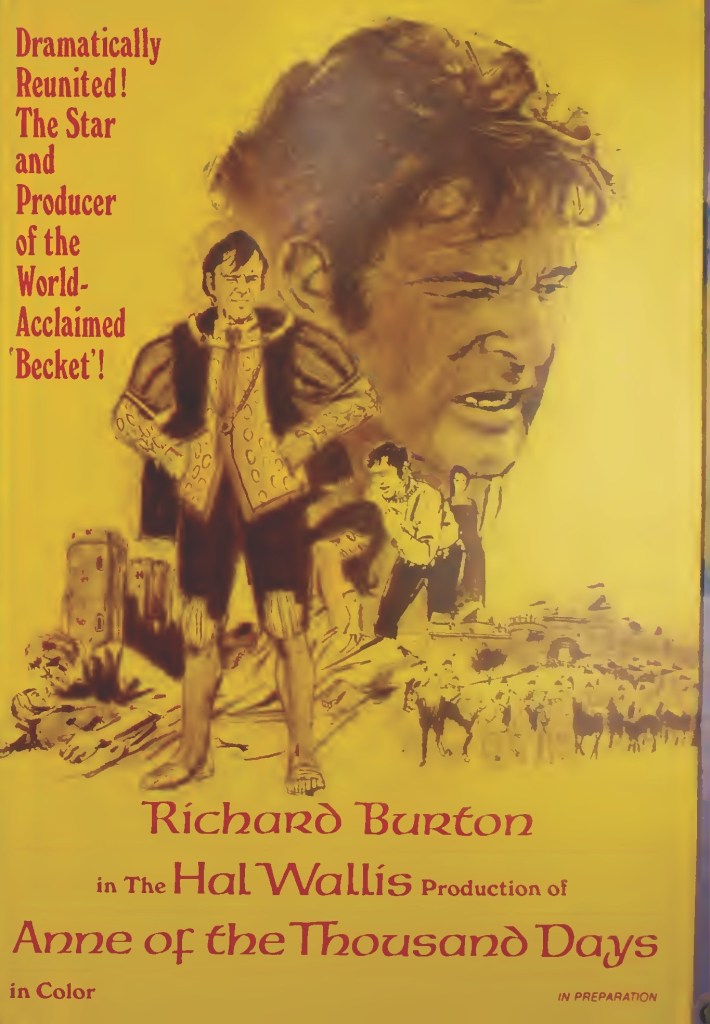
Anne of the Thousand Days (1969) ****

You can keep your Succession dramas with families squabbling over a mere business empire. And even the more woke Snow White (2025) doesn’t remotely tackle the realities of marriage in medieval times when the role of a woman, in an era when more children died in childbirth or soon after than actually survived, was to produce an heir. And not just random in gender. But male.

So, on the one hand, you can sympathize with the dilemma of English King Henry VIII whose Spanish wife Katherine, while eminently fertile – several babies died in childbirth – had managed only one male offspring, who died shortly after birth, and one female, Mary. All the queen had given him, rails Henry (Richard Burton), are “dead sons.” So with the future of one of the biggest kingdoms in the world at stake, Henry isn’t keen to leave it in the hands of a woman. Even if he can arrange a suitable marriage, it would inevitably mean letting the kingdom fall into the hands of someone he doesn’t trust.

But in the twisted world of inheritance, here’s the rub. Henry shouldn’t be king. His elder brother Arthur should have, except he died before he could succeed to the throne. And Katherine, married to Arthur, should have been Queen.  But Spain at that point was as powerful, if not more so, than England, so Henry decided to marry his sister-in-law, on the basis that the marriage was never consummated, and the Pope, the authority in such matters, gave the go-ahead, glossing over the technicality of what was considered in those days incest.

So, Henry comes up with a cunning plan. He will go trophy-hunting and marry a younger wife. This isn’t just because he’s fallen in love with Anne Boleyn (Genevieve Bujold). He doesn’t have to marry her to have sex with her. He’s already having sex with her mother (Valerie Gearon) with the tacit approval of her father (Michael Hordern) who receives benefits in kind.

To add complication, Anne is promised in marriage already, and deeply in love. Siring a bastard son would inevitably cause an inheritance battle. So legitimizing the relationship seems the only way forward. This time the Pope isn’t keen, mostly because the Spanish have invaded the Vatican and if he wants to survive he can hardly annoy his captors.

But when the Pope refuses, Henry takes the nuclear option, and splits from the Catholic Church, not just taking advantage of the old church vs state argument, but also made aware by Thomas Cromwell of the sudden increase in wealth acquiring the items of the Catholic Church would bring.

Sorry to bore you with a history lesson but this intriguing backdrop – as well as the dazzling performances – is what twists this away from lush costume confection into riveting drama. This was the peak of a trend in historical movies that shifted the emphasis from heroic action to the down’n’dirty. Camelot (1967) to some extent had begun the trend but only dealt with infidelity and was given something of a free pass because it focused on the iconic Knights of the Round Table and a legendary love affair. The Lion in Winter (1968) primarily concentrated on  inheritance.

Depending where your sympathies lay this was either corruption writ large or a battle to free the ordinary man from the yoke of religion.

Primarily, it works because it revolves around the human drive, the king refusing to bow the knee to anyone, Anne Boleyn seduced not just by gifts but by this older man who is much more virile and passionate than her younger somewhat effete fiancé (and who couldn’t be dazzled by a man risking his kingdom for her love?) – and the courtiers looking after number one, always seeking a way of winning the king’s favor, and as importantly, not losing it, for that could lead to banishment or execution.

No one dares stand in Henry’s way – except Sir Thomas More (William Squire) and here he’s merely a small subplot (not center stage as in A Man for All Seasons, 1966) – not even the religious hierarchy, especially Cardinal Wolseley (Anthony Quayle), head of the Catholic Church in England, who keeps a mistress.

The tragedy is that the cunning plan unravels. While Anne is fertile enough, she gives birth to a girl, Elizabeth (the later Virgin Queen). Convinced she’s not going to present him with the male heir he so desperately desires, he hatches a conspiracy that sees her executed for adultery and treachery, leaving him free to marry again and continue his mad obsession.

So we’ve got all the back-biting and bitching we expect from court, plus regal revelry, costumes, castles, and in the middle of it all a driven king and a feisty woman, not by any means a pushover, and not either going unwillingly into his bed. This would be a match made in heaven except that’s probably the last place, the way things stand, the king would be welcome. He’s very aware of excommunication and it shows the power of the Catholic Church that its teachings are so embedded in his brain that he fears that consequence.

This is rich in performance – Richard Burton (The Spy Who Came in from the Cold, 1965), Canadian Genevieve Bujold (The Thief of Paris, 1967) and Anthony Quayle (East of Sudan, 1964) were Oscar-nominated. The only significant figure in the production not to receive one of the movie’s ten nominations – including for Best Picture – was director Charles Jarrott who pulled the whole thing together. Maybe it was thought he was rusty, not having helmed a picture since Time to Remember seven years previously.

The acting is particularly well-judged by the two principals, Burton could easily have lurched into cliché, and Bujold into passivity. Others worth noting are Irene Papas (The Guns of Navarone, 1961), Michael Hordern (Khartoum, 1966), Valerie Gearon (Invasion, 1966)  and Peter Jeffrey (The Fixer, 1968).

Based on the play by Maxwell Anderson (The Bad Seed, 1963), screenwriters John Hale in his movie debut and Bridget Boland (Gaslight, 1940) manage to balance what could be dry subject matter with fragility and tragedy.

There couldn’t be a better demonstration of women used as pawns and collateral damage in male power struggles.

Totally absorbing.

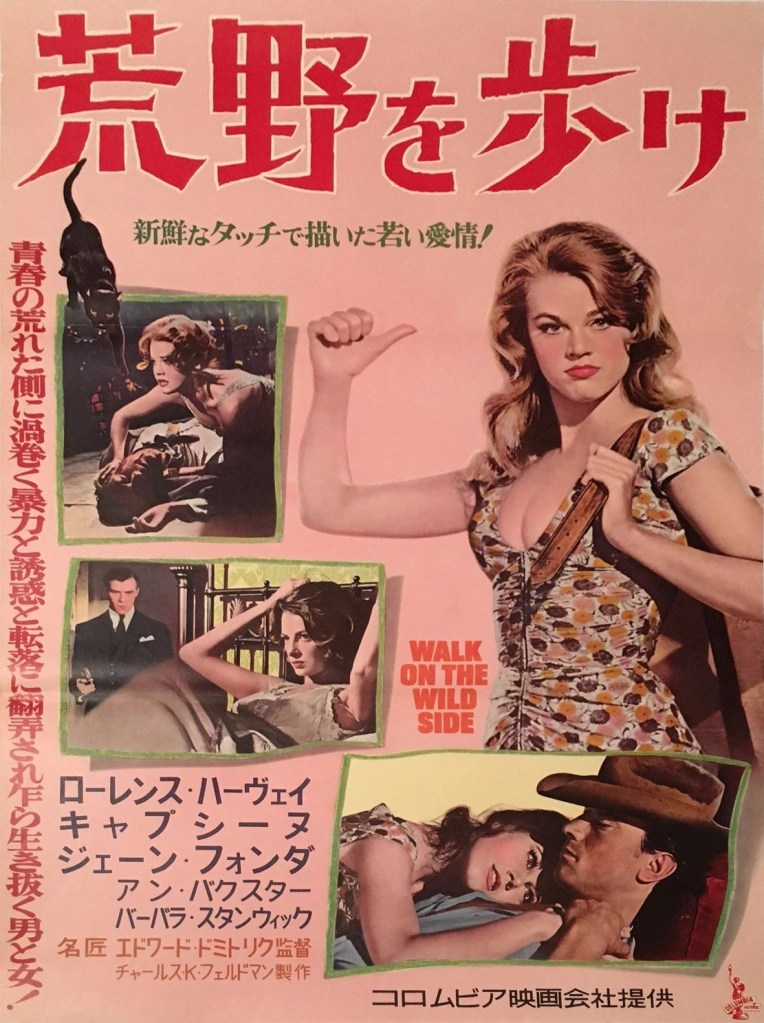
Walk on the Wild Side (1962) ***

As much as the censor would permit – would be the subtitle. While not as harsh as the Nelson Algren source novel, it’s still, wrapped up in a bitter romance, a more brutal than heretofore expose of the sex worker, far removed from the gloss of Butterfield 8 (1960) or the romantic comedy of Never on Sunday (1960) and Irma La Douce (1963).

The initial thwarted romance lacks the tragic element. It falls apart due to the mundane. After a four-month affair Dove (Laurence Harvey) can’t commit to artist Hallie (Capucine) because his father is too ill to leave. So she ups sticks and heads for New York, hooks up with buyer Jo (Barbara Stanwyck) who turns out to invest in more than art, and ends up in a New Orleans brothel where as well as servicing the clients she can continue making sculptures.

After his father dies three years later, Dove heads to New Orleans to find her, but with no idea where to look. He falls in with vagabond-cum-thief Kitty (Jane Fonda) and eventually having dumped her due to her thieving ways takes refuge in a café whose owner Teresina (Anne Baxter), a victim of Kitty, offers him employment. She suggests he puts an advert in a New Orleans newspaper and just when he’s giving up hope and Teresina is getting up her hopes that she can win him over romantically he gets a phone call.

He’s clearly unaware that Hallie is a sex worker and after romancing her sets them up in an apartment. Hallie abandons the reunion after a night or possibly just an idyllic afternoon. Hallie’s reluctance is twofold. She’s become accustomed to the relative laziness of her life, she’s a high-class lady and is not worked too hard, plus she’s got accommodation and a studio to work in and she knows her boss Jo is sweet on her. On the other hand, it would be difficult to quit, the brothel employs tough guy Oliver to keep the girls in line and nobody’s going to want her to be giving it away for free.

Kitty, now working in the establishment, annoyed that he previously rejected her advances, gives Dove a full run-down on his lover. And there’s a legal catch that Jo is quick to take advantage of. Since Kitty is now a sex worker and it was Dove who took her with him to New Orleans he could be prosecuted for sex trafficking of a minor. When that doesn’t work, Dove receives a beating.

Kitty now decides Dove isn’t so bad after all, feels remorse at her role in his downfall, and helps him get back to café where Teresina cares for him and gets her hopes up once again. Then she helps Hallie escape and then fesses up to Oliver where she is. It doesn’t end well – although the censor would be pleased since after the climactic fracas the brothel is closed down and Jo and Co jailed.

It’s got a Tennessee Williams feel, though everything set in the South appeared to come into his bailiwick, but most of the realism is understated, as it would have to be in those times. Jo’s a groomer of the vulnerable, and for all Hallie’s artistic ambition she’s every bit as easy pickings as Kitty who is grateful to be freed from prison where she was arrested as a vagrant and reckons being given money for fancy clothes and having a roof over her head is good enough reward for selling body and soul. Her role in the denouement is a mite too convenient from the narrative perspective but it will do as a means of tacking on a tragic ending.

It helps enormously that most of the performances are understated. Laurence Harvey (A Dandy in Aspic, 1967), more commonly a scene-stealer, is good value and Barbara Stanwyck (The Night Walker, 1964) only requires a stare to make her feelings known. Though Capucine (Song without End, 1960) was criticized at the time I felt her performance was measured. Jane Fonda (Barbarella, 1968) was more of a wild card and it didn’t seem believable that such a flighty piece was going to become principled.

You can thank director Edward Dymytryk (Shalako, 1968) for keeping the actors in line and maintaining an even tone without spilling over into the melodramatic. John Fante (My Six Loves, 1963) and Edmund Morris (The Savage Guns, 1961) adapted the book. Special nod of appreciation to Saul Bass for the credits.

Born Free (1966) ***

Unusual mix of the sentimental and the unsentimental, mixing soft-centered animal features like That Darn Cat (1966) where cute beasts cause mayhem with the kind of realism espoused by Sir David Attenborough (Planet Earth, 2006) where nature is red in tooth and claw, though skipping the irony of game warden-cum-conservationist George Adamson (Bill Travers) bringing up the cubs of the leonine parents he has shot dead.

With wife Joy (Virginia McKenna) they decide to rear the baby animals. Joy is most attracted to the runt of the litter, Elsa. Cue much hilarity as the animals destroy their house, knocking over anything standing, pulling down curtains, breaking plates, and like any youngsters resisting bedtime. Joy is so distraught at having to get rid of the grown-up cubs, despatched to zoos, that her husband holds onto Elsa.

If Joy can’t face shipping the cub overseas, she’s unwilling to face up to the fact that the only other alternative is to groom her for a life in the wild. A tame animal let loose would hardly survive a minute. So they’ve got to train Elsa to hunt. This doesn’t work out, Elsa finding herself at the wrong end of the hunting business – attacked by a warthog – or too inexperienced to know not to go near a herd of wild elephants. When she crawls home nursing her wounds, George is on the verge of giving up, but Joy wishes to persevere, resulting in scenes of the cute Elsa now suddenly red in tooth and claw and savoring her kill.

Now, all that’s left is finding her a willing mate. When that’s achieved, it’s job done, though when Elsa returns for a visit she’s accompanied by her own cubs.

And if you’re occasionally bored by the cutesy elements and wish the movie would get a move on, you can always savor, as I did, the Oscar-winning music by John Barry. It’s what these days would be deemed a feel-good movie but that’s only if you wriggle out of the irony.

The problem for the big cats in Kenya was that they were prey to illicit big-game hunters and if that had been the reason for the cubs being orphaned it would be a better fit for the general theme. But, basically, what lions don’t seem to realize is that they can’t treat humans like any other prey. There’s some weird supposition that they can prefer the taste of human flesh, rather than the more obvious reason why humans are attractive being that, unless armed, they can neither run away nor defend themselves like all the other jungle occupants.

There’s an unspoken rule – to which the lions are obviously not privy – that if you get a reputation as a man-eater then that friendly game warden who’s otherwise on your side is going to come after you and shoot you dead. It would only be luck that your offspring might end up with a couple of friendly humans rather than as dinner for other predators.

So being “born free” comes with the proviso of not getting in the way of humans.

Real life couple Bill Travers (The Bridal Path, 1959) and Virginia McKenna (Carve Her Name with Pride, 1958) were considered well past their sell-by date, neither having made a picture in five years. But they seem to embody the characters well, McKenna’s acting recognized by the Golden Globes.

James Hill (A Study in Terror, 1965) directs from a screenplay by Lester Cole (Operation Eichmann, 1961), blacklisted as one of the Hollywood Ten, and Joy Adamson, author of the eponymous bestseller.

While you’re probably not as nit-picky as me, you might well figure this is well past its sell-by date or, equally, you might hail it as the precursor of an animal rights campaign.

Blackeyes (1989) *****

Absolutely mesmeric. Would be catnip for contemporary audiences with its shifting time frames, juggling perspectives, narrative sleight-of-hand, and heavily feminist-oriented outlook with its slating of misogyny. Ripe for a remake and with the adventurous directors around these days they should be vying for the opportunity. But I should warn you, steer clear of the version that showed on Amazon Prime which cut the four-part television series in half.

British screenwriter Dennis Potter was something of a national institution before this appeared, the BBC ponying up vast sums (in television terms) for his experimental programs that included the likes of Pennies from Heaven (1978) – remade as a movie three years later with Steve Martin – and The Singing Detective (1986) (remade seventeen years later with Robert Downey Jr) and his blend of pastiche and males struggling with raw emotion had made him not just a household name but accorded him worldwide acclaim.

However, just as Peeping Tom (1960) put the kibosh on the career of Michael Powell, Blackeyes proved a major critical reversal and after the mauling it received and outraged headlines in the national media Potter somewhat lost his mojo and automatic critical favor although Lipstick On Your Collar (1993) helped a certain Ewan McGregor to make his mark.  

In part, Blackeyes is way ahead of its time in the use of the stylistic devices mentioned above which when incorporated into the works of, for example, David Lynch or Christopher Nolan, were hailed as groundbreaking.

So this is a three-hour-plus show setting precedents that not only break all the rules of narrative but blows them sky-high and has so many layers you can hardly keep up and that narrative spinning continues to the very end. You could almost entitle it “Whose Story Is It, Anyway?”

Elderly author Maurice (Michael Gough) has fashioned the experiences of his model niece Jessica (Carol Royle) into a bestselling literary novel. Leading character Blackeyes (Gina Bellman) is taken advantage of so often by men that she commits suicide, wading out dressed in sexy night attire into a lake.  Although Maurice makes a fine specimen suited-and-booted and talking to admiring audiences at book fairs, in reality he’s a sodden old drunk living in a threadbare apartment with a teddy bear. But he’s intellectually adroit as shown with his verbal duels with a smug journalist who spouts artistic jargon.

Jessica is so annoyed that she has not been acknowledged as the source of her uncle’s novel – he claims it is a work of imagination – that she begins to write her own fictional version of her life story, calling into question some of the events in her uncle’s account. So that’s two perspectives already. Stand by for a third, that turns the entire story on its head.

It appears Blackeyes (Gina Bellman) has not committed suicide. Detective Blake (John Shrapnel) is convinced she has been murdered, especially after he finds a list of names stuck in her vagina (yes, despite Blake gamely searching for every euphemism under the sun, the actual word, to add to the shock and horror of an audience and especially critics reeling from the sex and nudity, was used on the BBC) and later finds her diary which provides another version of events.

He’s an old-school detective, and while not beating anyone up, not above handing out a good thump in the ribs to anyone giving him lip. So while following Maurice and his niece, we are also finding out more about Blackeyes via the cop’s investigations and how she was taken advantage of in the advertising profession and world of photographic modeling. She is even the one who gets the blame when someone tries to rape her.

Her life could be viewed in two ways, as a sexually independent woman or as a victim of MeToo.

To counteract what is presented as a sordid existence there comes into her life a gentler soul, advertising copywriter Jeff (Nigel Planer) and he’s writing and rewriting versions of a more old-fashioned romance where they enjoy a meet-cute (of sorts) and get talking and move onto romantic walks along the seaside. But Jeff’s too diffident a fellow to appeal to Blackeyes and he doesn’t even get to first base. But it also turns out that he’s been watching Jessica through binoculars (they live across the street from each other) and there’s a marvelous moment when he realizes that Blackeyes occupies the same apartment as Jessica and that he could at that very moment be watching himself.

All the way through there’s been a male voice-over, measured, commenting on the action, advising on twists in the story, adding a different perspective to characters, offering many polished bon mots, and it takes you quite a while to realize that this is an entirely new voice, and doesn’t belong to either Maurice or Jeff. In the ordinary run of things, this character would turn out to be the Hercule Poirot of the piece, putting the jigsaw together, explaining all.

In fact, he’s another element of the jigsaw. He’s not just the narrator. Everyone we’ve seen are characters in his fiction. But they don’t always obey the rules and at the very end Blackeyes escapes.

So just a stunning piece of television. Although Michael Gough (Batman Returns, 1992) received the bulk of what little plaudits there were, the series is carried by New Zealand actress Gina Bellman (Leverage, 2008-2012, and Leverage: Redemption, 2021-2023) who is simply superb. She rises above what could easily have been a cliché – and in some respects was written as a cliché version of the “dumb blonde” at male beck and call. Her comic timing for a start turns many scenes on their heads. But what’s often been overlooked is her transitional skill. She moves from male fantasy figure to believable human being and from there to rebel. And that takes some doing.

Gina Bellman hates talking about this series, my guess on account of the nudity and the backlash that created for a young actress, but she should be proud of her achievement. This is more than solid stuff.

Writer Dennis Potter also directed and his camera is always prowling around the edges.

The word auteur was over-used but this genuinely fits that category.

A masterpiece.

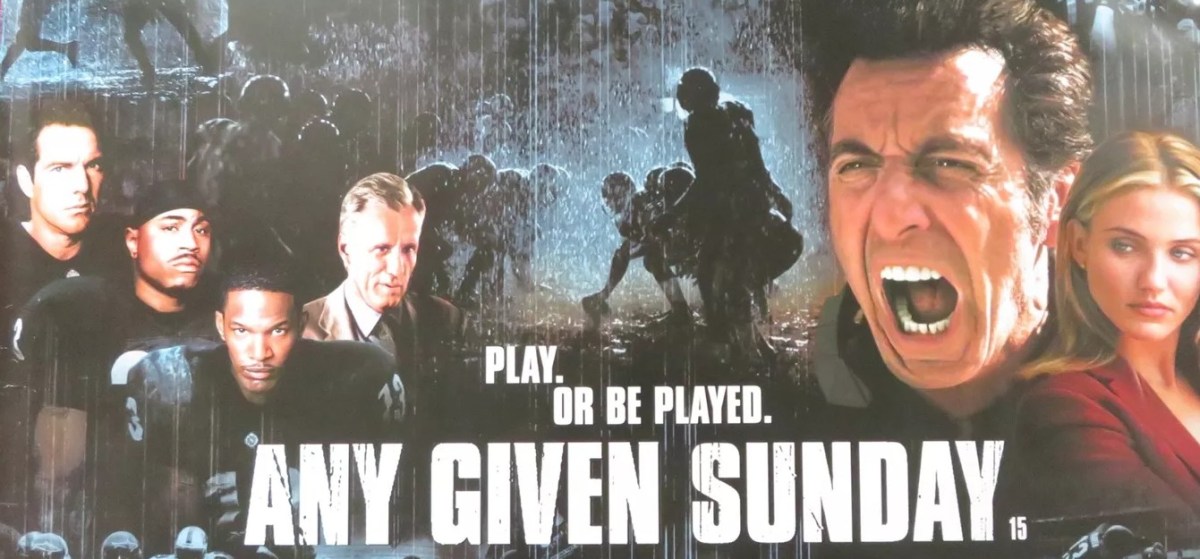
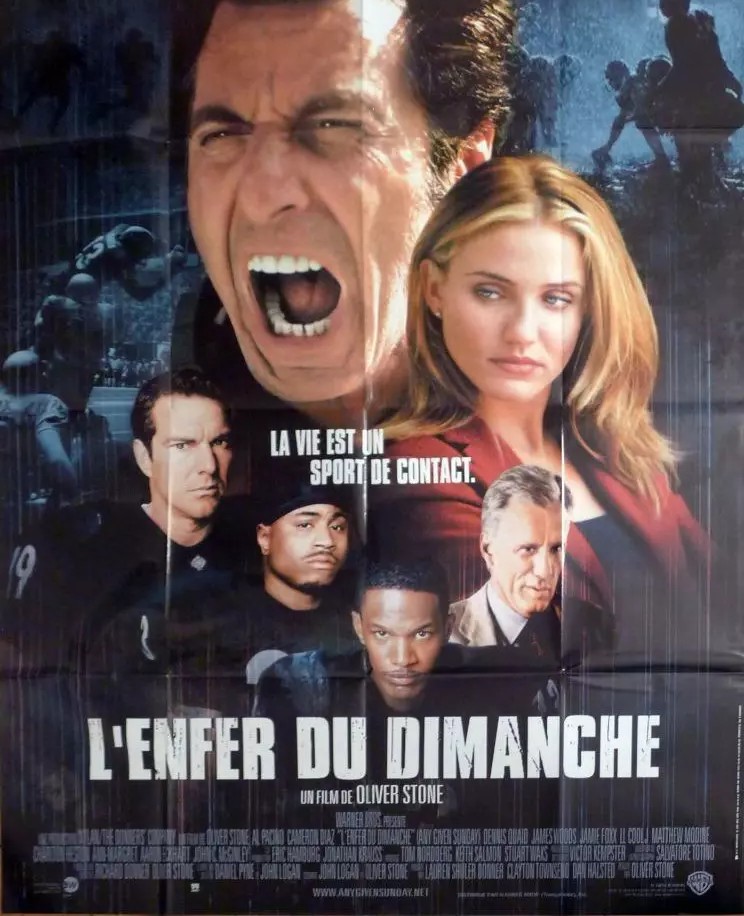
Any Given Sunday (1999) *****

It’s always with trepidation that I go back to a banker, one of my favorite films, hoping that it will remain timeless, and still good enough for a place on my all-time personal Top Ten. I’d planned a double bill of Kingdom of Heaven (2005) and this but the former proved so disappointing that it took me a while to pluck up the courage to watch Oliver Stone’s kaleidoscopic American football epic.

My fears proved misplaced and this is bearing in mind that I know nothing about the sport and have little understanding of what always appear arcane rules that make little sense to someone brought up on the  more disciplined (at least in my eyes, rules-wise) football/soccer (or the hybrid “soccerball” as my grandkids refer to it). I’ve always been a fan of sports movies, which means American sports movies, because with the exception of Chariots of Fire (1981) the British don’t seem to have the knack. So I’m used to following movies where I don’t necessarily understand what’s going on the field of play.

This is driven by three compelling narratives – all power duels of one kind or another, between owner Christina Pagniacci (Cameron Diaz) and various politicians, between her and coach Tony D’Amato (Al Pacino), and between Tony and arrogant rising star quarterback Willie Beaman (Jamie Foxx). And while all these battles are a mixture of discreet management and full-blown blood-and-thunder shouting matches, the movie is liberally sprinkled with tiny cameo moments that add depth.

There’s a blink-and-you-miss moment when team physician Dr Mandrake (James Woods) is seen in conversation on the sidelines with a blonde cheerleader. The next time you see her is when she chooses not to follow Mandrake when he is fired, as curt a signal as you’ll ever find that position rather than personality equates to worth. She appears for one more nanosecond and this time in conversation with his replacement Dr Powers (Matthew Modine).

The saddest moment is when cute sex worker Mandy (Elizabeth Berkley) tries to let Tony down gently that theirs is purely a financial, not romantic, transaction. But that’s run close when Willie’s girlfriend Vanessa (Lela Rochon) is given the brush-off by the established WAGs. And the toughest scene, amidst all these high-powered testosterone-driven adrenalin male and female junkies, is when injured star quarterback Cap Rooney (Dennis Quaid) is given the mother of all slaps by wife Cindy (Lauren Holly). All such moments are merely incidental to the three main narratives, as is the battle for music supremacy in the dressing room, when the head-bangers among the team turn the volume up to eleven.

Revenge is a theme. And that can run from setting loose your baby alligator in the team shower room, taking a buzz saw to a rival’s ultra-expensive automobile or his team-mates punishing Willie for his overweening arrogance by not protecting him on the field and allowing him to be battered by the opposition. Though there’s little as sweet as Tony handing Christina her come-uppance by stealing away Willie for his new team. But that’s run close by the grim smile of satisfaction on the face of the Football Commissioner (Charlton Heston) when he, too, brings her up short. And by Tony stiffing cocky pundit Jack Rose (John C. McGinley). Indulgence, by comparison, is sniffing coke off a naked woman’s breast. There’s even moments of comedy, Willie being duped into taking flowers to the coach when invited for dinner, and the holding-up-the-hand scene.

And all of this is before we get to the meat of the movie, the games that mean absolutely everything – more than sex, family and drugs – to the participants. Sometimes Tony, a 30-year-old veteran, conjures up the words to inspire his team, sometimes he doesn’t, occasionally he turns away from them in disgust, occasionally it’s left to the padre (in the days when “take a knee” meant something else) to inject some common sense into the overloaded equation.

If all these characters are larger-than-life that’s no surprise because there’s little room in the hard world of top-level sport for the shy and withdrawn. So shouting matches are titanic. Lives play out only in the fast lane. Winners get the prom queen, losers get…nothing. And unlike sports originating from Britain – like football/soccer/soccerball or cricket – there are no draws. If you’re not a winner, then you’re a loser.

The essential tale of staying on top, maintaining a winning role, reversing a losing one, getting to the playoffs, the holy grail of winning the Super Bowl (known here as the Pantheon) and the coveted ring that accompanies victory, is always going to be packed with drama. But director Oliver Stone (Platoon, 1986) adds other layers, the daughter whose father wanted a son, the coach who’s driven away everyone who ever loved him and now pays through the nose for nights of affection, the quarterback so infused with self-belief and victim mentality that he learns the hard way he needs help.

You can’t deny Stone his quirks, the lightning bolts or seemingly endless snatches of pop tunes and shadowy figures who appear out of nowhere, and cuts to cheerleaders or crowds, and the paraphernalia that surrounds the game. But not a moment is wasted.

The acting is top-notch. Al Pacino (The Godfather, 1972) gives one of his best performances, Cameron Diaz (The Mask, 1994) upends her cute screen persona, James Woods (White House Down, 2013) plays another version of his screen schemer, Jamie Foxx (Back in Action, 2025) gives notice of his talent. Written by John Logan (Gladiator, 2000), the director and Daniel Pyne (The Manchurian Candidate, 2004).

Best-ever sports movie (though maybe tied with Field of Dreams, 1989).

Without doubt retains its place on my All-Time Top Ten.

Satan Never Sleeps (1962) **

Of all the misguided sentimental anti-Communist drivel, this is a very poor swansong for triple Oscar-winning director Leo McCarey (Going My Way, 1944). A tone that’s awkward enough all the way through goes straight through the wringer when we are asked to accept without question the actions of a rapist. Such genocidal rape as the conqueror visits on the conquered would sit less comfortably with a contemporary audience.

Most of the problem is the set-up. Apart from those pesky Communists invading a Christian Mission, in other circumstances this would have settled into a verbal sparring match between about-to-retire old priest Fr Bovard (Clifton Webb minus trademark moustache), full of tetchy quips, and his younger replacement Fr O’Banion (William Holden) trying to shake off the unwelcome advances of even younger native Siu Lan (France Nuyen). There would be a servant or maybe a more high-flown doctor whom O’Banion could push Siu Lan onto.

There’s laffs  aplenty if you’re easily satisfied with the likes of a servant (Burt Kwouk in an early role) who believes thieving is compatible with Christianity, O’Banion’s woeful attempts at cooking and his inability to shoo away the ardent Siu Lan, and the priests risking breaking a golden rule of their religion to enjoy a glass of wine before the clock strikes midnight.

The arrival of the Communists is not initially too tiresome, Bovard doing his best headmaster impression keeps them in line, Communist leader Chung Ren (Robert Lee), an ex-Christian, sweet on Siu Lan. Things get tricky when Chung Ren’s attempts to forcefully claim the woman are deterred by O’Banion who is tested several times on the old Christian principle of turning the other cheek before resorting to unchristian violence.

Chung Ren then rapes Siu Lan anyway. But when she stabs him in the back and the rapist is forced to ask O’Banion to go to another mission to fetch the necessary penicillin to prevent infection spreading, the older priest is inclined to ignore the request and let him die. O’Banion thinks he has struck a deal to free the old priest in exchange for fetching the medicine, but Chung Ren reneges on the agreement and the priests are tortured and stand trial.

Meanwhile, Chung Ren has a change of heart, or so it seems, after Siu Lan gives birth to his son. But, actually, this might be more to do with the fact that he has been demoted for not being a good Communist, inclined to enjoy the finer things in life rather than share them out with his comrades. And it’s only when he’s told he’s going to be sent away to some kind of Chinese Gulag that his principles make an appearance and he helps the two priests and Siu Lan and her baby to escape.

I could see maybe Siu Lan being forced into marriage by Chung Ren in the Communist state while he was in a position of importance; she would have no choice in the matter. But for her to show the same acceptance in a democracy outside China smacks of the worst kind of wishful thinking. Sure, the Christian God is all-forgiving and, technically, all Chung Ren would have to do was confess the sin of rape and equally technically he would receive absolution and therefore in the Church’s eyes be free to marry.

But O’Banion overheard the rape. He’s a witness. That’s no use in the Communist society, but in a democracy you would have thought he would have been seeking prosecution. As he was a witness and this was not something protected by the sanctuary of the confession, he would not just be perfectly within his rights but would have to seek out rule of law.

I have never heard of a rapist and the woman he raped living happily ever after and I doubt if it would ever have been considered conceivable even in the early 1960s.

That aside, William Holden (The Devil’s Brigade, 1968) and Clifford Webb, in his last picture, are good value as the squabbling priests, less so when they venture into dubious morality. France Nuyen (A Girl Named Tamiko, 1962) doesn’t get a fair shake, required to be the cliché happy grinning native and then provided with no opportunity to state her case against her rapist before she’s pushed, for the sake of a fairy tale ending, into marriage.

Written by the director and Claude Binyon (North to Alaska, 1960) from the bestseller by Pearl S. Buck.

A Dream of Kings (1969) *****

Sometimes great movies just disappear. Even if they pick up some critical traction on initial release, as here, they flop at the box office. And they are not revived because the production company goes bust or the rights are complicated. Or, more likely, they don’t fit into audience expectation. All three stars here completely play against type, outliers in career portfolios. We have become so accustomed to the attraction of stars according to their screen personas that unless they are known to completely change their screen characters with every outing anything that’s different to the norm becomes unacceptable.

Director Daniel Mann (Ada, 1961) was best known for producing Oscar-winning or Oscar-nominated performances from female stars. He was immensely skilled at making audiences sympathize with the most flawed women. Here, he does the same for Anthony Quinn, in a performance that should have had Oscar voters lining up but was dismissed for all the wrong reasons. Theoretically, one of the film’s problems is the dialog. We are so used to a script full of cut-and-thrust or witty putdowns that we fail to recognize a screenplay, that in much the same way as a stage play – but without that form’s inherent artificiality – lets characters live and breathe, explore depths that are just not possible except in fleeting moments in the normal construction of a movie.

Most scenes here begin one way and then move in all sorts of directions, sometimes ending up back where they started, but most often going somewhere unexpected, not in the sense of a sudden twist, but in digging deeper into relationships and understanding that marriages are built on shifting sands, and not all of them perilous. There’s a lot of dialog and when you get a lot of long speeches it can make the actors look as though they’re hamming it up when in fact what they’re doing is opening up the character.

We shouldn’t like Matsoukas (Anthony Quinn) at all. He’s a gambler, a womanizer, drinks, comes home at sunrise, has nothing you’d call a real job.

And yet.

In his company you enter a world of possibility. By sheer force of personality he lifts gloom, even when it’s his actions that have caused it. He can convince the most downtrodden weaklings that they have something of worth.

When nobody has anything good to say about old drunk Cicero (Sam Levene), Matsoukas tells him he has a poker dealer’s graceful hands and provides solace just by befriending him. He convinces a 72-year-old man that the loss of his libido is not down to the old guy’s age but because in four years of marriage he has lost interest in his 31-year-old wife because she’s the one who has aged, physically less appealing, and then he teaches the desperate soul the gentle art of seduction, how to win a woman’s heart by putting her on a pedestal, treating her like a goddess, kissing her softly on eyes and ears rather than pawing her in frantic passion.

Just what Matsoukas’s job is – on the door it says “counsellor” which would suggest something  legal  – but in fact he’s a male version of an old wife and provides solutions to odd problems, a mother worried that her teenage son masturbates, for example.

He is the sort of guy who can wring triumph from disaster. He has just lost a bundle of dough at poker but the way he tells it you’d think he’d won. Instead, he appreciates the drama of it all, the way it makes a great tale even if he’s the loser. Naturally, wife Caliope (Irene Papas) doesn’t see it his way. She’s on her knees with trying to feed her three children from the scraps that fall from his gambling. Though when he wins big, they live like kings.

Although he still has a lusty sex life with Calope, and can mostly coax her round, he has fallen for widowed baker Anna (Inger Stevens), attracted to her in part to alleviate her grief, pull her out of the darkness.

And he cannot face up to the potential loss of his young son who has three months to live and has it fixed in his own mind that the boy will be cured if Matsoukas can expose him to the sunshine and the ancient gods of his Greek homeland, though he lacks the $700 required for the air fare.

Each sequence is long, carefully calibrated, giving time for the exploration of a wealth of emotions. Outside of the three main narratives are two other stand-out scenes. In his sermon a priest rails against the evils of life insurance that makes people welcome death yet argues, ironically, that death is a great joy and should not be feared. And there’s a party where Matsoukas on the dance floor is a magnet for every woman in the room.

This is an Anthony Quinn (The Shoes of the Fisherman, 1968) devoid of all trademark abrasiveness, the loud voice gone, trying to gouge every ounce of joy from a forbidding world. He has a very tender relationship with his dying son, inventing a game with fake telephones to deal with the boy’s fears, and is very playful with his two daughters. He is constantly wooing his wife, in part to ease the pain he causes her, but mostly because he wants them to get the most out of life.

This is a different Irene Papas (The Brotherhood, 1968) too, not the fiery woman or dutiful wife of her screen persona. Whatever anger she feels is subsumed by sorrow and she is always willing to let her husband fire up her heart as in the old days. Actresses don’t get such complex roles these days.

And all the pent-up fragility of Inger Stevens (Five Card Stud, 1968) is suddenly let loose as she twists her entire screen persona of tough woman in a man’s world – usually a western – on its head. Her scenes with Quinn are breathtaking. Unfortunately, this was her final film – she committed suicide shortly after. But she could not have found a better swansong, one that extended her range.

As he always does, Daniel Mann doesn’t take his main character’s side, but while extracting sympathy for character predicament and perspective, still lets the audience make up his mind. This could easily have gone all maudlin, the child miraculously recovering, the flight to Greece to find a rare cure, all Matsoukas’s delusion revealed as nothing more than true faith, but it’s more hard-edged than that. At the end Matsoukas has his exterior carapace ripped apart, beaten up, ostracized for committing the worst crime of a gambler – cheating – in dire straits.

And yet.

Written by Ian McLellan Hunter (Roman Holiday, 1953) from the bestseller by Harry Mark Petrakis.

I just adored this.

The New Interns (1964) ***

Columbia had turned this series into a glorified New Talent Contest. It didn’t spend much cash buffing up the sequel in terms of narrative or characters, so it’s mostly enjoyable to see just how well the studio was at spotting talent. In that regard this outing was as profitable as the original. This marked the debut of George Segal (The Quiller Memorandum, 1966) who quickly became a major marquee name. Also brought into the mainstream was Inger Stevens (Five Card Stud, 1968). Receiving a welcome career boost was rising star Dean Jones, though Disney (The Love Bug, 1967) rather than Columbia took better advantage of his skills, and in the comedic rather than the dramatic vein.

Various stars reprised their roles including top-billed Michael Callan (You Must Be Joking, 1965), signed up to a long-term deal. But most of the others in this category made their names through television. Telly Savalas (The Assassination Bureau, 1969) was the cop Kojak (1973-1978); Stefanie Powers (Warning Shot, 1967) flourished as The Girl from U.N.C.L.E. (1966-1967) and in Hart to Hart (1979-1984); and Barbara Eden went quickly into I Dream of Jeannie (1965-1970).

The upshot is that, depending on your taste, you might end up talent spotting yourself, shrieking with glee at spotting an old favorite, or perhaps so many of them, in what was, effectively, an all-star (of the minor kind) cast and paying less attention to the various storylines.

Most of the narrative energy revolves around various characters coming together in romantic entanglement – Dr Alec Considine (Michael Callan), while more inclined to play the field, ends up with Nurse Laura Rogers (Barbara Eden); despite initially being at odds Dr Tony Pirelli (George Segal) and social worker Nancy Terman (Inger Stevens) hook up; and various other romances are short-lived.

Outside of this, newlyweds Dr Lew Worship (Dean Jones) and wife Gloria (Stefanie Powers) discover he is sterile. The more powerful sequence relates to Nancy being sexually assaulted by juvenile delinquents who grew up in the same tough neighbourhood as Tony. As you might expect, the thugs end up in hospital and cause a fracas in which Alec is injured.

Tony has all the best lines. Invited to chance his arm with the nurses, he snaps that he didn’t come to the hospital to “learn to kiss.” Pushed out of the way by resident Dr Riccio (Telly Savalas) he retorts that he didn’t come to deliver messages. And so on, the most driven of the new intake, and the most surly, his initial encounter with Nancy has him upbraiding her for crying in front of a patient.

Decent soap opera as soap operas go, but without the more challenging aspects of the original. In an era when the series movie was beginning to take shape – primarily in the espionage arena – you can see why Columbia thought this might run and run and eventually the studio had another go at the concept, but this time as a television series.

Directed by John Rich (Boeing, Boeing, 1965) and written by big screen debutant Wilton Schiller from the bestseller by Richard Frede.

George Segal and Inger Stevens are the standouts.

Unstoppable (2010) ****

Fitting swansong for director Tony Scott (The Hunger, 1983). Throwback to the disaster movie of the 1970s when something enormous is going to be decimated, and lives, in this case three-quarters of a million citizens, are put at deadly risk. Distant cousin to Speed (1994), which bears no comparison in the potential mayhem department, since an ordinary bus carries a fraction of the power of a train with 30-odd train cars (carriages to the English) filled with deadly toxic cargo barreling along at 60mph. Basically, “a missile.” And while other trains can be sidelined to get out of its way, it’s headed for an unavoidable obstacle, a piece of raised track in a major city which bends so sharply it can only be safely negotiated at 20mph or thereabouts.

And while said train is a wrecking ball when it comes to anything that happens to be on the track at the same time, the tail end of another train for example or a horse-box, it runs not so much on action as character. The various explosions are just there to remind us how dangerous the damn thing is and to raise tension by perilous degrees.

On board are two opposites, veteran driver Frank (Denzel Washington) and entitled surly know-it-all rookie Will (Chris Pine), who’s the train conductor and technically, I guess, in charge. Not quite open hostility but not far off it.

Frank’s a widower with two daughters who work, as he shamefacedly admits, in Hooters (look it up) while Will has been slapped with a restraining order from his wife and lucky not to be facing a jail sentence for pulling a gun on a cop. On top of that, in a money-saving ploy, Will’s the kind of employee recruited by the company to replace Frank, who, it turns out, is only three weeks away from enforced retirement. So that’s a twist on the gangster trope of the character planning one last big job.

I should point out that thanks to a lazy employee, this is a runaway train, no driver on board, air brakes unconnected, other safety elements unharnessed, nothing to stop it picking up speed and heading straight to hell. Luckily, it’s not full of passengers. I’m being a bit cynical here because a trainload of shrieking passengers and back stories to take account of would have dissipated, rather than increased, the tension.

But there’s also in the back office boss Connie (Rosario Dawson) trying to do her job in the face of the corporate greed, money-grabbing chief executive Galvin (Kevin Dunn) more concerned about the $100 million the company will lose if this goes belly-up, not to mention the catastrophic effect on the share price, so he’s full-on in on barmy schemes to stop the train, including parachuting someone onto the train and trying to bring it to a halt in a much smaller town which can be more easily evacuated than one with a 750,000 population.

Needless to say, none of these dumb ideas work, but it’s fun to watch the high-ups get egg on their faces and watch the cost of the collateral damage escalate. All the while, this being Tony Scott, we’ve got helicopters whizzing around, a huge flotilla of cop cars on blue light duty, uniforms everywhere, and that amazing technical trick that Scott has mastered of having the camera racing past characters who are stock still.

Frank and Will operate like a tag team when it comes to saving the day, Frank hopping from car roof to car roof having come up with the great wheeze of applying the brakes on each individual train car (carriage to you English) and Will at a lower level engaged on similar hazardous enterprise and then not just leaping from a train doing 60mph to a vehicle racing  alongside doing 60mph but leaping back onto the train from said car going at an even higher speed.

Denzel Washington (Gladiator II, 2024) – who had been train bound the year before in Scott’s remake of The Taking of Pelham 123 (2009) – and Chris Pine (Don’t Worry, Darling, 2022) are on top form. As too is Rosario Dawson (Trance, 2013), for once given a decent role rather than just as a sidekick/love interest/femme fatale.

Written by Mark Bomback (Dawn of the Planet of the Apes, 2014). It’s worth noting that  actors looking for career longevity could do worse than follow the example of Denzel Washington who, since he became a top-billed star, has worked consistently with three directors, Tony Scott, Ridley Scott and  Antoine Fuqua.

A cracker.

I Thank a Fool (1962) ***

One of those bonkers pictures whose nuttiness is initially irritating but ends up being thoroughly enjoyable once you give in to the barmy plot and overheated melodrama. Murder, suicide, madness, illicit sex, blackmail – and that’s just the start of this farrago of nonsense. And set in Liverpool before The Beatles made it famous.

Christine (Susan Hayward), a doctor, is jailed when she kills her married seriously ill lover in a mercy killing. She’s not convicted of the murder but of the lesser crime of medical malpractice, but after serving an 18-month sentence finds she is unemployable, even in more lowly professions where her prison stretch counts against her.

When she is hired by the attorney Stephen (Peter Finch) who prosecuted her to look after his mentally ill wife Liane (Diane Cilento), the audience will already smell a rat given that Christine has changed her name and therefore the lawyer must have made considerable effort to track her down. His argument is that since she is no longer a qualified practitioner, she cannot advocate to have his wife committed to a mental institute, as a proper doctor would be required to, since Liane is clearly a danger to herself and other people. Your immediate suspicion is that Christine has been hired to take the rap once Liane is bumped off.

And it doesn’t take long for Christine to work out that not everything adds up. Liane is given enough rope to hang herself, access to a car to cause an accident, access to a horse which could easily bolt or fall.

Liane has been told her Irish father died in an accident where she was driving, the incident that triggered her madness. But when we discover the father, Captain Ferris (Cyril Cusack), is very much alive that’s the cue for a slew of unlikely events. When Liane finds her father, he’s not in the least a candidate for canonization, but an alcoholic. That triggers further mental trauma. And another accident, self-inflicted. After Christine administers pills, the young woman is found dead.

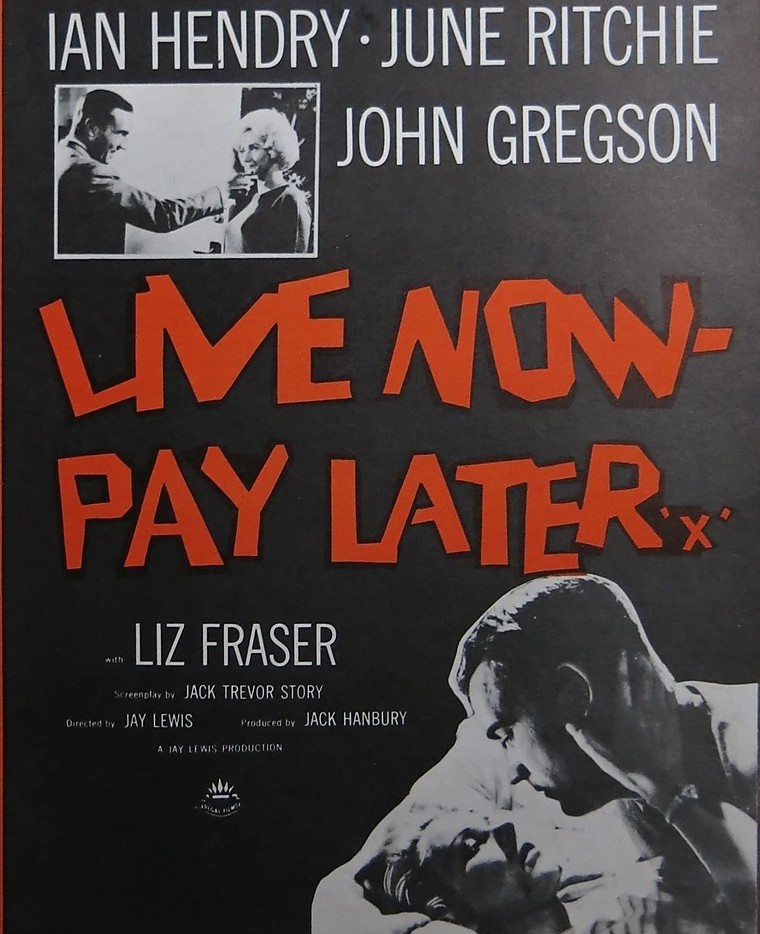
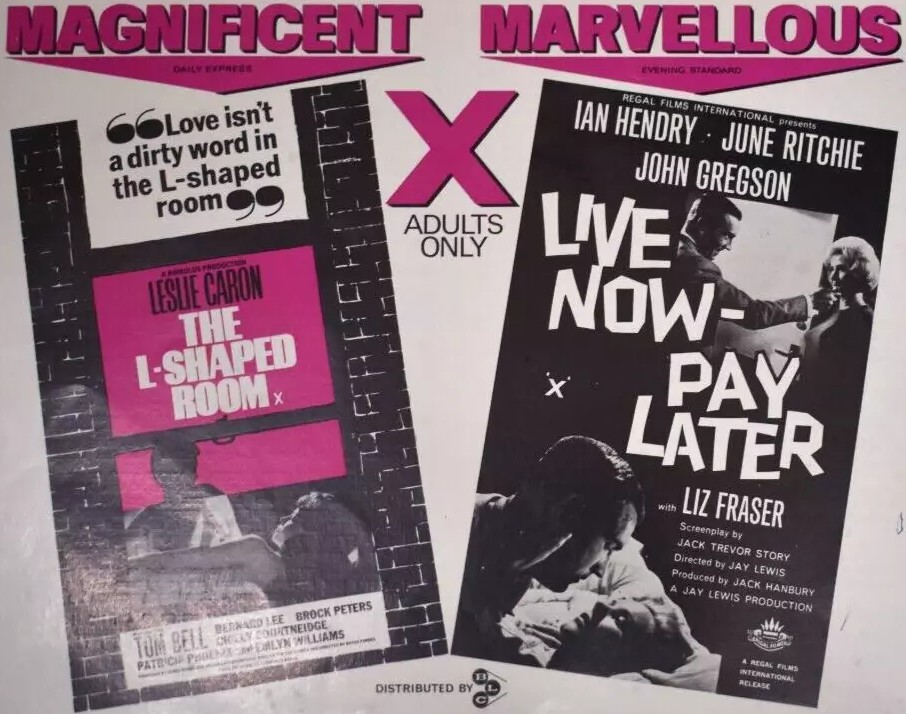
Bit of a stretch to compare it to the movies
mentioned in this poster.

Naturally, an inquest brings up Christine’s past and suspicion falls on her. And that would be par for the course, and it would be up to the condemned woman to find a way to prove her innocence. But that takes us into even murkier depths.

There’s bad blood between Capt Ferris and Stephen and the inference that this was only resolved by the father offering his underage daughter to the lawyer to be followed by the unscrupulous father blackmailing Stephen. Then it turns out there’s no case to answer and that Christine is innocent because, blow me down, Liane committed suicide.

But what should have been a straightforward, if unlikely, murder plot comes unstuck because it can’t make up its mind what it wants to be. Too many ingredients are thrown into the pot and the result is a mess.

Even the queen of melodrama Susan Hayward (Stolen Hours, 1963) can’t rescue this. And the pairing with Peter Finch (Accident, 1966) doesn’t produce the necessary sparks. Despite a variable Irish accent, Diane Cilento (Hombre, 1967) comes off best as the wayward deluded young woman.

Robert Stevens (In the Cool of the Day, 1963) directs from a screenplay by Oscar-nominated  Karl Tunberg (The 7th Dawn, 1964) adapting the bestseller by Audrey Erskine-Lindop.

Had every opportunity to be a star attraction in the So Bad It’s Good sub-genre but fails miserably. Still, if you enter into the swing of things, remarkably tolerable.

Discover WordPress

A daily selection of the best content published on WordPress, collected for you by humans who love to read.

The Atavist Magazine

by Brian Hannan

WordPress.com News

The latest news on WordPress.com and the WordPress community.