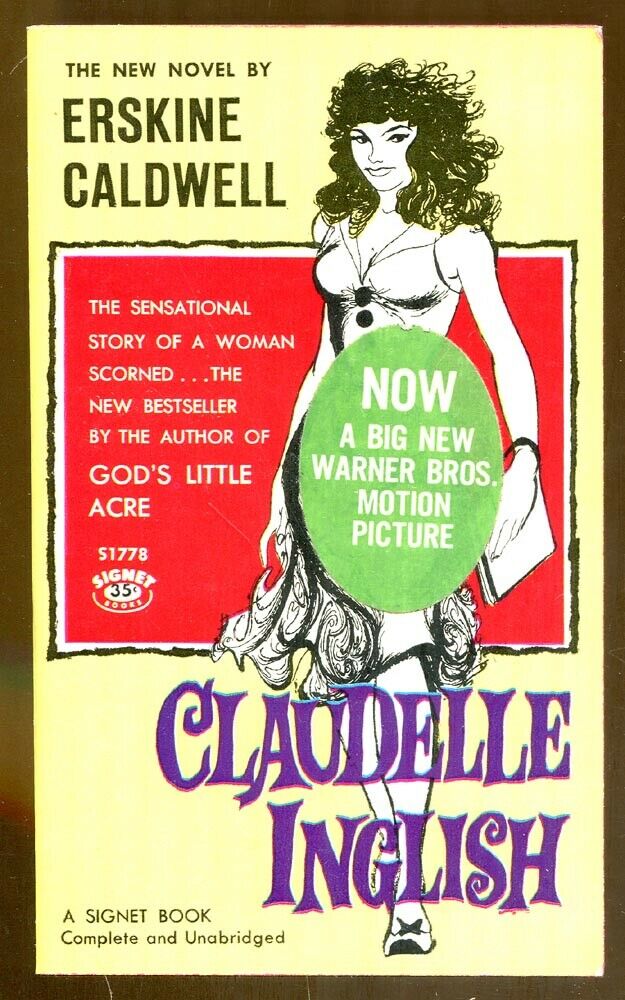
Claudelle Inglish (1961) ****

Simple small-town morality tale, brilliantly told, with a quiet nod to The Blue Angel and Citizen Kane. Shy dirt-poor farmer’s daughter Claudelle Inglish (Diane McBain) after falling for the handsome Linn Varner (Chad Everett) expects to be married when he returns from his Army stint until she receives a “Dear John” letter. Initially devastated, keeping all his letters and the dancing doll she had won with him at a fair, she decides that lying in bed all day and staring at the ceiling is not going to work. So she smartens up her frumpish look with lipstick and turns her simple wedding dress into a more attractive outfit.

She discovers that the boys are so desperate to come calling on this new-look creature that they will bring presents to every date, ranging from the biggest box of candy in the shop to a pair of red shoes. Encouraging her determined manhunt, dissatisfied mother Jessie (Constance Ford), who has endured twenty years of broken promises throughout marriage to hardworking Clyde (Arthur Kennedy),  beseeches her to go after a rich man. Luckily, there is one in the vicinity, the widowed S.T. Crawford (Claude Akins) who happens to be their landlord. Crawford tries to bribe Clyde with free rent and other benefits to put in a good word, but to no avail, the father believing that true love cannot be bought and, furthermore, will alleviate abject poverty.

Advertisement to the trade encouraging exhibitors to book for one
of the key dates on the U.S. release calendar.

Claudelle bluntly rejects Crawford as “too old and too fat” but takes his present anyway and, under pressure, agrees to go for a ride with him without allowing him to stop the car. Dennis Peasley (Will Hutchins), elder son of a store owner, believes he is the front runner, deluging her with gifts, naively believing she is his sweetheart until he realizes he is in competition with a horde of other local boys, including his younger brother, and outsider Rip (Robert Colbert). Jessie, seeing the prospect of a rich husband slip away, embarks on an affair with Crawford. Soon, Claudelle has the entire male population in the palm of her hand, piling up presents galore. However, tragedy, in the way these things go, is just round the corner.

What struck me first was the subtlety. Nothing here to bother the censor, beyond the immorality on show and despite Hitchcock breaking all sorts of sexual taboos with Psycho the year before. This isn’t an all-hot-and-bothered essay like the previously reviewed A Cold Wind in August or a picture that pivots on twists-and-turns like A Fever in the Blood, both out the same year. It is so delicately handled that took me a while to work out that Claudelle was actually having sex with all these guys.

Erskine Caldwell was America’s bestselling author at the time with over 40 million books sold and most famous, of course, for God’s Little Acre, filmed in 1958, and Tobacco Road (1941).

The initial shy girl blossoming under the first blush of love is done very well, a gentle romance ensuing, Claudelle still withdrawn in company, agreeing to an engagement even though Linn cannot afford a ring, waiting anxiously for his letters, adoring the dancing doll,  paying off a few cents at a time material for a wedding dress. It’s only after she receives a Dear John (Dear Jane?) letter that it becomes clear, though not crystal clear, that sex has been involved because that word is never spoken and that action never glimpsed. Only gradually do we realise that present-givers are being rewarded, and as her self-confidence grows she is soon able to pick her own presents.  One look is generally all it takes to have men falling all over themselves to give her what she wants, which is, essentially, a life where promises are not broken. But the closest she gets to showing how much she is changed from her original innocent incarnation is still by implication, telling a young buck she is “pretty all over.”

I was also very taken with the black-and-white cinematography by Ralph Woolsey. The compositions are all very clear, but in the shadows Claudelle’s eyes become glittering pinpoints. The costumes by Howard Shoup won an unexpected Oscar nomination, his third in three years. Veteran director Gordon Douglas (Them!, 1954) does an excellent job of keeping the story simple and fluent, resisting all temptations to pander to the lowest common denominator while extracting surprisingly good performances from the cast, many drawn from Warner Brothers’ new talent roster.

Diane McBain (Parrish, 1961) handles very well the transition from innocence to depravity (a woman playing the field in those days would be tagged fallen rather than independent) and holds onto her anguish in an understated manner. In some senses Arthur Kennedy (Elmer Gantry,1960) was a coup for such a low-budget production, but this could well have been a part he was born to play, since in his movie career he knew only too well the pain of promise, nominated five times for Best Supporting Actor (some kind of record, surely) without that nudging him further up the billing ladder. His performance is heartbreaking, working his socks off without ever keeping head above water, repairs getting in the way of promises made to wife and daughter, kept going through adoration for his wife.

Constance Ford (Home from the Hill, 1960) is heartbreaking in a different way, scorning her loving husband and dressing like her daughter in a bid to hook Crawford.  Television regular Claude Akins is the surprise turn. In a role that looked like a cliché from the off – i.e. older powerful man determined by whatever means to win the object of his desires – he plays it like he was auditioning for The Blue Angel, hanging on every word, being twisted round her little finger, demeaning himself as he is made to wait, sitting downcast outside the Inglish house like an rejected schoolboy. Of the younger cast, Will Hutchins was Sugarfoot (1957-1961), Chad Everett was making his movie debut, and Robert Overton had appeared in A Fever in the Blood (1961). Leonard Freeman (Hang ‘Em High, 1968) wrote the screenplay based on the Erskine Caldwell bestseller.

And where does Citizen Kane come into all this? The dancing doll Claudelle won at a fair when dating Linn is something of a motif, never discarded, as if a symbol of her innocence, and in close-up in the last shot of the film.

A Cold Wind in August (1961) ***

Touching low-budget B-movie shot in black-and-white of a young man receiving his sexual education from an older woman. Motherless Vito (Scott Maxwell), the son of an apartment block super, is seduced by the older Iris (Lola Albright), a three-time divorcee looking for a son to mother.  

This is not the transactional sex of The Graduate, and seduction is too strong a description for the yearning Iris whose advances are sensual and romantic, stroking Vito’s head, trapping his hand with her foot, and there is nothing clandestine about their affair either, no false names on a hotel register. They dally in the park, eat hot dogs, he buys her flowers.  

But as he experiences love for the first time, he also experiences more difficult emotions like jealousy and finds it difficult not just to cope with what seems like another man in her life, the wholesaler Juley (Herschel Bernardi), but the fact that she treats Juley with such contempt. Spoiler alert – well, not really, because you know from the off this is not going to turn out well – the affair ends when he discovers she is a stripper. And while she is left bereft, he now appears more attractive to girls his own age.

In contrast to the powerful emotions stoked up when the pair are together, director Alexander Singer (Pysche ‘59, 1964) fills us in on the rest of Vito’s humdrum life, working for his father during the school holidays, goofing off with his pals, and generally failing to make headway with girls his own age.  But Iris’s life is not humdrum. Although she has a rule not to work in her own geographical area, she breaks that to accommodate her estranged husband, whom she seems to tolerate, while at the same time drinking herself into oblivion to avoid any moves from Juley. Nor is she ashamed of her profession. It is an act, a job like any other, and provides her with a nice apartment. Small wonder she treats men with contempt. Perhaps what she falls in love with is untainted innocence. In some senses she is adrift, at other times in full command. And her love for Vito is convincing.

It is full of incidentals. He gulps down ice-cream, she teaches him to drink one sip at a time, without being patronizing the father (Joe De Santis) tries to educate him to honor his inner feelings.

Lola Albright (Peter Gunn television series) carries off a difficult role very well indeed. Without laughs to help him out as it did Dustin Hoffman in The Graduate Scott Maxwell is believable both as the youth growing into adulthood and the youth wanting to remain a youth with no adult responsibilities. The low-key performance of Joe De Santis is worth a mention.

While the picture no doubt attracted attention for the risqué material, which would have certainly given the Hays Code pause for thoughts, it provided a more rounded picture than was normal at the time of a woman working in the sex industry, even if only in the stripping department. Iris did not fall into any of the cliches. She is presented as a woman first and foremost rather than a stripper.


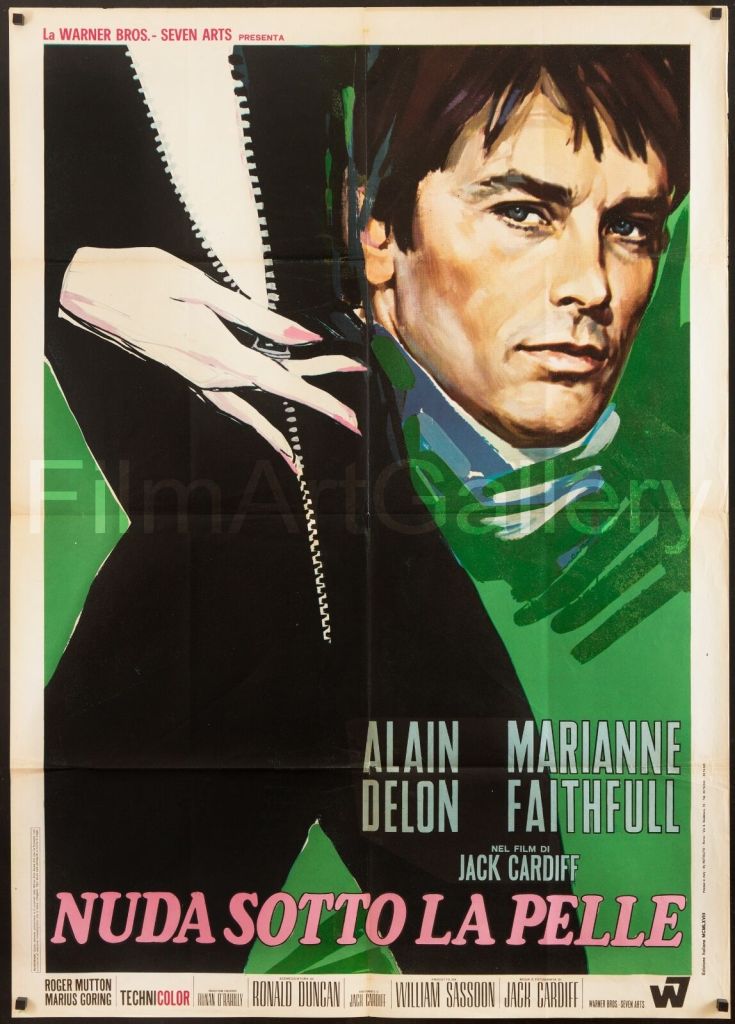
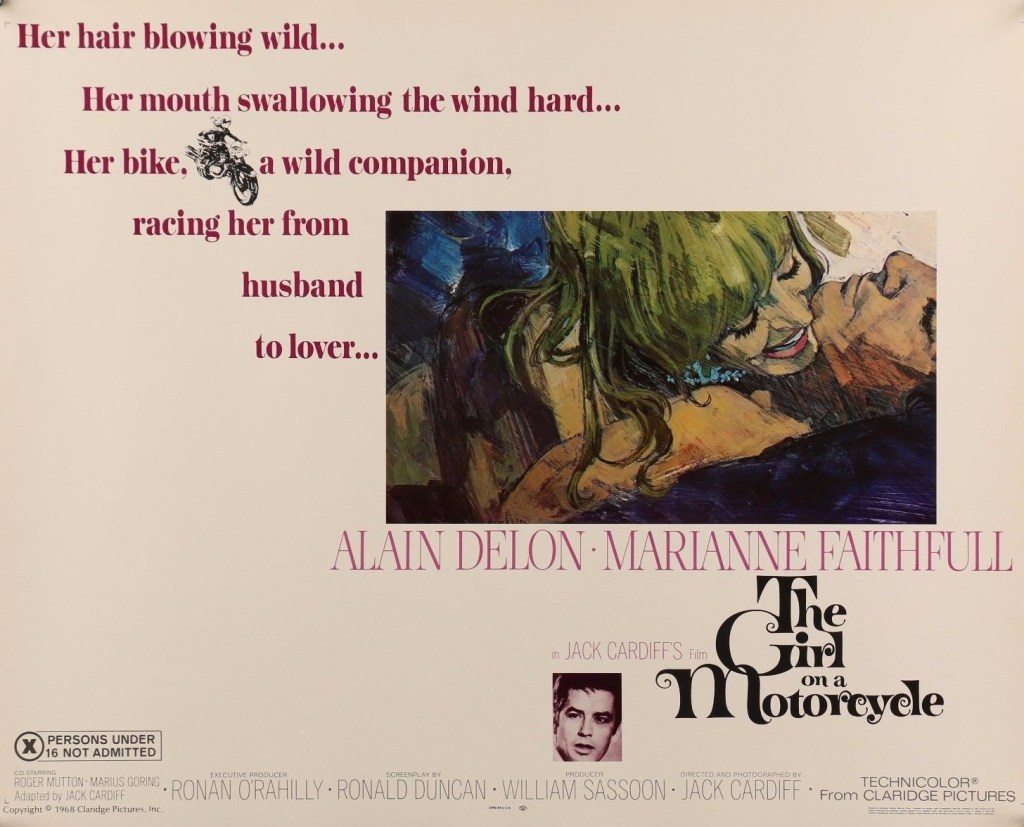
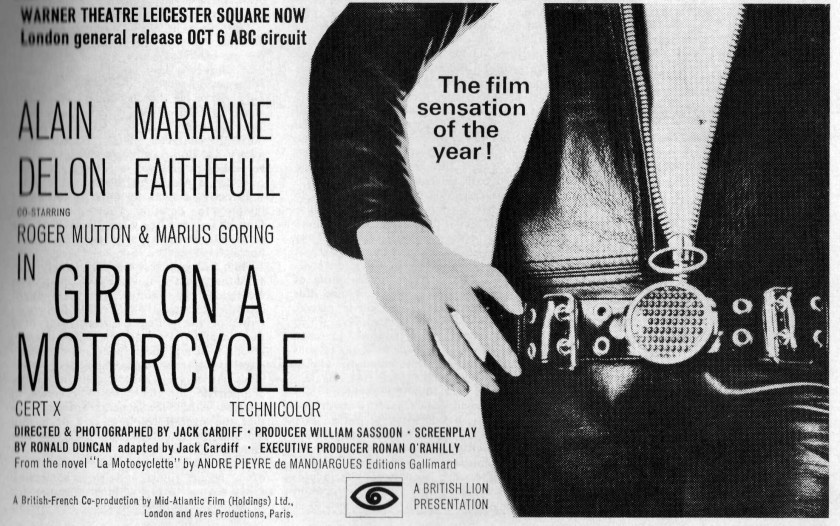
The Girl on a Motorcycle / Naked under Leather (1968) ***

An erotic charge deftly switched this picture from the Hell’s Angels default of violent biker pictures spun out cheaply by American International.  Where Easy Rider (1969) was powered by drugs, this gets its highs from sex. Rebecca (Marianne Faithful), gifted a Harley Davidson Electra Glide motorbike by lover Daniel (Alain Delon) two months before marriage to staid teacher Raymond (Roger Mutton), takes to the highways to find herself.

This ode to speed (of the mechanical kind) allows her to shake off her preconceptions and fully express her personality, beginning with the one-piece black leather outfit, whose zip, in one famous scene, Daniel pulls down with his teeth. The bike is masculine. “There he is,” she intones and there is a none-too-subtle succession of images where she clearly treats it as a male appendage.

She is both self-aware and lost. In some respects Raymond is an ideal partner since he respects her wild nature and gives her space, and she views marriage to him as a method of avoiding “becoming a tart.” In other words he represents respectability, just like her father (Marius Goring) who owns the bookshop where she works. But he is just too reasonable for her and, in reality, as she would inevitably discover that is just a cover for his weakness. The only scene in which she does not appear is given over to Raymond being tormented by young pupils who have him chasing round the class hunting for a transistor radio.

But Daniel is not quite up to scratch either. He believes in “free love”, i.e. sex without commitment and he is not inclined to romantic gestures and she knows she could just become another in a long line of discarded conquests should they continue. Raymond is a “protection against” Daniel and her ending up as an adulteress teenage bride and potential nymphomaniac. She seeks abandon not reality.

As well as sexy interludes with Daniel, her head is filled with sexual images, not to mention dabbling with masochism, in a dream her leather outfit being stripped off piece by piece by a whip-wielding Daniel, in a bar imagining taking off her clothes in front of the aged drinkers.

Jack Cardiff’s film is certainly an interesting meditation on freedom and sexual liberation at a time when such notions were beginning to take hold, but it suffers from over-reliance on internal monologue and Marianne Faithful’s lack of acting experience. Cardiff went straight into this from violent actioner Dark of the Sun (1968) and audiences remembering him from The Liquidator (1965) and The Long Ships (1964) would need reminded that he braced romance before in the touching and Oscar-nominated Sons and Lovers (1960). In that film he elicited an Oscar-nominated performance from Mary Ure, something that was unlikely here.

Pipe-smoking was generally the preserve of the old, or detectives, unless you were a young intellectual as Delon is here, but it does seem an odd conceit to force the actor into such a contrivance. Delon is accustomed to playing amoral characters, so this part is no great stretch, but, minus the pipe, he is, of course, one of the great male stars of the era and his charisma sees him through.

It was also interesting to compare Cardiff’s soundtrack to that of Easy Rider. Here, the music by Les Reed – making his movie debut but better known as a songwriter of classic singles like “Delilah” sung by Tom Jones – is strictly in the romantic vein rather than an energetic paeon to freedom such as “Born to Be Wild.” 

Cardiff’s skill as an acclaimed cinematographer (Oscar-winner for Black Narcissus, 1947) helps the picture along and clever use of the psychedelic helped some of the sexual scenes escape the British censor’s wrath, though not so in the U.S. where it was deemed an “X”. 

Current Cinema Catch-Up 1 – Nomadland, Judas and the Black Messiah, Godzilla vs. Kong

Before the pandemic and before I started writing this Blog I used to go to the cinema once a week on a Monday, normally catching a double-bill of my own choosing, and occasionally lucky enough to watch three movies in a day. Since cinemas re-opened in my neck of the woods in mid-May I’ve found it impossible not to return to my old habits. So here’s my first triple-bill.

Nomadland  (2020) ****

Easy Rider meets The Grapes of Wrath except in both these cases the travellers had a distinct destination in mind. Like the title implies, the characters in Nomadland are going nowhere, and often just round, though somewhat contentedly, in circles. Deservedly winning Oscars for Best Picture, Best Actress Frances McDormand and Best Director Chloe Zhao, this not so much invests in diversity but in a world we never knew existed, of people who live out their lives in the backs of vans and trailers. In a previous generation, they might be deemed trailer trash, but that’s not the case here. They may be humbled but they are not unprincipled.

Recently widowed Fern (Frances McDormand) takes to the road after unemployment closes down her small town and temporary work at the local Amazon depot dries up  after Xmas. Considering herself “houseless” rather than “homeless” Fern finds herself involved in a peripatetic community of like-minded individuals, some drifting due to circumstance, others wanting to live out their last years as sight-seers. It’s not a drama and it hardly even qualifies as a docu-drama because virtually nothing happens but it is an eye-opener, not just for the visuals but for the way it explores the inherent loneliness in society. Once she has a taste for the road, Fern spurns every opportunity to settle down. The characters encountered are definitely originals and have the feel of genuine nomads – Swankie and Linda May certainly are –  the camera just happened to catch as it tracked by.

A true original with McDormand – her third acting Oscar after Fargo (1996) and Three Billboards Outside Ebbing, Missouri (2107) plus another one as producer here – giving a tremendous performance as a passive individual surrendering, despite occasional indignity and hardship, to the joys of roaming.

Judas and the Black Messiah (2021) ****

Rather than face a jail sentence. car thief Bill O’Neal (LaKeith Stanfield) turns FBI informant and infiltrates a Black Panther group led by Fred Hampton (Daniel Kaluuya). Spurred on by FBI controller Roy Mitchell (Jesse Plemons), O’Neal’s work has disastrous consequences.

As a devastating expose of the criminal activities undertaken by the world’s highest- profile criminal-catching operation, the FBI,  this is a first-class procedural type of picture, where, courtesy of the suspense created by director Shaka King (Newlyweeds, 2013), you find yourself rooting for O’Neal as he comes close to being discovered. But it is also grounded by an impeccable performance by Kaluuya (Queen and Slim, 2019) who portrays Hampton as a gentle soul, shy with women, but with a gift for public speaking that rouses a put-upon generation.

The Black Panthers are shown as instigators of genuine social reform, setting up medical programs etc, rather than just gun-toting rebels. Kaluuya won the Oscar for Best Supporting Actor but in truth he steals the show from the lead Stanfield.  

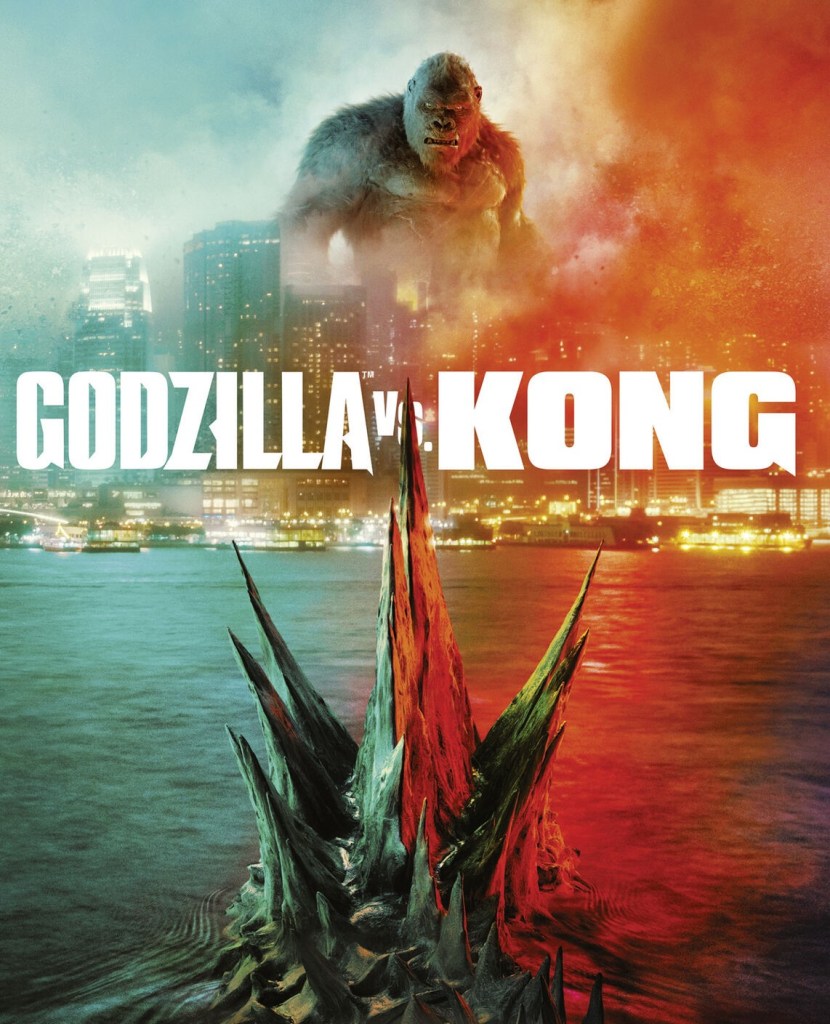
Godzilla vs. Kong (2021) ***

If you can make out what is going on in among all the noise and implausibilities then there is a halfway decent summer blockbuster to be enjoyed. The sci-fi gobbledegook spouted by scientist Nathan Lind (Alexander Skarsgard) leads Kong-whisperer Madison (Millie Bobby Brown) and Ilene (Rebecca Hall) into harm’s way, so far beneath the earth you are likely to poke up in Australia. Naturally, the two ancient behemoths go head-to-head while destroying everything in sight.

Justine (1969) **

In pre-WW2 Alexandria in the Middle East with the British on the point of departing, impoverished young poet Darley (Michael York) becomes the latest plaything for Justine (Anouk Aimee), wife to Egyptian banker Nessim (John Vernon) who encourages her multiple relationships in order  to smooth the path for his gun-running activities. Matters are complicated since Darley is having an affair with belly dancer Melissa (Anna Karina) and some of Justine’s other lovers float in and out of the picture. Political intrigue which might have anchored the movie also shifts in and out of view. In this cross-cultural hotchpotch various groups – Jews, Moslems, Coptic Christians – look to seize control.

Cluttered is the best way to describe this. Despite excellent performances by Anouk Aimee and Dirk Bogarde it is still a mess. Whatever story there was has been buried by “atmosphere” and too many characters adding too little to the overall outcome. Entangled lives end up being just that – wrapped around each other with nowhere to go. Over-emphasis is placed on the louche background, nightclubs featuring cross-dressing belly dancers and a  massive carnival. Luckily, we can’t entirely blame venerated Oscar-winning director George Cukor (My Fair Lady, 1964). He was picking up the pieces after Twentieth Century Fox fired Joseph Strick (Ulysses, 1967) but was stuck with a lot of footage that had already been shot and a screenplay that didn’t make much sense.

When you realize the movie encompasses religious prejudice, racism, same sex arrangements, incest, child prostitution, nymphomania, revolution, and police and political corruption and is hardly able to give any of these themes more than a fleeting glance you soon realize this is one of those films that is just going to go on and on until sudden conclusion rears up and all is revealed. And that would be fine since many movies of this decade meander at length and sometimes appear to be completely lacking in plot or logic, but whose flaws are more than compensated by outstanding direction or performances. Alas, even the stunning evocation of this city and period cannot save the day.  

And it would have worked if Justine had been a femme fatale of the film noir school or if the politics been more grounded, but that doesn’t occur either and although Justine does have many influential men in her clutches you could hardly say that Darley is one of them. His role is merely to act as narrator and apologist.

One last point which has little to do with the film. In this film and in the same year’s Topaz, John Vernon gives very good dramatic performances, in both cases, coincidentally, wounded emotionally. So what happened that he is mostly remembered for villainous tough-guy roles from the following decade?

The Happening (1967) ***

Poor casting blows a hole in this picture’s great premise and only an excellent turn by Anthony Quinn as an indignant kidnappee prevents it achieving “so-bad-it’s-good” infamy. In fact for the first third of the movie you could pretty much guarantee it’s going to be a stinker, so dire are the performances of the quartet of hippy kidnappers. Only when the camera cuts  Quinn a bit more slack and the script skids into a clever reversal does the movie takes flight although still hovering dangerously close to the waterline.

Faye Dunaway (Sandy), all blonde hair and pouting lips, looks for the most part as though she has entered an Ann-Margret Look-A-Like Competition. Michael Parks (Sureshot) resembles a fluffy-haired James Dean. George Maharis is condemned to over-acting in the role as ringleader Taurus while Robert Walker Jr. as Herby does little more than mooch around. None shows the slightest spark and behave virtually all the time as if they are in on the joke.

For no special reason, beyond boredom, they kidnap hotel tycoon Roc (Quinn) hoping to make an easy score with the ransom. Unfortunately for Roc, none of those he is counting on to cough up the dough – wife Monica (Martha Hyers), current business partner Fred (Milton Berle), former business partner Sam (Oscar Homolka) and offscreen mother – will play ball. In fact, Monica and Sam, enjoying an affair, would be delighted if failure to produce a ransom ended in his death.

Eventually, while the movie is almost in the death throes itself, Roc fights back, using blackmail to extort far more than the kidnappers require from his business associates and taking revenge on his wife by setting her up as his murderer. It turns out Roc is a former gangster and well-schooled in the nefarious. So then we are into the intricacies of making the scam work, which turns a movie heading in too many directions for its own good into a well-honed crime picture.

Quinn is the lynchpin, and just as well since the others help not a jot. From a kidnappee only too willing to play the victim in case he endangers wife and son, he achieves a complete turnaround into a mobster with brains to outwit all his enemies. But in between he has to make a transition from a man in control to one realizing he has been duped by all he trusted.

Director Elliott Silverstein, who got away with a lot of diversionary tactics in Cat Ballou (1965) – such as musical interludes featuring Stubby Kaye and Nat King Cole – essays a different kind of interlude here, fast cars speeding across the screen at crazy angles. But that does not work at all. Probably having realized pretty quickly that he can’t trust any of the young actors, he mostly shoots them in a group.  

Some scenes are completely out of place – a multiple car crash straight out of It’s A Mad, Mad, Mad, Mad World, for example. But occasionally he hits the mark in ways that will resonate with today’s audience. Sureshot, confronted by a policeman, refuses to lower his hands in case he is shot for resisting arrest. Although drug use is implied rather than shown, Sureshot is so stoned he can’t remember if he has actually made love to Sandy. And like any modern Tinderite, neither knows the other’s name after spending a night together.  

The strange thing about the youngsters was that they were not first-timers. Dunaway had made her debut in Hurry Sundown (1967). George Maharis had the lead in The Satan Bug (1965) and A Covenant with Death (1967), Michael Parks the male lead in The Idol (1966) and played Adam in The Bible (1966) and although it marked the debut of Robert Walker Jr. he had several years in television. Oh, and you’ll probably remember a snappy tune, the music more than the lyrics, that became a single by The Supremes.

I’ve got an old DVD copy but I don’t think this is readily available but you can catch it for free on YouTube, although it’s not a good print. Via Google you should be able to see The Supremes performing the title song.

Pressure Point (1962) ****

Central to this under-rated tale of psychopathy and racism is one extraordinary scene, possibly the most exceptional bar-room sequence ever filmed. In the annals of imaginative repulsion, it ranks alongside the rape committed by Alex and his “droogs” in Stanley Kubrick’s A Clockwork Orange (1971). It begins with mere intimidation as an unnamed young man (Bobby Darin) begins to etch into a bar counter the lines and symbols of Tic-Tac-Toe (a.k.a. Knots & Crosses or Noughts and Crosses). Discovering tins of paint, the man and his gang proceed to cover the entire bar – floor, walls, ceiling, even tables – with the same symbols.

The humiliation is ratcheted up a notch when the gang leader forces tavern owner (Howard Caine)  to lie on the floor behind the counter where he cannot see the bar hostess (Mary Munday), rigid with fear, being tormented. Using lipstick rifled from her handbag, the man decorates her face in the same fashion before pulling down the back of her dress and doing the same there. Fortunately, the rest of the scene, presumably ending in rape, is left to our imagination.

Italian poster showing image from the Tic-Tac-Toe scene. A variation of this was shown in the main image which removed the domineering man and concentrated on the humiliated woman.

Other potent scenes show how the man arrived at his crazed state, smothered with affection by a weak mother (Anne Barton) who has taken to bed in order to escape his drunken, raucous father (James Anderson) who taunts his ineffective wife by flaunting in her face his casual pick-ups and making love to them in the same room. Indicative of the lonely child’s disturbed personality is that when he invents an imaginary playmate, it is to have someone to subjugate, making his fictional friend lick his boots.

Imprisoned during the Second World War for sedition, the man, suffering from blackouts and nightmares – in which he imagines himself clinging to the edge of a giant plughole before being swept away by a torrent of water from the taps – becomes a patient of a young, also unnamed, doctor (Sidney Poitier) whom he subjects to racial abuse.  The doctor, physically bigger and more imposing than the patient, would like to simply give him a good thumping, but his profession necessitates that he treats this objectionable person as just another patient. And eventually they come to enough of a concord that the patient accepts treatment although the doctor suspects that his core personality has not changed.

The U.S. poster was different to that used in Italy. This is pretty much a straight rip-off of “The Defiant Ones” (1958).

The movie is layered with themes other than psychopathy and psychiatry. While the racist element is to the fore, including the doctor’s need to prove himself in a white man’s world, and the lack of diversity in this particular medical field at that time, director Hubert Cornfield also explores the growth of right-wing extremism among the disaffected who see no contradiction in still espousing traditional American values, for example giving the Nazi salute while singing in all sincerity the national anthem. The African American doctor has to come to terms with lack of objectiveness when dealing with such an abhorrent person.

The movie flits between scenes between the two protagonists staged in a stagey manner and  expressionistic almost dreamlike sequences representing the patient’s upbringing such as being menaced by his butcher father among the swinging carcasses of the store. The patient flashbacks are shown without dialogue, explanation given in voice-over by either the patient or the doctor.

The father torments the mother by bringing a casual pick-up to their bedroom.

Reliance on visual dexterity, however, detracts from the tension and director Hubert Cornfield (The 3rd Voice, 1960) is also hampered by an unnecessary framing device which results in the story being told in flashback – leading to a conflation of flashbacks: the older Poitier explaining his earlier problems dealing with a difficult patent and listening in turn to the patient’s own life story. So the pressure indicated by the title is often undercut and does not build as much as you might expect. Critical reaction in those days pivoted on the racism elements, but a contemporary audience is almost certainly going to be as influenced by sequences involving the patient, so the picture automatically becomes more involved and Cornfield’s visual mastery more appreciated.

You can detect the influence of producer Stanley Kramer. In his capacity as director he had explored psychiatric therapy and anti-semitism in Home of the Brave (1949) and racism in The Defiant Ones (1958) also with Poitier. As producer he was responsible not only for selection of the original material, based on a short story The Fifty-Minute Hour by Robert M. Lindner, but also imposed the framing device, which Kramer wrote. Those scenes relate to another psychiatrist (Peter Falk) coming to a much older and experienced Poitier for advice after hitting a brick wall with a similarly repugnant patient, Poitier telling the story of his treatment of the Bobby Darin patient as a way of showing that even the worst patients are treatable.

This is quite a different Sidney Poitier than you might be used to. Wearing suit and tie, and spectacles, this is a more restrained, measured performance. Poitier’s taboo-busting Oscar nomination for The Defiant Ones had not progressed his career that much, still restricted to starring roles in low-budget pictures. But Kramer broke another taboo in Poitier’s favor with this one, casting him a role not initially written as an African American.

Bobby Darin (Come September, 1961) had parlayed his status as hit recording artist into a burgeoning movie career but does not quite display the menace necessary for a fully-fledged psycho. The likes of Richard Widmark would have been a more convincing adversary. Peter Falk (Machine Gun McCain, 1969) has a small one-tone role. The jazz-nuanced music by Ernest Gold (Exodus, 1961) is worth a listen. And if someone can tell me who designed the striking credit sequence I would be very pleased.

Incidentally, the title of Lindner’s short story is ironic. Patients pay for one hour of a psychiatrist’s time but in reality only receive 50 minutes in order for the professional to achieve a swift turnaround and keep his/her appointment timetable scheduled to the hour. Tic-Tac-Toe, in case you are unfamiliar with this two-person childhood game, consists of drawing lines to create nine squares and filling those with either a zero or a cross. The object of the exercise is to create a complete line of either symbols.

Catch-Up: Sidney Poitier films previously reviewed in the Blog are The Long Ships (1964), The Bedford Incident (1965) and Duel at Diablo (1966).

The Red Tent (1969) ***

If you’re unfamiliar with the abortive Italian airship expedition to the North Pole led by General Umberto Nobilo (Peter Finch) in 1928, you’ll find this an absorbing tale. If you are familiar then you will probably appreciate the film-makers’ attempts, via an unusual framing device, to carry out a post-mortem and to apportion blame for the disaster. If you know your history you’ll also be aware both poles had already been conquered, American Robert Peary first to the North Pole in 1909, Norwegian Roald Amundsen (Sean Connery) claiming South Pole bragging rights two years later. So you’re also probably wondering what was the point nearly two decades later of the Nobilo operation?

But the sled-led efforts of Peary and Amundsen were feats of endurance i.e. man vs.  nature. This was science vs. nature. The dirigible was the apex of aviation advancement and nations still battled for exploration glory. So to travel in some comfort and fly over the North Pole in a few days would be a demonstration of scientific supremacy. Conquest of one of the most inhospitable places on earth was almost a PR exercise. With no intention of landing it was also a glorified tourist trip.

Connery and Cardinale lock horns over tea.

However, the science was flawed. Nobody had counted on the build-up of ice. The airship crashed and since this was a joyride nobody was equipped to walk their way out. Just surviving would be difficult enough. Loss of radio transmission (science) indicated a problem to those waiting back at the base so rescue airplanes were deployed. But without a location to pinpoint, the searchers had about two million square kilometers cover. Luckily, a brilliant scientific deduction by expedition member Finn Malmgreen (Eduard Martsevich) saves the day and a ham radio user (amateur science) picks up the location. Game on!

Except airplanes are too easily thwarted by blizzards, fog and the inhospitable. Home base, set up simply to welcome home a successful jaunt, is not capable of organizing a proper rescue. A Russian ice-breaker joins the rescue attempt. Taking greater risks is aviator Einar Lundborg (Hardy Kruger), fired up by the promise of sex with desperate nurse Valeria (Claudia Cardinale), who happens to be Malmgreen’s girlfriend, and a bounty from Nobilo’s insurers. The redoubtable Valeria does not have to sell her body to persuade the more highly-principled Amundsen to join the rescue effort.

So it’s gripping clock-ticking-down stuff, action shown in considerable detail, almost over-populated in one sense as director Mikhail Kalatozov (The Cranes Are Flying, 1957) covers multiple storylines, the various disjointed rescue efforts, the survivors weakening by the day, imperiled by marauding polar bears and the ice cracking up beneath their feet.

In the main it’s a true story, Valeria the only fictional element, inserted for dramatic purpose, to give the audience someone to emotionally root for back on land and for her character to guide us in almost contemporary fashion through the ghoulish carnival onshore as thousands gather to witness first-hand news of disaster.

What’s patently untrue is the framing device, given that it shows the still-living Nobilo summoning up the ghosts of others involved in the event for a post-mortem, in which his guilt drives him into the position of sacrificial lamb. Although on first encounter it appears a bizarre idea, that, too, soon achieves dramatic purpose. Clearly there was intense discussion at the time and in the immediate aftermath by those who survived the disaster and there must have been high-level talks behind closed doors that usually excluded the main characters of the kind that was played out in a host of historical pictures made during the decade. Lawrence of Arabia (1963) and Khartoum (1965) had many such set-pieces where reputations were shredded.

This approach permits opportunity for all the principals to come together for confrontational purposes in the one room. Not all discussion follows the expected path and there is an interesting argument between Nobilo and Amundsen about leadership. From an audience perspective, it is, of course, quite satisfying to see Sean Connery facing off against Peter Finch with Hardy Kruger and Claudia Cardinale embroiled in the debate.

All eyes on Claudia Cardinale in the Japanese poster.

There is the bonus of fabulous cinematography of the majestic Arctic, the icy waste and breaking up of ice floes and collapsing icebergs never before captured in such widescreen glory. Further pluses are in the performances, especially Connery as an aged Amundsen, Finch as the glorious pioneer bewildered the sudden turn of events and Cardinale as a woman willing to go to any lengths to save her lover. Ennio Morricone provided the score.

However, you are best going into this to be aware that while Finch has a goodly amount of time onscreen, Connery and Cardinale (the ostensible stars judging by the credits) are not seen so frequently. That said, the movie happily falls into the survival sub-genre. The DVD version I saw was just a shade over two hours – cut by about 30 minutes from original release – but reportedly the longer version adds little more than some extra angst.

Hotel (1967) ***

The cardinal rule of the grand hotel picture was that it featured major stars. That is not so much the case here although the portmanteau of stories is up to scratch. Traditional hotel manager Peter McDermott (Rod Taylor) and boss Warren Trent (Melvyn Douglas) battle ruthless financiers, aristocrats Geoffrey (Michael Rennie) and Caroline (Merle Oberon) are involved in a fatal car accident, hypocritical God-fearing businessman Curtis O’Keefe (Kevin McCarthy) has a mistress Jeanne Rochefot (Catherine Spaak) on the side. Added into the mix are hotel thief Keycase Milne (Karl Malden) and hotel detective Dupere (Richard Conte). Not forgetting a dodgy elevator (you know where that’s headed!).

None of the stars mentioned comes up to the marquee standard set by the original in the subgenre – Grand Hotel (1932) boasted Jean Harlow, Greta Garbo, Joan Crawford and Wallace Beery – while an offshoot of the same idea The VIPs (1963) had Elizabeth Taylor, Richard Burton Orson Welles and the later Airport (1970) would rustle up top attractions Burt Lancaster, Dean Martin and Jean Seberg.

Top British film critic Alexander Walker espoused the movie.

It’s a fair bet that Warner Brothers felt audiences would be satisfied that the storylines were augmented by the behind-the-scenes insider information promised by the Arthur Hailey bestseller on which the film was based, such as how B-girls stole hotel keys, the tricks employed by a hotel thief and the various corrupt opportunities open to hotel staff. But it’s a major miscalculation to assume an audience cares that much who owns a particular hotel. And in the year in which In the Heat of the Night and Guess Who’s Coming to Dinner dealt with racism head-on, it was odd to see desegregation parlayed as a device to lower the asking price for the business or introduced out of economic necessity rather than high-minded principle.

Such gripes aside, this is movie comfort food, a picture that moves at a leisurely pace among its interwoven tales. Kevin McCarthy’s ruthless arrogant businessman steals the show, closely followed by Merle Oberon’s scheming duchess. To use a soccer analogy Rod Taylor is more like an old-fashioned center half rather than a midfield maestro, holding the picture together rather than setting it alight and his romance with McCarthy’s mistress (half his age) is an unlikely diversion, although the soft-spoken French actress, confronted by conscience, is particularly good. Melvyn Douglas as the aging owner mixes curmudgeon with affection and it’s hard not to feel sorry for Conte, outwitted by an older woman, and especially for Malden as the thief finding out how much the credit card has cut into the larceny business.

This was the last big-budget production for director Richard Quine whose career had been on the slide since box office highs The World of Suzie Wong (1960) and Sex and the Single Girl (1964). But he may have been somewhat restrained by having screenwriter Wendell Mayes (Von Ryan’s Express, 1965) as his producer. While well-crafted affair and glossy it lacks the inherent tension of an Airport.

The Third Secret (1964) ***

Non-exploitative films about the psychologically vulnerable were thin on the ground during the 1960s and although The Third Secret is a bit talky nonetheless it does explore issues normally dealt with in heavy-handed fashion. Catherine Whitset (Pamela Franklin) the young daughter of a famous psychiatrist convinces television journalist Alex Stedman (Stephen Boyd) to investigate her father’s supposed suicide. Whitset needs the murder verdict because otherwise she will lose her home (no insurance payout on suicide). Stedman, Whitset’s patient, wants a similar outcome because his world would be turned upside down if the psychiatrist had committed a deed which he appeared steadfastly opposed.

The main suspects are all patients of the dead doctor – judge (Jack Hawkins), gallery owner (Richard Attenborough) and secretary (Diane Cilento). Although all outwardly successful socially-functioning upstanding members of society each is mired in mental agony – anger management, sexual inadequacy, depression, low self-esteem among problems addressed – defenses against which are perilously thin. Under sustained pressure each of the individuals will crack to reveal the cowering creature underneath.

But are they the killer or just condemned to torment? With the one man who could keep them sane removed from their lives, who knows what carnage they can self-inflict. All, even Stedman – given to bouts of terrible rage and drunkenness – seem capable of murder and there is every likelihood (as any viewer will guess) that his investigation could lead back to himself.

Director Charles Crichton (The Lavender Hill Mob, 1951) might have been suffering from low self-esteem himself having been unceremoniously dumped from The Birdman of Alcatraz (1962) and certainly the atmosphere is one of severity, not just characters teetering on the brink, but the black-and-white photography rendering London a wasteland, the tide on the Thames always out so the shore is just mud. However, his compositions do have style. The title’s explanation by the way is that the first secret is what you keep from the public, the second is what you hide from yourself, but the third is the truth.

Boyd (Ben-Hur, 1959) and Franklin (The Innocents, 1961) appear often on the point of hysteria, the girl’s high-pitched voice set against his growling outbursts. Attenborough (fresh from the heroics of The Great Escape, 1963) plays against type as a hand-wringing wannabe artist stuck in a role he despises. Hawkins, too, more used to heroic roles, is convincing as a man trying to escape his past. The neurotic Cilento has the best scenes, touching in her efforts to cling to normality. Judi Dench makes her debut in a bit part. The investigation takes the form of character analysis rather than “where were you on the night of…” which gives the picture an unique flavor, but best to know that going in rather than complain about the slow pace. If the psychological does not keep you hooked, there are sufficient twists to keep you watching.

Discover WordPress

A daily selection of the best content published on WordPress, collected for you by humans who love to read.

The Atavist Magazine

by Brian Hannan

WordPress.com News

The latest news on WordPress.com and the WordPress community.