The Sweet Ride (1968) ***

Unusual drama mainlining on Californian surf, sex, bikers, a mystery of Blow-Up (1966) dimensions and the best entrance since Ursula Andress in Dr No (1962). Displays a 1960s vibe with a 1950s pay-off as the “hitchhiker” of responsibility rears its ugly head.

A woman thrown out of a car narrowly escapes being run over. The cops jack in the investigation after television actress Vickie (Jacqueline Bisset) refuses to explain why she’s been badly beaten up.  And so we enter flashback mode to supposedly find out. She makes a glorious entrance, emerging from the sea, minus bikini top, into the lives of surfer Denny (Michael Sarrazin), jazz pianist Choo-Choo (Bob Denver) and ageing beach bum and tennis hustler Collie (Tony Franciosca). From the off, she’s enigmatic, gives a false address, won’t explain bruises on her arm, has something clandestine going on with television producer Caswell (Warren Stevens) and like Blow-Up we are only privy to snippets of information.

She’s half-in half-out of a relationship with Dennis, with Collie hovering on the periphery hoping to pick up the pieces to his sexual advantage. Contemporary issues clog the background, Choo-Choo tries a camp number complete with pink dog to avoid the draft, a neighbor threatens to shoot Parker for wandering around in shorts and habitually stealing his newspaper, epithets like “degenerates” are tossed around, Choo Choo’s girlfriend Thumper, while appearing in movies with titles like Suburban Lust Queen acts den mother, there’s not much actual exciting surfing, and a biker called Mr. Clean is somehow involved.

The romance plays out well, Vicky unsure, Denny convinced but without a livelihood to offer and unable to get a straight answer out of her. Choo-Choo gets the gig of his dreams in Las Vegas and there’s an rape scene, more unsettling because it’s committed by Denny with the bizarre justification of getting “just for once something on my terms.”  And there’s the equally disquieting sense that the only explanation for Vickie’s behavior is to tab her a nymphomaniac, walking out of an argument with a mysterious man in a beach house to drop her clothes for a bout of sex with Mr Clean.

I must have seen a different picture from everyone else. A good few critics at the time and reviewers since appear to think Vickie was also victim of a gangbang by the bikers, but I can’t see why. When he sees Vickie coming down from the beach house, Mr. Clean shouts “everybody split” and his buddies clear the beach. However, Mr. Clean, ironically, gives the best indication of her state of mind, explaining that Vickie “kept staring back at the house and moaning about how she wanted to die” while he enjoyed the best night of his life sex-wise.

Denny and Collie prove not to be the pussycats they appear, bearding the bikers in their den and beating up Mr. Clean while Denny goes on to deliver a hiding to Caswell. But what this film turns out to be is an examination of vulnerability, how easily those with a new sense of freedom are trapped. An examination of contemporary mores, perhaps, but in not resolving the mystery of Vickie ultimately fails to deliver, especially as it does not, from the outset, carry the kind of artistic credentials of Antonioni in Blow-Up.

Perhaps the mystery needs no resolution, it’s just same old-same old dressed up in the novelty of sexual freedom. There’s no idea of why Vickie was beaten up, and essentially abandoned on the road to become accident fodder, and no hint really of why she fell foul of someone so badly she needed disposed of, no notion that she was a threat to anyone. (Or, for that matter, no explanation of what happened to her bikini top and why, if she was so apparently free with her charms, she was so shy about being seen half-naked.) On the other hand, victim may well have been Vicky’s destiny from the get-go, that kind of innocence only waiting to be defiled.

In any 1960s contemporary picture there’s always the temptation to accept as truthful or reject as phony the lives shown. The idea that sexual freedom bestows actual freedom is usually the issue until consequence (i.e. old-fashioned Hollywood morality) comes into play. This is less heavy-handed than, for example, Easy Rider (1969) or Bob & Carol & Ted & Alice (1969). The characters make decisions to grow up or to stay locked in a world of easy sex, dope and money. There’s no grand finale, just a more realistic drifting apart, and it’s only Vickie who comes apart, although that process had begun long before she met the drifters.  

Jacqueline Bisset (The Detective, 1968), in her divinely posh British accent, comes over well as an attractive screen presence and complex character. In fact, she has a bigger part here than in Bullitt (1968) or The Detective (1968). If you wanted anyone to portray a soulful hippie you need look no further than tousle-haired Michael Sarrazin (In Search of Gregory, 1969) and normally if you required someone on the sly, despicable side, Tony Franciosca (Fathom, 1967) might well be your first port of call, but Franciosca proves the surprise here, classic wind-up merchant and predator who exhibits considerable vulnerability when he realizes he is losing the worship of the idealistic young.

Former British matinee idol Michael Wilding (A Girl Named Tamiko, 1962) and Norma Crane (Penelope, 1966) appear as Vickie’s parents.  Bob Denver (Who’s Minding the Mint, 1967) and Michele Carey (The Spy with My Face, 1965) are solid support. Director Harvey Hart (Fortune and Men’s Eyes, 1970) tries to cover too much ground and could have done with narrowing the focus. Future Bond screenwriter Tom Mankiewicz (son of Joseph L.) made his screenwriting debut adapting the book by William Murray.

The DVD is a bit on the pricey side, but if you just want to check it out, YouTube has a print.

Maverick: Top Gun (2022) **** – Seen at the Cinema

And just like that Old Hollywood thumped a nose at super-heroes and jumped back to the top of the tree. Of course, that’s if you discount Tom Cruise as being a super-hero of box office dimensions and one with his own franchise Mission Impossible which at times has single-handedly kept his marquee value alive.

Unusually, for a sequel, this has taken account of the passing of time. No shoe-horning Maverick (Tom Cruise) into the role of current hot-shot pilot and there is a past he has to deal with, two relationships in fact, with Rooster (Miles Teller) the son of Goose, whose death Maverick is accused of causing, and with Penny (Jennifer Connelly), an on-again off-again affair too often too easily fractured. But, of course, the main thrust of the picture is Maverick taking on everybody, the top brass in the shape of Admiral Simpson (Jon Hamm) and Admiral Bates (Charles Parnell), his pupils and the unnamed bad guys.

It’s pretty nifty in using character flaw to justify the plot. That Maverick is anywhere near being recruited as teacher and not gainfully employed as a high-flying Admiral somewhere – as is former-rival-cum-buddy Iceman (Val Kilmer) – is down to the fact that he has resisted well-justified promotion in order to keep flying and because, well, he tends to piss off his superiors. But he still has the juice, in the opening sequence taking an experimental plane way beyond its capabilities (another plot point, by the way).

Somewhat older, not necessarily that much wiser, Maverick’s introduction to the Top Gun base is a tad humiliating, drummed out of Penny’s bar for not being able to pay his tab, watching wistfully as younger guns batter out his favorite tune on the piano, and aware that he has personal bridges to mend, that maybe, just this time, he might have the maturity to manage.

There’s the usual cocky bunch led by Hangman (Glen Powell), Phoenix (Monica Barbaro)  and Payback (Jay Ellis) plus Bob (Lewis Pullman), his call sign apparently a contraction of first name Robert but in reality standing for baby-on-board. In true reality television style there are heats, only four pilots making the cut to fly the desperate mission against the enemy.

And here’s where the picture takes off (pardon the pun). The aeronautics are just breathtaking and if you happen to catch it in Imax or an equivalent you’re going to be rocked by the sound  as well. It’s unbelievable stuff.  If there’s any CGI in there it’s not in the shapes of aliens, and looks distinctly old Hollywood. The kind of epic airplane stunts for which you run out of superlatives. And in best James Bond fashion the clock is ticking.

A resoundingly human story, relationships that looked cut-and-dried proving more fluid, until a band of brothers are properly worked up. Even as you wonder just how they are going to involve Maverick in a finale in which he should be a back-seat driver, a deft screenplay provides the answer. Maverick stands up for older guys everywhere, like an ageing pro brought back to save a football game.

Nostalgia has never been more vividly utilized. In terms of satisfactory denouement this is along the lines of the resolutions in Star Wars VII: The Force Awakens (2015) rather than the desultory reappearance of Decker (Harrison Ford again) in Blade Runner 2049 (2017). Some great scenes from the original have been touchingly reinvented, snippets of the original themes inserted at vital points plus a Lady Gaga offering.

It could easily have sunk not so much from the weight of expectations (and the long Covid-induced delay) but from a clunky re-boot, as producers determined, story be damned, to get all their ducks in line. Instead, there’s enough recycling to catch satisfy the previous generation of fans and sufficient whip-smacking wizardry to pull in the new generation,  which determinedly steers clear of anything non-CGI.  

Cruise is just superb, potentially an Oscar-nominated performance, as the guy who refuses to be jaded, who requires not one wingman but a whole team of them, with still the individuality and self-confidence that manuals cannot deliver. Given a job that set him up not to be a scene-stealer (teachers just ain’t action heroes) Cruise effortlessly steals the show, and its maturity more than double-balls-out cojones that does the trick.

Full marks to Joseph Kosinski (Oblivion, 2103) for fulfilling those weighty expectations, for keeping the movie focused when the temptation must have been to insert more romance, buff up issues facing the rest of the gang, add too much more when what this always needed was so much less, let the action show the way and Cruise carry the story. Much as I like Miles Teller in this I was hoping he would go on to better top-billed parts after Whiplash (2014).  Glen Powell (Everybody Wants Some, 2016) is another one Hollywood should be trying to make more of. I could say the same for the gutsy Monica Barbero (The Cathedral, 2021). This is the kind of movie to make the next generation of stars, especially as it solidified the reputation of the last of the older generation in Tom Cruise.

Incidentally, while I was at the cinema for this I saw a cracking trailer for the next Mission Impossible picture so cruise is going to continue his box office roll for a while.

The Unfinished Task / I’ll Give My Life (1960) ***

Complete your Angie Dickinson collection with his long-lost number. Almost unrecognizable as a brunette, she carries much of the emotional weight of this tale about an outsider rejecting a chosen career. Hollywood pictures about creative outsiders such as artists and writers relied on charismatic actors – Kirk Douglas in Lust for Life (1956), Charlton Heston in The Agony and the Ecstasy (1965) – to bring the project to life. Similarly, you might think, in movies about another type of outsider, of the religious variety, having the likes of Gregory Peck (The Keys of the Kingdom, 1944) or Bing Crosby in Going My Way (1944) goes a long way to giving such ventures audience-appeal.

Here, Jim (John Bryant), the son of a successful construction tycoon, having completed a degree goes against the wishes of father John (Ray Collins) by becoming a minister instead. In due course he is sent overseas to a mission in New Guinea, and like Father Stu (2022) contracts a deadly disease. Jim is far from charismatic, just a plodding ordinary guy who has found “something more important than building skyscrapers.”

The story is instead told through the eyes of John, resentful of his son’s decision, and his girlfriend/fiancée/wife Alice (Angie Dickinson) who, expecting marriage to a wealthy engineer, instead has to set aside her own ambitions and go along with her husband’s wishes, this being post-WWII America, and independence hardly a prerequisite in a wife, never mind a woman.

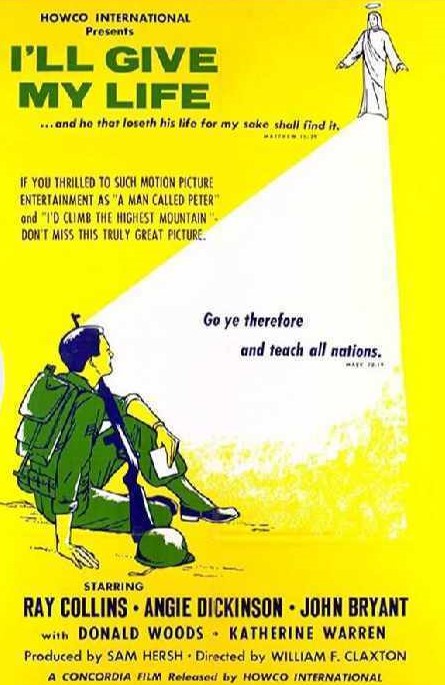
This poster does not do the film justice. It’s nothing like as “heavenly” as that. Howco was an exhibition company that entered distribution in order to provide enough product for its cinemas.

But if this is a story of a conversion – as was the case in Father Stu – it’s about the conversion of the father and Alice and the bulk of the story hinges upon their reactions to the path taken by Jim rather than him taking center stage. So it’s cleverly done, and whether this is due to budgetary pressure, or creative decision, it proves the right choice. John is the kind of self-made man who would dominate any stage, forever making plans, spinning the world as he would like it to be. In Alice’s eyes we see nothing but her weighing up Jim’s choices, sometimes accompanied by shock, occasionally elation, but mostly resignation and infrequent resentment as she, too, is parted from family to follow her husband into an unknown in which she had considerably less faith.

Unlike Father Stu, conversion does not come easily. Jim is long dead, two-thirds of the way through the picture as it happens, before John comes to realize that his son’s demise should not be in vain and that he left behind “an unfinished task” for his father to complete, namely raising awareness of the power of missionaries to improve the lot of the miserable and poor in foreign parts. Bear in mind the era in which this was made, so there are some attitudes that will make you wince, but generally it is well done, not weighted down with platitudes and, in concentrating on the doubter, brings alive a difficult subject.

And although this was before questions were asked about the sexual corruption of priests and ministers, men who followed religion were still not as easily accommodated in the general community, seen as overly pious and, to the businessman, existing in a vacuum. The idea that the Church, of various kinds, had not done enough to ease global suffering, is continually raised and nobody here is giving themselves a pat on the back.

Alice is actually given more screen time than Jim, his father using her as a sounding board, and, while Jim is off in New Guinea, enjoying herself with the firm’s resident beau, Bob (Jon Sheppod), and finally taking on motherhood and coping with the premature death of her husband and still fighting to open the father’s eyes to the good being done.

Angie Dickinson (Jessica, 1962) gives a very good account of herself, especially as the narrative restricts her to the kind of wifely 1950s role rather than the frisky sexuality she exhibited in the 1960s. Her acting skill saved her from being lumbered with portentous dialogue since she could portray her feelings more easily with her eyes.

Ray Collins (famed for a running role in the Perry Mason series) is excellent as the father confused by his son’s decision, fighting him every inch of the way. John Bryant (The Bat, 1959), it has to be said, does not light up the screen, lacking the magnetism of a Peck or a Crosby but in some regard this kind of straight playing suits the film, since the character is not meant to be out of the ordinary.

William F. Claxton (Desire in the Dust, 1960) directed from a script by Herbert Moulton, better known as a producer of shorts. Although this film was released in 1960, it appears to have been made before that, some suggest as early as 1955. Given it was funded by the Lutheran Church, the script does not make heavy weather of the religious elements and John’s resistance to his son’s vocation reflected that of any father to a son embarking on as shaky a career as painting or writing.

You can catch this on YouTube, though it’s not a great print. And, yes, that is Angie Dickinson sitting demurely at a desk.

Father Stu (2022) **** – Seen at the Cinema

If Benedict Cumberbatch or Leonardo DiCaprio or Brad Pitt had essayed this role Oscar voters would already be sharpening their pencils, especially as dramatic weight gain (Robert DeNiro in Raging Bull) seems to attract more sympathy than dramatic weight loss (Christian Bale, The Machinist). Although Mark Wahlberg (Uncharted, 2022) has a brace of Oscar nominations to his name, this movie seems to have struck out with most critics due to prejudice against organised religion. And that’s a shame because Wahlberg gives the performance of his career as a self-destructive boxer who finds redemption in becoming a rebel priest.

Atheist Stuart Long (Mark Wahlberg) is a whip-smart, charming, cocky loser. But when it comes to lifestyle choices he hasn’t the brains of a toad. Washed up as a boxer, he decides, as one does, that he has missed his vocation – he should be an actor. So off he hoofs to California, taking a job in a supermarket, on the basis (obviously) that one of the customers is bound to work in the movies and provide the lucky break. Instead, he falls for Carmen (Teresa Ruiz) only to discover she is an avowed Catholic, so serious about religion there would none of that sex-before-marriage nonsense.

So smitten is Stuart that he agrees to get baptised and then proving a holy hell of a parishioner questions priests about everything sacred, dropping F*** bombs left, right and center. But when he almost dies in a drunken accident, he decides to turn his life around the hard way and determines to become a priest. That’s another almighty battle in the acceptance stakes, and his take on religion is certainly not what the Catholic Church expected, but just when it looks as if he is going to achieve his ambition he is diagnosed with an incurable wasting disease.

Three hankies at the ready? No way. This is not one of the lovestruck teenager dying of cancer pictures, but a thoughtful and hilarious account of, effectively, stoicism. I knew nothing about the story on which this is based and half-expected either a miracle cure or that Carmen would announce herself pregnant, having done the whole sex-before-marriage thing, and scupper his chances of a life of chastity helping others.

Instead, Stuart is the kind of guy whose suffering infuses others with a dynamic to accept their own, often as miserable, life. And he’s so far from a saint that nobody could be lobbying the Pope on his behalf. I’ve no idea why this has been tagged “faith-based” which seems to spell box office doom especially Stateside. Anyone wanting to know what religion means to someone for whom religion means a lot would learn a huge amount from this picture. Stuart challenges everyone – and that includes the Almighty – but in a very real and often very funny way.

Yes, there is discussion of doctrine, but this part is fascinating, as Stuart pulls apart long-held tenets and tackles one of the apparent hallmarks of the faith in the U.S. – that no disabled person is allowed to stand on the altar. That he’s not the one who personally mounts a campaign to change this, since he’s so accepting of the will of God, and that it’s left to others, helps make this movie character-based rather than virtue-signalling.

This is best I have ever seen Wahlberg, not just because of how far he goes, body-wise, but because it is an incredibly assured performance, the fast-talking screen persona given the bullet, and in its place a realistic human being who begins to understand the benefits of humility over brashness. If it wasn’t for religion Stuart would have been one of life’s washed-up characters, ending up like his father Bill (Mel Gibson) at the bottom of a bottle.

Mel Gibson, now firmly in the Nicolas-Cage-straight-to-dvd league, turns in a superb performance as the bitter father and the Oscar-nominated Jackie Weaver (The Silver Linings Playbook, 2012) is excellent as the buttoned-down lost mother.  Teresa Ruiz (The Marksman, 2021) is every bit as good. Cody Fern (Eden television series, 2021) as a buttoned-up priest who doubts his faith is one to watch and you might spot, under all his priestly garb and smug expression, Malcolm McDowell (A Clockwork Orange, 1971).  

Given the emphasis on equality I’m surprised writer-director Rosalind Ross has not received more acclaim, if any at all from what I can gather, for what is a very assured debut. And I can only hope this is not because she committed the terrible sin, apparently, of attempting to make a sincere picture about the effect of religion on peoples’ lives.  In Hollywood’s Golden Era all sorts of unlikely priests, step up Bing Crosby et al, and stars like Gary Cooper (The Pride of the Yankees, 1942) died of incurable diseases and the crowds would line up, but somehow this kind of storyline has become a box office affliction rather than carrying a banner for the kind of character-based straightforward story audiences used to love.

The Bedford Incident (1965) ****

A belated entry into the Cold War thriller genre that appeared to have peaked with Dr Strangelove (1964), Fail Safe (1964) and Seven Days in May (1964). The Bedford Incident, filmed in black-and-white with a less-than-stellar cast nonetheless holds its own as an examination of men under pressure, a cat-and-mouse actioner, as well as a stark warning of the dangers of nuclear war. Perhaps you could not find a more contemporary theme,

Capt Eric Finlander (Richard Widmark) is a maverick U.S. Navy destroyer commander hunting down Russian submarines should they stray into territorial waters. He has been passed over for promotion, despite having previously successfully forced a Russian sub to the surface. Into his meticulously-run ship are dropped photo journalist Ben Munceford (Sidney Poitier) – re-teamed with Widmark after The Long Ships – and Lt. Commander Chester Potter (Martin Balsam),  a ship’s doctor. In effect, their presence is a simple device to put Widmark under the spotlight, in some respects to  challenge his operational methods, and, as a narrative device, to provide an excuse to tell the audience everything they need to know.  Among the ship’s crew are young ensign Ralston (James MacArthur) and former  German former U-boat commander Commodore Wolfgang Schrepke (Eric Portman) who acts as an advisor.

The newcomers are afforded insight into how this ship is run and into its hunting methods, for example, dredging up waste from the sea in order to examine it for evidence of a Russian presence. There is a bundle of interesting technical data – a submarine has to surface for air, as another example – and the soundtrack mostly consists of endless sonar. Apart from the German, who appears to subsist on Schnapps, the crew is unusually top-quality, the sick bay deserted, the enterprise run under wartime conditions, every person on board dedicated to fulfilling the captain’s every wish.

The tension is in triplicate. First of all, there is the obsessive captain who could at any time just explode; secondly, there is the hunt for the submarine replete with tactical maneuvers and hunches; and finally, always in the background, there is the nuclear element and the fear that untoward action could trigger a holocaust. And there’s also time to take down a peg or two the holier-than-thou visitors, Dr Potter revealed as a civilian medic returning to the service as a refuge, Munceford as a rather spoiled individual who complains when dangerous maneuvers interrupt his shower. Schrepke has the unenviable task of trying to rein in his boss, Ralston one of the few on board finding the pressure hard to handle.  

But Widmark steals the show. His over-acting often stole the show when he had a supporting role, but this is a finely nuanced performance. An admirable, instinctive commander, he is loved by his men (such adoration not easily won) with a gift for battle and outfoxing an opponent, often barely containing his own tension. It would have been easy to ramp up the pressures he felt in the way of Humphrey Bogart as Captain Queeg in The Caine Mutiny (1954) but there’s a big difference between a man about to crack and one who loves battle and is desperate to score victory. 

Sidney Poitier (Duel at Diablo, 1966) is excellent in a more relaxed role, combative only in matters of intelligence, and probably benefitting from not having to carry the picture. James MacArthur (The Truth about Spring, 1964) shows acting maturity is moving away from the easier Disney roles in which he came to prominence.  Character actor Martin Balsam (Harlow, 1965) excels as always in this kind of role, a man with hidden weakness. Eric Portman (The Man Who Finally Died, 1963), somewhat typecast as a German officer, is given a deeper role where villainy is not his only ace.  If you keep your eyes peeled you might spot a fleeting glimpse of The Dirty Dozen (1967) alumni Donald Sutherland, as part of the medical crew, and Colin Maitland as a seaman.

The top-billed Richard Widmark turned producer on this one, as he had done for The Secret Ways (1961), not so much as to greenlight a pet project but to keep a place at Hollywood’s high table just when that seemed to be slipping out of his grasp after the commercially disastrous John Ford roadshow Cheyenne Autumn (1964). In truth, Widmark’s position as an outright star appeared questionable. He seemed to transition all too easily between top billing (Warlock, 1959, The Long Ships, 1964) and second billing (Two Rode Together, 1961,  Judgement at Nuremberg, 1961, and Flight from Ashiya 1964).   

But the billing oddity from today’s perspective if to find Sidney Poitier – coming off an Oscar win for Lilies of the Field (1963) and later a box office smash in his annus mirabilis of To Sir, With Love (1967), Guess Who’s Coming to Dinner (1967) and In the Heat of the Night (1967) – subordinate to Widmark in the credits department.  The Long Ships featured the same billing arrangement.

Also putting his neck on the line was James B. Harris who was making the jump to director from producer of Stanley Kubrick’s The Killing (1956), Paths of Glory (1957) and Lolita (1962). Screenplay honors go to James Poe (They Shoot Horses, Don’t They, 1969) who adapted the bestseller by Mark Rascovich.

Harris makes a sound debut, the decision to film in black-and-white paying off, and enough going on through personality clash and the sub hunt to keep the pace taut. Authenticity was added by filming aboard naval vessels (although British in this case) and what little model work there is does not look out of place. A bigger budget would have made better use of the actual hunt (as The Hunt for Red October, 1990, later proved) but sound effects rather than visual effects suffice. I had not at all expected the shock ending. Another point in this film’s favor is that the threat of nuclear apocalypse has not gone away and the fact remains that the world as we know could disappear at the touch of a button.

Baby Love (1969) ****

Disturbing tale about grooming marking the debut of Linda Hayden could not more accurately reflect changes in public perception from over half a century ago.  What had originally seemed a movie about a young woman wreaking havoc on a middle-class family is now more easily recognized as a more sympathetic study of a young girl denied familial attention attempting to find a stable and welcoming home.

After the suicide of her mother (Diana Dors) Luci (Linda Hayden) is taken in by Robert (Keith Barron), a highly successful doctor and ex-lover of her mother, and his wife Amy (Ann Lynn). His marriage to sophisticated housewife Amy is distinctly rocky. They live in a fabulous three-storey house on the bank of the Thames with son Nick (Derek Lamden), a typical teenager the same age as Luci but who is sexually naive, confused and hypersensitive. Amy comforts Luci when the young girl has terrible nightmares and ends up sleeping in the same bed until she realizes how inappropriate is such behavior.

Nick chances his arm with Luci but is continually rejected, not surprisingly since his approach is more than a tad creepy, spying on her in the bathroom, entering her bedroom when she is naked, leching after her in the garden. Robert is the only one to try and keep his distance and in the absence of her own father becomes the subject of a father fixation.

Conditioned to accept the advances of older men finds her in potentially unsavory situations in a cinema, a club, and with a friend of the couple (Dick Emery). That she apparently welcomes such attention reveals the depth of her grooming, not just forced to watch her mother make love, but, as suggested in a flashback, the mother complicit in not preventing her lovers making a play for her. If Luci appears sexually confident that only disguises her inner turmoil, a desperate need to be loved, lack of proper parenting and setting of boundaries and having chanced on a proper home determined to do whatever it takes to remain there.

It is actually Ann who is the disturbing element, eventually overcoming her own inhibitions and not only seducing the girl but telling her that if she wants to remain in the house she will need to twist Robert round her little finger. And the only way she knows how to do that is follow her mother’s example and exploit her sexuality. If Luci appears exploitative in the context of the family that is only because they are not privy – as is the audience – to the depth of her nightmares, the constantly reappearing image of her mother dead in the bath, her mother’s leering lovers. Even when she goes over-the-top with make-up or clothing there is an innocence to such behavior, little more than a young woman testing boundaries and trying to find her way. Any intelligent assessment of what is going on would clearly see the child as the victim.

The grandeur of her new potential home bears no comparison to the poky working-class council house she occupied up north. For a child with such an impoverished upbringing, she is fairly grounded. She is not the wild child you might expect from her upbringing. She fits well into family life, happy to listen to classical music, and to Ann’s astonishment can actually cook breakfast and knows how to lay a table, skills her spoiled son patently lacks.

Considerable efforts are made to make each character more rounded. Robert hates his wife’s sophisticated parties and is an insomniac judging from the stack of books on his bedside.  The guilt he feels for abandoning Luci’s mother, apparently his one true love, in favor of ambition, is exacerbated by Luci’s presence that reminds him not only of a path wrongly chosen but of what he has lost, that relationship ripped asunder when abortion entered the frame.

Ann clearly needs to project success, expensive clothes and champagne the least of their lifestyle, and with little outlet for pent-up emotion and a need to mother settles on Luci as the object of, initially at last, her affection. Nick hides his cigarette ends in a matchbox, would accept Luci as just a friend, occasionally rising to the role of protector, delighted to be seen in the company of a beautiful girl. Teenage fantasy in other words but with an edge of entitlement that goes too far.

In her debut Linda Hayden (Taste the Blood of Dracula, 1970) is superb in an extremely difficult role and it was a shame that it was the sexual part of her portrayal that made its biggest impact on future movie producers rather than the sensitivity of her performance, the look in her eyes when she is shown her bedroom for the first time is amazing. Also making a  movie debut Keith Barron (Nothing But the Night, 1973) lacks the mellifluous tones that were later his hallmark and his performance as unloved husband and guilty ex-lover is very well observed.

Ann Lynn (I’ll Never Forget Whatsisname, 1967) has the most challenging role of a woman tortured by desire she has until now kept hidden or under control. Derek Lamden did not make another movie. Diana Dors (Hammerhead, 1968) has a fleeting role.

It wasn’t the fault of director Alasdair Reid that uber-producer and marketing kingpin Joseph E. Levine (The Carpetbaggers, 1964) wanted to sell a different movie from the one that was made, focusing on titillation and turning Luci’s sexual confusion into something predatory. The idea that this movie is a sexualized film noir is a marketing trick. Closer re-examination reveals that Luci is entering a disturbed household, one she lacks the skills to negotiate and is in reality the exploited one.

In fact, Reid (Something to Hide, 1972) did a very commendable job. He made some bold decisions especially relating to sound. The opening credits are accompanied by the sound of a dripping tap that would turn into a cascade of water. That would become a recurring motif, along with steam. Most scenes lacked music. Although most nightmares are image-driven, the initial one is full of clashing sound as well as disturbing sights. As the movie hits its stride, a clever device is adopted, showing disturbing images outside the house that are actually, you quickly discover, another nightmare. Mostly the camera remains fairly static but it occasionally swoops to represents anxiety from one point-of-view. The bulk of the story takes place in the house but when the camera goes outside, to a disturbing scene on the river for example there are original ideas, one character speaking through a megaphone.

Passed by the British censor with an X-certificate then and an 18-certificate DVD today, it still has the power to shock. However as far as I can see it was last classified in 1994 and I have written to the BBFC to see if that classification should still stand.

Well worth a reappraisal.

Network has this on DVD.

The Devil-Ship Pirates (1964) ***

Despite the title and Hammer’s penchant for the unholy, there is nothing satanical about this picture. Christopher Lee (The Whip and the Body, 1963)  less cadaverous than in his better-known incarnation as Dracula, plays the captain of ship called Diablo, part of the defeated Spanish Armada, who lands in 1588 on British shores and by convincing the locals that the British have been defeated  imposes an occupation.

Writer (and later director) Jimmy Sangster’s clever premise works, the lord of the manor (Ernest Clark) immediately surrendering and befriending the invaders, most of the villagers succumbing, a few more doughty lads (Andrew Keir and son John Cairney to the fore) rebelling. 

Running alongside its regular horror output, Hammer had a sideline in swashbucklers, the Men of Sherwood Forest (1954), Sword of Sherwood Forest (1960), The Pirates of Blood River (1962) and The Scarlet Blade (1963) – aka The Crimson Blade – preceding this, and all, interestingly, aimed at the general rather than adult market. Australian director Don Sharp, in the first of several teamings with Lee, does extraordinary well with a limited budget. Although the village square was a leftover from The Scarlet Blade, there is a full-size galleon, swamps, fog, floggings, a hanging, fire, chases, a massive explosion, and a number of better-than-average fencing scenes.

In other hands, more time could have been spent exploring the psychology of occupation, but despite that there is enough of a story to keep interest taut. Lee has a high-principled lieutenant who secretly subverts his master’s wishes. Tension is maintained by Lee’s ruthlessness, the efforts of captured women to escape, and attempts to seek outside help. While the intended audience meant toning down actual violence, Sharp creates a menacing atmosphere. The final scenes involving sabotage are tremendously well done.

A rare outing for Lee outside of the horror genre, he truly commands the screen, an excellent actor all too often under-rated who holds the picture together. Andrew Keir (The Viking Queen, 1967) and Ernest Clark (Masquerade, 1965) provide sterling support. Suzan Farmer (The Crimson Blade, 1963) plays the requisite damsel in distress.  Director Don Sharp (Bang! Bang! You’re Dead!, 1966) was another horror regular responsible for, among others, Curse of the Fly (1965) and Rasputin: The Mad Monk (1966), the latter reuniting him with Lee.

I should acknowledge a vested interest as John Cairney was a distant relative and I do remember as a child being taken to see his previous outing Jason and the Argonauts (1963) but, strangely enough, this one was given a miss by my parents. I wonder if the title put them off.

CATCH-UP: Christopher Lee was so prolific I have only so far reviewed a fraction of his 1960s output: Beat Girl/Wild for Kicks (1960), Sherlock Holmes and the Deadly Necklace (1962), The Whip and the Body (1963), The Gorgon (1964), She (1965), The Skull (1965), The Brides of Fu Manchu (1966), Five Golden Dragons (1967). The Devil Rides Out (1968),  The Curse of the Crimson Altar/The Crimson Cult (1968) and The Oblong Box (1969).  Quite enough to be getting on with if want an idea of this fine actor’s range and ability.

The Big Gamble (1961) ***

If only there had been some serious money put behind this picture it would have been an absolute cracker, custom-made for the likes of Cinerama which didn’t go down the dramatic route until a few years later. It’s a bit “Hell Drivers or Wages of Fear Goes to Africa” but with some really quite stunning sequences.

Whatever French chanteuse Juliette Greco (Crack in the Mirror, 1960) had to offer on stage and in a personal capacity – lovers included Miles Davis and this film’s producer Darryl F. Zanuck – never seemed to translate to the screen in this particular role and the most we get is a kind of tomboyish perkiness. It’s a medium-grade cast, the lead taken by Northern Irishman Stephen Boyd (here playing a Dubliner). David Wayne (The Three Faces of Eve, 1957) is the sad sack brother who joins the other two in a bold plan to set up a haulage business on the Ivory Coast in Africa.

The opening sequence demonstrates the dreary Irish life Boyd is trying to escape with a sparkling cameo from Sybil Thorndike (Shake Hands with the Devil, 1959) as the family matriarch before the African sequences kick in. Apart from scenes shot at Ardmore Studios in Bray, Ireland, the rest is clearly filmed on pretty dangerous locations if the unloading of a lorry onto what looks like little more than a large canoe is anything to go by. After an unpromising start, the intrepid trio (well, two are bold, Wayne is not) set off into the wilderness.

There are two edge-of-the-cliff sequences that would have The Italian Job fans frothing at the mouth, a runaway lorry in the best Cinerama tradition and an astonishing section crossing a swollen river where clearly the actors did their own stunts (and Boyd was in reality saved from drowning by his co-star). In between we have snippets of genuine Africa, especially canoeists braving the surf and an African funeral party. Emotionally, beyond Boyd sticking out his chin as much as possible, the main drama focuses on fraternal rivalry with Wayne trying to pull himself together in the face of a mission he believes doomed to failure.  Their plans are further hit by sabotage by the German Kaltenberg (Gregory Ratoff in his final role).

While some of the posters highlight the river crossing, others focus on the cliff-top sequences.

This was Boyd’s bid for stardom. Five years into a seven-year contract with Twentieth Century Fox, he had worked his way up the ranks at that studio to become male lead to top-billed females like Susan Hayward (A Woman Obsessed, 1959) and Hope Lange (The Best of Everything, 1959) before his career received a massive boost after a loan-out deal to MGM for Ben-Hur (1959). He might have been hotter yet had Fox not abandoned its first Rouben Mamoulian-directed version of Cleopatra in which he played Mark Anthony, a role that later brought Richard Burton worldwide fame and a new wife. Boyd would be hot at various times during his short-lived career (he died at 45) while equally never making the transition to major star.

One of the great Hollywood what-ifs – how would Boyd’s career have developed
if he had followed up “Ben-Hur” with “Cleopatra.”

Directed by the underrated Richard Fleischer, best known for 20,000 Leagues under the Sea (1954), Compulsion (1959), Crack in the Mirror (1960) and later The Boston Strangler (1968) and here with some help for the African sequences from Elmo Williams (The Longest Day, 1962) – the nerve-wracking clifftop sequences and river crossing were actually shot in France – it has a decent enough script from novelist Irwin Shaw (The Young Lions).

All-in-all this tight little film more than does justice to its miserable budget with some genuinely exciting sequences.  Filmed in CinemaScope, this is one of the films of the era which does justice to the widescreen. As a wee bonus, if you listen hard to Maurice Jarre’s score you will hear strains of some themes that turned up in Lawrence of Arabia.

Phantom of the Open (2021) ** – Seen at the Cinema

A sentimental ending and Oscar winner Mark Rylance (The Bridge of Spies, 2015) can’t save this latest tribute to that particularly British phenomenon – the loser. While no doubt this is in essence the true story of golfing wannabe Maurice Flitcroft who gained some kind of notoriety – and latterly some celebrity – as the world’s worst golfer after posting, on live television, by a long way the worst score in British Open history, it’s plagued with a woeful attempt at no-hoper charm that just doesn’t work.

Rylance (Maurice Flitcroft) is part of the problem. He could be a cousin to Jim Broadbent’s dour character in The Duke, but where Broadbent comes to life in the second half, Rylance does not, a one-note performance that fails to elicit any sympathy for the character. Where do I start with what is wrong with the picture?

Well, for a start, the idea that a crane driver is an awful job. My grandfather was a crane driver in the shipyards in Clydebank and it was a skilled and highly-prized job and earned him a little bit more than the other workers down below and instead of moaning about his job he drove on his children to become educated – my mother among three of the family to go to university in World War Two Glasgow. Clearly, also, “poor” Maurice earned enough to put down a deposit on a house, a big achievement in the 1960s.

And the idea that Maurice had never heard of golf until the mid-1970s seemed preposterous when hardly 80 miles away Tony Jacklin, the son of a steel worker, won the British Open at Royal Lytham St Annes in 1969. The whole of Britain was electrified. I remember with my brother peering through the window of a television shop to watch it live on television. Equally preposterous is the notion that golf was a middle-class hobby. I remember as a teenager just after Jacklin’s famous win caddying for my father at a public golf course, which required no payment of annual fees nor wearing of fancy golfing ensembles. Golf was far from a hobby restricted to the well-off.

The closest loser-hero to Flitcroft is British ski jumper Eddie the Eagle (also filmed) but Eddie was at least a recognized and official contender in his sport. He did not try to sneak in the back door without doing any of the endless training necessary for anyone who wants to compete at a high level. It’s just crazy to set Flitcroft up as some kind of official-tweaking hero, when he simply managed to gain entry to the Open by cheating. The closest comparison in golf in the winner-from-nowhere category was John Daly who won a major in the U.S. in 1991, only qualifying after one of the contenders dropped out, but he had been a professional golfer for four years by that time.

And I hate this grim mud-tainted view of the 1960s and 1970s. I grew up in that period and certainly don’t recognize the picture painted. Flitcroft’s children, luckily, didn’t inherit the delusional gene, his twins becoming world champion disco dancers and his other son becoming a successful businessman.

Flitcroft just wanted glory without any of the hard work and it’s hard to find any sympathy for such a delusional man. Anyone who pointed out to Flitcroft just how delusional he was received short shrift in the film. Woe betide any official who thought this character was going to bring derision to golf, at a time when the sport was going through a revival, thanks to Jacklin who would inspire a generation of even better golfers like Nick Faldo and Ian Woosnam.

It’s almost a cosmic joke that everyday golfers looked upon Flitcroft as their idol simply because he played the game as badly as they did and that he received some kind of celebrity as a result. Odd, too, that nobody’s ever thought to make a film about a true winner like Tony Jacklin.

The Duke (2020) *** – Seen at the Cinema

The most stunning twist since Keyser Soze shucked off his disguise in The Usual Suspects (1995). But where Soze’s trick was a cinematic triumph, here moviegoers are duped by unfair sleight-of-hand. 

If ever there was a movie of two halves, this is it. For the first half we are presented with  Kempton Bunton (Jim Broadbent) as a dour working-class liberal devoted to fighting every cause. In the second half he’s a stand-up comic with the legal profession eating out of his hand, as if the character that turned up in court bore no relation to the one in the initial section. And if his defense for stealing from the National Gallery a Goya painting of the Duke of Wellington seemed rather far-fetched even for someone as cause-addicted as him that is because, as we discover in the trick ending, it was just that, entirely made up.

You may also have wondered how a 60-year-man was quite so nimble as to scale a high fence and climb up a couple of floors by ladder, then the trick at the end reveals that this too is part of the audience deception.

Which leaves you wondering just why the core of the story – that a father volunteers to take the place of his guilty son and face the prospect of years in prison – does not even merit a scene. If it wasn’t for the performance of Broadbent and Helen Mirren as his wife, as tour de force an acting partnership as you could hope for, you would wonder what on earth was the point of making the film.

Who outside Britain has ever heard of the license fee? Everyone knows about the BBC, of course, but I would doubt very much if anyone has any idea that what appears to be a free public service broadcasting body (akin to PBS in the U.S.) actually has to be paid for on an annual basis by every single person in the country who owns a television set. Since Bunton claims he stole the painting in protest against certain members of the public being forced to pay this fee, you might wonder how this is going to go down in foreign parts. Setting Bunton up as a working-class rebel on the basis of this preposterous idea is one of the barmiest notions ever to afflict a screenwriter.

This movie has been receiving rave reviews – and picked up £3 million at the box office – because it is charming, pokes fun at the BBC and the Police and the Government and feels like a latter-day Ealing comedy with Broadbent and Mirren in top form. I was duped by the reviews and by the trailer which showed all the funny bits but was bored for a first half that seemed like a very out-of-date attack on too many targets, without providing any real measure of the man who turned into a supreme entertainer in the second half. Some of the issues he raised such as racism were worthy of his defence, but others were simply ignored. The fact that workers could be dismissed in the 1960s for any reason whatsoever with no recourse to tribunals was glossed over. The fact that he was sacked for allowing his taxi passengers to travel for free – the taxi owners not Kempton thus footing the bill – or possibly for boring is passengers to death with his strident views is equally ignored.

I have to say that initially I did enjoy the film. But afterwards I began to have a niggling feeling that somewhere along the way I had been cheated. If Bunton knew he was innocent and was simply taking the fall for his guilty son, his idealistic crusade was pointless. You would have to ask why did he not just return the painting? I can’t believe there was no confrontation with his son. Are we expected to imagine that Bunton just congratulated his son on providing him with a perfect opportunity to embarrass the BBC and thought to himself it was well worth a jail sentence regardless of the fact it would put his wife through hell.

It feels like the director was expecting after the revelation at the end that the audience would just say “oh now it all makes sense” rather than the opposite, that it made no sense at all unless we were shown collusion between father and son, and the son especially accepting the burden of the sacrifice his father was making.

In The Usual Suspects, audiences went back over the film to marvel at just how clever Soze had been. Here, though, when you try to do the same, it doesn’t work. The Bunton we are shown in the first half was not a deliberate fiction dreamt up by the character, but simply a directorial device to misdirect the audience. The big reveal appears without any reference to the father and no sign of guilt on the part of the son.

This was not one of those legal pictures where there would be a last-minute reprieve or a lawyer in the Perry Mason mold saving the day. It was a contrivance so Bunton would have his day in court and deliver his philosophy on life to a wider audience. For all I know he may well have thought such an opportunity was worth the imprisonment. But for all this sleight-of-hand to work the director had to just completely ignore the core relationship between father and son and between innocence and guilt. It would say a lot for a son that he carried out the theft out of love for his deluded father, but such a scene would have to be left to our imagination.

Discover WordPress

A daily selection of the best content published on WordPress, collected for you by humans who love to read.

The Atavist Magazine

by Brian Hannan

WordPress.com News

The latest news on WordPress.com and the WordPress community.