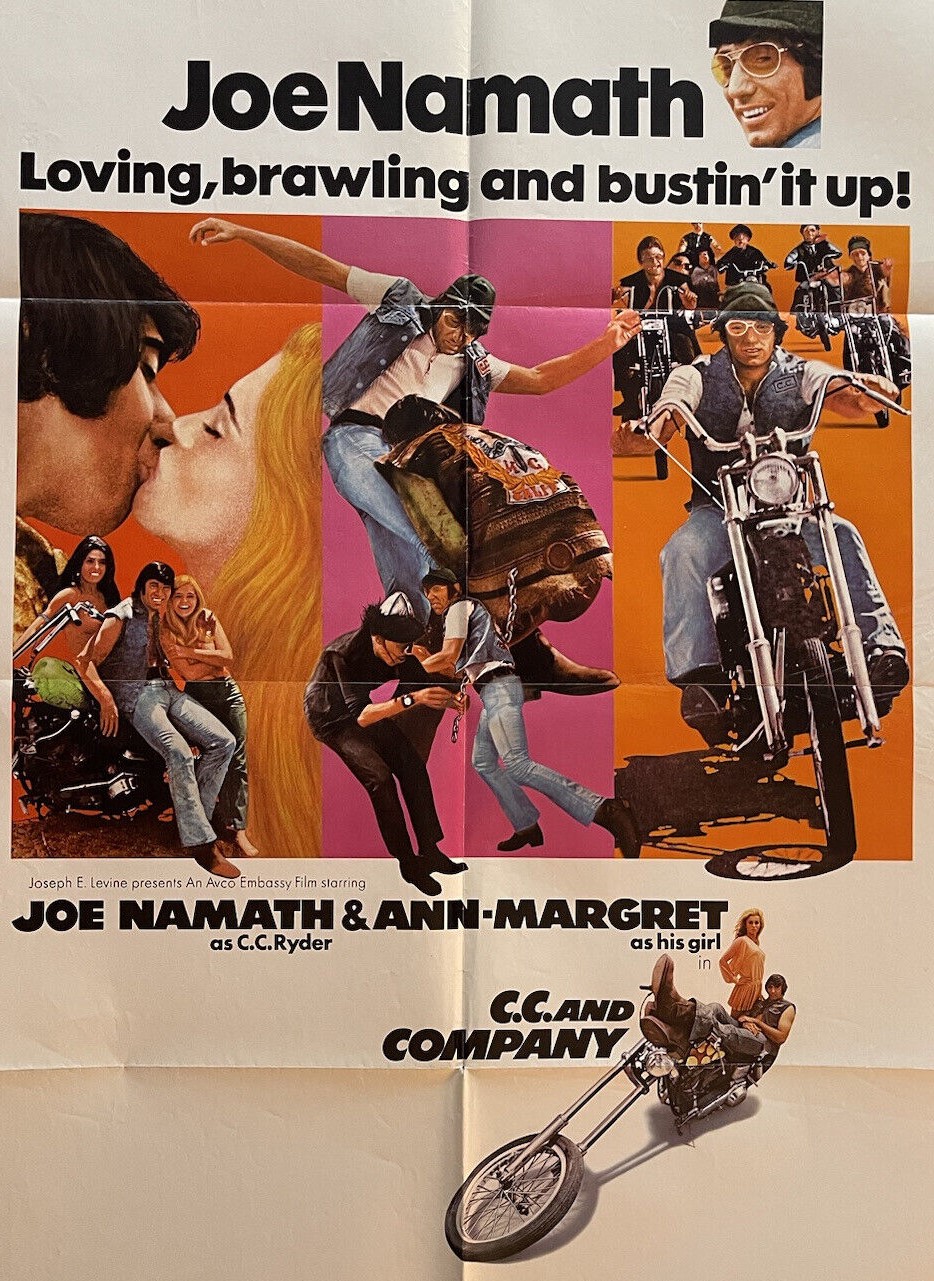
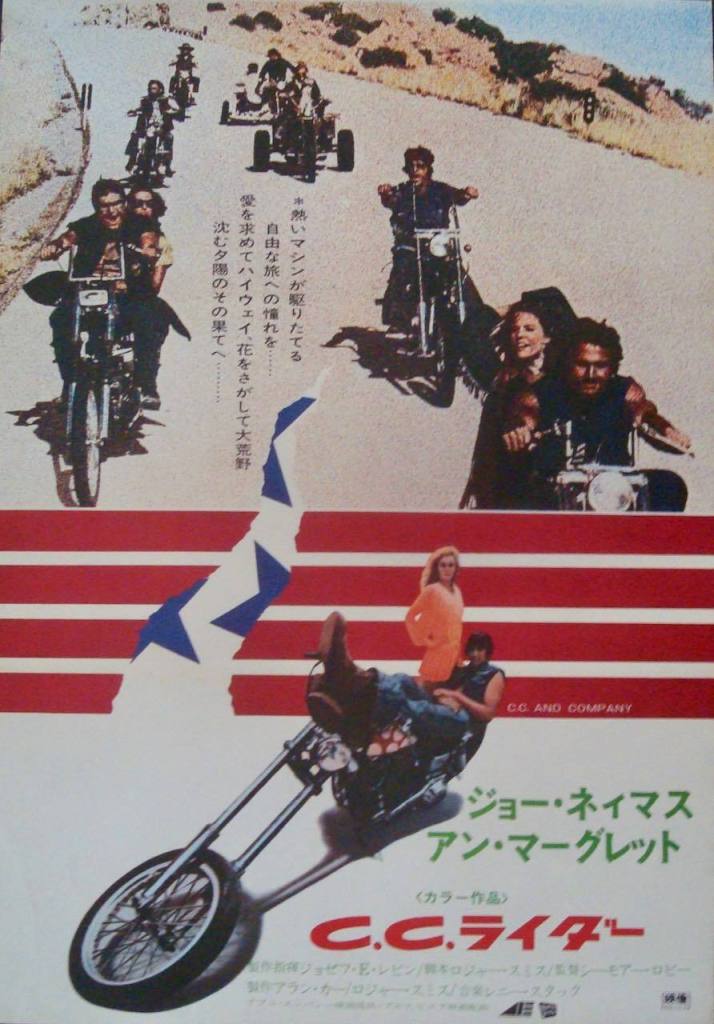
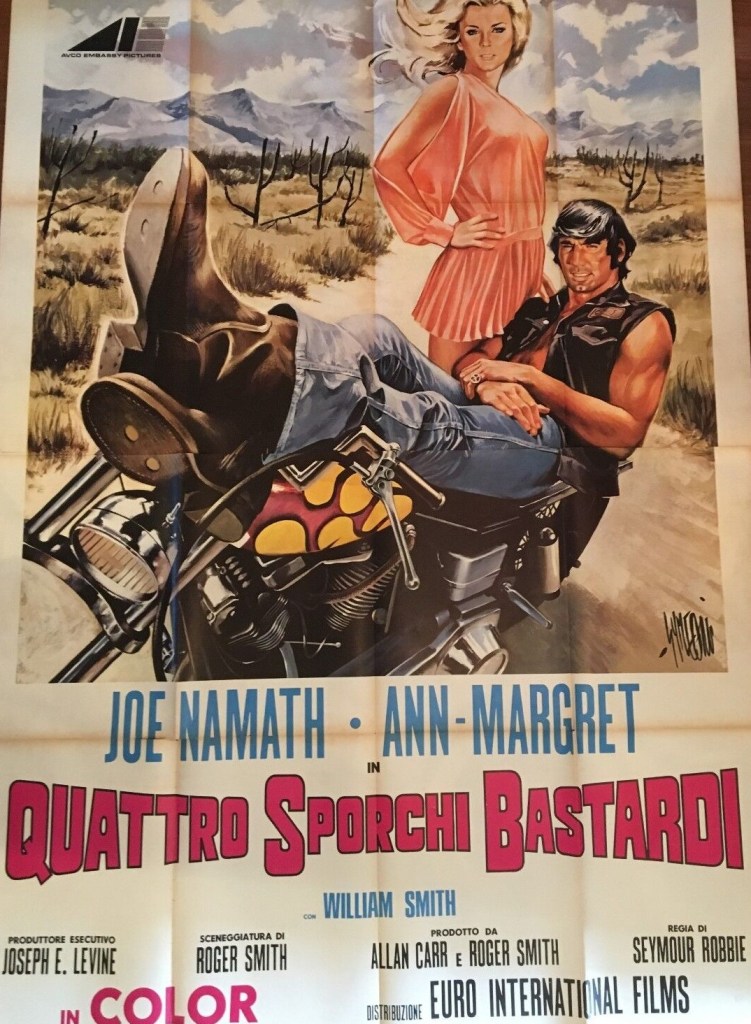
C.C. and Company (1970) *

Just terrible. Not even the presence of Ann-Margret (The Swinger, 1966) can save this. Scarcely a single redeeming feature and nothing that might lend itself to shift it into the So Bad It’s Good category. In fact, you would probably put it in a lower class, the So Bad It’s Worse Than You Can Possibly Imagine strata. Little seen for over half a century, and small wonder.

And, boy, did Ann-Margret need a hit after a three-year self-imposed exile in Italy, where she earned big bucks for pictures that hardly got a sniff on the U.S. release circuit, putting an almighty dent in her marquee value. In theory, she should have returned home with a bang, as female lead in a Stanley Kramer production, R.P.M. (1970), the most prestigious picture she had ever been associated with, and easily the best director. But that, riding the counter-culture wave, was a big flop.

This was her second attempt at counter-culture. Motorbike sagas were bankable after the success of Easy Rider (1969) and even as B-pictures had attracted decent audiences for the likes of The Wild Angels (1967) and Run, Angel, Run (1969).

But this was saddled with a terrible star in Joe Namath, and a terrible script by Roger Smith (The First Time, 1969), Ann-Margret’s husband-manager, that puts the wild boys of the highways in a motocross competition, swapping their high-powered bikes for the much smaller Kawasaki engines used in that sport.

If you were American, Joe Namath was a god. If you were foreign, he was a nobody. One of the country’s greatest American football (not soccer!) players, he had made his movie debut in another flop, Norwood (1969). My guess is Ann-Margret was there to help out her husband, also the producer, and beef up the marquee.

But C.C. Ryder (Joe Namath) looks more like an overgrown schoolboy, hulking though he is, than a Hell’s Angel. For the lack of believability he invests in the role you would have done as well with pop star Fabian (Ten Little Indians, 1965).

Anyway, on with the barmy story. So, fashion director Ann (Ann-Margret) has the bright idea, as fashion directors did in those days, of setting up a shoot against the backdrop of a motocross event, kind of like Zabriskie Point (1970) but with bikes. On the way, her car breaks down. The two passing bikers who come to her rescue have something else in mind and she is only saved from rape by the intervention of Ryder.

He belongs to a biking troupe headed by Moon (William Smith), the misogynist’s misogynist, who slaps his women around and sends them out to prostitute themselves on the highways because unlike the enterprising chaps from Easy Rider he’s not got the brains to set up a drugs operation. Then he gets the inspired notion of picking up easy money by sending his guys to compete in the motocross competition because, surely, them being serious motorbike freaks they can beat the hell out of any professional motocross rider who does this for a living.

No doubt audiences will be rooting for the amateurs the way they do for the young kids in other movies that need to put on their own show to save an orphanage or the like.

Naturally, Ryder falls for Ann. Equally naturally, Moon doesn’t like that one bit. And so kidnaps Ann, ensuring Ryder comes to the rescue. Cue a showdown. No doubt we’ll see an almighty battle with chains and wrenches and surely there will be a flashing blade or two as this pair roll around in the dust.

Nope! Let’s just find a handy football stadium and race round the athletic dirt track. That’s bound to be more exciting. You would get more excitement watching goldfish in a bowl.

Theoretically, the combination of Namath and Ann-Margret should have reached the incendiary levels of football star Jim Brown’s sexual tussle with Raquel Welch in 100 Rifles (1969). Nope. Namath has all the screen charisma of a beetle and there’s nothing Ann-Margret can do to help that. You couldn’t have wasted her first nude scene on someone less deserving.

As you might expect, Ann-Margret does get to dance, but for some reason the camera is more focused on Namath who is lacking in the shake-your-booty department.

There is one decent scene and one interesting shot. Unfortunately, the only good scene is the opener, giving a false sense that this might be an interesting picture. It involves Namath “grazing” his way round a supermarket, making up a sandwich from easily available ingredients, even stealing a tissue from a box to wipe his lips. What a rascal, no wonder everyone would be terrified of such a biker. And in the climactic race one of the bikers hits a fence that collapses concertina style.

But that’s it, a 94-minute vanity project that killed off Namath’s movie career and nearly put the kibosh on Ann-Margret’s. You can’t really blame television director Seymour Robbie (Marco, 1973) for failing to improve the material or the stars.  

Sometimes being a completist (in this case following Ann-Marget’s career) has its down side.  

PREVIOUSLY REVIEWED IN THE BLOG: Ann-Margret in State Fair (1962), Viva Las Vegas (1964), Kitten with a Whip (1964), The Pleasure Seekers (1964), Bus Riley’s Back in Town (1965), Once a Thief (1965), The Cincinnati Kid (1965), Made in Paris (1966), The Swinger (1966), Stagecoach (1966), Appointment in Beirut/Rebus (1968), Criminal Affair/Criminal Symphony (1968).

Shock Corridor (1963) *****

Sam Fuller’s (The Naked Kiss, 1964) masterpiece, targeting every conceivable taboo subject – incest, sexual abuse, racism, the atomic bomb – under the guise, as with the later Shock Treatment (1964), of a sane man entering a mental asylum with the aim of uncovering criminality. In this case, uber-ambitious journalist Johnny Barrett (Peter Breck), with his eyes on a Pulitzer Prize, undergoes training from psychiatrist Dr Fong (Philip Ahn) to pass himself off as insane in a bid to find the killer of an inmate called Sloane.

Apparently, in those days in the U.S., incest, while viewed as sexual deviation, was also considered a mental illness. So when Barrett’s girlfriend, stripper Cathy (Constance Towers), turns up at a police station masquerading as his sister and complaining of sexual molestation, he is packed off to the nearest asylum. That he passes muster is not only down to his acting (or over-acting) but to the release of his own inner demons.

Tormented by jealousy and insecurity, he imagines Cathy, dancing as a demonic miniature in his dreams, her mouth a “lush tunnel,” will abandon him for another man or just play the field, no shortage of unsuitable suitors in her line of work. For her part, Cathy finds it hard to maintain the pretence, and clearly starts to crumble under the pressure, almost giving the game away, and soon enough almost compelled to do so after seeing the impact of incarceration – and its various treatments including electric shock therapy – upon her lover.

But what a difference a director with an agenda and a knack for stunning imagery makes. While Denis Sanders with Shock Treatment (1964) and George Englund in Signpost to Murder (1964) take the melodramatic tack to mental illness, which robs the subject matter of some of its power, Sam Fuller takes a two-fisted approach. Sure, there are shades of noir in the lighting, and the internal corruption of personality, but this is a world twisted upside down, filled with intentional and accidental malevolence, often from people who don’t know the difference.

The simmering violence can explode from a minor tiff over vitamin pills, or from the wrong man entering the female quarters at the wrong time, or from deep-seated hatred, while torture is visited upon inmates from the best of intentions as psychiatrists attempt to subdue or quell the worst instincts. Best of all is the depiction of obsession. People are only committed to an asylum because they are a danger to themselves or others, in other words when what is going on in their minds has got out of control and they can think of little else but the thoughts that consume them and are condemned to play out again and again perverse versions of reality.

So we have the patient constantly singing opera who likes to stab inmates with his hands and stuff their mouths full of chewing gum, another obsessed with hide-and-seek, a third with the Civil War, yet another who steals pillowcases in order to turn them into Ku Klux Klan masks. Mental warping renders some relatively harmless and others lethal. But there are also those with nothing left on the surface, reduced to catatonic state, arms stretched out, bodies draped over a bed or a chair, and you can guess that those who still act out will eventually end up silent, helpless and rigidly comatose.

Soon you realize, as Barrett clearly does not, the futility of attempting to carry out an investigation under these circumstances. He has three witnesses to pursue, none of whom a prosecutor would ever consider putting into the witness box in a court, and eventually of course Barrett does find the murderer – the victim killed for threatening to expose an attendant preying on female patients – but by that point his mind is so jumbled up by a combination of treatment and his own psychiatric problems that he either can’t locate the name in his memory or finds himself struck dumb and hallucinating.

When he is mauled by a pack of predatory females he can just about retain his dignity, but once he visualises water pouring in from the ceiling and almost drowns in the subsequent flood, and struck by imaginary lightning to boot, he has only a few shreds of his personality left.

This is brutal stuff and even now an incredible shock to the cinematic system so you wonder how it ever managed to get released. In retrospect, not so much an expose of the treatment methods in asylums as an insight into the power of mental illness once it exerts control on hapless humans.

You won’t forget the long corridor either empty or filled with individuals bent out of shape, or Barrett battered by torrential downpour or buried under a mob of savage women, or the African American white supremacist hunting for a victim or the agony of the outsider Cathy forced into playing this terrible game.

One of those films that creates its own visual grammar. I remember the rediscovery of Sam Fuller by the cognoscenti, a director whose work stood so far outside the accepted masters of cinema like John Ford or Sergei Eisenstein or Howard Hawks that he was the very definition of cult. Critics (Phil Hardy in 1970 and Nicholas Garnham in 1972) even had the temerity to write books about him as if he was fitting company for directors who produced acknowledged masterpieces and he was lionised, in the words of Peter Cowie, “by a posse of film commandos at the Edinburgh Films Society” who hailed him as a cinematic god.

All that acclaim, driven by the French New Wave, was hard to accept because his movies were impossible to find outside of a festival retrospective, unlikely to be screened on television and in the days before VHS and DVD just nowhere to be seen. But eventually, as the books and critical articles accumulated and the films became more readily available, the attraction was obvious.

Without much in the way of Stuart Whitman’s sensitivity in Shock Treatment, Peter Breck (The Glory Guys, 1965) delivers a stunning performance, perhaps all the more so because he is blatantly on the make at the start. There’s nobody to equal Lauren Bacall for ice-cold heart in the later film, but Constance Towers (The Naked Kiss, 1964) quivering with vulnerability runs her close. Special mention in the acting stakes for Hari Rhodes (Mirage, 1965) as Trent.

Ever the multi-hyphenate, Fuller dreamed up the whole thing.

A must see.

PREVOUSLY REVIEWED IN THE BLOG: Sam Fuller’s Underworld USA (1961) and The Naked Kiss (1964); and Constance Towers in The Naked Kiss.

Shock Treatment (1964) ***

The Stuart Whitman (The Mark, 1961) retrospective sees another great performance as an inmate in a mental institution but perhaps put in the shade by Roddy McDowall (5 Card Stud, 1968) as a murderous gardener and Lauren Bacall, in her first movie in five years, as a psychiatrist in the Nurse Ratchet mold.

Though killing his wealthy boss earns Martin (Roddy MacDowall) a return to the mental asylum, the dead woman’s executor Harley Manning (Judson Laire) believes the gardener is faking it and has hidden a million dollars he says he burned. So Manning hires actor Dale (Stuart Whitman) to fake insanity, thus gaining entrance to the institution and finding out whether Martin is pretending.

Dale is pretty good at the mad act and appears initially to fool resident psychiatrist Dr Beighley (Lauren Bacall). On the other hand, he is sane enough to develop a relationship with another inmate Cynthia (Carol Lynley) whose rejection of men is equally an act.

Turns out Beighley is not fooled by either Martin or Dale. The former she takes under her wing, hoping to discover for herself the missing million bucks, the latter she had sussed out from the start, pointing to the obvious flaws in his role playing. She has a bunch of nasty medicines up her sleeve and when that doesn’t pipe Dale down she has the recourse of sending him in for electric shock treatment.

That doesn’t seem to go so far as the lobotomy in One Flew over the Cuckoo’s Nest (1975) but it renders our hero helpless, or put him out of the picture long enough for her to engage in her unscrupulous scheme of hypnotising Martin to get to the truth.

In reality, this isn’t so much an expose of the goings-on in mental hospitals so much as portrait of femme fatale going overboard. You might think Beighley would be better off getting treatment herself rather than dishing it out so deluded is she in convincing herself that Martin is sane. And there’s an absolutely fabulous pay-off in that department.

For the rest of it, she is the antithesis of the liberal psychiatrists we have mostly seen during this decade, the ones that try to find the good in their patients, helping them along to sanity, or at the very least getting them to understand the depth of their problems. That Beighley and Dr Fleming in Signpost of Murder (1964) conspire to give psychiatrists a bad name is an anomaly when mostly, as with The Mark (1961), they are of an encouraging rather than venal disposition.

Perhaps it was the very nature of the gentle psychiatrist as depicted in Hollywood that gave vent to movies that showed the darker side of the mental institutions where inmates are not only robbed of their freedom but are powerless to prevent being treated either as guinea pigs or being drugged to just shut them up or lobotomised to rid society of their unnerving instincts.

That said, seeing the patients strapped down in gurneys or incapacitated in other ways while the psychiatrist plays God is pretty strong stuff, even viewing it now nearly sixty years later. Some of the other inmates are cliché material, but by concentrating on the three characters with charisma, the enigmatic gardener, the actor attempting to put on the performance of his life and the charming duplicitous psychiatrist there’s enough meat for an entertaining drama with a powerful twist.

Of course, one of the tropes of any prison drama is that someone is innocent of their perceived guilt, and here only Dale really fits that bill, but equally since the rules relating to incarceration in this facility differ entirely from those of a prison, there is every chance that someone sane could be locked up for ever, especially if a powerful psychiatrist deems it so.

Stuart Whitman certainly plays around with his screen persona, the dandified actor entrancing a courtroom and police station with his performance, but fooling them proves easier work than duping the psychiatrist so there’s a couple of great scenes where he realizes this could be a trap of his own making – and there’s a twist in his tale, too. You might well  accuse Roddy  McDowall hamming it up, but actually, although he appears extrovert in fact he is introverted, concerned only with his flowers and plants, his violent side only emerging when that existence is threatened.

But Lauren Bacall (Harper, 1966) steals the show, cleverly concealing her true nature behind a convincing professional front and undone by greed.

Denis Sanders (One Man’s Way, 1964) directs from a screenplay by Sidney Boehm (Rough Night in Jericho, 1967) based on the bestseller by Winifred von Atta.

Riveting performances drive this one more than the expose elements.

PREVIOUSLY REVIEWED IN THE BLOG: Stuart Whitman in Murder Inc (1960), The Mark (1961), Rio Conchos (1964), Signpost to Murder (1964) and Sands of the Kalahari (1965); Joanne Woodward in From the Terrace (1960) and A Fine Madness (1966); and Carol Lynley in The Cardinal (1963), The Pleasure Seekers (1964), Harlow (1965) Bunny Lake is Missing (1965); Danger Route (1967) and The Maltese Bippy (1969).

The Mark (1961) ****

Despite an exceptional and Oscar-nominated performance by Stuart Whitman (Rio Conchos, 1964) , I suspect modern audiences will take less kindly to this tale of convicted child molester trying to come to terms with his feelings. At least it’s considerably more honest than the creepier May December (2023) where the criminal steadfastly contended her innocence.

And I suspect, too, that Whitman’s square jaw and muscular physique got in the way of his attracting the parts for which the depths of vulnerability he was able to exhibit were most suited. He came to this straight after an action role, as the charming bad-good-guy of The Commancheros (1961) where, as far as audiences were concerned, what he did with his fists was more important that what he expressed through his eyes.

There’s a bit of a grey area that lends the convicted Jim Fuller (Stuart Whitman) the benefit of the doubt. He was found guilty of intent not of actual molestation and a goodly part of the picture is spend on examining why he went down that route, either in a group exercise in prison or one-on-one with a psychiatrist, chain-smoking Irishman Dr McNally (Rod Steiger) in both instances.

I’m not sure how the psychiatric evidence adds up, but basically, with a dominant mother who bullied his father, he grew up frightened of women, despite being attracted and attractive to them, and sought out someone with whom he felt more comfortable, less challenging, leading him to spend too much time watching children at play and eventually buying a young girl an ice cream and going out on walks with her.

It would have been too much for audiences of the time – as it even was with May December – to go into the technicalities of what he intended to do so we are left to trust his own word that he never intended to instigate anything sexual, though why kidnap a child in the first place. The second element that would fill modern audiences with alarm is that though he manages to begin a sexual relationship with a woman of his own age, secretary Ruth Leighton (Maria Schell), she is a widow with a young daughter. Most people would instantly come to the conclusion he was using mother to groom daughter.

However, the film takes the tack that he’s using the daughter to explore a normal relationship with a child, the joy of having a daughter, and the delight and happiness that a young person can bring into a dour repressed life. Dr McNally keeps on banging on that Fuller is “cured” but it’s a very uneasy watch trying to work out if he is or not.

In the event, the first time he’s alone with the girl he is photographed by a local journalist who sticks the photo on the front page, destroying the life Fuller has carefully rebuilt. He has found employment as an accountant with a sympathetic business owner Andrew Clive (Donald Wolfit), fitting in so well he is promoted, though at odds with another senior employee Roy Milne (Paul Rogers). He is chucked out of his accommodation, loses his job and although Ruth initially stands by him the minute she sees Fuller with her daughter her instincts are hostile.

There would be no point in an actor trying to gain sympathy for such an unsympathetic character by playing to the gallery with bouts of temper or floods of self-pitying tears, but even so, the vulnerable husk Whitman presents, his struggles with his self-contempt, his understanding of the feelings he must invoke, his determination to live as quietly as possible, almost in that determined English manner of never being heard nor seen, is what makes this film. Interestingly, he replaced Richard Burton, who pulled out at the last minute (as did Jean Simmons) and you could easily imagine with those trademark quick intakes of breath and deep growls how that actor would have played the part.

Whitman doesn’t go near any grandstanding. It’s just a heartfelt performance of a man who’s lost his way and knows he might never find his way back, haunted by his past, unable to trust himself, unable to believe that he is, in fact, cured. Probably, the biggest issue is that the movie comes down on his side, especially when he becomes one of the usual suspects in another crime involving children, though he did not commit that, and tries to suggest that a child molester will find salvation through living with a mother and child in the normal fashion. As I said, this is not my subject of expertise, thankfully, and that may be well what’s advocated rather than staying away from children altogether.

While the approach might be considered a shade naïve at the same time it does examine issues surrounding reintegration and avoids the obvious trap of attempting some kind of character redemption.

Apart from Whitman, there are good performances all round. Maria Schell, whose career within a decade would go from roadshow blockbuster Cimarron (1960) to WIP epic 99 Women (1969), subsumes her normal more glamorous persona to play a believable working mother. With his chain-smoking, Rod Steiger (The Pawnbroker, 1964) is allowed to fidget to his heart’s content but even such obvious scene-stealing only places more emphasis on the quieter Whitman. Donald Wolfit (Life at the Top, 1965), too, reins in his usual bluster.

Guy Green (The Magus, 1968) directed from a screenplay by Sidney Buchman (The Group, 1966) and Stanley Mann (The Collector, 1965) from the bestseller by Charles E. Israel.

In this instance, given the Oscar nom, Stuart Whitman could hardly be considered under-rated but over the years seems to have disappeared from sight.

Worth a look to see what he could do with the right material.

Madison Avenue (1961) ***

Surprisingly effective feminist angle. Unusual for the suave salesman to get his come-uppance from two vulnerable women, but that’s the case here, in an expose of the “build-up” (what we’d call “hype” these days) techniques of the public relations business, an area of advertising generally considered one step below the Mad Men of popular television. Fancy bars and cocktail dresses put in an appearance but, mostly, this deals with the grittier end.

This was pretty much the end of the mainstream Hollywood career for Dana Andrews. Still best-known for Laura (1944) and The Best Years of Our Lives (1946) and for some key film noir titles, this was his last major top-billed role. He wouldn’t make another movie for four years and anyone coming to him in this decade would associate him with supporting roles in the likes of The Satan Bug (1965) and Battle of the Bulge (1965).

So this is, possibly unexpectedly, a performance to savor, for he is hardly the hero, more the kind of character who might turn up in a contemporary movie, with questionable motives to go along with his decided charm (look no further than Leonardo DiCaprio in Killers of the Flower Moon). Though hardly murderous, he is ruthless and doesn’t care who he brings down in achieving his objectives.

After losing his job for purportedly (an accusation unproven but going with the territory) trying to steal the major client, Associated Dairies, of his boss, J.D. (Howard St John), top executive Clint (Dana Andrews) plans to get his revenge in rather sneaky fashion, by turning round its poorly-performing subsidiary Cloverleaf. He targets the dowdy owner, Anne Tremain (Eleanor Parker), of its failing advertising firm, promising her client a big editorial splash in a big newspaper courtesy of journalist girlfriend Peggy (Jeanne Crain).

Anne’s the first beneficiary of his PR skills, reinventing her as a glamorous, power-dressing, more confident advocate of the persuasion industry. He inveigles himself into her arms, at the expense of Peggy. He aids the idiotic owner of Cloverleaf, Harvey (Eddie Albert), who spends all his time in the office playing with model airplanes. (From today’s perspective, he’s something of a savant, predicting these machines – think drones – could one day form part of the delivery contingent.)  

To show just how damn clever he is, Clint “builds up” Harvey into the kind of self-made-man that has politicians purring, and brings Clint back into the winners circle. Unfortunately, the only way to get right in is through deviousness, a bit of back-stabbing here and there, dropping anyone who’s outlived their usefulness. But he’s not as clever as he thinks, lacks the business acumen of Anne, who’s denied him a share of her growing business, and therefore any real power base.

The women take unkindly to being used, Anne now the one doing the tossing-aside. For her revenge, Peggy writes an article that digs the dirt on him. Neither of these women would fall into the femme fatale category, though once all glammed-up Anne could pass for one had she required violence rather than business dexterity to exact her revenge.

Though both, unusually for the times, hold top positions in their businesses – Peggy’s a high-flying journalist working the Washington beat – they are presented initially as easy meat for a man capable of exploiting their vulnerabilities. Clint keeps Peggy on the back foot by failing to turn up for dates or presenting Anne as a rival for his affections.

This is an era where, purportedly, all women wanted was a ring on their finger, and to hang with being landed with an unsuitable man. But both Anne and Peggy upend that stereotype, seeing through the creature who’s come calling. In a western, audiences would have the satisfaction of seeing this kind of despicable character being shot. Here, they get to see him cringe, and be humiliated by women who have come to their senses. Albeit there’s a “happy” ending, that only occurs after some begging by the predator.

It suffers from too many long sequences, and by its determination to go down the satire route in exposing the seamier side of the public relations business. But there are some classic moments, such as when Harvey, tumbling through a prepared speech, has to suddenly wing it and finds his real voice.

But watching Anne get the measure of Clint and seeing him brought to heel by both women suggests the kind of ahead-of-its-time come-uppance that sets this up as an early feminist venture.

Eleanor Parker (The Sound of Music, 1965) and Jeanne Craine (Queen of the Nile, 1961) are both superb as women coming to their senses and this is a quite superb last top-billed hurrah from Dana Andrews. This was also the final outing for director H. Bruce Humberstone (Desert Song, 1953). Former newspaperman Norman Corwin (The Story of Ruth, 1960) and Richard P. Powell (Follow That Dream, 1962) based the screenplay on the best seller by Jeremy Kirk.

Resonates on the feminist front.

Morgan! / Morgan, A Suitable Case for Treatment (1966) ***

While Hollywood was capable of dealing with mental illness head-on in pictures like Frank Perry’s David and Lisa (1962), Sam Fuller’s Shock Corridor (1963) and Robert Rossen’s Lilith (1964), the British were more inclined to take an alternative approach. The titular characters of Billy Liar (1963) and this film dealt with awkward reality by creating a fantasy world.  

Morgan (David Warner in his first starring role), is a failed artist and virulent communist who cannot come to terms with being divorced by rich Leonie (Vanessa Redgrave) who is planning to marry businessman Napier (Robert Stephens). Morgan forces his way back into his wife’s house and attempts to win her back with nothing stronger than whimsicality and when that fails resorts to kidnap.

And it is clear that she shares his fancy for furry animals, responding to his chest-pounding gorilla impression with tiny pats of her own chest. For a slim guy, Morgan makes a believable stab at a gorilla, shoulders hunched up under his jacket, chest stuck out. And he has an animal’s sense of smell – detecting his rival’s hair oil. 

The tone of the film is surreal. Had David Attenborough been a big name then you could have cited him as one of director Karel Reisz’s influences, such was his predilection for inserting wildlife into the proceedings, not just primates but giraffes, a hippo, a peacock and a variety of other creatures. Some are comments on Morgan’s state of mind but after a while it becomes monotonous. The film is clearly intentionally all over the place, the class struggle also taking central stage, but it’s hard work for the viewer. If you had stuck in some psychedelia, the fantasy would have made as much sense as The Trip (1967).

Having said that, towards the end of the picture there is an extraordinary image – possibly stolen from the opening of La Dolce Vita – of Morgan in a straitjacket hanging from a crane. Had that been the film’s starting point, it might have dealt more demonstrably with the subject matter.  The whimsy is all very well but the focus on external animals does little to illuminate Morgan’s internal struggle and mental descent.

At this stage of his career, David Warner (Perfect Friday, 1970) exhibited a core instability, although later he was adept at ruthless villains. You could argue he is too charming for the role.

Vanessa Redgrave (Blow-Up, 1966), in her second film and her first starring role, steals the picture, winning her first Oscar nomination (in the same year as sister Lynn for Georgy Girl). She is made of gossamer. Still attracted to a man she knows will only bring her pain, she is far from your normal leading lady. There is a touch of the Audrey Hepburn in her ethereality but she portrays a completely genuine soul, not a manufactured screen personality. Robert Stephens (The Prime of Miss Jean Brodie, 1969) adds a welcome hard core to the frivolity.

But Karel Reisz (Saturday Night and Sunday Morning, 1960) misses the spot. Distinguished British playwright David Mercer adapted his own BBC television work from 1962.

Could have done with taking a step back from the material and offered a more objective assessment.

https://amzn.to/3GIA5HL

The Trip (1967) ***

Give any neophyte (word of the week!) independent film director a camera and a small budget ($100,000 in this case) and they might well have come up with something like this. Has the feel of being an advert for promoters of LSD who felt they had to play fair and show the potential downside. Meanwhile, they can jam in an absolute phantasmagoria of imagery and sit back and wait for Stanley Kubrick to rip off some of their ideas and give the whole head-spinning malarkey some credence for the conclusion of 2001: A Space Odyssey.

If there’s a story, it’s as thin as they come. Commercials director Paul (Peter Fonda), trying to understand himself better, and why, for example, wife Sally (Susan Strasberg) has left him for another man, enlists the help of self-help guru John (Bruce) to guide him through an LSD trip. The notion that there are drug guides comes as a surprise to me, and this feels like the kind of the warning you get on the side of cigarette packets, although quite what guidance anyone can expect while under the influence is anybody’s guess. If you’re high as a kite, it’s unlikely you’re on an even enough keel to do what you’re told.

Anyway, off we go. And lo and behold, before you can utter the words “groovy” or even “psychedelic,” suddenly the screen is invaded with all sorts of images, coming so quick and fast that even the ones that might makes sense – i.e. indicating paranoia – get little time to settle before the next appear. Some of the images look like they’re offcuts from an AIP horror picture, haunted houses, medieval backdrops, torture, people being mummified or hanged or drowned or all three (maybe all at once).

And from there it’s an easy step into being dazzled by headlights or climbing a cliff or running through a desert or being chased by masked men on horseback and hearing high-pitched giggling. Some of the images, while dreamlike, remain realistic, such as topless body-painted go-go dancers. And the oddest image of a woman in curlers eating a chicken leg in a laundromat feels easily like something out of a bizarre dream when in fact it isn’t.

Some stuff you might expect. Items like an orange are experienced with more intensity. And Paul is disembodied when he observes people making love. Sometimes you’re looking through a kaleidoscope, other times it’s with grim clarity. Strobe lights, hallucination, add to the dreamy expressionistic quality. Not sure the movie had much to say except drugs can be fun – or not. But, inevitably, the imagery, instead of assisting with characterization, gets in its way.

Looks strange to see so many hippies with short hair. Peter Fonda, Dennis Hopper and Jack Nicholson (here only in his capacity as the screenwriter) would come together with greater effect in Easy Rider (1969). This resembles nothing more than an audition for the later film but directed by someone (Hopper) with a bit more sense, adding a proper narrative and cutting the tripping down to the minimum.

Roger Corman (The Secret Invasion, 1964) directed but Susan Strasberg (The Sisters, 1969), Bruce Dern (Castle Keep, 1969)  and Dennis Hopper have such small parts they are almost only there to add marquee value. Not quite the ode to counter culture envisaged.

Shows how difficult it is to film the unfilmable.

https://amzn.to/3Rz1mCW

Ada (1961) ****

Oddly enough, this shares some elements with Killers of the Flower Moon. For a start Sylvester (Wilfrid Hyde-White), the political fixer, comes over as Robert DeNiro’s benign uncle, both so low-key, charming and persuasive you’d never believe them capable of  wicked manipulation. In the second place Bo (Dean Martin) is every bit as charming and baffled as Leonardo DiCaprio.

And just as the latter’s role is to worm his way into wealth and power via marriage, so too that’s the route taken by Ada (Susan Hayward), who would be euphemistically known in those days as a “good-time girl.”  

You’d figure this for a mild political satire except for the fact that stooges/buffoons have consistently made their way to the highest political office. As Ada pointedly points out, public appeal is the greatest qualification of any candidate, opportunism a close second.  Bizarre as it seems, Bo is a popular local guitar-playing-singer of the Hank Williams variety, a well-meaning dumb-as-they-come sort, whom Sylvester persuades to run for Governor. In the course of the campaign, as “a present in a back-room saloon,” he is served up Ada with whom he unexpectedly falls in love and marries.

His campaign path is smoothed when one of Sylvester’s hacks leaks news that his rival’s wife is an addict, the woman conveniently shooting her brains out. Naturally, Bo soon realizes he’s the sap, his only job to sign hundreds of legal documents every day, pieces of legislation that as it happens fill the pockets of Sylvester and his buddies.

When Bo’s long-time chum Ronnie (Frank Maxwell) threatens to expose the river of sleaze he is quickly eased out. That leaves an interesting vacancy for Ronnie was Lieutenant-Governor, Bo’s deputy. So, Ada, with a good bit more between the ears than her husband, throws her hat into the ring.

She’s to politics born, a particularly wily creature, able to bring into line the society dames who look down their nose on her, and keep tabs on Sylvester. What she doesn’t realise of course is that once you’ve got a very amenable deputy, that person becomes Acting Governor, and in effect Governor, should anything happen to the incumbent. And should she then decide she’s had enough of the sleaze, then a little poking around in her background should bring her to heel.

So, all the corruption you ever dreamt of, all the smart back-slappers ponying up thousands in campaign contributions in order to seek future reward, all that tax-payers money heading in the rich man’s pocket. Not a lot that’s new there.

What makes this stand out are the performances and the narrative arc. Wilfrid Hyde-White (The Liquidator, 1965) is a sensational casting coup. The British actor specialized in characters oozing wry charm, sometimes verging on the dotty, sometimes a tad idiotic, but never an outright swine. There are a couple of scenes where those mellifluous tones turn in an instant into a sharp crack, the avuncular replaced by the sinister.

And I’m not saying DeNiro copies his aging trick, you know the bit later on in Killers of the Flower Moon, when body no longer as sharp as the mind, the actor begins to drag his leg, and with no reference to that impairment. Well, here, similarly, the fit-as-a-fiddle Sylvester later on, still at the height of his mental powers, is seen being transported in a wheelchair.

The performance of Dean Martin (Rough Night in Jericho, 1967) was oddly dismissed at the time. And yet it was bold playing. He goes from ebullient star, enjoying being feted by all, lousy speeches lapped up by an adoring crowd, to withdrawing into himself as he realizes he has been duped. That doesn’t just take some acting skill, but considerable self-belief, to play a character who undergoes the wrong kind of transformation, not the general redemptive kind, nor sinking into some Oscar-worthy illness, but coming to terms with your own lack of ability.

Of course, Susan Hayward (Stolen Hours, 1963) delivers, as always, her screen wattage burns brighter than virtually any other female star of the period. You know the character expects her past to be exposed at any time, but she dives straight in, determined to tackle the sleaze. There’s a wonderful scene where, her background challenged by the hoity-toity society dames, she puts them in their place with a clever piece of political maneuvering.

Ada totally turns on its head the idea of the political do-gooder. She has none of the usual innocence, nor the ability to capture the crowd by seizing upon an ideal, but she’s more at home by dealing with the sleaze-merchants straight-on, taking apart their schemes in the comfort of the government’s back rooms where until now such deals have been dreamt up.

Director Daniel Mann (Judith, 1966) was known as a woman’s director. Under his direction in the Oscar stakes, Elizabeth Taylor had won for Butterfield 8 (1960), likewise both Anna Magnani for The Rose Tattoo (1955) and Shirley Booth for Come Back, Little Sheba (1953), while Hayward was nominated for I’ll Cry Tomorrow (1955). He not only chose grittier dramas but had the knack of encouraging actresses to let loose, without going overboard, on a part.  

Considerably overlooked and substantially under-rated, but not only prescient regarding future political candidates and the kind of corruption they got involved in (land deals ring a bell?) but elevated by the role of his career by Wilfrid Hyde-White, an unexpectedly good one from Dean Martin and Susan Hayward in top form.

https://amzn.to/3QGZoQC

In the French Style (1963) ***

Short stories can be an excellent starting point for movies because usually they are lean and narrative driven, a screenwriter needing basically to fill out the characters and add a subplot. But short stories have one weakness. They require a pay-off,  a twist, something the reader doesn’t see coming. And short of a twist of the caliber of Jagged Edge (1985) or The Sixth Sense (1999), these don’t usually come off, the audience feeling duped.

This one falls down due to a twist. Two actually, because it comprises a pair of initially unconnected short stories, A Year to Learn the Language and In the French Style. Which is a shame because the movie itself  with its Parisian setting is in general charming and conveys the development of young American Christine (Jean Seberg) as she moves from innocent wannabe artist to promiscuous model while worrying she is throwing her life away on transient pleasures.

Writer Irwin Shaw (Two Weeks in Another Town, 1962), who doubles as producer, has used Christine as the link between two of this best-known short stories. So it’s – to dip into soccer parlance – a film of two halves and I’ll let you know right away co-star Stanley Baker (Sands of the Kalahari, 1965) is consigned to the second part, when he meets an older and perhaps more rueful Christine.

So, young, not exactly starving (an allowance from her father funds her lifestyle), artist meets a young Frenchman Guy (Phillipe Forquet) determined to be the antithesis of the standard Frenchman. He doesn’t drink because alcohol is ruining his country. He won’t kiss her in public because not all Frenchman are insanely romantic. He’s severely lacking it has to be said in the romantic gene. Seduction is abrupt. He’s got the key to a friend’s apartment. Let’s go. Is as much subtlety as he can summon up.

So no sex this time and she decides she’ll be the one doing the asking, which upsets his notion of the biddable girlfriend. Anyway, they end up touring Paris on his scooter looking for a suitable no-questions-asked hotel. Surprisingly, the city, according to Guy, isn’t full of them.

And end up in a freezing hotel room. He can’t open the champagne bottle. He insists she undress last, as apparently that’s the done thing. And then he springs his surprise. He’s not only a virgin, he’s not the 21-year-old he told her he was, but still at school and just 16.

If this had been done The Graduate-style, with his awkwardness to the fore, or if she had just been as clumsy, it would probably have worked. There would have been nothing illegal in their coupling, or cringe-worthy (she’s 19 after all), but it just makes her out to be an idiot, fooled because she effectively fell for the first handsome Frenchman to come her way. It just drops a bomb of the wrong kind halfway through the movie.

Cut to four years later and she’s much more the lady-about-town, independent or of questionable morals depending on your point of view, self-sufficient or relying on male companionship to see her through depending on your point of view. Having been dumped by Bill (Jack Hedley), she hooks up with itinerant flamboyant journalist Walter (Stanley Baker) but while he’s off on some important story she’s made hay with more sober American Dr John Haislip (James Leo Herlihy, yes that one, author of Midnight Cowboy) and chooses security over culture and fun.

The problem with this section is that the short story was originally written from Walter’s point of view, as he comes to realize that long-term commitment is not compatible with globe-trotting.

All told, a pretty odd concoction. That it works at all is largely due to Jean Seberg (Breathless, 1960). I’m not totally convinced by her transition. You get the impression that had she met a more worldly Frenchman in the first half she would have quickly shaken him off for another lover. As it is, her rootlessness is meant to be the result of being disappointed by a schoolboy lover. Hmmm!

Although there’s over-reliance on Paris atmosphere – jazz club, Arc de Triomphe, restaurants where waiters transport flambe dishes halfway across a room, a “happening” where the art crowd lets it all hang out – and we rely on other characters telling us about Christine’s personal situation, it remains an interesting view of the French capital from the point-of-view of an American ex-pat, who, less successfully than Hemingway perhaps, offers a different perspective on the city. Robert Parrish (Duffy, 1968) directed.

Worth it, though, to see Seberg transformed.

https://amzn.to/470agOY

https://amzn.to/49n6Xmv

Downhill Racer (1969) ***

Robert Redford rarely took the easy option. Even his big romantic number, The Way We Were (1973), with Barbra Streisand had a serious center, Jeremiah Johnson (1972) focused on ecology and he used his star power to get studio backing for All the President’s Men (1976). Even starting out, and before Butch Cassidy and the Sundance Kid (1969) anointed him a star, when he could, or should according to some observers, have been capitalizing on his good looks he did not shrink from playing unlikeable characters.

Idealizing heroes is endemic. Most films which portray sport stars with feet of clay generally begin with an attractive personality who presses the self-destruct button through alcohol, sex or drugs (or all three) such as Number One (1969) with Charlton Heston. The general consensus is that this approach to the sports movie was not rescinded until the brutal boxer exposed in Scorsese’s Raging Bull (1980).

But it turns out Scorsese was not the first. In this ski drama Chappellet (Robert Redford) is a loner who cares for no-one but himself. Alienated from his father (Walter Stroud), his girlfriend at home little more than a sex object, the obsessed skier proves a constant source of friction for his national team manager Claire (Gene Hackman) and not above the kind of dirty tricks as typified in Slap Shot (1977). He sees nothing wrong with making no bones about the fact that he is in the game for fame.

Totally lacking in self-delusion, he’s a farm boy and few steps up from being illiterate. The world of the professional skier was hardly the obvious subject for a sports drama. There’s certainly an excitement in the action that couldn’t be captured on television, but the essential competitive element, the race against the clock, is not so riveting as the last-minute touchdown or winning home run.

Pretty much Chapellet’s only attractive feature is that he is played by Robert Redford, and the film plays upon the conceit that as handsome a man as this will at some point turn into a good guy.  There’s an interesting debate – and one that would last decades – about whether Redford’s looks got in the way of the characters he portrayed. Imagine Robert Duvall in the part, for instance, and relentless determination would not be called into question.

This leaves the film with only pity as a way to provide the character any sympathy, the sense that if he turns into a loser the audience will warm more to him than if he is a champion, but that arrives outside the competitive circle, and perhaps is even more touching, when his hopes of genuine romance with top-notch blonde Carole (Camilla Sparv) are dashed. 

Michael Ritchie (The Candidate, 1972), making his directing debut, opts for a documentary-style approach, so minimalist it’s almost perfunctory. This is a decent option given there’s very little going on beyond lonely hotel rooms, and an endless round of competitions and an occasional outburst from the manager. The skiing scenes, sensational at the time, are boosted by Blu Ray. Although it gained good reviews, audiences failed to respond although Redford was on a career high after Butch Cassidy and the Sundance Kid (1969).

While it was a brave choice for the actor, the script by James Salter (Three, 1969), based on the Oakley Hall bestseller, doesn’t bring enough insight, though you could argue it was intended to keep the character at arm’s length.  A novel can be engaging enough just by opening up an unusual world, but a movie needs to do more. This is pre-chuckle Gene Hackman (The Gypsy Moths, 1969)   and at this point you would probably have bet on him remaining a supporting player.

Redford, the thinking man’s actor, in embryo.

https://amzn.to/3MonLzM

Discover WordPress

A daily selection of the best content published on WordPress, collected for you by humans who love to read.

The Atavist Magazine

by Brian Hannan

WordPress.com News

The latest news on WordPress.com and the WordPress community.