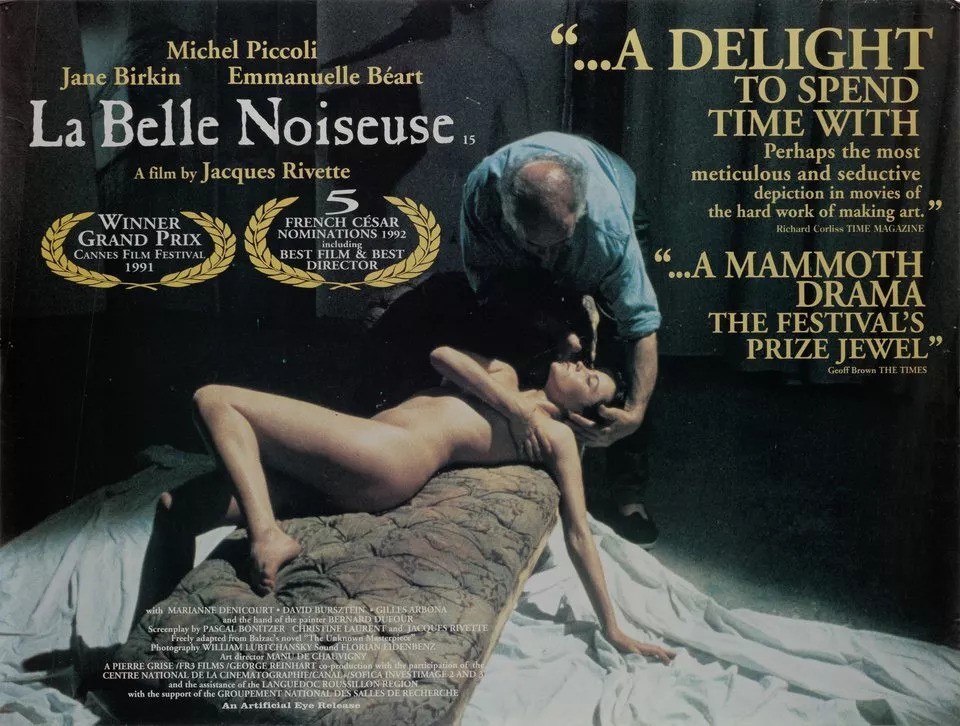
La Belle Noiseuse (1991) ****

I’m taking the Jacques Rivette test. Aka the bum-on-seat test. How easily can you sit through a four-hour intimate epic is often seen as the true test of your credentials as a critic. I have to confess I’ve failed this test once. Twice, to be truthful. I walked out – twice – of Celine and Julie Go Boating Go Boating (1974). But as I’m partial to tales of creative endeavor, a sucker for any story about an artist, this seemed more promising.

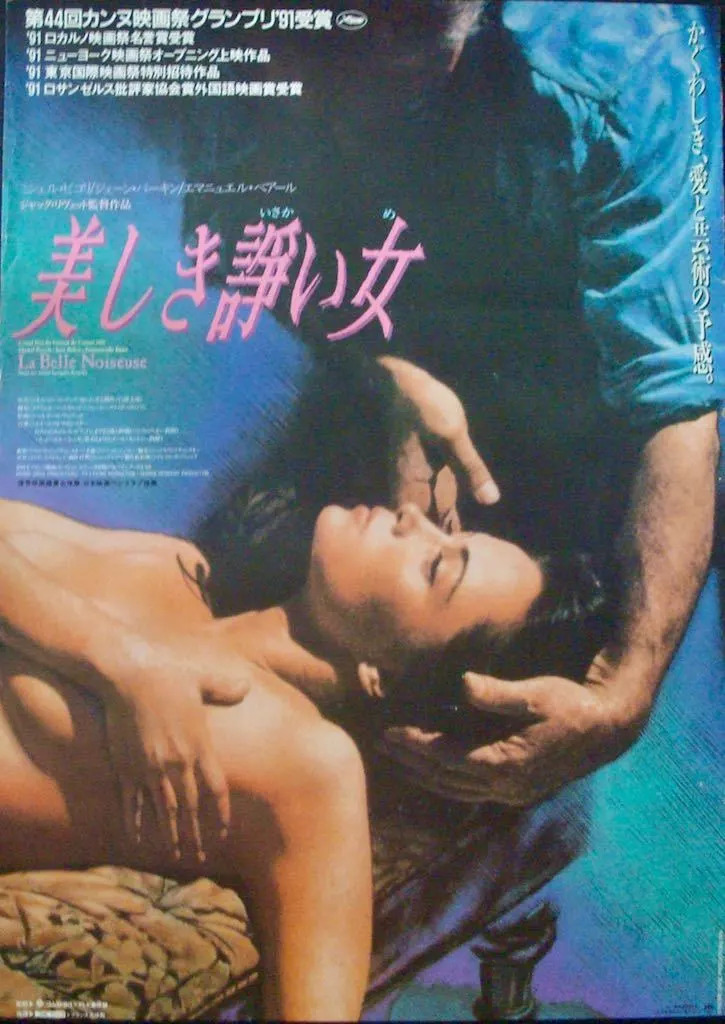
This director does something so clever you wonder why the idea wasn’t applied before. Maybe it was, but nobody fessed up. The star of this show in many ways is neither Michel Piccoli (Topaz, 1968) as artist  Frenhofer nor Emmanuelle Beart (Mission: Impossible, 1996) as model Marianne but the real-life painter Bernard Dufour. We never see Dufour’s face, only his hands. For it’s he who sketches and paints, not the actor. So we don’t have any of that nonsense where an actor purportedly spent a year preparing for the role, learning to play an instrument or whatever and then showing all too obviously that he/she is doing something by rote rather than inhabiting the skin of a true artist.
But that does also mean we don’t have to skate over a lifetime’s worth of painting or music or whatever to get to the painting or piece of music for which the character became famous and we don’t need to dwell on background or career development or any other issue that might have hindered /affected/ charged their progress.

This is, beyond a couple of introductory scenes, the story of how an artist paints and his relationship with the model and how that changes both of them. Rivette, having given himself all the time in the world, takes all the time in the world, so we go from initial sketches, ink on crackling paper, to an outline of an idea, to the false steps, wrong steps and true steps.

The awkwardness between artist and model is cleverly captured. Marianne feels she has been traded. Her boyfriend Nicolas (David Bursztein), a rising artist, hopes to win favor with the established artist by pushing her into the project without first asking her approval. Quite what makes her accept the (unpaid) job is unclear but then there are no academic studies on amateur models to provide clarification beyond a sense of excitement at being asked.
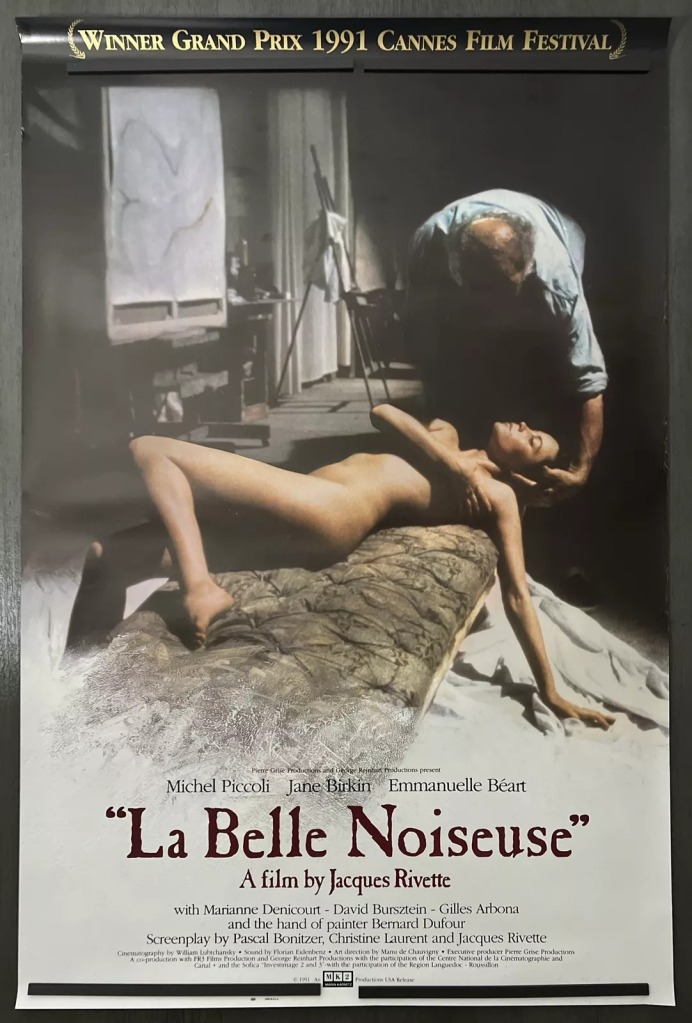
She takes in her stride the perfunctory reality that she will be naked virtually the whole time. That aspect of the film might have been viewed as somewhat prurient, but, in fact, it sheds light on just what a model does, what is asked of her, and why, and the idea is killed off right away that an artist always has a clear idea of his composition before he embarks on a painting.

Here, Frenhofer spends as much time trying to get to the heart and soul of his subject, to understand the shape and lines of her body, as he does on the actual picture. He wants to combine her characteristics with whatever he has in his head. There’s another element to the story. He tried to paint a similar picture a decade before, with his wife Liz (Jane Birkin) as the model. For reasons unstated, he abandoned the painting.

Although there’s a twist at the end, there’s not much more to the story than a painting being created from start to finish, including all the finicky bits like deciding on the pose and the size and shape of the canvas and the colors etc.

Yes, it’s incredibly long and not long in the way of Christopher Nolan or Martin Scorsese or Ridley Scott where length is the result of trying to cram in too much, characters, details, storylines, complications or visualisations a director could not resist. But it’s endlessly fascinating and for many the best movie ever made about the creative process, all the more so because although documentary in style it’s not documentary in execution.

Both actors are superb, not least for the concentration this must have taken, since development would have taken place in minute detail.

I think I passed the Rivette test. Celine and Julie….hmmm, still not so sure.

Well worth four hours of your time.

The Last Safari (1967) ***

Producer Hal Wallis was known as a star maker. He had launched the careers of Burt Lancaster, Kirk Douglas, Lizabeth Scott, Dean Martin, Jerry Lewis and Shirley MacLaine and was instrumental in shaping Elvis Presley’s screen persona. Continually on the lookout for new talent and with a roster of pictures to cast, he had swooped in the mid-60s on Suzanna Leigh (Boeing Boeing, 1965), Broadway rising star Tanya Everett and on the basis of a television pilot Lithuanian-born Kaz Garas.

So if The Last Safari appears both overcooked and undercooked, put that down to Wallis saddling director Henry Hathaway with the untried Garas as his star, billed ahead, much to his fury, of veteran Stewart Granger (The Secret Invasion, 1964). The film’s way too long as the producer keeps finding ways to insert the youngster into the older man’s tale of hunting an elephant that killed his buddy. In fact, it’s another youngster, Gabriella Licudi (The Unearthly Stranger, 1965) who, with a fraction of Garas’s dialog, steals the show.

The safari picture was by now fast out of fashion, the days of glorifying hunting, even just to supply zoos as in Hatari! (1962), losing its appeal especially with the softer conservationist approach of Born Free (1966) and Africa, Texas Style (1967). So while issues regarding poaching, native self-determination, tribal tradition and colonial interference are given more coverage than you might expect, it still boils down to great white hunter Gilchrist (Stewart Granger) setting out to kill an elephant. That millionaire playboy Casey (Kaz Garas) keeps getting in his way is down to an odd screenplay and the top-billing error that seems determined to find more space for the younger irritant than for the older guy coming to terms with himself.

By the time Casey lands in Kenya in a zebra-striped private plane with native guide Grant (Gabriella Licudi), Granger has already torn up his hunter’s license. Much of the initial narrative is simply Casey pursuing him and being turned down, until the American simply decides to tag along, despite inexperience of the bush.

It’s unclear whether Grant is a guide-with-benefits but she milks him at every turn and filches anything she can, including a lucky charm belonging to Gilchrist. But where Casey drones on, the camera is kind to her, showing her character in tiny snippets, concealing the lucky charm at Gilchrist’s approach, for example, or not being at all perturbed at being excluded from dinner on the grounds that’s she’s a servant and astonished that Casey gets himself so wound up at what he sees as an injustice. She’s perfectly happy dancing the Watusi on her own away from the boring grown-ups. And she puts him in his place, “You want a trophy…I’m not for sale.”

Quite why Gilchrist is obsessed with this particular elephant is never satisfactorily explained. There’s guilt of course since he was the protector but any observer would see that the buddy had stupidly put himself in harm’s way for the sake of getting a better photo of a charging elephant. You get the impression that Gilchrist is just finding a long slow way to die, now he has little else to live for, and his profession is being swamped by idiots, and the work involves dealing with entitled nincompoops like Casey.

Every now and then the movie takes a different, occasionally cute, turn, like watching the baby hippos clamber all over their parents in the water, repetition of this item explained by Gilchrist’s preference for that animal rather than that someone dug up some interesting library shots. But, more likely, it’s dangerous intrusion on tradition. Both Grant and Casey take it upon themselves to participate in a tribal dance, which leads to fisticuffs after a native, following her response to his moves, takes a fancy to the woman. Another time Gilchrist has to rescue some white people trapped in a village because they had violated tradition or were upholding tradition (the reason was unclear). Another chap is trampled to death because his watch alarm went off at the wrong time.

Once the movie settles down to what Hathaway is expert at, old men heading off on quests, long vistas, unwanted traveling companion, it picks up though audiences were probably let down by the ending, not the expected savage slaughter. By the time Casey admits he has learned humility you’ve long lost interest in him.

Howard Hawks would have swung in with a gender switch to make this work, turning Grant into an annoying female, introducing a romantic tussle, hoping the age gap wouldn’t act as too much of a deterrent. Frustratingly, this is excellent in patches, primarily when Gilchrist gets to demonstrate tradecraft and understanding of tribal tradition.

Stewart Granger, in festering in his guilt far removed from the traditional hero, is surprisingly good. Kaz Garas’s career told its own story, this being his only top-billed movie. He’s been thrown in at the deep end and sunk not swam. I was surprised to see Gabriella Licudi not popping up elsewhere because she makes a good stab at the self-sufficient sassy heroine. Hathaway looks overburdened with Wallis’s star-making. John Gay (Soldier Blue, 1970) adapted the Gerald Hanley novel.

Despite the flaws, still interesting.

The Angel Wore Red (1960) ***

Given that this is filmed in black-and-white, it seems a curious title. So I’m assuming the color is a reference to a scarlet woman which, indeed, Ava Gardner (Mayerling, 1968) is, working in a “cabaret” in an unnamed town at the start of the Spanish Civil War. Strangely enough, the decision to shoot in black-and-white works in the actress’s favor. She was one of the last relics of the Hollywood Golden Age when brilliant cinematographers used innovative lighting to capture on screen not so much great beauty but tantalizing emotion.

The close-up was almost exclusively the preserve of actresses who could convey deep feeling with minute changes of expression or simply through their eyes. Here, a couple of joint close-ups prove the point: Gardner’s face illuminated, even in repose struggling to contain passion; that of lover Dirk Bogarde (Victim, 1961) merely the same as always.  

This Italian-American production is a curiosity, part homily, part reverential, part brutal. Arturo (Dirk Bogarde) is a priest on the run from the invading Communist forces. He takes refuge in a cabaret (code for brothel) where he is sheltered by Soedad (Ava Gardner). He has just denounced his faith so when captured is not executed as an enemy of the state, thus allowing him to begin a relationship with her.

They share an unusual type of innocence, Soledad because, as what was known in those days as a woman of easy virtue, she has never known true love, Arturo, for obvious reasons, denied such an emotion. Their trembling acceptance of this wondrous state of affairs is the beauty of the film.

The love story which would surely in any case have a tragic outcome unfortunately too often plays second fiddle to a subsidiary tale of safeguarding a sacred relic – about whose importance, strangely enough, both sides are agreed – and of arguments between various other political elements over the conflict. Hawthorne ( Joseph Cotton), a cynical journalist – are there any other kind? – bears testimony to the opposing perspectives while no-nonsense General Clave (Vittorio de Sica) deplores the “dirty” war. Neither side comes out well in the conflict the Communists, like a mob storming Dracula’s castle, destroy the cathedral, the Republicans committed to killing all prisoners so as not to hold up their advance. Only the clergy retain their principles even when tortured. 

No one can portray a fallen woman like Gardner, but even as a mature woman her steps towards true love are hesitant, almost believing it is tucked away beyond the rainbow way out of reach, while inner conflict had become central to the Bogarde screen persona.

Writer-director Nunnally Johnson (The Three Faces of Eve, 1957), in his final movie in the hyphenate capacity, had good reason for choosing to film in black-and white – it permitted use of newsreel footage of diving Stuka bombers and more importantly since much of the story takes place at night it creates a haunted background of dark alleys. Color would have destroyed such a vision. You could argue there is artistic purpose here, filming a country which has fallen into a state of spiritual darkness. But that would not be true of the star – black-and-white allows rare opportunity to show what the camera adores in Ava Gardner, her face, even in repose, absorbing the light, as if she were, indeed, redemption. 

A film that doesn’t take sides with characters caught in the middle can’t quite make up its mind where it wants to go.   

Garner rather than Bogarde is the reason to see it.

Victim (1961) ****

Blackmail remains an odious and, unfortunately, booming area of criminal activity, especially targeting youngsters for perceived sexually inappropriate behavior. Politicians still fall into honey traps and I’m sure there are  Hollywood stars who dare not risk coming out for fear of jeopardising their careers. Too often, people pay up or commit suicide rather than endure what they view as a shameful transgression. Seventy years ago, it was a crime in Britain to be a homosexual so anyone with that particular inclination was open to blackmail.

This picture tied the British censor in knots just for daring to use the word “homosexual” never mind “queer” (in the old slang). The Americans were less sympathetic, refusing to allow it to be shown.

It remains surprisingly powerful, not just for the dealing with a subject that had ruined as brilliant career as that of Oscar Wilde over half a century before and had the power to continue to do so. While the wealthy might be able to hush up such criminal acts, the less well-off endured spells in prison.

It’s structured as a triple-edged thriller. Top London barrister Farr (Dirk Bogarde), a fast rising star, determines to root out a vicious blackmailer, while keeping from wife Laura (Sylvia Syms) his own submerged inclinations,  and all the time paying the price in emotional terms for denying his true feelings.

The police are surprisingly sympathetic so this isn’t full of tough cops beating up poor gay men but a community turned inside out trying to retain its sanity. The movie makes various open pleas to the British government to change its mind, but such agitation for change takes place within the context of an enthralling narrative.

It opens like a conventional thriller. A man on the run, Barratt (Peter McEnery), one step ahead of the law, seeking help from a variety of acquaintances, one of whom is Farr. We don’t know what this chap has done except he lugs around a precious suitcase. Not filled, it transpires, with compromising photos, as you might expect, but with a scrapbook.

Eventually, we find out Barratt has embezzled a large stash of cash in order to pay off blackmailers. When caught, he refuses to fess up, instead taking the suicidal way out. Farr, feeling guilty, decides to hunt down the blackmailers. This takes him through a gay underground, populated by characters who are being similarly fleeced: upmarket hairdresser Henry (Charles Lloyd-Pack), upmarket car salesman Phip (Nigel Stock), West End actor Calloway (Dennis Price). Some victims are not only complicit but implicate others (exactly as happened recently in Britain when a Tory MP was blackmailed). Eventually, the trailer leads to the vicious Sandy (Derren Nesbitt) and vile accomplice Madge (Mavis Villiers).

That it avoids falling into the exploitation sector is thanks to a story that focuses on human torment rather than pointing the finger. Prior to his marriage, Farr himself has owned up to a previous indiscretion and promised never to go astray. He can allow himself to fall in love, as with Barratt, but take it no further than giving the young man a lift home. Laura, meanwhile, refuses to just be his alibi, his “lifebelt,” her belief that she is in a proper marriage torn asunder by her husband’s admission that his career is under threat.

Inadvertently, Farr has wrecked other lives, small, dumpy bookseller Doe (Norman Bird) rejected by Barratt for unrequited love with the handsome lawyer. Laura’s brother cuts ties with her over the stain such a scandal would cast over the family. Friendship with Farr throws  suspicion onto married friend Eddy (Donald Churchill). Not everyone can hide their sexuality, Henry having endured four prison sentences for being caught.

And as with your normal thriller, there are red herrings, a newcomer to a pub possibly being in league with the blackmailer, and audience suspicion is directed to the camp pair whispering in the pub. As with the best red herrings, these are transformed into different narrative pegs.

Farr is far from your usual detective, what with his upper class lifestyle, and the danger – physical, marital and emotional – he puts himself in, but he is dogged and principled and in the end gets his man, knowing full well that he will pay a price. Eliminating stereotypes helps. Nobody minces around and there’s no vicious gossip or sarcastic observer on the sidelines.

I’d already been very impressed by the work of the underrated Basil Dearden whose portfolio includes lean thrillers The Secret Partner (1961) and The Man Who Haunted Himself (1970), grander affairs such as Khartoum (1966) and The Assassination Bureau (1964), and fistfuls of sub-Hitchcockian twisted complication in The Mind Benders (1963), Woman of Straw (1964), Masquerade (1965) and Only When I Larf (1968). This sits high on his list. But he is very much aided by a superb screenplay by Janet Green (The Clouded Yellow, 1950) and John McCormick (Seven Women, 1965).

Excellent performance by Dirk Bogarde (Our Mother’s House, 1967) and a very rounded one by Sylvia Sims (East of Sudan, 1964). A shout out for Derren Nesbitt (The Blue Max, 1966) as the creepy smug villain and John Cairney (Jason and the Argonauts, 1963), who recently died, and was a relation of my mother.

Recommended. Blackmail has an ominous contemporary ring.  

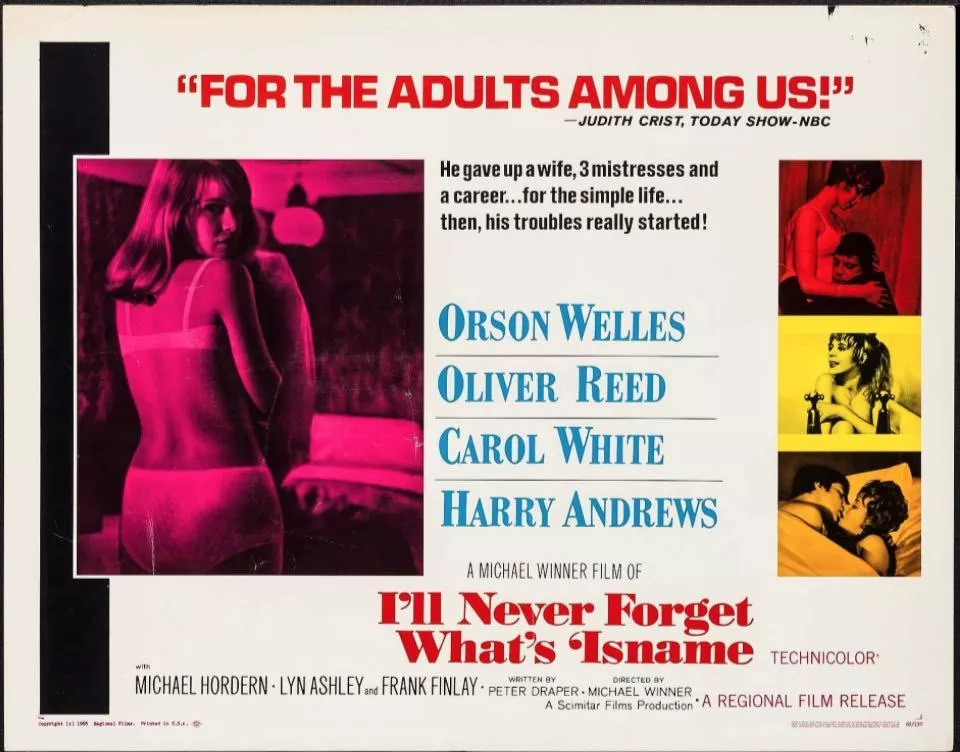
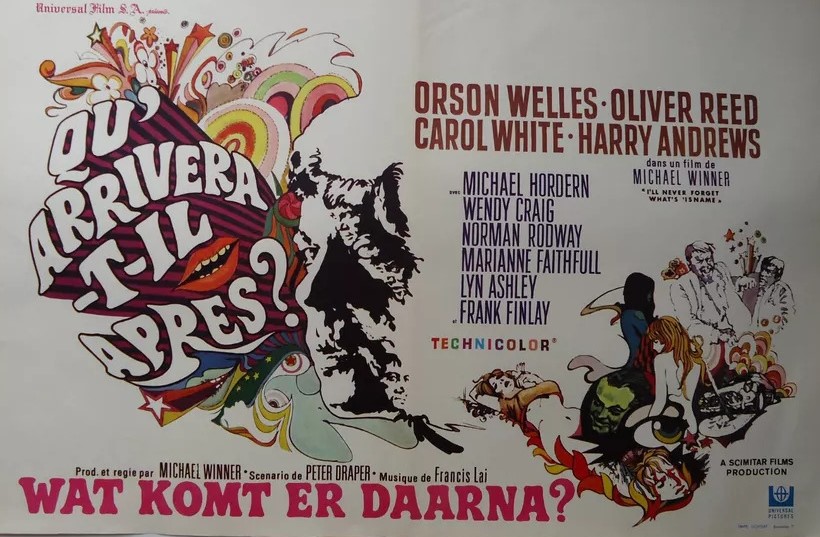
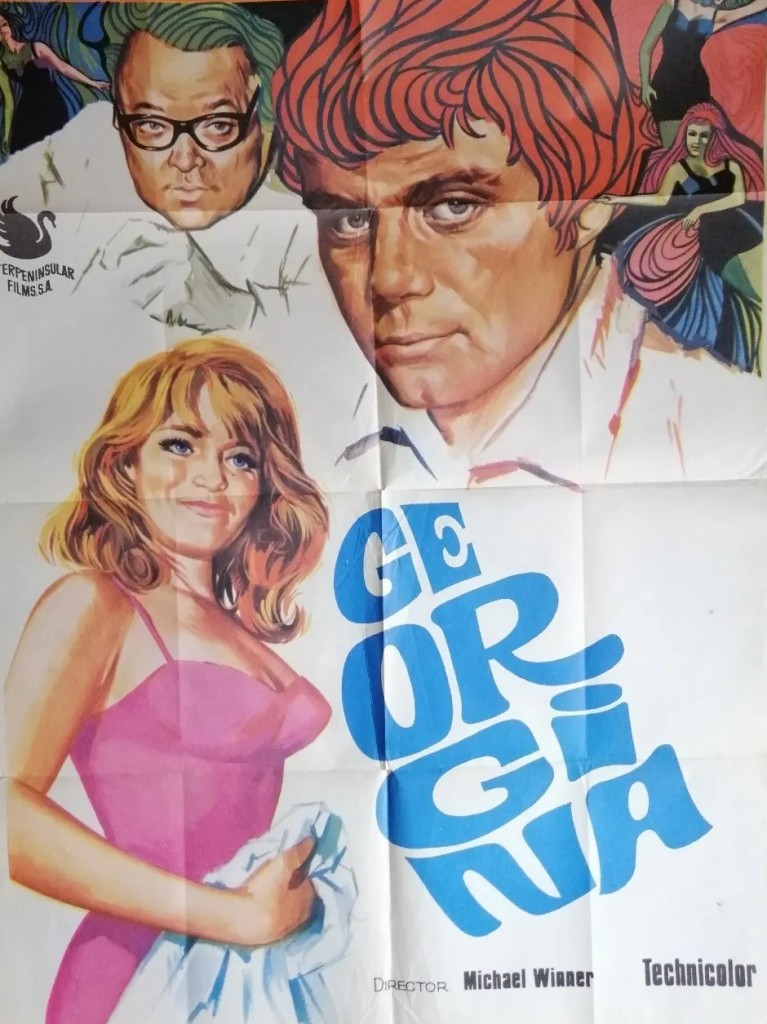
I’ll Never Forget Whatsisname (1967) ****

Director Michael Winner’s proudest moment – from a critical perspective. Rave reviews all round and hailed as a rising star of British cinema. Such adulation didn’t last long, of course, Hannibal Brooks (1968) and The Games (1970) elicited little critical reposnse and whatever kudos he achieved from a couple of westerns was soon blown away once he went down the Death Wish (1974) brutal revenge route. So this fits into the anomaly department in his canon and, although pretentious in spots, it does show a fine intelligence at work and a singular prophetic quality that should have contemporary reverberation.

For a start, he highlights the creativity of the advertising world that became the training ground for such British directorial talents as Ridley Scott (Alien, 1979), his brother Tony (Top Gun, 1986), Alan Parker (Midnight Express, 1978) and Adrian Lyne (Fatal Attraction, 1987) as well as producers in the vein of David Puttnam (Chariots of Fire, 1981). Perhaps more interesting are the ecological aspects, predicting the importance of waste both as an issue and a financial opportunity.

And although If… (1969) was viewed as the pre-eminent depiction of public school immorality, this provided a much shorter introduction to the prevalence of public school attitudes in society. You might also suggest, should you be so bold, that Winner envisioned the boom in reality televison, when the camera is not used to create illusion but to pick at the scabs of society. And we might also fast forward to Jaws (1975) whose meanest character shares the same surname as our hero here, whose personality defects are what drives the picture.

Within all this there’s a fair chunk of satire. And it’s rare for this director to so obviously poke fun at his heroes.

The narrative follows disillusioned advertising ace Quint (Oliver Reed) as he tries to extricate himself from various romantic entanglements in order to concentrate on first playing a more meaningful role via literary creativity and then, when that option is pulled out from under him, exposing the hypocrisy from which he has made his fortune.

The movie opens with a stunning image. Quint wielding an axe. Despite this being in the  middle of London, he scarcely receives a second glance – as if this might be construed as typical English eccentricity – as he marches towards his posh headquarters, proceeds to smash his office and hand in his notice to boss Lute (Orson Welles). He finds work in a literary magazine with old school chum Nicholas (Norman Rodway) where, unfortunately given he already has a wife and several mistresses, he falls for virgin secretary Georgina (Carol White).

But despite his success he is tormented by his schooldays, which instead of toughening him up made him more vulnerable to abuse from a teacher and to bullying from fellow pupils led by entitled thug Maccabee (Harvey Hall). The nightmarish glimpses of school are sharply brought into focus when he encounters Maccabee again and witnesses the savage hounding of another innocent man.

Meanwhile, Lute keeps popping up, either to try and seduce Quint back to his job or to sabotage his existing one. When a fight breaks out at one of Lute’s parties he wants it stopped before another of his precious artworks is broken rather than before a participant ends up in hospital. Lute takes English eccentricity to the extreme, enjoying a massage while playing Scalextrix, the epitome of avuncular decency except that he’s twisting the rules.

Even with his diabolical childhood, it’s hard to sympathize with Quint. He’s little more than a charming lout, but I suspect his is a more universal condition, those who have so much easy wealth inclined to poke at the foundations of success, and seek a more worthwhile profession. The ending is contrived, but, then, the fun has to stop somewhere.

That said, Oliver Reed (The Assassination Bureau, 1969) presents a more rounded character than in many of his later films. From the confidence of his delivery you get the impression that Orson Welles (House of Cards, 1968)  – top-billed ahead of Reed – improvised many of his lines. He’s certainly having some fun with his role, but then that is the seductive part of his character. Carol White (Daddy’s Gone A-Hunting, 1969) is the big surprise, bringing a genuine freshness to her role, before she conformed to the Hollywood dictat. And you won’t forget the malicious Harvey Hall (The Games, 1970).

The quite amazing cast includes Edward Fox (Day of the Jackal, 1973),  Michael Hordern (Where Eagles Dare, 1968) as a demented headmaster, Marianne Faithfull  (The Girl on a Motorcycle, 1968), Harry Andrews (The Long Duel, 1967) as a writer with a creepy hobby, Wendy Craig (TV series Not in Front of the Children, 1967-1973), Ann Lynn (Baby Love, 1969) and Frank Finlay (The Shoes of the Fisherman, 1968).

It’s entirely possible that it was pure coincidence that Winner covered so many topics relevant to today but I’m giving him the beenfit of the doubt. Written by Peter Draper (The System / The Girl-Getters, 1964).

Great – and meaningful – fun.

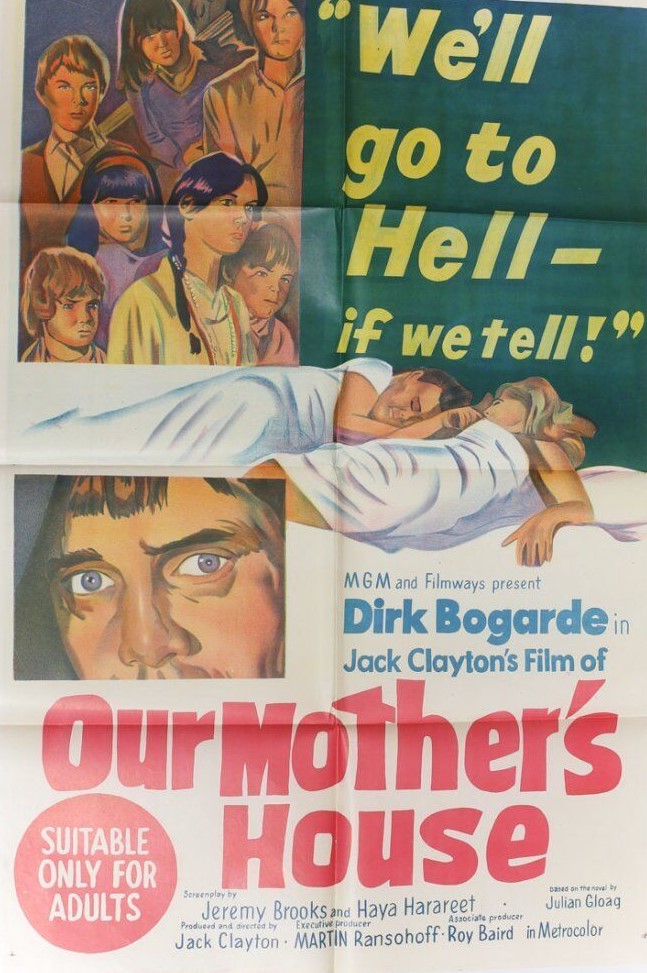
Our Mother’s House (1967) ***

Lord of the Flies set in a sprawling London Victorian mansion. At its best when kids give rein to vivid imagination, not so strong when melodrama intrudes.

After the death of her invalid mother and dreading being sent to an orphanage, eldest child Elsa (Margaret Brooks), who has been with the help of a maid running the house anyway, determines that she and the rest of the brood will pretend their mother is still alive. They bury the body in the garden, manage financially after Jimimee (Mark Lester) discovers an aptitude for forging their mother’s signature on the monthly cheques she receives from a trust fund, and hold séances in the shed to commune with the deceased one.

To maintain the pretence, they get rid of the nosey and querulous maid Mrs Quayle (Yootha Joyce) and come up with all sorts of reasons to explain their mother’s absence to school teachers and neighbors. Child fears run rampant as they visualize the terrible lives they would lead in an orphanage. But the generally tolerant community lifestyle is disturbed by the dictatorial rule of Elsa, determining that Gerty (Sarah Nicholls), for example, must have her long hair sheared off for innocently breaking a house rule and, in keeping with their mother’s fundamentalist beliefs, refuses to call a doctor when the girl falls ill. But the séance takes on a creepier aspect, Elsa the one in communion with her mother and therefore using the supposed other-worldy presence to enforce her will.

So far, so Lord of the Flies, and excellent in its depiction of a world ruled by children according to their fears and beliefs and without adult intercession. But it loses its grip when melodrama takes hold.

Their mother’s dissolute husband Charlie (Dirk Bogarde) returns, romancing Mrs Quayle, and, initially, spoiling the children, who are delighted to see him. He soon reverts to form, spending all their money, getting Charlie to forge his mother’s signature on the house deeds, planning to pocket the proceeds and dispatch the kids to an orphanage. Worse, he breaks the spell their seemingly devout mother had over their children, informing them that their mother’s conversion to religion only came after a life of debauchery and that, in fact, every single one of them is illegitimate and not his offspring. That’s too much for Diana (Pamela Franklin) who kills him with a poker.

Too many twists for sure and by diverting a fascinating dissertation of childhood into adult melodrama robs the film of much of its power.

Director Jack Clayton had been here before with The Innocents (1961) but, there, less was spelled out. Dirk Bogarde (Justine, 1969) is surprisingly good as the charming rough layabout with an eye to the main chance but it’s the children who captivate especially Pamela Franklin (And Soon the Darkness, 1970) and Mark Lester (Oliver!, 1968). The children’s innocence in any case would have been despoiled as they challenged Elsa’s rule and it would have been more satisfying to go down that route.

It was based on the bestseller by Julian Gloag and for anyone wondering what happened to Haya Harareet (Ben-Hur, 1959, and The Secret Partner, 1961) she married Clayton and is credited with the screenplay of this along with Jeremy Brooks.

Slow-burn that trips the wrong way.

Two Weeks in September (1967) ***

Soubriquets were not common currency in Hollywood. Names might be shortened to a Christian name or a surname, as in Marilyn or Garbo, and occasionally a reporter might suggest an unlikely familiarity by referring to a star as “Coop” and for sure Bogie must have been desperate for people to call him anything other than Humphrey, hardly a name that spun off the tongue for a supposedly hardbitten hero eschewing his middle-class origins. But the world swung on its axis when simple use of the star’s initials were enough to guarantee universal acceptance.

BB was born on a wave of controversy. After And God Created Woman (1956) broke box office records all over the world, a star was born. But one who seemed to live as much on the pages of newspapers as on the screen. She could forever be guaranteed to provide a revealing photograph to spice up the more puritan newspapers.

But BB’s global fame didn’t translate into worldwide box office in part because her movies were mostly X-certificate in the U.K. and, being made generally by foreign companies, slipping past the Production Code in the U.S. and therefore into arthouses or shady emporiums in both countries rather than mainstream houses.

This isn’t the best introduction to her canon, but in many senses it’s pretty typical. The camera adores BB and shuns anyone else in her presence. There’s not much story here – bored wife dashes off to a model assignment in London and has an affair and can’t decide whether he’s ready for divorce.

To fill in the time we get plenty Carnaby St fashion shoots, certainly put into the shade by the likes of Blow-Up (1966), but of the kind that used to be so common, beautiful women in outlandish clothes against backdrops like zoo animals or suits of armor and all the while flirting with photographers and being chatted up in night clubs by all and sundry. As you might expec, red buses and mini cars are common, though the chances of a cop on horseback at night seems to stretch it a bit.

Cecile (Brigitte Bardot) seems too lively for staid husband Philippe (Jean Rochefort) and burdens him with ensuring her happiness. But he seems, I guess unusually for the time for such a wealthy character, to be happy for her to continue in her profession. She’s never been unfaithful unlike model buddy Patricia (Georgina Ward). But all this cavorting brings out the lech in photographer Dickinson (Mike Sarne) and while she flirts with him she fancies for no apparent reason the doe-eyed Vincent (Laurent Terzieff) although his doe-eyed dog is livelier.

Anyway, off they go to Scotland for a romantic idyll since every filmmaker in the world has been duped by Scottish Tourist Board fantasies of sunshine, tartan, heather and miles of unspoiled beaches (unaware they are empty because the natives have more sense than to go diving into icy water in freezing temperatures). Mostly, what they get is damp streets and grey skies, though if you have BB romping  in the water then nobody’s really going to notice the awful weather. And, naturally, the highways and byways are filled with tartan-clad gents so Brigadoon rides again.

Not quite sure how “To Their Heart’s Content” – clumsy in translation as it is –
is turned into the dull “Two Weeks in September.” Though she hardly seems happy in the poster.

In any case, by the time September comes round, the sun has already packed up for the winter in Scotland, so there’s your get-out-of-jail-card in the title. Not much happens in Scotland either, mostly soulful camera work, soulful BB and dull-as-ditchwater Vincent. There’s a contrived ending.

What impresses most is how little BB you need to make a picture work, even one as patchy as this. It is almost the same template as an Elvis picture minus the songs. Just like BB, Elvis scarcely required a working script, just any excuse to get him on screen. Some stars possess screen charisman that it’s impossible to shift. Shame it was left to Serge Bourguignon (The Picasso Summer, 1969) to get more out of the faint storyline because he  was never that bothered with narrative and inclined just to get by on close-ups and scenery. With BB she was as much scenery as audiences ever seemed to require.

Hardly falls into the recommended bracket but nonetheless an interesting example of how Bardot could get away with the mildest of trifles.

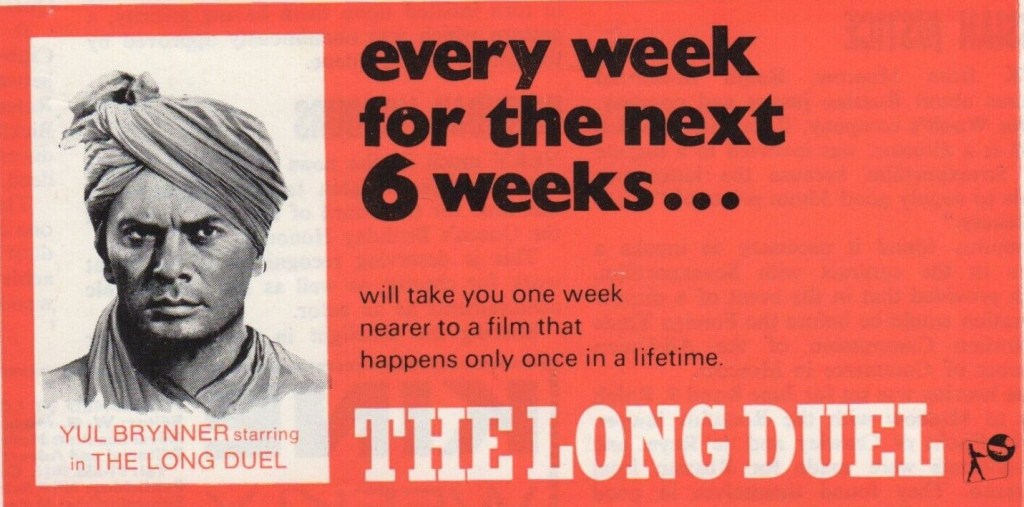
The Long Duel (1967) ****

Surprisingly thoughtful action-packed “eastern western”  with obvious parallels to the plight of the Native American. Here, the British attempt to shift nomadic tribesmen from their traditional hunting grounds in north-west India to “resettlements.” Set in post World War One India, the duel in question between tribal chief Sultan (Yul Brynner) and police chief Young (Trevor Howard) brims over with mutual respect.

Unusually intelligent approach for what could otherwise have been a more straight forward action picture, more critical of the British, whose idea of civilization is to turn everything into “a bad replica of Surrey,” than you would have expected for the period. Ruthless pursuit in large part because the British “can’t afford local heroes.”   

After his tribe is taken captive with a view to forced repatriation by boorish police superintendent Stafford (Harry Andrews), Sultan organises a breakout, taking with him heavily pregnant wife Tara (Imogen Hassall) who dies while on the run. The Governor (Maurice Denham) of the province brings in Young – who knows the territory and is more familiar, through a previous career as an anthropologist, with the nomadic lifestyle, and largely sympathetic to their cause – to head up an elite force and bring to justice Sultan, whose men are now murderers.

Young seems lacking in the stiff upper lip department, condemned for “misplaced chivatry,” unwilling to just do his job, and certainly not to blindly obey the more ruthless ignorant Stafford. Aware he is unable to stop what the British would like to call progress, hopes he can ease the transition, avoid driving the tribesmen into the ground and prevent a noble leader like Sultan ending up a despised bandit, the kind who were forever presented as the bad guys in films like North West Frontier / Flame over India (1959).

Young has the sense not to be dragged all over the country searching for his quarry, and sets up his team in more sensible fashion, but still, is largely outwitted by Sultan, especially as Stafford, who later gets in on the act, is too dumb to fall for obvious lures. Adding  complication is the arrival of Stafford’s equally intelligent daughter Jane (Charlotte Rampling), a Cambridge University graduate, who falls for Young.

Thankfully, there’s no need for the British hero to transition from brute into someone more appreciative of the way of life he is forced to destroy – a trope in the American western – and equally there’s no corrupt businessman selling the tribesman weaponry and there’s no savage attack either on innocent women and children, and removal of these narrative cliches allows the movie more freedom to debate the central questions of freedom. The tribesmen acquire rifles and the occasional Gatling gun simply by stealing them from the more inept British soldiers.

Anyone expecting a shoot-out or more likely a swordfght between Sultan and Young will be disappointed, the title, as with the entire picture, is more subtle than that, especially as each, in turn, have the opportunity to save each other’s lives. Eventually, Young’s sympathetic approach is deemed ineffective and Stafford is put in charge, leading to a superb climax.

While Sultan’s nomadic lifestyle is eased by dancing girl Champa (Virginia North), whose loyalty to her lover is soon put to the test, and who is not, surprisingly, necessarily looking for love, his emotions center more around his younger son, whom he doesn’t want to grow up wearting the tag of bandit’s son. The solution to that problem seems a tad simplistic, but still seems to work.

With the feeling of western with splendid use of superb mountainous locales, and excellent widescreen, an astute script opts as much for intelligence as adventure.

One of Yul Brynner’s (The Double Man, 1967) last great roles before he turned into a parody of himself and certainly more than matched by Trevor Howard (Von Ryan’s Express, 1967), given a role with considerable depth and scope. Charlotte Rampling (Three, 1969) also impresses while Virginia North (Deadlier than the Male, 1967) and Imogen Hassall (El Condor, 1970) provide support. Harry Andrews (The Night They Raided Minsky’s / The Night They Invented Striptease, 1968) has played this role before. You can catch Edward Fox (Day of the Jackal, 1973) in a tiny role.

Superbly directed by Ken Annakin (Battle of the Bulge, 1965) from a script by Peter Yeldham (Age of Consent, 1969), Ernest Borneman (Game of Danger, 1954) and Ranveer Singh in his debut.

Well worth a look.

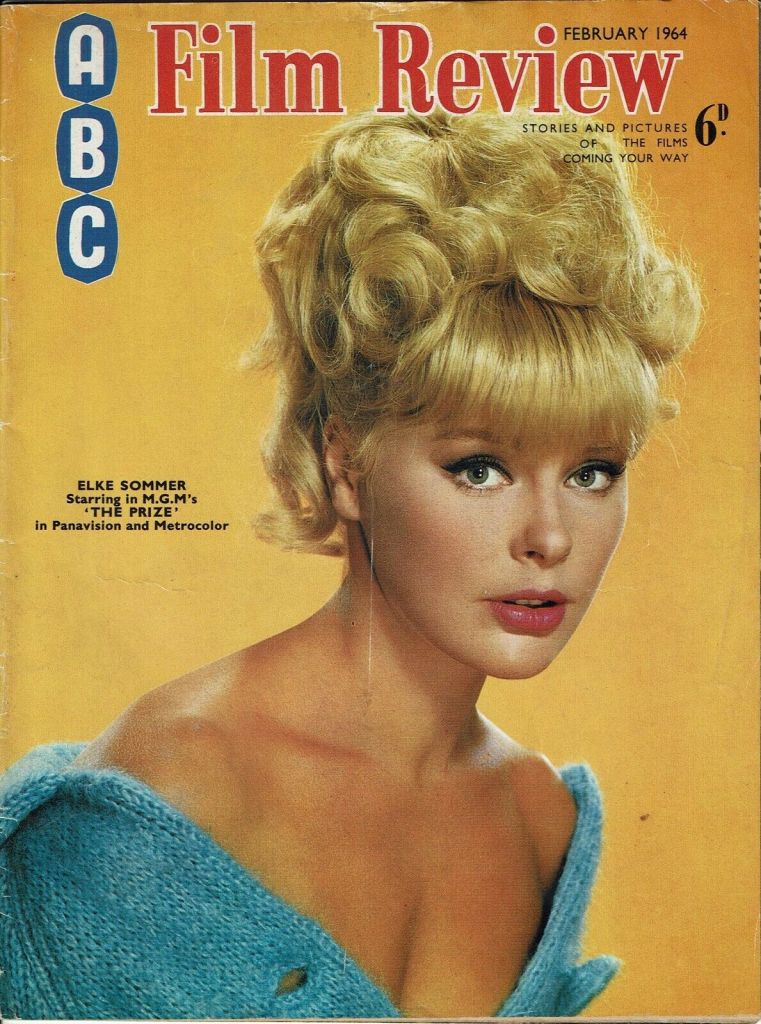
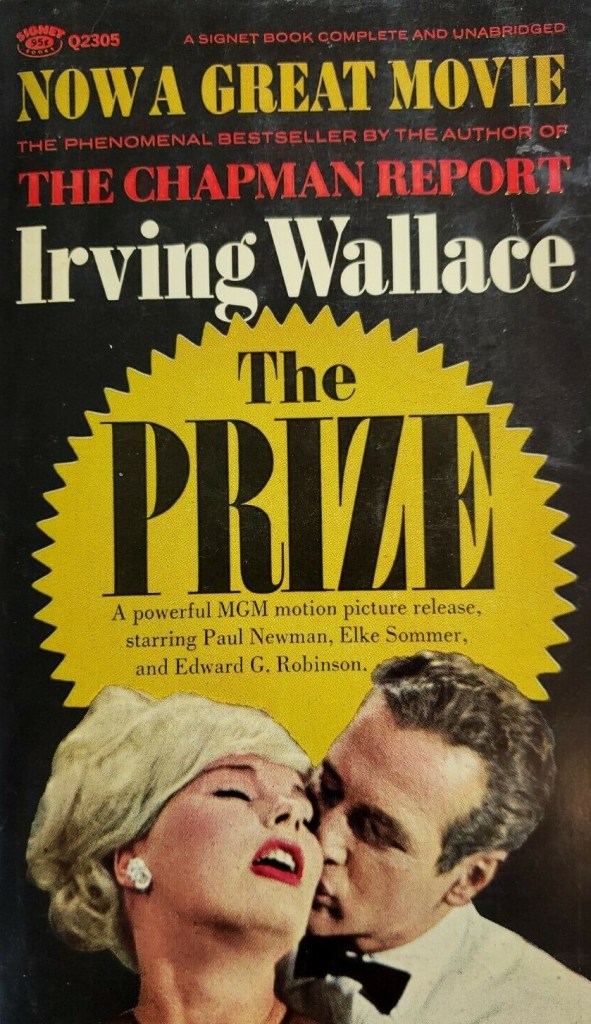
The Prize (1963) ****

Thoroughly involving potboiler with alcoholic novelist Andrew Craig (Paul Newman) turning unlikely detective to uncover murky double-dealings at the annual Nobel Prize ceremony. Based on the Irving Wallace bestseller set in Stockholm, director Mark Robson (Von Ryan’s Express,1965) strings together a number of different stories that coalesce in a gripping climax. Screenwriter Ernest Lehman (North by Northwest,1959) brings alive what could have been a very soggy adaptation of a beefy bestseller with witty and literate dialog and a plot that hovers just the right side of hokum.

Inger (Elke Sommer), delegated to look after the author, starts out as a stuffed shirt not a sexpot, allowing Newman’s attention to drift towards Emily Stratman (Diane Baker) – daughter of another winner Dr. Max Stratman (Edward G. Robinson) – while he is dragged into romantic entanglement with neglected wife Dr Denise Marceau (Micheline Presle). Mostly, Newman just wants his next drink, and his almost continual inebriation sparks some good comedy and he is gifted good lines to extricate himself from embarrassment. Simmering in the background are warring winners – the Marceau husband-and-wife team and Dr John Garrett (Kevin McCarthy) convinced that Dr Carlo Farelli (Gerard Oury), with whom he is sharing a prize, has stolen his research.  

There are sufficient character clashes and plots to be getting along with if you were just intent on taking a Valley of the Dolls approach to the material, that is, cutting between various dramatic story arcs, but, without invalidating the other subsidiary tales, the movie takes quite a different turn, providing the potboiler with considerable edge. 

Turns out that Andrew is so impoverished that he has been writing detective novels under a pseudonym and suspecting that Dr Stratman is an imposter he starts investigating. So in some respects it’s a private eye procedural played out against the glamorous backdrop of the awards. But the clues are inventive enough and there is a femme fatale and once Inger comes along for the ride and with Andrew a target the picture picks up an invigorating pace. Echoing the humorous auction scene in North by Northwest is a sequence set in a nudist colony where Andrew seeks refuge to avoid villains while another terrific scene plays out in the docks.

Paul Newman looks as if he is having a ball. In most of his pictures he was saddled with seriousness as if every part was chosen with an eye on the Oscars. Here, he lets rip with a lighter persona, and even if he mugs to the camera once too often, the result is a screen departure that lifts the picture. Inebriation has clearly never been so enjoyable. Sommer is a delight, showing great dramatic promise. Edward G. Robinson (Seven Thieves,1960), more renowned for his gangster roles, convinces as a scientist. Diane Baker (The 300 Spartans, 1962), Kevin McCarthy (Invasion of the Body Snatchers,1956) and Leo G. Carroll (North by Northwest) provide sterling support.

Robson directs with dexterity, mostly with an eye on pace, but it is Lehman’s script with occasional nods to Hitchcock that steals the show.

Les Biches (1968) *****

Innocence and experience alike are corrupted by the destructive power of love in this elegant and compelling early masterpiece from French director Claude Chabrol. Although he owed much of his later fame to slow-burning thrillers, this is more of a three-hander drama with a twist and it says much for his skill that we sympathize in turn with each of these amoral characters.

Wealthy stylish Frederique (Stephane Audran), in an iconic hat, picks up younger pavement artist Why (Jacqueline Sassard) in Paris. They decamp to St Tropez where Frederique keeps a rather discordant house, indulging in the antics of two avant-garde house-guests. Why loses her virginity to architect Paul Thomas (Jean-Louis Trintignant) who soon abandons her in favor of the older woman. Each is guilty of betrayal and although a menage a trois might have been one solution instead the lovers dance from one to another with Frederique  apparently in control, in one scene stroking Why’s hair with her hand and caressing Paul’s  face with her foot. In an attempt to win the man back, Why dresses like her rival down to hairstyle, make-up and even the older woman’s beauty spot.   

At no point is there angry confrontation, nor does Frederique simply dismiss Why from the household, but the story works out in more subtle insinuation, Frederique clearly expecting either that Why make herself scarce or, alternatively, make herself available for whenever Frederique tires of male companionship. The movie’s focus is the baffled Why. When the older pair disappear to Paris, the camera follows Why through off-season St Tropez, chilly weather replacing glorious sunshine. Frederique and Paul are the sophisticates who expect Why  to know how to play the game. The younger woman has wiles enough to see off the avant-garde irritants.

It looks for a while as if it might be a coming-of-age tale or of young love thwarted but every time Frederique enters the picture her dominance is such that proceedings, no matter how deftly controlled, have an edge and so it becomes a study of something else entirely. At one point, each has power over the other. If Why has learned anything it is restraint, so the movie never descends to tempestuous passion. She also learns, in a sense, to submit, since the impoverished can never compete with the rich. In the end her revolt takes the only other option available, against which the wealthy have no defence.     

Excellent performances from Stephane Audran (The Champagne Murders, 1967), Jean Louis Trintignant (A Man and a Woman, 1966) and Jacqueline Sassard (Accident, 1966) but Chabrol keeps all under control, twisting them round his little finger.

Superb.       

Discover WordPress

A daily selection of the best content published on WordPress, collected for you by humans who love to read.

The Atavist Magazine

by Brian Hannan

WordPress.com News

The latest news on WordPress.com and the WordPress community.