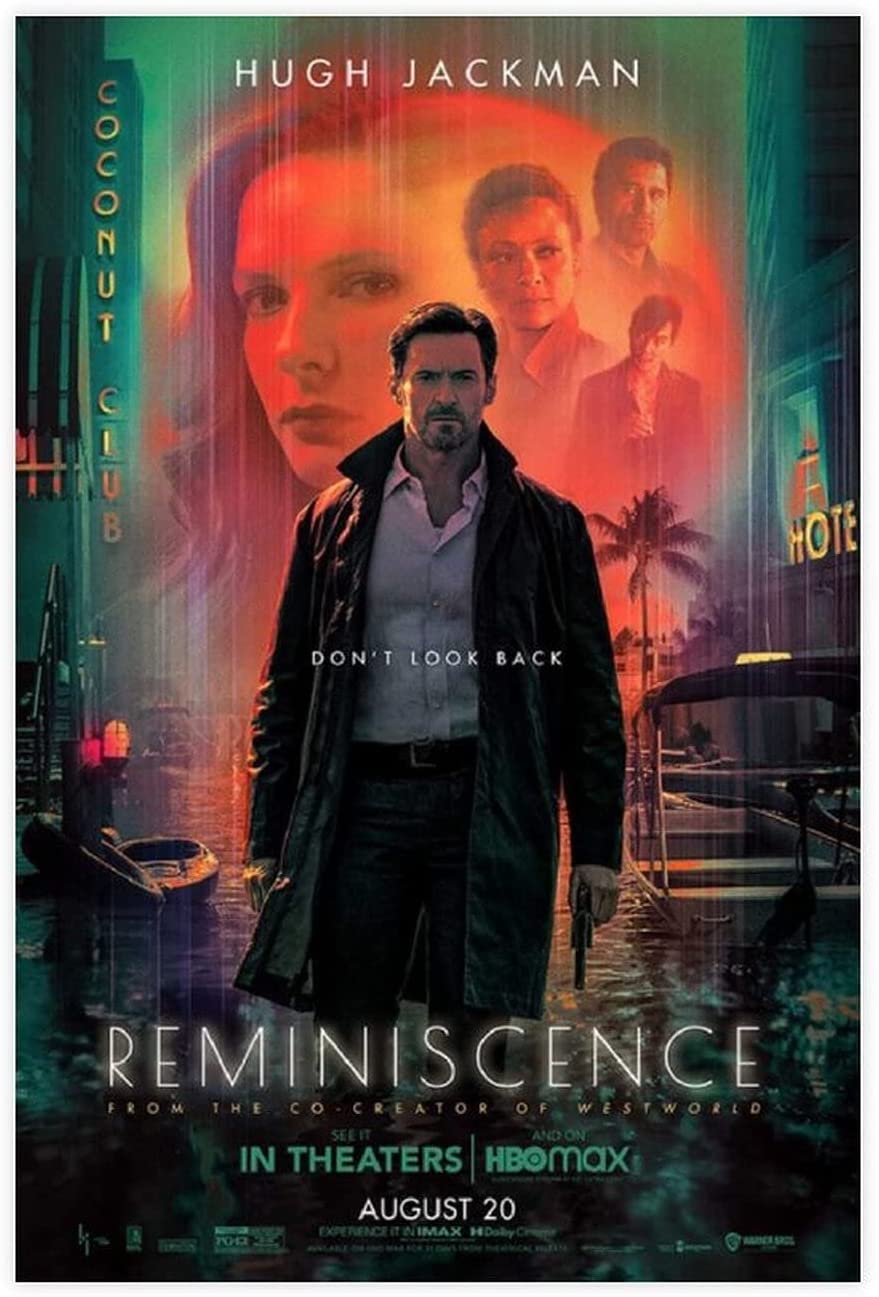
Deadlier than the Male (1967) ****

Now revealed as the first film seen by Quentin Tarantino – at the age of five.

For a movie intended to set up a series character in the vein of James Bond, it was ironic that it was the women who stole the show, not just from their tendency to turn up in bikinis but for their outrageous villainy. Irma (Elke Sommer) and Penelope (Sylva Koscina) are the seductive assassins in the hire of Carl Petersen (Nigel Green) who has designs on an Arab oil empire. On her own Irma dispatches mogul Henry Keller (Dervis Ward) then the pair – emerging from the sea like a pair of latter-day Ursula Andresses – harpoon his colleague Wyngarde (John Stone).   

Soon Hugh Drummond (Richard Johnson), investigating the death of Wyngarde, becomes a target  and that sets him off, with nephew Robert (Steve Carlson) in tow,  to the Mediterranean and the yacht of oil-rich King Fedra (Zia Mohyeddin) where, of course, the girls lie in wait.

Dispensing with the gadgets – except for one item employed by the villainesses – and gimmicks of Bond, but retaining the quips, this is a fun ride with a more down-to-earth leading man – like the early Bonds – smarter girls, a more old-fashioned mystery, a hefty thug Chang (Milton Reid)  in the Oddjob mold, a castle doubling as the villain’s lair, a suave master criminal, some detective work, and a super scene involving giant robotic chess men.

The bickering between Irma and Penelope, who is not just a tad sadistic but a kleptomaniac especially as far as her partner is concerned, coupled with their overweening confidence, makes them much more human than any Bond Girl and the character traits explored have a pay-off at the climax. Equally interesting are the mind games, Drummond vs. Peterson but also Drummond vs. Irma. And that the female baddies see it as points on their scoreboard to seduce Drummond rather than the other way round.

Drummond is every bit as capable a seducer as Bond and equally ruthless, stripping a suspect naked. Petersen is also a clever character, faking his own death and running a very smooth operation, and certainly his recruitment techniques are second to none.
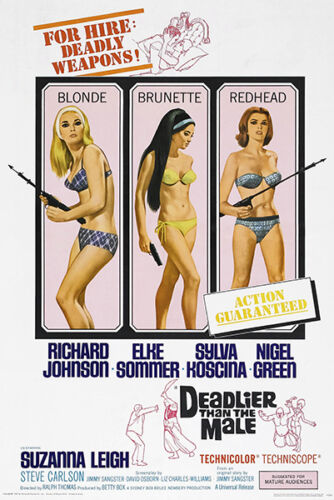
Some ideas were certainly ahead of their time, the chess men are the equivalent of a modern computer game while the human bomb has, unfortunately, entered the modern lexicon and there are enough female serial killers around to prevent anyone believing they are always (to use an outmoded sexist phrase) the gentle sex. However, in the middle 1960s, the concept that women would be partial to murder and torture not to mention repeatedly seducing males went so much against the grain of the male authority figures that the British censor slapped an X-certificate on the movie.

Shakespearian actor Richard Johnson was a one time MGM contract player, but his only previous top-billed outing was the Italian-made The Witch (1966). He certainly made a splash with this character, investing it with a great deal more gravitas than Flint or Helm. The Teutonic Elke Sommer (The Venetian Affair, 1966) is brilliant as one half of the assassin tag-team with a batch of one-liners for every occasion. Sylva Koscina (A Lovely Way To Die, 1968), nose always put out of joint, almost steals the show.  Nigel Green (Tobruk, 1967), while his usual sardonic self, has the playfulness of the rich and powerful.

Steve Carlsen, in his movie debut, doesn’t make much of an impact in a largely lame role. Zia Mohyeddin has a more interesting part as the oil kingpin wanting to help his people. As you can expect in a spy picture there are a host of beautiful women – Suzanna Leigh (The Lost Continent, 1968) a defector, Virginia North, also making her debut, Justine Lord (Night after Night after Night, 1969), and Didi Sydow in her only screen appearance.
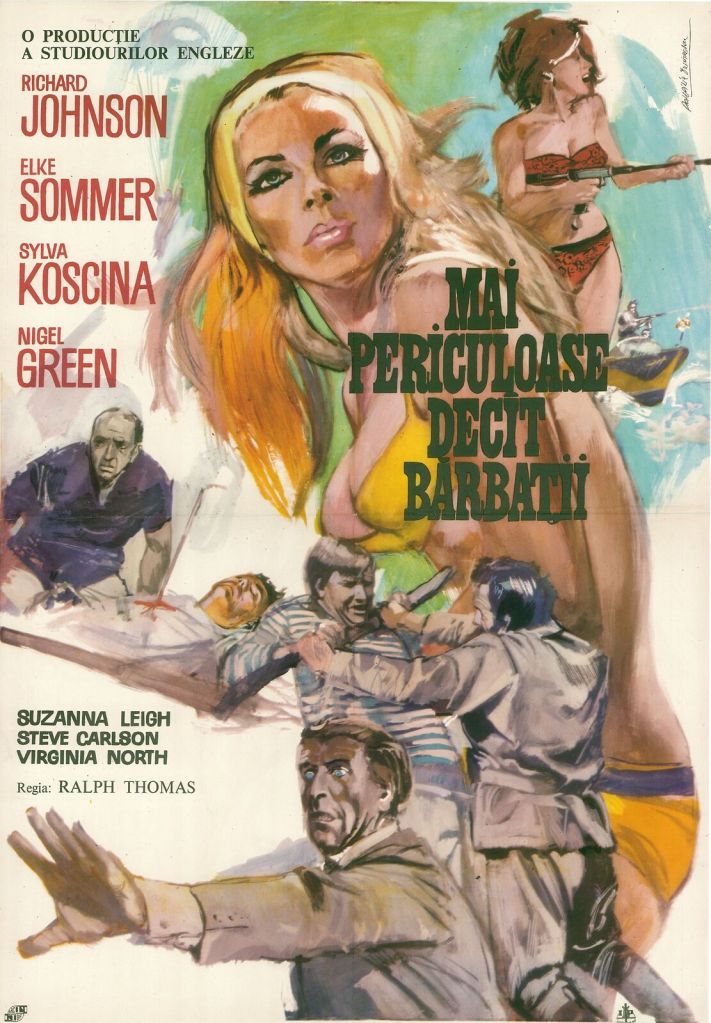
The light comedy experience of director Ralph Thomas (Doctor in Distress, 1963) comes is very handy, as his sense of comic timing is excellent, but, perhaps learning from his previous brush with espionage in Agent 8¾ / Hot Enough for June (1964) brings a bigger punch to the action scenes. And it’s a bold ploy to start with an action sequence revolving around Irma and Penelope rather than our star man.

The screenplay was a team effort – Jimmy Sangster (The Devil-Ship Pirates, 1964), taking a break from Hammer duties, David D. Osborn (Maroc 7, 1967) and Liz Charles-Williams, making her screen debut  – all involved.  This was familiar territory for composer Malcolm Lockyer (Five Golden Men, 1967). British pop act The Walker Brothers had a hit with the theme tune.

This is more fun than camp, not a send-up of the genre like Derek Flint and Matt Helm, but a spy picture with a believable leading men and excellent villains. But the plot is more centred on filthy lucre rather than global control and there is a genuine understanding of how businesses work – takeovers, mergers, dirty dealings – though small wonder Petersen would like to be shot of pedantic boardroom nuisances like Bridgenorth (Leonard Rossiter) – wouldn’t we all?

Bulldog Drummond was an international crime-buster invented by “Sapper,” the pen-name of H.C. McNeile. Bulldog Drummond had been a Hollywood mainstay for over four decades, the twenty-plus pictures attracting stars like Ronald Colman (Bulldog Drummond, 1929, and Bulldog Drummond Strikes Back, 1934), Ray Milland (Bulldog Drummond Escapes, 1937), Walter Pidgeon (Calling Bulldog Drummond, 1951) and a young Ralph Richardson (The Return of Bulldog Drummond, 1934). But the notion, in the Swinging Sixties, of tagging any leading man by the moniker of ‘Bulldog’ did not seem like a good idea, so the character underwent wholesale reinvention and his nickname is never mentioned.  

The title comes from a line in a poem by Rudyard Kipling, The Female of the Species. That was the original title of the film and also of a Sapper book.

You can get his on a double bill with the sequel Some Girls Do from Network at a very reasonable price. Will be reviewing Some Girls Do next.
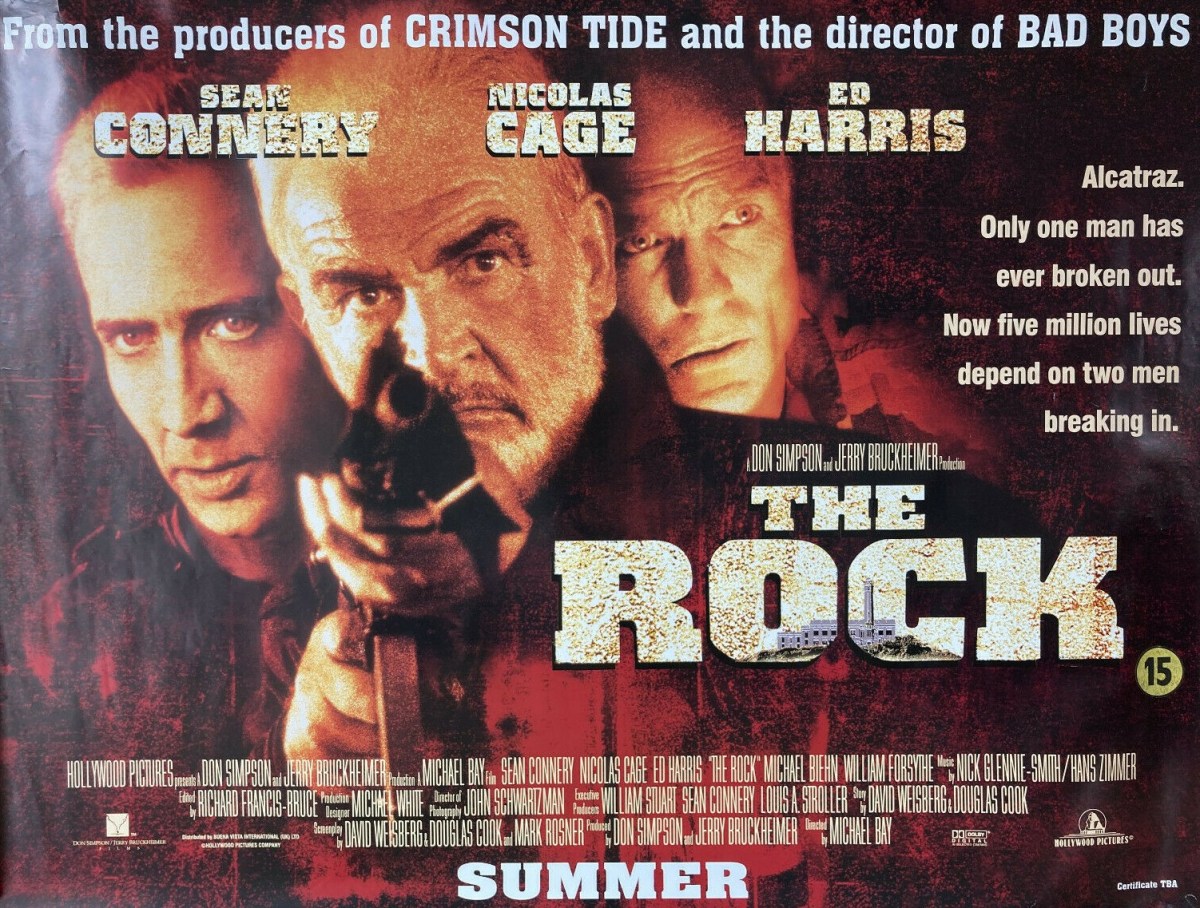
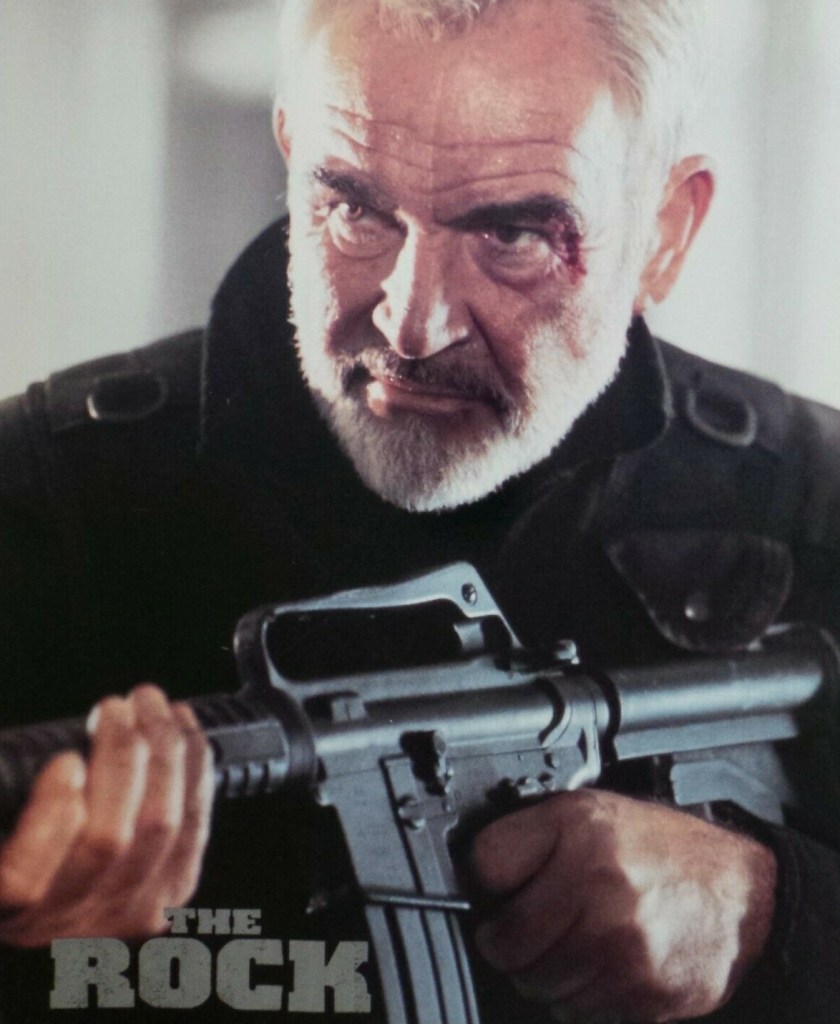
The Rock (1996) *****

Amazingly, there’s been no 25th anniversary razzamatazz for this pulsating piledriver of an action movie, a stone cold classic. Instead of the standard breaking out of Alcatraz, a brilliant reversal sees a crack military team of U.S. Navy SEALS trying to break in to stop maniac martinet General Hummel (Ed Harris) devastating San Francisco with stolen missiles containing nerve gas. Notwithstanding his iconic turn as James Bond and Oscar acclaim for The Untouchables (1987), this is surely Sean Connery’s best, if not boldest, performance, the calm at the heart of the storm, exuding a riveting screen persona. No other star of his calibre would have allowed themselves to be seen at the start with such lack of dignity, not just shackled but with dirty exceedingly long hair.

Not only is it a brilliant entrance but such is director Michael Bay’s mastery of his material that he makes audiences wait 25 minutes for it while he sets up the terror that awaits the city from a rain of terrifying gas, Hummel as a ruthless legendary officer with a point to prove and allows Nicolas Cage to break out of his initial geek. Backed by a classic battering ram of a score by Hans Zimmer and Nick Glennie-Smith and an outstanding battalion of supporting players, Bay never lets up the high-pitch tension, finding his stylistic way with slo-mo, helicopters swaying in the sky, brutal stand-offs.

Former British spy John Mason (Connery), the only man alive who has broken out of Alcatraz, is released from prison to lead the break-in, Hummel holding hostages as well as his weaponry. Never has a star done so much with so little, using a coin to discover his nemesis F.B.I. director Womack (John Spencer) and with nothing more than a piece of string engineers his own escape from a San Francisco hotel that leads to a riveting car chase ending in wanton destruction and a touching scene reuniting Mason with a long-lost daughter (Clare Forlani). That such a cracking movie bothers with emotional hooks –  academic FBI chemical expert Stanley Goodspeed also has his girlfriend in harm’s way – shows the screenwriter skill in bringing greater character depth. Except for his daughter, Mason would have made another escape from Alcatraz at the first opportunity.

What appears mission impossible becomes mission impossible too far when Hummel’s men slaughter the military invasion leaving the unlikely duo of Mason and Goodspeed to save the city – and their own lives when the equally ruthless operation overseers determine it’s better to completely liquidate Alcatraz rather than risk the missiles being fired.

And without Cage as the mild-mannerd scientist stepping up to the action plate, this would be a different picture, over-dominated by Connery. Cage delivers a multi-layered performance, from the emphatic strum of a guitar string to his flickering fingers and the brilliant delivery of the humdrum line “in the name of Zeus’s butthole.” He shifts from fearful geek who has left his gun behind to determinedly hunting down Mason in a car chase and then finding a true action mojo on the rock.

Given this top-notch performance, it’s proof of Connery’s star power that he easily steals the picture. Suspicious, clever, ruthless, soft-hearted when it matters, he mentors Goodspeed, though not always gently, “losers always whine about their best, winners go home and f*** the prom queen.”

Odd as it might be to say about a Michael Bay picture, this is layered too. From the conflict between Mason and Womack, the nuanced performance by the essentially honorable Hummel, brilliant character development –  like Hilts in The Great Escape Mason the loner eventually persuaded to help the general cause –  the transition of Goodspeed from goofy oddball to saviour, speedy edits, some cracking images, a script dipped in paranoia (references to Roswell, the Kennedy assassination, black ops and secret military slush funds)  and a stack of one-liners. All this delivered in passing as this high-speed train of an action blockbuster thunders along the line.

The whole enterprise is bolstered by a top-notch supporting cast led by the Mason-hating John Spencer (stepping up from a supporting role in L.A. Law, 1990-1996), David Morse (The Green Mile, 1999), eternal heavy William Forsythe (J. Edgar Hoover in The Man in the High Castle, 2018-2019) getting the chance to lighten his load, Michael Biehn (Aliens, 1986), John C. McGinley (Any Given Sunday, 1999) and Bokeem Woodbine (Queen and Slim, 2019). Two young actresses show tremendous promise – Clare Forlani capitalised on this break with Meet Joe Black (1998) but it proved less of a Hollywood calling card for Vanessa Marcil (Goodspeed’s fiancé), her best work coming in television (Las Vegas, 2003-2008). This was Mark Rosner’s only screenplay from a story by Douglas Cook and David Weisberg. who collaborated on Double Jeopardy (1999).

It was also Michael Bay’s calling card to enter the high-octane world of big-budget blockbusters like Armageddon (1998). While his career had as many ups as downs, this is unquestionably his action masterpiece, a no-holds-barred non-stop adrenaline spike.

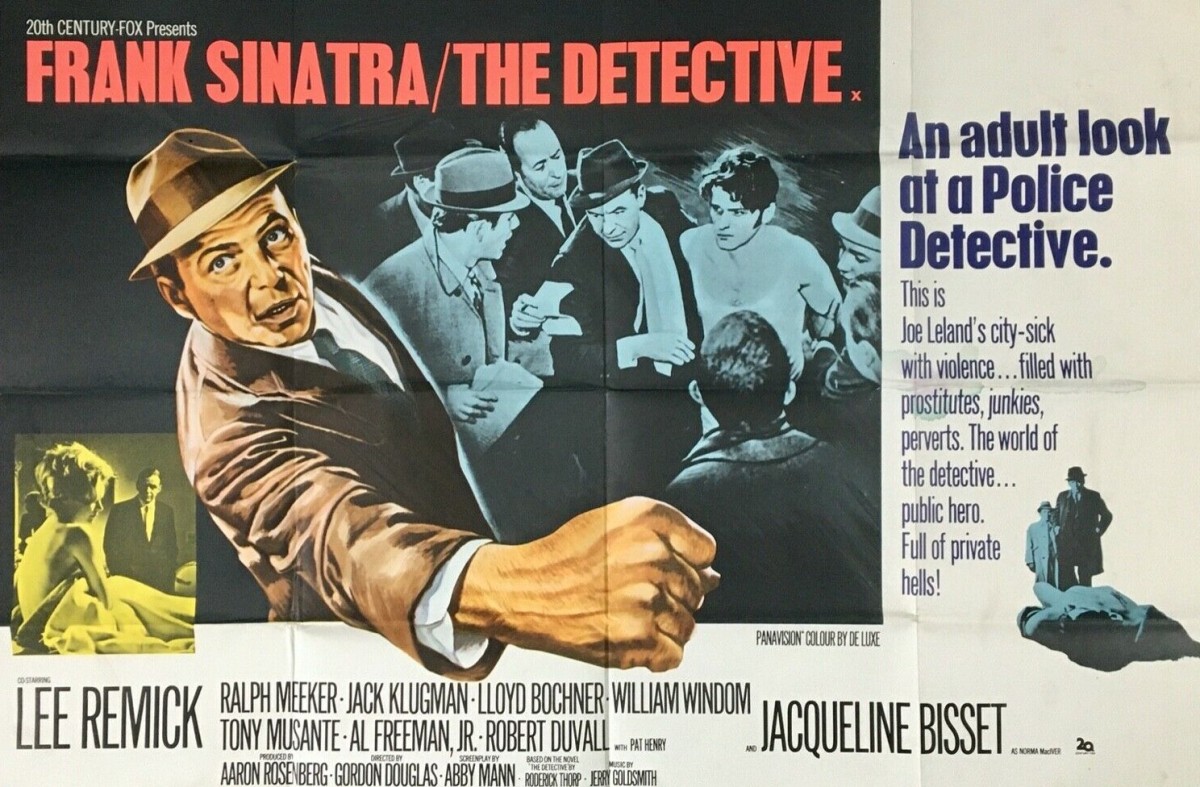
The Detective (1968) ****

Perhaps the boldest aspect of this raw look at the seamier side of life as a New York cop is that perennial screen loverboy Frank Sinatra plays a cuckold. Prior to what is always considered the more hard-hitting cop pictures of the 1970s – Dirty Harry (1971), The French Connection (1971), Serpico (1973) etc – this touched upon just about every element of society’s underbelly. Despite an old-school treatment, more a police procedural than anything else, homosexuality, nymphomania, corruption, police brutality, and a system that ensured poverty remained endemic all fell into its maw. And, for the times, several of these issues were dealt with in often sympathetic fashion.

Joe Leland (Frank Sinatra), an ambitious but principled detective gunning for promotion, investigates the murder of a prominent homosexual while dealing with the disintegration of his marriage to Karen (Lee Remick) and colleagues on the take. When other cops want to beat confessions out of suspects or strip them naked to humiliate them, Leland intervenes to prevent further brutality. He is not just highly moral, but takes a soft approach to criminals, not just playing the “good cop” part of a good cop/bad cop double-act but genuinely showing sympathy. Not only does Leland leap to the defense of those he feels unfairly treated, but he trades punches with those meting out such treatment. In addition, he clearly feels guilt over sending to the electric chair a man he believes should be treated in a mental institution.

Although at first glance this appears a homophobic picture, it is anything but, Leland showing tremendous sympathy towards homosexual suspect Felix (Tony Musante) – whom his  colleagues clearly despise – to the extent of holding his hand and gently cajoling him through an interview. Later, rather than condemn a bisexual the film shows empathy for his torment. Certainly, some of the attitudes will appear dated, especially the idea of sexual expression as a brand of deviancy, but the film takes a genuinely even-handed approach. Through the medium of Leland’s perspective, it is clearly demonstrated that it is other police officers who have the warped notions.  

Having solved the first murder, Leland takes up the case of an apparent suicide at the behest of widow Norma McIver (Jacqueline Bisset), only for this to lead not only to civic corruption on a large scale but back to the original investigation. Leland also has a wider social perspective than most cops and there is a terrific scene where he berates civic authorities for creating a system that perpetuates poverty. The ending, too, casts new light on Leland’s  character.

By this point, most screen cops were defined by their alcoholism and ruined domestic lives, but this is altogether a more tender portrait of an honest cop. Leland’s relationship with Karen is exceptionally well done. Normally, of course, it is the man who usually strays. This reversal in the infidelity stakes adds a new element. Karen has more in common with an independent woman like the Faye Dunaway character in The Arrangement (1969).

While playing the good cop would come relatively easy to an actor like Sinatra, carrying off the role of the hurt husband is a much tougher ask. Coupled with his sensitive approach to criminals, this is acting of some distinction, a mature performance by a mature star.  This is the last great Hollywood role by Lee Remick (No Way to Treat a Lady, 1968) and she brilliantly portrays a woman trapped by her self-destructive desires.

Jacqueline Bisset (Bullitt, 1969) leads an excellent supporting cast that includes Jack Klugman (The Split, 1968), Ralph Meeker (The Dirty Dozen, 1967), Robert Duvall (The Godfather, 1972), Lloyd Bochner (Point Blank, 1967) and Al Freeman Jr. (Dutchman, 1966).

While Gordon Douglas (Claudelle Inglish, 1961, and Tony Rome, 1967) was viewed very much as a journeyman director, he brings an inventive approach and some surprising subtleties to the picture. He opens with a very audacious shot. It looks like you are seeing skyscrapers upside down, as if a Christopher Nolan sensibility had entered a time warp, until you realize it is the city reflected off a car roof. There are some bold compositions, often with Sinatra appearing below Remick’s sightline, rather than the normal notion that the star must be taller or at least the same height as everyone else.

Oscar-winning Abby Mann (The Judgement at Nuremberg, 1961) adapted the bestseller by Roderick Thorp who achieved greater fame much later for writing the source novel for Die Hard (1988) – Nothing Lasts Forever, a sequel to The Detective. For the Bruce Willis film Joe Leland became John McClane. Sinatra, although 73 at the time, was offered that role first as part of his original contract for The Detective.

In The Detective Sinatra’s wife Mia Farrow was initially contracted to play the part of Norma McIver but pulled out when Rosemary’s Baby (1968) overshot its schedule. Partly in revenge, Sinatra sued her for divorce.

The Satan Bug (1965) ***

Director John Sturges blows apart all the conventions of the genre and boy does he enjoy playing with the audience in this Alistair Maclean pandemic thriller. Hero Barrett (George Maharis) takes fifteen minutes to arrive and the second main character General Williamson (Dana Andrews) another thirty minutes. We shift from docu-drama to pure detection to a manhunt that is way ahead of its time. General Williamson marshals an air-sea-land operation that pulls a dragnet so tight it seems the villains cannot escape – but that is just another device to throw the audience off track.

Most spy/thrillers take place in glorious color or in noir night, but here we are either in broad desert daylight, with vistas so wide and dirty brown nothing can escape the camera, or in murky twilight where anyone could get away, so that when we reach Los Angeles civilization is like a lush new world.  In the arid desert water is like an oasis of blue.

Barrett is a pretty good investigator so it’s quite wordy in places but discovery drives forward the narrative. By now quite a lot of the bad guys in this kind of thriller (e.g. James Bond) were narcissists, delighted to step into the spotlight and take on the good guys, but once again Sturges lets us nibble on this juicy bone before yanking it away.  The bad guy may be well known but has left no trace on the public records of the day.

There are a few standout scenes: Barrett entering the bug vault in full Hazchem outfit with every squeak of his accompanying hamster setting the viewer on edge; newsreel footage of roads littered with corpses; a roadblock played for laughs. And some neat twists – a phone ringing inside a locked house is easily answered because everyone also has a phone beside the pool, and in the noir tradition ex-flame Ann turns up too often for coincidence. That kind of playing on expectation goes, too, for Ed Asner (The Venetian Affair, 1966) who tones down his usual belligerence to a whispers.

Barrett is always behind the eight ball, never getting the drop on the opposition, and unlike James Bond, who always makes time for a dalliance of two, he’s a more down-to-earth hero and you can see why Sturges steered clear of the more obvious likes of Steve McQueen who would have demanded more action scenes to preserve his screen persona.

There’s a bit overmuch exposition at the start and especially once the picture picks up pace but that said the tension remains taut.

Maharis is excellent as the smart detective but former Hollywood superstar Dana Andrews (Laura, 1944) steals the show as the tight-lipped general. Anne Francis (Girl of the Night, 1960) proves a spunky girlfriend while Richard Basehart (Voyage to the Bottom of the Sea series, 1964-1968) has a plum as the chief scientist.

James Clavell (The Great Escape, 1963) and Edward Anhalt (Becket, 1964) devised the screenplay from the Alistair Maclean thriller – written under his pseudonym Ian Stuart.

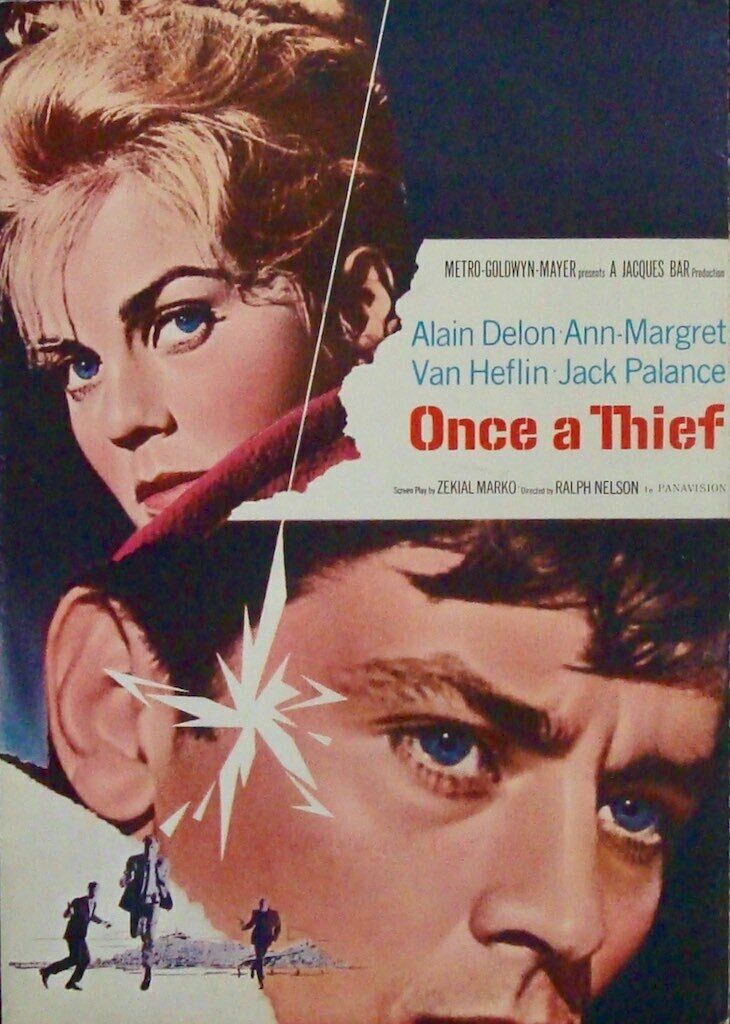
Once a Thief (1965) ****

Latter-day film noir gem with terrific cast filmed in black-and-white and often at night that crams into a taut storyline  different slants of the themes of the con-going-straight, the vendetta and the double-cross. While Hollywood at this point had imported platoons of foreign beauties in the Sophia Loren-Elke Sommer vein, there had been less interest in the male of the species with the exception of a small British contingent and possibly Omar Sharif, on whom the jury was still out. 

MGM was gambling on Frenchman Alain Delon (The Leopard, 1963) to alter industry perceptions at the same time as pushing new contract star Ann-Margret (The Pleasure Seekers, 1964) along more dramatic lines away from the glossy puffery that had made her name and which relied more upon her physical assets than acting potential. Had she continued in this vein, her career would certainly have taken a different turn. 

Eddie Pedak (Alain Delon), former minor hood turned San Francisco truck driver, is happily married to Kristine (Ann-Margret) with a young daughter they both adore. But tough cop Mike Vido (Van Heflin), with a reputation for brutality, is determined to pin a murder on him in revenge for purportedly being shot by him early in Eddie’s previous career. Eddie manages for a time to resist the overtures of brother Walter (Jack Palance) to participate in a million-dollar diamond. But when he loses his job, that changes.

While the robbery naturally takes center stage, that’s not actually the dramatic highlight. Instead, it is the Eddie-Kristine relationship. Instead of Eddie being the usual down-on-his-luck ex-con, he has clearly turned his life around, so much so he can afford a $500 down payment on a small boat. A loving father, he accepts without rancor when his daughter interrupts a night-time lovemaking session. And he’s stylish, too, wearing an iconic sheepskin jacket and driving a snazzy 1931 Ford Model A roadster. Kristine just wants a normal home life, desiring domesticity above all else, but swallowing her pride when she needs to go out to work in a night club to make ends meet, for a time rendering the unemployed Eddie a house husband.

But Eddie is not all he initially seems. His tough streak has not been smothered by the good life. In a brilliant Catch-22 situation he gets violent when an employment benefits clerk refuses to accept that Eddie was fired from his job, instead believing his employer’s claim that he resigned – the former triggering relief payment, the latter zilch. But that’s nothing to the beating he inflicts on Kristine when, pride injured that he is not the breadwinner, he discovers the skimpy costume she wears for her job.

Adding to the unusual mix are Vido and Walter, the former’s brooding presence somewhat undercut by the fact that in middle age he still lives with his mother, the latter while a big-time gangster letting nothing get in the way of strong fraternal feeling for Eddie. You won’t be surprised to learn that double cross is in the air, not when Walter employs a creepy sunglass-wearing henchman Sargantanas (John Davis Chandler) who appears to have more than a passing interest in little girls. The climax, which contains both emotional and dramatic twist, involves redemption and sacrifice.

Delon has played the cold-eyed ruthless but romantic character before, but here adds depth from his paternal commitment and as a man turned inside out by the system.

Ann-Margret is the revelation, truly believable as mother first, sexy wife second, and her anguish in the later parts of the picture showcase a different level of acting skill to anything she previously essayed. This role immediately preceded her man-eater in The Cincinnati Kid (1965) which attracted far more attention and considerably bigger box office and it would have been interesting to see how her career might have panned out had Once a Thief been the critical and commercial triumph. She probably did not attain such acting heights again until Carnal Knowledge (1971). And I did wonder, as with Daliah Lavi (The Demon, 1963) before her whether her acting skills were too often overshadowed in the Hollywood mindset by her physical attributes.  

Van Heflin (Cry of Battle, 1963) is excellent as the cop tormented by the idea that a villain is walking free, Jack Palance (The Professionals, 1966) is good as always and character actor Jeff Corey (The Cincinnati Kid) puts in an appearance as Vido’s whip-cracking boss. This marks the debut of Tony Musante (The Bird with the Crystal Plumage, 1970). Watch for a cameo by screenwriter Zekial Marko, who wrote the original book.

This represented another change of pace for director Ralph Nelson, Oscar-nominated for the Lilies of the Field (1963) and also known for box office comedy hit Father Goose (1964). His  use of an experimental extremely light-sensitive camera eliminated the bulky lighting commensurate with filming at night, bringing freshness and greater freedom to those scenes. His natural gift for drama ensured that the emotional was given as much prominence as the action. Racial awareness was demonstrated by the opening scene in a jazz club where African Americans were clearly welcome, hardly the norm at that time.

The picture was shot on location in San Francisco including Nob Hill, Chinatown and Fisherman’s Wharf. To add authenticity, Nelson employed as extras or in bit parts people famed for different reasons in the area. There was Armenian Al Nalbandian who owned the Cable Car flower store on Union Square. William ‘Tiny’ Baskin was a highly successful diamond cutter, owner of the city’s biggest diamond collection – because of his size he was ideal to play a night club bouncer. The North Beach night club provided cameos for Big Al and resident jazz drummer Russell Lee, who both play themselves. Local singer Toy Yat Mar plays the woman murdered at the start of the film. Also appearing were piano player Jimmy Diamond, bus driver Wed Trindle and belly dancer Shereef.

Mention again of a terrific score by Lalo Schifrin, especially the bold drum solo that played out over the credit sequence. Schifrin’s work on the film was showcased in a featurette aimed at schools and colleges. Russell Lee’s drumming so impressed Ralph Nelson that the opening credits were rewritten around his drum solo.

Catch-Up: Alain Delon has featured in the Blog in reviews for Lost Command (1966), Is Paris Burning? (1966), The Girl on a Motorcycle (1968) and Farewell, Friend (1968); check out also Ralph Nelson’s Duel at Diablo (1966) and Ann-Margret in The Cincinnati Kid (1965).

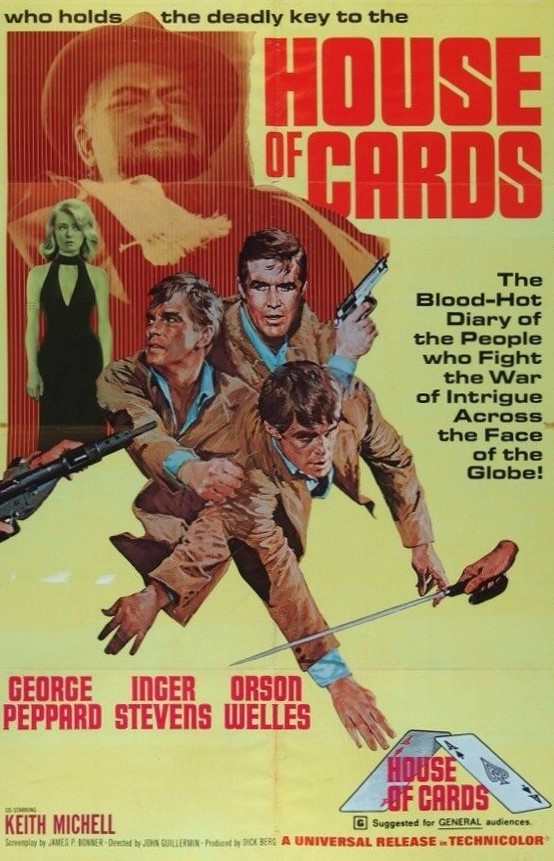
House of Cards (1968) ***

American boxer Reno Davis (George Peppard) stumbles on an international conspiracy when hired by rich widow Anne de Villemont (Inger Stevens) in Paris to look after her eight-year-old son Paul (Barnaby Shaw). All roads eventually lead to Rome and a showdown with arch-conspirator Leschenahut (Orson Welles) in this thriller which throws in a couple of measures of Gaslight (1944) and, more obviously, North by Northwest (1959) to the extent of Anne being an icy blonde of the Eva Marie Saint persuasion and the couple, on the run, sharing a compartment on a train.

The boy’s previous tutor has been murdered. After months in a sanatorium, Anne, paranoid about her son being kidnapped, is in virtual house arrest in the family mansion, watched over by arrogant psychiatrist Dr Morillon (Keith Michell) who has diagnosed her as unstable, neurotic and a danger to the boy.

After an assassin on a bridge on the River Seine takes potshots at Reno and Paul, Reno is framed for murder but escaping from the police returns to the mansion to find it empty, the furniture covered in dust sheets. I half-expected Reno to be told that the job was all in his imagination and that Anne did not exist, but instead finds out that mother and son have been taken to a castle in Dijon, in reality a fortress with a platoon of armed guards. Only Paul has been already been transported to Italy. So it’s attempted rescue, imprisonment, escape, fistfights, chase, clever moves and countermoves, twists and double twists as Reno and the still icy Anne head for Rome.

In among the mayhem are a few humorous moments, a play on the Trevi fountain scene from La Dolce Vita, a monk mistaken for a killer, a bored girl only too happy to be taken hostage, an over-familiar American who gives away valuable secrets because he mistakes Reno for a co-conspirator, Dr Morillon making the error of treating Reno as a servant. And characters involved in assisting escape extract a high price, one seeking financial reward, another that her husband be killed in the process. There is also a flirtatious but spiky maid Jeanne-Marie (Perette Pradier) and a couple of excellent reversals.

Reno is somewhat innovative in the weaponry department, the hook of a fishing rod, for example, while the son is rather handy with a pistol. But given the opposition are armed with machine guns, knives and swords that seems only fair.

George Peppard continues the excellent run of acting form that started in Tobruk (1967) and P.J. / New Face in Hell (1968), developing his own niche, dropping the innate arrogance of The Blue Max (1965) and Operation Crossbow (1965), no chip on the shoulder. Here he is a good bit more attractive as a screen presence, a nice line with the ladies, more than able to take care of himself, a sprinkling of wit, completely at ease. Inger Stevens comes off well though her psychological problems and concerns for her son get in the way of any burgeoning romance with Peppard. But she has quite a range of emotions to get through, from wondering if she is mad, to dealing with the controlling family, and letting go of her son enough to allow the boy to bond with Reno, and despite her vast wealth down-to-earth enough to see a toothbrush as an essential when on the run.

Orson Welles (Is Paris Burning?, 1966), as ever, looms large over everything, with dialogue so good you always have the impression he improvised on the spot. Keith Michell, a couple of years away from international fame in BBC mini-series The Six Wives of Henry VIII (1970), does a very good turn as the psychiatrist.

John Guillermin, who directed Peppard in The Blue Max and P.J., has a lot to do to keep the various balls in the air, especially keeping track of a multiplicity of characters. The screenwriting team of Harriet Frank Jr. and Irving Ravetch (Hud, 1963) pulled this one together from the novel by Stanley Ellin. Francis Lai’s memorable score is worth a mention, with distinctive themes for various parts of the story.

Eva Renzi (Funeral in Berlin, 1966) was originally down for the part of Anne and Italian actress Rosemary Dexter (Romeo and Juliet, 1964) has a small part.

Catch-up: The Blog previously reviewed George Peppard in Breakfast at Tiffanys (1961),The Blue Max (1965), Operation Crossbow (1966), Tobruk (1967), P.J (1968) and Pendulum (1969); John Guillermin directed The Blue Max (1965) and P.J; Orson Welles was seen in Is Paris Burning? (1966) and The Southern Star (1969).

Pendulum (1969) ****

It’s better to come at this as a drama rather than the thriller it was marketed as. That the name of George Schaefer, the last to make a movie of the directors who shot to fame in television in the 1950s, is attached should be indication that this is character- and issue- rather than action-driven. It’s more about people being sucked into the system, about the vulnerable members of society, who, whether cop or criminal, have no recourse to some kind of higher power to sort their lives out. As such, it’s a satisfying drama.

A-list male stars playing emotionally vulnerable characters was a growing trend in the late 60s. Think of Burt Lancaster in The Swimmer (1968) and Kirk Douglas in The Arrangement (1969) – all reviewed in the Blog, incidentally. Here top Washington detective Frank Matthews (George Peppard) goes through the personal and professional wringer, suspecting wife Adele (Jean Seberg) of an affair then becoming a suspect himself in a murder case. Underlying these plot-driven aspects is an exploration of the political issue of civil liberties, in particular the constitutional rights of criminals, setting this up as one of the earliest law’n’order movies, a trope that would take center stage in films like Dirty Harry (1971).  

At a peak of professional success, having been awarded a medal and promoted to consultant on a subcommittee on Law and Order headed by Senator Augustus Cole (Paul McGrath), Matthews’ ethics come under scrutiny when alleged murder/rapist Paul Sanderson (Robert F. Lyons), whom Matthews had arrested, is freed on a technicality thanks to the efforts of civil liberties attorney Woodrow Wilson King (Richard Kiley).

Matthews appears distracted much of the time trying to keep track of his wife’s whereabouts.  After delivering a speech in Baltimore, he walks the streets in a fug of depression. Meanwhile, King is disturbed by the fact that a man he clearly believes guilty refuses to seek psychiatric help. The question in the audience’s mind is where he will strike next. There’s an excellent scene in King’s office where his secretary Liz (Marj Dusay), delighted at the lawyer’s success in overturning Sanderson’s case, instinctively pulls away from the freed man.

When Adele and lover are murdered in Matthews’ bed, he finds himself on the opposite side of the law, undergoing the kind of treatment he has meted out to so many criminals, quickly aware that circumstantial evidence could find him guilty. Front-page news himself now, suspended from his job by a quick-to-judge senator, emotionally isolated and a laughing stock, he retreats further inside himself. Naturally, he evades subsequent arrest, setting out to track down the killer himself, that leads him into the murkier depths of society from which emotionally-abused villains easily spring. 

Other issues are explored in passing, the independent woman for a start, whether it is wanting to have her own career and not play the stay-at-home wife or considering it fair game – as with Gwen (Faye Dunaway) in The Arrangement – to upturn accepted morality and take a lover.

But the focus remains squarely on Matthews struggling to cope with life running away from  him, falling deeper into despair and into the maw of the criminal justice system which has the knack of bending its own rules. He has never been the saintly cop and there are moments where violence seems the best option, although not the vicious kind later espoused by Inspector Harry Callaghan. It’s ironic that the only solid detection the cop does in the first part of the film is tracking down his wife’s whereabouts.

George Peppard (Tobruk, 1967), generally a much-maligned actor, excels in a part where he can neither charm his way into an audience’s heart, nor confide in someone else about his marital problems, nor resort to action to define his character. That his pain is all internalised shows the acting skills he brings to bear. Oddly enough Jean Seberg (Moment to Moment, 1966), a specialist in emotional pain, takes a different path, coming across as a devious minx, keeping Matthews on the hook while enjoying relations with an ex-lover, whose career, as it happens, has panned out a lot better than her husband.

I only knew Richard Kiley, an American theatrical giant and primarily in the 1960s a television performer, through that mention in Jurassic Park (1993), but he is solid as the attorney who has qualms about releasing a prisoner he knows is guilty. Robert F. Lyons, making his movie debut, brings jittery danger to the unbalanced criminal. Look out also for Charles McGraw (The Narrow Margin, 1952) as the cop determined to take Matthews down and Frank Marth (Madigan, 1968) as the subordinate who gives the suspect too much leeway – to his cost. Madeleine Sherwood (Hurry Sundown, 1967) is excellent as the disturbed, needy mother.

George Schaefer, at this point a four-time Emmy award-winner, specialized in thought-provoking drama such as Inherit the Wind (TV, 1965) and Elizabeth the Queen (TV, 1968).  This fits easily into that pattern. The title is a giveaway, too, referring to the pendulum swinging, “perhaps too far,” from all-powerful police to the rights of the accused taking prominence.

This was the only screenplay from Stanley Niss, who died shortly after the film’s release. He was also the producer. And better known as the writer-producer of television series like Jericho (1966-1967) and Hawaiian Eye (1959-1961).

Catch-Up: George Peppard pictures reviewed in the Blog are Breakfast at Tiffany’s (1961), Operation Crossbow (1965), The Blue Max (1966), Tobruk (1967), and P.J. / New Face in Hell (1968).

Pendulum is best sourced on Ebay.

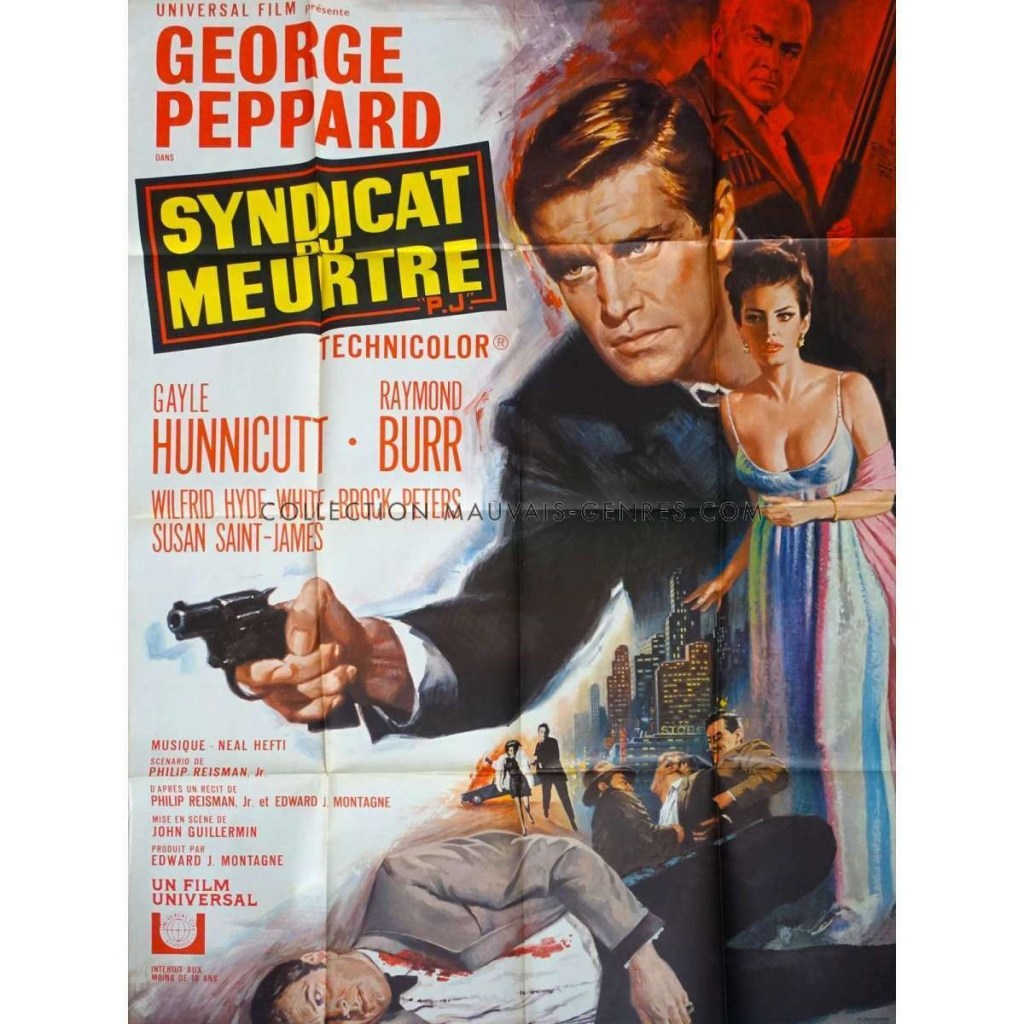
P.J. / New Face in Hell (1968) ****

Exceptional down-and-dirty thriller and throwback film noir woefully underrated on release but with a brilliant mystery (or two), a touch of satire, red herrings, some great lines, and believable characters. Private eye P.J. Detweiler (George Peppard) is so down on his luck he is willing to play the lover so an errant wife can be photographed in a motel room. What little he earns goes on paying is debts. So he can hardly reject the chance of serious money as bodyguard to Maureen (Gayle Hunnicutt), mistress of rich businessman William Orbison (Raymond Burr), never mind that she initially treats him as a servant.

Orbison has a legendary mean streak – to save on paper secretaries have to type closer to the edge of the sheet, he forces wife Betty (Colette Gray) to account for every dime of her allowance to the point of almost making her beg. Sadism is another character trait. He enjoys watching animals die. The childless millionaire adds his mistress to his will for the sole purpose of upsetting every other potential heir. In front of guests at a prestigious party he forces Betty to acknowledge Maureen’s existence.

The title was changed for British audiences and came from a line in the film.

This apparently wealthy world is riddled with seedy inhabitants, whose only motivation is  greed, all desperate to retain status or inheritance and enjoying Orbison’s largesse, which, despite his miserly nature, he nonetheless flaunts. As well as Betty enduring ritual humiliation to enjoy a gilded lifestyle, his executive assistant Jason (Jason Evers) accepts being treated as a gofer in order to keep his position and the perks that go with it, and Maureen makes no bones about prostituting herself for temporary and future gain. Everyone has to kowtow, even the occupants of a West Indian island dependent on Orbison for investment, not only a kids choir welcoming Orbison on arrival, but a calypso performer singing a song in his praise.

As various threats, including narrowly missing a bullet, are made against Maureen, making a classical entrance in a red dress and alternating between helpless victim and femme fatale, with her creepy manservant Quell (Severn Darden) reporting her every move, inevitably Detweiler grows closer to his client, unaware that Orbison is planning to have someone killed.

That someone turns out to be Jason, whom Orbison suspects of clandestine activity with his wife, and whom Detweiler innocently kills. As this takes place on the island, where the death is hushed up, Detweiler begins to wonder if he’s a patsy and, paid off by Orbison, undertakes his own investigation, quickly entering more dangerous waters, viciously beaten up at Quell’s behest in a gay bar, narrowly avoiding death in the subway and literally finding himself in the firing line.

Detweiler’s character undergoes transition, too. From begging for scraps and turning the other way so as not to jeopardize easy income, he rediscovers his suit of shining armor, walking down some pretty mean streets, a diligent private eye who can no longer be bought off, determined to get to the bottom of what turns out to be a complicated mystery. Detweiler is no Marlowe or even Tony Rome, but rather despicable at the outset, employing all sorts of dodges, his interest in Maureen not slackening even after he knows she indulges in a quickie with Orbison. He takes too much at face value.

The unfolding mystery is superbly handled, involving proper clues and investigation, shoot-outs and fisticuffs, the outcome not what you might initially imagine. Although primarily an old school private eye picture, it’s great fun, with some wonderful comedy involving a dog, gentle satire on the West Indian island where political whitewash is the order of the day, and some touching romantic foreplay.

Peppard (Tobruk, 1967) is outstanding as the dupe who rediscovers his moral compass and his Detweiler is an excellent addition to the ranks of the private eye.  Raymond Burr, a far cry from his Perry Mason (1957-1966) television persona,  is easily one of the worst screen millionaires in his contempt for humanity and with his silver hair and bulk and scheming proves a slick adversary. Gayle Hunnicutt (Eye of the Cat, 1969) is allure on legs, brilliantly playing every man in sight, eyes never diverted from the prize.

Brock Peters (The Pawnbroker, 1964) has a standout cameo as the island’s cynical police chief. Susan Saint James (The Name of the Game, 1968-1971) makes her movie debut as Orbison’s slinky sex-mad niece.  Also putting in an appearance are Wilfrid Hyde-white (The Liquidator, 1965) as the island’s sycophantic governor, Colleen Gray (Red River, 1948) as the humiliated wife, Severn Darden (The President’s Analyst, 1967) as the odious Quell and John Ford regular John Qualen (The Man Who Shot Liberty Valance, 1962).

This was the second of director John Guillermin’s George Peppard trilogy following The Blue Max (1966) and prior to House of Cards (1968). Generally dismissed as a journeyman, Guillermin brings a sly eye to this picture, the send-up of British colonialism, the master-servant aspects, an over-the-shoulder shot of an unknown assassin, the scenes in a bar which doubles as Detweiler’s office, the brutal beating in the gay bar, and a brilliant subway sequence adding layers to the movie. He is bold in his use of close-ups with Hunnicutt, some compositions almost a homage to the Bogart-Bacall chemistry, and brings out a world-weary performance from the usually cocky Peppard.

Philip Reisman Jr. (All the Way Home, 1963) fashioned the screenplay, delivering one of cinema’s most memorable final lines.

Reminiscence (2021) ** – Seen at the Cinema

Hollywood has been running shy of genuine film noir for some time now so it makes little sense to give it a waterlogged futuristic setting despite the impressive track record, albeit not in the movies, of writer-director Lisa Joy best known as co-creator of television hit Westworld (2016-2021). Ecologic disaster dominates this future, floods reducing cities to rivers, skyscrapers and buildings existing as islands in a wet landscape. Dystopia is also rampant with the masses close to riot and big business, as you might expect, nonetheless able to exploit the situation.

Nick Bannister (Hugh Jackman) is a private eye of sorts, but concentrating his practice on infiltrating the mind, operating some kind of giant bathtub immersion which, plus a  headset that looks borrowed from a Marvel supervillain, allows him to penetrate secrets. Enter statuesque femme fatale Mae (Rebecca Ferguson) who has – wait for it – lost her keys! Yep, that’s the set-up. Some amazing technological gizmo that can be turned into a key-hunting device.

Of course, that’s not the whole story. To fill out the film noir aspect, Mae is some kind of nightclub singer, rehashing the Rodgers & Hart standard “Where or When,” singing into a  1940s mike. And there’s a voice-over reminiscent of the awful voice-over that besmirched the original release of Blade Runner, with some lines so bad that the director sees fit to run them twice.

Soon Bannister is plunged (pardon the pun) into a mystery that takes in businessman Walter Sylvan (Brett Cullen) and family and there’s other bad guys like Cyrus Boothe (Cliff Curtis) and a shoal of red herrings lying in wait. Instead of Bannister being the alcoholic as is usually the private eye trope, it’s his sidekick Watts (Thandiwe Newton).

Left alone, this might have made a decent mystery, and there is enough intrigue to be going along with, family secrets to expose, but the setting destroys any possibility that the picture might actually take off.  The city is in some cases flooded to probably the first ren or twenty storeys of a skyscraper but in other sequences Bannister skips through what look like little more than a few inches of water. There is an absolutely peculiar scene where Bannister escapes his enemy by trapping him in a grand piano and sending him into a watery grave only to change his mind and try to rescue him.

There’s some interesting material about how to capture memory and keep it on permanent rewind but it’s kind of lost in the general flotsam and jetsam and there’s a sweet line about finishing a story at the good part before it turns into a sad ending. But there’s really no justification for the futuristic setting even if Bannister had invented a gizmo that opened up the mind, more of an electronic psychiatrist than a gumshoe.

Hugh Jackman (The Front Runner, 2018) does his best but the risible voice-over, striving too hard for memorable lines, does for him. Rebecca Ferguson (Mission Impossible: Fallout, 2018) is satisfactory without being electrifying but Thandiwe Newton (Solo: A Star Wars Story, 2018) is wasted.

Danger: Diabolik (1968) ****

Super-fun slick cult thriller as uber-villain Diabolik (John Philip Law) and sidekick Eva (Marisa Mell) outwit cops – and robbers – in a series of cunning heists. When not thieving they’re making love or pranking officialdom. Diabolik, hiding out in an underground cavern, out-Bonds James Bond in the fast-car and gadget department while Eva, smarter than the average Bond girl, leads the world in fashion or lack of it, her opening outfit looking as if it has either been cut to ribbons or made up of ribbons. Diabolik’s mask is cool and Eva is dressed to kill. Crime was never so fun, stylish, sexy – or lucrative.

Heist number one is the biggest shipment of dollars – $10 million – ever transported through Italy with a  massive convoy of outriders and an official plan to outwit the master thief. Already one step ahead, Diabolik, a master of the magnetic, whisks away the money in plain sight. Heist number two, an emerald necklace worn by the British ambassador’s wife high in an impregnable castle, involves Spiderman-type maneuvers. Heist number three: a 22-ton gold ingot.

A crackdown on criminal activity so endangers the Mafia that top cop Inspector Ginko (Michel Piccoli) finds a surprise recruit in the hunt to capture Diabolik – Mafia boss Ralph Valmont (Adolfo Celi). The criminal network proves more potent than the cops and Valmont hatches a plan to snare Diabolik and exact revenge. And so ensues an elaborate chess game as criminals chase criminals with cops hoping to pick up the pieces.

John Philip Law (Hurry Sundown, 1967) was the coolest villain by a mile until challenged by Steve McQueen in The Thomas Crown Affair the same year. His classic good looks are matched by a fabulous brain as he cooks up brilliant scheme after brilliant scheme. Marisa Mell (Masquerade, 1965) is sexy as hell and a worthy companion in the thieving stakes. Adolfo Celi (Thunderball, 1965) and Michel Piccoli (Belle du Jour, 1967) are clumps in comparison, even though they do their ingenious best and Celi has his own harem.

Although Mario Bava (Black Sabbath, 1963) was better known for horror, this is a cult tour-de-force that employs the outlandish to set the tone, from go-go dancers and face-painted nightclubbers to the psychelic, the uber-fashionable, gadgets decades ahead of their time and the outrageous heists. The whole picture, coated in a sheen of glamour, is irresistible. The couple make love on a bed of dollars, airplanes have trap doors, there is a parachute jump twist, suspended animation, psychedelia, radioactive tracking devices, high-speed chases and a fiendish statuesque climax. And where not bedecked in fabulous fashion or one-piece cat-suits, the pair scamper about naked or as close as.

Bava captures the spirit and the look of the comic books by Angela and Luciana Giussani that provided the film’s inspiration. But that eight names including Britain’s Tudor Gates (creator of television’s Vendetta, 1966-1968) were involved in the screenplay shows the work this required. Ennio Morricone created a superb score. All-time cult classic.

Discover WordPress

A daily selection of the best content published on WordPress, collected for you by humans who love to read.

The Atavist Magazine

by Brian Hannan

WordPress.com News

The latest news on WordPress.com and the WordPress community.