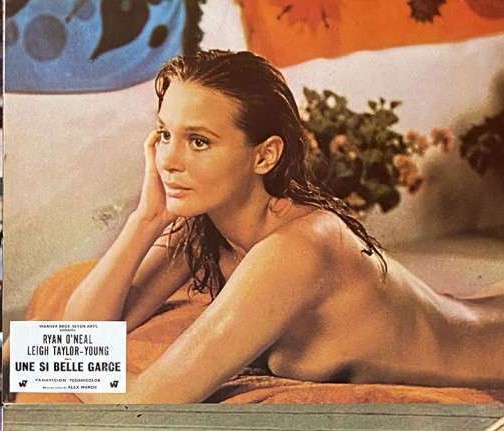
The Big Bounce (1969) ***

Femme fatale Nancy (Leigh Taylor-Young) makes a fair bid for the coveted Bunny Boiler of the Year Award. Had she chanced upon the right wrong guy who could channel her inherent viciousness she could have turned into Bonnie Parker. The only thing that holds her back from being a feminist icon, taking revenge for male betrayal, is her lack of independence.

Mistress to rich farmer Ray (James Daly), she teases the hell out of his head honcho Bob (Robert Webber), makes love in a graveyard, and fuels her amorality by going from breaking windows, attempted burglary and big-time heist to driving cars off the road and murder.

Temptation – Nancy-style.

Dupe is Vietnam vet Jack (Ryan O’Neal) who works as a hotel handyman and happily two-times her with single mother Joanne (Lee Grant).

Although easy with her charms, it’s sex that comes back to bite her when Ray explains that all this heady living comes at a price, pimping her out to a Senator he wants to impress. Whether that turns her against all men, including the dupe who she suspects of making out with Joanne, or whether she is plotting simple revenge against Ray isn’t made clear, but like the best femme fatales she has her eye on the loot that could bring her freedom and doesn’t much care what it costs to get it.

Nobody much cared for this picture, either, but I can’t see why. Sure, too much time is spent on Jack – he gets slung out of a job picking pickles for getting into a fight, and he lands on his feet with a friendly hotel owner Sam (Van Heflin) who buys him beers and even makes his breakfast, and pretty much could have the pick of any girl who walks into a bar. But that’s the usual narrative for film noir, pointing out, usually over and over, what an easy mark he is for a determined woman.

Unusual for the foreign title to be better than the original but this certainly captures the character better.

Nancy could have been less obvious, but she uses her perceived availability as a potent weapon – the scene where she holds her naked body just enough away from the panting Bob while probing him about his wife and children, is a classic – and she doesn’t make it easy for Jack either, although his reward is a drawn-out striptease. She’s the typical bored young woman looking for kicks, and like Pretty Poison (1968) you have to suspect that there’s considerable calculation behind what appear like spur-of-the-moment decisions, trying to work out just how far the dupe will go to retain her favors.

So while she races through the gears, Jack seems stuck on the starting grid, as his apparent good luck turns into confusion. And although he’s got the looks to attract women, he hasn’t the brains to understand them. He’s so dumb you just want Nancy to get away with it. If there’s a weak spot in the movie it’s that he just isn’t interesting enough to spend any screen time with. He boasts of having committed misdemeanours and he’s got a temper when roused but actually he’s your typical lost Sixties character looking for more stability in his life.

Unusually for a movie that’s drawn so much criticism, the supporting characters are quite appealing.  Sam is also a very worldly Justice of the Peace. Ray, far from being an easy conquest, is a hardass, the scene where he deadpans a line that it would take him, oh, a week to replace her if she fails to sleep with the Senator is priceless. There’s also some decent stuff about war, how Jack never even saw the enemy he was killing. And Joanne is a great study, another woman endlessly drawn to the wrong men, who can keep her dangling while never committing.

And beyond the scene where Nancy poses as a naked statue in a graveyard that is obviously unforgettable, there’s a marvellous scene where Jack wakes up in a strange house to the sound of tapping. When, finally, he opens his eyes, he sees a small girl tapping her cup at the breakfast table;  Joanne has a daughter she omitted to mention.

This was the first of Elmore Leonard’s crime novels to be adapted for the movies. But he wasn’t a Hollywood unknown. He supplied the source material for 3.10 to Yuma (1957) and Hombre (1967). And at this point he was keen on setting his stories in poorer areas, as well as pickle farming here,  the Kentucky backwoods are the setting for The Moonshine War (1970) and melon farming for Mr Majestyk (1974). There’s not a million miles between Mr Majestyk reaching for his gun when threatened and Nancy for one when betrayed, but somehow he’s in the right and she’s in the wrong.

And while you’re at it you might as well reflect on the complexities of Hollywood. Leigh Taylor-Young (I Love You, Alice B. Toklas, 1968) carries this picture and despite what the posters show was top-billed. But she didn’t get one more starring role. Two flops in a row – this and The Games (1970) – and Ryan O’Neal gets Love Story (1971) and he’s king of the hill.

Definitely worth a look.

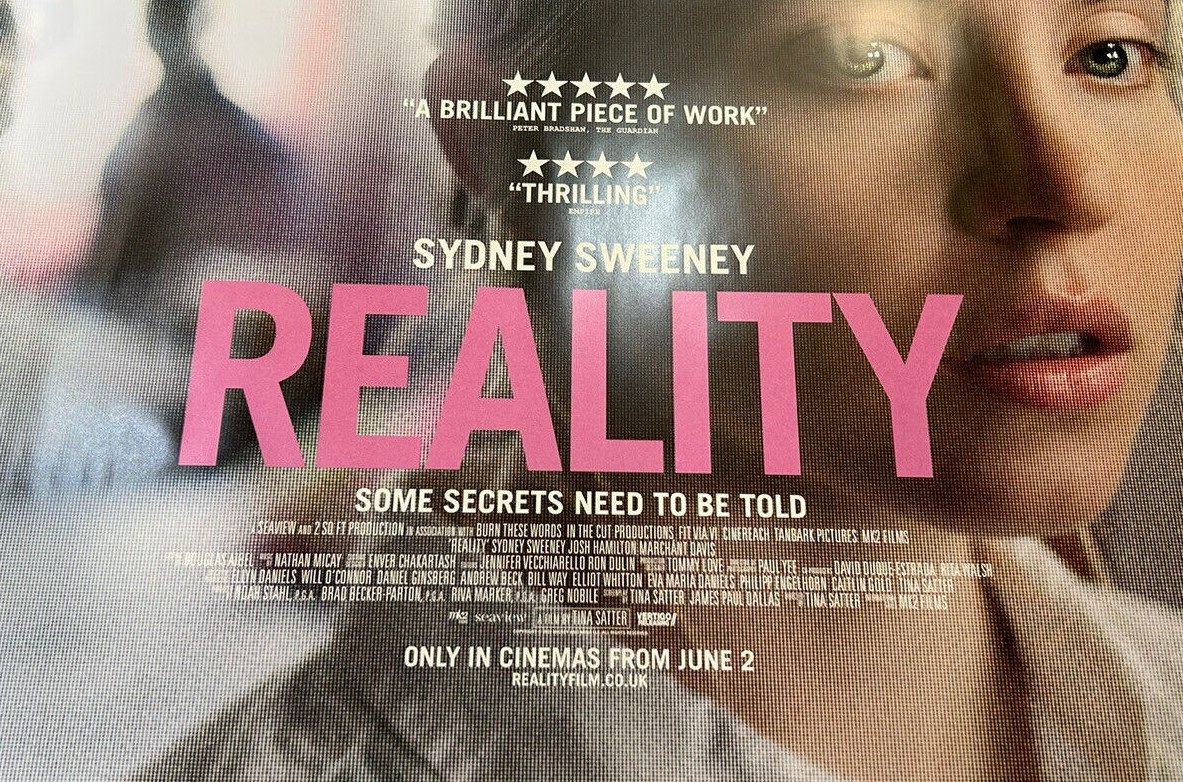
Reality (2023) – Seen at the Cinema ****

When F.B.I. agents turn up at your door with a search warrant, surely your first instinct is to ask what the hell is going on? When that doesn’t transpire, an audience’s gut feeling is that you are hiding something. Or, this being America, it’s going to be a miscarriage of justice.

Whether it is that in the end would depend on your political point of view.

Keeping politics out of it for the moment this is a riveting piece of what used to be called cinema verite and now probably is labelled docu-drama. The title would be ironic except that this main character had the kind of parents who named her Reality (Sydney Sweeney).

Initially, it’s just two rather amiable non-threatening FBI officers, Agent Garrick (Josh Hamilton) and Agent Taylor (Marchant Davis), who turn up in 2017 at the aforesaid door. They are advance warning, if you like, for soon there’s a posse of agents tumbling out of the cliché black vehicles. There’s certainly no sense of menace though Reality is kept clear of touching her mobile phone and kept outside and possibly thinking from the continued amiable chat with Garrick that it’s all going to be a misunderstanding. But then, as luck would have it, she’s got a room in her house that could stand in for a jail cell any day of the week, no furniture, bleak, and a snail plodding along the window ledge. And it’s in this room that the interrogation takes place.

What’s superb I guess is that the dialog all comes from F.B.I. transcripts so instead of the waterboarding or good-guy-bad-guy routine or just beating up a suspect that we’ve been fed as the truth by umpteen Hollywood movies the actual interrogation is so low-key you think this has got to be a case of mistaken identity. Or that someone out of malice has pointed the finger at an innocent party.

Reality is a linguist – speaks fluent Farsi (an Iranian language) – with high-level clearance working for the National Security Agency. Oh, and she teaches yoga, competes in weightlifting competitions and if I got this right owns three guns including an automatic rifle.

So, the questioning is pretty much along the lines of the F.B.I. just wanting to clear up a few things. Did she, for example, by accident ever take out of the building something classified that should never have left the office?  Sure enough, way back, by accident she had done so. But it soon becomes clear, if ironic, that someone engaged effectively in espionage is just as open to being spied upon as the country’s adversaries.

But as the tension mounts, the tone never changes. It’s Reality who looks more and more under pressure. From standing stock still and meeting their eyes, her attention is diverted by the antics of the snail and she starts moving around and eventually slides to the floor. Occasionally, Taylor will take a turn asking questions and both are equally adept at expressing surprise, especially convincing given it’s soon evident they know her every move.

These guys could be classic courtroom lawyers, because they make no wild assertions, just gently lead her on to admitting what they know is true. They make a point of telling her they don’t think she’s a big badass spy, and that she’s just someone who made a mistake, maybe in the heat of the moment, what with so much going in the U.S. Presidential Elections of 2016.

And you’d be amazed at how the guilty party commits herself on the slightest of details, a piece of paper folded over, for example. Turns out Reality has been a whistle-blower and getting her to admit makes the consequences easier, especially when all her answers have been recorded, for the prosecution.

It’s quite obvious where debut director Tina Satter’s political views lie but that doesn’t get in the way of a stunning piece of cinema. She’s had the sense to keep it short – it barely passes the 80-minute mark – and to limit editorial outrage to the end.

As it stands, setting aside the political element, it’s an engrossing watch. Sydney Sweeney, a name I’m unfamiliar with, is superb as the guilty party while Garrick and Taylor are equally good at tying her up in knots.

One to watch, regardless of which end of the political divide you favor. This is the kind of movie that a Sidney Lumet – it reminded me both of the dryness of The Offence (1973) and the courtroom spectacle of The Verdict (1982) – or a John Frankenheimer would have pumped out in their prime or the fly-on-the-wall documentaries of Frederick Wiseman (Basic Training, 1971).

A must-see.

* They’re releasing this in the UK and possibly the rest of the world in the cinema, but in the U.S. it’s appearing as an HBO Original so I’m not sure if that means it’s gone straight to streaming or doing the indie rounds first.

Night of the Generals (1967) ****

Impressive vastly underrated whodunit that breaks all the rules. Take the length for a start – just stopping short of two-and-a-half hours. The investigation covers multiple time periods – 1942, 1944 and 1965. The killer outwits the detective. Most important of all, the murder is clearly a MacGuffin to examine politics among the German officer class.

A Polish woman who turns out to be a German agent is viciously stabbed to death in Warsaw in 1942 during a period of staunch resistance by the inhabitants. General Tanz (Peter O’Toole), sent in to quell a potential uprising, is one of three generals on the suspect list compiled by Major Grau (Omar Sharif), the others being the alcoholic General Khalenberge (Donald Pleasance) and the philandering General von Seidlitz-Gabler (Charles Gray).

But Grau is no ordinary detective or, put another way, this not an ordinary investigation.

Grau lacks any of the powers we associate with an investigator. Yes, we expect obstruction, perhaps collusion, as the murderer tries to avoid detection. But Grau might well have been a sergeant for the disdainful treatment and lack of cooperation he receives. And there’s a fair chance he’s going to be shot at as he prowls the streets, and resistance fighters in tenement exchange fire with the invaders. None of the generals can account for their whereabouts on the night in question.

While Tanz is benign to children, ordering a hungry bunch fed from his own supplies, he is ruthless with adults, willing to employ flamethrowers (Phase Two of his plan) to drive snipers out of buildings and if that fails move onto Phase Three which simply uses tanks to obliterate everything. Like some knight of old, Tanz stands upright in his jeep directing operations in full view of the enemy, almost taunting them to kill him.

The most powerful image in the film – the one used in the posters – has Tanz standing (on the right of the screen) upright in his jeep with the world on fire behind him. What’s edited out of the poster is that Grau occupies the left side of the screen, standing like a servant awaiting his master’s orders.

That Grau makes no progress at all is down to the power of his superiors. Since he commits the cardinal sin of getting in the way, he is just shuttled out of Warsaw, promoted to Colonel and given other duties in Paris. So the scene shifts to the Parisian capital in 1944 after D-Day. The same three generals are on duty in the French capital, not supervising, as you might expect, the defence of the city against the encroaching Allies, but planning an attempt on the Fuhrer’s life (Operation Valkyrie). This time it’s Tanz, returning from the Russian front where his regiment has been decimated, who is shuttled to one side, ordered to take two days leave so he doesn’t get in the way of the saboteurs.

At this point, the movie boldly switches perspective, in part to encompass the assassination subplot, in part to focus more closely on Army politics, in part to follow Tanz, not just an alcoholic but a poster boy for OCD, as he tries to enjoy some downtime. He is accompanied on his tourist trip through the city and jaunts to visit museums by his chauffer/butler Corporal Hartmann (Tom Courtenay) whose other duties include spying on the general on behalf of the plotters. Grau, meanwhile, recruits French Inspector Morand (Phillippe Noiret) to assist in his investigation, which is otherwise being obstructed on all sides.

I won’t reveal the shocking ending which shows just how clever the murderer is because that’s not actually the ending and the story shifts to 1965 when the generals have been rehabilitated after the war, the case still open because a third woman has been killed in the same fashion.

I may have seen this back in the day and certainly remember it vaguely from a pan-and-scan version edited for television, but I had generally avoided it because of the poor reviews. I wonder how many critics just found it in poor taste, to be spending big Hollywood bucks on a story that treated German generals as pretty well ordinary human beings, the war itself so much in the background you would think it non-existent. Plenty critics sniped at the performance of the principles, perhaps because Peter O’Toole (Becket, 1964) and Omar Sharif (Genghis Khan, 1965) played so much against type. The image I mentioned of O’Toole with the world ablaze is an ironic one, not charged with the glory of David Lean’s vision of the actor in Lawrence of Arabia (1962). Similarly, not once does director Anatole Litvak (Five Miles to Midnight, 1962) rely on Omar Sharif’s soulful brown eyes the way Lean did in Doctor Zhivago (1965), in fact there is no such shot here at all. Sharif looks weary and jaded, kept going in the face of obstruction by his own convictions about justice. O’Toole is so wound up he likes like he’s about to explode and at times certainly teeters off-balance.

Critics seemed so intent on dishing out barbs that they missed two excellent performances, Sharif , in particular, unable to call on his romantic side, delivering very fine work. Donald Pleasance (Soldier Blue, 1970), devoid of his usual physical tics, is also memorable. And there is so much to enjoy from the direction. Litvak, in particular, makes superb use of the tracking shot. Often a scene begins with a close-up, tracks back to reveals others, allows them to deliver their lines, then tracks back into the original character, usually the one with most to lose at this moment. He allows time to develop the other characters. Without ever appearing drunk in the way of Tanz, Khalenberg is always pouring or drinking a shot of alcohol. Seidlitz-Graber is inhibited by family politics as his wife (Coral Browne) attempts to ease their daughter Ulrike (Joanna Pettet) into high society.  

I must also mention the brilliant score and the pithy lines that shoot out from cynical mouths. “Making up one’s mind is one thing,” observes Seidlitz-Graber acidly, “speaking it is another.” On hearing of the assassination plot, Grau points out, “when things were going well, the generals enjoyed the war as much as Hitler.” Music came courtesy of Maurice Jarre (Doctor Zhivago) and the screenplay was a joint effort between Joseph Kessel (Army of Shadows, 1969) and Paul Dehn (The Spy Who Came in from the Cold, 1965) who hacked away at the H.H. Kirst novel, retaining only the opening.

Well worth watching.

Rider on the Rain (1970) ****

This is not the Charles Bronson you think you know, the mean, truculent, monosyllabic persona who turned into a box office powerhouse later in the decade. It took the French to recognize the leading man qualities Hollywood determinedly ignored. God forbid, he is actually pretty charming, although his methods for squeezing information out of a suspect are, well, suspect. And he turns up pretty late in the picture, just when you think the focus is going to be on the suspect, Mellie (Marlene Jobert) and it’s going to be one of those pictures where an innocent woman is suspected of a crime and the man has to clear her name.

Except Mellie isn’t innocent. She’s killed a rapist who broke into her house and then dumped his body over the cliff. And she isn’t, officially at least, a suspect, local cop Inspector Toussaint (Jean Gaven) more interested in getting a loan from her husband, pilot Tony (Gabriele Tinti), to pay off gambling debts. Needless to say, any time the cop does knock on her door, she jumps out of her skin.

And she would have got away with the murder, except for the arrival of Dobbs (Charles Bronson). He turns up at a wedding, ensures she gets to see a newspaper headline of the murder, insinuates his way into her life, not too difficult once her husband heads off on another flight. She runs a bowling alley with her mother Juliette (Annie Cordy) who scarcely has a maternal bone in her body.

Rather than helping the cops solve the case, Dobbs is more interested in the red bag the rapist was carrying. But when she hands over the bag, it doesn’t contain the $60,000 Dobbs wants.  We never see what Dobbs gets up to when he’s not with Mellie. But we hear it. His investigations may be carried out off screen but he’s tailing her – knows she bought a ton of newspapers – and tells her what he’s found out by speaking to cops and neighbors. Even though she’s replaced the cartridges in the shotgun she used to kill the rapist, he knows the gun has been fired. When she claims she was aiming at rats in the cellar, he points to the marks on the wall, too high for even the most acrobatic rat.

Mellie is trapped in a claustrophobic world, assailed by her own guilt and a jealous husband with too much unexplained loose cash (drug smuggling is the implication), turns against her best friend, boutique owner Nicole (Jill) who had an affair with her husband, and against her mother whom as a child she caught in bed with another man, causing her father to dump the mother.

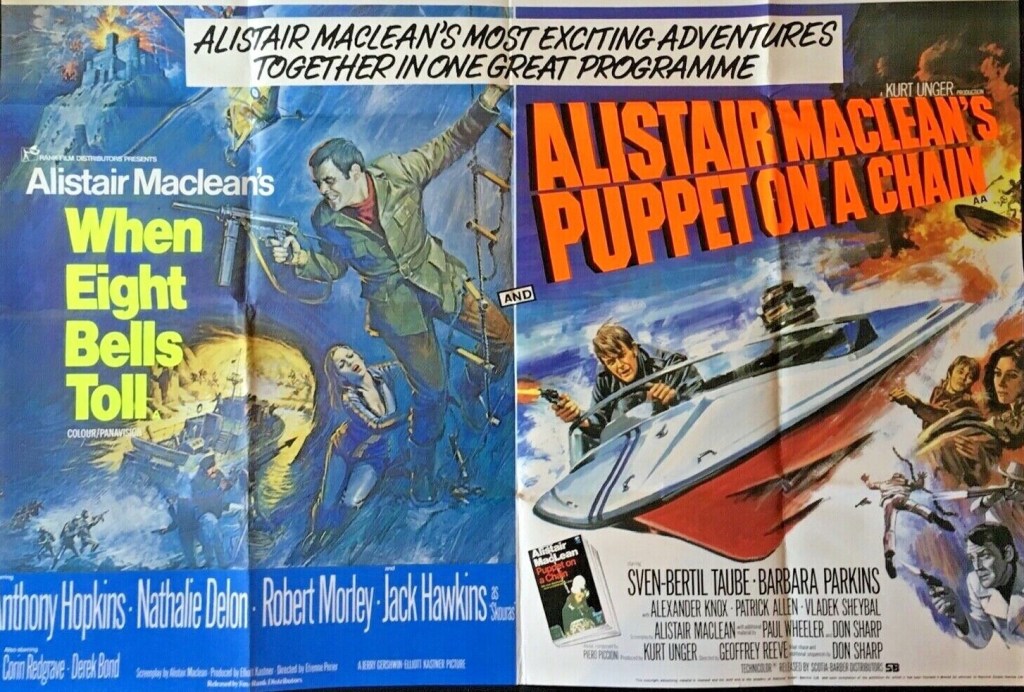
They started to get tricky with double bills in the 1970s, trying to suggest
the films were equally attractive, ignoring the fact that if they had been
such hits they wouldn’t have been paired in the first place.

Most of the tension is self-inflicted but Dobbs has thing about nuts and soon is whizzing shells across rooms, some trick where they break on impact with a window, but the noise is like a shot, too close to the blast of the shotgun.

Every twist ratchets up the tension. And by concentrating on the suspect the police are ignoring and making Dobbs, by default, the chief investigator, and nobody to turn to, Mellie is turned inside out by his mere presence, never mind, when exasperated, he employs his own interrogation method, akin to waterboarding, except the liquid is alcohol, forced down her throat until her lungs are full to bursting.

The last act is a bit murky, as the locale shifts to Paris, involving a brothel owner and a set of gangsters who are even more intent on humiliating Mellie. With echoes of Charade (1963) and Moment to Moment (1966), it’s superbly directed by Rene Clement (Is Paris Burning? 1965), who doles out clues and twists like he’s playing a hand at cards.

In spite of the concentration on tension, he takes the time to build up his characters. A series of emotional flashbacks show the fault-lines in Mellie’s character, no matter that she initially appears confident with fashionable short hairstyle and white outfits bound to attract attention. Dobbs’ obsession with suddenly chucking nut shells around maintains the tension and his cavalier tone, especially his jocular use of a nickname, suggests an interesting personality behind the tough guy pose.

Like his script for The Sleeping Car Murder (1965), screenwriter Sebastian Japrisot is as concerned with ordinary life as with the thriller elements.

Charles Bronson (Farewell, Friend / Adieu L’Ami, 1968)  delivers the best performance of his entire career, tough guy with a charming underbelly, kind of Cary Grant with muscle. Marlene Jobert (Catch Me a Spy, 1971) is excellent as the victim turned suspect, and even Jill Ireland, for whom a part was always found in husband Charlie’s movies, shows a different side to her screen persona.

A riveting watch.

Rebus / Appointment in Beirut (1968) ***

Ann-Margret, at this point in her career, must have had a clause written in her contract that she gotta sing, gotta dance. And you can see the sense of that demand because, as in previous films, she proves she can shake her booty, that number more of a showstopper than her earlier crooning. But, honestly, she has taken a backward step in terms of billing. Here, she’s effectively the leading lady rather than the top-billed star, and really, beyond the dancing, little more than “the girl.”

The heist itself is niftily done, making use not just of such an old-fashioned notion as a magnet but also making a pitch for early recognition as one of the originators of solar power. (How that combination works out, I’ll leave to your imagination.) But, in a twist in the heist genre, the focus is largely on those trying to stop a major robbery from a casino in Beirut, the latest in a series of thefts from top casinos around the world. And it’s not a heist in the normal sense. Millions of dollars have gone missing, but no one can figure out how.

Naturally, your automatic port of call would be an alcoholic croupier, Jeff (Laurence Harvey), currently working at The Playboy Club in London because it’s about the only city where he’s not been blacklisted. Anyway, handed a ticket to Beirut and the prospect of some easy cash by Benson (Jose Calvo) who initially appears as a drunken apparition in the fog, Jeff decides it’s the easiest option.

Benson, it transpires, is not the shady character Jeff imagined, but some kind of investigator entrusted with finding out who is defrauding the casinos. Jeff makes the acquaintance of night club singer Laura (Ann-Margret), who soon develops a soft spot for him, but not enough to join him for a drink (or, presumably, sex) after work since that time is set aside for current squeeze Ghinis (Ivan Desny).

No sooner has Jeff worked out that a huge amount of cash is at stake than he carves himself  a slice of it, $100,000, working for Benson. But, no sooner has he won that particular lottery than the bad guys make a counter-offer, the same amount but at least you’ll come out of the deal alive. Laura is clearly some kind of bait to keep him sweet, though she could be bait for hundreds of customers as she shakes her booty during her big number, “Take a Chance,” the lyrics, ironically enough, encouraging gambling.

This being the kind of European co-production that requires assistance from the authorities, we are treated to a tour of the sights of Beirut (there’s also a journey by motorbike earlier on from Highgate in London to Mayfair and by taking rather a detour manages to take in many of the capital’s finest tourist sites). The Beirut leg of the movie itinerary takes in a traditional concert in some first-class ruins, a bazaar, and for reasons that may be more to do with commercial concerns than tourist, an oil refinery.

There’s also a very irritating shrill American, Mrs Brown (Camilla Horn), who, constantly getting in Jeff’s way, appears to be there just for comic effect, intent as if she had a social media channel to film everything in view. Turns out her movie camera and the lady herself are there for another purpose entirely.

The heist, itself, is particularly well done, especially as it appears to be achieved by a bunch of proper strangers – that is people who seem to have no connection to each other at all rather than the old trope of strangers coming together for a robbery by the end of which they know far too much about each other.  

Unfortunately, from the narrative perspective and for fans of Ann-Margret (The Swinger, 1966), she is less the femme fatale than the equivalent of the dumb blonde. But pretty much you could have advertised this as starring two Hollywood stars who had fallen from grace and were taking Italian coin because little else was on offer. Laurence Harvey (Life at the Top, 1965) is actually pretty good, when sober capable of dealing with good guys and bad guys and with still enough charm to make romance with Ann-Margret seem plausible. Except that this is not a great movie, though interesting enough in a double-cross kind of way and the heist is good, both actually acquit themselves well, Ann-Margret correct in her assumption that her dancing goes a long way to keep audiences sweet.

This was only the second film for director Nino Zanchin, and the fact that he only got to make one more tells its own story.

You may have been scratching your head, wondering when the hell “Rebus” is going to appear or perhaps imagine it’s some kind of code word or password. No amount of head-scratching by myself right to the end of the movie made any sense out of this title. That was the original title, but some distributors, fed up presumably with scratching their heads, opted for the more sensible Appointment in Beirut.

An okay watch, some decent twists and lifted I guess you would have to say by Ann-Margret’s dance number more than Laurence Harvey’s snippy performance

Marlowe (1969) ***

Anyone breaking into the private eye market in the late 1960s had to content not only with the ghost of Humphrey Bogart but a heavyweight slugger name of Harper (1966) whom Paul Newman had fashioned into the most likely contender for the Bogart crown. Ironically, it was growing interest in Bogart that spurred on an imitator. His movies, screened two hundred times a year on television, created an initial cult following, his persona maximized to the full by the reissue on the tenth anniversary of his death of 45 of his pictures plus the half-dozen biographies that appeared in a three-month stretch.

As it happened a couple of Raymond Chandler novels, The Little Sister and The Long Goodbye never before filmed and theoretically at least avoiding comparison with the past, were up for grabs. The Little Sister was the chosen vehicle. But, anyone chancing their arm in the role of Philip Marlowe was likely to be met with jibes of “he’s no Humphrey Bogart.”

That’s not the only problem here. The story is awfully convoluted, it’s been updated to a modern Los Angeles complete with hippies and gym work-outs and screenwriter Stirling Silliphant has chucked away the bulk of the original dialog. So, little remains of what made the character compulsive viewing in the first place.

Marlowe (James Garner) is investigating the disappearance of the brother of Orfamay Quest (Sharon Farrell), a young woman from Kansas, when he stumbles upon a couple of ice-pick murders and a pack of incriminating photos that depict television sit-com star Mavis Weld (Gayle Hunnicutt) – no slouch herself at knocking people out – in a compromising situation with top-line gangster Sonny Steelgrave (H.M. Wynant) whose speciality had been killing people with an ice-pick. So it’s a murder/blackmail double whammy.

The plot thickens when Winslow Wong (Bruce Lee) tries to pay him off and when that fails wrecks his office by demonstrating the kung fu skills that would later make that actor a star.  Detective Lt French (Carroll O’Connor) is the typical dumb cop that Marlowe runs rings round. Also entering the fray is exotic dancer Dolores (Rita Moreno), a friend of Mavis, and to liven things up for the gumshoe a girlfriend Julie (Corinne Camacho) who has some nifty one-liners when Ofamay attempts to seduce her boyfriend. And there’s any number of Steelgrave’s thugs who make any number of attempts to scare Marlow off.

Eventually, after being drugged by Dr Vincent Lagardie, Marlowe finds the missing brother, Orrin, who, while dying, attempts to kill the detective with an ice-pick. Assuming that clears up both cases, Marlowe then discovers that Orrin, Mavis and Orfamay are siblings.

Hunnicutt is given the pin-up treatment in ABC Film Review.

But the tale still has some way to go, uncovering a hornet’s nest of spite and revenge among the warring siblings. There’s way too cute an ending though whether that was Silliphant’s invention or the tack taken by Chandler I have little interest in finding out, exhausted as I am by a seemingly endless series of twists and turns.

I’m not exactly sure what’s missing from this except a femme fatale – Mavis makes no moves on Marlowe, though her sister, who hardly qualifies as a femme fatale, does. It’s unfair in a sense to complain that it’s not following the Chandler template when so much effort has gone in to trying to initiate something new. If it had been called anything else, or the name Marlowe substituted by Smith, then we wouldn’t be thinking so much of the source material or the imitable Bogart.

Confusingly, there is a Bogart involved, director Paul Bogart (The Three Sisters, 1966 – from the Checkov play and no relation to The Little Sister) and although he keeps the plot ticking along – who wouldn’t with so much plot to tick – that’s pretty much all he does, in the cold light of Los Angeles hardly able to emulate the film noir setting.

So, effectively, it’s up to James Garner (Mister Buddwing, 1966) to pull the whole movie together, or put another way, keep it from falling apart. Audiences, much taken with the actor’s reinvention of his screen persona in his previous picture, comedy western Support Your Local Sherrif (1969), didn’t bring sufficient box office support. Garner is okay but sorry to say he’s no Bogart.

Rita Moreno (Night of the Following Day, 1969) is the pick of the supporting cast. Gayle Hunnicutt (Eye of the Cat, 1969), given the type of billing that elevated Lauren Bacall to super-stardom, doesn’t do enough to achieve the same.  Interestingly, both Garner and Hunnicutt went down the shamus route in television in the future, the former in The Rockford Files (1974-1980), the latter in an episode of Philip Marlowe, Private Eye (1983).

If you’re a fan of Garner a reasonable watch. If you’re a fan of Chandler or Bogart you’d be inclined to give it a miss.

Five Miles to Midnight (1962) ****

Superb performance by Sophia Loren (Arabesque, 1966) lifts taut Parisian-set thriller into outstanding class. Forced, of narrative necessity, to keep a lid on her emotions, Loren’s eyes betray her feelings. Director Anatole Litvak’s (Lady in the Car with Glasses and a Gun, 1970) camera is relentless, trapping her with almost claustrophobic compulsion, allowing little release, preventing her escaping the eye of truth.

Husband Robert (Anthony Perkins) and wife Lisa (Sophia Loren) embark on major insurance fraud. He’s the instigator, she reluctantly goes along with the plan as she imagines that, with their unlikely marriage already teetering, it will buy her freedom. Robert, sole survivor of a plane crash, rather than announcing he is alive, uses his death to scam the insurance company out of $120,000 (equivalent to $1.2 million today).

Given he is deceased, she has to carry out the formalities of making the claim, dealing with the various authorities, including police and the American consulate. Meanwhile, hiding out, every knock on the door or ring of the telephone creates panic. At various points Robert has to hide in every room in the apartment – remembering to remove any sign of his existence –  and on the stairwell and when that proves too dangerous on the roof.

Little things that could give him away. The extra plate or glass could trigger suspicion from the cleaner. Lisa, a non-smoker, has to purchase cigarettes for Robert, the remains of an ashtray a possible reveal. She returns to work much faster than you would expect of a grieving widow.

She attracts an initially unwelcome suitor, David (Gig Young), a doctor, a friend of a friend. Workmates turn up at inopportune moments. A boy in an apartment opposite spots the recluse, at one point, shining a mirror into Robert’s eyes, dazzling him as he hides, precariously, on the roof. A cat, too, threatens to reveal the voluntarily imprisoned man.

You might wonder how why she married the financially dissolute Robert in the first place, more baby than man, a “charming octopus” whose needs would strangle the life out of a wife. He was her meal ticket from post-war Naples. She was so desperate to escape poverty that she would, as Robert acidly (and truthfully) puts it, that she would have gone off with any fellow with “a couple of bucks in his pocket.”

In Britain it was released on the lower part of a double bill to “Taras Bulba.”

He suspects she has a lover. And from random clues in the apartment, David also suspects she has a lover. But mostly it’s nail-biting waiting. And when her nerves are so shredded she is inclined to confess all to the police, and be rid of her husband, she realises she would be jailed as his accomplice. And though going along with the notion that the money will buy both their (separate) freedom, the devious Robert has no intention of letting her go, intending to blackmail her into remaining with him.

As the stakes rise we enter a frankly magnificent endgame, with one twist after another, Lisa barely coherent from overwhelming pressure even as freedom beckons.

It’s splendidly done, chock full of surprises, from the opening credits to the last intense close-up of Lisa. The credit sequence, a long tracking shot following a pair of legs from a bus to a nigh club, jaunty jazz in the background, Lisa exuberantly dancing the Twist, ends in an explosive slap. Where are obstructive insurance agents, the kind that automatically challenge every claim, hoping to whittle down the amount, when you need them? This one couldn’t be more helpful, even easing the path, when she had counted on the opposite in order to scupper the outrageous plan, to getting a death certificate out of the American consulate. It turns out you can easily dupe the police by simply denying that a coat found near the location of the crash does not belong to Robert.

The focus is kept almost evenly on the culprits. Awful husband that he is, Robert’s little-boy-lost persona still extracts audience sympathy – she is a deceiver after all, conning him into marriage, lover on the side – especially as you know that, even though this never occurs to Lisa, that capturing Robert will result in her imprisonment. But Robert already lives on the emotional edge and there’s one terrifying scene where he is clearly tempted to throw the small boy off the roof.

Even when Lisa believes she has found sanctuary in David, his suspicions threaten that. I won’t spoil the endgame for you because it is exceptional, very well worked in terms of action and emotion.

This didn’t get much attention when it appeared despite Loren’s stunning performance, perhaps because insurance fraud suggests little of the inherent tension of a heist. Anthony Perkins, desperately trying to avoid the typecasting triggered by Psycho (1960), successfully develops a more attractive screen persona that would climax in Pretty Poison (1968). Given the set-up, you imagine that the eternally charming Gig Young (They Shoot Horses, Don’t They, 1969) will turn out to be an undercover insurance agent. Even when that is obviously not the case, he is too inquisitive for Lisa’s good.

In contrast to the claustrophobic tension, the movie plays out against the backdrop of fun-filled parties, dancing, nightclubs, cocktails, the high life.

At this point Anatole Litvak was rarely mentioned in dispatches, critics considering his best films (The Snake Pit, 1948, for example) way behind him and that he was more likely to helm lumbering well-meaning vehicles like The Journey (1959). But, opening credits and a couple of scenes making using of perilous shadow apart, he is primarily an actor’s director. And when he gives a star of the skill of Sophia Loren such leeway, the script not permitting her self-justification, he is truly rewarded.

Superb performance by Sophia Loren (Arabesque, 1966) lifts taut Parisian-set thriller into outstanding class. Forced, of narrative necessity, to keep a lid on her emotions, Loren’s eyes betray her feelings. Director Anatole Litvak’s (Lady in the Car with Glasses and a Gun, 1970) camera is relentless, trapping her with almost claustrophobic compulsion, allowing little release, preventing her escaping the eye of truth.

Husband Robert (Anthony Perkins) and wife Lisa (Sophia Loren) embark on major insurance fraud. He’s the instigator, she reluctantly goes along with the plan as she imagines that, with their unlikely marriage already teetering, it will buy her freedom. Robert, sole survivor of a plane crash, rather than announcing he is alive, uses his death to scam the insurance company out of $120,000 (equivalent to $1.2 million today).

Given he is deceased, she has to carry out the formalities of making the claim, dealing with the various authorities, including police and the American consulate. Meanwhile, hiding out, every knock on the door or ring of the telephone creates panic. At various points Robert has to hide in every room in the apartment – remembering to remove any sign of his existence –  and on the stairwell and when that proves too dangerous on the roof.

Little things that could give him away. The extra plate or glass could trigger suspicion from the cleaner. Lisa, a non-smoker, has to purchase cigarettes for Robert, the remains of an ashtray a possible reveal. She returns to work much faster than you would expect of a grieving widow.

She attracts an initially unwelcome suitor, David (Gig Young), a doctor, a friend of a friend. Workmates turn up at inopportune moments. A boy in an apartment opposite spots the recluse, at one point, shining a mirror into Robert’s eyes, dazzling him as he hides, precariously, on the roof. A cat, too, threatens to reveal the voluntarily imprisoned man.

You might wonder how why she married the financially dissolute Robert in the first place, more baby than man, a “charming octopus” whose needs would strangle the life out of a wife. He was her meal ticket from post-war Naples. She was so desperate to escape poverty that she would, as Robert acidly (and truthfully) puts it, that she would have gone off with any fellow with “a couple of bucks in his pocket.”

He suspects she has a lover. And from random clues in the apartment, David also suspects she has a lover. But mostly it’s nail-biting waiting. And when her nerves are so shredded she is inclined to confess all to the police, and be rid of her husband, she realises she would be jailed as his accomplice. And though going along with the notion that the money will buy both their (separate) freedom, the devious Robert has no intention of letting her go, intending to blackmail her into remaining with him.

As the stakes rise we enter a frankly magnificent endgame, with one twist after another, Lisa barely coherent from overwhelming pressure even as freedom beckons.

It’s splendidly done, chock full of surprises, from the opening credits to the last intense close-up of Lisa. The credit sequence, a long tracking shot following a pair of legs from a bus to a nigh club, jaunty jazz in the background, Lisa exuberantly dancing the Twist, ends in an explosive slap. Where are obstructive insurance agents, the kind that automatically challenge every claim, hoping to whittle down the amount, when you need them? This one couldn’t be more helpful, even easing the path, when she had counted on the opposite in order to scupper the outrageous plan, to getting a death certificate out of the American consulate. It turns out you can easily dupe the police by simply denying that a coat found near the location of the crash does not belong to Robert.

The focus is kept almost evenly on the culprits. Awful husband that he is, Robert’s little-boy-lost persona still extracts audience sympathy – she is a deceiver after all, conning him into marriage, lover on the side – especially as you know that, even though this never occurs to Lisa, that capturing Robert will result in her imprisonment. But Robert already lives on the emotional edge and there’s one terrifying scene where he is clearly tempted to throw the small boy off the roof.

Even when Lisa believes she has found sanctuary in David, his suspicions threaten that. I won’t spoil the endgame for you because it is exceptional, very well worked in terms of action and emotion.

This didn’t get much attention when it appeared despite Loren’s stunning performance, perhaps because insurance fraud suggests little of the inherent tension of a heist. Anthony Perkins, desperately trying to avoid the typecasting triggered by Psycho (1960), successfully develops a more attractive screen persona that would climax in Pretty Poison (1968). Given the set-up, you imagine that the eternally charming Gig Young (They Shoot Horses, Don’t They, 1969) will turn out to be an undercover insurance agent. Even when that is obviously not the case, he is too inquisitive for Lisa’s good.

In contrast to the claustrophobic tension, the movie plays out against the backdrop of fun-filled parties, dancing, nightclubs, cocktails, the high life.

At this point Anatole Litvak was rarely mentioned in dispatches, critics considering his best films (The Snake Pit, 1948, for example) way behind him and that he was more likely to helm lumbering well-meaning vehicles like The Journey (1959). But, opening credits and a couple of scenes making using of perilous shadow apart, he is primarily an actor’s director. And when he gives a star of the skill of Sophia Loren such leeway, the script not permitting her self-justification, he is truly rewarded.

The screenplay, for once not drawn an another source like a novel or Broadway play, is an original drawn out of the combined minds of Peter Viertel (The Old Man and the Sea, 1958), Hugh Wheeler (Kaleidoscope, 1967) and Andre Versini (Mission to Venice, 1964).

Loren is the true star. In a peach of a performance, her eyes constantly reveal inner turmoil.

Well worth seeing.  

Playgirl After Dark / Too Hot to Handle (1960) ***

Passable British crime B-picture, mainlining on sleaze, plot as flimsy as the costumes of the dancers, rescued by, flipping her screen persona on its head, a heartfelt performance by Jayne Mansfield.  Career tumbling spectacularly after her Frank Tashlin heyday (The Girl Can’t Help It and Will Success Spoil Rock Hunter, both 1957) she was loaned out to any outfit that would have her. Director Terence Young’s (Dr No, 1962) career was also at a low ebb after Safari and Zarak (both 1956) while Carl Boehm (Peeping Tom, 1960) and future Carry On stalwart Barbara Windsor, minus trademark Cockney accent, were on the way up.

Ostensibly an expose of the Soho strip club business, invests too much time in cabaret, though Midnight Franklin’s (Jayne Mansfield) number is surprisingly well done. Parallel plots see journalist Robert (Carl Boehm) investigating the industry while rival night club owners Johnny Solo (Leo Genn) and Diamonds Dielli (Sheldon Lawrence) duke it out over the spoils.

As you might expect, such clubs are populated by seedy customers, some harmless like a Leipzig salesman falling for disinterested showgirl Lilliane (Danik Patisson), others on the creepier side like Mr Arpels (Martin Boddey) who tempts unwary girls with talk of setting them up in the movie business. Naturally, so many girls together, jealousies simmer and tensions flare, resulting, as you might expect, in a catfight. But that’s nothing compared to the beating handed out to Johnny by Diamonds’ thugs. Matters aren’t helped by Johnny’s manager Novak (Christopher Lee) being in the pay of the opposition.

Apart from wearing outfits that would give the censor of the time a heart attack, Midnight is really a sensible girl, hating violence, warning boyfriend Johnny to get out of the business before he ends up dead. She’s got few illusions left, hardly expecting Johnny to pop the question, but like Richard Widmark in yesterday’s Two Rode Together (1961) gradually becoming repelled by his actions.

For the most part she accepts that Johnny effectively pimps out his acts to wealthy customers like Arpels but recoils when he attempts to do so with Ponytail (Barbara Windsor) whom most people believe to be under-age. However, when Ponytail’s attempted rape turns into murder and the police turn up at the nightclub, Midnight, initially obeying the laws of omerta, turns on Johnny after she discovers his gun. But in a wonderful closing scene, she picks up the discarded flower he wore in his lapel and kisses it.

There’s some surprisingly potent dialogue and sharp one-liners – “that’s a very nice dress you nearly got on” / “I had a friend once but it didn’t take”/ “there’s not enough milk of human kindness around here to fill a baby’s bottle” / after a date with Arpels “some girls came back with promises…one came back with a baby.” A good bit more of such zingers and the movie would barrel along regardless of limp plot.

Energy is lost by focusing too long on the cabaret acts and on the growing romance between Robert and Lilliane. As glamorous fading nightclub star, Midnight provides the necessary oomph in more ways that one, but the movie would have benefitted by concentrating more on her ruefulness and self-awareness. Though besotted by Johnny, she knows he’s no lifetime ticket, tries to keep from herself as long as possible acknowledgement of his more sinister side, not so much knowing her place but aware which barriers not to cross. There’s a terrific scene in the middle of the night when she guesses he might be in trouble but hesitates over telephoning him in case this would be deemed over-familiar intrusion. Even she doesn’t know why she still hangs around a joint like this except “fish gotta swim, bird gotta fly.”

Bombastic on stage, she’s subtle off. You will come away believing Jayne Mansfield can actually act. But there’s nothing much to get excited about from the other performers, mostly in the stolid category, though it’s interesting to see what Barbara Windsor can do without  reverting to a Cockney accent. Oscar-nominated Leo Genn (55 Days at Peking, 1963) proves that even crooks can possess a stiff upper lip. At this point with only a couple of horror pictures to his name Christopher Lee (The Devil Rides Out, 1968) could still be found in dramatic fare, but this is no break-put role.

Herbert Kretzmer, credited with the screenplay along with Harry Lee (All That Heaven Allows, 1955), would go onto worldwide fame and enormous wealth for Anglicizing French hit musical Les Miserables. While posters boast of Eastman color, which would have added to enjoyment of the dance routines, you can pretty much only find this in black-and-white and with ten minutes lopped off.

Wanna feel sorry for Jayne Mansfield, this is for you.

The Golden Claws of the Cat Girl / La Louve Solitaire (1968) ****

A sheer delight, a twisty thriller with a standout sexy burglar. It might put you immediately in mind of To Catch a Thief (1955) but this takes the Hitchcock embryo and molds it in something effortlessly stylish and not just to keep the audience on the hop. A second viewing has raised it in my estimation.

Unless you were a fan of the more permissive pictures at the end of the 1960s or kept a close eye on the gossip columns – or for that matter Playboy magazine – you were unlikely to have come across slinky blonde Daniele Gaubert. A former teen model and supporting actress in a number of French and Italian films at the start of the 1960s, she had a brief brush with Hollywood as Yul Brynner’s girlfriend in United Artists’ Flight from Ashiya (1964) but then married Rhadames Trujillo, son of the Dominican Republic dictator.

The year after The Golden Claws of the Cat Girl she starred in Radley Metzger’s provocative Camille 2000 which set pulses racing especially at the censor’s office. Then marriage beckoned again, this time to French Olympic triple gold medallist skier Jean-Claude Killy with whom she made her last picture The Snow Job (1972) also known, depending on where you lived, as The Ski Raiders and The Great Ski Caper.

She only made eighteen movies but The Golden Claws of the Cat Girl is by far the standout. A taut thriller with plenty of twists and stylish action scenes, the French-Italian co-production  was the only film of documentary film maker Edouard Logerau and that background helps shape the movie with many of the most thrilling sequences lacking musical accompaniment.

Female empowerment is not normally associated with crime, given that organized crime is generally organized by men. But burglary is a different matter, lending itself to non-gender-specific individual enterprise. Though there are safes to break, there’s no glass ceiling in this brand of thievery.

Gaubert plays a cat burglar ironically known as “the lone wolf” (as in the original title) who is forced to trade her freedom by stealing a cache of drugs for the police in order to apprehend a criminal mastermind (Sacha Pitoeff). (Maybe this notion inspired Luc Besson’s Nikita.)  Her sidekick is Michael Duchaussoy, seconded from his usual job as an embassy press attache, on the grounds that he can lip-read (which proves more than a gimmick as the plot unfolds).

Given that this was all shot “in camera” – Christopher Nolan’s favourite phrase – without the benefit of CGI or, so it would appear, much in the way of bluescreen, the burglary scenes are pretty impressive. For a kick-off, Gaubert is a sexy as you can get in a skin-tight cat-suit. Furthermore, her character calls on skills from her previous occupation as a trapeze artist. While the director doesn’t match Hitchcock’s in the tension-racking stakes, the sheer verve of the burglary takes the breath away.

The first burglary – before she is caught – takes place at a fancy chateau where a party is in full swing (owners in residence less likely to take extra precautions to hide their valuables), Gaubert nips over a wall, slips up a tree,  uses a line thrower (a type of harpoon) to connect tree to building, and then proceeds to walk along the tightrope. Mission accomplished, she zooms off in a sports car, only stopping to remove false tyre treads and strip out of her costume before hiding her ill-gotten gains in a secret compartment at the back of the fridge.

The police burglary is in an office block. She and the lip-reader are holed up in an apartment opposite watching via a telescope. Although they pass the time in gentle flirtation, especially as she favours revealing outfits, she is not quite as imprisoned as it might seem and is already hatching her own plans to outwit her captors. This burglary is even more dangerous, in the pouring rain for a start, across Parisian rooftops, and involving a trapeze and ropes.

Thereafter, plot twists come thick and fast after this. She escapes to Switzerland, pursued by lip-reader (to whom she has clearly formed an attachment), cops and furious drug runners. Eventually re-captured she agree to another official burglary as a way of finally trapping Mr Big.

The tone is lightened by repartee and some interesting characterization. The lone wolf turns out to have very strong principles that prevent her just running off. Mr Big is a stamp aficionado. A lava lamp is turned into a weapon. Instead of counting to five before killing someone, a bad guy does the countdown according to the number of people diving into a swimming pool. Gaubert fools her captors into thinking they have a flat tyre by dangling her handbag over the edge of the door until it bumps into the tyre and makes the thwock-thwock of a burst tyre. “Survivors give me goose flesh,” quips a thug.

The closest comparison is not Hitchcock but Danger: Diabolik (1968) featuring John Philip Law which has a definite comic book riff. And you might also point to Joseph Losey’s Modesty Blaise (1966) or even, for a self-contained independent woman, to Raquel Welch’s Fathom (1967. But this lone wolf is ice-cold. Blonde is not enough. She is one step ahead of the law and the criminals. There are hints of a tragic past – a trapeze artists requires a partner, for example.

The last shot has Genault triumphant on a Paris rooftop. There is a nod to Hitchcock (think Rear Window) in the use of a telescopic framing device for many scenes, giving them a voyeuristic aspect. Sure, a bigger budget and a better supporting cast – and perhaps a more obvious romance – might have lifted the picture but Genault’s presence ensures that the film does not lack style. Gaubert dominates so much you could imagine she harldy needed direction but it is the cleverness of Edourd Logerau (Paris Secret, 1965) that makes it appear seamless.

Definitely deserves a more appreciative audience.

The Manchurian Candidate (1962) *****

The most celebrated of the conspiracy thrillers and rightly so. But I’m not going to start with the Korean brainwashing, extraordinary cinematic sequence that that is, but with the scene on the train, the pickup scene as it might be known in those days, meet-cute now. There is little cute about this picture which stretches the bounds of normality. And I guess I was already so unsettled, and perhaps settling into film noir mode when an easily available woman was always to be distrusted, and thought that the sudden appearance of Eugenie (Janet Leigh) was a plant.

But that wasn’t in itself what lodged that scene in the caboose so firmly in my mind. But the superlative acting of Frank Sinatra as the investigative Major Marco. Sure, we’ve seen good, sometimes great acting before from Sinatra, generally under-rated due to the myth that nobody could seriously give a good performance after just one take, as if stage actors do not do this every night of the week. But this is above and beyond.

Ads aimed at the cinema manager.

What makes this so outstanding is the depth. Whatever he is saying, that’s not what he’s thinking. He is so dislocated his mind is elsewhere.

Now you give an actor punchy dialog and that’s the way he’s going to treat it, like a punchball, zing zing zing, but that’s not the case here. You can see from his expression that while he is responding well enough to this apparently sympathetic dame that his mind is not completely gone, but that he is barely holding himself together. Another actor would have shown greater signs of mental collapse, signs of a tear perhaps or using an artefact for support, a glass to crush in his hands. But not here. It’s all in the face.

He’s helped of course that the dialog is all about identity. Who is Eugenie? Not as in, who is she really, which would be a good question to ask at this point in the proceedings, but how does someone cope with a name like Eugenie and so the dialog rambles around the various shortenings of her name, while at the same time, recognising he desperately needs a port in a storm, she ensures she knows her address.

The way this movie is going that could be code, too, or a trigger, or that when he turns up at her apartment he’s going to encounter some obstacle, but it doesn’t turn out that way either, even though this is a movie where no one is what he or she seems. Insanely ambitious politician’s wife Eleanor (Angela Lansbury) double crosses her country, the Koreans double cross her by turning her son (rather than any old grunt) into an assassin,  and in the end the son, the rather effete Raymond Shaw (Laurence Harvey), turns on the mother in the most murderous way imaginable. Much as she loves her son, she is willing to sacrifice him for the chance of becoming the President’s wife and when she does will exert her revenge on the Koreans.

The “exchange” is an old industry term, literally like a library, meaning where you would take the movie you had just screened and swap it for your next movie. You would pick up all your advertising material and campaign manual at the same time. Certainly saved on the postage. And the exchange manager, meanwhile, would try to sweet talk you into taking another movie you had never heard of.

I’ve gone on before about the beauty of the single-take movie (Grenfell, 2023) but here I’m in raptures at the single scene, how a movie pivots on superb acting. I could have used the brainwashing as an example, but that’s not about acting, but about directing, about perception, about how the audience as much as the participants is being led around by the nose by director John Frankenheimer, who would return to questions of identity and voluntary brainwashing in Seconds (1966).

But back to the brainwashing. This hits the mother lode. A troop of captured U.S. soldiers face an audience with a ringmaster demonstrating just how much they are under his command and can be hypnotised into carrying out any order, even cold-blooded murder. But each of the soldiers sees a different audience. That’s the cinematic coup. I would have loved to have been part of the original audience back in the day, brought up on war movies or thrillers that followed a straightforward narrative arc. Even critics singing the praises of the French New Wave would have never seen anything like this.

Anyway, it soon occurs to Major Marco that his ongoing nightmares are part of a deeper problem especially as his memory of Shaw does not tally with what he finds himself saying about his troop leader.

We follow two parallel stories, Marco trying to get to the truth before he fries his brain, and the audience being let in on much of the truth by tracking Shaw, who, to spite his hated mother, has taken a job with, effectively, the opposition and has fallen in love again with Jocelyn (Leslie Parrish), the daughter of one of her husband’s most implacable foes.

You couldn’t get a more twisty movie, set against the backdrop of the Communist witch hunt, when a politician could garner headlines just by pretending to name Communists in high office. The political element is just as cynical as the same year’s Advise and Consent and savage as the ineffectual Senator Iselin (James Gregory) is, he’s not much worse than the clowns in the Preminger picture. So it all rings true.

There’s scarcely a moment wasted as the movie screams towards a terrifying climax. The built-in control trigger I didn’t see coming, and Shaw’s transformation from strict man-in-charge to bumbling romantic fool is a joy.

Frank Sinatra (The Detective, 1968) gives the performance of his life, Laurence Harvey (Life at the Top, 1965) proof of the power of love, Angela Lansbury (In the Cool of the Day, 1963), the mother from Hell, are all outstanding. The support cast includes Janet Leigh (Psycho, 1960), Henry Silva (The Secret Invasion, 1964) and John McGiver (Breakfast at Tiffanys, 1961).

Frankenheimer directs with elan from the script by George Axelrod (Breakfast at Tiffanys) based on the Richard Condon (The Happy Thieves, 1961) bestseller.

An absolute must.

Discover WordPress

A daily selection of the best content published on WordPress, collected for you by humans who love to read.

The Atavist Magazine

by Brian Hannan

WordPress.com News

The latest news on WordPress.com and the WordPress community.