Behind the Scenes: Book into Film – “The Housemaid” (2025)

Now that Hollywood is waking up to the surprise hit of the season – worldwide gross now pushing $300 million – it’s equally surprising to discover just how much work went into converting a bestseller with a very enticing hook into a runaway success. The pitch is a stunner – abused wife grooms housemaid to take her place and, potentially, put her abusive husband in his place.

Screenwriter Rebecca Sonnenshine (The Keeping Hours, 2017) does a quite superb job of tailoring the bestseller by Freida McFadden. It would have seemed, on the face of it, with such a killer premise, you wouldn’t have to do much tampering. But you’d be wrong. What Sonnenshine removes and adds and touches up are a template for the art of screenwriting.

Major changes: the climax is completely changed and the role of handyman Enzo (Michele Morrone) considerably reduced, especially the icky section where our valiant housemaid Millie (Sydney Sweeney) looking for a no-strings-attached one-night-stand comes on to Enzo only to be rejected; and the screenwriter takes the “privilege” line that doesn’t appear until well into the book and brings it in much earlier, to add gentle menace.

Minor changes: just about everything.

The filling out begins at the start. In the book, there’s very little detail regarding the job interview and the grandeur of the house except that it’s grand. Here’s what Sonnenshine adds – the “W” on the gate, the display of enticing food that employer Nina (Amanda Seyfried) lays on for a prospective employee, the emphasis on the obnoxious child Cece (Indiana Elle) as a potential ballerina, the cops rousting Millie when she’s asleep in her car. Here’s what Sonnenshine immediately removes: the attic is smaller in the book, tiny, compressed, more ominous; an immediate warning from Enzo; and we don’t learn right away that Millie is a killer.

If you want to know the difference between taut narrative and drama, follow Sonnenshine. In the book, Millie meets husband Andrew (Brandon Sklenar) and child at the interview. In the film, it’s on her first day on the job when Cece introduces herself as the most obnoxious child, taking the new employee to task right away.

Other simple changes: in the book Millie starts work the next day, in the film she starts immediately following the job offer. In the book, Millie arrives overloaded with baggage that Nina doesn’t offer to help carry, in the film she brings very little and Nina does offer to help.

Major change: the heirloom plates. That’s pure Sonnenshine invention. They don’t appear in the book, and husband Andrew’s mother (Elizabeth Perkins) is scarcely in sight.

Sonnenshine also dumps Millie’s apparent first big mistake. In the book Millie makes Cece a peanut butter sandwich only for Nina to go ballistic because the child is apparently allergic. That’s too obvious a schematic and Sonnenshine opts for something better.

Right away, over the “dirty glass” issue, Sonnenshine brings in the first use of the “privilege” weapon long before as I said I was used in the book and never by the child. But she takes out the point about Millie’s glasses / contact lens. In the book this is a contentious issue – Nina accuses Millie of lying over wearing contact lens and glasses.

Also Nina gives her old clothes to Millie very early on whereas Sonnenshine dramatizes this so that it’s seen as an apology.

It’s Sonnenshine who adds drama to Millie’s visit to her probation officer and gives the probation officer the icky line asking Millie about her sex life. Nor, in the book, is Andrew mad keen on Stanley Kubrick’s Barry Lyndon (1975). That’s another Sonnenshine touch, to fill out Andrew’s character. “Hot saint” is another of Sonnenshine’s lines. In the book it’s Andrew who suggests going to the Broadway show, not Nina, so that’s a nice gesture rather than with Nina, another apology. I should also point out that in the book Nina is about 50lb heavier than in the film. The ballet isn’t so dominant, either, Cece in the book attending a range of classes.

In the book, Andrew and Millie don’t get separate rooms at the hotel. They are all over each other in the cab to the hotel. It’s Sonnenshine who adds the dramatic urgency and ratchets up the tension in that in the film Millie tries to avoid intimacy and it’s only when she thinks she’s been fired by mobile phone that she falls into Andrew’s arms.

The film’s killer twisty line of “did you learn to cook in prison?” is better than the book’s “what’s prison food like?” Sonnenshine’s other big switch is that in the book Millie’ in juvenile detention not a scholarship kid as a private school when she commits murder. In the book Nina’s discovery of the Playbill program for the Broadway play is more discreetly done. But Sonnenshine turns it more dramatic with Nina coming down the stairs holding the magazine.

Nina’s immediate revenge in the book is to have Millie suspected of shoplifting after an anonymous phone call to a supermarket. Again, in the film it’s ratcheted up, Millie arrest for stealing her boss’s car and handcuffed and more roundly humiliated that provides the grounds for Andrew to chuck his wife out. The book cuts Millie out of the confrontation between husband-and-wife which results in Nina leaving.

And the book has no equivalent to Nina howling in her car apparently in despair at being chucked out, nor, in a marvelous twist, once we discover what hell awaits Millie, to cutting back to that scene and Nina turn that wail into a whoop of delight at being free.

Nina having to compensate for not getting her roots done by pulling a hundred strands of her hair out twice is in the book. But since the book didn’t include anything to do with priceless heirloom crockery, Millie’s first punishment is, frankly, a lot less interesting. Millie has to balance a stack of heavy books on her stomach for hours at a time. Honestly, that’s nothing, and visually zero, compared to having to rip your stomach open with the sharp end of a broken piece of crockery, which must be one of the most horrific scenes committed to celluloid.

And it’s not a cake knife left in the attic deliberately by Nina that allows Millie to escape, it’s the remains of a pepper spray that had formed part of one of Nina’s punishments. Stabbing someone in the neck with a knife versus blinding them with a pepper spray – what’s the more visual? You don’t need me to tell you.

His punishment in the book is rather long-winded especially bearing in mind that there’s no heirloom plates and assorted crockery to up the ante. So first of all in the book, Millie tortures Andrew by making him bear the weight of the books for hours at a time. It’s only days later, in fact, that in the book Millie instructs Andrew to pull out a tooth. Bear in mind, too, there’s been no lead-up to this, not in the book, which is why the screenwriter places such emphasis on his teeth and smile.

Sonnenshine tosses away the book’s ending. And you can see why. It’s not remotely cinematic. Sure, Nina returns to help. But in the book little help is needed. By the time Nina returns several days later, Andrew has already starved to death, or dead by dehydration, technically. That would be more easily explained to the cops given the problems with the door and Andrew in the house alone except in the book Millie has had her fun and made him pull out four teeth.

So, Sonnenshine opts for another course of action. He’s not dead when Nina returns. She makes the mistake of thinking it’s Millie locked in the attic and inadvertently frees her husband and then after some coming and going Millie pushes him over the banister and down about 50ft to his death.

Sonnenshine adds a happier postscript, Nina giving Millie $100,000.

I read the book after I saw the film so I was amazed at the quality of the script, the changes, the omissions, the additions and especially the nuances, the rounding out of every character. I doubt if anyone voting for the Best Adapted Screenplay Oscar ever reads the source material and that will probably count against Rebecca Sonnenshine come next year’s awards when virtue-signaling will probably win the day once again.

Other additions by the screenwriter: the toy troll, and therefore Cece stealing it from Nina’s bedroom, the creepy dolls house, and therefore Cece playing with it.

Much as I enjoyed the plot-heavy book, I enjoyed far more what the screenwriter made of it and I think Sonnenshine has played an enormous role in making the film such an appealing attraction.

The movie’s still going to be playing for weeks now, so if you get the chance check it out.

Behind the Scenes: The Overseas Box Office Breakout

For the first four decades of the Hollywood business, success in markets other than domestic was random. Many countries restricted the number of U.S. films that could be shown, others like Britain prevented American studios for a long time taking out of the country money earned at the box office.   There was always the chance it could be less profitable if a dominant foreign cinema chain or distributor demanded a larger slice of the box office. In addition, some genres that worked in America stiffed abroad – musicals and comedies found it hard to translate.

Except in extremely sporadic fashion, foreign box office was not reported in the trade media until the 1990s. So there was no such thing as worldwide grosses available on any real scale. These days for many films overseas receipts bring in more than domestic – Zootropolis a current example with around 70 per cent of takings coming from abroad – but that was virtually never the case until the arrival of the James Bond pictures, which acquired a genuine global brand, in the 1960s.

However, the United Artists archives held by the University of Wisconsin provide some  fascinating insights into the growing power of the foreign box office in the 1950s. Movies released into the foreign market would make a percentage of their domestic take. But that varied enormously. Even the star-studded Around the World in 80 Days (1956), the second-biggest blockbuster of the year Stateside, with a colossal $16 million in domestic  rentals took in less than a quarter of that abroad, just $3.9 million.

For some films, the percentage was better. Controversial William Holden drama The Moon Is Blue (1953) notched up $1.3 million abroad compared to $3.5 million at home. War picture Beachhead (1954) starring Tony Curtis bundled up $1 million overseas as against $1.4 million in domestic. The Barefoot Contessa (1954), boasting Humphrey Bogart and Ava Gardner, added $2.2 million in foreign coin to its domestic tally of $3.25 million.

Richard Burton as Alexander the Great proved the breakthrough, domestic’s $2.5 million matched by the exact same amount abroad. Robert Mitchum in Foreign Intrigue (1956) went one further, reversing the usual situation, foreign of $1.14 million ahead of domestic’s $1 million.

But the UA star with the biggest consistent pull overseas was Burt Lancaster. Robert Aldrich’s Apache (1954) knocked up $1.75 million abroad compared to $3.25 million at home. Vera Cruz, (1954) also directed by Aldrich and coupling Lancaster with Gary Cooper, hit a home run – the $3.94 million abroad being just short of the $4.5 million at home. The actor’s first venture into directing The Kentuckian (1955) kept up the pace with $1.97 million overseas versus $2.6 million at home.

While these were all action pictures, it was acrobatic drama Trapeze (1956), with Lancaster and Tony Curtis fighting over Italian sex symbol Gina Lollobrigida, that made Hollywood wake up. In the U.S, it came third on the annual box office charts with $7.5 million in rentals. If that took the industry by surprise that was nothing compared to foreign where the movie racked up $7.4 million.

Lancaster remained potent. Submarine war picture Run Silent, Run Deep (1958), co-starring Clark Gable, did virtually as well abroad as at home – $2.42 million overseas compared to $2.5 million at home.

Perhaps learning from the experience of Trapeze, UA went for broke with historical actioner The Vikings (1958) starring Kirk Douglas and Tony Curtis. Domestic of $7 million, enough for fifth  place in the annual box office league, was beaten by an overseas count of $7.34 million.

For the first time it appeared that Hollywood could count on overseas to swell the box office in sizeable fashion, thus allowing studios to invest more, especially in historical movies with an action angle, thus opening the door for the spate of 1960s roadshows. Such results also cemented star salaries. If a Burt Lancaster picture could make the same again abroad as at home that put him in a new category of dependable stars and allowed studios to gamble on increasing his salary.

That Charlie Chaplin proved  a better draw overseas than in the U.S. was largely by default. The actor-producer-director had fallen foul of American politics with the result that his latest release Limelight (1952) flopped. Abroad it was a different story and Limelight hit a tremendous $5.1 million. With the U.S. reissue market also showing resistance to Chaplin oldies, it was left to overseas audiences to show what cinemas were missing as Modern Times (1936) racked up $2.1 million and The Gold Rush (1925) $1.25 million. For comparison the reissue of Red River (1948) pulled in just $19,000 overseas.

Other notable leaders in the overseas market included: Frank Sinatra, Cary Grant and Sophia Loren in The Pride and the Passion (1957) with $3.17 million ($5.9 million domestic); Billy Wilder’s Agatha Christie adaptation Witness for the Prosecution starring Tyrone Power and Marlene Dietrich on $2.81 million ($3.75 million domestic); and Love in the Afternoon (1957) with $2.7 million ($2 million domestic) starring Gary Cooper and Audrey Hepburn.

Also making a noise overseas were: Stanley Kramer medical drama Not As a Stranger (1955) toplining Olivia De Havilland, Frank Sinatra and Robert Mitchum  on a $2 million haul ($7.1 million domestic): Sinatra again in Otto Preminger’s study of addiction The Man with the Golden Arm (1953) on $1.87 million ($4.35 million domestic); Sinatra in war picture Kings Go Forth (1958) on $1.83 million ($2.8 million domestic) and Kirk Douglas as The Indian Fighter (1955) with $1.84 million ($2.45 million domestic).

Bob Hope went against the grain when his overseas tally for Paris Holiday (1958) at $1.8 million bested the $1.5 million of domestic while John Wayne and Sophia Loren’s foreign engagements for Legend of the Lot (1957) counted as a disappointment with just $1.66 million compared to $2.2million domestic.

Low-budget Oscar-winner Marty (1955), produced by Burt Lancaster’s company, was as big a surprise abroad as at home, sprinting to $1.43 million ($2 million domestic). Others worth noting included: Bandido! starring Robert Mitchum on $1.42 million overseas ($1.65 million domestic); David Lean’s romantic drama Summertime (1955) with Katharine Hepburn on $1.3 million ($2 million domestic); Anthony Mann’s Korean War venture Men in War (1957) on $1.26 million ($1.5 million domestic); and Clark Gable in The King and Four Queens (1956) hauling in $1.24 million ($2.5 million domestic).

Olivia De Havilland as The Ambassador’s Daughter (1956) tabbed $1.1 million overseas ($1.5 million domestic) and Gary Cooper in Mark Robson’s Return to Paradise (1953) tallied $1.1 million ($1.8 million domestic). Slow burners numbered Dale Robertson in Sitting Bull (1954) with $1.1 million ($1.5 million domestic) and Stanley Kubrick’s anti-war picture Paths of Glory (1957) with Kirk Douglas shooting up $1 million ($1.2 million domestic).

SOURCE: “Foreign Distribution Gross Estimates,” United Artists Archives, Box 1, Folder 8, University of Wisconsin. Note that in this case “gross” means “gross rentals” not “box office gross.”

Behind the Scenes: Selling “Quality Sleaze,” Gregory Peck and Robert Mitchum – Pressbook for “Cape Fear” (1962)

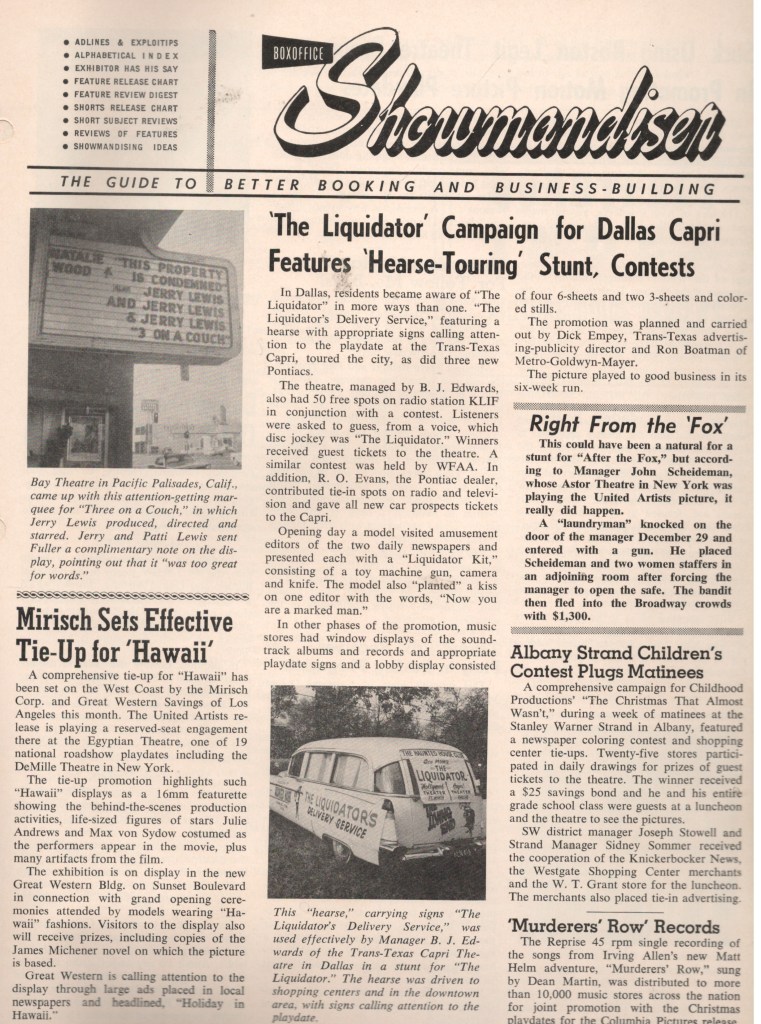
If you’re not Alfred Hitchcock with carte blanche to scare the pants off the audiences every which way but loose and you’re not launching a B-movie sexploitation drama, then you’ve got to take a more sensible path to selling a picture headlined by the world’s greatest hero Gregory Peck elevated to such a position by the extraordinary success of The Guns of Navarone (1961) which topped the annual box rankings in the USA.

So while your taglines can emphasize “shock and suspense” what you’re selling cinema managers is quality. So, in the Pressbook/Marketing Manual, Peck is portrayed as a “celluloid perfectionist” and “four-time Oscar nominee” so multi-talented he’s a triple hyphenate – writer, producer, actor. Such a perfectionist he’s known “to spend a week or more preparing for one small scene.”

He is a class act not some sleazy B-movie bum. “He not only completely absorbed all the dialog, its various nuances and shadings, but also probed the psychological and physiological motivations of the attorney he portrays,” notes the Pressbook.

And it’s not just Peck who’s to be praised. “Seldom has such an outstanding array of talent been so tellingly marshaled for such a dramatic thunderbolt.”

The messianic tone is evident throughout. Headlines claim “Bob Mitchum’s career reaches a new high,” Lori Martin has the “top role” of her career, Barrie Chase is “praised as top talent discovery” and “Telly Savalas termed top talent find by Peck.”

Polly Bergen “emerges as an actress of great sensitivity and insight.” Lori Singer, in her movie debut, “graphically attests to the polish she has achieved through her work as child lead in the video (television) series National Velvet.” Although Martin had another reason for turning up word perfect – so that she could get off early and go ice skating.

And the praise doesn’t stop there. “A whole new career should open for sultry Barrie Chase, one-time dancing partner of Fred Astaire.” She is “sensationally good as the casual pick-up ensnared by Mitchum.” The talent pickers had no doubt she was “destined to become one of the foremost dramatic talents of the industry. The very quality which made her such an outstanding dancer – her tireless attention to even the minutest detail – has helped turn her into a magnificent actress.” The marketeers were convinced her “masterpiece” performance would result in an Oscar nomination.

Peck had appointed himself the “tub-thumper” for Savalas after seeing him play Al Capone” in the television series The Witness (1960-1961) calling him “one of the finest new talents of the last 10 years.”

According to the Pressbook, director J. Lee Thompson “deliberately imparted…a distinctively British touch.” Claimed Thompson, “There emerges in the best of the British pictures a certain warmth and credibility which are looked upon as the English hallmark. Such an impression is achieved, it seems to me, through the simple technique of emphasizing character development.”

For journalistic snippets there’s not much beyond that Peck was so impressed with the location in Georgia that he purchased a plot of land on Sea Island to build a beach house. Plus that he’s turned into a noted photographer, now onto his seventh camera with a fast lens. Polly Bergen was creating a nightclub act. Robert Mitchum was thrown three times on his first film horse.

But it was unlikely that cinema managers would find a way of passing on to audiences the idea that this was a “quality sleaze” picture populated by proven and up-and-coming talent. The public had to make do with posters and taglines to get a feel for what was on offer. And in that respect the marketeers pulled few punches.

As usual, cinema managers were offered a plethora of choice when it came to the posters. Mostly, Peck and Mitchum were shown on opposite sides of the poster with in between an image intended to conjure up menace – the bare-chested Mitchum confronting Bergen, Bergen comforting her daughter, mother and daughter running, Mitchum tangling with the daughter.

Taglines spelled it out in a variety of ways: “A terrifying war of nerves unparalleled in suspense!” with a sub-tag of “A man savagely dedicated to committing a crime shocking beyond belief! A man desperately determined to end his ordeal of terror…even if it meant using the ultimate weapon – murder!”

Exclamation marks were in full flow. “Now, he had only one weapon left – murder…to prevent an even more shocking crime” was backed up by “the drama of an unrelenting war of nerves…and the helpless lives that were caught in its terrifying crossfire!”

Or try this – “The savagely suspenseful story of an unspeakable crime…and the man, the woman, the helpless people it touched with terror. From the moment they meet the tension is explosive. An electrifying war of nerves unrelenting in suspense!”

In case you didn’t get the message, here it is in more subtle form: “What happens to them in an adventure in the unusual!” That understatement is followed up with “So daring in theme…so frank in treatment…that it frightens while it fascinates and gives a terrifying new meaning in suspense!”

And there were variations of the above: “A terrifying war of nerves unparalleled in suspense! The Watched…who can only run so far before coming face-to-face with The Watcher…who waits for the moment when the woman and her daughter will be alone.”

And – “Now the nightmare was about to become a terrifying reality… the whispered threat a crime unspeakable. So daring in theme…so frank in treatment. What happens to them is an adventure in the unusual!”

Plus – “Their ordeal of terror triggers the screen’s most savage war of nerves! Unparalleled suspense…as one becomes a target for nightmare, the other becomes his target for execution.”

Unusually, there were a host of promotional items. As well as a motion picture paperback edition from Fawcett, “hot off the press” was the Prentice-Hall hardback The Polly Bergen Book of Beauty, Fashion and Charm, including stills from Cape Fear. Books were a major source for marketing, given there were over 100,000 outlets in specialist shops, drug stores, railway and bus terminals and carousels on newspaper stands.

Virtually any homely element of the movie was co-opted for promotional purposes. A scene taking place at a United Air Lines terminal counter provided opportunity for tie-ins with travel agents and ticket offices. Bowling “palaces” might be happy to display posters and promotional material given there’s a scene set in a bowling alley. Distributors of a Chris Craft boats, Chrysler station wagons, Larson speed boats and Scott outboard motors – which all appear in the movie – could be targeted.

Behind the Scenes: “Cape Fear” (1962)

Like many an ambitious – not to say greedy – actor, Gregory Peck had decided to go into the production business. In theory, there were two good reasons for this: actors could take control of their careers and they could make vanity projects. In reality, there were other over-riding reasons: after years in the business they thought they knew better than their Hollywood bosses and, more importantly, with a bigger stake in a picture they thought they could make more money. First of all came the tax advantages. As a producer, they could spread income over a number of years rather than just one. And they could take advantage of a loophole in the tax laws by making movies abroad. And then if all went as well as the actor imagined, they would get a bigger share of the spoils. If it proved a flop, then the studio carried the can and the actor walked off scot-free.

In 1956 Peck set up Melville Productions with screenwriter Sy Bartlett, with whom he had worked on Twelve O’Clock High (1950). They signed a two-picture deal with United Artists, the go-to studio for actors wanting to become producers. The first projected ideas fell by the wayside, Affair of Honor based on a Broadway play that subsequently flopped and Thieves Market – with William Wyler on board as director – whose commissioned script didn’t meet Peck’s standards. Also on the agenda was Winged Horse with a script by Bartlett and James R. Webb.

Instead, Peck set up The Big Country (1958) through another production shingle, Anthony Productions, and co-produced it with director William Wyler’s outfit, World Wide Productions. The budget rocketed from $2.5 million to $4.1 million, which limited the potential for profit.

Melville Productions launched with Korean War picture Pork Chop Hill (1959). When that flopped it was the end of the UA deal. Peck moved his shingle to Universal. The production company lay dormant while Peck returned to actor-for-hire for Beloved Infidel (1959) and On the Beach (1959), both flops, before jumping back into the top league with the biggest hit of his career The Guns of Navarone (1961) directed by J. Lee Thompson.

Melville Productions was resuscitated for Cape Fear. Peck and Barlett had purchased in 1958 a piece of pulp fiction (novels that bypassed hardback publication and went straight into paperback) by John D. MacDonald called The Executioners. Bartlett passed on screenwriting duties which were handed to James R. Webb (How the West Was Won, 1962).   

Director and star had bonded on The Guns of Navarone. “We were working so well together,” recalled Thompson that when Peck handed him the script of Cape Fear he was intrigued. “I liked the book very much,” said Thompson. “Greg had a script prepared, we signed the contracts, and I came to make my first picture in Hollywood.” (The Guns of Navarone had been filmed in Greece and London).

Though author John D. MacDonald had written a hard-boiled thriller with a merciless killer, screenwriter James R. Webb (Pork Chop Hill) racked up the tension and added a thicker layer of predatory sexuality in the vein of Psycho (1960). The final touch was a Bernard Hermann (Psycho) score brimming with menace.

Ernest Borgnine (Go Naked in the World, 1961) was first choice to play psychopathic killer Max Cady. Rod Steiger (The Pawnbroker, 1964), Jack Palance (Once a Thief, 1965) and Telly Savalas (Birdman of Alcatraz, 1962) were also considered.  “We actually tested Savalas and he gave a very good test for the part,” explained Thompson. “But these were character actors or at least secondary actors compared to Greg. At some point discussing it together we began to talk about having the villain played by an actor of equal importance, making it a much stronger match-up from the audience’s point of view and (Robert) Mitchum immediately came to mind.” 

But  Mitchum had essayed a similar venal character in Night of the Hunter (1955) and didn’t want to repeat himself. However, he liked the way the tale showed just how corrupt law enforcement could be and how easily the cards were stacked. Mitchum understood the character from the outset. “The whole thing with Cady is that snakelike charm. Me, Officer, I never laid a hand on the girl, you must be mistaken.”

“When we heard Mitchum’s thoughts,” noted Thompson, “we were more convinced than ever he would be terrific for the role. And I think by the end of the meeting he now realized that himself.” But he still held back, unsure. The producers sent him a case of bourbon. He drank the bourbon and signed up. There was the additional inducement of sharing in the profits by being made a co-producer which involved nothing more taxing than signing on the dotted line. Universal took it on as the first in two-picture deal with Melville.

Mitchum’s career was following its usual up-and-down course, a couple of flops always seemed to be followed by a big hit. His acclaimed performance in Fred Zinnemann’s The Sundowners (1960) had offset The Night Fighters / A Terrible Beauty (1960) and Home from the Hill (1960). His latest picture, The Last Time I Saw Archie (1961) was filed in the negative column.

Peck and Mitchum had opposite approaches to their profession, the former diligent and serious, the latter not able to get off a set quickly enough, not even bothering to learn his lines because thanks to a photographic memory he could scan his lines just before a scene began and be word perfect.

Locations were scouted in the Carolinas where MacDonald had set the book, but failing to find  anything suitable exteriors were switched to Savannah in Georgia. Where Peck rented a house and went home every night, Mitchum took a room in the DeSoto Hotel and when work was finished for the day went out drinking, an assistant director taken along as ballast to keep him out of trouble. The town held bad memories for Mitchum. Last time he had visited he had been arrested for vagrancy and did a stint on a chain gang, which recollection possibly put steely bitterness in his portrayal of the ex-convict. Although he hated the town, he liked the idea that on his return everyone was kowtowing to the big movie star, including a bevy of hairdressers in town for a convention.

Fortunately, the Savanah sojourn was short, bad weather getting in the way, barely two weeks before the unit repaired to Hollywood (some of the boat scenes were filmed around Ventura but  the climactic fight took place on the studio lake) where the production overshot its schedule by a month, wrapping on July 5 instead of June 8, and racking up $2.6 million in costs.

Mitchum appeared determined to demonstrate quite how different their approaches were. In one scene, off camera, Mitchum stripped naked to get a reaction from the stolid co-star, who remained immune to such provocation. In reality, Mitchum was very professional. “He would work perfectly,” said Thompson. “He just goes in and does it. He was superb.”

Though far from a Method Actor, Mitchum was chillingly close to the part. “I live character and this character drinks and rapes,” he confessed. During the scenes of violence he worked himself up. “He made people frightened,” acknowledged Thompson.

And that included Peck, especially during the slugfest in the water which took nearly a week of a night shoot to complete. Despite warmers being put in the water, it was freezing. “Sometimes, Mitchum overstepped the line,” said Thompson. “He was meant to be drowning Greg and he really took it to the limit…but Peck never complained.”

The final scene filmed was the rape of Polly Bergen playing Peck’s wife. Bare-chested and sweating, Mitchum built himself up into a fury. “You felt any moment he would explode,” said Thompson. “But there was no rehearsal, so nobody really knew what to expect. Thompson improvised the business with the eggs. But Mitchum was more brutal with the eggs than could ever be shown in a cinema, smearing the yolk over Bergen’s breasts. He cut his arm flailing wildly and he used the actress to break open the cabin door, so she finished the scene with the front of her dress sodden with egg yolk and the back covered in blood.”

While Peck expressed confidence in director J. Lee Thompson and could count on Mitchum’s experience to see him through, female lead Polly Bergen was making her first film in eight years, after a small part in western Escape from Fort Bravo (1953) starring William Holden. She had come to wider attention for winning an Emmy for The Helen Morgan Story (1958).

“Greg spent an enormous amount of time with me,” said a nervous Bergen, “He was wonderful and he was very, very supportive.” She added, “I wouldn’t have let anyone know how insecure and frightened I was. But he, I think, knew that instinctively and was there to set me at ease and be helpful and nurturing.”

Peck had no worries about Thompson, the situation helped by the director appearing to take the line the producer-star wanted. When it came to editing, Peck played fair with Mitchum, resisting the temptation to tone down his co-star’s performance which threatened to overshadow his own.

The censors were livid. They eliminated all mention of the word “rape”, removed most of Mitchum’s ogling of Peck’s daughter and cut to the bone the sexual assault.

While critics tended to agree that Mitchum stole the show, the movie was mauled by the New York Herald-Tribune as a “masochistic exercise” and the New Yorker took Peck to task for becoming involved in “an exercise in sadism.”

Initially, it appeared to be doing well enough. There was a “big” $37,000 in New York, a “giant” $29,000 in Chicago, a “fancy” $14,000 in Cleveland, a “rousing” $18,000 in San Francisco and a “proud” $14,000 in Boston. But the “expectancy of lush performance” did not materialize. Final tally was $1.6 million in rentals, a poor 47th in the annual box office rankings, so there were no profits for Peck or Mitchum to share.

The British censor demanded five minutes of cuts. Thompson made headlines by claiming that 161 individual cuts, a record, had destroyed the film but censor John Trevelyan argued it was just 15. Despite claiming the movie would not be shelved until the controversy had died down, in fact it lost its May 1962 premiere slot at the Odeon Leicester Square in London’s West End  and was held back until the following January when it opened at the less prestigious Odeon Marble Arch, setting a record for a Universal release. Bergen was furious at the cuts in her role. “I really blasted British censorship.”

Ironically, Peck made more money from selling the rights to Martin Scorsese for the 1991 remake, in which he had a small part, and whether it’s the Peck estate or Scorsese who benefits there’s a 10-part mini-series on the way starring Patrick Wilson (The Conjuring: Last Rites, 2025) as the attorney, Amy Adams (Nightbitch, 2024) as his wife and Javier Bardem (Dune, Part Two, 2024) as their tormentor.

SOURCES: Gary Fishgall, Gregory Peck, A Biography (Scribner, 2002) pp197-198, 208, 225-228; Lee Server, Robert Mitchum, Baby, I Don’t Care (Faber & Faber, 2001) p43-437; “Peck-Bartlett Spanish Pic Halts,” Variety, February 13, 1957, p2; “U Gets Melville Pair,” Variety, July 29, 1959, p18; “U Repacts Bartlett,” Variety, September 28, 1960, p4; “Director of Cape Fear Claims British Censor Demands Too Many Cuts,” Variety, May 9, 1962, p26; “Censor Replies to J. Lee Thompson,” Kine Weekly, June 28, 1962, p6; “Classification-Plus-Mutilation,” Variety, December 19, 1962, p5; “Your Films,” Kine Weekly, February 7, 1963, p14. Box Office figures: Variety April-May 1962 and “Big Rental Pictures of 1962,” Variety, January 9, p13,

Behind the Scenes: Reissue Juice

The big news in a slack weekend at the box office is that the re-release of The Lord of the Rings trilogy – each film showing for just one day over Jan 16-Jan 18 – has taken $5 million in advance sales. Sure, the fanboys have been putting down their dollars as you might expect in appreciation of their favorite fantasy threesome, but it’s pretty certain that the trio will put in a far better showing by the end of the weekend. Old films are in the renewal business once again, with revenues showing a steady increase over the past five years and then a remarkable jump from 2024 to 2025.

But there’s nothing new in putting old movies back to work. They’ve been chucking old films back into the distribution pot since 1914 – at least according to the whopper of a book (now recognized as the authority on the subject) I wrote a decade ago about the history of the Hollywood reissue. After World War One, old films had struck box office gold during periods of marked low production such as post-WW2, the 1970s, and currently; and on the back of the Director’s Cut; or reinvention through a premium vehicle such as IMAX.

Theoretically, reissues should be dead in the water. Fans of any major or cult motion picture are most likely to own a DVD or can catch it easily enough for free on a streaming outlet without paying big bucks to watch it on the big screen. But reissue has also been reinvented on the back of an anniversary and through restriction. Used to be, an old movie would be thrown into the distribution maw in the same way as any other movie, running for any multiple of one week at your local multiplex. But then some smartass decided that restricting opportunity would increase demand. “For One Day Only” became a marketing tool, except in rare instances. Anniversaries – the dates shown below are the giveaway –  remain the most common reason for oldies seeing the light of day, but occasionally it’s to cash in on a forthcoming addition to a long-running series.

You might be surprised to learn that the reissue is actually booming in terms of box office. Last year’s overall take of $138.8 million was more than double the previous year’s $58.4 million which was just ahead of the 2023 tally of $56.4 million. And that was also up on the 2022 total of $46.4 million which was light years behind the 2021 figure of $115 million. So in the space of a few years, reissue receipts have remained constant and you can see why cinemas, faced with such low box office figures for Oscar-bait, are turning to oldies.

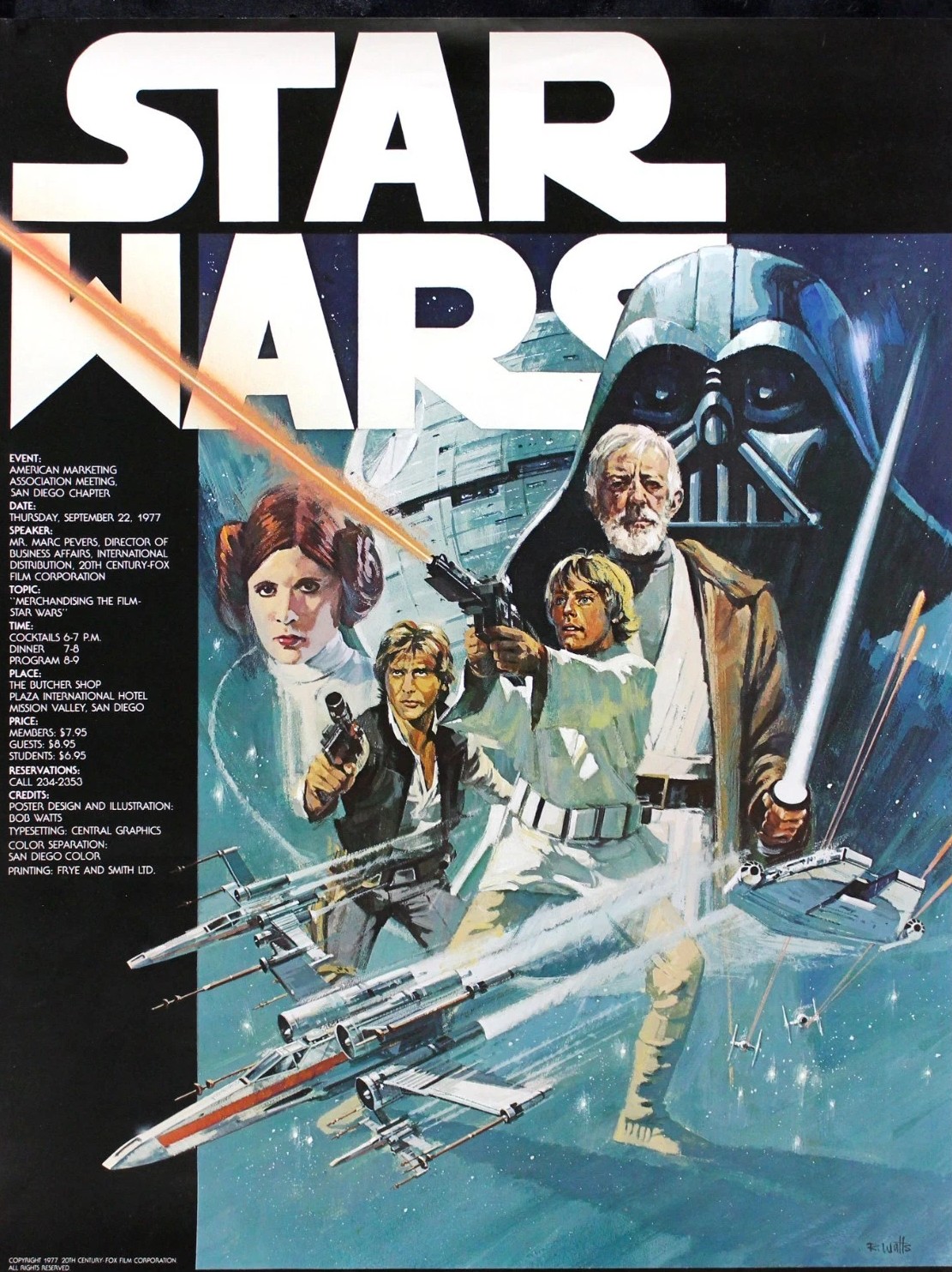
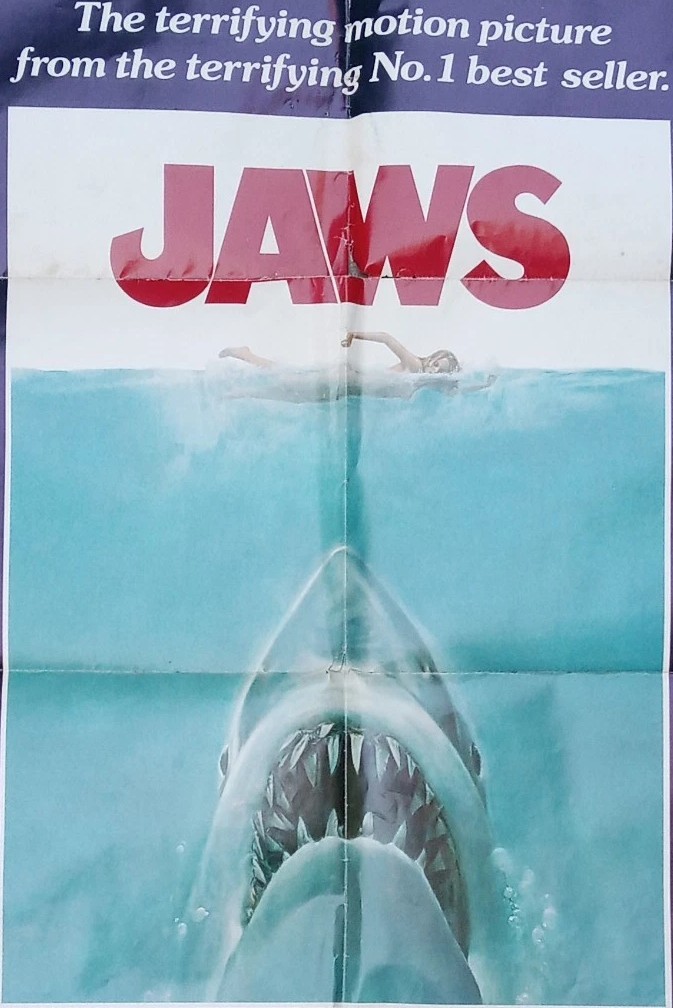
The biggest hit in 2025 was Star Wars Episode III: Revenge of the Sith (2005) on $34 million followed by The Twilight Saga: Breaking Dawn – Part 2 (2012) with $19.9 million and The Twilight Saga: Breaking Dawn – Part 1 (2011) on $19.7 million. Jaws (1975) came next biting off $16.1 million then James Cameron sequel Avatar: The Way of Water (2022) on  $13.8 million, Back to the Future (1985) on $13.1 million, Pixar’s Toy Story (1995) on $11.4 million and Japanese animated classic Princess Mononoke (1997) on $10.8 million.

In 2024 Christopher Nolan’s Interstellar (2014) led the way with $15.2 million, chased by Star Wars: Episode 1 – The Phantom Menace (1999) on $13 million, Tim Burton’s The Nightmare Before Xmas (1993) with $6 million, Columbia’s 100th anniversary bunch on $6 million and animated sequel Shrek 2 (2004) on $3.4 million. The Lord of the Rings trilogy knocked up $8.1 million, cumulatively, Howl’s Moving Castle (2004) was on $2.3 million, Ridley Scott’s unsurpassed space horror Alien (1979) on $2.3 million and Disney’s The Lion King (1994) drumming up $2.1 million.

The top re-release in 2023 was another James Cameron epic Titanic (1997) with $15 million followed by The Nightmare before Xmas clocking up $10.2 million and Star Wars: Episode VI – Return of the Jedi (1983) with $7.2 million. Henry Selick’s adaptation of the Neil Gaiman dark fantasy novel Coraline (2009) dished up $7.1 million,  Bette Midler bewitchment Hocus Pocus (1993) spelled out $4.9 million, Talking Heads live performance film Stop Making Sense (1983) nabbed $4.8 million, Steven Spielberg’s SFX-driven Jurassic Park (1993) chewed up $2.9 million, Bruce Willis in Die Hard (1988) clobbered $2 million, Coen Brothers cult favorite The Big Lebowski (1988) bowled $1.2 million and The Lord of the Rings: Return of the King (2003) netted $1.1 million.

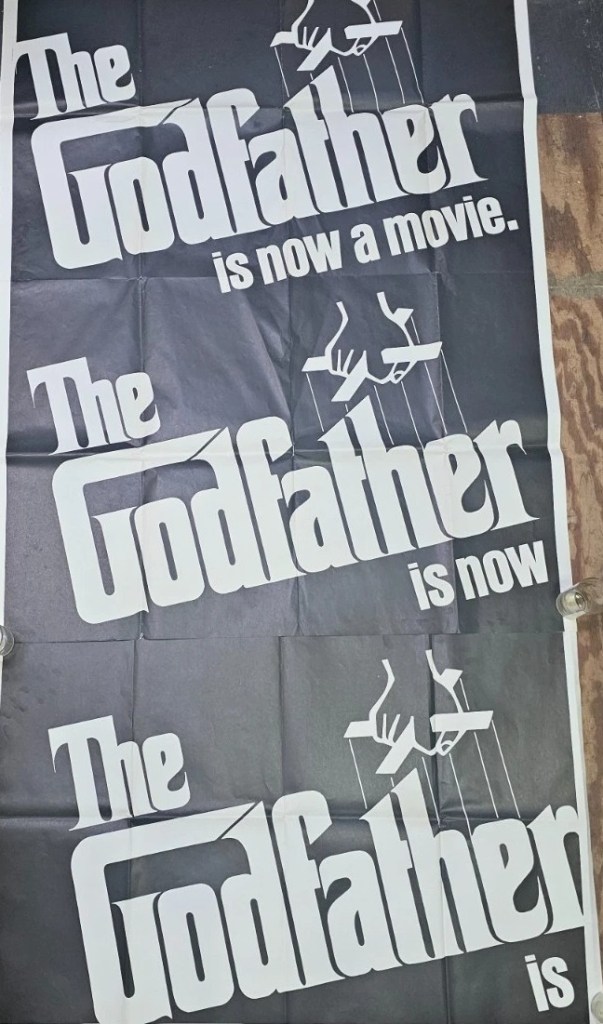
In 2022 James Cameron again came out on top with Avatar (2009) heading the list on $24.7 million, followed by Jaws – minus any anniversary hullabaloo – on $5.1 million, another Spielberg E.T. – the Extra Terrestrial (1982) on $2 million, perennial revival  It’s A Wonderful Life (1946) with $1.4 million, Francis Ford Coppola gangster classic The Godfather (1972) on $1.4 million, Rogue One: A Star Wars Story (2016) on  $1.3 million and Howl’s Moving Castle $1.2 million.

Avatar again led the way in 2021 with $57.9 million followed by John Carney romance Begin Again (2013) with $21.3 million, Harry Potter and the Philosopher’s Stone (2021) on $15.8 million, The Lord of the Rings: The Fellowship of the Ring (2001) with $8.9 million and Japanese classic Love Letter (1995) on $7.4 million.

Most of these are reissues are already reissues, the various Star Wars episodes going through a reissue mill over the decades, the Disney cartoons receiving a reissue hoopla when they went out on 3D or Imax. The Lord of the Rings trilogy in an “Extended Edition” should set the target to be matched for this year.

SOURCES: Box Office Mojo “Worldwide Top 200” annual charts; Brian Hannan, Coming Back to a Theater Near You, A History of Hollywood Reissues, 1914-2014 (McFarland, 2016)

Behind the Scenes: “Ship of Fools” (1965)

Stanley Kramer was on a roll, It’s A Mad, Mad, Mad, Mad World – an outlier in his portfolio of serious pictures – his biggest-ever hit. Although United Artists, where the director had made his last four pictures, was initially in the frame for Katharine Anne Porter’s 1962 best seller Ship of Fools, the project ended up at Columbia which Kramer had last partnered on The Caine Mutiny in 1951. While the asking price was $450,000 plus a percentage, Kramer secured the rights for $375,000 although he chipped in $25,000 towards the book’s advertising campaign.

Kramer envisioned a character-driven film that would make up for the lack of action. He shifted the timescale to 1933 from 1931 to bring greater overtones of the Hitler threat. “Although we never mention him in the picture,” said Kramer, “his ascendancy is an ever-present factor.” Since there were no seagoing liners available to take over, the movie was shot entirely on the soundstage. “We filmed a ship’s ocean voyage without a ship and without an ocean.” He ransacked old footage for establishing shots of the ship, usually seen in the distance. Decks, staterooms and dining areas were constructed in the studio.

The kind of muted color he would have preferred was not available and since “the theme was just too foreboding for full color” he decided to film in black and white. Shooting in black and white wasn’t yet redundant. Of 27 features going in front of the cameras in 1964, six (including The Disorderly Orderly and Hush, Hush, Sweet Charlotte) were made in monochrome –  down from ten out of 24 the year before.

A thoughtful epic was always going to have trouble finding stars especially as current wisdom was that the industry only had at its disposal 22 genuine box office stars “thinly sprinkled” through the 43 pictures currently in production. While the movie’s marketeers boasted of an all-star cast, the reality was that while overall the actors had “combined heft” they were “minus any individual box office behemoth.”

Spencer Tracy, whom Kramer initially envisioned for the role of the ship’s doctor and who had starred in the director’s last three pictures, would have added definite marquee allure, but he was unavailable due to illness. Greer Garson and Jane Fonda also fell by the wayside.

And unusually, Kramer insisted that many of those actors were not American. Vivien Leigh was born in India, Simone Signoret – who had just quit Zorba the Greek (1964) – was German and Oskar Werner Austrian. Jose Ferrer (who had won the Oscar in Kramer’s production of Cyrano de Bergerac, 1950) hailed from Puerto Rico, Jose Greco from Italy, Charles Korvin from Hungary, Lila Skalia from Austria and Alf Kjellin from Sweden. Signoret and Skala had Jewish ancestry.

His biggest casting coup was luring double Oscar-winner Vivien Leigh (The Roman Spring of Mrs Stone, 1961) out of retirement. But that was a double-edged sword. In real-life she led a tortured existence. Her marriage to Laurence Olivier was over and she had only appeared in two films since A Streetcar Named Desire (1951). She suffered from mental illness and tuberculosis. “Happiness or even contentment” eluded her and in that respect she was ideal for the role. “I’m sure she realized that, in the picture, she was playing something like her own life yet she never, by word of gesture, betrayed any such recognition.” She was another gamble, the reason her dance card was so empty down to directors despairing of getting a performance out of her.

Kramer flew to Germany to persuade Oskar Werner to take on the role intended for Spencer Tracy. At the time Werner, while familiar to European audiences and the American arthouse set through Jules and Jim (1962),was a relative unknown and a casting gamble. On set he proved obstinate. For one scene where he was instructed to enter camera right he did the opposite. When the direction was repeated, he stood his ground, insisting he preferred that view of his face. Despite the cost of reversing the set-up Kramer was forced to concede. Despite these trials, Kramer got along with Werner better than the actors. “They just couldn’t stand him.”  Notwithstanding such difficulties Kramer later signed him for another film, but the actor died before shooting began.

James MacArthur (The Truth about Spring, 1964) was mooted for a role as was Sabine Sun (The Sicilian Clan, 1969). The most unlikely prospect was German comedian Heinz Ruhmann who was cast as Lowenthal. The Screen Actors Guild complained when Kramer hired five Spaniards instead of Americans for bit parts paying union scale of $350 a week, but their complaints were ignored.

Kramer admitted the ingénue roles played by George Segal (The Bridge at Remagen, 1968) and Elizabeth Ashley (The Third Day, 1965) were too much of a cliché. “As in most pictures,” observed Kramer, “older actors not only had more stature but they were also better armed by the writers. There was no way Segal and Ashley could compete with Werner and Signoret.”

The film cost $3.9 million. Filming began on June 22, 1964. It was initially a long shot for roadshow release but since Columbia was already committed to the more expensive Lord Jim and there were already 15 others lined up from other studios, Columbia nixed the two-a-day release in favour of continuous program.

Boosted by book sales – it was the number one hardback bestseller of 1962 and had sold millions in paperback – the movie carved out a more commercial niche than had been anticipated. Positive reviews helped. It opened to a “mighty” $88,000 in New York breaking records at the 1,003-seat Victoria and the 561-seat Sutton arthouse.

There was a “socko” $25,000 in Chicago, “giant” $23,000 in Philadelphia, “sock” $14,000 in Baltimore, “strong” $13,000 in St Louis, “lively” $12,000 in Detroit, “stout” 12,000 in San Francisco, “sturdy” $11,000 in Pittsburgh, and “slick” $10,000 in Columbus, Ohio. The only first run location where it toiled was Denver where it merited a merely “okay” opening of $8,000.

There was a sense of Columbia letting it run as long as possible in first run in the hope of garnering Oscars to boost its subsequent runs. But the studio was the beneficiary three times over from the Oscars – with Cat Ballou, Ship of Fools and William Wyler’s The Collector in contention for various awards.

The studio had the clever idea of pairing Ship of Fools in reissue with Cat Ballou, for which Marvin had won the Oscar, and although not the star of Ship of Fools the teaming suggested it was a Marvin double bill. In Los Angeles the double bill hoisted $135,000 from 21 houses followed by $121,000 from 28. But in Cleveland Ship of Fools went out first with The Collector and then Cat Ballou. A mix-and-match strategy also saw Ship of Fools double up with, variously, A Patch of Blue, Darling and The Pawnbroker.

The final tally was difficult to compute. In its 1965 end-of-year rankings Variety reckoned it had only pulled in $900,000 in rentals but it was good for $3.5 million in the longer term, a realistic target once you counted in the $1.3 million in rentals generated by the combination with Cat Ballou.

SOURCES:  Stanley Kramer with Thomas F. Coffey, It’s A Mad, Mad, Mad, Mad World, A Life in Hollywood (Aurum Press, 1997) pp203-212; “New York Sound Track,” Variety, May 2, 1962, p4; “375G for Fools Novel,” Variety, May 2, 1962, p5; “Publisher’s Big Break,” Variety, May 23, 1962, p4; “Kramer to Produce Ship of Fools for Columbia,” Box Office, June 18, 1962, p9; “Abby Mann to Script Ship of Fools,” Box Office, November 1962, pSE4; “Top German Comic,” Variety, April 15, 1964, p23; “Simone Signoret Exits Zorba,” Variety, April 22, 1964, p11; “Control of Space,” Variety, May 6, 1964, p4; “Five Spaniards on Ship of Fools Irks SAG,” Variety, June 3, 1964, p5;“To Speed MacArthur for Ship of Fools,” Variety, June 10, 1964, p17; “27 Features Shoot in Color, Only Six in Monochrome,” Variety, August 5, 1964, p3; “Perennial Quiz,” Variety, September 2, 1964, p1; “15, Maybe 17, Pix for Roadshowing,” Variety, October 28, 1964, p22; “Too Many Roadshows,” Variety, August 2, 1965, p5. Box office figures, Variety September-November 1965, “Big Rental Pictures of 1965,” Variety, January5, 1966, p6.

Behind the Scenes: All Time Top 30

Since I’ve expanded the All-Time Top Movies to 100 it seems only fair to enlarge the Behind the Scenes section. So this is now a Top 30. The rankings here relate to this time last year.

Includes three Alistair MacLean adaptations. John Wayne and Gregory Peck feature three times and Kirk douglas, Dean Martin, James Stewart, Steve McQueen and Omar sharif twice each. Andrew V. McLaglen leads the directorial charge with three mentions.

  1. (1)Waterloo (1970). No doubting the effect of Ridley Scott’s Napoleon in increasing interest in this famous flop that had Rod Steiger’s French emperor squaring off against Christopher Plummer.
  2. (3) In Harm’s Way (1965). Otto Preminger takes off the gloves to expose problems in the American military around Pearl Harbor. John Wayne and Kirk douglas head an all-star cat.
  3. (2)Man’s Favorite Sport (1964). Howard Hawks back in the gender wars with Rock Hudson being taken down a peg by Paula Prentiss.
  4. (4) The Guns of Navarone (1961). Alistair MacLean created the template for the men-on-a-mission war picture. Gregory Peck, David Niven and Anthony Quinn topline. Nominated for five Oscars including Best Picture, Best Director (J. Lee Thompson) and Screenplay (Carl Foreman) and enough jeopardy throughout the filming to qualify for a movie of its own.
  5. (7) The Satan Bug (1965). The problems facing director John Sturges in adapting the Alistair MacLean pandemic classic for the big screen.
  6. (6) Battle of the Bulge (1965). There were going to be two versions, so the race was on to get this one to the public first. A Cinerama number.
  7. (5) Ice Station Zebra (1968). A complete cast overhaul and ground-breaking  special effects are at the core of this filming of another Alistair MacLean tale. Second Alistair MacLean outing for John Sturges.
  8. (New Entry) Barbarella (1968). Jane Fonda was fourth choice after Brigitte Bardot, Sophia Loren and Ira von Furstenberg. Should never have been directed by Roger Vadim who was out of favor with Paramount. One of the first movies to be given a global simultaneous release.
  9. (8) Cast a Giant Shadow (1965). Producer Melville Shavelson wrote a book about his experiences and this and other material relating the arduous task of bringing the Kirk Douglas-starrer to the screen are told here.
  10. (12) Mackenna’s Gold (1969). Tortuous route to the screen for Carl Foreman-produced roadshow western, filmed in 70mm Cinerama, with an all-star cast including Omar Sharif, Gregory Peck and Telly Savalas.
  11. (9) The Girl on a Motorcycle / Naked under Leather (1968). Cult classic starring Marianne Faithful and Alain Delon had a rocky road to release, especially in the U.S. where the censor was not happy.
  12. (12) The Sons of Katie Elder (1965). First envisioned nearly a decade before, Henry Hathaway western finally hit the screen with John Wayne and Dean Martin.
  13. (11). Tora! Tora! Tora! (1970). Richard Fleischer dispenses with the all-star cast in favor of even-handed verisimilitude.
  14. (15) The Trouble with Angels (1966). Less than angelic Hayley Mills sparring with convent boss Rosalind Russell. Directed by one-time star Ida Lupino.
  15. (New Entry) The Misfits (1961). Robert Mitchum turned down the male lead. Clark Gable failed the medical, both Montgomery Clift and Marilyn Monroe had drug problems. It went 40 days over schedule and half a million over budget.
  16. (14) The Bridge at Remagen (1969). British director John Guillerman hits trouble filming World War Two picture starring George Segal and Robert Vaughn.
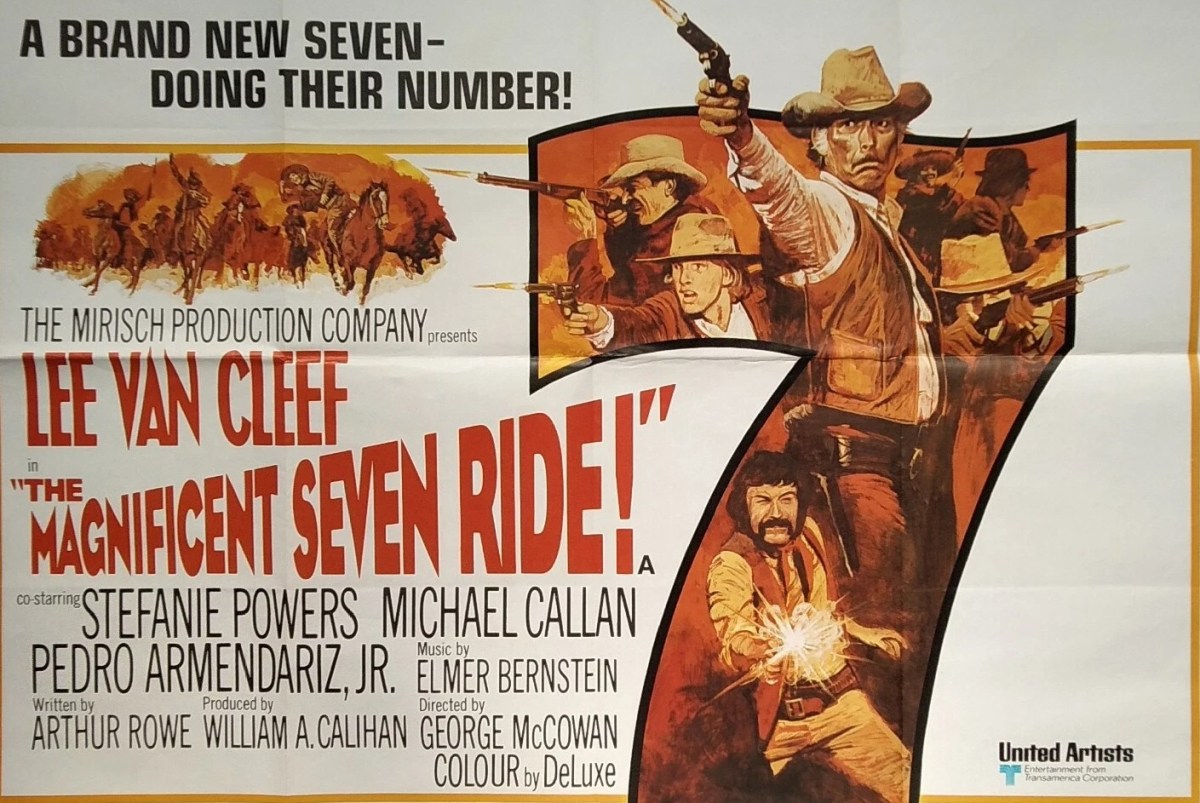
  17. (16) For a Few Dollars More (1965). Sergio Leone sequel to first spaghetti western brings in Lee van Cleef to pair with Clint Eastwood.
  18. (20) The Collector (1963). William Wyler’s creepy adaptation of John Fowles’ creepy bestseller with Terence Stamp and Samatha Eggar.
  19. (13) Sink the Bismarck! (1960). Documentary-style British World War Two classic with Kenneth More exhibiting the stiffest of stiff-upper-lips.
  20. (18) Bandolero! (1968). Director Andrew V. McLaglen teams up with James Stewart, Dean Martin and Raquel Welch to fight Mexican bandits.
  21. (19) The Train (1964). John Frankenheimer replaced Arthur Penn in the directorial chair to steer home unusual over-budget World War Two picture with Burt Lancaster trying to steal art treasures from under the nose of German Paul Schofield.
  22. (17) How The West Was Won (1962). First non-travelog Cinerama picture, all-star cast and all-star team of directors tackling multi-generational western and all sorts of logistical problems.
  23. (New entry) The Way West (1967). Burt Lancaster, James Stewart and Gary Cooper were the original cast. Charlton Heston turned it down. Robert Mitchum couldn’t make up his mind. Director Andrew V. McLaglen claimed it had been savaged by the studio.
  24. (New Entry) The Wicker Man (1973) at the Box Office. A flop on initial release, U.S. release delayed, it took a long long time before the movie achieved both cult status and came out of the red.
  25. (New Entry) The Stalking Moon (1968). Should never have been made, according to existing legislation, even with Gregory Peck’s participation long delayed in part due to original director George Stevens pulling out.
  26. (New Entry) “Barbieheimer” Recalls the Old Double Bill. The perfect double bill aimed to attract different segments of the audience.
  27. (New Entry) Judgement at Nuremberg (1961). Laurence Olivier was first choice to play the role taken by Burt Lancaster. United Artists was not at all keen on the proposition. Innovative use of the camera. Judy Garland and Montgomery Clift overcame personal problems while Marlene Dietrich was acquainted with one of men on trial.
  28. (New Entry) The Thomas Crown Affair (1968). Sean Connery, Jack Lemmon and Brigitte Bardot turned it down. Director Norman Jewison thought Steve McQueen “completely wrong” for the part.
  29. (New Entry) The Cincinnati Kid (1965). Sam Peckinpah was fired. Spencer Tracy quit. Sharon Tate declined.
  30. (New Entry) The Appointment (1969). Booed at the Cannes Film Festival. Denied a release in the U.S., even with Omar Sharif as star and after being heavily edited by MGM. Only shown on American TV. The biggest financial flop of Sidney Lumet’s career.

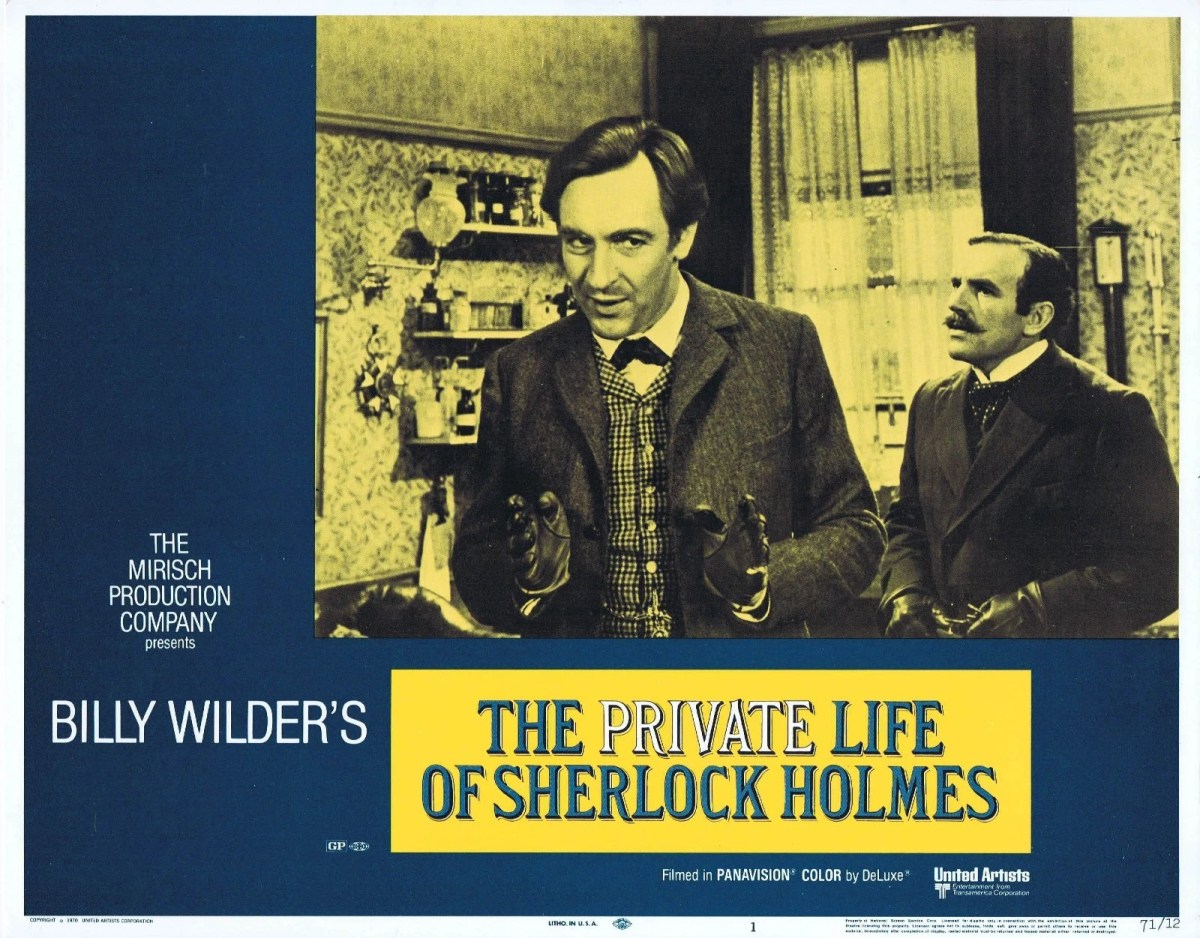
Behind the Scenes: Becoming a Producer, Part One – The Walter Mirisch Story

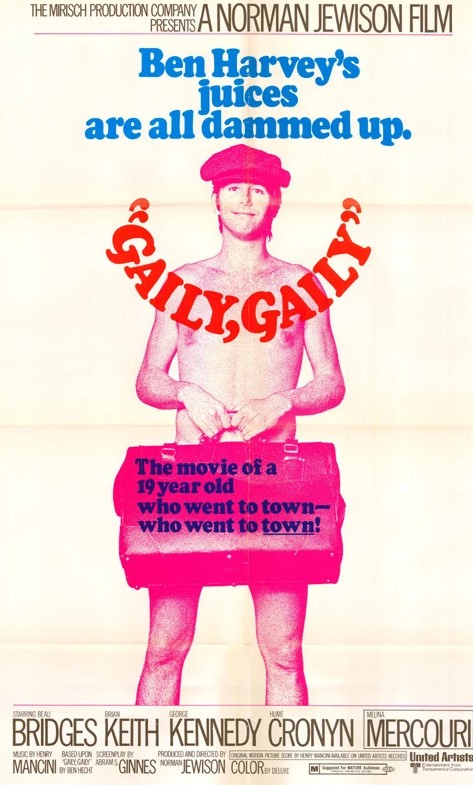
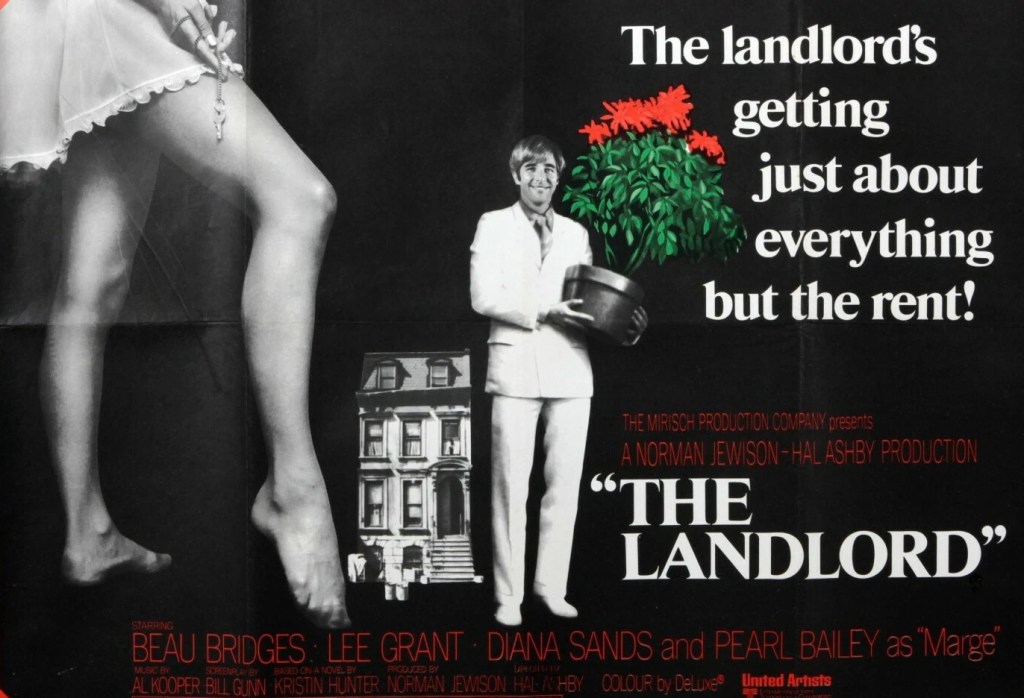
You don’t just waltz into Hollywood and start churning out classics like Some Like it Hot (1959), The Magnificent Seven (1960), West Side Story (1961) and The Great Escape (1963). Usually, there’s a long apprenticeship, especially for a producer. Walter Mirisch spent nearly a decade at the B-picture coalface. And before that  a year as a gofer, working his way up in the business, but on one of the smallest rungs of all, at Monogram.

Born in 1921, the of a Polish immigrant tailor specializing in custom-made garments, one of whose customers was George Skouras, owner of a cinema chain, Walter, not surprisingly in the Hollywood Golden Age, started out an even lower rung, as an usher in the State Theater in Jersey City, owned by Skouras, an hour’s commute from his home in the Bronx, earning 25 cents an hour. He was quickly promoted to ticket checker.

His older brother Harold was a film booker, receiving an education in negotiation, and then as a cinema manager in Milwaukee flexed his entrepreneurial muscles by starting a concession company. After the family moved to Milwaukee, Walter attended the University of  Wisconsin and then Harvard Business School. Physically unfit for active duty during the war, he worked for Lockheed in Los Angeles on its aircraft program in an administrative capacity.

While Harold was a highflyer at RKO, acting as chief buyer and then managing its cinema chain, Walter entered at a lower level in 1946 as a general assistant to Steve Broidy, boss of Monogram, maker of B-pictures of the series variety – Charlie Chan, The Bowery Boys, Joe Palooka, shot within eight days and at budgets under $100,000.

After badgering Broidy for a bigger opportunity, he was granted permission to hunt for a property he could produce. For $500 he found a Ring Lardner short story about a boxer, but Broidy felt the main character was unsympathetic. Stanley Kramer did not and snapped it up to make Champion (1949). 

Walter’s first ventures were in film noir. Fall Guy (1947), based on a story by Cornell Woolrich,  made for $83,000, broke even. I Wouldn’t Be In Your Shoes (1948) followed, from a Woolrich novel but there was a drawback to being a producer. He was taken off the payroll and his $2,500 producer’s fee didn’t compensate for the loss of a $75 weekly salary. The answer was to invent his own series, ripping off the Tarzan pictures for Bomba the Jungle Boy (1949), starring Johnny Sheffield who had played Tarzan’s son and utilizing stock footage from Africa Speaks. Apart from his fee, Walter had a 50 per cent profit share.

For six years, these appeared at the rate of two a year, earning Walter a minimum of $5,000 and he soon branched out into other genres, sci fi like Flight to Mars (1951) and westerns such as Cavalry Scout (1951) and Fort Osage (1951), both starring B-movie stalwart Rod Cameron.

Monogram had decided to move upmarket with the introduction in 1951 of Allied Artists, its sales division run by Walter’s brother Harold, with Walter acting as an executive producer and other brother Marvin as treasurer, turning out solid B-picture-plus hits like Riot in Cell Block 11 (1954).

When the threat from television hit the B-picture market Allied went properly upscale, investing in William Wyler western Friendly Persuasion (1956) and Billy Wilder’s Love in the Afternoon (1957), both starring Gary Cooper. Their failure at the box office sent  Monogram back to basics.

But the Mirisches wanted more of the big time. The three brothers turned to United Artists and negotiated a  deal for that studio to finance four pictures a year, cover the brothers’ overhead and salaries and throw in a profit share. The Mirisch Company was born and their creative credit within the industry was so high – and the deals they offered, it has to be said,  so advantageous to their creative partners – that soon they were scooping up big names like Wilder (he made his next eight pictures for Mirisch), William Wyler, Gary Cooper, Tony Curtis, Doris Day, Audrey Hepburn and Lana Turner. One of the first pictures announced was a remake of King Kong (1933). Wilder planned My Sister and I with Hepburn. John Sturges was attached to 633 Squadron. Doris Day would star in Roar Like A Dove and there were two-picture deals with Alan Ladd and Audie Murphy.

Their first two efforts didn’t break the budget bank, Fort Massacre (1958) starring Joel McCrea, and Man of the West (1958) headlined by Cooper, but neither were they hits. Hoping to provide ongoing financial sustenance, Walter turned to television, turning Wichita (1955) into the series Wichita Town (1959), and further television contributions were mooted for UA Playhouse but that and Peter Loves Mary and The Iron Horseman failed.

Movies proved a better bet and Walter struck gold with the third picture in the Mirisch-UA deal, Some Like it Hot (1959), costing $2.5 million, an enormous financial and critical success and tied down a triumvirate of top talent in John Wayne, William Holden and John Ford for western The Horse Soldiers (1959), the actors pulling down $750,000 apiece.

Such salaries sent the nascent company on a collision course with traditional Hollywood. The majors “screamed” that independents were overpaying the talent, hefty profit shares accompanying the salaries.

On top of that in 1959 in the space of two weeks Mirisch spent a record $600,000 pre-publication on James Michener blockbuster Hawaii and tied up a deal to film Broadway hit West Side Story. Within two years of setting up, Walter Mirisch announced a $34.5 million production slate, earning the company the tag of “mini-major,” as part of a shift in attitude to a “go for broke” policy. By the start of the new decade it was by far the biggest independent the industry had ever seen, handling $50 million worth of product, including The Magnificent Seven and The Apartment (1960). Average budgets had risen from $1.5 million to $3.5 million.

To outsiders, assuming the Mirisch venture was Walter’s first, it might look as if Walter had knocked the ball out of the park in a very short space of time, but, in reality, by the time he produced Some Like it Hot, he had been responsible for thirty-three pictures. Not bad for a “beginner.”

Explained Walter Mirisch, “Producing films is a chancy business. To produce a really fine film requires the confluence of a large number of elements, all combined in the exactly correct proportions. It’s very difficult and that’s why it happens so infrequently. It takes great attention to detail, the right instincts, the right combinations of talents and the heavens deciding to smile down on the enterprise. Timing is often critical.”

What would have happened to Allied Artists, for example, had Wilder made Some Like it Hot there instead of Love in the Afternoon?

Added Walter, “Where is the country’s or the world’s interest at that time? What is the audience looking for? Asking them won’t help because they themselves will tell you they don’t know what they’re looking for. They don’t know what it is until they’ve seen it. All the elements must come together at exactly the right time. So to say one embarks with great certainty on such an endeavor is an exaggeration.”

After 33 films Mirisch hit a home run with Some Like It Hot and continued to do so throughout the 1960s chalking up further critical and commercials hits like The Pink Panther (1964), In the Heat of the Night (1967) and The Thomas Crown Affair (1968) and vacuuming up a stack of Oscars.

SOURCES: Walter Mirisch, I Thought We Were Making Movies, Not History (University of Wisconsin, 2008); “Mirisch Freres Features Outlet Via United Artists,” Variety, August 7, 1957, p16; “3 Mirisch Bros Set Up Indie Co for 12 UA Films,” Variety, September 11, 1957, p7; “RKO vs Mirisch Kong,Variety, September 11, 1957, p7; Advertisement, “United Artists Welcomes The Mirisch Company,” Variety, November, 13, 1957, p13; “Brynner, Mirisch Pledge UA TV Tie,” Variety, January 1, 1958, p23; “Mirisch Freres 6 By Year-End,” Variety, March 19, 1958, p3; “Majors Originated Outrageous Wages,” Variety, December 10, 1958, p4; “UA-Mirisch’s  $600,000 For Michener’s Hawaii,Variety, August 26, 1959, p5; “Mirisch West Side Story,” Variety, September 2, 1959, p4; “Mirisch Takes on ‘Major’ Mantle With 2-Yr $34,500,000 Production Slate,” Variety, October 21, 1959, 21; “Mirisch Sets $50,000,000 14-Pic Slate; Biggest for Single Indie,” Variety, August 17, 1960, p7.

Behind the Scenes: Selling the New-Look Paul Newman – Pressbook for “The Hustler” (1961)

While Twentieth Century Fox head honcho Spyros Skouras initially balked at the title, with its connotations of prostitution, by the time the movie appeared that subject matter was less contentious thanks to critical and commercial big hitters Butterfield 8 (1960) and Never on Sunday (1960). Given that the idea of a movie set in a poolroom was going to be a hard sell to a female audience, despite the marquee lure of Paul Newman, the studio gave marketeers free rein to pitch it as a raw, sex-oriented drama.

There’s little sign of a pool cue in some of the artwork. Instead, we have Paul Newman lustily nuzzling Piper Laurie’s neck or bosom. The taglines promise something far removed from a sports picture.

“It probes the stranger…the pick up…the  savage realities,” screamed the main tagline. Another tempted with: “It delves without compromise into the inner loneliness and hunger that lie deep within us all!” In other words we’re talking about sex, not love, and casual sex at that, the world of the one-night stand between consenting adults for whom marriage is the last thing on their minds. “The word for Robert Rossen’s The Hustler is prim-i-tive” suggested out of control lust.

Fast Eddie Felson (Newman) has “the animal instinct.” Sarah (Piper Laurie) has a “bottle, two glasses and a man’s razor always in her room.” Bert (George C. Scott) is on the look-out for the “sucker to skin alive.”

Those images which did show a cue and pool balls did not suggest an august sport like football or baseball, not with a tagline like “he was a winner, he was a loser, he was a hustler.”

With such talented actors to hand, the Pressbook wasn’t short of good stories relating to the actual movie rather than the kind of snippets that might appeal to an editor on a slow news day. So we learn that Piper Laurie continually limped, Method-style, around on the set. “When I limp in the picture, I don’t want to act it. It’s something that has to be a part of me, something of which I am no longer conscious, apart from its being a physical defect. I must be able to limp as if I had a bad foot from birth.”

Laurie had made so few pictures that her name wouldn’t be on any director’s wanted list and what she was best known for – ingénue roles when a contract player for Universal (who gave out that she bathed in milk to keep her skin soft) opposite  the likes of Tony Curtis – wouldn’t have inspired confidence. Robert Rossen might well have spotted her in two Emmy-nominated performances in successive years including Days of Wine and Roses (1958), but instead said he remembered her for “a sensitive characterization” from a stage production of Rosemary.

Ames Billiards Academy had once been a Chinese restaurant so boasted a balcony. This was unseen in the picture but allowed director Robert Rossen to shoot from widely varied overhead angles. The crew took over the Manhattan Bus Terminal for a day and a night. A row of lunch booths was constructed in front of the existing lunch counter. “It looked so real,” we are told, “that passers-by sat down and waited for their orders to be taken.” A nice story, and the kind often furnished by Pressbook journos, but rather fanciful, since it would be obvious what with the crew milling around and the lights and cameras and miles of cable that this was a movie set with security posted to prevent trespassing.

Just how good a pool player was Jackie Gleason, who came to the picture with a reputation for handling a cue? Well, at one point, the affable television comedian with a top-rated show, potted 96 consecutive balls.

Paul Newman plays the iconic hero as a “figure cut from the fabric of our time.” He had a firm grasp of the character. “With him it’s a question of commitment. He is so wrapped up in his drive to win and be somebody that he has no time to give of himself that which others need. It is a disease of our time, both the ambition and the isolation. I want him to be understood.”

Needless to say there was no mention of author Walter Tevis. That wasn’t so unusual in the make-up of Pressbooks, but if the marketeers these days were looking for something to write about the eclectic Tevis would be prime. He followed up The Hustler, published in 1959, four years later with sci fi The Man Who Fell to Earth, filmed in 1976 with David Bowie. A sequel to The Hustler, The Color of Money, was directed in 1986 by Martin Scorsese with Newman reprising his role and managing Tom Cruise. Tevis also wrote The Queen’s Gambit, turned into an acclaimed television mini-series in 2020 with Anya Taylor-Joy.

Behind the Scenes: “The Hustler” (1961)

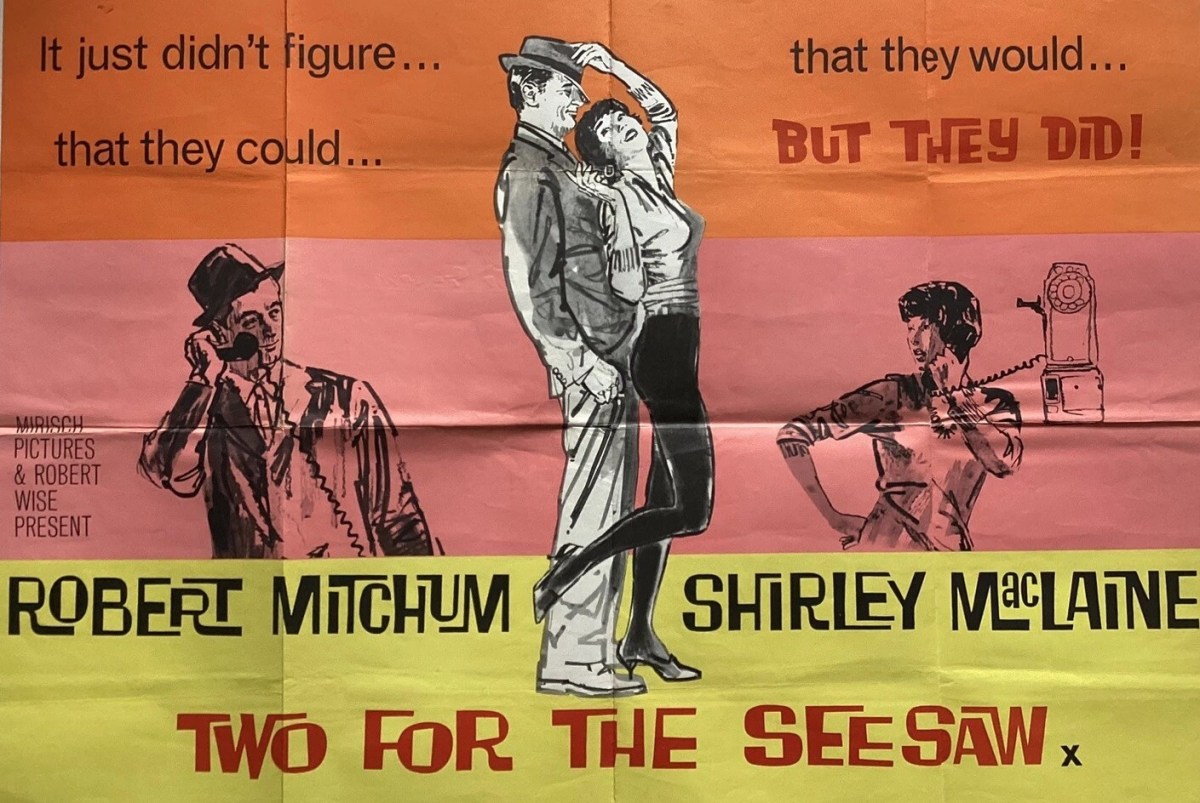
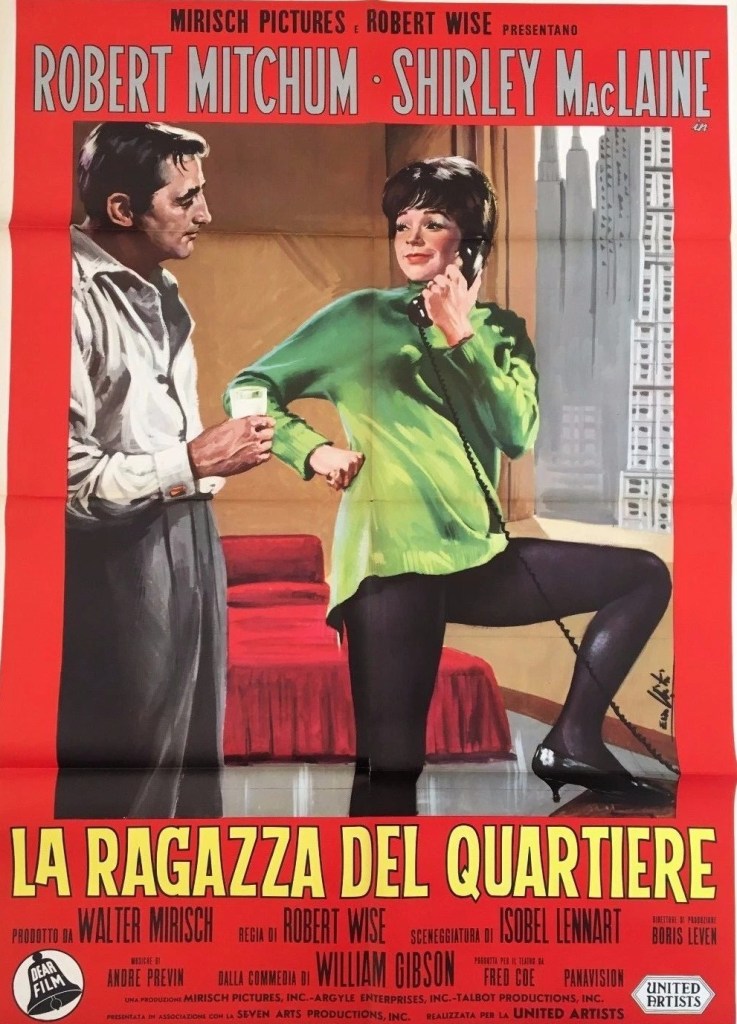
It should have been Frank Sinatra in the leading role, not Newman. Sinatra acquired the rights to the Walter Tevis semi-biographical novel published in 1959. When Sinatra moved onto something else and director Robert Rossen took up the slack still Newman should have been ruled out courtesy of a planned re-teaming with Elizabeth Taylor – they had worked together on Cat on a Hot Tin Roof (1959) – for the screen adaptation of Broadway hit Two for a Seesaw. Bobby Darin (Pressure Point, 1962) was being lined up instead. When illness put paid to Taylor’s involvement, Newman would have remained tied to Two for the Seesaw except he had co-star approval and none of the actresses suggested measured up.

Based on reading half the script, Newman, calling his agent at six o’clock in the morning to confirm interest, jumped at the role. Though Exodus (1960) had been a success, and he had managed to ease himself out of his contract with Warner Bros, he was not considered hot box office and he needed a part not just to consolidate his commercial standing but to provide a professional springboard that would shape his career. His previous outing, Paris Blues (1961), hadn’t carved out a clear path. As well as his salary, the actor was in line for ten per cent of the profits.

Initially, the picture was backed by United Artists and it featured in their adverts in the trade magazines in 1959. The studio had shelled out an advance to Rossen to option the rights. But when the director couldn’t find a “box office star as insurance” UA pulled out. By this point, the end of 1959, there was at least a screenplay, Rossen having called upon the services of Sydney Carroll (Big Deal at Dodge City, 1966).

Rossen shopped the package to Twentieth Century Fox which, somewhat surprisingly, signed up to the project when no major star was attached, especially as, according to Rossen, the picture “pulled no punches” with its “frank approach to people and life.” UA had promoted itself as the go-to studio for independents but by Rossen’s reckoning Fox was superior in that department because backing the movie “took some guts.”

Fox chief Spyros Skouras wasn’t keen on the title, believing, understandably, that The Hustler might signal to audiences that it was a story about prostitution. It was changed first of all to A Stroke of Luck and then to Sin of Angels. However, UA objected to the latter title on the grounds it had already registered a similar title The Side of the Angels and with some reluctance Skouras agreed to go with the original title.

It was a critical picture for Rossen, who hadn’t had a solid hit in a decade and hadn’t made a picture that could be mentioned in the same breath as All the King’s Men (1949). In part his low output was due to being blacklisted during the anti-Communist witch hunt of the early 1950s, although finally cleared. But it was as much due to his unusual method of working. “You gamble time which is money,” he said, “because you may work for six months or a year then realize the property is not quite right and your drop the while idea.” That ran counter to the general Hollywood practice where studios would press ahead with inferior product precisely because so much time and money had been spent on it. Rossen’s office was littered with abandoned projects.

Female lead Piper Laurie was also in the market for a comeback. She had bowed out of the business after Until They Sail (1958) – also starring Newman – fed up with ingénue parts, although the director had initially favored daughter Carole Rossen (The Arrangement, 1969) for the role. At one point Rossen identified Yves Montand for a top supporting role. Co-star Jackie Gleason (Soldier in the Rain, 1963), known at this time as a television comedy actor, was already a decent pool player and Newman was coached by Willie Mosconi, a fourteen-time world billiards champ. Except for one maneuver the two actors managed to achieve all the shots caught on camera. Newman believed he was good enough to beat Gleason and it cost him $50 to be proved wrong.

George C. Scott, primarily known for his work on the stage, had attracted attention with an Oscar-nominated turn in Otto Preminger courtroom drama Anatomy of a Murder (1959).

The film, budgeted at $2.1 million, was shot on location in New York City in the winter and spring of 1961. “You get certain values,” noted Rossen, “ in New York that you can’t get on the Coast (Hollywood).” The pool scenes were filmed at Ames Billiard Academy, established in 1946, near Times Square and McGirr’s. Other locations included a townhouse on East 82nd St which doubled as the Louisville home of the billiard player Findley and the Greyhound Bus Station in Manhattan even though it lacked a dining area and the one built on the premises confused regular customers.

Rossen spent five weeks of the 10-week schedule on the pool action. Sarah’s apartment, however, was located on a sound stage. The director, under pressure to revive his career and suffering from diabetes, was tough on the crew but went easy on the cast. He hired street thugs as extras to add authenticity. He fell foul of electricians and they fell foul of him after he exposed a blackmail scam whereby the electricians responsible for inspecting the unit  complained of code violations when it was the same inspectors who should have ensured everything complied with regulations. .

The part was custom-made for Newman. “I spent the first thirty years of my life looking for a way to explode,” recalled the actor. He found an outlet for that problem through acting and he reckoned for Fast Eddie Felson it was pool. “It was one of those movies when you woke every day and could hardly wait to get to work because you knew it was so good that nobody was going to be able to louse it up.”

Though studio 20th Century Fox did its best to louse it up, originally objecting to the location shoot, looking to cut down the running time, especially telescoping the pool sequences it felt might bore the female audience. Desperate to hold onto his vision, Rossen hired Arthur P. Jacobs, then a top-flight PR honcho (and later producer of Planet of the Apes, 1968), who contrived to set up a celebrity screening where the positive response stopped Fox in its interfering tracks. Due to the Actors Strike the previous year, product was in short supply, so although The Hustler was one of 19 pictures opening in September 1961 it didn’t face tough competition, the biggest movies it contended with were Rock Hudson-Gina Lollobrigida comedy Come September and upscale horror The Innocents with Deborah Kerr.

Reviews were positive although in an editorial Box Office magazine railed against a picture which cinemas could not sell to a family audience for a matinee performance.

A surprise box office hit, at least initially, in first run in the big cities, The Hustler creamed  a “wow” $64,000 in opening week at the 3,665-seat Paramount in New York. There was a “boffo” $36,000 in Chicago, a “fast” $20,000 in Detroit, a “hotsy” $15,000 in Cleveland, a “wow” $14,000 in Pittsburgh and a “smash” $11,000 in Providence. The poster which effectively showed Paul Newman thrusting his head into Piper Laurie’s bosom attracted adverse criticism and caused Chicago newspapers to take a stronger line on movie ads.

It was nominated for nine Oscars with Newman, Laurie, Gleason and Scott all earning acting nods, and Rossen up for two gongs in his capacity as director and producer, as well as potentially sharing one with Sydney Carroll for the screenplay. In the event the only winners were for Eugen Schufftan for Cinematography and Harry Horner and Gene Callahan for Art Direction. At the Baftas it was named Best Film while Newman won Best Foreign Actor and Piper Laurie was also nominated.

Oscar nominations ensured the picture went out on speedy reissue in February and March 1962 resulting in domestic rentals of $2.8 million and a decent run abroad.

Robert Rossen only made one more picture. Paul Newman reconfigured his career and George C. Scott added to his lustre. Jackie Gleason got a shot at top billing with Gigot (1962) but Piper Laurie didn’t make another movie until Carrie (1976).

SOURCES: Daniel O’Brien, Paul Newman (Faber & Faber, 2005) pp79-85; Shawn Levy, Paul Newman, A Life (Aurum, 2009) pp 175-182; Aubrey Solomon, Twentieth Century Fox, (Scarecrow Press, 2002) p229 and p253; Advertisement, United Artists, Variety, June 24, 1959, p21; “New York Sound Track,” Variety, August 12, 1959, p17; “Gleaned on a Gondola,” Variety, August 26, 1959, p20; “New York Sound Track,” Variety, November 16, 1960, p17; “Fox Nicer to Indies than UA,” Variety, March 8, 1961, p3; “New York Electrical Inspectors,” Variety, March 29, 1961, p5; “Sins of Angels Tag disputed,” Variety, March 29, 1961, p7; “Artistic Comeback,” Variety, May 24, 1961, p4; “Skinpix Can’t See,” Variety, October 18, 1961, p17; “Hustler Re-Release,” Box Office, January 22, 1962, pSW8. Box office figures: Variety October-November 1961.  

Discover WordPress

A daily selection of the best content published on WordPress, collected for you by humans who love to read.

The Atavist Magazine

by Brian Hannan

WordPress.com News

The latest news on WordPress.com and the WordPress community.